UNIT I
CEMENT
• History of cement
• Indian Cement Industry
• Chemical Composition & functions
• Manufacturing Process
• Chemical requirements
• Grade of cement
• Properties of cement
• Uses of cement
HISTORY
• As Old as History of Engineering
construction
• Egyptians used by burning Gypsum
• Early Greeks and Romans used by
burning Limestones
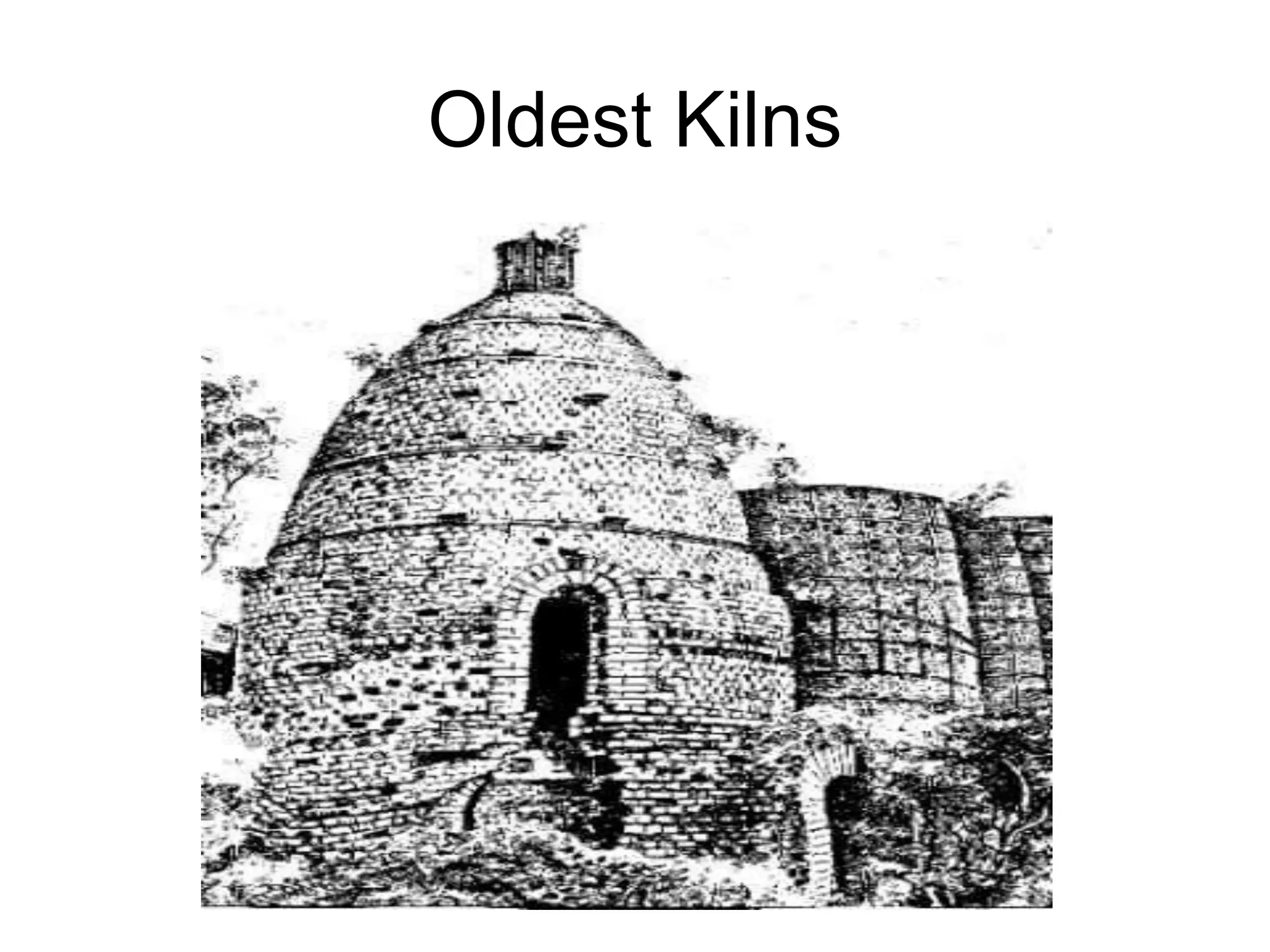
Oldest Kilns
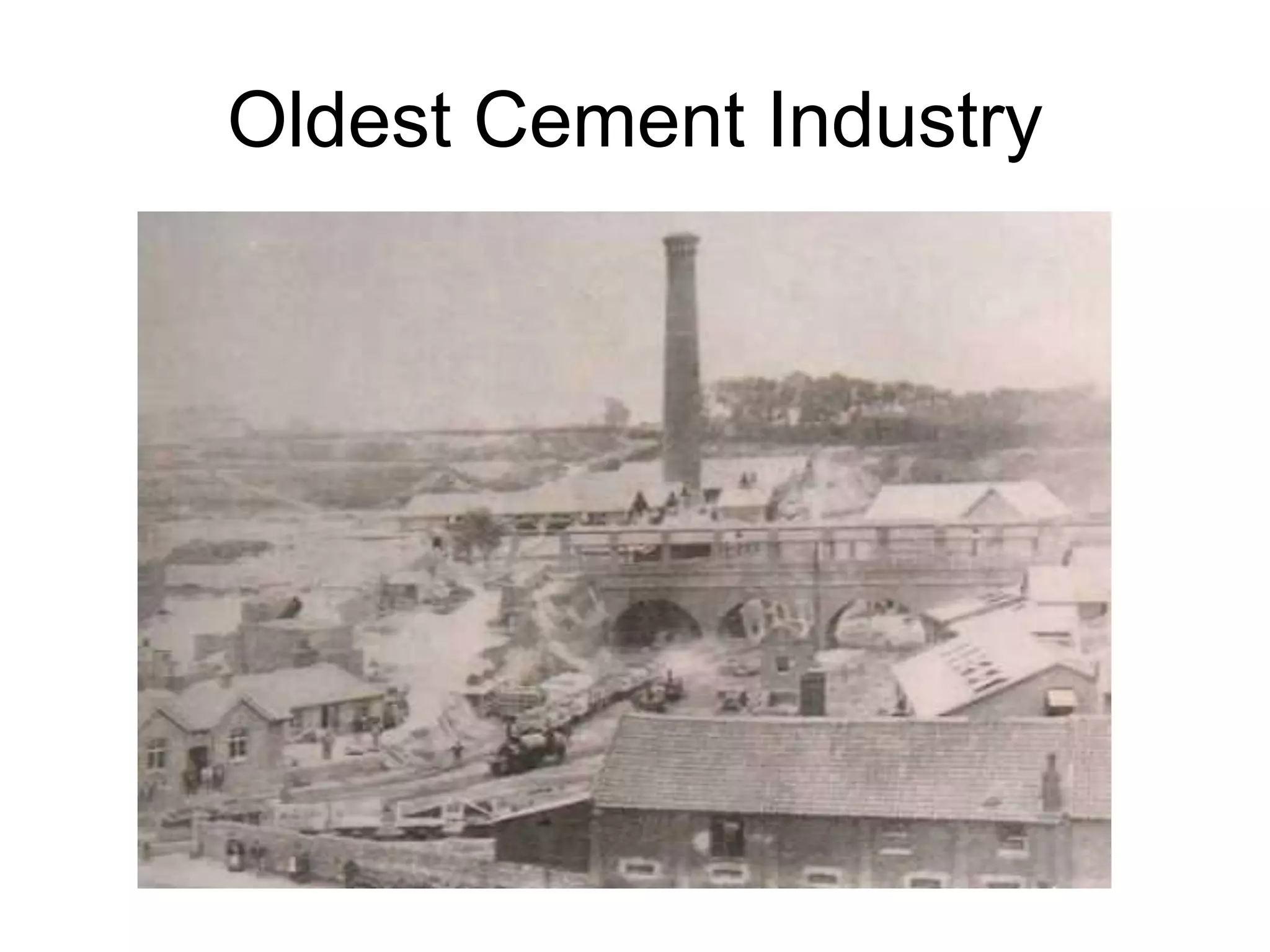
Oldest Cement Industry
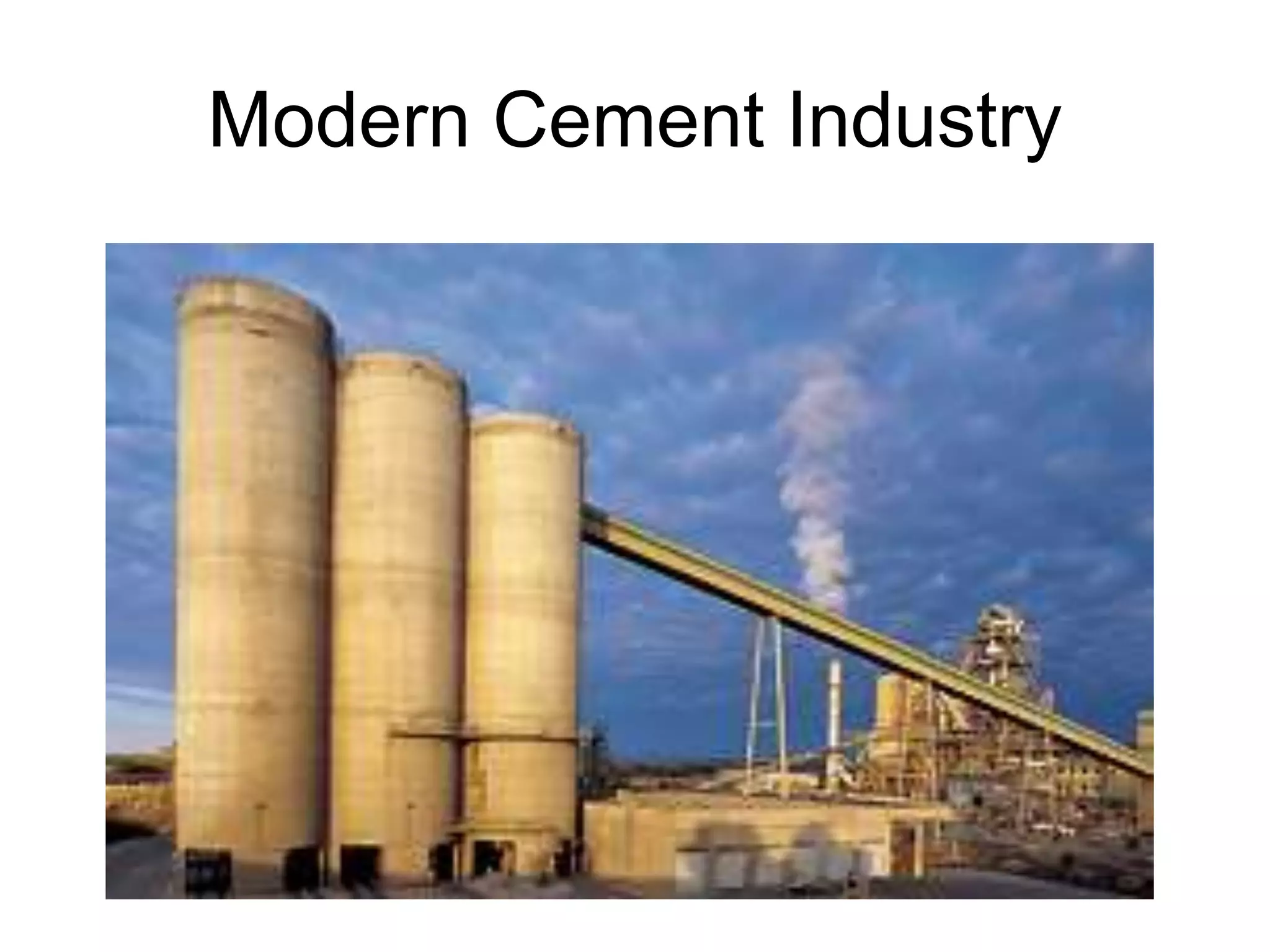
Modern Cement Industry
NATURAL CEMENT
• Obtained by Burning and Crushing the
Stones
• Brown in Color
• Best Variety is known as Roman Cement
• Not strong as Artificial Cement
ARTIFICIAL CEMENT
• Obtained by Burning mixture of
Calcareous and Argillaceous materials
• Burned at high temperature
• Clinker
– Mixture of ingredients should be intimate
– Should be in Correct proportion
…continued
ARTIFICIAL CEMENT
• Cement
– Small Quantity of Gypsum added to Clinker
– Pulverized into very fine Powder
• Invention
– Invented by Joseph Aspdin of Leeds in
England in 1824
– Named as Portland Cement
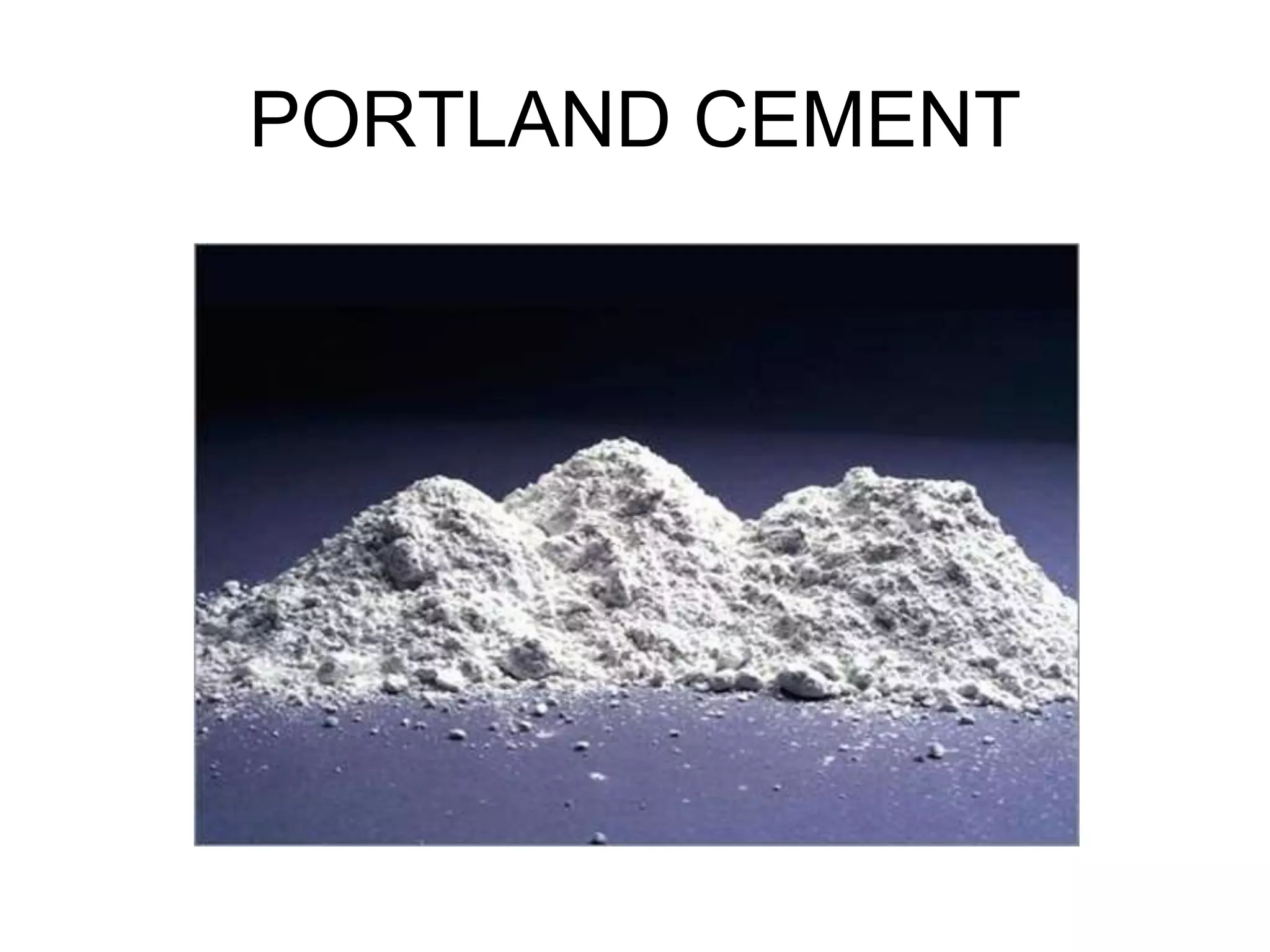
PORTLAND CEMENT
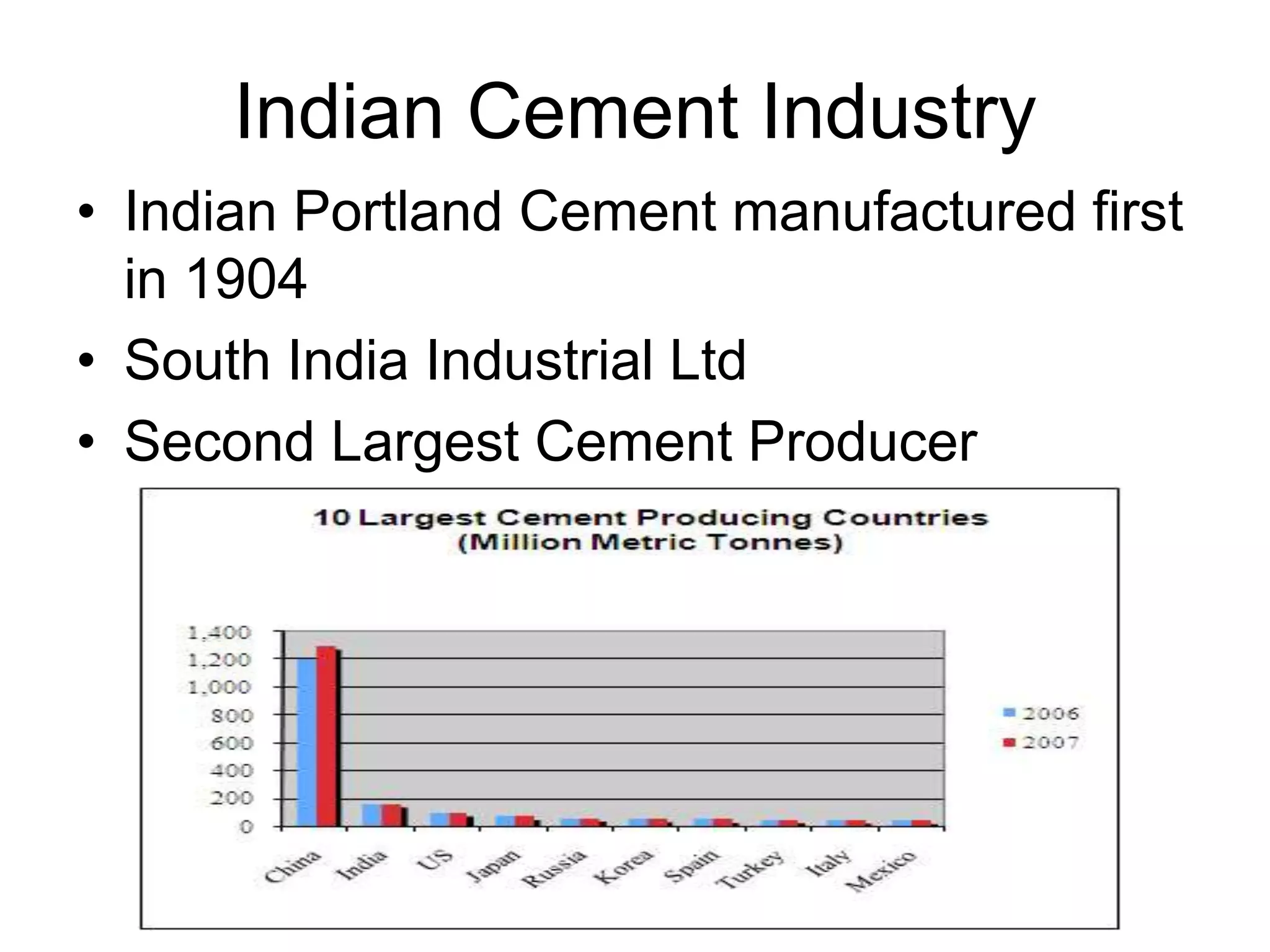
Indian Cement Industry
• Indian Portland Cement manufactured first
in 1904
• South India Industrial Ltd
• Second Largest Cement Producer
Indian Cement Industry
• Highlights
– Energy Consumption Higher
– Manpower productivity low
– Uses new technologies like vertical roller mill,
Roll presses, High Efficiency seperators
– Per capita Consumption – 570 N
– Better Packaging material, Bulk Containers
deserve immediate attention
Manufacture Of Ordinary Cement
• Chemical composition
– Argillaceous  Clay Predominates
– Calcareous  Calcium Carbonate
Predominates
• Harmful constituents of cement
– Affects the quality of cement
– Alkali Oxides K2O and Na2O
– Magnesium Oxide Mgo
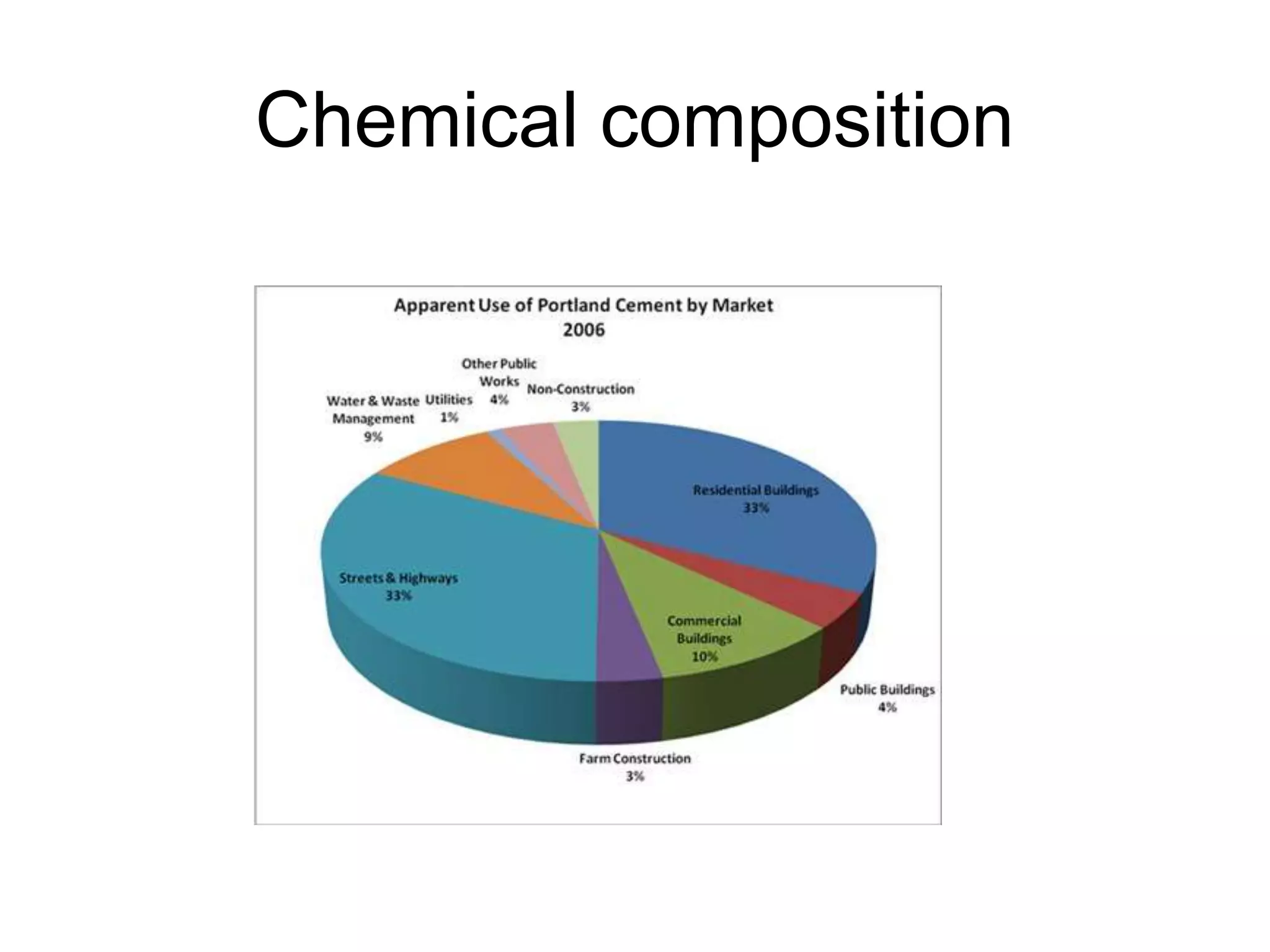
Chemical composition
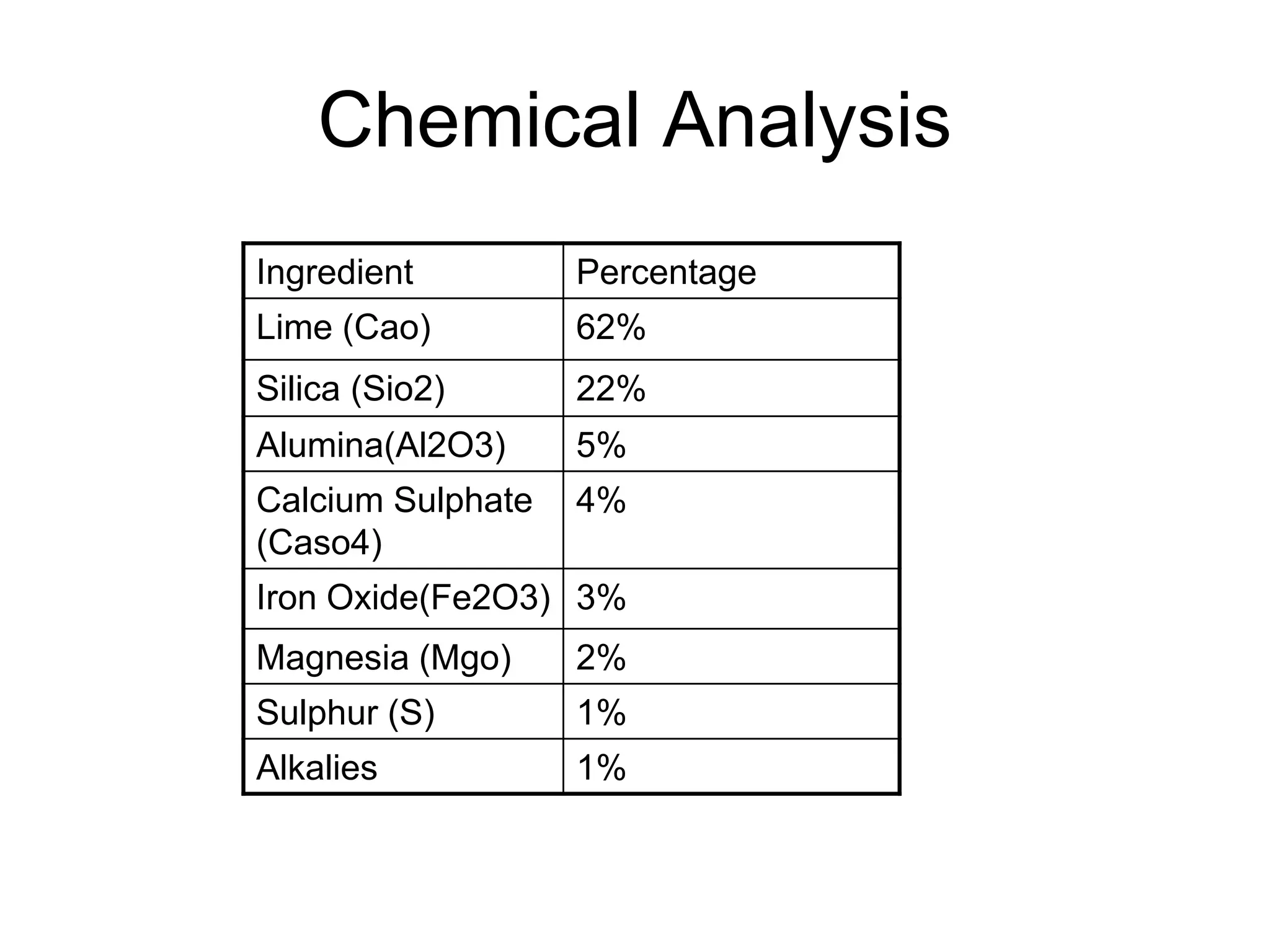
Chemical Analysis
Ingredient Percentage
Lime (Cao) 62%
Silica (Sio2) 22%
Alumina(Al2O3) 5%
Calcium Sulphate
(Caso4)
4%
Iron Oxide(Fe2O3) 3%
Magnesia (Mgo) 2%
Sulphur (S) 1%
Alkalies 1%
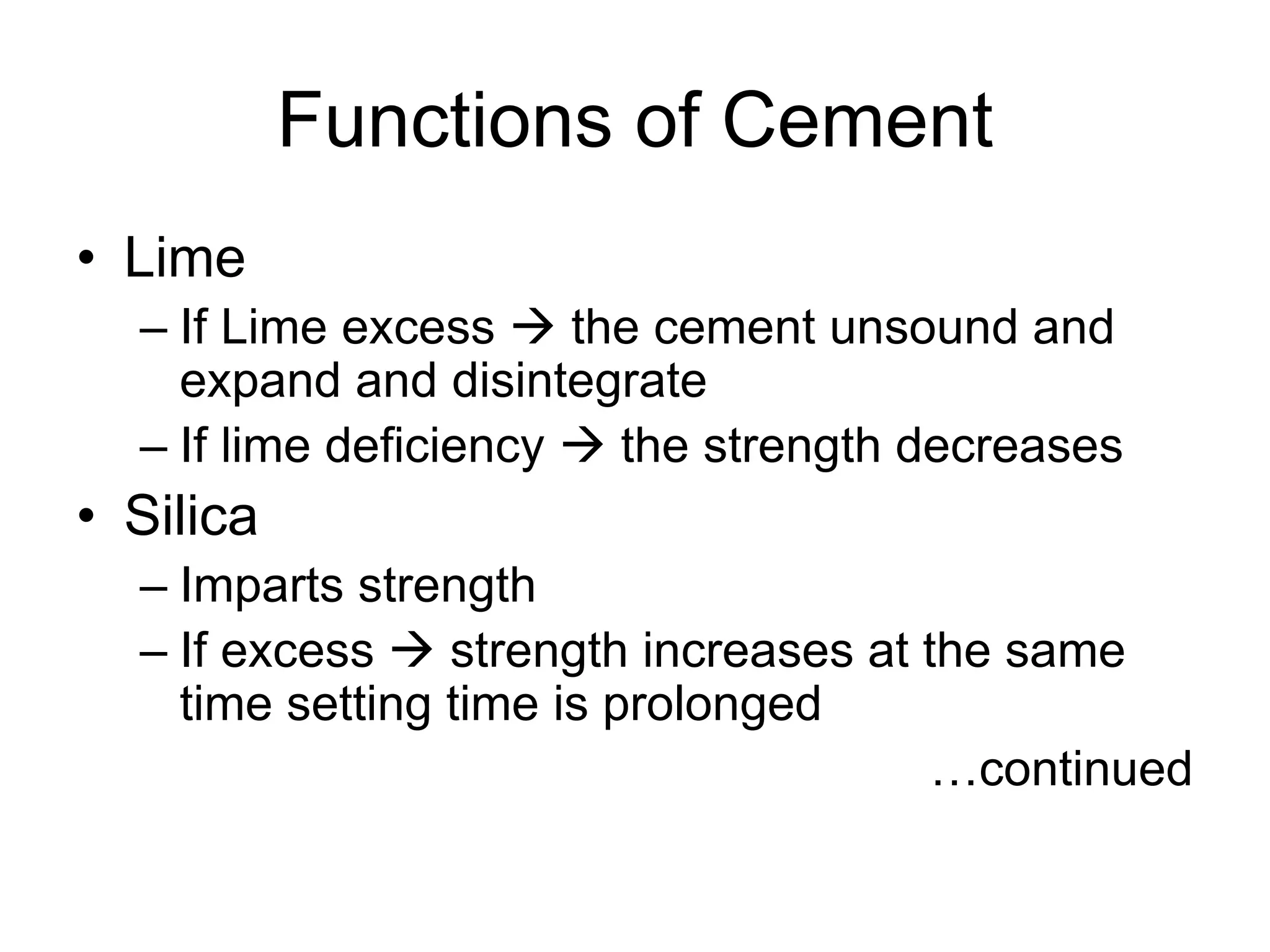
Functions of Cement
• Lime
– If Lime excess  the cement unsound and
expand and disintegrate
– If lime deficiency  the strength decreases
• Silica
– Imparts strength
– If excess  strength increases at the same
time setting time is prolonged
…continued
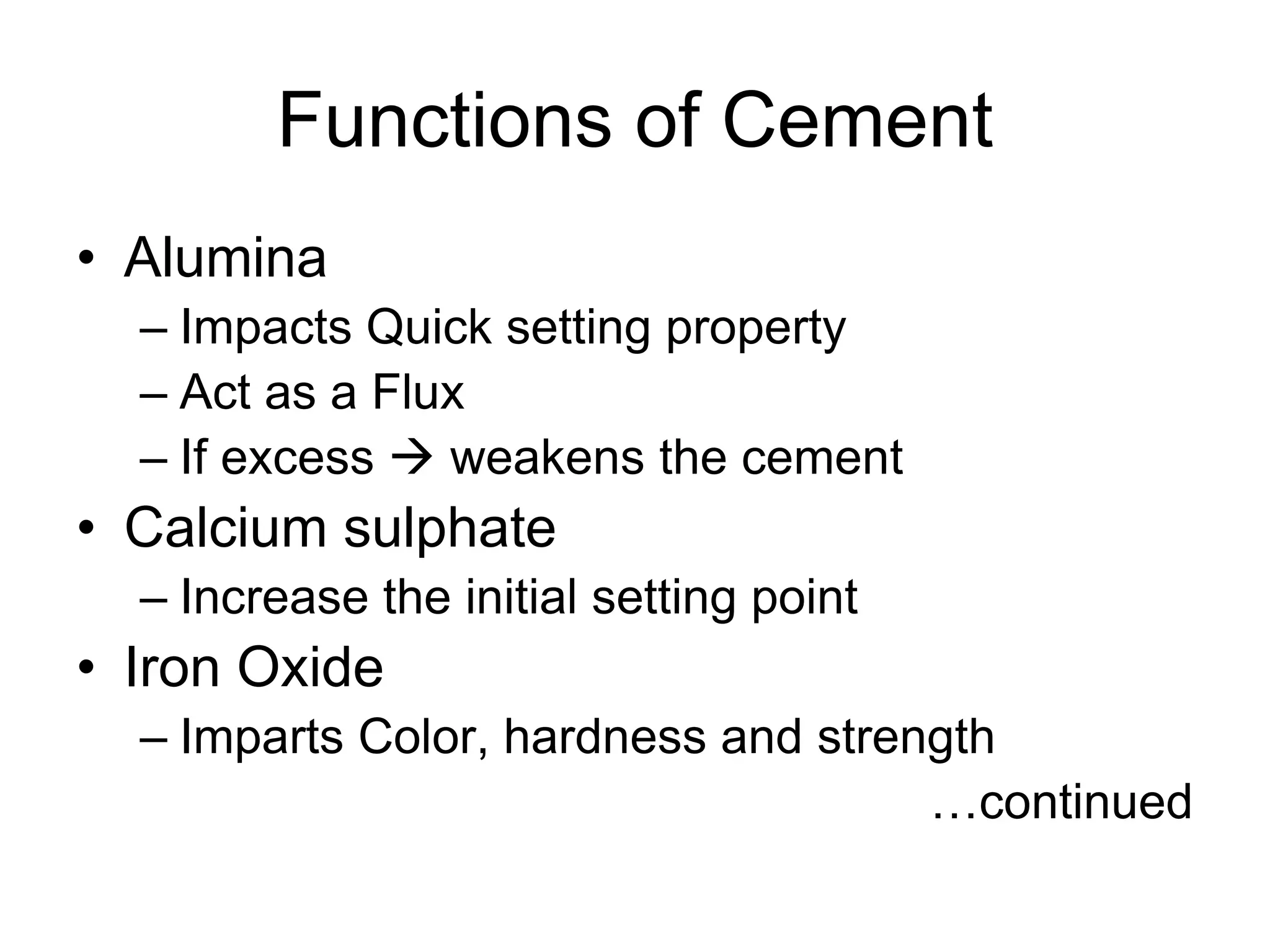
Functions of Cement
• Alumina
– Impacts Quick setting property
– Act as a Flux
– If excess  weakens the cement
• Calcium sulphate
– Increase the initial setting point
• Iron Oxide
– Imparts Color, hardness and strength
…continued
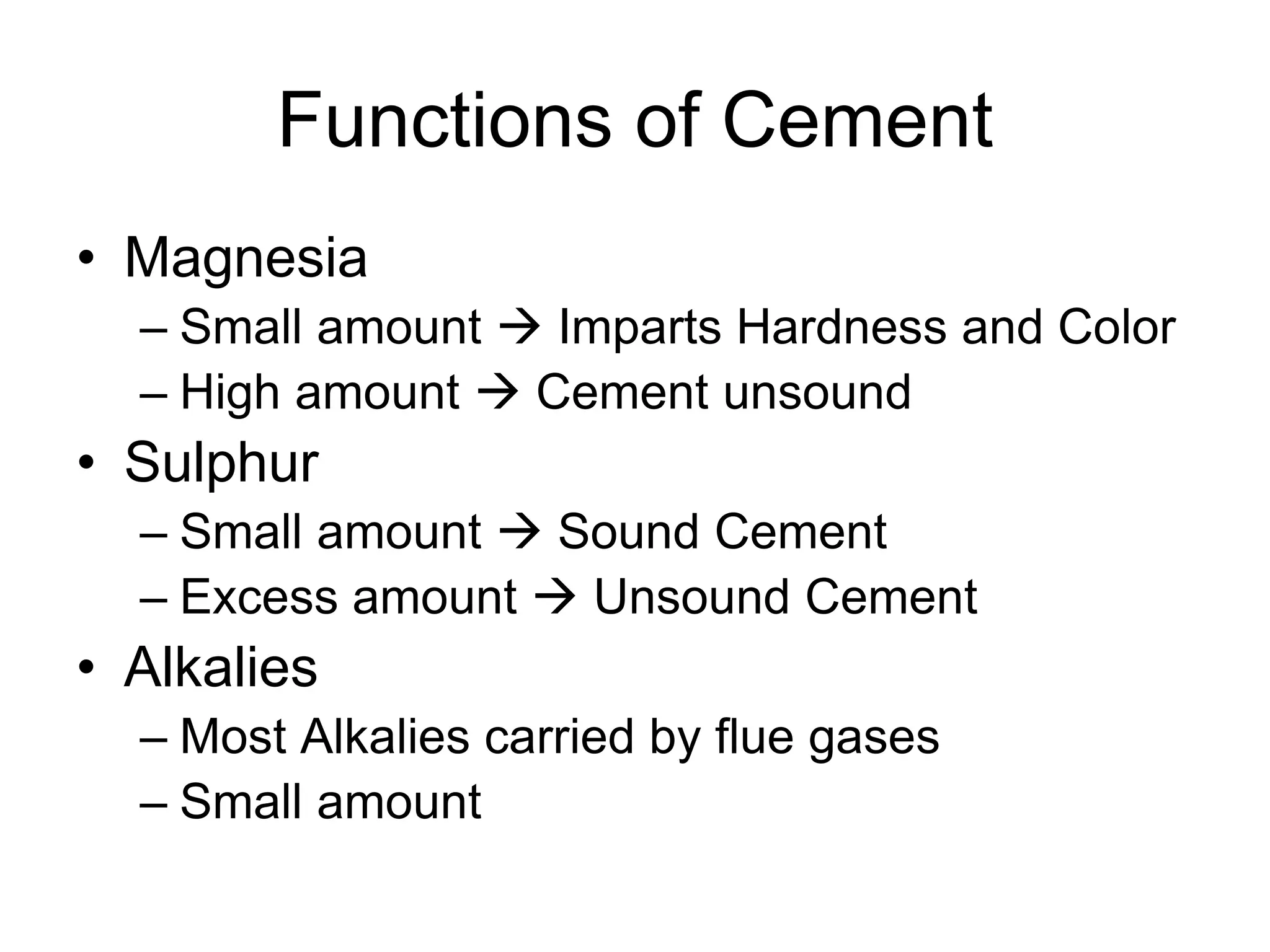
Functions of Cement
• Magnesia
– Small amount  Imparts Hardness and Color
– High amount  Cement unsound
• Sulphur
– Small amount  Sound Cement
– Excess amount  Unsound Cement
• Alkalies
– Most Alkalies carried by flue gases
– Small amount
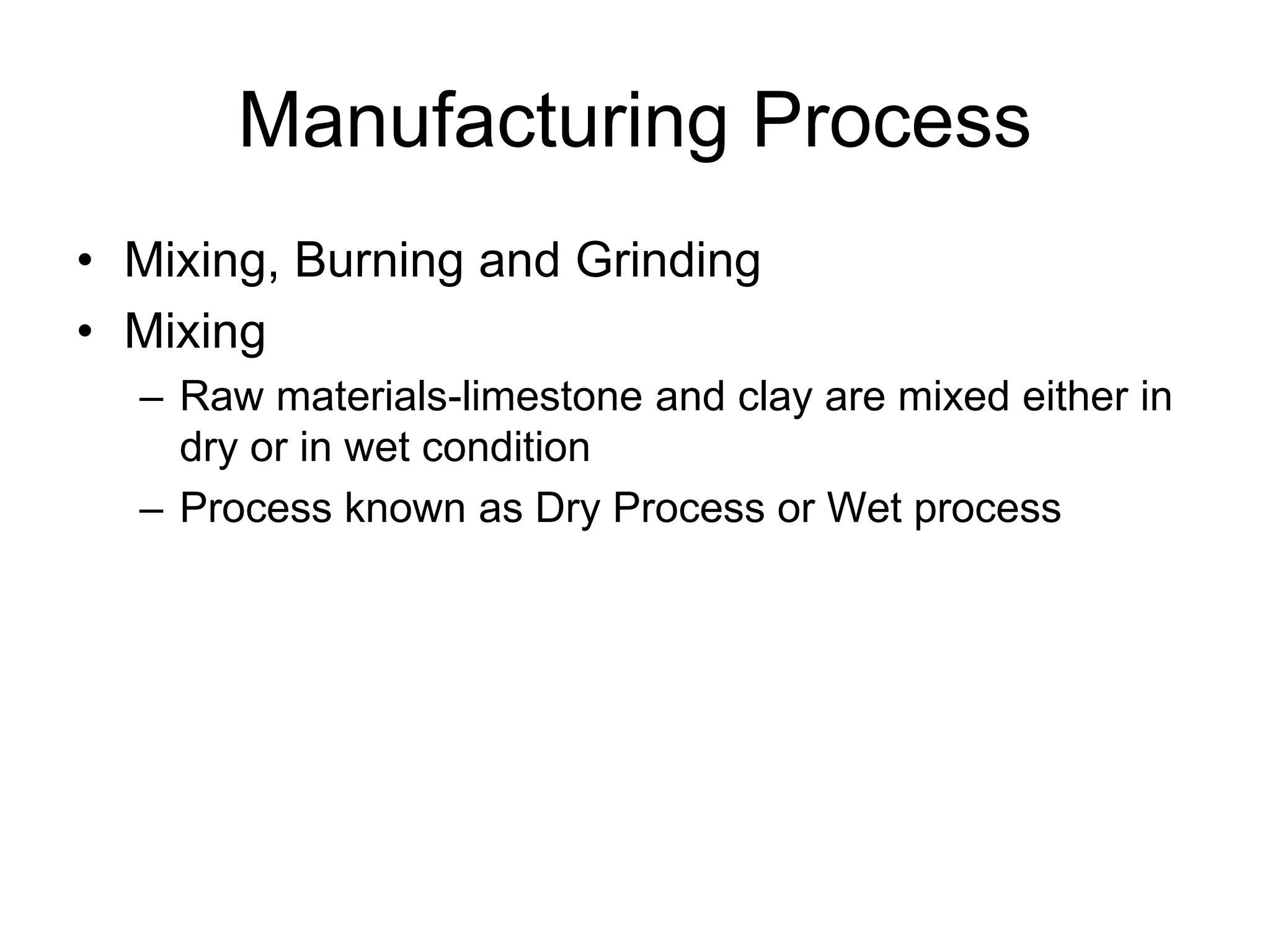
Manufacturing Process
• Mixing, Burning and Grinding
• Mixing
– Raw materials-limestone and clay are mixed either in
dry or in wet condition
– Process known as Dry Process or Wet process
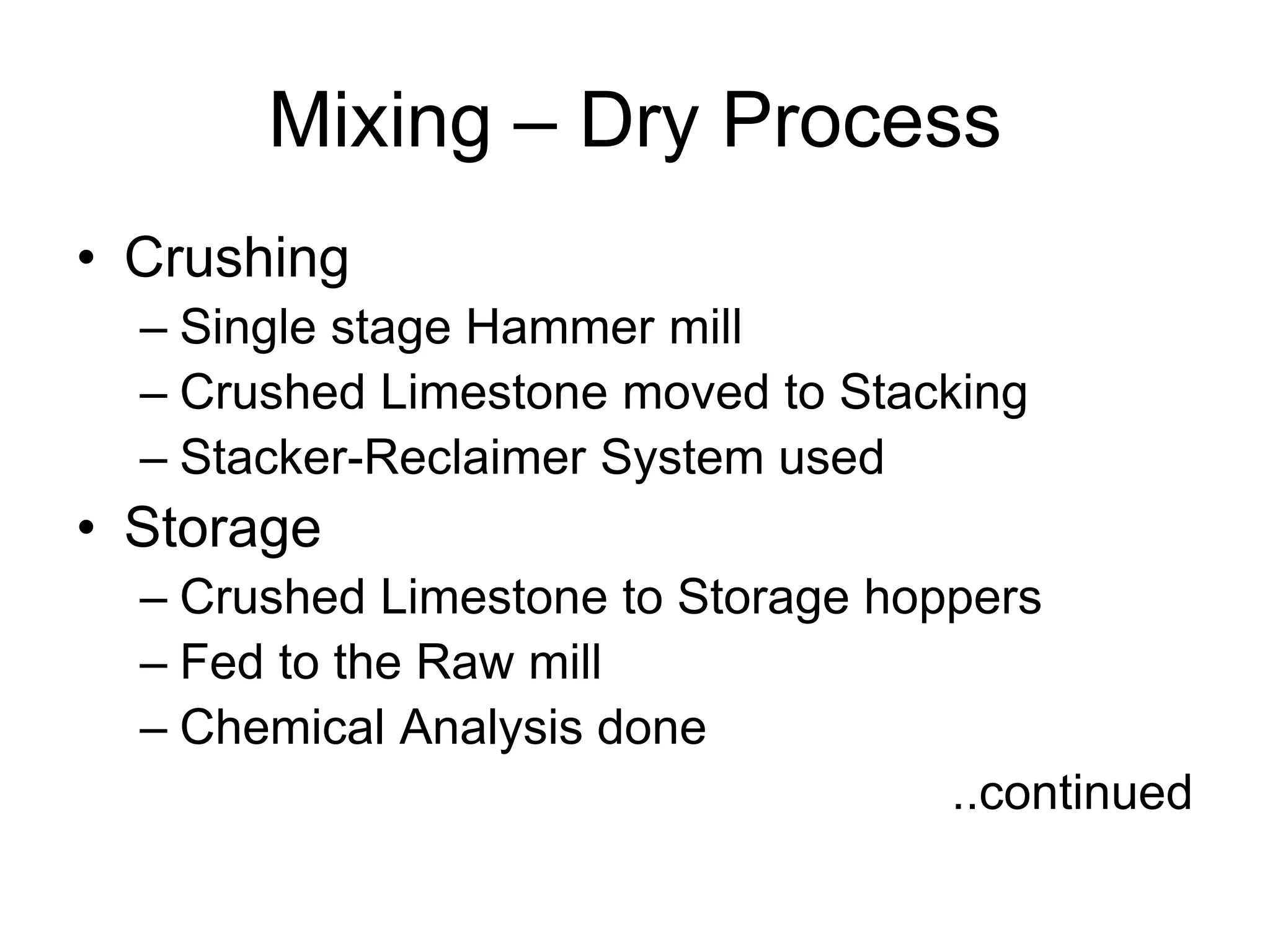
Mixing – Dry Process
• Crushing
– Single stage Hammer mill
– Crushed Limestone moved to Stacking
– Stacker-Reclaimer System used
• Storage
– Crushed Limestone to Storage hoppers
– Fed to the Raw mill
– Chemical Analysis done
..continued
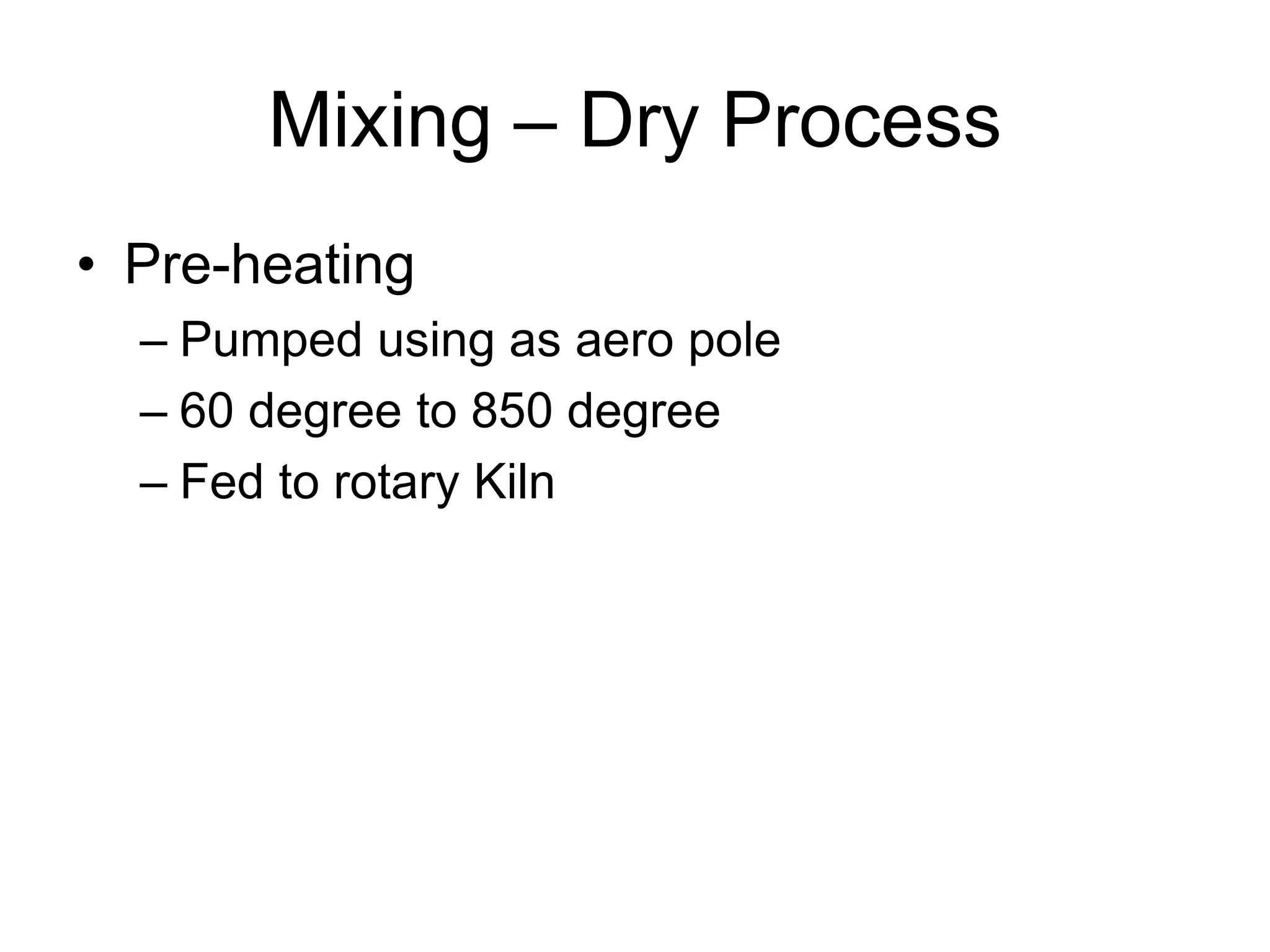
Mixing – Dry Process
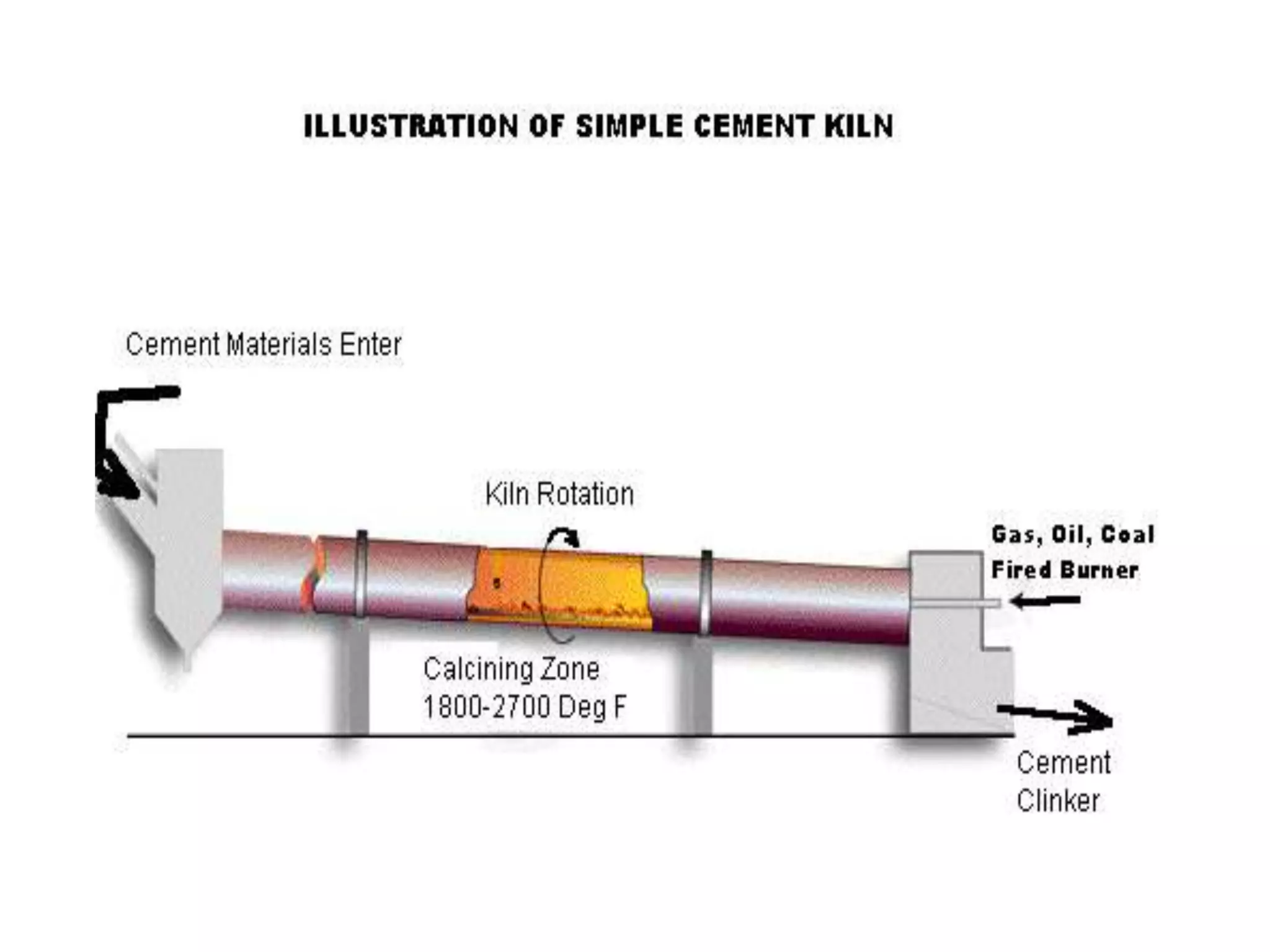
• Pre-heating
– Pumped using as aero pole
– 60 degree to 850 degree
– Fed to rotary Kiln
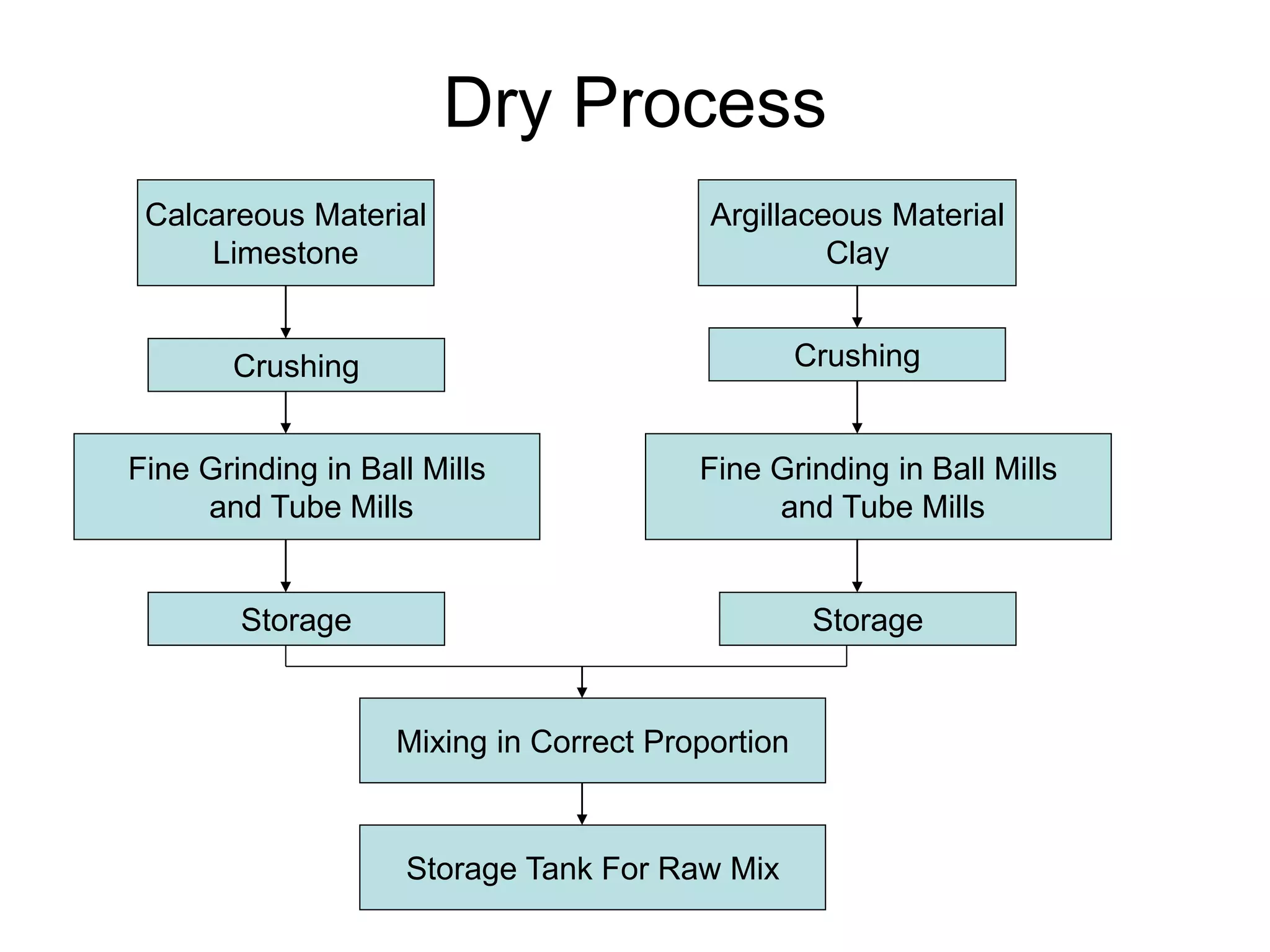
Dry Process
Calcareous Material
Limestone
Argillaceous Material
Clay
Crushing Crushing
Fine Grinding in Ball Mills
and Tube Mills
Fine Grinding in Ball Mills
and Tube Mills
Storage Storage
Mixing in Correct Proportion
Storage Tank For Raw Mix
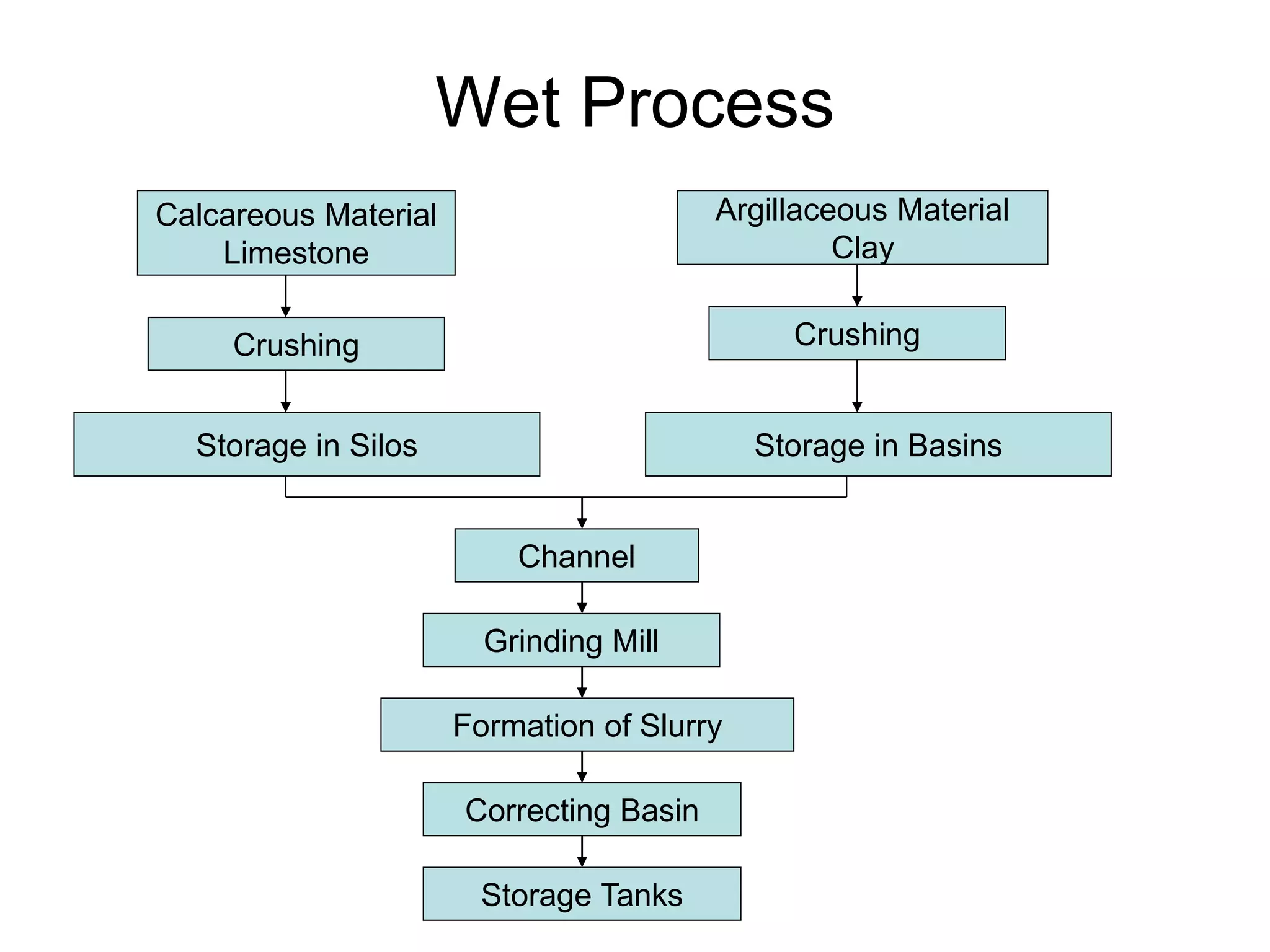
Wet Process
Calcareous Material
Limestone
Argillaceous Material
Clay
Crushing Crushing
Storage in Silos Storage in Basins
Channel
Grinding Mill
Formation of Slurry
Correcting Basin
Storage Tanks
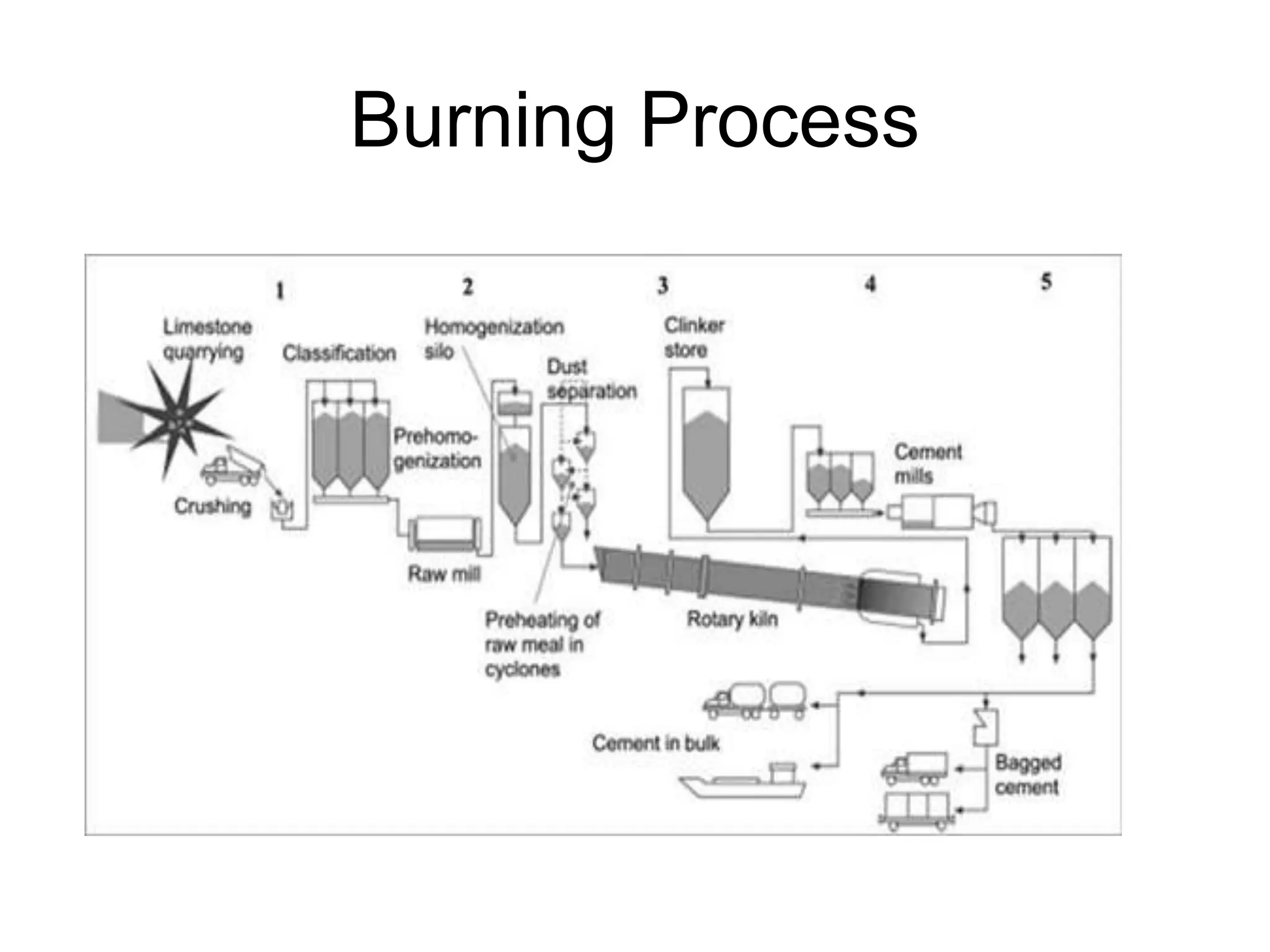
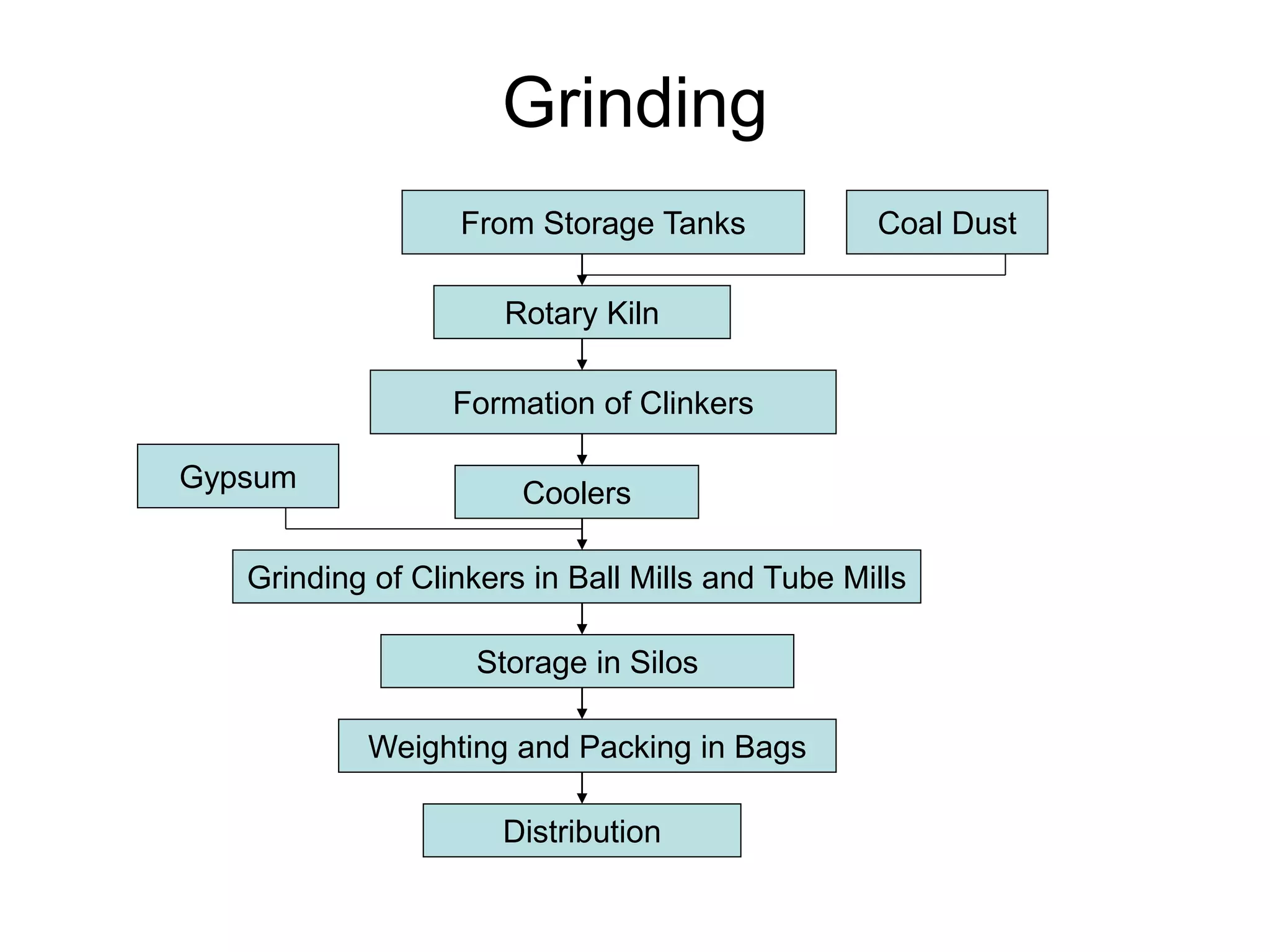
Burning Process
Grinding
From Storage Tanks
Rotary Kiln
Gypsum
Formation of Clinkers
Coolers
Grinding of Clinkers in Ball Mills and Tube Mills
Storage in Silos
Weighting and Packing in Bags
Distribution
Coal Dust
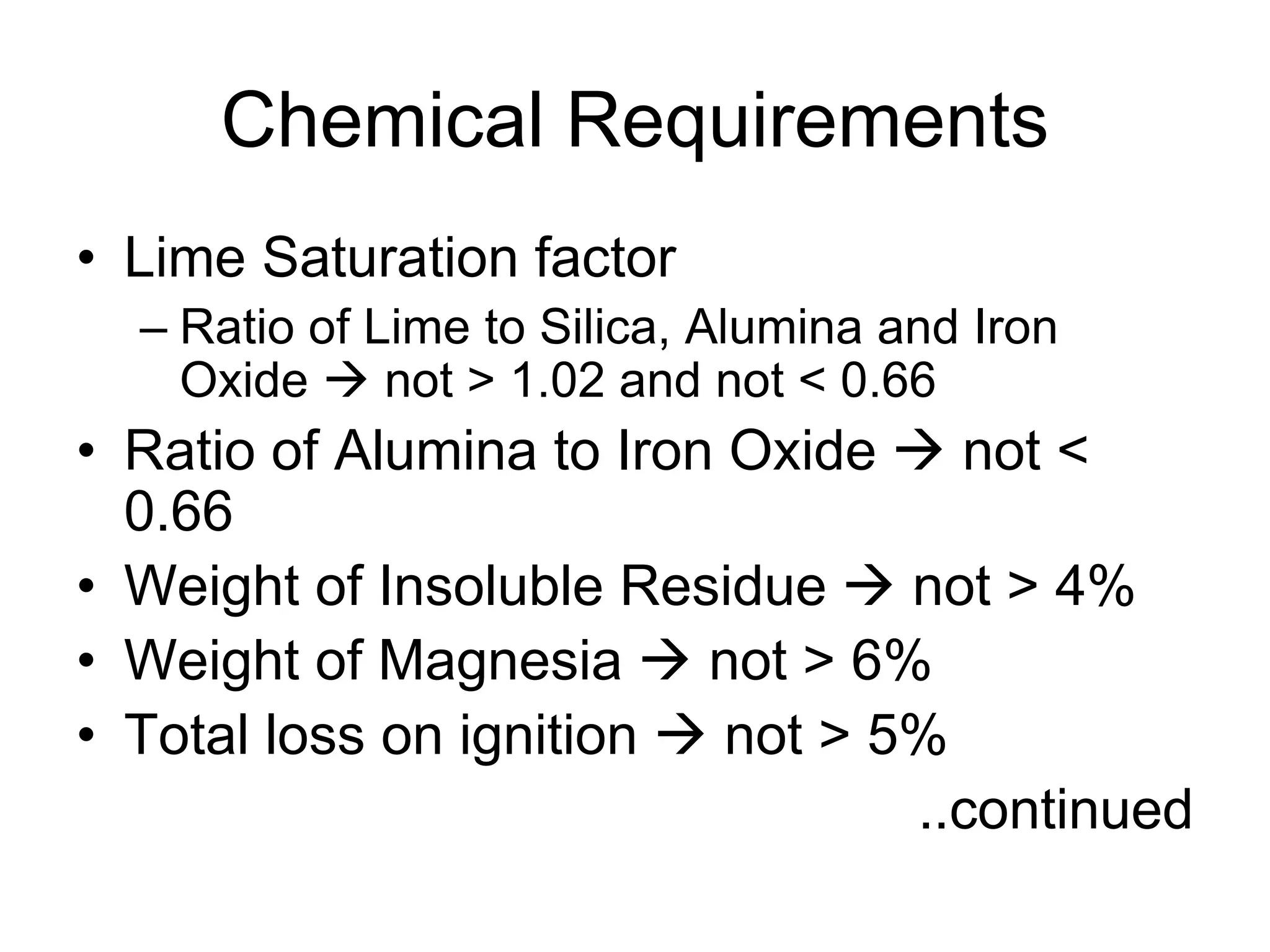
Chemical Requirements
• Lime Saturation factor
– Ratio of Lime to Silica, Alumina and Iron
Oxide  not > 1.02 and not < 0.66
• Ratio of Alumina to Iron Oxide  not <
0.66
• Weight of Insoluble Residue  not > 4%
• Weight of Magnesia  not > 6%
• Total loss on ignition  not > 5%
..continued
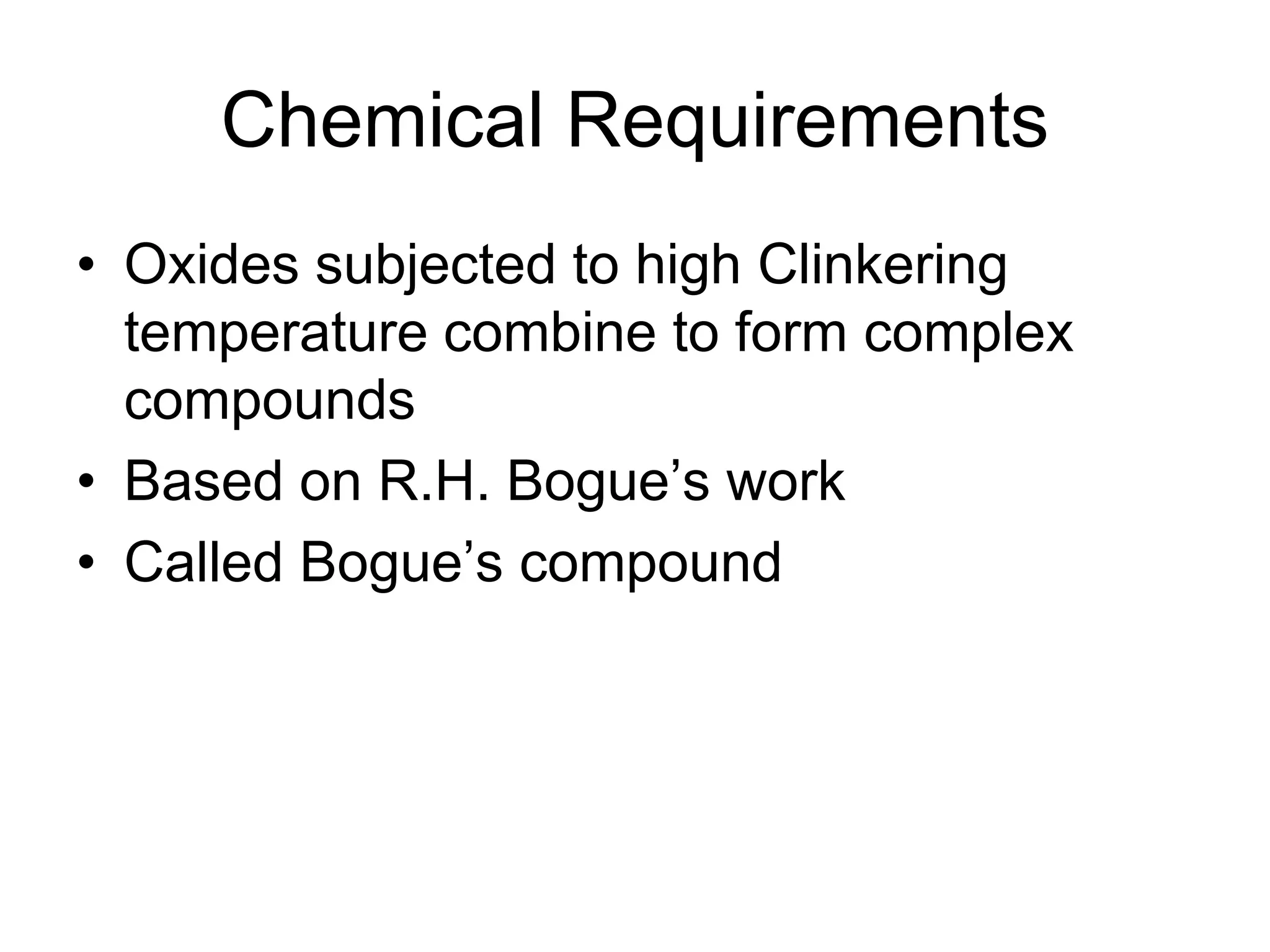
Chemical Requirements
• Oxides subjected to high Clinkering
temperature combine to form complex
compounds
• Based on R.H. Bogue’s work
• Called Bogue’s compound
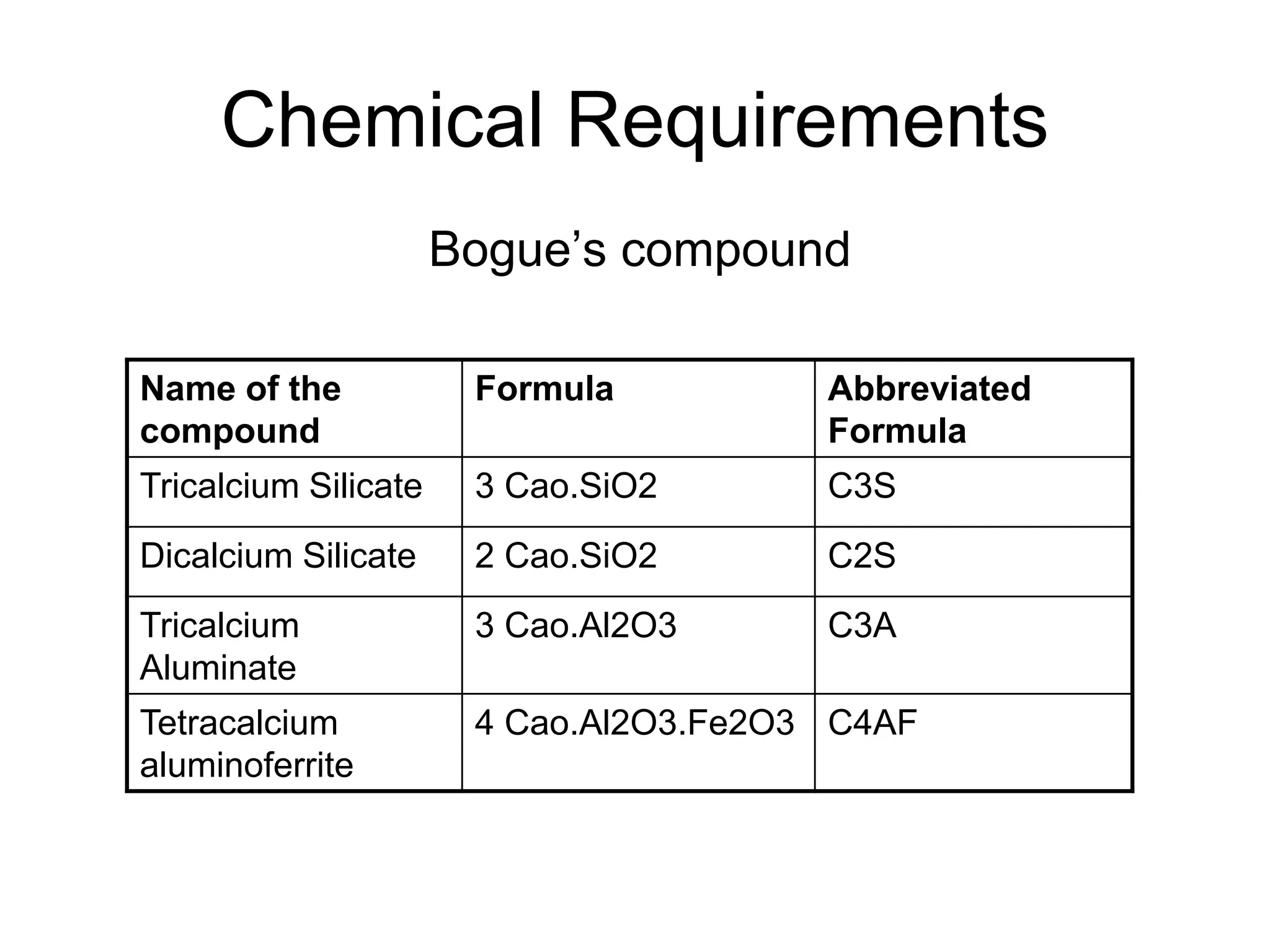
Chemical Requirements
Bogue’s compound
Name of the
compound
Formula Abbreviated
Formula
Tricalcium Silicate 3 Cao.SiO2 C3S
Dicalcium Silicate 2 Cao.SiO2 C2S
Tricalcium
Aluminate
3 Cao.Al2O3 C3A
Tetracalcium
aluminoferrite
4 Cao.Al2O3.Fe2O3 C4AF
Properties of Cement
• Strength to the masonry
• Excellent binding material
• Easily workable
• Offers good resistance to the moisture
• Possesses good plasticity
• Stiffens or Hardens early
• Fineness
– Affects hydration of strength gain
Properties of Cement
• Soundness
– Refers to ability of hardened cement to retains
its volume
• Setting Time
– Affected by Cement Fineness, Chemical
content and Admixtures
• Strength
– Compressive, Tensile and flexural
Uses of Cement
• Building
• Transport
• Water
• Civil
• Agriculture
• Making joints for Drains and Pipes
Grade Cement
• 53 Grade Cement
• Uses
– Residential, Commercial, Industrial
Complexes
– Water Retaining Structures
– Prestressed Concrete Units like Bridge-
Girders
– Precast units like poles, grills, manhole
covers, Concrete sleepers, etc
Grade Cement
• OPC 43 Grade Cement
• Most Structural Concrete Constructions
• Residential & Commercial Complexes
• Precast units like Structural Components,
Pipes, Poles, Solid & Hollow blocks
• Flooring Tiles, Wall Tiles, Dado, etc
• Asbestos Cement Products

Unit I.ppt

  • 1.
  • 2.
    CEMENT • History ofcement • Indian Cement Industry • Chemical Composition & functions • Manufacturing Process • Chemical requirements • Grade of cement • Properties of cement • Uses of cement
  • 3.
    HISTORY • As Oldas History of Engineering construction • Egyptians used by burning Gypsum • Early Greeks and Romans used by burning Limestones
  • 4.
  • 5.
  • 6.
  • 7.
    NATURAL CEMENT • Obtainedby Burning and Crushing the Stones • Brown in Color • Best Variety is known as Roman Cement • Not strong as Artificial Cement
  • 8.
    ARTIFICIAL CEMENT • Obtainedby Burning mixture of Calcareous and Argillaceous materials • Burned at high temperature • Clinker – Mixture of ingredients should be intimate – Should be in Correct proportion …continued
  • 9.
    ARTIFICIAL CEMENT • Cement –Small Quantity of Gypsum added to Clinker – Pulverized into very fine Powder • Invention – Invented by Joseph Aspdin of Leeds in England in 1824 – Named as Portland Cement
  • 10.
  • 11.
    Indian Cement Industry •Indian Portland Cement manufactured first in 1904 • South India Industrial Ltd • Second Largest Cement Producer
  • 12.
    Indian Cement Industry •Highlights – Energy Consumption Higher – Manpower productivity low – Uses new technologies like vertical roller mill, Roll presses, High Efficiency seperators – Per capita Consumption – 570 N – Better Packaging material, Bulk Containers deserve immediate attention
  • 13.
    Manufacture Of OrdinaryCement • Chemical composition – Argillaceous  Clay Predominates – Calcareous  Calcium Carbonate Predominates • Harmful constituents of cement – Affects the quality of cement – Alkali Oxides K2O and Na2O – Magnesium Oxide Mgo
  • 14.
  • 15.
    Chemical Analysis Ingredient Percentage Lime(Cao) 62% Silica (Sio2) 22% Alumina(Al2O3) 5% Calcium Sulphate (Caso4) 4% Iron Oxide(Fe2O3) 3% Magnesia (Mgo) 2% Sulphur (S) 1% Alkalies 1%
  • 16.
    Functions of Cement •Lime – If Lime excess  the cement unsound and expand and disintegrate – If lime deficiency  the strength decreases • Silica – Imparts strength – If excess  strength increases at the same time setting time is prolonged …continued
  • 17.
    Functions of Cement •Alumina – Impacts Quick setting property – Act as a Flux – If excess  weakens the cement • Calcium sulphate – Increase the initial setting point • Iron Oxide – Imparts Color, hardness and strength …continued
  • 18.
    Functions of Cement •Magnesia – Small amount  Imparts Hardness and Color – High amount  Cement unsound • Sulphur – Small amount  Sound Cement – Excess amount  Unsound Cement • Alkalies – Most Alkalies carried by flue gases – Small amount
  • 19.
    Manufacturing Process • Mixing,Burning and Grinding • Mixing – Raw materials-limestone and clay are mixed either in dry or in wet condition – Process known as Dry Process or Wet process
  • 20.
    Mixing – DryProcess • Crushing – Single stage Hammer mill – Crushed Limestone moved to Stacking – Stacker-Reclaimer System used • Storage – Crushed Limestone to Storage hoppers – Fed to the Raw mill – Chemical Analysis done ..continued
  • 21.
    Mixing – DryProcess • Pre-heating – Pumped using as aero pole – 60 degree to 850 degree – Fed to rotary Kiln
  • 22.
    Dry Process Calcareous Material Limestone ArgillaceousMaterial Clay Crushing Crushing Fine Grinding in Ball Mills and Tube Mills Fine Grinding in Ball Mills and Tube Mills Storage Storage Mixing in Correct Proportion Storage Tank For Raw Mix
  • 23.
    Wet Process Calcareous Material Limestone ArgillaceousMaterial Clay Crushing Crushing Storage in Silos Storage in Basins Channel Grinding Mill Formation of Slurry Correcting Basin Storage Tanks
  • 25.
  • 26.
    Grinding From Storage Tanks RotaryKiln Gypsum Formation of Clinkers Coolers Grinding of Clinkers in Ball Mills and Tube Mills Storage in Silos Weighting and Packing in Bags Distribution Coal Dust
  • 27.
    Chemical Requirements • LimeSaturation factor – Ratio of Lime to Silica, Alumina and Iron Oxide  not > 1.02 and not < 0.66 • Ratio of Alumina to Iron Oxide  not < 0.66 • Weight of Insoluble Residue  not > 4% • Weight of Magnesia  not > 6% • Total loss on ignition  not > 5% ..continued
  • 28.
    Chemical Requirements • Oxidessubjected to high Clinkering temperature combine to form complex compounds • Based on R.H. Bogue’s work • Called Bogue’s compound
  • 29.
    Chemical Requirements Bogue’s compound Nameof the compound Formula Abbreviated Formula Tricalcium Silicate 3 Cao.SiO2 C3S Dicalcium Silicate 2 Cao.SiO2 C2S Tricalcium Aluminate 3 Cao.Al2O3 C3A Tetracalcium aluminoferrite 4 Cao.Al2O3.Fe2O3 C4AF
  • 30.
    Properties of Cement •Strength to the masonry • Excellent binding material • Easily workable • Offers good resistance to the moisture • Possesses good plasticity • Stiffens or Hardens early • Fineness – Affects hydration of strength gain
  • 31.
    Properties of Cement •Soundness – Refers to ability of hardened cement to retains its volume • Setting Time – Affected by Cement Fineness, Chemical content and Admixtures • Strength – Compressive, Tensile and flexural
  • 32.
    Uses of Cement •Building • Transport • Water • Civil • Agriculture • Making joints for Drains and Pipes
  • 33.
    Grade Cement • 53Grade Cement • Uses – Residential, Commercial, Industrial Complexes – Water Retaining Structures – Prestressed Concrete Units like Bridge- Girders – Precast units like poles, grills, manhole covers, Concrete sleepers, etc
  • 34.
    Grade Cement • OPC43 Grade Cement • Most Structural Concrete Constructions • Residential & Commercial Complexes • Precast units like Structural Components, Pipes, Poles, Solid & Hollow blocks • Flooring Tiles, Wall Tiles, Dado, etc • Asbestos Cement Products