Cement
Cement is a hydraulic binder i.e. it is
finely ground inorganic material which,
when mixed with water, forms a paste
which sets and hardens by means of
hydration reactions and processes and
which after hardening, retains its
strength and stability even under water.
It was the achievement of Joseph
Aspdin a British bricklayer to produce
Portland Cement in 1824 by burning a
mixture containing certain proportion of
lime and clay at a high temperature
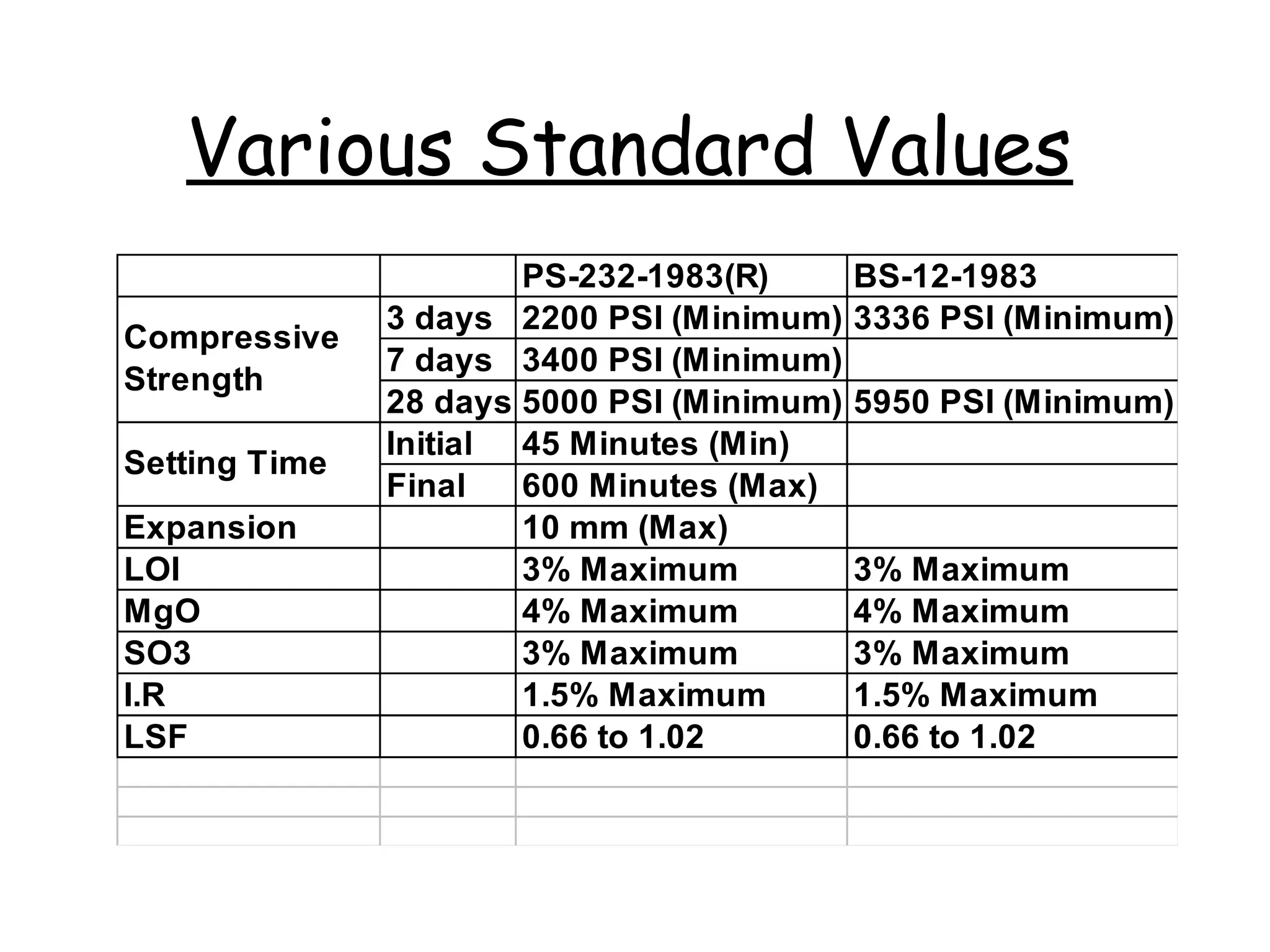
Various Standard Values
PS-232-1983(R) BS-12-1983
3 days 2200 PSI (Minimum) 3336 PSI (Minimum)
7 days 3400 PSI (Minimum)
28 days 5000 PSI (Minimum) 5950 PSI (Minimum)
Initial 45 Minutes (Min)
Final 600 Minutes (Max)
Expansion 10 mm (Max)
LOI 3% Maximum 3% Maximum
MgO 4% Maximum 4% Maximum
SO3 3% Maximum 3% Maximum
I.R 1.5% Maximum 1.5% Maximum
LSF 0.66 to 1.02 0.66 to 1.02
Compressive
Strength
Setting Time
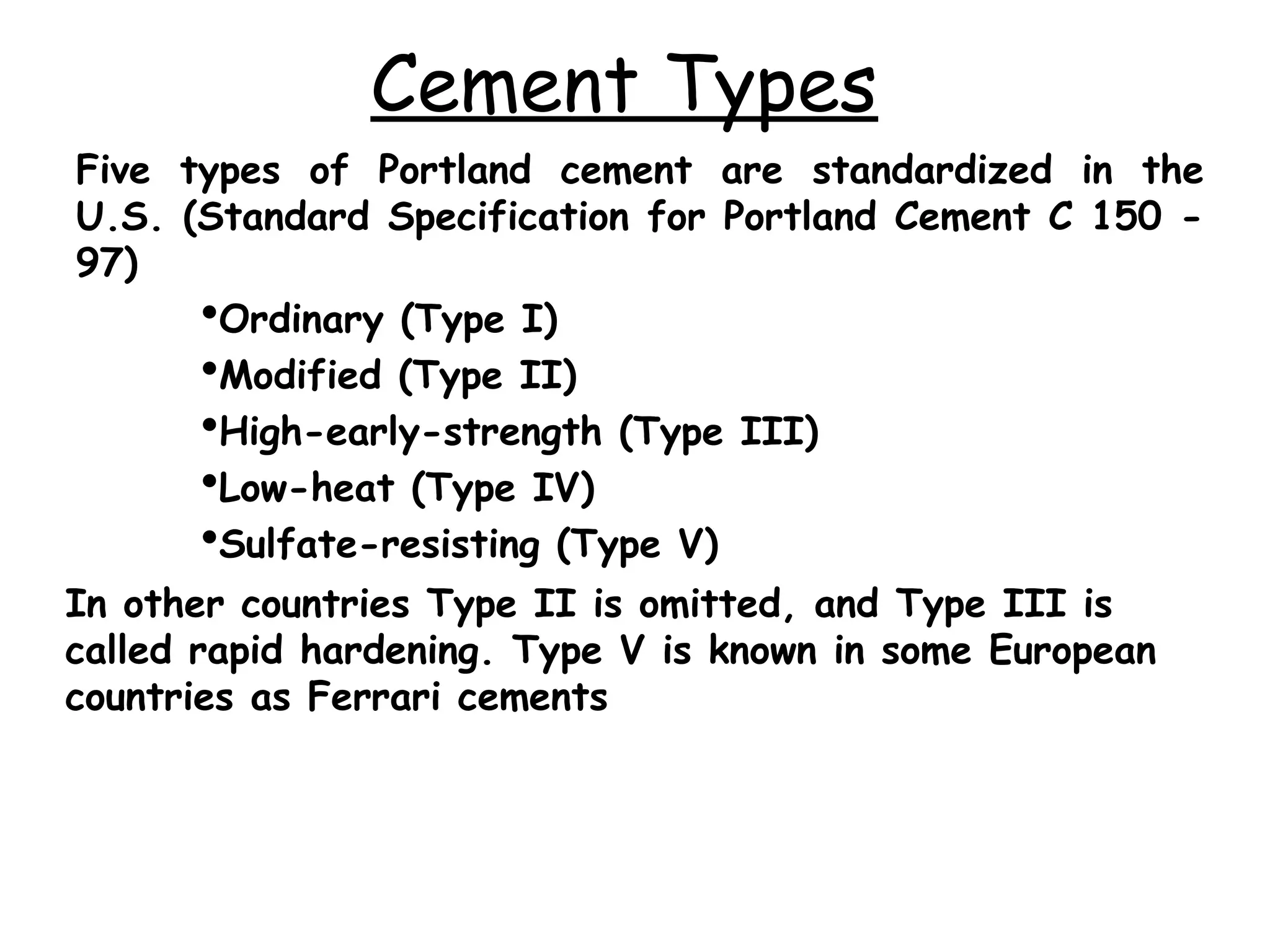
Cement Types
Five types of Portland cement are standardized in the
U.S. (Standard Specification for Portland Cement C 150 -
97)
Ordinary (Type I)
Modified (Type II)
High-early-strength (Type III)
Low-heat (Type IV)
Sulfate-resisting (Type V)
In other countries Type II is omitted, and Type III is
called rapid hardening. Type V is known in some European
countries as Ferrari cements
Cement Types
Five types of Portland cement are also standardized in the
U.K. (Specification for Portland Cement BS 12: 1996):
CEM I Portland Cement: up to 5% additional constituents
CEM II Portland-Composite Cement:35% other constituents
CEM III Blastfurnace Cement: High %age of B.F Slag
CEM IV Pozzolanic Cement: High %age of pozzolana
CEM V Composite Cement: High %age of B.F Slag and
pozzolana or Fly ash
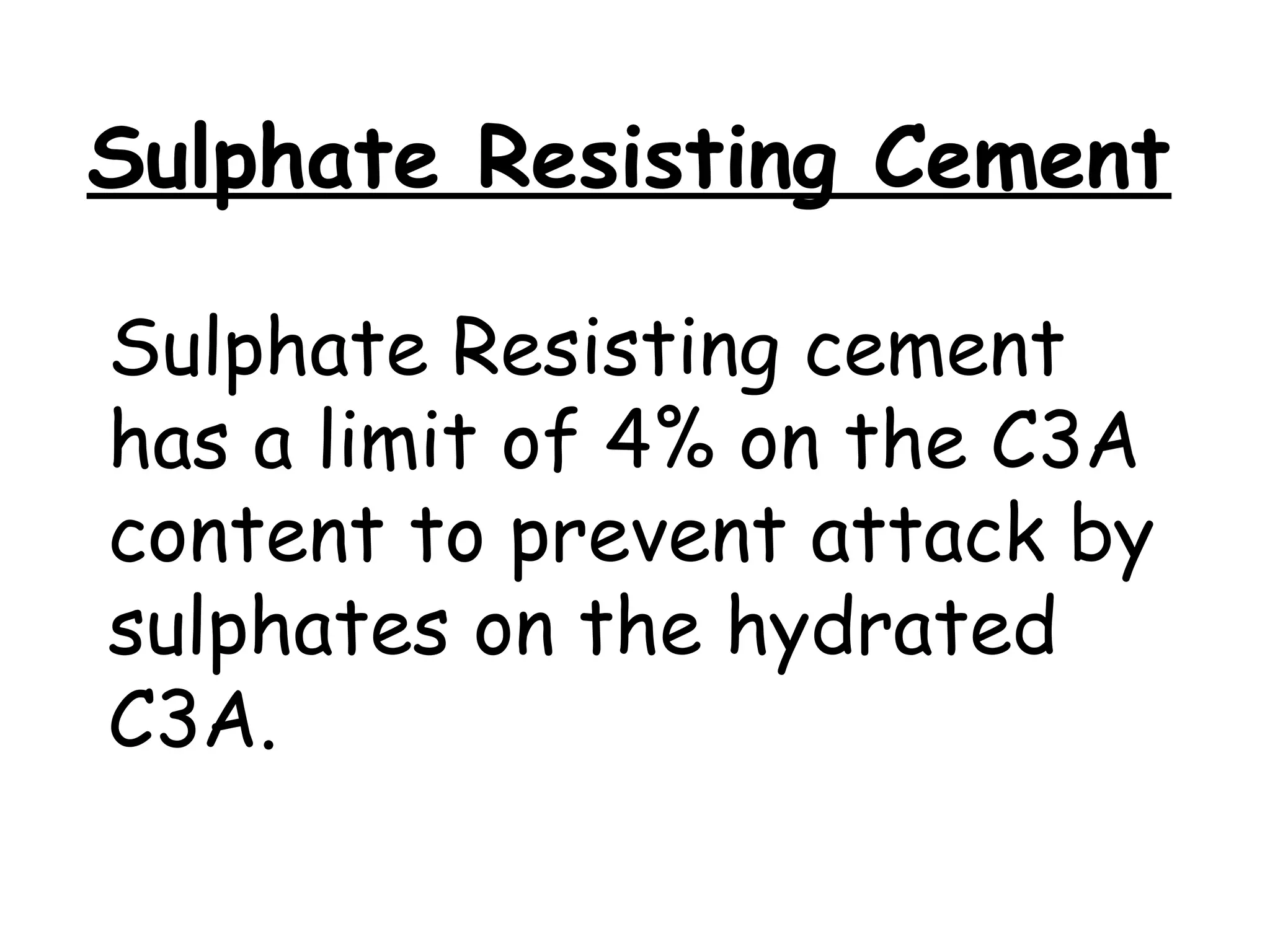
Sulphate Resisting cement
has a limit of 4% on the C3A
content to prevent attack by
sulphates on the hydrated
C3A.
Sulphate Resisting Cement
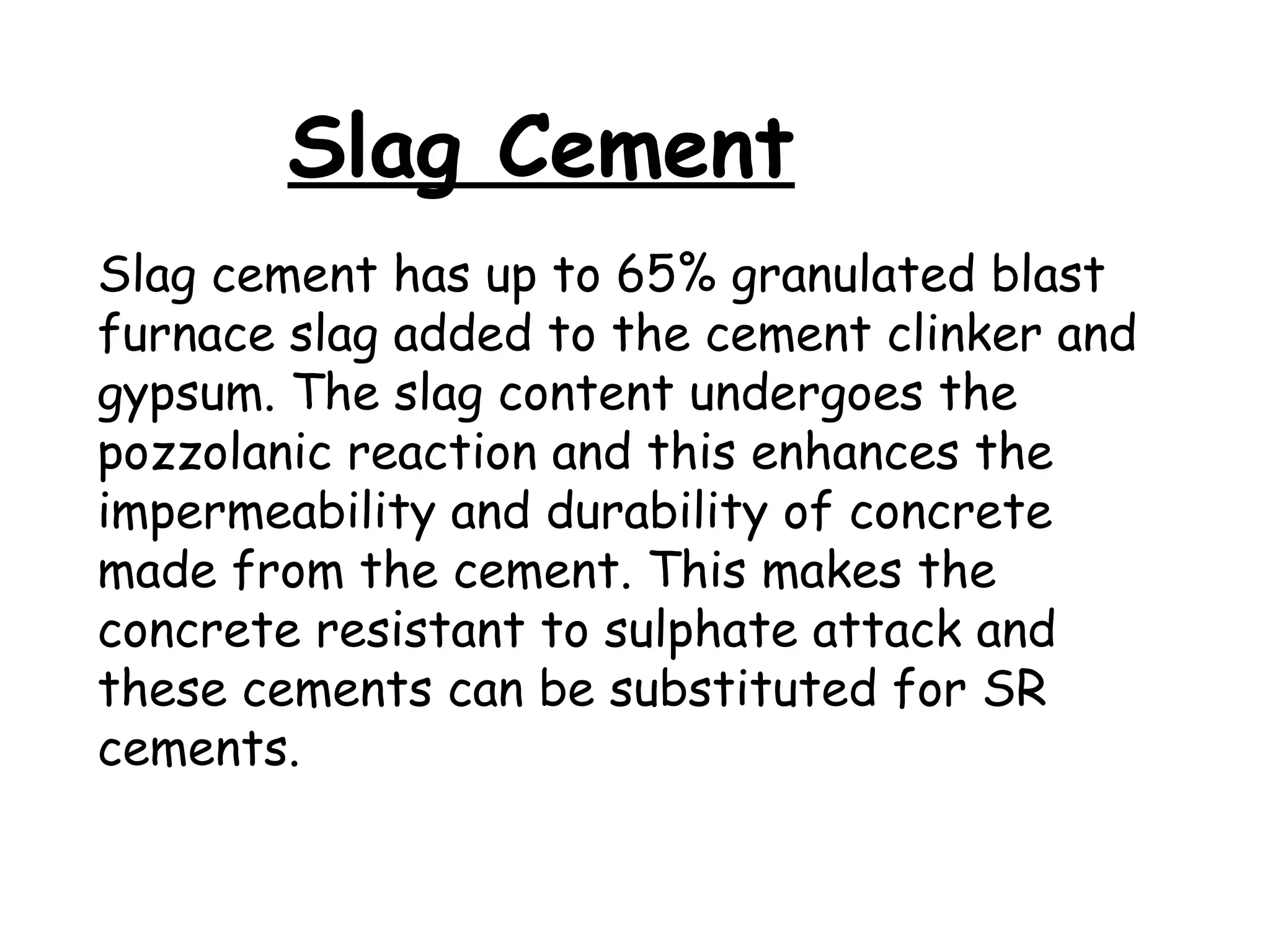
Slag cement has up to 65% granulated blast
furnace slag added to the cement clinker and
gypsum. The slag content undergoes the
pozzolanic reaction and this enhances the
impermeability and durability of concrete
made from the cement. This makes the
concrete resistant to sulphate attack and
these cements can be substituted for SR
cements.
Slag Cement
Fly ash cement contains up to 35% fly ash
added to the cement clinker and gypsum. The
fly ash undergoes the pozzolanic reaction and
this enhances the impermeability and
durability of concrete made from the
cement. This makes the concrete resistant to
sulphate attack and these cements can be
substituted for SR cements
Fly ash Cement
Oil well cement comes in different grades
(API Grades A to J inclusive). They are
designed to be slow setting and therefore
have very low C3A contents and are
coarsely ground. Some grades also contain
added retarders. As they have low C3A
content they are sulphate resisting and
could be substituted for SR cement,
however the setting time would be long.
Oil well Cement
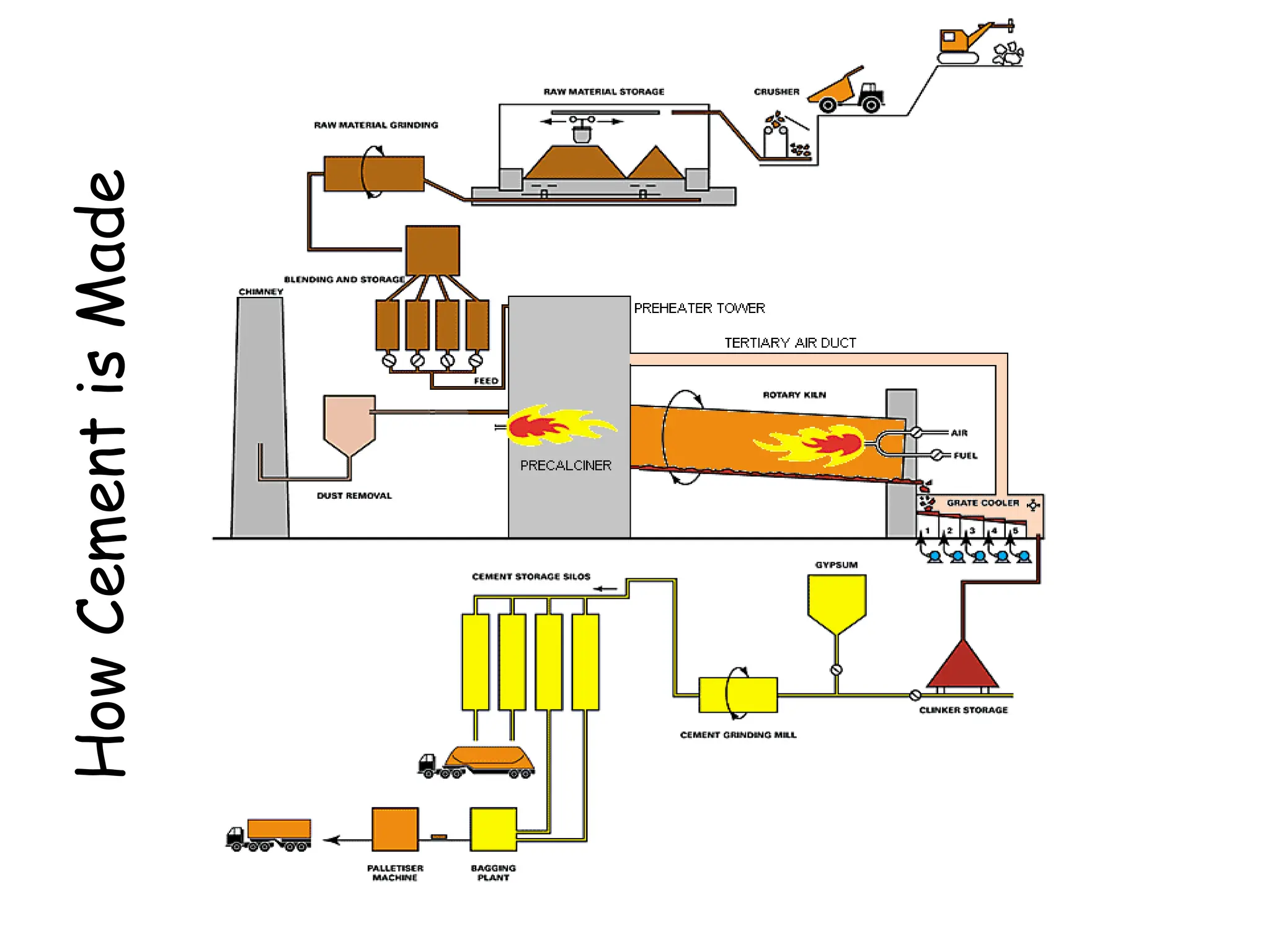
How
Cement
is
Made
Laterite
Fe2O3 > 30%
Al2O3 < 20%
Clay
SiO2 > 50 %
Al2O3 >10 %
Limestone
CaO > 48 %
95% < 100mm
Ground to Rawmix
LSF 92~93, SIM 2.50~2.55
Residue < 12% on 90  sieve
Raw Mill Grinds @ 270 T/hr
Stored in C.F Silo of
Capacity 22500 Tons
Burned at 1450 o
C to form
Clinker Granules
Free Lime < 1.5%
Liter Wt > 1100 gm/liter
Burned in KILN @ 210 T/hr
Stored in Clinker Silo
Capacity 30,000 Tons
95 % Clinker + 5 % Gypsum
Ground to Cement
Blain > 3000 cm2
/gm
Residue < 2% on 90  sieve
Gypsum
Purity > 85%
Ground in Cement Mill
@ 180 T/hr
Stored in 2 x Cement Silos
Capacity 13500 Tons each
Dispatched in Cement Bags
or through Bulk Loading
Flow
Chart
at FCCL
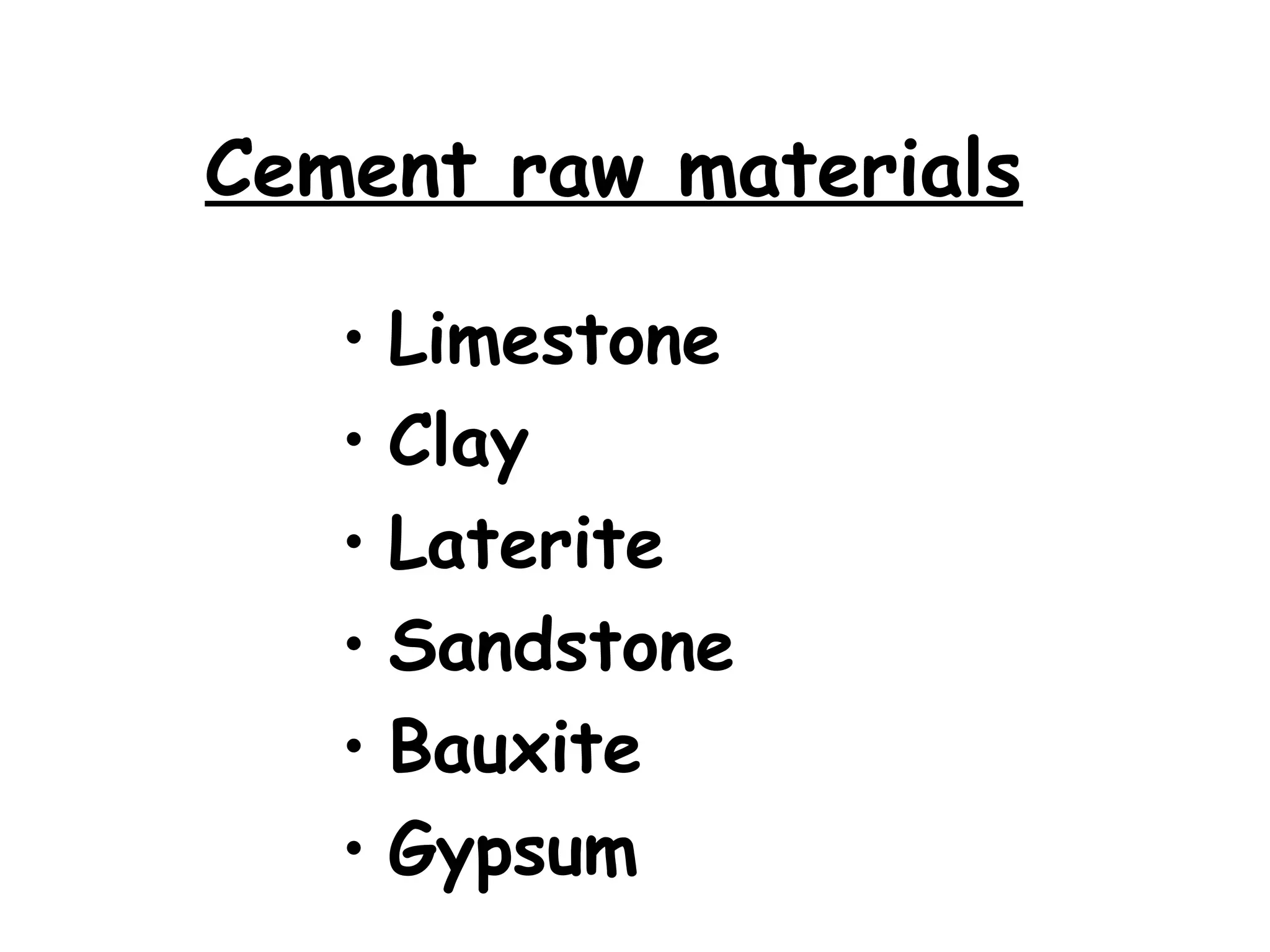
Cement raw materials
• Limestone
• Clay
• Laterite
• Sandstone
• Bauxite
• Gypsum
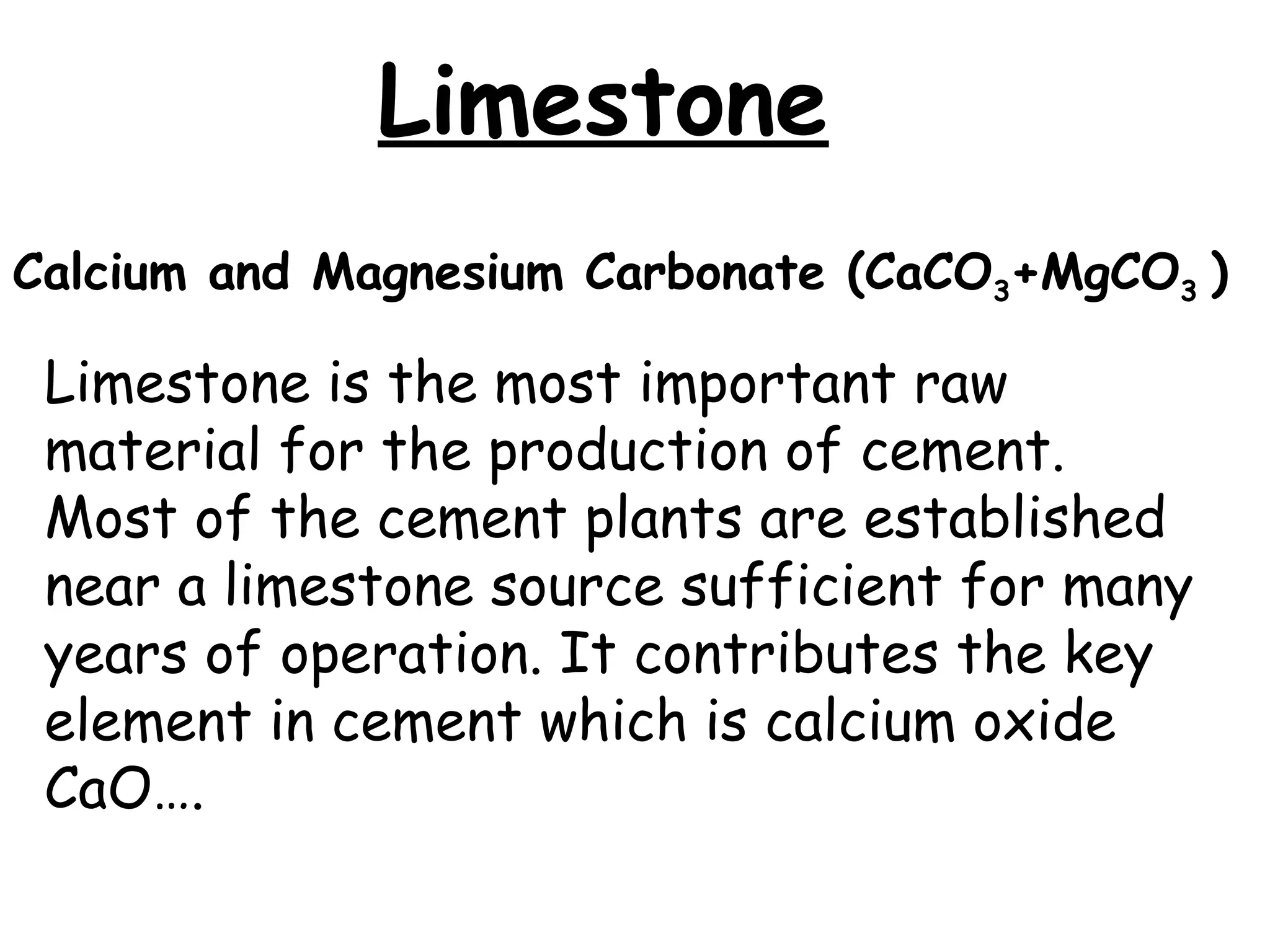
Limestone
Limestone is the most important raw
material for the production of cement.
Most of the cement plants are established
near a limestone source sufficient for many
years of operation. It contributes the key
element in cement which is calcium oxide
CaO….
Calcium and Magnesium Carbonate (CaCO3+MgCO3 )
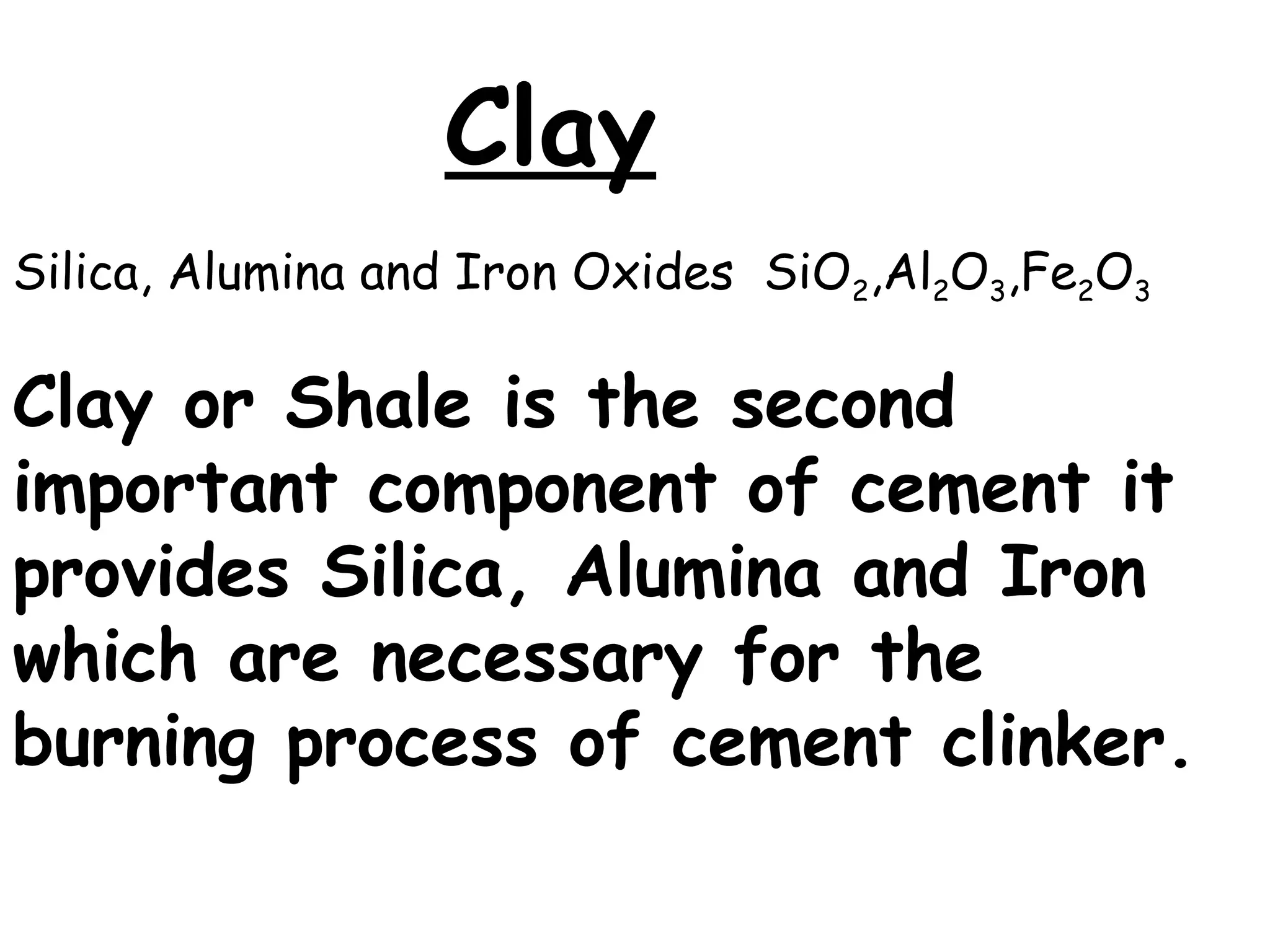
Clay
Silica, Alumina and Iron Oxides SiO2,Al2O3,Fe2O3
Clay or Shale is the second
important component of cement it
provides Silica, Alumina and Iron
which are necessary for the
burning process of cement clinker.
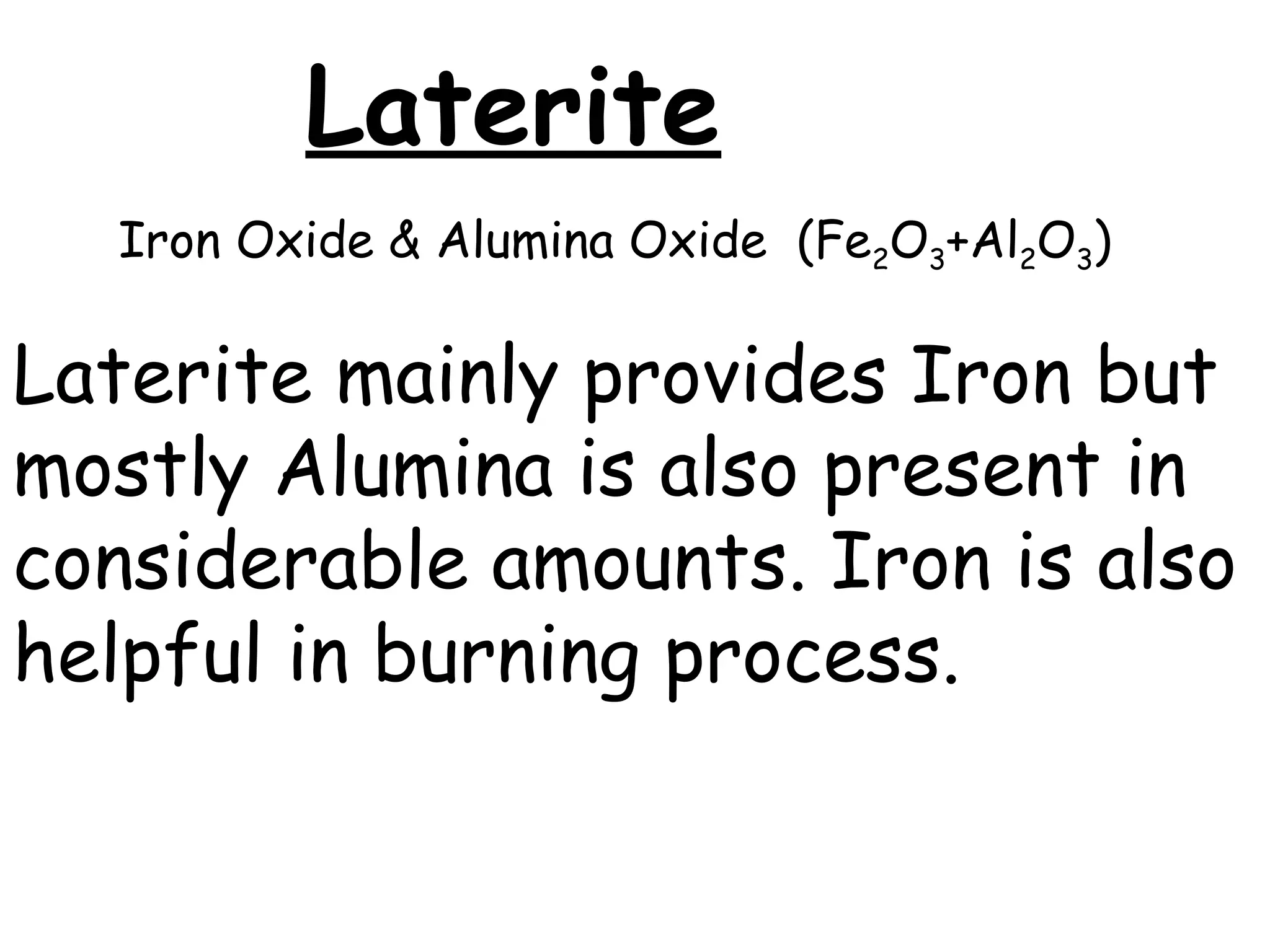
Laterite
Iron Oxide & Alumina Oxide (Fe2O3+Al2O3)
Laterite mainly provides Iron but
mostly Alumina is also present in
considerable amounts. Iron is also
helpful in burning process.
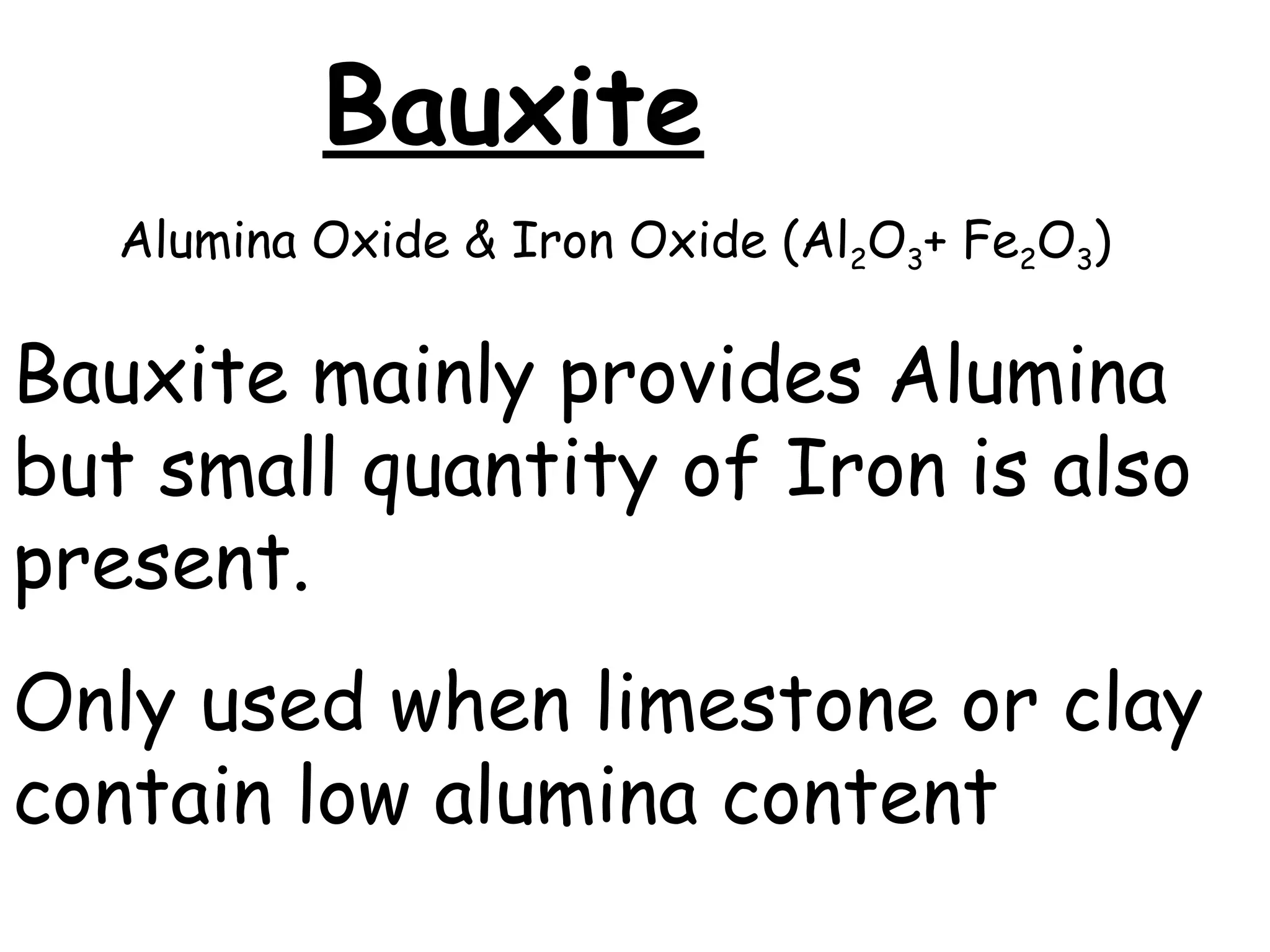
Bauxite
Alumina Oxide & Iron Oxide (Al2O3+ Fe2O3)
Bauxite mainly provides Alumina
but small quantity of Iron is also
present.
Only used when limestone or clay
contain low alumina content
Sandstone
Sandstone mainly provides Silica
but small quantity of Alumina and
Iron is also present.
Only used when available Clay
contains low silica content.
Silica SiO2
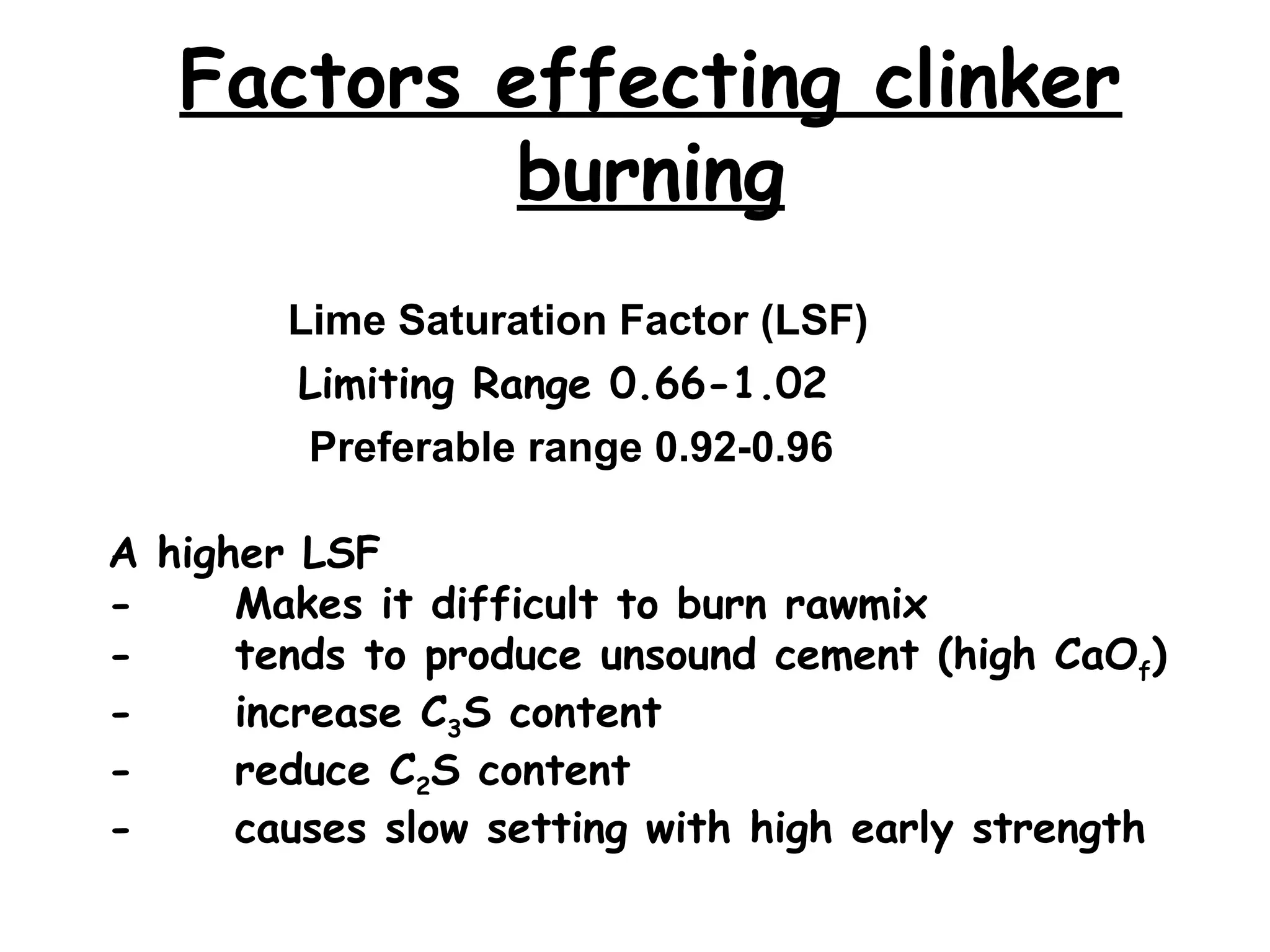
Factors effecting clinker
burning
Lime Saturation Factor (LSF)
Limiting Range 0.66-1.02
Preferable range 0.92-0.96
A higher LSF
- Makes it difficult to burn rawmix
- tends to produce unsound cement (high CaOf)
- increase C3S content
- reduce C2S content
- causes slow setting with high early strength
Factors effecting clinker
burning
SILICA MODULUS (SIM)
Limiting Range 1.90 - 3.20
Preferable range 2.30 - 2.70
A higher SIM
- results in harder burning and high fuel
consumption
- tends to cause unsoundness(high CaOf)
- causes difficulty in coating formation and hence
the radiation from shell is high
- deteriorates the kiln lining
- results in slow setting and hardening of cement
Factors effecting clinker
burning
ALUMINA MODULUS (AM)
Limiting Range 1.50 - 2.50
A higher AM
- imparts harder burning and entails higher fuel
consumption
- increases the proportion of C3A and reduces C4AF
- increases both C3S and C2S(C3S>C2S)
- reduces the liquid phase and kiln output
- tends the cement quick setting and strong at early ages
- increases viscosity of liquid Phase at constant
temperature
- MA determines the role of fluxes in a raw mix
MA <1.23(<1.63) – “A” acts as flux
MA >1.23(>1.63) – “F” acts as flux
- if MA is too low and rawmix is without free silica,
clinker sticking and balling is high
Chemistry of clinker
formation
Temperature Process Chemical Transformation
< 200 Escape of free water
100 – 400 Escape of absorbed water
400 – 750 Decomposition of clay e.g. with
formation of metakaolinite
Al4(OH)8 Si4O10 
2(Al2O3.2SiO2 )+ 4H 2 O
600 – 900 Decomposition of metakaolinite and
other compounds, with formation of a
reactive oxide mixture
Al2O3.2SiO2
 Al2O3 +
2SiO2
600 – 1000 Decomposition of limestone with
formation of CS and CA
CaCO3  CaO + CO2
3CaO+2SiO2 + Al2O3

2(CaO. 2SiO2)+CaO. Al2O3
800 – 1300 Uptake of lime by CS and CA,
formation of C4AF
CS + C  C2S : 2C + S 
C2S : CA + 2C  C3A
CA+3C+F  C4AF
1250 - 1450 Further uptake of lime by C2S C2S + C  C3S
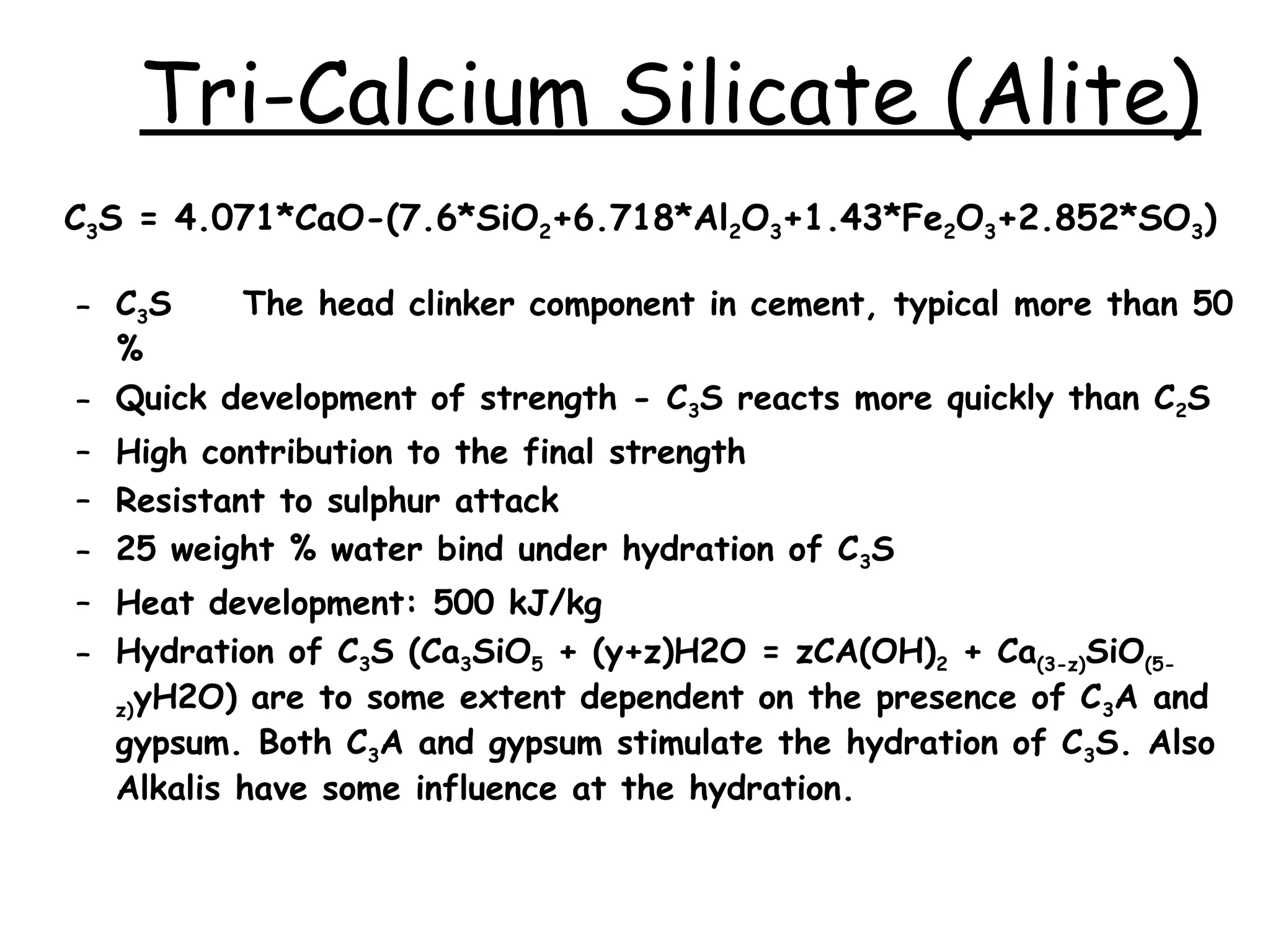
C3S = 4.071*CaO-(7.6*SiO2+6.718*Al2O3+1.43*Fe2O3+2.852*SO3)
– C3S The head clinker component in cement, typical more than 50
%
– Quick development of strength - C3S reacts more quickly than C2S
– High contribution to the final strength
– Resistant to sulphur attack
– 25 weight % water bind under hydration of C3S
– Heat development: 500 kJ/kg
– Hydration of C3S (Ca3SiO5 + (y+z)H2O = zCA(OH)2 + Ca(3-z)SiO(5-
z)yH2O) are to some extent dependent on the presence of C3A and
gypsum. Both C3A and gypsum stimulate the hydration of C3S. Also
Alkalis have some influence at the hydration.
Tri-Calcium Silicate (Alite)
C2S = 2.87*SiO2-0.754*(Ca3SiO5)
– Second clinker component in cement, between 10 - 60 %
– Slow development of strength - C2S reacts more slow than C3S
– High contribution to the final strength
– Resistant to sulphur attack
– 20 weight % water bind under hydration of C2S
– Heat development: 250 kJ/kg
– On hydration, C2S shows similar behaviour to C3S, but is slower
to react. It does however continue to hydrate late in the
setting period, and may then contribute to the strength of the
cement.
Di Calcium Silicate (Belite)
C3A = 2.65*Al2O3-1.69*Fe2O3
– Ranges in the cement between 3 - 10 %
– High contribution to the early strength
– Low contribution to the final strength
– Not resistant to sulphur attack
– 40 - 210 weight % water bind under hydration of C3A
– Fast and high heat development: 900 kJ/kg
– Compared with C3S, C3A reacts very rapidly with water, giving two
hydrated products: 2C3A + 21H = C4AH13 + C2AH8 These forms platelets
within the cement, and convert to C3AH6, which forms very quickly, and
is responsible for the initial formation of a crystalline network. In the
presence of free lime in the cement, the formation of C4AH13 is
favoured. This slows the formation of C3AH6, but even so the formation
of C4AH13 can causing the cement to set too quickly. To avoid speed
setting is gypsum added the cement and the mineral ettringite is formed
on hydration:
C3A + 3CaSO42H2O + 25-26H2O = Ca6Al2O6(SO4)31-32H2O.
Tri-Calcium Aluminate
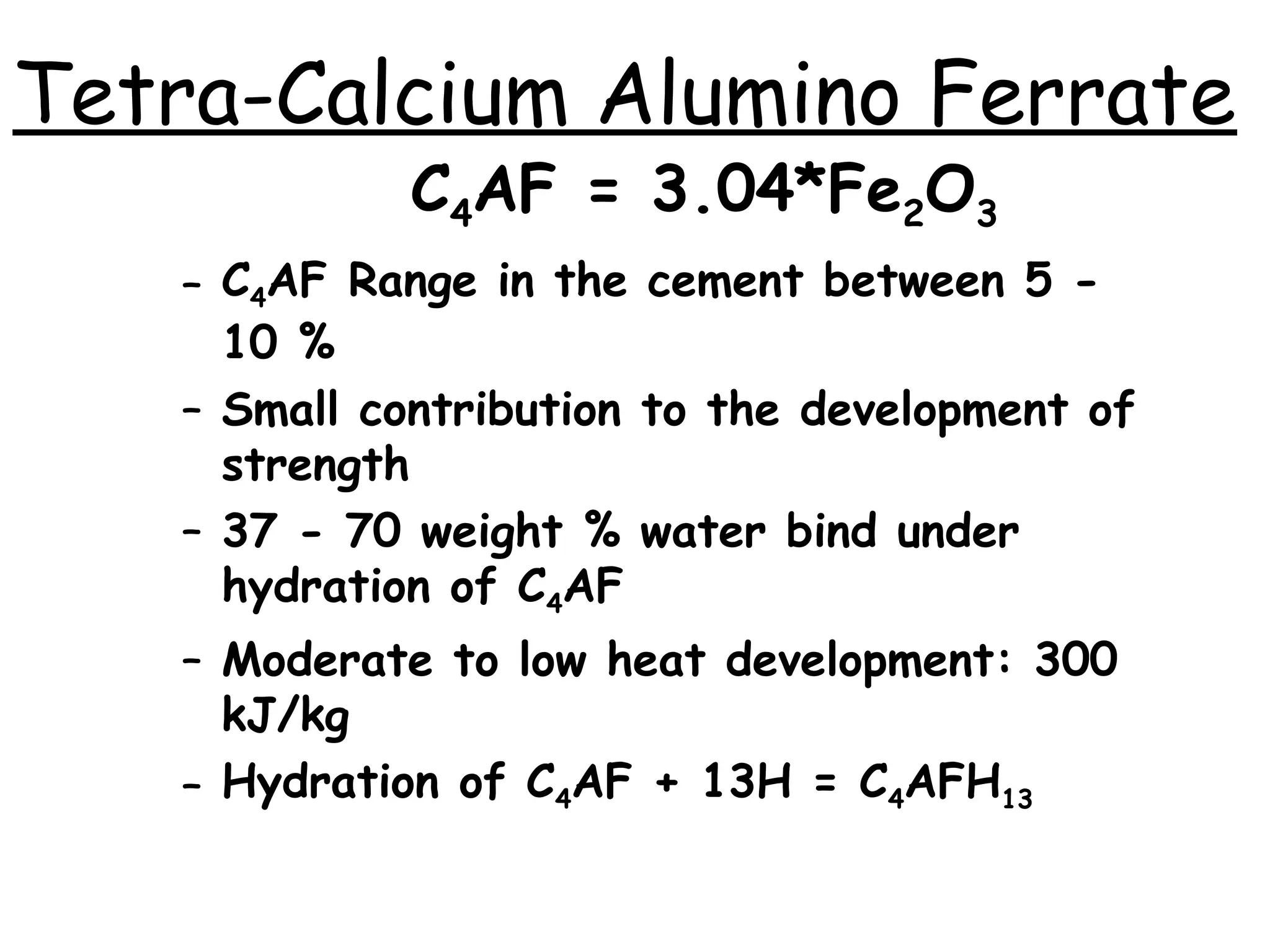
C4AF = 3.04*Fe2O3
– C4AF Range in the cement between 5 -
10 %
– Small contribution to the development of
strength
– 37 - 70 weight % water bind under
hydration of C4AF
– Moderate to low heat development: 300
kJ/kg
– Hydration of C4AF + 13H = C4AFH13
Tetra-Calcium Alumino Ferrate
Alkalis as Na2O
= Na2O + 0.658 * K2O
(Na2O + K2O)Cements with a low alkali content may be
required for use in the manufacture of concrete in
which the use of aggregate introduces silica. Alkalis
may enhance reactions with amorphous silica. The
content of alkalis contributed to the acceleration of
the early strength and lowering of the final strength.
The content of alkalis is dependent on the raw
materials but also the manufacturing process decide
the content of alkalis. Cement manufactured by the
wet processing will compared to the dry processing
contain less alkalis.
Kiln process Heat consumption
(kcal per kg clinker)
Wet process with internals 1400-1500
Long dry process with internals 1100
1-stage cyclone preheater 1000
2-stage cyclone preheater 900
4-stage cyclone preheater 800
4-stage cyclone preheater plus
calciner
750
5- stage preheater plus calciner plus
high efficiency cooler
720
6-stage preheater plus calciner plus
high efficiency cooler
less than 700
Specific heat consumption in various kiln systems
Coal Analysis
Coal is analyzed or tested in order that
• The most suitable use for an available coal
may be assessed. Or that
• The suitability of an available coal for a
particular purpose may be disclosed.
The laboratory tests applied to coal to assess its
properties are grouped into three classes:
i) Proximate analysis = V+free C+ash+m
ii) Ultimate analysis = C+H+N+S+O
where O = 100 – others, Also Cl, P, As
iii) Additional tests= caking power of coal
Coal Types
Type
Moist
ure
Volat
ile
Free
Carbon
Ash S H C N O Btu/lb
Kcal/
kg
Lignite 33.4 40.4 17.2 9 0.6 3.1 40.8 0.8 12.3 7500 4167
Sub
Bituminous
22.3 31.4 34.7 11.6 2.6 3.2 70.3 1.0 11.3 8300 4610
Bituminous
high volatile
12 34.2 47.4 9.3 0.5 4.4 73.4 1.3 11.1 11500 6390
Bituminous
low volatile
3.6 15.4 76.3 11.7 0.8 4.6 79.0 1.4 2.5 13000 7220
Anthracite 5.4 7 71.8 15.8 0.8 2.5 77.9 0.8 2.2 12000 6670

Cement Manufacturing and Process Optimization

  • 1.
    Cement Cement is ahydraulic binder i.e. it is finely ground inorganic material which, when mixed with water, forms a paste which sets and hardens by means of hydration reactions and processes and which after hardening, retains its strength and stability even under water. It was the achievement of Joseph Aspdin a British bricklayer to produce Portland Cement in 1824 by burning a mixture containing certain proportion of lime and clay at a high temperature
  • 2.
    Various Standard Values PS-232-1983(R)BS-12-1983 3 days 2200 PSI (Minimum) 3336 PSI (Minimum) 7 days 3400 PSI (Minimum) 28 days 5000 PSI (Minimum) 5950 PSI (Minimum) Initial 45 Minutes (Min) Final 600 Minutes (Max) Expansion 10 mm (Max) LOI 3% Maximum 3% Maximum MgO 4% Maximum 4% Maximum SO3 3% Maximum 3% Maximum I.R 1.5% Maximum 1.5% Maximum LSF 0.66 to 1.02 0.66 to 1.02 Compressive Strength Setting Time
  • 3.
    Cement Types Five typesof Portland cement are standardized in the U.S. (Standard Specification for Portland Cement C 150 - 97) Ordinary (Type I) Modified (Type II) High-early-strength (Type III) Low-heat (Type IV) Sulfate-resisting (Type V) In other countries Type II is omitted, and Type III is called rapid hardening. Type V is known in some European countries as Ferrari cements
  • 4.
    Cement Types Five typesof Portland cement are also standardized in the U.K. (Specification for Portland Cement BS 12: 1996): CEM I Portland Cement: up to 5% additional constituents CEM II Portland-Composite Cement:35% other constituents CEM III Blastfurnace Cement: High %age of B.F Slag CEM IV Pozzolanic Cement: High %age of pozzolana CEM V Composite Cement: High %age of B.F Slag and pozzolana or Fly ash
  • 5.
    Sulphate Resisting cement hasa limit of 4% on the C3A content to prevent attack by sulphates on the hydrated C3A. Sulphate Resisting Cement
  • 6.
    Slag cement hasup to 65% granulated blast furnace slag added to the cement clinker and gypsum. The slag content undergoes the pozzolanic reaction and this enhances the impermeability and durability of concrete made from the cement. This makes the concrete resistant to sulphate attack and these cements can be substituted for SR cements. Slag Cement
  • 7.
    Fly ash cementcontains up to 35% fly ash added to the cement clinker and gypsum. The fly ash undergoes the pozzolanic reaction and this enhances the impermeability and durability of concrete made from the cement. This makes the concrete resistant to sulphate attack and these cements can be substituted for SR cements Fly ash Cement
  • 8.
    Oil well cementcomes in different grades (API Grades A to J inclusive). They are designed to be slow setting and therefore have very low C3A contents and are coarsely ground. Some grades also contain added retarders. As they have low C3A content they are sulphate resisting and could be substituted for SR cement, however the setting time would be long. Oil well Cement
  • 9.
  • 10.
    Laterite Fe2O3 > 30% Al2O3< 20% Clay SiO2 > 50 % Al2O3 >10 % Limestone CaO > 48 % 95% < 100mm Ground to Rawmix LSF 92~93, SIM 2.50~2.55 Residue < 12% on 90  sieve Raw Mill Grinds @ 270 T/hr Stored in C.F Silo of Capacity 22500 Tons Burned at 1450 o C to form Clinker Granules Free Lime < 1.5% Liter Wt > 1100 gm/liter Burned in KILN @ 210 T/hr Stored in Clinker Silo Capacity 30,000 Tons 95 % Clinker + 5 % Gypsum Ground to Cement Blain > 3000 cm2 /gm Residue < 2% on 90  sieve Gypsum Purity > 85% Ground in Cement Mill @ 180 T/hr Stored in 2 x Cement Silos Capacity 13500 Tons each Dispatched in Cement Bags or through Bulk Loading Flow Chart at FCCL
  • 11.
    Cement raw materials •Limestone • Clay • Laterite • Sandstone • Bauxite • Gypsum
  • 12.
    Limestone Limestone is themost important raw material for the production of cement. Most of the cement plants are established near a limestone source sufficient for many years of operation. It contributes the key element in cement which is calcium oxide CaO…. Calcium and Magnesium Carbonate (CaCO3+MgCO3 )
  • 13.
    Clay Silica, Alumina andIron Oxides SiO2,Al2O3,Fe2O3 Clay or Shale is the second important component of cement it provides Silica, Alumina and Iron which are necessary for the burning process of cement clinker.
  • 14.
    Laterite Iron Oxide &Alumina Oxide (Fe2O3+Al2O3) Laterite mainly provides Iron but mostly Alumina is also present in considerable amounts. Iron is also helpful in burning process.
  • 15.
    Bauxite Alumina Oxide &Iron Oxide (Al2O3+ Fe2O3) Bauxite mainly provides Alumina but small quantity of Iron is also present. Only used when limestone or clay contain low alumina content
  • 16.
    Sandstone Sandstone mainly providesSilica but small quantity of Alumina and Iron is also present. Only used when available Clay contains low silica content. Silica SiO2
  • 17.
    Factors effecting clinker burning LimeSaturation Factor (LSF) Limiting Range 0.66-1.02 Preferable range 0.92-0.96 A higher LSF - Makes it difficult to burn rawmix - tends to produce unsound cement (high CaOf) - increase C3S content - reduce C2S content - causes slow setting with high early strength
  • 18.
    Factors effecting clinker burning SILICAMODULUS (SIM) Limiting Range 1.90 - 3.20 Preferable range 2.30 - 2.70 A higher SIM - results in harder burning and high fuel consumption - tends to cause unsoundness(high CaOf) - causes difficulty in coating formation and hence the radiation from shell is high - deteriorates the kiln lining - results in slow setting and hardening of cement
  • 19.
    Factors effecting clinker burning ALUMINAMODULUS (AM) Limiting Range 1.50 - 2.50 A higher AM - imparts harder burning and entails higher fuel consumption - increases the proportion of C3A and reduces C4AF - increases both C3S and C2S(C3S>C2S) - reduces the liquid phase and kiln output - tends the cement quick setting and strong at early ages - increases viscosity of liquid Phase at constant temperature - MA determines the role of fluxes in a raw mix MA <1.23(<1.63) – “A” acts as flux MA >1.23(>1.63) – “F” acts as flux - if MA is too low and rawmix is without free silica, clinker sticking and balling is high
  • 21.
    Chemistry of clinker formation TemperatureProcess Chemical Transformation < 200 Escape of free water 100 – 400 Escape of absorbed water 400 – 750 Decomposition of clay e.g. with formation of metakaolinite Al4(OH)8 Si4O10  2(Al2O3.2SiO2 )+ 4H 2 O 600 – 900 Decomposition of metakaolinite and other compounds, with formation of a reactive oxide mixture Al2O3.2SiO2  Al2O3 + 2SiO2 600 – 1000 Decomposition of limestone with formation of CS and CA CaCO3  CaO + CO2 3CaO+2SiO2 + Al2O3  2(CaO. 2SiO2)+CaO. Al2O3 800 – 1300 Uptake of lime by CS and CA, formation of C4AF CS + C  C2S : 2C + S  C2S : CA + 2C  C3A CA+3C+F  C4AF 1250 - 1450 Further uptake of lime by C2S C2S + C  C3S
  • 22.
    C3S = 4.071*CaO-(7.6*SiO2+6.718*Al2O3+1.43*Fe2O3+2.852*SO3) –C3S The head clinker component in cement, typical more than 50 % – Quick development of strength - C3S reacts more quickly than C2S – High contribution to the final strength – Resistant to sulphur attack – 25 weight % water bind under hydration of C3S – Heat development: 500 kJ/kg – Hydration of C3S (Ca3SiO5 + (y+z)H2O = zCA(OH)2 + Ca(3-z)SiO(5- z)yH2O) are to some extent dependent on the presence of C3A and gypsum. Both C3A and gypsum stimulate the hydration of C3S. Also Alkalis have some influence at the hydration. Tri-Calcium Silicate (Alite)
  • 23.
    C2S = 2.87*SiO2-0.754*(Ca3SiO5) –Second clinker component in cement, between 10 - 60 % – Slow development of strength - C2S reacts more slow than C3S – High contribution to the final strength – Resistant to sulphur attack – 20 weight % water bind under hydration of C2S – Heat development: 250 kJ/kg – On hydration, C2S shows similar behaviour to C3S, but is slower to react. It does however continue to hydrate late in the setting period, and may then contribute to the strength of the cement. Di Calcium Silicate (Belite)
  • 24.
    C3A = 2.65*Al2O3-1.69*Fe2O3 –Ranges in the cement between 3 - 10 % – High contribution to the early strength – Low contribution to the final strength – Not resistant to sulphur attack – 40 - 210 weight % water bind under hydration of C3A – Fast and high heat development: 900 kJ/kg – Compared with C3S, C3A reacts very rapidly with water, giving two hydrated products: 2C3A + 21H = C4AH13 + C2AH8 These forms platelets within the cement, and convert to C3AH6, which forms very quickly, and is responsible for the initial formation of a crystalline network. In the presence of free lime in the cement, the formation of C4AH13 is favoured. This slows the formation of C3AH6, but even so the formation of C4AH13 can causing the cement to set too quickly. To avoid speed setting is gypsum added the cement and the mineral ettringite is formed on hydration: C3A + 3CaSO42H2O + 25-26H2O = Ca6Al2O6(SO4)31-32H2O. Tri-Calcium Aluminate
  • 25.
    C4AF = 3.04*Fe2O3 –C4AF Range in the cement between 5 - 10 % – Small contribution to the development of strength – 37 - 70 weight % water bind under hydration of C4AF – Moderate to low heat development: 300 kJ/kg – Hydration of C4AF + 13H = C4AFH13 Tetra-Calcium Alumino Ferrate
  • 26.
    Alkalis as Na2O =Na2O + 0.658 * K2O (Na2O + K2O)Cements with a low alkali content may be required for use in the manufacture of concrete in which the use of aggregate introduces silica. Alkalis may enhance reactions with amorphous silica. The content of alkalis contributed to the acceleration of the early strength and lowering of the final strength. The content of alkalis is dependent on the raw materials but also the manufacturing process decide the content of alkalis. Cement manufactured by the wet processing will compared to the dry processing contain less alkalis.
  • 27.
    Kiln process Heatconsumption (kcal per kg clinker) Wet process with internals 1400-1500 Long dry process with internals 1100 1-stage cyclone preheater 1000 2-stage cyclone preheater 900 4-stage cyclone preheater 800 4-stage cyclone preheater plus calciner 750 5- stage preheater plus calciner plus high efficiency cooler 720 6-stage preheater plus calciner plus high efficiency cooler less than 700 Specific heat consumption in various kiln systems
  • 28.
    Coal Analysis Coal isanalyzed or tested in order that • The most suitable use for an available coal may be assessed. Or that • The suitability of an available coal for a particular purpose may be disclosed. The laboratory tests applied to coal to assess its properties are grouped into three classes: i) Proximate analysis = V+free C+ash+m ii) Ultimate analysis = C+H+N+S+O where O = 100 – others, Also Cl, P, As iii) Additional tests= caking power of coal
  • 30.
    Coal Types Type Moist ure Volat ile Free Carbon Ash SH C N O Btu/lb Kcal/ kg Lignite 33.4 40.4 17.2 9 0.6 3.1 40.8 0.8 12.3 7500 4167 Sub Bituminous 22.3 31.4 34.7 11.6 2.6 3.2 70.3 1.0 11.3 8300 4610 Bituminous high volatile 12 34.2 47.4 9.3 0.5 4.4 73.4 1.3 11.1 11500 6390 Bituminous low volatile 3.6 15.4 76.3 11.7 0.8 4.6 79.0 1.4 2.5 13000 7220 Anthracite 5.4 7 71.8 15.8 0.8 2.5 77.9 0.8 2.2 12000 6670