Research Methodology
1st Semester
2023-2024
Unit II
Research Process
Research Process
Exploring your own approach to knowledge
An individuals’ preference for learning, knowing and researching can be broadly
classified into two categories:
Category I:
In this category, individuals are described as: analytic, organized and logical.
In research, those persons can have difficulty in thinking outside the square; as they
may struggle with randomness and spontaneity.
Category II:
In this category, individuals are described as: intuitive, holistic and imaginative.
In research, those persons have difficulty in defining their methods, finishing and
writing up; as they may/can struggle with structure and order.
Research Process
Exploring your own approach to knowledge…continued
There are several learning styles that can help researchers (beginners)
understand how they best process, assimilate and produce knowledge.
These styles are summarized as follows.
 Visual learners
Visual learners tend to collect data and grasp knowledge through visual
displays. In research, they often enjoy observation.
 Auditory learners
Auditory learners tend to gather data through, ”hearing”, and they benefit
from listening, talking and reading aloud. In research, they enjoy
interviews.
 Kinesthetic learners
Kinesthetic learners learn best from moving, doing and touching. They enjoy
a hands-on approach to explore the world around them. Kinesthetic researchers
enjoy data collection from engaging in action research.
Research Process
Exploring your own approach to knowledge…continued
 Assimilator
Assimilator (Theorist) tend to use abstract conceptualization and reflective
observation. Assimilators enjoy creating theoretical models and are
interested in abstract concepts.
 Converger
Converger (Pragmatist) tend to use abstract conceptualization with active
experimentation. Convergers enjoy the practical application of ideas. They
prefer to deal with things (physical sciences) rather than people.
Accommodator
Accommodator (Activist) tend to use concrete experience and active
experimentation. Accommodators enjoy, “doing”, and tend to solve
problems intuitively.
 Diverger
Diverger (Reflector) tend to use reflective observation and concrete experience
and enjoy thinking about a topic. Divergers are interested in lives and emotions;
thus they tend to specialize in they arts.
To investigate some existing situation or problem.
 To provide solutions to a problem.
 To explore and analyse more general issues.
 To construct or create a new procedure or system.
 To explain a new phenomenon.
 To generate new knowledge.
To pass, get good grades, finishing the degree.
 A combination of two or more of any of the above.
Research Process
Research’s Motivations
Research Process
• Researching is a process that demands planning, forethought, commitment and persistence.
• Research process is not a task. It is a journey that needs to be managed, navigated, negotiated
from early conception to final destination.
Research Process
Research Project Framework
A research project framework comprises four accurate ,clear, and specific
answers for four questions.
What?
• Research area/field
• Research’s topic
Why?
• Necessities/importance of conducting a research’s topic
How?
• Research’s methodology including:
• Approaches,
• Methods, techniques and tools
When
• Research’s project execution timelines
Research Process
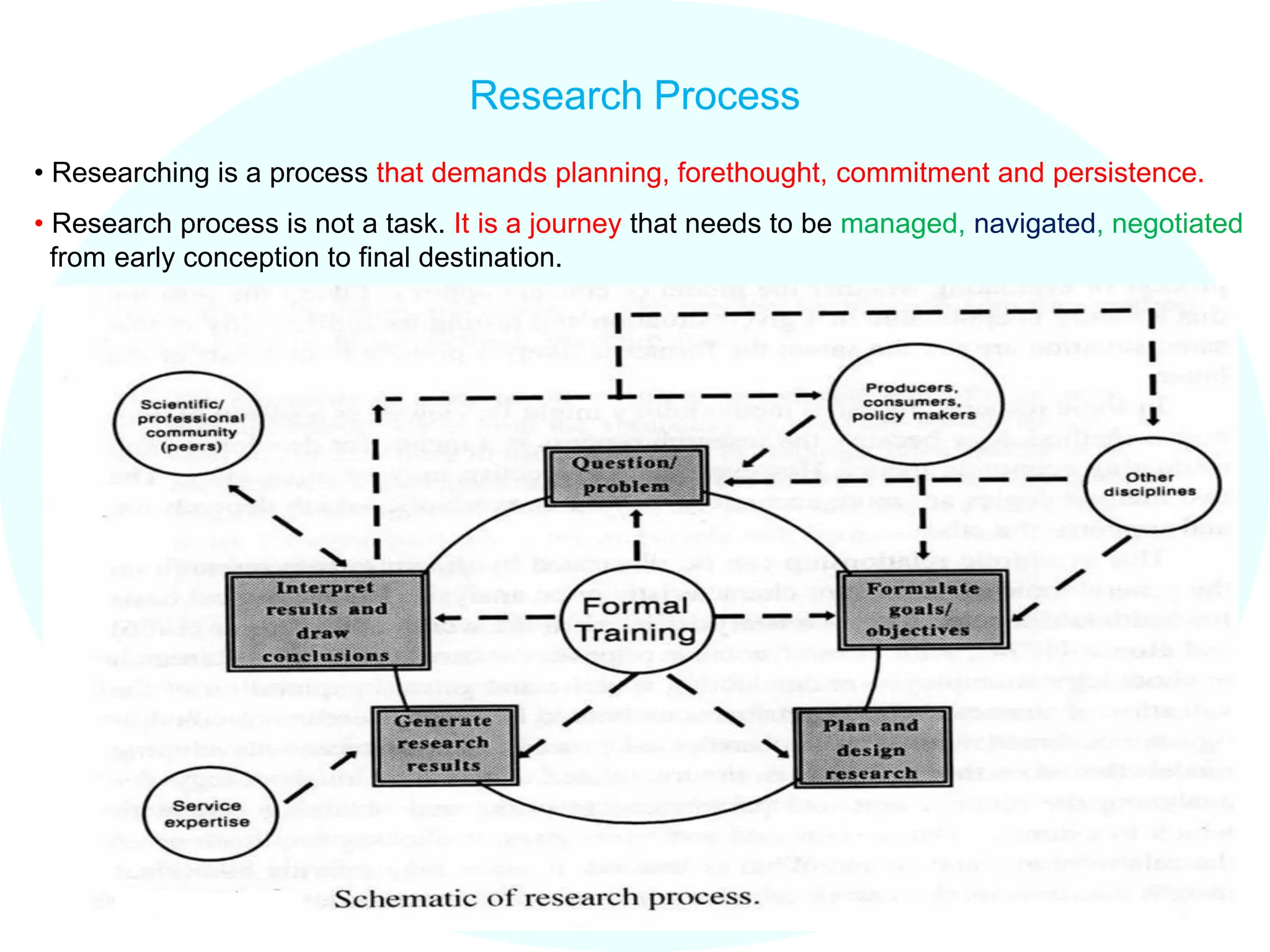
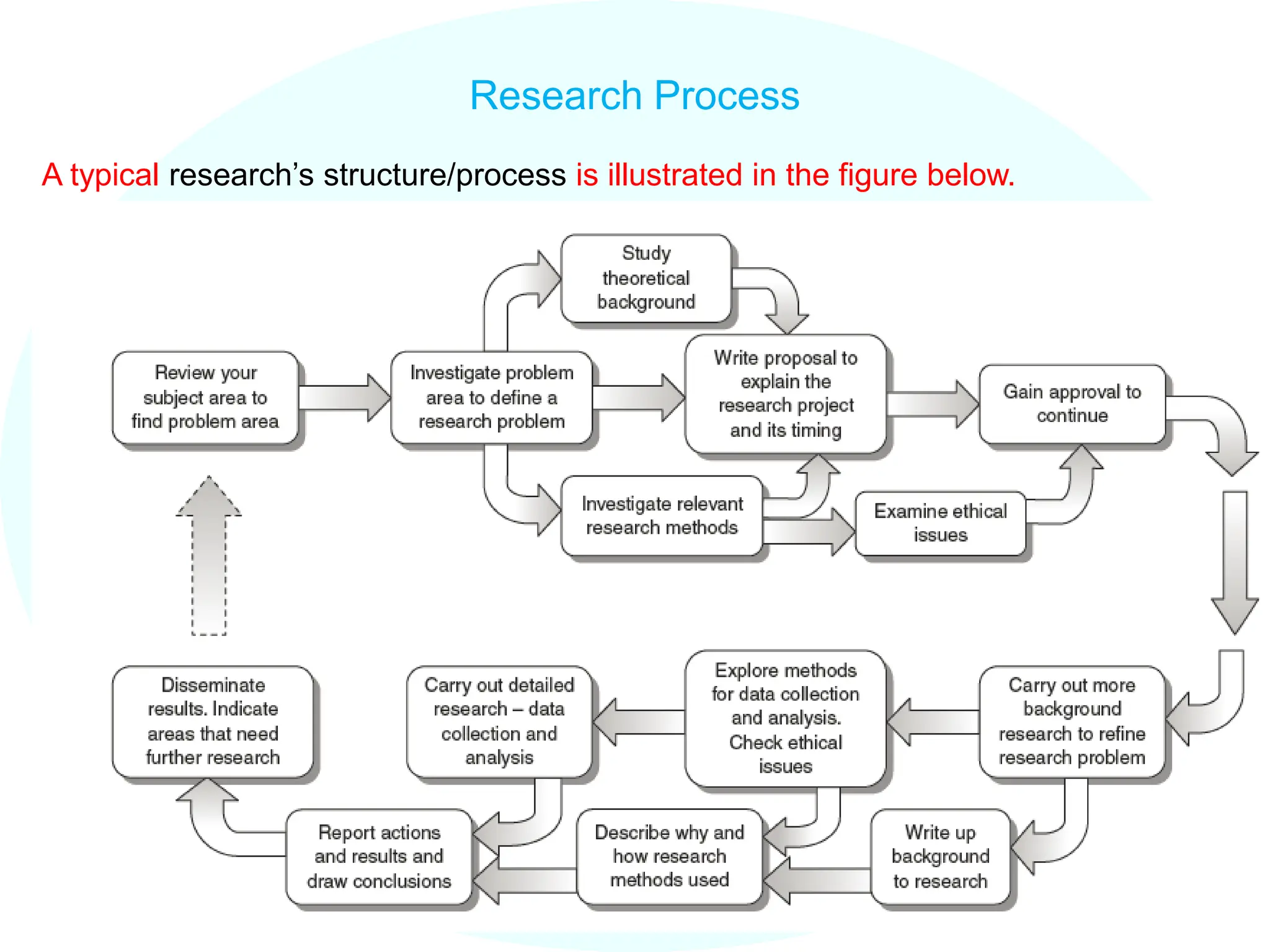
A typical research’s structure/process is illustrated in the figure below.
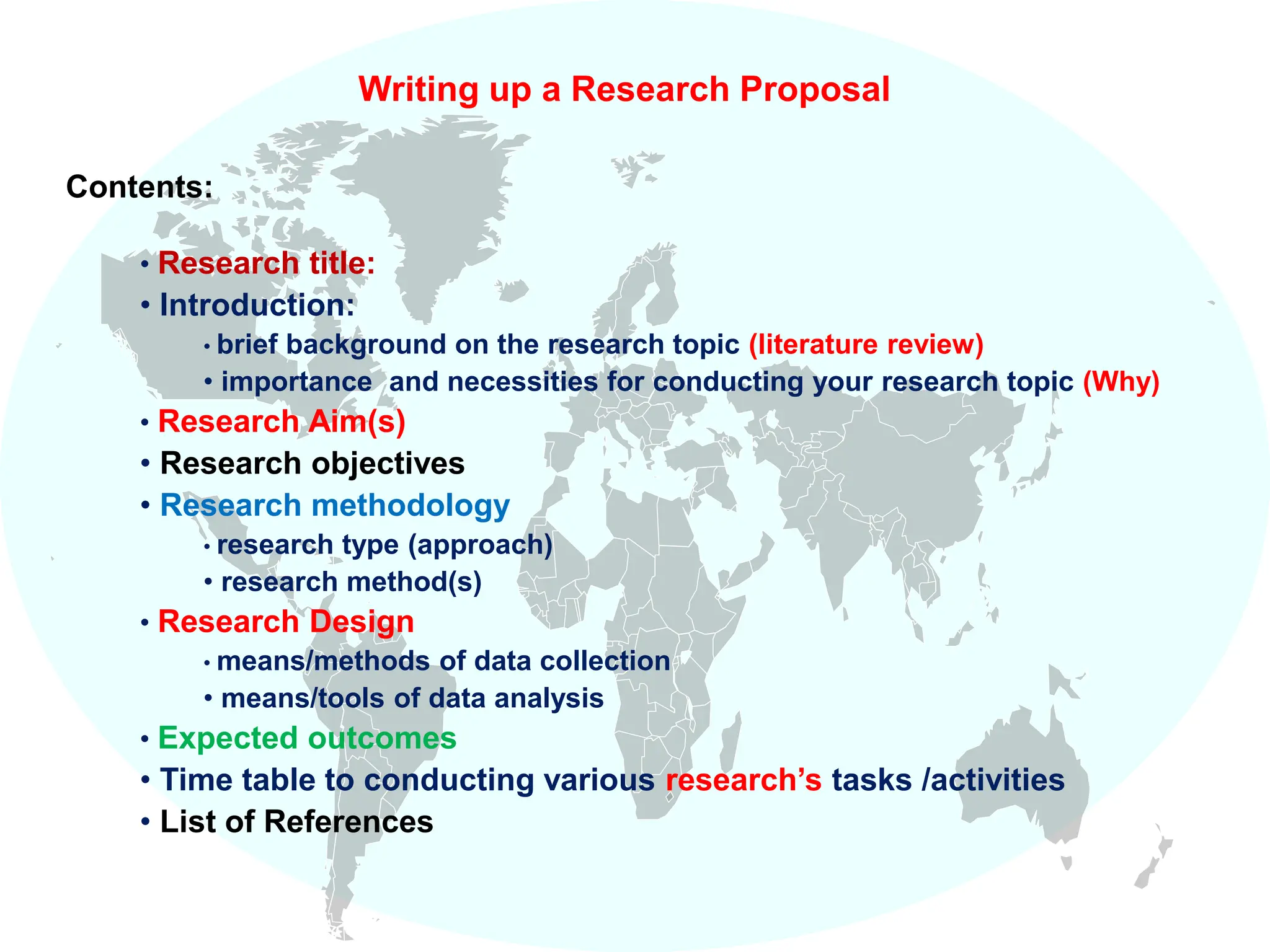
Writing up a Research Proposal
• Research title:
• Introduction:
• brief background on the research topic (literature review)
• importance and necessities for conducting your research topic (Why)
• Research Aim(s)
• Research objectives
• Research methodology
• research type (approach)
• research method(s)
• Research Design
• means/methods of data collection
• means/tools of data analysis
• Expected outcomes
• Time table to conducting various research’s tasks /activities
• List of References
Contents:

Unit II.pdf

  • 1.
  • 2.
  • 3.
    Research Process Exploring yourown approach to knowledge An individuals’ preference for learning, knowing and researching can be broadly classified into two categories: Category I: In this category, individuals are described as: analytic, organized and logical. In research, those persons can have difficulty in thinking outside the square; as they may struggle with randomness and spontaneity. Category II: In this category, individuals are described as: intuitive, holistic and imaginative. In research, those persons have difficulty in defining their methods, finishing and writing up; as they may/can struggle with structure and order.
  • 4.
    Research Process Exploring yourown approach to knowledge…continued There are several learning styles that can help researchers (beginners) understand how they best process, assimilate and produce knowledge. These styles are summarized as follows.  Visual learners Visual learners tend to collect data and grasp knowledge through visual displays. In research, they often enjoy observation.  Auditory learners Auditory learners tend to gather data through, ”hearing”, and they benefit from listening, talking and reading aloud. In research, they enjoy interviews.  Kinesthetic learners Kinesthetic learners learn best from moving, doing and touching. They enjoy a hands-on approach to explore the world around them. Kinesthetic researchers enjoy data collection from engaging in action research.
  • 5.
    Research Process Exploring yourown approach to knowledge…continued  Assimilator Assimilator (Theorist) tend to use abstract conceptualization and reflective observation. Assimilators enjoy creating theoretical models and are interested in abstract concepts.  Converger Converger (Pragmatist) tend to use abstract conceptualization with active experimentation. Convergers enjoy the practical application of ideas. They prefer to deal with things (physical sciences) rather than people. Accommodator Accommodator (Activist) tend to use concrete experience and active experimentation. Accommodators enjoy, “doing”, and tend to solve problems intuitively.  Diverger Diverger (Reflector) tend to use reflective observation and concrete experience and enjoy thinking about a topic. Divergers are interested in lives and emotions; thus they tend to specialize in they arts.
  • 6.
    To investigate someexisting situation or problem.  To provide solutions to a problem.  To explore and analyse more general issues.  To construct or create a new procedure or system.  To explain a new phenomenon.  To generate new knowledge. To pass, get good grades, finishing the degree.  A combination of two or more of any of the above. Research Process Research’s Motivations
  • 7.
    Research Process • Researchingis a process that demands planning, forethought, commitment and persistence. • Research process is not a task. It is a journey that needs to be managed, navigated, negotiated from early conception to final destination.
  • 8.
    Research Process Research ProjectFramework A research project framework comprises four accurate ,clear, and specific answers for four questions. What? • Research area/field • Research’s topic Why? • Necessities/importance of conducting a research’s topic How? • Research’s methodology including: • Approaches, • Methods, techniques and tools When • Research’s project execution timelines
  • 9.
    Research Process A typicalresearch’s structure/process is illustrated in the figure below.
  • 10.
    Writing up aResearch Proposal • Research title: • Introduction: • brief background on the research topic (literature review) • importance and necessities for conducting your research topic (Why) • Research Aim(s) • Research objectives • Research methodology • research type (approach) • research method(s) • Research Design • means/methods of data collection • means/tools of data analysis • Expected outcomes • Time table to conducting various research’s tasks /activities • List of References Contents: