Sanjivani Rural Education Society’s
Sanjivani College of Engineering, Kopargaon-423 603
(An Autonomous Institute, Affiliated to Savitribai Phule Pune University, Pune)
NACC ‘A’ Grade Accredited, ISO 9001:2015 Certified
Department of Computer Engineering
(NBA Accredited)
Prof. S.A.Shivarkar
Assistant Professor
E-mail :
shivarkarsandipcomp@sanjivani.org.in
Contact No: 8275032712
Subject- Business Intelligence
Unit-II:Decision Making Concepts
Decision Support System
 A decision support system (DSS) is an
interactive computer-based application that
combines data and mathematical models to help
decision makers solve complex problems faced
in managing the public and private enterprises
and organizations.
Types of DSS
• Communications-driven and Group DSS
• Data-driven DSS
• Document-driven
• Knowledge-driven DSS Data Mining, and
Management Expert Systems Applications
• Model-driven DSS
• Compound DSS
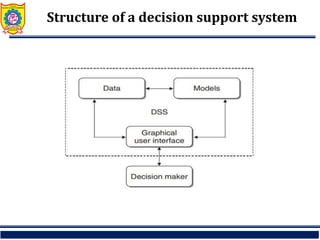
Structure of a decision support system
Features of decision support system
 Effectiveness
 Mathematical model
 Integration in the decision-making process
 Organizational role
 Flexibility
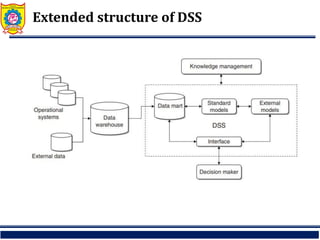
Extended structure of DSS
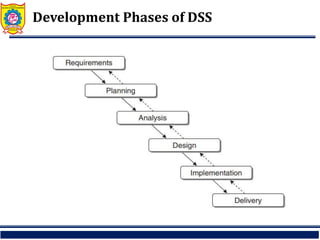
Development Phases of DSS
Case Study 1: CSAV
 Compafiia Sud Americana de Vapores (CSAV) is a
shipping company headquartered in Chile, South
America, and is the sixth largest shipping company
in the world. There were four main challenges
recognized by CSA V to its empty container logistics
problem:
 Imbalance
 Uncertainty
 Information handling and sharing
 Coordination of interrelated decisions worldwide
Case Study 1 : CSAV- Solution
 CSAV developed an integrated system called Empty
Container Logistics Optimization (ECO) using moving
average, trended and seasonal time series, and sales force
forecast (CFM) methods.
 The ECO system comprises a forecasting model, invento1y
model, multi-commodity (MC) network flow model, and a
Web interface.
 The forecasting model draws data from the regional offices,
processes it, and feeds the resultant information to the
inventory model. Some of the information the forecasting
model generates are the space in the vessel for empty
containers and container demand.
Case Study 1: CSAV- Solution
 The forecasting module also helps reduce forecast error and,
hence, allows CSAV's depot to maintain lower safety stocks.
The inventory model calculates the safety stocks and feeds it
to the MC Network Flow model.
 The MC Network Flow model is the core of the ECO system.
It provides information for optimal decisions to be made
regarding inventory levels, container repositioning flows,
and the leasing and return of empty containers.
 The objective function is to minimize empty container
logistics cost, which is mostly a result of leasing,
repositioning, storage, loading, and discharge operations
Case Study 2: Decision Making Process for e
Commerce Customer
 The Customer Recognizes they have a problem that needs to
be solved
 They Search for a Solution
 They Evaluate Alternative Solutions
 They Make a Decision
 They Evaluate their Purchasing Decision

Unit II Decision Support System.pdf

  • 1.
    Sanjivani Rural EducationSociety’s Sanjivani College of Engineering, Kopargaon-423 603 (An Autonomous Institute, Affiliated to Savitribai Phule Pune University, Pune) NACC ‘A’ Grade Accredited, ISO 9001:2015 Certified Department of Computer Engineering (NBA Accredited) Prof. S.A.Shivarkar Assistant Professor E-mail : shivarkarsandipcomp@sanjivani.org.in Contact No: 8275032712 Subject- Business Intelligence Unit-II:Decision Making Concepts
  • 2.
    Decision Support System A decision support system (DSS) is an interactive computer-based application that combines data and mathematical models to help decision makers solve complex problems faced in managing the public and private enterprises and organizations.
  • 3.
    Types of DSS •Communications-driven and Group DSS • Data-driven DSS • Document-driven • Knowledge-driven DSS Data Mining, and Management Expert Systems Applications • Model-driven DSS • Compound DSS
  • 4.
    Structure of adecision support system
  • 5.
    Features of decisionsupport system  Effectiveness  Mathematical model  Integration in the decision-making process  Organizational role  Flexibility
  • 6.
  • 7.
  • 8.
    Case Study 1:CSAV  Compafiia Sud Americana de Vapores (CSAV) is a shipping company headquartered in Chile, South America, and is the sixth largest shipping company in the world. There were four main challenges recognized by CSA V to its empty container logistics problem:  Imbalance  Uncertainty  Information handling and sharing  Coordination of interrelated decisions worldwide
  • 9.
    Case Study 1: CSAV- Solution  CSAV developed an integrated system called Empty Container Logistics Optimization (ECO) using moving average, trended and seasonal time series, and sales force forecast (CFM) methods.  The ECO system comprises a forecasting model, invento1y model, multi-commodity (MC) network flow model, and a Web interface.  The forecasting model draws data from the regional offices, processes it, and feeds the resultant information to the inventory model. Some of the information the forecasting model generates are the space in the vessel for empty containers and container demand.
  • 10.
    Case Study 1:CSAV- Solution  The forecasting module also helps reduce forecast error and, hence, allows CSAV's depot to maintain lower safety stocks. The inventory model calculates the safety stocks and feeds it to the MC Network Flow model.  The MC Network Flow model is the core of the ECO system. It provides information for optimal decisions to be made regarding inventory levels, container repositioning flows, and the leasing and return of empty containers.  The objective function is to minimize empty container logistics cost, which is mostly a result of leasing, repositioning, storage, loading, and discharge operations
  • 11.
    Case Study 2:Decision Making Process for e Commerce Customer  The Customer Recognizes they have a problem that needs to be solved  They Search for a Solution  They Evaluate Alternative Solutions  They Make a Decision  They Evaluate their Purchasing Decision