Sanjivani Rural Education Society’s
Sanjivani College of Engineering, Kopargaon-423 603
(An Autonomous Institute, Affiliated to Savitribai Phule Pune University, Pune)
NACC ‘A’ Grade Accredited, ISO 9001:2015 Certified
Department of Computer Engineering
(NBA Accredited)
Prof. S.A.Shivarkar
Assistant Professor
E-mail :
shivarkarsandipcomp@sanjivani.org.in
Contact No: 8275032712
Subject- Business Intelligence
Unit-I: Concepts with Mathematical treatment
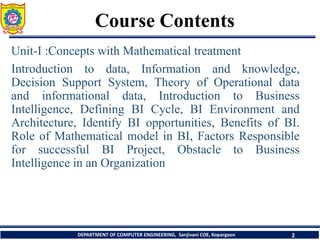
Course Contents
DEPARTMENT OF COMPUTER ENGINEERING, Sanjivani COE, Kopargaon 2
Unit-I :Concepts with Mathematical treatment
Introduction to data, Information and knowledge,
Decision Support System, Theory of Operational data
and informational data, Introduction to Business
Intelligence, Defining BI Cycle, BI Environment and
Architecture, Identify BI opportunities, Benefits of BI.
Role of Mathematical model in BI, Factors Responsible
for successful BI Project, Obstacle to Business
Intelligence in an Organization
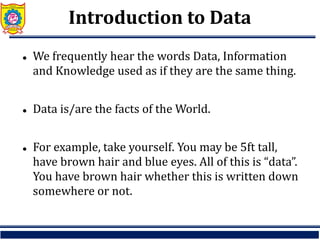
Introduction to Data
 We frequently hear the words Data, Information
and Knowledge used as if they are the same thing.
 Data is/are the facts of the World.
 For example, take yourself. You may be 5ft tall,
have brown hair and blue eyes. All of this is “data”.
You have brown hair whether this is written down
somewhere or not.
Data
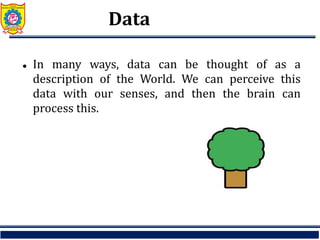
 In many ways, data can be thought of as a
description of the World. We can perceive this
data with our senses, and then the brain can
process this.
Information
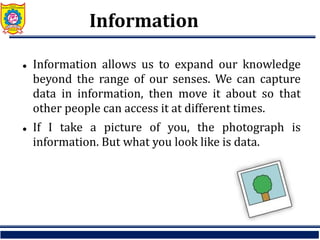
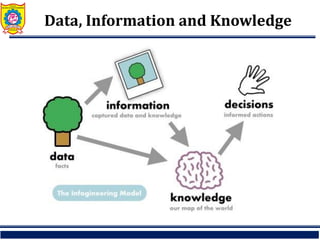
 Information allows us to expand our knowledge
beyond the range of our senses. We can capture
data in information, then move it about so that
other people can access it at different times.
 If I take a picture of you, the photograph is
information. But what you look like is data.
Knowledge
 Knowledge is what we know. Think
of this as the map of the World we
build inside our brains.
 Like a physical map, it helps us
know where things are – but it
contains more than that.
 It also contains our beliefs and
expectations. “If I do this, I will
probably get that.”
 Crucially, the brain links all these
things together into a giant
network of ideas, memories,
predictions, beliefs, etc.
Data, Information and Knowledge
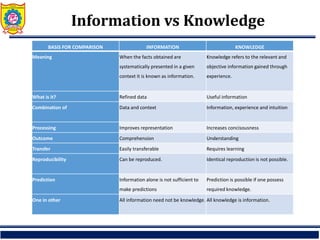
Information vs Knowledge
BASIS FOR COMPARISON INFORMATION KNOWLEDGE
Meaning When the facts obtained are
systematically presented in a given
context it is known as information.
Knowledge refers to the relevant and
objective information gained through
experience.
What is it? Refined data Useful information
Combination of Data and context Information, experience and intuition
Processing Improves representation Increases concisousness
Outcome Comprehension Understanding
Transfer Easily transferable Requires learning
Reproducibility Can be reproduced. Identical reproduction is not possible.
Prediction Information alone is not sufficient to
make predictions
Prediction is possible if one possess
required knowledge.
One in other All information need not be knowledge. All knowledge is information.

Unit I Data Information Knowledge.pdf

  • 1.
    Sanjivani Rural EducationSociety’s Sanjivani College of Engineering, Kopargaon-423 603 (An Autonomous Institute, Affiliated to Savitribai Phule Pune University, Pune) NACC ‘A’ Grade Accredited, ISO 9001:2015 Certified Department of Computer Engineering (NBA Accredited) Prof. S.A.Shivarkar Assistant Professor E-mail : shivarkarsandipcomp@sanjivani.org.in Contact No: 8275032712 Subject- Business Intelligence Unit-I: Concepts with Mathematical treatment
  • 2.
    Course Contents DEPARTMENT OFCOMPUTER ENGINEERING, Sanjivani COE, Kopargaon 2 Unit-I :Concepts with Mathematical treatment Introduction to data, Information and knowledge, Decision Support System, Theory of Operational data and informational data, Introduction to Business Intelligence, Defining BI Cycle, BI Environment and Architecture, Identify BI opportunities, Benefits of BI. Role of Mathematical model in BI, Factors Responsible for successful BI Project, Obstacle to Business Intelligence in an Organization
  • 3.
    Introduction to Data We frequently hear the words Data, Information and Knowledge used as if they are the same thing.  Data is/are the facts of the World.  For example, take yourself. You may be 5ft tall, have brown hair and blue eyes. All of this is “data”. You have brown hair whether this is written down somewhere or not.
  • 4.
    Data  In manyways, data can be thought of as a description of the World. We can perceive this data with our senses, and then the brain can process this.
  • 5.
    Information  Information allowsus to expand our knowledge beyond the range of our senses. We can capture data in information, then move it about so that other people can access it at different times.  If I take a picture of you, the photograph is information. But what you look like is data.
  • 6.
    Knowledge  Knowledge iswhat we know. Think of this as the map of the World we build inside our brains.  Like a physical map, it helps us know where things are – but it contains more than that.  It also contains our beliefs and expectations. “If I do this, I will probably get that.”  Crucially, the brain links all these things together into a giant network of ideas, memories, predictions, beliefs, etc.
  • 7.
  • 8.
    Information vs Knowledge BASISFOR COMPARISON INFORMATION KNOWLEDGE Meaning When the facts obtained are systematically presented in a given context it is known as information. Knowledge refers to the relevant and objective information gained through experience. What is it? Refined data Useful information Combination of Data and context Information, experience and intuition Processing Improves representation Increases concisousness Outcome Comprehension Understanding Transfer Easily transferable Requires learning Reproducibility Can be reproduced. Identical reproduction is not possible. Prediction Information alone is not sufficient to make predictions Prediction is possible if one possess required knowledge. One in other All information need not be knowledge. All knowledge is information.