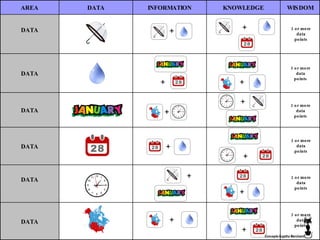
+ + + + + + 3 or more data points 3 or more data points 3 or more data points 3 or more data points 3 or more data points 3 or more data points DATA DATA WISDOM KNOWLEDGE INFORMATION DATA DATA DATA DATA DATA AREA + + + + + +
Hello there! I’m Dr.KnowHow. I work with the Knowledge Management team & I am the one with Story-Telling skills.  K 2
Story telling is a method by which a concept is taken and explained in a story-telling fashion, so the listener is not bored but is able to grasp the concept and store it in his memory!  K 2
So here I am today! I will try to explain the differences between data, information &knowledge and how they can be worked together.  K 2
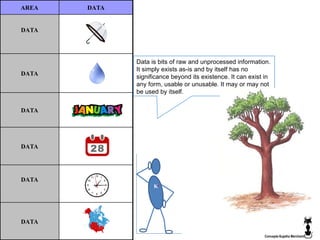
Data is bits of raw and unprocessed information. It simply exists as-is and by itself has no significance beyond its existence. It can exist in any form, usable or unusable. It may or may not be used by itself.  DATA DATA DATA DATA DATA DATA DATA AREA K 2
Data can exist in any form like numbers, words or symbols. An example of data being used by itself would be the symbols that you see on roads or on restroom doors. K 2
The only reason that the above bits of data make sense to you is because it immediately triggers your tacit memory for similar data to combine and become information in your head. K 2
DATA DATA DATA DATA DATA DATA DATA AREA K 2
Information is data that has been given meaning by way of relational connection which could be with mental associations or with other data. This "meaning" can be useful, or could be just information that does not serve any purpose! DATA DATA DATA DATA DATA DATA DATA AREA K 2
In reports that you see in monthly or weekly meetings, or the information that you get as part of quarterly/annual reports is bits of data put together to show what happened, when it happened, who was there and maybe could show ‘why’ to a certain extent. Information always depends heavily on the tacit information existing in your mind to convert information to knowledge. Many reporting tools that publish reports, fail, because it assumes a certain amount of existing knowledge of a topic on which repeated information is published. Sometimes this remains as information and doesn’t move into the next level where new knowledge is created and good decisions are taken. K 2
Information 1 Information one mentions that there is a possibility of rain and to bring and umbrella. + K 2
Information 2 Information two indicates the time in a certain geography. + K 2
Information 3 Information three is about a certain date when rain can be expected. + K 2
Information 4 Information four talks about rain in a certain geography + K 2
Information is usually insufficient by itself and depends heavily on previous know-how to make any additional sense of the new information. K 2
+ + + + + + DATA DATA KNOWLEDGE DATA DATA DATA DATA AREA K 2
+ + + + + + Knowledge is the appropriate collection of information, such that it's intent is to be useful. Usually data/ information that is presented in a way that it gives the user the complete information around a topic gives him good knowledge to take sensible business decisions. DATA DATA KNOWLEDGE DATA DATA DATA DATA AREA K 2
Knowledge 1 + K 2
Knowledge 1 Knowledge 2 + + K 2
Knowledge 1 Knowledge 2 Knowledge 3 + + + K 2
Knowledge 1 Knowledge 2 Knowledge 3 Knowledge 4 + + + K 2 +
Knowledge 1 Knowledge 2 Knowledge 3 Knowledge 5 Knowledge 4 + + + + K 2 +
Knowledge 1 Knowledge 2 Knowledge 3 Knowledge 5 Knowledge 6 Knowledge 4 + + + + + K 2 +
Knowledge 1 Knowledge 2 Knowledge 3 Knowledge 5 Knowledge 6 Combining the knowledge accumulated from various sources, a person has enough details around a topic. Now the most important piece of this processing, is the understanding that the person has already on the topic. When understanding is combined with knowledge, wise decisions can be made. Knowledge Management when combined with experienced individuals create High Performing Organizations. Knowledge 4 + + + + + K 2 +
K 2
DATA K 2
DATA CONNECTEDNESS K 2
DATA UNDERSTANDING CONNECTEDNESS K 2
DATA UNDERSTANDING CONNECTEDNESS INFORMATION K 2
DATA UNDERSTANDING CONNECTEDNESS INFORMATION KNOWLEDGE K 2
DATA UNDERSTANDING CONNECTEDNESS INFORMATION KNOWLEDGE WISDOM K 2
DATA UNDERSTANDING CONNECTEDNESS INFORMATION KNOWLEDGE WISDOM Undertsanding Relations K 2
DATA UNDERSTANDING CONNECTEDNESS INFORMATION KNOWLEDGE WISDOM Undertsanding Relations Undertsanding patterns K 2
DATA UNDERSTANDING CONNECTEDNESS INFORMATION KNOWLEDGE WISDOM Undertsanding Relations Undertsanding patterns Undertsanding principles K 2
DATA UNDERSTANDING CONNECTEDNESS INFORMATION KNOWLEDGE WISDOM Undertsanding Relations Undertsanding patterns Undertsanding principles Hope this session around data, information and knowledge was helpful to you. If you require further information please do contact me. We look forward to your questions around knowledge management. K 2
K 2 Thank you!

Data-Info-Knowledge

  • 1.
    + + ++ + + 3 or more data points 3 or more data points 3 or more data points 3 or more data points 3 or more data points 3 or more data points DATA DATA WISDOM KNOWLEDGE INFORMATION DATA DATA DATA DATA DATA AREA + + + + + +
  • 2.
    Hello there! I’mDr.KnowHow. I work with the Knowledge Management team & I am the one with Story-Telling skills. K 2
  • 3.
    Story telling isa method by which a concept is taken and explained in a story-telling fashion, so the listener is not bored but is able to grasp the concept and store it in his memory! K 2
  • 4.
    So here Iam today! I will try to explain the differences between data, information &knowledge and how they can be worked together. K 2
  • 5.
    Data is bitsof raw and unprocessed information. It simply exists as-is and by itself has no significance beyond its existence. It can exist in any form, usable or unusable. It may or may not be used by itself. DATA DATA DATA DATA DATA DATA DATA AREA K 2
  • 6.
    Data can existin any form like numbers, words or symbols. An example of data being used by itself would be the symbols that you see on roads or on restroom doors. K 2
  • 7.
    The only reasonthat the above bits of data make sense to you is because it immediately triggers your tacit memory for similar data to combine and become information in your head. K 2
  • 8.
    The only reasonthat the above bits of data make sense to you is because it immediately triggers your tacit memory for similar data to combine and become information in your head. K 2
  • 9.
    DATA DATA DATADATA DATA DATA DATA AREA K 2
  • 10.
    Information is datathat has been given meaning by way of relational connection which could be with mental associations or with other data. This "meaning" can be useful, or could be just information that does not serve any purpose! DATA DATA DATA DATA DATA DATA DATA AREA K 2
  • 11.
    In reports thatyou see in monthly or weekly meetings, or the information that you get as part of quarterly/annual reports is bits of data put together to show what happened, when it happened, who was there and maybe could show ‘why’ to a certain extent. Information always depends heavily on the tacit information existing in your mind to convert information to knowledge. Many reporting tools that publish reports, fail, because it assumes a certain amount of existing knowledge of a topic on which repeated information is published. Sometimes this remains as information and doesn’t move into the next level where new knowledge is created and good decisions are taken. K 2
  • 12.
    In reports thatyou see in monthly or weekly meetings, or the information that you get as part of quarterly/annual reports is bits of data put together to show what happened, when it happened, who was there and maybe could show ‘why’ to a certain extent. Information always depends heavily on the tacit information existing in your mind to convert information to knowledge. Many reporting tools that publish reports, fail, because it assumes a certain amount of existing knowledge of a topic on which repeated information is published. Sometimes this remains as information and doesn’t move into the next level where new knowledge is created and good decisions are taken. K 2
  • 13.
    Information 1 Informationone mentions that there is a possibility of rain and to bring and umbrella. + K 2
  • 14.
    Information 2 Informationtwo indicates the time in a certain geography. + K 2
  • 15.
    Information 3 Informationthree is about a certain date when rain can be expected. + K 2
  • 16.
    Information 4 Informationfour talks about rain in a certain geography + K 2
  • 17.
    Information is usuallyinsufficient by itself and depends heavily on previous know-how to make any additional sense of the new information. K 2
  • 18.
    + + ++ + + DATA DATA KNOWLEDGE DATA DATA DATA DATA AREA K 2
  • 19.
    + + ++ + + Knowledge is the appropriate collection of information, such that it's intent is to be useful. Usually data/ information that is presented in a way that it gives the user the complete information around a topic gives him good knowledge to take sensible business decisions. DATA DATA KNOWLEDGE DATA DATA DATA DATA AREA K 2
  • 20.
  • 21.
  • 22.
    Knowledge 1 Knowledge2 Knowledge 3 + + + K 2
  • 23.
    Knowledge 1 Knowledge2 Knowledge 3 Knowledge 4 + + + K 2 +
  • 24.
    Knowledge 1 Knowledge2 Knowledge 3 Knowledge 5 Knowledge 4 + + + + K 2 +
  • 25.
    Knowledge 1 Knowledge2 Knowledge 3 Knowledge 5 Knowledge 6 Knowledge 4 + + + + + K 2 +
  • 26.
    Knowledge 1 Knowledge2 Knowledge 3 Knowledge 5 Knowledge 6 Combining the knowledge accumulated from various sources, a person has enough details around a topic. Now the most important piece of this processing, is the understanding that the person has already on the topic. When understanding is combined with knowledge, wise decisions can be made. Knowledge Management when combined with experienced individuals create High Performing Organizations. Knowledge 4 + + + + + K 2 +
  • 27.
  • 28.
  • 29.
  • 30.
  • 31.
  • 32.
    DATA UNDERSTANDING CONNECTEDNESSINFORMATION KNOWLEDGE K 2
  • 33.
    DATA UNDERSTANDING CONNECTEDNESSINFORMATION KNOWLEDGE WISDOM K 2
  • 34.
    DATA UNDERSTANDING CONNECTEDNESSINFORMATION KNOWLEDGE WISDOM Undertsanding Relations K 2
  • 35.
    DATA UNDERSTANDING CONNECTEDNESSINFORMATION KNOWLEDGE WISDOM Undertsanding Relations Undertsanding patterns K 2
  • 36.
    DATA UNDERSTANDING CONNECTEDNESSINFORMATION KNOWLEDGE WISDOM Undertsanding Relations Undertsanding patterns Undertsanding principles K 2
  • 37.
    DATA UNDERSTANDING CONNECTEDNESSINFORMATION KNOWLEDGE WISDOM Undertsanding Relations Undertsanding patterns Undertsanding principles Hope this session around data, information and knowledge was helpful to you. If you require further information please do contact me. We look forward to your questions around knowledge management. K 2
  • 38.

Editor's Notes

  • #2 Lets start with a slide that covers data, information and knowledge. If we take a simple subject like rain, you would notice that the data column has raw bits like an umbrella, or a month, time etc. Two or more data points become information. This may or may not make sense to the user. When a pattern or trend is arrived at by bringing together 2 or more bits of information, then we see knowledge that we can use to make informed decisions. Lets move on to the next slide!