CLIL UNIT


THE ANIMALS
GROUP OF STUDENTS

   This didactic unit is directed to the 3rd cycle of
  Primary education, specifically for the first course.
 The characteristics of our session are designed for a
  group of 25 students.These students are considered
mature enough and able to work in an independent way.
 In general, we can say that our students have not had
               problems learning English.
   Regarding their education levels, our pupils are of
                     mixed-abilities.
Considering their social development, the group is quite
    cohesive, without any kind of problems. They are
 restless children, full of energy, but they are not too
                        disruptive.
OBJECTIVES

Main objective:
 To learn about different animals and how they live.
Secondary objectives:
 To classify animals in the correct category.
 To learn and appreciate the abilities of animals.
 To establish dialogues with peers and the teacher using the
  vocabulary learned.
 To use the vocabulary learned to describe pictures.
 To understand morphological characteristics of animals and what
  they eat.
CONTENTS TO BE DEVELOPED

Concepts
 - Animal characteristics and parts of the body.
Procedures
 Classification of animals: mammals, birds, reptiles, amphibians, fish,
  insects.
 Oral comprehension and expression during interactions with peers
  or the teacher.
 Reading of a short story “Mom and I” (about animals and their
  babies).
 Elaboration of wallchart containing animals pictures and their
  descriptions.
Attitudes
 - Rules that respect nature and its creatures.
SEQUENCING OF ACTIVITIES AND TIMING
                ACTIVITIES
They are varied, meaningful, entertaining, but informative. Among them we can find:
BLOCK 1: LISTENING, SPEAKING, AND ORAL INTERACTION:
 Presentation and revision of vocabulary through flashcards. (5 minutes).
 Listening to the teacher´s explanations while visiting this site:
 www.sheppardsoftware.com/content/animals/kidscorner/clasification/kc_classification-
  reptiles.htm (10 minutes).
 They will learn a song about animals. (4 minutes).
BLOCK 2: READING AND WRITING:
 Shortreading “Mom and I” (to learn more about the animals and their babies). (10
  minutes).
 Have the students write a description of an animal at home and bring it to the next
  class. (6 minutes).
BLOCK 3: LANGUAGE AWARENESS AND REFLECTIONS ON LEARNING:
 Four corners game: in the playground, there are four labels, one in each corner. They
  say: “mammals, reptiles and amphibians, birds and fish”. The teacher shows a picture of
  an animal and children will have to run and touch the correct label. (10 minutes).
 Pupils mix the descriptions and the pictures, and they choose one. (5 minutes). Then they
  will have to find the matching cards.
SEQUENCING OF ACTIVITIES AND TIMING
              ACTIVITIES
These are the four aspects on which the CLIL approach is base:
 Autonomous learning.
 Cooperative learning.
 Task- based approach.
 Learner centred.
There are also other aspects to bear in mind:
 Students will be in contact with significant communicative and comprehensible data, which are
  near to their interests.
 The previous knowledge of the unit will be taken into account.
 Students should learn to learn, on their own they should be provided with strategies that will
  allow them to develop autonomous learning.
 We should promote the pupils´positive attitudes towards the foreign language, towards their
  peers and themselves, given the importance of emotional factors in present- day society.
 Clearly structured presentation of content.
 Coherent concepts adapted to the psychological structure and knowledge of students.
 Use of stimulating activities and promoting active teaching.
 Provide opportunities for students to check and apply the acquired knowledge and awareness of
  the usefulness of such learning.
 Development of capabilities that can be applied to all areas and contexts in which children
  operate.
 Attention to student diversity.
 Adapt the use of different resources to the objetives to be achieved.

This didactic unit is prepared for the second course term, to be developed in May.
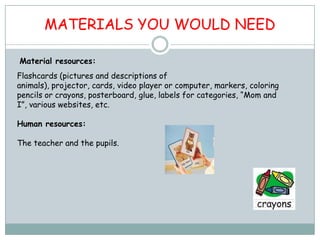
MATERIALS YOU WOULD NEED

Material resources:
Flashcards (pictures and descriptions of
animals), projector, cards, video player or computer, markers, coloring
pencils or crayons, posterboard, glue, labels for categories, “Mom and
I”, various websites, etc.

Human resources:

The teacher and the pupils.
SPECIFIF MEASURES FOR DIVERSITY/ STUDENTS
WICH SPECIFIC EDUCATIONAL NEEDS IF NECESSARY

 Activities to reinforce the lessons for children who don´t learn as
  quickly.


 - Activities for advanced students who might complete the basic
  activities much faster than others or who learn faster than others.
BASIC COMPETENCES THAT WILL BE
                  DEVELOPED
All through this unit, we will deal with all the basic competences, but specially with the following
    ones:
 Linguistic communication: we will try to promote reading (story “Mom and I”); and we will use
    the English language to communicate in the classrom. Students will also have to learn and use the
    vocabulary related to the unit.
 Knowledge of the environment: all through this unit, students will acquire some basic ideas about
    the characteristics of the different groups of animals.
 Information processing and digital competence: we will make use of varied websites, and use the
    internet to introduce the vocabulary that we need. Children will also play games and have fun using
    the technology.
 Social and civic competence: students will assume that animals are part of our daily life.
    Students will learn how to look after their pets regarding rules of hygiene, affective aspects, etc.
 Cultural and artistic competence: students will be provided with pictures to colour, to make, the
    final task “animal wallchart”. Inadolition, they will play “Scrabble”, and they will have to draw the
    animals as accurately as possible.
 Autonomy and personal iniciative: we will try to improve the pupils´ interactions with animals
    (including their pets).
EVALUATION CRITERIA FOR THE SESSION
Evaluation stages:
   Initial evaluation: to be carried out at the beginning of the Clil Unit to check what students
    know about the topic.
   Formative evaluation: to be carried out through the constant observation of the pupils
    performances, attitudes and participation in the proposed activities.
   Final evaluation: to take place at the end of the Clil Unit for the final task designed for
    the Clil Unit (the animal wallchart).

Assessment instruments:
   Direct observation in class.
   Personal evaluation sheets.
   Behaviours board and evaluation board.
   Self evaluation worksheets (they think about their own participation, behaviour in class
    too).
   Coevaluation: when doing games, crafts, activities or songs, our pupils can be the jury. It
    is also possible when doing pairwork, too.
   Evaluation criteria.
   The students portfolio.
   Final task “the animal wallchart”.
BIBLIOGRAPHY

 “Abre la puerta” Conocimiento del medio, 5º de educación Primaria.
  Editorial Anaya.
 www.sheppardsoftware.com/content/animals/kidscorner/classification
  /kc_classification-reptiles.htm

   http://www.educarm.es/udicom/unid8.htm

   http://www.eslkidsworld.com

   www.doredin.mec.es/documentos/00620082000170

   www.youtube.com/watch?=AB2CdXVKDWs

   www.youtube.com/watch?=E84UVMU6MY4

Unit clil.

  • 1.
  • 2.
    GROUP OF STUDENTS This didactic unit is directed to the 3rd cycle of Primary education, specifically for the first course. The characteristics of our session are designed for a group of 25 students.These students are considered mature enough and able to work in an independent way. In general, we can say that our students have not had problems learning English. Regarding their education levels, our pupils are of mixed-abilities. Considering their social development, the group is quite cohesive, without any kind of problems. They are restless children, full of energy, but they are not too disruptive.
  • 3.
    OBJECTIVES Main objective:  Tolearn about different animals and how they live. Secondary objectives:  To classify animals in the correct category.  To learn and appreciate the abilities of animals.  To establish dialogues with peers and the teacher using the vocabulary learned.  To use the vocabulary learned to describe pictures.  To understand morphological characteristics of animals and what they eat.
  • 4.
    CONTENTS TO BEDEVELOPED Concepts  - Animal characteristics and parts of the body. Procedures  Classification of animals: mammals, birds, reptiles, amphibians, fish, insects.  Oral comprehension and expression during interactions with peers or the teacher.  Reading of a short story “Mom and I” (about animals and their babies).  Elaboration of wallchart containing animals pictures and their descriptions. Attitudes  - Rules that respect nature and its creatures.
  • 5.
    SEQUENCING OF ACTIVITIESAND TIMING ACTIVITIES They are varied, meaningful, entertaining, but informative. Among them we can find: BLOCK 1: LISTENING, SPEAKING, AND ORAL INTERACTION:  Presentation and revision of vocabulary through flashcards. (5 minutes).  Listening to the teacher´s explanations while visiting this site:  www.sheppardsoftware.com/content/animals/kidscorner/clasification/kc_classification- reptiles.htm (10 minutes).  They will learn a song about animals. (4 minutes). BLOCK 2: READING AND WRITING:  Shortreading “Mom and I” (to learn more about the animals and their babies). (10 minutes).  Have the students write a description of an animal at home and bring it to the next class. (6 minutes). BLOCK 3: LANGUAGE AWARENESS AND REFLECTIONS ON LEARNING:  Four corners game: in the playground, there are four labels, one in each corner. They say: “mammals, reptiles and amphibians, birds and fish”. The teacher shows a picture of an animal and children will have to run and touch the correct label. (10 minutes).  Pupils mix the descriptions and the pictures, and they choose one. (5 minutes). Then they will have to find the matching cards.
  • 6.
    SEQUENCING OF ACTIVITIESAND TIMING ACTIVITIES These are the four aspects on which the CLIL approach is base:  Autonomous learning.  Cooperative learning.  Task- based approach.  Learner centred. There are also other aspects to bear in mind:  Students will be in contact with significant communicative and comprehensible data, which are near to their interests.  The previous knowledge of the unit will be taken into account.  Students should learn to learn, on their own they should be provided with strategies that will allow them to develop autonomous learning.  We should promote the pupils´positive attitudes towards the foreign language, towards their peers and themselves, given the importance of emotional factors in present- day society.  Clearly structured presentation of content.  Coherent concepts adapted to the psychological structure and knowledge of students.  Use of stimulating activities and promoting active teaching.  Provide opportunities for students to check and apply the acquired knowledge and awareness of the usefulness of such learning.  Development of capabilities that can be applied to all areas and contexts in which children operate.  Attention to student diversity.  Adapt the use of different resources to the objetives to be achieved. This didactic unit is prepared for the second course term, to be developed in May.
  • 7.
    MATERIALS YOU WOULDNEED Material resources: Flashcards (pictures and descriptions of animals), projector, cards, video player or computer, markers, coloring pencils or crayons, posterboard, glue, labels for categories, “Mom and I”, various websites, etc. Human resources: The teacher and the pupils.
  • 8.
    SPECIFIF MEASURES FORDIVERSITY/ STUDENTS WICH SPECIFIC EDUCATIONAL NEEDS IF NECESSARY  Activities to reinforce the lessons for children who don´t learn as quickly.  - Activities for advanced students who might complete the basic activities much faster than others or who learn faster than others.
  • 9.
    BASIC COMPETENCES THATWILL BE DEVELOPED All through this unit, we will deal with all the basic competences, but specially with the following ones:  Linguistic communication: we will try to promote reading (story “Mom and I”); and we will use the English language to communicate in the classrom. Students will also have to learn and use the vocabulary related to the unit.  Knowledge of the environment: all through this unit, students will acquire some basic ideas about the characteristics of the different groups of animals.  Information processing and digital competence: we will make use of varied websites, and use the internet to introduce the vocabulary that we need. Children will also play games and have fun using the technology.  Social and civic competence: students will assume that animals are part of our daily life. Students will learn how to look after their pets regarding rules of hygiene, affective aspects, etc.  Cultural and artistic competence: students will be provided with pictures to colour, to make, the final task “animal wallchart”. Inadolition, they will play “Scrabble”, and they will have to draw the animals as accurately as possible.  Autonomy and personal iniciative: we will try to improve the pupils´ interactions with animals (including their pets).
  • 10.
    EVALUATION CRITERIA FORTHE SESSION Evaluation stages:  Initial evaluation: to be carried out at the beginning of the Clil Unit to check what students know about the topic.  Formative evaluation: to be carried out through the constant observation of the pupils performances, attitudes and participation in the proposed activities.  Final evaluation: to take place at the end of the Clil Unit for the final task designed for the Clil Unit (the animal wallchart). Assessment instruments:  Direct observation in class.  Personal evaluation sheets.  Behaviours board and evaluation board.  Self evaluation worksheets (they think about their own participation, behaviour in class too).  Coevaluation: when doing games, crafts, activities or songs, our pupils can be the jury. It is also possible when doing pairwork, too.  Evaluation criteria.  The students portfolio.  Final task “the animal wallchart”.
  • 11.
    BIBLIOGRAPHY  “Abre lapuerta” Conocimiento del medio, 5º de educación Primaria. Editorial Anaya.  www.sheppardsoftware.com/content/animals/kidscorner/classification /kc_classification-reptiles.htm  http://www.educarm.es/udicom/unid8.htm  http://www.eslkidsworld.com  www.doredin.mec.es/documentos/00620082000170  www.youtube.com/watch?=AB2CdXVKDWs  www.youtube.com/watch?=E84UVMU6MY4