UNIT:
ANIMALS
Ester Pastor Ibáñez
Metodología para la enseñanza plurilingüe y el
aprendizaje de lenguas extranjeras.
Group:Intensive
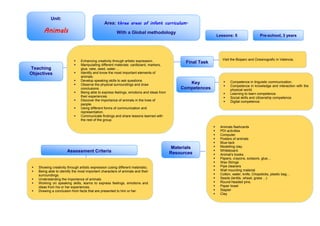
TTeeaacchhiinngg
OObbjjeeccttiivveess
UUnniitt::
AAnniimmaallss
 Enhancing creativity through artistic expression.
 Manipulating different materials: cardboard, markers,
glue, rake, seed, water ...
 Identify and know the most important elements of
animals.
 Develop speaking skills to ask questions
 Observe the physical surroundings and draw
conclusions.
 Being able to express feelings, emotions and ideas from
their experiences.
 Discover the importance of animals in the lives of
people.
 Using different forms of communication and
representation.
 Communicate findings and share lessons learned with
the rest of the group.
LLeessssoonnss:: 55




FFiinnaall TTaasskk
Visit the Bioparc and Oceanografic in Valencia.
AAsssseessssmmeenntt CCrriitteerriiaa
 Showing creativity through artistic expression (using different materials).
 Being able to identify the most important characters of animals and their
surroundings.
 Understanding the importance of animals.
 Working on speaking skills, learns to express feelings, emotions and
ideas from his or her experiences.
 Drawing a conclusion from facts that are presented to him or her.
MMaatteerriiaallss
Resources
KKeeyy
CCoommppeetteenncceess
 Competence in linguistic communication.
 Competence in knowledge and interaction with the
physical world.
 Learning to learn competence.
 Social skills and citizenship competence.
 Digital competence.
 Animals flashcards
 PDI activities
 Computer
 Posters of animals
 Blue-tack
 Modelling clay.
 Whiteboard.
 Animal’s books.
 Papers, crayons, scissors, glue…
 Wax Strings
 Pipe cleaners
 Wall mounting material
 Cotton, water, knife, Chopsticks, plastic bag…
 Seeds (lentils, wheat, grass ...)
 Round-headed pins.
 Paper towel
 Stapler
 Clay
AArreeaa:: tthhrreeee aarreeaass ooff iinnffaanntt ccuurrrriiccuulluumm..
WWiitthh aa GGlloobbaall mmeetthhooddoollooggyy
PPrree--sscchhooooll,, 33 yyeeaarrss




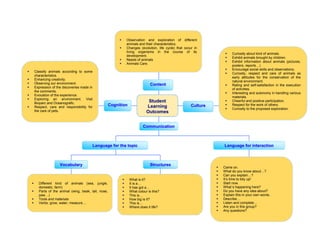
 Observation and exploration of different
animals and their characteristics.
 Changes (evolution, life cycle) that occur in
living organisms in the course of its
development.
 Needs of animals
 Animals Care.
CCoommmmuunniiccaattiioonn
CCuullttuurree




 Curiosity about kind of animals.
 Exhibit animals brought by children.
 Exhibit information about animals (pictures,
posters, reports…)
 Encourage social skills and observations.
 Curiosity, respect and care of animals as
early attitudes for the conservation of the
natural environment.
 Rating and self-satisfaction in the execution
of activities.
 Interesting and autonomy in handling various
materials.
 Cheerful and positive participation.
 Respect for the work of others.
 Curiosity to the proposed exploration.
SSttrruuccttuurreess




VVooccaabbuullaarryy




LLaanngguuaaggee ffoorr iinntteerraaccttiioonn




 What is it?
 It is a…
 It has got a…
 What colour is this?
 This is…
 How big is it?
 This is…
 Where does it life?
 Came on.
 What do you know about…?
 Can you explain…?
 It’s time to tidy up!
 Start now.
 What´s happening here?
 Do you have any idea about?
 Explain this in your own words.
 Describe…
 Listen and complete…
 Are you in this group?
 Any questions?
SSttuuddeenntt
LLeeaarrnniinngg
OOuuttccoommeess
CCooggnniittiioonn
CCoonntteenntt
 Classify animals according to some
characteristics.
 Enhancing creativity.
 Observing our environment.
 Expression of the discoveries made in
the comments.
 Evocation of the experience.
 Exploring an environment. Visit
Bioparc and Oceanografic.
 Respect, care and responsibility for
the care of pets.
LLaanngguuaaggee ffoorr tthhee ttooppiicc




 Different kind of animals (sea, jungle,
domestic, farm)
 Parts of the animal (wing, beak, tail, nose,
paw…)
 Tools and materials
 Verbs: grow, water, measure…
UUnniitt::
AANNIIMMAALLSS




AAsssseessssmmeenntt//
RReefflleeccttiioonn
WWaanntt ttoo kknnooww//
RReeiinnffoorrcceemmeenntt//
EExxtteennssiioonn
MMaaiinn
AAccttiivviittiieess
Introduction/
RReevviissiioonn
Warm up
Activities
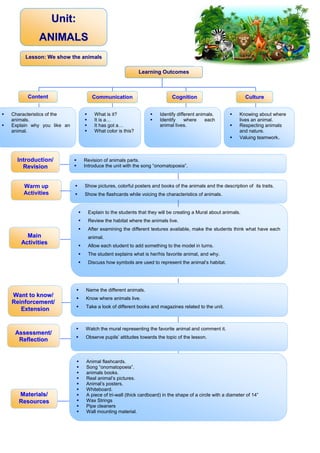
 Show pictures, colorful posters and books of the animals and the description of its traits.
 Show the flashcards while voicing the characteristics of animals.
 Revision of animals parts.
 Introduce the unit with the song “onomatopoeia”.
 Explain to the students that they will be creating a Mural about animals.
 Review the habitat where the animals live.
 After examining the different textures available, make the students think what have each
animal.
 Allow each student to add something to the model in turns.
 The student explains what is her/his favorite animal, and why.
 Discuss how symbols are used to represent the animal’s habitat.
 Name the different animals.
 Know where animals live.
 Take a look of different books and magazines related to the unit.
 Watch the mural representing the favorite animal and comment it.
 Observe pupils’ attitudes towards the topic of the lesson.
LLeeaarrnniinngg OOuuttccoommeess




 Knowing about where
lives an animal.
 Respecting animals
and nature.
 Valuing teamwork.
 What is it?
 It is a…
 It has got a…
 What color is this?
 Characteristics of the
animals.
 Explain why you like an
animal.
 Identify different animals.
 Identify where each
animal lives.
CCoommmmuunniiccaattiioonn




CCooggnniittiioonn




CCuullttuurree




CCoonntteenntt




 Animal flashcards.
 Song “onomatopoeia”.
 animals books.
 Real animal’s pictures.
 Animal’s posters.
 Whiteboard.
 A piece of tri-wall (thick cardboard) in the shape of a circle with a diameter of 14”
 Wax Strings
 Pipe cleaners
 Wall mounting material.
MMaatteerriiaallss//
RReessoouurrcceess
LLeessssoonn:: WWee sshhooww tthhee aanniimmaallss




AAsssseessssmmeenntt//
RReefflleeccttiioonn
WWaanntt ttoo kknnooww//
RReeiinnffoorrcceemmeenntt//
EExxtteennssiioonn
MMaaiinn
AAccttiivviittiieess
Introduction/
RReevviissiioonn
Warm up
Activities
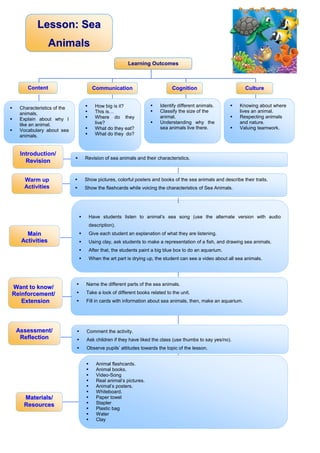
 Show pictures, colorful posters and books of the sea animals and describe their traits.
 Show the flashcards while voicing the characteristics of Sea Animals.
 Revision of sea animals and their characteristics.
 Have students listen to animal’s sea song (use the alternate version with audio
description).
 Give each student an explanation of what they are listening.
 Using clay, ask students to make a representation of a fish, and drawing sea animals.
 After that, the students paint a big blue box to do an aquarium.
 When the art part is drying up, the student can see a video about all sea animals.
 Name the different parts of the sea animals.
 Take a look of different books related to the unit.
 Fill in cards with information about sea animals, then, make an aquarium.
 Comment the activity.
 Ask children if they have liked the class (use thumbs to say yes/no).
 Observe pupils’ attitudes towards the topic of the lesson.
 Work properly with other classmates.

LLeeaarrnniinngg OOuuttccoommeess




 Knowing about where
lives an animal.
 Respecting animals
and nature.
 Valuing teamwork.
 How big is it?
 This is…
 Where do they
live?
 What do they eat?
 What do they do?
 Characteristics of the
animals.
 Explain about why I
like an animal.
 Vocabulary about sea
animals.
 Identify different animals.
 Classify the size of the
animal.
 Understanding why the
sea animals live there.
CCoommmmuunniiccaattiioonn




CCooggnniittiioonn




CCuullttuurree




CCoonntteenntt




 Animal flashcards.
 Animal books.
 Video-Song
 Real animal’s pictures.
 Animal’s posters.
 Whiteboard.
 Paper towel
 Stapler
 Plastic bag
 Water
 Clay
MMaatteerriiaallss//
RReessoouurrcceess
LLeessssoonn:: SSeeaa
AAnniimmaallss




AAsssseessssmmeenntt//
RReefflleeccttiioonn
WWaanntt ttoo kknnooww//
RReeiinnffoorrcceemmeenntt//
EExxtteennssiioonn
MMaaiinn
AAccttiivviittiieess
Introduction/
RReevviissiioonn
Warm up
Activities
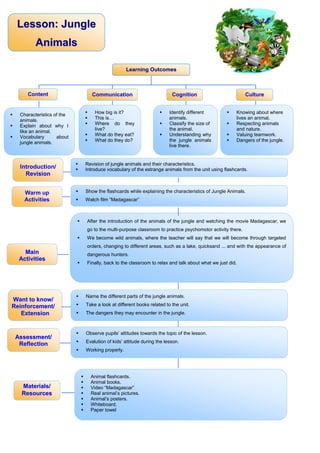
 Show the flashcards while explaining the characteristics of Jungle Animals.
 Watch film “Madagascar”
 Revision of jungle animals and their characteristics.
 Introduce vocabulary of the estrange animals from the unit using flashcards.
 After the introduction of the animals of the jungle and watching the movie Madagascar, we
go to the multi-purpose classroom to practice psychomotor activity there.
 We become wild animals, where the teacher will say that we will become through targeted
orders, changing to different areas, such as a lake, quicksand ... and with the appearance of
dangerous hunters.
 Finally, back to the classroom to relax and talk about what we just did.
 Name the different parts of the jungle animals.
 Take a look at different books related to the unit.
 The dangers they may encounter in the jungle.
 Observe pupils’ attitudes towards the topic of the lesson.
 Evalution of kids’ attitude during the lesson.
 Working properly.
LLeeaarrnniinngg OOuuttccoommeess




 Knowing about where
lives an animal.
 Respecting animals
and nature.
 Valuing teamwork.
 Dangers of the jungle.
 How big is it?
 This is…
 Where do they
live?
 What do they eat?
 What do they do?
 Characteristics of the
animals.
 Explain about why I
like an animal.
 Vocabulary about
jungle animals.
 Identify different
animals.
 Classify the size of
the animal.
 Understanding why
the jungle animals
live there.
CCoommmmuunniiccaattiioonn




CCooggnniittiioonn




CCuullttuurree




CCoonntteenntt




 Animal flashcards.
 Animal books.
 Video “Madagascar”
 Real animal’s pictures.
 Animal’s posters.
 Whiteboard.
 Paper towel
MMaatteerriiaallss//
RReessoouurrcceess
LLeessssoonn:: JJuunnggllee
AAnniimmaallss




AAsssseessssmmeenntt//
RReefflleeccttiioonn
WWaanntt ttoo kknnooww//
RReeiinnffoorrcceemmeenntt//
EExxtteennssiioonn
MMaaiinn
AAccttiivviittiieess
Introduction/
RReevviissiioonn
Warm up
Activities
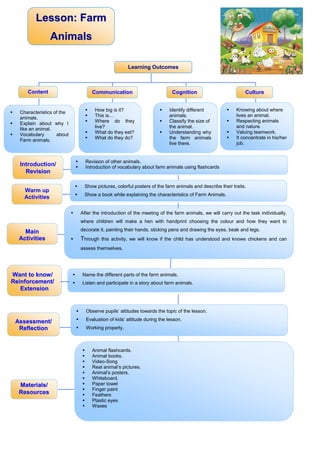
 Show pictures, colorful posters of the farm animals and describe their traits.
 Show a book while explaining the characteristics of Farm Animals.

 Revision of other animals.
 Introduction of vocabulary about farm animals using flashcards
 After the introduction of the meeting of the farm animals, we will carry out the task individually,
where children will make a hen with handprint choosing the colour and how they want to
decorate it, painting their hands, sticking pens and drawing the eyes, beak and legs.
 Through this activity, we will know if the child has understood and knows chickens and can
assess themselves.
 Name the different parts of the farm animals.
 Listen and participate in a story about farm animals.
 Observe pupils’ attitudes towards the topic of the lesson.
 Evaluation of kids’ attitude during the lesson.
 Working properly.
LLeeaarrnniinngg OOuuttccoommeess




 Knowing about where
lives an animal.
 Respecting animals
and nature.
 Valuing teamwork.
 It concentrate in his/her
job.
 How big is it?
 This is…
 Where do they
live?
 What do they eat?
 What do they do?
 Characteristics of the
animals.
 Explain about why I
like an animal.
 Vocabulary about
Farm animals.
 Identify different
animals.
 Classify the size of
the animal.
 Understanding why
the farm animals
live there.
CCoommmmuunniiccaattiioonn




CCooggnniittiioonn




CCuullttuurree




CCoonntteenntt




 Animal flashcards.
 Animal books.
 Video-Song
 Real animal’s pictures.
 Animal’s posters.
 Whiteboard.
 Paper towel
 Finger paint
 Feathers
 Plastic eyes
 Waxes
MMaatteerriiaallss//
RReessoouurrcceess
LLeessssoonn:: FFaarrmm
AAnniimmaallss





Todo ud

  • 1.
    UNIT: ANIMALS Ester Pastor Ibáñez Metodologíapara la enseñanza plurilingüe y el aprendizaje de lenguas extranjeras. Group:Intensive
  • 2.
    TTeeaacchhiinngg OObbjjeeccttiivveess UUnniitt:: AAnniimmaallss  Enhancing creativitythrough artistic expression.  Manipulating different materials: cardboard, markers, glue, rake, seed, water ...  Identify and know the most important elements of animals.  Develop speaking skills to ask questions  Observe the physical surroundings and draw conclusions.  Being able to express feelings, emotions and ideas from their experiences.  Discover the importance of animals in the lives of people.  Using different forms of communication and representation.  Communicate findings and share lessons learned with the rest of the group. LLeessssoonnss:: 55     FFiinnaall TTaasskk Visit the Bioparc and Oceanografic in Valencia. AAsssseessssmmeenntt CCrriitteerriiaa  Showing creativity through artistic expression (using different materials).  Being able to identify the most important characters of animals and their surroundings.  Understanding the importance of animals.  Working on speaking skills, learns to express feelings, emotions and ideas from his or her experiences.  Drawing a conclusion from facts that are presented to him or her. MMaatteerriiaallss Resources KKeeyy CCoommppeetteenncceess  Competence in linguistic communication.  Competence in knowledge and interaction with the physical world.  Learning to learn competence.  Social skills and citizenship competence.  Digital competence.  Animals flashcards  PDI activities  Computer  Posters of animals  Blue-tack  Modelling clay.  Whiteboard.  Animal’s books.  Papers, crayons, scissors, glue…  Wax Strings  Pipe cleaners  Wall mounting material  Cotton, water, knife, Chopsticks, plastic bag…  Seeds (lentils, wheat, grass ...)  Round-headed pins.  Paper towel  Stapler  Clay AArreeaa:: tthhrreeee aarreeaass ooff iinnffaanntt ccuurrrriiccuulluumm.. WWiitthh aa GGlloobbaall mmeetthhooddoollooggyy PPrree--sscchhooooll,, 33 yyeeaarrss    
  • 3.
     Observation andexploration of different animals and their characteristics.  Changes (evolution, life cycle) that occur in living organisms in the course of its development.  Needs of animals  Animals Care. CCoommmmuunniiccaattiioonn CCuullttuurree      Curiosity about kind of animals.  Exhibit animals brought by children.  Exhibit information about animals (pictures, posters, reports…)  Encourage social skills and observations.  Curiosity, respect and care of animals as early attitudes for the conservation of the natural environment.  Rating and self-satisfaction in the execution of activities.  Interesting and autonomy in handling various materials.  Cheerful and positive participation.  Respect for the work of others.  Curiosity to the proposed exploration. SSttrruuccttuurreess     VVooccaabbuullaarryy     LLaanngguuaaggee ffoorr iinntteerraaccttiioonn      What is it?  It is a…  It has got a…  What colour is this?  This is…  How big is it?  This is…  Where does it life?  Came on.  What do you know about…?  Can you explain…?  It’s time to tidy up!  Start now.  What´s happening here?  Do you have any idea about?  Explain this in your own words.  Describe…  Listen and complete…  Are you in this group?  Any questions? SSttuuddeenntt LLeeaarrnniinngg OOuuttccoommeess CCooggnniittiioonn CCoonntteenntt  Classify animals according to some characteristics.  Enhancing creativity.  Observing our environment.  Expression of the discoveries made in the comments.  Evocation of the experience.  Exploring an environment. Visit Bioparc and Oceanografic.  Respect, care and responsibility for the care of pets. LLaanngguuaaggee ffoorr tthhee ttooppiicc      Different kind of animals (sea, jungle, domestic, farm)  Parts of the animal (wing, beak, tail, nose, paw…)  Tools and materials  Verbs: grow, water, measure…
  • 4.
    UUnniitt:: AANNIIMMAALLSS     AAsssseessssmmeenntt// RReefflleeccttiioonn WWaanntt ttoo kknnooww// RReeiinnffoorrcceemmeenntt// EExxtteennssiioonn MMaaiinn AAccttiivviittiieess Introduction/ RReevviissiioonn Warmup Activities  Show pictures, colorful posters and books of the animals and the description of its traits.  Show the flashcards while voicing the characteristics of animals.  Revision of animals parts.  Introduce the unit with the song “onomatopoeia”.  Explain to the students that they will be creating a Mural about animals.  Review the habitat where the animals live.  After examining the different textures available, make the students think what have each animal.  Allow each student to add something to the model in turns.  The student explains what is her/his favorite animal, and why.  Discuss how symbols are used to represent the animal’s habitat.  Name the different animals.  Know where animals live.  Take a look of different books and magazines related to the unit.  Watch the mural representing the favorite animal and comment it.  Observe pupils’ attitudes towards the topic of the lesson. LLeeaarrnniinngg OOuuttccoommeess      Knowing about where lives an animal.  Respecting animals and nature.  Valuing teamwork.  What is it?  It is a…  It has got a…  What color is this?  Characteristics of the animals.  Explain why you like an animal.  Identify different animals.  Identify where each animal lives. CCoommmmuunniiccaattiioonn     CCooggnniittiioonn     CCuullttuurree     CCoonntteenntt      Animal flashcards.  Song “onomatopoeia”.  animals books.  Real animal’s pictures.  Animal’s posters.  Whiteboard.  A piece of tri-wall (thick cardboard) in the shape of a circle with a diameter of 14”  Wax Strings  Pipe cleaners  Wall mounting material. MMaatteerriiaallss// RReessoouurrcceess LLeessssoonn:: WWee sshhooww tthhee aanniimmaallss    
  • 5.
    AAsssseessssmmeenntt// RReefflleeccttiioonn WWaanntt ttoo kknnooww// RReeiinnffoorrcceemmeenntt// EExxtteennssiioonn MMaaiinn AAccttiivviittiieess Introduction/ RReevviissiioonn Warmup Activities  Show pictures, colorful posters and books of the sea animals and describe their traits.  Show the flashcards while voicing the characteristics of Sea Animals.  Revision of sea animals and their characteristics.  Have students listen to animal’s sea song (use the alternate version with audio description).  Give each student an explanation of what they are listening.  Using clay, ask students to make a representation of a fish, and drawing sea animals.  After that, the students paint a big blue box to do an aquarium.  When the art part is drying up, the student can see a video about all sea animals.  Name the different parts of the sea animals.  Take a look of different books related to the unit.  Fill in cards with information about sea animals, then, make an aquarium.  Comment the activity.  Ask children if they have liked the class (use thumbs to say yes/no).  Observe pupils’ attitudes towards the topic of the lesson.  Work properly with other classmates.  LLeeaarrnniinngg OOuuttccoommeess      Knowing about where lives an animal.  Respecting animals and nature.  Valuing teamwork.  How big is it?  This is…  Where do they live?  What do they eat?  What do they do?  Characteristics of the animals.  Explain about why I like an animal.  Vocabulary about sea animals.  Identify different animals.  Classify the size of the animal.  Understanding why the sea animals live there. CCoommmmuunniiccaattiioonn     CCooggnniittiioonn     CCuullttuurree     CCoonntteenntt      Animal flashcards.  Animal books.  Video-Song  Real animal’s pictures.  Animal’s posters.  Whiteboard.  Paper towel  Stapler  Plastic bag  Water  Clay MMaatteerriiaallss// RReessoouurrcceess LLeessssoonn:: SSeeaa AAnniimmaallss    
  • 6.
    AAsssseessssmmeenntt// RReefflleeccttiioonn WWaanntt ttoo kknnooww// RReeiinnffoorrcceemmeenntt// EExxtteennssiioonn MMaaiinn AAccttiivviittiieess Introduction/ RReevviissiioonn Warmup Activities  Show the flashcards while explaining the characteristics of Jungle Animals.  Watch film “Madagascar”  Revision of jungle animals and their characteristics.  Introduce vocabulary of the estrange animals from the unit using flashcards.  After the introduction of the animals of the jungle and watching the movie Madagascar, we go to the multi-purpose classroom to practice psychomotor activity there.  We become wild animals, where the teacher will say that we will become through targeted orders, changing to different areas, such as a lake, quicksand ... and with the appearance of dangerous hunters.  Finally, back to the classroom to relax and talk about what we just did.  Name the different parts of the jungle animals.  Take a look at different books related to the unit.  The dangers they may encounter in the jungle.  Observe pupils’ attitudes towards the topic of the lesson.  Evalution of kids’ attitude during the lesson.  Working properly. LLeeaarrnniinngg OOuuttccoommeess      Knowing about where lives an animal.  Respecting animals and nature.  Valuing teamwork.  Dangers of the jungle.  How big is it?  This is…  Where do they live?  What do they eat?  What do they do?  Characteristics of the animals.  Explain about why I like an animal.  Vocabulary about jungle animals.  Identify different animals.  Classify the size of the animal.  Understanding why the jungle animals live there. CCoommmmuunniiccaattiioonn     CCooggnniittiioonn     CCuullttuurree     CCoonntteenntt      Animal flashcards.  Animal books.  Video “Madagascar”  Real animal’s pictures.  Animal’s posters.  Whiteboard.  Paper towel MMaatteerriiaallss// RReessoouurrcceess LLeessssoonn:: JJuunnggllee AAnniimmaallss    
  • 7.
    AAsssseessssmmeenntt// RReefflleeccttiioonn WWaanntt ttoo kknnooww// RReeiinnffoorrcceemmeenntt// EExxtteennssiioonn MMaaiinn AAccttiivviittiieess Introduction/ RReevviissiioonn Warmup Activities  Show pictures, colorful posters of the farm animals and describe their traits.  Show a book while explaining the characteristics of Farm Animals.   Revision of other animals.  Introduction of vocabulary about farm animals using flashcards  After the introduction of the meeting of the farm animals, we will carry out the task individually, where children will make a hen with handprint choosing the colour and how they want to decorate it, painting their hands, sticking pens and drawing the eyes, beak and legs.  Through this activity, we will know if the child has understood and knows chickens and can assess themselves.  Name the different parts of the farm animals.  Listen and participate in a story about farm animals.  Observe pupils’ attitudes towards the topic of the lesson.  Evaluation of kids’ attitude during the lesson.  Working properly. LLeeaarrnniinngg OOuuttccoommeess      Knowing about where lives an animal.  Respecting animals and nature.  Valuing teamwork.  It concentrate in his/her job.  How big is it?  This is…  Where do they live?  What do they eat?  What do they do?  Characteristics of the animals.  Explain about why I like an animal.  Vocabulary about Farm animals.  Identify different animals.  Classify the size of the animal.  Understanding why the farm animals live there. CCoommmmuunniiccaattiioonn     CCooggnniittiioonn     CCuullttuurree     CCoonntteenntt      Animal flashcards.  Animal books.  Video-Song  Real animal’s pictures.  Animal’s posters.  Whiteboard.  Paper towel  Finger paint  Feathers  Plastic eyes  Waxes MMaatteerriiaallss// RReessoouurrcceess LLeessssoonn:: FFaarrmm AAnniimmaallss    