Developing a Web Page
Unit Objectives
•
•
•
•
•
•
•
•

Plan the page layout
Create the head content
Set web page properties
Create and format text
Add links to web pages
Use the History panel
View HTML code
Test and modify web pages

Adobe Dreamweaver CS6 - Illustrated
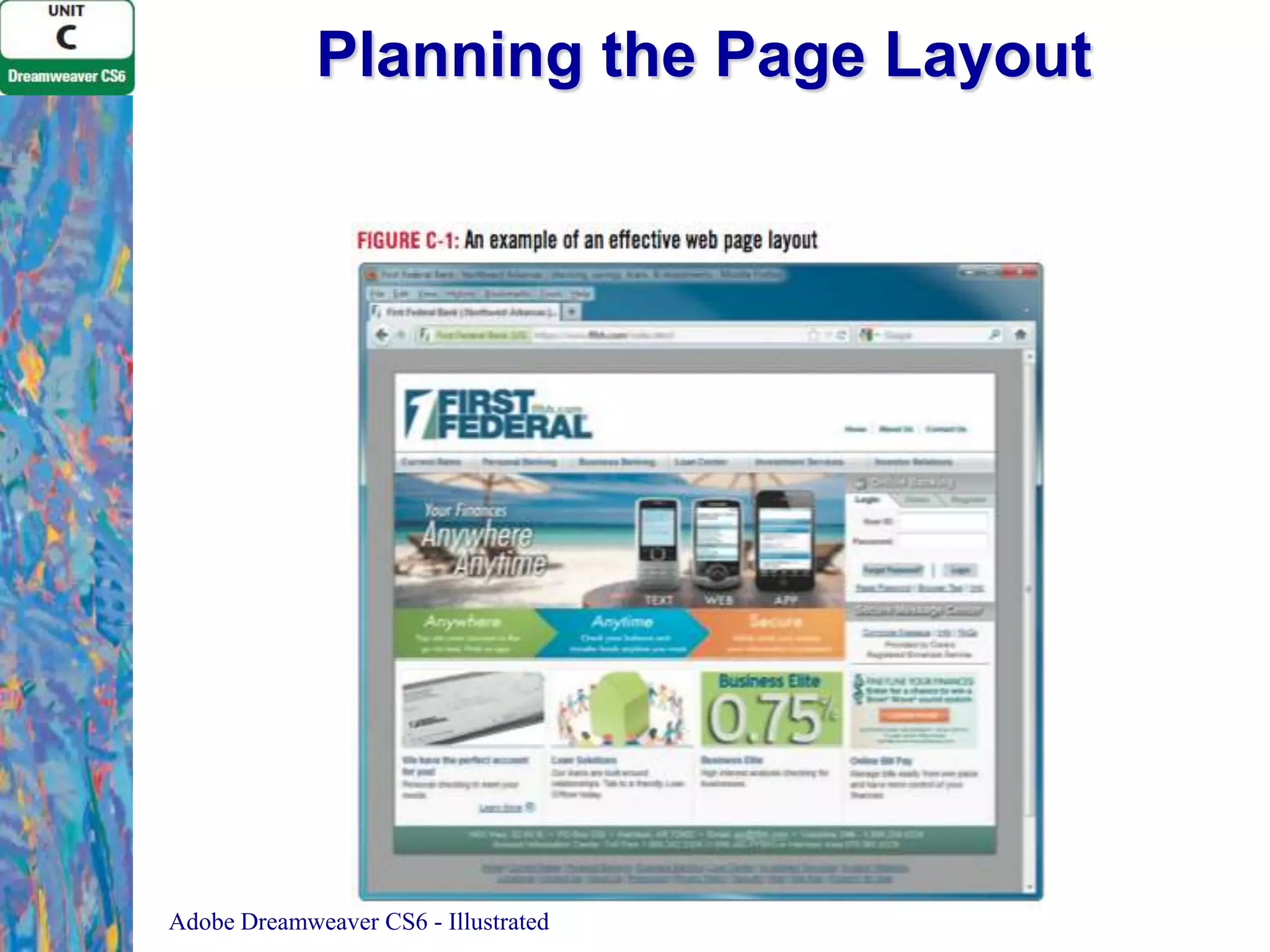
Planning the Page Layout
•
•
•
•
•
•
•

Keep it simple
Use white space effectively
Limit media objects
Use an intuitive navigation structure
Apply a consistent theme using templates
Use CSS for page layout
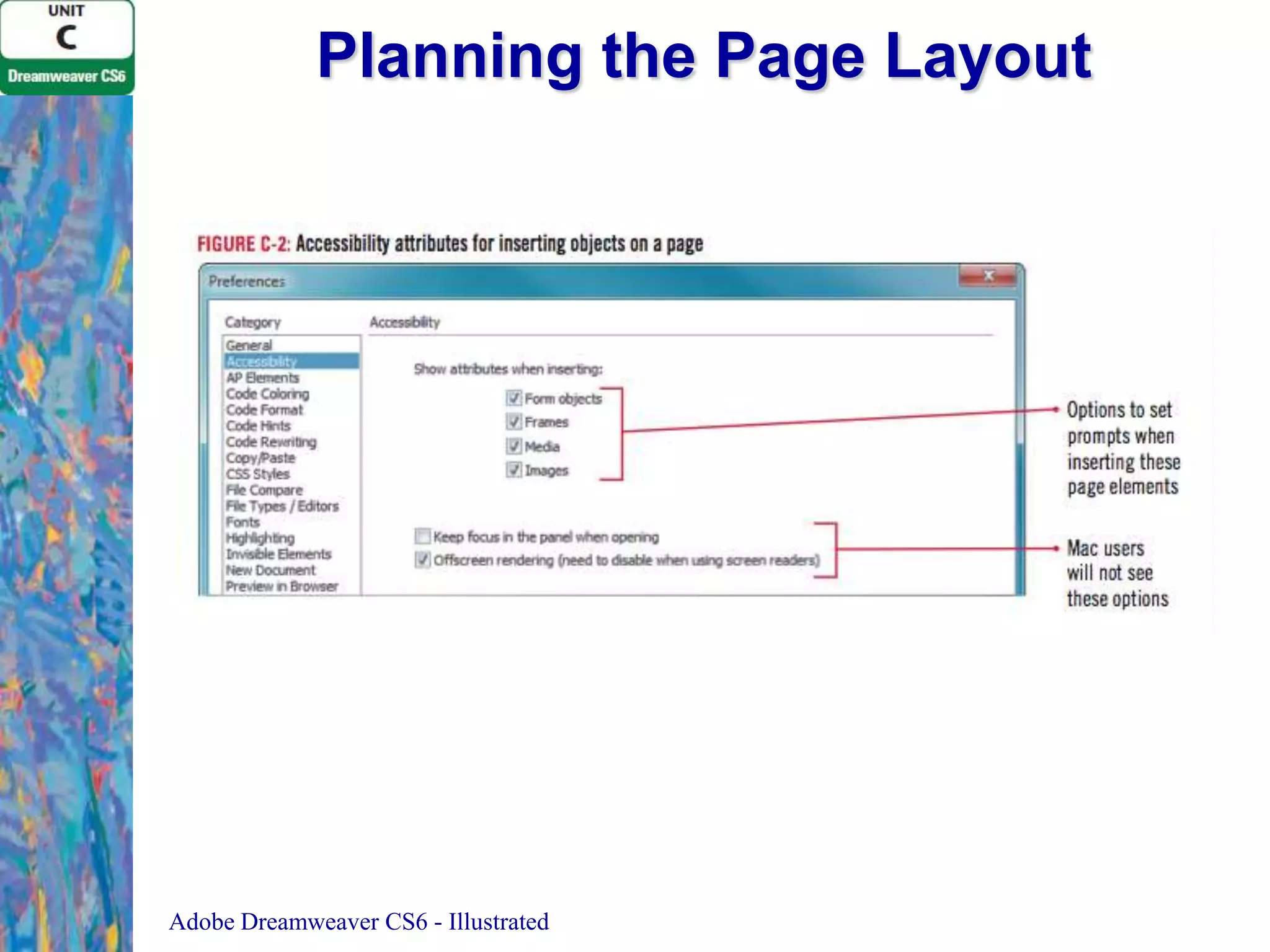
Be conscious of accessibility issues

Adobe Dreamweaver CS6 - Illustrated
Planning the Page Layout

Adobe Dreamweaver CS6 - Illustrated
Planning the Page Layout

Adobe Dreamweaver CS6 - Illustrated
Design Matters
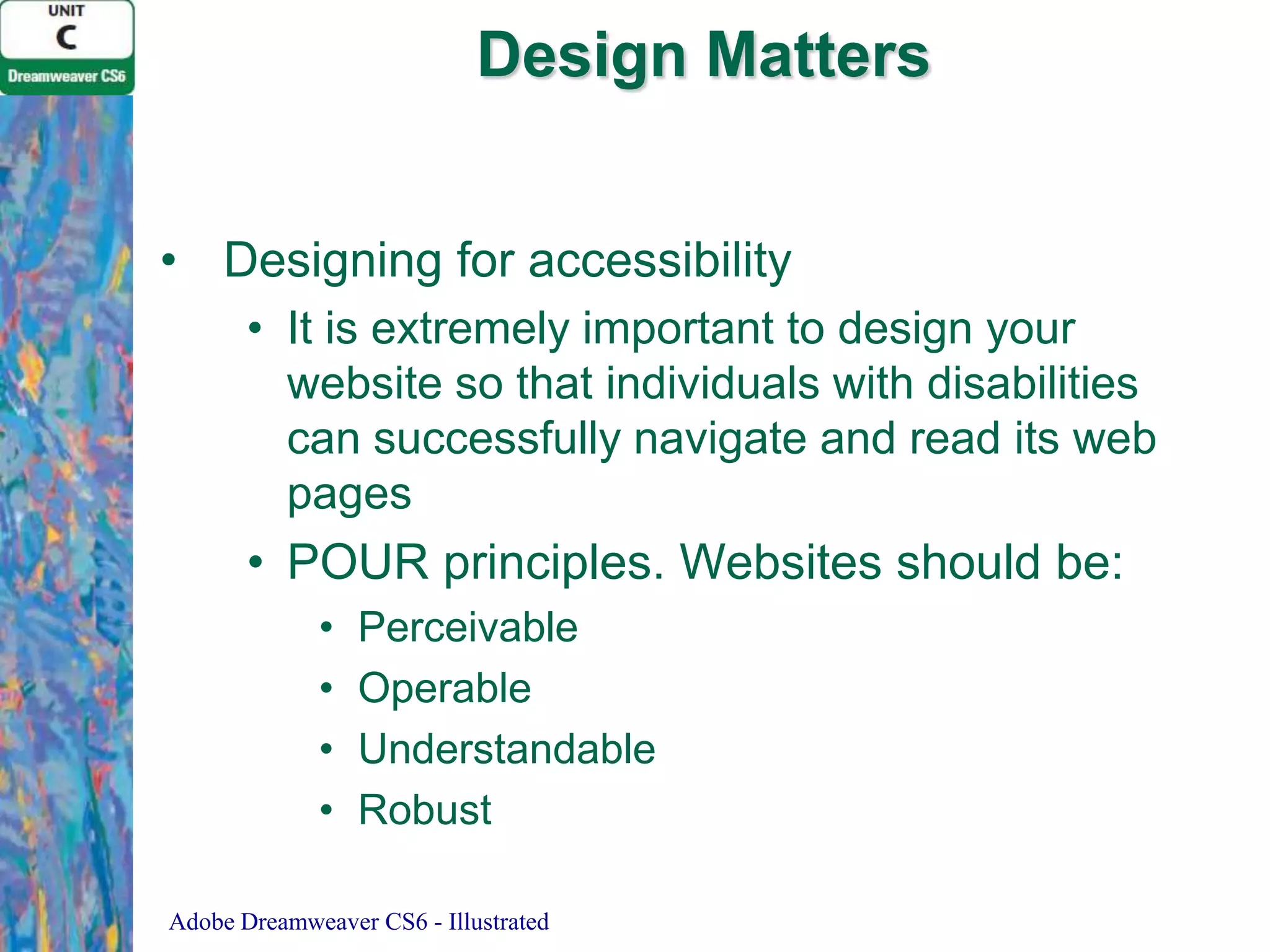
• Designing for accessibility
• It is extremely important to design your
website so that individuals with disabilities
can successfully navigate and read its web
pages

• POUR principles. Websites should be:
•
•
•
•

Perceivable
Operable
Understandable
Robust

Adobe Dreamweaver CS6 - Illustrated
Creating the Head Content
1. Start Dreamweaver, click the Site list arrow on the Files
panel
– Then click The Striped Umbrella if not already
selected
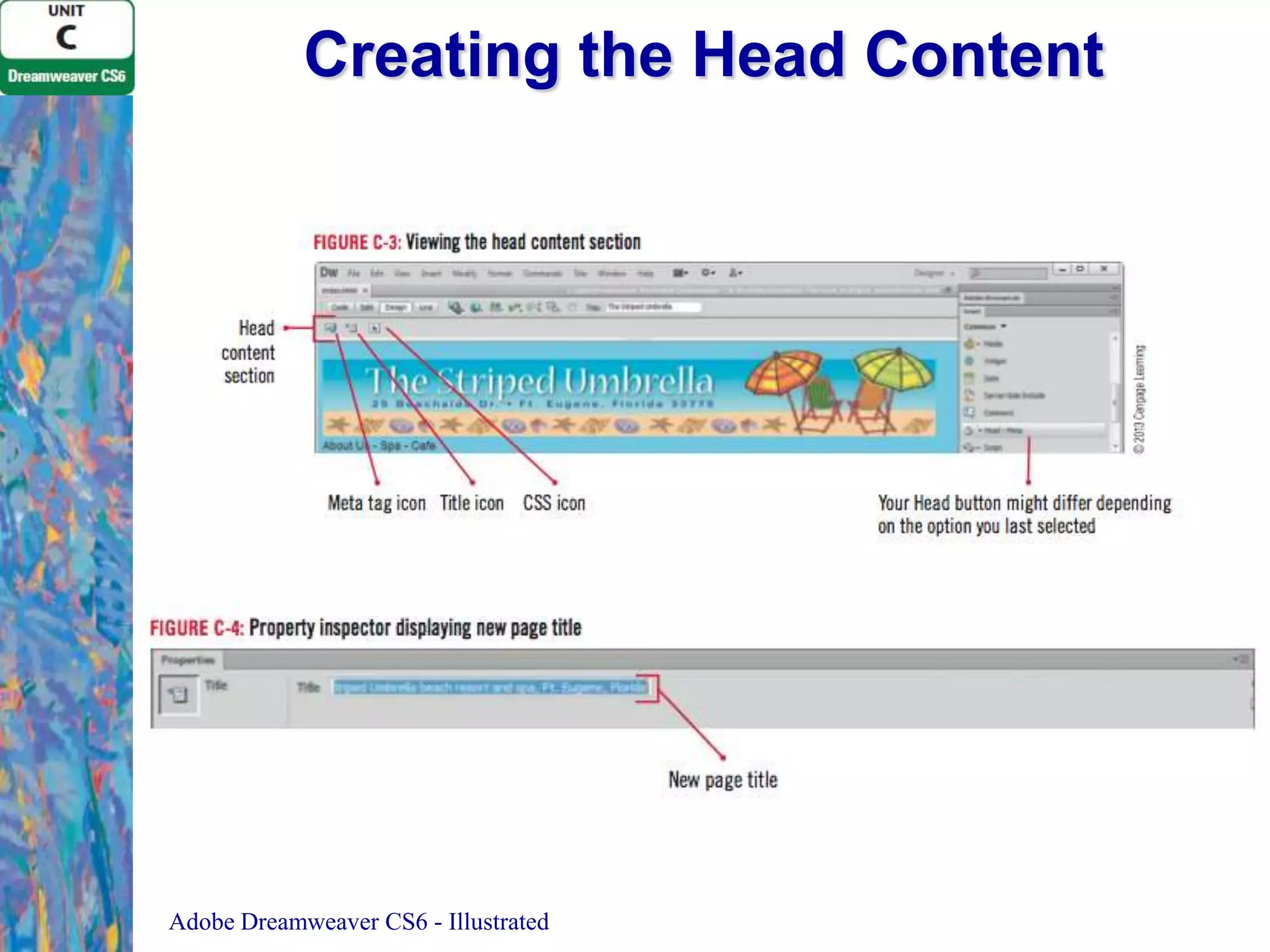
2. Double-click index.html; make sure the Document
window is maximized
– Click View on the Menu bar
– Click Head Content if necessary

3. Click the Title loon
– Please the insertion point after The Striped Umbrella in
the Title text box in the Property Inspector
– Press [spacebar], type beach resort and spa, Ft.
Eugene, Florida, then press [Enter] (Win) or [return]
(Mac)
Adobe Dreamweaver CS6 - Illustrated
Creating the Head Content
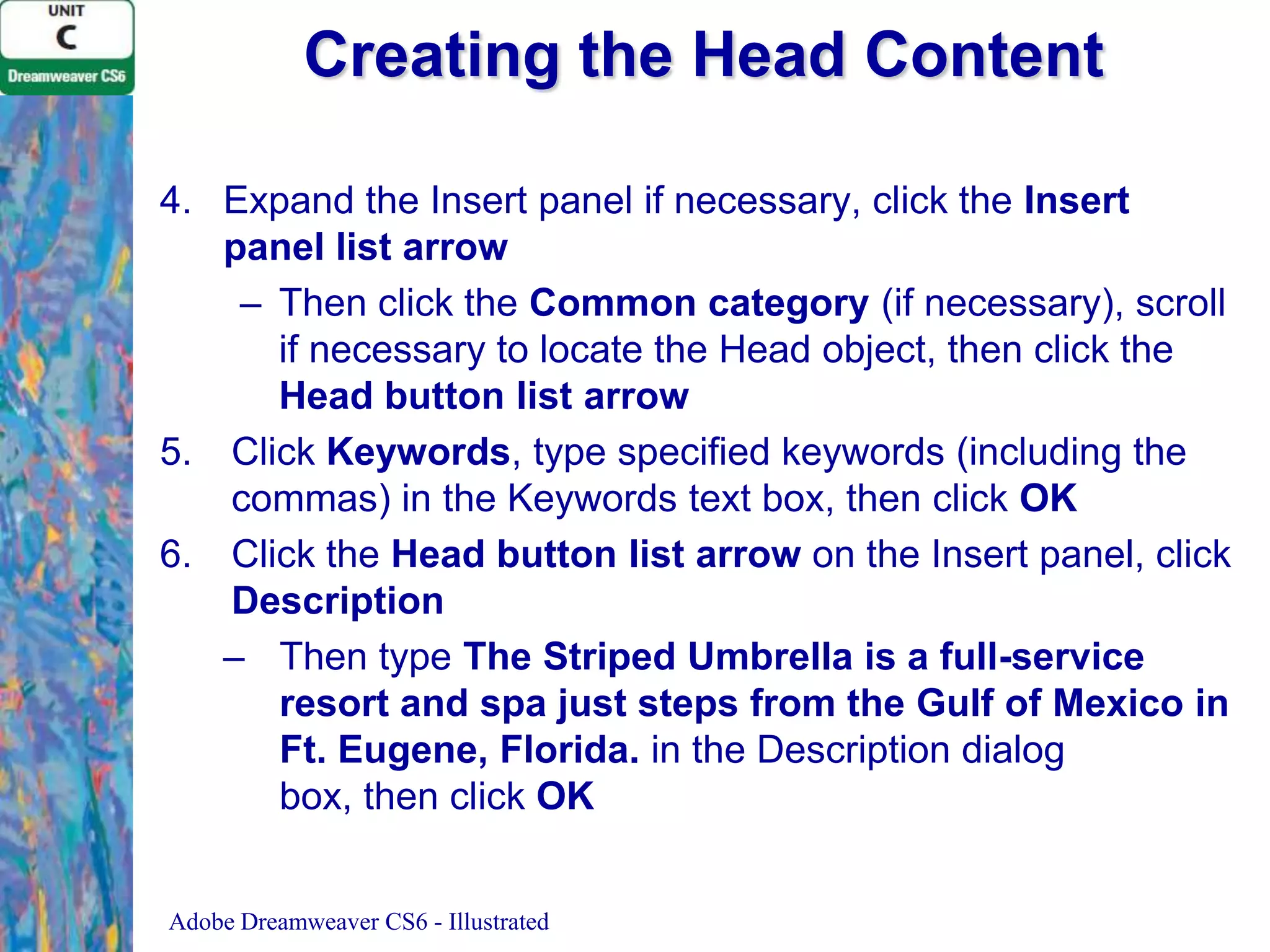
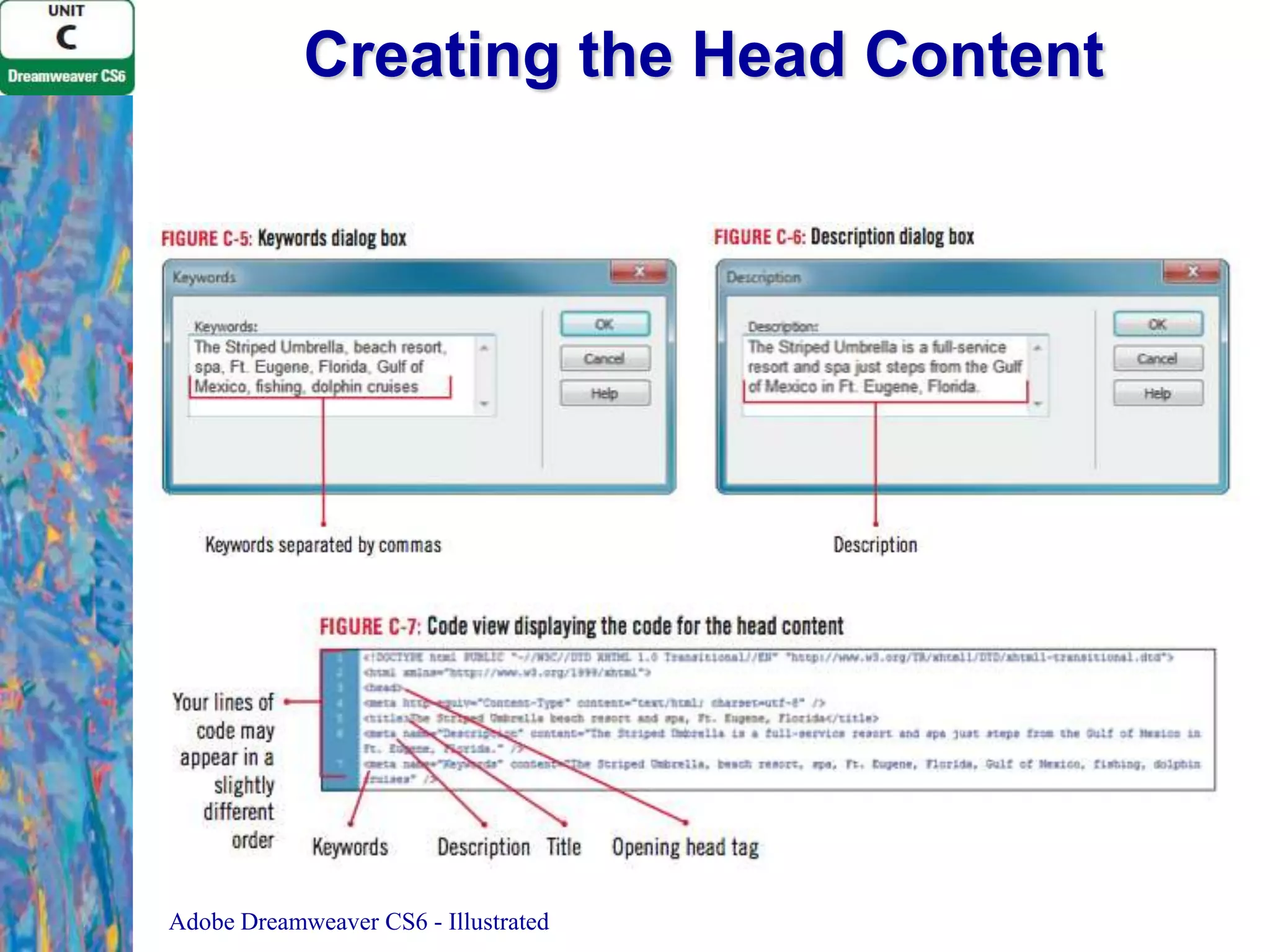
4. Expand the Insert panel if necessary, click the Insert
panel list arrow
– Then click the Common category (if necessary), scroll
if necessary to locate the Head object, then click the
Head button list arrow
5. Click Keywords, type specified keywords (including the
commas) in the Keywords text box, then click OK
6. Click the Head button list arrow on the Insert panel, click
Description
– Then type The Striped Umbrella is a full-service
resort and spa just steps from the Gulf of Mexico in
Ft. Eugene, Florida. in the Description dialog
box, then click OK
Adobe Dreamweaver CS6 - Illustrated
Creating the Head Content
7.

8.

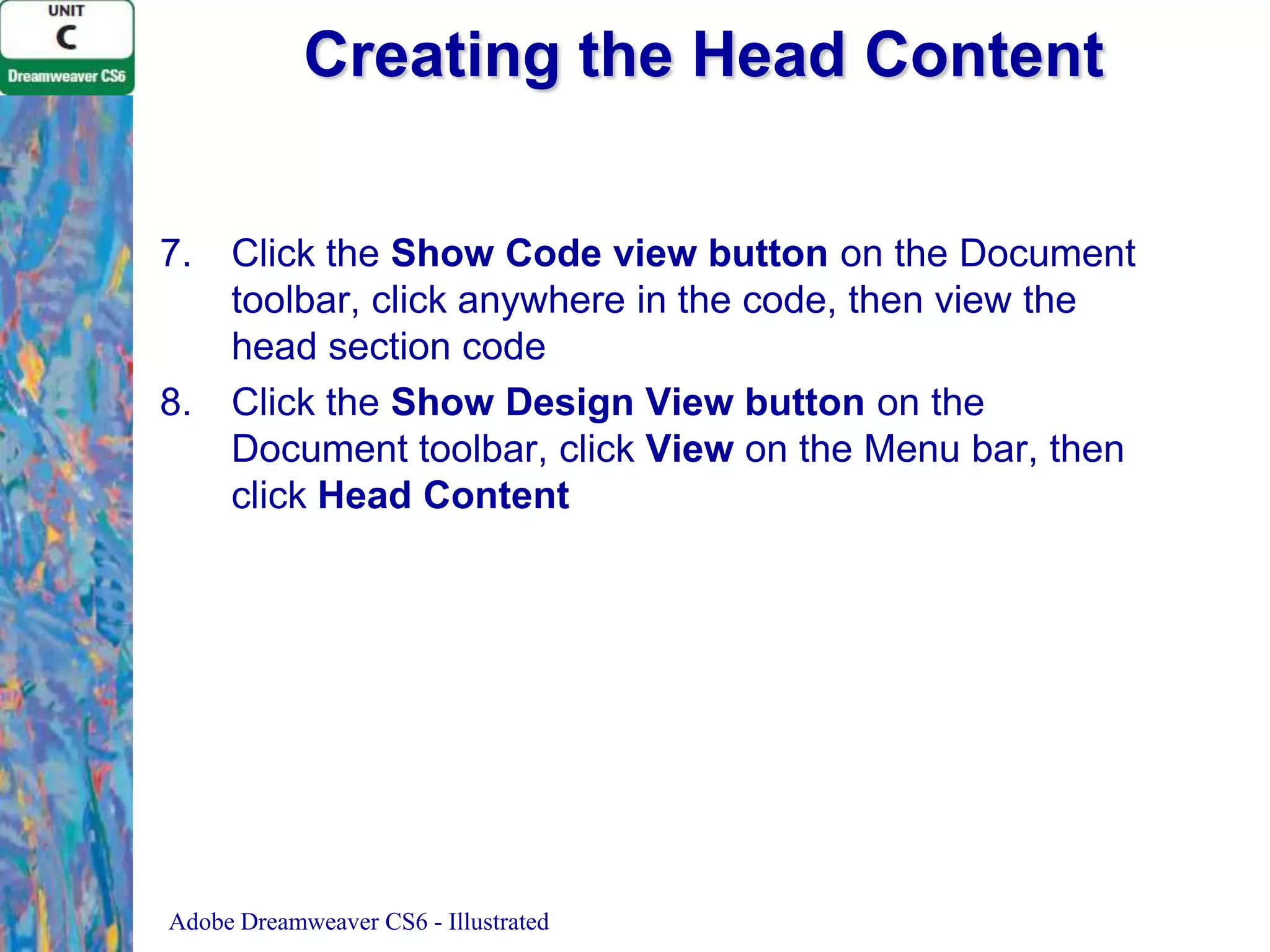
Click the Show Code view button on the Document
toolbar, click anywhere in the code, then view the
head section code
Click the Show Design View button on the
Document toolbar, click View on the Menu bar, then
click Head Content

Adobe Dreamweaver CS6 - Illustrated
Creating the Head Content

Adobe Dreamweaver CS6 - Illustrated
Creating the Head Content

Adobe Dreamweaver CS6 - Illustrated
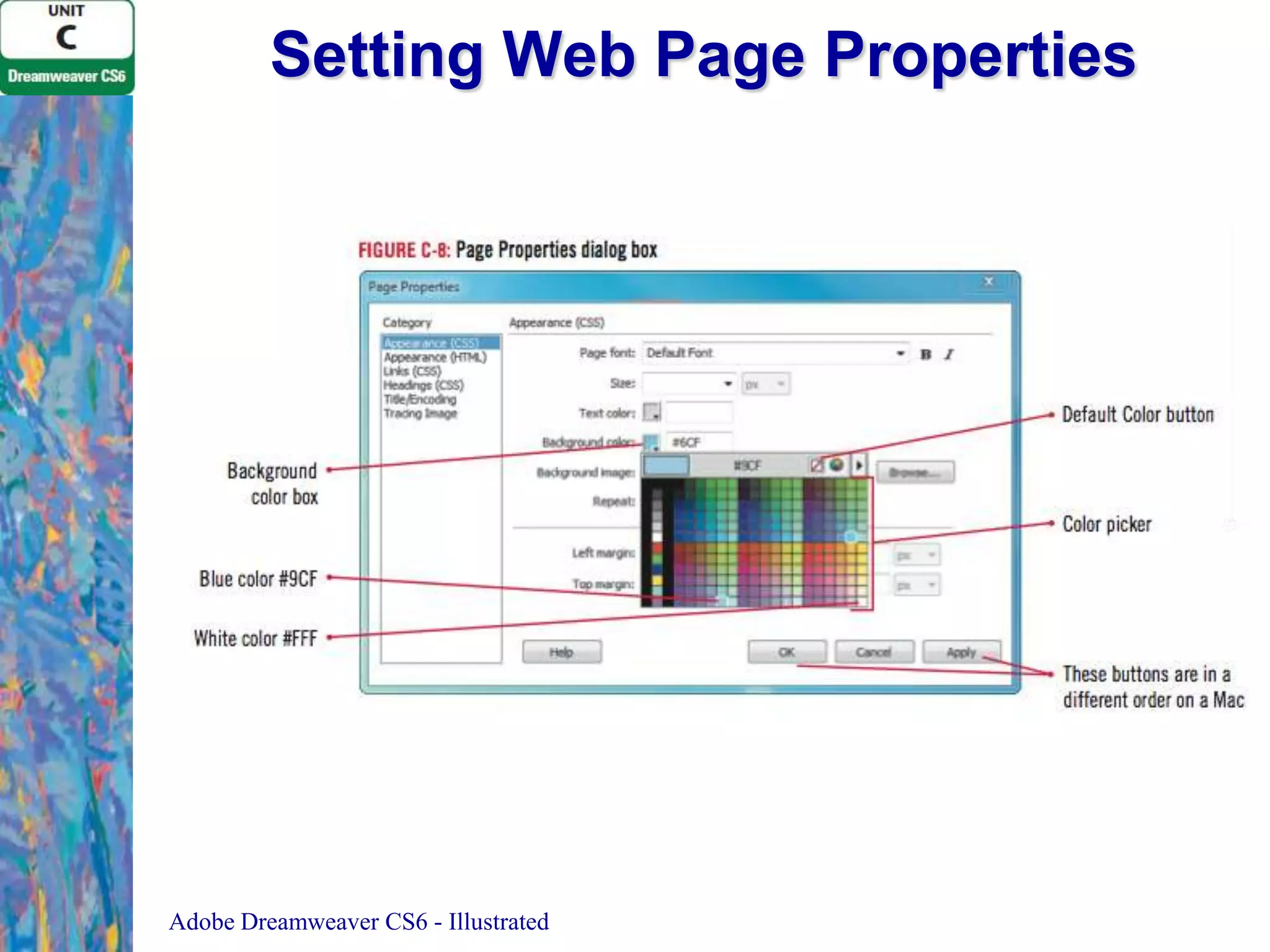
Setting Web Page Properties
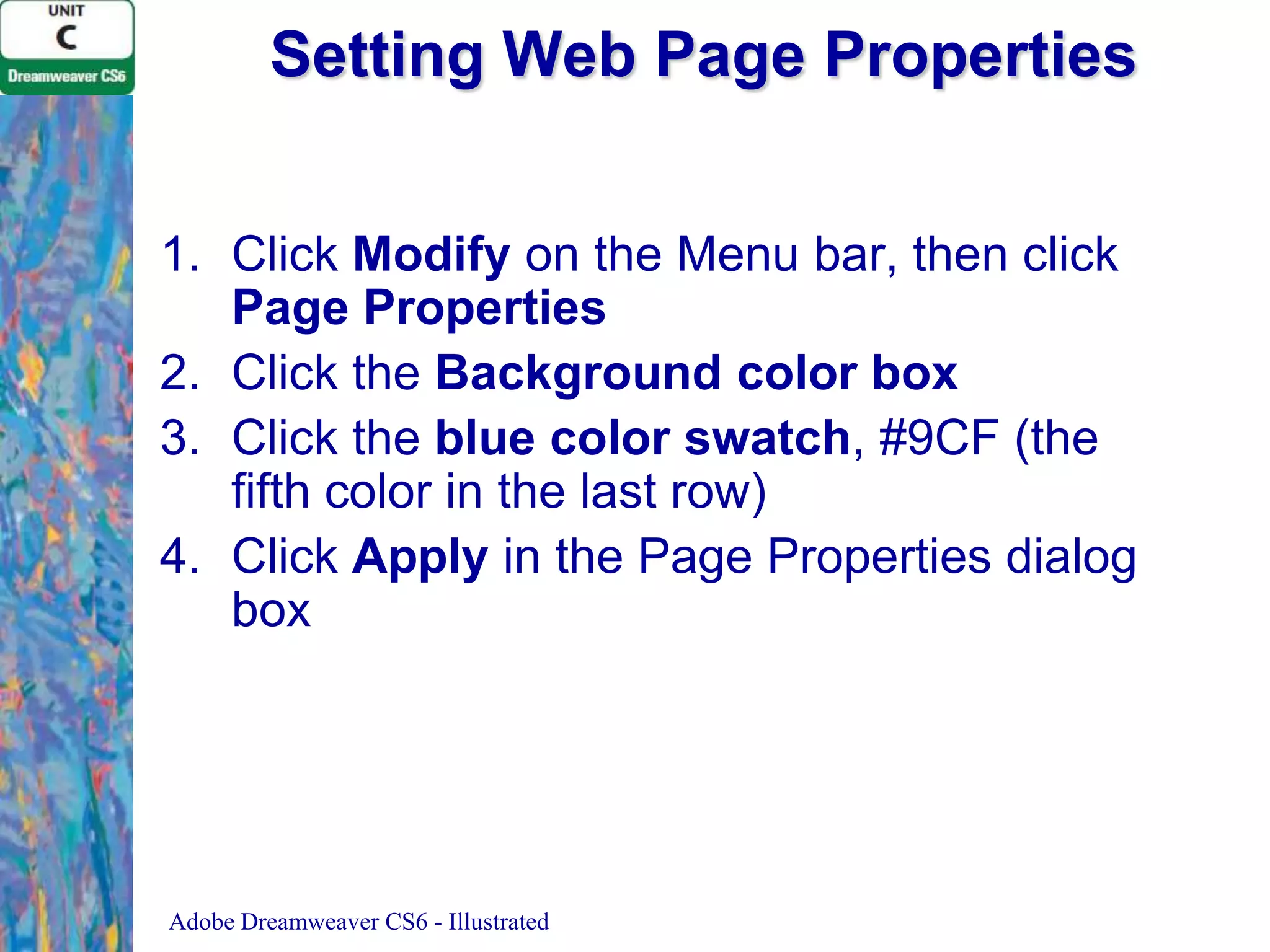
1. Click Modify on the Menu bar, then click
Page Properties
2. Click the Background color box
3. Click the blue color swatch, #9CF (the
fifth color in the last row)
4. Click Apply in the Page Properties dialog
box

Adobe Dreamweaver CS6 - Illustrated
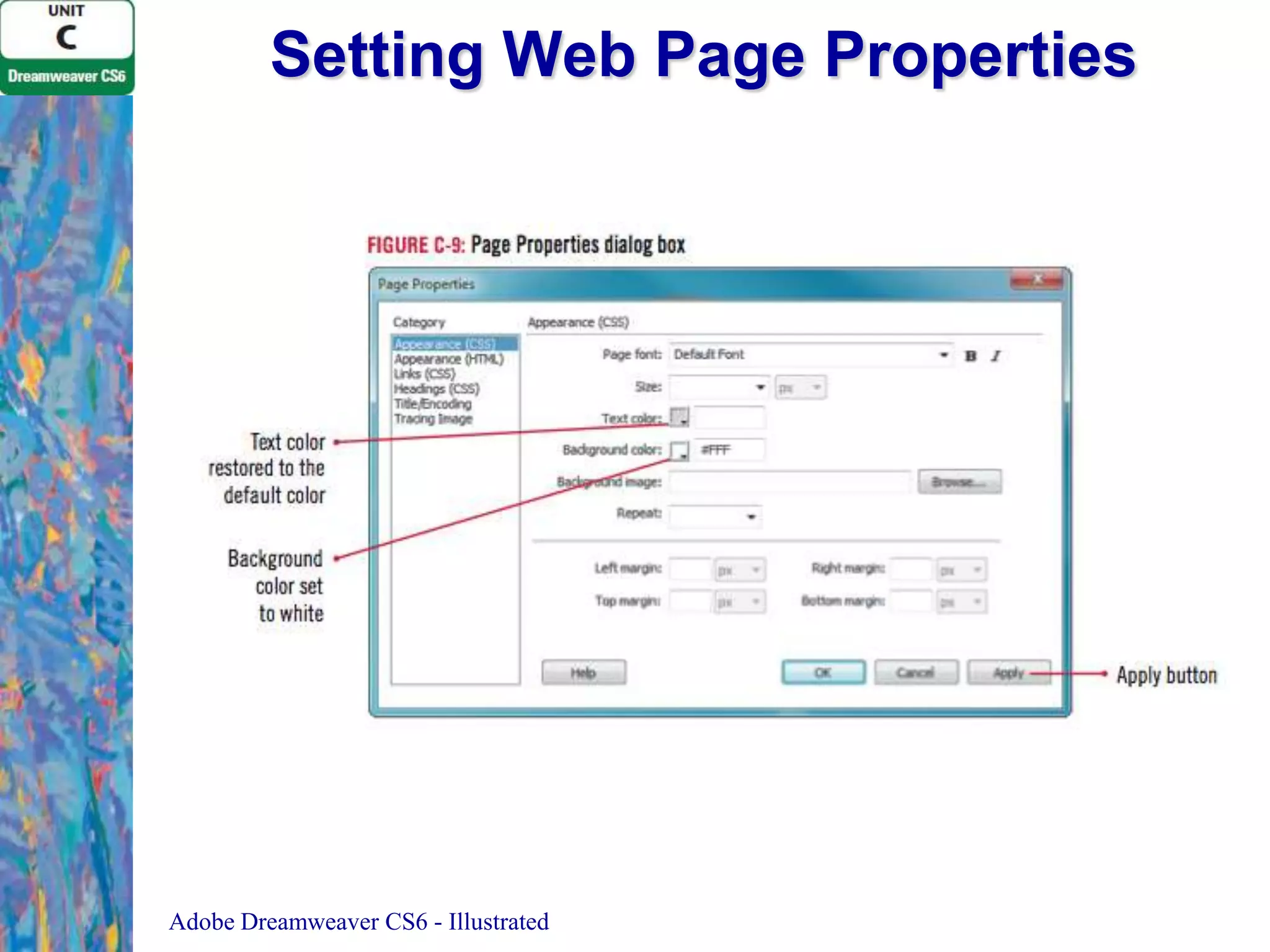
Setting Web Page Properties
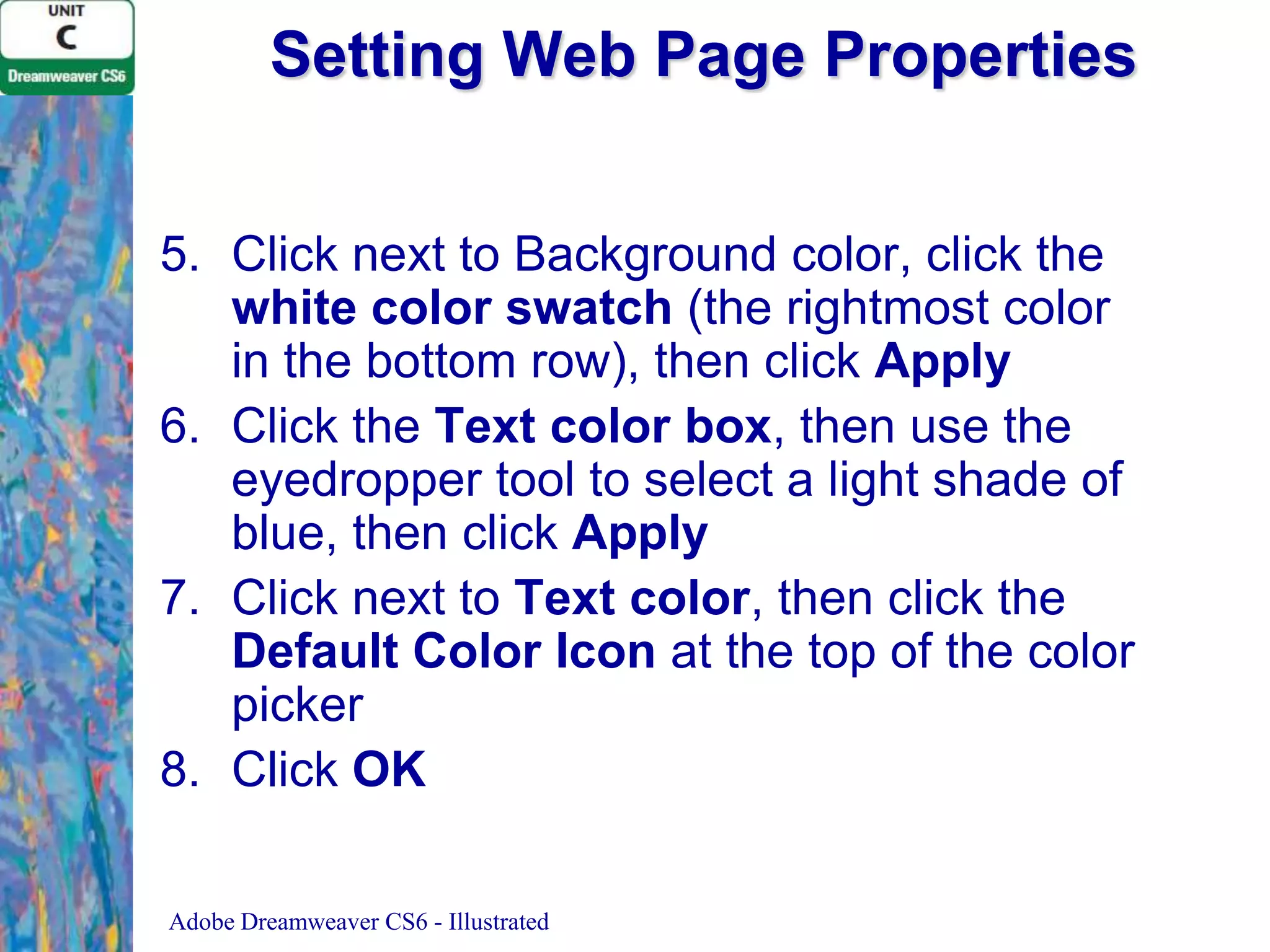
5. Click next to Background color, click the
white color swatch (the rightmost color
in the bottom row), then click Apply
6. Click the Text color box, then use the
eyedropper tool to select a light shade of
blue, then click Apply
7. Click next to Text color, then click the
Default Color Icon at the top of the color
picker
8. Click OK
Adobe Dreamweaver CS6 - Illustrated
Setting Web Page Properties

Adobe Dreamweaver CS6 - Illustrated
Setting Web Page Properties

Adobe Dreamweaver CS6 - Illustrated
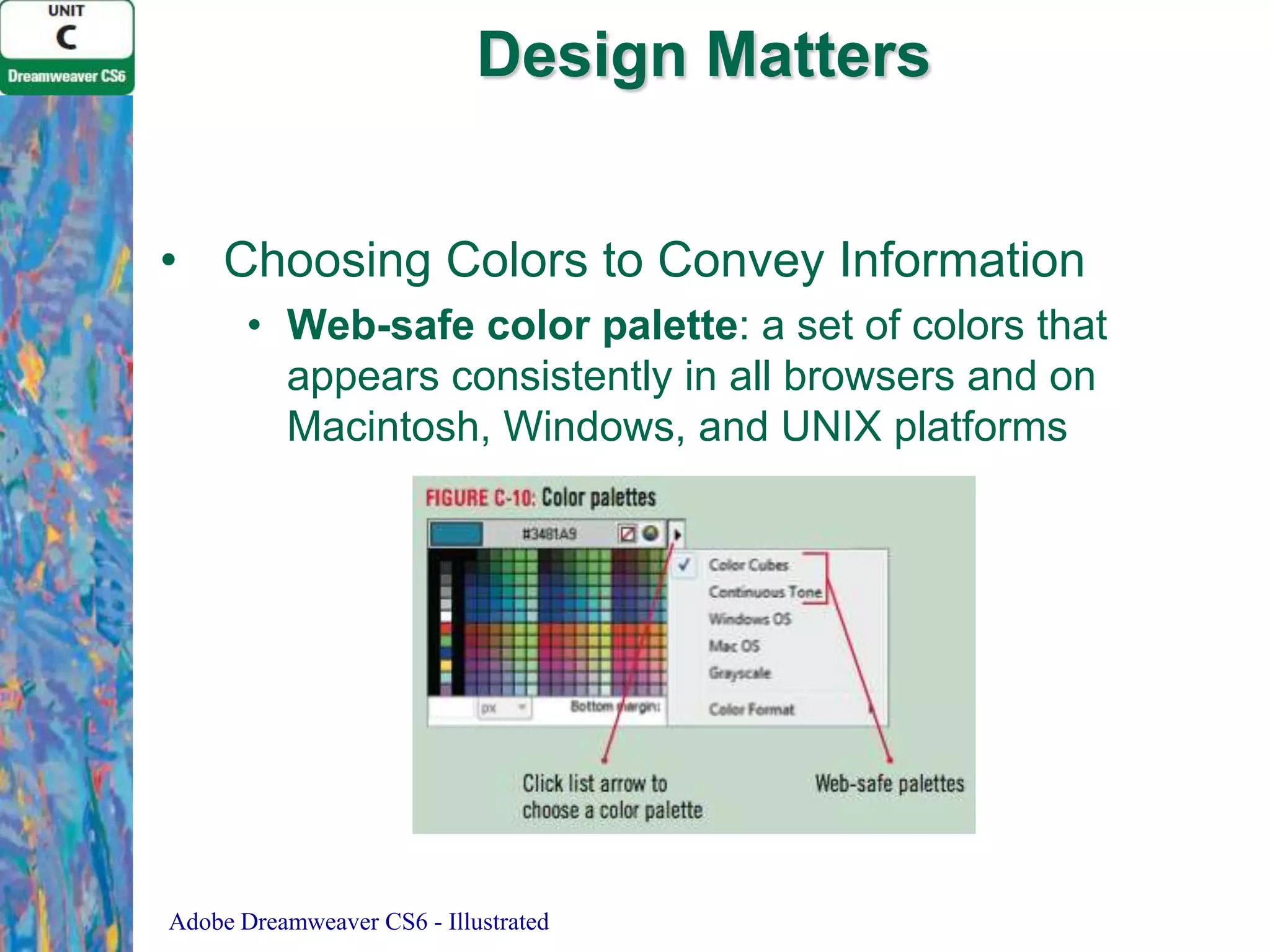
Design Matters
• Choosing Colors to Convey Information
• Web-safe color palette: a set of colors that
appears consistently in all browsers and on
Macintosh, Windows, and UNIX platforms

Adobe Dreamweaver CS6 - Illustrated
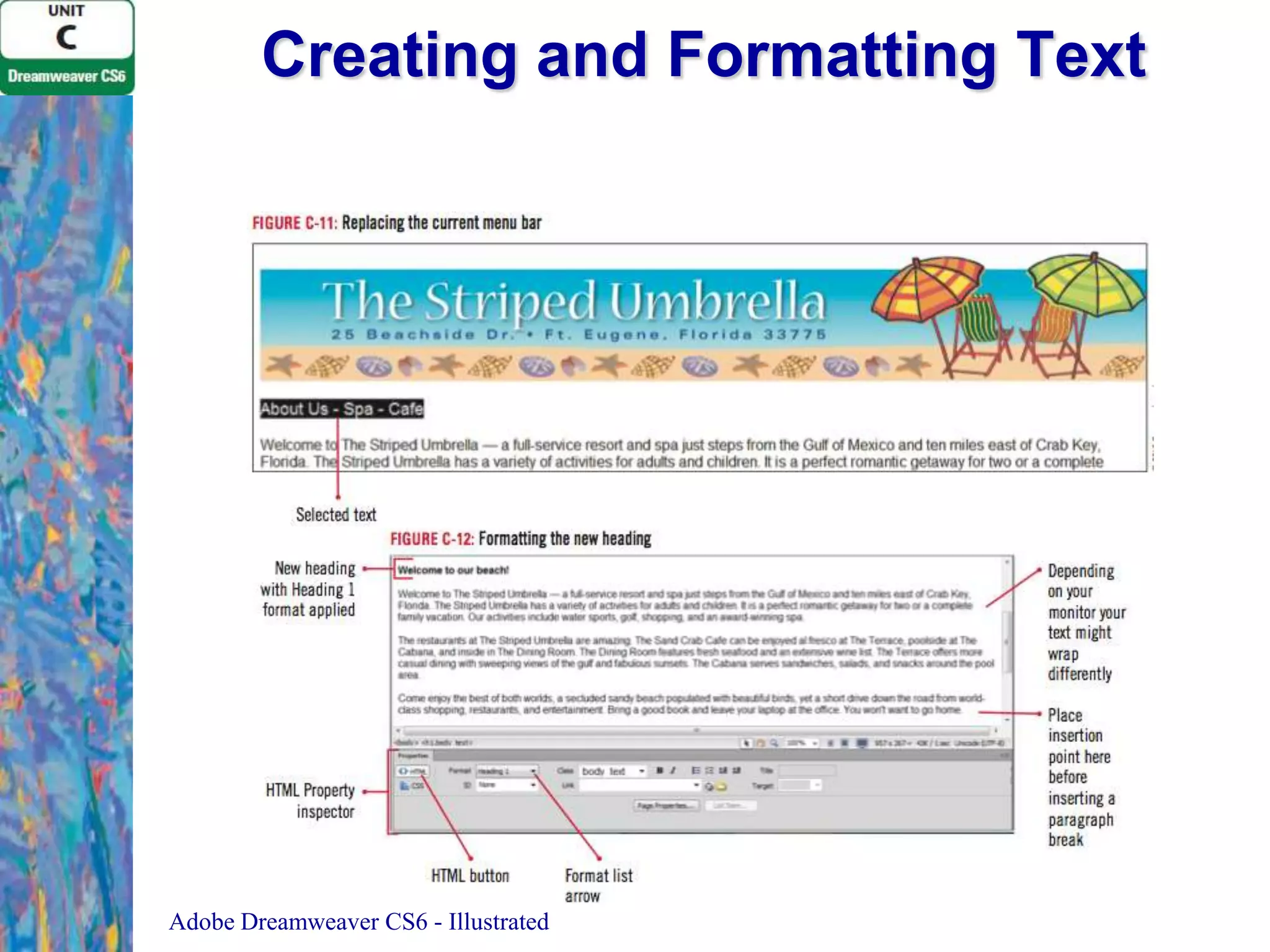
Creating and Formatting Text
1. Position the insertion point to the left of A in About
Us, then drag to select About Us – Spa – Café
2. Type Home - About Us - Spa - Cafe - Activities,
with spaces in between
3. Position the insertion point at the beginning of the
first paragraph, type Welcome to our beach! then,
press [Enter] (Win) or [return] (Mac)
4. Click anywhere in the “Welcome!” text you just
entered, click the HTML button on the Property
inspector to open the HTML Property inspector if
necessary, click the Format list arrow in the HTML
Property inspector, then click Heading 1
Adobe Dreamweaver CS6 - Illustrated
Creating and Formatting Text
5. Position the insertion point after the period
following “…want to go home”, press [Enter]
(Win) or [return] (Mac), then type The Striped
Umbrella
6. Press and hold [Shift], press [Enter] (Win) or
[return] (Mac) to create a line break
7. Enter the following information, placing a line
break at the end of each line:
25 Beachside Drive
Ft. Eugene, Florida 33775
(555) 594-9458
Adobe Dreamweaver CS6 - Illustrated
Creating and Formatting Text
8. Position the pointer to the left of The Striped
Umbrella
– Click and drag to select all information entered
in Step 7
– Click the Italic button in the Property
inspector
– Then click anywhere to deselect the text

Adobe Dreamweaver CS6 - Illustrated
Creating and Formatting Text

Adobe Dreamweaver CS6 - Illustrated
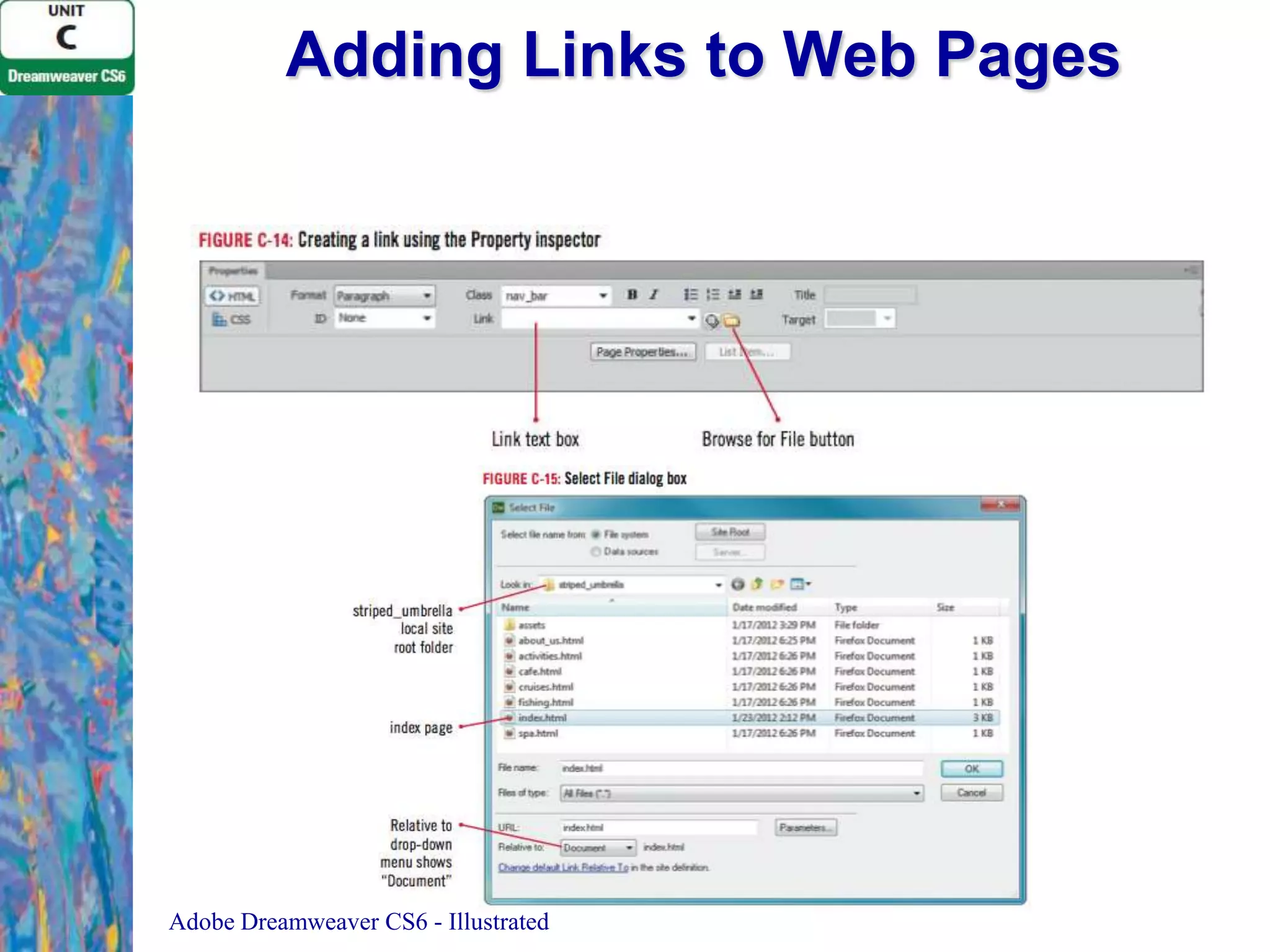
Adding Links to Web Pages
1. Double-click Home in the menu bar
2. Click the Browse for File icon next to the Link text
box in the HTML Property inspector, then navigate to
the striped_umbrella root folder
3. Click index.html, verify that Document is selected
in the Relative to pop-up menu, then click OK (Win)
or Open (Mac)
4. Repeat steps 1-4 to create links for About Us, Spa,
Cafe, and Activities, using about_us.html,
spa.html, cafe.html, and activities.html as the
corresponding files, then click anywhere on the page
5. Click anywhere on the home page to deselect Home
Adobe Dreamweaver CS6 - Illustrated
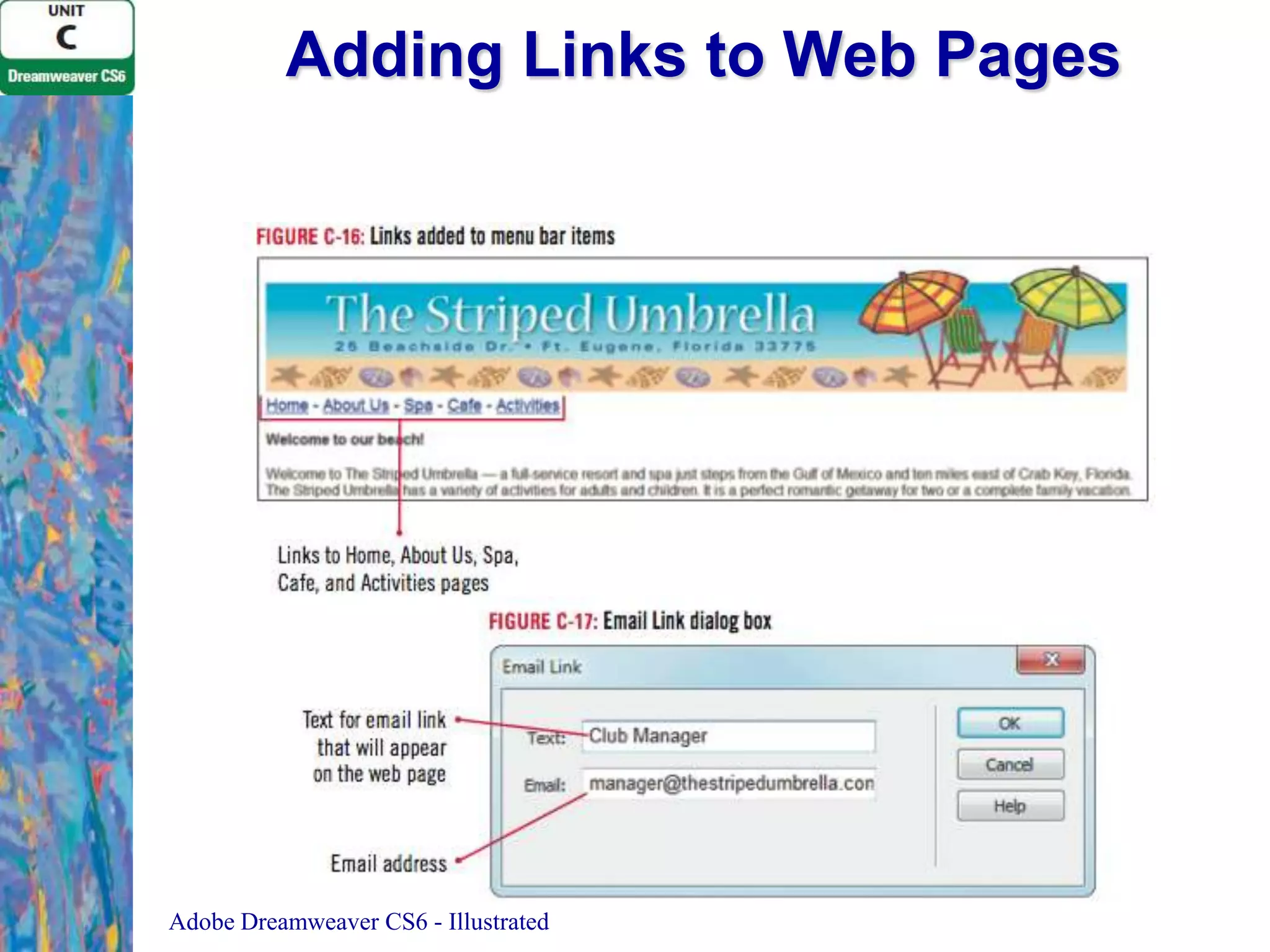
Adding Links to Web Pages
6. Position the insertion point immediately after the last
digit in the telephone number, press and hold [Shift],
then press [Enter] (Win) or [return] (Mac)
7. Click the Insert panel list arrow, click Common if
necessary, then click Email Link
8. Type Club Manager in the text box, press [Tab],
then type manager@thestripedumbrella.com in the
E-Mail text box, click OK
9. If link is not italicized, position the pointer left of Club
Manager, click/drag to select text, click the Italic
button, then click anywhere to deselect the text
Adobe Dreamweaver CS6 - Illustrated
Adding Links to Web Pages

Adobe Dreamweaver CS6 - Illustrated
Adding Links to Web Pages

Adobe Dreamweaver CS6 - Illustrated
Using the History Panel
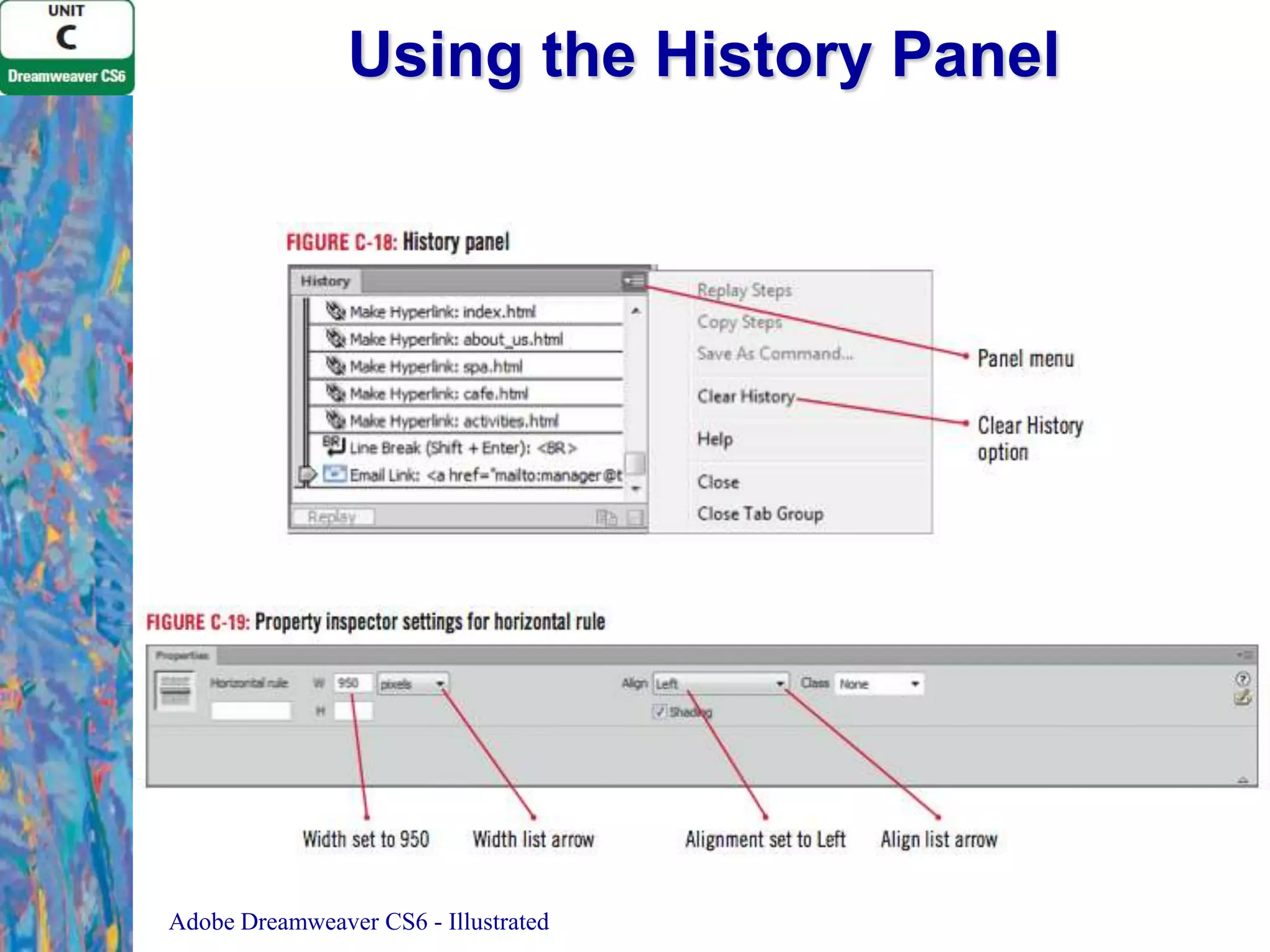
1. Click Window on the Menu bar, then click History
2. Click the Panel menu on the History panel title bar,
click Clear History, then click Yes in the Dreamweaver
warning box
3. Position the insertion point to the left of the words
Welcome to our beach! in the line of text
– Click Insert on the Menu bar, point to HTML, then
click Horizontal Rule
4. If “pixels” is not displayed in the width pop-up menu,
click the width list arrow in the Property inspector,
click pixels, type 950 in the W text box, then press
[Enter] (Win) or [return] (Mac)
Adobe Dreamweaver CS6 - Illustrated
Using the History Panel
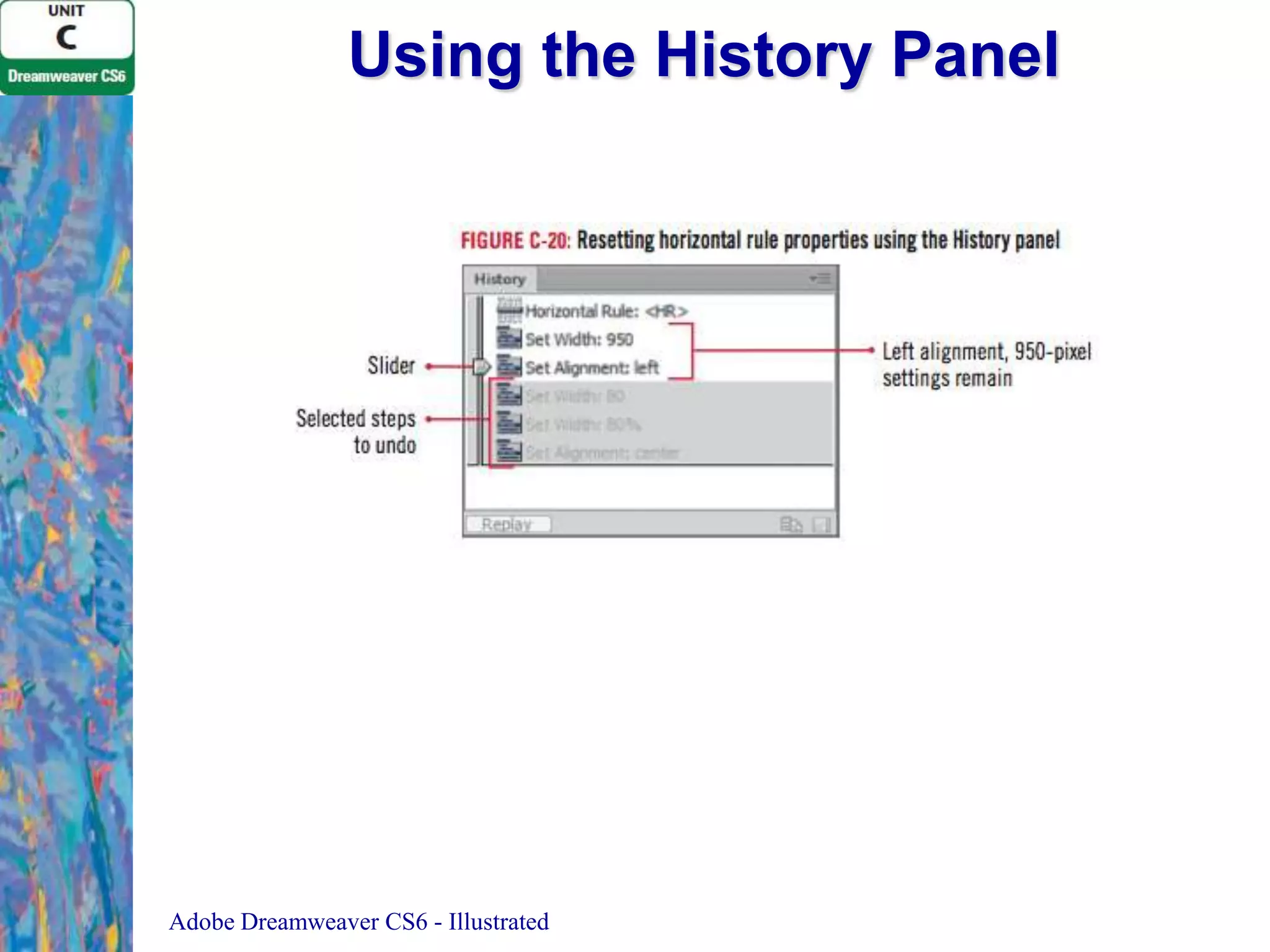
5. Click the Align list arrow in the Property
inspector, then click Left
6. Select 950 in the W text box, type 80, click the
Width list arrow, click %, click the Align list
arrow, then click Center
7. Drag the slider on the History panel up until it is
pointing to Set Alignment: left, then release it
8. Click File on the Menu bar, then click Save

Adobe Dreamweaver CS6 - Illustrated
Using the History Panel

Adobe Dreamweaver CS6 - Illustrated
Using the History Panel

Adobe Dreamweaver CS6 - Illustrated
Clues to Use
•

Using the History panel
– Undo or redo steps
• By dragging the slider up and down in the
History panel
– Memorizes certain steps
– Some Dreamweaver features cannot be recorded
in the History panel
– Default number of steps recorded is 50
• Setting this number higher requires more
memory, which may affect speed

Adobe Dreamweaver CS6 - Illustrated
Clues to Use
•

Checking your screen against book figures
– They will likely look different
– Dreamweaver “remembers” the screen
arrangement from your last session
– Open, close, collapse, or expand various panels,
toolbars, and inspectors to change screen
arrangement

Adobe Dreamweaver CS6 - Illustrated
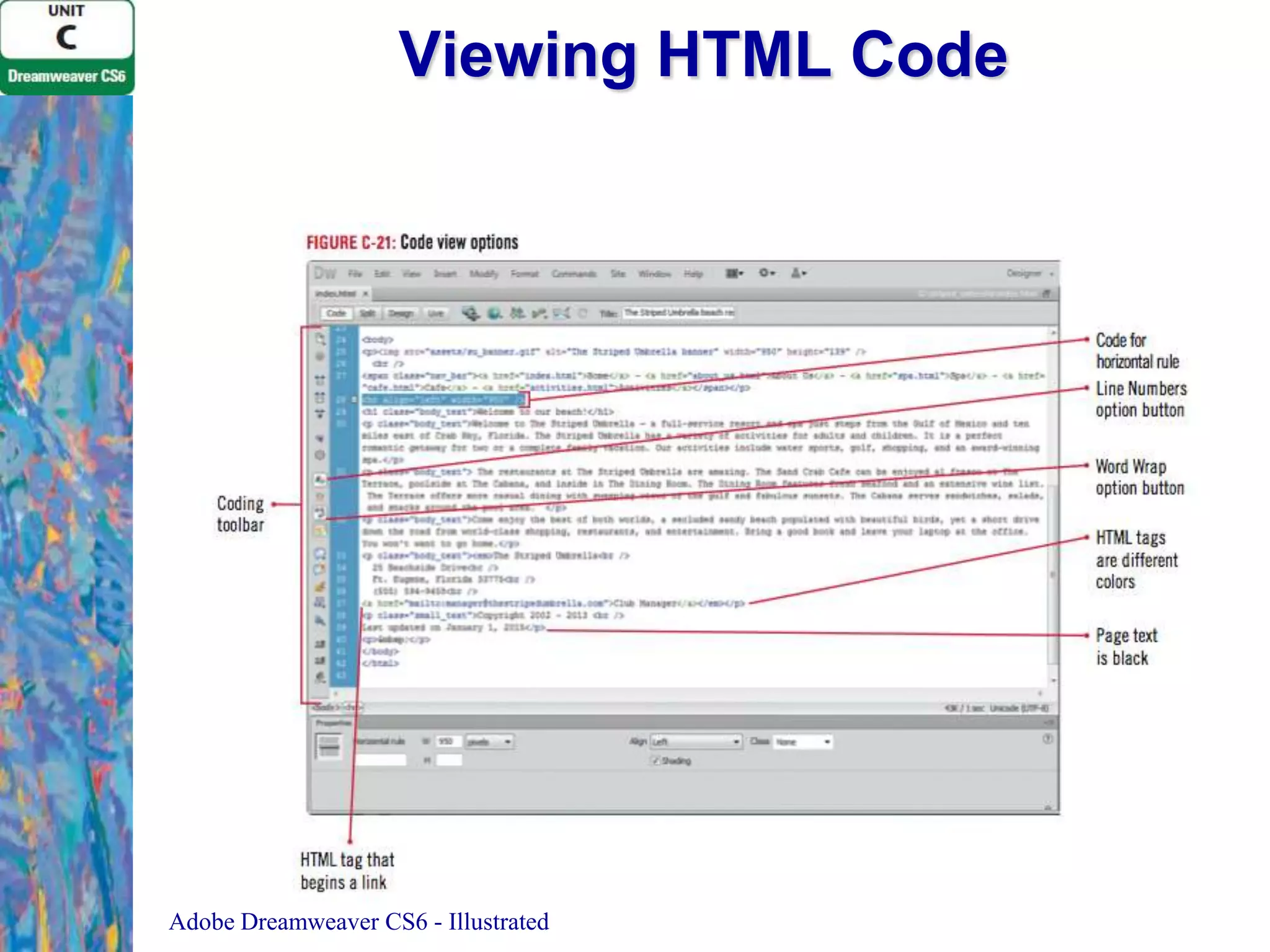
Viewing HTML Code
1. Click Window on the Menu bar, click History to close
the History panel, then click the horizontal rule
2. Click the Show Code view button on the Document
toolbar
3. If necessary, click to select the Line Numbers and
Word Wrap option buttons on the Coding toolbar
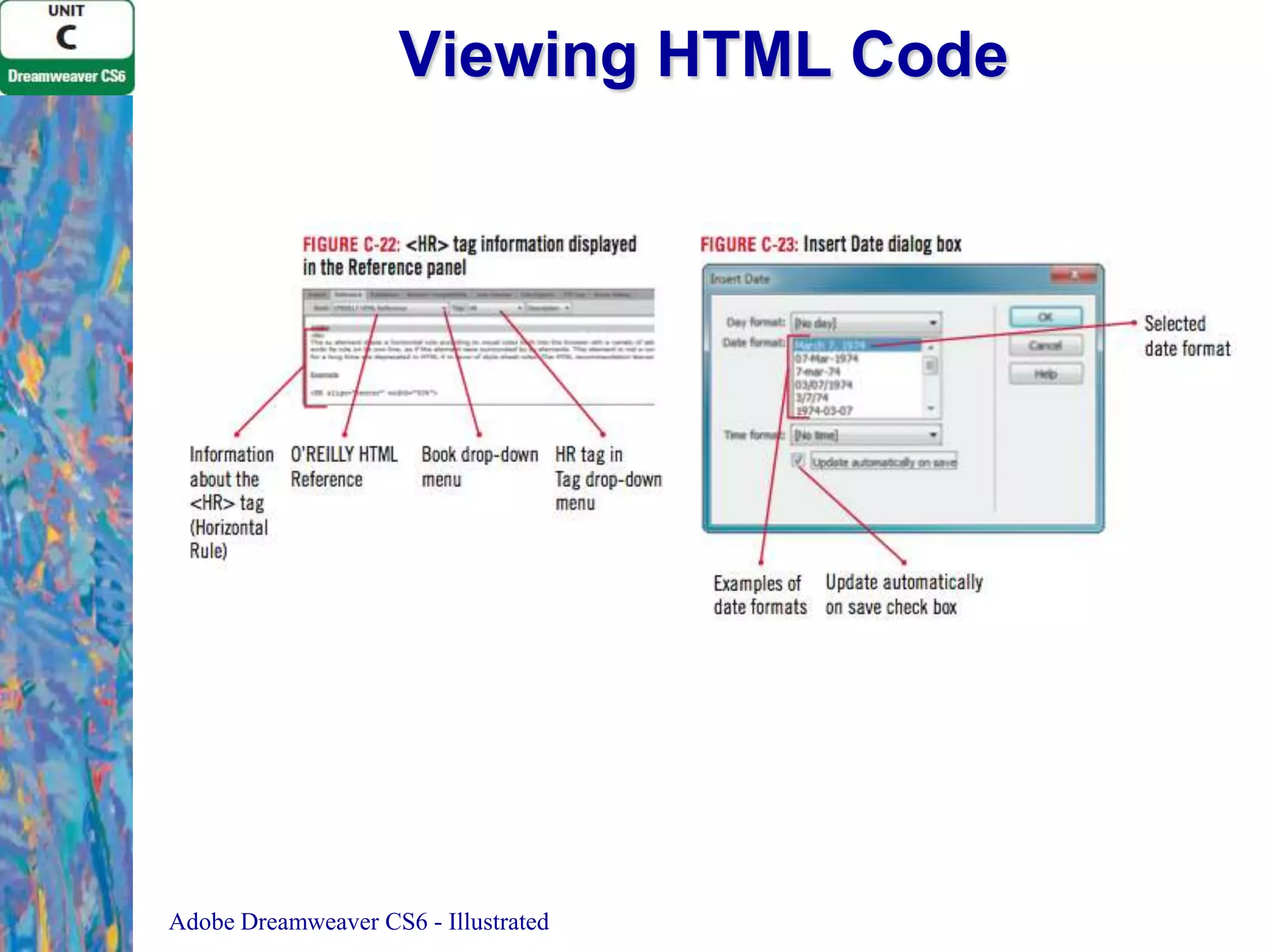
4. Click Window on the Menu bar, point to Results
– Click Reference
– Click the Book list arrow in the Reference Panel
to select O’REILLY HTML Reference
– Click the Tag list arrow to select HR if necessary
5. Read the information about horizontal rules
Adobe Dreamweaver CS6 - Illustrated
Viewing HTML Code
6. Click the Panel menu on the Results panel title bar,
then click Close Tab Group
7. Scroll down if necessary in the Document window,
select January 1, 2015, then press [Delete]
8. Scroll down the Common category on the Insert panel
until the Date object button appears
– Click Date, click March 7, 1974, in the Date format
options list
– Click the Update automatically on save check
box if necessary to select it, then click OK
9. Click the Show Design view button on the Document
toolbar
Adobe Dreamweaver CS6 - Illustrated
Viewing HTML Code

Adobe Dreamweaver CS6 - Illustrated
Viewing HTML Code

Adobe Dreamweaver CS6 - Illustrated
Testing and Modifying Web Pages
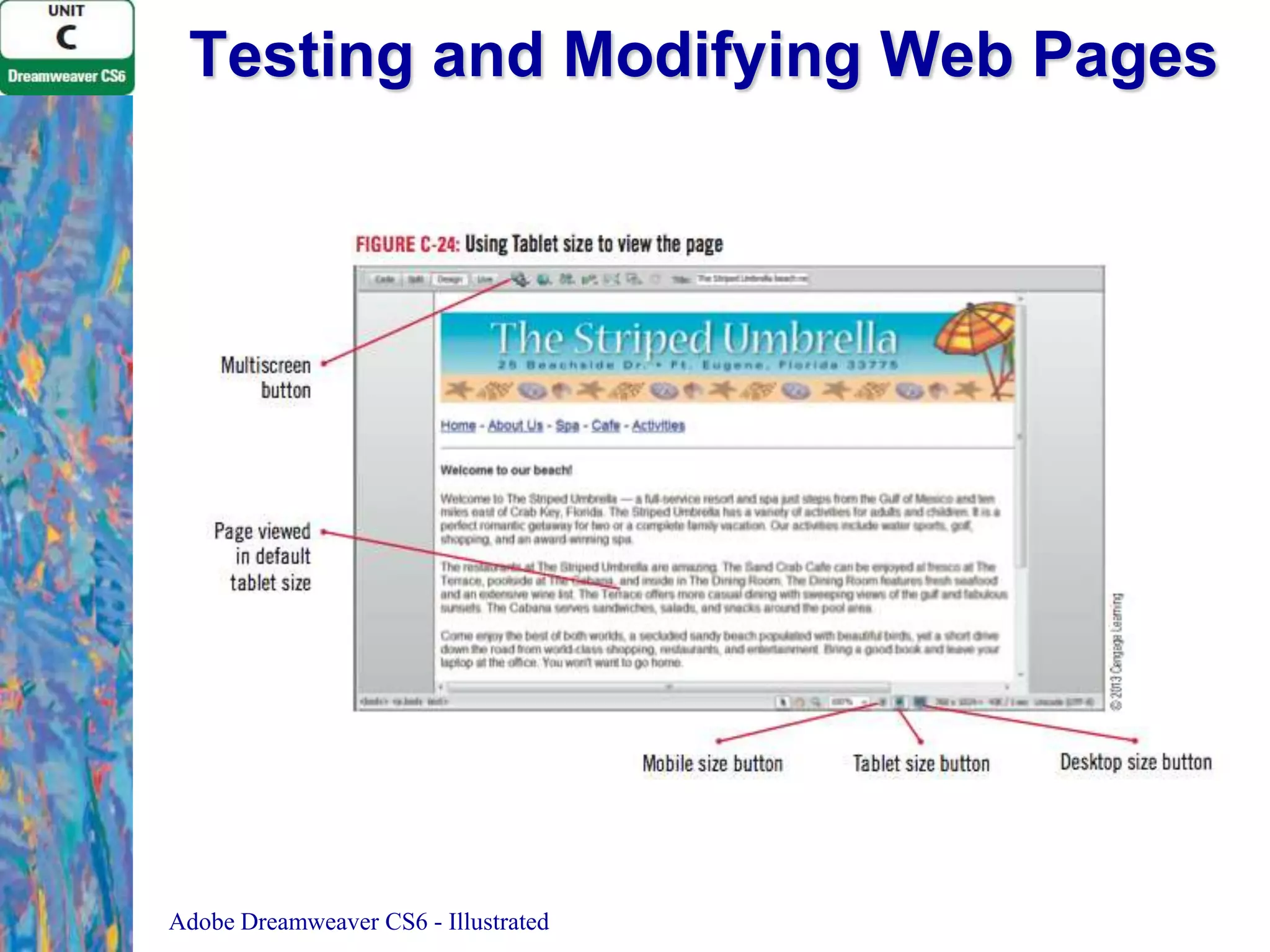
1. Click the Tablet size button on the Status bar to see
how the page would appear on a tablet using the
default tablet settings
2. Click the Desktop size button, scroll down if
necessary and highlight the period after the “...go
home” text, then type !
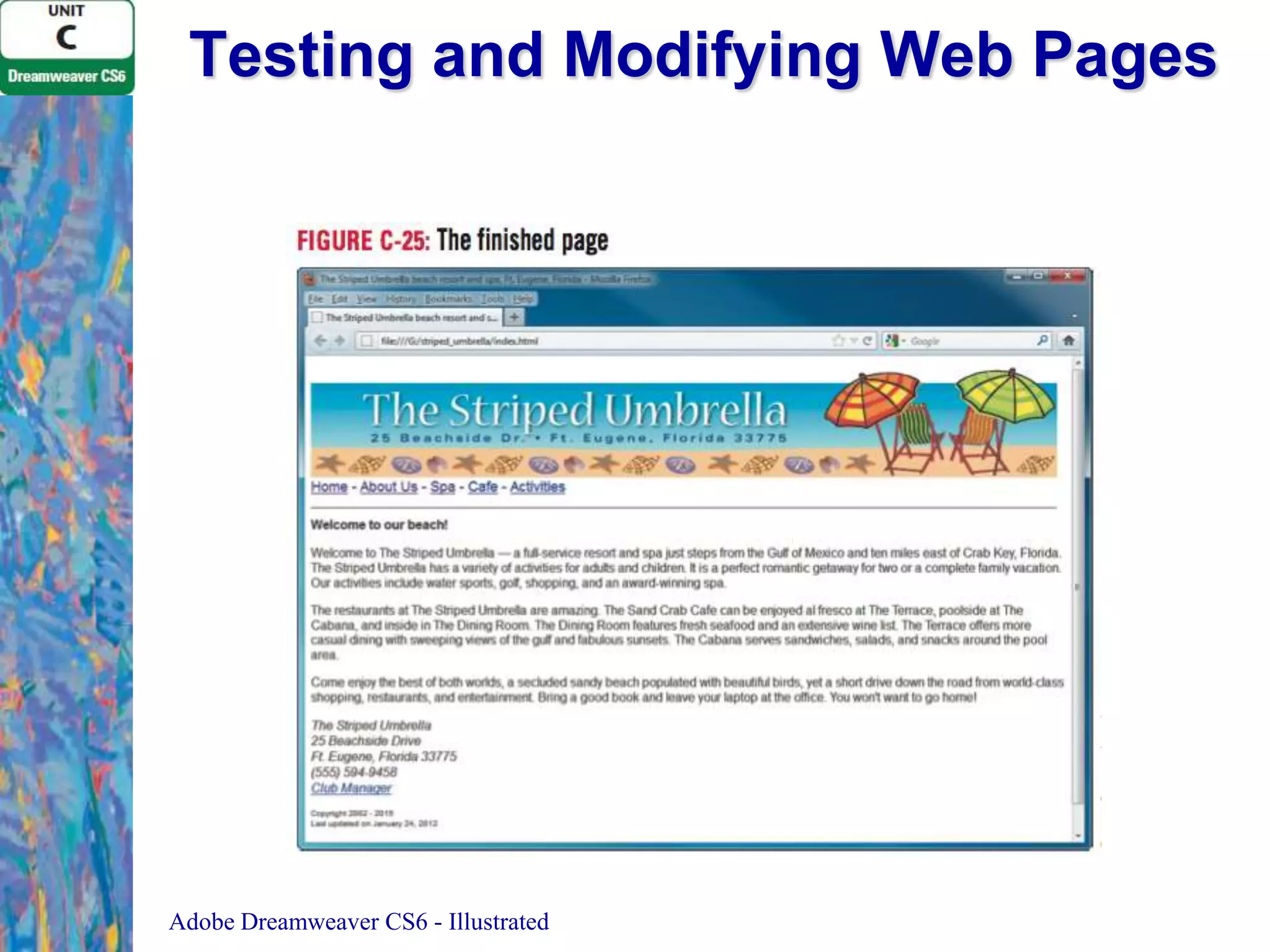
3. Click File on the Menu bar, click Save, click on the
Document toolbar, then click Preview in [your default
browser]

Adobe Dreamweaver CS6 - Illustrated
Testing and Modifying Web Pages
4. Click the About Us link on the menu bar to display
one of the blank pages you created in Unit B, then
click the Back button on the Address bar (Win) or the
Navigation toolbar (Mac)
5. Repeat step 4 to test the Spa, Cafe, and Activities
links
6. Click the Club Manager link
7. Close the email message dialog box, close the
browser window, close the index page, then click Exit
on the File menu (Win) or Quit on the Dreamweaver
menu (Mac) to close the Dreamweaver program
Adobe Dreamweaver CS6 - Illustrated
Testing and Modifying Web Pages

Adobe Dreamweaver CS6 - Illustrated
Testing and Modifying Web Pages

Adobe Dreamweaver CS6 - Illustrated
Design Matters
• Using smart design principles
•
•
•
•
•

Horizontal symmetry
Vertical symmetry
Diagonal symmetry
Radial symmetry
Rule of thirds

Adobe Dreamweaver CS6 - Illustrated
Unit Summary
•
•
•
•
•
•
•
•

Plan the page layout
Create the head content
Set web page properties
Create and format text
Add links to web pages
Use the History panel
View HTML code
Test and modify web pages

Adobe Dreamweaver CS6 - Illustrated

Unit c adobe dreamweaver cs6

  • 1.
  • 2.
    Unit Objectives • • • • • • • • Plan thepage layout Create the head content Set web page properties Create and format text Add links to web pages Use the History panel View HTML code Test and modify web pages Adobe Dreamweaver CS6 - Illustrated
  • 3.
    Planning the PageLayout • • • • • • • Keep it simple Use white space effectively Limit media objects Use an intuitive navigation structure Apply a consistent theme using templates Use CSS for page layout Be conscious of accessibility issues Adobe Dreamweaver CS6 - Illustrated
  • 4.
    Planning the PageLayout Adobe Dreamweaver CS6 - Illustrated
  • 5.
    Planning the PageLayout Adobe Dreamweaver CS6 - Illustrated
  • 6.
    Design Matters • Designingfor accessibility • It is extremely important to design your website so that individuals with disabilities can successfully navigate and read its web pages • POUR principles. Websites should be: • • • • Perceivable Operable Understandable Robust Adobe Dreamweaver CS6 - Illustrated
  • 7.
    Creating the HeadContent 1. Start Dreamweaver, click the Site list arrow on the Files panel – Then click The Striped Umbrella if not already selected 2. Double-click index.html; make sure the Document window is maximized – Click View on the Menu bar – Click Head Content if necessary 3. Click the Title loon – Please the insertion point after The Striped Umbrella in the Title text box in the Property Inspector – Press [spacebar], type beach resort and spa, Ft. Eugene, Florida, then press [Enter] (Win) or [return] (Mac) Adobe Dreamweaver CS6 - Illustrated
  • 8.
    Creating the HeadContent 4. Expand the Insert panel if necessary, click the Insert panel list arrow – Then click the Common category (if necessary), scroll if necessary to locate the Head object, then click the Head button list arrow 5. Click Keywords, type specified keywords (including the commas) in the Keywords text box, then click OK 6. Click the Head button list arrow on the Insert panel, click Description – Then type The Striped Umbrella is a full-service resort and spa just steps from the Gulf of Mexico in Ft. Eugene, Florida. in the Description dialog box, then click OK Adobe Dreamweaver CS6 - Illustrated
  • 9.
    Creating the HeadContent 7. 8. Click the Show Code view button on the Document toolbar, click anywhere in the code, then view the head section code Click the Show Design View button on the Document toolbar, click View on the Menu bar, then click Head Content Adobe Dreamweaver CS6 - Illustrated
  • 10.
    Creating the HeadContent Adobe Dreamweaver CS6 - Illustrated
  • 11.
    Creating the HeadContent Adobe Dreamweaver CS6 - Illustrated
  • 12.
    Setting Web PageProperties 1. Click Modify on the Menu bar, then click Page Properties 2. Click the Background color box 3. Click the blue color swatch, #9CF (the fifth color in the last row) 4. Click Apply in the Page Properties dialog box Adobe Dreamweaver CS6 - Illustrated
  • 13.
    Setting Web PageProperties 5. Click next to Background color, click the white color swatch (the rightmost color in the bottom row), then click Apply 6. Click the Text color box, then use the eyedropper tool to select a light shade of blue, then click Apply 7. Click next to Text color, then click the Default Color Icon at the top of the color picker 8. Click OK Adobe Dreamweaver CS6 - Illustrated
  • 14.
    Setting Web PageProperties Adobe Dreamweaver CS6 - Illustrated
  • 15.
    Setting Web PageProperties Adobe Dreamweaver CS6 - Illustrated
  • 16.
    Design Matters • ChoosingColors to Convey Information • Web-safe color palette: a set of colors that appears consistently in all browsers and on Macintosh, Windows, and UNIX platforms Adobe Dreamweaver CS6 - Illustrated
  • 17.
    Creating and FormattingText 1. Position the insertion point to the left of A in About Us, then drag to select About Us – Spa – Café 2. Type Home - About Us - Spa - Cafe - Activities, with spaces in between 3. Position the insertion point at the beginning of the first paragraph, type Welcome to our beach! then, press [Enter] (Win) or [return] (Mac) 4. Click anywhere in the “Welcome!” text you just entered, click the HTML button on the Property inspector to open the HTML Property inspector if necessary, click the Format list arrow in the HTML Property inspector, then click Heading 1 Adobe Dreamweaver CS6 - Illustrated
  • 18.
    Creating and FormattingText 5. Position the insertion point after the period following “…want to go home”, press [Enter] (Win) or [return] (Mac), then type The Striped Umbrella 6. Press and hold [Shift], press [Enter] (Win) or [return] (Mac) to create a line break 7. Enter the following information, placing a line break at the end of each line: 25 Beachside Drive Ft. Eugene, Florida 33775 (555) 594-9458 Adobe Dreamweaver CS6 - Illustrated
  • 19.
    Creating and FormattingText 8. Position the pointer to the left of The Striped Umbrella – Click and drag to select all information entered in Step 7 – Click the Italic button in the Property inspector – Then click anywhere to deselect the text Adobe Dreamweaver CS6 - Illustrated
  • 20.
    Creating and FormattingText Adobe Dreamweaver CS6 - Illustrated
  • 21.
    Adding Links toWeb Pages 1. Double-click Home in the menu bar 2. Click the Browse for File icon next to the Link text box in the HTML Property inspector, then navigate to the striped_umbrella root folder 3. Click index.html, verify that Document is selected in the Relative to pop-up menu, then click OK (Win) or Open (Mac) 4. Repeat steps 1-4 to create links for About Us, Spa, Cafe, and Activities, using about_us.html, spa.html, cafe.html, and activities.html as the corresponding files, then click anywhere on the page 5. Click anywhere on the home page to deselect Home Adobe Dreamweaver CS6 - Illustrated
  • 22.
    Adding Links toWeb Pages 6. Position the insertion point immediately after the last digit in the telephone number, press and hold [Shift], then press [Enter] (Win) or [return] (Mac) 7. Click the Insert panel list arrow, click Common if necessary, then click Email Link 8. Type Club Manager in the text box, press [Tab], then type manager@thestripedumbrella.com in the E-Mail text box, click OK 9. If link is not italicized, position the pointer left of Club Manager, click/drag to select text, click the Italic button, then click anywhere to deselect the text Adobe Dreamweaver CS6 - Illustrated
  • 23.
    Adding Links toWeb Pages Adobe Dreamweaver CS6 - Illustrated
  • 24.
    Adding Links toWeb Pages Adobe Dreamweaver CS6 - Illustrated
  • 25.
    Using the HistoryPanel 1. Click Window on the Menu bar, then click History 2. Click the Panel menu on the History panel title bar, click Clear History, then click Yes in the Dreamweaver warning box 3. Position the insertion point to the left of the words Welcome to our beach! in the line of text – Click Insert on the Menu bar, point to HTML, then click Horizontal Rule 4. If “pixels” is not displayed in the width pop-up menu, click the width list arrow in the Property inspector, click pixels, type 950 in the W text box, then press [Enter] (Win) or [return] (Mac) Adobe Dreamweaver CS6 - Illustrated
  • 26.
    Using the HistoryPanel 5. Click the Align list arrow in the Property inspector, then click Left 6. Select 950 in the W text box, type 80, click the Width list arrow, click %, click the Align list arrow, then click Center 7. Drag the slider on the History panel up until it is pointing to Set Alignment: left, then release it 8. Click File on the Menu bar, then click Save Adobe Dreamweaver CS6 - Illustrated
  • 27.
    Using the HistoryPanel Adobe Dreamweaver CS6 - Illustrated
  • 28.
    Using the HistoryPanel Adobe Dreamweaver CS6 - Illustrated
  • 29.
    Clues to Use • Usingthe History panel – Undo or redo steps • By dragging the slider up and down in the History panel – Memorizes certain steps – Some Dreamweaver features cannot be recorded in the History panel – Default number of steps recorded is 50 • Setting this number higher requires more memory, which may affect speed Adobe Dreamweaver CS6 - Illustrated
  • 30.
    Clues to Use • Checkingyour screen against book figures – They will likely look different – Dreamweaver “remembers” the screen arrangement from your last session – Open, close, collapse, or expand various panels, toolbars, and inspectors to change screen arrangement Adobe Dreamweaver CS6 - Illustrated
  • 31.
    Viewing HTML Code 1.Click Window on the Menu bar, click History to close the History panel, then click the horizontal rule 2. Click the Show Code view button on the Document toolbar 3. If necessary, click to select the Line Numbers and Word Wrap option buttons on the Coding toolbar 4. Click Window on the Menu bar, point to Results – Click Reference – Click the Book list arrow in the Reference Panel to select O’REILLY HTML Reference – Click the Tag list arrow to select HR if necessary 5. Read the information about horizontal rules Adobe Dreamweaver CS6 - Illustrated
  • 32.
    Viewing HTML Code 6.Click the Panel menu on the Results panel title bar, then click Close Tab Group 7. Scroll down if necessary in the Document window, select January 1, 2015, then press [Delete] 8. Scroll down the Common category on the Insert panel until the Date object button appears – Click Date, click March 7, 1974, in the Date format options list – Click the Update automatically on save check box if necessary to select it, then click OK 9. Click the Show Design view button on the Document toolbar Adobe Dreamweaver CS6 - Illustrated
  • 33.
    Viewing HTML Code AdobeDreamweaver CS6 - Illustrated
  • 34.
    Viewing HTML Code AdobeDreamweaver CS6 - Illustrated
  • 35.
    Testing and ModifyingWeb Pages 1. Click the Tablet size button on the Status bar to see how the page would appear on a tablet using the default tablet settings 2. Click the Desktop size button, scroll down if necessary and highlight the period after the “...go home” text, then type ! 3. Click File on the Menu bar, click Save, click on the Document toolbar, then click Preview in [your default browser] Adobe Dreamweaver CS6 - Illustrated
  • 36.
    Testing and ModifyingWeb Pages 4. Click the About Us link on the menu bar to display one of the blank pages you created in Unit B, then click the Back button on the Address bar (Win) or the Navigation toolbar (Mac) 5. Repeat step 4 to test the Spa, Cafe, and Activities links 6. Click the Club Manager link 7. Close the email message dialog box, close the browser window, close the index page, then click Exit on the File menu (Win) or Quit on the Dreamweaver menu (Mac) to close the Dreamweaver program Adobe Dreamweaver CS6 - Illustrated
  • 37.
    Testing and ModifyingWeb Pages Adobe Dreamweaver CS6 - Illustrated
  • 38.
    Testing and ModifyingWeb Pages Adobe Dreamweaver CS6 - Illustrated
  • 39.
    Design Matters • Usingsmart design principles • • • • • Horizontal symmetry Vertical symmetry Diagonal symmetry Radial symmetry Rule of thirds Adobe Dreamweaver CS6 - Illustrated
  • 40.
    Unit Summary • • • • • • • • Plan thepage layout Create the head content Set web page properties Create and format text Add links to web pages Use the History panel View HTML code Test and modify web pages Adobe Dreamweaver CS6 - Illustrated