THE CELL CYCLE AND CELL CYCLE
REGULATION
Cell Biology (Biol.2021)
2015
Unit- 9
BRIEF INTRODUCTION
 Living things are capable of reproduction by
transferring hereditary information to the
next generation.
 This unique capacity to reproduce, like all
other biological functions, has a cellular basis.
 Cells need to divide/ reproduce for the
continuity of life.
2
Potentiality of cell division:
3
 When unicellular organisms (amoeba and bacteria)
divides and forms duplicate offspring, the division of
one cell reproduce an entire organism.
 Cell division on a larger scale can produce progeny
from some multicellular organisms (vegetative
reproduction).
 Sexually reproducing multicellular organisms develop
from fertilization of single cell.
In order for any cell to divide, FOUR events
must occur in prokaryotes:
4
 A reproductive signal: come from the inside or outside
of the cell and kick off reproductive events
 Rpilication of DNA (genetic material): the two new
cells will be identical and have complete cell functions
 Segregation: distribution of the replicated DNA to
each of the two new cells
 Cytokinesis: complete separation of the two new cells
PROKARYOTIC CELL DIVISION
5
 Prokaryotes are much simpler in their organization than
are eukaryotes.
 The usual method of prokaryote cell division is termed
binary fission.
 The prokaryote chromosome is much easier to
manipulate than the eukaryotic one.
 Prokaryotic chromosome: single DNA molecule
 Eukaryotic chromosome: many in number
6
One
consequence of
this asexual
mode of
reproduction is
that all
organisms in a
colony are
genetically
identical.
A drug that kills one
bacteria (of a
specific type) will also
kill all other members
of that clone (colony)
it comes in contact
with.
EUKARYOTIC CELL DIVISION
7
 Due to the increased number and more
complicated organization of chromosomes, the
eukaryotic cell division is more complicated
 This division process is diagrammed as a cell
cycle, consisting of five phases
 The cell cycle is an ordered set of events; it
ultimately ends in cell growth and division into
two daughter cells
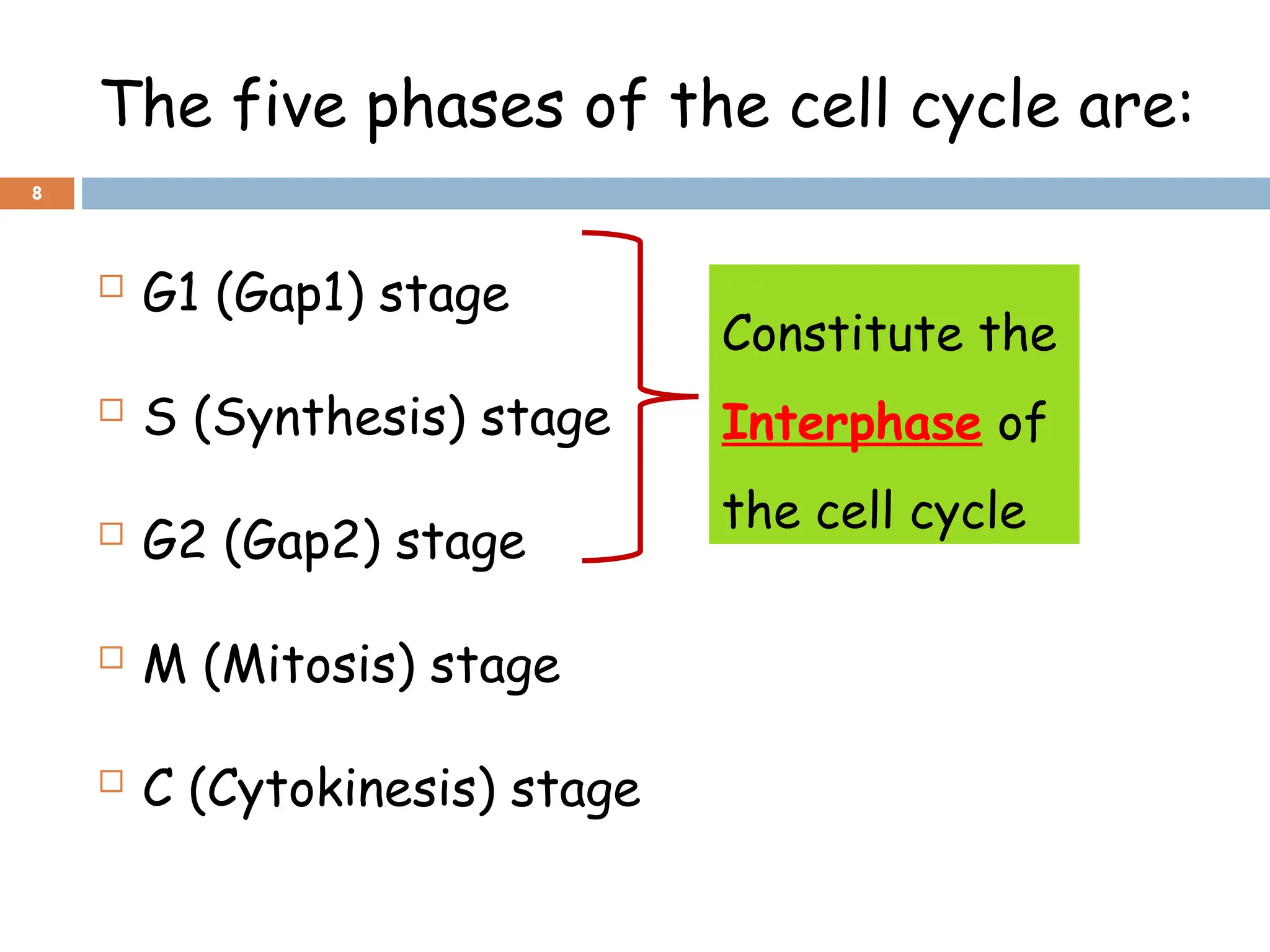
The five phases of the cell cycle are:
8
 G1 (Gap1) stage
 S (Synthesis) stage
 G2 (Gap2) stage
 M (Mitosis) stage
 C (Cytokinesis) stage
Constitute the
Interphase of
the cell cycle
INTERPHASE
9
 G1 stage: 1º phase of the cell cycle
 Involves growth and preparation of DNA for
replication
 Most of the variations in the length of the cell cycle
occur in the G1 phase
 Some cells pause at the G1 phase before DNA
replication and enter a resting state called G0 phase.
In this phase they may remain for days to years
before resuming cell division
10
 S stage: the cell synthesizes a replica of the genome
(DNA or chromatin) and also synthesizes the
centrosomes
 G2 stage: Involves preparation for M (Mitosis) stage
by making preparations for genomic separation
 Mitochondria and other organelles replicate,
chromosomes start to condense, and microtubules
begin to assemble at a spindle
11
The G2 of interphase:
A nuclear envelope
bounds the nucleus.
The nucleus contains
one or more nucleoli
(singular, nucleolus).
The duplicated
chromosomes/
chromatins are thread
like uncondensed
structures
12
The Eukaryotic Cell Cycle
Cytokinesis
•Actin
filaments
involved in
constricting
the cell
•Spindle fiber
pushes the
dividing cells
apart
Duration of the Cell Cycle
13
 The time it takes to complete a cell cycle varies greatly
among organisms
 Cells in growing embryos – cell cycle within 20 minutes;
 Fruit fly – the shortest known animal cell division in
embryos (8 minutes)
 Some cells divide rapidly
 Red blood cells must divide at a rate of 2.5 million per
second
14
 While others divide slowly
 Beans, for example take 19 hours for the complete
cycle
 Others, such as nerve cells, lose their capability to
divide once they reach maturity
 Some cells, such as liver cells, do not normally utilize
their capacity for division unless some STIMULUS is
received
IN GENERAL:
15
 For eukaryotic cell to divide into two, the two into
four, etc. two processes must alternate:
i. Doubling of its genome (DNA) in S phase
(synthesis phase) of the cell cycle
ii. Halving of that genome during mitosis (M phase)
16
 Mitosis is the process of forming identical daughter
cells by replicating and dividing the original
chromosomes
 It Involves nuclear division (karyokinesis) and
cytoplasmic division (cytokinesis)
 Mitosis deals with the segregation of the
chromosomes and organelles into daughter cells
M STAGE (MITOSIS)
17
 Mitosis is only observed in Somatic Cells, i.e.,
non-germ line cells (non-gametic cells)
Parent Cell
Daughter
Cells
2n = 46
2n = 46 2n = 46
Parent cells are identical
with the daughter cells in
terms of their:
•Chromosome Number
•Genome Content
To segregate equal number of chromosome having
similar DNA sequence among the daughter cells:
18
 Cells use microtubules with 9 + 2 arrangement
 Microtubules are organized and assembled by
centrosome
 In animal cells, a pair of centrioles are found in the
centrosome, but they do not have any known
function
 However, plants lack centrioles
19
 Cells that contain centrioles also have series radial
arrays of shorter microtubuies called Aster
 The aster extend from the centrioles to the cell
membrane
 The aster is thought to serve as a brace for the
functioning of the spindle fibers
 Prokaryotes lack spindles and centrioles
 The cell membrane assumes this function when it
pulls the replicated chromosomes apart during binary
fission
A glance look over the eukaryotic
chromosomes:
20
SEM
21
 Mitosis is further divided into FOUR stages:
 Prophase
 Metaphase
 Anaphase
 Telophase
 We will focus on mitosis in plant and animal cells
22
 The 1st
stage of mitosis
 Chromatin fibers more tightly
coiled
 Sister chromatids become
vosible
 Nucloelos dissolve &
disappear
 Centrosomes & centrioles
divide and pushed by the
lengthening microtubules
 Kinetochore begin to mature
PROPHASE
PROMETAPHASE
23
 Nuclear envelop fragments/
breaks
 Microtubules invade the
nuclear area
 Interact with the condensed
chromosomes & attach to
kinetochore, becoming
kinetochore microtubules
 Non-kinetochore microtubules
interact with those from the
opposite pole of the spindles
METAPHASE
24
 It is the longest stage of mitosis
 Centromeres situated at the
opposite ends
 The chromosomes (pair of
sister chromatids) align along
the metaphase plate at the
equator of the cell
 The chromosomes' centromeres
lie on the metaphase plate
ANAPHASE
25
 It is the shortest stage of mitosis
lasting only for few minutes
 It begins with the separation of
the centromeres, and
 The pulling of sister chromatids
to opposite poles of the spindle
 The cell elongates as the non-
kinetochore microtubules
lengthen
 Finally, the two ends of the cell
have equivalent and complete
collection of chromosomes
TELOPHASE
26
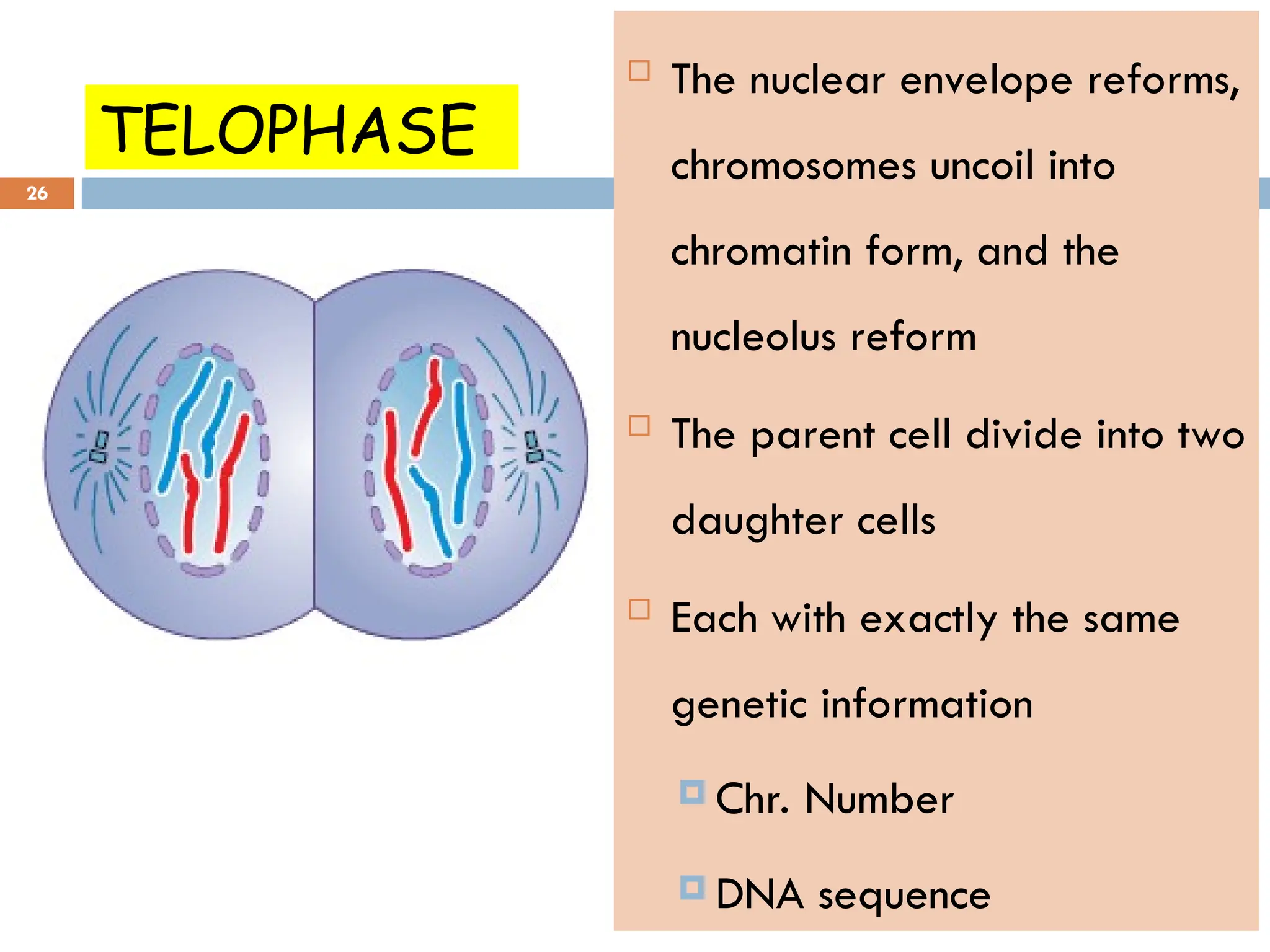
 The nuclear envelope reforms,
chromosomes uncoil into
chromatin form, and the
nucleolus reform
 The parent cell divide into two
daughter cells
 Each with exactly the same
genetic information
 Chr. Number
 DNA sequence
CYTOKINESIS
27
 It is the process of splitting the daughter cells apart
 It is the segregation of the cytoplasm and allocation
of the organelles (like golgi apparatus, plastids etc)
and cytoplasm into each new cell
 It usually occurs shortly after the end of mitosis
28
•In animal cells, cytokinesis involves the formation of a
cleavage furrow, which pinches the cell into two
• In plant cells, it involves in the formation of cell plate
MEIOSIS
29
 It is the process of cell division leading to the
production of daughter nuclei with half the genetic
complement of the parent cells
 Meiosis consists of two nuclear divisions
 First meiotic division/ meiosis I
 Second meiotic division/ meiosis II
The overall functions of meiosis are:
30
 Reducing the chromosome number from diploid to
haploid in order to produce gametes (sex cell)
 Ensuring that each of the haploid products has a
complete set of chromosomes
 Promote genetic diversity among its products
REGULATION OF THE CELL CYCLE
31
Architecture of the Control System
32
 THREE principal checkpoints that control the cell
cycle in eukaryotes are:
 Cell growth is assessed at the G1 checkpoint
 The success of DNA replication is assessed at the
G2 checkpoint
 Mitosis is assessed at the M checkpoint
33
The three principal check points that control the
eukaryotic cell cycle
Cell growth is assessed at the G1
checkpoint
34
 Located near the end of G1, just before entry into S
phase. It decides whether the cell should divide, delay
division, or enter a resting stage
 This checkpoint is called START
 If conditions are favorable for division, the cell begins
to copy its DNA by initiating S phase.
35
The success of DNA replication is
assessed at the G2 checkpoint
36
 The second checkpoint, which occurs at the end of
G2, triggers/ block the start of M phase.
 If this checkpoint is passed, the cell initiates the
many molecular processes that signal the beginning
of mitosis.
Mitosis is assessed at the M
checkpoint
37
 Occurring at metaphase, the third checkpoint
triggers the exit from mitosis and cytokinesis, and
the beginning of G1.

Unit 9. The cell cycle and cell cycle regulation.ppt

  • 1.
    THE CELL CYCLEAND CELL CYCLE REGULATION Cell Biology (Biol.2021) 2015 Unit- 9
  • 2.
    BRIEF INTRODUCTION  Livingthings are capable of reproduction by transferring hereditary information to the next generation.  This unique capacity to reproduce, like all other biological functions, has a cellular basis.  Cells need to divide/ reproduce for the continuity of life. 2
  • 3.
    Potentiality of celldivision: 3  When unicellular organisms (amoeba and bacteria) divides and forms duplicate offspring, the division of one cell reproduce an entire organism.  Cell division on a larger scale can produce progeny from some multicellular organisms (vegetative reproduction).  Sexually reproducing multicellular organisms develop from fertilization of single cell.
  • 4.
    In order forany cell to divide, FOUR events must occur in prokaryotes: 4  A reproductive signal: come from the inside or outside of the cell and kick off reproductive events  Rpilication of DNA (genetic material): the two new cells will be identical and have complete cell functions  Segregation: distribution of the replicated DNA to each of the two new cells  Cytokinesis: complete separation of the two new cells
  • 5.
    PROKARYOTIC CELL DIVISION 5 Prokaryotes are much simpler in their organization than are eukaryotes.  The usual method of prokaryote cell division is termed binary fission.  The prokaryote chromosome is much easier to manipulate than the eukaryotic one.  Prokaryotic chromosome: single DNA molecule  Eukaryotic chromosome: many in number
  • 6.
    6 One consequence of this asexual modeof reproduction is that all organisms in a colony are genetically identical. A drug that kills one bacteria (of a specific type) will also kill all other members of that clone (colony) it comes in contact with.
  • 7.
    EUKARYOTIC CELL DIVISION 7 Due to the increased number and more complicated organization of chromosomes, the eukaryotic cell division is more complicated  This division process is diagrammed as a cell cycle, consisting of five phases  The cell cycle is an ordered set of events; it ultimately ends in cell growth and division into two daughter cells
  • 8.
    The five phasesof the cell cycle are: 8  G1 (Gap1) stage  S (Synthesis) stage  G2 (Gap2) stage  M (Mitosis) stage  C (Cytokinesis) stage Constitute the Interphase of the cell cycle
  • 9.
    INTERPHASE 9  G1 stage:1º phase of the cell cycle  Involves growth and preparation of DNA for replication  Most of the variations in the length of the cell cycle occur in the G1 phase  Some cells pause at the G1 phase before DNA replication and enter a resting state called G0 phase. In this phase they may remain for days to years before resuming cell division
  • 10.
    10  S stage:the cell synthesizes a replica of the genome (DNA or chromatin) and also synthesizes the centrosomes  G2 stage: Involves preparation for M (Mitosis) stage by making preparations for genomic separation  Mitochondria and other organelles replicate, chromosomes start to condense, and microtubules begin to assemble at a spindle
  • 11.
    11 The G2 ofinterphase: A nuclear envelope bounds the nucleus. The nucleus contains one or more nucleoli (singular, nucleolus). The duplicated chromosomes/ chromatins are thread like uncondensed structures
  • 12.
    12 The Eukaryotic CellCycle Cytokinesis •Actin filaments involved in constricting the cell •Spindle fiber pushes the dividing cells apart
  • 13.
    Duration of theCell Cycle 13  The time it takes to complete a cell cycle varies greatly among organisms  Cells in growing embryos – cell cycle within 20 minutes;  Fruit fly – the shortest known animal cell division in embryos (8 minutes)  Some cells divide rapidly  Red blood cells must divide at a rate of 2.5 million per second
  • 14.
    14  While othersdivide slowly  Beans, for example take 19 hours for the complete cycle  Others, such as nerve cells, lose their capability to divide once they reach maturity  Some cells, such as liver cells, do not normally utilize their capacity for division unless some STIMULUS is received
  • 15.
    IN GENERAL: 15  Foreukaryotic cell to divide into two, the two into four, etc. two processes must alternate: i. Doubling of its genome (DNA) in S phase (synthesis phase) of the cell cycle ii. Halving of that genome during mitosis (M phase)
  • 16.
    16  Mitosis isthe process of forming identical daughter cells by replicating and dividing the original chromosomes  It Involves nuclear division (karyokinesis) and cytoplasmic division (cytokinesis)  Mitosis deals with the segregation of the chromosomes and organelles into daughter cells M STAGE (MITOSIS)
  • 17.
    17  Mitosis isonly observed in Somatic Cells, i.e., non-germ line cells (non-gametic cells) Parent Cell Daughter Cells 2n = 46 2n = 46 2n = 46 Parent cells are identical with the daughter cells in terms of their: •Chromosome Number •Genome Content
  • 18.
    To segregate equalnumber of chromosome having similar DNA sequence among the daughter cells: 18  Cells use microtubules with 9 + 2 arrangement  Microtubules are organized and assembled by centrosome  In animal cells, a pair of centrioles are found in the centrosome, but they do not have any known function  However, plants lack centrioles
  • 19.
    19  Cells thatcontain centrioles also have series radial arrays of shorter microtubuies called Aster  The aster extend from the centrioles to the cell membrane  The aster is thought to serve as a brace for the functioning of the spindle fibers  Prokaryotes lack spindles and centrioles  The cell membrane assumes this function when it pulls the replicated chromosomes apart during binary fission
  • 20.
    A glance lookover the eukaryotic chromosomes: 20 SEM
  • 21.
    21  Mitosis isfurther divided into FOUR stages:  Prophase  Metaphase  Anaphase  Telophase  We will focus on mitosis in plant and animal cells
  • 22.
    22  The 1st stageof mitosis  Chromatin fibers more tightly coiled  Sister chromatids become vosible  Nucloelos dissolve & disappear  Centrosomes & centrioles divide and pushed by the lengthening microtubules  Kinetochore begin to mature PROPHASE
  • 23.
    PROMETAPHASE 23  Nuclear envelopfragments/ breaks  Microtubules invade the nuclear area  Interact with the condensed chromosomes & attach to kinetochore, becoming kinetochore microtubules  Non-kinetochore microtubules interact with those from the opposite pole of the spindles
  • 24.
    METAPHASE 24  It isthe longest stage of mitosis  Centromeres situated at the opposite ends  The chromosomes (pair of sister chromatids) align along the metaphase plate at the equator of the cell  The chromosomes' centromeres lie on the metaphase plate
  • 25.
    ANAPHASE 25  It isthe shortest stage of mitosis lasting only for few minutes  It begins with the separation of the centromeres, and  The pulling of sister chromatids to opposite poles of the spindle  The cell elongates as the non- kinetochore microtubules lengthen  Finally, the two ends of the cell have equivalent and complete collection of chromosomes
  • 26.
    TELOPHASE 26  The nuclearenvelope reforms, chromosomes uncoil into chromatin form, and the nucleolus reform  The parent cell divide into two daughter cells  Each with exactly the same genetic information  Chr. Number  DNA sequence
  • 27.
    CYTOKINESIS 27  It isthe process of splitting the daughter cells apart  It is the segregation of the cytoplasm and allocation of the organelles (like golgi apparatus, plastids etc) and cytoplasm into each new cell  It usually occurs shortly after the end of mitosis
  • 28.
    28 •In animal cells,cytokinesis involves the formation of a cleavage furrow, which pinches the cell into two • In plant cells, it involves in the formation of cell plate
  • 29.
    MEIOSIS 29  It isthe process of cell division leading to the production of daughter nuclei with half the genetic complement of the parent cells  Meiosis consists of two nuclear divisions  First meiotic division/ meiosis I  Second meiotic division/ meiosis II
  • 30.
    The overall functionsof meiosis are: 30  Reducing the chromosome number from diploid to haploid in order to produce gametes (sex cell)  Ensuring that each of the haploid products has a complete set of chromosomes  Promote genetic diversity among its products
  • 31.
    REGULATION OF THECELL CYCLE 31
  • 32.
    Architecture of theControl System 32  THREE principal checkpoints that control the cell cycle in eukaryotes are:  Cell growth is assessed at the G1 checkpoint  The success of DNA replication is assessed at the G2 checkpoint  Mitosis is assessed at the M checkpoint
  • 33.
    33 The three principalcheck points that control the eukaryotic cell cycle
  • 34.
    Cell growth isassessed at the G1 checkpoint 34  Located near the end of G1, just before entry into S phase. It decides whether the cell should divide, delay division, or enter a resting stage  This checkpoint is called START  If conditions are favorable for division, the cell begins to copy its DNA by initiating S phase.
  • 35.
  • 36.
    The success ofDNA replication is assessed at the G2 checkpoint 36  The second checkpoint, which occurs at the end of G2, triggers/ block the start of M phase.  If this checkpoint is passed, the cell initiates the many molecular processes that signal the beginning of mitosis.
  • 37.
    Mitosis is assessedat the M checkpoint 37  Occurring at metaphase, the third checkpoint triggers the exit from mitosis and cytokinesis, and the beginning of G1.