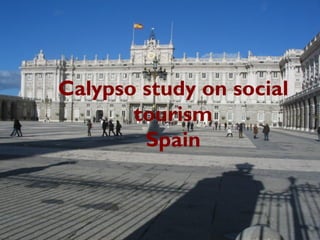
Calypso study on social
       tourism
        Spain
Generality

 The  tourism sector is
  considered to be the
  most important
  economic sector in Spain.
 Tourism represents 10, 8
  % of the gdp.
 Tourism employed 2,7
  million people in 2005,
  which is 12,4 % of the
  total working population
   Competitiveness and
    strengths

 The proximity to the
  main European markets.
 Favourable weather
  conditions.
 Several consolidated
  tourist destinations.
 Large variety of cultural
  resources distributed
  across the territory.
   Weaknesses

 it’s
     characterised by a
  strong seasonal
  component.
 Lack of identity in
  tourism proposal for
  traditional destinations.
 Excessive geographical
  concentration of tourist
  and residential
  accommodation offer
Spain is one of the countries with a
stronger tradition in social tourism.

 In  Spain, the main actors involved with social
    tourism are of an institutional nature.

The most important are:
 IMSERSO is a management Organisation of the
 Social Security, belonging to the ministry of
 health and social policy
 SEGITUR  is a public company created by the
 ministry of Industry and tourism.

 COCEMFE   is the Spanish Confederation of
 Persons with Physical and Organics Disabilities.

 TheUGT, union general de trabadores, also
 arranges it’s members requests for seats to
 enjoy their holidays.
II The target groups of social
       tourism in Spain
The segmentation profile: Senior citizens

   The population over the age of 65 in Spain is
    more of 7 million.

 The    economic problems derived from the fact
    that participants depend on a retirement
    pension.

   Accommodation is usually in hotels.
 The seniors like mostly
 cultural visits to cities,
 museum, sun and beach
 tourism, gastronomy routes
 (the food component is
 increasingly important).

 Thisgroup can travel during
 the low season, as they are
 not usually engaged in
 employment.
Young people

   Between 15 and 35 five years old, there is
    more than 12 million people in Spain

• Constraints:
 The economic difficulties: young people with
  low income
 Geographic obstacles: young persons living in a
  rural or remote area.
 They prefer European
  destinations.
 The accommodation will
  depend on the nature of
  travel, but for them it’s easy
  to find.
 The demand of activities is
  wide.
 They are very sensitive to the
  price.
 The period as many of them
  are students, is summer or
  other school holidays.
Families facing difficult circumstances

There   is a lack of legal and institutional
definition of this group, the limits of which are
blurred.

•Constraints:
Tourism of families with difficulties is not
developed in Spain. Marketwise doesn’t exist.
Adults with disabilities

The  sector represents between 9% and 10 % of
Spanish population.
 Who are they: between 18 and 60 years old,
with a disability of more than 33%

•Constraints:
 Economic problems because most of them
depend on a non-contributing pension.
 Problems    derived from
  their own disability.
 Difficulties derived from
  living in a rural or poorly
  communicated area.
 According NGOs, 84% of
  all like travelling. Demand
  largely exceeds the
  existing supply subsided.
 The accommodation
  usually takes place in
  hotels.
III The IMSERSO program
(Instituto de mayores y servicios
              sociales)
Generality
   The program

 IMSERSO     was created in
  1985, it starting offering
  16000 seats and until now it
  has offered 1,2 million seats.
 The target group is seniors
  from the age of 65.
 Since it started, more than 10
  million persons have taken
  part in this program.
   The objectives

It’s a social program with a
   double dimension:
 To improve the quality of
   life and wellbeing of
   seniors.
 To favour the creation an
   maintenance of
   employment and economic
   activity during the period
   of low activity.
   Requirements, modalities and duration:

 Aged  65 and over.
 Pensioners of the Public Pension System.
 This is an intra-regional social tourism program.
  There are no exchanges.
 Cultural trip: 6 day routes, full board.
 Nature tourism: 5 days full board, in
  recreational and contemplative areas.
   Description of
    support
    mechanisms

  Partial financing from
  the IMSERSO, equal
  for all persons.
 Reservation facilities:
  more than 9300 travel
  agencies offer the
  programme.
Funding mechanisms and results
•   Description of funding
    mechanisms
   the total amount of
    direct resources
    allocated to be 300
    million euros.
   The following economic
    impact is estimated: 1,53
    euros are recovered by
    the state for every euro
    invested.
   The result on the Spanish economy

 13000  direct jobs and 85000 indirect jobs in the
  low season are created every year.
 The employment generated has a direct
  repercussion on the public administration
  income.
 Not only sun and Beach destinations: Inland are
  included. ( more than 82000 persons in 2007-
  2008).
 Wealth and employment are generated in all
  regions.
Calypso study spain

Calypso study spain

  • 1.
    Calypso study onsocial tourism Spain
  • 4.
    Generality  The tourism sector is considered to be the most important economic sector in Spain.  Tourism represents 10, 8 % of the gdp.  Tourism employed 2,7 million people in 2005, which is 12,4 % of the total working population
  • 5.
    Competitiveness and strengths  The proximity to the main European markets.  Favourable weather conditions.  Several consolidated tourist destinations.  Large variety of cultural resources distributed across the territory.
  • 6.
    Weaknesses  it’s characterised by a strong seasonal component.  Lack of identity in tourism proposal for traditional destinations.  Excessive geographical concentration of tourist and residential accommodation offer
  • 7.
    Spain is oneof the countries with a stronger tradition in social tourism.  In Spain, the main actors involved with social tourism are of an institutional nature. The most important are:  IMSERSO is a management Organisation of the Social Security, belonging to the ministry of health and social policy
  • 8.
     SEGITUR is a public company created by the ministry of Industry and tourism.  COCEMFE is the Spanish Confederation of Persons with Physical and Organics Disabilities.  TheUGT, union general de trabadores, also arranges it’s members requests for seats to enjoy their holidays.
  • 9.
    II The targetgroups of social tourism in Spain
  • 10.
    The segmentation profile:Senior citizens  The population over the age of 65 in Spain is more of 7 million.  The economic problems derived from the fact that participants depend on a retirement pension.  Accommodation is usually in hotels.
  • 11.
     The seniorslike mostly cultural visits to cities, museum, sun and beach tourism, gastronomy routes (the food component is increasingly important).  Thisgroup can travel during the low season, as they are not usually engaged in employment.
  • 12.
    Young people  Between 15 and 35 five years old, there is more than 12 million people in Spain • Constraints:  The economic difficulties: young people with low income  Geographic obstacles: young persons living in a rural or remote area.
  • 13.
     They preferEuropean destinations.  The accommodation will depend on the nature of travel, but for them it’s easy to find.  The demand of activities is wide.  They are very sensitive to the price.  The period as many of them are students, is summer or other school holidays.
  • 14.
    Families facing difficultcircumstances There is a lack of legal and institutional definition of this group, the limits of which are blurred. •Constraints: Tourism of families with difficulties is not developed in Spain. Marketwise doesn’t exist.
  • 15.
    Adults with disabilities The sector represents between 9% and 10 % of Spanish population.  Who are they: between 18 and 60 years old, with a disability of more than 33% •Constraints:  Economic problems because most of them depend on a non-contributing pension.
  • 16.
     Problems derived from their own disability.  Difficulties derived from living in a rural or poorly communicated area.  According NGOs, 84% of all like travelling. Demand largely exceeds the existing supply subsided.  The accommodation usually takes place in hotels.
  • 17.
    III The IMSERSOprogram (Instituto de mayores y servicios sociales)
  • 18.
    Generality  The program  IMSERSO was created in 1985, it starting offering 16000 seats and until now it has offered 1,2 million seats.  The target group is seniors from the age of 65.  Since it started, more than 10 million persons have taken part in this program.
  • 19.
    The objectives It’s a social program with a double dimension:  To improve the quality of life and wellbeing of seniors.  To favour the creation an maintenance of employment and economic activity during the period of low activity.
  • 20.
    Requirements, modalities and duration:  Aged 65 and over.  Pensioners of the Public Pension System.  This is an intra-regional social tourism program. There are no exchanges.  Cultural trip: 6 day routes, full board.  Nature tourism: 5 days full board, in recreational and contemplative areas.
  • 21.
    Description of support mechanisms  Partial financing from the IMSERSO, equal for all persons.  Reservation facilities: more than 9300 travel agencies offer the programme.
  • 22.
    Funding mechanisms andresults • Description of funding mechanisms  the total amount of direct resources allocated to be 300 million euros.  The following economic impact is estimated: 1,53 euros are recovered by the state for every euro invested.
  • 23.
    The result on the Spanish economy  13000 direct jobs and 85000 indirect jobs in the low season are created every year.  The employment generated has a direct repercussion on the public administration income.  Not only sun and Beach destinations: Inland are included. ( more than 82000 persons in 2007- 2008).  Wealth and employment are generated in all regions.