Unit IV
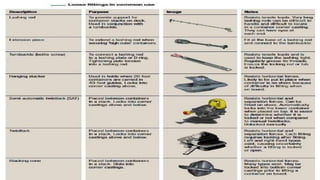
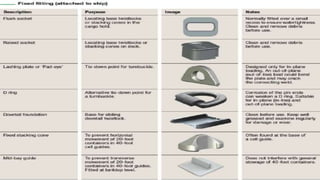
Cargo Equipment
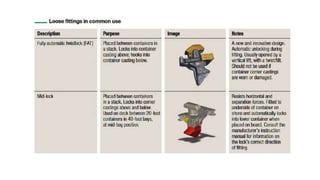
• Base Twist lock
• Semi Automatic Twist lock
• Midlocks
• Semi Automatic Base Twist lock
• Hanging staker
• Lashing Rods
• Turnbuckle & Bottle screw
• Spammer
• Emergency tool
• Grease
Different Cargo Handling Equipment Used on Container Ships (marineinsight.com)
Exercise
• Chapter 3 Ship’s Structure and Equipment - ppt video online
download (slideplayer.com)
• Microsoft Word - 16-ME-tal (uniri.hr)- equipment
IMO
• Dangerous or IMO (International Maritime Organization) goods are
any goods whose properties or characteristics pose a risk to people’s
safety and security.
9 DIFFERENT CLASSES OF IMO
• Class 1: Explosives
• Class 2: Gases
• Class 3: Flammable liquids.
• Class 4: Flammable solids.
• Class 5: Oxidizing substances and organic peroxides.
• Class 6: Toxic substances.
• Class 7: Radioactive material.
• Class 8: Corrosive substances.
• Class 9: Miscellaneous dangerous substances and articles.
IMO Classification: Identifying Dangerous Goods (tibagroup.com)
Port Authorities
• A port authority (or a port district) is a governmental or quasi-
governmental public entity usually formed by a legislative body to
operate ports and other transportation infrastructure.
• Port authorities are usually governed by boards or commissions,
which are commonly appointed, but may be elected.
Port functions
• Regulatory function: ensure that statutory requirements are fulfilled
• The landlord function: focuses on managing and planning the real
estate, implementing policies and strategies for development of
infrastructure, providing access for road and rail based transportation
• Operator function: engage in physical transfer of goods between sea
and land
• Stakeholder function: Community (“cluster”) manager
Types of Ports:
The Operating Port
• Builds the docks, owns the cranes and cargo-
handling equipment and hires the labor to move
cargo in the sheds and yards. A stevedore company
hires longshore labor to lift cargo between the ship
and the dock, where the port’s laborers pick it up and
bring it to the storage site.
The Landlord Port
• The powers of the port authority are limited to the
decisions concerning land use, reservations of space for
the port areas and construction and use of public port
works. Port authorities act like the owner of the port
property, granting short or long term leases or
concessions to private enterprises.
The Hybrid Port
• The port authority runs one or more terminals while leasing others or
can act as a tool port in one instance and as a landlord or operating port
at other facilities
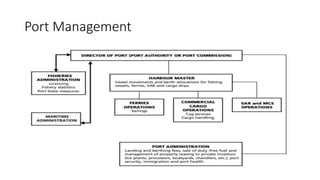
Port Management
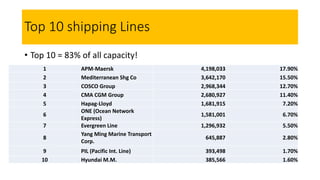
Top 10 shipping Lines
1 APM-Maersk 4,198,033 17.90%
2 Mediterranean Shg Co 3,642,170 15.50%
3 COSCO Group 2,968,344 12.70%
4 CMA CGM Group 2,680,927 11.40%
5 Hapag-Lloyd 1,681,915 7.20%
6
ONE (Ocean Network
Express)
1,581,001 6.70%
7 Evergreen Line 1,296,932 5.50%
8
Yang Ming Marine Transport
Corp.
645,887 2.80%
9 PIL (Pacific Int. Line) 393,498 1.70%
10 Hyundai M.M. 385,566 1.60%
• Top 10 = 83% of all capacity!
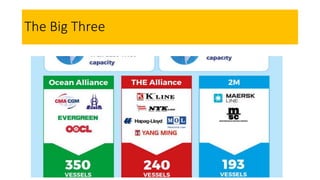
The Big Three
23
Terminal management
• Terminal: A terminal is a specific physical, technological,
organizational and/or operational area where a certain cargo is
handled
• Port terminal managers are responsible for planning, administering
and reviewing the operations on a port terminal in order to optimize
resource use, minimize costs and maintain quality standards.
• They are also in charge of safety and health throughout the terminal,
including the proper handling of dangerous goods.
Responsibilities of terminal managers
• Lead production operation of a port terminal
• Develop and delivers on business plans to meet port terminal commitments
• Oversee terminal budget
• Coordinate with rail carriers on delivery of product
• Manage vessel tug, barge switching and fleeting operations
• Be responsible for safety and health throughout the terminal
• Lead, develop and implement strategic and operational planning
• Serve as liaison with industry stakeholders
• Represent the company on external committees and associations
• Supervise shipping process and inventory management
• Monitor computerized automation systems
• Coordinate and distribute products to maximize efficiency
Role of ship officers
• Chief Officer is responsible for performing
vessel navigation watch duties, cargo operations in ports
which includes loading, unloading, and cargo planning.
• The duties include the administration task of scheduling and
distributing work to deck crew.
• S/He has to build up the co-ordination with other departments
and take part in conflict resolution.
• He is responsible for garbage management for the deck and
accommodation part of the ship.
• S/He is in charge of the ballast and de-ballasting operation
done on board.
• Training in all the above regulations and conventions are to
be carried out by the chief officer as per company policy.
• To look after supply, overtime, cost control records, purchase
order, requisition, and other paperwork on behalf of shore
management.
• S/He also acts as SSO- ship security officer, responsible for
the security of the ship both in port and at sea.
• S/He is the overall safety in charge of the deck crew.
• S/He is responsible for the welfare of the crew on board ship.
Ballast What is Ballasting and De-
ballasting? (marineinsight.com)
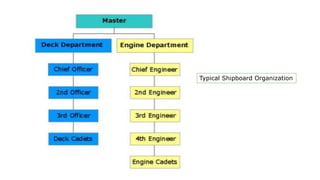
Typical Shipboard Organization
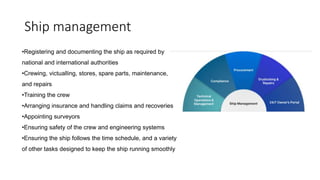
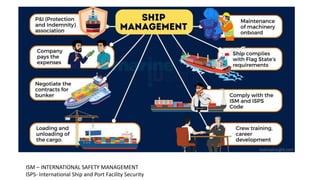
Ship management
•Registering and documenting the ship as required by
national and international authorities
•Crewing, victualling, stores, spare parts, maintenance,
and repairs
•Training the crew
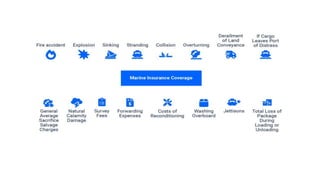
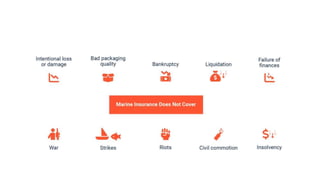
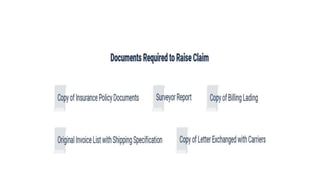
•Arranging insurance and handling claims and recoveries
•Appointing surveyors
•Ensuring safety of the crew and engineering systems
•Ensuring the ship follows the time schedule, and a variety
of other tasks designed to keep the ship running smoothly
ISM – INTERNATIONAL SAFETY MANAGEMENT
ISPS- International Ship and Port Facility Security
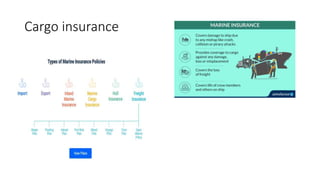
Cargo insurance
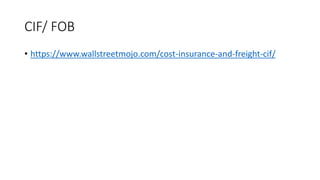
CIF/ FOB
• https://www.wallstreetmojo.com/cost-insurance-and-freight-cif/
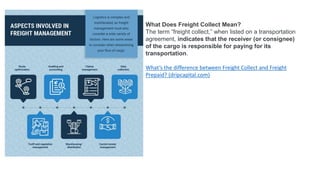
What Does Freight Collect Mean?
The term “freight collect,” when listed on a transportation
agreement, indicates that the receiver (or consignee)
of the cargo is responsible for paying for its
transportation.
What’s the difference between Freight Collect and Freight
Prepaid? (dripcapital.com)

unit 4.pptx

  • 1.
  • 2.
    Cargo Equipment • BaseTwist lock • Semi Automatic Twist lock • Midlocks • Semi Automatic Base Twist lock • Hanging staker • Lashing Rods • Turnbuckle & Bottle screw • Spammer • Emergency tool • Grease Different Cargo Handling Equipment Used on Container Ships (marineinsight.com)
  • 6.
    Exercise • Chapter 3Ship’s Structure and Equipment - ppt video online download (slideplayer.com) • Microsoft Word - 16-ME-tal (uniri.hr)- equipment
  • 7.
    IMO • Dangerous orIMO (International Maritime Organization) goods are any goods whose properties or characteristics pose a risk to people’s safety and security.
  • 8.
    9 DIFFERENT CLASSESOF IMO • Class 1: Explosives • Class 2: Gases • Class 3: Flammable liquids. • Class 4: Flammable solids. • Class 5: Oxidizing substances and organic peroxides. • Class 6: Toxic substances. • Class 7: Radioactive material. • Class 8: Corrosive substances. • Class 9: Miscellaneous dangerous substances and articles. IMO Classification: Identifying Dangerous Goods (tibagroup.com)
  • 15.
    Port Authorities • Aport authority (or a port district) is a governmental or quasi- governmental public entity usually formed by a legislative body to operate ports and other transportation infrastructure. • Port authorities are usually governed by boards or commissions, which are commonly appointed, but may be elected.
  • 16.
    Port functions • Regulatoryfunction: ensure that statutory requirements are fulfilled • The landlord function: focuses on managing and planning the real estate, implementing policies and strategies for development of infrastructure, providing access for road and rail based transportation • Operator function: engage in physical transfer of goods between sea and land • Stakeholder function: Community (“cluster”) manager
  • 17.
    Types of Ports: TheOperating Port • Builds the docks, owns the cranes and cargo- handling equipment and hires the labor to move cargo in the sheds and yards. A stevedore company hires longshore labor to lift cargo between the ship and the dock, where the port’s laborers pick it up and bring it to the storage site.
  • 18.
    The Landlord Port •The powers of the port authority are limited to the decisions concerning land use, reservations of space for the port areas and construction and use of public port works. Port authorities act like the owner of the port property, granting short or long term leases or concessions to private enterprises.
  • 19.
    The Hybrid Port •The port authority runs one or more terminals while leasing others or can act as a tool port in one instance and as a landlord or operating port at other facilities
  • 20.
  • 21.
    Top 10 shippingLines 1 APM-Maersk 4,198,033 17.90% 2 Mediterranean Shg Co 3,642,170 15.50% 3 COSCO Group 2,968,344 12.70% 4 CMA CGM Group 2,680,927 11.40% 5 Hapag-Lloyd 1,681,915 7.20% 6 ONE (Ocean Network Express) 1,581,001 6.70% 7 Evergreen Line 1,296,932 5.50% 8 Yang Ming Marine Transport Corp. 645,887 2.80% 9 PIL (Pacific Int. Line) 393,498 1.70% 10 Hyundai M.M. 385,566 1.60% • Top 10 = 83% of all capacity!
  • 22.
  • 23.
  • 24.
    Terminal management • Terminal:A terminal is a specific physical, technological, organizational and/or operational area where a certain cargo is handled • Port terminal managers are responsible for planning, administering and reviewing the operations on a port terminal in order to optimize resource use, minimize costs and maintain quality standards. • They are also in charge of safety and health throughout the terminal, including the proper handling of dangerous goods.
  • 25.
    Responsibilities of terminalmanagers • Lead production operation of a port terminal • Develop and delivers on business plans to meet port terminal commitments • Oversee terminal budget • Coordinate with rail carriers on delivery of product • Manage vessel tug, barge switching and fleeting operations • Be responsible for safety and health throughout the terminal • Lead, develop and implement strategic and operational planning • Serve as liaison with industry stakeholders • Represent the company on external committees and associations • Supervise shipping process and inventory management • Monitor computerized automation systems • Coordinate and distribute products to maximize efficiency
  • 26.
    Role of shipofficers • Chief Officer is responsible for performing vessel navigation watch duties, cargo operations in ports which includes loading, unloading, and cargo planning. • The duties include the administration task of scheduling and distributing work to deck crew. • S/He has to build up the co-ordination with other departments and take part in conflict resolution. • He is responsible for garbage management for the deck and accommodation part of the ship. • S/He is in charge of the ballast and de-ballasting operation done on board. • Training in all the above regulations and conventions are to be carried out by the chief officer as per company policy. • To look after supply, overtime, cost control records, purchase order, requisition, and other paperwork on behalf of shore management. • S/He also acts as SSO- ship security officer, responsible for the security of the ship both in port and at sea. • S/He is the overall safety in charge of the deck crew. • S/He is responsible for the welfare of the crew on board ship. Ballast What is Ballasting and De- ballasting? (marineinsight.com)
  • 27.
  • 28.
    Ship management •Registering anddocumenting the ship as required by national and international authorities •Crewing, victualling, stores, spare parts, maintenance, and repairs •Training the crew •Arranging insurance and handling claims and recoveries •Appointing surveyors •Ensuring safety of the crew and engineering systems •Ensuring the ship follows the time schedule, and a variety of other tasks designed to keep the ship running smoothly
  • 29.
    ISM – INTERNATIONALSAFETY MANAGEMENT ISPS- International Ship and Port Facility Security
  • 30.
  • 33.
  • 37.
    What Does FreightCollect Mean? The term “freight collect,” when listed on a transportation agreement, indicates that the receiver (or consignee) of the cargo is responsible for paying for its transportation. What’s the difference between Freight Collect and Freight Prepaid? (dripcapital.com)

Editor's Notes

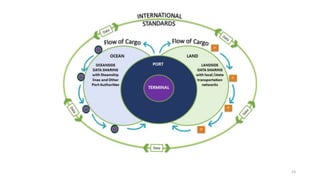
  • #24 GE incorporating all functions, not just the outer circle (Don) They want to leverage, but plug into as much hard data as they can. Two things 1. The standards, they don’t exist today. The stakeholder still has to visit every site to get the updates they need. Concept of how something works and reality if you don’t get stakeholders on board, it won’t work. We won’t solve that, we will need to watch and see how it’s worked out. 3rd party systems, pay into and get a certain amount of visibility to the data / information we need. There will be multiple platforms. Need, demand, and benefit. What is the return? you’re not going to have a lease, to pay for a facility Digital infrastructure becomes a part of doing business Why do we need a PCS? We don’t own data that people want. RFID. We can do a better job of knowing of what to invest in and where to use resources What is our value proposition, what do we bring to the table that the private entities cannot do? Do we need to define the gateway relationships? Today we have stakeholders who have to go to many different locations to get the data / information. Help stakeholders to get the information they need to be more efficient with their business. As you get the data in place, you can leverage it to optimize the process. Idea of transitioning from passive management to active management – we use the lease as a mechanism to monitor/incentivize KPIs. Secure platform that is outside of our control. If we don’t fill this space, someone will. Someone will provide what we’re talking about. IF we don’t influence, we might not have the When will we be done with the PCS effort? Never Digitization will drive what we do, more and more. Unique opportunity to recognize the importance of leveraging data / information. Develop roadmap with short term, mid term and long term goals. Roadmap –goals here & futue --------------------------------- Resources - all resources people, software, hardware --------------------------------- Budget – as we move forward Cheaply, efficiently Surrounds and supports those terminals Paving, equipment, power – we’re supporting them to make them efficient Hardware, things that collect data, I.e. RFID. Tons of data around all of the trucks coming in and out of the system. OCR AIS Predicting cargo location for importers and exporters – what everyone wants to know. Cargo flow creates data points. Standards: i.e block chain. TZ: Will we need to redefine our relationship with the MTO ZT: If we want to have control over the data, then yes. That is not the main focus though. We want to promote visibility. This is the flow and the data that is created out of the system. We can’t start on the outside, need to start from the inside. We have to shift from passive to active management. Same position that we’re in with Terminals. Big ships, bigger moves. Active: Provide visibility, actively measure so we can manage If you try to build enough capacity into the roads, it would take 115B dollars. We pay 1.15 in gas tax. To afford this kind of infrastructure we would pay 2.50 in gas tax