UNIT – 3
EMPHASIS
• Emphasis involves the concentration of interest in the selected area of design when compared with other
subordinated areas.
• Emphasis as such, should not be placed at an area that one wishesto minimize attention on.
• Designers often create emphasis partially though the carefularrangement of line, texture and colours.
• There is some portion in every dress which is the centre of attraction.
• This portion is called point of emphasis.
• Emphasis is concentration of interest in one area called eye arresting area of a design that acts as the center of
attention.
• It is the center of attention of an outfit.
• This implies that some areas require subordination in order to emphasize that area.
• Without any such centre of interest, an outfit looks unplanned and monotonous too.
• When many focal points are created in a dress, a jumbled, confusing design results.
• So, it is best for instance, to leave the cuffs, hemline and other areas of a dress fairly plain if the neckline is
being emphasized.
• The face or personality area is more important and should be emphasizedmost often.
• This is the part of the person that is most unique and individualistic and so one should make use of this area.
• Emphasis at this personality area may be achieved by colour and texture contrasts, necklines, jewelry, scarves,
hats, hairstyles, and makeup.
• Care is exercised to see that only one area is emphasized as discussed earlier.
• Hands are emphasized by long sleeves, especially when cuffs are linked, by bracelets and rings and even by
well manicured nails.
• Hands that are dirty orwith chewed nails can bring negative emphasis to this area.
• Similarly, legs and feet are made dominated by unusual hem lengths, design details at the hem, textured or
coloured hosiery and even elaborate footwear.
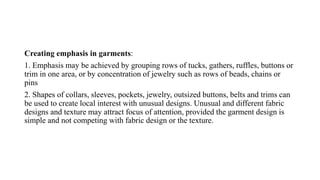
Creating emphasis in garments:
1. Emphasis may be achieved by grouping rows of tucks, gathers, ruffles, buttons or
trim in one area, or by concentration of jewelry such as rows of beads, chains or
pins
2. Shapes of collars, sleeves, pockets, jewelry, outsized buttons, belts and trims can
be used to create local interest with unusual designs. Unusual and different fabric
designs and texture may attract focus of attention, provided the garment design is
simple and not competing with fabric design or the texture.
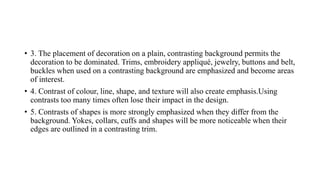
• 3. The placement of decoration on a plain, contrasting background permits the
decoration to be dominated. Trims, embroidery appliqué, jewelry, buttons and belt,
buckles when used on a contrasting background are emphasized and become areas
of interest.
• 4. Contrast of colour, line, shape, and texture will also create emphasis.Using
contrasts too many times often lose their impact in the design.
• 5. Contrasts of shapes is more strongly emphasized when they differ from the
background. Yokes, collars, cuffs and shapes will be more noticeable when their
edges are outlined in a contrasting trim.
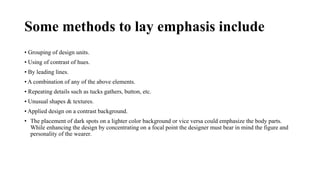
Some methods to lay emphasis include
• Grouping of design units.
• Using of contrast of hues.
• By leading lines.
• A combination of any of the above elements.
• Repeating details such as tucks gathers, button, etc.
• Unusual shapes & textures.
• Applied design on a contrast background.
• The placement of dark spots on a lighter color background or vice versa could emphasize the body parts.
While enhancing the design by concentrating on a focal point the designer must bear in mind the figure and
personality of the wearer.

unit 3 principles of design 2.pptx

  • 1.
  • 2.
    • Emphasis involvesthe concentration of interest in the selected area of design when compared with other subordinated areas. • Emphasis as such, should not be placed at an area that one wishesto minimize attention on. • Designers often create emphasis partially though the carefularrangement of line, texture and colours. • There is some portion in every dress which is the centre of attraction. • This portion is called point of emphasis. • Emphasis is concentration of interest in one area called eye arresting area of a design that acts as the center of attention. • It is the center of attention of an outfit.
  • 3.
    • This impliesthat some areas require subordination in order to emphasize that area. • Without any such centre of interest, an outfit looks unplanned and monotonous too. • When many focal points are created in a dress, a jumbled, confusing design results. • So, it is best for instance, to leave the cuffs, hemline and other areas of a dress fairly plain if the neckline is being emphasized. • The face or personality area is more important and should be emphasizedmost often. • This is the part of the person that is most unique and individualistic and so one should make use of this area.
  • 4.
    • Emphasis atthis personality area may be achieved by colour and texture contrasts, necklines, jewelry, scarves, hats, hairstyles, and makeup. • Care is exercised to see that only one area is emphasized as discussed earlier. • Hands are emphasized by long sleeves, especially when cuffs are linked, by bracelets and rings and even by well manicured nails. • Hands that are dirty orwith chewed nails can bring negative emphasis to this area. • Similarly, legs and feet are made dominated by unusual hem lengths, design details at the hem, textured or coloured hosiery and even elaborate footwear.
  • 5.
    Creating emphasis ingarments: 1. Emphasis may be achieved by grouping rows of tucks, gathers, ruffles, buttons or trim in one area, or by concentration of jewelry such as rows of beads, chains or pins 2. Shapes of collars, sleeves, pockets, jewelry, outsized buttons, belts and trims can be used to create local interest with unusual designs. Unusual and different fabric designs and texture may attract focus of attention, provided the garment design is simple and not competing with fabric design or the texture.
  • 6.
    • 3. Theplacement of decoration on a plain, contrasting background permits the decoration to be dominated. Trims, embroidery appliqué, jewelry, buttons and belt, buckles when used on a contrasting background are emphasized and become areas of interest. • 4. Contrast of colour, line, shape, and texture will also create emphasis.Using contrasts too many times often lose their impact in the design. • 5. Contrasts of shapes is more strongly emphasized when they differ from the background. Yokes, collars, cuffs and shapes will be more noticeable when their edges are outlined in a contrasting trim.
  • 7.
    Some methods tolay emphasis include • Grouping of design units. • Using of contrast of hues. • By leading lines. • A combination of any of the above elements. • Repeating details such as tucks gathers, button, etc. • Unusual shapes & textures. • Applied design on a contrast background. • The placement of dark spots on a lighter color background or vice versa could emphasize the body parts. While enhancing the design by concentrating on a focal point the designer must bear in mind the figure and personality of the wearer.