PRINCIPLES OF DESIGN 
Balance 
Emphasis 
Harmony/unity 
Rhythm/Movement 
Proportion/scale
Balance 
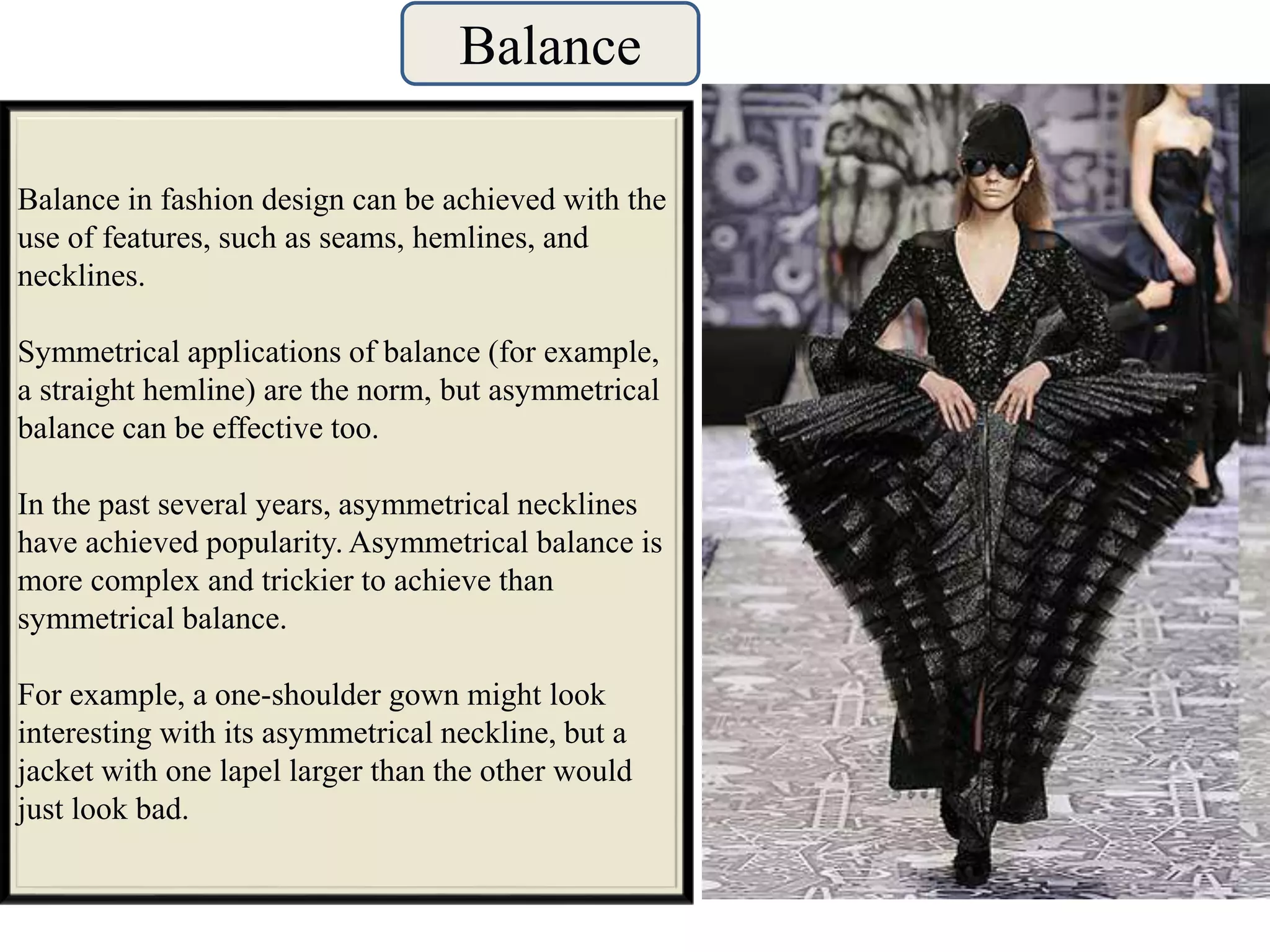
Balance in fashion design can be achieved with the 
use of features, such as seams, hemlines, and 
necklines. 
Symmetrical applications of balance (for example, 
a straight hemline) are the norm, but asymmetrical 
balance can be effective too. 
In the past several years, asymmetrical necklines 
have achieved popularity. Asymmetrical balance is 
more complex and trickier to achieve than 
symmetrical balance. 
For example, a one-shoulder gown might look 
interesting with its asymmetrical neckline, but a 
jacket with one lapel larger than the other would 
just look bad.
Balance 
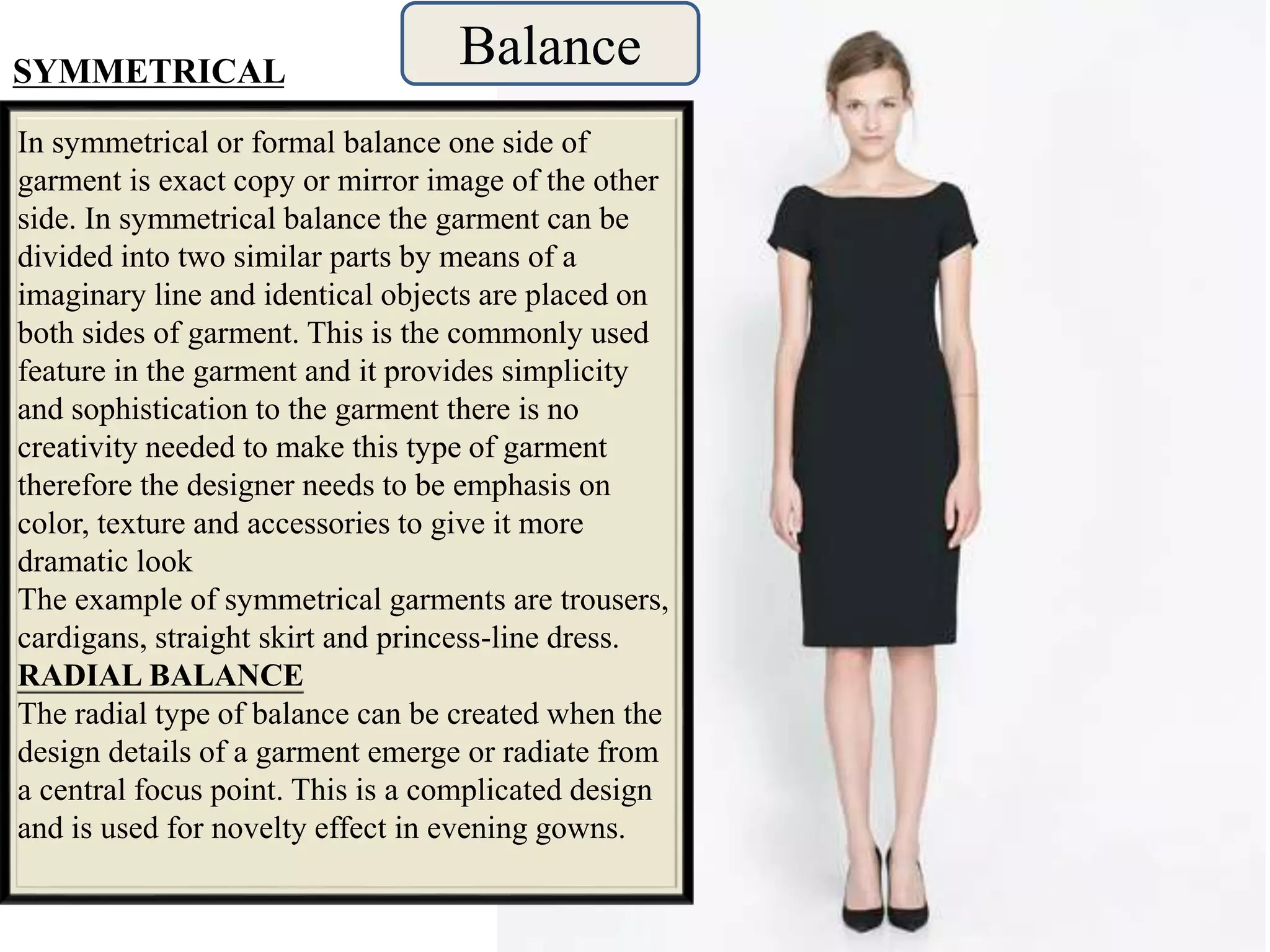
SYMMETRICAL 
BALANCE 
In symmetrical or formal balance one side of 
garment is exact copy or mirror image of the other 
side. In symmetrical balance the garment can be 
divided into two similar parts by means of a 
imaginary line and identical objects are placed on 
both sides of garment. This is the commonly used 
feature in the garment and it provides simplicity 
and sophistication to the garment there is no 
creativity needed to make this type of garment 
therefore the designer needs to be emphasis on 
color, texture and accessories to give it more 
dramatic look 
The example of symmetrical garments are trousers, 
cardigans, straight skirt and princess-line dress. 
RADIAL BALANCE 
The radial type of balance can be created when the 
design details of a garment emerge or radiate from 
a central focus point. This is a complicated design 
and is used for novelty effect in evening gowns.
Balance 
ASYMMETRICAL BALANCE 
The asymmetrical or informal balance 
provides more excitement to the garment. 
In this case the design composition of the 
garment on either side is different from 
each other but one part of the garment 
equalizes the other part in weight. The 
more creativity can be showed on these 
types of garments and 
body irregularities can be hidden by this 
factor. The example of this type of 
balance can be shown in formal wears.
Asymmetrical—(balance) balanced, but each side is different
Symmetrical—(formal balance) exactly same on both sides
Rhythm
Rhythm 
Regular Rhythm 
A element is repeated at 
the same 
repetition/interval each 
time
Rhythm
Rhythm
Rhythm
Rhythm 
Gradated Rhythm 
Rhythm
RHYTHM 
• Rhythm is created by repetition of lines, patterns, shapes or colors. 
• By use of gathers, pleats, buttons and tucks we can make a 
rhythmic effect in the garment. 
• Printed suit fabrics are a wonderful example of rhythm on fabric. 
Example: collection of vases displayed on a shelf, row of buttons on 
garment or stripes
14 
What type of balance does this garment have? 
Where is the rhythm in this garment?
Harmony/Unity 
When the principle of unity in fashion design is applied well, a garment or fashion 
accessory should look good overall. 
It should look as though it goes together, and it should look as though all the design 
elements are contributing to make a harmonious whole. 
In an effective application of the principle of unity, each element enhances the others, 
rather than distracting from the design.
16 
Harmony/Unity 
* Unity + Variety = Harmony 
* Unity-everything works together 
* Variety-design is not boring, several 
elements used to hold viewers attention
HARMONY 
Harmony in a garment relates to the overall look of the garment, in 
which garment, hairdo, accessories all makes the whole look. 
Principles of Harmony 
Silhouette of the garment should be in a good relation to the body 
shape of the garment. 
Style lines should be consistent on every area of the garment. 
All areas of the garment should reflect the same shapes so that 
the continuity of the design is not broken. 
Similar or contrasting textures should be used in a pleasing way. 
Unity in the color combination should be there to provide harmony. 
Small differences in the hem lengths of sleeves and garment ends 
should be avoided as they interfere with the horizontal movement of 
the eye
18 
Discuss the design of this room 
Are all of the elements harmonious? 
Harmony 
Why or why not?
EMPHASIS 
There are a number of techniques that a fashion designer may use to place emphasis on a 
feature of a garment or a fashion accessory. 
Such techniques may include the addition of embellishment, cut-outs, ruffles, peplums, and so 
on. 
Use of color and its placement is another way to create emphasis, making some areas stand out 
more than others. 
Exaggerated or unusual designs, such as the leg-o-mutton sleeves that were popular on 1980s 
wedding gowns, also create emphasis, highlighting a particular area. 
Knowing about emphasis, which can be part of the design itself or emphasis on the body 
because of the way a garment is designed, can help any woman when she is selecting a garment 
or fashion accessory. 
For example, if a woman wants to showcase her shoulders, she may select a strapless top or 
dress. If she wants to highlight her cleavage, she may select a gown with a deep V-neckline.
EMPHASIS 
•Points of attention in a 
design. 
•The feature in a design that 
attracts one’s eye. 
•The focal point. 
•Emphasis can be achieved 
through size, placement, color 
and use of lines. 
•The most personal aspect of a 
design.
EMPHASIS 
Emphasis is the center of interest, which 
draws and holds the attention more than 
any other part. 
Every garment has a area of emphasis on 
it which makes the center of attraction of 
the garment. Emphasis can be achieved 
by means of- 
Contrasting Colors 
Bold and unusual shapes 
Eye catching patterns 
Complex Textures 
Attractive Design Details 
Interesting Trims 
There are some details 
which emphasis on face with the use of 
collars in contrasting colors, a bright 
coloured scarf or necktie, jewellery and 
hats.
Example: fire place, vase of flowers, artwork piece of jewelry, 
scarf, hair clip
23 
What area of this room is your eye drawn to? 
Why do you think this has become the focal point?
Proportion 
Proportion in fashion design is the principle that 
holds that the size of various components of a 
garment or fashion accessory must look good 
together. 
Proportion is one of the most important principles of 
fashion design for the petite woman because when 
she selects garments, their proportion (or size/scale 
of the garment or various components of a garment 
or fashion accessory) should be relative to her small 
stature. 
For example, a tea-length, full skirt would have so 
much volume that it would be overwhelming on a 
petite woman.
PROPORTION 
Proportion can be defined as a pleasing relationship between the garment and its different 
parts. In garment its silhouette has to be in proportion with the different parts of the garment. 
The basic law or the golden law that is provided by the Egyptians is 3:5:8 and 5:8:13. A 
proportionate garment design needs to be synchronized with the motifs, the placement of the 
motifs and the desirability of the garment to the wearer. The colors in a garment also provide 
proportion to the garment. The best examples of this are Indian ladies suits which follow an 
inverted proportion system. Although miniskirts are designed in poor proportion as the shorter 
length of the garment proportionate the longer legs of the wearer. 
Proportion And Body Shape 
The body size can be divided into three categories which are as follows- 
Small 
Medium 
Large 
The person who is of small body size should not wear garments which have big patterns on it , 
excess of jewellery also do not look good on small statured people. 
The person who is of medium body size can wear a wide variety of garments and different types 
of fabrics according to their body size. 
The person who has large body size can wear garments which have small motifs on it which 
can accentuate the body shape of the person.
Is this area well-proportioned or disproportioned? 
Compare the size and scale of the objects in the room to one 
another
Principlasofdesign 131114025120-phpapp01

Principlasofdesign 131114025120-phpapp01

  • 1.
    PRINCIPLES OF DESIGN Balance Emphasis Harmony/unity Rhythm/Movement Proportion/scale
  • 2.
    Balance Balance infashion design can be achieved with the use of features, such as seams, hemlines, and necklines. Symmetrical applications of balance (for example, a straight hemline) are the norm, but asymmetrical balance can be effective too. In the past several years, asymmetrical necklines have achieved popularity. Asymmetrical balance is more complex and trickier to achieve than symmetrical balance. For example, a one-shoulder gown might look interesting with its asymmetrical neckline, but a jacket with one lapel larger than the other would just look bad.
  • 3.
    Balance SYMMETRICAL BALANCE In symmetrical or formal balance one side of garment is exact copy or mirror image of the other side. In symmetrical balance the garment can be divided into two similar parts by means of a imaginary line and identical objects are placed on both sides of garment. This is the commonly used feature in the garment and it provides simplicity and sophistication to the garment there is no creativity needed to make this type of garment therefore the designer needs to be emphasis on color, texture and accessories to give it more dramatic look The example of symmetrical garments are trousers, cardigans, straight skirt and princess-line dress. RADIAL BALANCE The radial type of balance can be created when the design details of a garment emerge or radiate from a central focus point. This is a complicated design and is used for novelty effect in evening gowns.
  • 4.
    Balance ASYMMETRICAL BALANCE The asymmetrical or informal balance provides more excitement to the garment. In this case the design composition of the garment on either side is different from each other but one part of the garment equalizes the other part in weight. The more creativity can be showed on these types of garments and body irregularities can be hidden by this factor. The example of this type of balance can be shown in formal wears.
  • 5.
  • 6.
  • 7.
  • 8.
    Rhythm Regular Rhythm A element is repeated at the same repetition/interval each time
  • 9.
  • 10.
  • 11.
  • 12.
  • 13.
    RHYTHM • Rhythmis created by repetition of lines, patterns, shapes or colors. • By use of gathers, pleats, buttons and tucks we can make a rhythmic effect in the garment. • Printed suit fabrics are a wonderful example of rhythm on fabric. Example: collection of vases displayed on a shelf, row of buttons on garment or stripes
  • 14.
    14 What typeof balance does this garment have? Where is the rhythm in this garment?
  • 15.
    Harmony/Unity When theprinciple of unity in fashion design is applied well, a garment or fashion accessory should look good overall. It should look as though it goes together, and it should look as though all the design elements are contributing to make a harmonious whole. In an effective application of the principle of unity, each element enhances the others, rather than distracting from the design.
  • 16.
    16 Harmony/Unity *Unity + Variety = Harmony * Unity-everything works together * Variety-design is not boring, several elements used to hold viewers attention
  • 17.
    HARMONY Harmony ina garment relates to the overall look of the garment, in which garment, hairdo, accessories all makes the whole look. Principles of Harmony Silhouette of the garment should be in a good relation to the body shape of the garment. Style lines should be consistent on every area of the garment. All areas of the garment should reflect the same shapes so that the continuity of the design is not broken. Similar or contrasting textures should be used in a pleasing way. Unity in the color combination should be there to provide harmony. Small differences in the hem lengths of sleeves and garment ends should be avoided as they interfere with the horizontal movement of the eye
  • 18.
    18 Discuss thedesign of this room Are all of the elements harmonious? Harmony Why or why not?
  • 19.
    EMPHASIS There area number of techniques that a fashion designer may use to place emphasis on a feature of a garment or a fashion accessory. Such techniques may include the addition of embellishment, cut-outs, ruffles, peplums, and so on. Use of color and its placement is another way to create emphasis, making some areas stand out more than others. Exaggerated or unusual designs, such as the leg-o-mutton sleeves that were popular on 1980s wedding gowns, also create emphasis, highlighting a particular area. Knowing about emphasis, which can be part of the design itself or emphasis on the body because of the way a garment is designed, can help any woman when she is selecting a garment or fashion accessory. For example, if a woman wants to showcase her shoulders, she may select a strapless top or dress. If she wants to highlight her cleavage, she may select a gown with a deep V-neckline.
  • 20.
    EMPHASIS •Points ofattention in a design. •The feature in a design that attracts one’s eye. •The focal point. •Emphasis can be achieved through size, placement, color and use of lines. •The most personal aspect of a design.
  • 21.
    EMPHASIS Emphasis isthe center of interest, which draws and holds the attention more than any other part. Every garment has a area of emphasis on it which makes the center of attraction of the garment. Emphasis can be achieved by means of- Contrasting Colors Bold and unusual shapes Eye catching patterns Complex Textures Attractive Design Details Interesting Trims There are some details which emphasis on face with the use of collars in contrasting colors, a bright coloured scarf or necktie, jewellery and hats.
  • 22.
    Example: fire place,vase of flowers, artwork piece of jewelry, scarf, hair clip
  • 23.
    23 What areaof this room is your eye drawn to? Why do you think this has become the focal point?
  • 24.
    Proportion Proportion infashion design is the principle that holds that the size of various components of a garment or fashion accessory must look good together. Proportion is one of the most important principles of fashion design for the petite woman because when she selects garments, their proportion (or size/scale of the garment or various components of a garment or fashion accessory) should be relative to her small stature. For example, a tea-length, full skirt would have so much volume that it would be overwhelming on a petite woman.
  • 25.
    PROPORTION Proportion canbe defined as a pleasing relationship between the garment and its different parts. In garment its silhouette has to be in proportion with the different parts of the garment. The basic law or the golden law that is provided by the Egyptians is 3:5:8 and 5:8:13. A proportionate garment design needs to be synchronized with the motifs, the placement of the motifs and the desirability of the garment to the wearer. The colors in a garment also provide proportion to the garment. The best examples of this are Indian ladies suits which follow an inverted proportion system. Although miniskirts are designed in poor proportion as the shorter length of the garment proportionate the longer legs of the wearer. Proportion And Body Shape The body size can be divided into three categories which are as follows- Small Medium Large The person who is of small body size should not wear garments which have big patterns on it , excess of jewellery also do not look good on small statured people. The person who is of medium body size can wear a wide variety of garments and different types of fabrics according to their body size. The person who has large body size can wear garments which have small motifs on it which can accentuate the body shape of the person.
  • 26.
    Is this areawell-proportioned or disproportioned? Compare the size and scale of the objects in the room to one another

Editor's Notes

  • #8 Project Lead The Way® Copyright 2006
  • #9 Project Lead The Way® Copyright 2006
  • #10 Project Lead The Way® Copyright 2006
  • #11 Project Lead The Way® Copyright 2006
  • #12 Project Lead The Way® Copyright 2006
  • #13 Project Lead The Way® Copyright 2006