Cryptography and
Network Security
Multiple Encryption & DES
 clear a replacement for DES was needed
 theoretical attacks that can break it
 demonstrated exhaustive key search attacks
 AES is a new cipher alternative
 prior to this alternative was to use multiple
encryption with DES implementations
 Triple-DES is the chosen form
Double-DES?
 could use 2 DES encrypts on each block
 C = EK2(EK1(P))
 issue of reduction to single stage
 and have “meet-in-the-middle” attack
 works whenever use a cipher twice
 since X = EK1(P) = DK2(C)
 attack by encrypting P with all keys and store
 then decrypt C with keys and match X value
 can show takes O(256) steps
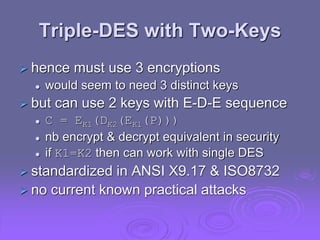
Triple-DES with Two-Keys
 hence must use 3 encryptions
 would seem to need 3 distinct keys
 but can use 2 keys with E-D-E sequence
 C = EK1(DK2(EK1(P)))
 nb encrypt & decrypt equivalent in security
 if K1=K2 then can work with single DES
 standardized in ANSI X9.17 & ISO8732
 no current known practical attacks
Triple-DES with Three-Keys
 although are no practical attacks on two-
key Triple-DES have some indications
 can use Triple-DES with Three-Keys to
avoid even these
 C = EK3(DK2(EK1(P)))
 has been adopted by some Internet
applications, eg PGP, S/MIME
Modes of Operation
 block ciphers encrypt fixed size blocks
 eg. DES encrypts 64-bit blocks with 56-bit key
 need some way to en/decrypt arbitrary
amounts of data in practise
 ANSI X3.106-1983 Modes of Use (now
FIPS 81) defines 4 possible modes
 subsequently 5 defined for AES & DES
 have block and stream modes
Electronic Codebook Book (ECB)
 message is broken into independent
blocks which are encrypted
 each block is a value which is substituted,
like a codebook, hence name
 each block is encoded independently of
the other blocks
Ci = DESK1(Pi)
 uses: secure transmission of single values
Electronic Codebook Book (ECB)
Advantages and Limitations of
ECB
 message repetitions may show in ciphertext
 if aligned with message block
 particularly with data such graphics
 or with messages that change very little, which
become a code-book analysis problem
 weakness is due to the encrypted message
blocks being independent
 main use is sending a few blocks of data
Cipher Block Chaining (CBC)
 message is broken into blocks
 linked together in encryption operation
 each previous cipher blocks is chained
with current plaintext block, hence name
 use Initial Vector (IV) to start process
Ci = DESK1(Pi XOR Ci-1)
C-1 = IV
 uses: bulk data encryption, authentication
Cipher Block Chaining (CBC)
Message Padding
 at end of message must handle a possible
last short block
 which is not as large as blocksize of cipher
 pad either with known non-data value (eg nulls)
 or pad last block along with count of pad size
• eg. [ b1 b2 b3 0 0 0 0 5]
• means have 3 data bytes, then 5 bytes pad+count
 this may require an extra entire block over
those in message
 there are other, more esoteric modes,
which avoid the need for an extra block
Advantages and Limitations of
CBC
 a ciphertext block depends on all blocks
before it
 any change to a block affects all following
ciphertext blocks
 need Initialization Vector (IV)
 which must be known to sender & receiver
 if sent in clear, attacker can change bits of first block,
and change IV to compensate
 hence IV must either be a fixed value (as in EFTPOS)
 or must be sent encrypted in ECB mode before rest of
message
Cipher FeedBack (CFB)
 message is treated as a stream of bits
 added to the output of the block cipher
 result is feed back for next stage (hence name)
 standard allows any number of bit (1,8, 64 or
128 etc) to be feed back
 denoted CFB-1, CFB-8, CFB-64, CFB-128 etc
 most efficient to use all bits in block (64 or 128)
Ci = Pi XOR DESK1(Ci-1)
C-1 = IV
 uses: stream data encryption, authentication
Cipher FeedBack (CFB)
Advantages and Limitations of
CFB
 appropriate when data arrives in bits/bytes
 most common stream mode
 limitation is need to stall while do block
encryption after every n-bits
 note that the block cipher is used in
encryption mode at both ends
 errors propogate for several blocks after
the error
Output FeedBack (OFB)
 message is treated as a stream of bits
 output of cipher is added to message
 output is then feed back (hence name)
 feedback is independent of message
 can be computed in advance
Ci = Pi XOR Oi
Oi = DESK1(Oi-1)
O-1 = IV
 uses: stream encryption on noisy channels
Output FeedBack (OFB)
Advantages and Limitations of
OFB
 bit errors do not propagate
 more vulnerable to message stream modification
 a variation of a Vernam cipher
 hence must never reuse the same sequence
(key+IV)
 sender & receiver must remain in sync
 originally specified with m-bit feedback
 subsequent research has shown that only full
block feedback (ie CFB-64 or CFB-128) should
ever be used
Counter (CTR)
 a “new” mode, though proposed early on
 similar to OFB but encrypts counter value
rather than any feedback value
 must have a different key & counter value
for every plaintext block (never reused)
Ci = Pi XOR Oi
Oi = DESK1(i)
 uses: high-speed network encryptions
Counter (CTR)
Advantages and Limitations of
CTR
 efficiency
 can do parallel encryptions in h/w or s/w
 can preprocess in advance of need
 good for bursty high speed links
 random access to encrypted data blocks
 provable security (good as other modes)
 but must ensure never reuse key/counter
values, otherwise could break (cf OFB)
Stream Ciphers
 process message bit by bit (as a stream)
 have a pseudo random keystream
 combined (XOR) with plaintext bit by bit
 randomness of stream key completely
destroys statistically properties in message
 Ci = Mi XOR StreamKeyi
 but must never reuse stream key
 otherwise can recover messages (cf book
cipher)
Stream Cipher Structure
Stream Cipher Properties
 some design considerations are:
 long period with no repetitions
 statistically random
 depends on large enough key
 large linear complexity
 properly designed, can be as secure as a
block cipher with same size key
 but usually simpler & faster
RC4
 a proprietary cipher owned by RSA DSI
 another Ron Rivest design, simple but effective
 variable key size, byte-oriented stream cipher
 widely used (web SSL/TLS, wireless WEP)
 key forms random permutation of all 8-bit values
 uses that permutation to scramble input info
processed a byte at a time
RC4 Key Schedule
 starts with an array S of numbers: 0..255
 use key to well and truly shuffle
 S forms internal state of the cipher
for i = 0 to 255 do
S[i] = i
T[i] = K[i mod keylen])
j = 0
for i = 0 to 255 do
j = (j + S[i] + T[i]) (mod 256)
swap (S[i], S[j])
RC4 Encryption
 encryption continues shuffling array values
 sum of shuffled pair selects "stream key"
value from permutation
 XOR S[t] with next byte of message to
en/decrypt
i = j = 0
for each message byte Mi
i = (i + 1) (mod 256)
j = (j + S[i]) (mod 256)
swap(S[i], S[j])
t = (S[i] + S[j]) (mod 256)
Ci = Mi XOR S[t]
RC4 Overview
RC4 Security
 claimed secure against known attacks
 have some analyses, none practical
 result is very non-linear
 since RC4 is a stream cipher, must never
reuse a key
 have a concern with WEP, but due to key
handling rather than RC4 itself
Summary
 Triple-DES
 Modes of Operation
 ECB, CBC, CFB, OFB, CTR
 stream ciphers
 RC4

unit 2.ppt

  • 1.
  • 2.
    Multiple Encryption &DES  clear a replacement for DES was needed  theoretical attacks that can break it  demonstrated exhaustive key search attacks  AES is a new cipher alternative  prior to this alternative was to use multiple encryption with DES implementations  Triple-DES is the chosen form
  • 3.
    Double-DES?  could use2 DES encrypts on each block  C = EK2(EK1(P))  issue of reduction to single stage  and have “meet-in-the-middle” attack  works whenever use a cipher twice  since X = EK1(P) = DK2(C)  attack by encrypting P with all keys and store  then decrypt C with keys and match X value  can show takes O(256) steps
  • 4.
    Triple-DES with Two-Keys hence must use 3 encryptions  would seem to need 3 distinct keys  but can use 2 keys with E-D-E sequence  C = EK1(DK2(EK1(P)))  nb encrypt & decrypt equivalent in security  if K1=K2 then can work with single DES  standardized in ANSI X9.17 & ISO8732  no current known practical attacks
  • 5.
    Triple-DES with Three-Keys although are no practical attacks on two- key Triple-DES have some indications  can use Triple-DES with Three-Keys to avoid even these  C = EK3(DK2(EK1(P)))  has been adopted by some Internet applications, eg PGP, S/MIME
  • 6.
    Modes of Operation block ciphers encrypt fixed size blocks  eg. DES encrypts 64-bit blocks with 56-bit key  need some way to en/decrypt arbitrary amounts of data in practise  ANSI X3.106-1983 Modes of Use (now FIPS 81) defines 4 possible modes  subsequently 5 defined for AES & DES  have block and stream modes
  • 7.
    Electronic Codebook Book(ECB)  message is broken into independent blocks which are encrypted  each block is a value which is substituted, like a codebook, hence name  each block is encoded independently of the other blocks Ci = DESK1(Pi)  uses: secure transmission of single values
  • 8.
  • 9.
    Advantages and Limitationsof ECB  message repetitions may show in ciphertext  if aligned with message block  particularly with data such graphics  or with messages that change very little, which become a code-book analysis problem  weakness is due to the encrypted message blocks being independent  main use is sending a few blocks of data
  • 10.
    Cipher Block Chaining(CBC)  message is broken into blocks  linked together in encryption operation  each previous cipher blocks is chained with current plaintext block, hence name  use Initial Vector (IV) to start process Ci = DESK1(Pi XOR Ci-1) C-1 = IV  uses: bulk data encryption, authentication
  • 11.
  • 12.
    Message Padding  atend of message must handle a possible last short block  which is not as large as blocksize of cipher  pad either with known non-data value (eg nulls)  or pad last block along with count of pad size • eg. [ b1 b2 b3 0 0 0 0 5] • means have 3 data bytes, then 5 bytes pad+count  this may require an extra entire block over those in message  there are other, more esoteric modes, which avoid the need for an extra block
  • 13.
    Advantages and Limitationsof CBC  a ciphertext block depends on all blocks before it  any change to a block affects all following ciphertext blocks  need Initialization Vector (IV)  which must be known to sender & receiver  if sent in clear, attacker can change bits of first block, and change IV to compensate  hence IV must either be a fixed value (as in EFTPOS)  or must be sent encrypted in ECB mode before rest of message
  • 14.
    Cipher FeedBack (CFB) message is treated as a stream of bits  added to the output of the block cipher  result is feed back for next stage (hence name)  standard allows any number of bit (1,8, 64 or 128 etc) to be feed back  denoted CFB-1, CFB-8, CFB-64, CFB-128 etc  most efficient to use all bits in block (64 or 128) Ci = Pi XOR DESK1(Ci-1) C-1 = IV  uses: stream data encryption, authentication
  • 15.
  • 16.
    Advantages and Limitationsof CFB  appropriate when data arrives in bits/bytes  most common stream mode  limitation is need to stall while do block encryption after every n-bits  note that the block cipher is used in encryption mode at both ends  errors propogate for several blocks after the error
  • 17.
    Output FeedBack (OFB) message is treated as a stream of bits  output of cipher is added to message  output is then feed back (hence name)  feedback is independent of message  can be computed in advance Ci = Pi XOR Oi Oi = DESK1(Oi-1) O-1 = IV  uses: stream encryption on noisy channels
  • 18.
  • 19.
    Advantages and Limitationsof OFB  bit errors do not propagate  more vulnerable to message stream modification  a variation of a Vernam cipher  hence must never reuse the same sequence (key+IV)  sender & receiver must remain in sync  originally specified with m-bit feedback  subsequent research has shown that only full block feedback (ie CFB-64 or CFB-128) should ever be used
  • 20.
    Counter (CTR)  a“new” mode, though proposed early on  similar to OFB but encrypts counter value rather than any feedback value  must have a different key & counter value for every plaintext block (never reused) Ci = Pi XOR Oi Oi = DESK1(i)  uses: high-speed network encryptions
  • 21.
  • 22.
    Advantages and Limitationsof CTR  efficiency  can do parallel encryptions in h/w or s/w  can preprocess in advance of need  good for bursty high speed links  random access to encrypted data blocks  provable security (good as other modes)  but must ensure never reuse key/counter values, otherwise could break (cf OFB)
  • 23.
    Stream Ciphers  processmessage bit by bit (as a stream)  have a pseudo random keystream  combined (XOR) with plaintext bit by bit  randomness of stream key completely destroys statistically properties in message  Ci = Mi XOR StreamKeyi  but must never reuse stream key  otherwise can recover messages (cf book cipher)
  • 24.
  • 25.
    Stream Cipher Properties some design considerations are:  long period with no repetitions  statistically random  depends on large enough key  large linear complexity  properly designed, can be as secure as a block cipher with same size key  but usually simpler & faster
  • 26.
    RC4  a proprietarycipher owned by RSA DSI  another Ron Rivest design, simple but effective  variable key size, byte-oriented stream cipher  widely used (web SSL/TLS, wireless WEP)  key forms random permutation of all 8-bit values  uses that permutation to scramble input info processed a byte at a time
  • 27.
    RC4 Key Schedule starts with an array S of numbers: 0..255  use key to well and truly shuffle  S forms internal state of the cipher for i = 0 to 255 do S[i] = i T[i] = K[i mod keylen]) j = 0 for i = 0 to 255 do j = (j + S[i] + T[i]) (mod 256) swap (S[i], S[j])
  • 28.
    RC4 Encryption  encryptioncontinues shuffling array values  sum of shuffled pair selects "stream key" value from permutation  XOR S[t] with next byte of message to en/decrypt i = j = 0 for each message byte Mi i = (i + 1) (mod 256) j = (j + S[i]) (mod 256) swap(S[i], S[j]) t = (S[i] + S[j]) (mod 256) Ci = Mi XOR S[t]
  • 29.
  • 30.
    RC4 Security  claimedsecure against known attacks  have some analyses, none practical  result is very non-linear  since RC4 is a stream cipher, must never reuse a key  have a concern with WEP, but due to key handling rather than RC4 itself
  • 31.
    Summary  Triple-DES  Modesof Operation  ECB, CBC, CFB, OFB, CTR  stream ciphers  RC4