Unit 26 Film studies

    By Daniel Vidal
Storyline
It is set in the present day, of the economic downturn of the world.
A very successful ceo of a multi-billion oil company crashes into debt, and Dave
     is blamed, he is then stunned to the street with nothing to his name.
While sitting in a doorway, Dave notices a commotion and goes to investigate.
     He sees a young man being dragged into a abandoned warehouse. Dave
     makes to snap decision to go in, he finds the man on a chair with a bomb
     counting down, Dave saves the man (lee) and get to safety.
Casting
Good Guy - Ryan Reynolds $15’000’000


Bad guy - Alan Ford
$10’000’000
                                              Director - Paul McGuigan worth
                                              $5’000’000
Ernie Reyes Jr.
$2’000’000


Inculding CGI effects and explosions
$8’000’000
                  Leaving my production with $60’000’000 for
                  marketing
Advertisement
Also the super bowl is a great time to advertise because it has
millions of views at one time to watch my promotional trailer.

I will also use youtube to advertise my action movie, by using this
form of media it would be shown to a wide range of people.
Diversion – to escape from ever day problems

Personal relationships – using the media for emotional and other
  interaction.

Personal identity – finding yourself reflected in texts, learning
  behaviour and values for texts.

Surveillance – information which could be used for.
7 characteristics of blockbusters
•   It is a ‘star vehicle’.
•   A large production budget e.g $100million.
•   A large marketing budget.
•   A range of merchandising.
•   A wide demographic.
•   A holiday release date.
•   Worldwide release.
4 audience theories
•   Reception
•   Two step flow
•   Uses and Gratification
•   The hypodermic needle
Reception theory
Dominant (hegemonic): the reader fully shares the text code
  and accepts and reproduces the preferred reading.
Negotiated reading: the reader partly shares the text code and
  broadly accepts, but sometimes its modified to the person
  own position.
Oppositional (counter- hegemonic): complete opposite to the
  dominant code, so the reader understands the text code and
  rejects this reading.
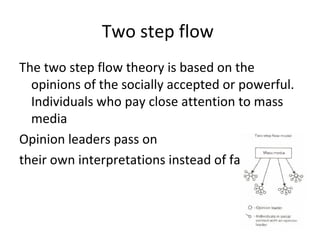
Two step flow
The two step flow theory is based on the
  opinions of the socially accepted or powerful.
  Individuals who pay close attention to mass
  media
Opinion leaders pass on
their own interpretations instead of facts
Uses and Gratification
There are 5 main reasons why people watch media.
To escape
Social interaction
Identify
Inform & Educate
Entertain
The hypodermic needle
During second world wars media plays a vital role in both United
  States and Germany to made influence in the people’s mind.
  The Germany Hitler’s Nazi used film industry for Propaganda
  and they produced lots of movies about their achievements
  which made a great impact in Germans mind.
The media (magic gun) fired the message directly into audience
  head without their own knowledge. The message cause the
  instant reaction from the audience mind without any hesitation
  is called “Magic Bullet Theory”.
5 narrative theories
•   Tordorov's equilibrium
•   Propp’s narrative structure
•   Levi’s binary oppositions
•   Barthes’s codes
•   Shklovsky’s …..
Tordorov's Narrative Theory
Tordorov’s believed that the narrative theory was in
   every film/ story.
It starts with a state of normality, the equilibrium is
   then followed by a disequilibrium which is a
   disruption of events. The disequilibrium must then
   be recognised by the characters causing them to take
   action to restore the equilibrium. Since the
   characters cannot return to the original equilibrium,
   a new one is created in the process.
Propp’s characters roles
Between 1895 - 1970 Propp analysed fairy tales by there narrative
  structure

The Hero ((protagonist) has a mission)
The Villains ((antagonist) tries to stop hero)
The Doner (gives the hero something)
The False Hero (villain that pretends to be good)
The Helper (always with the hero)
The Princess (love interest)
Levi
Levi showed that in 1970’s there was always
  binary oppositions in films.
Strong – weak
Good – bad
Domestic – Savage
Philosophy - myth
Barthes
Action code; something the audience knows and doesn’t need
   explaining.

Enigma code; something hidden from the audience.

Symbolic code; something that symbolizes a more abstract concept.

Cultural code; something that is read with understanding due to
   cultural awareness.

Semic code; something that the audience recognise through
  connotations.

Unit 26

  • 1.
    Unit 26 Filmstudies By Daniel Vidal
  • 2.
    Storyline It is setin the present day, of the economic downturn of the world. A very successful ceo of a multi-billion oil company crashes into debt, and Dave is blamed, he is then stunned to the street with nothing to his name. While sitting in a doorway, Dave notices a commotion and goes to investigate. He sees a young man being dragged into a abandoned warehouse. Dave makes to snap decision to go in, he finds the man on a chair with a bomb counting down, Dave saves the man (lee) and get to safety.
  • 3.
    Casting Good Guy -Ryan Reynolds $15’000’000 Bad guy - Alan Ford $10’000’000 Director - Paul McGuigan worth $5’000’000 Ernie Reyes Jr. $2’000’000 Inculding CGI effects and explosions $8’000’000 Leaving my production with $60’000’000 for marketing
  • 4.
    Advertisement Also the superbowl is a great time to advertise because it has millions of views at one time to watch my promotional trailer. I will also use youtube to advertise my action movie, by using this form of media it would be shown to a wide range of people.
  • 5.
    Diversion – toescape from ever day problems Personal relationships – using the media for emotional and other interaction. Personal identity – finding yourself reflected in texts, learning behaviour and values for texts. Surveillance – information which could be used for.
  • 6.
    7 characteristics ofblockbusters • It is a ‘star vehicle’. • A large production budget e.g $100million. • A large marketing budget. • A range of merchandising. • A wide demographic. • A holiday release date. • Worldwide release.
  • 7.
    4 audience theories • Reception • Two step flow • Uses and Gratification • The hypodermic needle
  • 8.
    Reception theory Dominant (hegemonic):the reader fully shares the text code and accepts and reproduces the preferred reading. Negotiated reading: the reader partly shares the text code and broadly accepts, but sometimes its modified to the person own position. Oppositional (counter- hegemonic): complete opposite to the dominant code, so the reader understands the text code and rejects this reading.
  • 9.
    Two step flow Thetwo step flow theory is based on the opinions of the socially accepted or powerful. Individuals who pay close attention to mass media Opinion leaders pass on their own interpretations instead of facts
  • 10.
    Uses and Gratification Thereare 5 main reasons why people watch media. To escape Social interaction Identify Inform & Educate Entertain
  • 11.
    The hypodermic needle Duringsecond world wars media plays a vital role in both United States and Germany to made influence in the people’s mind. The Germany Hitler’s Nazi used film industry for Propaganda and they produced lots of movies about their achievements which made a great impact in Germans mind. The media (magic gun) fired the message directly into audience head without their own knowledge. The message cause the instant reaction from the audience mind without any hesitation is called “Magic Bullet Theory”.
  • 12.
    5 narrative theories • Tordorov's equilibrium • Propp’s narrative structure • Levi’s binary oppositions • Barthes’s codes • Shklovsky’s …..
  • 13.
    Tordorov's Narrative Theory Tordorov’sbelieved that the narrative theory was in every film/ story. It starts with a state of normality, the equilibrium is then followed by a disequilibrium which is a disruption of events. The disequilibrium must then be recognised by the characters causing them to take action to restore the equilibrium. Since the characters cannot return to the original equilibrium, a new one is created in the process.
  • 14.
    Propp’s characters roles Between1895 - 1970 Propp analysed fairy tales by there narrative structure The Hero ((protagonist) has a mission) The Villains ((antagonist) tries to stop hero) The Doner (gives the hero something) The False Hero (villain that pretends to be good) The Helper (always with the hero) The Princess (love interest)
  • 15.
    Levi Levi showed thatin 1970’s there was always binary oppositions in films. Strong – weak Good – bad Domestic – Savage Philosophy - myth
  • 16.
    Barthes Action code; somethingthe audience knows and doesn’t need explaining. Enigma code; something hidden from the audience. Symbolic code; something that symbolizes a more abstract concept. Cultural code; something that is read with understanding due to cultural awareness. Semic code; something that the audience recognise through connotations.