UNIT 21 - EDITING TECHNIQUES.
CONTINUITY EDITS.
A continuity edit is the combination of relevant shots into one shot that shows continuity in weather,
props and the overall scene. The intention is for it to be relatively seamless and invisible by getting the
same shots from different angles or the shot reverse shot.
A non-continuity edit is where shots do not line up and which ruins the immersiveness of a piece
which will disjoint an audience from the piece because of the disjointed editing and is the opposite of
what a continuity edit is perceived to be.
To fully understand the variety of editing techniques available in digital media I will analyse five clips
from different movies, all that display a specific editing technique and how editing has changed over
time.
EXAMPLE 1 -Way down East (1920)
Editing Technique - Parallel Editing.
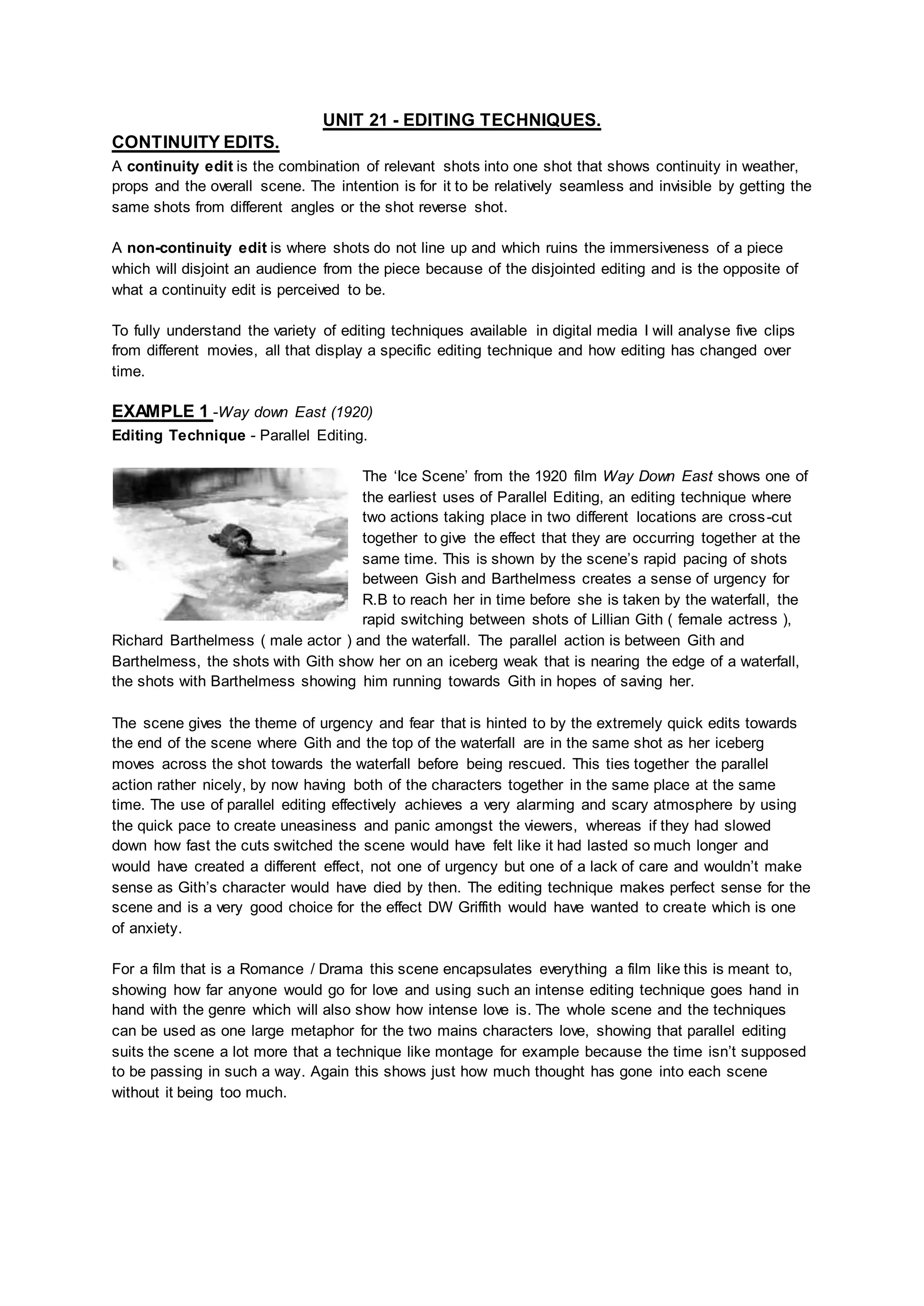
The ‘Ice Scene’ from the 1920 film Way Down East shows one of
the earliest uses of Parallel Editing, an editing technique where
two actions taking place in two different locations are cross-cut
together to give the effect that they are occurring together at the
same time. This is shown by the scene’s rapid pacing of shots
between Gish and Barthelmess creates a sense of urgency for
R.B to reach her in time before she is taken by the waterfall, the
rapid switching between shots of Lillian Gith ( female actress ),
Richard Barthelmess ( male actor ) and the waterfall. The parallel action is between Gith and
Barthelmess, the shots with Gith show her on an iceberg weak that is nearing the edge of a waterfall,
the shots with Barthelmess showing him running towards Gith in hopes of saving her.
The scene gives the theme of urgency and fear that is hinted to by the extremely quick edits towards
the end of the scene where Gith and the top of the waterfall are in the same shot as her iceberg
moves across the shot towards the waterfall before being rescued. This ties together the parallel
action rather nicely, by now having both of the characters together in the same place at the same
time. The use of parallel editing effectively achieves a very alarming and scary atmosphere by using
the quick pace to create uneasiness and panic amongst the viewers, whereas if they had slowed
down how fast the cuts switched the scene would have felt like it had lasted so much longer and
would have created a different effect, not one of urgency but one of a lack of care and wouldn’t make
sense as Gith’s character would have died by then. The editing technique makes perfect sense for the
scene and is a very good choice for the effect DW Griffith would have wanted to create which is one
of anxiety.
For a film that is a Romance / Drama this scene encapsulates everything a film like this is meant to,
showing how far anyone would go for love and using such an intense editing technique goes hand in
hand with the genre which will also show how intense love is. The whole scene and the techniques
can be used as one large metaphor for the two mains characters love, showing that parallel editing
suits the scene a lot more that a technique like montage for example because the time isn’t supposed
to be passing in such a way. Again this shows just how much thought has gone into each scene
without it being too much.
EXAMPLE 2 - Battleship Potemkin (1925)
Editing Technique - Rhythmic Montage.
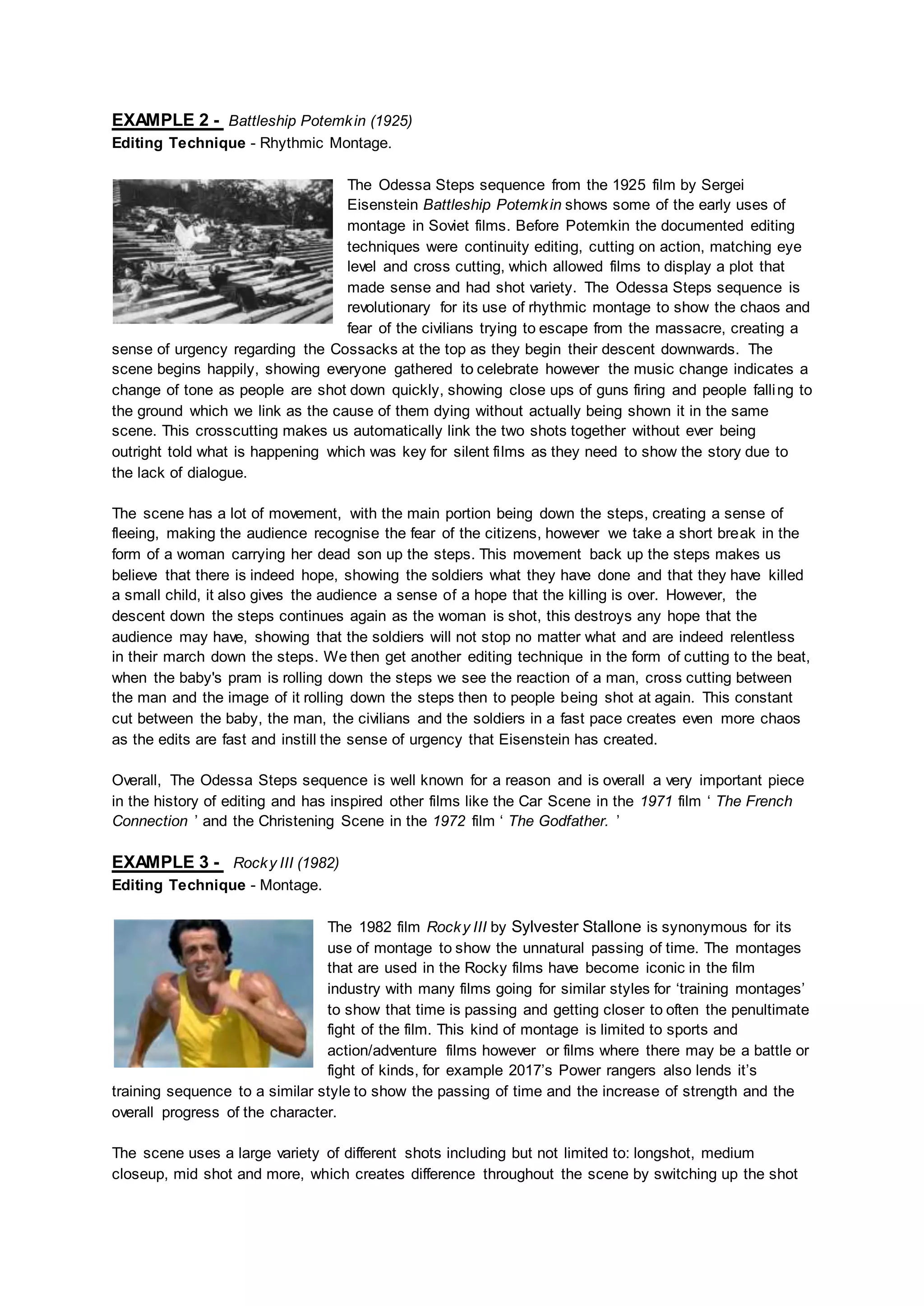
The Odessa Steps sequence from the 1925 film by Sergei
Eisenstein Battleship Potemkin shows some of the early uses of
montage in Soviet films. Before Potemkin the documented editing
techniques were continuity editing, cutting on action, matching eye
level and cross cutting, which allowed films to display a plot that
made sense and had shot variety. The Odessa Steps sequence is
revolutionary for its use of rhythmic montage to show the chaos and
fear of the civilians trying to escape from the massacre, creating a
sense of urgency regarding the Cossacks at the top as they begin their descent downwards. The
scene begins happily, showing everyone gathered to celebrate however the music change indicates a
change of tone as people are shot down quickly, showing close ups of guns firing and people falling to
the ground which we link as the cause of them dying without actually being shown it in the same
scene. This crosscutting makes us automatically link the two shots together without ever being
outright told what is happening which was key for silent films as they need to show the story due to
the lack of dialogue.
The scene has a lot of movement, with the main portion being down the steps, creating a sense of
fleeing, making the audience recognise the fear of the citizens, however we take a short break in the
form of a woman carrying her dead son up the steps. This movement back up the steps makes us
believe that there is indeed hope, showing the soldiers what they have done and that they have killed
a small child, it also gives the audience a sense of a hope that the killing is over. However, the
descent down the steps continues again as the woman is shot, this destroys any hope that the
audience may have, showing that the soldiers will not stop no matter what and are indeed relentless
in their march down the steps. We then get another editing technique in the form of cutting to the beat,
when the baby's pram is rolling down the steps we see the reaction of a man, cross cutting between
the man and the image of it rolling down the steps then to people being shot at again. This constant
cut between the baby, the man, the civilians and the soldiers in a fast pace creates even more chaos
as the edits are fast and instill the sense of urgency that Eisenstein has created.
Overall, The Odessa Steps sequence is well known for a reason and is overall a very important piece
in the history of editing and has inspired other films like the Car Scene in the 1971 film ‘ The French
Connection ’ and the Christening Scene in the 1972 film ‘ The Godfather. ’
EXAMPLE 3 - Rocky III (1982)
Editing Technique - Montage.
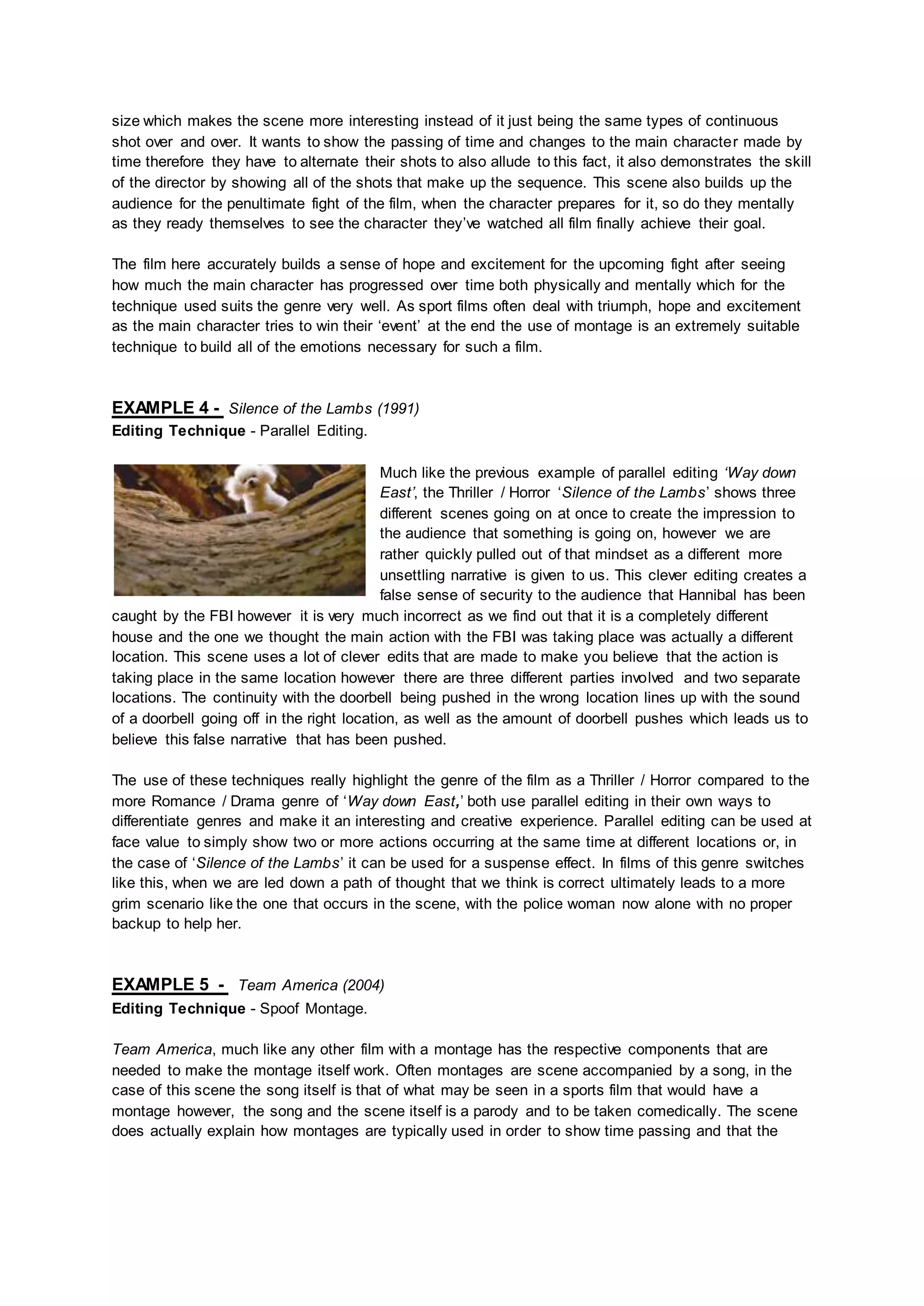
The 1982 film Rocky III by Sylvester Stallone is synonymous for its
use of montage to show the unnatural passing of time. The montages
that are used in the Rocky films have become iconic in the film
industry with many films going for similar styles for ‘training montages’
to show that time is passing and getting closer to often the penultimate
fight of the film. This kind of montage is limited to sports and
action/adventure films however or films where there may be a battle or
fight of kinds, for example 2017’s Power rangers also lends it’s
training sequence to a similar style to show the passing of time and the increase of strength and the
overall progress of the character.
The scene uses a large variety of different shots including but not limited to: longshot, medium
closeup, mid shot and more, which creates difference throughout the scene by switching up the shot
size which makes the scene more interesting instead of it just being the same types of continuous
shot over and over. It wants to show the passing of time and changes to the main character made by
time therefore they have to alternate their shots to also allude to this fact, it also demonstrates the skill
of the director by showing all of the shots that make up the sequence. This scene also builds up the
audience for the penultimate fight of the film, when the character prepares for it, so do they mentally
as they ready themselves to see the character they’ve watched all film finally achieve their goal.
The film here accurately builds a sense of hope and excitement for the upcoming fight after seeing
how much the main character has progressed over time both physically and mentally which for the
technique used suits the genre very well. As sport films often deal with triumph, hope and excitement
as the main character tries to win their ‘event’ at the end the use of montage is an extremely suitable
technique to build all of the emotions necessary for such a film.
EXAMPLE 4 - Silence of the Lambs (1991)
Editing Technique - Parallel Editing.
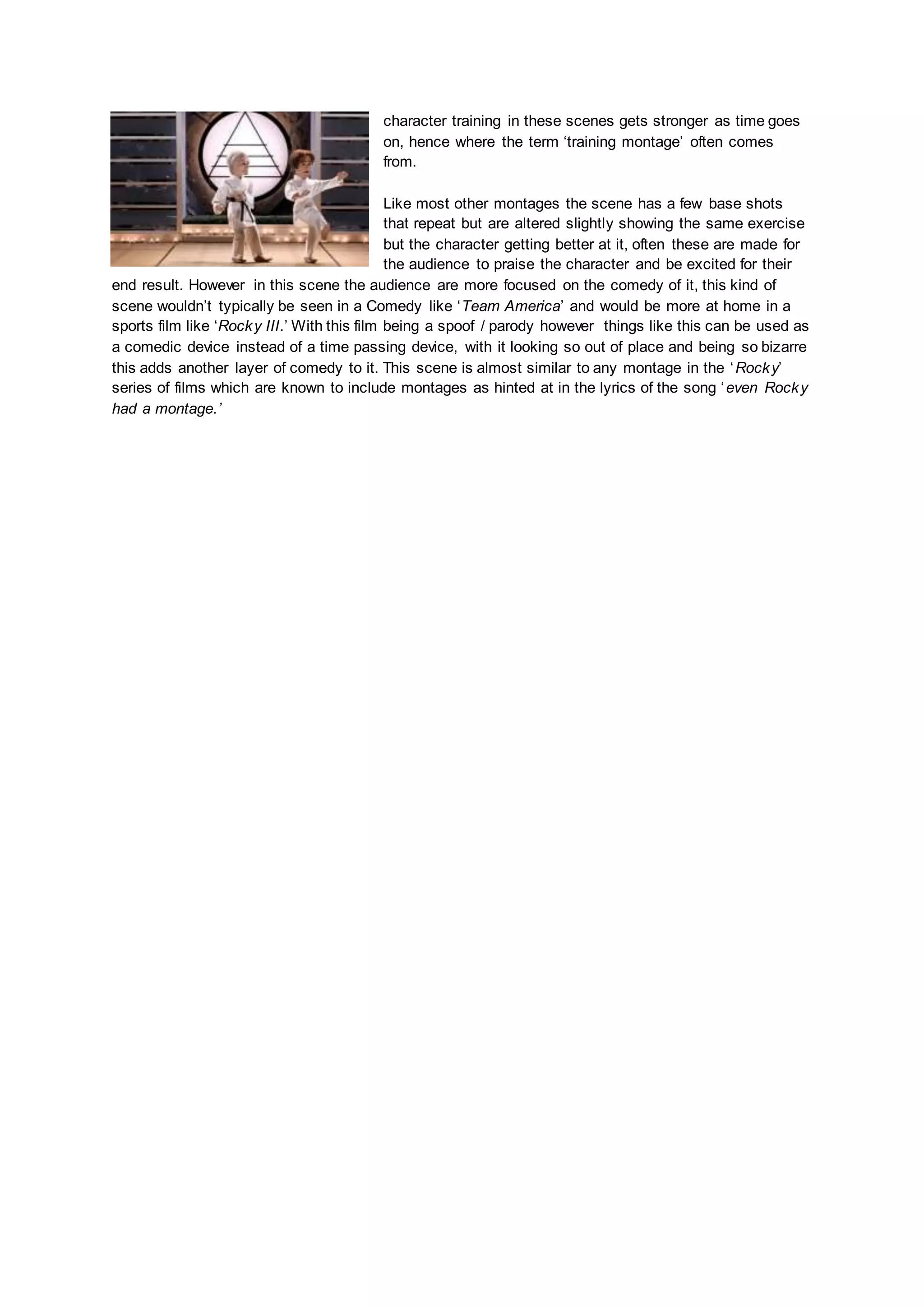
Much like the previous example of parallel editing ‘Way down
East’, the Thriller / Horror ‘Silence of the Lambs’ shows three
different scenes going on at once to create the impression to
the audience that something is going on, however we are
rather quickly pulled out of that mindset as a different more
unsettling narrative is given to us. This clever editing creates a
false sense of security to the audience that Hannibal has been
caught by the FBI however it is very much incorrect as we find out that it is a completely different
house and the one we thought the main action with the FBI was taking place was actually a different
location. This scene uses a lot of clever edits that are made to make you believe that the action is
taking place in the same location however there are three different parties involved and two separate
locations. The continuity with the doorbell being pushed in the wrong location lines up with the sound
of a doorbell going off in the right location, as well as the amount of doorbell pushes which leads us to
believe this false narrative that has been pushed.
The use of these techniques really highlight the genre of the film as a Thriller / Horror compared to the
more Romance / Drama genre of ‘Way down East,’ both use parallel editing in their own ways to
differentiate genres and make it an interesting and creative experience. Parallel editing can be used at
face value to simply show two or more actions occurring at the same time at different locations or, in
the case of ‘Silence of the Lambs’ it can be used for a suspense effect. In films of this genre switches
like this, when we are led down a path of thought that we think is correct ultimately leads to a more
grim scenario like the one that occurs in the scene, with the police woman now alone with no proper
backup to help her.
EXAMPLE 5 - Team America (2004)
Editing Technique - Spoof Montage.
Team America, much like any other film with a montage has the respective components that are
needed to make the montage itself work. Often montages are scene accompanied by a song, in the
case of this scene the song itself is that of what may be seen in a sports film that would have a
montage however, the song and the scene itself is a parody and to be taken comedically. The scene
does actually explain how montages are typically used in order to show time passing and that the
character training in these scenes gets stronger as time goes
on, hence where the term ‘training montage’ often comes
from.
Like most other montages the scene has a few base shots
that repeat but are altered slightly showing the same exercise
but the character getting better at it, often these are made for
the audience to praise the character and be excited for their
end result. However in this scene the audience are more focused on the comedy of it, this kind of
scene wouldn’t typically be seen in a Comedy like ‘Team America’ and would be more at home in a
sports film like ‘Rocky III.’ With this film being a spoof / parody however things like this can be used as
a comedic device instead of a time passing device, with it looking so out of place and being so bizarre
this adds another layer of comedy to it. This scene is almost similar to any montage in the ‘Rocky’
series of films which are known to include montages as hinted at in the lyrics of the song ‘even Rocky
had a montage.’

Unit 21 learning aim A

  • 1.
    UNIT 21 -EDITING TECHNIQUES. CONTINUITY EDITS. A continuity edit is the combination of relevant shots into one shot that shows continuity in weather, props and the overall scene. The intention is for it to be relatively seamless and invisible by getting the same shots from different angles or the shot reverse shot. A non-continuity edit is where shots do not line up and which ruins the immersiveness of a piece which will disjoint an audience from the piece because of the disjointed editing and is the opposite of what a continuity edit is perceived to be. To fully understand the variety of editing techniques available in digital media I will analyse five clips from different movies, all that display a specific editing technique and how editing has changed over time. EXAMPLE 1 -Way down East (1920) Editing Technique - Parallel Editing. The ‘Ice Scene’ from the 1920 film Way Down East shows one of the earliest uses of Parallel Editing, an editing technique where two actions taking place in two different locations are cross-cut together to give the effect that they are occurring together at the same time. This is shown by the scene’s rapid pacing of shots between Gish and Barthelmess creates a sense of urgency for R.B to reach her in time before she is taken by the waterfall, the rapid switching between shots of Lillian Gith ( female actress ), Richard Barthelmess ( male actor ) and the waterfall. The parallel action is between Gith and Barthelmess, the shots with Gith show her on an iceberg weak that is nearing the edge of a waterfall, the shots with Barthelmess showing him running towards Gith in hopes of saving her. The scene gives the theme of urgency and fear that is hinted to by the extremely quick edits towards the end of the scene where Gith and the top of the waterfall are in the same shot as her iceberg moves across the shot towards the waterfall before being rescued. This ties together the parallel action rather nicely, by now having both of the characters together in the same place at the same time. The use of parallel editing effectively achieves a very alarming and scary atmosphere by using the quick pace to create uneasiness and panic amongst the viewers, whereas if they had slowed down how fast the cuts switched the scene would have felt like it had lasted so much longer and would have created a different effect, not one of urgency but one of a lack of care and wouldn’t make sense as Gith’s character would have died by then. The editing technique makes perfect sense for the scene and is a very good choice for the effect DW Griffith would have wanted to create which is one of anxiety. For a film that is a Romance / Drama this scene encapsulates everything a film like this is meant to, showing how far anyone would go for love and using such an intense editing technique goes hand in hand with the genre which will also show how intense love is. The whole scene and the techniques can be used as one large metaphor for the two mains characters love, showing that parallel editing suits the scene a lot more that a technique like montage for example because the time isn’t supposed to be passing in such a way. Again this shows just how much thought has gone into each scene without it being too much.
  • 2.
    EXAMPLE 2 -Battleship Potemkin (1925) Editing Technique - Rhythmic Montage. The Odessa Steps sequence from the 1925 film by Sergei Eisenstein Battleship Potemkin shows some of the early uses of montage in Soviet films. Before Potemkin the documented editing techniques were continuity editing, cutting on action, matching eye level and cross cutting, which allowed films to display a plot that made sense and had shot variety. The Odessa Steps sequence is revolutionary for its use of rhythmic montage to show the chaos and fear of the civilians trying to escape from the massacre, creating a sense of urgency regarding the Cossacks at the top as they begin their descent downwards. The scene begins happily, showing everyone gathered to celebrate however the music change indicates a change of tone as people are shot down quickly, showing close ups of guns firing and people falling to the ground which we link as the cause of them dying without actually being shown it in the same scene. This crosscutting makes us automatically link the two shots together without ever being outright told what is happening which was key for silent films as they need to show the story due to the lack of dialogue. The scene has a lot of movement, with the main portion being down the steps, creating a sense of fleeing, making the audience recognise the fear of the citizens, however we take a short break in the form of a woman carrying her dead son up the steps. This movement back up the steps makes us believe that there is indeed hope, showing the soldiers what they have done and that they have killed a small child, it also gives the audience a sense of a hope that the killing is over. However, the descent down the steps continues again as the woman is shot, this destroys any hope that the audience may have, showing that the soldiers will not stop no matter what and are indeed relentless in their march down the steps. We then get another editing technique in the form of cutting to the beat, when the baby's pram is rolling down the steps we see the reaction of a man, cross cutting between the man and the image of it rolling down the steps then to people being shot at again. This constant cut between the baby, the man, the civilians and the soldiers in a fast pace creates even more chaos as the edits are fast and instill the sense of urgency that Eisenstein has created. Overall, The Odessa Steps sequence is well known for a reason and is overall a very important piece in the history of editing and has inspired other films like the Car Scene in the 1971 film ‘ The French Connection ’ and the Christening Scene in the 1972 film ‘ The Godfather. ’ EXAMPLE 3 - Rocky III (1982) Editing Technique - Montage. The 1982 film Rocky III by Sylvester Stallone is synonymous for its use of montage to show the unnatural passing of time. The montages that are used in the Rocky films have become iconic in the film industry with many films going for similar styles for ‘training montages’ to show that time is passing and getting closer to often the penultimate fight of the film. This kind of montage is limited to sports and action/adventure films however or films where there may be a battle or fight of kinds, for example 2017’s Power rangers also lends it’s training sequence to a similar style to show the passing of time and the increase of strength and the overall progress of the character. The scene uses a large variety of different shots including but not limited to: longshot, medium closeup, mid shot and more, which creates difference throughout the scene by switching up the shot
  • 3.
    size which makesthe scene more interesting instead of it just being the same types of continuous shot over and over. It wants to show the passing of time and changes to the main character made by time therefore they have to alternate their shots to also allude to this fact, it also demonstrates the skill of the director by showing all of the shots that make up the sequence. This scene also builds up the audience for the penultimate fight of the film, when the character prepares for it, so do they mentally as they ready themselves to see the character they’ve watched all film finally achieve their goal. The film here accurately builds a sense of hope and excitement for the upcoming fight after seeing how much the main character has progressed over time both physically and mentally which for the technique used suits the genre very well. As sport films often deal with triumph, hope and excitement as the main character tries to win their ‘event’ at the end the use of montage is an extremely suitable technique to build all of the emotions necessary for such a film. EXAMPLE 4 - Silence of the Lambs (1991) Editing Technique - Parallel Editing. Much like the previous example of parallel editing ‘Way down East’, the Thriller / Horror ‘Silence of the Lambs’ shows three different scenes going on at once to create the impression to the audience that something is going on, however we are rather quickly pulled out of that mindset as a different more unsettling narrative is given to us. This clever editing creates a false sense of security to the audience that Hannibal has been caught by the FBI however it is very much incorrect as we find out that it is a completely different house and the one we thought the main action with the FBI was taking place was actually a different location. This scene uses a lot of clever edits that are made to make you believe that the action is taking place in the same location however there are three different parties involved and two separate locations. The continuity with the doorbell being pushed in the wrong location lines up with the sound of a doorbell going off in the right location, as well as the amount of doorbell pushes which leads us to believe this false narrative that has been pushed. The use of these techniques really highlight the genre of the film as a Thriller / Horror compared to the more Romance / Drama genre of ‘Way down East,’ both use parallel editing in their own ways to differentiate genres and make it an interesting and creative experience. Parallel editing can be used at face value to simply show two or more actions occurring at the same time at different locations or, in the case of ‘Silence of the Lambs’ it can be used for a suspense effect. In films of this genre switches like this, when we are led down a path of thought that we think is correct ultimately leads to a more grim scenario like the one that occurs in the scene, with the police woman now alone with no proper backup to help her. EXAMPLE 5 - Team America (2004) Editing Technique - Spoof Montage. Team America, much like any other film with a montage has the respective components that are needed to make the montage itself work. Often montages are scene accompanied by a song, in the case of this scene the song itself is that of what may be seen in a sports film that would have a montage however, the song and the scene itself is a parody and to be taken comedically. The scene does actually explain how montages are typically used in order to show time passing and that the
  • 4.
    character training inthese scenes gets stronger as time goes on, hence where the term ‘training montage’ often comes from. Like most other montages the scene has a few base shots that repeat but are altered slightly showing the same exercise but the character getting better at it, often these are made for the audience to praise the character and be excited for their end result. However in this scene the audience are more focused on the comedy of it, this kind of scene wouldn’t typically be seen in a Comedy like ‘Team America’ and would be more at home in a sports film like ‘Rocky III.’ With this film being a spoof / parody however things like this can be used as a comedic device instead of a time passing device, with it looking so out of place and being so bizarre this adds another layer of comedy to it. This scene is almost similar to any montage in the ‘Rocky’ series of films which are known to include montages as hinted at in the lyrics of the song ‘even Rocky had a montage.’