This work is supported by the National Science Foundation’s
Transforming Undergraduate Education in STEM program within the
Directorate for Education and Human Resources (DUE-1245025). Questions, contact education-AT-unavco.org
IDENTIFYING FAULTS IN A LANDSCAPE
Bruce Douglas (Indiana University)
Version: Mar 25, 2015
STRIKE-SLIP FAULT FEATURES
After Keller & Pinter, Active Tectonics, 2002
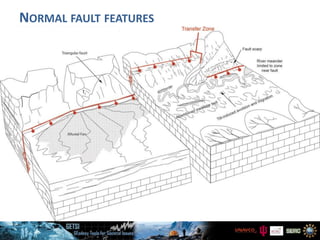
NORMAL FAULT FEATURES
After Keller & Pinter, Active Tectonics, 2002
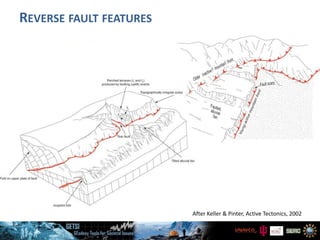
REVERSE FAULT FEATURES
After Keller & Pinter, Active Tectonics, 2002
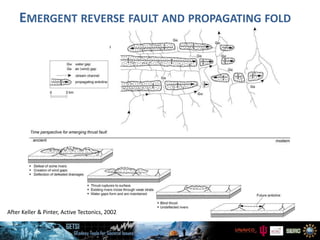
EMERGENT REVERSE FAULT AND PROPAGATING FOLD
After Keller & Pinter, Active Tectonics, 2002

Unit 2 Tectonic Geomorphology Presentation

  • 1.
    This work issupported by the National Science Foundation’s Transforming Undergraduate Education in STEM program within the Directorate for Education and Human Resources (DUE-1245025). Questions, contact education-AT-unavco.org IDENTIFYING FAULTS IN A LANDSCAPE Bruce Douglas (Indiana University) Version: Mar 25, 2015
  • 2.
    STRIKE-SLIP FAULT FEATURES AfterKeller & Pinter, Active Tectonics, 2002
  • 3.
    NORMAL FAULT FEATURES AfterKeller & Pinter, Active Tectonics, 2002
  • 4.
    REVERSE FAULT FEATURES AfterKeller & Pinter, Active Tectonics, 2002
  • 5.
    EMERGENT REVERSE FAULTAND PROPAGATING FOLD After Keller & Pinter, Active Tectonics, 2002

Editor's Notes

  • #3 Figure provides examples of geomorphic/topographic features that are indicative of active strike-slip faulting. While all these features may be present, some are more common than others, and not all would be expected to be found in a single location because some are dependent on the local geologic materials, climate, and human alteration. Adapted from figures 1.7 and 2.5 from Keller and Pinter, 2002, Active Tectonics Earthquakes, Uplift, and Landscape, 2nd Edition, Prentice Hall, Upper Saddle River, NJ, 362 pp.
  • #4 Figure provides examples of geomorphic/topographic features that are indicative of active normal faulting. While all these features may be present, some are more common than others and not all would be expected to be found in a single location because some are dependent on the local geologic materials, climate, and human alteration. Adapted from figures 1.7 and 5.17 from Keller and Pinter, 2002, Active Tectonics Earthquakes, Uplift, and Landscape, 2nd Edition, Prentice Hall, Upper Saddle River, NJ, 362 pp.
  • #5 Figure provides examples of geomorphic/topographic features that are indicative of active reverse faulting. While all these features may be present, some are more common than others, and not all would be expected to be found in a single location because some are dependent on the local geologic materials, climate, and human alteration. It should be noted that reverse or thrust faults often have the most subtle geomorphic patterns relative to the other fault types. This is due in part to the potential for low to no scarp relief created by a single slip event. Adapted from figures 1.7 and 4.28 from Keller and Pinter, 2002, Active Tectonics Earthquakes, Uplift, and Landscape, 2nd Edition, Prentice Hall, Upper Saddle River, NJ, 362 pp.
  • #6 Figure provides examples of geomorphic/topographic features that are indicative of active reverse faulting. The upper diagram is based on features displayed at Wheeler Ridge in California, where the Wheeler Ridge Fault is extending laterally as well as adding incrementally to the dip slip displacement. This pattern has resulted in what may be interpreted as a time sequence which is shown in the lower diagram. The geomorphic development indicated as ancient reflects a topography that has undergone a number of thrust events whereas the modern diagram reflects conditions prior to initial faulting. While all these features may be present, some are more common than others, and not all would be expected to be found in a single location because some are dependent on the local geologic materials, climate, and human alteration. Adapted from figures 5.2 and 7.25from Keller and Pinter, 2002, Active Tectonics Earthquakes, Uplift, and Landscape, 2nd Edition, Prentice Hall, Upper Saddle River, NJ, 362 pp.