Lesson 2.3
Inverting Operations
Introduction To Logarithms
Logarithms were originally
developed to simplify complex
arithmetic calculations.
They were designed to transform
multiplicative processes
into additive ones.
Desmos Activity
Instructions:
→Go to 👉 https://www.desmos.com/calculator
→ Enter each of the the following equations to produce their graphs.
1. y = 2x
2. x = 2y (Inverse of 1)
3. log2 x = y
What do you notice?
What is a logarithm ?
Logarithm is the inverse of exponential
function for
x>0 and b>0 , b≠1,
y = Logb x is equivalent to by = x
The function f(x) = Logb x is the logarithmic function with base ‘b’
Forms
Logarithmic form:
y = Logb x
Exponential form:
by = x
Notice
Logarithmic form: Where is the exponent and base.
y = Logb x
Exponential form:
by = x
Base of the logarithm is the base of the exponent.
Example 1: Exponential to Log
Write 23 = 8 in logarithmic form
Example 2: Exponential to Log
Write 42 = 16 in logarithmic form
Example 3: Exponential to Log
Write 2-3 = 1/8 in logarithmic form
Practice
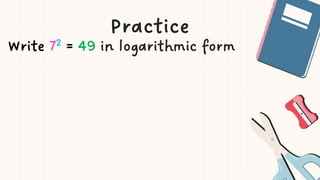
Write 72 = 49 in logarithmic form
Practice
Write 50 = 1 in logarithmic form
Practice
Write 10-2 = 1/100 in logarithmic form
Practice
Write 161/2 = 4 in logarithmic form
Example 1: Log to Exponential
Write Log3 81 = 4 in logarithmic form
Example 2: Log to Exponential
Write Log2 1/8 = -3 in logarithmic form
Practice
Write Log10 100 = 2 in logarithmic form
Practice
Write Log5 1/125 = -3 in logarithmic form
Practice
Write Log27 3 = 1/3 in logarithmic form

Unit 2 – Lesson 2.3 - Inverting Operations.pdf