ENVIRONMENTAL STUDIES
MII: ECOSYSTEMS
Presented by –
Subham Chatterjee
Assistant Professor
An ecosystem is a natural unit consisting of all plants, animals, and micro-
organisms in an area functioning together with all the non-living physical
factors of the environment.
According to British ecologist Arthur Tansley (1935), an ecosystem is a
system that arises from the integration of all living and non-living factors of
the environment.
An ecosystem is a self-sustained community of plants and animals
existing in its own environment. The term ecosystem may be defined as a
system resulting from the integration of all the living and non living
factors of the environment. Desert, Forest, Ocean, Grasslands, Mountains,
etc. are all ecosystems.
Ecosystem
What is an ecosystem?
Ecosystem is a system of living things
that interact with each other and
with the physical world.
However……..
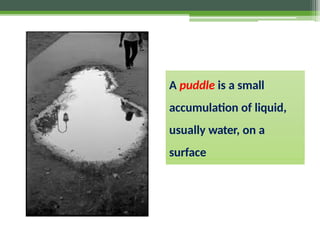
•An ecosystem can be as large as the Sahara Desert,
or as small as a puddle!!!
•Ecosystems are more than just the organisms they
contain.
•Geography, weather, climate and geologic factors
also influence the interactions within an ecosystem.
A puddle is a small
accumulation of liquid,
usually water, on a
surface
Functions of Ecosystem
The functions of the ecosystem are as follows:
1. It regulates the essential ecological processes, supports life
systems and renders stability.
2. It is also responsible for the cycling of nutrients between biotic and
abiotic components.
3. It maintains a balance among the various trophic levels in the
ecosystem.
4. It cycles the minerals through the biosphere.
5. The abiotic components help in the synthesis of organic
components that involve the exchange of energy.
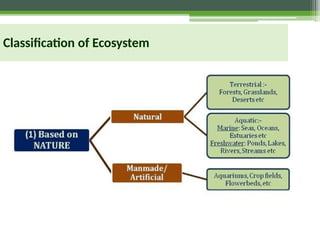
Classification of Ecosystem
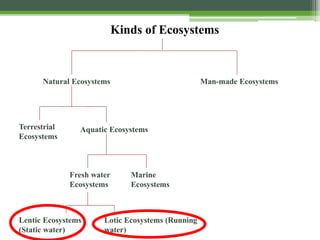
Kinds of Ecosystems
Natural Ecosystems Man-made Ecosystems
Terrestrial
Ecosystems
Aquatic Ecosystems
Fresh water
Ecosystems
Marine
Ecosystems
Lentic Ecosystems
(Static water)
Lotic Ecosystems (Running
water)
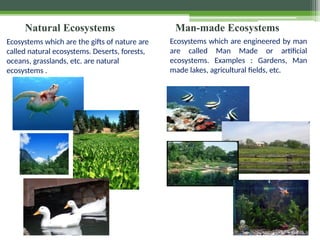
Natural Ecosystems Man-made Ecosystems
Ecosystems which are engineered by man
are called Man Made or artificial
ecosystems. Examples : Gardens, Man
made lakes, agricultural fields, etc.
Ecosystems which are the gifts of nature are
called natural ecosystems. Deserts, forests,
oceans, grasslands, etc. are natural
ecosystems .
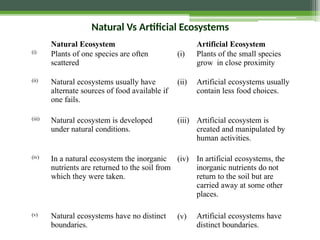
Natural Ecosystem Artificial Ecosystem
(i) Plants of one species are often
scattered
(i) Plants of the small species
grow in close proximity
(ii) Natural ecosystems usually have
alternate sources of food available if
one fails.
(ii) Artificial ecosystems usually
contain less food choices.
(iii) Natural ecosystem is developed
under natural conditions.
(iii) Artificial ecosystem is
created and manipulated by
human activities.
(iv) In a natural ecosystem the inorganic
nutrients are returned to the soil from
which they were taken.
(iv) In artificial ecosystems, the
inorganic nutrients do not
return to the soil but are
carried away at some other
places.
(v) Natural ecosystems have no distinct
boundaries.
(v) Artificial ecosystems have
distinct boundaries.
Natural Vs Artificial Ecosystems
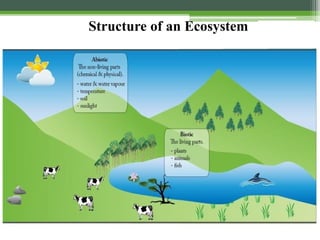
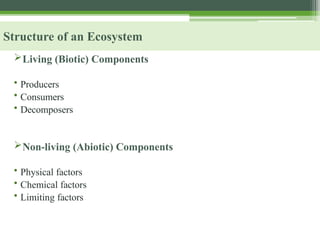
Structure of an Ecosystem
Living (Biotic) Components
• Producers
• Consumers
• Decomposers
Non-living (Abiotic) Components
• Physical factors
• Chemical factors
• Limiting factors
Biotic Components of Ecosystems
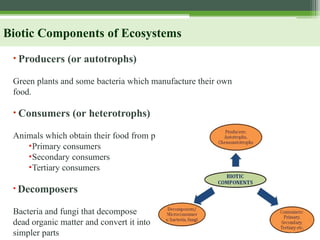
• Producers (or autotrophs)
Green plants and some bacteria which manufacture their own
food.
• Consumers (or heterotrophs)
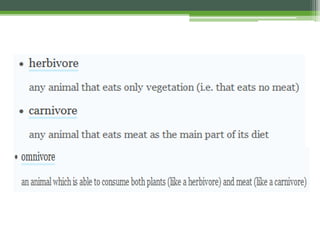
Animals which obtain their food from producers
•Primary consumers
•Secondary consumers
•Tertiary consumers
• Decomposers
Bacteria and fungi that decompose
dead organic matter and convert it into
simpler parts
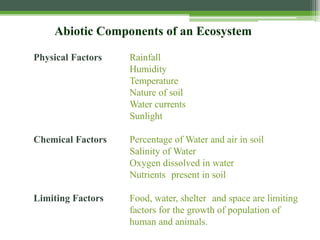
Abiotic Components of an Ecosystem
Physical Factors Rainfall
Humidity
Temperature
Nature of soil
Water currents
Sunlight
Chemical Factors Percentage of Water and air in soil
Salinity of Water
Oxygen dissolved in water
Nutrients present in soil
Limiting Factors Food, water, shelter and space are limiting
factors for the growth of population of
human and animals.
• Food chain and food web
• Energy flow
• Ecological pyramids
Functions of an Ecosystem
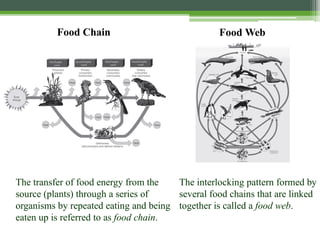
The transfer of food energy from the
source (plants) through a series of
organisms by repeated eating and being
eaten up is referred to as food chain.
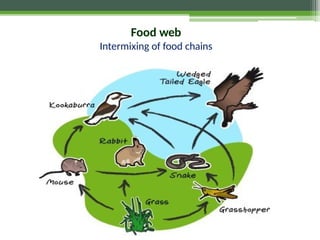
Food Web
The interlocking pattern formed by
several food chains that are linked
together is called a food web.
Food Chain
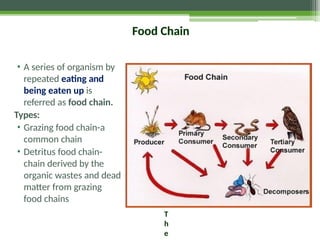
Food Chain
• A series of organism by
repeated eating and
being eaten up is
referred as food chain.
Types:
• Grazing food chain-a
common chain
• Detritus food chain-
chain derived by the
organic wastes and dead
matter from grazing
food chains
T
h
e
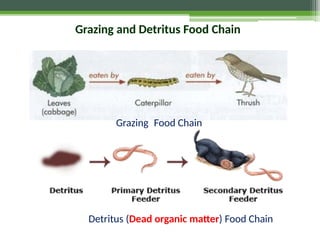
Grazing and Detritus Food Chain
Detritus (Dead organic matter) Food Chain
Grazing Food Chain
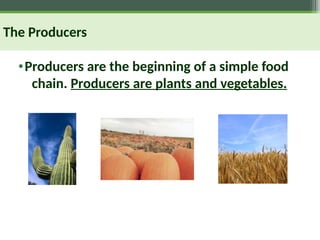
The Producers
•Producers are the beginning of a simple food
chain. Producers are plants and vegetables.
The Producers
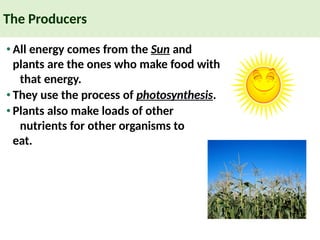
•All energy comes from the Sun and
plants are the ones who make food with
that energy.
•They use the process of photosynthesis.
•Plants also make loads of other
nutrients for other organisms to
eat.
The Consumers
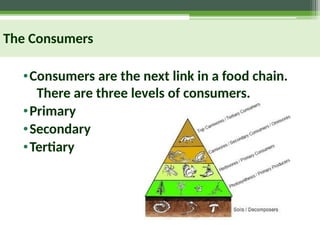
•Consumers are the next link in a food chain.
There are three levels of consumers.
•Primary
•Secondary
•Tertiary
Feeding Relationships
• A food chain shows a simple feeding relationship.
• Sun →
• All food chains start with the sun
Feeding Relationships
• A food chain shows a simple feeding relationship.
• Sun → grass →
Feeding Relationships
• A food chain shows a simple feeding relationship.
• Sun → grass →
rabbit →
Feeding Relationships
• A food chain shows a simple feeding relationship.
• Sun → grass → rabbit
→ fox
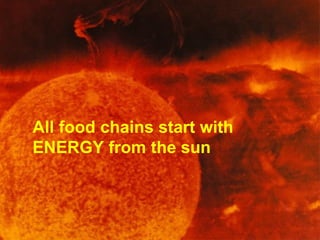
All food chains start with
ENERGY from the sun
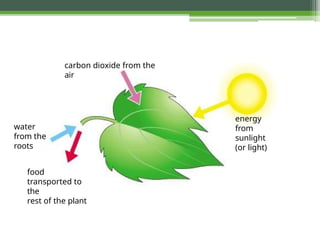
carbon dioxide from the
air
energy
from
sunlight
(or light)
water
from the
roots
food
transported to
the
rest of the plant
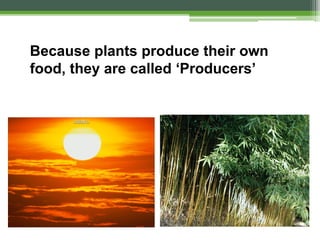
Because plants produce their own
food, they are called ‘Producers’
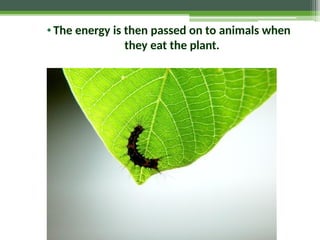
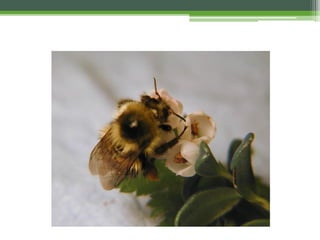
•The energy is then passed on to animals when
they eat the plant.
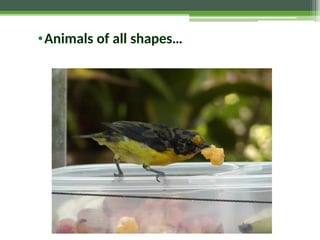
•Animals of all shapes…
…and
sizes!
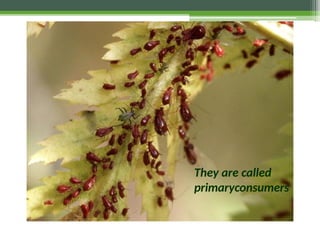
They are called
primaryconsumers
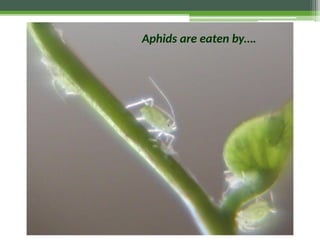
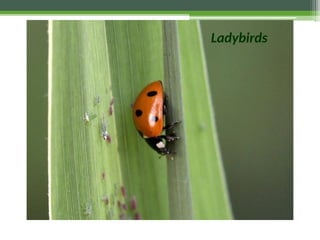
Aphids are eaten by….
Ladybirds
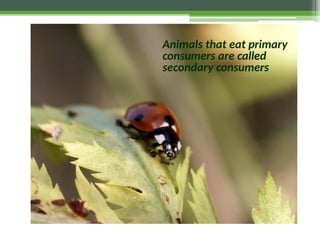
Animals that eat primary
consumers are called
secondary consumers
• So far this is a straightforward food chain
• Sun → aphid → ladybird
• But in reality it is more complicated than that
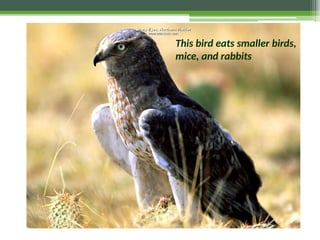
This bird eats smaller birds,
mice, and rabbits
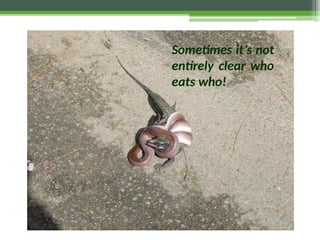
Sometimes it’s not
entirely clear who
eats who!
Biomagnification
“Result of the process of bioaccumulation and
biotransfer
by which tissue concentrations of chemicals in
organisms at one trophic level exceed tissue
concentrations in organisms at the next lower trophic
level in a food chain.”
Biomagnification of DDT was observed in some birds like
as Osprey, in the results ofsharp
decline in their population.
The young ones of these bird were found to hatch in
a premature condition which led to their death.
This was later found to be due to biomagnification of DDT
through the food chain.
DDT is one of the pesticide, a chemical used to control pests
in very low concentration
The concentration of DDT was magnified several thousands
times in the birds which caused thinning of shells in
the birds eggs, causing deaths.
Means, animals occupying higher trophic levels are at a
A build- up of DDT concentration
Food web
Intermixing of food chains
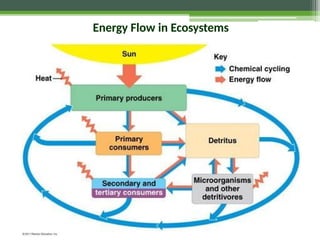
Energy Flow in Ecosystems
 First Law of Thermodynamics energy can neither be created nor destroyed
but only is transformed from one form to another.
 Second Law of Thermodynamics-The second law of thermodynamics states
that no energy transformations are 100% efficient.
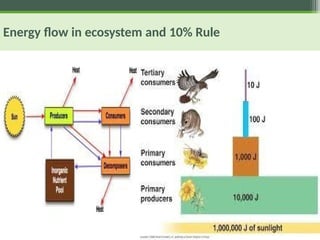
 10 Percent Rule of Energy
As a rule of thumb, 90 percent of the energy involved is degraded at each
trophic transfer and only 10 percent of the energy is conserved in the
organism's tissue.
Energy Flow in Ecosystems
Energy flow in ecosystem and 10% Rule
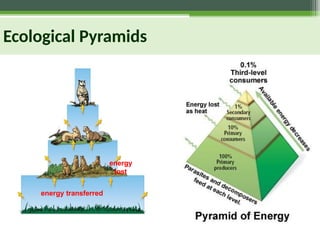
Ecological Pyramid
The graphical representations of different trophic levels in an ecosystem
where producers occupy the base and the top consumer occupy the apex of
the pyramid, is known as ecological pyramid .
They are used to illustrate the feeding relationships between organisms.
Types of Ecological Pyramids
•Pyramid of number
•Pyramid of biomass
•Pyramid of energy
ECOLOGICAL PYRAMIDS
•Food chains and food webs do not give any
information about the numbers of
organisms involved.
•This information can be shown through
ecological pyramids.
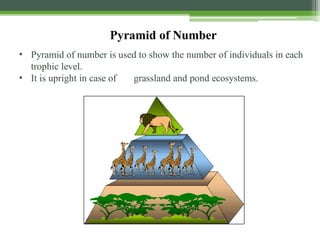
Pyramid of Number
• Pyramid of number is used to show the number of individuals in each
trophic level.
• It is upright in case of grassland and pond ecosystems.
Pyramid of Biomass
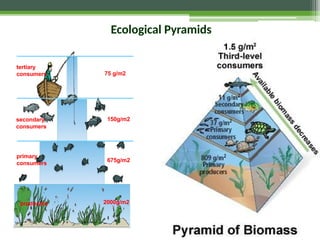
Pyramid of biomass records the total dry organic matter of
organisms at each trophic level in a given area of an ecosystem.
The pyramid of biomass is used to show the total biomass of
individuals at each trophic level.
It is better than the pyramid of number for showing the relationships
between organisms.
tertiary
consumers
secondary
consumers
primary
consumers
producers
75 g/m2
150g/m2
675g/m2
2000g/m2
Ecological Pyramids
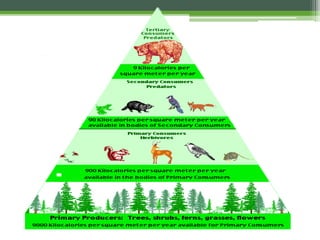
Pyramid of Energy
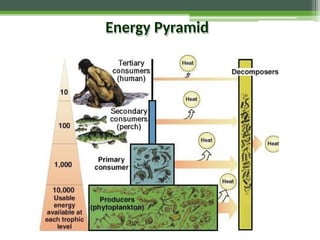
 Pyramid of energy is used to show the amount of energy
transferred between trophic levels. It provides the best
representation of the overall nature of an ecosystem.
 The pyramid of energy flow is always upright because there is
always loss of energy while moving from lower trophic
level to higher trophic level. Therefore, the energy
reaching the next trophic level is always less compared
to that in the previous trophic level.
Energy Pyramid
is
Ecological Pyramids
energy
lost
energy transferred
Ecological Succession
Ecological succession is the gradual process by which ecosystems change and
develop over time. It is therefore a series of predictable temporary communities or
stages leading up to a climax community. Each stage/temporary community is
called a successional stage. Each step prepares the land for the next successional
stage. All habitats are in the state of constant ecological succession.
Environment is always kept on changing over a period of time due to
(i) variations in climatic and physiographic factors, and
(ii) the activities of the species of the communities themselves.
Ecological Succession is an orderly sequence of different
communities over a period of time.
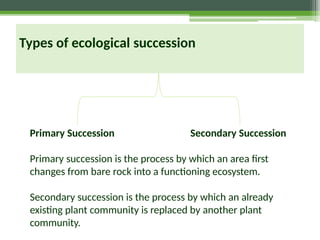
Primary Succession Secondary Succession
Primary succession is the process by which an area first
changes from bare rock into a functioning ecosystem.
Secondary succession is the process by which an already
existing plant community is replaced by another plant
community.
Types of ecological succession
59
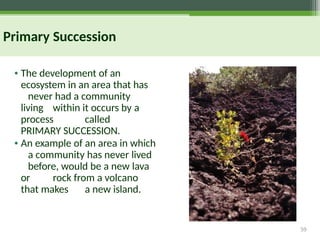
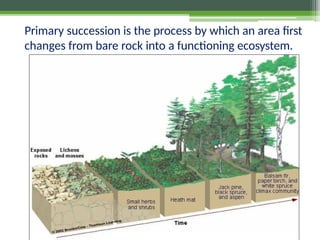
Primary Succession
• The development of an
ecosystem in an area that has
never had a community
living within it occurs by a
process called
PRIMARY SUCCESSION.
• An example of an area in which
a community has never lived
before, would be a new lava
or rock from a volcano
that makes a new island.
Primary succession is the process by which an area first
changes from bare rock into a functioning ecosystem.
61
Secondary Succession
• SECONDARY SUCCESSION begins in habitats where communities
were entirely or partially destroyed by some kind of damaging
event.
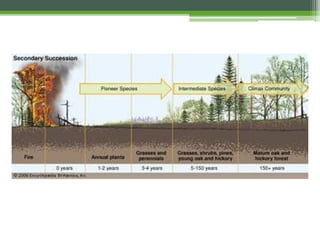
• When an existing community has been cleared by a disturbance
such as a fire, tornado, etc...and the soil remains intact, the area
begins to return to its natural community. Because these habitats
previously supported life, secondary succession, unlike primary
succession, begins on substrates that already bear soil. In
addition, the soil contains a native seed bank.
• Since the soil is already in place, secondary succession can take
place five to ten times faster than primary succession.
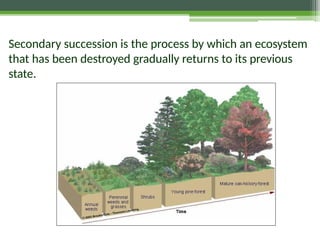
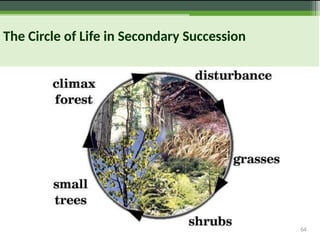
Secondary succession is the process by which an ecosystem
that has been destroyed gradually returns to its previous
state.
64
The Circle of Life in Secondary Succession
65
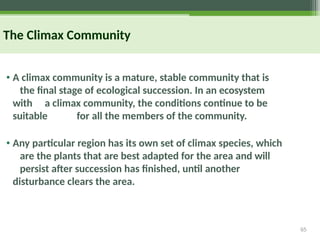
The Climax Community
• A climax community is a mature, stable community that is
the final stage of ecological succession. In an ecosystem
with a climax community, the conditions continue to be
suitable for all the members of the community.
• Any particular region has its own set of climax species, which
are the plants that are best adapted for the area and will
persist after succession has finished, until another
disturbance clears the area.
66
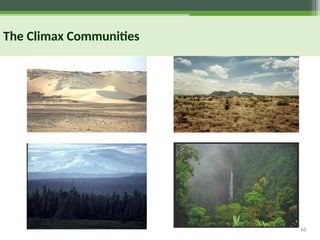
The Climax Communities
Nudation- Succession begins with the development of a bare site, called
Nudation (disturbance).
Invasion
• Migration- It refers to arrival of propagules (seeds), dispersion.
• Ecesis- It involves establishment and initial growth of vegetation.
• Aggregation- It involves increase in number of various species.
Competition- As vegetation became well established, grew, and spread,
various species began to compete for space, light and nutrients. This phase is
called competition.
Stabilization- Reaction phase leads to development of a climax community.
Process / Stages of Ecological Succession
Study of some common ecosystems
•Terrestrial ecosystem
oGrassland ecosystem
oDesert ecosystem
oForest ecosystem
•Aquatic ecosystem
oPond ecosystem
oOcean ecosystem
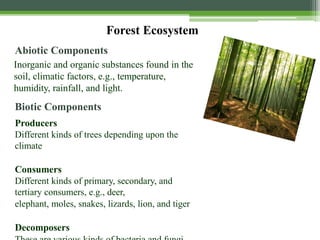
Forest Ecosystem
Abiotic Components
Inorganic and organic substances found in the
soil, climatic factors, e.g., temperature,
humidity, rainfall, and light.
Biotic Components
Producers
Different kinds of trees depending upon the
climate
Consumers
Different kinds of primary, secondary, and
tertiary consumers, e.g., deer,
elephant, moles, snakes, lizards, lion, and tiger
Decomposers
Grassland ecosystem
• All grasslands in the world are categorize into the following two
types:
• Tropical grasslands- closets to equator and are hot throughout
the year.
• Temperate grasslands - farther from the equator and have both
hot summers and harsh winters.
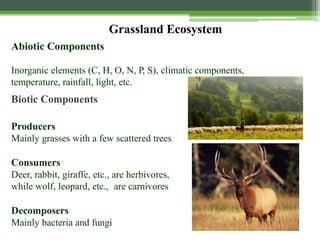
Grassland Ecosystem
Abiotic Components
Inorganic elements (C, H, O, N, P, S), climatic components,
temperature, rainfall, light, etc.
Biotic Components
Producers
Mainly grasses with a few scattered trees
Consumers
Deer, rabbit, giraffe, etc., are herbivores,
while wolf, leopard, etc., are carnivores
Decomposers
Mainly bacteria and fungi
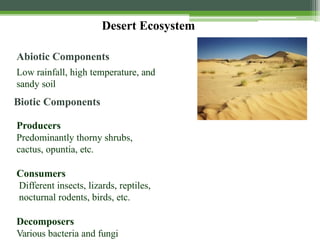
Desert Ecosystem
Abiotic Components
Low rainfall, high temperature, and
sandy soil
Biotic Components
Producers
Predominantly thorny shrubs,
cactus, opuntia, etc.
Consumers
Different insects, lizards, reptiles,
nocturnal rodents, birds, etc.
Decomposers
Various bacteria and fungi
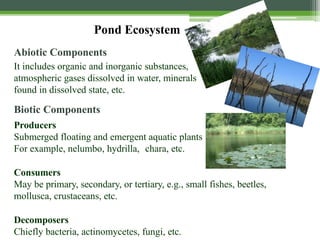
Pond Ecosystem
Abiotic Components
It includes organic and inorganic substances,
atmospheric gases dissolved in water, minerals
found in dissolved state, etc.
Biotic Components
Producers
Submerged floating and emergent aquatic plants
For example, nelumbo, hydrilla, chara, etc.
Consumers
May be primary, secondary, or tertiary, e.g., small fishes, beetles,
mollusca, crustaceans, etc.
Decomposers
Chiefly bacteria, actinomycetes, fungi, etc.
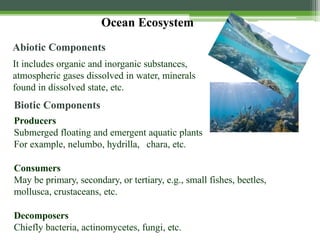
Ocean Ecosystem
Abiotic Components
It includes organic and inorganic substances,
atmospheric gases dissolved in water, minerals
found in dissolved state, etc.
Biotic Components
Producers
Submerged floating and emergent aquatic plants
For example, nelumbo, hydrilla, chara, etc.
Consumers
May be primary, secondary, or tertiary, e.g., small fishes, beetles,
mollusca, crustaceans, etc.
Decomposers
Chiefly bacteria, actinomycetes, fungi, etc.

This Module 2 is on ecosystems that helps the students.pptx

  • 1.
    ENVIRONMENTAL STUDIES MII: ECOSYSTEMS Presentedby – Subham Chatterjee Assistant Professor
  • 2.
    An ecosystem isa natural unit consisting of all plants, animals, and micro- organisms in an area functioning together with all the non-living physical factors of the environment. According to British ecologist Arthur Tansley (1935), an ecosystem is a system that arises from the integration of all living and non-living factors of the environment. An ecosystem is a self-sustained community of plants and animals existing in its own environment. The term ecosystem may be defined as a system resulting from the integration of all the living and non living factors of the environment. Desert, Forest, Ocean, Grasslands, Mountains, etc. are all ecosystems. Ecosystem
  • 3.
    What is anecosystem? Ecosystem is a system of living things that interact with each other and with the physical world.
  • 4.
    However…….. •An ecosystem canbe as large as the Sahara Desert, or as small as a puddle!!! •Ecosystems are more than just the organisms they contain. •Geography, weather, climate and geologic factors also influence the interactions within an ecosystem.
  • 5.
    A puddle isa small accumulation of liquid, usually water, on a surface
  • 6.
    Functions of Ecosystem Thefunctions of the ecosystem are as follows: 1. It regulates the essential ecological processes, supports life systems and renders stability. 2. It is also responsible for the cycling of nutrients between biotic and abiotic components. 3. It maintains a balance among the various trophic levels in the ecosystem. 4. It cycles the minerals through the biosphere. 5. The abiotic components help in the synthesis of organic components that involve the exchange of energy.
  • 7.
  • 8.
    Kinds of Ecosystems NaturalEcosystems Man-made Ecosystems Terrestrial Ecosystems Aquatic Ecosystems Fresh water Ecosystems Marine Ecosystems Lentic Ecosystems (Static water) Lotic Ecosystems (Running water)
  • 9.
    Natural Ecosystems Man-madeEcosystems Ecosystems which are engineered by man are called Man Made or artificial ecosystems. Examples : Gardens, Man made lakes, agricultural fields, etc. Ecosystems which are the gifts of nature are called natural ecosystems. Deserts, forests, oceans, grasslands, etc. are natural ecosystems .

  • 10.
    Natural Ecosystem ArtificialEcosystem (i) Plants of one species are often scattered (i) Plants of the small species grow in close proximity (ii) Natural ecosystems usually have alternate sources of food available if one fails. (ii) Artificial ecosystems usually contain less food choices. (iii) Natural ecosystem is developed under natural conditions. (iii) Artificial ecosystem is created and manipulated by human activities. (iv) In a natural ecosystem the inorganic nutrients are returned to the soil from which they were taken. (iv) In artificial ecosystems, the inorganic nutrients do not return to the soil but are carried away at some other places. (v) Natural ecosystems have no distinct boundaries. (v) Artificial ecosystems have distinct boundaries. Natural Vs Artificial Ecosystems
  • 11.
    Structure of anEcosystem
  • 12.
    Structure of anEcosystem Living (Biotic) Components • Producers • Consumers • Decomposers Non-living (Abiotic) Components • Physical factors • Chemical factors • Limiting factors
  • 13.
    Biotic Components ofEcosystems • Producers (or autotrophs) Green plants and some bacteria which manufacture their own food. • Consumers (or heterotrophs) Animals which obtain their food from producers •Primary consumers •Secondary consumers •Tertiary consumers • Decomposers Bacteria and fungi that decompose dead organic matter and convert it into simpler parts
  • 15.
    Abiotic Components ofan Ecosystem Physical Factors Rainfall Humidity Temperature Nature of soil Water currents Sunlight Chemical Factors Percentage of Water and air in soil Salinity of Water Oxygen dissolved in water Nutrients present in soil Limiting Factors Food, water, shelter and space are limiting factors for the growth of population of human and animals.
  • 16.
    • Food chainand food web • Energy flow • Ecological pyramids Functions of an Ecosystem
  • 17.
    The transfer offood energy from the source (plants) through a series of organisms by repeated eating and being eaten up is referred to as food chain. Food Web The interlocking pattern formed by several food chains that are linked together is called a food web. Food Chain
  • 18.
    Food Chain • Aseries of organism by repeated eating and being eaten up is referred as food chain. Types: • Grazing food chain-a common chain • Detritus food chain- chain derived by the organic wastes and dead matter from grazing food chains T h e
  • 19.
    Grazing and DetritusFood Chain Detritus (Dead organic matter) Food Chain Grazing Food Chain
  • 20.
    The Producers •Producers arethe beginning of a simple food chain. Producers are plants and vegetables.
  • 21.
    The Producers •All energycomes from the Sun and plants are the ones who make food with that energy. •They use the process of photosynthesis. •Plants also make loads of other nutrients for other organisms to eat.
  • 22.
    The Consumers •Consumers arethe next link in a food chain. There are three levels of consumers. •Primary •Secondary •Tertiary
  • 23.
    Feeding Relationships • Afood chain shows a simple feeding relationship. • Sun → • All food chains start with the sun
  • 24.
    Feeding Relationships • Afood chain shows a simple feeding relationship. • Sun → grass →
  • 25.
    Feeding Relationships • Afood chain shows a simple feeding relationship. • Sun → grass → rabbit →
  • 26.
    Feeding Relationships • Afood chain shows a simple feeding relationship. • Sun → grass → rabbit → fox
  • 27.
    All food chainsstart with ENERGY from the sun
  • 28.
    carbon dioxide fromthe air energy from sunlight (or light) water from the roots food transported to the rest of the plant
  • 29.
    Because plants producetheir own food, they are called ‘Producers’
  • 30.
    •The energy isthen passed on to animals when they eat the plant.
  • 31.
  • 33.
  • 34.
  • 35.
  • 36.
  • 37.
    Animals that eatprimary consumers are called secondary consumers
  • 38.
    • So farthis is a straightforward food chain • Sun → aphid → ladybird • But in reality it is more complicated than that
  • 39.
    This bird eatssmaller birds, mice, and rabbits
  • 40.
    Sometimes it’s not entirelyclear who eats who!
  • 41.
    Biomagnification “Result of theprocess of bioaccumulation and biotransfer by which tissue concentrations of chemicals in organisms at one trophic level exceed tissue concentrations in organisms at the next lower trophic level in a food chain.”
  • 43.
    Biomagnification of DDTwas observed in some birds like as Osprey, in the results ofsharp decline in their population. The young ones of these bird were found to hatch in a premature condition which led to their death. This was later found to be due to biomagnification of DDT through the food chain. DDT is one of the pesticide, a chemical used to control pests in very low concentration The concentration of DDT was magnified several thousands times in the birds which caused thinning of shells in the birds eggs, causing deaths. Means, animals occupying higher trophic levels are at a A build- up of DDT concentration
  • 44.
  • 45.
    Energy Flow inEcosystems  First Law of Thermodynamics energy can neither be created nor destroyed but only is transformed from one form to another.  Second Law of Thermodynamics-The second law of thermodynamics states that no energy transformations are 100% efficient.  10 Percent Rule of Energy As a rule of thumb, 90 percent of the energy involved is degraded at each trophic transfer and only 10 percent of the energy is conserved in the organism's tissue.
  • 46.
    Energy Flow inEcosystems
  • 47.
    Energy flow inecosystem and 10% Rule
  • 48.
    Ecological Pyramid The graphicalrepresentations of different trophic levels in an ecosystem where producers occupy the base and the top consumer occupy the apex of the pyramid, is known as ecological pyramid . They are used to illustrate the feeding relationships between organisms. Types of Ecological Pyramids •Pyramid of number •Pyramid of biomass •Pyramid of energy
  • 49.
    ECOLOGICAL PYRAMIDS •Food chainsand food webs do not give any information about the numbers of organisms involved. •This information can be shown through ecological pyramids.
  • 50.
    Pyramid of Number •Pyramid of number is used to show the number of individuals in each trophic level. • It is upright in case of grassland and pond ecosystems.
  • 52.
    Pyramid of Biomass Pyramidof biomass records the total dry organic matter of organisms at each trophic level in a given area of an ecosystem. The pyramid of biomass is used to show the total biomass of individuals at each trophic level. It is better than the pyramid of number for showing the relationships between organisms.
  • 53.
  • 54.
    Pyramid of Energy Pyramid of energy is used to show the amount of energy transferred between trophic levels. It provides the best representation of the overall nature of an ecosystem.  The pyramid of energy flow is always upright because there is always loss of energy while moving from lower trophic level to higher trophic level. Therefore, the energy reaching the next trophic level is always less compared to that in the previous trophic level.
  • 55.
  • 56.
  • 57.
    Ecological Succession Ecological successionis the gradual process by which ecosystems change and develop over time. It is therefore a series of predictable temporary communities or stages leading up to a climax community. Each stage/temporary community is called a successional stage. Each step prepares the land for the next successional stage. All habitats are in the state of constant ecological succession. Environment is always kept on changing over a period of time due to (i) variations in climatic and physiographic factors, and (ii) the activities of the species of the communities themselves. Ecological Succession is an orderly sequence of different communities over a period of time.
  • 58.
    Primary Succession SecondarySuccession Primary succession is the process by which an area first changes from bare rock into a functioning ecosystem. Secondary succession is the process by which an already existing plant community is replaced by another plant community. Types of ecological succession
  • 59.
    59 Primary Succession • Thedevelopment of an ecosystem in an area that has never had a community living within it occurs by a process called PRIMARY SUCCESSION. • An example of an area in which a community has never lived before, would be a new lava or rock from a volcano that makes a new island.
  • 60.
    Primary succession isthe process by which an area first changes from bare rock into a functioning ecosystem.
  • 61.
    61 Secondary Succession • SECONDARYSUCCESSION begins in habitats where communities were entirely or partially destroyed by some kind of damaging event. • When an existing community has been cleared by a disturbance such as a fire, tornado, etc...and the soil remains intact, the area begins to return to its natural community. Because these habitats previously supported life, secondary succession, unlike primary succession, begins on substrates that already bear soil. In addition, the soil contains a native seed bank. • Since the soil is already in place, secondary succession can take place five to ten times faster than primary succession.
  • 62.
    Secondary succession isthe process by which an ecosystem that has been destroyed gradually returns to its previous state.
  • 64.
    64 The Circle ofLife in Secondary Succession
  • 65.
    65 The Climax Community •A climax community is a mature, stable community that is the final stage of ecological succession. In an ecosystem with a climax community, the conditions continue to be suitable for all the members of the community. • Any particular region has its own set of climax species, which are the plants that are best adapted for the area and will persist after succession has finished, until another disturbance clears the area.
  • 66.
  • 67.
    Nudation- Succession beginswith the development of a bare site, called Nudation (disturbance). Invasion • Migration- It refers to arrival of propagules (seeds), dispersion. • Ecesis- It involves establishment and initial growth of vegetation. • Aggregation- It involves increase in number of various species. Competition- As vegetation became well established, grew, and spread, various species began to compete for space, light and nutrients. This phase is called competition. Stabilization- Reaction phase leads to development of a climax community. Process / Stages of Ecological Succession
  • 68.
    Study of somecommon ecosystems •Terrestrial ecosystem oGrassland ecosystem oDesert ecosystem oForest ecosystem •Aquatic ecosystem oPond ecosystem oOcean ecosystem
  • 69.
    Forest Ecosystem Abiotic Components Inorganicand organic substances found in the soil, climatic factors, e.g., temperature, humidity, rainfall, and light. Biotic Components Producers Different kinds of trees depending upon the climate Consumers Different kinds of primary, secondary, and tertiary consumers, e.g., deer, elephant, moles, snakes, lizards, lion, and tiger Decomposers
  • 70.
    Grassland ecosystem • Allgrasslands in the world are categorize into the following two types: • Tropical grasslands- closets to equator and are hot throughout the year. • Temperate grasslands - farther from the equator and have both hot summers and harsh winters.
  • 71.
    Grassland Ecosystem Abiotic Components Inorganicelements (C, H, O, N, P, S), climatic components, temperature, rainfall, light, etc. Biotic Components Producers Mainly grasses with a few scattered trees Consumers Deer, rabbit, giraffe, etc., are herbivores, while wolf, leopard, etc., are carnivores Decomposers Mainly bacteria and fungi
  • 72.
    Desert Ecosystem Abiotic Components Lowrainfall, high temperature, and sandy soil Biotic Components Producers Predominantly thorny shrubs, cactus, opuntia, etc. Consumers Different insects, lizards, reptiles, nocturnal rodents, birds, etc. Decomposers Various bacteria and fungi
  • 73.
    Pond Ecosystem Abiotic Components Itincludes organic and inorganic substances, atmospheric gases dissolved in water, minerals found in dissolved state, etc. Biotic Components Producers Submerged floating and emergent aquatic plants For example, nelumbo, hydrilla, chara, etc. Consumers May be primary, secondary, or tertiary, e.g., small fishes, beetles, mollusca, crustaceans, etc. Decomposers Chiefly bacteria, actinomycetes, fungi, etc.
  • 74.
    Ocean Ecosystem Abiotic Components Itincludes organic and inorganic substances, atmospheric gases dissolved in water, minerals found in dissolved state, etc. Biotic Components Producers Submerged floating and emergent aquatic plants For example, nelumbo, hydrilla, chara, etc. Consumers May be primary, secondary, or tertiary, e.g., small fishes, beetles, mollusca, crustaceans, etc. Decomposers Chiefly bacteria, actinomycetes, fungi, etc.