SOFTWARE ENGINEERING
Mr. Sanjay Kalyankar
SYLLABUS
Unit I
Introduction: Professional software development, Software engineering
ethics, Case studies. Software processes: Software process models,
Process activities, Coping with change, The rational unified process.
Unit II
Agile software development: Agile methods, Plan-driven and agile
development, Extreme programming, Agile project management, Scaling
agile methods. Requirements engineering: Functional and non-
functional requirements, The software requirements document,
Requirements specification, Requirements engineering processes,
Requirements elicitation and analysis, Requirements validation,
Requirements management.
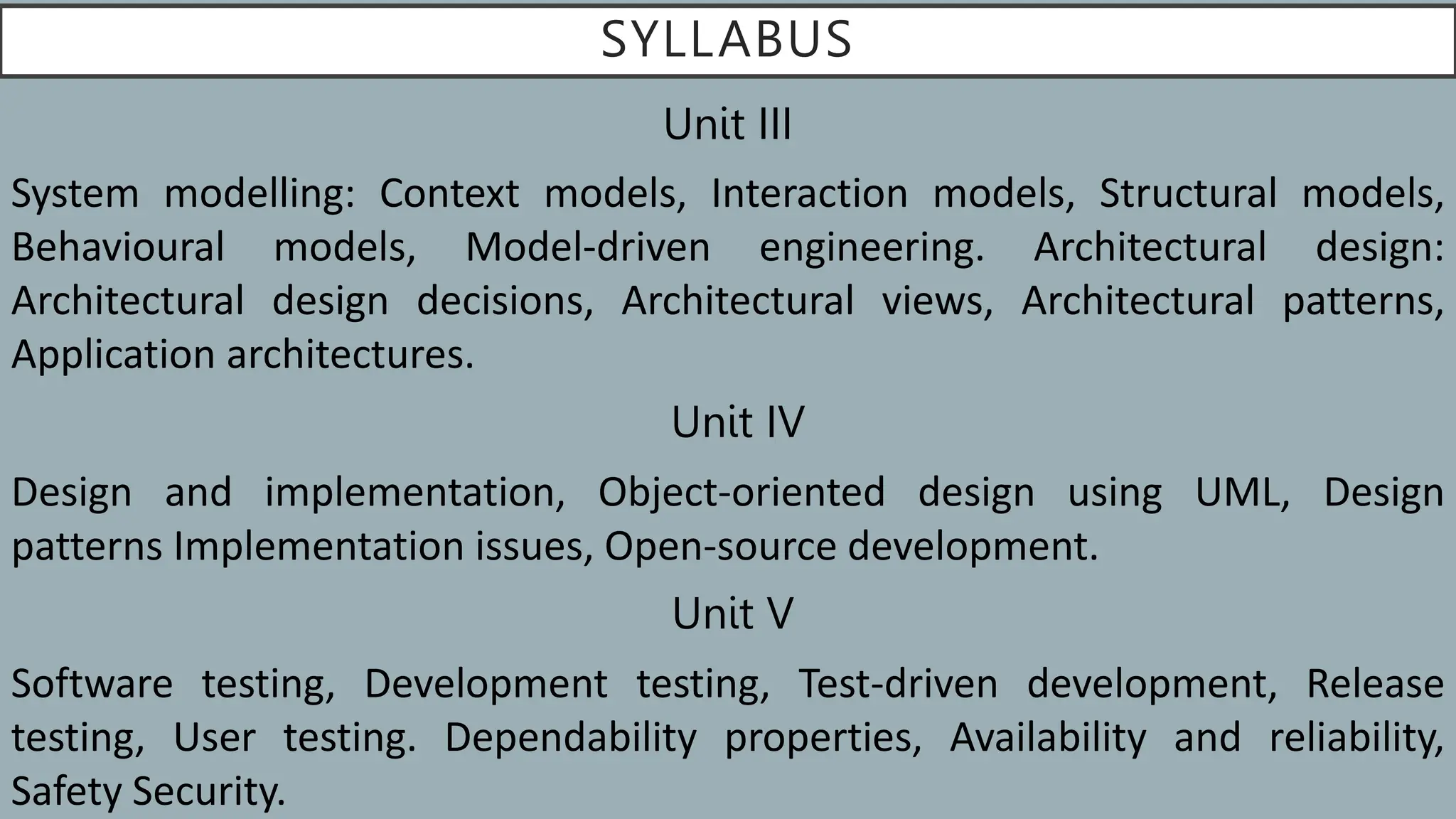
SYLLABUS
Unit III
System modelling: Context models, Interaction models, Structural models,
Behavioural models, Model-driven engineering. Architectural design:
Architectural design decisions, Architectural views, Architectural patterns,
Application architectures.
Unit IV
Design and implementation, Object-oriented design using UML, Design
patterns Implementation issues, Open-source development.
Unit V
Software testing, Development testing, Test-driven development, Release
testing, User testing. Dependability properties, Availability and reliability,
Safety Security.
BOOKS
Textbook:
1. Ian Sommerville, Software Engineering; 9th Edition, Addison-
Wesley Publishing Company, USA.
Reference Books:
1. S.A. Kelkar, Software Engineering, , Prentice Hall of India,
2007.
2. Pressman, Software Engineering, Tata McGraw Hill, 6th
Edition, 2006.
3. Pankaj Jalote, Software Engineering, Narosa Publishers, 3rd
Edition, 2006.
COURSE OBJECTIVES
 Understand what software engineering is and why it is
important.
 Understand important ethical and professional issues for
software engineers.
 Understand the concepts of software processes and software
process models.
 Understand the rationale for agile software development
methods and the difference between agile and plan driven
development.
COURSE OBJECTIVES
1.Understand the concepts of user and system requirements and
why these requirements should be written in different ways.
2.Understand how graphical models can be used to represent
software systems and why several types of models are needed
to fully represent a system.
3.Understand why the architectural design of software is
important.
4.Understand the most important activities in object-oriented
design process.
COURSE OBJECTIVES
1.Understand the stages of testing from testing during
development to acceptance testing by system customers.
COURSE OUTCOMES
CO Course Outcome
Blooms
Taxonomy
Level
CO 1
Select the most appropriate software engineering model for
developing the software
Understan
d
CO 2
Discuss agile methodology to cope with the changes while
software development process
Understan
d
CO 3 Prepare a Software Requirement Specification document Create
CO 4 Distinguish fundamental system modelling perspectives Analyze
CO 5
Analyze how the Object-Oriented UML diagrams can be
used in system modelling and designing patterns
Analyze
CO 6
Describe the stages of software testing from testing during
development to testing during deployment
Understan
d
CA METHODOLOGIES
CA I: Online Quiz
CA II: Report on Mini Project Testing
WHAT IS SOFTWARE ENGINEERING
Engineering approach to develop software.
• –Building construction analogy.
Systematic collection of experience:
• –Techniques
• –Methodologies
• –Guidelines
IEEE DEFINITION
Software engineering is the application of a
systematic, disciplined, quantifiable approach
to the development, operation, and
maintenance of software; that is, the
application of engineering to software.
WHAT IS EXPLORATORY SOFTWARE DEVELOPMENT
Early programmers used exploratory also called
(build and fix ) style.
– A `dirty' program is quickly developed.
– The bugs are fixed as and when they are
noticed.
– Similar to how a junior student develops
programs
WHAT IS EXPLORATORY SOFTWARE DEVELOPMENT
Initial coding
Test
Do until done
If bug (Error) found go back to Initial coding.
Clearly not suitable for large projects ….. Why?
WHAT IS WRONG WITH EXPLORATORY SOFTWARE DEVELOPMENT
Can successfully be used for developing only very
small (toy) programs.
Besides the exponential growth of effort, cost, and
time with problem size:
– Exploratory style usually results in unmaintainable
code.
– It becomes very difficult to use the exploratory
style in team development environments …
WHY STUDY SOFTWARE ENGINEERING?
To acquire skills to develop large programs.
– Handling exponential growth in complexity with
size.
– Systematic techniques based on abstraction
(modelling) and decomposition.
WHY STUDY SOFTWARE ENGINEERING?
Learn systematic techniques of:
– Specification, design, user interface development,
testing, project management, maintenance, etc.
– Appreciate issues that arise in team development.
WHY STUDY SOFTWARE ENGINEERING?
To acquire skills to be a better programmer:
• Higher Productivity
• Better Quality Programs
TYPES OF SOFTWARE PROJECTS
Two types of software projects:
– Products (Generic software)
– Services (custom software)
• Total business Several Trillions of US $
– Half in products and half services
– Services segment is growing fast!
Accounting, Antivirus, Communication, Database etc.
Swiggy, Zomato, Bookmyshow
SOFTWARE ENGINEERING
The economies of ALL developed nations are
dependent on software.
More and more systems are software controlled
Software engineering is concerned with theories,
methods and tools for professional software
development.
Expenditure on software represents a significant
fraction of GNP in all developed countries
SOFTWARE COSTS
Software costs often dominate computer system costs.
The costs of software on a PC are often greater than the
hardware cost.
Software costs more to maintain than it does to develop.
For systems with a long life, maintenance costs may be
several times development costs.
Software engineering is concerned with cost-effective
software development.
SOFTWARE PROJECTS FAILURE
Increasing system complexity
Failure to use software engineering methods
SOFTWARE ENGINEERING FAQ
What is software?
Computer programs and associated documentation.
Software products may be developed for a particular
customer or may be developed for a general market.
What are the attributes of good software?
Good software should deliver the required
functionality and performance to the user and
should be maintainable, dependable and usable.
SOFTWARE ENGINEERING FAQ
What is software engineering?
Software engineering is an engineering discipline that
is concerned with all aspects of software production.
What are the fundamental software engineering
activities?
Software specification, software development,
software validation and software evolution.
SOFTWARE ENGINEERING FAQ
What is the difference between software
engineering and computer science?
Computer science focuses on theory and
fundamentals; software engineering is concerned
with the practicalities of developing and delivering
useful software.
SOFTWARE ENGINEERING FAQ
What is the difference between software
engineering and system engineering?
System engineering is concerned with all aspects of
computer-based systems development including
hardware, software and process engineering.
Software engineering is part of this more general
process
SOFTWARE ENGINEERING FAQ
What are the key challenges facing software
engineering?
Coping with increasing diversity, demands for reduced
delivery times and developing trustworthy software.
What are the costs of software engineering?
Roughly 60% of software costs are development
costs, 40% are testing costs. For custom software,
evolution costs often exceed development costs.
SOFTWARE ENGINEERING FAQ
What are the best software engineering techniques
and methods?
While all software projects have to be professionally managed
and developed, different techniques are appropriate for
different types of system. For example, games should always be
developed using a series of prototypes whereas safety critical
control systems require a complete and analyzable specification
to be developed. You can’t, therefore, say that one method is
better than another.
SOFTWARE ENGINEERING FAQ
What differences has the web made to software
engineering?
The web has led to the availability of software
services and the possibility of developing highly
distributed service-based systems.
Web-based systems development has led to
important advances in programming languages and
software reuse.
SOFTWARE PRODUCTS
Two types of software products
Generic products
Stand-alone systems that are marketed and sold to
any customer who wishes to buy them.
Examples – PC software such as graphics programs,
project management tools; CAD software; software
for specific markets such as appointments systems
for dentists.
SOFTWARE PRODUCTS
Two types of software products
Customized products
Software that is commissioned (demanded) by a
specific customer to meet their own needs.
Examples – embedded control systems, air traffic
control software, traffic monitoring systems.
SOFTWARE PRODUCTS PRODUCT SPECIFICATION
Generic products
The specification of what the software should do is
owned by the software developer and decisions on
software change are made by the developer.
Customized products
The specification of what the software should do is
owned by the customer for the software and they
make decisions on software changes that are required.
ESSENTIAL ATTRIBUTES OF A GOOD SOFTWARE
Maintainability:
Software should be written in such a way so that it can
evolve (adapt to changes) to meet the changing needs
of customers.
This is a critical attribute because software change is
an inevitable requirement of a changing business
environment.
ESSENTIAL ATTRIBUTES OF A GOOD SOFTWARE
Dependability and security:
Software dependability includes a range of
characteristics including reliability, security and
safety.
Dependable software should not cause physical or
economic damage in the event of system failure.
Malicious users should not be able to access or
damage the system (Security).
ESSENTIAL ATTRIBUTES OF A GOOD SOFTWARE
Efficiency:
Software should not make wasteful use of system
resources such as memory and processor cycles.
Efficiency therefore includes responsiveness,
processing time, memory utilization, etc.
ESSENTIAL ATTRIBUTES OF A GOOD SOFTWARE
Acceptability:
Software must be acceptable to the type of users for
which it is designed.
This means that it must be understandable, usable and
compatible with other systems that they use.
SOFTWARE ENGINEERING
Software engineering is an engineering discipline that is
concerned with all aspects of software production from the
early stages of system specification through to maintaining the
system after it has gone into use.
Using appropriate theories and methods to solve problems
bearing in mind organizational and financial constraints.
(Engineering Approach)
Not just technical process of development. It is also project
management and the development of tools, methods etc. to
support software production. (All aspects of software production)
SOFTWARE PROCESS ACTIVITIES
Software specification, where customers and
engineers define the software that is to be produced
and the constraints on its operation.
Software development, where the software is
designed and programmed.
Software validation, where the software is checked to
ensure that it is what the customer requires.
Software evolution, where the software is modified to
reflect changing customer and market requirements.
GENERAL ISSUES THAT AFFECTS SOFTWARE
Heterogeneity:
Increasingly, systems are required to operate as distributed
systems across networks that include different types of
computer and mobile devices.
Business and social change:
Business and society are changing incredibly quickly as
emerging economies develop and new technologies
become available. They need to be able to change their
existing software and to rapidly develop new software.
GENERAL ISSUES THAT AFFECTS SOFTWARE
Security and trust
As software is intertwined with all aspects of our lives,
it is essential that we can trust that software.
Scale
Software must be developed across a very wide range
of scales, from very small embedded systems in
portable or wearable devices through to Internet-
scale, cloud-based systems that serve a global
community.
SOFTWARE ENGINEERING DIVERSITY
There are many different types of software system
and there is no universal set of software techniques
that is applicable to all of these.
The software engineering methods and tools used
depend on the type of application being developed,
the requirements of the customer and the background
of the development team.
TYPES OF APPLICATIONS
Stand-alone applications
These are application systems that run on a local computer,
such as a PC. They include all necessary functionality and
do not need to be connected to a network.
Interactive transaction-based applications
Applications that execute on a remote computer and are
accessed by users from their own PCs or terminals. These
include web applications such as e-commerce
applications.
TYPES OF APPLICATIONS
Embedded control systems
These are software control systems that control and
manage hardware devices. Numerically, there are probably
more embedded systems than any other type of system.
Batch processing systems
These are business systems that are designed to process
data in large batches. They process large numbers of
individual inputs to create corresponding outputs.
TYPES OF APPLICATIONS
Entertainment systems
These are systems that are primarily for personal use,
and which are intended to entertain the user.
Systems for modeling and simulation
These are systems that are developed by scientists and
engineers to model physical processes or situations,
which include many, separate, interacting objects.
TYPES OF APPLICATIONS
Data collection systems
These are systems that collect data from their
environment using a set of sensors and send that data
to other systems for processing.
Systems of systems
These are systems that are composed of several other
software systems.
SOFTWARE ENGINEERING FUNDAMENTALS
There are some fundamental principles apply to all
types of software system, irrespective of the
development techniques used:
Systems should be developed using a managed and
understood development process. Of course, different
processes are used for different types of software.
Dependability and performance are important for all
types of system.
SOFTWARE ENGINEERING FUNDAMENTALS
Understanding and managing the software
specification and requirements (what the software
should do) are important.
Where appropriate, you should reuse software that
has already been developed rather than write new
software.
INTERNET SOFTWARE ENGINEERING
The Web is now a platform for running application and
organizations are increasingly developing web-based
systems rather than local systems.
Web services allow application functionality to be
accessed over the web.
Cloud computing is an approach to the provision of
computer services where applications run remotely on
the ‘cloud’.
Users do not buy software buy pay according to use.
INTERNET SOFTWARE ENGINEERING (CLOUD PRIZING)
Provider
CPU 1 /
RAM 2
CPU 2 /
RAM 4
CPU 4 /
RAM 8
CPU 8 /
RAM 16
CPU 16 /
RAM 32
Amazon
Cloud
$0.07 $0.11 $0.21 $0.42 $0.84
Microsoft $0.06 $0.11 $0.21 $0.45 $0.89
IBM
SoftLayer
$0.05 $0.11 $0.21 $0.39 $0.72
Google
Cloud
$0.04 $0.09 $0.18 $0.35 $0.71
INTERNET SOFTWARE ENGINEERING (CLOUD PRIZING)
Provider Storage Type GB/Month
Amazon
EBS Cold HDD
Optimized HDD
EBS General Purpose SSD
$.03
$.05
$.10
Google
Standard Provisioned Space
SSD Provisioned Space
$0.04
$0.17
IBM Endurance Block Storage $.15/$.35
Microsoft
Standard Disk LRS
Standard Disk GRS
Standard Disk RA GRS
$.05
$.10
$.012
WEB BASED SOFTWARE ENGINEERING
Web-based systems are complex distributed systems,
but the fundamental principles of software engineering
discussed previously are as applicable to them as they
are to any other types of system.
The fundamental ideas of software engineering apply
to web-based software in the same way that they apply
to other types of software system.
WEB SOFTWARE ENGINEERING
Software reuse
Software reuse is the dominant approach for constructing
web-based systems. When building these systems, you
think about how you can assemble them from pre-existing
software components and systems.
Incremental and agile development
Web-based systems should be developed and delivered
incrementally. It is now generally recognized that it is
impractical to specify all the requirements for such
systems in advance.
WEB SOFTWARE ENGINEERING
Service-oriented systems
Software may be implemented using service-oriented
software engineering, where the software
components are stand-alone web services.
Rich interfaces
Interface development technologies such as AJAX and
HTML5 have emerged that support the creation of rich
interfaces within a web browser.
SOFTWARE ENGINEERING ETHICS
Software engineering involves wider responsibilities
than simply the application of technical skills.
Software engineers must behave in an honest and
ethically responsible way if they are to be respected as
professionals.
Ethical behavior is more than simply upholding the law
but involves following a set of principles that are
morally correct:
SOFTWARE ENGINEERING ETHICS
Confidentiality
Engineers should normally respect the confidentiality
of their employers or clients irrespective of whether or
not a formal confidentiality agreement has been
signed.
Competence
Engineers should not misrepresent their level of
competence. They should not knowingly accept work
which is out with their competence.
SOFTWARE ENGINEERING ETHICS
Intellectual property rights
Engineers should be aware of local laws governing the use
of intellectual property such as patents, copyright, etc.
They should be careful to ensure that the intellectual
property of employers and clients is protected.
Computer misuse
Software engineers should not use their technical skills to
misuse other people’s computers. Computer misuse ranges
from relatively trivial (game playing on an employer’s
machine, say) to extremely serious (dissemination of
viruses).
ACM/IEEE CODE OF ETHICS
The professional societies in the US have cooperated to
produce a code of ethical practice.
Members of these organizations sign up to the code of
practice when they join.
The Code contains eight Principles related to the
behavior of and decisions made by professional
software engineers, including practitioners, educators,
managers, supervisors and policy makers, as well as
trainees and students of the profession.
RATIONALE FOR CODE OF ETHICS
Computers have a central and growing role in
commerce, industry, government, medicine,
education, entertainment and society at large.
Software engineers are those who contribute by direct
participation or by teaching, to the analysis,
specification, design, development, certification,
maintenance and testing of software systems.
RATIONALE FOR CODE OF ETHICS
Because of their roles in developing software systems,
software engineers have significant opportunities to
do good or cause harm, to enable others to do good or
cause harm, or to influence others to do good or cause
harm.
To ensure, as much as possible, that their efforts will
be used for good, software engineers must commit
themselves to making software engineering a
beneficial and respected profession.
THE ACM/IEEE CODE OF ETHICS
Software Engineering Code of Ethics and Professional
Practice:
ACM/IEEE-CS Joint Task Force on Software Engineering
Ethics and Professional Practices
PREAMBLE
The short version of the code summarizes aspirations at a
high level of the abstraction; the clauses that are included
in the full version give examples and details of how these
aspirations change the way we act as software engineering
professionals.
THE ACM/IEEE CODE OF ETHICS
Without the aspirations, the details can become legalistic
and tedious; without the details, the aspirations can
become high sounding but empty; together, the aspirations
and the details form a cohesive code.
Software engineers shall commit themselves to making the
analysis, specification, design, development, testing and
maintenance of software a beneficial and respected
profession. In accordance with their commitment to the
health, safety and welfare of the public, software engineers
shall adhere to the following Eight Principles:
THE ACM/IEEE ETHICAL PRINCIPLES
1. PUBLIC - Software engineers shall act consistently with
the public interest.
2. CLIENT AND EMPLOYER - Software engineers shall act in
a manner that is in the best interests of their client and
employer consistent with the public interest.
3. PRODUCT - Software engineers shall ensure that their
products and related modifications meet the highest
professional standards possible.
4. JUDGMENT - Software engineers shall maintain integrity
and independence in their professional judgment.
THE ACM/IEEE ETHICAL PRINCIPLES
5. MANAGEMENT - Software engineering managers and leaders
shall subscribe to and promote an ethical approach to the
management of software development and maintenance.
6. PROFESSION - Software engineers shall advance the integrity
and reputation of the profession consistent with the public
interest.
7. COLLEAGUES - Software engineers shall be fair to and
supportive of their colleagues.
8. SELF - Software engineers shall participate in lifelong learning
regarding the practice of their profession and shall promote an
ethical approach to the practice of the profession.
THE ETHICAL DILEMMAS
Disagreement in principle with the policies of senior
management.
Your employer acts in an unethical way and releases a
safety-critical system without finishing the testing of
the system.
Participation in the development of military weapons
systems or nuclear systems.
CASE STUDIES
A personal insulin pump
An embedded system in an insulin pump used by diabetics to
maintain blood glucose control.
A mental health case patient management system
Mentcare. A system used to maintain records of people
receiving care for mental health problems.
A wilderness weather station
A data collection system that collects data about weather
conditions in remote areas.
iLearn: a digital learning environment
A system to support learning in schools
KEY POINTS
Software engineering is an engineering discipline that is
concerned with all aspects of software production.
Essential software product attributes are maintainability,
dependability and security, efficiency and acceptability.
The high-level activities of specification, development,
validation and evolution are part of all software
processes.
The fundamental notions of software engineering are
universally applicable to all types of system
development.
KEY POINTS
There are many different types of system and each
requires appropriate software engineering tools and
techniques for their development.
The fundamental ideas of software engineering are
applicable to all types of software system.
Software engineers have responsibilities to the
engineering profession and society. They should not
simply be concerned with technical issues.
Professional societies publish codes of conduct which set
out the standards of behavior expected of their members.
KEY POINTS
There are many different types of system and each
requires appropriate software engineering tools and
techniques for their development.
The fundamental ideas of software engineering are
applicable to all types of software system.
Software engineers have responsibilities to the
engineering profession and society. They should not
simply be concerned with technical issues.
Professional societies publish codes of conduct which set
out the standards of behavior expected of their members.

Software Engineering PPT Unit I.pptx

  • 1.
  • 2.
    SYLLABUS Unit I Introduction: Professionalsoftware development, Software engineering ethics, Case studies. Software processes: Software process models, Process activities, Coping with change, The rational unified process. Unit II Agile software development: Agile methods, Plan-driven and agile development, Extreme programming, Agile project management, Scaling agile methods. Requirements engineering: Functional and non- functional requirements, The software requirements document, Requirements specification, Requirements engineering processes, Requirements elicitation and analysis, Requirements validation, Requirements management.
  • 3.
    SYLLABUS Unit III System modelling:Context models, Interaction models, Structural models, Behavioural models, Model-driven engineering. Architectural design: Architectural design decisions, Architectural views, Architectural patterns, Application architectures. Unit IV Design and implementation, Object-oriented design using UML, Design patterns Implementation issues, Open-source development. Unit V Software testing, Development testing, Test-driven development, Release testing, User testing. Dependability properties, Availability and reliability, Safety Security.
  • 4.
    BOOKS Textbook: 1. Ian Sommerville,Software Engineering; 9th Edition, Addison- Wesley Publishing Company, USA. Reference Books: 1. S.A. Kelkar, Software Engineering, , Prentice Hall of India, 2007. 2. Pressman, Software Engineering, Tata McGraw Hill, 6th Edition, 2006. 3. Pankaj Jalote, Software Engineering, Narosa Publishers, 3rd Edition, 2006.
  • 5.
    COURSE OBJECTIVES  Understandwhat software engineering is and why it is important.  Understand important ethical and professional issues for software engineers.  Understand the concepts of software processes and software process models.  Understand the rationale for agile software development methods and the difference between agile and plan driven development.
  • 6.
    COURSE OBJECTIVES 1.Understand theconcepts of user and system requirements and why these requirements should be written in different ways. 2.Understand how graphical models can be used to represent software systems and why several types of models are needed to fully represent a system. 3.Understand why the architectural design of software is important. 4.Understand the most important activities in object-oriented design process.
  • 7.
    COURSE OBJECTIVES 1.Understand thestages of testing from testing during development to acceptance testing by system customers.
  • 8.
    COURSE OUTCOMES CO CourseOutcome Blooms Taxonomy Level CO 1 Select the most appropriate software engineering model for developing the software Understan d CO 2 Discuss agile methodology to cope with the changes while software development process Understan d CO 3 Prepare a Software Requirement Specification document Create CO 4 Distinguish fundamental system modelling perspectives Analyze CO 5 Analyze how the Object-Oriented UML diagrams can be used in system modelling and designing patterns Analyze CO 6 Describe the stages of software testing from testing during development to testing during deployment Understan d
  • 9.
    CA METHODOLOGIES CA I:Online Quiz CA II: Report on Mini Project Testing
  • 10.
    WHAT IS SOFTWAREENGINEERING Engineering approach to develop software. • –Building construction analogy. Systematic collection of experience: • –Techniques • –Methodologies • –Guidelines
  • 11.
    IEEE DEFINITION Software engineeringis the application of a systematic, disciplined, quantifiable approach to the development, operation, and maintenance of software; that is, the application of engineering to software.
  • 12.
    WHAT IS EXPLORATORYSOFTWARE DEVELOPMENT Early programmers used exploratory also called (build and fix ) style. – A `dirty' program is quickly developed. – The bugs are fixed as and when they are noticed. – Similar to how a junior student develops programs
  • 13.
    WHAT IS EXPLORATORYSOFTWARE DEVELOPMENT Initial coding Test Do until done If bug (Error) found go back to Initial coding. Clearly not suitable for large projects ….. Why?
  • 14.
    WHAT IS WRONGWITH EXPLORATORY SOFTWARE DEVELOPMENT Can successfully be used for developing only very small (toy) programs. Besides the exponential growth of effort, cost, and time with problem size: – Exploratory style usually results in unmaintainable code. – It becomes very difficult to use the exploratory style in team development environments …
  • 15.
    WHY STUDY SOFTWAREENGINEERING? To acquire skills to develop large programs. – Handling exponential growth in complexity with size. – Systematic techniques based on abstraction (modelling) and decomposition.
  • 16.
    WHY STUDY SOFTWAREENGINEERING? Learn systematic techniques of: – Specification, design, user interface development, testing, project management, maintenance, etc. – Appreciate issues that arise in team development.
  • 17.
    WHY STUDY SOFTWAREENGINEERING? To acquire skills to be a better programmer: • Higher Productivity • Better Quality Programs
  • 18.
    TYPES OF SOFTWAREPROJECTS Two types of software projects: – Products (Generic software) – Services (custom software) • Total business Several Trillions of US $ – Half in products and half services – Services segment is growing fast! Accounting, Antivirus, Communication, Database etc. Swiggy, Zomato, Bookmyshow
  • 19.
    SOFTWARE ENGINEERING The economiesof ALL developed nations are dependent on software. More and more systems are software controlled Software engineering is concerned with theories, methods and tools for professional software development. Expenditure on software represents a significant fraction of GNP in all developed countries
  • 20.
    SOFTWARE COSTS Software costsoften dominate computer system costs. The costs of software on a PC are often greater than the hardware cost. Software costs more to maintain than it does to develop. For systems with a long life, maintenance costs may be several times development costs. Software engineering is concerned with cost-effective software development.
  • 21.
    SOFTWARE PROJECTS FAILURE Increasingsystem complexity Failure to use software engineering methods
  • 22.
    SOFTWARE ENGINEERING FAQ Whatis software? Computer programs and associated documentation. Software products may be developed for a particular customer or may be developed for a general market. What are the attributes of good software? Good software should deliver the required functionality and performance to the user and should be maintainable, dependable and usable.
  • 23.
    SOFTWARE ENGINEERING FAQ Whatis software engineering? Software engineering is an engineering discipline that is concerned with all aspects of software production. What are the fundamental software engineering activities? Software specification, software development, software validation and software evolution.
  • 24.
    SOFTWARE ENGINEERING FAQ Whatis the difference between software engineering and computer science? Computer science focuses on theory and fundamentals; software engineering is concerned with the practicalities of developing and delivering useful software.
  • 25.
    SOFTWARE ENGINEERING FAQ Whatis the difference between software engineering and system engineering? System engineering is concerned with all aspects of computer-based systems development including hardware, software and process engineering. Software engineering is part of this more general process
  • 26.
    SOFTWARE ENGINEERING FAQ Whatare the key challenges facing software engineering? Coping with increasing diversity, demands for reduced delivery times and developing trustworthy software. What are the costs of software engineering? Roughly 60% of software costs are development costs, 40% are testing costs. For custom software, evolution costs often exceed development costs.
  • 27.
    SOFTWARE ENGINEERING FAQ Whatare the best software engineering techniques and methods? While all software projects have to be professionally managed and developed, different techniques are appropriate for different types of system. For example, games should always be developed using a series of prototypes whereas safety critical control systems require a complete and analyzable specification to be developed. You can’t, therefore, say that one method is better than another.
  • 28.
    SOFTWARE ENGINEERING FAQ Whatdifferences has the web made to software engineering? The web has led to the availability of software services and the possibility of developing highly distributed service-based systems. Web-based systems development has led to important advances in programming languages and software reuse.
  • 29.
    SOFTWARE PRODUCTS Two typesof software products Generic products Stand-alone systems that are marketed and sold to any customer who wishes to buy them. Examples – PC software such as graphics programs, project management tools; CAD software; software for specific markets such as appointments systems for dentists.
  • 30.
    SOFTWARE PRODUCTS Two typesof software products Customized products Software that is commissioned (demanded) by a specific customer to meet their own needs. Examples – embedded control systems, air traffic control software, traffic monitoring systems.
  • 31.
    SOFTWARE PRODUCTS PRODUCTSPECIFICATION Generic products The specification of what the software should do is owned by the software developer and decisions on software change are made by the developer. Customized products The specification of what the software should do is owned by the customer for the software and they make decisions on software changes that are required.
  • 32.
    ESSENTIAL ATTRIBUTES OFA GOOD SOFTWARE Maintainability: Software should be written in such a way so that it can evolve (adapt to changes) to meet the changing needs of customers. This is a critical attribute because software change is an inevitable requirement of a changing business environment.
  • 33.
    ESSENTIAL ATTRIBUTES OFA GOOD SOFTWARE Dependability and security: Software dependability includes a range of characteristics including reliability, security and safety. Dependable software should not cause physical or economic damage in the event of system failure. Malicious users should not be able to access or damage the system (Security).
  • 34.
    ESSENTIAL ATTRIBUTES OFA GOOD SOFTWARE Efficiency: Software should not make wasteful use of system resources such as memory and processor cycles. Efficiency therefore includes responsiveness, processing time, memory utilization, etc.
  • 35.
    ESSENTIAL ATTRIBUTES OFA GOOD SOFTWARE Acceptability: Software must be acceptable to the type of users for which it is designed. This means that it must be understandable, usable and compatible with other systems that they use.
  • 36.
    SOFTWARE ENGINEERING Software engineeringis an engineering discipline that is concerned with all aspects of software production from the early stages of system specification through to maintaining the system after it has gone into use. Using appropriate theories and methods to solve problems bearing in mind organizational and financial constraints. (Engineering Approach) Not just technical process of development. It is also project management and the development of tools, methods etc. to support software production. (All aspects of software production)
  • 37.
    SOFTWARE PROCESS ACTIVITIES Softwarespecification, where customers and engineers define the software that is to be produced and the constraints on its operation. Software development, where the software is designed and programmed. Software validation, where the software is checked to ensure that it is what the customer requires. Software evolution, where the software is modified to reflect changing customer and market requirements.
  • 38.
    GENERAL ISSUES THATAFFECTS SOFTWARE Heterogeneity: Increasingly, systems are required to operate as distributed systems across networks that include different types of computer and mobile devices. Business and social change: Business and society are changing incredibly quickly as emerging economies develop and new technologies become available. They need to be able to change their existing software and to rapidly develop new software.
  • 39.
    GENERAL ISSUES THATAFFECTS SOFTWARE Security and trust As software is intertwined with all aspects of our lives, it is essential that we can trust that software. Scale Software must be developed across a very wide range of scales, from very small embedded systems in portable or wearable devices through to Internet- scale, cloud-based systems that serve a global community.
  • 40.
    SOFTWARE ENGINEERING DIVERSITY Thereare many different types of software system and there is no universal set of software techniques that is applicable to all of these. The software engineering methods and tools used depend on the type of application being developed, the requirements of the customer and the background of the development team.
  • 41.
    TYPES OF APPLICATIONS Stand-aloneapplications These are application systems that run on a local computer, such as a PC. They include all necessary functionality and do not need to be connected to a network. Interactive transaction-based applications Applications that execute on a remote computer and are accessed by users from their own PCs or terminals. These include web applications such as e-commerce applications.
  • 42.
    TYPES OF APPLICATIONS Embeddedcontrol systems These are software control systems that control and manage hardware devices. Numerically, there are probably more embedded systems than any other type of system. Batch processing systems These are business systems that are designed to process data in large batches. They process large numbers of individual inputs to create corresponding outputs.
  • 43.
    TYPES OF APPLICATIONS Entertainmentsystems These are systems that are primarily for personal use, and which are intended to entertain the user. Systems for modeling and simulation These are systems that are developed by scientists and engineers to model physical processes or situations, which include many, separate, interacting objects.
  • 44.
    TYPES OF APPLICATIONS Datacollection systems These are systems that collect data from their environment using a set of sensors and send that data to other systems for processing. Systems of systems These are systems that are composed of several other software systems.
  • 45.
    SOFTWARE ENGINEERING FUNDAMENTALS Thereare some fundamental principles apply to all types of software system, irrespective of the development techniques used: Systems should be developed using a managed and understood development process. Of course, different processes are used for different types of software. Dependability and performance are important for all types of system.
  • 46.
    SOFTWARE ENGINEERING FUNDAMENTALS Understandingand managing the software specification and requirements (what the software should do) are important. Where appropriate, you should reuse software that has already been developed rather than write new software.
  • 47.
    INTERNET SOFTWARE ENGINEERING TheWeb is now a platform for running application and organizations are increasingly developing web-based systems rather than local systems. Web services allow application functionality to be accessed over the web. Cloud computing is an approach to the provision of computer services where applications run remotely on the ‘cloud’. Users do not buy software buy pay according to use.
  • 48.
    INTERNET SOFTWARE ENGINEERING(CLOUD PRIZING) Provider CPU 1 / RAM 2 CPU 2 / RAM 4 CPU 4 / RAM 8 CPU 8 / RAM 16 CPU 16 / RAM 32 Amazon Cloud $0.07 $0.11 $0.21 $0.42 $0.84 Microsoft $0.06 $0.11 $0.21 $0.45 $0.89 IBM SoftLayer $0.05 $0.11 $0.21 $0.39 $0.72 Google Cloud $0.04 $0.09 $0.18 $0.35 $0.71
  • 49.
    INTERNET SOFTWARE ENGINEERING(CLOUD PRIZING) Provider Storage Type GB/Month Amazon EBS Cold HDD Optimized HDD EBS General Purpose SSD $.03 $.05 $.10 Google Standard Provisioned Space SSD Provisioned Space $0.04 $0.17 IBM Endurance Block Storage $.15/$.35 Microsoft Standard Disk LRS Standard Disk GRS Standard Disk RA GRS $.05 $.10 $.012
  • 50.
    WEB BASED SOFTWAREENGINEERING Web-based systems are complex distributed systems, but the fundamental principles of software engineering discussed previously are as applicable to them as they are to any other types of system. The fundamental ideas of software engineering apply to web-based software in the same way that they apply to other types of software system.
  • 51.
    WEB SOFTWARE ENGINEERING Softwarereuse Software reuse is the dominant approach for constructing web-based systems. When building these systems, you think about how you can assemble them from pre-existing software components and systems. Incremental and agile development Web-based systems should be developed and delivered incrementally. It is now generally recognized that it is impractical to specify all the requirements for such systems in advance.
  • 52.
    WEB SOFTWARE ENGINEERING Service-orientedsystems Software may be implemented using service-oriented software engineering, where the software components are stand-alone web services. Rich interfaces Interface development technologies such as AJAX and HTML5 have emerged that support the creation of rich interfaces within a web browser.
  • 53.
    SOFTWARE ENGINEERING ETHICS Softwareengineering involves wider responsibilities than simply the application of technical skills. Software engineers must behave in an honest and ethically responsible way if they are to be respected as professionals. Ethical behavior is more than simply upholding the law but involves following a set of principles that are morally correct:
  • 54.
    SOFTWARE ENGINEERING ETHICS Confidentiality Engineersshould normally respect the confidentiality of their employers or clients irrespective of whether or not a formal confidentiality agreement has been signed. Competence Engineers should not misrepresent their level of competence. They should not knowingly accept work which is out with their competence.
  • 55.
    SOFTWARE ENGINEERING ETHICS Intellectualproperty rights Engineers should be aware of local laws governing the use of intellectual property such as patents, copyright, etc. They should be careful to ensure that the intellectual property of employers and clients is protected. Computer misuse Software engineers should not use their technical skills to misuse other people’s computers. Computer misuse ranges from relatively trivial (game playing on an employer’s machine, say) to extremely serious (dissemination of viruses).
  • 56.
    ACM/IEEE CODE OFETHICS The professional societies in the US have cooperated to produce a code of ethical practice. Members of these organizations sign up to the code of practice when they join. The Code contains eight Principles related to the behavior of and decisions made by professional software engineers, including practitioners, educators, managers, supervisors and policy makers, as well as trainees and students of the profession.
  • 57.
    RATIONALE FOR CODEOF ETHICS Computers have a central and growing role in commerce, industry, government, medicine, education, entertainment and society at large. Software engineers are those who contribute by direct participation or by teaching, to the analysis, specification, design, development, certification, maintenance and testing of software systems.
  • 58.
    RATIONALE FOR CODEOF ETHICS Because of their roles in developing software systems, software engineers have significant opportunities to do good or cause harm, to enable others to do good or cause harm, or to influence others to do good or cause harm. To ensure, as much as possible, that their efforts will be used for good, software engineers must commit themselves to making software engineering a beneficial and respected profession.
  • 59.
    THE ACM/IEEE CODEOF ETHICS Software Engineering Code of Ethics and Professional Practice: ACM/IEEE-CS Joint Task Force on Software Engineering Ethics and Professional Practices PREAMBLE The short version of the code summarizes aspirations at a high level of the abstraction; the clauses that are included in the full version give examples and details of how these aspirations change the way we act as software engineering professionals.
  • 60.
    THE ACM/IEEE CODEOF ETHICS Without the aspirations, the details can become legalistic and tedious; without the details, the aspirations can become high sounding but empty; together, the aspirations and the details form a cohesive code. Software engineers shall commit themselves to making the analysis, specification, design, development, testing and maintenance of software a beneficial and respected profession. In accordance with their commitment to the health, safety and welfare of the public, software engineers shall adhere to the following Eight Principles:
  • 61.
    THE ACM/IEEE ETHICALPRINCIPLES 1. PUBLIC - Software engineers shall act consistently with the public interest. 2. CLIENT AND EMPLOYER - Software engineers shall act in a manner that is in the best interests of their client and employer consistent with the public interest. 3. PRODUCT - Software engineers shall ensure that their products and related modifications meet the highest professional standards possible. 4. JUDGMENT - Software engineers shall maintain integrity and independence in their professional judgment.
  • 62.
    THE ACM/IEEE ETHICALPRINCIPLES 5. MANAGEMENT - Software engineering managers and leaders shall subscribe to and promote an ethical approach to the management of software development and maintenance. 6. PROFESSION - Software engineers shall advance the integrity and reputation of the profession consistent with the public interest. 7. COLLEAGUES - Software engineers shall be fair to and supportive of their colleagues. 8. SELF - Software engineers shall participate in lifelong learning regarding the practice of their profession and shall promote an ethical approach to the practice of the profession.
  • 63.
    THE ETHICAL DILEMMAS Disagreementin principle with the policies of senior management. Your employer acts in an unethical way and releases a safety-critical system without finishing the testing of the system. Participation in the development of military weapons systems or nuclear systems.
  • 64.
    CASE STUDIES A personalinsulin pump An embedded system in an insulin pump used by diabetics to maintain blood glucose control. A mental health case patient management system Mentcare. A system used to maintain records of people receiving care for mental health problems. A wilderness weather station A data collection system that collects data about weather conditions in remote areas. iLearn: a digital learning environment A system to support learning in schools
  • 65.
    KEY POINTS Software engineeringis an engineering discipline that is concerned with all aspects of software production. Essential software product attributes are maintainability, dependability and security, efficiency and acceptability. The high-level activities of specification, development, validation and evolution are part of all software processes. The fundamental notions of software engineering are universally applicable to all types of system development.
  • 66.
    KEY POINTS There aremany different types of system and each requires appropriate software engineering tools and techniques for their development. The fundamental ideas of software engineering are applicable to all types of software system. Software engineers have responsibilities to the engineering profession and society. They should not simply be concerned with technical issues. Professional societies publish codes of conduct which set out the standards of behavior expected of their members.
  • 67.
    KEY POINTS There aremany different types of system and each requires appropriate software engineering tools and techniques for their development. The fundamental ideas of software engineering are applicable to all types of software system. Software engineers have responsibilities to the engineering profession and society. They should not simply be concerned with technical issues. Professional societies publish codes of conduct which set out the standards of behavior expected of their members.