Intro:
Profile for target audience:
• Age demographic: 14-19 years old
• This age range has the most disposable income and spare
time, therefore they are a lot more able to read magazines
than older age demographics who have more responsibilities.
Teenagers will also use my magazine to help create their
identity, which is something many people in their
demographic struggle with compared to older and younger
age ranges.
• Gender: overall gender neutral, however Yungblud has a lot of
female fans so it would benefit my magazine to make it
slightly more feminine.
• Social grade: Mainly E because most of the age range will be
unemployed, however the minority that are employed would
be grade D. In comparison higher social grads are less likely to
read music magazines because they have higher paid
(professional) jobs so they would most likely read business
magazines.
• Psychographic: Mainstreamers, Aspirers and strugglers. These
are three teenagers tend conform to, I will try to create my
magazine in a way that would appeal to these psychographics.
Digital or Print magazine:
Initially I planned to create a digital magazine because I think the newer technology resonates better with the younger
generation(my target audience). This is because they enjoy the convenience of accessing various magazines from their mobile
device/ computer. However while creating the magazines in InDesign I encountered several issues, the first being the realization
that advertising posters in a digital magazine isn't practical. These posters were a crucial feature on the front cover because they
attract the target audience. Younger demographics enjoy posters because they help to construct their identity, without the
posters I don’t think they would interact with my magazine. Other issues included hyperlinks not working with page transitions,
meaning that I would have to sacrifice one of the few interactive elements of the magazine. I could have continued to work in
InDesign to try to get this feature to work, but after taking the posters into consideration I decided my magazine would attract
the target audience more in a print format.
Despite my decision to create a print magazine, I have proof of experimenting with the InDesign software used to create digital
magazines.
When using secondary content it Is important to give credit to the original owner/creator of that material. This is important
because it avoids any legal repercussions for using copyrighted material, if you neglect to give the appropriate credits you could
face a lawsuit from owners/companies. Therefore, when creating my magazine I will feature a buy line for all secondary content
on the double page spread and the contents page. This buy line gives credit to the photographers of my secondary content,
meaning I wouldn't face repercussions. Finally, I received permission from all of my models in the primary content.
Furthermore, using content without giving credit/ receiving permission could cause ethical issues/ damage the reputation of
your magazine and discourage your audience from reading it.
Legal and ethical issues:
Music magazine
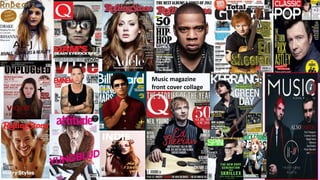
front cover collage
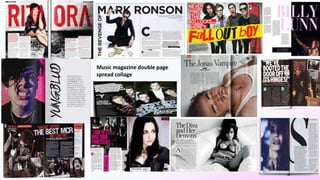
Music magazine double page
spread collage
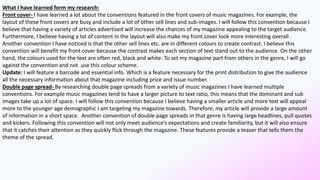
What I have learned form my research:
Front cover- I have learned a lot about the conventions featured in the front covers of music magazines. For example, the
layout of these front covers are busy and include a lot of other sell lines and sub-images. I will follow this convention because I
believe that having a variety of articles advertised will increase the chances of my magazine appealing to the target audience.
Furthermore, I believe having a lot of content in the layout will also make my front cover look more interesting overall .
Another convention I have noticed is that the other sell lines etc. are in different colours to create contrast. I believe this
convention will benefit my front cover because the contrast makes each section of text stand out to the audience. On the other
hand, the colours used for the text are often red, black and white. To set my magazine part from others in the genre, I will go
against the convention and not use this colour scheme.
Update: I will feature a barcode and essential info. Which is a feature necessary for the print distribution to give the audience
all the necessary information about that magazine including price and issue number.
Double page spread- By researching double page spreads from a variety of music magazines I have learned multiple
conventions. For example music magazines tend to have a larger picture to text ratio, this means that the dominant and sub
images take up a lot of space. I will follow this convention because I believe having a smaller article and more text will appeal
more to the younger age demographic I am targeting my magazine towards. Therefore, my article will provide a large amount
of information in a short space. Another convention of double page spreads in that genre is having large headlines, pull quotes
and kickers. Following this convention will not only meet audience’s expectations and create familiarity, but it will also ensure
that it catches their attention as they quickly flick through the magazine. These features provide a teaser that tells them the
theme of the spread.
Skyline
Masthead
Essentialinfo
Otherselllines
+subheads
Main sell line
+Subhead
Dominant image
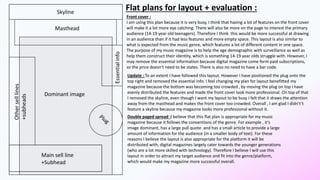
Front cover :
I am using this plan because it is very busy, I think that having a lot of features on the front cover
will make it a lot more eye catching. There will also be more on the page to interest the primary
audience (14-19 year old teenagers). Therefore I think this would be more successful at drawing
in an audience than if it had less features and more empty space. This layout is also similar to
what is expected from the music genre, which features a lot of different content in one space.
The purpose of my music magazine is to help the age demographic with surveillance as well as
help them construct their identity, which is something 14-19 year olds struggle with. However, I
may remove the essential information because digital magazine come form paid subscriptions,
so the price doesn't need to be states. There is also no need to have a bar code.
1
Flat plans for layout + evaluation :
Update : To an extent I have followed this layout. However I have positioned the plug onto the
top right and removed the essential info. I feel changing my plan for layout benefitted my
magazine because the bottom was becoming too crowded , by moving the plug on top I have
evenly distributed the features and made the front cover look more professional. On top of that
I removed the skyline, even though I want my layout to be busy I felt that it draws the attention
away from the masthead and makes the front cover too crowded. Overall , I am glad I didn't’t
feature a skyline because my magazine looks more professional without it.
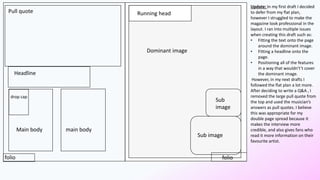
Double paged spread :I believe that this flat plan is appropriate for my music
magazine because it follows the conventions of the genre. For example , it’s
image dominant, has a large pull quote and has a small article to provide a large
amount of information for the audience (in a smaller body of text). For these
reasons I believe the layout is also appropriate for the platform it will be
distributed with, digital magazines largely cater towards the younger generations
(who are a lot more skilled with technology). Therefore I believe I will use this
layout in order to attract my target audience and fit into the genre/platform,
which would make my magazine more successful overall.
Pull quote
Headline
drop cap
Main body main body
Running head
Dominant image
Sub
image
Sub image
folio folio
Update: In my first draft I decided
to defer from my flat plan,
however I struggled to make the
magazine look professional in the
layout. I ran into multiple issues
when creating this draft such as:
• Fitting the text onto the page
around the dominant image.
• Fitting a headline onto the
page.
• Positioning all of the features
in a way that wouldn't’t cover
the dominant image.
However, in my next drafts I
followed the flat plan a lot more.
After deciding to write a Q&A , I
removed the large pull quote from
the top and used the musician’s
answers as pull quotes. I believe
this was appropriate for my
double page spread because it
makes the interview more
credible, and also gives fans who
read it more information on their
favourite artist.
Masthead
Plug
Sub image
Other sell
lines
Barcode and some
essential info
Dominant image
Dominant image
Headline
kicker
Dropcap
Main
body of
text
Running head
Sub images
folio
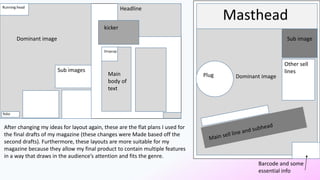
After changing my ideas for layout again, these are the flat plans I used for
the final drafts of my magazine (these changes were Made based off the
second drafts). Furthermore, these layouts are more suitable for my
magazine because they allow my final product to contain multiple features
in a way that draws in the audience’s attention and fits the genre.
Names :
Underpin – it means to support , could use it as a metaphor for supporting the music industry . Could
pair it with a retro font and give the appearance of an old/successful magazine. On the other hand , I don’t find
it suitable for my magazine because it has a more mature connotation that I don’t think would interest the age
demographic of 14-19.
Sound steel –Masculine, could use it to draw in a primarily male audience. However, I want to attract both
genders equally if possible. Also it isn't appropriate for the genre of music I want to cover in my magazine.
Furthermore, I think It would be better suited for the heavy metal genre of music.
Soundlux- Could be used to connote the idea of luxury or high class. On the other hand, it doesn’t fit the
pop-punk aesthetic I am attempting to create in my magazine and therefore can’t be used. I think it would be
better suited for a more mature magazine that wouldn’t attract the chosen target audience.
vexD - I like this name because it sounds modern and could draw in a younger demographic. However, I
decided not to use this name because the verb vex means to irritate someone and I don’t believe that is an
appropriate connotation for a magazine.
Music junkie- I chose this name because I feel like the term colloquial term ‘junkie ‘ will attract the
younger age demographic, it also connotes the idea of an addiction. Having said that, I believe the name will
attract a younger demographic of people strongly interested in music .They may regularly buy this specific
music magazine because it is aimed towards those ‘addicted ‘ to music , creating a sense of being elite. Finally,
the name is gender neutral so it will maximize the number of demographics we are able to attract.
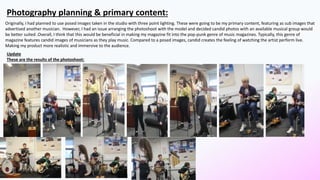
Photography planning & primary content:
Originally, I had planned to use posed images taken in the studio with three point lighting. These were going to be my primary content, featuring as sub images that
advertised another musician. However, I had an issue arranging the photoshoot with the model and decided candid photos with an available musical group would
be better suited .Overall, I think that this would be beneficial in making my magazine fit into the pop-punk genre of music magazines. Typically, this genre of
magazine features candid images of musicians as they play music. Compared to a posed images, candid creates the feeling of watching the artist perform live.
Making my product more realistic and immersive to the audience.
Update
These are the results of the photoshoot:
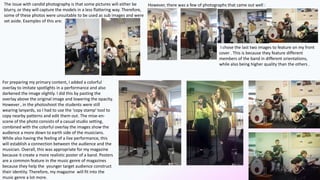
The issue with candid photography is that some pictures will either be
blurry, or they will capture the models in a less flattering way. Therefore,
some of these photos were unsuitable to be used as sub images and were
set aside. Examples of this are:
However, there was a few of photographs that came out well :
I chose the last two images to feature on my front
cover . This is because they feature different
members of the band in different orientations,
while also being higher quality than the others .
For preparing my primary content, I added a colorful
overlay to imitate spotlights in a performance and also
darkened the image slightly. I did this by pasting the
overlay above the original image and lowering the opacity.
However , in the photoshoot the students were still
wearing lanyards, so I had to use the ‘copy stamp’ tool to
copy nearby patterns and edit them out. The mise-en-
scene of the photo consists of a casual studio setting,
combined with the colorful overlay the images show the
audience a more down to earth side of the musicians.
While also having the feeling of a live performance, this
will establish a connection between the audience and the
musician. Overall, this was appropriate for my magazine
because it create a more realistic poster of a band. Posters
are a common feature in the music genre of magazines
because they help the younger target audience construct
their identity. Therefore, my magazine will fit into the
music genre a lot more.
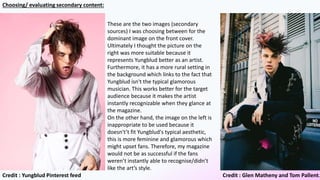
These are the two images (secondary
sources) I was choosing between for the
dominant image on the front cover.
Ultimately I thought the picture on the
right was more suitable because it
represents Yungblud better as an artist.
Furthermore, it has a more rural setting in
the background which links to the fact that
Yungblud isn't the typical glamorous
musician. This works better for the target
audience because it makes the artist
instantly recognizable when they glance at
the magazine.
On the other hand, the image on the left is
inappropriate to be used because it
doesn't’t fit Yungblud's typical aesthetic,
this is more feminine and glamorous which
might upset fans. Therefore, my magazine
would not be as successful if the fans
weren’t instantly able to recognise/didn’t
like the art’s style.
Credit : Glen Matheny and Tom Pallent.Credit : Yungblud Pinterest feed
Choosing/ evaluating secondary content:
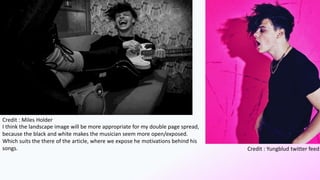
Credit : Miles Holder
Credit : Yungblud twitter feed
I think the landscape image will be more appropriate for my double page spread,
because the black and white makes the musician seem more open/exposed.
Which suits the there of the article, where we expose he motivations behind his
songs.

Unit 14 learning aims b&c

  • 1.
    Intro: Profile for targetaudience: • Age demographic: 14-19 years old • This age range has the most disposable income and spare time, therefore they are a lot more able to read magazines than older age demographics who have more responsibilities. Teenagers will also use my magazine to help create their identity, which is something many people in their demographic struggle with compared to older and younger age ranges. • Gender: overall gender neutral, however Yungblud has a lot of female fans so it would benefit my magazine to make it slightly more feminine. • Social grade: Mainly E because most of the age range will be unemployed, however the minority that are employed would be grade D. In comparison higher social grads are less likely to read music magazines because they have higher paid (professional) jobs so they would most likely read business magazines. • Psychographic: Mainstreamers, Aspirers and strugglers. These are three teenagers tend conform to, I will try to create my magazine in a way that would appeal to these psychographics.
  • 2.
    Digital or Printmagazine: Initially I planned to create a digital magazine because I think the newer technology resonates better with the younger generation(my target audience). This is because they enjoy the convenience of accessing various magazines from their mobile device/ computer. However while creating the magazines in InDesign I encountered several issues, the first being the realization that advertising posters in a digital magazine isn't practical. These posters were a crucial feature on the front cover because they attract the target audience. Younger demographics enjoy posters because they help to construct their identity, without the posters I don’t think they would interact with my magazine. Other issues included hyperlinks not working with page transitions, meaning that I would have to sacrifice one of the few interactive elements of the magazine. I could have continued to work in InDesign to try to get this feature to work, but after taking the posters into consideration I decided my magazine would attract the target audience more in a print format. Despite my decision to create a print magazine, I have proof of experimenting with the InDesign software used to create digital magazines. When using secondary content it Is important to give credit to the original owner/creator of that material. This is important because it avoids any legal repercussions for using copyrighted material, if you neglect to give the appropriate credits you could face a lawsuit from owners/companies. Therefore, when creating my magazine I will feature a buy line for all secondary content on the double page spread and the contents page. This buy line gives credit to the photographers of my secondary content, meaning I wouldn't face repercussions. Finally, I received permission from all of my models in the primary content. Furthermore, using content without giving credit/ receiving permission could cause ethical issues/ damage the reputation of your magazine and discourage your audience from reading it. Legal and ethical issues:
  • 3.
  • 4.
    Music magazine doublepage spread collage
  • 5.
    What I havelearned form my research: Front cover- I have learned a lot about the conventions featured in the front covers of music magazines. For example, the layout of these front covers are busy and include a lot of other sell lines and sub-images. I will follow this convention because I believe that having a variety of articles advertised will increase the chances of my magazine appealing to the target audience. Furthermore, I believe having a lot of content in the layout will also make my front cover look more interesting overall . Another convention I have noticed is that the other sell lines etc. are in different colours to create contrast. I believe this convention will benefit my front cover because the contrast makes each section of text stand out to the audience. On the other hand, the colours used for the text are often red, black and white. To set my magazine part from others in the genre, I will go against the convention and not use this colour scheme. Update: I will feature a barcode and essential info. Which is a feature necessary for the print distribution to give the audience all the necessary information about that magazine including price and issue number. Double page spread- By researching double page spreads from a variety of music magazines I have learned multiple conventions. For example music magazines tend to have a larger picture to text ratio, this means that the dominant and sub images take up a lot of space. I will follow this convention because I believe having a smaller article and more text will appeal more to the younger age demographic I am targeting my magazine towards. Therefore, my article will provide a large amount of information in a short space. Another convention of double page spreads in that genre is having large headlines, pull quotes and kickers. Following this convention will not only meet audience’s expectations and create familiarity, but it will also ensure that it catches their attention as they quickly flick through the magazine. These features provide a teaser that tells them the theme of the spread.
  • 6.
    Skyline Masthead Essentialinfo Otherselllines +subheads Main sell line +Subhead Dominantimage Front cover : I am using this plan because it is very busy, I think that having a lot of features on the front cover will make it a lot more eye catching. There will also be more on the page to interest the primary audience (14-19 year old teenagers). Therefore I think this would be more successful at drawing in an audience than if it had less features and more empty space. This layout is also similar to what is expected from the music genre, which features a lot of different content in one space. The purpose of my music magazine is to help the age demographic with surveillance as well as help them construct their identity, which is something 14-19 year olds struggle with. However, I may remove the essential information because digital magazine come form paid subscriptions, so the price doesn't need to be states. There is also no need to have a bar code. 1 Flat plans for layout + evaluation : Update : To an extent I have followed this layout. However I have positioned the plug onto the top right and removed the essential info. I feel changing my plan for layout benefitted my magazine because the bottom was becoming too crowded , by moving the plug on top I have evenly distributed the features and made the front cover look more professional. On top of that I removed the skyline, even though I want my layout to be busy I felt that it draws the attention away from the masthead and makes the front cover too crowded. Overall , I am glad I didn't’t feature a skyline because my magazine looks more professional without it. Double paged spread :I believe that this flat plan is appropriate for my music magazine because it follows the conventions of the genre. For example , it’s image dominant, has a large pull quote and has a small article to provide a large amount of information for the audience (in a smaller body of text). For these reasons I believe the layout is also appropriate for the platform it will be distributed with, digital magazines largely cater towards the younger generations (who are a lot more skilled with technology). Therefore I believe I will use this layout in order to attract my target audience and fit into the genre/platform, which would make my magazine more successful overall.
  • 7.
    Pull quote Headline drop cap Mainbody main body Running head Dominant image Sub image Sub image folio folio Update: In my first draft I decided to defer from my flat plan, however I struggled to make the magazine look professional in the layout. I ran into multiple issues when creating this draft such as: • Fitting the text onto the page around the dominant image. • Fitting a headline onto the page. • Positioning all of the features in a way that wouldn't’t cover the dominant image. However, in my next drafts I followed the flat plan a lot more. After deciding to write a Q&A , I removed the large pull quote from the top and used the musician’s answers as pull quotes. I believe this was appropriate for my double page spread because it makes the interview more credible, and also gives fans who read it more information on their favourite artist.
  • 8.
    Masthead Plug Sub image Other sell lines Barcodeand some essential info Dominant image Dominant image Headline kicker Dropcap Main body of text Running head Sub images folio After changing my ideas for layout again, these are the flat plans I used for the final drafts of my magazine (these changes were Made based off the second drafts). Furthermore, these layouts are more suitable for my magazine because they allow my final product to contain multiple features in a way that draws in the audience’s attention and fits the genre.
  • 9.
    Names : Underpin –it means to support , could use it as a metaphor for supporting the music industry . Could pair it with a retro font and give the appearance of an old/successful magazine. On the other hand , I don’t find it suitable for my magazine because it has a more mature connotation that I don’t think would interest the age demographic of 14-19. Sound steel –Masculine, could use it to draw in a primarily male audience. However, I want to attract both genders equally if possible. Also it isn't appropriate for the genre of music I want to cover in my magazine. Furthermore, I think It would be better suited for the heavy metal genre of music. Soundlux- Could be used to connote the idea of luxury or high class. On the other hand, it doesn’t fit the pop-punk aesthetic I am attempting to create in my magazine and therefore can’t be used. I think it would be better suited for a more mature magazine that wouldn’t attract the chosen target audience. vexD - I like this name because it sounds modern and could draw in a younger demographic. However, I decided not to use this name because the verb vex means to irritate someone and I don’t believe that is an appropriate connotation for a magazine. Music junkie- I chose this name because I feel like the term colloquial term ‘junkie ‘ will attract the younger age demographic, it also connotes the idea of an addiction. Having said that, I believe the name will attract a younger demographic of people strongly interested in music .They may regularly buy this specific music magazine because it is aimed towards those ‘addicted ‘ to music , creating a sense of being elite. Finally, the name is gender neutral so it will maximize the number of demographics we are able to attract.
  • 10.
    Photography planning &primary content: Originally, I had planned to use posed images taken in the studio with three point lighting. These were going to be my primary content, featuring as sub images that advertised another musician. However, I had an issue arranging the photoshoot with the model and decided candid photos with an available musical group would be better suited .Overall, I think that this would be beneficial in making my magazine fit into the pop-punk genre of music magazines. Typically, this genre of magazine features candid images of musicians as they play music. Compared to a posed images, candid creates the feeling of watching the artist perform live. Making my product more realistic and immersive to the audience. Update These are the results of the photoshoot:
  • 11.
    The issue withcandid photography is that some pictures will either be blurry, or they will capture the models in a less flattering way. Therefore, some of these photos were unsuitable to be used as sub images and were set aside. Examples of this are: However, there was a few of photographs that came out well : I chose the last two images to feature on my front cover . This is because they feature different members of the band in different orientations, while also being higher quality than the others . For preparing my primary content, I added a colorful overlay to imitate spotlights in a performance and also darkened the image slightly. I did this by pasting the overlay above the original image and lowering the opacity. However , in the photoshoot the students were still wearing lanyards, so I had to use the ‘copy stamp’ tool to copy nearby patterns and edit them out. The mise-en- scene of the photo consists of a casual studio setting, combined with the colorful overlay the images show the audience a more down to earth side of the musicians. While also having the feeling of a live performance, this will establish a connection between the audience and the musician. Overall, this was appropriate for my magazine because it create a more realistic poster of a band. Posters are a common feature in the music genre of magazines because they help the younger target audience construct their identity. Therefore, my magazine will fit into the music genre a lot more.
  • 12.
    These are thetwo images (secondary sources) I was choosing between for the dominant image on the front cover. Ultimately I thought the picture on the right was more suitable because it represents Yungblud better as an artist. Furthermore, it has a more rural setting in the background which links to the fact that Yungblud isn't the typical glamorous musician. This works better for the target audience because it makes the artist instantly recognizable when they glance at the magazine. On the other hand, the image on the left is inappropriate to be used because it doesn't’t fit Yungblud's typical aesthetic, this is more feminine and glamorous which might upset fans. Therefore, my magazine would not be as successful if the fans weren’t instantly able to recognise/didn’t like the art’s style. Credit : Glen Matheny and Tom Pallent.Credit : Yungblud Pinterest feed Choosing/ evaluating secondary content:
  • 13.
    Credit : MilesHolder Credit : Yungblud twitter feed I think the landscape image will be more appropriate for my double page spread, because the black and white makes the musician seem more open/exposed. Which suits the there of the article, where we expose he motivations behind his songs.