UNIT 13 LO1
GUS DEVLIN
CANDIDATE NUMBER:4032
CENTRE NUMBER:64135
Contents Page
• 7. Clash Magazine
• 8. Clash Magazine
• 9. Key Job Roles in Clash Magazine
• 10. 3 Important Job Roles in Clash Magazine
• 11. 3 Important Job Roles (Clash Magazine)
• 12. Frequency of Clash Magazine
• 13. Circulation Figures
• 14. Subscription Figures
• 15. Subscription Figures
• 16. Production Process
• 17. Production Process
• 18. Production Process
Contents Page
• 19. Clash Magazine
• 20. Dimensions & Size of Music Magazine (Form & Style)
• 21. Style
• 22. Layout
• 23. Style
• 24. Age & Gender
• 25. Age & Gender
• 26. Age & Gender
• 27. Age & Gender
• 28. Front Cover Analysis
• 29. Front Cover Analysis
• 30. Front Cover Analysis
Contents Page
• 31. Front Cover Analysis
• 32. Front Cover Analysis
• 33. Analysing Contents Page
• 34. Codes & Conventions of Music Magazine
• 35. Codes & Conventions of Music Magazine
• 36. Double Page Spread Analysis
• 37. Double Page Spread Analysis
• 38. Double Page Spread Analysis
• 39. Double Page Spread Analysis
• 40. Double Page Spread Analysis
• 41. Double Page Spread Analysis
• 42. Double Page Spread Analysis
Contents Page
• 43. Double Page Spread Analysis
• 44. Promotion of the Magazine
• 45. Repetition & Difference (Genre)
• 46. Target Audience
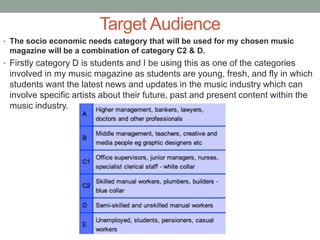
• 47. Target Audience
• 48. Target Audience
• 49. Target Audience
• 50. Target Audience (Maslow’s Hierarchy of Needs)
• 51. Target Audience (Maslow’s Hierarchy of Needs)
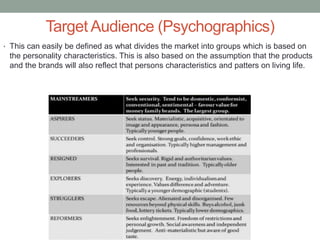
• 52. Target Audience (Psychographics)
• 53. Target Audience (Psychographics)
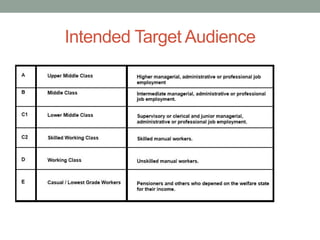
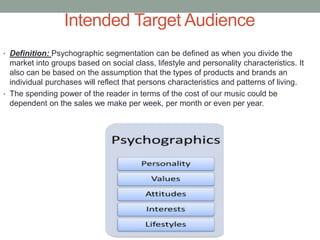
• 54. Intended Target Audience
Contents Page
• 55. Intended Target Audience
• 56. Digital Distribution of Clash Magazine
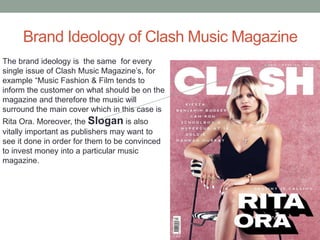
• 57. Brand Ideology of Clash Music Magazine
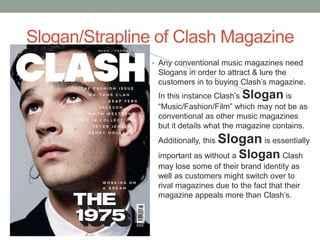
• 58. Slogan/Strapline of Clash Magazine
• 59. Slogan/Strapline of Clash Magazine
• 60. Conclusion
Clash Magazine
• Source: http://www.scottishmusiccentre.com/news/1055/
• Clash magazine is normally known as a popular music an fashion magazine which is
published by Music Republic Ltd. in the UK.
• Clash magazine’s content changes at a regular basis between modern bands such as
The horrors, Florence and the Machine as well as the mix of hip hop artists such as
Kanye West & The Beastie Boys who have all recently had main front cover issues on
this particular magazine.
• Frequency: The music magazine of my inspiration is Clash Magazine which is
published once a week and the reason for this will be to keep Clash’s customers up to
date with the world of music and this is done through the form of their magazine
content. In addition to this, Clash publishes once a week as it is a constant regular
basis which would attract a particular demographic. My magazine of inspiration will be
successful with this type of frequency as music customers want regular content and
Clash offer this service as they publish their magazine weekly instead of something
such as monthly.
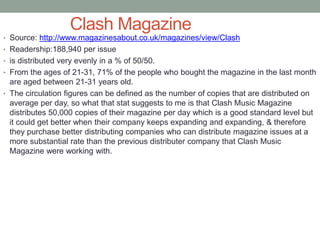
Clash Magazine
• Source: http://www.magazinesabout.co.uk/magazines/view/Clash
• Readership:188,940 per issue
• is distributed very evenly in a % of 50/50.
• From the ages of 21-31, 71% of the people who bought the magazine in the last month
are aged between 21-31 years old.
• The circulation figures can be defined as the number of copies that are distributed on
average per day, so what that stat suggests to me is that Clash Music Magazine
distributes 50,000 copies of their magazine per day which is a good standard level but
it could get better when their company keeps expanding and expanding, & therefore
they purchase better distributing companies who can distribute magazine issues at a
more substantial rate than the previous distributer company that Clash Music
Magazine were working with.
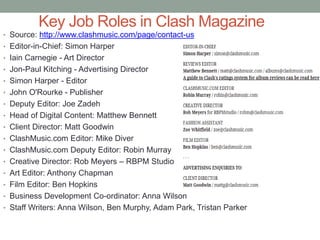
Key Job Roles in Clash Magazine
• Source: http://www.clashmusic.com/page/contact-us
• Editor-in-Chief: Simon Harper
• Iain Carnegie - Art Director
• Jon-Paul Kitching - Advertising Director
• Simon Harper - Editor
• John O'Rourke - Publisher
• Deputy Editor: Joe Zadeh
• Head of Digital Content: Matthew Bennett
• Client Director: Matt Goodwin
• ClashMusic.com Editor: Mike Diver
• ClashMusic.com Deputy Editor: Robin Murray
• Creative Director: Rob Meyers – RBPM Studio
• Art Editor: Anthony Chapman
• Film Editor: Ben Hopkins
• Business Development Co-ordinator: Anna Wilson
• Staff Writers: Anna Wilson, Ben Murphy, Adam Park, Tristan Parker
3 Important Job Roles ( Clash Magazine)
Source: http://uk.linkedin.com/company/clash-music-group?trk=ppro_cprof
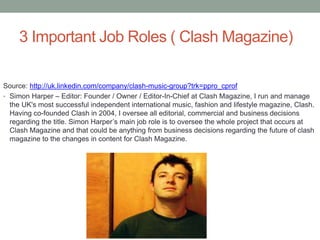
• Simon Harper – Editor: Founder / Owner / Editor-In-Chief at Clash Magazine, I run and manage
the UK's most successful independent international music, fashion and lifestyle magazine, Clash.
Having co-founded Clash in 2004, I oversee all editorial, commercial and business decisions
regarding the title. Simon Harper’s main job role is to oversee the whole project that occurs at
Clash Magazine and that could be anything from business decisions regarding the future of clash
magazine to the changes in content for Clash Magazine.
3 Important Job Roles ( Clash
Magazine)• http://uk.linkedin.com/company/clash-music-group?trk=ppro_cprof
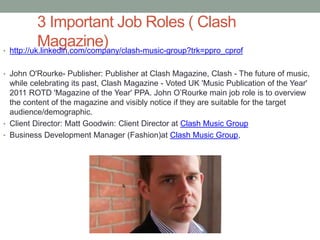
• John O'Rourke- Publisher: Publisher at Clash Magazine, Clash - The future of music,
while celebrating its past, Clash Magazine - Voted UK 'Music Publication of the Year'
2011 ROTD 'Magazine of the Year' PPA. John O’Rourke main job role is to overview
the content of the magazine and visibly notice if they are suitable for the target
audience/demographic.
• Client Director: Matt Goodwin: Client Director at Clash Music Group
• Business Development Manager (Fashion)at Clash Music Group,
Frequency of Clash Music Magazine
• Clash Music Magazine is published and printed once a month for the customers to buy
and therefore there prices are at a more substantial rate than other music magazines
who may publish and print their magazines on a weekly basis. Clash Music Magazine
have tended to go for the monthly option as it may deceive the fans on what kind of
content might come up on this months compared to different months and therefore lure
the customers in with teasers and trailers.
• Some Music Magazines are published once a week and the reason for this will be to
keep the customers of my magazine content with my magazine which gives them the
latest ins and outs of the music industry for example: gossip, interviews, festival dates.
In addition to this, I am publishing my magazine once a week as it is a constant regular
basis which will help potential customers to be lured to my magazine if they want
regular content which gives you standard updates on the music industry.
Circulation Figures
• Source: http://www.magazinesabout.co.uk/magazines/view/Clash
• Readership:188,940 per issue
• Circulation:50,000 per issue
• The gender of buys from male to female is distributed very evenly in a
% of 50/50.
• From the ages of 21-31, 71% of the people who bought the magazine
in the last month are aged between 21-31 years old.
• The circulation figures can be defined as the number of copies that
are distributed on average per day, so what that stat suggests to me is
that Clash Music Magazine distributes 50,000 copies of their
magazine per day which is a good standard level but it could get
better when their company keeps expanding and expanding, &
therefore they purchase better distributing companies who can
distribute magazine issues at a more substantial rate than the
previous distributer company that Clash Music Magazine were working
with.
Subscription Figures
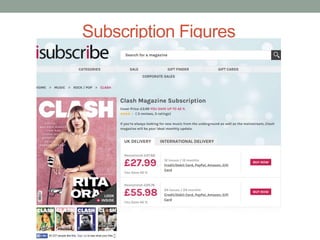
• Clash Music Magazine offer two types of subscriptions, one of these subscriptions is
based over a 12 month in which you get an issue per month and this deal s priced at
£27.99.
• The second offer that is available to the local customer is a 2 year service in which you
get 24 issues over two years so you get 24 issues spread over two years & this would
cost you £55.98 which may seem a lot of money but the value for product may be
satisfactory or even very good to the local customer.
• In conclusion to this, I think that both of these offers are very achievable in relation to
the target audience & demographic so that they can buy this music magazine and
have this subscription for either 1 year or two years.
Production Process
• Clash would need to create a detailed plan for each story that they are planning to
publish and print, therefore Clash would need to seriously consider the content of a
story to check if it matches the target audience in hand. Additionally, aspects of the
music magazine for Clash would also need to be considered before publishing &
printing articles, interviews, news stories which would need to be considered to make
sure that they are fit for purpose in reference to the target audience. Furthermore, the
mock-ups is one of the most easiest processes within this actual process as Clash
would need to communicate well with the author to both be on the same page with the
quality of the design, the last part of this aspect of this production process bit part is
that the authors need to correctly select which author is the best fit for purpose & once
this is done, deadlines can be submitted.
• Next, Clash would need to proof read their stories to see if they are breaking any
ethical & legal codes with the content that they are submitting along with any spelling
errors which really should not be occurring at this level in the music magazine industry.
Production Process
• The last stages include checking to see if there are any grammatical errors and this
could be anything from punctuation to actual word spelling or just words in a sentence
which just don’t make any sense at all. Furthermore, once all of this completed the
distribution technically starts from Clash sending the prints to the warehouse in which
the warehouse take part in the main distribution and then sell to the public.
Production Process
• Source: http://contentmarketinginstitute.com/2011/08/6-steps-for-producing-a-custom-
magazine/
• Prior to the production and the printing of Clash’s Music Magazine, Clash would need
to create a production schedule in order to help to oversee the production in the time
slot available. Additionally deadlines need to be punctual in the sense that Clash must
be reliable with the deadlines so that Clash get the story submitted to the editors on
time, this is important for Clash to be punctual in order for our reputation to stay
intact.
• Conventionally, a content plan needs to be created which Clash should illustrate all of
the pages within a music magazine such as Clash’s for example the front covers and
double page spreads will be within the content plan along with the advertising spaces
& posters. Therefore, this plan would need to be confirmed by all of the team involved
in the content of Clash’s Music Magazine .
Clash Magazine
• Source: http://81.138.142.186/wp-content/uploads/2014/02/Clashmusicip.pdf
• Clash Music Magazine is a media group which consists of delivering music magazine
towards their fans and 2004 was the year that Clash were voted for an award as a
result for their large following and growing positive reputation. Clash Music Magazine
is one of the leading music magazine within the UK.
Dimensions & Size of a Music Magazine
(Form & Style)
• Source:
http://momentumpress.com/sccc/LD/Resources/MagazinePageSize.pdf
• There are two sizes which are the known as the dimensions and size of a
music magazine and these are known as the “Standard Size” & the “Digest
Size”, the standard size is 8 3/8 X 10 7/8 . Additionally magazines sizes often
vary from the two standard sizes as over sized as well as undersized
magazines can be produced and their cost per square inch is always at a
higher rate.
• As a result of the mini research I have carried out in order to find out all of the
possible print sizes & dimensions along with this music magazine, we have
decided to use the standard size which is recommended by most music
magazines in order for our magazine to look more conventional and buyable
for the average consumer.
Style
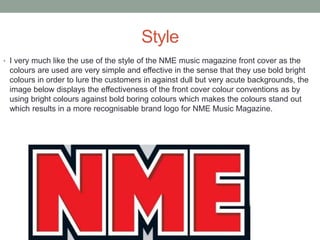
• I very much like the use of the style of the NME music magazine front cover as the
colours are used are very simple and effective in the sense that they use bold bright
colours in order to lure the customers in against dull but very acute backgrounds, the
image below displays the effectiveness of the front cover colour conventions as by
using bright colours against bold boring colours which makes the colours stand out
which results in a more recognisable brand logo for NME Music Magazine.
Layout
• The layout of the front cover and double page spread will be very much similar to my music
magazine front cover and double page spread in the sense that in the majority of the front cover
and double page spreads, there are slogans which seem to sum up the articles of this particular's
artists future in the music industry.
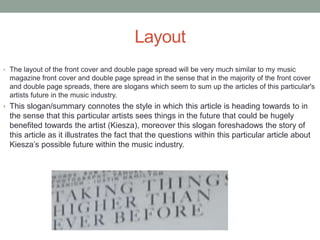
• This slogan/summary connotes the style in which this article is heading towards to in
the sense that this particular artists sees things in the future that could be hugely
benefited towards the artist (Kiesza), moreover this slogan foreshadows the story of
this article as it illustrates the fact that the questions within this particular article about
Kiesza’s possible future within the music industry.
Style
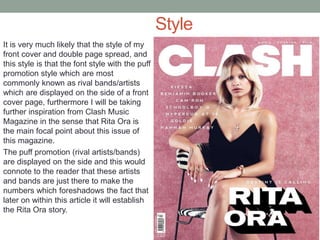
It is very much likely that the style of my
front cover and double page spread, and
this style is that the font style with the puff
promotion style which are most
commonly known as rival bands/artists
which are displayed on the side of a front
cover page, furthermore I will be taking
further inspiration from Clash Music
Magazine in the sense that Rita Ora is
the main focal point about this issue of
this magazine.
The puff promotion (rival artists/bands)
are displayed on the side and this would
connote to the reader that these artists
and bands are just there to make the
numbers which foreshadows the fact that
later on within this article it will establish
the Rita Ora story.
Age & Gender
• This music magazine which was inspired from NME music magazine
suggests to the reader that the main ethnicity group that are recommended
to read my indie style music magazine will be the white ethnicity group as
this music magazine is indie genre based which normally appeals to the
mass group of white skin population.
• The image I will be trying to accomplish with my second choice genre based
indie style magazine is a music magazine which will either recap the latest
news for example gossip, tour and festival dates of popular artists and to
introduce new and upcoming bands to indie genre based fans.
Age & Gender
• Ethnicity will play an integral part within this music magazine as all races are open to
read this music magazine in the sense that some magazines have genres that make in
unlikely for some ethnicity groups to not read their magazine, in contrast to my
magazine there are artists for all of the ethnicity groups an example of this is hip hop
for African American & pop for White ethnicity based people.
• The way I see my magazine is a way that it will appeal to the customers/demographics
as my music magazine is entitle to everyone who enjoys listening to music and also
enjoys the information, updates, ingoing’s, outgoing’s within the music industry.
Furthermore the self image I am trying to promote towards my
customers/members/demographic is a weekly music magazine which entails the latest
news with the artists which can include gossip, tour and festival dates and this is what I
am trying to accomplish with my Music Magazine.
Age & Gender
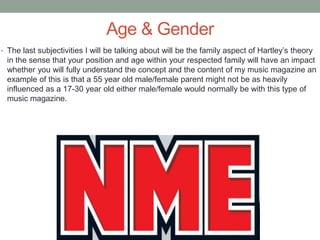
• The last subjectivities I will be talking about will be the family aspect of Hartley’s theory
in the sense that your position and age within your respected family will have an impact
whether you will fully understand the concept and the content of my music magazine an
example of this is that a 55 year old male/female parent might not be as heavily
influenced as a 17-30 year old either male/female would normally be with this type of
music magazine.
Age & Gender
• The place of the family you are positioned in is a very integral part in the customer’s
willingness to purchase a copy of my Music Magazine as the content of my Music
Magazine is dependent on the position member of the family, an example of this would
be if a member of the family is aged from 13-19, and is in my category in terms of the
audience target age range, then the Music Magazine would be more than suitable for
them rather than a family member who is more senior such as a mother/father would
not be very suited to my Music Magazine as the content would not be correct for them.
Front Cover Analysis
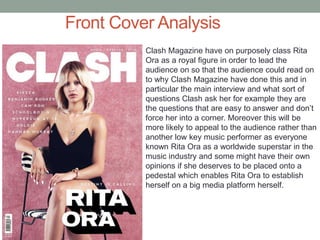
Clash Magazine have on purposely class Rita
Ora as a royal figure in order to lead the
audience on so that the audience could read on
to why Clash Magazine have done this and in
particular the main interview and what sort of
questions Clash ask her for example they are
the questions that are easy to answer and don’t
force her into a corner. Moreover this will be
more likely to appeal to the audience rather than
another low key music performer as everyone
known Rita Ora as a worldwide superstar in the
music industry and some might have their own
opinions if she deserves to be placed onto a
pedestal which enables Rita Ora to establish
herself on a big media platform herself.
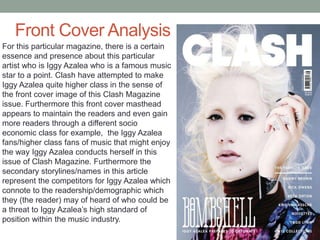
Front Cover Analysis
For this particular magazine, there is a certain
essence and presence about this particular
artist who is Iggy Azalea who is a famous music
star to a point. Clash have attempted to make
Iggy Azalea quite higher class in the sense of
the front cover image of this Clash Magazine
issue. Furthermore this front cover masthead
appears to maintain the readers and even gain
more readers through a different socio
economic class for example, the Iggy Azalea
fans/higher class fans of music that might enjoy
the way Iggy Azalea conducts herself in this
issue of Clash Magazine. Furthermore the
secondary storylines/names in this article
represent the competitors for Iggy Azalea which
connote to the readership/demographic which
they (the reader) may of heard of who could be
a threat to Iggy Azalea’s high standard of
position within the music industry.
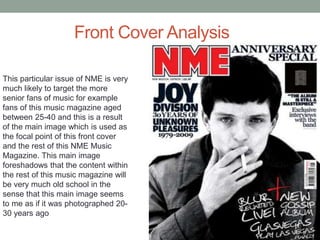
Front Cover Analysis
This particular issue of NME is very
much likely to target the more
senior fans of music for example
fans of this music magazine aged
between 25-40 and this is a result
of the main image which is used as
the focal point of this front cover
and the rest of this NME Music
Magazine. This main image
foreshadows that the content within
the rest of this music magazine will
be very much old school in the
sense that this main image seems
to me as if it was photographed 20-
30 years ago
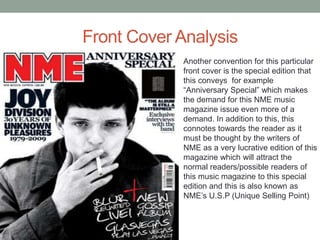
Front Cover Analysis
Another convention for this particular
front cover is the special edition that
this conveys for example
“Anniversary Special” which makes
the demand for this NME music
magazine issue even more of a
demand. In addition to this, this
connotes towards the reader as it
must be thought by the writers of
NME as a very lucrative edition of this
magazine which will attract the
normal readers/possible readers of
this music magazine to this special
edition and this is also known as
NME’s U.S.P (Unique Selling Point)
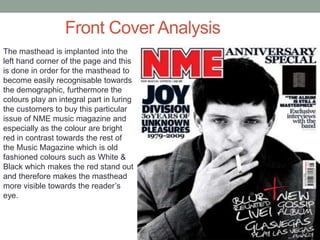
Front Cover Analysis
The masthead is implanted into the
left hand corner of the page and this
is done in order for the masthead to
become easily recognisable towards
the demographic, furthermore the
colours play an integral part in luring
the customers to buy this particular
issue of NME music magazine and
especially as the colour are bright
red in contrast towards the rest of
the Music Magazine which is old
fashioned colours such as White &
Black which makes the red stand out
and therefore makes the masthead
more visible towards the reader’s
eye.
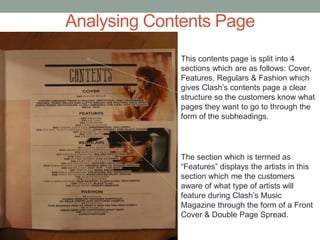
Analysing Contents Page
This contents page is split into 4
sections which are as follows: Cover,
Features, Regulars & Fashion which
gives Clash’s contents page a clear
structure so the customers know what
pages they want to go to through the
form of the subheadings.
The section which is termed as
“Features” displays the artists in this
section which me the customers
aware of what type of artists will
feature during Clash’s Music
Magazine through the form of a Front
Cover & Double Page Spread.
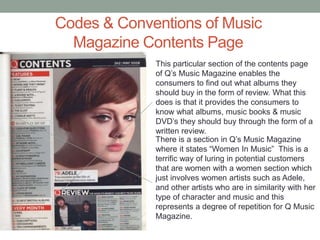
Codes & Conventions of Music
Magazine Contents Page
This particular section of the contents page
of Q’s Music Magazine enables the
consumers to find out what albums they
should buy in the form of review. What this
does is that it provides the consumers to
know what albums, music books & music
DVD’s they should buy through the form of a
written review.
There is a section in Q’s Music Magazine
where it states “Women In Music” This is a
terrific way of luring in potential customers
that are women with a women section which
just involves women artists such as Adele,
and other artists who are in similarity with her
type of character and music and this
represents a degree of repetition for Q Music
Magazine.
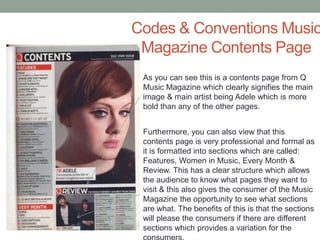
Codes & Conventions Music
Magazine Contents Page
As you can see this is a contents page from Q
Music Magazine which clearly signifies the main
image & main artist being Adele which is more
bold than any of the other pages.
Furthermore, you can also view that this
contents page is very professional and formal as
it is formatted into sections which are called:
Features, Women in Music, Every Month &
Review. This has a clear structure which allows
the audience to know what pages they want to
visit & this also gives the consumer of the Music
Magazine the opportunity to see what sections
are what. The benefits of this is that the sections
will please the consumers if there are different
sections which provides a variation for the
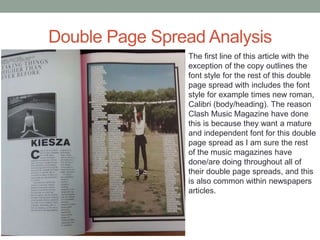
Double Page Spread Analysis
The first line of this article with the
exception of the copy outlines the
font style for the rest of this double
page spread with includes the font
style for example times new roman,
Calibri (body/heading). The reason
Clash Music Magazine have done
this is because they want a mature
and independent font for this double
page spread as I am sure the rest
of the music magazines have
done/are doing throughout all of
their double page spreads, and this
is also common within newspapers
articles.
Double Page Spread Analysis
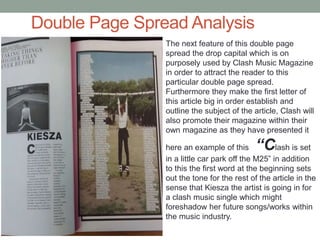
The next feature of this double page
spread the drop capital which is on
purposely used by Clash Music Magazine
in order to attract the reader to this
particular double page spread.
Furthermore they make the first letter of
this article big in order establish and
outline the subject of the article, Clash will
also promote their magazine within their
own magazine as they have presented it
here an example of this “Clash is set
in a little car park off the M25” in addition
to this the first word at the beginning sets
out the tone for the rest of the article in the
sense that Kiesza the artist is going in for
a clash music single which might
foreshadow her future songs/works within
the music industry.
Double Page Spread Analysis
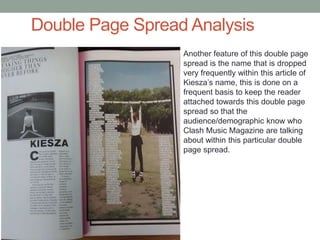
Another feature of this double page
spread is the name that is dropped
very frequently within this article of
Kiesza’s name, this is done on a
frequent basis to keep the reader
attached towards this double page
spread so that the
audience/demographic know who
Clash Music Magazine are talking
about within this particular double
page spread.
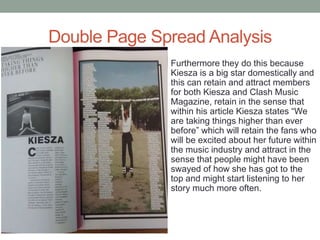
Double Page Spread Analysis
Furthermore they do this because
Kiesza is a big star domestically and
this can retain and attract members
for both Kiesza and Clash Music
Magazine, retain in the sense that
within his article Kiesza states “We
are taking things higher than ever
before” which will retain the fans who
will be excited about her future within
the music industry and attract in the
sense that people might have been
swayed of how she has got to the
top and might start listening to her
story much more often.
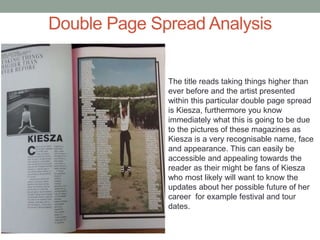
Double Page Spread Analysis
The title reads taking things higher than
ever before and the artist presented
within this particular double page spread
is Kiesza, furthermore you know
immediately what this is going to be due
to the pictures of these magazines as
Kiesza is a very recognisable name, face
and appearance. This can easily be
accessible and appealing towards the
reader as their might be fans of Kiesza
who most likely will want to know the
updates about her possible future of her
career for example festival and tour
dates.
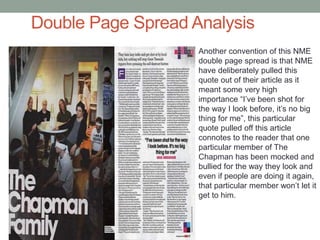
Double Page Spread Analysis
Another convention of this NME
double page spread is that NME
have deliberately pulled this
quote out of their article as it
meant some very high
importance “I’ve been shot for
the way I look before, it’s no big
thing for me”, this particular
quote pulled off this article
connotes to the reader that one
particular member of The
Chapman has been mocked and
bullied for the way they look and
even if people are doing it again,
that particular member won’t let it
get to him.
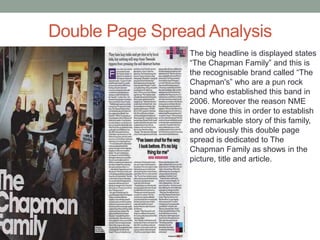
Double Page Spread Analysis
The big headline is displayed states
“The Chapman Family” and this is
the recognisable brand called “The
Chapman's” who are a pun rock
band who established this band in
2006. Moreover the reason NME
have done this in order to establish
the remarkable story of this family,
and obviously this double page
spread is dedicated to The
Chapman Family as shows in the
picture, title and article.
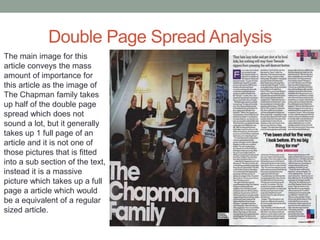
Double Page Spread Analysis
The main image for this
article conveys the mass
amount of importance for
this article as the image of
The Chapman family takes
up half of the double page
spread which does not
sound a lot, but it generally
takes up 1 full page of an
article and it is not one of
those pictures that is fitted
into a sub section of the text,
instead it is a massive
picture which takes up a full
page a article which would
be a equivalent of a regular
sized article.
Promotion of The Magazine
There are a variety of ways and formats to promote
any type of music magazine, however social media
promotion is known as one of the most conventional
methods of promotion and has proven to be one of
the most efficient as social media promotion reaches
out to people who may not of heard of our music
magazine. By doing this, we gain more readership
figures from our music magazine which enhances
our customer sales. Additionally, promotion for a
music magazine is key to the success of any music
magazine as if there is no type of promotion with a
music magazine, then it is likely that there will be
very little customer sales as with no promotion there
will be no interest in the music magazine as
customers may go to one of their competitors.
Repetition & Difference (Genre)
• In relation to Steve Neale’s theory of Repetition & Difference, music magazines
readers will understand the later content of the music magazine once they understand
the codes, conventions and features of our music magazine. Within our music
magazine “Clash” we plan to make sure our viewers will know the content that we
will be delivering on a constant weekly basis that they will start to familiarise
themselves with and this done through the form of Repetition.
• This theory is yet again relevant and can be related to our magazines of inspirations,
for example “Smash Hits & Clash Music Magazine” are two magazines which we deem
as magazines of inspirations and their content is repetitive which even further backs up
Steve Neale’s theory about Repetition & Difference in relevance to the genre of our
magazines along with our chosen inspirations.
Target Audience
• Clash magazine is aimed at 18-25 year olds who seem to be classed as the download
generation, furthermore the demographic that reads this magazine are people that are
into bands such as Jay-Z, Kanye West & Coldplay and this also attracts people who
have a further addition in fashion and film.
• Clash magazine’s demographic is for people that want quick and fast information
about the upcoming music festivals, and not only this but also fashion and films and
what music has been formatted into films and fashion shows. Moreover the readers of
clash magazine will want weekly/monthly information on the latest updates on what
music artists such as Jay Z & Kanye West might be working on e.g. a collaboration
and this can be presented through a duo interview with them two rap icons.
Target Audience
• One of the components of Hartley's 7 subjectivities is age and this links into clash
magazine as in one of my previous slides, I state that from the ages of 28-25 years
old, there is an astounding 71% of people who buy the magazine are aged from 18-25
years old which just signifies what demographic this magazine has successfully
targeted at their chosen demographic (18-25 years old).
• A couple of the components of Katz Uses & Gratifications are Escapism, Inform &
Educate, additionally the male and female demographic have the opportunity to
escape from the stress of exams. Furthermore Clash as a music magazine may
inform the consumers about particular artists who are destined for success in future.
Target Audience
• The socio economic needs category that will be used for my chosen music
magazine will be a combination of category C2 & D.
• Firstly category D is students and I be using this as one of the categories
involved in my music magazine as students are young, fresh, and fly in which
students want the latest news and updates in the music industry which can
involve specific artists about their future, past and present content within the
music industry.
Target Audience
• Next, I have also chosen C2 to go with this as I feel that the student category
is too minor and too dangerous in terms of number of students buying my
magazine in order for my own personal music magazine to be successful, so
in general I cannot be too dependant on the students category and therefore I
need to chose another category and as a result of this skilled full time workers
would be the second choice to make the combination of the two socio
economic needs in order for the chance of success of my magazine to be at a
higher chance with one of these two groups very likely to be appealed and
intrigued to my music magazine.
• The main reason why I have chosen these two socio economic needs for my
music magazine (C2 & D) as the D socio economic needs are normally
defined as working class students who would genuinely take an interest in
music to the point where D level socio economic needs people would buy
music magazines as a result of their music interests.
Target Audience (Maslow’s
Hierarchy of Needs)
• Source: http://www.smashingmagazine.com/2010/04/26/designing-for-a-hierarchy-of-
needs/
• Maslow’s Hierarchy of needs is a theory which suggests that there are 5 stages people
go through in life & the theory states that each stage we have different motivation that
drives us through. If we then apply these stages to media, we can then use them to try
and understand the motivations behind our target audience.
• (Functional.) In relation to Clash Music Magazine, the target audience must be able to
work before anything else so that your target audience needs to be realistic in terms of
matching your content.
• (Reliability) Now that Clash Music Magazine have established themselves as they
have been around for around a decade now, they must be reliable with their target
audience and their content in the sense that they can’t chop and chance whenever
they like, they could in the short term i.e. 6-12 months but they must plan this out and
make sure the new target audience and new content will work together agreeably.
Target Audience (Maslow’s
Hierarchy of Needs)
• Source: http://www.smashingmagazine.com/2010/04/26/designing-for-
a-hierarchy-of-needs/
• (Usability) The usability of Clash’s Music Magazine regardless the
issue is easy, it is not dependable on the creators and editors of their
music magazine as it is not very difficult to navigate your way through
a music magazine to find the pages that you want to. For example the
contents page is a fantastic example on to guide the reader on what
pages they want to specifically read about.
• (Profitability) Clash’s Music Magazine enables the readers of the
music magazine to not only allow them to read it but also find out
information about upcoming issues of Clash’s Music Magazine &
artists who could potentially feature on the front cover and double
page spread of those upcoming issues.
Target Audience (Psychographics)
• This can easily be defined as what divides the market into groups which is based on
the personality characteristics. This is also based on the assumption that the products
and the brands will also reflect that persons characteristics and patters on living life.
Target Audience (Psychographics)
• Source: http://www.magazine.org/psychographic-profile-magazine-audiences-
investigation-medias-climate
• Clash’s Music Magazine’s target audience in reference to the Psychographics will
mainly have interests hobbies and beliefs that most people within the pop genre for
psychographics would normally have. Additionally, the normal interests that the
average person who would read Clash Music Magazine would be someone who is
particularly interested in popular fashion which includes: clothes, make up &
accessories.
• Moreover the main hobbies that someone who would read Clash Music Magazine
would be Sports, Clothing, Photography & Fashion, also the main readership are
people who believe that you should look up to somebody else having a role mode and
that everything in existence resolves around their personal status.
Intended Target Audience
• Definition: Psychographic segmentation can be defined as when you divide the
market into groups based on social class, lifestyle and personality characteristics. It
also can be based on the assumption that the types of products and brands an
individual purchases will reflect that persons characteristics and patterns of living.
• The spending power of the reader in terms of the cost of our music could be
dependent on the sales we make per week, per month or even per year.
Digital Distribution of Clash Music
Magazine
• Digital Distribution could potentially be vitally important for Clash as a
“company” as it reduces the cost of printing as no materials are used so the
printing costs would therefore be much less.
• Additionally, this allows for a higher income for Clash Music Magazine which
then enables the readership to expand more which can be accessed
throughout a variety of digital media methods such as phones, laptops, I Pads
which yet again enables Clash Music Magazine to receive a higher income
with a reduced distribution cost.
Brand Ideology of Clash Music Magazine
The brand ideology is the same for every
single issue of Clash Music Magazine’s, for
example “Music Fashion & Film tends to
inform the customer on what should be on the
magazine and therefore the music will
surround the main cover which in this case is
Rita Ora. Moreover, the Slogan is also
vitally important as publishers may want to
see it done in order for them to be convinced
to invest money into a particular music
magazine.
Slogan/Strapline of Clash Magazine
• Any conventional music magazines need
Slogans in order to attract & lure the
customers in to buying Clash’s magazine.
In this instance Clash’s Slogan is
“Music/Fashion/Film” which may not be as
conventional as other music magazines
but it details what the magazine contains.
Additionally, this Slogan is essentially
important as without a Slogan Clash
may lose some of their brand identity as
well as customers might switch over to
rival magazines due to the fact that their
magazine appeals more than Clash’s.
Slogan/Strapline of Clash Magazine
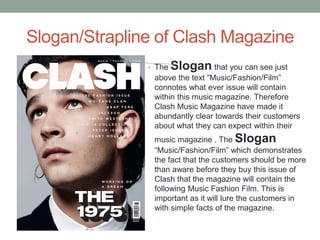
• The Slogan that you can see just
above the text “Music/Fashion/Film”
connotes what ever issue will contain
within this music magazine. Therefore
Clash Music Magazine have made it
abundantly clear towards their customers
about what they can expect within their
music magazine . The Slogan
“Music/Fashion/Film” which demonstrates
the fact that the customers should be more
than aware before they buy this issue of
Clash that the magazine will contain the
following Music Fashion Film. This is
important as it will lure the customers in
with simple facts of the magazine.
Conclusion of LO1
• Within this certain document, I have learnt about circulation figures and how
they can impact a music magazine in terms of how they can adapt their music
magazines to retain their market position and this is dependable on the
circulation figures which will impact the actual production of any music
magazine & brand ideology.

Unit 13 LO1

  • 1.
    UNIT 13 LO1 GUSDEVLIN CANDIDATE NUMBER:4032 CENTRE NUMBER:64135
  • 2.
    Contents Page • 7.Clash Magazine • 8. Clash Magazine • 9. Key Job Roles in Clash Magazine • 10. 3 Important Job Roles in Clash Magazine • 11. 3 Important Job Roles (Clash Magazine) • 12. Frequency of Clash Magazine • 13. Circulation Figures • 14. Subscription Figures • 15. Subscription Figures • 16. Production Process • 17. Production Process • 18. Production Process
  • 3.
    Contents Page • 19.Clash Magazine • 20. Dimensions & Size of Music Magazine (Form & Style) • 21. Style • 22. Layout • 23. Style • 24. Age & Gender • 25. Age & Gender • 26. Age & Gender • 27. Age & Gender • 28. Front Cover Analysis • 29. Front Cover Analysis • 30. Front Cover Analysis
  • 4.
    Contents Page • 31.Front Cover Analysis • 32. Front Cover Analysis • 33. Analysing Contents Page • 34. Codes & Conventions of Music Magazine • 35. Codes & Conventions of Music Magazine • 36. Double Page Spread Analysis • 37. Double Page Spread Analysis • 38. Double Page Spread Analysis • 39. Double Page Spread Analysis • 40. Double Page Spread Analysis • 41. Double Page Spread Analysis • 42. Double Page Spread Analysis
  • 5.
    Contents Page • 43.Double Page Spread Analysis • 44. Promotion of the Magazine • 45. Repetition & Difference (Genre) • 46. Target Audience • 47. Target Audience • 48. Target Audience • 49. Target Audience • 50. Target Audience (Maslow’s Hierarchy of Needs) • 51. Target Audience (Maslow’s Hierarchy of Needs) • 52. Target Audience (Psychographics) • 53. Target Audience (Psychographics) • 54. Intended Target Audience
  • 6.
    Contents Page • 55.Intended Target Audience • 56. Digital Distribution of Clash Magazine • 57. Brand Ideology of Clash Music Magazine • 58. Slogan/Strapline of Clash Magazine • 59. Slogan/Strapline of Clash Magazine • 60. Conclusion
  • 7.
    Clash Magazine • Source:http://www.scottishmusiccentre.com/news/1055/ • Clash magazine is normally known as a popular music an fashion magazine which is published by Music Republic Ltd. in the UK. • Clash magazine’s content changes at a regular basis between modern bands such as The horrors, Florence and the Machine as well as the mix of hip hop artists such as Kanye West & The Beastie Boys who have all recently had main front cover issues on this particular magazine. • Frequency: The music magazine of my inspiration is Clash Magazine which is published once a week and the reason for this will be to keep Clash’s customers up to date with the world of music and this is done through the form of their magazine content. In addition to this, Clash publishes once a week as it is a constant regular basis which would attract a particular demographic. My magazine of inspiration will be successful with this type of frequency as music customers want regular content and Clash offer this service as they publish their magazine weekly instead of something such as monthly.
  • 8.
    Clash Magazine • Source:http://www.magazinesabout.co.uk/magazines/view/Clash • Readership:188,940 per issue • is distributed very evenly in a % of 50/50. • From the ages of 21-31, 71% of the people who bought the magazine in the last month are aged between 21-31 years old. • The circulation figures can be defined as the number of copies that are distributed on average per day, so what that stat suggests to me is that Clash Music Magazine distributes 50,000 copies of their magazine per day which is a good standard level but it could get better when their company keeps expanding and expanding, & therefore they purchase better distributing companies who can distribute magazine issues at a more substantial rate than the previous distributer company that Clash Music Magazine were working with.
  • 9.
    Key Job Rolesin Clash Magazine • Source: http://www.clashmusic.com/page/contact-us • Editor-in-Chief: Simon Harper • Iain Carnegie - Art Director • Jon-Paul Kitching - Advertising Director • Simon Harper - Editor • John O'Rourke - Publisher • Deputy Editor: Joe Zadeh • Head of Digital Content: Matthew Bennett • Client Director: Matt Goodwin • ClashMusic.com Editor: Mike Diver • ClashMusic.com Deputy Editor: Robin Murray • Creative Director: Rob Meyers – RBPM Studio • Art Editor: Anthony Chapman • Film Editor: Ben Hopkins • Business Development Co-ordinator: Anna Wilson • Staff Writers: Anna Wilson, Ben Murphy, Adam Park, Tristan Parker
  • 10.
    3 Important JobRoles ( Clash Magazine) Source: http://uk.linkedin.com/company/clash-music-group?trk=ppro_cprof • Simon Harper – Editor: Founder / Owner / Editor-In-Chief at Clash Magazine, I run and manage the UK's most successful independent international music, fashion and lifestyle magazine, Clash. Having co-founded Clash in 2004, I oversee all editorial, commercial and business decisions regarding the title. Simon Harper’s main job role is to oversee the whole project that occurs at Clash Magazine and that could be anything from business decisions regarding the future of clash magazine to the changes in content for Clash Magazine.
  • 11.
    3 Important JobRoles ( Clash Magazine)• http://uk.linkedin.com/company/clash-music-group?trk=ppro_cprof • John O'Rourke- Publisher: Publisher at Clash Magazine, Clash - The future of music, while celebrating its past, Clash Magazine - Voted UK 'Music Publication of the Year' 2011 ROTD 'Magazine of the Year' PPA. John O’Rourke main job role is to overview the content of the magazine and visibly notice if they are suitable for the target audience/demographic. • Client Director: Matt Goodwin: Client Director at Clash Music Group • Business Development Manager (Fashion)at Clash Music Group,
  • 12.
    Frequency of ClashMusic Magazine • Clash Music Magazine is published and printed once a month for the customers to buy and therefore there prices are at a more substantial rate than other music magazines who may publish and print their magazines on a weekly basis. Clash Music Magazine have tended to go for the monthly option as it may deceive the fans on what kind of content might come up on this months compared to different months and therefore lure the customers in with teasers and trailers. • Some Music Magazines are published once a week and the reason for this will be to keep the customers of my magazine content with my magazine which gives them the latest ins and outs of the music industry for example: gossip, interviews, festival dates. In addition to this, I am publishing my magazine once a week as it is a constant regular basis which will help potential customers to be lured to my magazine if they want regular content which gives you standard updates on the music industry.
  • 13.
    Circulation Figures • Source:http://www.magazinesabout.co.uk/magazines/view/Clash • Readership:188,940 per issue • Circulation:50,000 per issue • The gender of buys from male to female is distributed very evenly in a % of 50/50. • From the ages of 21-31, 71% of the people who bought the magazine in the last month are aged between 21-31 years old. • The circulation figures can be defined as the number of copies that are distributed on average per day, so what that stat suggests to me is that Clash Music Magazine distributes 50,000 copies of their magazine per day which is a good standard level but it could get better when their company keeps expanding and expanding, & therefore they purchase better distributing companies who can distribute magazine issues at a more substantial rate than the previous distributer company that Clash Music Magazine were working with.
  • 14.
  • 15.
    Subscription Figures • ClashMusic Magazine offer two types of subscriptions, one of these subscriptions is based over a 12 month in which you get an issue per month and this deal s priced at £27.99. • The second offer that is available to the local customer is a 2 year service in which you get 24 issues over two years so you get 24 issues spread over two years & this would cost you £55.98 which may seem a lot of money but the value for product may be satisfactory or even very good to the local customer. • In conclusion to this, I think that both of these offers are very achievable in relation to the target audience & demographic so that they can buy this music magazine and have this subscription for either 1 year or two years.
  • 16.
    Production Process • Clashwould need to create a detailed plan for each story that they are planning to publish and print, therefore Clash would need to seriously consider the content of a story to check if it matches the target audience in hand. Additionally, aspects of the music magazine for Clash would also need to be considered before publishing & printing articles, interviews, news stories which would need to be considered to make sure that they are fit for purpose in reference to the target audience. Furthermore, the mock-ups is one of the most easiest processes within this actual process as Clash would need to communicate well with the author to both be on the same page with the quality of the design, the last part of this aspect of this production process bit part is that the authors need to correctly select which author is the best fit for purpose & once this is done, deadlines can be submitted. • Next, Clash would need to proof read their stories to see if they are breaking any ethical & legal codes with the content that they are submitting along with any spelling errors which really should not be occurring at this level in the music magazine industry.
  • 17.
    Production Process • Thelast stages include checking to see if there are any grammatical errors and this could be anything from punctuation to actual word spelling or just words in a sentence which just don’t make any sense at all. Furthermore, once all of this completed the distribution technically starts from Clash sending the prints to the warehouse in which the warehouse take part in the main distribution and then sell to the public.
  • 18.
    Production Process • Source:http://contentmarketinginstitute.com/2011/08/6-steps-for-producing-a-custom- magazine/ • Prior to the production and the printing of Clash’s Music Magazine, Clash would need to create a production schedule in order to help to oversee the production in the time slot available. Additionally deadlines need to be punctual in the sense that Clash must be reliable with the deadlines so that Clash get the story submitted to the editors on time, this is important for Clash to be punctual in order for our reputation to stay intact. • Conventionally, a content plan needs to be created which Clash should illustrate all of the pages within a music magazine such as Clash’s for example the front covers and double page spreads will be within the content plan along with the advertising spaces & posters. Therefore, this plan would need to be confirmed by all of the team involved in the content of Clash’s Music Magazine .
  • 19.
    Clash Magazine • Source:http://81.138.142.186/wp-content/uploads/2014/02/Clashmusicip.pdf • Clash Music Magazine is a media group which consists of delivering music magazine towards their fans and 2004 was the year that Clash were voted for an award as a result for their large following and growing positive reputation. Clash Music Magazine is one of the leading music magazine within the UK.
  • 20.
    Dimensions & Sizeof a Music Magazine (Form & Style) • Source: http://momentumpress.com/sccc/LD/Resources/MagazinePageSize.pdf • There are two sizes which are the known as the dimensions and size of a music magazine and these are known as the “Standard Size” & the “Digest Size”, the standard size is 8 3/8 X 10 7/8 . Additionally magazines sizes often vary from the two standard sizes as over sized as well as undersized magazines can be produced and their cost per square inch is always at a higher rate. • As a result of the mini research I have carried out in order to find out all of the possible print sizes & dimensions along with this music magazine, we have decided to use the standard size which is recommended by most music magazines in order for our magazine to look more conventional and buyable for the average consumer.
  • 21.
    Style • I verymuch like the use of the style of the NME music magazine front cover as the colours are used are very simple and effective in the sense that they use bold bright colours in order to lure the customers in against dull but very acute backgrounds, the image below displays the effectiveness of the front cover colour conventions as by using bright colours against bold boring colours which makes the colours stand out which results in a more recognisable brand logo for NME Music Magazine.
  • 22.
    Layout • The layoutof the front cover and double page spread will be very much similar to my music magazine front cover and double page spread in the sense that in the majority of the front cover and double page spreads, there are slogans which seem to sum up the articles of this particular's artists future in the music industry. • This slogan/summary connotes the style in which this article is heading towards to in the sense that this particular artists sees things in the future that could be hugely benefited towards the artist (Kiesza), moreover this slogan foreshadows the story of this article as it illustrates the fact that the questions within this particular article about Kiesza’s possible future within the music industry.
  • 23.
    Style It is verymuch likely that the style of my front cover and double page spread, and this style is that the font style with the puff promotion style which are most commonly known as rival bands/artists which are displayed on the side of a front cover page, furthermore I will be taking further inspiration from Clash Music Magazine in the sense that Rita Ora is the main focal point about this issue of this magazine. The puff promotion (rival artists/bands) are displayed on the side and this would connote to the reader that these artists and bands are just there to make the numbers which foreshadows the fact that later on within this article it will establish the Rita Ora story.
  • 24.
    Age & Gender •This music magazine which was inspired from NME music magazine suggests to the reader that the main ethnicity group that are recommended to read my indie style music magazine will be the white ethnicity group as this music magazine is indie genre based which normally appeals to the mass group of white skin population. • The image I will be trying to accomplish with my second choice genre based indie style magazine is a music magazine which will either recap the latest news for example gossip, tour and festival dates of popular artists and to introduce new and upcoming bands to indie genre based fans.
  • 25.
    Age & Gender •Ethnicity will play an integral part within this music magazine as all races are open to read this music magazine in the sense that some magazines have genres that make in unlikely for some ethnicity groups to not read their magazine, in contrast to my magazine there are artists for all of the ethnicity groups an example of this is hip hop for African American & pop for White ethnicity based people. • The way I see my magazine is a way that it will appeal to the customers/demographics as my music magazine is entitle to everyone who enjoys listening to music and also enjoys the information, updates, ingoing’s, outgoing’s within the music industry. Furthermore the self image I am trying to promote towards my customers/members/demographic is a weekly music magazine which entails the latest news with the artists which can include gossip, tour and festival dates and this is what I am trying to accomplish with my Music Magazine.
  • 26.
    Age & Gender •The last subjectivities I will be talking about will be the family aspect of Hartley’s theory in the sense that your position and age within your respected family will have an impact whether you will fully understand the concept and the content of my music magazine an example of this is that a 55 year old male/female parent might not be as heavily influenced as a 17-30 year old either male/female would normally be with this type of music magazine.
  • 27.
    Age & Gender •The place of the family you are positioned in is a very integral part in the customer’s willingness to purchase a copy of my Music Magazine as the content of my Music Magazine is dependent on the position member of the family, an example of this would be if a member of the family is aged from 13-19, and is in my category in terms of the audience target age range, then the Music Magazine would be more than suitable for them rather than a family member who is more senior such as a mother/father would not be very suited to my Music Magazine as the content would not be correct for them.
  • 28.
    Front Cover Analysis ClashMagazine have on purposely class Rita Ora as a royal figure in order to lead the audience on so that the audience could read on to why Clash Magazine have done this and in particular the main interview and what sort of questions Clash ask her for example they are the questions that are easy to answer and don’t force her into a corner. Moreover this will be more likely to appeal to the audience rather than another low key music performer as everyone known Rita Ora as a worldwide superstar in the music industry and some might have their own opinions if she deserves to be placed onto a pedestal which enables Rita Ora to establish herself on a big media platform herself.
  • 29.
    Front Cover Analysis Forthis particular magazine, there is a certain essence and presence about this particular artist who is Iggy Azalea who is a famous music star to a point. Clash have attempted to make Iggy Azalea quite higher class in the sense of the front cover image of this Clash Magazine issue. Furthermore this front cover masthead appears to maintain the readers and even gain more readers through a different socio economic class for example, the Iggy Azalea fans/higher class fans of music that might enjoy the way Iggy Azalea conducts herself in this issue of Clash Magazine. Furthermore the secondary storylines/names in this article represent the competitors for Iggy Azalea which connote to the readership/demographic which they (the reader) may of heard of who could be a threat to Iggy Azalea’s high standard of position within the music industry.
  • 30.
    Front Cover Analysis Thisparticular issue of NME is very much likely to target the more senior fans of music for example fans of this music magazine aged between 25-40 and this is a result of the main image which is used as the focal point of this front cover and the rest of this NME Music Magazine. This main image foreshadows that the content within the rest of this music magazine will be very much old school in the sense that this main image seems to me as if it was photographed 20- 30 years ago
  • 31.
    Front Cover Analysis Anotherconvention for this particular front cover is the special edition that this conveys for example “Anniversary Special” which makes the demand for this NME music magazine issue even more of a demand. In addition to this, this connotes towards the reader as it must be thought by the writers of NME as a very lucrative edition of this magazine which will attract the normal readers/possible readers of this music magazine to this special edition and this is also known as NME’s U.S.P (Unique Selling Point)
  • 32.
    Front Cover Analysis Themasthead is implanted into the left hand corner of the page and this is done in order for the masthead to become easily recognisable towards the demographic, furthermore the colours play an integral part in luring the customers to buy this particular issue of NME music magazine and especially as the colour are bright red in contrast towards the rest of the Music Magazine which is old fashioned colours such as White & Black which makes the red stand out and therefore makes the masthead more visible towards the reader’s eye.
  • 33.
    Analysing Contents Page Thiscontents page is split into 4 sections which are as follows: Cover, Features, Regulars & Fashion which gives Clash’s contents page a clear structure so the customers know what pages they want to go to through the form of the subheadings. The section which is termed as “Features” displays the artists in this section which me the customers aware of what type of artists will feature during Clash’s Music Magazine through the form of a Front Cover & Double Page Spread.
  • 34.
    Codes & Conventionsof Music Magazine Contents Page This particular section of the contents page of Q’s Music Magazine enables the consumers to find out what albums they should buy in the form of review. What this does is that it provides the consumers to know what albums, music books & music DVD’s they should buy through the form of a written review. There is a section in Q’s Music Magazine where it states “Women In Music” This is a terrific way of luring in potential customers that are women with a women section which just involves women artists such as Adele, and other artists who are in similarity with her type of character and music and this represents a degree of repetition for Q Music Magazine.
  • 35.
    Codes & ConventionsMusic Magazine Contents Page As you can see this is a contents page from Q Music Magazine which clearly signifies the main image & main artist being Adele which is more bold than any of the other pages. Furthermore, you can also view that this contents page is very professional and formal as it is formatted into sections which are called: Features, Women in Music, Every Month & Review. This has a clear structure which allows the audience to know what pages they want to visit & this also gives the consumer of the Music Magazine the opportunity to see what sections are what. The benefits of this is that the sections will please the consumers if there are different sections which provides a variation for the
  • 36.
    Double Page SpreadAnalysis The first line of this article with the exception of the copy outlines the font style for the rest of this double page spread with includes the font style for example times new roman, Calibri (body/heading). The reason Clash Music Magazine have done this is because they want a mature and independent font for this double page spread as I am sure the rest of the music magazines have done/are doing throughout all of their double page spreads, and this is also common within newspapers articles.
  • 37.
    Double Page SpreadAnalysis The next feature of this double page spread the drop capital which is on purposely used by Clash Music Magazine in order to attract the reader to this particular double page spread. Furthermore they make the first letter of this article big in order establish and outline the subject of the article, Clash will also promote their magazine within their own magazine as they have presented it here an example of this “Clash is set in a little car park off the M25” in addition to this the first word at the beginning sets out the tone for the rest of the article in the sense that Kiesza the artist is going in for a clash music single which might foreshadow her future songs/works within the music industry.
  • 38.
    Double Page SpreadAnalysis Another feature of this double page spread is the name that is dropped very frequently within this article of Kiesza’s name, this is done on a frequent basis to keep the reader attached towards this double page spread so that the audience/demographic know who Clash Music Magazine are talking about within this particular double page spread.
  • 39.
    Double Page SpreadAnalysis Furthermore they do this because Kiesza is a big star domestically and this can retain and attract members for both Kiesza and Clash Music Magazine, retain in the sense that within his article Kiesza states “We are taking things higher than ever before” which will retain the fans who will be excited about her future within the music industry and attract in the sense that people might have been swayed of how she has got to the top and might start listening to her story much more often.
  • 40.
    Double Page SpreadAnalysis The title reads taking things higher than ever before and the artist presented within this particular double page spread is Kiesza, furthermore you know immediately what this is going to be due to the pictures of these magazines as Kiesza is a very recognisable name, face and appearance. This can easily be accessible and appealing towards the reader as their might be fans of Kiesza who most likely will want to know the updates about her possible future of her career for example festival and tour dates.
  • 41.
    Double Page SpreadAnalysis Another convention of this NME double page spread is that NME have deliberately pulled this quote out of their article as it meant some very high importance “I’ve been shot for the way I look before, it’s no big thing for me”, this particular quote pulled off this article connotes to the reader that one particular member of The Chapman has been mocked and bullied for the way they look and even if people are doing it again, that particular member won’t let it get to him.
  • 42.
    Double Page SpreadAnalysis The big headline is displayed states “The Chapman Family” and this is the recognisable brand called “The Chapman's” who are a pun rock band who established this band in 2006. Moreover the reason NME have done this in order to establish the remarkable story of this family, and obviously this double page spread is dedicated to The Chapman Family as shows in the picture, title and article.
  • 43.
    Double Page SpreadAnalysis The main image for this article conveys the mass amount of importance for this article as the image of The Chapman family takes up half of the double page spread which does not sound a lot, but it generally takes up 1 full page of an article and it is not one of those pictures that is fitted into a sub section of the text, instead it is a massive picture which takes up a full page a article which would be a equivalent of a regular sized article.
  • 44.
    Promotion of TheMagazine There are a variety of ways and formats to promote any type of music magazine, however social media promotion is known as one of the most conventional methods of promotion and has proven to be one of the most efficient as social media promotion reaches out to people who may not of heard of our music magazine. By doing this, we gain more readership figures from our music magazine which enhances our customer sales. Additionally, promotion for a music magazine is key to the success of any music magazine as if there is no type of promotion with a music magazine, then it is likely that there will be very little customer sales as with no promotion there will be no interest in the music magazine as customers may go to one of their competitors.
  • 45.
    Repetition & Difference(Genre) • In relation to Steve Neale’s theory of Repetition & Difference, music magazines readers will understand the later content of the music magazine once they understand the codes, conventions and features of our music magazine. Within our music magazine “Clash” we plan to make sure our viewers will know the content that we will be delivering on a constant weekly basis that they will start to familiarise themselves with and this done through the form of Repetition. • This theory is yet again relevant and can be related to our magazines of inspirations, for example “Smash Hits & Clash Music Magazine” are two magazines which we deem as magazines of inspirations and their content is repetitive which even further backs up Steve Neale’s theory about Repetition & Difference in relevance to the genre of our magazines along with our chosen inspirations.
  • 46.
    Target Audience • Clashmagazine is aimed at 18-25 year olds who seem to be classed as the download generation, furthermore the demographic that reads this magazine are people that are into bands such as Jay-Z, Kanye West & Coldplay and this also attracts people who have a further addition in fashion and film. • Clash magazine’s demographic is for people that want quick and fast information about the upcoming music festivals, and not only this but also fashion and films and what music has been formatted into films and fashion shows. Moreover the readers of clash magazine will want weekly/monthly information on the latest updates on what music artists such as Jay Z & Kanye West might be working on e.g. a collaboration and this can be presented through a duo interview with them two rap icons.
  • 47.
    Target Audience • Oneof the components of Hartley's 7 subjectivities is age and this links into clash magazine as in one of my previous slides, I state that from the ages of 28-25 years old, there is an astounding 71% of people who buy the magazine are aged from 18-25 years old which just signifies what demographic this magazine has successfully targeted at their chosen demographic (18-25 years old). • A couple of the components of Katz Uses & Gratifications are Escapism, Inform & Educate, additionally the male and female demographic have the opportunity to escape from the stress of exams. Furthermore Clash as a music magazine may inform the consumers about particular artists who are destined for success in future.
  • 48.
    Target Audience • Thesocio economic needs category that will be used for my chosen music magazine will be a combination of category C2 & D. • Firstly category D is students and I be using this as one of the categories involved in my music magazine as students are young, fresh, and fly in which students want the latest news and updates in the music industry which can involve specific artists about their future, past and present content within the music industry.
  • 49.
    Target Audience • Next,I have also chosen C2 to go with this as I feel that the student category is too minor and too dangerous in terms of number of students buying my magazine in order for my own personal music magazine to be successful, so in general I cannot be too dependant on the students category and therefore I need to chose another category and as a result of this skilled full time workers would be the second choice to make the combination of the two socio economic needs in order for the chance of success of my magazine to be at a higher chance with one of these two groups very likely to be appealed and intrigued to my music magazine. • The main reason why I have chosen these two socio economic needs for my music magazine (C2 & D) as the D socio economic needs are normally defined as working class students who would genuinely take an interest in music to the point where D level socio economic needs people would buy music magazines as a result of their music interests.
  • 50.
    Target Audience (Maslow’s Hierarchyof Needs) • Source: http://www.smashingmagazine.com/2010/04/26/designing-for-a-hierarchy-of- needs/ • Maslow’s Hierarchy of needs is a theory which suggests that there are 5 stages people go through in life & the theory states that each stage we have different motivation that drives us through. If we then apply these stages to media, we can then use them to try and understand the motivations behind our target audience. • (Functional.) In relation to Clash Music Magazine, the target audience must be able to work before anything else so that your target audience needs to be realistic in terms of matching your content. • (Reliability) Now that Clash Music Magazine have established themselves as they have been around for around a decade now, they must be reliable with their target audience and their content in the sense that they can’t chop and chance whenever they like, they could in the short term i.e. 6-12 months but they must plan this out and make sure the new target audience and new content will work together agreeably.
  • 51.
    Target Audience (Maslow’s Hierarchyof Needs) • Source: http://www.smashingmagazine.com/2010/04/26/designing-for- a-hierarchy-of-needs/ • (Usability) The usability of Clash’s Music Magazine regardless the issue is easy, it is not dependable on the creators and editors of their music magazine as it is not very difficult to navigate your way through a music magazine to find the pages that you want to. For example the contents page is a fantastic example on to guide the reader on what pages they want to specifically read about. • (Profitability) Clash’s Music Magazine enables the readers of the music magazine to not only allow them to read it but also find out information about upcoming issues of Clash’s Music Magazine & artists who could potentially feature on the front cover and double page spread of those upcoming issues.
  • 52.
    Target Audience (Psychographics) •This can easily be defined as what divides the market into groups which is based on the personality characteristics. This is also based on the assumption that the products and the brands will also reflect that persons characteristics and patters on living life.
  • 53.
    Target Audience (Psychographics) •Source: http://www.magazine.org/psychographic-profile-magazine-audiences- investigation-medias-climate • Clash’s Music Magazine’s target audience in reference to the Psychographics will mainly have interests hobbies and beliefs that most people within the pop genre for psychographics would normally have. Additionally, the normal interests that the average person who would read Clash Music Magazine would be someone who is particularly interested in popular fashion which includes: clothes, make up & accessories. • Moreover the main hobbies that someone who would read Clash Music Magazine would be Sports, Clothing, Photography & Fashion, also the main readership are people who believe that you should look up to somebody else having a role mode and that everything in existence resolves around their personal status.
  • 54.
  • 55.
    Intended Target Audience •Definition: Psychographic segmentation can be defined as when you divide the market into groups based on social class, lifestyle and personality characteristics. It also can be based on the assumption that the types of products and brands an individual purchases will reflect that persons characteristics and patterns of living. • The spending power of the reader in terms of the cost of our music could be dependent on the sales we make per week, per month or even per year.
  • 56.
    Digital Distribution ofClash Music Magazine • Digital Distribution could potentially be vitally important for Clash as a “company” as it reduces the cost of printing as no materials are used so the printing costs would therefore be much less. • Additionally, this allows for a higher income for Clash Music Magazine which then enables the readership to expand more which can be accessed throughout a variety of digital media methods such as phones, laptops, I Pads which yet again enables Clash Music Magazine to receive a higher income with a reduced distribution cost.
  • 57.
    Brand Ideology ofClash Music Magazine The brand ideology is the same for every single issue of Clash Music Magazine’s, for example “Music Fashion & Film tends to inform the customer on what should be on the magazine and therefore the music will surround the main cover which in this case is Rita Ora. Moreover, the Slogan is also vitally important as publishers may want to see it done in order for them to be convinced to invest money into a particular music magazine.
  • 58.
    Slogan/Strapline of ClashMagazine • Any conventional music magazines need Slogans in order to attract & lure the customers in to buying Clash’s magazine. In this instance Clash’s Slogan is “Music/Fashion/Film” which may not be as conventional as other music magazines but it details what the magazine contains. Additionally, this Slogan is essentially important as without a Slogan Clash may lose some of their brand identity as well as customers might switch over to rival magazines due to the fact that their magazine appeals more than Clash’s.
  • 59.
    Slogan/Strapline of ClashMagazine • The Slogan that you can see just above the text “Music/Fashion/Film” connotes what ever issue will contain within this music magazine. Therefore Clash Music Magazine have made it abundantly clear towards their customers about what they can expect within their music magazine . The Slogan “Music/Fashion/Film” which demonstrates the fact that the customers should be more than aware before they buy this issue of Clash that the magazine will contain the following Music Fashion Film. This is important as it will lure the customers in with simple facts of the magazine.
  • 60.
    Conclusion of LO1 •Within this certain document, I have learnt about circulation figures and how they can impact a music magazine in terms of how they can adapt their music magazines to retain their market position and this is dependable on the circulation figures which will impact the actual production of any music magazine & brand ideology.

Editor's Notes