Current Liabilities and Payroll 11
Learning Objective 1 3-1 Describe the nature of the adjusting process. Learning Objective 1 3-1 Describe the nature of the adjusting process. 9- Insert Chapter Objectives Current Liabilities and Payroll The objectives for this Slidecast are: 11-2 1 Define and illustrate current liabilities related to accounts payable, current portion of long-term debt, and notes payable. 2 Describe the accounting treatment for contingent liabilities and journalize entries for product warranties.
Liabilities that are to be paid out of current assets and are due within a short time, usually within one year, are called  current liabilities . Accounts payable Current portion of long-term debt Notes payable 1
Accounts payable  arise from purchasing goods or services for use in a company’s operations or for purchasing merchandise for resale. 1
Current Portion of Long-Term Debt Long-term liabilities are often paid back in periodic payments, called  installments . Installments   that are due  within  the coming year must be classified as a current liability.  1
The total amount of the installments due  after  the coming year is classified as a long-term liability. 1
Short-Term Notes Payable Discussed in Chapter 9 Often issue to replace an accounts payable Notes payable have a longer term than an accounts payable (> 60 days) 1
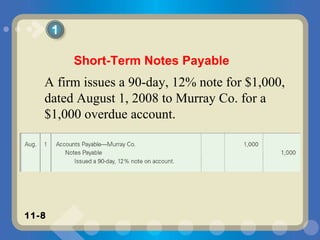
A firm issues a 90-day, 12% note for $1,000, dated August 1, 2008 to Murray Co. for a $1,000 overdue account. Short-Term Notes Payable 1
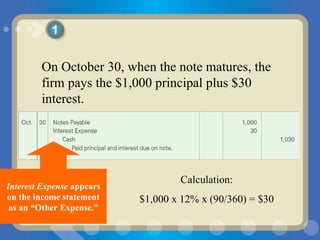
On October 30, when the note matures, the firm pays the $1,000 principal plus $30 interest. 1 Interest Expense  appears on the income statement as an “Other Expense.” Calculation: $1,000 x 12% x (90/360) = $30
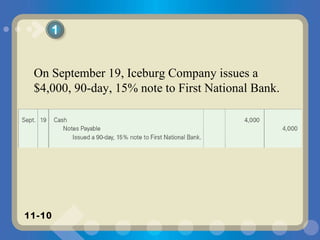
On September 19, Iceburg Company issues a $4,000, 90-day, 15% note to First National Bank. 1
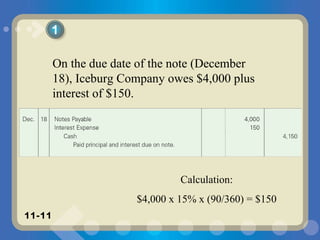
On the due date of the note (December 18), Iceburg Company owes $4,000 plus interest of $150. 1 Calculation: $4,000 x 15% x (90/360) = $150
Discounting a Note A discounted note has the following characteristics: The creditor (lender) requires an interest rate, called the  discount rate . Interest, called the  discount , is computed on the face amount of the note. The debtor (borrower) receives the face amount of the note less the discount, called the  proceeds . The debtor pays the face amount of the note on the due date. 1
Describe the accounting treatment for contingent liabilities and journalize entries for product warranties. * Note: This is objective #5 in your text 2 11-79
Some liabilities may arise from past transactions if certain events occur in the future. These  potential  obligations are called  contingent liabilities . 5 Contingent Liabilities
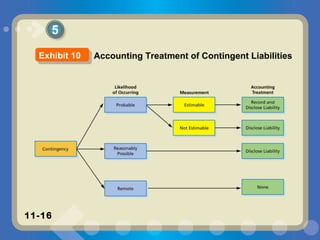
The accounting for contingent liabilities depends on the following two factors: Likelihood of occurring: Probable, reasonably possible, or remote. Measurement: Estimable or not estimable. 5 If  probable  AND  estimable , the contingent liability must be  recorded and disclosed
5 Accounting Treatment of Contingent Liabilities Exhibit 10
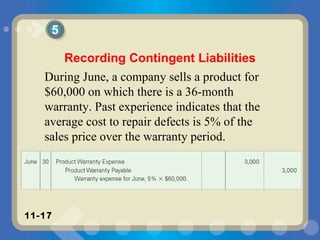
During June, a company sells a product for $60,000 on which there is a 36-month warranty. Past experience indicates that the average cost to repair defects is 5% of the sales price over the warranty period. Recording Contingent Liabilities 5
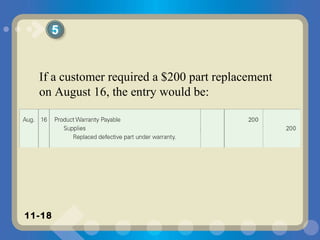
If a customer required a $200 part replacement on August 16, the entry would be: 5
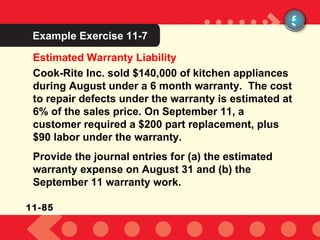
Example Exercise 10-2 Estimated Warranty Liability 5 Example Exercise 11-7 Cook-Rite Inc. sold $140,000 of kitchen appliances during August under a 6 month warranty.  The cost to repair defects under the warranty is estimated at 6% of the sales price. On September 11, a customer required a $200 part replacement, plus $90 labor under the warranty. Provide the journal entries for (a) the estimated warranty expense on August 31 and (b) the September 11 warranty work. 11-85
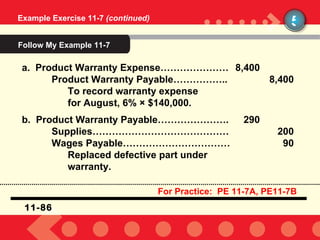
Example Exercise 11-7  (continued) 5 a.  Product Warranty Expense………………… 8,400 Product Warranty Payable…………….. 8,400 To record warranty expense  for August, 6%  ×  $140,000. b.  Product Warranty Payable…………………. 290 Supplies…………………………………… 200 Wages Payable…………………………… 90 Replaced defective part under warranty. 11-86 For Practice:  PE 11-7A, PE11-7B Follow My Example 11-7
 

Unit 11 - Current Liabilities and Contingent Liabilities

  • 1.
  • 2.
    Learning Objective 13-1 Describe the nature of the adjusting process. Learning Objective 1 3-1 Describe the nature of the adjusting process. 9- Insert Chapter Objectives Current Liabilities and Payroll The objectives for this Slidecast are: 11-2 1 Define and illustrate current liabilities related to accounts payable, current portion of long-term debt, and notes payable. 2 Describe the accounting treatment for contingent liabilities and journalize entries for product warranties.
  • 3.
    Liabilities that areto be paid out of current assets and are due within a short time, usually within one year, are called current liabilities . Accounts payable Current portion of long-term debt Notes payable 1
  • 4.
    Accounts payable arise from purchasing goods or services for use in a company’s operations or for purchasing merchandise for resale. 1
  • 5.
    Current Portion ofLong-Term Debt Long-term liabilities are often paid back in periodic payments, called installments . Installments that are due within the coming year must be classified as a current liability. 1
  • 6.
    The total amountof the installments due after the coming year is classified as a long-term liability. 1
  • 7.
    Short-Term Notes PayableDiscussed in Chapter 9 Often issue to replace an accounts payable Notes payable have a longer term than an accounts payable (> 60 days) 1
  • 8.
    A firm issuesa 90-day, 12% note for $1,000, dated August 1, 2008 to Murray Co. for a $1,000 overdue account. Short-Term Notes Payable 1
  • 9.
    On October 30,when the note matures, the firm pays the $1,000 principal plus $30 interest. 1 Interest Expense appears on the income statement as an “Other Expense.” Calculation: $1,000 x 12% x (90/360) = $30
  • 10.
    On September 19,Iceburg Company issues a $4,000, 90-day, 15% note to First National Bank. 1
  • 11.
    On the duedate of the note (December 18), Iceburg Company owes $4,000 plus interest of $150. 1 Calculation: $4,000 x 15% x (90/360) = $150
  • 12.
    Discounting a NoteA discounted note has the following characteristics: The creditor (lender) requires an interest rate, called the discount rate . Interest, called the discount , is computed on the face amount of the note. The debtor (borrower) receives the face amount of the note less the discount, called the proceeds . The debtor pays the face amount of the note on the due date. 1
  • 13.
    Describe the accountingtreatment for contingent liabilities and journalize entries for product warranties. * Note: This is objective #5 in your text 2 11-79
  • 14.
    Some liabilities mayarise from past transactions if certain events occur in the future. These potential obligations are called contingent liabilities . 5 Contingent Liabilities
  • 15.
    The accounting forcontingent liabilities depends on the following two factors: Likelihood of occurring: Probable, reasonably possible, or remote. Measurement: Estimable or not estimable. 5 If probable AND estimable , the contingent liability must be recorded and disclosed
  • 16.
    5 Accounting Treatmentof Contingent Liabilities Exhibit 10
  • 17.
    During June, acompany sells a product for $60,000 on which there is a 36-month warranty. Past experience indicates that the average cost to repair defects is 5% of the sales price over the warranty period. Recording Contingent Liabilities 5
  • 18.
    If a customerrequired a $200 part replacement on August 16, the entry would be: 5
  • 19.
    Example Exercise 10-2Estimated Warranty Liability 5 Example Exercise 11-7 Cook-Rite Inc. sold $140,000 of kitchen appliances during August under a 6 month warranty. The cost to repair defects under the warranty is estimated at 6% of the sales price. On September 11, a customer required a $200 part replacement, plus $90 labor under the warranty. Provide the journal entries for (a) the estimated warranty expense on August 31 and (b) the September 11 warranty work. 11-85
  • 20.
    Example Exercise 11-7 (continued) 5 a. Product Warranty Expense………………… 8,400 Product Warranty Payable…………….. 8,400 To record warranty expense for August, 6% × $140,000. b. Product Warranty Payable…………………. 290 Supplies…………………………………… 200 Wages Payable…………………………… 90 Replaced defective part under warranty. 11-86 For Practice: PE 11-7A, PE11-7B Follow My Example 11-7
  • 21.