1.1 Understanding PlaceValue
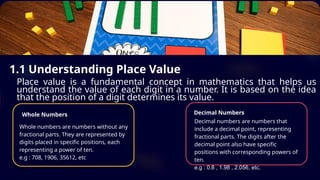
Place value is a fundamental concept in mathematics that helps us
understand the value of each digit in a number. It is based on the idea
that the position of a digit determines its value.
Whole Numbers
Whole numbers are numbers without any
fractional parts. They are represented by
digits placed in specific positions, each
representing a power of ten.
e.g : 708, 1906, 35612, etc
Decimal Numbers
Decimal numbers are numbers that
include a decimal point, representing
fractional parts. The digits after the
decimal point also have specific
positions with corresponding powers of
ten.
e.g : 0.8 , 1.98 , 2.056, etc.
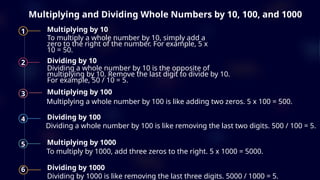
Multiplying and DividingWhole Numbers by 10, 100, and 1000
1 Multiplying by 10
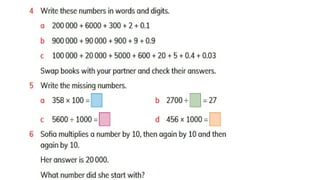
To multiply a whole number by 10, simply add a
zero to the right of the number. For example, 5 x
10 = 50.
2 Dividing by 10
Dividing a whole number by 10 is the opposite of
multiplying by 10. Remove the last digit to divide by 10.
For example, 50 / 10 = 5.
3 Multiplying by 100
Multiplying a whole number by 100 is like adding two zeros. 5 x 100 = 500.
4 Dividing by 100
Dividing a whole number by 100 is like removing the last two digits. 500 / 100 = 5.
5 Multiplying by 1000
To multiply by 1000, add three zeros to the right. 5 x 1000 = 5000.
6 Dividing by 1000
Dividing by 1000 is like removing the last three digits. 5000 / 1000 = 5.
6.
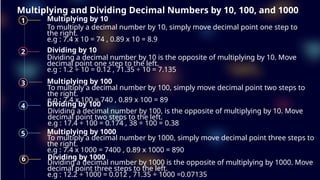
Multiplying and DividingDecimal Numbers by 10, 100, and 1000
1 Multiplying by 10
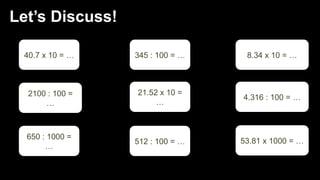
To multiply a decimal number by 10, simply move decimal point one step to
the right.
e.g : 7.4 x 10 = 74 , 0.89 x 10 = 8.9
2 Dividing by 10
Dividing a decimal number by 10 is the opposite of multiplying by 10. Move
decimal point one step to the left.
e.g : 1.2 ÷ 10 = 0.12 , 71.35 ÷ 10 = 7.135
3 Multiplying by 100
4 Dividing by 100
5 Multiplying by 1000
6 Dividing by 1000
Dividing a decimal number by 100, is the opposite of multiplying by 10. Move
decimal point two steps to the left.
e.g : 17.4 ÷ 100 = 0.174 , 38 ÷ 100 = 0.38
To multiply a decimal number by 1000, simply move decimal point three steps to
the right.
e.g : 7.4 x 1000 = 7400 , 0.89 x 1000 = 890
Dividing a decimal number by 1000 is the opposite of multiplying by 1000. Move
decimal point three steps to the left.
e.g : 12.2 ÷ 1000 = 0.012 , 71.35 ÷ 1000 =0.07135
To multiply a decimal number by 100, simply move decimal point two steps to
the right.
e.g : 7.4 x 100 = 740 , 0.89 x 100 = 89
7.
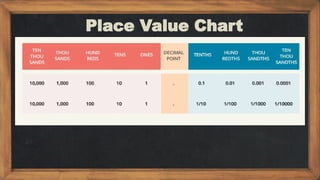
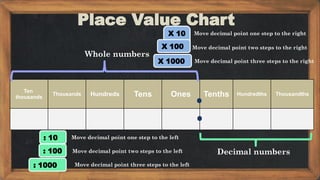
Ten
thousands
Thousands Hundreds TensOnes Tenths Hundredths Thousandths
.
.
Place Value Chart
Whole numbers
Decimal numbers
X 10
: 10
X 100
X 1000
: 100
: 1000
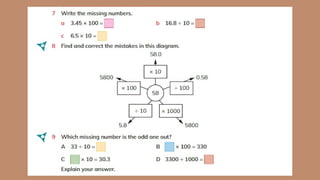
Move decimal point one step to the right
Move decimal point two steps to the right
Move decimal point three steps to the right
Move decimal point one step to the left
Move decimal point two steps to the left
Move decimal point three steps to the left
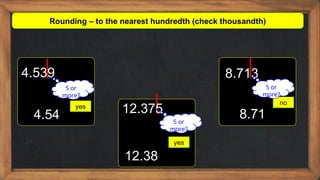
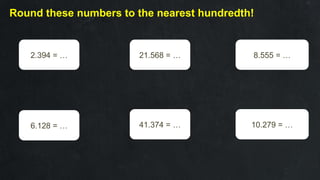
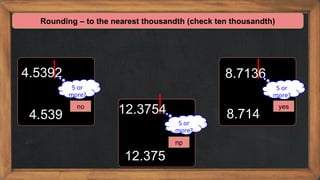
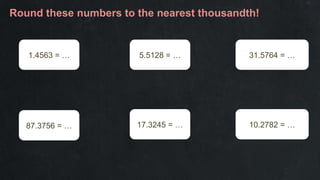
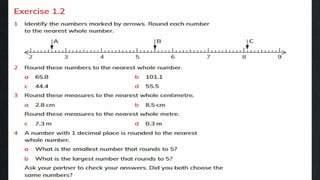
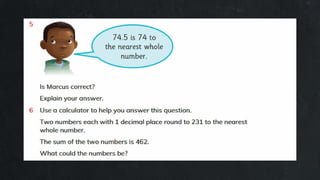
1.2 Rounding decimalnumbers
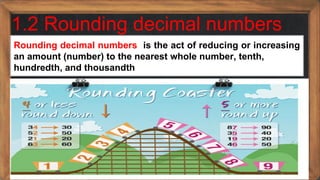
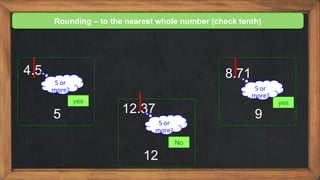
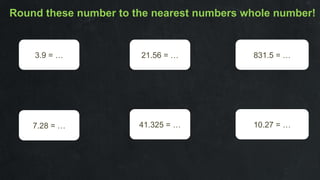
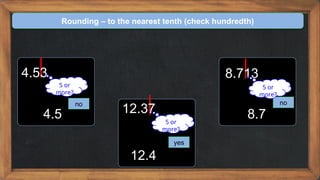
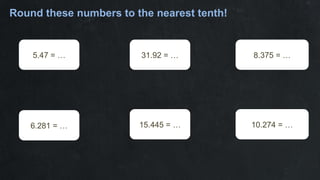
Rounding decimal numbers is the act of reducing or increasing
an amount (number) to the nearest whole number, tenth,
hundredth, and thousandth
13.
Rounding – tothe nearest whole number (check tenth)
4.5
yes
5 or
more?
5 12.37
No
5 or
more?
12
8.71
yes
5 or
more?
9