MERCANTILISM
• Mercantilism wasthe prevalent economic system in the
western world from the 16th
to 18th
century.
• Mercantilism is an economic practice by which
government used their economies to augment state power
at the expense of other countries.
• Government sought to ensure that experts exceeded
imports and to accumulate wealth in the form of bullion
(mostly gold and silver).
3.
• The primarycountries that employed mercantilism were of
western Europe- France, Spain, Portugal, Italy, Britain,
Germany and Netherlands. Since colonies were regarded as
existing for the benefit of their mother countries.
• The colonized parts of North America, South America and
Africa were involuntarily involved with mercantilism and
were required to sell raw materials only to their colonies
and to purchase finished goods only from their mother
countries.
• Mercantilism led to the creation of monopolistic trading
companies, such as The East India Company and The French
East India Company.
• Commercial rivalry tended to result in military rivalry as
well.
4.
THINKERS
• Thomus Mun(England)
• Jean Baptiste Colbert (France)
• Antonio Serra (Italy)
• Adam Smith (Scotland)
5.
PHYSIOCRATS
• Physiocrats, schoolof economists founded in 18th
century in
France and characterized chiefly by a belief that
government policy should not interfere with the operation of
natural economic laws and that land is the source of all
wealth.
• It is generally regarded as the first scientific school of
economics.
• Francois Quesnay published the “Tableau economique” in
1758, which provided the foundations of the ideas of the
physiocrats
6.
DEFINITION OF ECONOMICS
1.Wealth Based Definition
2. Welfare Based Definition
3. Scarcity Based Definition
4. Modern Definition
5. Growth Definition
7.
The cause oforigin of Economics
1. Resources are limited
2. Human wants are infinite
3. Resources have alternative uses
8.
Wealth Based Definition
•Adam Smith’s most popular book on Economics is “An
enquiry into the nature and causes of wealth of nation”
march 1776. He defines “Economics as a Science of
natural wealth”.
• Prof. Francis Amasa Walker “Economics is a body of
knowledge which relates to wealth”.
• Jean Baptise say “Economics is a science that studies
wealth”
9.
Welfare Based Definition
•Alfred Marshall Book “Principles of Economics” (1890) “Economics is a
study of mankind in the ordinary business of life. It examines that
part of individual and social action which is most closely connected
with the attainment and use of material requisites of well being.”
• Pigou “Economics is a relationship between various Economic
variables like consumption, wealth, employment and output during
different situations in an economy such as inflation, deflation etc. He
considered Economics as the study of mercantilism in the economy.”
10.
Scarcity Based Definition
•Robins Abba P. Lerner “The science which studies human
behavior as a relationship between ends and scarce means
which have alternative uses.”
11.
Modern Definition
• Moderneconomics has presented an evolutionary and welfare
approach to Economics.
• Hicks as defined Economics as “The science which deals with business
affairs.”
12.
Growth Definition
• Prof.Paul Samuelson defined Economics as “The study of how men
society choose with or without the use of money, to employ scarce
productive resources which could have alternative uses, to produce
various commodities overtime and distribute them for consumption,
now and in future among various people and groups of society. It
analyses cost and benefits of improving pattern of resources
allocation.”
Capitalism
• Trade, industriesand means of productions are completely privately
owned.
• Also termed as free market economy
• Production and prices are determined by market forces.
• Follow laissez faire philosophy : No interference of Gov.
• Example : UK, US etc.
• Father of capitalist economy is Adam Smith
15.
Features
• Private property
•Large scale production
• Profit institution
• Competition
• Price is determined by demand and supply
• Wages are highly bargained
16.
Merits/Demerits
• Merits :
•High level of production
• Products of high quality at low cost
• Growth and prosperity
• Demerits :
• Leads to monopoly
• Inequalities of income and wealth
• Depression and unemployment
• Non utilization of resources
17.
Socialism
• Means ofproduction are owned and regulated by Gov.
• Also known as socialist or command economy
• Production and prices are determined by state i.e Gov.
• Guarantee public welfare and equality among members of the society
• Father of socialism is Karl Marks
• Example : Russia, China etc.
18.
Features
• Social ownership
•Social welfare
• Central planning (Planning commission)
• Equality of income and opportunity
19.
Merits/Demerits
• Merits :
•Absence of monopoly
• Right utilization of resources
• Absence of business fluctuation
• Equal distribution
• Demerits:
• Loss of consumer sovereignty
• Fixed occupation
20.
Mixed Economy
• Combinationof public ownership and private ownership
• Private ownership is allowed with Gov. interference
• Father of Mixed Economy is Adam Smith
• Example : India
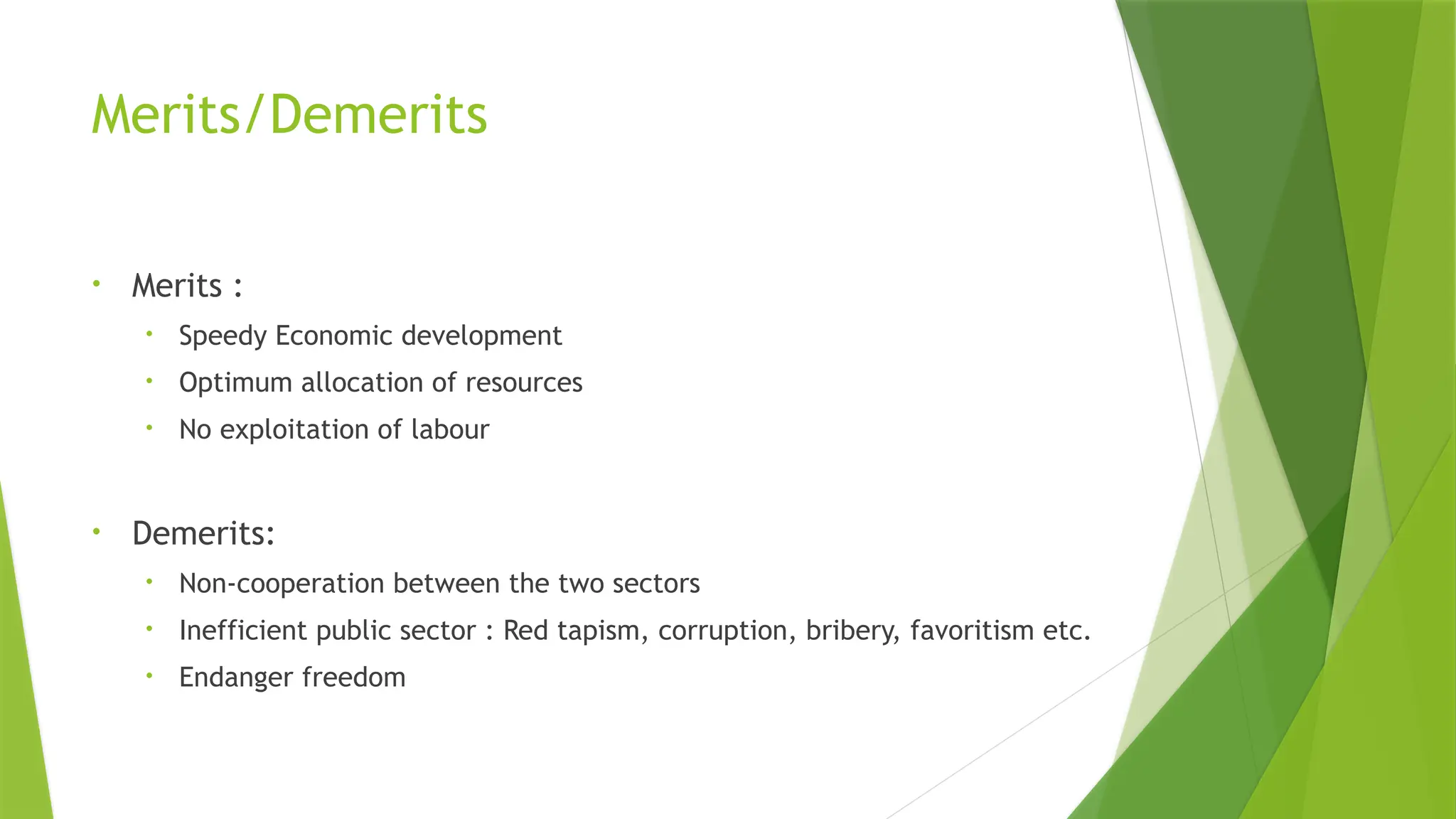
Merits/Demerits
• Merits :
•Speedy Economic development
• Optimum allocation of resources
• No exploitation of labour
• Demerits:
• Non-cooperation between the two sectors
• Inefficient public sector : Red tapism, corruption, bribery, favoritism etc.
• Endanger freedom