8085 PROCESSOR
--Functional block diagram
--Signals
--Memory interfacing
--I/O ports and data transfer concepts
--Timing Diagram
--Interrupt structure.
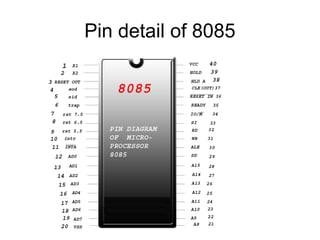
Pin detail of 8085
The 8085 Microprocessor
Architecture
● The 8085 is an 8-bit general purpose microprocessor
that can address 64K Byte of memory.
● It has 40 pins and uses +5V for power. It can run at a
maximum frequency of 3 MHz.
● The pins on the chip can be grouped into 6 groups:
● Address Bus.
● Data Bus.
● Control and Status Signals.
● Power supply and frequency.
● Externally Initiated Signals.
● Serial I/O ports.
The Address and Data Busses
● The address bus has 8 signal lines A8 – A15 which are
unidirectional.
● The other 8 address bits are multiplexed (time shared)
with the 8 data bits.
● So, the bits AD0 – AD7 are bi-directional and serve as
A0 – A7 and D0 – D7 at the same time.
● During the execution of the instruction, these lines
carry the address bits during the early part, then
during the late parts of the execution, they carry
the 8 data bits.
● In order to separate the address from the data, we
can use a latch to save the value before the function
of the bits changes.
The Control and Status Signals
● There are 4 main control and status signals. These are:
● ALE: Address Latch Enable. This signal is a pulse that
become 1 when the AD0 – AD7 lines have an address on
them. It becomes 0 after that. This signal can be used to
enable a latch to save the address bits from the AD lines.
● RD: Read. Active low.
● WR: Write. Active low.
● IO/M: This signal specifies whether the operation is a
memory operation (IO/M=0) or an I/O operation (IO/M=1).
● S1 and S0 : Status signals to specify the kind of operation
being performed .Usually un-used in small systems.
Frequency Control Signals
● There are 3 important pins in the frequency control group.
● X0 and X1 are the inputs from the crystal or clock generating
circuit.
● The frequency is internally divided by 2.
● So, to run the microprocessor at 3 MHz, a clock running
at 6 MHz should be connected to the X0 and X1 pins.
● CLK (OUT): An output clock pin to drive the clock of the rest of
the system.
● We will discuss the rest of the control signals as we get to them.
The ALU
● In addition to the arithmetic & logic circuits, the
ALU includes the accumulator, which is part of
every arithmetic & logic operation.
● Also, the ALU includes a temporary register
used for holding data temporarily during the
execution of the operation. This temporary
register is not accessible by the programmer.
The Flags register
● There is also the flags register whose bits are affected by the arithmetic & logic
operations.
● S-sign flag
● The sign flag is set if bit D7 of the accumulator is set after an arithmetic
or logic operation.
● Z-zero flag
● Set if the result of the ALU operation is 0. Otherwise is reset. This flag
is affected by operations on the accumulator as well as other registers.
(DCR B).
● AC-Auxiliary Carry
● This flag is set when a carry is generated from bit D3 and passed to
D4 . This flag is used only internally for BCD operations. (Section 10.5
describes BCD addition including the DAA instruction).
● P-Parity flag
● After an ALU operation if the result has an even # of 1’s the p-flag is
set. Otherwise it is cleared. So, the flag can be used to indicate even
parity.
● CY-carry flag
● Discussed earlier
8085 Instruction Set
*
8085 Instruction
Set
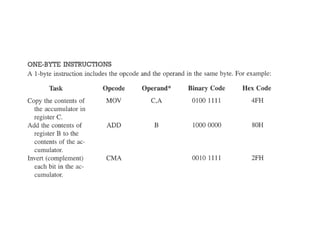
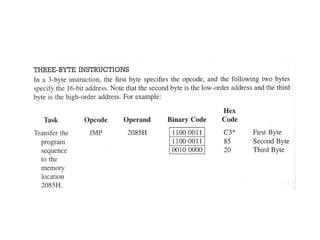
The 8085 instructions can be classified as follows:
 Data transfer operations
 Arithmetic operations (ADD, SUB, INR, DCR)
 Logic operations
 Branching operations (JMP, CALL, RET)
● Between registers
● Between memory location and a register
● Direct write to a register / memory
● Between I/O device and accumulator
*
Simple Data Transfer Operations
Examples:
 MOV B,A 47 From ACC to REG
 MOV C,D 4A Between two REGs
 MVI D,47 16 Direct-write into REG D
47
*
Simple Data Transfer Operations
Example:
 OUT 05 D3
05
Contents of ACC sent to output port number 05.
*
Simple Memory Access Operations
*
Simple Memory Access Operations
*
Arithmetic
Operations
*
Arithmetic
Operations
*
Arithmetic
Operations
*
Arithmetic
Operations
*
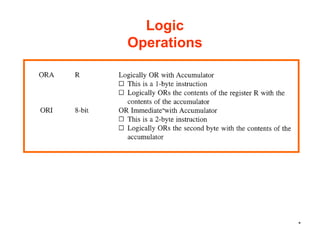
Overview of Logic
Operations
*
Logic
Operations
*
Logic
Operations
*
Logic
Operations
*
Branching
Operations
Note: This is an unconditional jump operation.
It will always force the program counter to a fixed
memory address continuous loop !
*
Branching
Operations
Conditional jump operations are very useful for decision
making during the execution of the program.
Data transfer operation
● LHLD Load H & L Registers Directly from Memory
● SHLD Store H & L Registers Directly in Memory
● LXI Load Register Pair with Immediate data
● LDAX Load Accumulator from Address in Register
Pair
● STAX Store Accumulator in Address in Register Pair
● XCHG Exchange H & L with D & E
● XTHL Exchange Top of Stack with H & L
Arithmetic Operations
● ADC Add to Accumulator Using Carry Flag
● ACI Add Immediate data to Accumulator Using Carry
● SBB Subtract from Accumulator Using Borrow (Carry) Flag
● SBI Subtract Immediate from Accumulator Using Borrow
(Carry) Flag
● INX Increment Register Pair by One
● DCX Decrement Register Pair by One
● DAD Double Register Add; Add Content of Register
Pair to H & L Register Pair
Logic Operations
The Compare instructions compare the content of an 8-bit value with
the contents of the accumulator
● CMP Compare
● CPI Compare Using Immediate Data
The rotate instructions shift the contents of the accumulator one bit
position to the left or right:
● RLC Rotate Accumulator Left
● RRC Rotate Accumulator Right
● RAL Rotate Left Through Carry
● RAR Rotate Right Through Carry
Complement and carry flag instructions:
● CMA Complement Accumulator
● CMC Complement Carry Flag
● STC Set Carry Flag
Branching Operations
the conditional branching instructions are specified as follows:
Jumps Calls Returns
C CC RC (Carry)
INC CNC RNC (No Carry)
JZ CZ RZ (Zero)
JNZ CNZ RNZ (Not Zero)
JP CP RP (Plus)
JM CM RM (Minus)
JPE CPE RPE (Parity Even)
JP0 CPO RPO (Parity Odd)
Two other instructions can affect a branch by replacing the contents or the
program counter:
PCHL Move H & L to Program Counter
RST Special Restart Instruction Used
with Interrupts
Stack I/O and Machine Control
Instructions
The following instructions affect the Stack and/or Stack
Pointer:
PUSH Push Two bytes of Data onto the Stack
POP Pop Two Bytes of Data off the Stack
XTHL Exchange Top of Stack with H & L
SPHL Move content of H & L to Stack Pointer
The Machine Control instructions are as follows:
EI Enable Interrupt System
DI Disable Interrupt System
HLT Halt
NOP No Operation
TIMING DIAGRAM
Timing Diagram is a graphical representation. It represents the
execution time taken by each instruction in a graphical format. The
execution time is represented in T-states.
Instruction Cycle:
The time required to execute an instruction is called instruction cycle.
Machine Cycle:
The time required to access the memory or input/output devices is
called machine cycle.
T-State:
The machine cycle and instruction cycle takes multiple clock periods.
A portion of an operation carried out in one system clock period is
called as T-state.
MACHINE CYCLES OF 8085
The 8085 microprocessor has 5 (seven) basic machine cycles.
● Opcode fetch cycle (4T)
● Memory read cycle (3 T)
● Memory write cycle (3 T)
● I/O read cycle (3 T)
● I/O write cycle (3 T)
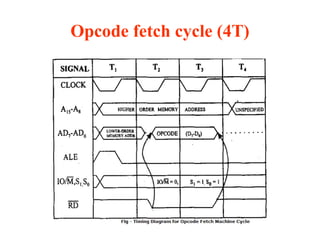
Opcode fetch cycle (4T)
Memory Read Machine Cycle
Memory Write Machine Cycle
● The memory write machine cycle is executed by the processor to write a data byte
in a memory location.
● The processor takes, 3T states to execute this machine cycle.
I/O Write Cycle
● The I/O write machine cycle is executed by the processor to write a data byte in
the I/O port or to a peripheral, which is I/O, mapped in the system.
● The processor takes, 3T states to execute this machine cycle
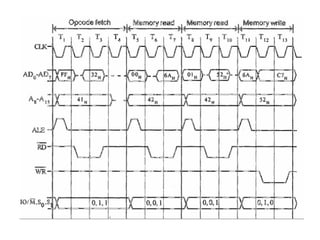
Timing diagram for STA 526AH
● STA means Store Accumulator -The contents of the accumulator is stored
in the specified address(526A).
● The opcode of the STA instruction is said to be 32H. It is fetched from the
memory 41FFH(see fig). - OF machine cycle
● Then the lower order memory address is read(6A). - Memory Read
Machine Cycle
● Read the higher order memory address (52).- Memory Read Machine Cycle
● The combination of both the addresses are considered and the content from
accumulator is written in 526A. - Memory Write Machine Cycle
● Assume the memory address for the instruction and let the content of
accumulator is C7H. So, C7H from accumulator is now stored in 526A.
Timing diagram for IN C0H
● Fetching the Opcode DBH from the memory 4125H.
● Read the port address C0H from 4126H.
● Read the content of port C0H and send it to the accumulator.
● Let the content of port is 5EH.
INTERRUPT STRUCTURE
● Interrupt is signals send by an external device to the processor, to
request the processor to perform a particular task or work.
● Mainly in the microprocessor based system the interrupts are used
for data transfer between the peripheral and the microprocessor.
● The processor will check the interrupts always at the 2nd T-state
of last machine cycle.
● If there is any interrupt it accept the interrupt and send the INTA
(active low) signal to the peripheral.
● The vectored address of particular interrupt is stored in program
counter.
● The processor executes an interrupt service routine (ISR)
addressed in program counter.
● It returned to main program by RET instruction.
TYPES OF INTERRUPTS:
It supports two types of interrupts.
● Hardware
● Software
Software interrupts:
● The software interrupts are program instructions. These instructions
are inserted at desired locations in a program.
● The 8085 has eight software interrupts from RST 0 to RST 7. The
vector address for these interrupts can be calculated as follows.
Interrupt number * 8 = vector address
For RST 5 5 * 8 = 40 = 28H
Vector address for interrupt RST 5 is 0028H
HARDWARE INTERRUPTS:
● An external device initiates the hardware interrupts and placing an
appropriate signal at the interrupt pin of the processor.
● If the interrupt is accepted then the processor executes an interrupt
service routine.
● The 8085 has five hardware interrupts
(1) TRAP
(2) RST 7.5
(3) RST6.5
(4) RST 5.5
(5) INTR
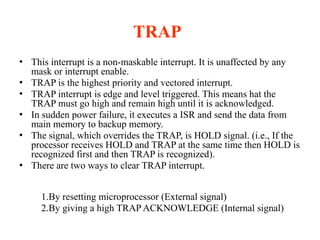
TRAP
● This interrupt is a non-maskable interrupt. It is unaffected by any
mask or interrupt enable.
● TRAP is the highest priority and vectored interrupt.
● TRAP interrupt is edge and level triggered. This means hat the
TRAP must go high and remain high until it is acknowledged.
● In sudden power failure, it executes a ISR and send the data from
main memory to backup memory.
● The signal, which overrides the TRAP, is HOLD signal. (i.e., If the
processor receives HOLD and TRAP at the same time then HOLD is
recognized first and then TRAP is recognized).
● There are two ways to clear TRAP interrupt.
1.By resetting microprocessor (External signal)
2.By giving a high TRAP ACKNOWLEDGE (Internal signal)
RST 7.5
● The RST 7.5 interrupt is a maskable interrupt.
● It has the second highest priority.
● It is edge sensitive. ie. Input goes to high and no
need to maintain high state until it recognized.
● Maskable interrupt. It is disabled by,
1.DI instruction
2.System or processor reset.
3.After reorganization of interrupt.
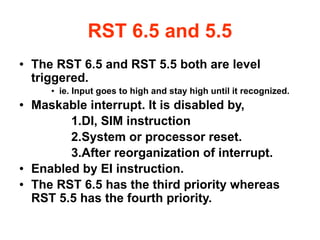
RST 6.5 and 5.5
● The RST 6.5 and RST 5.5 both are level
triggered.
● ie. Input goes to high and stay high until it recognized.
● Maskable interrupt. It is disabled by,
1.DI, SIM instruction
2.System or processor reset.
3.After reorganization of interrupt.
● Enabled by EI instruction.
● The RST 6.5 has the third priority whereas
RST 5.5 has the fourth priority.
INTR
● INTR is a maskable interrupt. It is disabled by,
1.DI, SIM instruction
2.System or processor reset.
3.After reorganization of interrupt.
Enabled by EI instruction.
● Non- vectored interrupt. After receiving INTA (active low) signal, it has to supply the
address of ISR.
● It has lowest priority.
● It is a level sensitive interrupts. ie. Input goes to high and it is necessary to maintain
high state until it recognized.
● The following sequence of events occurs when INTR signal goes high.
● 1. The 8085 checks the status of INTR signal during execution of each instruction.
● 2. If INTR signal is high, then 8085 complete its current instruction and sends active
low interrupt acknowledge signal, if the interrupt is enabled
● 3. In response to the acknowledge signal, external logic places an instruction
OPCODE on the data bus. In the case of multibyte instruction, additional interrupt
acknowledge machine cycles are generated by the 8085 to transfer the additional
bytes into the microprocessor.
● 4. On receiving the instruction, the 8085 save the address of next instruction on stack
and execute received instruction.
NAME: ADDRESS:
RST 0 00H
RST 1 08H
RST 2 10H
RST 3 18H
RST 4 20H
TRAP 24H
RST 5 28H
REST 5.5 2CH
RST 6 30H
RST 6.5 34H
RST 7 38H
RST 7.5 3CH
SIM and RIM for interrupts
● The 8085 provide additional masking facility for RST 7.5, RST 6.5 and RST
5.5 using SIM instruction.
● The status of these interrupts can be read by executing RIM instruction.
● The masking or unmasking of RST 7.5, RST 6.5 and RST 5.5 interrupts can
be performed by moving an 8-bit data to accumulator and then executing
SIM instruction.
● The format of the 8-bit data is shown below
● The status of pending interrupts can be read from accumulator after executing
RIM instruction.
● When RIM instruction is executed an 8-bit data is loaded in accumulator, which
can be interpreted as shown in fig.
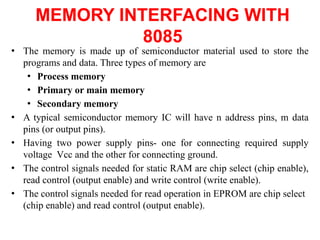
MEMORY INTERFACING WITH
8085
● The memory is made up of semiconductor material used to store the
programs and data. Three types of memory are
● Process memory
● Primary or main memory
● Secondary memory
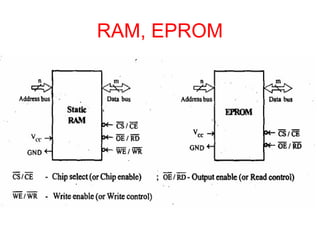
● A typical semiconductor memory IC will have n address pins, m data
pins (or output pins).
● Having two power supply pins- one for connecting required supply
voltage Vcc and the other for connecting ground.
● The control signals needed for static RAM are chip select (chip enable),
read control (output enable) and write control (write enable).
● The control signals needed for read operation in EPROM are chip select
(chip enable) and read control (output enable).
RAM, EPROM
Interfacing EPROM 27512
● The memory capacity is 64 Kbytes. i.e
● 2^n = 64 x 1000 bytes where n = address lines.
● So, n = 16.
● In this system the entire 16 address lines of the processor are
connected to address input pins of memory IC in order to address
the internal locations of memory.
● The chip select (CS) pin of EPROM is permanently tied to logic
low (i.e., tied to ground).
● Since the processor is connected to EPROM, the active low RD
pin is connected to active low output enable pin of EPROM.
● The range of address for EPROM is 0000H to FFFFH.
Interface the EPROM and RAM
● 64kb memory space is equally divided between EPROM and RAM.
● Implement 32kb memory capacity of EPROM using single IC 27256.
● 32kb RAM capacity is implemented using single IC 62256.
● The 32kb memory requires 15 address lines and so the address lines A0
- A14 of the processor are connected to 15 address pins of both
EPROM and RAM.
● The unused address line A15 is used as to chip select. If A15 is 1, it
select RAM and If A15 is 0, it select EPROM.
● RD and WR pins of processor are connected to low WE and OE pins
of memory respectively.
● The address range of EPROM will be 0000H to 7FFFH and that of
RAM will be 8000H to FFFFH.
DECODER
● It is used to increase memory chip to processor. IC's used for decoder is,
● 2-4 decoder (74LS139)
● 3-8 decoder (74LS138)
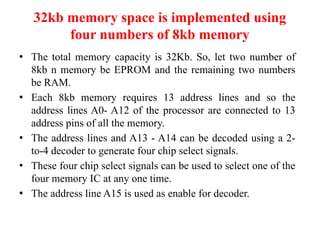
32kb memory space is implemented using
four numbers of 8kb memory
● The total memory capacity is 32Kb. So, let two number of
8kb n memory be EPROM and the remaining two numbers
be RAM.
● Each 8kb memory requires 13 address lines and so the
address lines A0- A12 of the processor are connected to 13
address pins of all the memory.
● The address lines and A13 - A14 can be decoded using a 2-
to-4 decoder to generate four chip select signals.
● These four chip select signals can be used to select one of the
four memory IC at any one time.
● The address line A15 is used as enable for decoder.
Interfacing 16Kb EPROM and
16Kb RAM with 8085
Address Allotted to each memory IC
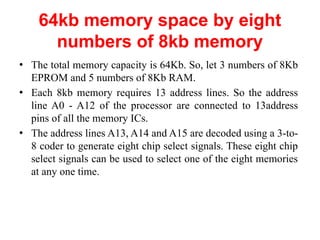
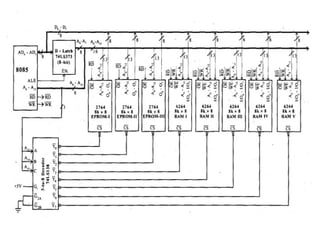
64kb memory space by eight
numbers of 8kb memory
● The total memory capacity is 64Kb. So, let 3 numbers of 8Kb
EPROM and 5 numbers of 8Kb RAM.
● Each 8kb memory requires 13 address lines. So the address
line A0 - A12 of the processor are connected to 13address
pins of all the memory ICs.
● The address lines A13, A14 and A15 are decoded using a 3-to-
8 coder to generate eight chip select signals. These eight chip
select signals can be used to select one of the eight memories
at any one time.
unit-1.ppt8085 basic information imp.pptx

unit-1.ppt8085 basic information imp.pptx

  • 1.
    8085 PROCESSOR --Functional blockdiagram --Signals --Memory interfacing --I/O ports and data transfer concepts --Timing Diagram --Interrupt structure.
  • 2.
  • 4.
    The 8085 Microprocessor Architecture ●The 8085 is an 8-bit general purpose microprocessor that can address 64K Byte of memory. ● It has 40 pins and uses +5V for power. It can run at a maximum frequency of 3 MHz. ● The pins on the chip can be grouped into 6 groups: ● Address Bus. ● Data Bus. ● Control and Status Signals. ● Power supply and frequency. ● Externally Initiated Signals. ● Serial I/O ports.
  • 5.
    The Address andData Busses ● The address bus has 8 signal lines A8 – A15 which are unidirectional. ● The other 8 address bits are multiplexed (time shared) with the 8 data bits. ● So, the bits AD0 – AD7 are bi-directional and serve as A0 – A7 and D0 – D7 at the same time. ● During the execution of the instruction, these lines carry the address bits during the early part, then during the late parts of the execution, they carry the 8 data bits. ● In order to separate the address from the data, we can use a latch to save the value before the function of the bits changes.
  • 6.
    The Control andStatus Signals ● There are 4 main control and status signals. These are: ● ALE: Address Latch Enable. This signal is a pulse that become 1 when the AD0 – AD7 lines have an address on them. It becomes 0 after that. This signal can be used to enable a latch to save the address bits from the AD lines. ● RD: Read. Active low. ● WR: Write. Active low. ● IO/M: This signal specifies whether the operation is a memory operation (IO/M=0) or an I/O operation (IO/M=1). ● S1 and S0 : Status signals to specify the kind of operation being performed .Usually un-used in small systems.
  • 7.
    Frequency Control Signals ●There are 3 important pins in the frequency control group. ● X0 and X1 are the inputs from the crystal or clock generating circuit. ● The frequency is internally divided by 2. ● So, to run the microprocessor at 3 MHz, a clock running at 6 MHz should be connected to the X0 and X1 pins. ● CLK (OUT): An output clock pin to drive the clock of the rest of the system. ● We will discuss the rest of the control signals as we get to them.
  • 8.
    The ALU ● Inaddition to the arithmetic & logic circuits, the ALU includes the accumulator, which is part of every arithmetic & logic operation. ● Also, the ALU includes a temporary register used for holding data temporarily during the execution of the operation. This temporary register is not accessible by the programmer.
  • 9.
    The Flags register ●There is also the flags register whose bits are affected by the arithmetic & logic operations. ● S-sign flag ● The sign flag is set if bit D7 of the accumulator is set after an arithmetic or logic operation. ● Z-zero flag ● Set if the result of the ALU operation is 0. Otherwise is reset. This flag is affected by operations on the accumulator as well as other registers. (DCR B). ● AC-Auxiliary Carry ● This flag is set when a carry is generated from bit D3 and passed to D4 . This flag is used only internally for BCD operations. (Section 10.5 describes BCD addition including the DAA instruction). ● P-Parity flag ● After an ALU operation if the result has an even # of 1’s the p-flag is set. Otherwise it is cleared. So, the flag can be used to indicate even parity. ● CY-carry flag ● Discussed earlier
  • 10.
  • 11.
    * 8085 Instruction Set The 8085instructions can be classified as follows:  Data transfer operations  Arithmetic operations (ADD, SUB, INR, DCR)  Logic operations  Branching operations (JMP, CALL, RET) ● Between registers ● Between memory location and a register ● Direct write to a register / memory ● Between I/O device and accumulator
  • 15.
    * Simple Data TransferOperations Examples:  MOV B,A 47 From ACC to REG  MOV C,D 4A Between two REGs  MVI D,47 16 Direct-write into REG D 47
  • 16.
    * Simple Data TransferOperations Example:  OUT 05 D3 05 Contents of ACC sent to output port number 05.
  • 17.
  • 18.
  • 19.
  • 20.
  • 21.
  • 22.
  • 23.
  • 24.
  • 25.
  • 26.
  • 27.
    * Branching Operations Note: This isan unconditional jump operation. It will always force the program counter to a fixed memory address continuous loop !
  • 28.
    * Branching Operations Conditional jump operationsare very useful for decision making during the execution of the program.
  • 29.
    Data transfer operation ●LHLD Load H & L Registers Directly from Memory ● SHLD Store H & L Registers Directly in Memory ● LXI Load Register Pair with Immediate data ● LDAX Load Accumulator from Address in Register Pair ● STAX Store Accumulator in Address in Register Pair ● XCHG Exchange H & L with D & E ● XTHL Exchange Top of Stack with H & L
  • 30.
    Arithmetic Operations ● ADCAdd to Accumulator Using Carry Flag ● ACI Add Immediate data to Accumulator Using Carry ● SBB Subtract from Accumulator Using Borrow (Carry) Flag ● SBI Subtract Immediate from Accumulator Using Borrow (Carry) Flag ● INX Increment Register Pair by One ● DCX Decrement Register Pair by One ● DAD Double Register Add; Add Content of Register Pair to H & L Register Pair
  • 31.
    Logic Operations The Compareinstructions compare the content of an 8-bit value with the contents of the accumulator ● CMP Compare ● CPI Compare Using Immediate Data The rotate instructions shift the contents of the accumulator one bit position to the left or right: ● RLC Rotate Accumulator Left ● RRC Rotate Accumulator Right ● RAL Rotate Left Through Carry ● RAR Rotate Right Through Carry Complement and carry flag instructions: ● CMA Complement Accumulator ● CMC Complement Carry Flag ● STC Set Carry Flag
  • 32.
    Branching Operations the conditionalbranching instructions are specified as follows: Jumps Calls Returns C CC RC (Carry) INC CNC RNC (No Carry) JZ CZ RZ (Zero) JNZ CNZ RNZ (Not Zero) JP CP RP (Plus) JM CM RM (Minus) JPE CPE RPE (Parity Even) JP0 CPO RPO (Parity Odd) Two other instructions can affect a branch by replacing the contents or the program counter: PCHL Move H & L to Program Counter RST Special Restart Instruction Used with Interrupts
  • 33.
    Stack I/O andMachine Control Instructions The following instructions affect the Stack and/or Stack Pointer: PUSH Push Two bytes of Data onto the Stack POP Pop Two Bytes of Data off the Stack XTHL Exchange Top of Stack with H & L SPHL Move content of H & L to Stack Pointer The Machine Control instructions are as follows: EI Enable Interrupt System DI Disable Interrupt System HLT Halt NOP No Operation
  • 34.
    TIMING DIAGRAM Timing Diagramis a graphical representation. It represents the execution time taken by each instruction in a graphical format. The execution time is represented in T-states. Instruction Cycle: The time required to execute an instruction is called instruction cycle. Machine Cycle: The time required to access the memory or input/output devices is called machine cycle. T-State: The machine cycle and instruction cycle takes multiple clock periods. A portion of an operation carried out in one system clock period is called as T-state.
  • 35.
    MACHINE CYCLES OF8085 The 8085 microprocessor has 5 (seven) basic machine cycles. ● Opcode fetch cycle (4T) ● Memory read cycle (3 T) ● Memory write cycle (3 T) ● I/O read cycle (3 T) ● I/O write cycle (3 T)
  • 36.
  • 37.
  • 38.
    Memory Write MachineCycle ● The memory write machine cycle is executed by the processor to write a data byte in a memory location. ● The processor takes, 3T states to execute this machine cycle.
  • 39.
    I/O Write Cycle ●The I/O write machine cycle is executed by the processor to write a data byte in the I/O port or to a peripheral, which is I/O, mapped in the system. ● The processor takes, 3T states to execute this machine cycle
  • 40.
    Timing diagram forSTA 526AH ● STA means Store Accumulator -The contents of the accumulator is stored in the specified address(526A). ● The opcode of the STA instruction is said to be 32H. It is fetched from the memory 41FFH(see fig). - OF machine cycle ● Then the lower order memory address is read(6A). - Memory Read Machine Cycle ● Read the higher order memory address (52).- Memory Read Machine Cycle ● The combination of both the addresses are considered and the content from accumulator is written in 526A. - Memory Write Machine Cycle ● Assume the memory address for the instruction and let the content of accumulator is C7H. So, C7H from accumulator is now stored in 526A.
  • 42.
    Timing diagram forIN C0H ● Fetching the Opcode DBH from the memory 4125H. ● Read the port address C0H from 4126H. ● Read the content of port C0H and send it to the accumulator. ● Let the content of port is 5EH.
  • 43.
    INTERRUPT STRUCTURE ● Interruptis signals send by an external device to the processor, to request the processor to perform a particular task or work. ● Mainly in the microprocessor based system the interrupts are used for data transfer between the peripheral and the microprocessor. ● The processor will check the interrupts always at the 2nd T-state of last machine cycle. ● If there is any interrupt it accept the interrupt and send the INTA (active low) signal to the peripheral. ● The vectored address of particular interrupt is stored in program counter. ● The processor executes an interrupt service routine (ISR) addressed in program counter. ● It returned to main program by RET instruction.
  • 44.
    TYPES OF INTERRUPTS: Itsupports two types of interrupts. ● Hardware ● Software Software interrupts: ● The software interrupts are program instructions. These instructions are inserted at desired locations in a program. ● The 8085 has eight software interrupts from RST 0 to RST 7. The vector address for these interrupts can be calculated as follows. Interrupt number * 8 = vector address For RST 5 5 * 8 = 40 = 28H Vector address for interrupt RST 5 is 0028H
  • 45.
    HARDWARE INTERRUPTS: ● Anexternal device initiates the hardware interrupts and placing an appropriate signal at the interrupt pin of the processor. ● If the interrupt is accepted then the processor executes an interrupt service routine. ● The 8085 has five hardware interrupts (1) TRAP (2) RST 7.5 (3) RST6.5 (4) RST 5.5 (5) INTR
  • 46.
    TRAP ● This interruptis a non-maskable interrupt. It is unaffected by any mask or interrupt enable. ● TRAP is the highest priority and vectored interrupt. ● TRAP interrupt is edge and level triggered. This means hat the TRAP must go high and remain high until it is acknowledged. ● In sudden power failure, it executes a ISR and send the data from main memory to backup memory. ● The signal, which overrides the TRAP, is HOLD signal. (i.e., If the processor receives HOLD and TRAP at the same time then HOLD is recognized first and then TRAP is recognized). ● There are two ways to clear TRAP interrupt. 1.By resetting microprocessor (External signal) 2.By giving a high TRAP ACKNOWLEDGE (Internal signal)
  • 47.
    RST 7.5 ● TheRST 7.5 interrupt is a maskable interrupt. ● It has the second highest priority. ● It is edge sensitive. ie. Input goes to high and no need to maintain high state until it recognized. ● Maskable interrupt. It is disabled by, 1.DI instruction 2.System or processor reset. 3.After reorganization of interrupt.
  • 48.
    RST 6.5 and5.5 ● The RST 6.5 and RST 5.5 both are level triggered. ● ie. Input goes to high and stay high until it recognized. ● Maskable interrupt. It is disabled by, 1.DI, SIM instruction 2.System or processor reset. 3.After reorganization of interrupt. ● Enabled by EI instruction. ● The RST 6.5 has the third priority whereas RST 5.5 has the fourth priority.
  • 49.
    INTR ● INTR isa maskable interrupt. It is disabled by, 1.DI, SIM instruction 2.System or processor reset. 3.After reorganization of interrupt. Enabled by EI instruction. ● Non- vectored interrupt. After receiving INTA (active low) signal, it has to supply the address of ISR. ● It has lowest priority. ● It is a level sensitive interrupts. ie. Input goes to high and it is necessary to maintain high state until it recognized. ● The following sequence of events occurs when INTR signal goes high. ● 1. The 8085 checks the status of INTR signal during execution of each instruction. ● 2. If INTR signal is high, then 8085 complete its current instruction and sends active low interrupt acknowledge signal, if the interrupt is enabled ● 3. In response to the acknowledge signal, external logic places an instruction OPCODE on the data bus. In the case of multibyte instruction, additional interrupt acknowledge machine cycles are generated by the 8085 to transfer the additional bytes into the microprocessor. ● 4. On receiving the instruction, the 8085 save the address of next instruction on stack and execute received instruction.
  • 50.
    NAME: ADDRESS: RST 000H RST 1 08H RST 2 10H RST 3 18H RST 4 20H TRAP 24H RST 5 28H REST 5.5 2CH RST 6 30H RST 6.5 34H RST 7 38H RST 7.5 3CH
  • 51.
    SIM and RIMfor interrupts ● The 8085 provide additional masking facility for RST 7.5, RST 6.5 and RST 5.5 using SIM instruction. ● The status of these interrupts can be read by executing RIM instruction. ● The masking or unmasking of RST 7.5, RST 6.5 and RST 5.5 interrupts can be performed by moving an 8-bit data to accumulator and then executing SIM instruction. ● The format of the 8-bit data is shown below
  • 52.
    ● The statusof pending interrupts can be read from accumulator after executing RIM instruction. ● When RIM instruction is executed an 8-bit data is loaded in accumulator, which can be interpreted as shown in fig.
  • 53.
    MEMORY INTERFACING WITH 8085 ●The memory is made up of semiconductor material used to store the programs and data. Three types of memory are ● Process memory ● Primary or main memory ● Secondary memory ● A typical semiconductor memory IC will have n address pins, m data pins (or output pins). ● Having two power supply pins- one for connecting required supply voltage Vcc and the other for connecting ground. ● The control signals needed for static RAM are chip select (chip enable), read control (output enable) and write control (write enable). ● The control signals needed for read operation in EPROM are chip select (chip enable) and read control (output enable).
  • 54.
  • 56.
    Interfacing EPROM 27512 ●The memory capacity is 64 Kbytes. i.e ● 2^n = 64 x 1000 bytes where n = address lines. ● So, n = 16. ● In this system the entire 16 address lines of the processor are connected to address input pins of memory IC in order to address the internal locations of memory. ● The chip select (CS) pin of EPROM is permanently tied to logic low (i.e., tied to ground). ● Since the processor is connected to EPROM, the active low RD pin is connected to active low output enable pin of EPROM. ● The range of address for EPROM is 0000H to FFFFH.
  • 58.
    Interface the EPROMand RAM ● 64kb memory space is equally divided between EPROM and RAM. ● Implement 32kb memory capacity of EPROM using single IC 27256. ● 32kb RAM capacity is implemented using single IC 62256. ● The 32kb memory requires 15 address lines and so the address lines A0 - A14 of the processor are connected to 15 address pins of both EPROM and RAM. ● The unused address line A15 is used as to chip select. If A15 is 1, it select RAM and If A15 is 0, it select EPROM. ● RD and WR pins of processor are connected to low WE and OE pins of memory respectively. ● The address range of EPROM will be 0000H to 7FFFH and that of RAM will be 8000H to FFFFH.
  • 60.
    DECODER ● It isused to increase memory chip to processor. IC's used for decoder is, ● 2-4 decoder (74LS139) ● 3-8 decoder (74LS138)
  • 61.
    32kb memory spaceis implemented using four numbers of 8kb memory ● The total memory capacity is 32Kb. So, let two number of 8kb n memory be EPROM and the remaining two numbers be RAM. ● Each 8kb memory requires 13 address lines and so the address lines A0- A12 of the processor are connected to 13 address pins of all the memory. ● The address lines and A13 - A14 can be decoded using a 2- to-4 decoder to generate four chip select signals. ● These four chip select signals can be used to select one of the four memory IC at any one time. ● The address line A15 is used as enable for decoder.
  • 62.
    Interfacing 16Kb EPROMand 16Kb RAM with 8085
  • 63.
    Address Allotted toeach memory IC
  • 64.
    64kb memory spaceby eight numbers of 8kb memory ● The total memory capacity is 64Kb. So, let 3 numbers of 8Kb EPROM and 5 numbers of 8Kb RAM. ● Each 8kb memory requires 13 address lines. So the address line A0 - A12 of the processor are connected to 13address pins of all the memory ICs. ● The address lines A13, A14 and A15 are decoded using a 3-to- 8 coder to generate eight chip select signals. These eight chip select signals can be used to select one of the eight memories at any one time.