ARCHITECTURE OF THE 8085
MICROPROCESSOR
BY : NAVINKRISHNA K
INTRODUCTION TO THE 8085 MICROPROCESSOR
• What is the 8085 Microprocessor?
• 8-bit microprocessor developed by Intel.
• Operates on +5V power supply, with a clock speed of 3 MHz.
• Primarily used in embedded systems and early computers.
• Key Features:
• 16-bit address bus, 8-bit data bus.
• 74 instructions in its instruction set.
THE DATA FLOW - INTERNAL DATA BUS
•8-Bit Internal Data Bus:
•The internal data bus in the 8085 microprocessor is 8 bits wide, which means it can transfer 8 bits of data
simultaneously.
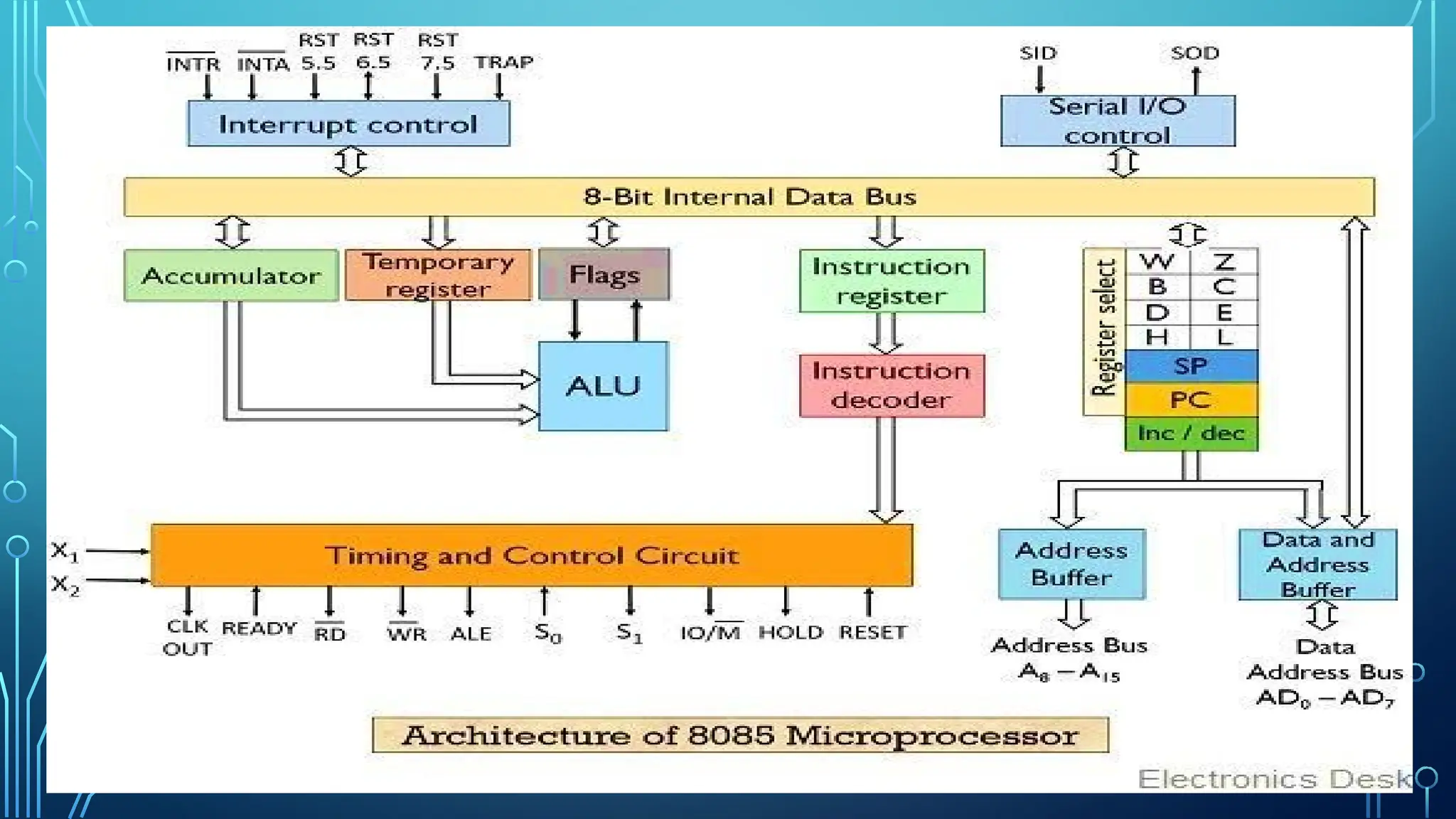
•Connects core components like the Accumulator, ALU, Temporary Register, and various internal registers,
enabling data movement within the CPU.
•Data Transfer and Operations:
•The data bus allows the microprocessor to move data between different registers and the ALU for processing.
•It plays a critical role in both instruction fetching and execution.
•Bidirectional Nature: The data bus is bidirectional, meaning it can carry data both to and from various parts of
the processor.
•Limitations:
•Being 8-bit means it can handle data operations in 8-bit chunks, which impacts the processing speed for larger
data types.
•The data bus is bidirectional, meaning it can carry data both to and from various parts of the processor.
KEY COMPONENTS - ALU, ACCUMULATOR, AND
FLAGS
•Accumulator (A):
•Acts as the primary register for arithmetic and logic operations.
•Often referred to as "Register A," it temporarily holds data that the ALU is currently processing or will process.
•Results of most arithmetic and logic operations are stored back in the accumulator.
•Arithmetic Logic Unit (ALU):
•The ALU performs two main types of operations:
•Arithmetic Operations: Addition, subtraction, increment, and decrement.
•Logic Operations: AND, OR, XOR, NOT, and compare operations.
•The ALU works closely with the flags to indicate the outcome of each operation.
• Flag Register: Contains five individual flags that represent the outcome of an operation:
• Sign Flag (S): Indicates if the result is positive (0) or negative (1).
• Zero Flag (Z): Set to 1 if the result is zero.
• Auxiliary Carry Flag (AC): Used for Binary-Coded Decimal (BCD) operations, indicates carry out of the
lower nibble.
• Parity Flag (P): Set to 1 if the number of 1s in the result is even.
• Carry Flag (CY): Set if there is a carry out or borrow in an arithmetic operation.
• Flags are used by conditional instructions (like JZ, JC) to make decisions based on operation
outcomes.
REGISTERS AND INSTRUCTION DECODING
•General-Purpose Registers:
•Registers B, C, D, E, H, and L can be used individually or in pairs (BC, DE, HL) to hold temporary data.
•These registers assist in operations by temporarily storing data, allowing the ALU to work more flexibly.
•Special Purpose Registers:
•Program Counter (PC): A 16-bit register that holds the address of the next instruction to be executed.
•After each instruction, the PC is incremented, directing the microprocessor to the next command.
•Stack Pointer (SP): A 16-bit register pointing to the top of the stack in memory.
•The stack is used to save return addresses, register values, or other temporary data.
•Instruction Register and Decoder:
•Instruction Register: Temporarily holds the current instruction being processed.
•Instruction Decoder: Interprets the binary opcode from the instruction register, identifying which operation
to perform.
•The decoded instruction then controls various parts of the processor to execute the command.
•Pipeline:
•The 8085 has limited pipelining; while it fetches one instruction, it can simultaneously decode and execute
the previous one.
CONTROL CIRCUIT AND TIMING
• Timing and Control Circuit: Manages the operation of the microprocessor by generating
and managing control signals.
• Coordinates with the clock to ensure each part of an instruction cycle (fetch, decode,
execute) happens at the right time.
• Control Signals:
• READY: Indicates if the external memory or I/O is ready for data transfer.
• HOLD: Allows external devices to request control of the bus.
• RESET: Resets the microprocessor, clearing the program counter and halting operations.
• WR: Used for writing data to memory or I/O.
• RD: Used for reading data from memory or I/O.
•Clock Signals:
•Clock signals control the timing of operations, ensuring that each operation occurs in synchrony with
others.
•The clock generator provides timing for all operations, including fetching and execution.
•I/O and Memory Control:
•IO/M Signal: Differentiates between memory and I/O operations.
•S0 and S1 Signals: Status signals that indicate the current state of the operation, used by external
devices.
INTERRUPT SYSTEM AND SERIAL COMMUNICATION
• Interrupt Control System: Provides mechanisms for handling external events and emergencies
by temporarily halting the main program.
• Types of Interrupts:
• INTR: General-purpose interrupt that can be masked.
• RST 7.5, RST 6.5, RST 5.5: Vectored, maskable interrupts with higher priority than INTR.
• TRAP: Non-maskable, highest-priority interrupt that cannot be ignored.
• Function:
• When an interrupt occurs, the current instruction is completed, and control is passed to a predefined
memory location to handle the interrupt.
• Serial I/O Control: Allows simple serial data communication.
• SID (Serial Input Data): Reads serial data from an external source.
• SOD (Serial Output Data): Sends serial data to an external device.
• Usage:
• Useful for basic data communication with devices like sensors, which may not need full
parallel I/O support.
SUMMARY AND CONCLUSION
•Summary:
•The 8085 microprocessor is a fundamental 8-bit processor with essential
components for computation, memory management, and I/O handling.
•Conclusion:
•Its simplicity and efficient design make it a foundational element in understanding
microprocessor architecture.

Architecture of the 8085 and its registers.pptx

  • 1.
    ARCHITECTURE OF THE8085 MICROPROCESSOR BY : NAVINKRISHNA K
  • 2.
    INTRODUCTION TO THE8085 MICROPROCESSOR • What is the 8085 Microprocessor? • 8-bit microprocessor developed by Intel. • Operates on +5V power supply, with a clock speed of 3 MHz. • Primarily used in embedded systems and early computers. • Key Features: • 16-bit address bus, 8-bit data bus. • 74 instructions in its instruction set.
  • 4.
    THE DATA FLOW- INTERNAL DATA BUS •8-Bit Internal Data Bus: •The internal data bus in the 8085 microprocessor is 8 bits wide, which means it can transfer 8 bits of data simultaneously. •Connects core components like the Accumulator, ALU, Temporary Register, and various internal registers, enabling data movement within the CPU. •Data Transfer and Operations: •The data bus allows the microprocessor to move data between different registers and the ALU for processing. •It plays a critical role in both instruction fetching and execution. •Bidirectional Nature: The data bus is bidirectional, meaning it can carry data both to and from various parts of the processor. •Limitations: •Being 8-bit means it can handle data operations in 8-bit chunks, which impacts the processing speed for larger data types. •The data bus is bidirectional, meaning it can carry data both to and from various parts of the processor.
  • 5.
    KEY COMPONENTS -ALU, ACCUMULATOR, AND FLAGS •Accumulator (A): •Acts as the primary register for arithmetic and logic operations. •Often referred to as "Register A," it temporarily holds data that the ALU is currently processing or will process. •Results of most arithmetic and logic operations are stored back in the accumulator. •Arithmetic Logic Unit (ALU): •The ALU performs two main types of operations: •Arithmetic Operations: Addition, subtraction, increment, and decrement. •Logic Operations: AND, OR, XOR, NOT, and compare operations. •The ALU works closely with the flags to indicate the outcome of each operation.
  • 6.
    • Flag Register:Contains five individual flags that represent the outcome of an operation: • Sign Flag (S): Indicates if the result is positive (0) or negative (1). • Zero Flag (Z): Set to 1 if the result is zero. • Auxiliary Carry Flag (AC): Used for Binary-Coded Decimal (BCD) operations, indicates carry out of the lower nibble. • Parity Flag (P): Set to 1 if the number of 1s in the result is even. • Carry Flag (CY): Set if there is a carry out or borrow in an arithmetic operation. • Flags are used by conditional instructions (like JZ, JC) to make decisions based on operation outcomes.
  • 7.
    REGISTERS AND INSTRUCTIONDECODING •General-Purpose Registers: •Registers B, C, D, E, H, and L can be used individually or in pairs (BC, DE, HL) to hold temporary data. •These registers assist in operations by temporarily storing data, allowing the ALU to work more flexibly. •Special Purpose Registers: •Program Counter (PC): A 16-bit register that holds the address of the next instruction to be executed. •After each instruction, the PC is incremented, directing the microprocessor to the next command. •Stack Pointer (SP): A 16-bit register pointing to the top of the stack in memory. •The stack is used to save return addresses, register values, or other temporary data.
  • 8.
    •Instruction Register andDecoder: •Instruction Register: Temporarily holds the current instruction being processed. •Instruction Decoder: Interprets the binary opcode from the instruction register, identifying which operation to perform. •The decoded instruction then controls various parts of the processor to execute the command. •Pipeline: •The 8085 has limited pipelining; while it fetches one instruction, it can simultaneously decode and execute the previous one.
  • 9.
    CONTROL CIRCUIT ANDTIMING • Timing and Control Circuit: Manages the operation of the microprocessor by generating and managing control signals. • Coordinates with the clock to ensure each part of an instruction cycle (fetch, decode, execute) happens at the right time. • Control Signals: • READY: Indicates if the external memory or I/O is ready for data transfer. • HOLD: Allows external devices to request control of the bus. • RESET: Resets the microprocessor, clearing the program counter and halting operations. • WR: Used for writing data to memory or I/O. • RD: Used for reading data from memory or I/O.
  • 10.
    •Clock Signals: •Clock signalscontrol the timing of operations, ensuring that each operation occurs in synchrony with others. •The clock generator provides timing for all operations, including fetching and execution. •I/O and Memory Control: •IO/M Signal: Differentiates between memory and I/O operations. •S0 and S1 Signals: Status signals that indicate the current state of the operation, used by external devices.
  • 11.
    INTERRUPT SYSTEM ANDSERIAL COMMUNICATION • Interrupt Control System: Provides mechanisms for handling external events and emergencies by temporarily halting the main program. • Types of Interrupts: • INTR: General-purpose interrupt that can be masked. • RST 7.5, RST 6.5, RST 5.5: Vectored, maskable interrupts with higher priority than INTR. • TRAP: Non-maskable, highest-priority interrupt that cannot be ignored. • Function: • When an interrupt occurs, the current instruction is completed, and control is passed to a predefined memory location to handle the interrupt.
  • 12.
    • Serial I/OControl: Allows simple serial data communication. • SID (Serial Input Data): Reads serial data from an external source. • SOD (Serial Output Data): Sends serial data to an external device. • Usage: • Useful for basic data communication with devices like sensors, which may not need full parallel I/O support.
  • 13.
    SUMMARY AND CONCLUSION •Summary: •The8085 microprocessor is a fundamental 8-bit processor with essential components for computation, memory management, and I/O handling. •Conclusion: •Its simplicity and efficient design make it a foundational element in understanding microprocessor architecture.