ARTIFICIAL
INTELLIGENCE
CONTENTS
Introduction
History of Artificial Intelligence
Why AI
Limitations of Human Mind
Applications
Advantages
Disadvantages
INTRODUCTION
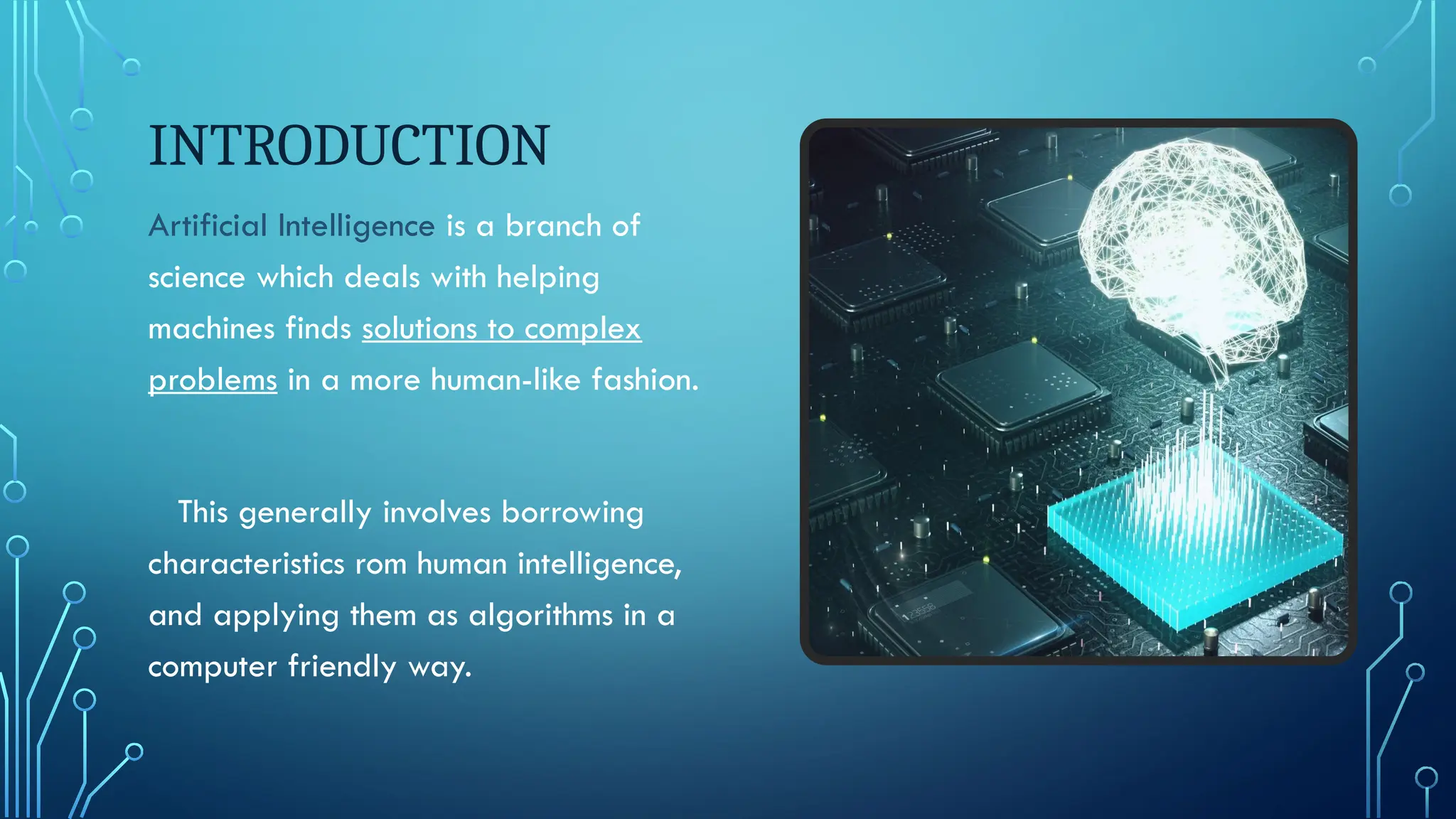
Artificial Intelligence is a branch of
science which deals with helping
machines finds solutions to complex
problems in a more human-like fashion.
This generally involves borrowing
characteristics rom human intelligence,
and applying them as algorithms in a
computer friendly way.
HISTORY OF AI
1941: First electronic computer [technology finally available]
1956: Term Artificial Intelligence introduced
1960s: Checkers-playing program that was able to play games
with opponents
1980s: Quality Control Systems
2000: First sophisticated walking robot
WHY AI ?
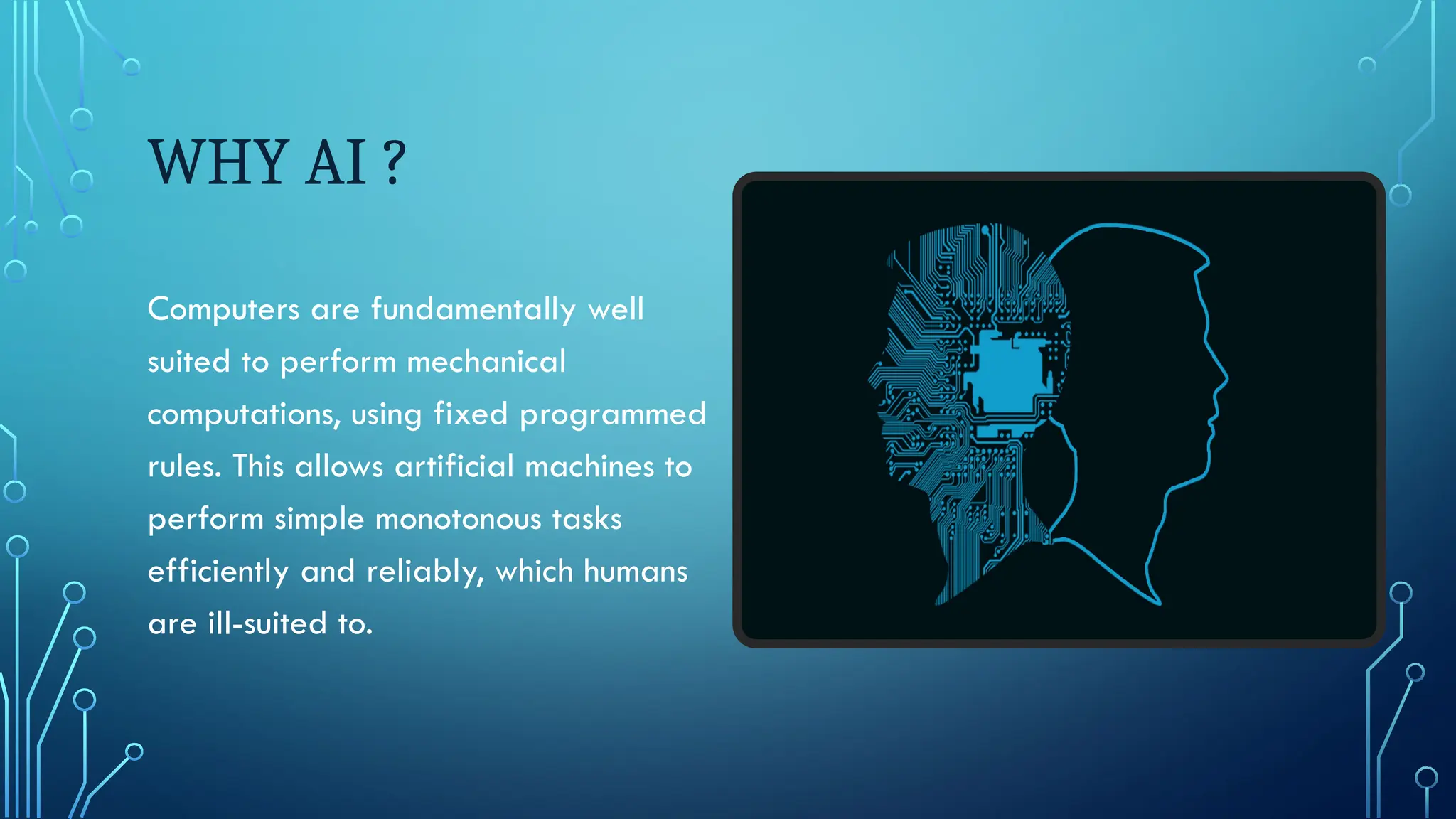
Computers are fundamentally well
suited to perform mechanical
computations, using fixed programmed
rules. This allows artificial machines to
perform simple monotonous tasks
efficiently and reliably, which humans
are ill-suited to.
LIMITATIONS OF HUMAN MIND
Object recognition. People cannot properly explain how they recognize
objects.
Face recognition. Cannot be passed on to another person by explanation.
Naming of colours. Based on learning, not on absolute standards.
APPLICATIONS OF AI
Expert systems.
Natural Language Processing (NLP).
Speech recognition.
Computer vision.
Robotics.
EXPERT SYSTEMS
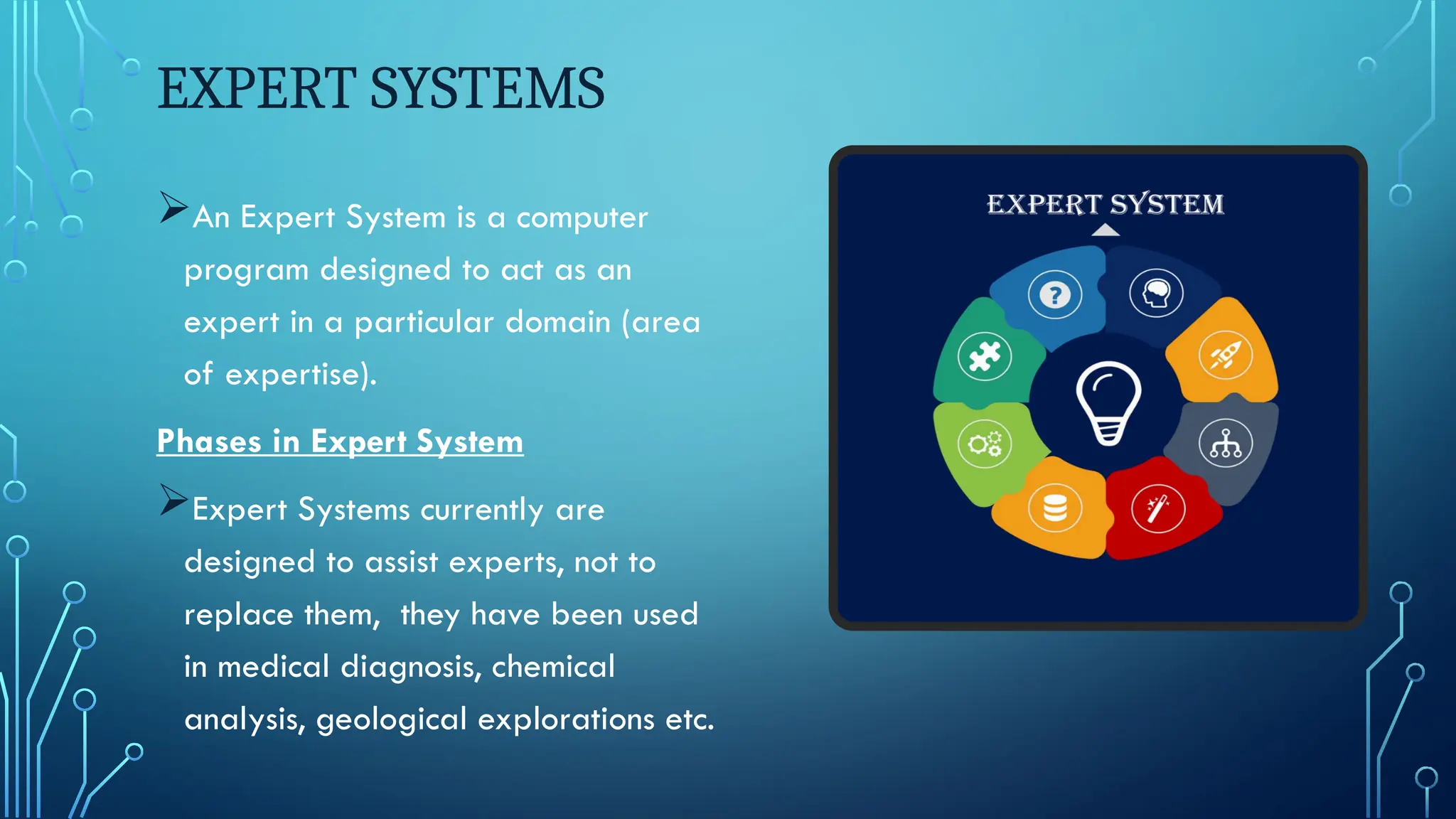
An Expert System is a computer
program designed to act as an
expert in a particular domain (area
of expertise).
Phases in Expert System
Expert Systems currently are
designed to assist experts, not to
replace them, they have been used
in medical diagnosis, chemical
analysis, geological explorations etc.
NATURAL LANGUAGE PROCESSING
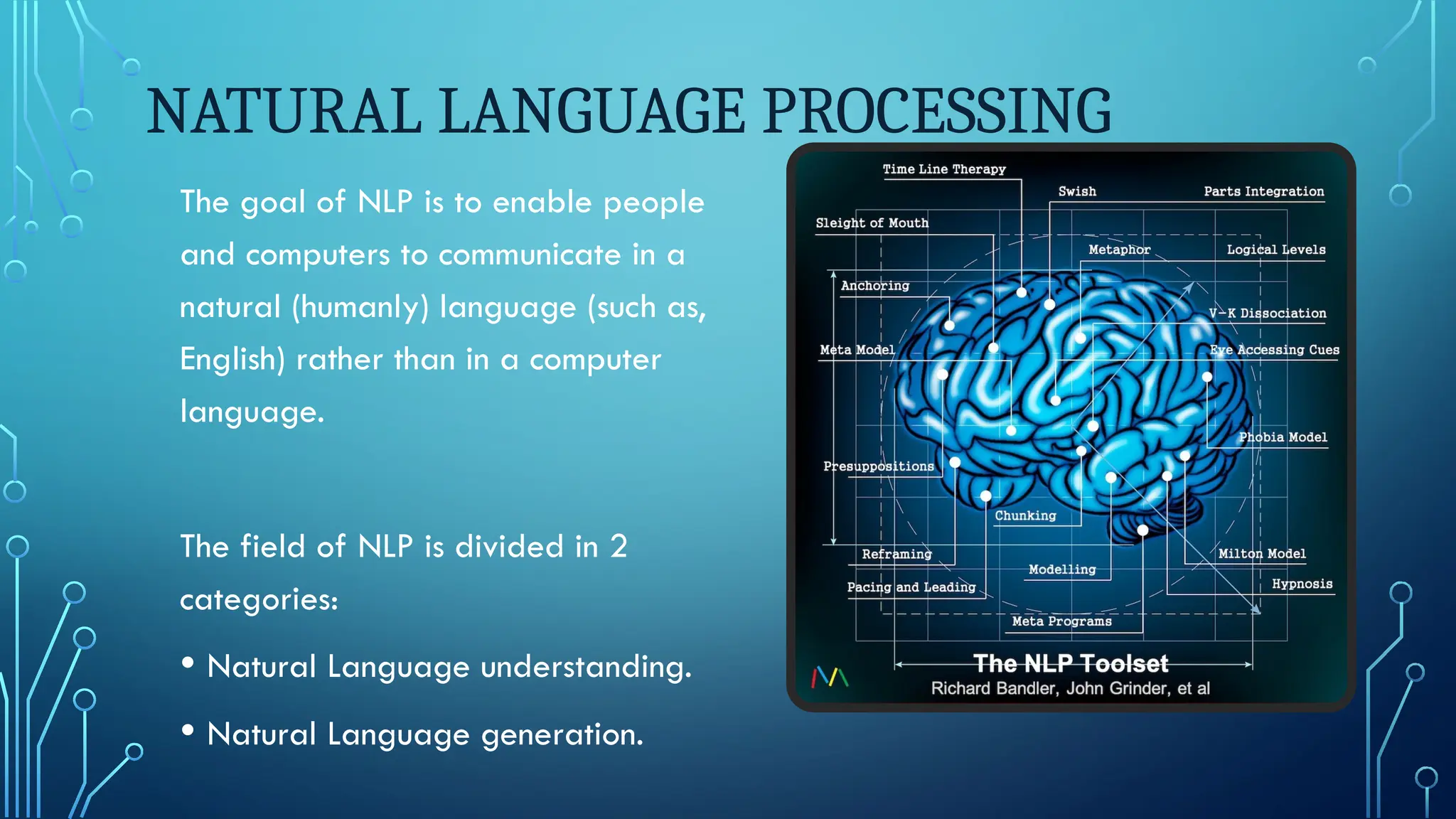
The goal of NLP is to enable people
and computers to communicate in a
natural (humanly) language (such as,
English) rather than in a computer
language.
The field of NLP is divided in 2
categories:
• Natural Language understanding.
• Natural Language generation.
SPEECH RECOGNITION
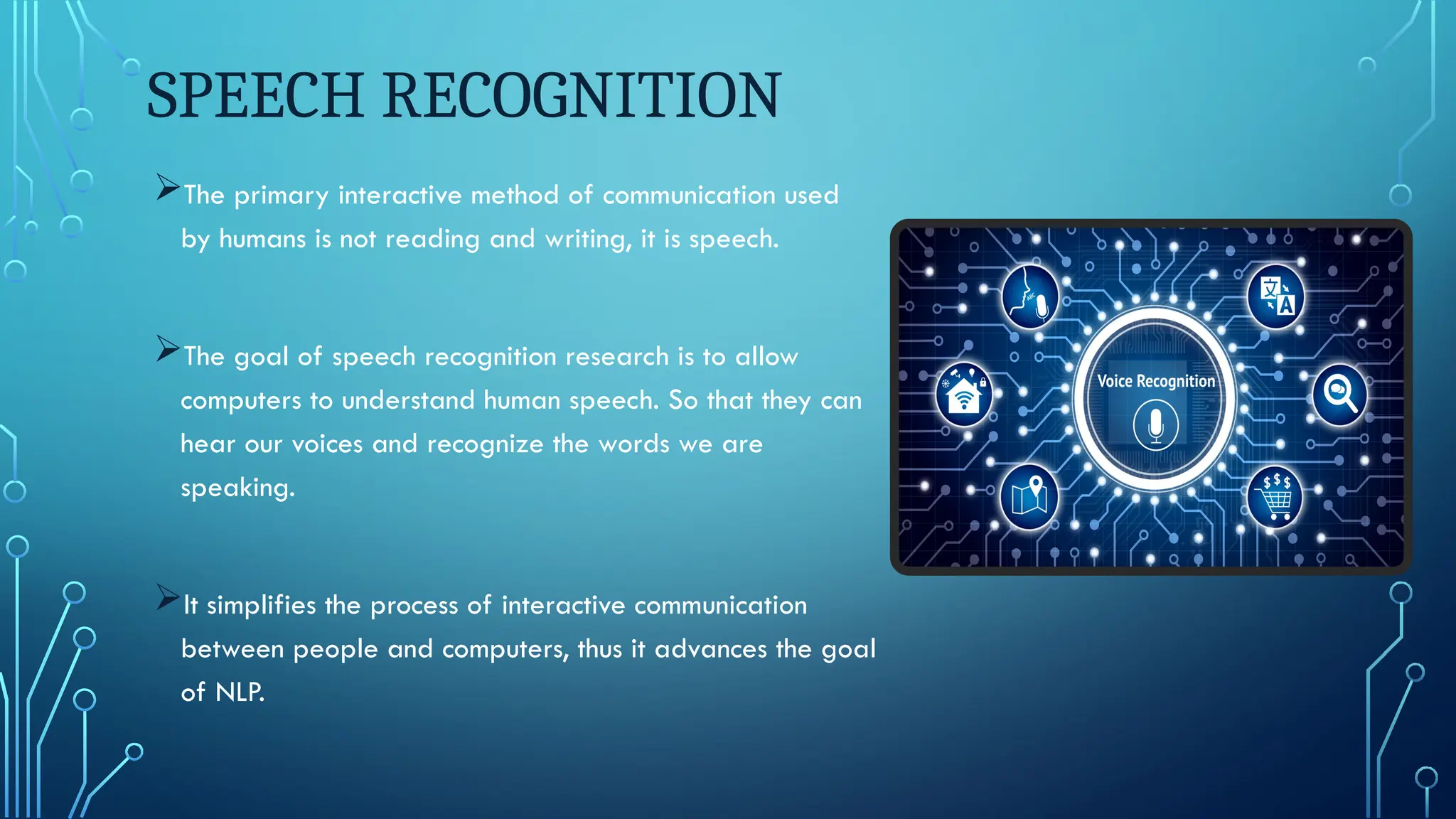
The primary interactive method of communication used
by humans is not reading and writing, it is speech.
The goal of speech recognition research is to allow
computers to understand human speech. So that they can
hear our voices and recognize the words we are
speaking.
It simplifies the process of interactive communication
between people and computers, thus it advances the goal
of NLP.
COMPUTER VISION
People generally use vision as their
primary means of sensing their
environment, we generally see more than
we hear, fell or smell or taste.
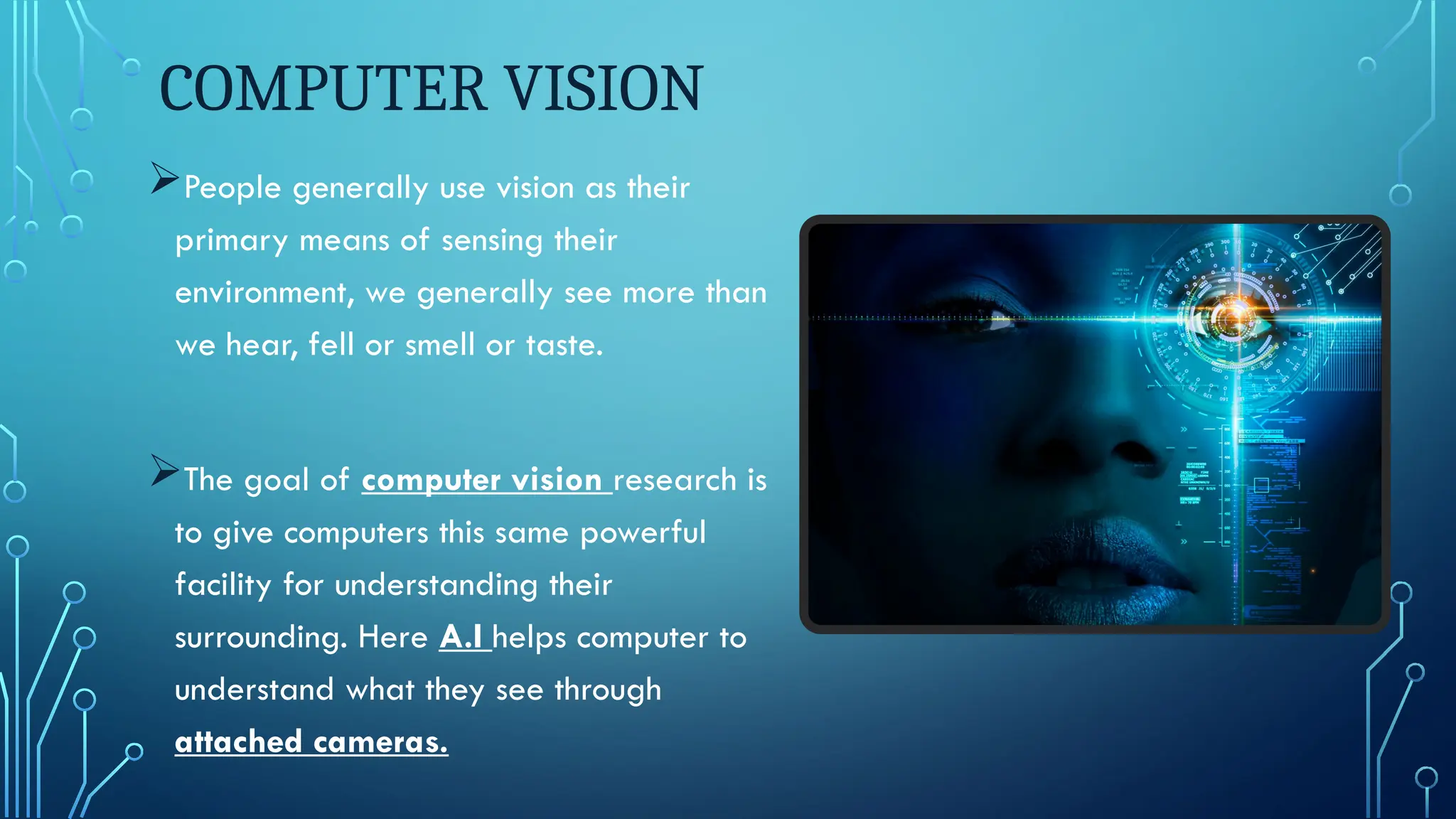
The goal of computer vision research is
to give computers this same powerful
facility for understanding their
surrounding. Here A.I helps computer to
understand what they see through
attached cameras.
ROBOTICS
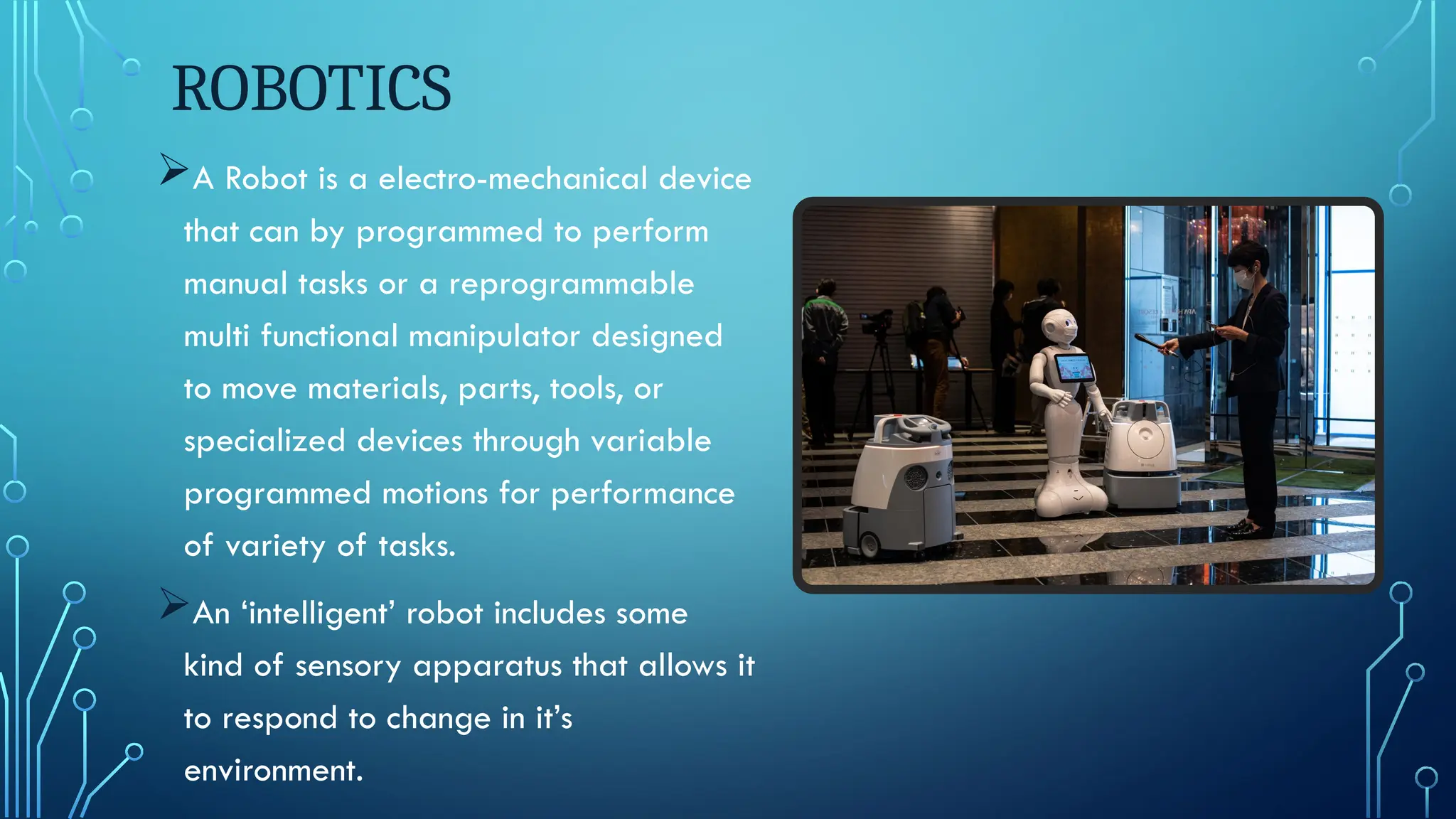
A Robot is a electro-mechanical device
that can by programmed to perform
manual tasks or a reprogrammable
multi functional manipulator designed
to move materials, parts, tools, or
specialized devices through variable
programmed motions for performance
of variety of tasks.
An ‘intelligent’ robot includes some
kind of sensory apparatus that allows it
to respond to change in it’s
environment.
ADVANTAGES DISADVANTAGES
Less room for errors.
Improved efficiency.
Takes risk instead of humans.
Always available.
Digital assistance.
Faster decision.
High development cost.
Unemployment.
Makes humans dependent.
Lack of out box thinking.
Could dominate humans.
Unit 1  of artificial intelligence and its introduction

Unit 1 of artificial intelligence and its introduction

  • 1.
  • 2.
    CONTENTS Introduction History of ArtificialIntelligence Why AI Limitations of Human Mind Applications Advantages Disadvantages
  • 3.
    INTRODUCTION Artificial Intelligence isa branch of science which deals with helping machines finds solutions to complex problems in a more human-like fashion. This generally involves borrowing characteristics rom human intelligence, and applying them as algorithms in a computer friendly way.
  • 4.
    HISTORY OF AI 1941:First electronic computer [technology finally available] 1956: Term Artificial Intelligence introduced 1960s: Checkers-playing program that was able to play games with opponents 1980s: Quality Control Systems 2000: First sophisticated walking robot
  • 5.
    WHY AI ? Computersare fundamentally well suited to perform mechanical computations, using fixed programmed rules. This allows artificial machines to perform simple monotonous tasks efficiently and reliably, which humans are ill-suited to.
  • 6.
    LIMITATIONS OF HUMANMIND Object recognition. People cannot properly explain how they recognize objects. Face recognition. Cannot be passed on to another person by explanation. Naming of colours. Based on learning, not on absolute standards.
  • 7.
    APPLICATIONS OF AI Expertsystems. Natural Language Processing (NLP). Speech recognition. Computer vision. Robotics.
  • 8.
    EXPERT SYSTEMS An ExpertSystem is a computer program designed to act as an expert in a particular domain (area of expertise). Phases in Expert System Expert Systems currently are designed to assist experts, not to replace them, they have been used in medical diagnosis, chemical analysis, geological explorations etc.
  • 9.
    NATURAL LANGUAGE PROCESSING Thegoal of NLP is to enable people and computers to communicate in a natural (humanly) language (such as, English) rather than in a computer language. The field of NLP is divided in 2 categories: • Natural Language understanding. • Natural Language generation.
  • 10.
    SPEECH RECOGNITION The primaryinteractive method of communication used by humans is not reading and writing, it is speech. The goal of speech recognition research is to allow computers to understand human speech. So that they can hear our voices and recognize the words we are speaking. It simplifies the process of interactive communication between people and computers, thus it advances the goal of NLP.
  • 11.
    COMPUTER VISION People generallyuse vision as their primary means of sensing their environment, we generally see more than we hear, fell or smell or taste. The goal of computer vision research is to give computers this same powerful facility for understanding their surrounding. Here A.I helps computer to understand what they see through attached cameras.
  • 12.
    ROBOTICS A Robot isa electro-mechanical device that can by programmed to perform manual tasks or a reprogrammable multi functional manipulator designed to move materials, parts, tools, or specialized devices through variable programmed motions for performance of variety of tasks. An ‘intelligent’ robot includes some kind of sensory apparatus that allows it to respond to change in it’s environment.
  • 13.
    ADVANTAGES DISADVANTAGES Less roomfor errors. Improved efficiency. Takes risk instead of humans. Always available. Digital assistance. Faster decision. High development cost. Unemployment. Makes humans dependent. Lack of out box thinking. Could dominate humans.