Economics 
The study of choices
What do you 
Want? 
I want… We want…
What do you 
Want? 
I want… We want… 
Census Bureau reports poverty at 
highest rate since 1994 
GDP Full employment 
Low inflation 
…more than I can get… …more than we can get… 
I Want It All
Scarcity – our wants for goods and 
services are virtually unlimited, 
but the productive resources we 
use to create them are not. 
Productive Resources: 
• natural 
• human (labor) 
• capital goods (goods used to 
produce other goods and services) 
Different priorities about importance of 
various goods and services 
(value judgments): 
What contributes most to the public good ? 
Is it more important to be efficient or fair? 
Wants vs. needs (personal choice) 
Macroeconomics 
Issues affecting 
the whole 
economy: 
unemployment, 
inflation, GDP,… 
Microeconomics 
• Individual choices 
• Individual markets 
(demand and supply) 
This is why 
economics exists. 
Complications
How Do You Know When 
Something Is Scarce? 
Scarcity Forces You to 
CHOOSE 
SCARCITY 
CHOICE
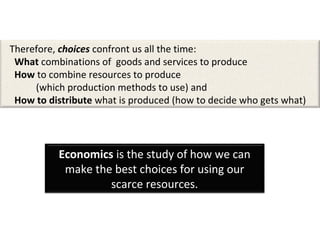
Therefore, choices confront us all the time: 
What combinations of goods and services to produce 
How to combine resources to produce 
(which production methods to use) and 
How to distribute what is produced (how to decide who gets what) 
Economics is the study of how we can 
make the best choices for using our 
scarce resources.
best choices? 
Economic efficiency 
producing the combination and 
amounts of goods and services 
that the society wants 
fijit 
Technical efficiency 
using the lowest cost 
production methods to 
produce the largest 
possible amount of 
output 
Allocative efficiency
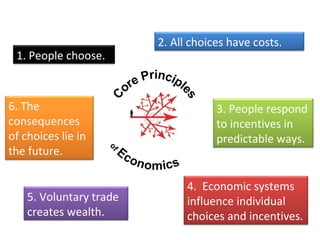
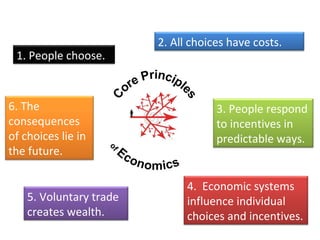
1. People choose. 
2. All choices have costs. 
3. People respond 
to incentives in 
predictable ways. 
5. Voluntary trade 
creates wealth. 
4. Economic systems 
influence individual 
choices and incentives. 
6. The 
consequences 
of choices lie in 
the future.
1. People choose. 
Based on goals: 
Consumers choose what combinations 
of goods and services to buy and how 
to behave in order to maximize 
individual well being given income. 
Workers choose what kind and how 
much labor to supply to businesses in 
order to maximize income given 
preferences for work and leisure time. 
(because of scarcity)
People choose - continued 
Businesses choose what and how much to 
produce and sell in order to maximize profit 
(revenue minus cost). 
Governments choose what combinations of 
goods and services (as determined by local, 
state, and federal government budgets) 
will maximize society’s well being 
(as measured by Gross Domestic Product 
[GDP], number of jobs, purchasing power, 
happiness, …?) 
Anyone – choose to behave in a 
way that will increase the 
world’s well being?
2. All choices have costs. 
“What should I do today? 
Play soccer or ride my scooter?” 
Cost = sacrifice 
“I will buy the sweater. My 
opportunity cost is the books.” 
(may or may not be measured in $) 
Opportunity cost: the next best alternative you 
sacrifice when you make a choice 
What is your opportunity cost for coming to 
school today?
Marginal rule for decision making: 
choose the alternative for which 
the additional benefit is more than the 
additional cost 
(ideally, the one that provides the most 
additional benefits with the least 
additional cost )
Negotiating with the Dentist 
Economics for Leaders
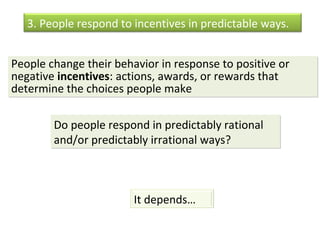
3. People respond to incentives in predictable ways. 
People change their behavior in response to positive or 
negative incentives: actions, awards, or rewards that 
determine the choices people make 
Do people respond in predictably rational 
and/or predictably irrational ways? 
It depends…
Did people respond to 
the rising price of gas by 
buying less? Yes 
…but 
How do people 
respond in the 
ultimatum game? 
Homo economicus: 
logical, consistent 
choices 
Was your decision to participate in this learning 
community affected by the thought of getting into a 
better college? 
Do you leave a tip for a server in a restaurant you will 
never go to again?
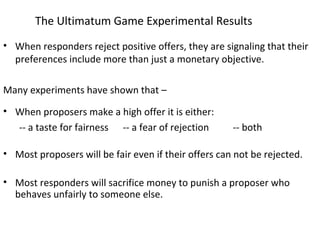
The Ultimatum Game Experimental Results 
• When responders reject positive offers, they are signaling that their 
preferences include more than just a monetary objective. 
Many experiments have shown that – 
• When proposers make a high offer it is either: 
-- a taste for fairness -- a fear of rejection -- both 
• Most proposers will be fair even if their offers can not be rejected. 
• Most responders will sacrifice money to punish a proposer who 
behaves unfairly to someone else.
The ultimatum game does not reveal 
rational “homo economicus,” 
but it does reveal behavior that 
Adam Smith would have predicted 
(yes, the same Adam Smith whose 
invisible hand guides the free market 
system!).
4. Economic systems influence individual choices 
and incentives. 
The type of economic system a country has is determined by: 
• Who owns the productive resources (natural, human, capital goods)? 
• How it chooses what, how, and who gets what? 
Are these questions answered by: 
• The interaction of buyers and sellers in markets (demand and 
supply)? 
• Government? 
• A combination? 
We want a system that will help us reach our goals 
as individuals and as a country.
Range of the World’s Economic Systems 
Almost all of the countries in the world have “mixed 
ePcuorneo smocieiasl.i”sm is rare. 
Mixed Capitalism 
Command 
economy 
(Based on a free market system, with some government intervention)
Research 
• On the computer look up the following information on The CIA world fact 
book ( Google it ) 
• Type information out on a google doc and share it (10 point assignment) 
1. What is the GDP per Capita, unemployment rate, government type, 
corporate tax rates of: 
a) USA 
b) Cuba 
c) Singapore 
d) Hong Kong 
e) Zimbabwe 
2. What other important economic factors can you find? 
3. Why are the countries ranked where they are? 
4. Does it all have to do with Government? 
5. Is one type of government a better type of government for their 
economies?
1. People choose. 
2. All choices have costs. 
3. People respond 
to incentives in 
predictable ways. 
5. Voluntary trade 
creates wealth. 
4. Economic systems 
influence individual 
choices and incentives. 
6. The 
consequences 
of choices lie in 
the future.
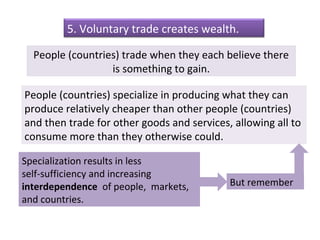
5. Voluntary trade creates wealth. 
People (countries) trade when they each believe there 
is something to gain. 
People (countries) specialize in producing what they can 
produce relatively cheaper than other people (countries) 
and then trade for other goods and services, allowing all to 
consume more than they otherwise could. 
Specialization results in less 
self-sufficiency and increasing 
interdependence of people, markets, 
and countries. 
But remember
6. The consequences of choices lie in the future. 
We can only influence the future; 
we cannot change the past (sunk cost). 
You pay $10 to see a movie. You soon regret your choice. 
This is without a doubt the worst movie you have ever 
seen. 
What do you do? 
a. Stay and watch the whole movie because 
you don’t want to waste your $10. 
b. Leave immediately. 
Unintended consequences 
Unexpected benefits: aspirin 
Unexpected costs: Prohibition

Economics

  • 1.
  • 3.
    What do you Want? I want… We want…
  • 4.
    What do you Want? I want… We want… Census Bureau reports poverty at highest rate since 1994 GDP Full employment Low inflation …more than I can get… …more than we can get… I Want It All
  • 5.
    Scarcity – ourwants for goods and services are virtually unlimited, but the productive resources we use to create them are not. Productive Resources: • natural • human (labor) • capital goods (goods used to produce other goods and services) Different priorities about importance of various goods and services (value judgments): What contributes most to the public good ? Is it more important to be efficient or fair? Wants vs. needs (personal choice) Macroeconomics Issues affecting the whole economy: unemployment, inflation, GDP,… Microeconomics • Individual choices • Individual markets (demand and supply) This is why economics exists. Complications
  • 6.
    How Do YouKnow When Something Is Scarce? Scarcity Forces You to CHOOSE SCARCITY CHOICE
  • 7.
    Therefore, choices confrontus all the time: What combinations of goods and services to produce How to combine resources to produce (which production methods to use) and How to distribute what is produced (how to decide who gets what) Economics is the study of how we can make the best choices for using our scarce resources.
  • 8.
    best choices? Economicefficiency producing the combination and amounts of goods and services that the society wants fijit Technical efficiency using the lowest cost production methods to produce the largest possible amount of output Allocative efficiency
  • 9.
    1. People choose. 2. All choices have costs. 3. People respond to incentives in predictable ways. 5. Voluntary trade creates wealth. 4. Economic systems influence individual choices and incentives. 6. The consequences of choices lie in the future.
  • 10.
    1. People choose. Based on goals: Consumers choose what combinations of goods and services to buy and how to behave in order to maximize individual well being given income. Workers choose what kind and how much labor to supply to businesses in order to maximize income given preferences for work and leisure time. (because of scarcity)
  • 11.
    People choose -continued Businesses choose what and how much to produce and sell in order to maximize profit (revenue minus cost). Governments choose what combinations of goods and services (as determined by local, state, and federal government budgets) will maximize society’s well being (as measured by Gross Domestic Product [GDP], number of jobs, purchasing power, happiness, …?) Anyone – choose to behave in a way that will increase the world’s well being?
  • 12.
    2. All choiceshave costs. “What should I do today? Play soccer or ride my scooter?” Cost = sacrifice “I will buy the sweater. My opportunity cost is the books.” (may or may not be measured in $) Opportunity cost: the next best alternative you sacrifice when you make a choice What is your opportunity cost for coming to school today?
  • 13.
    Marginal rule fordecision making: choose the alternative for which the additional benefit is more than the additional cost (ideally, the one that provides the most additional benefits with the least additional cost )
  • 14.
    Negotiating with theDentist Economics for Leaders
  • 15.
    3. People respondto incentives in predictable ways. People change their behavior in response to positive or negative incentives: actions, awards, or rewards that determine the choices people make Do people respond in predictably rational and/or predictably irrational ways? It depends…
  • 16.
    Did people respondto the rising price of gas by buying less? Yes …but How do people respond in the ultimatum game? Homo economicus: logical, consistent choices Was your decision to participate in this learning community affected by the thought of getting into a better college? Do you leave a tip for a server in a restaurant you will never go to again?
  • 17.
    The Ultimatum GameExperimental Results • When responders reject positive offers, they are signaling that their preferences include more than just a monetary objective. Many experiments have shown that – • When proposers make a high offer it is either: -- a taste for fairness -- a fear of rejection -- both • Most proposers will be fair even if their offers can not be rejected. • Most responders will sacrifice money to punish a proposer who behaves unfairly to someone else.
  • 18.
    The ultimatum gamedoes not reveal rational “homo economicus,” but it does reveal behavior that Adam Smith would have predicted (yes, the same Adam Smith whose invisible hand guides the free market system!).
  • 19.
    4. Economic systemsinfluence individual choices and incentives. The type of economic system a country has is determined by: • Who owns the productive resources (natural, human, capital goods)? • How it chooses what, how, and who gets what? Are these questions answered by: • The interaction of buyers and sellers in markets (demand and supply)? • Government? • A combination? We want a system that will help us reach our goals as individuals and as a country.
  • 20.
    Range of theWorld’s Economic Systems Almost all of the countries in the world have “mixed ePcuorneo smocieiasl.i”sm is rare. Mixed Capitalism Command economy (Based on a free market system, with some government intervention)
  • 21.
    Research • Onthe computer look up the following information on The CIA world fact book ( Google it ) • Type information out on a google doc and share it (10 point assignment) 1. What is the GDP per Capita, unemployment rate, government type, corporate tax rates of: a) USA b) Cuba c) Singapore d) Hong Kong e) Zimbabwe 2. What other important economic factors can you find? 3. Why are the countries ranked where they are? 4. Does it all have to do with Government? 5. Is one type of government a better type of government for their economies?
  • 23.
    1. People choose. 2. All choices have costs. 3. People respond to incentives in predictable ways. 5. Voluntary trade creates wealth. 4. Economic systems influence individual choices and incentives. 6. The consequences of choices lie in the future.
  • 24.
    5. Voluntary tradecreates wealth. People (countries) trade when they each believe there is something to gain. People (countries) specialize in producing what they can produce relatively cheaper than other people (countries) and then trade for other goods and services, allowing all to consume more than they otherwise could. Specialization results in less self-sufficiency and increasing interdependence of people, markets, and countries. But remember
  • 25.
    6. The consequencesof choices lie in the future. We can only influence the future; we cannot change the past (sunk cost). You pay $10 to see a movie. You soon regret your choice. This is without a doubt the worst movie you have ever seen. What do you do? a. Stay and watch the whole movie because you don’t want to waste your $10. b. Leave immediately. Unintended consequences Unexpected benefits: aspirin Unexpected costs: Prohibition