LO1
Business plans- A business plan includes where the business is at the time of writing the
document, including their resources and abilities. Then where they plan to be at a specific
point in the future, this could be how much they want to increase their profits, they may
want to reduce their outgoings, or to increase their assets.
A business plan is to help encourage a business to focus on the tasks that they want
to achieve. By doing this they may also be able to convince banks to provide them with
loans to improve their business because the banks would be able to see that they have got a
clear, realistic plan to be completed within a deadline.
Business models- A business model is to help the owners of the business create a product or
service that customers feel like they need. By creating a business model to business can first
look at what they want to sell, and then how they are going to make money off of it. They
must include the supplies used, the labour, manufacturing, marketing, distribution, delivery
and time it takes to process the sale. This all takes time and therefore, costs money/ The
business needs to make sure that they are pricing their time as appropriately as they would
be when it comes to working out the cost of the raw materials.
A sustainable business model also includes integrating social and environmental
issues into their business plan. These types of business models must be forward thinking to
be able to survive in a changing economy and to appeal to the needs of future customers
and generations.
Providing the platform for
‘free,’ Airbnb takes a 3%
commission on the host‘s
earnings and asks a
booking fee of 6-12% to
guests for every booking
they make.
This company has made their business model in a
way so that they encourage people to list their
properties with them by having it so they make
money on their property, and also so that the
business benefits from this.
Pets at home sell 50% of all pet services in the UK, having started off as a pet shop selling
food, toys, bedding etc. they have now started moving into the market of ‘the groom room’
which is their pet haircut service, and ‘vets for pets’ which is their vet service. This has
benefitted them greatly and it has made them a ‘one stop shop’ for all pet needs.
Pets at home have also started a VIP service where when people sign up, they
receive vouchers for services and products, and in return a percentage of the money they
spend in-store goes to the selection of charities that they help.
Changers makes money by
selling solar panels + batteries.
In the Changers shop, where
community members can
redeem credits for products and
services, they give exposure to
green brands, which pay a
commission fee for the leads.
This company encourages consumers to buy their
products by offering them benefits from using their
products. They are able to redeem credits for
products and services when they use green brands.
Uber takes a 5-20% commission on
all the rides made through its
service. Since all payments are
done automatically through the
app, Uber is sure to capture a part
of each transaction.
This company works by having regular people
working for the company and them taking a
commission of the earning. This encourages people
to work for the company because they are able to
work when they want to and have control over when
their working. UBER work through an app so they are
able to see each transaction and take the right
amount of money.
By offering these services they can encourage people to use a range of their services,
for example, when someone buys a rabbit, they get a voucher for money off vaccinations for
that rabbit which encourages them to use that service. If they then find tat service easy and
good value for money, they will keep using that service.
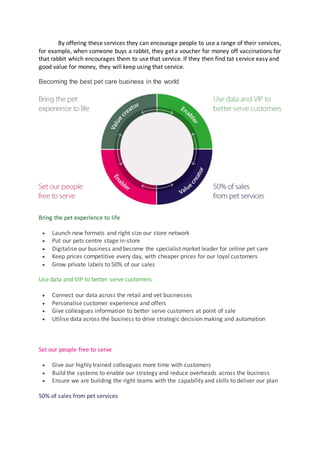
Becoming the best pet care business in the world
Bring the pet experience to life
 Launch new formats and right size our store network
 Put our pets centre stage in-store
 Digitalise our business and become the specialist market leader for online pet care
 Keep prices competitive every day, with cheaper prices for our loyal customers
 Grow private labels to 50% of our sales
Use data and VIP to better serve customers
 Connect our data across the retail and vet businesses
 Personalise customer experience and offers
 Give colleagues information to better serve customers at point of sale
 Utilise data across the business to drive strategic decision making and automation
Set our people free to serve
 Give our highly trained colleagues more time with customers
 Build the systems to enable our strategy and reduce overheads across the business
 Ensure we are building the right teams with the capability and skills to deliver our plan
50% of sales from pet services
 Develop our stores of tomorrow, with more space dedicated to pet care and services
 Extend our subscription expertise into pet care plans
 Recalibrate our First Opinion vet business and realise free cashflow growth
 Grow our Specialist Referral business through existing and new hospitals
Above shows Pets at homes business model, including their aims for the business, and how
they will achieve this. It also shows how they are using the VIP service to benefit both the
customer and the business and other types of customer service they will offer in-store and
online to stand out from their competitors.
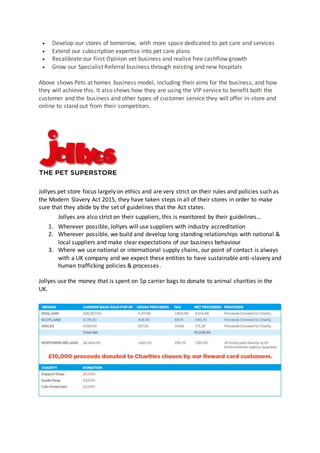
Jollyes pet store focus largely on ethics and are very strict on their rules and policies such as
the Modern Slavery Act 2015, they have taken steps in all of their stores in order to make
sure that they abide by the set of guidelines that the Act states.
Jollyes are also strict on their suppliers, this is monitored by their guidelines…
1. Wherever possible, Jollyes will use suppliers with industry accreditation
2. Wherever possible, we build and develop long standing relationships with national &
local suppliers and make clear expectations of our business behaviour
3. Where we use national or international supply chains, our point of contact is always
with a UK company and we expect these entities to have sustainable anti-slavery and
human trafficking policies & processes.
Jollyes use the money that is spent on 5p carrier bags to donate to animal charities in the
UK.
Mission statement-
A mission statement outlines the purpose of the company for those in the organisation and
to the public. A mission statement is important because it ensure that everyone in and
around the business are ‘on the same page’. A mission statement will also include a
company’s current capabilities, such as their activities.
Example- The mission of Make-A-Wish International is to grant the wishes of children with
life-threatening medical conditions to enrich the human experience with hope, strength and
joy
Brand positioning-
Brand positioning is where the company wants to have a place in the consumers mind, they
want their customers to think of their brand before they think of the company’s
competitors. They do this by making sure that they have a clear plan of who their target
market is and what they are going to do to appeal to them.
Example- Tesco supermarkets do this by having the most expensive brand at the consumers
eye level, then the middle-priced brand above and the cheapest brand at the bottom of the
shelves. This is because they want the consumer to see the item that makes the business
the most money before they see any other items.
Value drivers-
Value drivers are anything that can be added to a product or service that will increase its
value to consumers, this can allow the business to have a competitive advantage. A
company will be able to increase its sales and position on the market by adding value drivers
and will increase the possibility of customers buying the product.
Example-
How can a small business market themselves?
Newspaper
- Local radio
- Sponsorship for local events
- Social media
- Word-of-mouth
- Local networking group (BNI)
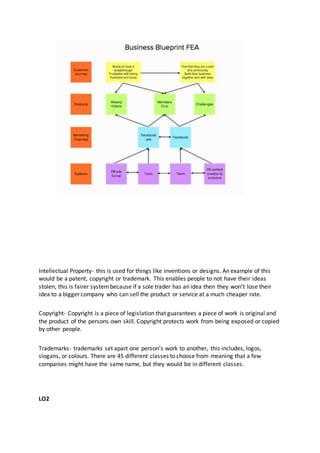
In business, what is a blueprint and how would this relate to customers and marketing?
A company will make a blueprint of the things that they want to incorporate into their
business processes. It is very similar to a business model, it includes what the business is
planning to do in the future and how they plan to do this.
Example-
Intellectual Property- this is used for things like inventions or designs. An example of this
would be a patent, copyright or trademark. This enables people to not have their ideas
stolen, this is fairer systembecause if a sole trader has an idea then they won’t lose their
idea to a bigger company who can sell the product or service at a much cheaper rate.
Copyright- Copyright is a piece of legislation that guarantees a piece of work is original and
the product of the persons own skill. Copyright protects work from being exposed or copied
by other people.
Trademarks- trademarks set apart one person’s work to another, this includes, logos,
slogans, or colours. There are 45 different classes to choose from meaning that a few
companies might have the same name, but they would be in different classes.
LO2
SWOT Analysis
Strengths-
- fast return on investment
Weaknesses-
- not enough resources for the work
Opportunities-
- can move into new geographic markets
Threats-
- competitors working on similar projects
A business uses a SWOT analysis to help look at if the business could take greater
advantages of their opportunities and therefore make more profit. A new business may also
make a SWOT analysis to see if their business idea would be viable, they can do this by
looking at the threats and weaknesses of their business ideas and to see how they could
overcome or avoid these issues.
PESTEL Analysis
Political
Economical
Sociological
Technological
Environmental
Legal
A PESTEL analysis allows a business to look at the external factors that impact or may impact
the business. Each sector of the PESTEL analysis applies to different businesses in different
ways, for example, a packaging manufacturer may look more at environmental factors for
their business. whereas, a supermarket would look more at the technological and economic
factors.
Brexit may affect creative businesses, this is because a lot of small creative business use
companies from abroad to buy supplies, this is because it is sometimes cheaper to do this
than to order from a company in the UK. However, prices may go up when the UK leaves the
EU meaning that the smaller businesses may be forced to put their prices up, this has a
knock-on effect because they then lose customers who don’t want to pay higher prices.
Cultural policy- what is currently happening in the UK
Political- Brexit is an issue that will affect a lot of businesses in the UK, especially creative
businesses. This is because there will be a lot more issues with travelling to European
countries which could affect filming industries who may travel for short amount of time
because it is currently hassle free.
Economical- An economical issue that could affect creative businesses could be funding,
because some projects may seemlike they won’t make any money back, it may be more
difficult to get funding from banks.
Sociological- social media will have a huge impact on creative industries, this is because
small businesses can use it to advertise and receive feedback on their products or services.
However, because the site is so widely used, it can mean that there is more competition and
some reviews can be very detrimental to small businesses.
Technological- Technology can have many great advantages to businesses and can mean
that they can produce faster, and more accurate work. However, a bigger company will be
able to afford better technology meaning that they can sell each product or service cheaper.
This will badly affect smaller businesses because they won’t be able to keep up with larger
businesses or sell their products or services any cheaper or they won’t make any money.
This in turn can put them out of business. The way the consumer communicates to the
business has also changed, communication used to be very formal and done by the use of
email, letter or phone call. Whereas, social media is becoming more popular to use to
communicate such as leaving comments on pictures, or messaging the company directly, or
even facetiming in some businesses. These can also be done as an way to make the
customer feel more special because they feel like the company is listening to them, and also
because it takes less time to send a quick message than sending an email which can be quite
formal.
Environmental- There are many environmental issues currently affecting the UK, climate
change is one of them. There are many protesters in and around main cities in the UK
targeting different businesses who may not be doing their best to help the environment.
This can make for a lot of bad publicity and possibly put some businesses in a very
vulnerable position because they are being directly targeted. Some businesses may not be
able to afford to put measures in place to combat these issues and therefore they may lose
customers.
Legal- Many legal issues affect all businesses, this can be policies that protect consumers or
employees. Some measures that are put in place take away certain ways that a business
may have been able to take a shortcut in order to save money. This is good for the
consumer or the employees because it means that they will be safer. However, these cost
businesses money, and the upkeep of certain things such as safety measures continuously
cost money. For large businesses this will mostly go unnoticed. But for smaller businesses
these implements would cost a lot of money.
conduct a personal SWOT analysis-
Strengths-
- Unique selling points
- Resources
- Innovation
Weaknesses-
- Capability gaps
- Financial risks
- Deadlines
Opportunities-
- Catered to customer needs
- Seasonal trends
- Partnerships with other small businesses
Threats-
- Consumer confidence
- Competitors
- Prices from suppliers changing
Current cultural policies may affect my business, for example Brexit may affect the
availability of supplies I can get for my business. Some of materials I use come from places
like the USA, the Czech Republic and China. By the UK leaving the EU it may be harder to get
materials from these places because the laws within the UK may change in regard to the
products allowed to be shipped.
However, this may benefit my business because materials may become cheaper to
source within the UK and therefore, I would be able to sell my products cheaper, or make
more profit on them. This would also be better for the economy to buy materials from this
country.
LO3
Funding for a small business
Personal savings- this is where the person starting the business uses the money that they
have earnt from previous work. This is good because then the business is theirs and they
don’t owe anyone any money. However, if the business fails then they lose their savings and
their source of income.
Family and friends- Family or friends sometimes offer to help start a business, this is good
because there are no deadlines to pay the person back, and there wouldn’t be any debt on
their loan. However, this can cause friction and the family or friends may lose a lot of money
because they wouldn’t have understood and assessed the businesses plans.
Crowdfunding- This involves asking for small donations from many people, this is good
because the money would not have to be paid back. However, it requires a lot of work
beforehand and it cannot be predicted how much money the person would make.
Angel investors- These are people who donate money to the business in exchange for a
share of the business and its profits. This means that the person running the business
wouldn’t be under any direct pressure to pay the money back. However, they would lose
some control of the business.
Bank loans- this is one of the most popular ways to start a business, the person starting the
business wouldn’t not have to lose any control of the business and the process is relatively
quick. However, the interest can be very high, and the person would have to pay back a lot
more than they originally borrowed.
For my business I would not need to lay out a lot of money to start, I could advertise the
colours of the materials I can source and when people order a particular colour, I can then
purchase it. I wouldn’t have to buy all of the materials at once because I might not sell any
of that particular product. This means that I can use my own personal savings which I would
be able to get back relatively quickly if I made sure that each of my products was priced to
make a profit. Also, because my business is run from social media, I would not have to pay
any money to advertise my business because social media does this for free.
In regard to the resources I would need, I would have to find a supplier that is both,
cheap and reliable and that the products they were selling me were value for money. I can
do this by buying small quantities to test, I can then sell these if they are of substantial
quality, of if they are not, I can use them as examples of the types of products I make for
customers to test sizing.
LO4
What is a regulatory body and what is a regulatory framework?
A regulatory body puts conditions, requirements and restrictions in place in order to set
standards for businesses to run by. By having these standards, it means that there is a
certain expectation for businesses to meet, this might be conditions for employees, or
standards for products or services. Regulatory framework is the systems of the regulations
and how they enforced.
OFCOM- This is a regulator and competition authority for UK industries, it aims to regulate
the TV and radio sectors as well as airwaves and wireless devices. They also regulate postal
services by making sure that letters are sent within 6 days. This is to help keep standards
higher so that customers get good service.
ASA- ASA is a company which process complaint from customers and businesses about
advertisements that may be offensive or misleading, they also monitor any ads. They
conduct research to test public opinion and only act when necessary. They have the power
to have any ads that they consider to be ‘wrong’ removed. This is a government run
company that doesn’t cost the taxpayer any money.
PCC- A PCC (Parish Church Council) these regulations were put in place for people working
on charity owned buildings. This come into place after a worker was injured when doing
work on a church. It means that the government pay the compensation and not the charity.
BBFC- This is the UK’s film and video regulator, they provide the age limits and ratings for
films that are released in the UK. They also have the power to reject projects if they don’t
think that they are safe, or good enough for the public to view. This was put in place so that
people can easily see age limits on films and what sort of thing the film includes.
PEGI- (Pan-European Game Information) this company are a rating system for video and
computer games. The ratings are determined from the content of the games such as
language, discrimination, drugs, fear, violence, gambling and sex. By setting these standards
consumers know what is included in the game and therefore whether they would want to
buy it either for them or for someone else.
Creative industries council- the creative industries council is a joint forum between creative
industries and the government. Their role is to check the growth and barriers in the sectors
and monitor any changes. This can help them decide what to put any funding they have on
such as further education for different creative sectors.
DCMS- The DCMS is the Department for Digital, Culture, Media and Sport, their aim is to
promote growth and enrich Britain abroad. They protect cultural and artistic heritage, this is
especially important for the creative industries because it mean that they get promoted and
protected wherever they are, and their history and culture are highlighted and invested
into.
My business would be affected by the Creative Industries Council, this is because they would
like to monitor the growth of my business and check any barriers that my business will face.
This is good because it means that I can be given advice based on what is found my this
organisation and use this to benefit my business and overcome any issues that I may face. It
may also be hat I can apply for funding for my business and therefore this can help my
business grow because I may be able to advertise to a larger audience or go to an event that
I may not have been able to afford otherwise.

Unit 1 assignment 1

  • 1.
    LO1 Business plans- Abusiness plan includes where the business is at the time of writing the document, including their resources and abilities. Then where they plan to be at a specific point in the future, this could be how much they want to increase their profits, they may want to reduce their outgoings, or to increase their assets. A business plan is to help encourage a business to focus on the tasks that they want to achieve. By doing this they may also be able to convince banks to provide them with loans to improve their business because the banks would be able to see that they have got a clear, realistic plan to be completed within a deadline. Business models- A business model is to help the owners of the business create a product or service that customers feel like they need. By creating a business model to business can first look at what they want to sell, and then how they are going to make money off of it. They must include the supplies used, the labour, manufacturing, marketing, distribution, delivery and time it takes to process the sale. This all takes time and therefore, costs money/ The business needs to make sure that they are pricing their time as appropriately as they would be when it comes to working out the cost of the raw materials. A sustainable business model also includes integrating social and environmental issues into their business plan. These types of business models must be forward thinking to be able to survive in a changing economy and to appeal to the needs of future customers and generations. Providing the platform for ‘free,’ Airbnb takes a 3% commission on the host‘s earnings and asks a booking fee of 6-12% to guests for every booking they make. This company has made their business model in a way so that they encourage people to list their properties with them by having it so they make money on their property, and also so that the business benefits from this.
  • 2.
    Pets at homesell 50% of all pet services in the UK, having started off as a pet shop selling food, toys, bedding etc. they have now started moving into the market of ‘the groom room’ which is their pet haircut service, and ‘vets for pets’ which is their vet service. This has benefitted them greatly and it has made them a ‘one stop shop’ for all pet needs. Pets at home have also started a VIP service where when people sign up, they receive vouchers for services and products, and in return a percentage of the money they spend in-store goes to the selection of charities that they help. Changers makes money by selling solar panels + batteries. In the Changers shop, where community members can redeem credits for products and services, they give exposure to green brands, which pay a commission fee for the leads. This company encourages consumers to buy their products by offering them benefits from using their products. They are able to redeem credits for products and services when they use green brands. Uber takes a 5-20% commission on all the rides made through its service. Since all payments are done automatically through the app, Uber is sure to capture a part of each transaction. This company works by having regular people working for the company and them taking a commission of the earning. This encourages people to work for the company because they are able to work when they want to and have control over when their working. UBER work through an app so they are able to see each transaction and take the right amount of money.
  • 3.
    By offering theseservices they can encourage people to use a range of their services, for example, when someone buys a rabbit, they get a voucher for money off vaccinations for that rabbit which encourages them to use that service. If they then find tat service easy and good value for money, they will keep using that service. Becoming the best pet care business in the world Bring the pet experience to life  Launch new formats and right size our store network  Put our pets centre stage in-store  Digitalise our business and become the specialist market leader for online pet care  Keep prices competitive every day, with cheaper prices for our loyal customers  Grow private labels to 50% of our sales Use data and VIP to better serve customers  Connect our data across the retail and vet businesses  Personalise customer experience and offers  Give colleagues information to better serve customers at point of sale  Utilise data across the business to drive strategic decision making and automation Set our people free to serve  Give our highly trained colleagues more time with customers  Build the systems to enable our strategy and reduce overheads across the business  Ensure we are building the right teams with the capability and skills to deliver our plan 50% of sales from pet services
  • 4.
     Develop ourstores of tomorrow, with more space dedicated to pet care and services  Extend our subscription expertise into pet care plans  Recalibrate our First Opinion vet business and realise free cashflow growth  Grow our Specialist Referral business through existing and new hospitals Above shows Pets at homes business model, including their aims for the business, and how they will achieve this. It also shows how they are using the VIP service to benefit both the customer and the business and other types of customer service they will offer in-store and online to stand out from their competitors. Jollyes pet store focus largely on ethics and are very strict on their rules and policies such as the Modern Slavery Act 2015, they have taken steps in all of their stores in order to make sure that they abide by the set of guidelines that the Act states. Jollyes are also strict on their suppliers, this is monitored by their guidelines… 1. Wherever possible, Jollyes will use suppliers with industry accreditation 2. Wherever possible, we build and develop long standing relationships with national & local suppliers and make clear expectations of our business behaviour 3. Where we use national or international supply chains, our point of contact is always with a UK company and we expect these entities to have sustainable anti-slavery and human trafficking policies & processes. Jollyes use the money that is spent on 5p carrier bags to donate to animal charities in the UK.
  • 5.
    Mission statement- A missionstatement outlines the purpose of the company for those in the organisation and to the public. A mission statement is important because it ensure that everyone in and around the business are ‘on the same page’. A mission statement will also include a company’s current capabilities, such as their activities. Example- The mission of Make-A-Wish International is to grant the wishes of children with life-threatening medical conditions to enrich the human experience with hope, strength and joy Brand positioning- Brand positioning is where the company wants to have a place in the consumers mind, they want their customers to think of their brand before they think of the company’s competitors. They do this by making sure that they have a clear plan of who their target market is and what they are going to do to appeal to them. Example- Tesco supermarkets do this by having the most expensive brand at the consumers eye level, then the middle-priced brand above and the cheapest brand at the bottom of the shelves. This is because they want the consumer to see the item that makes the business the most money before they see any other items. Value drivers- Value drivers are anything that can be added to a product or service that will increase its value to consumers, this can allow the business to have a competitive advantage. A company will be able to increase its sales and position on the market by adding value drivers and will increase the possibility of customers buying the product.
  • 6.
    Example- How can asmall business market themselves? Newspaper - Local radio - Sponsorship for local events - Social media - Word-of-mouth - Local networking group (BNI) In business, what is a blueprint and how would this relate to customers and marketing? A company will make a blueprint of the things that they want to incorporate into their business processes. It is very similar to a business model, it includes what the business is planning to do in the future and how they plan to do this. Example-
  • 7.
    Intellectual Property- thisis used for things like inventions or designs. An example of this would be a patent, copyright or trademark. This enables people to not have their ideas stolen, this is fairer systembecause if a sole trader has an idea then they won’t lose their idea to a bigger company who can sell the product or service at a much cheaper rate. Copyright- Copyright is a piece of legislation that guarantees a piece of work is original and the product of the persons own skill. Copyright protects work from being exposed or copied by other people. Trademarks- trademarks set apart one person’s work to another, this includes, logos, slogans, or colours. There are 45 different classes to choose from meaning that a few companies might have the same name, but they would be in different classes. LO2
  • 8.
    SWOT Analysis Strengths- - fastreturn on investment Weaknesses- - not enough resources for the work Opportunities- - can move into new geographic markets Threats- - competitors working on similar projects A business uses a SWOT analysis to help look at if the business could take greater advantages of their opportunities and therefore make more profit. A new business may also make a SWOT analysis to see if their business idea would be viable, they can do this by looking at the threats and weaknesses of their business ideas and to see how they could overcome or avoid these issues. PESTEL Analysis Political Economical Sociological Technological Environmental Legal A PESTEL analysis allows a business to look at the external factors that impact or may impact the business. Each sector of the PESTEL analysis applies to different businesses in different ways, for example, a packaging manufacturer may look more at environmental factors for their business. whereas, a supermarket would look more at the technological and economic factors. Brexit may affect creative businesses, this is because a lot of small creative business use companies from abroad to buy supplies, this is because it is sometimes cheaper to do this than to order from a company in the UK. However, prices may go up when the UK leaves the
  • 9.
    EU meaning thatthe smaller businesses may be forced to put their prices up, this has a knock-on effect because they then lose customers who don’t want to pay higher prices. Cultural policy- what is currently happening in the UK Political- Brexit is an issue that will affect a lot of businesses in the UK, especially creative businesses. This is because there will be a lot more issues with travelling to European countries which could affect filming industries who may travel for short amount of time because it is currently hassle free. Economical- An economical issue that could affect creative businesses could be funding, because some projects may seemlike they won’t make any money back, it may be more difficult to get funding from banks. Sociological- social media will have a huge impact on creative industries, this is because small businesses can use it to advertise and receive feedback on their products or services. However, because the site is so widely used, it can mean that there is more competition and some reviews can be very detrimental to small businesses. Technological- Technology can have many great advantages to businesses and can mean that they can produce faster, and more accurate work. However, a bigger company will be able to afford better technology meaning that they can sell each product or service cheaper. This will badly affect smaller businesses because they won’t be able to keep up with larger businesses or sell their products or services any cheaper or they won’t make any money. This in turn can put them out of business. The way the consumer communicates to the business has also changed, communication used to be very formal and done by the use of email, letter or phone call. Whereas, social media is becoming more popular to use to communicate such as leaving comments on pictures, or messaging the company directly, or even facetiming in some businesses. These can also be done as an way to make the customer feel more special because they feel like the company is listening to them, and also because it takes less time to send a quick message than sending an email which can be quite formal. Environmental- There are many environmental issues currently affecting the UK, climate change is one of them. There are many protesters in and around main cities in the UK targeting different businesses who may not be doing their best to help the environment. This can make for a lot of bad publicity and possibly put some businesses in a very vulnerable position because they are being directly targeted. Some businesses may not be able to afford to put measures in place to combat these issues and therefore they may lose customers. Legal- Many legal issues affect all businesses, this can be policies that protect consumers or employees. Some measures that are put in place take away certain ways that a business may have been able to take a shortcut in order to save money. This is good for the consumer or the employees because it means that they will be safer. However, these cost businesses money, and the upkeep of certain things such as safety measures continuously
  • 10.
    cost money. Forlarge businesses this will mostly go unnoticed. But for smaller businesses these implements would cost a lot of money. conduct a personal SWOT analysis- Strengths- - Unique selling points - Resources - Innovation Weaknesses- - Capability gaps - Financial risks - Deadlines Opportunities- - Catered to customer needs - Seasonal trends - Partnerships with other small businesses Threats- - Consumer confidence - Competitors - Prices from suppliers changing Current cultural policies may affect my business, for example Brexit may affect the availability of supplies I can get for my business. Some of materials I use come from places like the USA, the Czech Republic and China. By the UK leaving the EU it may be harder to get materials from these places because the laws within the UK may change in regard to the products allowed to be shipped. However, this may benefit my business because materials may become cheaper to source within the UK and therefore, I would be able to sell my products cheaper, or make more profit on them. This would also be better for the economy to buy materials from this country. LO3 Funding for a small business Personal savings- this is where the person starting the business uses the money that they have earnt from previous work. This is good because then the business is theirs and they
  • 11.
    don’t owe anyoneany money. However, if the business fails then they lose their savings and their source of income. Family and friends- Family or friends sometimes offer to help start a business, this is good because there are no deadlines to pay the person back, and there wouldn’t be any debt on their loan. However, this can cause friction and the family or friends may lose a lot of money because they wouldn’t have understood and assessed the businesses plans. Crowdfunding- This involves asking for small donations from many people, this is good because the money would not have to be paid back. However, it requires a lot of work beforehand and it cannot be predicted how much money the person would make. Angel investors- These are people who donate money to the business in exchange for a share of the business and its profits. This means that the person running the business wouldn’t be under any direct pressure to pay the money back. However, they would lose some control of the business. Bank loans- this is one of the most popular ways to start a business, the person starting the business wouldn’t not have to lose any control of the business and the process is relatively quick. However, the interest can be very high, and the person would have to pay back a lot more than they originally borrowed. For my business I would not need to lay out a lot of money to start, I could advertise the colours of the materials I can source and when people order a particular colour, I can then purchase it. I wouldn’t have to buy all of the materials at once because I might not sell any of that particular product. This means that I can use my own personal savings which I would be able to get back relatively quickly if I made sure that each of my products was priced to make a profit. Also, because my business is run from social media, I would not have to pay any money to advertise my business because social media does this for free. In regard to the resources I would need, I would have to find a supplier that is both, cheap and reliable and that the products they were selling me were value for money. I can do this by buying small quantities to test, I can then sell these if they are of substantial quality, of if they are not, I can use them as examples of the types of products I make for customers to test sizing. LO4 What is a regulatory body and what is a regulatory framework? A regulatory body puts conditions, requirements and restrictions in place in order to set standards for businesses to run by. By having these standards, it means that there is a certain expectation for businesses to meet, this might be conditions for employees, or standards for products or services. Regulatory framework is the systems of the regulations and how they enforced.
  • 12.
    OFCOM- This isa regulator and competition authority for UK industries, it aims to regulate the TV and radio sectors as well as airwaves and wireless devices. They also regulate postal services by making sure that letters are sent within 6 days. This is to help keep standards higher so that customers get good service. ASA- ASA is a company which process complaint from customers and businesses about advertisements that may be offensive or misleading, they also monitor any ads. They conduct research to test public opinion and only act when necessary. They have the power to have any ads that they consider to be ‘wrong’ removed. This is a government run company that doesn’t cost the taxpayer any money. PCC- A PCC (Parish Church Council) these regulations were put in place for people working on charity owned buildings. This come into place after a worker was injured when doing work on a church. It means that the government pay the compensation and not the charity. BBFC- This is the UK’s film and video regulator, they provide the age limits and ratings for films that are released in the UK. They also have the power to reject projects if they don’t think that they are safe, or good enough for the public to view. This was put in place so that people can easily see age limits on films and what sort of thing the film includes. PEGI- (Pan-European Game Information) this company are a rating system for video and computer games. The ratings are determined from the content of the games such as language, discrimination, drugs, fear, violence, gambling and sex. By setting these standards consumers know what is included in the game and therefore whether they would want to buy it either for them or for someone else. Creative industries council- the creative industries council is a joint forum between creative industries and the government. Their role is to check the growth and barriers in the sectors and monitor any changes. This can help them decide what to put any funding they have on such as further education for different creative sectors. DCMS- The DCMS is the Department for Digital, Culture, Media and Sport, their aim is to promote growth and enrich Britain abroad. They protect cultural and artistic heritage, this is especially important for the creative industries because it mean that they get promoted and protected wherever they are, and their history and culture are highlighted and invested into. My business would be affected by the Creative Industries Council, this is because they would like to monitor the growth of my business and check any barriers that my business will face. This is good because it means that I can be given advice based on what is found my this organisation and use this to benefit my business and overcome any issues that I may face. It may also be hat I can apply for funding for my business and therefore this can help my
  • 13.
    business grow becauseI may be able to advertise to a larger audience or go to an event that I may not have been able to afford otherwise.