


1
© 2015 Grant Thornton UK LLP. All rights reserved.
The Union Customs Code
A guide for UK business
© 2015 Grant Thornton UK LLP. All rights reserved.
Union Customs Code
What is which UK business is affected?
Businesses involved in global trade in goods will be affected by UCC changes.
Manufacturers, exporters, freight forwarders, warehouse-keepers, clearance
agents, carriers and importers should all assess how the UCC will impact them.
This impacts UK businesses trading internationally and:
• Paying customs duty
• Importing and/or exporting
• Storing goods in warehouses 'under bond'
• Processing raw materials into something else without paying customs duty.
The UCC (Regulation 952/2013) entered into force on 30
October 2013 but will only be applied as of 1 May 2016.
© 2015 Grant Thornton UK LLP. All rights reserved.
What are the key changes?
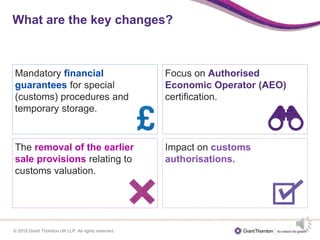
Mandatory financial
guarantees for special
(customs) procedures and
temporary storage.
Focus on Authorised
Economic Operator (AEO)
certification.
Impact on customs
authorisations.
The removal of the earlier
sale provisions relating to
customs valuation.
© 2015 Grant Thornton UK LLP. All rights reserved.
Financial guarantees
• This will apply to an estimated 20,000 existing customs authorisations in
the UK, where a guarantee is not currently required
• Transitional arrangements for guarantees and customs authorisations
– Existing guarantees for potential debts will be reassessed by Customs
until 1 May 2019
– Current authorisations will need to be reviewed (expiry date vs
reassessment)
All customs duties which are potentially due through the
operation of a customs duty relief scheme or suspension
regime, must now be secured by a guarantee.
© 2015 Grant Thornton UK LLP. All rights reserved.
Authorised Economic Operator (AEO)
Becoming accredited with HMRC as 'AEO' before 1 May 2016 means:
• A full financial guarantee waiver (for potential duty)
• Partial guarantee waiver (actual duty)
• Your authorisations to use customs warehouse under bond and
processing relief will be renewed post 1 May 2016
• Enhances the business's reputation as a 'trusted partner'
• Recognised status internationally, can speed up international supply
chain and logistic processes
© 2015 Grant Thornton UK LLP. All rights reserved.
Earlier sales, customs warehousing
Loss of first sale/
earlier sale
Earlier sale facility will be withdrawn and replaced by
a last sale only rule. This means that the customs
value must be declared on the price payable
immediately before entry into free circulation.
Impact on customs warehousing
Loss of first sale facility also means that customs
value must be based on the last selling price before
removal of goods.
A transitional period until 31 December
2017 is currently proposed to
businesses
A business contract with your supplier,
linked to the import and requiring use
of earlier sale value must be in place
as early as Spring/Summer 2015.
Any mark-up and profit would need to
be included, inflating the customs
value, where goods are sold before
removal from a customs warehouse.
© 2015 Grant Thornton UK LLP. All rights reserved.
How to prepare for upcoming changes?
• May 2016 is not a long
way ahead
• However, any business
contemplating AEO as a
strategy to prepare for the
UCC changes should
place this high on the
agenda for 2015
• Strategic customs
planning and
collaboration are vital
General
recommendations
• Identify the key areas that
are affected (such as
customs warehouse, royalty
agreements)
• Determine the risk level in
order to prioritise and build
your strategy
• Review and amend those
areas in order to minimise
any potential risks of non-
compliance
• Monitor any upcoming
changes
How Grant Thornton
can help
• Cost-benefit analysis of UCC
changes
• Risk reviews
• Remediation of gaps
encountered
• Assistance with writing or
updating processes and
procedures
• Completion and submission
of your AEO application pack
• Liaison with HMRC
• Designing and implementing
a monitoring programme
• Providing a regular update
service on UCC
© 2015 Grant Thornton UK LLP. All rights reserved.
Contact details
For further details please contact one of our team members below,
or your usual Grant Thornton contact.
Ian Worth
Customs Associate Director
T +44 (0)20 7728 2174
E ian.worth@uk.gt.com
Ilektra Sarri
Associate
T +44 (0)20 7728 3437
E ilektra.sarri@uk.gt.com
10

Union Custom Code

  • 1.
  • 2.
    © 2015 GrantThornton UK LLP. All rights reserved. The Union Customs Code A guide for UK business
  • 3.
    © 2015 GrantThornton UK LLP. All rights reserved. Union Customs Code What is which UK business is affected? Businesses involved in global trade in goods will be affected by UCC changes. Manufacturers, exporters, freight forwarders, warehouse-keepers, clearance agents, carriers and importers should all assess how the UCC will impact them. This impacts UK businesses trading internationally and: • Paying customs duty • Importing and/or exporting • Storing goods in warehouses 'under bond' • Processing raw materials into something else without paying customs duty. The UCC (Regulation 952/2013) entered into force on 30 October 2013 but will only be applied as of 1 May 2016.
  • 4.
    © 2015 GrantThornton UK LLP. All rights reserved. What are the key changes? Mandatory financial guarantees for special (customs) procedures and temporary storage. Focus on Authorised Economic Operator (AEO) certification. Impact on customs authorisations. The removal of the earlier sale provisions relating to customs valuation.
  • 5.
    © 2015 GrantThornton UK LLP. All rights reserved. Financial guarantees • This will apply to an estimated 20,000 existing customs authorisations in the UK, where a guarantee is not currently required • Transitional arrangements for guarantees and customs authorisations – Existing guarantees for potential debts will be reassessed by Customs until 1 May 2019 – Current authorisations will need to be reviewed (expiry date vs reassessment) All customs duties which are potentially due through the operation of a customs duty relief scheme or suspension regime, must now be secured by a guarantee.
  • 6.
    © 2015 GrantThornton UK LLP. All rights reserved. Authorised Economic Operator (AEO) Becoming accredited with HMRC as 'AEO' before 1 May 2016 means: • A full financial guarantee waiver (for potential duty) • Partial guarantee waiver (actual duty) • Your authorisations to use customs warehouse under bond and processing relief will be renewed post 1 May 2016 • Enhances the business's reputation as a 'trusted partner' • Recognised status internationally, can speed up international supply chain and logistic processes
  • 7.
    © 2015 GrantThornton UK LLP. All rights reserved. Earlier sales, customs warehousing Loss of first sale/ earlier sale Earlier sale facility will be withdrawn and replaced by a last sale only rule. This means that the customs value must be declared on the price payable immediately before entry into free circulation. Impact on customs warehousing Loss of first sale facility also means that customs value must be based on the last selling price before removal of goods. A transitional period until 31 December 2017 is currently proposed to businesses A business contract with your supplier, linked to the import and requiring use of earlier sale value must be in place as early as Spring/Summer 2015. Any mark-up and profit would need to be included, inflating the customs value, where goods are sold before removal from a customs warehouse.
  • 8.
    © 2015 GrantThornton UK LLP. All rights reserved. How to prepare for upcoming changes? • May 2016 is not a long way ahead • However, any business contemplating AEO as a strategy to prepare for the UCC changes should place this high on the agenda for 2015 • Strategic customs planning and collaboration are vital General recommendations • Identify the key areas that are affected (such as customs warehouse, royalty agreements) • Determine the risk level in order to prioritise and build your strategy • Review and amend those areas in order to minimise any potential risks of non- compliance • Monitor any upcoming changes How Grant Thornton can help • Cost-benefit analysis of UCC changes • Risk reviews • Remediation of gaps encountered • Assistance with writing or updating processes and procedures • Completion and submission of your AEO application pack • Liaison with HMRC • Designing and implementing a monitoring programme • Providing a regular update service on UCC
  • 9.
    © 2015 GrantThornton UK LLP. All rights reserved. Contact details For further details please contact one of our team members below, or your usual Grant Thornton contact. Ian Worth Customs Associate Director T +44 (0)20 7728 2174 E ian.worth@uk.gt.com Ilektra Sarri Associate T +44 (0)20 7728 3437 E ilektra.sarri@uk.gt.com
  • 10.

Editor's Notes

  • #3 Welcome to this Grant Thornton presentation outlining the 2016 legislative changes to global trade area brought about by the UCC, the new customs rulebook in the EU. My name is . . . In this briefing I will only touch on the main changes that are relevant from a finance perspective. We will also show you what you can do to manage these changes proactively.
  • #4 So what is the UCC? The UCC has already entered into force in 2013 but will be formally applied on 1 May 2016. So you need to ensure that you are prepared for the changes. further detail?? Having studied the UCC in detail, we are of the opinion that the businesses most impacted by the changes from a financial perspective are the once that are trading internationally in goods – that means are importing goods and paying customs duty that are doing something with the goods they import (like storing them in a warehouse or manufacturing them into something else) and have been authorised by HMRC to operate customs reliefs or simplifications on these economic activities. In a nutshell, if you currently benefit financially from a customs authorisation, then you may wish to listen up for the next few minutes.
  • #6 Some detail needed here about the transitional arrangements
  • #7 So the solution . . AEO provides effective response to the problem of financial guarantees. The Authorised economic operator or AEO is a trusted trader status, awarded to businesses that have demonstrated their ability to secure their part of the international supply chain and comply with customs regulations. Businesses that meet the AEO criteria will be entitled to a full financial guarantee waiver, for potential duty guarantees, and a reduction to 30% of "actual duty" guarantees – ie deferment. Actually, now the "present" is AEO . Although formally a voluntary certification, AEO appears to be the new ISO of customs! It is becoming a 'must have' if you wish to operate tomorrow as you do today. Non-AEOs may well be disadvantaged in the future, but those who obtain AEO approval will be able to preserve the benefits they get today from the customs authorisations they operate. If your business ambition involves international expansion and you are interested in secure and lean supply chains, then again the answer is AEO. We expect a range of other associated benefits with becoming AEO certified. . .these also include access to further customs simplifcations (eg?), ehnacmenet of business reputation and international effiecinecy. We would be very happy to discuss AEO with you in more detail. NB. AEO does not provide financial direct benefits but is in essence mandatory for globally operating companies Companies no longer have the luxury of asking 'what's in it for me'? AEO has become a 'must have'.
  • #9 Publication of the final text of the Implementing and Delegated Acts is expected at the end of September 2015.