

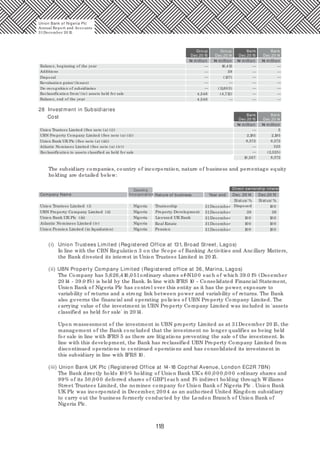
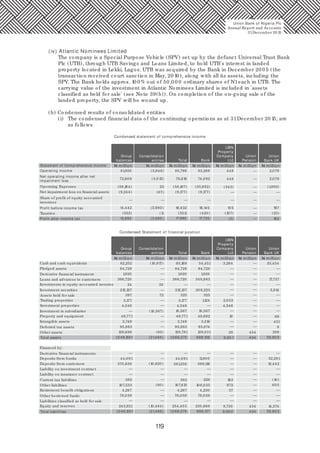
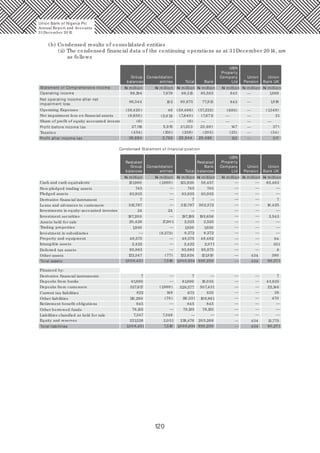
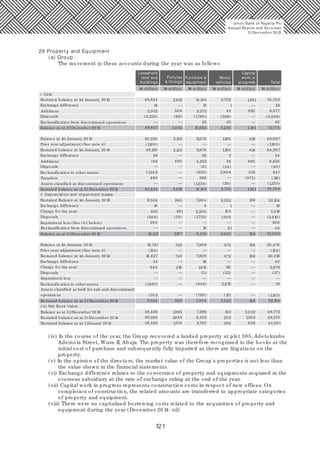


0 1
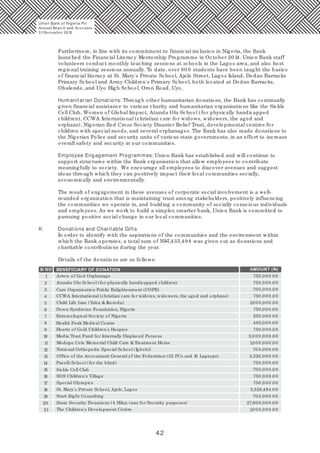
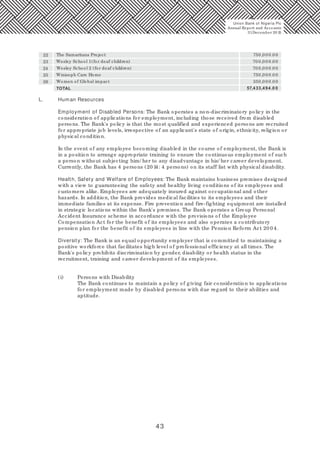
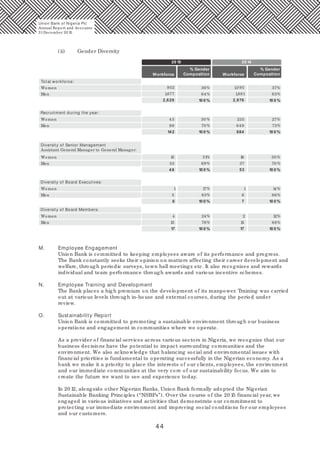
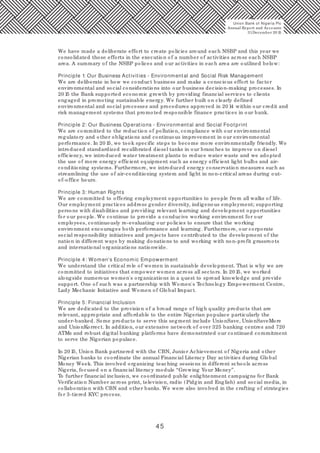
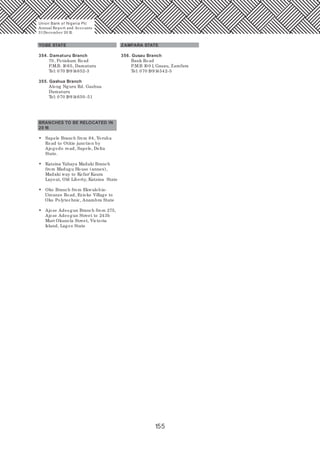
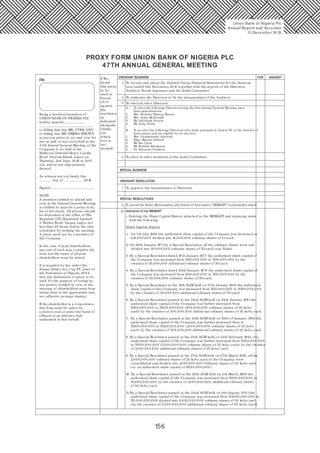
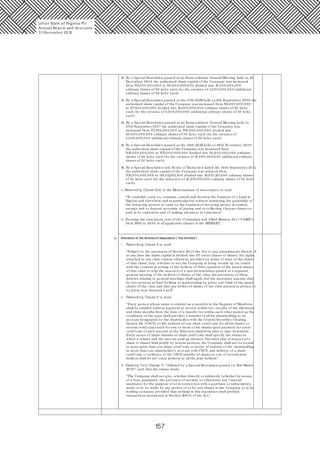
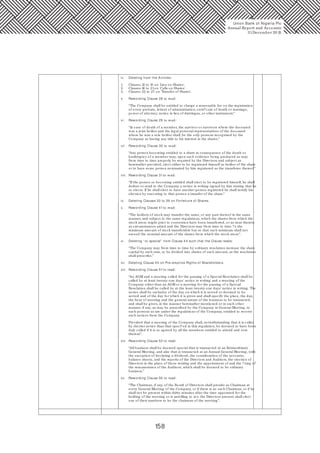
Union Bank of Nigeria Plc
Annual Report & Accounts
31 December 20 15
0 2
Union Bank of Nigeria Plc
Annual Report & Accounts
31December 20 15
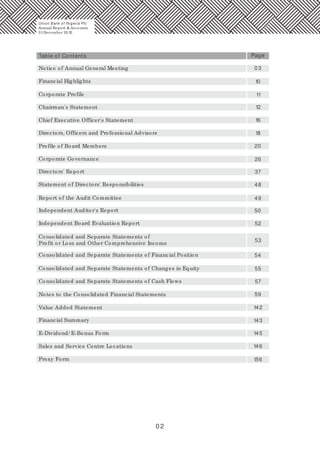
Table of Contents Page
Notice of Annual General Meeting
Financial Highlights
Corporate Profile
Chairman's Statement
Chief Executive Officer's Statement
Directors, Officers and Professional Advisors
Profile of Board Members
Corporate Governance
Directors' Report
Statement of Directors' Responsibilities
Report of the Audit Committee
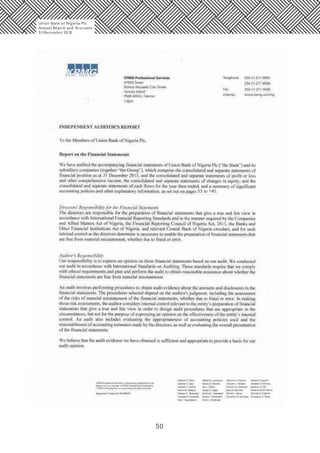
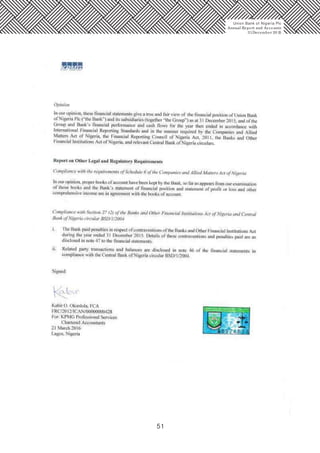
Independent Auditor's Report
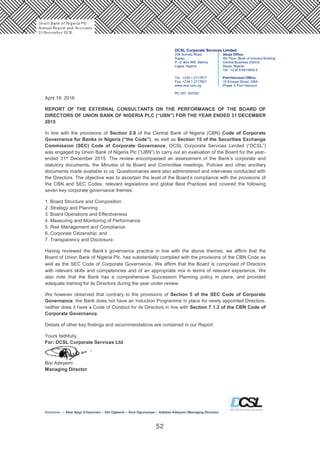
Independent Board Evaluation Report
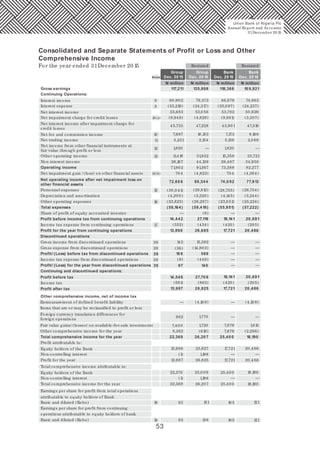
Consolidated and Separate Statements of
Profit or Loss and Other Comprehensive Income
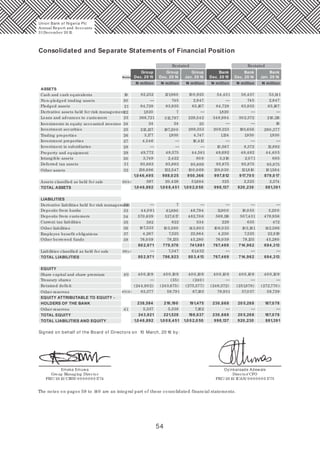
Consolidated and Separate Statements of Financial Position
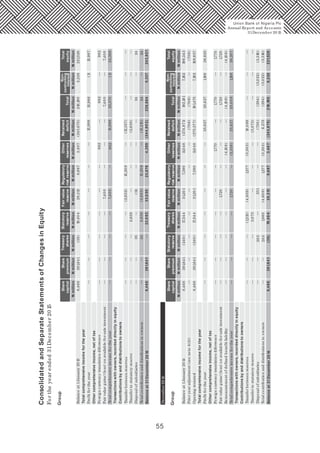
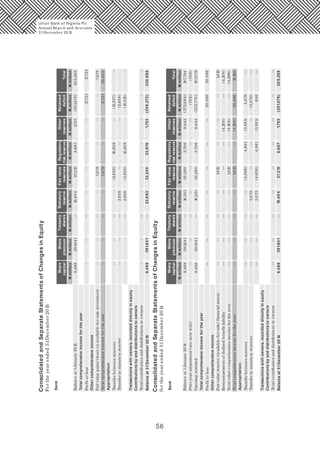
Consolidated and Separate Statements of Changes in Equity
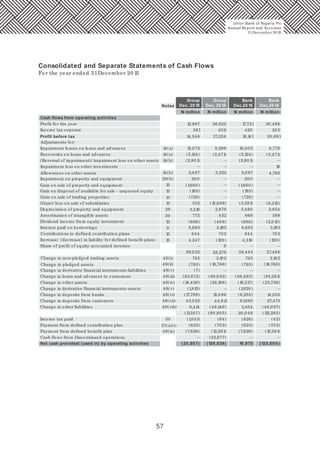
Consolidated and Separate Statements of Cash Flows
Notes to the Consolidated Financial Statements
Value Added Statement
Financial Summary
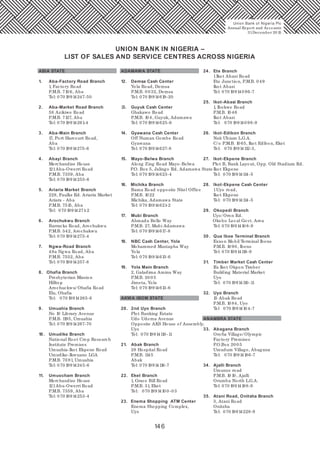
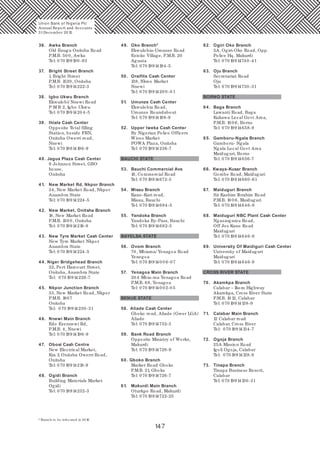
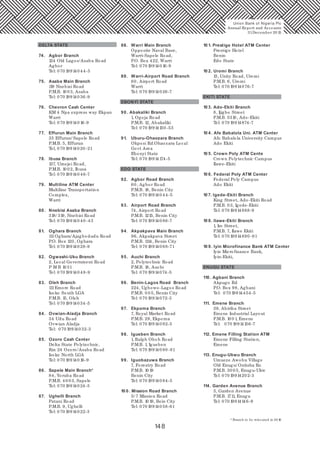
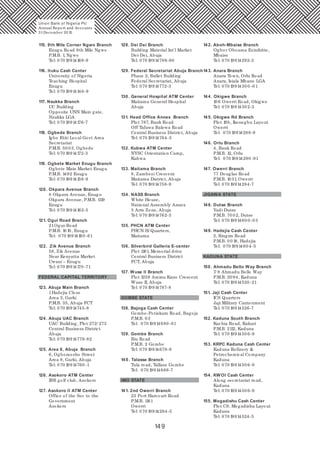
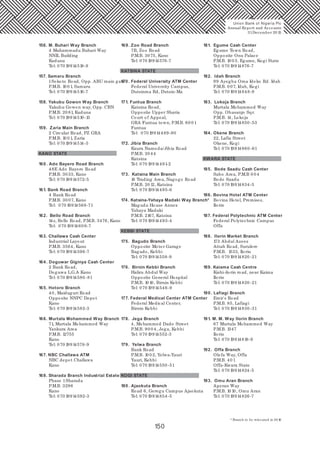
Sales and Service Centre Locations
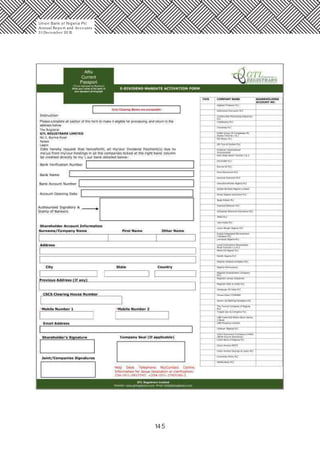
E-Dividend/ E-Bonus Form
Proxy Form
0 3
10
11
12
16
18
20
26
37
48
49
50
52
53
54
55
57
59
142
143
145
146
156
0 3
NOTICE is hereby given that the 47th Annual General Meeting (“AGM”) of Union Bank of Nigeria
Plc will be held in the Ballroom, Oriental Hotel, 3 Lekki Road, Victoria Island, Lagos on Thursday,
2nd June, 20 16 at 11.0 0 a.m. to transact the following business:
ORDINARY BUSINESS
1. To receive and adopt the Audited Group Financial Statements for the financial year ended
31st December, 20 15 together with the reports of the Directors, Auditors, Board Appraiser
and Audit Committee.
2. To authorize the Directors to fix the remuneration of the Auditors.
3. To elect/ re-elect Directors.
4. To elect/ re-elect members of the Statutory Audit Committee.
SPECIAL BUSINESS
Ordinary Resolution:
1. To approve the remuneration of Directors.
Special Resolutions:
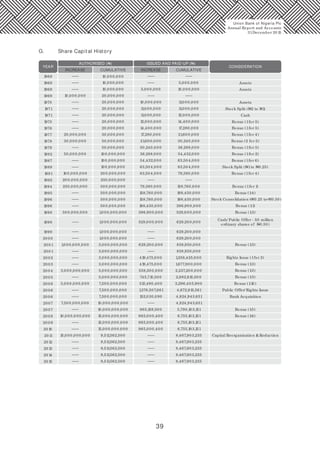
2. To amend the Bank's Memorandum and Articles of Association (“MEMART”) as hereinafter
stated:
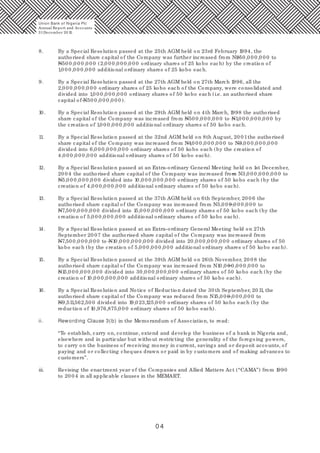
2(a) Alteration of the MEMART
i. Deleting the Share Capital History attached to the MEMART and replacing same with the
following:
Share Capital History
1. On 7th July 1969 the authorised share capital of the Company was increased to
£10,0 0 0,0 0 0 divided into 10,0 0 0,0 0 0 ordinary shares of £1each.
2. On 28th January 1971by a Special Resolution, all the ordinary shares were converted into
20,0 0 0,0 0 0 ordinary shares of N1each (one Naira).
3. By a Special Resolution dated 10 th January 1977 the authorised share capital of the
Company was increased from N20,0 0 0,0 0 0 to N30,0 0 0,0 0 0 by the creation of
10,0 0 0,0 0 0 additional ordinary shares of N1each.
4. By a Special Resolution dated 23rd January 1978 the authorised share capital of the
Company was increased from N30,0 0 0,0 0 0 to N50,0 0 0,0 0 0 by the creation of
20,0 0 0,0 0 0 ordinary shares of N1each.
5. By a Special Resolution at the 13th AGM held on 27th January 1982 the authorised share
capital of the Company was increased from N50,0 0 0,0 0 0 to N10 0,0 0 0,0 0 0 by the
creation of 50,0 0 0,0 0 0 additional ordinary shares of N1each.
6. By a Special Resolution passed at the 22nd AGM held on 23rd January 1991the authorised
share capital of the Company was further increased from N10 0,0 0 0,0 0 0 to N20 0,0 0 0,0 0 0
(80 0,0 0 0,0 0 0 ordinary shares of 25 kobo each) by the creation of 40 0,0 0 0,0 0 0
additional ordinary shares of 25 kobo each.
7. By a Special Resolution passed at the 23rd AGM held on 29th of January, 1992 the
authorised share capital of the Company was further increased from to N20 0,0 0 0,0 0 0 to
N250,0 0 0,0 0 0 (1,0 0 0,0 0 0,0 0 0 ordinary shares of 25 kobo each) by the creation of
20 0,0 0 0,0 0 0 additional ordinary shares of 25 kobo each.
NOTICE OF ANNUAL GENERAL MEETING
Union Bank of Nigeria Plc
Annual Report and Accounts
31December 20 15
0 4
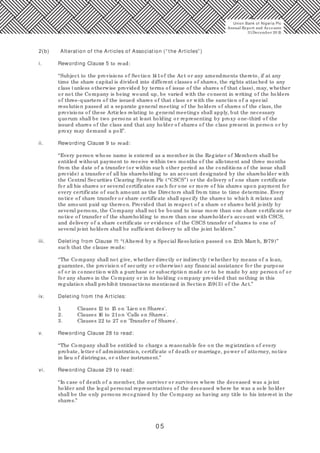
8. By a Special Resolution passed at the 25th AGM held on 23rd February 1994, the
authorised share capital of the Company was further increased from N250,0 0 0,0 0 0 to
N50 0,0 0 0,0 0 0 (2,0 0 0,0 0 0,0 0 0 ordinary shares of 25 kobo each) by the creation of
1,0 0 0,0 0 0,0 0 0 additional ordinary shares of 25 kobo each.
9. By a Special Resolution passed at the 27th AGM held on 27th March 1996, all the
2,0 0 0,0 0 0,0 0 0 ordinary shares of 25 kobo each of the Company, were consolidated and
divided into 1,0 0 0,0 0 0,0 0 0 ordinary shares of 50 kobo each (i.e. an authorised share
capital of N50 0,0 0 0,0 0 0 ).
10. By a Special Resolution passed at the 29th AGM held on 4th March, 1998 the authorised
share capital of the Company was increased from N50 0,0 0 0,0 0 0 to N1,0 0 0,0 0 0,0 0 0 by
the creation of 1,0 0 0,0 0 0,0 0 0 additional ordinary shares of 50 kobo each.
11. By a Special Resolution passed at the 32nd AGM held on 8th August, 20 0 1the authorised
share capital of the Company was increased from N1,0 0 0,0 0 0,0 0 0 to N3,0 0 0,0 0 0,0 0 0
divided into 6,0 0 0,0 0 0,0 0 0 ordinary shares of 50 kobo each (by the creation of
4,0 0 0,0 0 0,0 0 0 additional ordinary shares of 50 kobo each).
12. By a Special Resolution passed at an Extra-ordinary General Meeting held on 1st December,
20 0 4 the authorised share capital of the Company was increased from N3,0 0 0,0 0 0,0 0 0 to
N5,0 0 0,0 0 0,0 0 0 divided into 10,0 0 0,0 0 0,0 0 0 ordinary shares of 50 kobo each (by the
creation of 4,0 0 0,0 0 0,0 0 0 additional ordinary shares of 50 kobo each).
13. By a Special Resolution passed at the 37th AGM held on 6th September, 20 0 6 the
authorised share capital of the Company was increased from N5,0 0 0,0 0 0,0 0 0 to
N7,50 0,0 0 0,0 0 0 divided into 15,0 0 0,0 0 0,0 0 0 ordinary shares of 50 kobo each (by the
creation of 5,0 0 0,0 0 0,0 0 0 additional ordinary shares of 50 kobo each).
14. By a Special Resolution passed at an Extra-ordinary General Meeting held on 27th
September 20 07 the authorised share capital of the Company was increased from
N7,50 0,0 0 0,0 0 0 to N10,0 0 0,0 0 0,0 0 0 divided into 20,0 0 0,0 0 0,0 0 0 ordinary shares of 50
kobo each (by the creation of 5,0 0 0,0 0 0,0 0 0 additional ordinary shares of 50 kobo each).
15. By a Special Resolution passed at the 39th AGM held on 26th November, 20 0 8 the
authorised share capital of the Company was increased from N10,0 0 0,0 0 0,0 0 0 to
N15,0 0 0,0 0 0,0 0 0 divided into 30,0 0 0,0 0 0,0 0 0 ordinary shares of 50 kobo each (by the
creation of 10,0 0 0,0 0 0,0 0 0 additional ordinary shares of 50 kobo each).
16. By a Special Resolution and Notice of Reduction dated the 30 th September, 20 11, the
authorised share capital of the Company was reduced from N15,0 0 0,0 0 0,0 0 0 to
N9,511,562,50 0 divided into 19,023,125,0 0 0 ordinary shares of 50 kobo each (by the
reduction of 10,976,875,0 0 0 ordinary shares of 50 kobo each).
ii. Rewording Clause 3(b) in the Memorandum of Association, to read:
“To establish, carry on, continue, extend and develop the business of a bank in Nigeria and,
elsewhere and in particular but without restricting the generality of the foregoing powers,
to carry on the business of receiving money in current, savings and or deposit accounts, of
paying and or collecting cheques drawn or paid in by customers and of making advances to
customers”.
iii. Revising the enactment year of the Companies and Allied Matters Act (“CAMA”) from 1990
to 20 0 4 in all applicable clauses in the MEMART.
Union Bank of Nigeria Plc
Annual Report and Accounts
31December 20 15
0 5
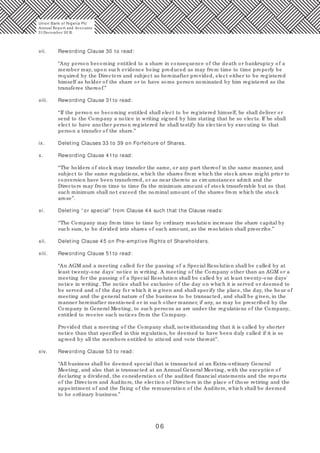
2(b) Alteration of the Articles of Association (“ the Articles” )
i. Rewording Clause 5 to read:
“Subject to the provisions of Section 141of the Act or any amendments thereto, if at any
time the share capital is divided into different classes of shares, the rights attached to any
class (unless otherwise provided by terms of issue of the shares of that class), may, whether
or not the Company is being wound up, be varied with the consent in writing of the holders
of three-quarters of the issued shares of that class or with the sanction of a special
resolution passed at a separate general meeting of the holders of shares of the class, the
provisions of these Articles relating to general meetings shall apply, but the necessary
quorum shall be two persons at least holding or representing by proxy one-third of the
issued shares of the class and that any holder of shares of the class present in person or by
proxy may demand a poll”.
ii. Rewording Clause 9 to read:
“Every person whose name is entered as a member in the Register of Members shall be
entitled without payment to receive within two months of the allotment and three months
from the date of a transfer (or within such other period as the conditions of the issue shall
provide) a transfer of all his shareholding to an account designated by the shareholder with
the Central Securities Clearing System Plc (“CSCS”) or the delivery of one share certificate
for all his shares or several certificates each for one or more of his shares upon payment for
every certificate of such amount as the Directors shall from time to time determine. Every
notice of share transfer or share certificate shall specify the shares to which it relates and
the amount paid up thereon. Provided that in respect of a share or shares held jointly by
several persons, the Company shall not be bound to issue more than one share certificate or
notice of transfer of the shareholding to more than one shareholder's account with CSCS,
and delivery of a share certificate or evidence of the CSCS transfer of shares to one of
several joint holders shall be sufficient delivery to all the joint holders.”
iii. Deleting from Clause 11: “(Altered by a Special Resolution passed on 12th March, 1979)”
such that the clause reads:
“The Company shall not give, whether directly or indirectly (whether by means of a loan,
guarantee, the provision of security or otherwise) any financial assistance for the purpose
of or in connection with a purchase or subscription made or to be made by any person of or
for any shares in the Company or in its holding company provided that nothing in this
regulation shall prohibit transactions mentioned in Section 159(3) of the Act.”
iv. Deleting from the Articles:
1. Clauses 12 to 15 on 'Lien on Shares'.
2. Clauses 16 to 21on 'Calls on Shares'.
3. Clauses 22 to 27 on 'Transfer of Shares'.
v. Rewording Clause 28 to read:
“The Company shall be entitled to charge a reasonable fee on the registration of every
probate, letter of administration, certificate of death or marriage, power of attorney, notice
in lieu of distringas, or other instrument.”
vi. Rewording Clause 29 to read:
“In case of death of a member, the survivor or survivors where the deceased was a joint
holder and the legal personal representatives of the deceased where he was a sole holder
shall be the only persons recognised by the Company as having any title to his interest in the
shares.”
Union Bank of Nigeria Plc
Annual Report and Accounts
31December 20 15
0 6
vii. Rewording Clause 30 to read:
“Any person becoming entitled to a share in consequence of the death or bankruptcy of a
member may, upon such evidence being produced as may from time to time properly be
required by the Directors and subject as hereinafter provided, elect either to be registered
himself as holder of the share or to have some person nominated by him registered as the
transferee thereof.”
viii. Rewording Clause 31to read:
“If the person so becoming entitled shall elect to be registered himself, he shall deliver or
send to the Company a notice in writing signed by him stating that he so elects. If he shall
elect to have another person registered he shall testify his election by executing to that
person a transfer of the share.”
ix. Deleting Clauses 33 to 39 on Forfeiture of Shares.
x. Rewording Clause 41to read:
“The holders of stock may transfer the same, or any part thereof in the same manner, and
subject to the same regulations, which the shares from which the stock arose might prior to
conversion have been transferred, or as near thereto as circumstances admit and the
Directors may from time to time fix the minimum amount of stock transferable but so that
such minimum shall not exceed the nominal amount of the shares from which the stock
arose”.
xi. Deleting “ or special” from Clause 44 such that the Clause reads:
“The Company may from time to time by ordinary resolution increase the share capital by
such sum, to be divided into shares of such amount, as the resolution shall prescribe.”
xii. Deleting Clause 45 on Pre-emptive Rights of Shareholders.
xiii. Rewording Clause 51to read:
“An AGM and a meeting called for the passing of a Special Resolution shall be called by at
least twenty-one days' notice in writing. A meeting of the Company other than an AGM or a
meeting for the passing of a Special Resolution shall be called by at least twenty-one days'
notice in writing. The notice shall be exclusive of the day on which it is served or deemed to
be served and of the day for which it is given and shall specify the place, the day, the hour of
meeting and the general nature of the business to be transacted, and shall be given, in the
manner hereinafter mentioned or in such other manner, if any, as may be prescribed by the
Company in General Meeting, to such persons as are under the regulations of the Company,
entitled to receive such notices from the Company.
Provided that a meeting of the Company shall, notwithstanding that it is called by shorter
notice than that specified in this regulation, be deemed to have been duly called if it is so
agreed by all the members entitled to attend and vote thereat”.
xiv. Rewording Clause 53 to read:
“All business shall be deemed special that is transacted at an Extra-ordinary General
Meeting, and also that is transacted at an Annual General Meeting, with the exception of
declaring a dividend, the consideration of the audited financial statements and the reports
of the Directors and Auditors, the election of Directors in the place of those retiring and the
appointment of and the fixing of the remuneration of the Auditors, which shall be deemed
to be ordinary business.”
Union Bank of Nigeria Plc
Annual Report and Accounts
31December 20 15
07
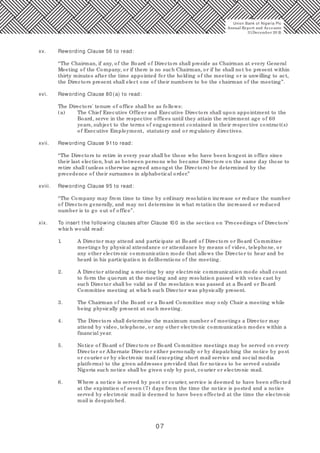
xv. Rewording Clause 56 to read:
“The Chairman, if any, of the Board of Directors shall preside as Chairman at every General
Meeting of the Company, or if there is no such Chairman, or if he shall not be present within
thirty minutes after the time appointed for the holding of the meeting or is unwilling to act,
the Directors present shall elect one of their numbers to be the chairman of the meeting”.
xvi. Rewording Clause 80 (a) to read:
The Directors' tenure of office shall be as follows:
(a) The Chief Executive Officer and Executive Directors shall upon appointment to the
Board, serve in the respective offices until they attain the retirement age of 60
years, subject to the terms of engagement contained in their respective contract(s)
of Executive Employment, statutory and or regulatory directives.
xvii. Rewording Clause 91to read:
“The Directors to retire in every year shall be those who have been longest in office since
their last election, but as between persons who became Directors on the same day those to
retire shall (unless otherwise agreed amongst the Directors) be determined by the
precedence of their surnames in alphabetical order.”
xviii. Rewording Clause 95 to read:
“The Company may from time to time by ordinary resolution increase or reduce the number
of Directors generally, and may not determine in what rotation the increased or reduced
number is to go out of office”.
xix. To insert the following clauses after Clause 10 0 in the section on 'Proceedings of Directors'
which would read:
1. A Director may attend and participate at Board of Directors or Board Committee
meetings by physical attendance or attendance by means of video, telephone, or
any other electronic communication mode that allows the Director to hear and be
heard in his participation in deliberations of the meeting.
2. A Director attending a meeting by any electronic communication mode shall count
to form the quorum at the meeting and any resolution passed with votes cast by
such Director shall be valid as if the resolution was passed at a Board or Board
Committee meeting at which such Director was physically present.
3. The Chairman of the Board or a Board Committee may only Chair a meeting while
being physically present at such meeting.
4. The Directors shall determine the maximum number of meetings a Director may
attend by video, telephone, or any other electronic communication modes within a
financial year.
5. Notice of Board of Directors or Board Committee meetings may be served on every
Director or Alternate Director either personally or by dispatching the notice by post
or courier or by electronic mail (excepting short mail service and social media
platforms) to the given addresses provided that for notices to be served outside
Nigeria such notice shall be given only by post, courier or electronic mail.
6. Where a notice is served by post or courier, service is deemed to have been effected
at the expiration of seven (7) days from the time the notice is posted and a notice
served by electronic mail is deemed to have been effected at the time the electronic
mail is despatched.
Union Bank of Nigeria Plc
Annual Report and Accounts
31December 20 15
0 8
xx. In Clause 10 2, replacing “five minutes” with “thirty minutes” as the time after which the
Directors may appoint a Chairman for any Board or other meeting when the incumbent
Chairman is absent.
xxi. In Clause 10 4, replacing “five minutes” with “thirty minutes” as the time after which a
Committee may appoint a Chairman for any Board committee or other meeting when the
incumbent Chairman is absent.
xxii. Rewording Clause 117 to read:
“Except as by the Act, expressly authorised, no dividend shall be paid otherwise than out of
profit and subject to the conditions (if any) from time to time imposed by or under any
relevant legislation and or regulation.”
xxiii. Rewording Clause 118 to read:
“The Company shall maintain a Statutory Reserve Fund in accordance with the
requirements of the Banking Act.”
xxiv. Rewording Clause 119 to read:
“In addition to such payments as are provided for in Article 117 the Directors may at any
time set aside out of the profits of the Company such amounts as they think proper and
transfer them to an Ordinary Reserve Fund which shall at the discretion of the Directors be
applicable for any purpose to which the profits of the Company may be properly applied,
and pending such application may, at their discretion, either be employed in the business of
the Company or be invested in such investments (other than shares of the Company) as are
permitted under the Banking Act and as the Directors may from time to time think fit. The
Directors may also without placing the same in the Ordinary Reserve Fund carry forward
any profits, which they may think prudent not to divide.”
xxv. Rewording Clause 120 to read:
“Subject to the rights of persons, if any, entitled to shares with special rights as to
dividends, all dividends shall be declared and paid according to the amounts paid or
credited as paid. All dividends shall be apportioned and paid proportionately to the
amounts paid or credited as paid on the shares during any portion or portions of the period
in respect of which the dividend is paid; but if any share is issued in terms providing that it
shall rank for dividends as from a particular date such share shall rank for dividend
accordingly.”
xxvi. Deleting Clause 121on “Unpaid Calls”.
xxvii. Deleting from Clauses 127, 128 and 129 all references to “Profit and Loss Accounts” and
“Balance Sheet” and replacing same respectively with “Consolidated and Separate
Statements of Profit or Loss and Other Comprehensive Income” and “Consolidated and
Separate Statements of Financial Position”.
2(c) “That following the deletion of the above-stated clauses from the Articles of the Company,
all the clauses retained in the Articles be renumbered accordingly and all typographical
errors in the Articles amended”.
2(d) “That all sections of the CAMA cited in the Company's MEMART should be reviewed and or
amended to ensure correctness”.
2(e) “That the Company's MEMART incorporating the above-listed amendments, be and are
hereby approved and adopted as the MEMART of the Company, in substitution for and to
the exclusion of all previous editions thereof”.
Union Bank of Nigeria Plc
Annual Report and Accounts
31December 20 15
0 9
Union Bank of Nigeria Plc
Annual Report and Accounts
31December 20 15
2(f) “That the Company Secretary be and is hereby authorised to file the amended MEMART of
the Company at the Corporate Affairs Commission”.
NOTES
a) PROXY
A member of the company entitled to attend and vote is entitled to appoint a proxy to
attend and vote in its, his or her stead. A proxy form is supplied with the Notice. Executed
proxy forms should be duly stamped at the Stamp Duties Office and deposited at the office
of the Company Registrar, GTL Registrars Limited, 2 Burma Road, Apapa, Lagos not less
than forty-eight (48) hours before the meeting.
b) STATUTORY AUDIT COMMITTEE
Any member may nominate a shareholder for election as a member of the Statutory Audit
Committee by giving notice in writing of such nomination to the Company Secretary at
least twenty-one (21) days before the Annual General Meeting.
c) CLOSURE OF THE REGISTER OF MEMBERS
The Register of Members and Transfer Books of the Company will be closed from Monday,
16th May 20 16 to Friday, 20 th May 20 16 (both days inclusive).
d) RIGHT OF SHAREHOLDERS TO ASK QUESTIONS
Pursuant to Rule 19.12 (c) of the Nigerian Stock Exchange's Rulebook 20 15, kindly note that
it is the right of every shareholder to ask questions not only at the meeting but also in
writing prior to the meeting. We urge that such questions be submitted to the Company
Secretariat not later than two (2) weeks before the meeting date.
BY ORDER OF THE BOARD
Somuyiwa Adedeji Sonubi
Company Secretary
FRC/ 20 13/ NBA/ 0 0 0 0 0 0 020 61
Union Bank of Nigeria Plc
Stallion Plaza
36 Marina
Lagos
Dated the 9th day of May 20 16
10
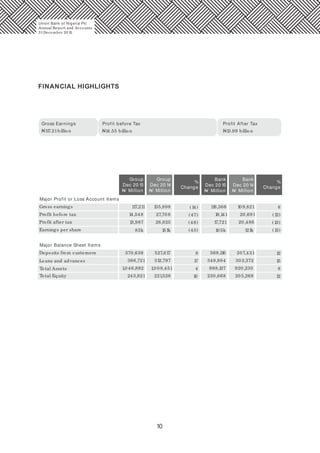
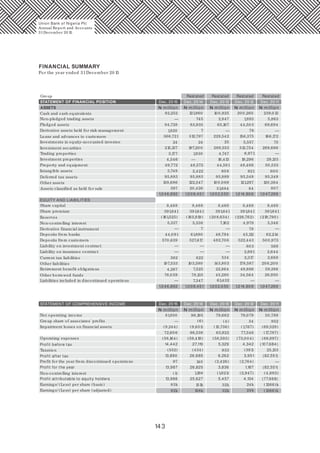
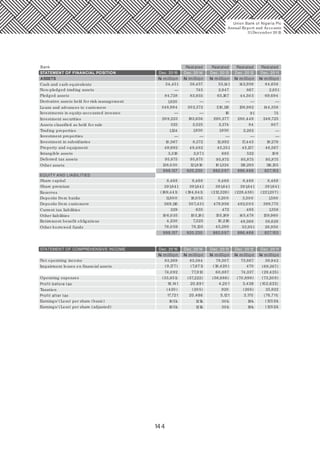
FINANCIAL HIGHLIGHTS
Gross Earnings Profit before Tax Profit After Tax
N117.21billion N14.55 billion N13.99 billion
Group
Dec 20 15
N’ Million
Group
Dec 20 14
N’ Million
%
Change
%
Change
Bank
Dec 20 15
N’ Million
Bank
Dec 20 14
N’ Million
Major Profit or Loss Account Items
Gross earnings 117,211 135,898 (14) 118,366 10 9,821 8
Profit before tax 14,548 27,70 8 (47) 18,141 20,691 (12)
Profit after tax 13,987 26,825 (48) 17,721 20,486 (13)
Earnings per share 83k 151k (45) 10 5k 121k (13)
Major Balance Sheet Items
Deposits from customers 570,639 527,617 8 569,116 507,431 12
Loans and advances 366,721 312,797 17 348,984 302,372 15
Total Assets 1,0 46,892 1,0 0 8,451 4 998,137 920,230 8
Total Equity 243,921 221,528 10 230,668 20 5,268 12
Union Bank of Nigeria Plc
Annual Report and Accounts
31December 20 15
11
Union Bank of Nigeria Plc (“UBN” or “the Bank”) was established in 1917 and is one of Nigeria's
long-standing and most respected financial institutions, offering a portfolio of banking services to
individuals, SMEs, commercial and corporate clients.
Our offerings include current, savings and deposit account services, funds transfer, foreign
currency domiciliation, loans, overdrafts, equipment leasing and trade finance. These services are
provided through an extensive network of over 325 sales and service centres, over 720 Automated
Teller Machines (“ATMs”) spread across Nigeria and alternate channels including online banking,
mobile banking, debit cards and point of sale systems.
Following the banking reforms initiated by the Central Bank of Nigeria (“CBN”), UBN in September
20 12, concluded a successful recapitalisation process with the injection of US$50 0 million by
Union Global Partners Limited (“UGPL”), a consortium of local and international investors. UGPL
acquired 65% of the Bank's shareholding while the Asset Management Corporation of Nigeria
(AMCON) held 20.0 4% with the remaining 14.96% held by a diverse group of shareholders. In
December 20 14 and January 20 15 respectively, Atlas Mara Limited acquired AMCON's
shareholding and majority shareholding in African Development Corporation, a member of the
UGPL Consortium.
Under new leadership, UBN redefined its ambition and mapped out a strategy to be a highly
respected provider of quality banking services. Execution of this strategy is well underway,
leveraging a robust transformation team largely focused on people, processes and technology.
The Bank's transformation efforts are yielding positive results as evident from its financial
performance. Other notable achievements to date include the successful migration to a new core
banking platform, implementation of a new mobile banking platform, launch of five smarter
banking centres, completion of over 10 0 + branch projects, implementation of a business process
management software, upgrade to a state of the art data centre, establishment of a central
processing centre to drive operational efficiencies and reinforcement of the talent base.
In October 20 15, UBN unveiled its new brand identity, signaling its evolution into a simpler, more
energized bank, dedicated to providing quality banking services. The new brand identity positions
the Bank competitively in the industry with opportunities to deepen existing customer
relationships and attract a new base of customers.
As UBN prepares to celebrate 10 0 years of serving clients in Nigeria, the pace of growth set by the
transformation programme is proof that the Bank is on track to regain its position as a leading
banking institution in Nigeria.
CORPORATE PROFILE
Union Bank of Nigeria Plc
Annual Report and Accounts
31December 20 15
12
CHAIRMAN’S STATEMENT
Introduction
Distinguished shareholders, ladies and gentlemen, on behalf of the
Board of Union Bank of Nigeria Plc. (“UBN” or “the Bank”), it is my
pleasure to welcome you to the Bank's 47th Annual General Meeting.
This is my first statement to you as the Chairman of the Board of UBN. I
hereby present the annual report and accounts for the financial year
ended 31st December 20 15.
The Global Economy
20 15 was clouded by uncertainty across developed and emerging
markets, which led to slow growth or decline around most parts the
world. The global economy recorded a growth of 3.1%, a slight dip from
20 14's 3.4%. Slower growth in the world economy was attributed to
lower commodity prices, manufacturing slowdown in emerging markets, particularly China, and
financial market volatility. India overtook China as the fastest growing economy as it recorded
strong growth of 7.5% in 20 15 compared to 7.3% in 20 14 versus 6.9% growth recorded by China in
20 15.
For developed economies, the United States recorded strong employment growth in 20 15, which is
expected to result in higher wages, spending and higher inflation in 20 16. Consequently, for the
first time in almost a decade, interest rates in the U.S. increased by 0.25% to 0.5% in December
20 15. In the Eurozone, growth from Germany remained strong in 20 15 increasing to 1.7% due to an
expansionary monetary policy which stimulated domestic consumption. France and Spain also
recorded growth spurred by low oil prices, low interest rates and increased consumption.
In Sub-Saharan Africa (SSA), growth slowed to about 3.6% from 5.1% in 20 14 due to falling
commodity prices. Lower oil prices particularly affected Nigeria and Angola resulting in a decline in
foreign reserves and foreign exchange valuation pressures.
International Monetary Fund (IMF) projections indicate that global growth will reach 3.4% in 20 16,
with China expected to remain a key player in the global economy. Commodity dependent nations
in Africa and Latin America are however expected to face ongoing challenges in the near term due
to lower revenues. For these reasons and other fundamental domestic factors, SSA growth is
estimated at 3.3% in 20 16 from a previous forecast of 4.4% announced in October 20 15.
The Nigerian Economy
In 20 15, the Nigerian economy experienced volatility stemming from global financial pressures and
political uncertainty. The suspense surrounding the elections and the swearing in of a new
President was the focal point for the first half of 20 15. The knock-on effects from delayed elections
and subsequently delayed appointment of cabinet members, coupled with the decline in oil prices
resulted in slower gross domestic product (GDP) growth of 2.8% in 20 15, compared to the 6.2%
growth in 20 14.
The non-oil sector – largely driven by trade and agriculture – remained the core contributor to GDP;
while the oil sector shrank by 5.5%, following a 1.3% drop in 20 14. Inflation increased consistently
during the year with the 12-month inflation average at 9.0 % (vs. 8.1% in 20 14). This was attributed to
the impact of exchange rate depreciation on imported goods and services, as well as reduced
supply of food from the north-eastern part of Nigeria due to unrest in the region.
With the country's main revenue generator, Bonny Light crude oil, closing the year at $36.20
compared to $63.80 in December 20 14, the Federal Government's revenues were severely
depleted with several states failing to meet monthly obligations.
The Central Bank of Nigeria (“CBN”) introduced a range of currency control policies to ease the
pressure on the foreign reserves. These restrictions resulted in the removal of Nigerian bonds from
the JP Morgan Index for Emerging Markets.
Union Bank of Nigeria Plc
Annual Report and Accounts
31December 20 15
13
At the end of 20 15, the Federal Government proposed a N6 trillion budget for 20 16. The budget
included allocation of 31% for capital expenditure, 44% for non-debt recurring expenditure and
23% for debt servicing. The expansionary budget is expected to have a positive knock-on effect on
the economy in the form of job creation, infrastructure development and economic diversification.
The Banking Industry
Prevailing headwinds in the global and local economy gave rise to a number of policy changes to
support the monetary and fiscal tightening stance of the Federal Government. Key changes made
within the year include:
• Reduction in commission on turnover from N2 to N1per mille which took effect in January 20 15.
• The deadline for the implementation of higher capital adequacy ratio requirements under
Basel II was extended to June 20 16.
• Cash Reserve Requirement (“CRR”) harmonized at 31% in May 20 15 for public and private
sector deposits. Subsequently reduced to 25% and further to 20 % by year end.
• Reduction in the spending limits on Naira denominated cards abroad; ban on foreign currency
payments for local transactions, and the exclusion of 41import items from accessing foreign
currency at the official market.
• Sale of foreign exchange to Bureaux de Change (BDC) was halted.
• Decrease in monetary policy rate from 13% to 11% in order to improve market liquidity.
• Implementation of Treasury Single Account which resulted in the transfer of N1.2trillion (US$6
billion) of public sector funds.
• Increase in the General Loan Loss Provision from 1% to 2% for performing loans.
The operating environment for banks in Nigeria was significantly impacted by the combination of
the above mentioned regulatory changes, lower oil prices, policy constraints and declining value of
the Naira which ultimately affected the bottom-line. Furthermore, new capital requirements have
resulted in the need for additional capital to comply with regulation and support growth.
Our Bank
Our Transformation
In 20 15, we continued with the execution of our strategy to be a highly respected provider of
quality banking services in Nigeria. Our transformation to a simpler, smarter bank was evident
across several areas – physical infrastructure with the renovation of several of our branches;
technology upgrades; people, process enhancements and our re-energized brand. Notable
achievements made across our businesses and operations resulted in strong 20 15 financial results.
Our New Brand Identity
We unveiled our new brand identity at a spectacular launch event in October 20 15. The refreshed
brand positions us competitively in the Nigerian financial industry and enhances our ability to
attract a new customer base. We are now focused on providing simple and smart banking solutions
to all our customers.
Sustainability
In 20 15, we consolidated our sustainability efforts across the nine Nigerian Sustainable Banking
Principles. We acknowledge that our commitment to good stewardship stems from direct
ownership of our actions as an organization and ensuring we understand the direct impact these
have on our environment.
We have implemented a more structured approach towards monitoring our Environmental and
Social (“E&S”) footprint and have created detailed E&S risk processes which govern how we
conduct business.
We continue to be an industry leader and a key contributor to financial inclusion. We have
established new collaborative partnerships across the industry, with sustainability oriented
organizations and reconfigured our governance framework to ensure we have the right level of
engagement with all relevant stakeholders.
Union Bank of Nigeria Plc
Annual Report and Accounts
31December 20 15
14
Our approach to sustainability is long term and we will continue doing business in a manner that is
beneficial to our clients, our employees, our business, our communities and our environment.
Changes in our Group Structure
In compliance with CBN's Regulation 3 on the Scope of Banking Activities and Ancillary Matters,
which restricts Nigerian banks to operate as commercial, merchant or specialized banks, we are
pleased to say that we have successfully and profitably completed divestment of the following
subsidiaries: Union Capital Markets Limited, Union Assurance Company Limited, UBN Insurance
Brokers Limited, Union Registrars Limited, Union Trustees Limited and Union Homes Savings and
Loans Plc.
Divestment of UBN Property Company Limited is ongoing. Union Pension Custodians Limited has
been liquidated and regulatory approval has been granted by the Corporate Affairs Commission.
Financial Performance in 20 15
The quality of our earnings is one of the critical pillars of Union Bank's transformation efforts and
the Board and Management are committed to delivering consistent growth in earnings to ensure
that we are able to return value to all shareholders in the near future.
The Bank maintained its positive performance trajectory in spite of challenging market conditions.
This is a testament to the success of our transformation efforts and reflects the significant
investments we have made in our people, platforms and processes.
Gross earnings for the Bank increased by 8% from N10 9.8billion in 20 14 to N118.4billion in 20 15. This
includes N3.6billion one-off gain on disposal of subsidiaries as we continued the implementation
of CBN Regulation 3. Profit before tax (“PBT”) for the Bank closed at N18.1billion for 20 15. Excluding
one-off gain of N3.6billion from sale of subsidiaries, core PBT grew from N14.4billion in 20 14 to
N14.6billion in 20 15.
Operating expenses reduced by 2% from N57.2bn in 20 14 to N56.0 bn in 20 15. The downward trend
in expenses is expected to continue and reflects our cost efficiency efforts over the past 18 to 24
months. Our cost-to-income ratio remained at the 20 14 level of 67%.
Customer deposits are up 12% to N569.1billion (N507.4billion in Dec 20 14), compared to 6% growth
achieved year-on-year in 20 14; reflecting increased customer confidence, a re-energised brand
and the success of new products. Loans and advances also increased by 15% to N349billion for the
Bank as we continued our risk-conscious growth in priority sectors of the economy.
Board Changes
In 20 15, Senator Udoma Udo Udoma, Mr. Adekunle Adeosun and Mr. Dickie Ulu resigned from the
Board of Directors. I would like to thank them for their valuable contributions to Union Bank during
their tenure. We welcome Mr. Adekunle Sonola as an Executive Director as well as Mrs. Beatrice A.
Hamza-Bassey, Ms. Arina McDonald and Mr. John Vitalo as Non-Executive Directors.
Awards and Recognition
Union Bank received several awards in 20 15 reflecting the significant enhancements in our
platforms and our capabilities. Notable awards include:
• “Best Bank to Support Nigeria's Small and Medium Scale Enterprises” - Business Day
• “Best Participating Bank in Nigeria” – CBN Agricultural Credit Guarantee Scheme Fund
• “Best Commercial Agriculture Bank” - Nigeria Agriculture Awards
• “Cashless POS Activation Champion” – Mastercard
Outlook for 20 16
We expect the challenging macroeconomic environment to persist in 20 16 with oil prices
remaining depressed. Nevertheless, we expect that as the government executes its economic
priorities - seeking further diversification of the economy and increasing investments in capital
infrastructure - the non-oil sectors should receive a boost, creating significant opportunity for
consumers, industry and investors.
Union Bank of Nigeria Plc
Annual Report and Accounts
31December 20 15
15
Union Bank of Nigeria Plc
Annual Report and Accounts
31December 20 15
For the banking sector in 20 16, we remain optimistic about the opportunities to build a sustainable
future for Union Bank and will continue to pursue sustainable growth by executing our strategic
priorities across our business segments.
Conclusion
Ladies and Gentlemen, on behalf of the Board, I thank you sincerely for your unreserved support
and continued trust and confidence in Union Bank. A special thank you to our staff for their hard
work throughout the year and to our loyal customers who have remained with us along our journey.
We all remain committed to achieving the transformation of Union Bank.
Thank you.
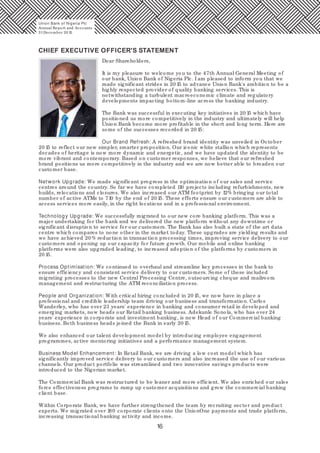
Cyril Odu
Chairman
16
CHIEF EXECUTIVE OFFICER'S STATEMENT
Dear Shareholders,
It is my pleasure to welcome you to the 47th Annual General Meeting of
our bank, Union Bank of Nigeria Plc. I am pleased to inform you that we
made significant strides in 20 15 to advance Union Bank's ambition to be a
highly respected provider of quality banking services. This is
notwithstanding a turbulent macroeconomic climate and regulatory
developments impacting bottom-line across the banking industry.
The Bank was successful in executing key initiatives in 20 15 which have
positioned us more competitively in the industry and ultimately will help
Union Bank become more profitable in the short and long term. Here are
some of the successes recorded in 20 15:
Our Brand Refresh: A refreshed brand identity was unveiled in October
20 15 to reflect our new simpler, smarter proposition. Our iconic white stallion which represents
decades of heritage is now more dynamic and energetic, and we have updated the identity to be
more vibrant and contemporary. Based on customer responses, we believe that our refreshed
brand positions us more competitively in the industry and we are now better able to broaden our
customer base.
Network Upgrade: We made significant progress in the optimization of our sales and service
centres around the country. So far we have completed 110 projects including refurbishments, new
builds, relocations and closures. We also increased our ATM footprint by 12% bringing our total
number of active ATMs to 710 by the end of 20 15. These efforts ensure our customers are able to
access services more easily, in the right locations and in a professional environment.
Technology Upgrade: We successfully migrated to our new core banking platform. This was a
major undertaking for the bank and we delivered the new platform without any downtime or
significant disruption to service for our customers. The Bank has also built a state of the art data
centre which compares to none other in the market today. These upgrades are yielding results and
we have achieved 20 % reduction in transaction processing times, improving service delivery to our
customers and opening up our capacity for future growth. Our mobile and online banking
platforms were also upgraded leading, to increased adoption of the platforms by customers in
20 15.
Process Optimisation: We continued to overhaul and streamline key processes in the bank to
ensure efficiency and consistent service delivery to our customers. Some of these included
migrating processes to the new Central Processing Centre, outsourcing cheque and mailroom
management and restructuring the ATM reconciliation process.
People and Organization: With critical hiring concluded in 20 15, we now have in place a
professional and credible leadership team driving our business and transformation. Carlos
Wanderley, who has over 23 years' experience in banking and consumer retail in developed and
emerging markets, now heads our Retail banking business. Adekunle Sonola, who has over 24
years' experience in corporate and investment banking, is now Head of our Commercial banking
business. Both business heads joined the Bank in early 20 15.
We also enhanced our talent development model by introducing employee engagement
programmes, active mentoring initiatives and a performance management system.
Business Model Enhancement: In Retail Bank, we are driving a low cost model which has
significantly improved service delivery to our customers and also increased the use of our various
channels. Our product portfolio was streamlined and two innovative savings products were
introduced to the Nigerian market.
The Commercial Bank was restructured to be leaner and more efficient. We also enriched our sales
force effectiveness programs to ramp up customer acquisitions and grow the commercial banking
client base.
Within Corporate Bank, we have further strengthened the team by recruiting sector and product
experts. We migrated over 180 corporate clients onto the UnionOne payments and trade platform,
increasing transactional banking activity and income.
Union Bank of Nigeria Plc
Annual Report and Accounts
31December 20 15
17
Our Premium Desk Service for top tier corporate clients continues to deliver superior customer
experience to corporate customers. We have assembled a proactive and knowledgeable Treasury
team that is well able to manage market volatility and has moved Union Bank's ranking on the
Financial Markets Dealers Quotations from 20 th place in 20 14 to 8th position in 20 15.
Service Excellence: Our improvement in service delivery was affirmed through customer
responses and our improved ranking on independent industry surveys including the KPMG 20 15
banking survey.
Our Financial Performance in 20 15
The Bank continues to deliver consistent financial performance since returning to profitability in
20 12. In 20 15, Union Bank recorded profit before tax (“PBT”) of N18.1billion. Notwithstanding the
tougher operating environment and excluding one-off gains from the sale of subsidiaries in 20 15,
our core PBT grew from N14.4billion in 20 14 to N14.6billion in 20 15.
At the Group level, with the sale of our non-banking subsidiaries largely concluded in 20 14, gross
earnings and PBT are expectedly lower in 20 15 without the one-off gains from the previous year.
We are now a leaner and more efficient group, focused on core retail, corporate and commercial
banking.
We have successfully kept operating costs down for the fourth consecutive year, while making
investments in technology, people, processes and marketing communication. Loans and Advances
were up 15% to N349billion for the Bank and 17% to N367billion for the Group owing largely to risk-
conscious growth in target sectors of the economy. Additionally, our balance sheet remains strong
with total assets for the Bank and Group closing at N998billion and N1,0 47billion respectively.
Our Expectations for 20 16
While market conditions in Nigeria, and globally, are expected to remain challenging in 20 16, I am
confident that the Bank is well-positioned to navigate the economic headwinds given our clearly
mapped out strategic priorities, our energised workforce and our commitment to innovation and
cost management. We are focused on execution to ensure we accomplish our objectives in the
short and long term. We have agreed to focus on the following priorities:
• We will continue to drive our business priorities, focusing on growing our deposit base,
transactional income and client base. We are proactively managing our risks, reducing
operational costs, effectively utilising capital and managing liquidity.
• From a growth and differentiation perspective, we will focus on trade and retail, growing our
public sector business in light of the opportunities created by the new administration, as well as
drive more value chain synergies across our businesses in Nigeria and the UK.
• We continue to focus on attracting, rewarding and retaining the right talent as well as driving a
productive employee base through training and providing the right tools and environment to
foster employee growth and satisfaction.
• We will leverage and foster innovation to drive long-term value creation for the Bank by
improving customer acquisition, customer retention and customer expansion.
• We are committed to enhancing the Bank's market perception and share-of-mind with existing
and target consumers.
Today, we are a stronger Bank, better able to serve our customers with innovative products and
professional services. We will continue to build on these successes which are already starting to
yield financial success for the Bank.
On behalf of the management and staff, I thank you, our esteemed shareholders, for your
continued support and steadfast loyalty. As we push forward into 20 16, I assure you of our
commitment to returning Union Bank to its position as a leading financial services provider in
Nigeria.
Emeka Emuwa
Chief Executive Officer
Union Bank of Nigeria Plc
Annual Report and Accounts
31December 20 15
18
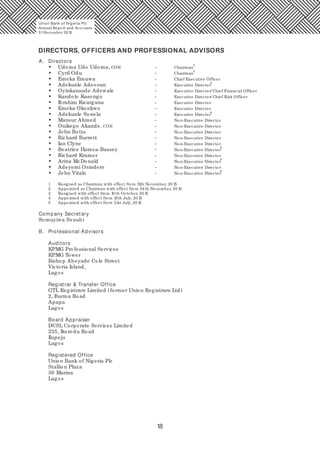
A. Directors
1
• Udoma Udo Udoma, CON - Chairman
2
• Cyril Odu - Chairman
• Emeka Emuwa - Chief Executive Officer
3
• Adekunle Adeosun - Executive Director
• Oyinkansade Adewale - Executive Director/ Chief Financial Officer
• Kandolo Kasongo - Executive Director/ Chief Risk Officer
• Ibrahim Kwargana - Executive Director
• Emeka Okonkwo - Executive Director
4
• Adekunle Sonola - Executive Director
• Mansur Ahmed - Non-Executive Director
• Onikepo Akande, CON - Non-Executive Director
• John Botts - Non-Executive Director
• Richard Burrett - Non-Executive Director
• Ian Clyne - Non-Executive Director
5
• Beatrice Hamza-Bassey - Non-Executive Director
• Richard Kramer - Non-Executive Director
5
• Arina McDonald - Non-Executive Director
• Adeyemi Osindero - Non-Executive Director
5
• John Vitalo - Non-Executive Director
1 Resigned as Chairman with effect from 11th November, 20 15
2 Appointed as Chairman with effect from 24th November, 20 15
3 Resigned with effect from 10 th October, 20 15
4 Appointed with effect from 15th July, 20 15
5 Appointed with effect from 21st July, 20 15
Company Secretary
Somuyiwa Sonubi
B. Professional Advisors
Auditors
KPMG Professional Services
KPMG Tower
Bishop Aboyade Cole Street
Victoria Island,
Lagos
Registrar & Transfer Office
GTL Registrars Limited (former Union Registrars Ltd)
2, Burma Road
Apapa
Lagos
Board Appraiser
DCSL Corporate Services Limited
235, Ikorodu Road
Ilupeju
Lagos
Registered Office
Union Bank of Nigeria Plc
Stallion Plaza
36 Marina
Lagos
DIRECTORS, OFFICERS AND PROFESSIONAL ADVISORS
Union Bank of Nigeria Plc
Annual Report and Accounts
31December 20 15
19
C. Management Team
Emeka Emuwa Chief Executive Officer
Oyinkansade Adewale Chief Financial Officer
Omolola Cardoso Head, Group Corporate Strategy
Luxhman Jayaratne Head, Operations & Information Technology
Kandolo Kasongo Chief Risk Officer
Ibrahim Kwargana Head, Public Sector
Joseph Mbulu Transformation Director
Emeka Okonkwo Head, Corporate and Investment Banking
Adekunle Sonola Head, Commercial Banking
Miyen Swomen Head, Human Resources
Carlos Wanderley Head, Retail Banking
Olabode Abikoye Head, AgriBusiness
Olanireti Abimbola Head, Internal Control
Joyce Adekoya Head, Risk Governance
Taiwo Adeneye Head, Treasury Operations
Oluwagbenga Adeoye Head, Financial Control
Sheahan Arasaratnam Head, Retail Products
Bulus Ayuba Head, Branch Operations & Services, North
Olugbenga Babatunde Head, Information Technology Operations
Fatai Baruwa Head, Special Projects
Lateef Dabiri Head of Operations
Rosemary David-Etim Regional Commercial Executive, South South
Abigail Duopama-Obomanu Head, Branch Coordination
Olusegun Edun Head, Credit Risk Analysis (Corporate)
Ogochukwu Ekezie-Ekaidem Head, Corporate Affairs & Corporate Communication
Ikechukwuka Emerole Head, Treasury
Chidi Ileka Head, Transaction Banking, Trade & Cash
David Isiavwe Chief Audit Executive
Abolade Jegede Regional Commercial Executive, Lagos Mainland
Adebanji Jimoh Head, Sales and Distribution
Ali Kadiri Head, General Markets
Pearl Kanu Group Head, Commercial
Segun Lamidi Head, Head Office Operations
Agatha Mbanefo Head, Customer Care
Magnus Nnoka Head, Business Support and Recovery
Roseline Nwayo Deputy Chief Audit Executive
Gbolahan Ogundipe Head, Foreign Operations
Mobolade Ojeahere Head, Cash Management
Morenike Olabisi Head, Fast Moving Consumer Goods
Babatunde Olagbaju Head, Credit Portfolio Management & Regulatory Compliance
Biyi Olagbami Chief Credit Officer
Ayodele Olaiya Head, Value Chain Banking
Uche Olowu Head, Energy Upstream/ Oil Services
Gloria Omereonye Group Head, Commercial
Ifeanyi Opara Head, Energy Downstream
Folorunsho Orimoloye Head, Alternative Channels
Oghenefovie Oyawiri Head, Operational Risk Management
Morayo Oyeleke Head, Learning Academy
Kabir Sarkin-Pawa Regional Commercial Executive, North
Rabiu Tata Head, Public Sector Group, Abuja/ North
Imoh Udoh Group Head, Commercial
Maria Udoh Public Sector Relationship Manager
Momohjimoh Umar Regional Commercial Executive, Lagos Island
Maurice Phido Managing Director, Union Bank UK Plc
Olufemi Okanlawon Head, South Africa Representative Office
Union Bank of Nigeria Plc
Annual Report and Accounts
31December 20 15
20
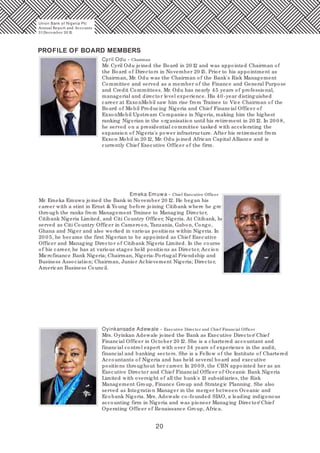
Cyril Odu - Chairman
Mr. Cyril Odu joined the Board in 20 12 and was appointed Chairman of
the Board of Directors in November 20 15. Prior to his appointment as
Chairman, Mr. Odu was the Chairman of the Bank's Risk Management
Committee and served as a member of the Finance and General Purpose
and Credit Committees. Mr. Odu has nearly 45 years of professional,
managerial and director level experience. His 40 -year distinguished
career at ExxonMobil saw him rise from Trainee to Vice Chairman of the
Board of Mobil Producing Nigeria and Chief Financial Officer of
ExxonMobil Upstream Companies in Nigeria, making him the highest
ranking Nigerian in the organisation until his retirement in 20 12. In 20 0 8,
he served on a presidential committee tasked with accelerating the
expansion of Nigeria's power infrastructure. After his retirement from
Exxon Mobil in 20 12, Mr. Odu joined African Capital Alliance and is
currently Chief Executive Officer of the firm.
Emeka Emuwa - Chief Executive Officer
Mr. Emeka Emuwa joined the Bank in November 20 12. He began his
career with a stint in Ernst & Young before joining Citibank where he grew
through the ranks from Management Trainee to Managing Director,
Citibank Nigeria Limited, and Citi Country Officer, Nigeria. At Citibank, he
served as Citi Country Officer in Cameroon, Tanzania, Gabon, Congo,
Ghana and Niger and also worked in various positions within Nigeria. In
20 0 5, he became the first Nigerian to be appointed as Chief Executive
Officer and Managing Director of Citibank Nigeria Limited. In the course
of his career, he has at various stages held positions as Director, Accion
Microfinance Bank Nigeria; Chairman, Nigeria-Portugal Friendship and
Business Association; Chairman, Junior Achievement Nigeria; Director,
American Business Council.
Oyinkansade Adewale - Executive Director and Chief Financial Officer
Mrs. Oyinkan Adewale joined the Bank as Executive Director/ Chief
Financial Officer in October 20 12. She is a chartered accountant and
financial control expert with over 34 years of experience in the audit,
financial and banking sectors. She is a Fellow of the Institute of Chartered
Accountants of Nigeria and has held several board and executive
positions throughout her career. In 20 0 9, the CBN appointed her as an
Executive Director and Chief Financial Officer of Oceanic Bank Nigeria
Limited with oversight of all the bank's 13 subsidiaries, the Risk
Management Group, Finance Group and Strategic Planning. She also
served as Integration Manager in the merger between Oceanic and
Ecobank Nigeria. Mrs. Adewale co-founded SIAO, a leading indigenous
accounting firm in Nigeria and was pioneer Managing Director/ Chief
Operating Officer of Renaissance Group, Africa.
PROFILE OF BOARD MEMBERS
Union Bank of Nigeria Plc
Annual Report and Accounts
31December 20 15
21
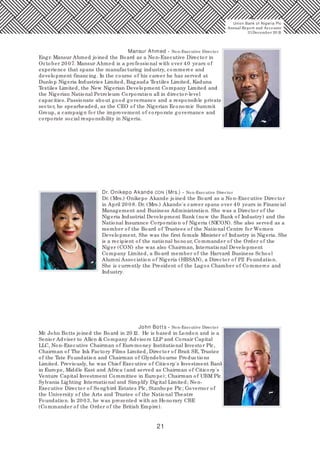
Mansur Ahmed - Non-Executive Director
Engr. Mansur Ahmed joined the Board as a Non-Executive Director in
October 20 07. Mansur Ahmed is a professional with over 40 years of
experience that spans the manufacturing industry, commerce and
development financing. In the course of his career he has served at
Dunlop Nigeria Industries Limited, Bagauda Textiles Limited, Kaduna
Textiles Limited, the New Nigerian Development Company Limited and
the Nigerian National Petroleum Corporation all in director-level
capacities. Passionate about good governance and a responsible private
sector, he spearheaded, as the CEO of the Nigerian Economic Summit
Group, a campaign for the improvement of corporate governance and
corporate social responsibility in Nigeria.
Dr. Onikepo Akande CON (Mrs.) - Non-Executive Director
Dr. (Mrs.) Onikepo Akande joined the Board as a Non-Executive Director
in April 20 0 8. Dr. (Mrs.) Akande's career spans over 40 years in Financial
Management and Business Administration. She was a Director of the
Nigeria Industrial Development Bank (now the Bank of Industry) and the
National Insurance Corporation of Nigeria (NICON). She also served as a
member of the Board of Trustees of the National Centre for Women
Development. She was the first female Minister of Industry in Nigeria. She
is a recipient of the national honour, Commander of the Order of the
Niger (CON) she was also Chairman, International Development
Company Limited, a Board member of the Harvard Business School
Alumni Association of Nigeria (HBSAN), a Director of PZ Foundation.
She is currently the President of the Lagos Chamber of Commerce and
Industry.
John Botts - Non-Executive Director
Mr. John Botts joined the Board in 20 12. He is based in London and is a
Senior Adviser to Allen & Company Advisors LLP and Corsair Capital
LLC, Non-Executive Chairman of Euromoney Institutional Investor Plc,
Chairman of The Ink Factory Films Limited, Director of Brait SE, Trustee
of the Tate Foundation and Chairman of Glyndebourne Productions
Limited. Previously, he was Chief Executive of Citicorp's Investment Bank
in Europe, Middle East and Africa (and served as Chairman of Citicorp's
Venture Capital Investment Committee in Europe); Chairman of UBM Plc,
Sylvania Lighting International and Simplify Digital Limited; Non-
Executive Director of Songbird Estates Plc, Stanhope Plc; Governor of
the University of the Arts and Trustee of the National Theatre
Foundation. In 20 03, he was presented with an Honorary CBE
(Commander of the Order of the British Empire).
Union Bank of Nigeria Plc
Annual Report and Accounts
31December 20 15
22
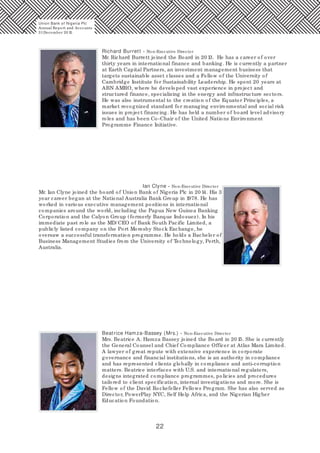
Richard Burrett - Non-Executive Director
Mr. Richard Burrett joined the Board in 20 13. He has a career of over
thirty years in international finance and banking. He is currently a partner
at Earth Capital Partners, an investment management business that
targets sustainable asset classes and a Fellow of the University of
Cambridge Institute for Sustainability Leadership. He spent 20 years at
ABN AMRO, where he developed vast experience in project and
structured finance, specializing in the energy and infrastructure sectors.
He was also instrumental to the creation of the Equator Principles, a
market recognized standard for managing environmental and social risk
issues in project financing. He has held a number of board level advisory
roles and has been Co-Chair of the United Nations Environment
Programme Finance Initiative.
Ian Clyne - Non-Executive Director
Mr. Ian Clyne joined the board of Union Bank of Nigeria Plc in 20 14. His 37
year career began at the National Australia Bank Group in 1978. He has
worked in various executive management positions in international
companies around the world, including the Papua New Guinea Banking
Corporation and the Calyon Group (formerly Banque Indosuez). In his
immediate past role as the MD/ CEO of Bank South Pacific Limited, a
publicly listed company on the Port Moresby Stock Exchange, he
oversaw a successful transformation programme. He holds a Bachelor of
Business Management Studies from the University of Technology, Perth,
Australia.
Beatrice Hamza-Bassey (Mrs.) - Non-Executive Director
Mrs. Beatrice A. Hamza Bassey joined the Board in 20 15. She is currently
the General Counsel and Chief Compliance Officer at Atlas Mara Limited.
A lawyer of great repute with extensive experience in corporate
governance and financial institutions, she is an authority in compliance
and has represented clients globally in compliance and anti-corruption
matters. Beatrice interfaces with U.S. and international regulators,
designs integrated compliance programmes, policies and procedures
tailored to client specification, internal investigations and more. She is
Fellow of the David Rockefeller Fellows Program. She has also served as
Director, PowerPlay NYC, Self Help Africa, and the Nigerian Higher
Education Foundation.
Union Bank of Nigeria Plc
Annual Report and Accounts
31December 20 15
23
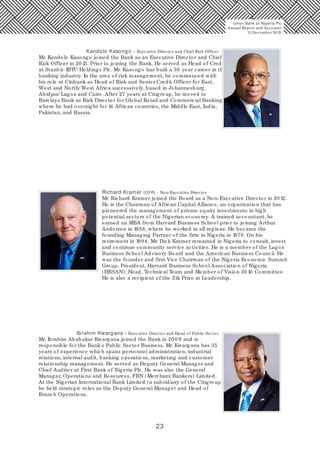
Kandolo Kasongo - Executive Director and Chief Risk Officer
Mr. Kandolo Kasongo joined the Bank as an Executive Director and Chief
Risk Officer in 20 13. Prior to joining the Bank, He served as Head of Credit
at Stanbic IBTC Holdings Plc. Mr. Kasongo has built a 30 year career in the
banking industry. In the area of risk management, he commenced with
his role at Citibank as Head of Risk and Senior Credit Officer for East,
West and North/ West Africa successively, based in Johannesburg,
Abidjan/ Lagos and Cairo. After 27 years at Citigroup, he moved to
Barclays Bank as Risk Director for Global Retail and Commercial Banking,
where he had oversight for 14 African countries, the Middle East, India,
Pakistan, and Russia.
Richard Kramer (OFR) - Non-Executive Director
Mr. Richard Kramer joined the Board as a Non-Executive Director in 20 12.
He is the Chairman of African Capital Alliance, an organization that has
pioneered the management of private equity investments in high
potential sectors of the Nigerian economy. A trained accountant, he
earned an MBA from Harvard Business School prior to joining Arthur
Andersen in 1958, where he worked in all regions. He became the
founding Managing Partner of the firm in Nigeria in 1978. On his
retirement in 1994, Mr. Dick Kramer remained in Nigeria to consult, invest
and continue community service activities. He is a member of the Lagos
Business School Advisory Board and the American Business Council. He
was the founder and first Vice Chairman of the Nigeria Economic Summit
Group; President, Harvard Business School Association of Nigeria
(HBSAN); Head, Technical Team and Member of Vision 20 10 Committee.
He is also a recipient of the Zik Prize in Leadership.
Ibrahim Kwargana - Executive Director and Head of Public Sector
Mr. Ibrahim Abubakar Kwargana joined the Bank in 20 0 9 and is
responsible for the Bank's Public Sector Business. Mr. Kwargana has 35
years of experience which spans personnel administration, industrial
relations, internal audit, banking operations, marketing and customer
relationship management. He served as Deputy General Manager and
Chief Auditor at First Bank of Nigeria Plc. He was also the General
Manager, Operations and Resources, FBN (Merchant Bankers) Limited.
At the Nigerian International Bank Limited (a subsidiary of the Citigroup)
he held strategic roles as the Deputy General Manager and Head of
Branch Operations.
Union Bank of Nigeria Plc
Annual Report and Accounts
31December 20 15
24
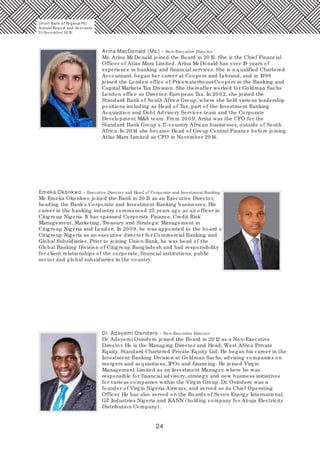
Arina MacDonald (Ms.) - Non-Executive Director
Ms. Arina McDonald joined the Board in 20 15. She is the Chief Financial
Officer of Atlas Mara Limited. Arina McDonald has over 19 years of
experience in banking and financial services. She is a qualified Chartered
Accountant, began her career at Coopers and Lybrand, and in 1998
joined the London office of PricewaterhouseCoopers in the Banking and
Capital Markets Tax Division. She thereafter worked for Goldman Sachs'
London office as Director: European Tax. In 20 02, she joined the
Standard Bank of South Africa Group, where she held various leadership
positions including as Head of Tax, part of the Investment Banking
Acquisition and Debt Advisory Services team and the Corporate
Development M&A team. From 20 0 9, Arina was the CFO for the
Standard Bank Group's 17-country African businesses, outside of South
Africa. In 20 14 she became Head of Group Central Finance before joining
Atlas Mara Limited as CFO in November 20 14.
Emeka Okonkwo - Executive Director and Head of Corporate and Investment Banking
Mr. Emeka Okonkwo joined the Bank in 20 13 as an Executive Director,
heading the Bank's Corporate and Investment Banking businesses. His
career in the banking industry commenced 25 years ago as an officer in
Citigroup Nigeria. It has spanned Corporate Finance, Credit Risk
Management, Marketing, Treasury and Strategic Management in
Citigroup Nigeria and London. In 20 0 9, he was appointed to the board of
Citigroup Nigeria as an executive director for Commercial Banking and
Global Subsidiaries. Prior to joining Union Bank, he was head of the
Global Banking Division of Citigroup Bangladesh and had responsibility
for client relationships of the corporate, financial institutions, public
sector and global subsidiaries in the country.
Dr. Adeyemi Osindero - Non-Executive Director
Dr. Adeyemi Osindero joined the Board in 20 12 as a Non-Executive
Director. He is the Managing Director and Head, West Africa Private
Equity, Standard Chartered Private Equity Ltd. He began his career in the
Investment Banking Division at Goldman Sachs, advising companies on
mergers and acquisitions, IPOs and financing. He joined Virgin
Management Limited as an Investment Manager, where he was
responsible for financial advisory, strategy and new business initiatives
for various companies within the Virgin Group. Dr. Osindero was a
founder of Virgin Nigeria Airways, and served as its Chief Operating
Officer. He has also served on the Boards of Seven Energy International,
GZ Industries Nigeria and KANN (holding company for Abuja Electricity
Distribution Company).
Union Bank of Nigeria Plc
Annual Report and Accounts
31December 20 15
25
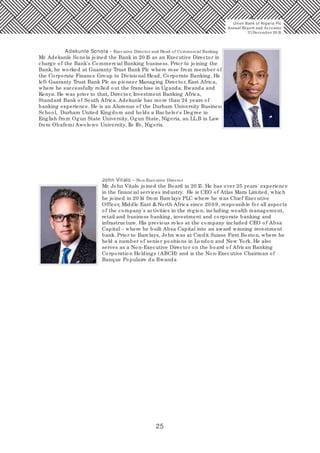
Adekunle Sonola - Executive Director and Head of Commercial Banking
Mr. Adekunle Sonola joined the Bank in 20 15 as an Executive Director in
charge of the Bank's Commercial Banking business. Prior to joining the
Bank, he worked at Guaranty Trust Bank Plc where rose from member of
the Corporate Finance Group to Divisional Head, Corporate Banking. He
left Guaranty Trust Bank Plc as pioneer Managing Director, East Africa,
where he successfully rolled out the franchise in Uganda, Rwanda and
Kenya. He was prior to that, Director, Investment Banking Africa,
Standard Bank of South Africa. Adekunle has more than 24 years of
banking experience. He is an Alumnus of the Durham University Business
School, Durham United Kingdom and holds a Bachelor's Degree in
English from Ogun State University, Ogun State, Nigeria, an LL.B in Law
from Obafemi Awolowo University, Ile Ife, Nigeria.
John Vitalo - Non-Executive Director
Mr. John Vitalo joined the Board in 20 15. He has over 25 years' experience
in the financial services industry. He is CEO of Atlas Mara Limited, which
he joined in 20 14 from Barclays PLC where he was Chief Executive
Officer, Middle East & North Africa since 20 0 9, responsible for all aspects
of the company's activities in the region, including wealth management,
retail and business banking, investment and corporate banking and
infrastructure. His previous roles at the company included CEO of Absa
Capital – where he built Absa Capital into an award winning investment
bank. Prior to Barclays, John was at Credit Suisse First Boston, where he
held a number of senior positions in London and New York. He also
serves as a Non-Executive Director on the board of African Banking
Corporation Holdings (ABCH) and is the Non-Executive Chairman of
Banque Populaire du Rwanda
Union Bank of Nigeria Plc
Annual Report and Accounts
31December 20 15
26
Corporate Governance practices in Union Bank of Nigeria Plc (“UBN” or “the Bank”) are as codified
in the Central Bank of Nigeria's (“CBN”) Code of Corporate Governance of 20 14, the Securities and
Exchange Commission (“SEC”) Code of Corporate Governance of 20 03, the Banks' and Other
Financial Institutions Act of 1991(as amended) and other relevant statutes, which provide
guidance for the governance of the Bank, compliance with regulatory requirements as well as, the
core values upon which the Bank was founded. These codes and statutes are geared towards
ensuring the accountability of the Board of Directors (“the Board”) and Management to the
stakeholders of the Bank in particular and emphasize the need to meet and address the interests of
a range of stakeholders, to promote the long-term sustainability of the Bank.
UBN is committed to the best corporate governance practices and believes that adherence and
commitment to high governance principles and standards is the panacea for effective control and
management of the Bank. The principle of good corporate governance practices is an important
ingredient in creating, protecting, promoting and sustaining shareholders' interests, rights and
values, as well as delivering excellent service to our customers. The Bank is committed to the
highest ethical standards and transparency in the conduct of its business.
In compliance with the requirements of the CBN, the Bank undertakes internal reviews of its
compliance with defined corporate governance practices and submits reports on the Bank's
compliance status to the CBN. An annual board appraisal review is also conducted by an
independent consultant appointed by the Bank, whose report is submitted to the CBN and
presented to shareholders at the AGM of the Bank, in compliance with the provisions of the CBN
Code of Corporate Governance.
Securities Trading Policy
To further demonstrate its commitment to transparency and ensure compliance with regulatory
requirements, the Bank has developed a Securities Trading Policy in line with the Codes of
Corporate Governance of the CBN and SEC respectively, and Section 14 of the Amendment to the
Listings Rules of the Nigerian Stock Exchange. The Policy restricts the directors, staff,
shareholders, key management personnel, third party service providers or any other connected
persons who have direct or indirect access to the Bank's insider information from dealing in the
Bank's securities. It also prohibits the trading of the Bank's securities during 'close' periods. The
policy is designed to ensure that its compliance is monitored on an ongoing basis.
Complaints Management Policy
The Bank's Complaints Management Policy has been prepared pursuant to the Rules Relating to
the Complaints Management Framework of the Nigerian Capital Market issued by the SEC on 16th
February, 20 15. The Policy applies strictly to the Bank's shareholders and provides an avenue for
them to make complaints regarding their shareholding and relationship with the Bank.
The Complaints Management Policy aims to promote and safeguard the interest of the Bank's
shareholders and investors, with its primary objective of ensuring that the activities of the board
and management are in the best interest of the Bank and its shareholders. The policy sets out the
process and channels through which shareholders can submit their complaints, and the process for
managing these complaints.
The Registrar and Company Secretary are jointly responsible for the implementation of this policy.
Remuneration Policy for Directors and Senior Management
The Bank's Remuneration Policy for directors and senior management is geared towards
attracting, retaining and motivating the best talent and enables the Bank achieve its financial,
strategic and operational objectives. The policy sets out amongst others, the structure and
components of the remuneration packages for Executive and Non-Executive Directors, and
ensures that the remuneration packages are in compliance with the CBN and SEC codes of
corporate governance.
In line with the provisions of the extant regulations and codes of corporate governance, the
remuneration of directors and senior management are set at levels which are fair and competitive,
CORPORATE GOVERNANCE IN UNION BANK
Union Bank of Nigeria Plc
Annual Report and Accounts
31December 20 15
27
and take into consideration the economic realities in the financial services sector and the Bank's
financial performance.
Governance Structure
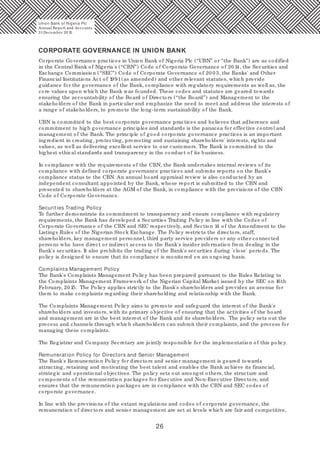
The Bank's governance bodies, composition and their respective meeting attendance schedules
are captured below:
A. The Board of Directors
The Board of Directors (“the Board”) oversees the management of the Bank, and
comprises a Non-Executive Chairman, ten Non-Executive Directors, the Chief Executive
Officer and five Executive Directors as listed below:
Responsibilities of the Board
The Board, the highest decision making body approved by the shareholders, met seven (7) times
during the year to provide strategic direction, policies and leadership in attaining the objectives of
the Bank.
The Board monitors the activities of the Chief Executive Officer and Executive Directors and the
accomplishment of set objectives through reports at its meetings. In performing its oversight
function over the Bank's business, the Board operates through the following Board and
Management Committees.
B. Standing Board Committees
The Board of Directors has six standing committees, which deal with specific operations of
the Bank, namely:
1. Board Credit Committee
2. Board Finance & General Purpose Committee
3. Board Establishment & Services Committee
4. Board Risk Management Committee
5. Board Remuneration Committee
6. Board Audit Committee
S/ NO NAME 24/ 0 2/ 20 15 21/ 0 4/ 20 15 16/ 0 6/ 20 15 16/ 0 6/ 20 15 14/ 07/ 20 15 22/ 0 9/ 20 15 24/ 11/ 20 15
1
1
Udo Udoma UDOMA
2
2
Cyril ODU
3 Emeka EMUWA
4
3
Adekunle ADEOSUN
5 Oyinkansade ADEWALE
6 Mansur AHMED
7 Onikepo AKANDE
8 John BOTTS
9 Richard BURRETT
10 Ian CLYNE
11
5
Beatrice HAMZA-BASSEY
12 Kandolo KASONGO
13 Richard KRAMER
14 Ibrahim KWARGANA
15
5
Arina MCDONALD
16 Emeka OKONKWO
17 Adeyemi OSINDERO
18
4
Adekunle SONOLA
19
5
John VITALO
Present
Absent
Present at AGM
Absent from AGM
Not applicable due to non-membership at specified time
Union Bank of Nigeria Plc
Annual Report and Accounts
31December 20 15
1 Resigned as Chairman with effect from 11th November 20 15
2 Appointed as Chairman with effect from 24th November 20 15
3 Resigned with effect from 10 th October 20 15
4 Appointed with effect from 15th July, 20 15
5 Appointed with effect from 21st July, 20 15
28
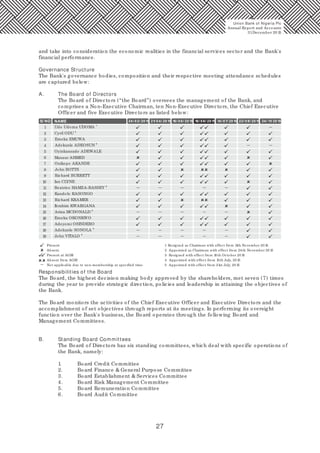
The composition of the Board committees was reconstituted in September, 20 15. In addition to the
committees listed above, there is a Statutory Audit Committee.
1. Board Credit Committee
The Committee met six (6) times during the year. It is comprised of the following members:
Its responsibilities include the following, amongst others:
• Consider and approve credits and other credit related matters within its set limit.
• Review and recommend credits and other credit related matters above its limit to the
Board for consideration and approval.
• Review the credit portfolio.
• Serve as a catalyst for the Bank's credit policy changes from the Credit Committee to
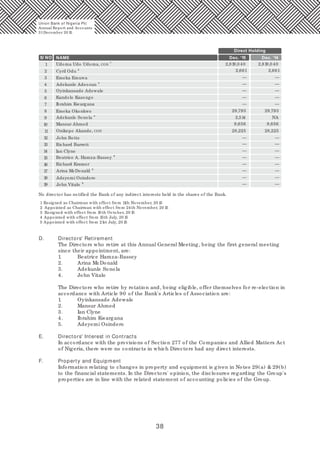
the Board.
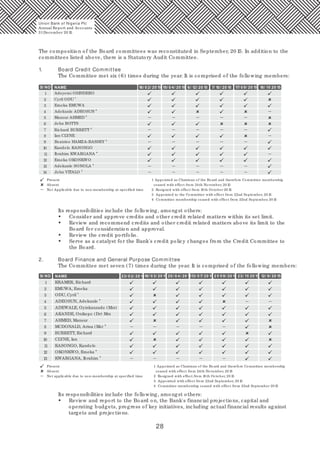
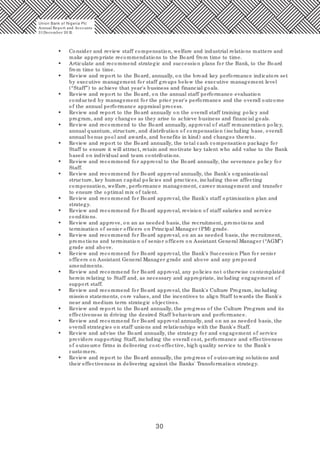
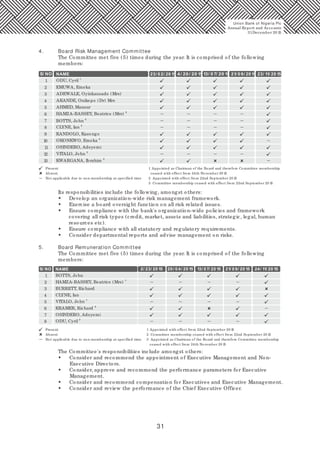
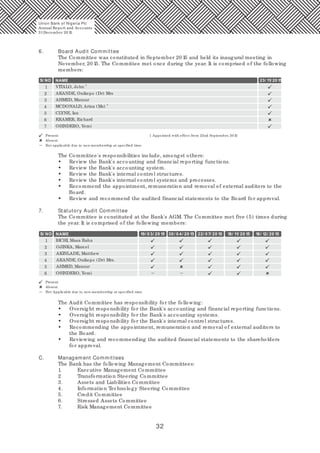
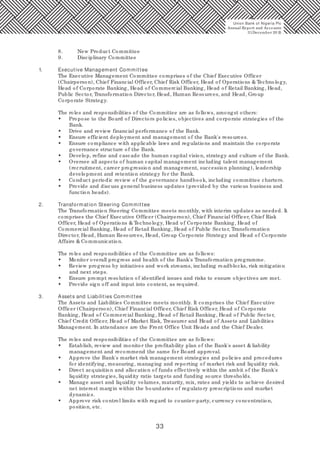
2. Board Finance and General Purpose Committee
The Committee met seven (7) times during the year. It is comprised of the following members:
Its responsibilities include the following, amongst others:
• Review and report to the Board on, the Bank's financial projections, capital and
operating budgets, progress of key initiatives, including actual financial results against
targets and projections.
S/ NO NAME 18/ 0 2/ 20 15 15/ 0 4/ 20 15 6/ 12/ 20 15 7/ 10/ 20 15 17/ 0 9/ 20 15 18/ 11/ 20 15
1 Adeyemi OSINDERO
2
1
Cyril ODU
3 Emeka EMUWA
4
2
Adekunle ADEOSUN
5
3
Mansur AHMED
6 John BOTTS
7 3
Richard BURRETT
8 Ian CLYNE
9
3
Beatrice HAMZA-BASSEY
10 Kandolo KASONGO
11
12
13
14
4
Ibrahim KWARGANA
Emeka OKONKWO
3
Adekunle SONOLA
3
John VITALO
Present
Absent
Not Applicable due to non-membership at specified time
S/ NO NAME
1
2
3
4
5
6
7
8
9
10
11
12
13
23/ 0 2/ 20 1518/ 0 3/ 20 15 20/ 0 4/ 20 1513/ 07/ 20 15 21/ 0 9/ 20 15 23/ 11/ 20 15 12/ 9/ 20 15
KRAMER, Richard
EMUWA, Emeka
1
ODU, Cyril
2
ADEOSUN, Adekunle
ADEWALE, Oyinkansade (Mrs)
AKANDE, Onikepo (Dr) Mrs
AHMED, Mansur
3
MCDONALD, Arina (Ms)
BURRETT, Richard
CLYNE, Ian
KASONGO, Kandolo
4
OKONKWO, Emeka
3
KWARGANA, Ibrahim
Present
Absent
Not applicable due to non-membership at specified time
Union Bank of Nigeria Plc
Annual Report and Accounts
31December 20 15
1 Appointed as Chairman of the Board and therefore Committee membership
ceased with effect from 24th November, 20 15
2 Resigned with effect from 10 th October 20 15
3 Appointed to the Committee with effect from 22nd September, 20 15
4 Committee membership ceased with effect from 22nd September, 20 15
1 Appointed as Chairman of the Board and therefore Committee membership
ceased with effect from 24th November, 20 15
2 Resigned with effect from 10 th October, 20 15
3 Appointed with effect from 22nd September, 20 15
4 Committee membership ceased with effect from 22nd September 20 15
29
• Review and recommend to the Board, the Bank's capital structure, including, but not
limited to, allotment of new capital, debt limits and any changes to the existing capital
structure.
• Review and recommend to the Board the Bank's annual plan for the allocation of
capital and material changes during the course of the year.
• Formulate guidelines from time to time on cost control and reduction, consistent with
maximum efficiency, and make appropriate recommendations to the Board.
• Review major expense lines, as warranted, and approve expenditures within the
Committee's approved limits and review/ recommend for Board approval any
expenditure beyond the Committee's approved limits.
• Review and report to the Board on the Transformation programme against goals,
including timing, budget, quality of delivery, and tradeoffs between transformation
plans and business as-usual (if required).
• Review and recommend for Board approval, the Bank's Transformation budget and
any associated expenditures beyond that delegated to management.
• Review and provide feedback to the Board on the development of the Bank's strategic
planning process and performance objectives to ensure the achievement of the
financial targets expected by shareholders.
• Review and report to the Board on the effectiveness of the Bank's strategic planning
and implementation monitoring process.
• Review and provide feedback to the Board on high-impact initiatives not otherwise
managed by another committee that may have a material impact on the Bank's
finances, regulatory relationships, customers and/or infrastructure.
• Review and recommend for Board approval any transactions associated with high-
impact initiatives and any associated expenditures beyond that delegated to
management.
• Review and recommend for Board approval any change to the delegation of
authorities to management and management committees on financial matters.
• Review and recommend for Board approval the Bank's dividend policy, including
amount, nature and timing.
3. Board Establishment and Services Committee
The Committee met seven (7) times during the year. It is comprised of the following members:
Its responsibilities include the following, amongst others:
• Consider and approve appointments, promotions and discipline of Principal Managers
and above;
• Review and recommend appointments, promotions and discipline of Assistant
General Managers and above to the Board for consideration and approval.
• Consider and recommend compensation increments for Principal Managers and
above to the Board for consideration and approval.
S/ NO NAME
1
2
3
4
5
6
7
8
9
10
11
12
2/ 18/ 20 15 23/ 0 2/ 20 1515/ 0 4/ 20 1515/ 0 6/ 20 15 7/ 8/ 20 15 18/ 0 9/ 20 15 18/ 11/ 20 15
AHMED, Mansur
EMUWA, Emeka
1
ADEOSUN, Adekunle
2
ADEWALE, Oyinkansade (Mrs)
AKANDE, Onikepo (Dr) Mrs
3
MCDONALD, Arina (Ms)
3
HAMZA-BASSEY Beatrice (Mrs)
BOTTS, John
BURRETT, Richard
KRAMER, Richard
KWARGANA, Ibrahim
3
SONOLA, Adekunle
Present
Absent
Not applicable due to non-membership at specified time
Union Bank of Nigeria Plc
Annual Report and Accounts
31December 20 15
1 Resigned with effect from 10 th October 20 15
2 Committee membership ceased with effect from 22nd September 20 15
3 Appointed with effect from 22nd September 20 15
30
• Consider and review staff compensation, welfare and industrial relations matters and
make appropriate recommendations to the Board from time to time.
• Articulate and recommend strategic and succession plans for the Bank, to the Board
from time to time.
• Review and report to the Board, annually, on the broad key performance indicators set
by executive management for staff groups below the executive management level
(“Staff”) to achieve that year's business and financial goals.
• Review and report to the Board, on the annual staff performance evaluation
conducted by management for the prior year's performance and the overall outcome
of the annual performance appraisal process.
• Review and report to the Board annually on the overall staff training policy and
program, and any changes as they arise to achieve business and financial goals.
• Review and recommend to the Board annually, approval of staff remuneration policy,
annual quantum, structure, and distribution of compensation (including base, overall
annual bonus pool and awards, and benefits in kind) and changes thereto.
• Review and report to the Board annually, the total cash compensation package for
Staff to ensure it will attract, retain and motivate key talent who add value to the Bank
based on individual and team contributions.
• Review and recommend for approval to the Board annually, the severance policy for
Staff.
• Review and recommend for Board approval annually, the Bank's organisational
structure, key human capital policies and practices, including those affecting
compensation, welfare, performance management, career management and transfer
to ensure the optimal mix of talent.
• Review and recommend for Board approval, the Bank's staff optimisation plan and
strategy.
• Review and recommend for Board approval, revision of staff salaries and service
conditions.
• Review and approve, on an as needed basis, the recruitment, promotions and
termination of senior officers on Principal Manager (PM) grade.
• Review and recommend for Board approval, on an as needed basis, the recruitment,
promotions and termination of senior officers on Assistant General Manager (“AGM”)
grade and above.
• Review and recommend for Board approval, the Bank's Succession Plan for senior
officers on Assistant General Manager grade and above and any proposed
amendments.
• Review and recommend for Board approval, any policies not otherwise contemplated
herein relating to Staff and, as necessary and appropriate, including engagement of
support staff.
• Review and recommend for Board approval, the Bank's Culture Program, including
mission statements, core values, and the incentives to align Staff towards the Bank's
near and medium term strategic objectives.
• Review and report to the Board annually, the progress of the Culture Program and its
effectiveness in driving the desired Staff behaviours and performance.
• Review and recommend for Board approval annually, and on an as needed basis, the
overall strategies on staff unions and relationships with the Bank's Staff.
• Review and advise the Board annually, the strategy for and engagement of service
providers supporting Staff, including the overall cost, performance and effectiveness
of outsource firms in delivering cost-effective, high quality service to the Bank's
customers.
• Review and report to the Board annually, the progress of outsourcing solutions and
their effectiveness in delivering against the Banks' Transformation strategy.
Union Bank of Nigeria Plc
Annual Report and Accounts
31December 20 15
31
4. Board Risk Management Committee
The Committee met five (5) times during the year. It is comprised of the following
members:
Its responsibilities include the following, amongst others:
• Develop an organization-wide risk management framework.
• Exercise a board oversight function on all risk related issues.
• Ensure compliance with the bank's organization-wide policies and framework
covering all risk types (credit, market, assets and liabilities, strategic, legal, human
resources etc).
• Ensure compliance with all statutory and regulatory requirements.
• Consider departmental reports and advise management on risks.
5. Board Remuneration Committee
The Committee met five (5) times during the year. It is comprised of the following
members:
The Committee's responsibilities include amongst others:
• Consider and recommend the appointment of Executive Management and Non-
Executive Directors.
• Consider, approve and recommend the performance parameters for Executive
Management.
• Consider and recommend compensation for Executives and Executive Management.
• Consider and review the performance of the Chief Executive Officer.
S/ NO NAME
1
2
3
4
5
6
7
8
9
10
11
12
13
23/ 0 2/ 20 15 4/ 20 / 20 15 13/ 0 7/ 20 15 21/ 0 9/ 20 15 23/ 11/ 20 15
1
ODU, Cyril
EMUWA, Emeka
ADEWALE, Oyinkansade (Mrs)
AKANDE, Onikepo (Dr) Mrs
AHMED, Mansur
2
HAMZA-BASSEY, Beatrice (Mrs)
3
BOTTS, John
2
CLYNE, Ian
KANDOLO, Kasongo
3
OKONKWO, Emeka
2
VITALO, John
3
KWARGANA, Ibrahim
OSINDERO, Adeyemi
Present
Absent
Not applicable due to non-membership at specified time
S/ NO NAME
1
2
3
4
5
6
7
8
2/ 23/ 20 15 13/ 07/ 20 15 21/ 0 9/ 20 15 24/ 11/ 20 15
BOTTS, John
1
HAMZA-BASSEY, Beatrice (Mrs)
BURRETT, Richard
CLYNE, Ian
1
VITALO, John
2
KRAMER, Richard
OSINDERO, Adeyemi
3
ODU, Cyril
20/ 0 4/ 20 15
Present
Absent
Not applicable due to non-membership at specified time
Union Bank of Nigeria Plc
Annual Report and Accounts
31December 20 15
1 Appointed as Chairman of the Board and therefore Committee membership
ceased with effect from 24th November 20 15
2 Appointed with effect from 22nd September 20 15
3 Committee membership ceased with effect from 22nd September 20 15
1 Appointed with effect from 22nd September 20 15
2 Committee membership ceased with effect from 22nd September 20 15
3 Appointed as Chairman of the Board and therefore Committee membership
ceased with effect from 24th November 20 15
32
6. Board Audit Committee
The Committee was constituted in September 20 15 and held its inaugural meeting in
November, 20 15. The Committee met once during the year. It is comprised of the following
members:
The Committee's responsibilities include, amongst others:
• Review the Bank's accounting and financial reporting functions.
• Review the Bank's accounting system.
• Review the Bank's internal control structures.
• Review the Bank's internal control systems and processes.
• Recommend the appointment, remuneration and removal of external auditors to the
Board.
• Review and recommend the audited financial statements to the Board for approval.
7. Statutory Audit Committee
The Committee is constituted at the Bank's AGM. The Committee met five (5) times during
the year. It is comprised of the following members:
The Audit Committee has responsibility for the following:
• Oversight responsibility for the Bank's accounting and financial reporting functions.
• Oversight responsibility for the Bank's accounting systems.
• Oversight responsibility for the Bank's internal control structures.
• Recommending the appointment, remuneration and removal of external auditors to
the Board.
• Reviewing and recommending the audited financial statements to the shareholders
for approval.
C. Management Committees
The Bank has the following Management Committees:
1. Executive Management Committee
2 Transformation Steering Committee
3. Assets and Liabilities Committee
4. Information Technology Steering Committee
5. Credit Committee
6. Stressed Assets Committee
7. Risk Management Committee
S/ NO NAME
1
2
3
4
5
6
7
23/ 11/ 20 15
1
VITALO, John
AKANDE, Onikepo (Dr) Mrs
AHMED, Mansur
1
MCDONALD, Arina (Ms)
CLYNE, Ian
KRAMER, Richard
OSINDERO, Yemi
Present
Absent
Not applicable due to non-membership at specified time
S/ NO NAME
1
2
3
4
5
6
19/ 0 3/ 20 15 22/ 07/ 20 15 18/ 11/ 20 15 16/ 12/ 20 15
BICHI, Musa Baba
OJINKA, Marcel
AKINLADE, Matthew
AKANDE, Onikepo (Dr) Mrs.
AHMED, Mansur
OSINDERO, Yemi
30/ 0 4/ 20 15
Present
Absent
Not Applicable due to non-membership at specified time
Union Bank of Nigeria Plc
Annual Report and Accounts
31December 20 15
1 Appointed with effect from 22nd September, 20 15
33
8. New Product Committee
9. Disciplinary Committee
1. Executive Management Committee
The Executive Management Committee comprises of the Chief Executive Officer
(Chairperson), Chief Financial Officer, Chief Risk Officer, Head of Operations & Technology,
Head of Corporate Banking, Head of Commercial Banking, Head of Retail Banking, Head,
Public Sector, Transformation Director, Head, Human Resources, and Head, Group
Corporate Strategy.
The roles and responsibilities of the Committee are as follows, amongst others:
• Propose to the Board of Directors policies, objectives and corporate strategies of the
Bank.
• Drive and review financial performance of the Bank.
• Ensure efficient deployment and management of the Bank's resources.
• Ensure compliance with applicable laws and regulations and maintain the corporate
governance structure of the Bank.
• Develop, refine and cascade the human capital vision, strategy and culture of the Bank.
• Oversee all aspects of human capital management including talent management
(recruitment, career progression and management, succession planning), leadership
development and retention strategy for the Bank.
• Conduct periodic review of the governance handbook, including committee charters.
• Provide and discuss general business updates (provided by the various business and
function heads).
2. Transformation Steering Committee
The Transformation Steering Committee meets monthly, with interim updates as needed. It
comprises the Chief Executive Officer (Chairperson), Chief Financial Officer, Chief Risk
Officer, Head of Operations & Technology, Head of Corporate Banking, Head of
Commercial Banking, Head of Retail Banking, Head of Public Sector, Transformation
Director, Head, Human Resources, Head, Group Corporate Strategy and Head of Corporate
Affairs & Communication.
The roles and responsibilities of the Committee are as follows:
• Monitor overall progress and health of the Bank's Transformation programme.
• Review progress by initiatives and work streams, including roadblocks, risk mitigation
and next steps.
• Ensure prompt resolution of identified issues and risks to ensure objectives are met.
• Provide sign off and input into content, as required.
3. Assets and Liabilities Committee
The Assets and Liabilities Committee meets monthly. It comprises the Chief Executive
Officer (Chairperson), Chief Financial Officer, Chief Risk Officer, Head of Corporate
Banking, Head of Commercial Banking, Head of Retail Banking, Head of Public Sector,
Chief Credit Officer, Head of Market Risk, Treasurer and Head of Assets and Liabilities
Management. In attendance are the Front Office Unit Heads and the Chief Dealer.
The roles and responsibilities of the Committee are as follows:
• Establish, review and monitor the profitability plan of the Bank's asset & liability
management and recommend the same for Board approval.
• Approve the Bank's market risk management strategies and policies and procedures
for identifying, measuring, managing and reporting of market risk and liquidity risk.
• Direct acquisition and allocation of funds effectively within the ambit of the Bank's
liquidity strategies, liquidity ratio targets and funding source thresholds.
• Manage asset and liquidity volumes, maturity, mix, rates and yields to achieve desired
net interest margin within the boundaries of regulatory prescriptions and market
dynamics.
• Approve risk control limits with regard to counter-party, currency concentration,
position, etc.
Union Bank of Nigeria Plc
Annual Report and Accounts
31December 20 15
34
• Establish and ensure effective implementation of liquidity strategies.
• Review and monitor liquidity risk and interest rate risk in banking book and foreign
exchange risk in Bank's balance sheet.
• Provide relevant input, as needed, into capital planning, monitor capital adequacy and
suggest strategy for capital augmentation.
• Design, implement and monitor contingency funding plan (CFP) and recommend for
Board approval.
• Design methodology and implementation of fund transfer pricing (FTP), profitability
of business units and create incentives for business units through FTP.
• Establish appropriate processes, resources and systems across the Bank for effective
pricing mechanism.
• Determine a profitable and optimal risk-return pricing for the Bank's financial
products.
4. Information Technology (“ IT” ) Steering Committee
The IT Steering Committee meets monthly. It comprises the Head of Operations &
Technology (Chairperson), Chief Executive Officer, Chief Risk Officer, Chief Financial
Officer, Chief Information Officer, Head of Corporate Banking, Head of Commercial
Banking, Head of Public Sector, Head of Operations, Transformation Director, Head, Group
Corporate Strategy, Head, Information Technology and Chief Audit Executive. In
attendance are the Head, Project Management, Head, E- Business and Head, Internal
Control.
The roles and responsibilities of the Committee are as follows:
• Develop and review regularly the Bank's IT Strategy.
• Ensure the Bank is well positioned for current and emerging IT issues.
• Review all systems development projects and set priorities based on resources
required, cost/ benefit, implementation schedule requirements or limitations.
• Monitor progress of key IT projects such as Flexcube Universal Banking Solution.
5. Credit Committee
The Credit Committee meets weekly. It comprises the Chief Risk Officer (Chairperson),
Chief Executive Officer, Head of Corporate Banking, Head of Commercial Banking, Head of
Retail Bank, Head of Public Sector Banking, Chief Credit Officer, one senior member of
Corporate Bank, one senior member of Commercial Bank. In attendance are the Head,
Credit Administration, Head of Risk Analysis (Corporate Bank), Head of Risk Analysis
(Commercial Bank), Head of Legal and Head of Business Support and Recovery.
The roles and responsibilities of the Committee are as follows:
• Review and recommend for Board Risk Committee (BRC) review, the Bank's credit risk
appetite and portfolio strategy and ensure that both are in line with the overall
corporate strategy and risk appetite of the Bank.
• Review and provide updates to the BRC on the Bank's credit portfolio and related
credit processes through periodic review, covering credit and asset quality trends and
statistics, business lending activities, areas of increasing/ decreasing risk, etc.
• Approve credit facility requests and proposals within the Committee's limits and
review and recommend for the Board Credit Committee's (BCC) consideration or
approval, credits beyond the Committee's limits.
• Review, and update the BCC, annually on the administration, effectiveness and
compliance with the Bank's credit policies.
6. Stressed Assets Committee
This Committee meets monthly. It comprises the Chief Risk Officer (Chairperson), Chief
Executive Officer, Head of Corporate Banking, Head of Commercial Banking, Head of Retail
Banking, Head of Public Sector, Chief Credit Officer, one senior member of Corporate
Banking, one senior member of Commercial Banking. In attendance are the Head of Credit
Administration, Head of Risk Analysis (Corporate), Head of Risk Analysis (Commercial),
Head of Legal and Head of Business Support and Recovery.
Union Bank of Nigeria Plc
Annual Report and Accounts
31December 20 15
35
The roles and responsibilities of the Committee are as follows:
• Review and monitor strategies and actions being taken on major accounts
(N10 0 million and above) classified as non-performing or with early warning signs.
• Review classification of and provisions taken on each account since the previous
meeting.
• Review accounts suitable for de-classification or upgrade to performing status and
return to the line.
• Review actions to be taken or proposed to be taken on large exposures in Business
Support and Recovery Department portfolio.
• Where applicable, approve a different course of action to that taken or proposed to be
taken.
7. Risk Management Committee
This Committee meets monthly or as needed. It comprises the Chief Risk Officer
(Chairperson), Head of Operations and Technology, Chief Audit Executive, Head,
Compliance, Head, Legal Services, Head, Human Resources, Head, Group Corporate
Strategy, Head, Quality Assurance, Head, Information Technology, Head, Operational Risk
Management, Head, Corporate Affairs & Communication, Head, Operations, Head, Internal
Control, Head ,Branch Co-ordination, Head, Customer Care.
The roles and responsibilities of the Committee are as follows:
• Monitor and review day-to-day risk management functions and operations and service
delivery.
• Design, implement and monitor Risk Adjusted Return On Capital (RAROC) framework
and allocation of capital to business units based on RAROC framework.
• Design, implement and monitor risk based pricing for products and services for
efficient allocation of resources.
• Establish, review and monitor credit risk models and risk parameter estimation; and
recommend for board risk management committee approval.
• Ensure that market risk management unit has adequate systems, procedures,
methodologies for effective assessment of risk.
• Ensure that effective operational risk assessment processes are carried out by all
major business units and results aggregated to identify and monitor hot spots for
effective remedial actions.
• Implement and review operational risk management tools and processes.
• Streamline processes to address the issues identified with effective service delivery
for the Bank.
8. New Product Committee
This Committee meets as required. It is composed of the Chief Risk Officer (Chairperson),
Chief Audit Executive, Head, Compliance, Head, Legal Services, Head, Information
Technology, Head, Operational Risk Management, Head, Financial Control, Head,
Operations, Head of business unit of the relevant product, Head, Group Corporate Strategy
and Head , Corporate Affairs.
The roles and responsibilities of the Committee are as follows:
• Set out policies regarding the Bank's product design, pricing methodologies,
competitive positioning and risk-reward philosophy.
• Review and recommend/ approve (as applicable) new product programs or changes
to existing product programs across the Bank (e.g. deposit programs, credit programs,
treasury programs).
• Review activities of product initiation teams and ensure adoption of suitable
processes, systems and personnel to support effective management of the product
through its life-cycle and associated risks.
• Establish the provision of adequate funding and obtain approvals for pricing from
ALCO.
• Obtain and review reports on financials, regulatory compliance and risk areas to
ensure product suitability.
• Ensure the policies and procedures for managing product risk are formally endorsed
by the Board and documented.
Union Bank of Nigeria Plc
Annual Report and Accounts
31December 20 15
36
9. Disciplinary Committee
This Committee meets bi-weekly or as required, depending on cases for review. It is
composed of an EXCO member (Chairperson), Chief Audit Executive, Head, Human
Resources, Head, Legal Services, Head, Branch Co-ordination, Head, Operational Risk, and
Head, Employee and Industrial Relations and head of relevant business/ function.
The roles and responsibilities of the Committee are as follows:
• Investigate identified cases of non-compliance of acts or practices with laws, accepted
banking practices, ethical principles or others (assisted by the Internal Audit
Department, as required).
• Carry out appropriate administrative sanctions as set out in the Bank's approved
sanction grid.
• Develop and communicate precautionary measures with respect to acts and practices
that may lead to the Bank's reputation and image being harmed in view of laws, public
opinion and customers.
• Ensure appropriate measures are taken by relevant departments to eliminate future
occurrence of identified from disciplinary cases.
Union Bank of Nigeria Plc
Annual Report and Accounts
31December 20 15
37
The Directors present their report on the affairs of Union Bank of Nigeria Plc (“ the Bank” ) and its
subsidiaries (“ the Group” ), together with the consolidated audited financial statements and the
auditor's report for the financial year ended 31December 20 15.
A. Legal Form and Principal Activity
The Bank commenced operations in Nigeria in 1917 as a branch of Barclays Bank Dominion
Colonial Overseas (DCO) and was incorporated as a private company limited by shares in
Nigeria in 1969. It became a public company limited by shares in 1970 with the Bank's
shares quoted on the Nigerian Stock Exchange.
The principal activity of the Bank is the provision of banking and related financial services
to corporate and individual customers. Such services include the granting of loans and
advances, acceptance of deposits and money market activities.
The Group financial statements comprise the results of Union Bank of Nigeria Plc, Union
Bank UK Plc and UBN Property Company Limited. Atlantic Nominees Limited has been
included as “Asset classified as held for sale”.
B. Operating Results
Highlights of the Group's operating results for the year are as follows:
DIRECTORS’ REPORT
For the year ended 31December 20 15
Group
Dec. 20 15
N million
Group
Dec. 20 14
N million
Bank
Dec. 20 15
N million
Bank
Dec. 20 14
N million
Gross earnings 117,211 135,898 118,366 10 9,821
Profit before taxation 14,548 27,70 8 18,141 20,691
Taxation (561) (883) (420 ) (20 5)
Profit after taxation 13,987 26,825 17,721 20,486
Other Comprehensive income:
Re-measurement of defined benefit liability (4,10 8) (4,10 8)
Foreign currency translation 1,770982 —
— —
—
Fair value gains/ (losses) on available-forsale investments 7,40 0 1,720 7,679 1,812
8,382 (618) 7,679 (2,296)
Total comprehensive income 22,369 26,207 25,40 0 18,190
Earnings per share (Basic and diluted) 83k 151k 10 5k 121k
Total non-performing loans and advances 25,937 16,934 25,937 16,756
Total non-performing loans to total gross loans and advances – IFRS6.67% 5.03% 6.99% 5.14%
C. Directors and Their Interests
The direct interests of directors in the issued share capital of the Bank, as recorded in the
register of directors' shareholding and for the purposes of Sections 275 and 276 of the
Companies and Allied Matters Act and the listing requirements of the Nigerian Stock
Exchange are as follows:
Union Bank of Nigeria Plc
Annual Report and Accounts
31December 20 15
38
S/ NO NAME
1
2
3
4
5
6
7
8
9
10
11
12
13
14
15
16
17
18
19
Direct Holding
Dec. ‘15 Dec. ‘14
1
Udoma Udo Udoma, CON 2,819,0 40 2,819,0 40
2
Cyril Odu 2,661
—
—
—
—
—
9,656
—
—
—
—
—
—
—
—
2,661
—
—
—
—
—
9,656
—
—
—
—
—
—
—
—
Emeka Emuwa
3
Adekunle Adeosun
Oyinkansade Adewale
Kandolo Kasongo
Ibrahim Kwargana
Emeka Okonkwo 29,793 29,793
4
Adekunle Sonola 2,514 NA
Mansur Ahmed
Onikepo Akande, CON 28,225 28,225
John Botts
Richard Burrett
Ian Clyne
5
Beatrice A. Hamza-Bassey
Richard Kramer
5
Arina McDonald
Adeyemi Osindero
5
John Vitalo
No director has notified the Bank of any indirect interests held in the shares of the Bank.
D. Directors' Retirement
The Directors who retire at this Annual General Meeting, being the first general meeting
since their appointment, are:
1. Beatrice Hamza-Bassey
2. Arina McDonald
3. Adekunle Sonola
4. John Vitalo
The Directors who retire by rotation and, being eligible, offer themselves for re-election in
accordance with Article 90 of the Bank's Articles of Association are:
1. Oyinkansade Adewale
2. Mansur Ahmed
3. Ian Clyne
4. Ibrahim Kwargana
5. Adeyemi Osindero
E. Directors' Interest in Contracts
In accordance with the provisions of Section 277 of the Companies and Allied Matters Act
of Nigeria, there were no contracts in which Directors had any direct interests.
F. Property and Equipment
Information relating to changes in property and equipment is given in Notes 29(a) & 29(b)
to the financial statements. In the Directors' opinion, the disclosures regarding the Group's
properties are in line with the related statement of accounting policies of the Group.
Union Bank of Nigeria Plc
Annual Report and Accounts
31December 20 15
1 Resigned as Chairman with effect from 11th November, 20 15
2 Appointed as Chairman with effect from 24th November, 20 15
3 Resigned with effect from 10 th October, 20 15
4 Appointed with effect from 15th July, 20 15
5 Appointed with effect from 21st July, 20 15
39
G. Share Capital History
YEAR
AUTHORISED (N) ISSUED AND PAID-UP (N)
INCREASE INCREASECUMULATIVE CUMULATIVE
CONSIDERATION
1969
1969
1969
1969
10,0 0 0,0 0 0
10,0 0 0,0 0 0
10,0 0 0,0 0 0 10,0 0 0,0 0 0
10,0 0 0,0 0 0
10,0 0 0,0 0 0 20,0 0 0,0 0 0
20,0 0 0,0 0 0
20,0 0 0,0 0 0
20,0 0 0,0 0 0
20,0 0 0,0 0 0
20,0 0 0,0 0 0
5,0 0 0,0 0 0
5,0 0 0,0 0 0
Assets
Assets
Assets
11,0 0 0,0 0 0
11,0 0 0,0 0 0
12,0 0 0,0 0 0
11,0 0 0,0 0 0
11,0 0 0,0 0 0
12,0 0 0,0 0 0
1970
1971
1971
1975
1976
Stock Split (N2 to N1)
Cash
Bonus (1for 5)
Bonus (1for 5)
Bonus (1for 2)
14,40 0,0 0 0
14,40 0,0 0 0 Bonus (1for 5)
Bonus (1for 4)
17,280,0 0 0
1977 20,0 0 0,0 0 0 30,0 0 0,0 0 0 17,280,0 0 0 21,60 0,0 0 0
30,240,0 0 0
36,288,0 0 0
Bonus (2 for 5)21,60 0,0 0 0
30,240,0 0 0
50,0 0 0,0 0 0
50,0 0 0,0 0 0
30,0 0 0,0 0 01978
1979
54,432,0 0 036,288,0 0 010 0,0 0 0,0 0 050,0 0 0,0 0 01982
1987
1989
10 0,0 0 0,0 0 0
10 0,0 0 0,0 0 0
10 0,0 0 0,0 0 0 20 0,0 0 0,0 0 0
54,432,0 0 0 63,50 4,0 0 0
63,50 4,0 0 0
79,380,0 0 0
63,50 4,0 0 0
63,50 4,0 0 0
Bonus (1for 6)
Stock Split (N1to N0.25)
1991 Bonus (1for 4)
Bonus (1for 1)
250,0 0 0,0 0 020 0,0 0 0,0 0 01992
1994 250,0 0 0,0 0 0 50 0,0 0 0,0 0 0 79,380,0 0 0 158,760,0 0 0
Bonus (1:4)198,450,0 0 0
198,450,0 0 0
158,760,0 0 0
158,760,0 0 0
50 0,0 0 0,0 0 0
50 0,0 0 0,0 0 0
1995
1996 Stock Consolidation (N0.25 to N0.50 )
396,90 0,0 0 0198,450,0 0 050 0,0 0 0,0 0 01996
1998
1998
50 0,0 0 0,0 0 0 1,0 0 0,0 0 0,0 0 0 396,90 0,0 0 0 529,0 0 0,0 0 0 Bonus (1:3)
Bonus (1:1)
Cash/ Public Offer - 50 million
ordinary shares of N0.50 )
629,20 0,0 0 0
629,20 0,0 0 0
629,20 0,0 0 0
529,0 0 0,0 0 01,0 0 0,0 0 0,0 0 0
1,0 0 0,0 0 0,0 0 0
1,0 0 0,0 0 0,0 0 0
1999
20 0 0
20 0 1 1,0 0 0,0 0 0,0 0 0 3,0 0 0,0 0 0,0 0 0
3,0 0 0,0 0 0,0 0 0
629,20 0,0 0 0 838,950,0 0 0
838,950,0 0 0
Bonus (1:3)
20 0 1
20 02 3,0 0 0,0 0 0,0 0 0
3,0 0 0,0 0 0,0 0 0
419,475,0 0 0
419,475,0 0 0
1,258,425,0 0 0 Rights Issue (1for 2)
Bonus (1:3)1,677,90 0,0 0 020 03
20 0 4
20 0 5
3,0 0 0,0 0 0,0 0 0 5,0 0 0,0 0 0,0 0 0 559,30 0,0 0 0
745,715,50 0
2,237,20 0,0 0 0 Bonus (1:3)
Bonus (1:3)2,982,915,50 05,0 0 0,0 0 0,0 0 0
7,50 0,0 0 0,0 0 020 0 6
20 0 6
5,0 0 0,0 0 0,0 0 0 313,490,40 0 3,296,40 5,90 0 Bonus (1:10 )
Public Offer/ Rights Issue4,672,913,5611,376,507,6617,50 0,0 0 0,0 0 0
7,50 0,0 0 0,0 0 020 0 6
20 07 7,50 0,0 0 0,0 0 0
152,030,0 90 4,824,943,651
4,824,943,651
Bank Acquisition
10,0 0 0,0 0 0,0 0 0
10,0 0 0,0 0 0,0 0 020 07 965,159,50 0 5,790,103,151 Bonus (1:5)
Bonus (1:6)
Capital Reorganization & Reduction
6,755,103,151
6,755,103,151
6,755,103,151
965,0 0 0,40 0
965,0 0 0,40 0
965,0 0 0,40 0
15,0 0 0,0 0 0,0 0 0
15,0 0 0,0 0 0,0 0 0
15,0 0 0,0 0 0,0 0 0
10,0 0 0,0 0 0,0 0 020 0 8
20 0 9
20 10
20 11
20 12
20 13
20 14
20 15
15,0 0 0,0 0 0,0 0 0 9,511,562,50 0
9,511,562,50 0
9,511,562,50 0
9,511,562,50 0
9,511,562,50 0
8,467,903,235
8,467,903,235
8,467,903,235
8,467,903,235
8,467,903,235
Union Bank of Nigeria Plc
Annual Report and Accounts
31December 20 15
40
Range
Number of
Shareholders
Domestic shareholders
Shares held
Percentage of
shareholding (%)
1-1,0 0 0 310,799 10 8,365,40 4 0.64
1,0 0 1- 5,0 0 0 114,591 247,70 4,952 1.46
5,0 0 1- 10,0 0 0
10,0 0 1-50,0 0 0
21,102 143,254,30 1 0.85
50,0 0 1- 10 0,0 0 0
14,693 286,698,127 1.69
10 0,0 0 1– 50 0,0 0 0
1,402 97,0 56,90 9 0.57
50 0,0 0 1– 1,0 0 0,0 0 0
1,0 68 20 8,280,397 1.23
1,0 0 0,0 0 1- 5,0 0 0,0 0 0
116 80,860,180 0.48
5,0 0 0,0 0 1– 10 0,0 0 0,0 0 0
103 229,257,239 1.35
10 0,0 0 0,0 0 1– 50 0,0 0 0,0 0 0
34
1
783,853,543
20 4,576,0 02
4.63
1.21
463,90 9 2,389,907,0 54 14.11
Foreign shareholders
50 0,0 0 0,0 0 1and above 2* 14,545,899,417 85.89
463,911 16,935,80 6,471 10 0 .0 0Total
The shareholding pattern of the Bank as at 31December 20 14 is as stated below:
Range
Number of
Shareholders
Domestic shareholders
Shares held
Percentage of
shareholding (%)
1- 1,0 0 0
1,0 0 1- 5,0 0 0
5,0 0 1- 10,0 0 0
10,0 0 1- 50,0 0 0
50,0 0 1- 10 0,0 0 0
10 0,0 0 1- 1,0 0 0,0 0 0
1,0 0 0,0 0 1- 5,0 0 0,0 0 0
5,0 0 0,0 0 1- 10,0 0 0,0 0 0
10,0 0 0,0 0 1- and above
Foreign shareholders
10,0 0 0,0 0 1- and above
Total
312,248 10 8,976,540 0.64
115,790 250,557,166 1.48
21,487 145,90 4,40 1 0.86
15,0 66 293,997,544 1.74
1,449 10 0,188,613 0.59
1,221 299,218,721 1.77
119 263,677,0 60 1.56
17 117,461,70 9 0.69
25 80 9,925,30 0 4.78
467,422 2,389,907,0 54 14.11
3* 14,545,899,417 85.89
467,425 16,935,80 6,471 10 0 .0 0
* The number of foreign shareholders within the last range was changed to 2 in the 20 15 report because the shareholding
of Standard Chartered Private Equity, which was earlier reported as a separate holding, forms a part of the shareholding of
Union Global Partners Limited.
Shares held
Percentage of
shareholding (%) Shares held
Percentage of
shareholding (%)
Dec. 20 15 Dec. 20 14
Shareholder
Atlas Mara Limited 3,537,625,211 20.89 3,537,625,211 20.89
Union Global Partners Limited 11,0 0 8,274,20 6 65.0 0 10,396,703,40 5 61.39
* Given that the shareholding of Standard Chartered Private Equity forms a part of the shareholding of Union Global
Partners Limited, the total shareholding of Union Global Partners Limited is computed as 11,0 0 8,274,20 6, being 65% of the
Bank's issued share capital.
H. Shareholding Analysis
The shareholding pattern of the Bank as at 31December 20 15 is as stated below:
I. Substantial Interest in Shares
According to the register of members as at 31December 20 15, no individual shareholder
held more than 5% of the issued share capital of the Bank except the following:
Union Bank of Nigeria Plc
Annual Report and Accounts
31December 20 15
41
J. Corporate Social Responsibility
Social responsibility is a key area of focus for Union Bank. As part of its operating
principles, Union Bank is committed to being a responsible corporate citizen by positively
impacting the individuals, communities and the environment in which it operates. For
nearly a century, the Bank has operated under the principles of creating value for
stakeholders and maintaining practices that encompass professionalism, respect for
people and the environment, and honesty and integrity in business decisions.
We have shown this commitment by making donations and working with non-profit
grassroots and international organizations in various areas of need across Nigeria. In 20 14,
the Bank redefined its Corporate Social Responsibility strategy to streamline its social
investments to deliver significant impact in the following areas:
• Talent development
• Agriculture
• Financial empowerment and mentoring
• Humanitarian donations
• Employee engagement programmes
With focused engagement in these areas, Union Bank seeks economic and social progress
for the society by driving innovation, entrepreneurship and creative expression, so as to
empower, build and support the development of Nigeria's large youth population,
agriculture and the Nigerian entrepreneurial spirit.
Talent Development: The Bank recognises talent development as a key avenue to boost
individual and community creativity. Through support for capacity building initiatives and
programmes that showcase creativity, the Bank seeks to promote economic
empowerment and growth. Support in this area includes but is not limited to the creative
arts, local artisans, entertainment, and sports.
In line with this, the Bank has supported the 5th Annual LasGidi Cultural Arts Exhibition,
aimed at providing a platform for emerging artists to showcase their work; Special
Olympics Nigeria, through support for Team Nigeria at the 20 15 World Summer Games;
W.TEC Girls' Technology Camp, a platform for female secondary school students to learn
and practice skills in science, technology, engineering and mathematics. In addition, Beeta
Universal Arts Foundation Playwrights Competition was identified as an avenue to support
emerging playwrights, hence providing an avenue for alternative sources of income.
Agriculture: The Greener Pastures Initiative is intended to be Union Bank's flagship
agricultural initiative that will leverage and enhance the Bank's reputation as a leader in the
field of agriculture. Through support to small-holder farmers and cooperatives, focus in
this area will harness relationships built through the Bank's long-standing Agribusiness
Department. A robust programme in this area is currently being developed.
Financial Empowerment and Mentoring: By supporting great ideas and innovation
through customised, partner-run programmes, Union Bank's focus in this area serves to
encourage and reward the Nigerian entrepreneurial spirit. Through mentoring, the Bank is
dedicated to equipping and empowering young people, providing them with the support
they need to become responsible individuals and contributing citizens.
In this regard, the Bank was the lead sponsor of the Union Bank-LEAP Africa Social
Innovators Programme and Awards 20 15/ 16. Through a rigorous process, the top 20 Social
Innovators were selected from applicants across Nigeria and enrolled in a year-long
mentorship and development programme. Innovators were mentored and taught
business, financial and other necessary skills, to enable them improve their existing
enterprises. Volunteers from the Bank also conducted sessions in strategy development
and financial literacy with the participants. In collaboration with the Public Affairs Section
of the U.S. Missions to Nigeria, the Bank also supported the W.TEC Entrepreneurship &
Technology Programme for Women, providing mentorship and training for female
business owners, teaching them how to utilize technology to their advantage.
Union Bank of Nigeria Plc
Annual Report and Accounts
31December 20 15
42
Furthermore, in line with its commitment to financial inclusion in Nigeria, the Bank
launched the Financial Literacy Mentorship Programme in October 20 14. Union Bank staff
volunteers conduct monthly teaching sessions at schools in the Lagos area, and also host
regional training sessions annually. To date, over 80 0 students have been taught the basics
of financial literacy at St. Mary's Private School, Ajele Street, Lagos Island, Dodan Barracks
Primary School and Army Children's Primary School, both located at Dodan Barracks,
Obalende, and Uyo High School, Oron Road, Uyo.
Humanitarian Donations: Through other humanitarian donations, the Bank has continually
given financial assistance to various charity and humanitarian organisations like the Sickle
Cell Club, Women of Global Impact, Atunda Olu School (for physically handicapped
children), CCWA International (christian care for widows, widowers, the aged and
orphans), Nigerian Red Cross Society Disaster Relief Trust, developmental centres for
children with special needs, and several orphanages. The Bank has also made donations to
the Nigerian Police and security units of various state governments, in an effort to increase
overall safety and security in our communities.
Employee Engagement Programmes: Union Bank has established and will continue to
support structures within the Bank organisation that allow employees to contribute
meaningfully to society. We encourage all employees to discover avenues and suggest
ideas through which they can positively impact their local communities socially,
economically and environmentally.
The result of engagement in these avenues of corporate social involvement is a well-
rounded organization that is maintaining trust among stakeholders, positively influencing
the communities we operate in, and building a community of socially conscious individuals
and employees. As we work to build a simpler, smarter bank, Union Bank is committed to
pursuing positive social change in our local communities.
K. Donations and Charitable Gifts
In order to identify with the aspirations of the communities and the environment within
which the Bank operates, a total sum of N57,433,494 was given out as donations and
charitable contributions during the year.
Details of the donations are as follows:
Union Bank of Nigeria Plc
Annual Report and Accounts
31December 20 15
S/ NO
1
2
3
4
5
6
7
8
9
10
11
12
13
14
15
16
17
18
19
BENEFICIARY OF DONATION AMOUNT (N)
20
485,0 0 0.0 0
5,320,0 0 0.0 0
Health Peak Medical Centre
Office of the Accountant General of the Federation (25 PCs and 10 Laptops)
21
Arrow of God Orphanage 750,0 0 0.0 0
Atunda Olu School (for physically handicapped children) 750,0 0 0.0 0
Care Organization Public Enlightenment (COPE) 70 0,0 0 0.0 0
CCWA International (christian care for widows, widowers, the aged and orphans) 750,0 0 0.0 0
Child Life Line (Yaba & Ikorodu) 1,0 0 0,0 0 0.0 0
Down Syndrome Foundation, Nigeria 750,0 0 0.0 0
Entomological Society of Nigeria 250,0 0 0.0 0
Hearts of Gold Children's Hospice 750,0 0 0.0 0
Media Trust Fund for Internally Displaced Persons 3,0 0 0,0 0 0.0 0
Modupe Cole Memorial Child Care & Treatment Home 1,0 0 0,0 0 0.0 0
National Orthopedic Special School (Igbobi) 70 0,0 0 0.0 0
Pacelli School (for the blind) 750,0 0 0.0 0
Sickle Cell Club 70 0,0 0 0.0 0
SOS Children's Village 750,0 0 0.0 0
Special Olympics 750,0 0 0.0 0
St. Mary's Private School, Ajele, Lagos 5,528,494.0 0
Start Right Consulting 70 0,0 0 0.0 0
State Security Donations (4 Hilux vans for Security purposes) 27,80 0,0 0 0.0 0
The Children's Development Centre 1,0 0 0,0 0 0.0 0
43
L. Human Resources
Employment of Disabled Persons: The Bank operates a non-discriminatory policy in the
consideration of applications for employment, including those received from disabled
persons. The Bank's policy is that the most qualified and experienced persons are recruited
for appropriate job levels, irrespective of an applicant's state of origin, ethnicity, religion or
physical condition.
In the event of any employee becoming disabled in the course of employment, the Bank is
in a position to arrange appropriate training to ensure the continuous employment of such
a person without subjecting him/ her to any disadvantage in his/ her career development.
Currently, the Bank has 4 persons (20 14: 4 persons) on its staff list with physical disability.
Health, Safety and Welfare of Employees: The Bank maintains business premises designed
with a view to guaranteeing the safety and healthy living conditions of its employees and
customers alike. Employees are adequately insured against occupational and other
hazards. In addition, the Bank provides medical facilities to its employees and their
immediate families at its expense. Fire prevention and fire-fighting equipment are installed
in strategic locations within the Bank's premises. The Bank operates a Group Personal
Accident Insurance scheme in accordance with the provisions of the Employee
Compensation Act for the benefit of its employees and also operates a contributory
pension plan for the benefit of its employees in line with the Pension Reform Act 20 0 4.
Diversity: The Bank is an equal opportunity employer that is committed to maintaining a
positive workforce that facilitates high level of professional efficiency at all times. The
Bank's policy prohibits discrimination by gender, disability or health status in the
recruitment, training and career development of its employees.
(i) Persons with Disability
The Bank continues to maintain a policy of giving fair consideration to applications
for employment made by disabled persons with due regard to their abilities and
aptitude.
Union Bank of Nigeria Plc
Annual Report and Accounts
31December 20 15
Wesley School 1(for deaf children) 70 0,0 0 0.0 0
22
23
24
26
25
Wesley School 2 (for deaf children)
Winiseph Care Home
Women of Global impact
70 0,0 0 0.0 0
750,0 0 0.0 0
350,0 0 0.0 0
TOTAL 57,433,494.0 0
The Samaritans Project 750,0 0 0.0 0
44
(ii) Gender Diversity
20 15
Workforce
% Gender
Composition Workforce
% Gender
Composition
Total workforce:
Women 952 36% 1,0 95 37%
Men 1,677 64% 1,881 63%
2,629 10 0 % 2,976 10 0 %
Recruitment during the year:
Women 43 30 % 235 27%
Men 99 70 % 649 73%
142 10 0 % 884 10 0 %
Diversity of Senior Management
Assistant General Manager to General Manager:
Women 15 31% 16 30 %
Men 33 69% 37 70 %
48 10 0 % 53 10 0 %
Diversity of Board Executives:
Women 1 17% 1 14%
Men 5 83% 6 86%
6 10 0 % 7 10 0 %
20 14
Diversity of Board Members:
Women 4 24% 2 12%
Men 13 76% 15 88%
17 10 0 % 17 10 0 %
M. Employee Engagement
Union Bank is committed to keeping employees aware of its performance and progress.
The Bank constantly seeks their opinion on matters affecting their career development and
welfare, through periodic surveys, town hall meetings etc. It also recognizes and rewards
individual and team performance through awards and various incentive schemes.
N. Employee Training and Development
The Bank places a high premium on the development of its manpower. Training was carried
out at various levels through in-house and external courses, during the period under
review.
O. Sustainability Report
Union Bank is committed to promoting a sustainable environment through our business
operations and engagement in communities where we operate.
As a provider of financial services across various sectors in Nigeria, we recognize that our
business decisions have the potential to impact surrounding communities and the
environment. We also acknowledge that balancing social and environmental issues with
financial priorities is fundamental to operating successfully in the Nigerian economy. As a
bank we make it a priority to place the interests of our clients, employees, the environment
and our immediate communities at the very core of our sustainability focus. We aim to
create the future we want to see and experience today.
In 20 12, alongside other Nigerian Banks, Union Bank formally adopted the Nigerian
Sustainable Banking Principles (“NSBPs”). Over the course of the 20 15 financial year, we
engaged in various initiatives and activities that demonstrate our commitment to
protecting our immediate environment and improving social conditions for our employees
and our customers.
Union Bank of Nigeria Plc
Annual Report and Accounts
31December 20 15
45
We have made a deliberate effort to create policies around each NSBP and this year we
consolidated those efforts in the execution of a number of activities across each NSBP
area. A summary of the NSBP polices and our activities in each area are outlined below:
Principle 1: Our Business Activities - Environmental and Social Risk Management
We are deliberate in how we conduct business and make a conscious effort to factor
environmental and social considerations into our business decision-making processes. In
20 15 the Bank supported economic growth by providing financial services to clients
engaged in promoting sustainable energy. We further built on clearly defined
environmental and social processes and procedures approved in 20 14 within our credit and
risk management systems that promoted responsible finance practices in our bank.
Principle 2: Our Business Operations - Environmental and Social Footprint
We are committed to the reduction of pollution, compliance with our environmental
regulatory and other obligations and continuous improvement in our environmental
performance. In 20 15, we took specific steps to become more environmentally friendly. We
introduced standardized recalibrated diesel tanks in our branches to improve on diesel
efficiency, we introduced water treatment plants to reduce water waste and we adopted
the use of more energy efficient equipment such as energy efficient light bulbs and air-
conditioning systems. Furthermore, we introduced energy conservation measures such as
streamlining the use of air-conditioning system and light in non-critical areas during out-
of-office hours.
Principle 3: Human Rights
We are committed to offering employment opportunities to people from all walks of life.
Our employment practices address gender diversity, indigenous employment; supporting
persons with disabilities and providing relevant learning and development opportunities
for our people. We continue to provide a conducive working environment for our
employees, continuously re-evaluating our policies to ensure that the working
environment encourages both performance and learning. Furthermore, our corporate
social responsibility initiatives and projects have contributed to the development of the
nation in different ways by making donations to and working with non-profit grassroots
and international organizations nationwide.
Principle 4: Women's Economic Empowerment
We understand the critical role of women in sustainable development. That is why we are
committed to initiatives that empower women across all sectors. In 20 15, we worked
alongside numerous women's organizations in a quest to spread knowledge and provide
support. One of such was a partnership with Women's Technology Empowerment Centre,
Lady Mechanic Initiative and Women of Global Impact.
Principle 5: Financial Inclusion
We are dedicated to the provision of a broad range of high quality products that are
relevant, appropriate and affordable to the entire Nigerian populace particularly the
under-banked. Some products to serve this segment include UnionSave, UnionSaveMore
and UnionKorrect. In addition, our extensive network of over 325 banking centres and 720
ATMs and robust digital banking platforms have demonstrated our continued commitment
to serve the Nigerian populace.
In 20 15, Union Bank partnered with the CBN, Junior Achievement of Nigeria and other
Nigerian banks to coordinate the annual Financial Literacy Day activities during Global
Money Week. This involved organizing teaching sessions in different schools across
Nigeria, focused on a financial literacy module “Growing Your Money”.
To further financial inclusion, we coordinated public enlightenment campaigns for Bank
Verification Number across print, television, radio (Pidgin and English) and social media, in
collaboration with CBN and other banks. We were also involved in the crafting of strategies
for 3-tiered KYC process.
Union Bank of Nigeria Plc
Annual Report and Accounts
31December 20 15
46
Principle 6: Environmental & Social Governance
We are dedicated to ensuring we have transparent governance practices especially in
assessing the impact that our people, ideas and capital can have on supporting economic
growth, addressing social challenges and promoting environmental sustainability. In 20 15,
we created a structured approach to our internal E & S governance process and are
committed to maintaining a focused and robust approach.
Principle 7: Capacity Building
Union Bank is committed to continuous and iterative capacity development of its
employees. We ensure that relevant general and specialist skills are developed for and
transferred to all employees on an ongoing basis. In 20 15, 10 0 % of Union Bank employees
undertook training programs either through class room based learning, e-learning or on
the job training programs.
We also support our immediate communities through the provision of capacity building
initiatives and the creation of partnership vehicles with organizations that have similar
goals. In 20 15, we collaborated with a number of non-governmental organizations,
including LEAP Africa where the Bank was the lead sponsor of the Union Bank-LEAP Africa
Social Innovators Programme and Awards 20 15/ 16. Through a rigorous process, the top 20
Social Innovators were selected from applicants across Nigeria and enrolled in a year-long
mentorship and development programme. Innovators were mentored and taught
business, financial and other necessary skills to enable them improve their existing
enterprises. Volunteers from the Bank also conducted sessions in strategy development
and financial literacy to the participants.
Principle 8: Collaborative Partnerships:
We are dedicated to forming alliances and partnerships at both institutional and sector
level. We are also dedicated to fostering international relationships with global entities that
have similar environmental and social development goals. In 20 15, Union Bank was active in
several industry level initiatives and was a key contributor in driving lasting change,
especially in the banking industry, being at the fore-front of the drive for increased
penetration of financial inclusion banking practices.
As a bank we had strong representation on the following industry level committees:
Bankers' Committee Sub-Committees on Financial Literacy and Public Enlightenment,
Sustainability and Economic Development; Steering Committee on Nigerian Sustainability
Banking Principles, and CBN Sustainability Champions Meeting.
Principle 9: Reporting:
We are dedicated to reporting on our sustainability initiatives, fostering improved
transparency on our activities and managing our social and environmental impact. In 20 15,
we reported regularly to both internal and external stakeholders including the CBN. These
reports contained detailed information on our business practices and operations as a bank.
Our continued objective is to enhance our reporting and ensure a mutually benefiting
relationship between the Bank and the environments we operate in.
P. Whistleblowing Procedures
In line with the Bank's commitment to instill the best corporate governance practices, the
Bank has established a whistle blowing procedure that ensures anonymity. To this end, the
Bank has two (2) hotlines and a dedicated e-mail address. The hotline numbers are 0 1-
280 5791and the email address is whistleblower@ unionbankng.com. Internally, the Bank
has a direct link on its intranet for dissemination of information, to enable members of staff
report all identified breaches of the Bank's Code of Corporate Governance.
Q. Compliance Plan with Central Bank of Nigeria's Regulation on the Scope of Banking
Activities
Section 6(1) of the Central Bank of Nigeria (“CBN”) Regulation on the Scope of Banking
Activities and Ancillary Matters (“Regulation 3”) requires every bank operating under a
universal banking license to submit to the CBN, for approval, a compliance plan duly
Union Bank of Nigeria Plc
Annual Report and Accounts
31December 20 15
47
Union Bank of Nigeria Plc
Annual Report and Accounts
31December 20 15
approved by the Board. Three broad alternative options were available to banks to comply
with Regulation 3, include retaining Portfolio Companies by restructuring into a holding
company structure, absorption of permissible activities by the Bank or full divestment from
Portfolio Companies.
The Bank's Board and shareholders approved a Compliance Plan which involves the Bank
divesting of its interests in all its Portfolio Companies, with the exception of Union Bank
(UK) Plc. and applying for an International Commercial Banking license. The Bank received
CBN's approval to proceed with its plans to comply with the Regulation 3 (the “Compliance
Plan”) in 20 13.
The Bank has successfully completed its divestment of the following subsidiaries: Union
Capital Markets Limited, Union Assurance Company Limited, UBN Insurance Brokers
Limited, Union Registrars Limited, Union Trustees Limited and Union Homes Savings and
Loans Plc. Divestment of UBN Property Company Limited is ongoing. Union Pension
Custodians Limited has been liquidated and regulatory submissions to finalize the
liquidation have been filed with the Corporate Affairs Commission. The Group has
recognised a receivable in respect of its shares of net assets in Union Pension Custodians
Limited as at 31December 20 15. Also, in preparation for the liquidation of the special
purpose vehicle (SPV), Atlantic Nominees Limited, the disposal of the SPV asset is in
progress.
R. Event after Reporting Date
There were no subsequent events which could have had material effect on the financial
statements of the Bank as at 31December 20 15 and the profit for the year ended on that
date, which have not been adequately provided for or disclosed.
S. Auditors
KPMG Professional Services has indicated its willingness to continue in office as auditors to
the Bank in accordance with Section 357(2) of the Companies and Allied Matters Act of
Nigeria.
BY ORDER OF THE BOARD
Somuyiwa Adedeji Sonubi
FRC/ 20 13/ NBA/ 0 0 0 0 0 0 020 61
Company Secretary
Lagos Nigeria
10 March, 20 16
48
STATEMENT OF DIRECTORS' RESPONSIBILITIES IN RELATION TO THE
FINANCIAL STATEMENTS FOR THE YEAR ENDED 31 DECEMBER 20 15
The directors accept responsibility for the preparation of the annual report set out on pages 53 to
140 that give a true and fair view in accordance with International Financial Reporting Standards
(“IFRS”) and in the manner required by the Companies and Allied Matters Act of Nigeria, the
Financial Reporting Council of Nigeria Act, 20 11, the Banks and Other Financial Institutions Act of
Nigeria and relevant Central Bank of Nigeria circulars.
The directors further accept responsibility for maintaining adequate accounting records as
required by the Companies and Allied Matters Act of Nigeria and for such internal control as the
directors determine is necessary to enable the preparation of financial statements that are free
from material misstatement whether due to fraud or error.
The directors have made an assessment of the Bank's ability to continue as a going concern and
have no reason to believe that the Bank will not remain a going concern in the year ahead.
SIGNED ON BEHALF OF THE BOARD OF DIRECTORS BY:
Emeka Emuwa Oyinkansade Adewale
Chief Executive Officer Director/ CFO
FRC/ 20 13/ CIBN/ 0 0 0 0 0 0 0 1774 FRC/ 20 13/ ICAN/ 0 0 0 0 0 0 0 1775
10 March, 20 16 10 March, 20 16
Union Bank of Nigeria Plc
Annual Report and Accounts
31December 20 15
49
REPORT OF THE AUDIT COMMITTEE
For the year ended 31December 20 15
To the members of Union Bank of Nigeria Plc
In accordance with the provisions of Section 359 (6) of the Companies and Allied Matters Act of
Nigeria, the members of the Audit Committee of Union Bank of Nigeria Plc hereby report as
follows:
(i) We have exercised our statutory functions under Section 359 (6) of the Companies and
Allied Matters Act of Nigeria and acknowledge the co-operation of management and staff
in the conduct of these responsibilities.
(ii) We are of the opinion that the accounting and reporting policies of the Bank and Group are
in accordance with legal requirements and agreed ethical practices and that the scope and
planning of both the external and internal audits for the year ended 31December 20 15 were
satisfactory and reinforce the Group's internal control systems.
(iii) We are satisfied that the Bank has complied with the provisions of Central Bank of Nigeria
Circular BSD/ 1/ 20 0 4 dated 18 February 20 0 4 on “Disclosure of insider related credits in
the financial statements of banks”. We hereby confirm that an aggregate amount of N34.7
billion (December 20 14: N12.85 billion) was outstanding as at 31December 20 15 of which
N25 million (December 20 14: N7.67 billion) was non-performing (see Note 46).
(iv) We have deliberated with the External Auditors, who have confirmed that necessary
cooperation was received from management in the course of their statutory audit and we
are satisfied with management's responses to the External Auditor's recommendations on
accounting and internal control matters and with the effectiveness of the Bank's system of
accounting and internal control.
Mr. Matthew Akinlade
FRC/ 20 13/ ICAN/ 0 0 0 0 0 0 02111
10 March, 20 16
Members of the Audit Committee are:
Musa Bichi - Chairman
Mansur Ahmed - Member
Onikepo Olufunmike Akande, CON - Member
Matthew Akinlade - Member
Marcel Ojinka - Member
1
Adeyemi Osindero - Member
1 Appointed as a member of the Audit Committee on 16th June, 20 15
Union Bank of Nigeria Plc
Annual Report and Accounts
31December 20 15
50
Union Bank of Nigeria Plc
Annual Report and Accounts
31December 20 15
53 to 140.
51
Union Bank of Nigeria Plc
Annual Report and Accounts
31December 20 15
52
Union Bank of Nigeria Plc
Annual Report and Accounts
31December 20 15
53
Consolidated and Separate Statements of Profit or Loss and Other
Comprehensive Income
For the year ended 31December 20 15
Notes
Group
Dec. 20 15
Group
Dec. 20 14
Bank
Dec. 20 15
Bank
Dec. 20 14
N million N million N million N million
Gross earnings 117,211 135,898 118,366 10 9,821
Continuing Operations:
Interest income 9 90,902 76,373 88,879 74,863
Interest expense 9 (35,219) (24,317) (35,0 97) (24,237)
Net interest income 55,683 52,0 56 53,782 50,626
Net impairment charge for credit losses 14(a) (9,948) (4,828) (9,881) (3,307)
Net interest income after impairment charge for
credit losses
45,735 47,228 43,90 1 47,319
Net fee and commission income 10 7,697
5,231
1,820
11,419
26,167
71,902
70 4
(30,0 41)
(4,30 0 )
(23,823)
(552)
142
(36)
(9)
982
7,40 0
8,382
13,988
22,370
(1)
(1)
18
18
13,987
22,369
82
(561)
72,60 6
(58,164)
14,442
13,890
10 6
97
14,548
13,987
22,369
10,153
2,154
31,832
44,139
91,367
(4,823)
(29,812)
(3,320 )
(26,287)
(434)
15,392
(14,803)
(449)
1,770
1,720
(618)
25,627
25,0 0 9
1,198
1,198
83
26,825
26,207
158
(883)
(4,10 8)
(6)
86,544
(59,419)
27,119
26,685
589
140
27,70 8
26,825
26,207
—
7,173
5,136
1,820
15,358
29,487
73,388
70 4
(28,755)
(4,145)
(23,0 51)
(420 )
(420 )
7,679
7,679
17,721
25,40 0
17,721
25,40 0
10 5
10 5
74,0 92
(55,951)
18,141
17,721
18,141
17,721
25,40 0
23,721
34,958
82,277
(4,364)
(28,754)
(3,244)
(25,224)
(20 5)
(20 5)
1,812
(2,296)
20,486
18,190
20,486
18,190
(4,10 8)
77,913
(57,222)
20 ,691
20 ,486
20 ,691
20 ,486
18,190
9,168
2,0 69
—
—
—
—
—
—
—
—
—
121
121
—
—
—
—
—
—
—
—
—
151
—
——
—
Net trading income 11
Net income from other financial instruments at
fair value through profit or loss
Other operating income
Non interest income
12
13
Operating income
Net impairment gain / (loss) on other financial assets 14(b)
Net operating income after net impairment loss on
other financial assets
Personnel expenses 15
Depreciation and amortisation
Other operating expenses 16
Total expenses
Share of profit of equity accounted investee
Profit before income tax from continuing operations
Income tax expense from continuing operations 17
Profit for the year from continuing operations
Discontinued operations
Gross income from discontinued operations 39
Gross expense from discontinued operations 39
Profit/ (Loss) before tax from discontinued operations 39
Income tax expense from discontinued operations 39
Profit/ (Loss) for the year from discontinued operations 39
Continuing and discontinued operations:
Profit before tax
Income tax
Profit after tax
Other comprehensive income, net of income tax
Remeasurement of defined benefit liability
Items that are or may be reclassified to profit or loss
Foreign currency translation differences for
foreign operations
Fair value gains/ (losses) on available-for-sale investments
Profit attributable to:
Total comprehensive income attributable to:
Earnings per share for profit from total operations
Equity holders of the Bank
attributable to equity holders of Bank
Non-controlling interest
Basic and diluted (Kobo)
Profit for the year
Total comprehensive income for the year
Earnings per share for profit from continuing
operations attributable to equity holders of bank
Basic and diluted (Kobo)
Other comprehensive income for the year
Total comprehensive income for the year
Restated Restated
Union Bank of Nigeria Plc
Annual Report and Accounts
31December 20 15
54
Consolidated and Separate Statements of Financial Position
Notes
Group
Dec. 20 15
Group
Dec. 20 14
Group
Jan. 20 14
Bank
Jan. 20 14
Bank
Dec. 20 15
Bank
Dec. 20 14
N million N million N million N million N million N million
ASSETS
Non-pledged trading assets
Pledged assets
Derivative assets held for risk management
Loans and advances to customers
Investments in equity accounted investee
Investment securities
Cash and cash equivalents
20
19 82,252
745
121,960
2,847
10 0,925
—— 745 2,847
54,451 58,457 53,141
21
22
84,728
1,820
366,721
24
215,137
83,935 65,167 84,728 83,935
302,372
65,167
210,11823
24
25
1,0 46,495
1,0 46,892
80 2,971
80 2,971
238,584
243,921
1,0 46,892
26
27
28
29
30
31
32
39(b)
22
34
35
36
33
37
38
40
41
39(c)
40 (d)
Restated Restated
Trading properties
Investment properties
Investment in subsidiaries
Property and equipment
Intangible assets
Deferred tax assets
Other assets
Assets classified as held for sale
Derivative liabilities held for risk management
Deposits from banks
Deposits from customers
Current tax liabilities
Other liabilities
Employee benefit obligations
Other borrowed funds
Liabilities classified as held for sale
Share capital and share premium
Treasury shares
Retained deficit
Other reserves
Other reserves
TOTAL ASSETS
LIABILITIES
TOTAL LIABILITIES
EQUITY
EQUITY ATTRIBUTABLE TO EQUITY -
HOLDERS OF THE BANK
TOTAL LIABILITIES AND EQUITY
TOTAL EQUITY
3,177
4,546
49,772
3,749
95,883
138,686
397
44,0 91
570,639
382
107,533
4,267
76,0 59
40 0,10 9
(244,902)
83,377
5,337
—
—
— —
— — —
—
—
—
—
—
—
—
—
—
—
—
—
—
7
312,797
24
197,20 0
1,930
48,575
2,422
95,883
122,547
988,0 25
20,426
1,0 0 8,451
7
61,890
527,617
822
103,580
7,525
78,135
779,576
7,347
786,923
40 0,10 9
(35)
(243,675)
59,791
216,190
5,338
221,528
1,0 0 8,451
— —
—
—
229,542
25
289,353
4,747
16,413
44,581
80 8
95,889
10 0,0 69
950,366
51,684
46,794
1,0 0 2,0 50
482,70 6
534
143,803
22,864
45,280
741,981
61,432
80 3,413 767,469
40 0,10 9 40 0,10 9
(249,372)
40 0,10 9 40 0,10 9
(240 )
(275,577)
67,183
191,475
7,162
198,637
1,0 0 2,0 50
1,820
348,984
—
—
20 9,223
1,124
10,567
49,692
3,318
95,875
138,030
997,812
325
998,137
11,80 0
569,116
229
10 6,035
4,230
76,0 59
767,469
79,931
230 ,668
230 ,668
998,137
193,656
1,930
8,372
— —
48,482
2,071
95,875
121,810
917,70 5
2,525
920 ,230
18,0 55
507,431
635
103,181
7,525
78,135
714,962
714,962
(251,878)
57,037
20 5,268
20 5,268
920 ,230
16
290,377
1,930
12,892
44,40 5
685
95,875
10 1,564
879,0 17
2,374
881,391
3,20 0
479,956
472
142,586
22,819
45,280
694,313
694,313
(272,770 )
59,739
187,078
187,078
881,391
Signed on behalf of the Board of Directors on 10 March, 20 16 by:
Emeka Emuwa
Group Managing Director
FRC/ 20 13/ CIBN/ 0 0 0 0 0 0 0 1774
Oyinkansade Adewale
Director/ CFO
FRC/ 20 13/ ICAN/ 0 0 0 0 0 0 0 1775
The notes on pages 59 to 140 are an integral part of these consolidated financial statements.
Union Bank of Nigeria Plc
Annual Report and Accounts
31December 20 15
55
Group
NmillionNmillionNmillionNmillion
Share
capital
Share
capital
Share
premium
Share
premium
Statutory
reserve
Statutory
reserve
Treasury
shares
Treasury
shares
Fairvalue
reserve
Fairvalue
reserve
Regulatory
riskreserve
Regulatory
riskreserve
Other
reserves
Other
reserves
Retained
deficit
Retained
deficit
Total
Total
Non-
controlling
interest
Non-
controlling
interest
Total
equity
Total
equity
Balanceat1January20158,468391,641(35)19,40428,3138,6673,407(243,675)216,1905,338221,528
Totalcomprehensiveincomefortheyear
Profitfortheyear
—
—
—
—
—
—
—
—
—
—
—
—
—
—
—
—
—
—
—
—
—
—
—
—
—
—
—
—
—
—
—
—
—
—
—
—
—
—
—
—
—
—
—
—
—
—
—
—
—
—
—
—
—
—
—
—
—
—
—
—
—
—
—
—
—
—
—
—
—
—
—
Othercomprehensiveincome,netoftax
Foreigncurrencytranslationdiferrence
Fairvaluegains/(loss)onavailable-for-saleinvestment
Totalcomprehensiveincomefortheyear
December2014
Balanceat1January20148,468
8,468
391,641
391,641
(240)
(240)
17,544
17,544
31,201
31,201
7,390
7,390
11,048(274,871)192,1817,162199,343
Totalcomprehensiveincomefortheyear
Profitfortheyear
Othercomprehensiveincome,netoftax
Remeasurementofdefinedbenefitliability
Foreigncurrencytranslationdiferrence
Fairvaluegains/(loss)onavailable-for-saleinvestment
Totalcomprehensiveincomefortheyear
Transactionswithowners,recordeddirectlyinequity
Contributionsbyanddistributionstoowners
Prioryearadjustment(seenote4(ii))
Openingrestated
13,988
13,988
13,988(1)
(1)
13,987
982
982
982982
7,400
7,400
7,400
22,370
7,400
22,369
2,658
15,209—
—
—
——
——
——
—
—
—
—
—
——
—Transferbetweenreserves
Transfertostatutoryreserve
(12,557)(2,652)
(2,658)
—
—
—
—
—
————
—
Transactionswithowners,recordeddirectlyinequity
Contributionsbyanddistributionstoowners
Disposalofsubsidiaries
Totalcontributionanddistributionstoowners
Balanceat31December20158,468391,64122,06233,05023,8764,389(244,902)238,5845,337243,921
24
24
24
24
—
—
(11)35
35
Group
(706)(706)(706)
198,637
26,825
1,770
7,162191,475(275,577)11,048
1,19825,62725,627
1,7701,770
1,7201,7201,720
(4,108)(4,108)(4,108)
26,2071,19825,00925,627(2,338)—1,720
—
—
—
—
—
———
—
—
—
—
—
——
Transferbetweenreserves
Transfertostatutoryreserve
10,098(5,303)1,277(4,859)(1,213)
3,073(3,073)
—
—
—
—
———Disposalofsubsidiaries
Totalcontributionanddistributionstoowners
Balanceat31December20148,468391,641(35)19,40428,3138,6673,407(243,675)216,1905,338221,528
(3,022)
(3,022)
(3,316)
(3,316)
(294)
(294)
(750)
6,275
251205
205
ConsolidatedandSeparateStatementsofChangesinEquity
Fortheyearended31December2015
NmillionNmillionNmillionNmillionNmillionNmillionNmillion
NmillionNmillionNmillionNmillionNmillionNmillionNmillionNmillionNmillionNmillionNmillion
Union Bank of Nigeria Plc
Annual Report and Accounts
31December 20 15
2,658(2,663)15,209(15,215)
1,860(4,608)1,277(5,303)
56
NmillionNmillionNmillionNmillionNmillion
Share
capital
Share
premium
Treasury
shares
Statutory
reserve
Fairvalue
reserves
Regulatory
riskreserves
Other
reserves
Retained
deficitTotal
Balanceat1January2015
Totalcomprehensiveincomefortheyear
Othercomprehensiveincome
Fairvaluegains/(loss)onavailable-for-saleinvestment
Totalcomprehensiveincomefortheyear
Appropriation:
Transferbetweenreserves
Transfertostatutoryreserve
Totalcontributionanddistributionstoowners
Balanceat31December2015
Transactionswithowners,recordeddirectlyinequity
Contributionsbyanddistributionstoowners
Bank
8,468
8,468
391,641
391,641
19,40427,2138,6671,753(251,878)205,268
17,72117,721Profitorloss—
—
—
—
—
—
—
—
—
Share
capital
Share
premium
Treasury
shares
Statutory
reserve
Fairvalue
reserve
Regulatory
riskreserve
Other
reserves
Retained
deficitTotal
Balanceat1January2014
Prioryearadjustment(seenote4(ii))
Openingrestated
Totalcomprehensiveincomefortheyear
Othercomprehensiveincome
Fairvaluereserve(available-for-sale)financialassets
Remeasurementofdefinedbenefitliability
Totalothercomprehensiveincomefortheyear
Totalcomprehensiveincomefortheyear
Appropriation:
Transferbetweenreserves
Transfertostatutoryreserves
Totalcontributionanddistributionstoowners
Balanceat31December2014
Transactionswithowners,recordeddirectlyinequity
Contributionsbyanddistributionstoowners
8,468
8,468
391,641
391,641
16,331
16,331
30,260
30,260
3,706
3,706
9,442
9,442
(272,064)
(706)(706)
(272,770)
187,784
187,078
Profitorloss—
—
—
—
—
—
—
—
—
—
—
—
—
—
—
—
—
—
—
—
—
—
—
—
—
—
—
——
——
—
—
—
—
—
—
——
——
—
—
—
—
—
—
—
—
—
—
—
—
—
—
—
—
—
—
—
—
—
—
—
—
—
—
20,48620,486
1,8121,812
(4,108)(4,108)
1,812(4,108)(2,296)
1,812(4,108)20,48618,190
(4,859)
(4,859)
4,961
4,961
(3,581)
(3,581)
3,479
3,073
3,073
(3,073)
406
8,468391,64119,40427,2138,6671,753(251,878)205,268
Bank
——————
—
—
—
—
—
—
—
—
—
—
—
—
—
—
—
—
—
—
—
—
—
—
—
—
—
—
—
—
—
—
—
—
—
7,6797,679
25,40017,7217,679
(12,557)15,209
15,209
(2,652)
(2,652)
(2,658)
(15,215)
2,658
2,658
22,06232,24023,8761,753(249,372)230,668
ConsolidatedandSeparateStatementsofChangesinEquity
Fortheyearended31December2015
ConsolidatedandSeparateStatementsofChangesinEquity
fortheyearended31December2014
NmillionNmillionNmillionNmillion
NmillionNmillionNmillionNmillionNmillionNmillionNmillionNmillionNmillion
Union Bank of Nigeria Plc
Annual Report and Accounts
31December 20 15
57
Group
Dec. 20 15
Group
Dec. 20 14
Bank
Dec.20 15
Bank
Dec.20 14
N million
Cash flows from operating activities
Profit for the year 13,987
561
14,548
26,825 17,721
420
20,486
Income tax expense
Profit before tax
Adjustments for:
Impairment losses on loans and advances
Recoveries on loans and advances
(Reversal of impairment)/ impairment loss on other assets
Impairment loss on other investments
Allowances on other assets
Impairment on property and equipment 29(b)
49(i)
49(ii)
49(v)
49(iii)
49(iv)
49(v)
49(vi)
49(vii)
49(viii)
13
13Gain on sale of property and equipment
Gain on disposal of available for sale - unquoted equity 13
29
Gain on sale of trading properties 13
(Gain)/ loss on sale of subsidiaries
Depreciation of property and equipment
Amortisation of intangible assets 30
Dividend income from equity investment
Interest paid on borrowings
13
Contributions to defined contribution plans
Increase/ (decrease) in liability for defined benefit plans
9
Share of profit of equity accounted investee
15
Change in non-pledged trading assets
15
Change in pledged assets
Change in derivative financial instruments-liabilities
(20 ,807) (126,839) 10 ,975 (125,60 0 )
Change in loans and advances to customers
Change in other assets
Change in derivative financial instruments-assets
Change in deposits from banks
Change in deposits from customers
Change in other liabilities
Payment from defined contribution plan
Income tax paid
Payment from defined benefit plan
Cash flows from Discontinued operations
Net cash provided/ (used in) by operating activities
15,072
(5,124)
14(a)
14(a)
14(b)
14(b)
(2,80 1)
2,0 97
20 0
(1,660 )
(193)
(728)
332
3,519
—
—
—
—
—
—
— —
—
—
—
—
—
— —
— —
—
— —
—
—
—
—
772
(686)
8,683
644
4,347
39,022
745
(793)
(7)
(63,872)
(18,426)
(1,813)
(17,799)
43,022
8,414
(11,507)
(1,0 51)35
37(a)(i)
49(ix)
(623)
(7,626)
40 9
27,234
8,299
(3,471)
5,222
(15,689)
2,879
432
(40 8)
3,193
702
(120 )
6
28,279
2,102
(18,768)
(88,0 83)
(28,196)
15,0 96
44,911
(46,146)
(90,80 5)
(64)
(702)
(12,591)
(22,677)
18,141
15,0 0 5
(5,124)
(2,80 1)
2,0 97
20 0
(1,660 )
(193)
(728)
(3,591)
3,480
666
(686)
8,683
644
4,310
38,443
745
(793)
(56,493)
(18,317)
(1,820 )
(6,255)
61,685
2,854
20,0 49
(826)
(623)
(7,626)
20 5
20,691
6,778
(3,471)
16
4,763
(6,315)
2,854
389
(2,0 15)
3,193
702
(120 )
27,465
2,102
(18,768)
(95,561)
(23,736)
14,855
27,475
(46,0 97)
(112,265)
(42)
(702)
(12,591)
Consolidated and Separate Statements of Cash Flows
For the year ended 31December 20 15
Notes
N million N million N million
Union Bank of Nigeria Plc
Annual Report and Accounts
31December 20 15
58
(9,0 97)
(10 ,759)
Acquisition of investment properties
Cash flows from investing activities
Net cash used in investing activities
Proceeds from sale of investment properties
Proceed/ (acquisition) of investment securities
Proceeds from sale of trading properties
Proceeds from sale of property and equipment
Net proceed from disposal of subsidiaries
Acquisition of property and equipment
Acquisition of intangible assets
Dividend income received
Cash flows from discontinued operations
Inflow from other borrowings
Repayment of borrowed funds
Cash flows from financing activities
Net cash from financing activities
Net increase/ (decrease) in cash and cash equivalents
Cash and cash equivalents at end of period/ year
Interest paid on borrowings
Inflows from non-controlling interest
Cash flows from Discontinued operations
Cash and cash equivalents at beginning of year
Net change in cash and cash equivalent from
discontinued operation
Effect of exchange rate fluctuations on cash held
—
—
—
—
—
—
— —
— —
—
— —
— —
— —
— —
— —
27
27
49(xiii)
49(x)
49(xi)
49(xii)
29
30
13
49(xiv)
49(xiv)
9(b)
19
19
(7,543)
1,534
3,438
3,596
(6,677)
(2,078)
686
39,685
(41,761)
(8,683)
121,960
955
(40 ,663)
82,252
(39)
137
93,873
635
3
8,849
(6,520 )
(1,90 1)
40 8
25,830
121,276
35,0 87
(2,232) (2,232)
(3,193) (3,193)
495
(2,259)
27,898
22,334
10 0,925
(3,0 69)
1,770
121,960
(4,894)
1,534
3,438
3,596
(6,669)
(1,913)
686
(4,221)
39,685
(41,761)
(8,683)
(10 ,759) 29,662
(4,0 0 6)
58,457
54,451
98,533
3
8,849
(6,471)
(1,675)
2,0 15
10 1,254
35,0 87
5,316
53,141
58,457
The notes on pages 59 to 140 are an integral part of these consolidated financial statements.
Union Bank of Nigeria Plc
Annual Report and Accounts
31December 20 15
59
1 Reporting Entity
Union Bank of Nigeria Plc (“the Bank”) is a company domiciled in Nigeria. The address of the
Bank's registered office is Stallion Plaza, 36 Marina, Lagos. The consolidated financial
statements of the Bank as at and for the year ended 31December 20 15 comprise the Bank and
its subsidiaries (together referred to as the “Group” and individually as 'Group entities'). The
Group is primarily involved in investment, corporate, commercial and retail banking.
The bank continues the divestment process from all non-banking businesses within the Group
in line with the CBN Regulation on the scope of Banking Activities and Anciliary Matters.
Consequently, the Bank sold Union Trustees Limited during the course of the year. The
proposed sale of the Bank's holdings in UBN Property Company Limited has been put on hold
as a result of shareholder litigation initiated by two of the subsidiary's shareholders.
2 Basis of Preparation
(a) Statement of Compliance
The consolidated and separate financial statements have been prepared in accordance
with International Financial Reporting Standards (IFRS).
They were authorised for issue by the Board of Directors on 10 March 20 16.
(b) Functional and Presentation Currency
These consolidated and separate financial statements are presented in Nigerian Naira,
which is the Bank's functional and presentation currency.
All amounts have been rounded to the nearest thousand, except otherwise indicated.
(c) Basis of Measurement
These consolidated and separate financial statements are prepared on the historical cost
basis except for the following material items in the statement of financial position:
• financial instruments at fair value through profit or loss are measured at fair value;
• available-for-sale financial assets are measured at fair value;
• investment property is measured at fair value;
• the liability for defined benefit obligations is recognised as the present value of the
defined benefit obligation less the net total value of the plan assets, plus unrecognised
actuarial gains, less unrecognised past service cost and unrecognised actuarial losses.
• the liability for staff non-contributory pension is recognised as the present value of the
scheme less net total value of the plan assets, plus unrecognised actuarial gains, less
unrecognised past service cost and unrecognised actuarial losses.
(d) Use of Estimates and Judgements
The preparation of financial statements in conformity with IFRS requires management to
make judgements, estimates and assumptions that affect the application of accounting
policies and the reported amounts of assets and liabilities, income and expenses.
The estimates and associated assumptions are based on historical experience and various
other factors that are believed to be reasonable under the circumstances, the results of
which form the basis of making the judgements about carrying values of assets and
liabilities that are not readily apparent from other sources. Actual results may differ from
these estimates.
The estimates and underlying assumptions are reviewed on an ongoing basis. Revisions to
accounting estimates are recognised in the year in which the estimate is revised, if the
revision affects only that year, or in the year of the revision and future years, if the revision
affects both current and future years.
Notes to the Consolidated Financial Statements
For the year ended 31December 20 15
Union Bank of Nigeria Plc
Annual Report and Accounts
31December 20 15
60
Information about significant areas of estimation uncertainty and critical judgements in
applying accounting policies that have the most significant effect on the amounts
recognised in these financial statements are included in note 6.
(e) Determination of Regulatory Risk Reserves
Provisions under Prudential Guidelines are determined using the time based provisioning
regime prescribed by the Revised Central Bank of Nigeria (CBN) Prudential Guidelines.
This is at variance with the requirements of the International Financial Reporting
Standards. As a result of the differences in the methodology/ provision regime, there may
be variances in the impairment allowances required under the two methodologies.
Paragraph 12.4 of the revised Prudential Guidelines for Deposit Money Banks in Nigeria
stipulates that Banks would be required to make provisions for loans and other financial
assets as prescribed in the relevant IFRS standards when IFRS is adopted. However, Banks
would be required to comply with the following:
(i) Provisions for loans and other financial assets recognised in the income statement
should be determined based on the requirements of IFRS. However, the IFRS
impairments should be compared with provisions determined under Prudential
Guidelines and the expected impact/changes in general reserves should be treated as
follows:
• If Prudential provisions are greater than IFRS impairments, the resultant excess
provision should be transferred from the retained earnings account to a
"regulatory risk reserve".
• If Prudential provisions are less than IFRS impairments; IFRS determined
impairments are charged to the income statement. The cumulative balance in the
regulatory risk reserve is thereafter reversed to the retained earnings account.
The Bank has complied with the requirements of the Prudential Guidelines.
The Revised Central Bank of Nigeria (CBN) Prudential Guidelines require that if the
IFRS based impairment is lower than the CBN Prudential Guidelines provisions, the
extent of the difference should be recognised as regulatory risk reserve in the
statement of changes in equity.
The reconciliation of the impairment based on relevant IFRS standards and CBN
Prudential Guidelines provision is shown in the statement below:
Notes
Bank
Dec.20 15
Bank
Dec.20 14
N million N million
IFRS-based impairments:
Prudential provisions:
Statement of Prudential Adjustments
Specific impairment on loans to customers 11,565 9,753
Portfolio impairment on loans to customers
Specific impairment on investment securities
Specific impairment on other assets
Specific provision on loans to customers
General provision on loans to customers
Interest in suspense
Specific provision on investment securities
Specific impairment on equity accounted investee
Provision for claims and contingencies
Specific provision on other assets
Regulatory risk reserve
36
23
23
32
Specific impairment on equity accounted investee
Provision for claims and contingencies
25
24
10,40 0
4,0 58
91 91
1,8442,236
6,197
34,547
13,623
4,072
183,510
212,893
27,846
4,968
13,027
4,0 58
91
2,236
6,197
58,423
23,876
24,034
2,931
5,078
4,072
91
1,844
183,510
221,560
8,667
Union Bank of Nigeria Plc
Annual Report and Accounts
31December 20 15
61
The movement in the Regulatory risk reserve during the year is shown below:
Balance, beginning of the year
Transfer during the year
Balance, end of the year
8,667
15,20 9
23,876
3,70 6
4,961
8,667
Bank
Dec.20 15
Bank
Dec.20 14
N million N million
3 Significant Accounting Policies
The accounting policies set out below have been consistently applied to all periods presented
in these consolidated and separate financial statements.
The accounting policies have been applied consistently by Group entities.
(a) Basis of Consolidation
Business Combination
Business combinations are accounted for using the acquisition method as at the
acquisition date, that is, when control is transferred to the Group. Consideration
transferred in the acquisition is generally measured at fair value, as are the identifiable net
assets acquired. Transaction costs are expensed as incurred, except if they relate to the
issue of debt or equity securities.
Non-Controlling Interest
Non-controlling interests (NCI) are measured at their proportionate share of the acquiree's
identifiable net assets at the acquisition date. Changes in the Group's interest in a
subsidiary that do not result in a loss of control are accounted for as equity transactions.
Subsidiaries
Subsidiaries are investees controlled by the Group. The Group controls an entity if it is
exposed to, or has rights to, variable returns from its involvement with the investee and has
the ability to affect those returns through its power over the investee. The financial
statements of subsidiaries are included in the consolidated financial statements from the
date on which control commences until the date when control ceases.
Associates
Associates are those entities in which the Group has significant influence, but not control,
over the financial and operating policies. The consolidated financial statements include the
Group's share of the total recognised gains and losses of associates on an equity-
accounted basis from the date that significant influence commences until the date that
significant influence ceases. When the Group's share of losses exceeds its interest in an
associate, the Group's carrying amount is reduced to nil and recognition of further losses is
discontinued except to the extent that the Group has incurred legal or constructive
obligations or made payments on behalf of an associate.
Loss of Control
The Group assesses whether there is loss of control in a variety of ways which includes:
• sale of all or part of its ownership interest in its subsidiary;
• expiry of a contractual agreement that gave control of the subsidiary to the Group;
• issue of shares to third parties by the subsidiary, thereby reducing the Group's
ownership interest in the subsidiary so that it no longer has control of the subsidiary;
• distribution of its ownership interest in the subsidiary by the Group;
• when the subsidiary becomes subject to the control of a government, court,
administrator or regulator.
When the Group loses control over a subsidiary, it derecognises the assets and liabilities of
the subsidiary, and any related non-controlling interests and the other components of
equity. Any interest retained in the former subsidiary is measured at fair value when control
is lost. Any resulting gain or loss is recognised in profit or loss.
Union Bank of Nigeria Plc
Annual Report and Accounts
31December 20 15
62
The amount recognised in profit or loss on the loss of control of a subsidiary is measured as
the difference between:
(a) The sum of:
• the fair value of the consideration received, if any;
• the recognised amount of the distribution of shares, if applicable;
• the fair value of any retained non-controlling investment (NCI); and
• the carrying amount of the NCI in the former subsidiary, including the accumulated
balance of each class of other comprehensive income (OCI) attributable to the NCI
(b) The carrying amount of the former subsidiary's net assets, together with any profit or
loss reclassifications.
From the Group's perspective, the loss of control of a subsidiary results in
derecognition of the individual assets and liabilities of the subsidiary. On disposal,
components of OCI related to the subsidiary's assets and liabilities are accounted for
on the same basis as would be required if the individual assets and liabilities had been
disposed of directly. As a result, the following amounts are reclassified to profit or loss:
• exchange differences that were recognised in OCI;
• changes in the fair value of available-for-sale financial assets previously recognised
in OCI; and
• the effective portion of gains and losses on hedging instruments in a cash flow
hedge previously recognised in OCI.
Transactions eliminated on consolidation
Intra-group balances, and any unrealised gains or losses or income and expenses arising
from intra-group transactions, are eliminated in preparing the consolidated financial
statements. Unrealised gains arising from transactions with associates are eliminated to
the extent of the Group's interest in the entity. Unrealised losses are eliminated in the same
way as unrealised gains, but only to the extent that there is no evidence of impairment.
(b) Foreign Currency Transactions
Foreign currency transactions
Transactions in foreign currencies are translated into the respective functional currency of
Group entities at the spot exchange rates at the date of the transactions.
Monetary assets and liabilities denominated in foreign currencies at the reporting date are
translated using the functional currency at the spot exchange rate at that date. The foreign
currency gain or loss on monetary items is the difference between the amortised cost in the
functional currency at the beginning of the year, adjusted for effective interest and
payments during the year, and the amortised cost in the foreign currency translated at the
spot exchange rate at the end of the year.
Non-monetary assets and liabilities that are measured at fair value in a foreign currency are
translated into the functional currency at the spot exchange rate at the date on which the
fair value is determined. Non-monetary items that are measured based on historical cost in
a foreign currency are translated using the spot exchange rate at the date of the
transaction.
Foreign currency differences arising on translation are generally recognised in profit or
loss. However, foreign currency differences arising from the translation of available for sale
equity instruments are recognised in OCI.
Foreign Operations
The assets and liabilities of foreign operations, including goodwill and fair value
adjustments arising on acquisition, are translated into naira at spot exchange rates at the
reporting date. The income and expenses of foreign operations are translated into naira at
spot exchange rates at the dates of the transactions.
Union Bank of Nigeria Plc
Annual Report and Accounts
31December 20 15
63
Foreign exchange differences on translation of foreign operations are recognised in other
comprehensive income, and presented in the currency translation reserve (translation
reserve) in equity. However, if the foreign operation is a non-wholly owned subsidiary, then
the relevant proportion of the translation differences is allocated to non-controlling
interests. When a foreign operation is disposed of such that control is lost, the cumulative
amount in the translation reserve related to that foreign operation is reclassified to profit or
loss as part of the gain or loss on disposal. When the Group disposes of only part of its
interest in a subsidiary that includes a foreign operation while retaining control, the
relevant proportion of the cumulative amount is reattributed to non-controlling interests.
When the settlement of a monetary item receivable from or payable to a foreign operation
is neither planned nor likely in the forseeable future, foreign currency gains and losses
arising from such items are considered to form part of a net investment in the foreign
operation and are recognised in other comprehensive income and presented in the
translation reserve in equity.
(c) Interest
Interest income and expense are recognised in profit or loss using the effective interest
method. The effective interest rate is the rate that exactly discounts the estimated future
cash payments and receipts through the expected life of the financial asset or financial
liability (or, where appropriate, a shorter period) to the carrying amount of the financial
liability. When calculating the effective interest rate, the group estimates future cash flow
considering all contractual terms of the financial instrument, but not future credit losses.
The calculation of the effective interest rate includes transaction costs and fees and points
paid or received that are an integral part of the effective interest rate. Transaction costs
include incremental costs that are directly attributable to the acquisition or issue of a
financial asset or financial liability.
Interest income and expense presented in the statement of profit or loss and OCI include:
• Interest on financial asset and financial liabilities measured at amortised cost
calculated on an effective interest basis;
• Interest on available-for-sale investment securities calculated on an effective interest basis;
Interest income and expense on all trading assets and liabilities are considered to be
incidental to the group's trading operations and are presented together with all other
changes in the fair value of trading assets and liabilities in net trading income (see(e)).
Fair value changes on other derivatives held for risk management purpose, and other
financial assets and financial liabilities carried at fair value through profit or loss are
presented in net income from other financial instruments at fair value through profit or loss
in the statement of profit or loss and OCI.
(d) Fees and Commission
Fee and commission income and expenses that are integral to the effective interest rate on
a financial asset or liability are included in the measurement of the effective interest rate.
Other fee and commission income, including account servicing fees, investment
management and other fiduciary activity fees, sales commission, placement fees and
syndication fees, are recognised as the related services are performed.
When a loan commitment is not expected to result in the draw-down of a loan, loan
commitment fees are recognised on a straight-line basis over the commitment period.
Other fee and commission expense relates mainly to transaction and service fees, which
are expensed as the services are received.
(e) Net Trading Income
Net trading income comprises gains less losses related to trading assets and liabilities and
includes all realised and unrealised fair value changes, interest, dividends and foreign
exchange differences.
Union Bank of Nigeria Plc
Annual Report and Accounts
31December 20 15
64
(f) Net Income from other Financial Instruments at Fair Value through Profit or Loss
Net income from other financial instruments at fair value through profit or loss relates to
non trading derivatives held for risk management purposes that do not form part of
qualifying hedge relationships and financial assets and financial liabilities designated at fair
value through profit or loss. It includes all realised and unrealised fair value changes,
interest, dividends and foreign exchange differences.
(g) Dividends
Dividend income is recognised when the right to receive income is established. Dividends
are reflected as a component of other operating income and are recognised net of
withholding tax.
(h) Lease Payments - Lessee
Payments made under operating leases are recognised in profit or loss on a straight-line
basis over the term of the lease. Lease incentives received are recognised as an integral
part of the total lease expense, over the term of the lease.
Minimum lease payments made under finance leases are apportioned between the finance
expense and the reduction of the outstanding liability. The finance expense is allocated to
each period during the lease term so as to produce a constant periodic rate of return on the
remaining balance of the liability.
Contingent lease payments are accounted for by revising the minimum lease payments
over the remaining term of the lease when the lease adjustment is confirmed.
(i) Income Tax Expense
Income tax comprises current and deferred taxes. Income tax expense is recognised in the
income statement except to the extent that it relates to items recognised directly in equity,
in which case it is recognised in equity. Current tax payable also includes any tax liability
arising from the declaration of dividends.
Current tax is the expected tax payable on taxable income for the year, using tax rates
enacted or substantively enacted at the statement of financial position date, and any
adjustment to tax payable in respect of previous years.
Deferred tax is provided using the balance sheet liability method, providing for temporary
differences between the carrying amounts of assets and liabilities for financial reporting
purposes and the amounts used for taxation purposes. Deferred tax is not recognised for
the following temporary differences: the initial recognition of goodwill, the initial
recognition of assets or liabilities in a transaction that is not a business combination and
that affects neither accounting nor taxable profit, and differences relating to investments
in subsidiaries to the extent that they probably will not reverse in the foreseeable future.
Deferred taxes are measured at the tax rates that are expected to be applied to the
temporary differences when they reverse, based on laws that have been enacted or
substantively enacted by the reporting date.
A deferred tax asset is recognised for unused tax losses, tax credits and deductible
temporary differences only to the extent that it is probable that future taxable profits will
be available against which the asset can be utilised. Deferred tax assets are reviewed at
each reporting date and are reduced to the extent that it is no longer probable that the
related tax benefit will be realised.
Additional taxes that arise from the distribution of dividends are recognised at the same
time as the liability to pay the related dividend is recognised.
(j) Financial Instruments
Recognition
A financial asset or financial liability is measured initially at fair value plus, for an item not at
fair value through profit or loss, transaction cost that are directly attributable to its
Union Bank of Nigeria Plc
Annual Report and Accounts
31December 20 15
65
acquisition or issue. Loans and advances, deposits and subordinated liabilities are
recognised on the date that they are originated. All other financial assets and liabilities are
initially recognised on the trade date at which the Group becomes a party to the
contractual provisions of the instrument.
Classification
The Group classifies its financial assets in the following categories:
• loans and receivables;
• held to maturity;
• available for sale; or
• at fair value through profit or loss and within the category as held for trading or
designated at fair value through profit or loss.
(i) Loans and Receivables
Loans and receivables are non-derivative financial assets with fixed or determinable
payments that are not quoted in an active market, and that the Group does not intend
to sell immediately or in the near term.
Loans and receivables are classified as loans and advances to customers and finance
lease receivables.
Loans and advances to customers are initially measured at fair value plus incremental
direct transaction costs, and subsequently measured at their amortised cost using the
effective interest method.
When the Group is the lessor in a lease agreement that transfers substantially all of the
risks and rewards incidental to ownership of the asset to the lessee, the arrangement is
classified as a finance lease and a receivable equal to the net investment in the lease is
recognised and presented within loans and advances.
(ii) Held-to-Maturity
Held-to-maturity investments are non-derivative assets with fixed determinable
payments and fixed maturity that the Group has the positive intent and ability to hold
to maturity, and which are not designated as at fair value through profit or loss or as
available for sale.
Held-to-maturity investments are carried at amortised cost, using the effective interest
method, less any impairment losses. A sale or reclassification of a more than an
insignificant amount of held-to-maturity investments would result in the
reclassification of all held-to-maturity investments as available for sale, and would
prevent the Group from classifying investment securities as held to maturity for the
current and the following two financial years. However, sales and reclassifications in
any of the following circumstances would not trigger a reclassification:
(a) sales or reclassifications that are so close to maturity that changes in the market
rate of interest would not have a significant effect on the financial asset's fair value;
(b) sales or reclassifications after the Group has collected substantially all of the
asset's original principal; and
(c) sales or reclassifications attributable to non-recurring isolated events beyond the
Group's control that could not have been reasonably anticipated.
(iii) Available-for-Sale
Available-for-sale investments are non-derivative investments that are designated as
available-for-sale or are not classified as another category of financial assets.
Available-for-sale investments comprise equity securities and debt securities.
Unquoted equity securities whose fair value cannot reliably be measured are carried at
cost. All other available-for-sale investments are carried at fair value.
Interest income is recognised in income statement using the effective interest method.
Dividend income on available for sale financial assets is recognised in profit or loss
Union Bank of Nigeria Plc
Annual Report and Accounts
31December 20 15
66
when the Group becomes entitled to the dividend. Foreign exchange gains or losses on
available-for-sale debt security investment are recognised in income statement.
Impairment losses are recognised in profit or loss.
Other fair value changes, other than impairment losses, are recognised in other
comprehensive income and presented in the fair value reserve in equity. When the
investment is sold, the gain or loss accumulated in equity is reclassified to income statement.
A non-derivative financial asset may be reclassified from the available-for-sale
category to the loans and receivable category if it otherwise would have met the
definition of loans and receivables and if the Group has the intention and ability to hold
that financial asset for the foreseeable future or until maturity.
(iv) Fair Value through Profit or Loss
This category comprises two sub-categories:
a) financial assets classified as held for trading;
b) financial assets designated by the Group as fair value through profit or loss upon
initial recognition (the "fair value option").
A financial asset is classified as held for trading if it is acquired or incurred principally
for the purpose of selling or repurchasing it in the near term or if it is part of a portfolio
of identified financial instruments that are managed together and for which there is
evidence of a recent actual pattern of short-term profit-taking. Derivatives are also
categorised as held for trading unless they are designated and effective as hedging
instruments. Financial assets held for trading consist of debt instruments, including
money-market paper, traded corporate and bank loans, and equity instruments, as well
as financial assets with embedded derivatives.
Financial instruments included in this category are recognised initially at fair value;
transaction costs are taken directly to profit or loss. Gains and losses arising from
changes in fair value are included directly in the income statement and are reported as
'Net trading income'.
The instruments are derecognised when the rights to receive cash flows have expired
or the Group has transferred substantially all the risks and rewards of ownership and
the transfer qualifies for derecognising.
The Group designates some investment securities at fair value, with fair value changes
recognised immediately in profit or loss.
Financial liabilities are subsequently stated at amortised cost using the effective
interest method; any differences between proceeds (net of transaction costs) and the
redemption value is recognised in the statement of profit or loss over the period of the
transaction.
Fair Value Measurement
Fair value is the price that would be received to sell an asset or paid to transfer a liability in
an orderly transaction between market participant at the measurement date in the
principal or, in its absence, the most advantageous market to which the Group has access
at that date. The fair value of a liability reflects its non-performance risk.
When available, the Group measures the fair value of an instrument using the quoted price
in an active market for that instrument. A market is regarded as active if transactions for
the asset or liability take place with sufficient frequency and volume to provide pricing
information on an ongoing basis.
If there is no quoted price in an active market, then the Group uses valuation techniques
that maximise the use of relevant observable inputs and minimise the use of unobservable
inputs. The chosen valuation techniques incorporate all of the factors that market
participants would take into account in pricing a transaction.
Union Bank of Nigeria Plc
Annual Report and Accounts
31December 20 15
67
The best evidence of fair value of a financial instrument at initial recognition is normally the
transaction price - i.e the fair value of the consideration given or received. If the Group
determines that the fair value at initial recognition differs from the transaction price and
the fair value is evidenced by neither by a quoted price in an active market for an identical
asset or liability nor based on a valuation techniques that uses only data from observable
markets, then the financial instrument is initially measured at fair value, adjusted to defer
the difference between the fair value at initial recognition and the transaction price,
Subsequently, that difference is recognised in profit or loss on an appropriate basis over
the life of the instrument but no later than when the valuation is wholly supported by
observable market data or the transaction is closed out.
If an asset or a liability measured at fair value has a bid and ask price, then the Group
measures assets, long positions, liabilities and short positions at a mid price which is the
average of the ask and bid prices.
Portfolios of financial assets and financial liabilities that are exposed to market risk and
credit risk that are managed by the Group on the basis of the net exposure to either market
or credit risk are measured by the Group on the basis of the price that would be received to
sell a net long position (or paid to transfer a net short position) for a particular risk
exposure. Those portfolio-level adjustments are allocated to the individual assets and
liabilities on the basis of the relative risk adjustment of each of the individual instruments in
the portfolio.
The fair value of a demand deposit is not less that the amount payable on demand,
discounted from the first date on which that amount could be required to be paid.
The Group recognises transfers between levels of the fair value hierarchy as of the end of
the reporting period during which the change has occurred.
Impairment of Financial Assets
(i) Assets Carried at Amortised Cost
The Group assesses at each reporting date whether there is objective evidence that a
financial asset or group of financial assets is impaired. A financial asset or a group of
financial assets is impaired and impairment losses are incurred if, and only if, there is
objective evidence of impairment as a result of one or more events that occurred after
the initial recognition of the assets (a 'loss event'), and that loss event (or events) has an
impact on the estimated future cash flows of the financial asset or group of financial
assets that can be reliably estimated.
The following factors are considered in assessing objective evidence of impairment:
• whether the customer's obligation is more than 90 days past due;
• the Group consents to a restructuring of the obligation, resulting in a diminished
financial obligation, demonstrated by a material forgiveness of debt or
postponement of scheduled payments; or
• there is observable data indicating that there is a measurable decrease in the
estimated future cash flows of a group of financial assets, although the decrease
cannot yet be identified with specific individual financial assets.
The Group first assesses whether objective evidence of impairment exists individually
for financial assets that are individually significant, and individually or collectively for
financial assets that are not individually significant.
If the Group determines that no objective evidence of impairment exists for an
individually assessed financial asset, whether significant or not, it includes the asset in a
group of financial assets with similar credit risk characteristics and collectively
assesses them for impairment. Assets that are individually assessed for impairment
and for which an impairment loss is or continues to be recognised, are not included in a
collective assessment of impairment.
Union Bank of Nigeria Plc
Annual Report and Accounts
31December 20 15
68
If there is objective evidence that an impairment loss on a loan and receivable or a held-
to-maturity asset has been incurred, the amount of the loss is measured as the
difference between the asset's carrying amount and the present value of estimated
future cash flows (excluding future credit losses that have not been incurred),
discounted at the asset's original effective interest rate. The carrying amount of the
asset is reduced through the use of an allowance account and the amount of the loss is
recognised in income statement. Such allowance is referred to as specific impairment.
The calculation of the present value of the estimated future cash flows of a
collateralised financial asset reflects the cash flows that may result from foreclosure,
less costs for obtaining and selling the collateral, whether or not foreclosure is
probable. For the purposes of a collective evaluation of impairment, financial assets are
grouped on the basis of similar credit risk characteristics (i.e. on the basis of the
Group's grading process which considers asset type, industry, geographic location,
collateral type, past-due status and other relevant factors). These characteristics are
relevant to the estimation of future cash flows for groups of such assets being
indicative of the debtor's ability to pay all amounts due according to the contractual
terms of the assets being evaluated.
Future cash flows in a group of financial assets that are collectively evaluated for
impairment are estimated on the basis of the historical loss experience for assets with
credit risk characteristics similar to those in the group. Historical loss experience is
adjusted on the basis of current observable data to reflect the effects of current
conditions that did not affect the period on which the historical loss experience is
based, and to remove the effects of conditions in the historical period that do not exist
currently.
To the extent a loan is irrecoverable, it is written off against the related allowance for
loan impairment. Such loans are written off after all the necessary procedures have
been completed and the amount of the loss has been determined. Subsequent
recoveries of amounts previously written off decrease the amount of the allowance for
loan impairment in income statement. If, in a subsequent period, the amount of the
impairment loss decreases and the decrease can be related objectively to an event
occurring after the impairment was recognised (such as an improvement in the
debtor's credit rating), the previously recognised impairment loss is reversed by
adjusting the allowance account. The amount of the reversal is recognised in income
statement.
(ii) Available-for-Sale Financial Assets
Available-for-sale financial assets are impaired if there is objective evidence of
impairment, resulting from one or more loss events that occurred after initial
recognition but before the balance sheet date, that have an impact on the future cash
flows of the asset. In addition, an available-for-sale equity instrument is generally
considered impaired if a significant or prolonged decline in the fair value of the
instrument below its cost has occurred. Where an available-for-sale asset, which has
been remeasured to fair value directly through equity, is impaired, the impairment loss
is recognised in income statement. If any loss on the financial asset was previously
recognised directly in equity as a reduction in fair value, the cumulative net loss that
had been recognised in equity is transferred to income statement and is recognised as
part of the impairment loss. The amount of the loss recognised in profit or loss is the
difference between the acquisition cost and the current fair value, less any previously
recognised impairment loss.
If, in a subsequent period, the amount relating to an impairment loss decreases and the
decrease can be linked objectively to an event occurring after the impairment loss was
recognised in the income statement, where the instrument is a debt instrument, the
impairment loss is reversed through profit or loss. An impairment loss in respect of an
equity instrument classified as available-for-sale is not reversed through profit or loss
but accounted for directly in equity.
Union Bank of Nigeria Plc
Annual Report and Accounts
31December 20 15
69
Offsetting Financial Instruments
Financial assets and liabilities are set off and the net amount presented in the statement of
financial position when, and only when, the Group has a legal right to set off the amounts
and intends either to settle on a net basis or to realise the asset and settle the liability
simultaneously.
Income and expenses are presented on a net basis only when permitted by accounting
standards, or for gains and losses arising from a group of similar transactions such as in the
Group's trading activity.
Sale and Repurchase Agreements
Securities sold subject to linked repurchase agreements are reclassified in the
consolidated financial statements as pledged assets when the transferee has the right by
contract or custom to sell or repledge the collateral. The liability to the counter-party is
included in deposit from banks, or other deposits, as appropriate.
Derecognition of Financial Instruments
The Group derecognises a financial asset when the contractual rights to the cash flows
from the asset expire, or it transfers the rights to receive the contractual cash flows on the
financial asset in a transaction in which substantially all the risks and rewards of ownership
of the financial asset are transferred.
Any interest in such transferred financial assets that qualify for derecognition is created or
retained by the Group is recognised as a separate asset or liability. On derecognition of a
financial asset, the difference between the carrying amount of the asset (or the carrying
amount allocated to the portion of the asset transferred), and the sum of:
(i) the consideration received (including and new asset obtained less any new liability
assumed); and
(ii) any cumulative gain or loss that had been recognised in other comprehensive income is
recognised in profit or loss.
The Group enters into transactions whereby it transfers assets recognised on its balance
sheet, but retains either all risks and rewards of the transferred assets or a portion of them.
If all or substantially all risks and rewards are retained, then the transferred assets are not
derecognised from the statement of financial position. In transactions where the Group
neither retains nor transfers substantially all the risks and rewards of ownership of a
financial asset, it derecognises the asset if control over the asset is lost.
The rights and obligations retained in the transfer are recognised separately as assets and
liabilities as appropriate. In transfers where control over the asset is retained, the Group
continues to recognise the asset to the extent of its continuing involvement, determined by
the extent to which it is exposed to changes in the value of the transferred asset.
(k) Cash and Cash Equivalents
Cash and cash equivalents include notes and coins in hand, unrestricted balances held with
central banks and highly liquid financial assets with original maturities of three months or
less from the acquisition date, which are subject to insignificant risk of changes in their fair
value, and are used by the Group in the management of its short-term commitments.
Cash and cash equivalents are carried at amortised cost in the statement of financial
position.
(l) Trading Assets and Liabilities
Trading assets and liabilities are those assets and liabilities that the Group acquires or
incurs principally for the purpose of selling or repurchasing in the near term, or holds as
part of a portfolio that is managed together for short term profit or position taking.
Trading assets and liabilities are initially recognised and subsequently measured at fair
value in the statement of financial position, with transaction costs recognised in profit or
Union Bank of Nigeria Plc
Annual Report and Accounts
31December 20 15
70
loss. All changes in fair value are recognised as part of net trading income in profit or loss.
Trading assets and liabilities are not reclassified subsequent to their initial recognition,
except that non-derivative trading assets, other than those designated at fair value
through profit or loss on initial recognition, may be reclassified out of the fair value through
profit or loss - i.e. trading category - if they are no longer held for the purposes of being
sold or repurchased in the near term and the following conditions are met:
(i) if the financial asset would have met the definition of loans and receivables (if the
financial asset had not been required to be classified as held for trading at initial
recognition), then it may be reclassified if the Group has the intention and ability to
hold the financial asset for the forseeable future or until maturity.
(ii) if the financial asset would not have met the definition of loans and receivables, then it
may be reclassified out of the trading category only in rare circumstances.
(m) Derivatives held for Risk Management Purposes
Derivatives held for risk management purposes include all derivative assets and liabilities
that are not classified as trading assets or liabilities. Derivatives are recognised initially at
fair value in the statement of financial position; attributable transaction costs are
recognised in income statement when incurred. Subsequent to initial recognition,
derivatives are measured at fair value with changes in fair value recognised in income
statement.
(n) Property and Equipment
Recognition and Measurement
Property and equipment are carried at cost less accumulated depreciation and impairment
losses. Cost includes expenditures that are directly attributable to the acquisition of the
asset. The cost of self-constructed assets includes the following:
(a) the cost of materials and direct labour;
(b) any other costs directly attributable to bringing the assets to working condition for
their intended use;
(c) when the Group has an obligation to remove the asset or restore the site, an estimate of
the costs of dismantling and removing the items and restoring the site on which they
are located; and
(d) capitalised borrowing costs.
Purchased software that is integral to the functionality of the related equipment is
capitalised as part of that equipment. When parts of an item of property or equipment
have different useful lives, they are accounted for as separate items (major components) of
property and equipment.
Any gain or loss on disposal of an item of property and equipment (calculated as the
difference between the net proceeds from disposal and the carrying amount of the item) is
recognised within other income in income statement.
Subsequent Costs
The cost of replacing part of an item of property or equipment is recognised in the carrying
amount of the item if it is probable that the future economic benefits embodied within the
part will flow to the Group and its cost can be measured reliably. The costs of the day-to-
day servicing of property and equipment are recognised in income statement as incurred.
Items of property and equipment are depreciated from the date they are available for use
or, in respect of self-constructed assets, from the date that the assets are completed and
ready for use. Depreciation is calculated to write off the cost of items of property and
equipment less their estimated residual values using the straight-line basis over their
estimated lives. Leased assets are depreciated over the shorter of the lease term and their
useful lives. Depreciation begins when an asset is available for use and ceases at the earlier
of the date that the asset is derecognised or classified as held for sale in accordance with
IFRS 5 - Non-current Assets Held for Sale and Discontinued Operations.
Depreciation is recognised in income statement.
Union Bank of Nigeria Plc
Annual Report and Accounts
31December 20 15
71
The estimated useful lives for the current and comparative period are as follows:
Leasehold land Over the lease period
Buildings 50 years
Fixtures and fittings 10 years
Leasehold improvements Over the unexpired lease term
Furniture and office equipments 5 years
Computer hardware 4 years
Motor vehicles 4 years
Capital work-in-progress Not depreciated
Depreciation methods, useful lives and residual values are reassessed at each reporting date.
De-Recognition
An item of property and equipment is derecognised on disposal or when no future
economic benefits are expected from its use or disposal. Any gain or loss arising on de-
recognition of the asset (calculated as the difference between the net disposal proceeds
and the carrying amount of the asset) is included in income statement in the year the asset
is derecognised.
(o) Investment Property
Investment property is property held either to earn rental income or for capital
appreciation or for both, but not for sale in the ordinary course of business, use in the
production of goods and services or for administrative purposes. Investment property is
initially measured at cost and subsequently at fair value with any change therein
recognised in income statement in other income.
Cost includes expenditure that is directly attributable to the acquisition of the investment
property.
Any gain or loss on disposal of an investment property (calculated as the difference
between the net proceeds from disposal and the carrying amount of the item) is
recognised in income statement. When an investment property that was previously
classified as property, plant and equipment is sold, any related amount included in the
revaluation reserve is transferred to retained earnings.
When the use of a property changes such that it is reclassified as property and equipment,
its fair value at the date of reclassification becomes its cost for subsequent accounting.
(p) Trading Properties
Trading properties represent inventories held by the group which are designated for resale
to customers. Trading properties are measured at the lower of cost and net realisable value.
The cost includes expenditure incurred in acquiring the trading properties, production or
conversion costs and other costs incurred in bringing them to their existing location.
Net realisable value is the estimated selling price in the ordinary course of business, less the
estimated costs of completion and selling expenses.
(q) Intangible Assets
Software
Software acquired by the Group is stated at cost less accumulated amortisation and
accumulated impairment losses.
Expenditure on internally developed software is recognised as an asset when the Group is
able to demonstrate its intention and ability to complete the development and use the
software in a manner that will generate future economic benefits, and can reliably measure
the costs to complete the development. The capitalised costs of internally developed
software include all costs directly attributable to developing the software, and are
amortised over its useful life. Internally developed software is stated at capitalised cost less
accumulated amortisation and impairment.
Union Bank of Nigeria Plc
Annual Report and Accounts
31December 20 15
72
Subsequent expenditure on software assets is capitalised only when it increases the future
economic benefits embodied in the specific asset to which it relates. All other expenditure
is expensed as incurred.
Amortisation is recognised in profit or loss on a straight-line basis over the estimated useful
life of the software, from the date that it is available for use. The estimated useful life of
software is five years. This is reassessed annually.
(r) Non-Current Assets Classified as held for Sale and Discontinued Operations
Non-current assets, or disposal groups comprising assets and liabilities, are classified as
held-for-sale if it is highly probable that they will be recovered primarily through sale rather
than through continuing use.
Such assets, or disposal groups, are generally measured at the lower of their carrying
amount and fair value less costs to sell. Any impairment loss on a disposal group is
allocated first to goodwill, and then to the remaining assets and liabilities on a pro rata
basis, except that no loss is allocated inventories, financial assets, deferred tax assets,
employee benefit analysis or investment property, which continue to be measured in
accordance with the Group's other accounting policies. Impairment losses on initial
classification as held-for-sale or held-for-distribution and subsequent gains and losses on
remeasurement are recognised in profit or loss.
Once classified as held-for-sale, intangible assets and property, plant and equipment are
no longer amortised or depreciated, and any equity accounted investee is no longer equity
accounted
Classification as a discontinued operation occurs on disposal or when the operation meets
the criteria to be classified as held for sale.
When an operation is classified as a discontinued operation, the comparative income
statement is re-presented as if the operation had been discontinued from the start of the
comparative year.
(s) Leased Assets - Lessee
Leases in terms of which the Group assumes substantially all the risks and rewards
incidental to ownership are classified as finance leases. Upon initial recognition, the leased
asset is measured at an amount equal to the lower of its fair value and the present value of
the minimum lease payments discounted at incremental rate of borrowing. Subsequent to
initial recognition, the asset is accounted for in accordance with the accounting policy
applicable to that asset.
Other leases are operating leases and are not recognised on the Group's statement of
financial position.
(t) Impairment of Non-Financial Assets
The carrying amounts of the Group's non-financial assets other than deferred tax assets,
are reviewed at each reporting date to determine whether there is any indication of
impairment. If any such indication exists then the asset's recoverable amount is estimated.
An impairment loss is recognised if the carrying amount of an asset or its cash-generating
unit exceeds its recoverable amount. A Cash-generating unit is the smallest identifiable
asset group that generates cash flows that largely are independent from other assets and
groups. Impairment losses are recognised in profit or loss. Impairment losses recognised in
respect of cash-generating units are allocated first to reduce the carrying amount of any
goodwill allocated to the units and then to reduce the carrying amount of the other assets
in the unit (group of units) on a pro rata basis.
The recoverable amount of an asset or cash-generating unit is the greater of its value in use
and its fair value less costs to sell. In assessing value in use, the estimated pre-tax future
Union Bank of Nigeria Plc
Annual Report and Accounts
31December 20 15
73
cash flows are discounted to their present value using a pre-tax discount rate that reflects
current market assessments of the time value of money and the risks specific to the asset
or cash generating unit.
An impairment loss in respect of goodwill is not reversed. In respect of other assets,
impairment losses recognised in prior periods are assessed at each reporting date for any
indications that the loss has decreased or no longer exists. An impairment loss is reversed
only to the extent that the asset's carrying amount does not exceed the carrying amount
that would have been determined, net of depreciation or amortisation, if no impairment
loss had been recognised. Reversals of impairment losses are recognised in income
statement.
(u) Deposits, Debt Securities Issued and Surbordinated Liabilities
Deposits, debt securities issued and subordinated liabilities are Group's sources of debt
funding.
When the Group sells a financial asset and simultaneously enters into an agreement to
repurchase the asset (or similar asset) at a fixed price on a future date) repo or stock
lending), the arrangement is accounted for as a deposit, and the underlying asset
continues to be recognised in the Group's financial statements.
The Group classifies capital instruments as financial liabilities or equity instruments in
accordance with the substance of the contractual terms of the instruments. The Group's
redeemable preference shares bear non-discretionary coupons and are redeemable by the
holder, and are therefore included with subordinated liabilities.
Deposits, debt securities issued and subordinated liabilities are initially measured at fair
value minus incremental direct transaction costs, and subsequently measured at their
amortised cost using the effective method, except where the Group designates liabilities
at fair value through profit or loss.
(v) Provisions
A provision is recognised if, as a result of a past event, the Group has a present legal or
constructive obligation that can be estimated reliably, and it is probable that an outflow of
economic benefits will be required to settle the obligation. Provisions are determined by
discounting the expected future cash flows at a pre-tax rate that reflects current market
assessments of the time value of money and, where appropriate, the risks specific to the
liability. The unwinding of the discount is recognised as finance cost.
A provision for restructuring is recognised when the Group has approved a detailed and
formal restructuring plan, and the restructuring either has commenced or has been
announced publicly. Future operating losses are not provided for.
A provision for onerous contracts is recognised when the expected benefits to be derived
by the Group from a contract are lower than the unavoidable cost of meeting its
obligations under the contract. The provision is measured at the present value of the lower
of the expected cost of terminating the contract and the expected net cost of continuing
with the contract. Before a provision is established, the Group recognises any impairment
loss on the assets associated with that contract.
(w) Financial Guarantee Contracts
Financial guarantee contracts are contracts that require the Group (issuer) to make
specified payments to reimburse the holder for a loss it incurs because a specified debtor
fails to make payment when due in accordance with the original or modified terms of a
debt instrument.
Financial guarantee liabilities are initially recognised at their fair value, which is the
premium received, and then amortised over the life of the financial guarantee. Subsequent
to initial recognition, the financial guarantee liability is measured at the higher of the
Union Bank of Nigeria Plc
Annual Report and Accounts
31December 20 15
74
present value of any expected payment, when a payment under the guarantee has become
probable, and the unamortised premium. Financial guarantees are included within other
liabilities.
(x) Employee Benefits
Post-Employment Benefits
Defined Contribution Plans
A defined contribution plan is a post-employment benefit plan under which an entity pays
fixed contributions of into a separate entity and has no legal or constructive obligation to
pay any further amount(s). Obligations for contributions to defined contribution plans are
recognised as personnel expenses in income statement in the periods during which related
services are rendered. The Group and its employees make respective contributions of 10 %
and 8% of basic salary, housing and transport allowance to each employee's retirement
savings account maintained with employees' nominated Pension Fund Administrators.
Defined Benefit Plans
The Group's net obligation in respect of defined benefit plans is calculated separately for
each plan by estimating the amount of future benefit that employees have earned in return
for their service in the current and prior periods; that benefit is discounted to determine its
present value, and any unrecognised past service costs and the fair value of any plan assets
are deducted.
The discount rate is the yield at the reporting date on government bonds that have
maturity dates approximating the terms of the Group's obligations. The calculation is
performed annually by a qualified actuary using the projected unit credit method. When
the calculation results in a benefit to the Group, the recognised asset is limited to the net
total of any unrecognised past service costs and the present value of any future refunds
from the plan or reduction in future contributions to the plan.
Remeasurements of the net defined benefit liability, which comprise actuarial gains and
losses, the return on plan assets (excluding interest) and the effect of the asset ceiling (if
any, excluding interest), are recognised immediately in OCI. The Group determines the net
interest expense (income) on the net defined benefit liability (asset) for the period by
applying the discount rate used to measure the defined benefit obligation at the beginning
of the annual period to the then-net defined benefit liability (asset), taking into account
any changes in the net defined benefit liability (asset) during the period as a result of
contributions and benefit payments.
Net interest expense and other expenses related to defined benefit plans are recognised in
personnel expenses in profit or loss.
When the benefits of a plan are changed or when a plan is curtailed, the resulting change in
benefit that relates to past service or the gain or loss on curtailment is recognised
immediately in profit or loss. The Group recognises gains and losses on the settlement of a
defined benefit plan when the settlement occurs.
When the benefits of a plan are improved, the portion of the increased benefit relating to
past service by employees is recognised in income statement on a straight-line basis over
the average period until the benefits become vested. To the extent that the benefits vest
immediately, the expense is recognised immediately in income statement.
When the calculation above results in a benefit to the Group, the recognised asset is limited
to the net total of any cumulative unrecognised actuarial losses and past service costs and
the present value of any economic benefit available in the form of any refunds from the
plan or reductions in future contribution to the plan. An economic benefit is available to the
Group if it is realisable during the life of the plan or on settlement of the plan liabilities.
Union Bank of Nigeria Plc
Annual Report and Accounts
31December 20 15
75
Termination Benefits
Termination benefits are recognised as an expense when the Group is demonstrably
committed, without realistic possibility of withdrawal, to a formal detailed plan to either
terminate employment before the normal retirement date, or to provide termination
benefit as a result of an offer made to encourage voluntary redundancy. Termination
benefits for voluntary redundancies are treated as an expense if the Group has made an
offer of voluntary redundancy, it is probable that the offer will be accepted, and the
number of acceptance can be estimated reliably. If benefits are payable more than 12
months after the reporting date, then they are discounted to their present value.
Short-Term Benefits
Short-term employee benefit obligations are measured on an undiscounted basis and are
expensed as the related service is provided.
A provision is recognised for the amount expected to be paid under short-term cash bonus
or profit-sharing plans if the Group has a present legal or constructive obligation to pay
this amount as a result of past service provided by the employee and the obligation can be
estimated reliably.
Other Long-Term Employee Benefits
The Group's net obligation in respect of long-term employee benefits other than pension
plans is the amount of future benefit that employees have earned in return for their service
in the current and prior periods; that benefit is discounted to determine its present value,
and the fair value of any related assets is deducted. The discount rate is the yield at the
reporting date on government bonds that have maturity dates approximating the terms of
the Group's obligations where relevant. The calculation is performed using the projected
unit credit method. Any actuarial gains or losses are recognised in profit or loss in the
period in which they arise.
(y) Share Capital and Reserves
Share Issue Costs
Incremental costs directly attributable to the issue of an equity instrument are deducted
from the initial measurement of the equity instruments.
Dividend on Ordinary Shares
Dividends on the Bank's ordinary shares are recognised in equity in the period in which
they are paid or, if earlier, approved by the Bank's shareholders.
Treasury Shares
Where the Bank or any member of the Group purchases the Bank's share capital, the
consideration paid is deducted from the shareholders' equity as treasury shares until they
are cancelled. Where such shares are subsequently sold or reissued, any consideration
received is included in shareholders' equity. Gains and losses on sales or redemption of
own shares are credited or charged to reserves.
(z) Earnings Per Share
The Group presents basic and diluted earnings per share (EPS) data for its ordinary shares.
Basic EPS is calculated by dividing the profit or loss attributable to ordinary shareholders
of the Bank by the weighted average number of ordinary shares outstanding during the
period.
Diluted EPS is determined by adjusting the profit or loss attributable to ordinary
shareholders and the weighted average number of ordinary shares outstanding for the
effects of all dilutive potential ordinary shares.
(aa) Segment Reporting
An operating segment is a component of the Group that engages in business activities
from which it may earn revenues and incur expenses, including revenues and expenses that
relate to transactions with any of the Group's other components, whose operating results
Union Bank of Nigeria Plc
Annual Report and Accounts
31December 20 15
76
are reviewed regularly by the Board of Directors (being the chief operating decision
maker) to make decisions about resources allocated to each segment and assess its
performance and for which discrete financial information is available. Segment results
include items directly attributable to a segment as well as those that can be allocated on a
reasonable basis.
(ab) Borrowings
Borrowings are recognised initially at fair value, net of transaction costs incurred.
Borrowings are subsequently stated at amortised cost using the effective interest method;
any differences between proceeds (net of transaction costs) and the redemption value is
recognised in the income statement over the period of the borrowings.
(ac) New Standards Issued but not yet Effective
A number of new standards, amendments to standards and interpretations are effective
for annual periods beginning after 1January 20 15 and earlier application is permitted;
however, the group has not opted for the early application of the following new or
amended standards in preparing these consolidated financial statements.
• IFRS 9: Financial Instruments:
IFRS 9, published in July 20 14, replaces the existing guidance in IAS 39 Financial
Instruments: Recognition and Measurement. IFRS 9 includes revised guidance on the
classification and measurement of financial instruments, including a new expected
credit loss model for calculating impairment on financial assets, and the new general
hedge accounting requirements. It also carries forward the guidance on recognition
and derecognition of financial instruments from IAS 39.
IFRS 9 is effective for annual periods beginning on or after 1January 20 18 with early
adoption permitted.
The Group is assessing the potential impact on its consolidated financial statements
resulting from the application of IFRS 9. Given the nature of the Group's operations,
this standard is expected to have a pervasive impact on the Group's financial
statements.
• IFRS 15 - Revenue from contracts with customers
IFRS 15 establishes a comprehensive framework for determining whether, how much
and when revenue is recognised. It replaces the existing revenue recognition guidance,
including IAS 18 Revenue, IAS 11Construction Contracts and IFRIC 13 Customer Loyalty
Programmes.
IFRS 15 is effective for annual reporting periods beginning on or after 1January 20 18,
with early adoption permitted.
The Group is assessing the potential impact on its consolidated financial statements
resulting from the application of IFRS 15. This standard is not expected to have
significant impact on the Group's operations.
The following new or amended standards are not expected to have a significant impact
of the Group's consolidated financial statements.
i). IFRS 14 Regulatory Deferral Accounts - effective 1January 20 16.
ii). Accounting for acquisitions of interests in Joint Operations (Amendments to IFRS
11) - effective 1January 20 16.
iii). Clarification of Acceptable Methods of Depreciation and Amortisation
(Amendments to IAS 16 and IAS 38)- effective 1January 20 16.
iv). Equity Method in Separate Financial Statements (Amendments to IAS 27) -
effective 1January 20 16.
Union Bank of Nigeria Plc
Annual Report and Accounts
31December 20 15
77
4 Changes in Accounting Policies and Correction of Prior Period Errors
(i) Change in Accounting Policy
Except for the change below, the Group has consistently applied the accounting policies
set out in Note 3 to all periods presented in these consolidated financial statements.
The Group has adopted the following new standard/ amendments that are required to be
adopted in annual periods beginning on 1January 20 15.
(a) Defined Benefit Plans: Employee Contributions (Amendments to IAS 19) - Effective date: 1
July 20 14
The Group has no transactions that would be affected by this amendment as defined
benefit plan has been discontinued by the Group
(ii) Prior Period Restatements
(a) In the year under review, it was discovered that a property carried in the books of the
Bank was also being carried in the books of the Bank's subsidiary, UBN Property
Company Limited. The Bank had therefore inadvertently overstated property and
equipment in prior years.
As this error was made in a reporting period prior to the comparative period and is
considered material, certain balances on the statement of financial position have been
restated as follows:
• Property and equipment was decreased by N946,237,732 to derecognise the land
and building that were previously recorded in the Bank's statement of financial
position. This decrease was effected as follows:
Cost - land and building: decreased by N1,10 0,346,541
Accumulated depreciation - land and building: decreased by N154,10 8,80 9
• Other assets (account receivables) was increased by N240,0 0 0,0 0 0 (a receivable
on the same asset in the subsidiary)
• Retained deficit was increased by N70 6,237,732 which was made up as follows:
Net book value of land and building - N946,237,732 (increase)
Other assets (receivable from Union Properties Company Limited) -
N240,0 0 0,0 0 0 (decrease)
(b) The Bank also reclassified from other liabilities to employee benefit obligations,
the balance of N6,680,460,950 (1January 20 14: N12,603,266,420 ) relating to the
net liabilities on post employment defined benefit obligation in respect of pre-
20 0 6 employees of the Bank . This has now been accounted for and disclosed in
line with IAS 19 - Employee Benefits. In prior years, the balance was inadvertently
misclassified as part of other liabilities. This has now been corrected by restating
the affected financial statement line items for prior years.
Union Bank of Nigeria Plc
Annual Report and Accounts
31December 20 15
78
Dec. 20 14
Restated
Dec. 20 14
N million N million N million N million N million N millionASSETS
Non-pledged trading assets
Pledged assets
Derivative assets held for risk
management
Loans and advances to customers
Investments in equity accounted investee
Investment securities
Cash and cash equivalents 121,960 121,960 58,457 58,457
786,923 786,923
1,0 0 9,157 1,0 0 8,451 920 ,936
Trading properties
Investment in subsidiaries
Property and equipment
Intangible assets
Deferred tax assets
Other assets
Assets classified as held for sale
Derivative liabilities held for risk
management
Deposits from banks
Deposits from customers
Current tax liabilities
Other liabilities
Retirement benefit obligations
Other borrowed funds
Liabilities classified as held for sale
TOTAL ASSETS
LIABILITIES
TOTAL LIABILITIES
—
— —
— —
— —
— — ——
—
— —
— — —
— —
— —
— ——
— —
— —
— —
— — ——
— —
— —
— —
— —
— —
— — ——
— —
Group Bank
Dec. 20 14
Restated
Dec. 20 14
745
83,935
7
312,797
24
197,20 0
1,930
49,521
2,422
95,883
122,307
988,731
20,426
7
61,890
527,617
822
110,260
845
78,135
779,576
7,347 7,347
(946) (946)
240 240
(70 6) (70 6)
(70 6) (70 6)
(6,680 ) (6,680 )
6,680 6,680
745 745
83,935 83,935
302,372
193,656
7
312,797
24
197,20 0
1,930
48,575
2,422
95,883
122,547
988,025
20,426
7
61,890
527,617
822
103,580
7,525
78,135
779,576
1,930
8,372
49,428
2,071 2,071
95,875 95,875
121,810121,570
918,411
2,525
18,0 55 18,0 55
507,431 507,431
635 635
10 9,861
845
78,135
714,962 714,962
714,962 714,962
745
83,935
302,372
193,656
1,930
8,372
48,482
917,70 5
2,525
920 ,230
103,181
7,525
78,135
1,0 0 9,157
Share capital and share premium
Treasury shares
Retained deficit
Other reserves
Non-controlling interest
EQUITY
EQUITY ATTRIBUTABLE TO EQUITY -
HOLDERS OF THE BANK
TOTAL LIABILITIES AND EQUITY
TOTAL EQUITY
— —
— — ——
— — —
——
—
(70 6) (70 6)
(70 6) (70 6)
1,0 0 8,451
221,528
920 ,936 920 ,230
40 0,10 9 40 0,10 9 40 0,10 9 40 0,10 9
(251,878)(251,172)
57,037
(35) (35)
(242,969) (243,675)
59,791 59,791
216,896
5,338 5,338
222,234
(70 6) (70 6)
(70 6) (70 6)216,190 20 5,974
20 5,974
57,037
20 5,268
20 5,268
Restatement of Financial Statements as a Result of Correction of Errors
Statement of Financial Position as at 31Dec 20 14
Correction
of prior
period error
Correction
of prior
period error
Union Bank of Nigeria Plc
Annual Report and Accounts
31December 20 15
79
ASSETS
Non-pledged trading assets
Pledged assets
Derivative assets held for risk
management
Loans and advances to customers
Investments in equity accounted investee
Investment securities
Cash and cash equivalents 10 0,925 10 0,925 53,141 53,141
1,0 0 2,756 1,0 0 2,0 50 882,0 97
Trading properties
Investment properties
Investment in subsidiaries
Property and equipment
Intangible assets
Deferred tax assets
Other assets
Assets classified as held for sale
Derivative liabilities held for risk
management
Deposits from banks
Deposits from customers
Current tax liabilities
Other liabilities
Employee benefit obligations
TOTAL ASSETS
LIABILITIES
—
—
—
2,847 2,847 2,847 2,847
65,167 65,167 65,167 65,167
210,118 210,118229,542 229,542
25 25
289,353 289,353
4,747 4,747
16,413 16,413
44,58145,527
80 8 80 8
95,889 95,889
10 0,0 6999,829
951,072
51,684
46,794 46,794
482,70 6 482,70 6
534 534
143,803156,40 6
10,261
(946) (946)
240 240
— —
— —
— —
— — —— —
— —
— —
— —
— —
— — ——
— ——
— —
— —
— —
— — —— —
— —
— —
— —
(70 6) (70 6)
(12,603) (12,603)
(70 6) (70 6) 881,391
12,603 12,603
950,366
51,684
22,864
16 16
290,377 290,377
1,930 1,930
12,892 12,892
44,40 545,351
685 685
95,875 95,875
10 1,564
879,0 17
10 1,324
879,723
2,374 2,374
3,20 0
479,956
472
155,189
10,216
80 3,413 80 3,413 694,313 694,313
Other borrowed funds
Liabilities classified as held for sale
TOTAL LIABILITIES
45,280 45,280
741,981 741,981
61,432 61,432
— —
— —
— — ——
— —
45,280 45,280
694,313 694,313
3,20 0
479,956
472
142,586
22,819
Statement of Financial Position as at 0 1 Jan 20 14
Jan. 20 14
Restated
Jan. 20 14
N million N million N million N million N million N million
Group Bank
Jan. 20 14
Correction
of prior
period error
Restated
Jan. 20 14
Correction
of prior
period error
1,0 0 2,756
Share capital and share premium
Treasury shares
Retained deficit
Other reserves
Non-controlling interest
EQUITY
EQUITY ATTRIBUTABLE TO EQUITY -
HOLDERS OF THE BANK
TOTAL LIABILITIES AND EQUITY
TOTAL EQUITY (70 6) (70 6)
(70 6) (70 6)1,0 0 2,0 50
198,637
882,0 97
187,784
881,391
40 0,10 9 40 0,10 9
(240 ) (240 )
(274,871)
67,183
192,181
7,162
199,343
— —
— — —
— —
—
— —
— — ——
(70 6) (70 6)
(70 6) (70 6)
(275,577)
67,183
191,475
7,162
40 0,10 9 40 0,10 9
(272,770 )(272,0 64)
59,739 59,739
187,078187,784
187,078
Union Bank of Nigeria Plc
Annual Report and Accounts
31December 20 15
80
5 Financial Risk Management
(a) Introduction and Overview
Union Bank of Nigeria Plc and its subsidiary companies (”the Bank” or “the Group”) have
exposures to the following risks from financial instruments:
• credit risk
• liquidity risk
• market risk
• operational risk
This note presents information about the Group's exposure to each of the above risks, the
Group's objectives, policies and processes for measuring and managing risk, and the
Group's management of capital. Further quantitative disclosures are included throughout
these consolidated financial statements.
(b) Credit Risk
Credit risk is the current or potential risk to earnings and capital arising from the failure of
an obligor of the Group to repay principal or interest at the stipulated time or failure
otherwise to perform as agreed. This risk is compounded if the assigned collateral only
partly covers the claims made to the borrower, or if its valuation is exposed to frequent
changes due to changing market conditions (i.e. market risk). Credit risk arises anytime the
Group commits its funds with the result that capital or earnings are dependent on
borrower's performance.
The Bank's Risk Management philosophy is that moderate and guarded risk attitude will
ensure sustainable growth in shareholder value and reputation. Extension of credit in the
Bank is guided by its Credit Risk and Portfolio Management Plan, which sets out specific
rules for risk origination and management of the loan portfolio. The Plan also sets out the
roles and responsibilities of different individuals and committees involved in the credit
process.
We recognize the fact that loan assets constitute a significant portion of assets on the
statement of financial position. Therefore, we actively safeguard and strive to continually
improve the health of our loan portfolio. We scrutinize all applications and weed out
potential problem loans during the loan application phase, as well as constantly monitor
existing loan portfolio.
The goal of the Group is to apply sophisticated but realistic credit models and systems to
monitor and manage credit risk. Ultimately these credit models and systems are the
foundation for the application of internal rating-based approach to calculation of capital
requirements. The development, implementation and application of these models are
guided by the Group's Basel II strategy.
The pricing of each credit granted reflects the level of risks inherent in the credit. Subject to
competitive forces, the Group implements a consistent pricing model for loans to its
different target markets. The client's interest is guarded at all times, and collateral quality is
never the sole reason for a positive credit decision.
The Group's credit process requires rigorous proactive and periodic review of the quality of
the loan portfolio. This helps us to identify and remediate credit issues proactively.
The Stressed Assets Committee (SAC) performs a review of loans with emerging signs of
weakness and also classified assets. The Management Credit Committee (CRECO), Board
Credit Committee and the Board Risk Committee also perform reviews of the quality of our
loan portfolio on a weekly/ monthly / quarterly basis respectively. These are in addition to
daily reviews performed by our Credit Risk Management department.
Union Bank of Nigeria Plc
Annual Report and Accounts
31December 20 15
81
Principal Credit Policies
The following are the principal credit policies of the Group:
(i) Extension of credit: Every extension of credit must be approved by at least three officers;
two from the Credit Risk function and one from the Business Unit, who must be the
Sponsoring Officer of the Credit. A credit officer from the credit risk function must
provide the Covering Limit.
(ii) Special Approvals: Extension of credit to certain sectors may require special approvals
or prohibited altogether.
(iii) Annual Review of facilities: All extension of credits must be reviewed at least once every 12
months.
(iv) Industry Limits: The Group utilizes industry limits to maintain a diversified portfolio of risk
assets.
(v) Tenor Limits: The Group also utilizes tenor limits to ensure improvement in quality of
risk assets
(vi) Problem Recognition: There are uniform and consistent standards for recognition of
credit migration and remediation across the Group.
Credit Process
The Bank's credit process starts with portfolio planning and target market identification.
There is preliminary screening of credit facility requests against the Bank's target market
and risk acceptance criteria. Screening is the responsibility of the relevant relationship
manager. The proposed credits are subjected to review and approvals by applicable credit
approval authorities which include the credit analysts. Further to appropriate approvals,
loans are disbursed to beneficiaries after documentation review by Credit Risk
Management. On-going management and monitoring of loans is undertaken by both
relationship management teams and our Credit Risk Management Group. The process is
applied at the Head Office and the Subsidiary.
If a preliminary analysis of a loan request by the account manager indicates that it merits
further scrutiny, it is then analyzed in greater detail by the credit analyst. If the loan
application passes their detailed analysis it is then submitted to the appropriate approval
authority for the size of facilities.
The standard credit evaluation process is based both on quantitative figures from the
financial statements and on an array of qualitative factors. Factual information on the
borrower is collected as well as pertinent macroeconomic data, such as an outlook for the
relevant sector, etc. These subjective factors are assessed by the analyst and all individuals
involved in the credit approval process, relying not only on quantitative factors but also on
extensive knowledge of the company in question, its industry and its management.
1 Credit Risk Measurement
Risk Rating Methodology
The credit rating of the counter-party plays a fundamental role in final credit decisions as
well as in the terms offered for successful loan applications. The Group employs a robust
credit rating system based on international best practices (including Basel II
recommendations) in the determination of the Obligor and Facility risks and thus allows
the Bank to maintain its asset quality at a desired level.
The Bank shall assign credit risk ratings for all credit activities, including consumer credits
availed under existing credit programs,. Credit risk ratings shall be based on a two tier
system of: i) Obligor Risk Rating (ORR) which represents a grade that denotes the
Probability of Default (PD) of a borrower or group of borrowers in repaying its obligation
over a one-year period, ii) Facility Risk Rating (FRR) which represents a grade that denotes
the Loss Given Default (LGD) of a given credit facility. This takes into account transaction
specific factors and collateral enhancement in place for a given facility.
The Risk rating policy incorporates credit risk rating models which estimate risk of obligor
default and facility risks (covering both recovery as well as Exposure risk). These models
are currently based on expert judgment for Retail and Non-Retail Exposures. Our long-
Union Bank of Nigeria Plc
Annual Report and Accounts
31December 20 15
82
term goal is to adopt the Internal Rating Based (“IRB”) approach. The data required to
facilitate the IRB approach is being gathered.
Credit Risk Rating Models
An Obligor Risk Rating (ORR) model has been developed by the Group for corporate and
commercial customers:
Risk Rating Process
In the Group, all businesses must have a documented and approved Risk Rating process for
deriving risk ratings for all obligors (including those covered under Credit Programs). The Risk
Rating process is the end-to-end process for deriving ORRs and includes models, guidelines,
process controls, as well as any other defined processes that a business undertakes in order to
arrive at ORRs. Risk rating process of each business must be in compliance with the Group's
Risk Rating Policy and deviations must be explicitly approved.
Establishing the Risk Rating process is the responsibility of the Credit Risk function and the
process must be documented and approved by the CRO.
The Risk Rating process for each business must be reviewed and approved every three
years, unless more frequent review is specified as a condition of the approvals. Interim
material changes to the Risk Rating process, as determined by the Credit Risk function,
must be re-approved.
Responsibility of Credit Risk Management
In the Group, Credit Risk Management has the responsibility for the overall accuracy of risk
ratings assigned to obligors.
Credit Risk Management is responsible for reviewing and ensuring the correctness of the
ORR assigned to a borrower. This review includes ensuring the ongoing consistency of the
Risk Rating process with the Group's Risk Rating Policy; ongoing appropriate application
of the Risk Rating process and tools; review of judgmental and qualitative inputs into the
Risk Rating process; ensuring the timeliness and thoroughness of risk rating reviews; and
ensuring that the documentation of the Risk Rating process is complete and current.
Risk Rating Scale and external rating equivalent
The Group operates a 10 -grade numeric risk rating scale. The risk rating scale runs from 1to
10. Rating 1represents the best obligors and facilities and rating 9/ 10 represents the worst
obligors and facilities.
The risk rating scale and the external rating equivalent is detailed below
2 Credit Risk Control & Mitigation Policy
Authority Limits on Credit
The highest credit approval authority is the Board of Directors, supported by the Board
Credit Committee and further by the Management Credit Committee (CRECO). The
principle of central management of risk and decision authority is maintained by the Group.
This structure gives the Group the possibility to incorporate much needed local expertise,
but at the same time manage risk on a global level. The Group has assigned to credit
analysts, credit approval limits in line with the Group's criteria for such delegation as set out
in its credit policy manual.
Non Investment Grade
Investment Grade
1
2
3
4
5
6
7
8
9/ 10
BB
B
CCC
CC
C/ D
AAA
AA
A
BBB
Standard Grade
Group Risk Rating Equivalent Grade
Union Bank of Nigeria Plc
Annual Report and Accounts
31December 20 15
83
The credit approval limits of the principal officers of the Group are shown in the table below:
Collateral Policies
It is the Group's policy that all credit exposures are adequately collateralized. Credit risk
mitigation is an activity of reducing credit risk in an exposure or transferring it to a counter-
party, at facility level, by a safety net of tangible and realizable securities including
approved third-party guarantees/ insurance.
In the Group, strategies for risk reduction at the transaction level differ from that at the
portfolio level. At transaction level, the most common technique used by the Group is the
collateralization of the exposures, by first priority claims or obtaining a third party
guarantee.
However primary consideration when approving credits is always the obligor's financial
strength and debt-servicing capacity. The guidelines relating to risk mitigant are to be
taken into consideration while using a credit risk mitigant to control credit risk.
The range of collaterals acceptable to the Group include:
(i) Cash / Deposit (domestic and foreign currency) with the Group, including certificates
of deposit or comparable instruments issued by the Group
(ii) Certificates of Deposit from other banks
(iii) Commodities.
(iv) Debt securities issued by sovereigns and public-sector enterprises.
(v) Equities - Stocks / Share Certificates of quoted blue chip companies
(vi) Irrevocable Standing Payment Order (ISPO)
(vii) Bank Guarantee
(viii) Mortgage on landed Property
(ix) Asset-backed securities
(x) Charge on assets (Fixed and/or Floating) - premises/ inventory/ receivables/
merchandise/ plant/ machinery etc.
(xi) Negative Pledges
(xii) Lien on Asset being financed
(xiii) Stock Hypothecation
(xiv) Shipping Documents (for imports)
(xv) Bankers Acceptance
(xvi) Life Assurance Policies
Master Netting Arrangements
It is the Group's policy that all credit exposures are adequately collateralized.
Notwithstanding, our account opening documentation allows the Bank to net off
customers' deposits against their exposure to the Bank. Generally, transactions are allowed
to run on a gross basis. However, in cases of unfavorable credit migration, the Bank may
elect to invoke the netting agreement.
Credit Analyst Up to N250,0 0 0,0 0 0
Business Executive Director & CCO/ CRO
Board Credit Committee
Management Credit Committee
Chief Executive Officer & CCO/ CRO
N2,50 0,0 0 0,0 0 1- N5,0 0 0,0 0 0,0 0 0
N1,0 0 0,0 0 0,0 0 1- N2,50 0,0 0 0,0 0 0
N50 0,0 0 0,0 0 1- N1,0 0 0,0 0 0,0 0 0
N250,0 0 0,0 0 1- N50 0,0 0 0,0 0 0
N2,50 0,0 0 0,0 1- N5,0 0 0,0 0 0,0 0 0
N1,0 0 0,0 0 0,0 1- N2,50 0,0 0 0,0 0 0
N50 0,0 0 0,0 1- N1,0 0 0,0 0 0,0 0 0
N250,0 0 0,0 1- N50 0,0 0 0,0 0 0
Up to N250,0 0 0,0 0 0
Authority
Board of Directors Above N5bn Above N5bn
Approval Limit
Dec. 20 15 Dec. 20 14
Union Bank of Nigeria Plc
Annual Report and Accounts
31December 20 15
84
NotesNmillionNmillionNmillion
Exposuretocreditrisk
Group
Carryingamount
Loansandadvances
tocustomers
Dec.2015Dec.2014
Investmentsecurities
Dec.2015Dec.2014Dec.2015Dec.2014
Pledgedassets
Dec.2014
NonPledgedassets
Dec.2015Dec.2015Dec.2015Dec.2014Dec.2014
DerivativesPlacements
23,25,21,20,197451,82033,878760,395366,721312,797
800
1,546
14,588
16,934
(9,931)
7,003
238,889
37,813
276,702
(13,663)
263,039
32,351
32,351
32,351
32,351
32,351
10,404
10,404
215,137197,20084,72883,935
Grade6:Impaired—
—
—
—
—
—
—
—
—
—
—
—
—
———
—
—
—
—
—
—
—
—
—
—
—
—
—
—
—
—
—
—
—
—
—
—
—
—
—
—
—
—
—
—
—
—
—
—
—
—
—
—
—
—
—
—
—
—
—
—
—
—
—
—
—
—
—
—
—
—
—
—
—
—
—
—
—
—
—
—
—
—
—
—
—
—
—
—
—
—
—
—
—
—
—
—
—
—
—
—
—
—
—
—
—
—
—
—
—
——
——
——
——
——
——
——
——
——
——
——
——
——
——
——
——
—
—
—
—
—
——
——
——
——
——
——
——
——
——
——
——
——
——
——
——
——
—
—
—
—
—
Grade7:Impaired
Grade8:Impaired
Grossamount
Allowanceforimpairment
Carryingamount
Grade1-3:Low-fairrisk
Grade4-5:Watchlist
Grossamount
Allowanceforimpairment
Carryingamount
Pastduebutnotimpaired:
Grade4-5:Low-fairrisk
Assetsatamortisedcost
Individuallyimpaired:
Collectivelyimpaired:
Grossamount
Carryingamount
Pastduecomprises:
30-90days
Carryingamount
Neitherpastduenorimpaired:
Grade1-3:Low-fairrisk
Carryingamount
33,87860,395
Totalcarryingamount
-amortisedcost
366,721312,79796,892117,69084,72883,935
Allowanceforimpairment
2,828
1,120
21,989
25,937
(11,565)
14,372
155,484
143,639
299,123
(10,508)
288,615
45,889
45,889
45,889
45,889
45,889
17,845
17,845
96,892
96,892
117,690
117,690
84,728
84,728
83,935
83,935
33,878
33,878
60,395
60,395
NmillionNmillionNmillionNmillionNmillionNmillionNmillionNmillionNmillion
Union Bank of Nigeria Plc
Annual Report and Accounts
31December 20 15
85
Group
Loansandadvances
tocustomers
Dec.2015Dec.2014
Investmentsecurities
Dec.2015Dec.2014Dec.2015Dec.2014
Pledgedassets
Dec.2014
NonPledgedassets
Dec.2015Dec.2015Dec.2015Dec.2014Dec.2014
DerivativesPlacements
745
745
745
745
1,820
1,820
1,820
1,820
7
7
7
7
Grade6:Impaired
—
—
—
—
—
—
—
—
—
—
—
—
—
—
—
—
—
—
—
—
—
—
—
—
—
—
—
—
—
—
—
—
—
—
—
—
———
———
———
———
———
———
———
———
———
———
———
——————
——————
—
—
—
—
—
—
—
—
—
—
—
——
——
——
——
——
——
——
——
——
—
——
——
——
——
——
——
——
——
——
——
—
——
Grade7:Impaired
Grade8:Impaired
Grossamount
Allowanceforimpairment
Carryingamount
Grade1-3:Low-fairrisk
Grade4-5:Low-fairrisk
Carryingamount
Grade4-5:Low-fairrisk
Available-for-saleassets(AFS)
Assetsatfairvaluethroughprofitorloss
Individuallyimpaired:
Neitherpastduenorimpaired:
Carryingamount
33,87860,395
Totalcarryingamount-fairvalue
366,721312,797215,137
118,245
197,200
79,510
84,72883,935
21,371
21,371
(4,058)
17,313
100,932
100,932
20,067
20,067
(4,072)
15,995
63,515
63,515
Totalcarryingamount
NmillionNmillionNmillionNmillionNmillionNmillionNmillionNmillionNmillionNmillionNmillionNmillion
Union Bank of Nigeria Plc
Annual Report and Accounts
31December 20 15
86
NotesNmillionNmillionNmillion
Bank
Carryingamount
Loansandadvances
tocustomers
Dec.2015Dec.2014
Investmentsecurities
Dec.2015Dec.2014Dec.2015Dec.2014
Pledgedassets
Dec.2014
NonPledgedassets
Dec.2015Dec.2015Dec.2015Dec.2014Dec.2014
DerivativesPlacements
23,25,21,20,19745
745
745
745
1,8207,504
7,504
7,504
7,504
7,502
7,502
7,502
7,502
348,984
2,828
1,120
21,989
25,937
(11,565)
14,372
155,484
143,639
299,123
(10,400)
288,723
45,889
45,889
45,889
45,889
45,889
302,372
1,546
15,210
16,756
(9,753)
7,003
238,889
37,813
276,702
(13,623)
263,079
32,290
32,290
32,290
32,290
32,290
209,223193,65684,72883,935
Grade6:Impaired——
—
—
—
—
—
—
—
—
—
—
—
—
———
—
—
—
——
—
—
—
—
—
—
—
—
—
—
—
—
—
—
—
—
—
—
—
—
—
—
—
—
—
—
—
—
—
—
—
—
—
—
—
—
—
—
—
—
—
—
—
—
—
—
—
—
—
—
—
—
—
—
—
—
—
—
—
—
—
—
—
—
—
—
—
—
—
—
—
———
———
———
—
—
—
—
—
—
—
—
—
—
—
—
—
—
—
—
—
—
—
——
——
——
——
——
——
——
——
——
——
——
——
——
——
——
——
—
—
——
—
—
—
—
—
—
—
——
——
——
——
——
——
——
——
——
——
——
——
——
——
——
—
—
——
—
—
—
—
Grade7:Impaired
Grade8:Impaired
Grossamount
Allowanceforimpairment
Carryingamount
Grade1-3:Low-fairrisk
Grade4-5:Watchlist
Grossamount
Allowanceforimpairment
Carryingamount
Pastduebutnotimpaired:
Grade4-5:Low-fairrisk
Assetsatamortisedcost
Individuallyimpaired:
Collectivelyimpaired:
Grossamount
Carryingamount
Pastduecomprises:
30-90days
Carryingamount
Neitherpastduenorimpaired:
Grade1-3:Low-fairrisk
Grade4-5:Low-fairrisk
Carryingamount
Totalcarryingamount-amortisedcost348,984302,37296,892117,69084,72883,935
Allowanceforimpairment
96,892
96,892
117,690
117,690
84,728
84,728
83,935
83,935
Union Bank of Nigeria Plc
Annual Report and Accounts
31December 20 15
NmillionNmillionNmillionNmillionNmillionNmillionNmillionNmillionNmillion
87
Loansandadvances
tocustomers
Dec.2015Dec.2014
Investmentsecurities
Dec.2015Dec.2014Dec.2015Dec.2014
Pledgedassets
Dec.2014
NonPledgedassets
Dec.2015Dec.2015Dec.2015Dec.2014Dec.2014
DerivativesPlacements
745
1,820
1,820
1,820
1,820
1,820
Grade6:Impaired
—
—
—
—
—
—
—
—
—
—
—
—
—
—
—
—
—
—
—
—
—
—
—
—
—
—
—
—
—
—
—
—
—
—
———
———
———
———
———
———
———
———
———
—————
————
————————
————————
——
—
—
—
—
—
—
—
—
—
—
——
——
——
——
——
——
——
——
——
—
—
——
——
——
——
——
——
——
——
——
—
——
Grade7:Impaired
Grade8:Impaired
Grossamount
Allowanceforimpairment
Carryingamount
Grade1-3:Low-fairrisk
Grade4-5:Low-fairrisk
Carryingamount
Grade4-5:Low-fairrisk
Available-for-saleassets(AFS)
Assetsatfairvaluethroughprofitorloss
Individuallyimpaired:
Neitherpastduenorimpaired:
Carryingamount
7,5047,502
Totalcarryingamount-fairvalue
348,984302,372209,223
112,331
193,656
75,966
84,72883,935
1,757
5,495
3,738
(4,058)
1,437
110,894
110,894
1,757
5,495
3,738
(4,072)
1,423
74,543
74,543
Totalcarryingamount
Union Bank of Nigeria Plc
Annual Report and Accounts
31December 20 15
NmillionNmillionNmillionNmillionNmillionNmillionNmillionNmillionNmillionNmillionNmillionNmillion
88
Setoutbelowisananalysisofthegrossandnet(ofallowancesforimpairment)amountsofindividuallyimpairedassetsbyriskgrade:
NmillionNmillionNmillion
Group
Grade6-8:Individuallyimpaired
Loansandadvances
tocustomers
GrossNet
Investmentsecurities
GrossNetGrossNet
Pledgedassets
Net
NonPledgedassets
GrossGrossGrossNetNet
DerivativesPlacements
25,937
25,93714,372
14,37221,37117,313
—
—
—
—
—
—
—
—
—
—
—
—
—
—
—
—
Total
31December2015
Grade6-8:Individuallyimpaired16,934
16,9347,003
7,00320,06715,995
—
—
—
—
—
—
—
—
—
—
—
—
—
—
—
—
Total
31December2014
21,371
20,067
17,313
15,995
Bank
Grade6-8:Individuallyimpaired
Loansandadvances
tocustomers
GrossNet
Investmentsecurities
GrossNetGrossNet
Pledgedassets
Net
NonPledgedassets
GrossGrossGrossNetNet
DerivativesPlacements
25,937
25,93714,372
14,3725,495
5,495
1,437
—
—
—
—
—
—
—
—
—
—
—
—
—
—
—
—
Total
31December2015
Grade6-8:Individuallyimpaired16,756
16,7567,003
7,0031,423
1,423—
—
—
—
—
—
—
—
—
—
—
—
—
—
—
—
Total
31December2014
1,437
5,495
5,495
Union Bank of Nigeria Plc
Annual Report and Accounts
31December 20 15
NmillionNmillionNmillionNmillionNmillionNmillionNmillionNmillionNmillion
NmillionNmillionNmillionNmillionNmillionNmillionNmillionNmillionNmillionNmillionNmillionNmillion
89
Concentrationsofcreditrisk
TheGroupmonitorsconcentrationsofcreditriskbysectorandbygeographiclocation.Ananalysisofconcentrationsofcreditriskfromloans
andadvancesandinvestmentsecuritiesatthereportingdateisshownbelow:
Notes
Group
Carryingamount
Loansandadvances
tocustomers
Dec.2015Dec.2014
Investmentsecurities
Dec.2015Dec.2014Dec.2015Dec.2014
Pledgedassets
Dec.2014
NonPledgedassets
Dec.2015Dec.2015Dec.2015Dec.2014Dec.2014
DerivativesPlacements
23,25,21,20,19745
745
745
745
745
1,820
1,820
1,820
7
7
7
33,878
33,878
7,504
26,374
33,878
33,878
60,395
60,395
5,542
54,853
60,395
60,395
366,721
128,393
26,431
48
29,680
44,536
35,561
584
39,117
3,432
30,599
1,215
2,053
3,124
20,821
1,127
348,984
17,737
312,797
39
93,537
18,226
20,906
38,494
1,803
29,359
1,761
39,262
17,308
23,025
19
1,797
1,368
22,514
3,379
302,372
10,425
215,137
2,195
17,313
195,629
209,223193,216
5,9143,984
2,195
179,010
15,995
80,533
4,195
84,72883,935
67,246
16,689
197,20084,72883,935
Oilandgas—
—
—
—
—
——
—
—
—
—
—
—
—
—
—
—
—
—
—
—
—
—
—
—
—
—
—
—
—
—
—
—
—
—
—
—
—
—
—
—
—
—
—
—
—
—
—
—
—
—
—
—
—
—
—
—
—
—
—
—
—
—
—
—
—
—
—
—
—
—
—
—
—
—
—
—
—
—
—
—
—
—
—
—
—
—
—
—
—
—
—
—
—
—
—
—
—
——
——
——
——
——
—
——
—
——
——
——
—
—
—
—
—
—
—
—
—
—
—
——
——
——
——
——
—
——
—
——
——
——
—
—
—
—
——
—
Capitalmarket
Consumercredit
Manufacture
Mortgage
Realestateandconstruction
FinanceandInsurance
Government
Power
Otherpublicutilities
Transportation
Communication
Education
Concentrationbysector:
Agriculture
Generalcommerce
Others
Nigeria
UnitedKingdom
Concentrationbylocation:
366,721
366,721
312,797
312,797
215,137
215,137
197,200
197,200
84,728
84,728
83,935
83,9351,820
1,820
7
7
Union Bank of Nigeria Plc
Annual Report and Accounts
31December 20 15
NmillionNmillionNmillionNmillionNmillionNmillionNmillionNmillionNmillionNmillionNmillionNmillion
90
NotesNmillionNmillionNmillion
Bank
Carryingamount
Loansandadvances
tocustomers
Dec.2015Dec.2014
Investmentsecurities
Dec.2015Dec.2014Dec.2015Dec.2014
Pledgedassets
Dec.2014
NonPledgedassets
Dec.2015Dec.2015Dec.2015Dec.2014Dec.2014
DerivativesPlacements
23,25,21,20,19745
745
745
745
745
1,820
1,820
1,820
7,504
7,504
7,504
7,504
7,504
7,502
7,502
5,542
7,502
7,502
348,984
128,393
21,977
48
29,680
44,536
34,292
584
29,138
3,432
30,599
1,215
2,053
1,089
20,821
1,127
348,984
302,372
39
93,537
18,226
20,906
38,494
1,803
29,359
1,761
27,261
17,308
23,025
19
1,797
1,368
22,514
4,955
302,372
209,223
2,195
17,313
189,715
209,223193,656
2,195
175,466
15,995
84,728
84,72883,935
83,935
193,65684,72883,935
Oilandgas—
—
—
—
—
——
—
—
—
—
—
—
—
—
———
—
—
—
—
—
—
—
—
—
—
—
—
—
—
—
—
—
—
—
—
—
—
—
—
—
—
—
—
—
—
—
—
—
—
—
—
—
—
—
—
—
—
—
—
—
—
—
—
—
—
—
—
—
—
—
—
—
—
—
—
—
—
—
—
—
—
—
—
—
—
—
—
—
—
—
—
—
—
—
—
—
—
—
—
—
—
—
—
—
—
—
—
—
—
——
——
——
—
—
—
—
——
——
—
—
—
—
——
——
—
—
—
—
——
——
—
—
—
—
—
——
——
——
—
—
—
—
——
—
——
—
—
—
—
——
——
—
—
—
—
—
—
—
——
—
—
Capitalmarket
Consumercredit
Manufacture
Miningandquarrying
Mortgage
Realestateandconstruction
FinanceandInsurance
Government
Power
Otherpublicutilities
Transportation
Communication
Education
Concentrationbysector:
Agriculture
Generalcommerce
Others
Nigeria
Europe
Concentrationbylocation:
348,984
348,984
302,372
302,372
209,223
209,223193,656
193,65684,728
84,728
83,935
83,9351,820
1,820
ConcentrationbylocationforloansandadvancesismeasuredbasedonthelocationoftheGroupentityholdingtheasset,which
hasahighcorrelationwiththelocationoftheborrower.Concentrationbylocationforinvestmentsecuritiesismeasuredbased
onthelocationoftheissuerofthesecurity.
TheGroup'sactivitiesmaygiverisetoriskatthetimeofsettlementoftransactionsandtrades.Settlementriskistheriskofloss
duetothefailureofanentitytohonouritsobligationstodelivercash,securitiesorotherassetsascontractuallyagreed.
ForcertaintypesoftransactionstheGroupmitigatesthisriskbyconductingsettlementsthroughasettlement/clearingagentto
ensurethatatradeissettledonlywhenbothpartieshavefulfilledtheircontractualsettlementobligations.Settlementlimitsform
partofthecreditapproval/limitmonitoringprocessdescribedearlier.Acceptanceofsettlementriskonfreesettlementtrades
requirestransactionspecificorcounterpartyspecificapprovalsfromGrouprisk.
Union Bank of Nigeria Plc
Annual Report and Accounts
31December 20 15
NmillionNmillionNmillionNmillionNmillionNmillionNmillionNmillionNmillion
91
(c) Liquidity Risk
Union Bank's Asset and Liability Management Policy defines Liquidity Risk as the risk that
arises due to inability of the bank to meet its obligations and fund its asset growth without
incurring unacceptable cost arising from borrowing at above market cost and asset sale at
off-market prices. The bank is principally exposed to liquidity risk due to mismatch in fund
inflows and outflows arising from its borrowing and lending activities and market
operations. Key elements of the bank's liquidity risk management framework include:
Identification of Liquidity Risk
The bank's liquidity management framework recognises two major sources of liquidity risk:
(i) Funding liquidity Risk and (ii) Market Liquidity Risk.
The risk that Union Bank will be unable to meet its obligations as they become due because
of the inability to liquidate assets or obtain adequate funding is viewed as the bank's
funding risk. This risk is structural in nature and lies in the mismatches in assets and
liabilities of bank’s balance sheet.
Market liquidity risk however, is the risk that Union bank will be unable to meet its
obligations as they become due because it cannot easily unwind or offset specific
exposures without significantly lowering market prices due to lack of market depth or
market disruptions. This risk could arise due to illiquidity of its assets and weak standing in
market to raise fund. Market liquidity risk comes to play in stressed market conditions.
Liquidity Risk Appetite
The bank views its exposure limits for liquidity risk as an essential component for a prudent
liquidity risk management. Consequently, Limits for liquidity risk are maintained under the
following categories: Maturity mismatches, Liquidity ratios ( regulatory and internal),
prudent portfolio limits on the mix of balance sheet assets (e.g. loans by credit category,
financial instruments, etc.) and concentration limits from funding sources.
Liquidity Risk Measurement, Monitoring and Reporting
The Bank's Market and Liquidity Risk Management Department is responsible for active
management of Union Bank's liquidity risk, guided by the Board approved liquidity risk
framework. The Department uses various tools to assess the bank's liquidity risk, capturing
information related to balance sheet structure, cash inflows and outflows, off-balance
sheet activities and market operations. Contractual maturity report, Structural liquidity
reports, concentration in funding, liquidity ratio reports, liquidity risk stress test reports,
etc are prepared in assessing its liquidity risk position and taking risk mitigation measures.
All limits are monitored at defined intervals with exceptions escalated at the bank's ALCO
and Board Risk Committees meetings which hold monthly and quarterly respectively.
Contingency Funding Plan
The Bank recognizes the importance of liquidity in the day-to-day operations of its
business as a stand-alone bank and also as a parent entity, hence, it believes that it is crucial
to have a plan for addressing liquidity in times of crisis. The Bank has a contingency funding
plan in place which clearly defines the Key Risk Indicators (KRIs) to monitor the market
conditions and measure its impact on the Bank’s liquidity position and funding strategies
and It also addresses the reporting, communications and confidence management in the
unlikely event of a liquidity crisis caused by unstable market.
Exposure to Liquidity Risk
Details of the reported Group ratio of net liquid assets to deposits from customers at the
reporting date and during the reporting year were as follows:
20 15 20 14
At 31December
Average for the year 45% 61%
Maximum for the year 54% 71%
Minimum for the year 38% 55%
Union Bank of Nigeria Plc
Annual Report and Accounts
31December 20 15
92
As at 31December 20 15, the Group's ratio of net liquid assets to deposits from customers is
130 0 basis points above the required 30 % benchmark.
The following table shows the undiscounted cash flows on the Group's financial assets and
liabilities and on the basis of their earliest possible contractual maturity. The Gross nominal
inflow / (outflow) disclosed in the table is the contractual, undiscounted cash flow on the
financial liability or commitment.
Group
31December 20 15
N million N million N millionNote
Carrying
amount
Gross nominal
inflow/
(outflow)
Less than
3 month
3 - 6
months
6 - 12
months 1- 5 years
More than
5 years
Non-derivative assets:
Cash and cash equivalents 19 82,252
84,728
366,721
215,137
135,0 63 135,0 63 135,0 63
230,279
84,833
82,252 82,252
8,225Pledged assets 21
Loans and advances to customers23
Investment securities 25
Other receivables^ 32
22
Derivative assets:
Held for Risk Management
Non-derivative liabilities
Deposits from banks 33
Deposits from customers 34
Other financial liabilities 36
Other borrowed funds 38
Gap (asset - liabilities)
Cumulative liquidity gap
31December 20 14
Non-derivative assets:
Cash and cash equivalents 121,960
745
83,935
312,797
197,20 0
121,960 121,960
Non-pledged trading assets
19
Pledged assets
20
Loans and advances to customers
21
Investment securities
23
Other receivables
25
Non-derivative liabilities
Derivative assets:
Derivative liabilities held for
risk management
Deposits from banks
Held for Risk Management
32
Deposits from customers
33
Other financial liabilities
34
Other borrowed funds
Held for Risk Management
38
36
Derivative liabilities:
Gap (asset - liabilities)
Cumulative liquidity gap
—
—
—
—
—
—
—
Group
Note
Carrying
amount
Gross nominal
inflow/
(outflow)
Less than
3 month
3 - 6
months
6 - 12
months 1- 5 years
More than
5 years
—
—
—
—
—
—
—
—
—
—
—
——
—
—
—
—
—
—
—
—
—
—
—
—
—
—
—
—
—
—
—
—
—
—
883,90 1
1,820 1,820
903,396
885,721
(44,0 91) (44,0 91) (44,0 91)
(555,119)
90 5,216
(570,639) (570,639)
(54,471) (54,471) (54,471)
(76,0 59)
(745,260 )
140,461 159,956
159,956
(745,260 )
(76,0 59)
370,968 102,235
112,513
440,289
1,820
440,289
(26,172)
(679,853)
(239,564)
(239,564)
(238,938)
626
(33,249)
(20,968)
(12,282)
33,876
32,0 56
4,557
17,623
9,876 8,874
24,910
33,715
67,499
67,499
(3,166)
(12,034)
(15,20 0 )
52,299
(186,639) 34.903
221,542
(10,885)
(10,812)
(73)
232,427
232,427
50,830
139,90 9
41,688 16,170
86,291
28,664
131,126
131,126
(6,073)
(6,073)
125,0 52
159,956
—
—
—
—
—
—
—
—
—
745 745
114,233 114,233
830,870
7 7
830,877
(61,890 ) (61,890 )
(527,617) (527,617)
(62,748) (62,748)
(78,135) (78,135)
(7)
(730,390 ) (730,390 )
(730,397)
10 0,480
207,411
207,411
(730,397)
(7)
937,80 8
937,80 1
248,829
335,853
116,181 16,340
10 5,0 0 9
28,932
114,233
387,219
7
387,226
(61,512)
(515,023)
(62,748)
(13,915)
(653,198)
(7)
(653,20 5)
(265,979)
(265,979) (20 1,383)
64,597
(17,039)
(17,039)
(5,0 54)
(11,60 8)
(378)
81,636
81,636
47,371
24,745
9,520 3,418
29,661
13,50 4
46,583
46,583
(917)
(17,429)
(18,346)
(18,346)
28,238
(173,145) 76,703
249,848
(38,826)
(38,826)
(38,757)
(69)
288,674
288,674
110,981
125,139
52,554 34,348
51,299
48,0 42
133,689
133,689
(2,980 )
(2,980 )
(2,980 )
130,70 9
207,411
Residual Contractual Maturities of Financial Assets and Liabilities
^The Group’s other receivables exclude prepayment (N3,623 million) which is not a financial asset.
Union Bank of Nigeria Plc
Annual Report and Accounts
31December 20 15
N million N million N million N million
N million N million N million N million N million N million N million
93
Bank
31December 20 15
N million N million N millionNote
Carrying
amount
Gross nominal
inflow/
(outflow)
Less than
3 month
3 - 6
months
6 - 12
months 1- 5 years
More than
5 years
Non-derivative assets:
Cash and cash equivalents 19 54,451
Pledged assets 21
Loans and advances to customers23
Investment securities 25
Other receivables^ 32
22
Derivative assets:
Held for Risk Management
Non-derivative liabilities
Deposits from banks 33
Deposits from customers 34
Other financial liabilities 36
Other borrowed funds 38
Derivative liabilities:
Held for Risk Management
Gap (asset - liabilities)
Cumulative liquidity gap
31December 20 14
Non-derivative assets:
Cash and cash equivalents 58,457 58,457 58,457
745
83,935
302,372
193,656
Non-pledged trading assets
19
Pledged assets
20
Loans and advances to customers
21
Investment securities
23
Other receivables
25
Non-derivative liabilities
Deposits from banks
32
Deposits from customers
33
Other financial liabilities
34
Other borrowed funds 38
36
Gap (asset - liabilities)
Cumulative liquidity gap
—
—
—
—
Bank
Note
Carrying
amount
Gross nominal
inflow/
(outflow)
Less than
3 month
3 - 6
months
6 - 12
months 1- 5 years
More than
5 years
—
—
—
—
—
—
—
—
———
—
—
—
—
—
—
—
—
—
—
—
——
—
—
—
—
—
—
—
—
—
—
—
—
—
—
—
—
—
—
—
—
—
—
9,876 8,874 41,688 16,170
83,490
745 745
114,233 114,233
753,398
(18,0 55) (18,0 55)
(507,431) (507,431)
(62,748) (62,748)
(78,135) (78,135)
(666,369) (666,369)
87,029
193,961
193,961
860,330
245,286
325,428
116,181 16,340
98,820
28,932
114,233
317,527
(17,677)
(498,955)
(62,748)
(13,915)
(593,295)
(275,769)
(275,769) (20 9,717)
66,0 52
(12,984)
(5,0 54)
(7,552)
(378)
79,036
45,512
24,0 0 4
9,520 3,418
29,661
13,50 4
46,583
(917)
(17,429)
(18,346)
28,238
(181,479) 63,340
244,819
(38,763)
(38,757)
(7)
283,583
10 9,297
125,139
52,554 34,348
51,211
48,0 42
133,60 1
(2,980 )
(2,980 )
130,621
193,961
54,451 54,451
84,728
348,984
84,833 8,225
10 0,0 61
20 9,223
134,569 134,569 134,569
831,955
1,820 1,820 1,820
857,602
833,775 859,422
(11,80 0 ) (11,80 0 ) (11,80 0 )
(569,116)
(54,469) (54,469) (54,469)
(569,116)
(76,0 59) (76,0 59)
(711,444)
(711,444)
112,331 147,978
147,978
(711,444)
(711,444)
224,365
359,384
111,779
40 9,0 85
40 9,0 85
(557,714)
(26,172)
(650,155)
(650,155)
(241,0 69)
(241,0 69) (236,389)
4,680
(29,194)
(29,194)
(20,968)
(8,227)
33,874
32,0 54
4,557
17,621 24,899
30,035
63,80 8
63,80 8
(3,166)
(12,034)
(15,20 0 )
(15,20 0 )
48,60 9
(187,780 ) 26,828
214,60 8
(10,823)
(10,823)
(10,812)
(10 )
225,431
225,431
50,430
133,313
27,564
127,224
127,224
(6,073)
(6,073)
(6,073)
121,151
147,978
(d) Market Risk
The Bank’s ability to effectively identify, assess, monitor and manage market risks involved
in its activities is critical to its soundness and profitability. The bank's exposure to market
risk is through proprietary investments and asset and liability management activities
which have direct exposure to adverse movements in market risk factors such as foreign
exchange rates and interest rates.
Interest Rate Risk Management and Control
Interest rate risk is the potential loss to the income and/or economic value of equity of the
bank as a result of adverse movement in interest rates. The Bank is exposed to three
dominant interest rate risks; re-pricing risk, basis risk and yield curve risk due to its primary
function of borrowing and lending and taking proprietary positions, as part of strategy, to
improve earnings.
Re-pricing risk is caused by changes in interest rates at different times due to re-pricing
maturities of assets, liabilities and off-balance sheet instruments. Yield curve risk arises
due to movement of yields (parallel and non-parallel shifts of yield curve) at different
times. The re-pricing mismatches of assets and liabilities expose the bank to loss in revenue
^The Bank’s other receivables exclude prepayment (N3,461million) which is not a financial asset.
Union Bank of Nigeria Plc
Annual Report and Accounts
31December 20 15
N million N million N million N million
N million N million N million N million N million N million N million
94
and economic value due to unanticipated changes in interest rates. Basis risk arises from
imperfect correlations between interest rate benchmarks leading to changes in rates
earned and paid on different instrument otherwise with similar re-pricing maturities.
One of the integral elements of the Bank's interest rate risk management framework is an
articulated appetite for interest rate risk sensitive exposures. Interest rate risk limits are set
for Price value per basis point (PV0 1), value at risk (VaR), stop loss, management action
triggers and economic value of equity (EVE). The bank's Market Risk Department is
responsible for measuring, monitoring, reporting actual positions against set limits and
carrying out stress tests at defined intervals.
The table below summarizes the Group's interest rate gap positions. Using the re-pricing
gap, the Bank is able to measure interest rate risks arising from yield curve, basis and re-
pricing risks in its balance sheet using the Economic value of equity model.
Group
The table below summarizes the Group's interest rate gap positions:
N million
N million
N million
N million
N million
N million
Note
Carrying
amount
Less than
3 month 6 months 12 months 5 years
More than
5 years
—
—
—
—
—
—
—
—
—
——
—
—
—
—
—
—
—
—
—
—
—
—
—
—
—
—
In millions of Naira
31December 20 15
Cash and cash equivalents 19 82,252
84,728
42,943 42,943
Non-pledged trading assets 20
Pledged assets
Derivative assets held for
risk management
21
22
7,10 5
18,785
16,170
Loans and advances to customers23
Investment securities 25
Other receivables^ 32
Deposits from banks 33
Deposits from customers 34
Other financial liabilities 36
Other borrowed funds 38
Total interest re-pricing gap
Total
amount
sensitive
to Rate
Re-pricing year
—
—
—
—
—
—
—
1,820 1,820 1,820
366,721
215,137
135,0 63
885,721
(44,0 91)
(570,639)
(54,471)
(76,0 59) (76,0 59)
(745,260 ) (487,229)
140,461 20 6,817 (21,311)
(367,079)
(44,0 91) (44,0 91)
694,0 46
183,749
388,439
77,0 95 6,795
363,287
4,368
417,393
(352,976)
(41,637) (15,644)
(438,70 4) (25,327)
4,972
(9,683)
30,299
16,214
4,828 7
68,0 18
75,131
(4,343)
(4,343) (77)
70,788 99,771
(77)
99,848
58,729
1,532
39,588
36,419
71,374
(18,778)
(18,778)
52,596
Note
Less than
3 month 6 months 12 months 5 years
More than
5 years
—
—
—
—
—
—
—
—
—
—
—
—
—
—
—
—
—
—
—
—
—
—
—
—
—
—
In millions of Naira
31December 20 14
Cash and cash equivalents 19 121,960 60,395 60,395
Non-pledged trading assets 20 745 745 745
Pledged assets 21 83,935 117,228 17,387 9,520 3,418 52,554 34,348
Derivative assets held for
risk management
Loans and advances to customers
22
23
7
312,797
7
290,027
7
271,664 1,681 4,318 12,276 88
Investment securities 25 197,20 0 174,020 17,230 43,129 7,625 85,364 20,672
Other receivables 32 114,233
830,877 642,422 367,428 54,331 15,361 150,194 55,107
Deposits from banks
Derivative liabilities held for
risk management
33 (61,890 ) (61,890 ) (61,890 )
Deposits from customers 34 (527,617) (30 5,437) (292,843) (11,60 8) (917) (69)
Other financial liabilities 36 (62,748)
Other borrowed funds 38 (78,135) (78,135) (13,915) (5,0 54) (17,429) (38,757) (2,980 )
(730,390 ) (445,462) (368,648) (16,662) (18,346) (38,826) (2,980 )
Total interest re-pricing gap 10 0,487 196,960 (1,221) 37,669 (2,984) 111,369 52,127
Re-pricing year
7,438
^The Group’s other receivables exclude prepayment (N3,623 million) which is not a financial asset.
Union Bank of Nigeria Plc
Annual Report and Accounts
31December 20 15
Total
amount
sensitive
to Rate
Carrying
amount
N million
N million
N million
N million
N million
N million
N million
N million
95
Bank
31December 20 15 Note
In millions of Naira
Carrying
amount
Less than
3 month 6 months 12 months 5 years
More than
5 years
Re-pricing year
Cash and cash equivalents 19 54,451 7,50 4 7,50 4
Pledged assets 21
18,778
16,170
Derivative assets held for
risk management
Loans and advances to customers
22
23
Investment securities 25
Other receivables^ 32
Deposits from banks 33
Deposits from customers 34
Other financial liabilities 36
Other borrowed funds 38
Total interest re-pricing gap 122,331 192,443 (26,831) 13,493 75,944 97,90 5 51,489
—
—
—
—
—
—
—
—
—
—
—
—
——
—
—
—
—
—
—
—
—
—
—
—
—
—
—
—
84,728
1,820 1,820 1,820
6,795
348,984
20 9,223
134,569
833,775
(11,80 0 ) (11,80 0 ) (11,80 0 )
(569,116)
(54,469)
(76,0 59)
(711,444) (442,497)
(76,0 59)
(354,638)
634,940
177,834
370,686
77,0 95 7,10 5
349,173
3,634
369,841
(343,235)
(41,637)
(396,672) (23,871)
(15,644)
(8,227)
37,364
16,214
2,735
7,438
64,338
79,110
(3,166)
(3,166)
(10 )
(10 )
97,916
58,328
39,588
35,319
70,267
(18,778)
(18,778)
Bank
31December 20 14 Note
In millions of Naira
Carrying
amount
Less than
3 month 6 months 12 months 5 years
More than
5 years
Re-pricing year
Cash and cash equivalents 19 58,457 7,502 7,502
Non-pledged trading assets 20 745 745 745
Pledged assets 21 83,935 113,283 16,512 6,450 3,418 52,554 34,348
Derivative assets held for
risk management
Loans and advances to customers
22
23 302,372 279,60 1 265,474 940 4,318 8,869
Investment securities 25 193,656 170,477 17,230 41,270 7,625 85,364 18,988
Other receivables 32 114,233
753,398 571,60 8 307,464 48,660 15,362 146,787 53,335
Deposits from banks 33 (18,0 55) (18,0 55) (17,677) (378)
Deposits from customers 34 (507,431) (298,822) (290,346) (7,552) (917) (7)
Other financial liabilities 36 (62,748)
Other borrowed funds 38 (78,135) (53,465) (53,465)
(666,369) (370,342) (361,488) (7,930 ) (917) (7)
Total interest re-pricing gap 87,0 29 20 1,266 (54,0 25) 40,730 14,444 146,781 53,335
—
—
—
—
—
—
—
—
—
—
—
—
—
—
— — — — — —
—
——
—
—
—
—
—
—
—
—
—
—
—
—
—
—
To complement the re-pricing gap, the Group adopted the value at risk model during the
year which was prospectively applied, for measuring interest rate risk inherent in any
trading position or portfolio. The value at risk (VaR) of a position or portfolio is the loss or
change in value that is not expected to be exceeded with a given degree of confidence
(99%) over a specified time year. VaR is therefore a statistical measure of variability in the
value of a portfolio of positions or earnings from economic activity arising from the
changes in the market prices of the commodities or other variables underlying the
portfolio or activity. Value at Risk measurement is most appropriate for marked-to-market
portfolios.
The Bank does not have a trading portfolio with inherent risk as at December 31, 20 15,
therefore no value at risk (VaR) exists.
Security Position VaR 1-Day VaR 10 -Day
Treasury Bills 40 4 0 1 0
FGN Bonds 30 0 3 9 3
Diversified
VaR 1-Day
In millions of naira
31December ,20 14
^The Bank’s other receivables exclude prepayment (N3,461million) which is not a financial asset.
Union Bank of Nigeria Plc
Annual Report and Accounts
31December 20 15
Total
amount
sensitive
to Rate
Total
amount
sensitive
to Rate
96
Foreign Currency Risk
As a licensed foreign exchange dealer and member of the Interbank foreign exchange
market, the Bank is exposed to foreign exchange risk, hence the need to effectively
identify, assess, monitor and manage foreign exchange rate risk as part of its overall market
risk management process.
Foreign Exchange Rate Risk Management and Control
In line with the Bank's overall market risk management framework, an articulated appetite
for foreign exchange rate risk is approved by the Board. Limits are set for Foreign exchange
net open positions (NOPL) in line with regulation, value at risk (VaR), stop loss and
management action triggers. The Bank's Market Risk Department is responsible for
measuring, monitoring, reporting actual positions against set limits and carrying out
stress tests at defined intervals.
The table below summarizes the Group's foreign exchange balance sheet as at December 31, 20 15:
Note
Group Total US Dollar Euro Pound Naira Others
31December 20 15
Cash and cash equivalents 19 82,252 40,635
4,195
956 814 39,695 152
Pledged assets
Derivative assets held for
risk management
21
22
Loans and advances to customers 23
Investment securities 25
Other receivables 32
Total financial assets
Deposits from banks 33
Deposit from customers 34
Other financial liabilities
38Other borrowed funds
Total financial liabilities
Net on-balance sheet position
84,728 80,533
1,820 1,820
33,443
366,721
215,137
135,0 63 135,0 63
885,721
(44,0 91)
(570,639)
(76,0 59)
(54,471)
(745,260 )
140,461
(186,330 )
(50,983)
(57,281)
(33,975)
(44,0 91)
219,773
173,124 658
1,614
(2,793)
(2,793)
(1,179) (2,034)
(4,537)
(4,537)
2,503
1,689 191,20 0
215,137
661,629
(529,178)
(18,778)
(3,488)
(551,444)
110,184 47
(155)
(155)
202
50
Note
Total US Dollar Euro Pound Naira Others
31December 20 14
Cash and cash equivalents 19 121,960 79,498 6,482 8,507 27,281 192
Non-pledged assets 20 745 745
Pledged assets 21 83,935 4,695 79,240
Derivative assets held for
risk management
Loans and advances to customers
22
23
1,820
312,797 143,795 658 1,689 166,60 5 50
Investment securities 25 197,20 0 3,543 193,657
Other receivables 32 114,233 114,233
Total financial assets 832,690 231,531 7,140 10,196 581,760 242
Deposits from banks 33 (61,890 ) (43,835) (18,0 55)
Deposit from customers 34 (527,617) (32,780 ) (1,631) (7,036) (486,0 14) (155)
Other financial liabilities 36 (62,748) (62,748)
Other borrowed funds 38 (78,135) (53,465) (24,670 )
Total financial liabilities
(54,469)
(784,859)
(50,983)
(181,0 63) (1,631) (7,036)
(3,486)
(594,973) (155)
Other financial liabilities
47,831 50,468 5,50 9 3,160 (13,213) 87
—
—
—
—
—
—
—
—
—
—
—
—
—
—
—
—
—
—
—
—
—
—
—
—
—
—
—
—
—
—
—
—
—
—
—
—
—
—
—
—
—
—
—
—
—
—
—
—
—
—
—
—
—
—
—
—
—
The Group's exposure to foreign currency risk is largely concentrated in the US Dollar.
Movement in exchange rate between the US Dollar and the Nigeria Naira affects reported
earnings through revaluation gain or loss through increase or decrease in the revalued
amounts of assets and liabilities denominated in foreign currency.
Union Bank of Nigeria Plc
Annual Report and Accounts
31December 20 15
N million
N million
N million
N million
N million
N million
N million
N million
N million
N million
N million
N million
97
Note
Total US Dollar Euro Pound Naira Others
31December 20 15
Bank
Cash and cash equivalents 19 54,451
84,728
16,0 98
4,195
956 814 36,539 44
43
Pledged assets 21
Loans and advances to customers
Derivative assets held for
risk management
23
Investment securities 25
Other receivables 32
Total financial assets
Deposits from banks 33
Deposit from customers 34
Other financial liabilities 36
Other borrowed funds 38
Total financial liabilities
Net on-balance sheet position
—
—
—
—
—
—
—
—
—
—
—
—
—
—
—
—
—
—
—
—
—
—
—
—
—
—
—
—
(2,185)
(2,999)
1,820
156,0 97348,984
178,210
(143,735)
34,475
20 9,223
134,569 134,569
833,775
1,820
956
(552)
40 4
(552)
(2,999)
814
80,533
192,887
20 9,223
653,752
(541,894)
(3,486)
(18,778)
(564,158)
89,594
(1)
(1)
44
(57,281)
(50,983)
(23,671)
(11,80 0 )(11,80 0 )
(569,116)
(54,469)
(76,0 59)
(711,444)
122,331
Note
Total US Dollar Euro Pound Naira Others
31December 20 14
— — — —
Bank
Cash and cash equivalents 19 58,457 30,580 1,785 2,493 23,515 84
Non-pledged assets 20 745 745
Pledged assets 21 83,935 4,695 79,240
Loans and advances to customers23 302,372 126,768 44 175,560
Investment securities 25 193,656 193,656
Other receivables 32 114,233 114,233
Total financial assets 753,398 162,0 43 1,829 2,493 586,949 84
Deposits from banks 33 (18,0 55) (18,0 55)
Deposit from customers 34 (507,431) (24,866) (1,714) (50 0 ) (480,351) (1)
Other financial liabilities 36 (62,748) (62,748)
Other borrowed funds 38 (78,135) (53,465) (24,670 )
Total financial liabilities (666,369) (96,386) (1,714) (50 0 ) (567,769) (1)
Net on-balance sheet position 87,029 65,657 115 1,994 19,180 83
—
—
—
—
—
—
—
—
—
—
—
—
—
—
—
—
—
—
—
—
—
—
—
—
The Bank's exposure to foreign currency risk is largely concentrated in the US Dollar.
Movement in exchange rate between the US Dollar and the Nigeria Naira affects reported
earnings through revaluation gain or loss through increase or decrease in the revalued
amounts of assets and liabilities denominated in foreign currency.
Sensitivity of Foreign Exchange Rate on Net Balance Sheet and Profit before Tax
At 31December 20 15, if the Naira had weakened/strengthened by ± 20 % against the Dollar,
Euro and Pounds with all other variables held constant the pre-tax profit for the year would
have increased/ (decreased) as set out in the table below mainly as a result of foreign
exchange gains or losses on the translation.
199.30 216.84 294.98
US Dollar Euro Pound
Exchange rate as at 31December 20 15
239.16
159.44
260.21
173.47
353.98
235.99
Exchange rate increased by 20 %
Exchange rate decreased by 20 %
Total US Dollar Euro Pound Naira Others
Net on-balance sheet position at 20 % increase
in exchange rate
116,883 28,729 337 (1,821) 89,594
89,594
44
44
Net on-balance sheet position at 20 % decrease
in exchange rate
130,50 5 43,0 94 50 5 (2,731)
Total US Dollar Euro Pound
Impact of 20 % increase in exchange rate on balance sheet position
and Profit before tax
5,449 5,746 67 (364)
Impact of 20 % decrease in exchange rate on balance sheet position
and Profit before tax
(8,174) (8,619) (10 1) 546
Union Bank of Nigeria Plc
Annual Report and Accounts
31December 20 15
N million
N million
N million
N million
N million
N million
N million
N million
N million
N million
N million
N million
N million N million N million
N million
N million
N million
N million
N million
N million
N million
98
(e) Operational Risk Management
The Group has adopted the Basel II definition of Operational Risk as the risk of loss
resulting from inadequate or failed internal processes, people, or from external events. This
definition includes legal risk but excludes strategic and reputational risk.
Our overall objective for managing Operational Risk in the Bank is to establish and maintain
a sound system which adequately identifies, measures, assesses, monitors, reports,
controls and reviews Operational Risks across the Bank.
Effective implementation of our Operational Risk Management program guarantees:
• A more risk awareness culture amongst staff;
• Better understanding of the Bank's operational risk profile;
• Significant reduction in operational losses, hence improved profitability;
• Improved processes and systems in the Bank; and
• Improved business resilience, which would guarantee enhanced responses to business
disruptions.
(f) Capital Management
The Group's objectives when managing capital, which is a broader concept than the
'equity' on the face of the statement of financial position, are:
(i) To comply with the capital requirements set by the regulators of the banking markets
where the entities within the Group operate;
(ii) To safeguard the Group's ability to continue as a going concern so that it can continue
to provide returns for shareholders and benefits for other stakeholders; and
(iii) To maintain a strong capital base to support the development of its business.
Capital adequacy and the use of regulatory capital are monitored by the Group's
management, employing techniques based on the guidelines developed by the Central
Bank of Nigeria (CBN), for supervisory purposes. The required information is filed with the
CBN on a monthly basis.
The CBN requires each international bank to:
(i) Hold the minimum level of regulatory capital of N25 billion, and
(ii) Maintain a ratio of total regulatory capital to the risk-weighted asset at a minimum of 15%.
In addition, those individual banking subsidiaries or similar financial institutions not
incorporated in Nigeria are 'directly regulated and supervised by their local banking
supervisor; as such, capital requirements may differ from country to country.
The Group's regulatory capital as managed by its Financial Control is divided into two tiers:
(a) Tier 1capital: share capital, retained earnings and reserves created by appropriations of
retained earnings. The book value of goodwill and intangible assets is deducted in
arriving at Tier 1capital; and
(b) Tier 2 capital: preference shares, non-controlling interests arising on consolidation,
qualifying debt stock, fixed assets revaluation reserves, foreign currency revaluation
reserves, general provisions subject to maximum of 1.25% of risk assets and hybrid
instruments – convertible bonds.
As directed by the CBN, the Bank crossed over to the Basel II capital measurement
standard by December, 20 14, replacing the Basel I Capital Adequacy Ratio (CAR)
computation with the Basel II Standardised Approach (Currently, CBN requires all
deposit money banks in Nigeria to adopt the Standardised Approach for the
computation of Capital Adequacy Ratio under Pillar 1)
In line with the CBN guideline for the Standardised Approach, the Risk Weighted
Assets (RWA) are derived using the CBN specified risk weigths (RW) for the different
asset classes:
• 0 % for Exposures to Central Governments and Central Banks
• 10 0 % for Exposures to Non Central Government Public Sector Entities
• Exposures to State Governments and Local Authorities;
Union Bank of Nigeria Plc
Annual Report and Accounts
31December 20 15
99
- 20 % for State Government bonds that meet the CBN eligibility criteria for
classification as liquid assets
- 10 0 % for other State and Local Government bonds and exposures
• State and Local Governments of other jurisdictions are assigned the Sovereign RW
of those jurisdictions.
- 0 % for Exposures to Multilateral Development Banks (MDBs)
• Exposures to Supervised Institutions
- 20 % for Short- term exposures to supervised institutions in Nigeria with an
original maturity of three months or less
- 10 0 % for long term exposures to supervised institutions in Nigeria with an
original maturity of three months or less
- 10 0 % for Exposures to Corporate and Other Persons
• 75% for Regulatory Retail Portfolio. However, to qualify, such exposures must
meet the following criteria:
i) Orientation criterion – the exposure is to an individual person or persons or
to a small business.
ii) Product criterion - the exposure takes the form of any of the following:
revolving credits and lines of credit (including credit cards and overdrafts),
personal term loans and other term loans (for example installment loans,
auto financing loans, student and educational loans, personal finance) and
small business facilities. Investment in debt and equity securities, whether
listed or not, are excluded from this portfolio. Mortgage loans are also
excluded to the extent that they qualify for treatment as exposures secured
by residential property.
iii) Granularity criterion - the aggregate exposure to one counterpart cannot
exceed 0.2% of the overall regulatory retail portfolio;
iv) Low value of individual exposures - the aggregate retail exposure to one
counterparty cannot exceed an absolute threshold of N10 0 million.
• 10 0 % for Exposures secured by Mortgages on Residential Property.
• 10 0 % for Exposures secured by Mortgages on Commercial Real Estate.
• Qualifying residential mortgage loans that are past due:
i) 10 0 % when specific provisions are less than 20 % of the outstanding
amount of the exposure; and
ii) 50 % when specific provisions are 20 % or more of the outstanding
amount of the exposure.
• Other unsecured Past Due Exposures (excluding past due residential
mortgages):
i) 150 % risk weight when specific provisions are less than 20 % of the
outstanding amount of the exposure;
ii) 10 0 % risk weight when specific provisions are no less than 20 % of the
outstanding amount of the exposure.
Other Assets:
i) Cash in hand and equivalent cash items shall be assigned a 0 % risk weight.
ii) Cheques and Cash items in transit shall be assigned a 20 % risk weight.
• 10 0 % risk weight for the following: fixed assets; prepayments;
investments in equity or regulatory capital instruments (unless
deducted from capital); collective investment schemes; real estate;
bank lending to subsidiaries in the same group (but to be deducted
from capital where loan is not fully secured).
• Off-Balance Sheet Exposures are first converted to credit equivalent
amount by multiplying the exposures by the related conversion factors
(CCF). The Capital requirement is then derived by multiplying the
credit equivalent by the risk weight of the counterparty.
Capital Adequacy Ratio
The Bank's Basel II capital adequacy ratio was 15.3% as at 31December 20 15, which is above
the CBN minimum requirement of 15%, as computed below. The Basel II rule for
computation of Capital Adequacy Ratio only came into force in the year under review and
has been prospectively applied.
Union Bank of Nigeria Plc
Annual Report and Accounts
31December 20 15
10 0
Regulatory risk reserves of N23.87billion (20 14: N8.67billion) are excluded from capital adequacy ratio computation
NoteBank
— —
— —
— —
Dec. 20 15 Dec. 20 14
Tier 1Capital
Ordinary share capital 8,468 8,468
Share premium 391,641 391,641
Retained deficit (249,372) (251,172)
Statutory reserve 22,0 62 19,40 4
Other reserves 1,753 1,753
174,552 170,0 94
Less:
Investment in subsidiaries (50 %) 28 (5,284) (4,186)
Investment in equity accounted investee (50 %) 24
Deferred tax assets 31 (95,875) (95,875)
Intangible assets 30 (3,318) (2,071)
Total qualifying Tier 1Capital 70,075 67,962
Tier 2 Capital
Fair value reserves 25,120 27,213
Investment in subsidiaries (50 %) (5,284) (4,186)
Investment in equity accounted investee (50 %)
Collective allowances for impairment
Total qualifying Tier 2 Capital 19,836 23,027
Total regulatory capital 89,911 90,989
Risk weighted assets
Risk-weighted Amount for Credit Risk 451,594 439,655
Risk-weighted Amount for Operational Risk 116,973 10 5,550
Risk-weighted Amount for Market Risk 18,948 9,992
Total weighted risk assets 587,515 555,197
Risk weighted Capital Adequacy Ratio (CAR) 15.3% 16.4%
6 Use of Estimates and Judgements
The preparation of the consolidated financial statements in conformity with IFRS requires
management to make judgments, estimates and assumptions that affect the application of
accounting policies and the reported amounts of assets, liabilities, income and expenses.
Actual results may differ from these estimates.
Estimates and underlying assumptions are reviewed on an ongoing basis. Revisions to
accounting estimates are recognized in the year in which the estimates are revised and in any
future years affected.
Management discusses with the Group Audit Committee the development, selection and
disclosure of the Group's critical accounting policies and their application, and assumptions
made relating to major estimation uncertainties. Information about assumptions and
estimation uncertainties that have a significant risk of resulting in a material adjustment within
the next financial year and about critical judgments in applying accounting policies that have
the most significant effect on the amounts recognized in the consolidated financial statements
is disclosed below.
These disclosures supplement the commentary on financial risk management (see note 5).
Union Bank of Nigeria Plc
Annual Report and Accounts
31December 20 15
N million N million
10 1
Impairment
Assets accounted for at amortised cost are evaluated for impairment on a basis described in
the accounting policy in note 3(j).
The specific counterparty component of the total allowances for impairment applies to claims
evaluated individually for impairment and is based upon management's best estimate of the
present value of the cash flows that are expected to be received. In estimating these cash flows,
management makes judgements about a counter party's financial situation and the net
realisable value of any underlying collateral. Each impaired asset is assessed on its merits, and
the workout strategy and estimate of cash flows considered recoverable are independently
reviewed by the Credit Risk function.
Collectively assessed impairment allowances cover credit losses inherent in portfolios of loans
and advances and held to maturity investment securities with similar economic characteristics
when there is objective evidence to suggest that they contain impaired loans and advances
and held to maturity investment securities, but the individual impaired items cannot yet be
identified. A component of collectively assessed allowances is for country risks. In assessing
the need for collective loan loss allowances, management considers factors such as credit
quality, portfolio size, concentrations, and economic factors. In order to estimate the required
allowance, assumptions are made to define the way inherent losses are modelled and to
determine the required input parameters, based on historical experience and current
economic conditions. The accuracy of the allowances depends on how well future cash flows
for specific counterparty allowances and the model assumptions and parameters used in
determining collective allowances are estimated.
Investments in equity securities were evaluated for impairment on the basis described in note
3(j). For an investment in an equity security, a significant or prolonged decline in its fair value
below its cost was objective evidence of impairment. In this respect, the Group regarded a
decline in fair value in excess of 20 percent to be significant and a decline in a quoted market
price that persisted for nine months or longer to be prolonged.
Determining Control over an Investee
The Group's evaluation of whether it has control over an investee was done on the basis
described in note 3(a). Information about judgment made in determining whether the Group
has control over its subsidiaries is included in Note 28 (a).
Recognition of Deferred Assets
Deferred tax assets were recognised on the basis described in note 3(i). Information about
assumptions made in the recognition of deferred tax assets and availability of future taxable
profit against which tax losses carried forward can be used is included in Note 31.
Determining Fair Values
The fair value of financial assets and liabilities that are traded in active markets are based on
quoted market prices or dealer price quotations. For all other financial instruments, the Group
determines fair values using other valuation techniques.
For financial instruments that traded infrequently and have little price transparency, fair value
is less objective, and requires varying degrees of judgement depending on liquidity,
concentration, uncertainty of market factors, pricing assumptions and other risks affecting the
specific instrument.
Financial Asset and Liability Classification
The Group's accounting policies provide scope for assets and liabilities to be designated on
inception into different accounting categories in certain circumstances:
(a) In classifying financial assets or liabilities as “trading”, the Group has determined that it meets
the description of trading assets and liabilities set out in the accounting policy in note 3(j).
(b) In designating financial assets or liabilities as available for sale, the Group has determined
that it has met one of the criteria for this designation set out in the accounting policy in 3(j).
Union Bank of Nigeria Plc
Annual Report and Accounts
31December 20 15
10 2
(c) In classifying financial assets as held-to-maturity, the Group has determined that it has
both the positive intention and ability to hold the assets until their maturity date as
required by the accounting policy in note 3(j).
Details of the Group's classification of financial assets and liabilities are given in note 7.
Depreciation and carrying value of property and equipment
The estimation of the useful lives of assets is based on management's judgement. Any material
adjustment to the estimated useful lives of items of property and equipment will have an
impact on the carrying value of these items.
Determination of impairment of property and equipment, and intangible assets
Management is required to make judgements concerning the cause, timing and amount of
impairment. In the identification of impairment indicators, management considers the impact
of changes in current competitive conditions, cost of capital, availability of funding,
technological obsolescence, discontinuance of services and other circumstances that could
indicate that impairment exists. The Group applies the impairment assessment to its separate
cash generating units. This requires management to make significant judgements and
estimates concerning the existence of impairment indicators, separate cash generating units,
remaining useful lives of assets, projected cash flows and net realisable values. Management's
judgement is also required when assessing whether a previously recognised impairment loss
should be reversed.
Valuation of financial instruments
The Group's accounting policy on fair value measurements is discussed in note 3(j)
The Group measures fair values using the following fair value hierarchy, which reflects the
significance of the imputs used in making the measurements.
(i) Level 1: Inputs that are quoted market prices (unadjusted) in an active market for identical
instruments.
(ii) Level 2: Inputs other than quoted prices uncluded within Level 1that are observable either
(i.e. as prices) or indirectly (i.e. derived from prices). This category includes instruments
valued using: quoted market prices in active markets for similar instruments; quoted prices
for identical or similar instruments in markets that are considered less than active; or other
valuation techniques where all significant inputs are directly or indirectly observable from
market data.
(iii) Level 3: inputs that are unobservable.This category includes instruments for which the
valuation technique includes inputs not based on observable data and the unobservable
inputs have a significant effect on the instrument's valuation. This category includes
instruments that are valued based onquoted prices for similar instruments for which
significant unobservable adjustments or assumptions are required to reflect differences
between the instruments.
The table below analyses financial instruments measured at fair value at the end of the
reporting year, by the level in the fair value hierarchy into which the fair value measurement
is categorised. The amounts are based on the value recognised in the statement of
financial position.
Note
—
—
—
—
Level 1 Level 2 Level 3 Total
31December 20 15
Pledged assets 14,620
Derivative assets held for risk management 22
Investment securities 25 10 4,972
119,592
31December 20 14 Note
Level 1 Level 2 Level 3 Total
Non pledged trading assets 20 348 397
Investment securities
Derivative assets held for risk management 22
25
68,615
68,267
397
—
7,70 6
——
1,820
7
7,359
7,699
9,179
76,718
14,620
745
1,820
7
112,331
75,966
128,771
Union Bank of Nigeria Plc
Annual Report and Accounts
31December 20 15
N million N million N million N million
— —
—
N million N million N million N million
10 3
Fair values of financial assets and financial liabilities that are traded in active markets are based
on quoted market prices or dealer price quotations. For all other financial instruments the
Group determines fair values using valuation techniques. Valuation techniques include net
present value and discounted cash flow models, comparison to similar instruments for which
market observable prices exist and other valuation models. Assumptions and inputs used in
valuation techniques include risk-free interest rates, credit spreads and other inputs used in
estimating discount rates, bonds and equity prices. The objective of valuation techniques is to
arrive at a fair value determination that reflects the price of the financial instrument at the
reporting date that would have been determined by market participants acting at arm's length.
The Group uses widely recognised valuation models for determining the fair value of common
and more simple financial instruments, like interest rate and currency swaps that use only
observable market data and require little management judgement and estimation. Observable
prices and model inputs are usually available in the market for listed debt and equity securities,
exchange traded derivatives and simple over the counter derivatives like interest rate swaps.
Availability of observable market prices and model inputs reduces the need for management
judgement and estimation and also reduces the uncertainty associated with the determination
of fair values. Availability of observable market prices and inputs varies depending on the
products and markets and is prone to changes based on specific events and general conditions
in the financial markets.
Level 3 Fair Value Measurements
(a) Reconciliation
The following table shows a reconciliation from the beginning balances to the ending
balances for fair value measurements in Level 3 of the fair value hierarchy for the group.
Financial Instruments not Measured at Fair Value
The following table sets out the fair values of financial instruments not measured at fair value
and analyses them by the level in the fair value hierarchy into which each fair value
measurement is categorised.
31December 20 15 Investment
Securities
Derivative
Assets Total
Balance at 1January 20 15 7,699 7,699
340 340
1,820 1,820
7,359 1,820 9,179
Total gains recognised in OCI
Balance at 31December 20 15
Purchases
In millions of naira
—
—
—
Note
—
—
—
—
—
Level 1 Level 2 Level 3 Total
Assets
31December 20 15
Cash and Cash equivalent 19 82,252 82,252
Pledged assets 67,1434,195
Loans and advances to customers 353,189
Investment securities 25 211,145
Other receivables 32 127,613
841,342
Liabilities
Deposits from banks 33 44,0 9144,0 91
Deposits from customers 34 570,639570,639
Other financial liabilities 36 54,47154,471
Other borrowed funds 38 76,0 5976,0 59
745,260745,260
—
—
—
—
—
—
—
—
—
—
—
—
—
—
—
62,948
145,20 0
353,189
211,145
127,613
696,142
Group
Union Bank of Nigeria Plc
Annual Report and Accounts
31December 20 15
N million N million N million N million
10 4
Note
—
—
—
—
—
—
Level 1 Level 2 Level 3 Total
Assets
31December 20 14
Cash and Cash equivalent 19 121,960 121,960
Pledged assets 745 745
Loans and advances to customers 294,838294,838
Investment securities 25 173,234173,234
Other receivables 32 113,376113,376
581,448122,70 5 70 4,153
Liabilities
Deposits from banks 33 61,890 61,890
Deposits from customers 34 527,617 527,617
Other financial liabilities 36 62,748 62,748
Other borrowed funds 38 78,135 78,135
730,390 730,390
—
—
—
—
—
—
—
—
—
—
—
—
—
—
—
Note
—
—
—
—
—
Level 1 Level 2 Level 3 Total
Assets
31December 20 15
Cash and Cash equivalent 19 54,451 54,451
Pledged assets 67,1434,195
Loans and advances to customers 335,344
Investment securities 25 92,90 0
Other receivables 32 127,613
677,451
Liabilities
Deposits from banks 33 11,80 011,80 0
Deposits from customers 34 569,116569,116
Other financial liabilities 36 54,46954,469
Other borrowed funds 38 76,0 5976,0 59
711,444711,444
—
—
—
—
—
—
—
—
—
—
—
—
—
—
—
62,948
117,399
335,344
92,90 0
127,613
560,0 52
Bank
Note
—
—
—
—
—
—
Level 1 Level 2 Level 3 Total
Assets
31December 20 14
Cash and Cash equivalent 19 58,457 58,457
Pledged assets 55,553 55,553
Loans and advances to customers 284,413284,413
Investment securities 25
21
93,72493,724
Other receivables 32 113,376113,376
491,513114,0 10 60 5,523
Liabilities
Deposits from banks 33 18,0 55 18,0 55
Deposits from customers 34 507,431 507,431
Other financial liabilities 36 62,748 62,748
Other borrowed funds 38 78,135 78,135
666,369 666,369
—
—
—
—
—
—
—
—
—
—
—
—
—
—
—
23
Union Bank of Nigeria Plc
Annual Report and Accounts
31December 20 15
N million
N million
N million
N million
N million
N million
N million
N million
N million
N million
N million
N million
10 5
7 Operating Segments
The Group has the following strategic business segments, which are its reportable segments.
(i) Retail Bank
(ii) Commercial Bank
(iii) Corporate Bank
(iv) Treasury
Retail Bank
This segment provides innovative products and solutions to mass market and mass affluent
customers as well as small & medium enterprises with a turnover below N250 million per
annum. Clients offerings include deposit products, complementary white label and payroll
driven asset products.
Commercial Bank
This segment caters to the banking needs of local corporates, usually with a turnover between
N50 0 million - N5 billion in such sectors as General Commerce, Construction, Oil & Gas,
Manufacturing, Agriculture, Education, Health and Public Sector. Products and services
offered within this segment includes loans and advances, equipment leasing, local purchase
order financing, value chain products, trade financing and cash management solutions.
Corporate Bank
This segment provides services to large corporates with a turnover above N5 billion in sectors
such as Oil & Gas, Telecoms, Manufacturing, FMCG, General Commerce, Agriculture, Aviation
and Maritime. Products and services offered include transactional banking products, cash
management solutions, trade, working capital finance, investment management, overdrafts
and loans and advances.
Treasury
Treasury supports clients in all segments of the bank such as affluent and high networth
individuals, commercial clients, corporates and non-banking financial institutions. Client
offering is composed of a diversified portfolio of products and services including issuance of
short term notes, investment management (money market products), fixed income sales and
trading.
31December 20 15
Retail
banking
Commercial
banking
Corporate
banking
Treasury &
investment
banking Total
Revenue:
Derived from external customers 11,767 14,427 49,322 41,694 117,211
—Derived from other business segments
Total Revenue
Interest expenses
(Loss)/ profit before income tax
Income tax expense (561)
Profit after tax
Assets and liabilities:
Reportable segment assets
Reportable segment liabilities
Net Assets/ (Liabilities)
24,259
36,026
(48,395)
(12,568)
138,713
(387,762)
(249,0 49) 50,374
(141,10 0 )
191,475
(996)
(19,951)
13,119
1,30 8 (10,998)
38,324
(16,076)
15,343
294,982
(193,143)
10 1,839 340,757
(80,575)
421,331
12,769
(14,962)
29,741
(11,953)
117,211
(93,383)
14,548
13,987
1,0 46,50 1
(802,580 )
243,921
Union Bank of Nigeria Plc
Annual Report and Accounts
31December 20 15
N million N million N million N million N million
10 6
31December 20 14
Retail
banking
Commercial
banking
Corporate
banking
Treasury &
investment
banking Total
Revenue:
Derived from external customers 10,917 24,768 27,658 72,553 135,897
Derived from other business segments
Total Revenue
Interest expenses
(Loss)/ profit before income tax
Income tax expense (40 9)
Profit after tax
Assets and liabilities:
Reportable segment assets
Reportable segment liabilities
Net Assets/ (Liabilities)
33,549
44,466
(13,951)
1,076
10 8,486
(321,426)
(212,940 ) 63,741
(155,746)
219,487
6,287
(2,641)
27,530
2,762 (8,476)
19,182
(961)
6,923
282,946
(66,517)
216,429 154,299
(243,234)
397,533
12,684
(6,764)
44,719
(27,835)
135,897
(24,317)
26,971
26,562
1,0 0 8,451
(786,923)
221,528
The Group's business is also organized along two (2) main geographical areas:
(i) Nigeria
(ii) United Kingdom
Transactions between the business segments are on normal commercial terms and
conditions.
Funds are ordinarily allocated between segments, resulting in funding cost transfers
disclosed in operating income. Interest charged on these funds is based on the Group's
cost of capital. There are no other material items of income or expense between the
business segments.
Internal charges and transfer pricing adjustments have been reflected in the performance
of each segment. Revenue sharing agreements are used to allocate external customer
revenues to a segment on a reasonable basis.
Union Bank of Nigeria Plc
Annual Report and Accounts
31December 20 15
33%
20%14%
33%
Revenue per segment
31 Dec 2014
Retail banking
Commercial banking
Corporate banking
Treasury and
investment banking
31%
18%28%
23%
Revenue per segment
31 Dec 2015
Retail banking
Commercial banking
Corporate banking
Treasury and
investment banking
N million N million N million N million N million
107
31December 20 15
—
—
—
—
—
—
TotalNigeria Europe
Derived from external customers 114,430
114,430
2,781
2,781
117,211
117,211
Derived from other segments
Total revenues
Interest and similar expenses
Operating income
Share of profit of equity accounted investee
Operating expenses
Net impairment loss on financial assets
(Loss)/ profit before taxation
Income tax expense
(Loss)/ profit after taxation
Assets and liabilities:
Total assets 59,90 5 1,0 46,892
Total liabilities (9,870 ) (802,971)
Net assets 50,035 243,921
(35,0 0 1) (254)
2,527
2,527
(35,255)
81,956
81,956
79,429
79,429
(55,929)
(9,177)
(2,235)
(67)
225
(131)
94
(58,164)
(9,244)
14,548
(561)
13,987
14,323
13,902
986,987
(421)
(793,10 1)
193,886
31December 20 14
——
—
—
TotalNigeria Europe
Derived from external customers 117,599 2,070 119,669
Derived from other segments
Total revenues 117,599 2,070 119,669
Interest and similar expenses (24,135) (182) (24,317)
Share of profit of equity accounted investee (6) (6)
93,457 1,889 95,346
Operating expenses (57,175) (1,549) (58,724)
Net impairment loss on financial assets (9,682) 31 (9,651)
(Loss)/ profit before taxation 26,60 0 371 26,971
Income tax expense (355) (54) (40 9)
(Loss)/ profit after taxation 26,245 317 26,562
Assets and liabilities:
Total assets 928,186 80,265 1,0 0 8,451
Total liabilities (796,211) 9,288 (786,923)
Net assets 131,975 89,553 221,528
Union Bank of Nigeria Plc
Annual Report and Accounts
31December 20 15
N million
N million
N million
N million
N million
N million
Nigeria
98%
Europe
2%
Revenue by Location
31 Dec 2014
Nigeria Europe
Nigeria
98%
Europe
2%
Revenue by Location
31 Dec 2015
Nigeria Europe
Segment Report by Geographical Location:
10 8
8FinancialAssetsandLiabilities
AccountingClassification,MeasurementBasisandFairValues
ThetablebelowsetsouttheGroup'sandBank'sclassificationofeachclassoffinancialassetsandliabilities,andtheir
fairvalues(excludingaccruedinterest).
Group
31December2015Note
—
—
—
—
—
—
—
—
—
—
—
—
—
—
—
—
—
—
—
—
—
—
—
—
—
—
—
—
—
—
—
—
—
—
—
—
—
—
—
—
———
—
—
—
—
—
—
—
Atfairvalue
throughP/L
Held-to-
maturity
Loansand
receivablesat
amortisedcost
Available-
forsale
Other
financial
liabilities
Total
carrying
amountFairvalue
Cashandcashequivalents1982,25282,25282,252
Pledgedassets2170,10884,72881,763
Derivativeassetsheldforriskmanagement221,8201,8201,820
Loansandadvancestocustomers23366,721366,721353,189
Investmentsecurities2596,892118,245
14,620
215,137211,145
Otherreceivables32127,613127,613127,613
1,820167,000576,586132,865878,271857,782
Derivativeliabilitiesheldforriskmanagement22
Depositsfrombanks3344,09144,09144,091
Depositsfromcustomers34570,639570,639570,639
Otherfinancialliabilities3654,47154,47154,471
Interestbearingloansandborrowings3876,05976,05976,059
745,260745,260745,260
31December2014
—
—
—
—
—
—
—
—
—
—
—
—
—
—
—
—
—
—
—
—
—
—
—
—
—
—
—
—
—
—
—
—
—
—
—
—
—
—
—
—
—
—
—
—
—
—
—
—
—
—
—
—
—Cashandcashequivalents19121,960121,960121,960
Nonpledgedtradingassets20745745745
Pledgedassets2183,93583,93555,553
Derivativeassetsheldforriskmanagement22777
Loansandadvancestocustomers23312,797312,797294,838
Investmentsecurities25117,69079,510197,200173,234
Otherreceivables32113,376113,376113,376
752201,625548,13379,510830,020759,713
Derivativeliabilitiesheldforriskmanagement2277
Depositsfrombanks3361,89061,89061,890
Depositsfromcustomers34527,617527,617527,617
Otherfinancialliabilities3662,74862,74862,748
Interestbearingloansandborrowings3878,13578,13578,135
730,390730,390730,390
Union Bank of Nigeria Plc
Annual Report and Accounts
31December 20 15
NmillionNmillionNmillionNmillionNmillionNmillionNmillion
10 9
Bank
31December2015Note
—
—
—
—
—
—
—
—
—
—
—
—
—
—
—
—
—
—
—
—
—
—
—
—
—
—
—
—
—
—
—
—
—
—
—
—
—
—
—
Atfairvalue
throughP/L
Held-to-
maturity
Loansand
receivablesat
amortisedcost
Available-
forsale
Other
financial
liabilities
Total
carrying
amountFairvalue
Cashandcashequivalents1954,45154,45154,451
1,820
Pledgedassets
Derivativeassetsheldforriskmanagement
21
22
70,10884,728
1,820
81,763
1,820
Loansandadvancestocustomers23348,984348,984335,344
Investmentsecurities2596,892112,331
14,620
209,223205,231
Otherreceivables32127,613127,613127,613
1,820167,000531,048126,951826,819806,222
Depositsfrombanks3311,80011,80011,800
Depositsfromcustomers34569,116569,116569,116
Interestbearingloansandborrowings3876,05976,05976,059
656,975656,975656,975
31December2014
—
—
—
—
—
—
—
—
—
—
—
—
—
—
—
—
—
—
—
—
—
—
—
—
—
—
—
—
—
—
—
—
—
—
—
—
—
—
—
—
—
—
—
—Cashandcashequivalents58,45758,45758,457
Nonpledgedtradingassets
19
745745745
Pledgedassets
20
83,93583,93555,553
Loansandadvancestocustomers23
21
302,372302,372284,413
Investmentsecurities25117,69075,966193,656169,690
Otherreceivables32113,376113,376113,376
745201,625474,20575,966752,541682,234
Depositsfrombanks18,05518,05518,055
Depositsfromcustomers
33
507,431507,431507,431
Otherfinancialliabilities
34
3662,74862,74862,748
Interestbearingloansandborrowings3878,13578,13578,135
666,369666,369666,369
InvestmentSecurities-UnquotedEquitySecuritiesatCost
TheabovetableincludesN1,469millionfortheGroupandalsotheBank(December2014:N1,204million(Groupand
Bank)ofavailableforsaleinvestmentsecuritiesinboththecarryingamountandfairvaluecolumnsthataremeasured
atcostandforwhichdisclosureoffairvalueisnotprovidedbecausetheirfairvaluecannotbereliablymeasured.
Union Bank of Nigeria Plc
Annual Report and Accounts
31December 20 15
NmillionNmillionNmillionNmillionNmillionNmillionNmillion
110
9 Net Interest Income
Group Group Bank Bank
Dec.20 15 Dec.20 14 Dec.20 15 Dec.20 14
Interest income
Cash and cash equivalents 1,573 1,0 69 1,120 1,0 69
Loans and advances to customers (see note (a) below)
Investment securities
Total interest income
Interest expense
Deposits from customers
Other borrowed funds (see note (b) below)
Total interest expense
Net interest income 55,683 52,0 56 53,782 50,626
60,835
28,494
90,902
26,536
8,683
35,219 24,317
3,193
21,124
76,373
35,970
39,334 59,686
28,073
88,879
26,414
8,683
35,0 97 24,237
3,193
21,0 44
74,863
35,676
38,118
Interest expense on financial liabilities not measured at fair value through profit or loss
amounted to N35,219 million (Group) and N35,0 97 million (Bank) for the year ended 31
December 20 15 (31December 20 14: N24,317 million (Group); N24,237 million (Bank)).
Group Group Bank Bank
Dec.20 15 Dec.20 14 Dec.20 15 Dec.20 14
Interest on foreign currency facilities
(a) Interest income on loans and advances to customers consists of:
12,255 8,030 11,10 6 6,814
Interest on local currency facilities 48,333
60,588 39,334
31,30 4 48,333
59,439 38,118
31,30 4
Group Group Bank Bank
Dec.20 15 Dec.20 14 Dec.20 15 Dec.20 14
27 2711 11BOI/ CACS on-lending facilities
(b) Interest on other borrowed funds comprises interest on:
FCY medium term borrowings
Interbank takings FCY
Interbank takings LCY
AMCON Clawback Rights Agreement (See Note 43b)
Open-Buy-Back transactions
2,253 2,253
2,224 2,224
1,736 1,736
955 955
1,488 1,488
8,683 8,6833,193 3,193
1,078 1,078
40 8 40 8
31 31
299 299
1,366 1,366
10 Net Fee and Commission Income
Group Group Bank Bank
Dec.20 15 Dec.20 14 Dec.20 15 Dec.20 14
Credit-related fees and commissions income 4,265 4,2654,953 4,953
Commission on turnover
E-business fee income (See note (b) )
Commission on off balance sheet transactions
Other fees and commission
1,198 1,198
715 715
995 995
524
7,697 10,153
996 11
1,639 1,639
30 5 30 5
2,260 2,260
7,173 9,168
—
(a) Credit related fees and commissions relate to fees charged to corporate customers other
than fees included in determining the effective interest rates relating to loans and
advances carried at amortised cost.
(b) E-business fee income/charge
Group Group Bank Bank
Dec.20 15 Dec.20 14 Dec.20 15 Dec.20 14
ATM on-us 40 6 40 6262 262
POS
E-card maintenance
80 80
715 71530 5 30 5
66 66
(23) (23)
228 228
Union Bank of Nigeria Plc
Annual Report and Accounts
31December 20 15
N million
N million
N million
N million
N million
N million
N million
N million
N million
N million
N million
N million
N million
N million
N million
N million
N million
N million
N million
N million
111
11 Net Trading Income/ (Loss)
Group Group Bank Bank
Dec.20 15 Dec.20 14 Dec.20 15 Dec.20 14
Gain on disposal of fixed income securities 3,171 3,171
Mark to market gain/ (loss) on fixed income securities
Foreign exchange trading gain
(7) (7)
2,0 67
5,231 2,154
2,120
34 34
1,972
5,136 2,0 69
2,035
— —
Net trading (loss)/ income includes the gains and losses arising both on the purchase and sale
of trading instruments and from changes in fair value.
12 Net Income from other Financial Instruments at Fair Value through Pro?t or Loss
Group Group Bank Bank
Dec.20 15 Dec.20 14 Dec.20 15 Dec.20 14
Derivatives held for risk management purposes:
Foreign exchange swap contracts 1,820 1,820
1,820 1,820— —
— —
13 Other Operating Income
Group Group Bank Bank
Dec.20 15 Dec.20 14 Dec.20 15 Dec.20 14
Gains on disposal of property and equipment
Dividend income 686
1,660 1,660
40 8 686 2,0 15
Gains on disposal of trading properties
Gain on disposal of available for sale investments - unquoted equity
(see (a) below)
Revaluation gain on 'fair value through profit or loss
Foreign exchange revaluation gain
(Loss)/ gain on disposal of subsidiaries (see (b) below)
Rental income
Provision no longer required (see (c) below)
Sundry income (see note (d) below)
11,419 31,832 15,358 23,721
728 728
193 193
(332)
124 124
397 397
7,30 6 7,30 6
657 653 3,2443,561
8,166 8,166
40 6 40 6
3,575 3,575
15,689
27
3,591 6,315
———
——
——
——
(a) In the course of the year, the Group disposed of its investment in an available for sale
unquoted equity (Central Securities Clearing Systems Limited). The gain on disposal is
analysed below:
Gain on disposal of investments in unquoted equity
Group Group Bank Bank
Dec.20 15 Dec.20 14 Dec.20 15 Dec.20 14
Sales Proceeds 212 212
Cost of investment in Central Securities Clearing System
Gain on disposal of unquoted equities
(19) (19)
193 193
—
— —
— —
—
(b) Gain on disposal of investments in subsidiaries
Group Group Bank Bank
Dec.20 15 Dec.20 14 Dec.20 15 Dec.20 14
Union Assurance Coy Ltd
Union Registrars Limited 4,149
877
10,688
(143)
5,807
Union Homes Savings Loans Plc
Union Capital Markets Ltd
Union Insurance Brokers Ltd
Union Trustees Limited (332)
(332) 15,689
118
3,591
3,591
6,315
—
——
—
— —
— —
—— —
— — 40 0
(10 )
118
Union Bank of Nigeria Plc
Annual Report and Accounts
31December 20 15
N million
N million
N million
N million
N million
N million
N million
N million
N million
N million
N million
N million
N million
N million
N million
N million
N million
N million
N million
N million
112
The gain or loss on disposal of subsidiaries for the Group for the year ended 31December
20 15 is arrived at as shown below:
Union
Trustees
Net assets
Sales proceeds 3,649
(3,899)
Fair value reserves
Cost incurred on disposal
Other net asset adjustment
(5)
(53)
(24)
(332)
The gain or loss on disposal of subsidiaries for the Bank for the year ended 31December
20 15 is arrived at as shown below:
Union
Trustees
Cost incurred on disposal
Sales proceeds 3,649
(53)
Cost of investment (5)
3,591
The gain or loss on disposal of subsidiaries for the Group for the year ended 31December
20 14 is arrived at as shown below:
Union
Registrars
Limited
Union
Assurance
Coy Ltd
Union Homes
Savings
Loans
Union
Capital
Markets Ltd Total
Union
Insurance
Brokers
Sales proceeds 6,0 0 0 1,923 80 6 8,849119
Net Assets (2,198) (2,027) 16,425 (939) 11,262
Non Controlling Interest 391 1,0 0 6 (5,210 )
Fair value reserves 34 49 (527)
Cost incurred on disposal (79) (75) (11) (166)
(444)
(2)
4,149 877 10,688 (143) 15,689118
—
—
—
—
—
—
—
(3,812)
The gain or loss on disposal of subsidiaries for the Bank for the year ended 31December
20 14 is arrived at as shown below:
Union
Registrars
Limited
Union
Assurance
Coy Ltd
Union Homes
Savings
Loans
Union
Capital
Markets Ltd Total
Union
Insurance
Brokers
Sales proceeds 6,0 0 0 1,923 8,84980 6 119
Cost of investment (114) (1,449) (2,369)
(79) (75)Cost incurred on disposal
5,807 40 0 6,315(10 ) 118
—
—
—
— —
(165)
(80 6)
(11) (2)
(c) Provision no longer required (see (c) below)
These amounts represent the credit balances no longer required that were released to
income during the year after confirmation that they do not represent liabilities to any third
parties. The amount was determined based on the completion of reconciliation and clean-
up of legacy balances in the general ledger prior to the migration to the Bank's new core
banking application.
(d) Sundry income
Group Group Bank Bank
Dec.20 15 Dec.20 14 Dec.20 15 Dec.20 14
Fraud recoveries
Cash handling fees 169 16986 86
10 1082 82
2,928 2,692489 50 5
3,561 3,244657 673
Bond auction income
Union Bank of Nigeria Plc
Annual Report and Accounts
31December 20 15
N million
N million
N million
N million
N million
N million
N million
N million
N million
N million
N million
N million
N million
N million
N million
N million
N million
N million
113
14 Net Impairment Loss on Financial Assets
(a) Net Impairment Charge for Credit Losses: Group Group Bank Bank
Dec.20 15 Dec.20 14 Dec.20 15 Dec.20 14
- specific impairment (see note 23 below)
Net impairment charge for credit losses:
18,228 18,228 4,750
- portfolio impairment (see note 23 below)
Total impairment charge on loans and advances
Recoveries on loans and advances (see note 23 below)
9,948 4,828 9,881 3,307
(3,156) (3,223) 2,028
15,072
(5,124)
15,0 0 5 6,778
(3,471)
8,299
2,028
6,271
(5,124) (3,471)
(b) Net Impairment Loss on other Financial Assets:
Allowance no longer required on other assets
Impairment loss on other assets
(2,80 1) (2,80 1)
2,0 97 2,0 97
(399)
4,763
Total impairment (gain)/charge on other assets
Total net impairment loss on financial assets 9,244 9,651 9,177 7,671
(70 4) (70 4) 4,3644,823
(399)
5,222
15 Personnel Expenses
Group Group Bank Bank
Dec.20 15 Dec.20 14 Dec.20 15 Dec.20 14
Contributions to defined contribution plans
Wages and salaries
644
28,336
644
27,0 50
702
26,655
Increase/ (decrease) in liability for defined benefit plans
Termination benefits
1,0 61 1,0 61 (120 )
30,0 41
1,517
29,812
1,517
(120 )
702
27,713
28,755 28,754
16 Other Operating Expenses
Group Group Bank Bank
Dec.20 15 Dec.20 14 Dec.20 15 Dec.20 14
NDIC Premium
Auditors' remuneration 161
2,395
127 131 98
Rents and Rates
Accommodation and travel
Fleet management and vehicle related expenses
Transformation Expense
Repair and maintenance
Professional fees
Advertising and promotion expenses
Security expense
Expenses on software
Donations and Subscriptions
General administrative expenses (see note (a) below)
Insurance
AMCON surcharge (see note (b) below)
23,823 26,287 23,0 51 25,224
1,0 68
723
696
1,314
737
716
1,144
1,10 1
2,232
327
6,239
365
4,60 5
2,466
972
789
668
1,516
1,756
1,877
566
1,464
2,107
434
6,874
261
4,410
2,395
994
691
696
1,165
737
630
1,144
1,10 1
2,232
327
5,863
340
4,60 5
2,466
972
789
668
1,516
1,756
1,868
566
1,464
2,107
434
5,849
261
4,410
(a) General Administrative Expenses
Group Group Bank Bank
Dec.20 15 Dec.20 14 Dec.20 15 Dec.20 14
Cash movement expense
Office cleaning 490 629 487 629
Entertainment
Directors fees and allowances
Diesel and power
Sports promotion
Stationery, printing, postage and telephone
Penalties
Restitution and other charges
Group restructuring expenses
Debt recovery expenses
Expense on Bulk SMS
Business meetings and conferences
Fixed assets related expenses
Annual General Meeting expenses
Bank charges
Other expenses
6,239 6,874 5,863 5,849
1,110
92
358
1,896
622
55
67
459
142
176
80
15
28
55
293
30 0
1,145
172
310
1,921
757
44
83
852
117
12
10 5
26
237
464
1,110
87
358
1,638
622
55
67
459
142
176
80
15
28
55
293
190
1,145
172
310
1,323
757
44
83
852
117
12
10 5
26
237
37
Union Bank of Nigeria Plc
Annual Report and Accounts
31December 20 15
N million
N million
N million
N million
N million
N million
N million
N million
N million
N million
N million
N million
N million
N million
N million
N million
—
—
—
—
—
—
114
(b) AMCON surcharge represents the Bank's contribution to the Banking Sector Stabilisation
Fund for the year ended 31December 20 15. The applicable rate is 0.5% of total assets plus
another 0.5% of 33% of the bank's off balance sheet items, calculated on a preceeding year
basis.
17 Income Tax Expense
(a) Recognised in the profit or loss
Group Group Bank Bank
Dec.20 15 Dec.20 14 Dec.20 15 Dec.20 14
Company Income Tax
Current tax expense
107
Education tax
Capital Gains tax
NITDA Levy
Total income tax expense
240
20 5
552
20 4
230
434
240
180
420
20 5
20 5
——
—— — —
——
In line with the Company Income Tax Act, 1990, as amended, the Bank is not liable to pay
income tax as the Bank recorded a tax loss for the year. The Bank is exempted from paying
minimum tax under the Act, as it has imported share capital of over 25%. No education tax
was charged because the Bank has no assessable profit for the year.
(b) Reconciliation of effective tax rate
—
—
—
—
—
—
—
—
—
—
—
—
—
—
—
—
Group Group Bank Bank
Dec. 20 15 Dec. 20 14 Dec. 20 15 Dec. 20 14
Profit/ (loss) before income tax 14,442 27,119 18,141 20,691
Income tax using the domestic corporation tax rate 30 % 4,333 30 % 8,136 0 % 0 %
Income tax based on minimum tax computation 0 % 0 % 0 % 0 %
Effect of tax rates in foreign jurisdictions 0 % 19 0 % 113 0 % 0 %
Education tax levy 0 % 0 % 0 % 0 %
Capital gains tax 2% 0 % 1% 0 %
NITDA levy 1% 20 5 1% 230 1% 180
240
1% 20 5
Tax losses (utilised)/ unutilised -29% (4,245) -33% (8,913) 0 % 0 %
Total income tax expense in comprehensive income 4% 552 2% 434 2% 420 1% 20 5
240
The effective income tax rate for 31December 20 15 is 4% (December 20 14:2%)
18 Earnings Per Share
(a) Basic earnings per share
Earnings/ (loss) per share has been computed based on profit after taxation attributable to
the Group ordinary shareholders and the weighted average number of shares in issue
during the year is as follows.
Weighted average number of ordinary shares
Group Group Bank Bank
Dec.20 15 Dec.20 14 Dec.20 15 Dec.20 14
Weighted effect of shares issued during the year
Issued ordinary shares at beginning of the year
16,936
16,936
16,936 16,936 16,936
16,936 16,936 16,936
(b) Pro?t attributable to ordinary shareholders In millions of Nigerian Naira
Group Group Bank Bank
Dec.20 15 Dec.20 14 Dec.20 15 Dec.20 14
Basic earnings/ (loss) per share (in kobo)
Profit/ (Loss) for the year attributable to equity holders
83
13,890 26,685
13,988
Profit from continuing operations attributable to equity holders of bank
Basic earnings/ (loss) per share (in kobo) 82 158
151 10 5
10 5
121
121
25,627 17,721 20,486
20,48617,721
(c) Diluted earnings per share
The Group does not have any dilutive potential ordinary shares, therefore, Basic EPS and
Diluted EPS are the same for the Group.
Union Bank of Nigeria Plc
Annual Report and Accounts
31December 20 15
N million
N millionN millionN millionN million
N millionN millionN million
N million
N million
N million
N million
N million
N million
N million
N million
115
19 Cash and Cash Equivalents
Group Group Bank Bank
Dec.20 15 Dec.20 14 Dec.20 15 Dec.20 14
Cash and balances with banks 34,189
14,185Unrestricted balances with central bank
Money market placements 33,878
82,252
52,661
8,90 4
121,960
7,50 4 7,502
54,451 58,457
60,395
32,762 42,0 51
14,185 8,90 4
20 Non-Pledged Assets (Held for Trading)
Group Group Bank Bank
Dec.20 15 Dec.20 14 Dec.20 15 Dec.20 14
Federal Government of Nigeria Bonds — —
— —
— —
Federal Government of Nigeria Treasury bills
348
397
745
348
397
745
21 Pledged assets
Financial assets that may be repledged or resold by counterparties
Group Group Bank Bank
Dec.20 15 Dec.20 14 Dec.20 15 Dec.20 14
Federal Government of Nigeria Treasury bills 14,620
65,913Federal Government of Nigeria Bonds
Placement with financial institution 4,195 4,195
84,728 84,728
17,034 17,034
62,20 6 62,20 6
83,935 83,935
4,695 4,695
14,620
65,913
a) Assets pledged as collateral relate to assets pledged to the Federal Inland Revenue Service
(FIRS), Central Bank of Nigeria (CBN) Clearing, Bank of Industry (BOI), Unified Payment
Systems, Interswitch Nigeria Limited and E-Tranzact for collections and other transactions.
b) Assets were also pledged as collateral as part of securities borrowing under terms that are
usual and customary for such activities.
The counterparties with whom assets have been pledged for inter-bank takings and
borrowings include Standard Chartered Bank UK, Eco Bank Plc, Zenith Bank Plc, and
Fidelity Bank Plc.
c) Assets pledged as collateral are based on prices in an active market.
22 Derivative Financial Instruments
Dec. 20 15 Dec. 20 14
Assets AssetsLiabilities Liabilities
Instrument Type:
Foreign exchange 1,820 7 7—
—1,820 7 7
Group
Dec. 20 15 Dec. 20 14
Assets AssetsLiabilities Liabilities
Instrument Type:
Foreign exchange 1,820 — — —
— — —1,820
Bank
The Group uses derivatives not designated in a qualifying hedge relationship, to manage its
exposure to foreign currency risks. The instruments used include forward contracts and
cross currency linked forward contracts.
Union Bank of Nigeria Plc
Annual Report and Accounts
31December 20 15
N million
N million
N million
N million
N million
N million
N million
N million
N million
N million
N million
N million
N million
N million
N million
N million
N million
N million
N million
N million
116
23 Loans and Advances to Customers at Amortised Cost
(a)
Group Group Bank Bank
Dec.20 15 Dec.20 14 Dec.20 15 Dec.20 14
Specific impairment
Gross amount
(11,565) (11,565) (9,753)
388,794
Portfolio impairment
Total impairment
Carrying amount
(22,073)
366,721
(9,931)
(13,664)
336,392
312,797
(21,965) (23,376)
370,949 325,748
348,984 302,372
(10,50 8)
(23,595)
(10,40 0 ) (13,623)
At 31December 20 15 N232.2 million (20 14: N153,381million) of the Group's loan and advances
to customers are expected to be recovered more than 12 months after the reporting date.
(b) Impairment allowance on loans and advances to customers
Group Group Bank Bank
Dec.20 15 Dec.20 14 Dec.20 15 Dec.20 14
Balance, beginning of the year
Specific impairment
Portfolio impairment
Impairment loss for the year:
- Charge for the year (See note 14(a))
- Recoveries (See note 14(a))
Effect of foreign currency movements
Net impairment for the year/ year
Provision re-instated during the year
Write-offs
Impairment transferred to discontinued operations
Balance, end of year
Balance, beginning of the year
Impairment credit/ loss for the year/ year:
Net Impairment for the year: (see note 14(a)
Net impairment for the year/ year
Effect of foreign currency movements
Reclassification
Impairment transferred to discontinued operations
Balance, end of the year 10,50 8 13,664 10,40 0 13,623
9,932
18,228 18,228
8,897
6,271
9,753 9,929
(5,124) (5,124)
13,10 4 13,10 4
(179)
1,40 5 1,40 5
(12,697)
—
— — —
— —
— —
—
—
—
—
—
—
—
(12,697)
11,565 11,565
13,664
(3,156)
(3,156)
(3,471) (3,471)
2,80 0
(310 )
7,549 7,549
1,279
(9,0 0 4) (9,0 0 4)
9,932
10,70 9
2,028 2,028
10,673
2,028 2,028
4
923 923
13,623
(3,223)
(3,223)
9,753
4,750
24 Investment in Equity Accounted Investee
This represents the Group's equity investment in Unique Venture Capital Management
Company Limited (40 %). The movement in investment in equity accounted investee as at 31
December 20 15 is as follows:
Group Group Bank Bank
Dec.20 15 Dec.20 14 Dec.20 15 Dec.20 14
Balance, beginning of the year
Cost
Share of current year result
Disposal of subsidiaries
Balance, end of the year
(Impairments) / increase in value
115
115 115
10 0
(6)
21
91 91
91
(91) (91)
24 —
——
——
—
—
—
91
(91)
24
(91)
25 Investment Securities Group Group Bank Bank
Dec.20 15 Dec.20 14 Dec.20 15 Dec.20 14
Treasury bills
(a) Available-for-sale investment securities comprise:
Equity: Quoted
Unquoted
Bonds
Less: specific impairment allowance
57,257 50,988 52,843 49,128
See Note 25(a)(i)
See Note 25(a)(ii)
2,195 2,195 2,195 2,195
21,371 21,371
41,480
122,303
(4,0 58) (4,0 58)
118,245
20,0 67 20,0 67
10,332
83,582
(4,072) (4,072)
79,510
39,980
116,389
112,331 75,966
80,038
8,648
Union Bank of Nigeria Plc
Annual Report and Accounts
31December 20 15
N million
N million
N million
N million
N million
N million
N million
N million
N million
N million
N million
N million
N million
N million
N million
N million
117
(i) Investment in quoted equities
Group Group Bank Bank
Dec.20 15 Dec.20 14 Dec.20 15 Dec.20 14
Investment in REIT 2,195 2,195 2,195 2,195
Group Group Bank Bank
Dec.20 15 Dec.20 14 Dec.20 15 Dec.20 14
Unified Payment Services Plc
Africa Finance Corporation
Central Securities Clearing System Limited
Nigeria Automated Clearing System (NAC)
Interswitch Nigeria Ltd
AfreximBank
CRC Credit Bureau Limited
Nigerian Superswitch Infrastructure
Afprint Nigeria Plc
Neimeth International Pharmaceuticals Plc.
Banque Internationale de Benin
Africa Investment Bank Cotonou
Investment in Small and Medium Scale Enterprises
Total investment in available for sale equity securities
Less: specific impairment allowance
Net investment in available for sale equity securities
(b) Held to maturity investment securities comprise:
Treasury bills
Federal Government of Nigeria -Bonds
State Government of Nigeria -Bonds
Corporate Bonds
Investment securities
15,844
126
42
15,84414,791
—
—
—
—
—
—
—
—
14,791
(ii) Investment in unquoted equities
126
19
126 126
19
42 42 42
2
50
30 5
10
50
21
50 50
2 2 2
30 5 21
10
3
10 10
3
11 11
1152 1152 1152 1152
122
3,718
21,371
23,566
(4,0 58)
19,50 8
48,273
31,702
16,917
96,892
215,137
31,702
16,917
96,892
20 9,223
48,273
19,50 8
(4,0 58)
23,566
21,371
122 122 122
3,718
20,0 67
22,262
(4,072)
18,190
9,197
57,747
33,978
16,768
117,690
197,20 0
33,978
16,768
117,690
193,656
57,747
18,190
(4,072)
22,262
20,0 67
3,718 3,718
9,197
Specific allowance for impairment on available-for-sale investment securities:
Group Group Bank Bank
Dec.20 15 Dec.20 14 Dec.20 15 Dec.20 14
Allowance no longer required
Balance, beginning of the year
Write-offs
Balance, end of the year
4,072 4,072
(14) (14)
4,0 58 4,0 58
4,0 83
— —
— —
4,542
(11) (470 )
4,072 4,072
26 Trading Properties
This represents the cost of real estate properties held by the Group which are designated for
resale. The movement on the trading properties account during the year was as follows:
Group Group Bank Bank
Dec.20 15 Dec.20 14 Dec.20 15 Dec.20 14
Reclassification from discontinued operations
Balance, beginning of year
Disposal
Transfer to assets held for sale
Balance, end of year
1,930
2,0 53
1,930
(80 6) (80 6)
3,177 1,124
4,747
— —
—
—
—
—
1,930
(635)
(2,182)
1,930 1,930
—
27 Investment Properties
These investment properties were last revalued during the year ended 31December 20 13 by
Messrs. Bode Adediji Partnership, a firm of estate surveyors and valuers, using the open market
basis of valuation, and their reports were dated 16 December 20 13 for UBN Property Company
Limited. As at 31December 20 15, the Directors are of the opinion that there were no material
fluctuations in the value of the Bank's investment properties since the last valuation.
Union Bank of Nigeria Plc
Annual Report and Accounts
31December 20 15
N million
N million
N million
N million
N million
N million
N million
N million
N million
N million
N million
N million
N million
N million
N million
N million
118
Group Group Bank Bank
Dec.20 15 Dec.20 14 Dec.20 15 Dec.20 14
Additions
Balance, beginning of the year
Disposal
Revaluation gains/ (losses)
De-recognition of subsidiaries
Balance, end of the year
Reclassification from/ (to) assets held for sale
16,413
— — —
— — ——
— — —
— —
— — —
— — —
— — —39
(137)
4,546
4,546
(4,712)
(11,603)
28 Investment in Subsidiaries
UBN Property Company Limited (See note (a) (ii))
Union Trustees Limited (See note (a) (i))
Union Bank UK Plc (See note (a) (iii))
Atlantic Nominees Limited (See note (a) (iv))
Reclassification to assets classified as held for sale
Bank Bank
Dec.20 15 Dec.20 14
—
—
—
Cost
2,195 2,195
5
8,372
10,567
8,372
325
(2,525)
8,372
The subsidiary companies, country of incorporation, nature of business and percentage equity
holding are detailed below:
Country
Incorporation
Direct ownership interest
Company Name Nature of business Year end Dec. 20 14 Dec.20 13
Status/ % Status/ %
Union Trustees Limited (i) Nigeria Trusteeship 31December
31December
31December
31December
31December
10 0
10 010 0
10 010 0
10 010 0
Union Bank UK Plc (iii)
UBN Property Company Limited (ii)
Nigeria
Nigeria
Licensed UK Bank
39 39
Atlantic Nominees Limited (iv) Nigeria Real Estate
Union Pension Limited (in liquidation) Nigeria Pension
Disposed
Property Development
(i) Union Trustees Limited (Registered Office at 131, Broad Street, Lagos)
In line with the CBN Regulation 3 on the Scope of Banking Activities and Ancillary Matters,
the Bank divested its interest in Union Trustees Limited in 20 15.
(ii) UBN Property Company Limited (Registered office at 36, Marina, Lagos)
The Company has 5,626,416,0 51ordinary shares of N1.0 0 each of which 39.0 1% (December
20 14 - 39.0 1%) is held by the Bank. In line with IFRS 10 - Consolidated Financial Statement,
Union Bank of Nigeria Plc has control over this entity as it has the power, exposure to
variability of returns and a strong link between power and variability of returns. The Bank
also governs the financial and operating policies of UBN Property Company Limited. The
carrying value of the investment in UBN Property Company Limited was included in 'assets
classified as held for sale' in 20 14.
Upon reassessment of the investment in UBN property Limited as at 31December 20 15, the
management of the Bank concluded that the investment no longer qualifies as being held
for sale in line with IFRS 5 as there are litigations preventing the sale of the investment. In
line with this development, the Bank has reclassified UBN Property Company Limited from
discontinued operations to continued operations and has consolidated its investment in
this subsidiary in line with IFRS 10.
(iii) Union Bank UK Plc (Registered Office at 14-18 Copthal Avenue, London EC2R 7BN)
The Bank directly holds 10 0 % holding of Union Bank UK's 60,0 0 0,0 0 0 ordinary shares and
99% of its 50,0 0 0 deferred shares of GBP1each and 1% indirect holding through Williams
Street Trustees Limited, the nominee company for Union Bank of Nigeria Plc . Union Bank
UK Plc was incorporated in December, 20 0 4 as an authorised United Kingdom subsidiary
to carry out the business formerly conducted by the London Branch of Union Bank of
Nigeria Plc.
Union Bank of Nigeria Plc
Annual Report and Accounts
31December 20 15
N million
N million
N million
N million
N millionN million
119
(iv) Atlantic Nominees Limited
The company is a Special Purpose Vehicle (SPV) set up by the defunct Universal Trust Bank
Plc (UTB), through UTB Savings and Loans Limited, to hold UTB's interest in landed
property located in Lekki, Lagos. UTB was acquired by the Bank in December 20 0 5 (the
transaction received court sanction in May, 20 10 ), along with all its assets, including the
SPV. The Bank holds approx. 10 0 % out of 50,0 0 0 ordinary shares of N1each in UTB. The
carrying value of the investment in Atlantic Nominees Limited is included in 'assets
classified as held for sale' (see Note 39(b)). On completion of the on-going sale of the
landed property, the SPV will be wound up.
(b) Condensed results of consolidated entities
(i) The condensed financial data of the continuing operations as at 31December 20 15, are
as follows
Condensed statement of comprehensive income
Condensed Statement of financial position
Statement of Comprehensive income
Group
balances Total Bank
UBN
Property
Company
Ltd
UBN
Property
Company
Ltd
Union
Pension
Union
Bank UK
Union
Bank UK
Operating income 81,850
72,60 6
(3,946) 85,796 83,269
74,0 92
448 2,079
Net operating income after net
impairment loss
Operating Expenses
Net impairment loss on financial assets
Share of profit of equity accounted
investees
Profit before income tax 14,442 (3,990 ) 18,432 18,140 10 5 187
162(2)
Taxation
Profit after income tax 13,890 17,880 17,720
——
—
——
—
—
—
—
—
—— —— —
—
—— —
—
—
—
—
—
— —
— —
— —
—
——
———
— —
—
— —
—
— —
— —
—
—
—
—
—
—
—
—
—
—
—————
—
—
Group
balances Total Bank
Union
Pension
Cash and cash equivalents 82,252 (10,917) 93,169 54,451 35,454
Pledged assets
Derivative financial instrument
Loans and advances to customers
Investments in equity-accounted investee
Investment securities
Assets held for sale
Trading properties
Investment properties
Investment in subsidiaries
Property and equipment
Intangible assets
Deferred tax assets
Other assets 434
Total assets 1,0 46,891 (21,484) 1,0 68,375 998,136
138,031
434 59,90 3
289
9
431
69
5,914
17,737
Financed by:
Derivative financial instruments
Deposits from banks
Liability on investment contract
44,0 91 44,0 91 11,80 0
Deposits from customers
Liability on insurance contract
(10,920 )
(80 )
Current tax liabilities
Other liabilities
Retirement benefit obligations
Other borrowed funds
Liabilities classified as held for sale
Equity and reserves 8,730
37
Total liabilities 1,0 46,891 (21,485)
(10,484)
1,0 68,376 998,137 9,90 2
—
—
—
—
—
—
—
—
—
—
434
434
32,291
59,90 3
Consolidation
entries
Consolidation
entries
—
——
——
—
—
——
—
—
—
——
——
—
—
——
——
28
9,90 1
(58,164)
(9,244)
(552)
(4,0 13)
23
(67)
(1) (551)
(3,990 )
76,619
(58,187)
(9,177)
(55,952)
(9,177)
(420 )
448
(343)
(107)
2,079
(1,892)
(25)
84,728
1,820 1,820 1,820
366,720 366,720
24 24
215,137 215,137
325 325397 72
(10,567)
(95)
3,177 3,177
4,546 4,546 4,546
1049,771 49,771
3,749 3,749
95,883 95,883
138,781138,686
84,728 84,728
10,567 10,567
1,124 2,0 53
95,874
3,318
49,692
20 9,223
348,983
3,264
—
570,638
382
—
—
107,533
4,267 4,267
76,0 59
243,921 254,40 5 230,668
76,0 59 76,0 59
107,613
382
581,558 569,116
229
10 6,035
4,230
972
163
12,442
(10 )
60 5
14,574
—
—
—
Union Bank of Nigeria Plc
Annual Report and Accounts
31December 20 15
N million
N million
N million
N million
N million
N million
N million
N million
N million
N million
N million
N million
N million
N million
120
Statement of Comprehensive income
Operating income
Operating Expenses
Net impairment loss on financial assets
Share of profit of equity accounted investees
Profit before income tax
Taxation
Profit after income tax
—
—
—
—
—
—
—
—
—
—
— —
— —
—
——
—
—
—
—
— —
—
— —
—
—
—
—
— —
—
Union
Pension
—
—
—
—
—
—
—
—
Cash and cash equivalents 121,960 (1,960 ) 123,920 58,457 65,463
Pledged assets
Non-pledged trading assets
Derivative financial instrument
Loans and advances to customers
Investments in equity-accounted investee
Investment securities
Assets held for sale
Trading properties
Investment in subsidiaries
Property and equipment
Intangible assets
Deferred tax assets
Other assets 434
Total assets 1,0 0 8,451 7,516 1,0 0 0,934 920,230
121,810
434 80,271
380
8
351
94
3,543
10,425
Financed by:
Derivative financial instruments
Deposits from banks 61,890 61,890
7 7
18,0 55
Deposits from customers (1,960 )
(70 )
149Current tax liabilities
Other liabilities
Retirement benefit obligations
Other borrowed funds
Liabilities classified as held for sale
Equity and reserves
Total liabilities 1,0 0 8,451 7,516
2,0 51
7,346
1,0 0 0,934 920,230
—
—
—
——
——
——
—
—
434
434 80,271
—
——
—
—
—
—
—
—
—
—
—
—
——
—
——
—
—
—
—
—
—
——
Group
balances
96,194
86,544
27,118
26,684
(59,420 )
(9,650 )
(6)
(434)
7,879
5,915
—
Consolidation
entries
102
46
(2,0 11)
(150 )
5,765
Total
88,315
21,20 3
20,944
(6)
(259)
80,675
(59,466)
(7,640 )
Bank
85,583
77,913
20,691
20,486
—
(57,222)
(7,671)
(20 5)
UBN
Property
Company
Ltd
843
147
122
—
—
843
(695)
(25)
Union
Bank UK
1,889
371
317
—
1,919
(1,549)
31
(54)
83,935 83,935 83,935
745
7 7 7
745 745
312,797 312,797
24 24
197,20 0 197,199
2,525 2,52520,426 17,90 1
(8,372)
(77)
1,930 1,930 1,930
48,575 48,575
2,422 2,422
95,883 95,883
122,624122,547
8,372 8,372
95,875
2,071
48,482
193,656
302,372
527,617
822
110,260
845 845 845
78,135 78,135 78,135
221,528
7,347
219,476 20 5,268
110,331
673
529,577 507,431
635
10 9,861
22,146
38
470
13,775
—
—
—
(b) Condensed results of consolidated entities
(ii) The condensed financial data of the continuing operations as at 31December 20 14, are
as follows
—
—
7
43,835
Condensed Statement of financial position
Union Bank of Nigeria Plc
Annual Report and Accounts
31December 20 15
Net operating income after net
impairment loss
Union
Pension
Restated
Group
balances
Consolidation
entries Total
UBN
Property
Company
Ltd
Union
Bank UK
N million
N million
N million
N million
N million
N million
N million
N million
N million
N million
N million
N million
N million
N million
Restated
balances
Bank
121
29 Property and Equipment
(a) Group:
The movement in these accounts during the year was as follows:
—
—— —
——
—
—
——— —
—
—
— ———
— ——
————
———
—
—
—
—— —
—
—
—
—— —
—
— —
— —— —
———
—
——
Leasehold
land and
buildings
Fixtures
& fittings
Furniture &
equipment
Motor
vehicles
Capital
work in
progress Total
i. Cost
Restated balance at 1st January, 20 15 48,834 14,145 3,755 1,361 70,70 8
Exchange difference
Additions
Disposals
Reclassification from discontinued operations
Balance as at 31December 20 15
Balance at 1st January, 20 14
2,613
3,0 52
50,220
Exchange difference
Restated balance at 1st January, 20 14
Prior year adjustment (See note 4)
Additions
Disposals
Reclassification to other assets
Transfers
Assets classified as discontinued operations
Restated balance as at 31December 20 14
ii. Depreciation and impairment losses
Restated Balance at 1st January, 20 15
Exchange difference
Charge for the year
Disposals
Impairment loss (See (iv) below)
Reclassification from discontinued operations
Balance as at 31December 20 15
Balance at 1st January, 20 14
Prior year adjustment (See note 4)
Exchange difference
Restated balance at 1st January, 20 14
Charge for the year
Disposals
Impairment loss
Reclassification to other assets
Assets classified as held for sale and discontinued
operations
Restated balance as at 31December 20 14
(iii) Net Book Value
Balance as at 31December 20 15
Restated balance as at 31December 20 14
Restated balance as at 1January 20 14
14
2,032
(2,233)
48,647
(69)
50 8
13
3,272
(1,790 )
25 25
15,665
2,613
1,167
965
1,885
3,230
1,160
(596)
45
1
820
2,181
1,361
159
159
159
159
159
2,022
72,775
50
(4,688)
6,677
28
65,997
(1,10 0 )
64,897
54
6,520
(40 )
647
(116)
(1,255)
70,70 8
23,0 03
20,470
(972)
525
990
818
81811,676
11,676
26
4,252
(6)
(935)
366
(1,234)
14,145
7,90 4
490
2,123
2,123
1,160
2
39
(34)
2,60 8
(20 )
3,755
(1,10 0 )
49,120
26
749
(1,551)
490
48,834
9,554
10
955
(50 8)
20 0 20 0
10,211
10,781
(59)
261
965
8
2,20 0
(1,752)
19
8,379
7,90 9
3,0 87
21
(591)
103
1
3,552
40
(2,910 )
3,519
19
22,134
(154) (154)
20,31610,627
24
940
(1,687)
(351)
9,554
38,436
216
749
749
7,90 9
16
1,613
(5)
(849)
(780 )
7,90 4
7,286
3,552
143
(13)
2,615
(32)
110
872
872
40
2,879
(37)
79
(1,143)
22,134
49,772
39,280
38,493
1,648
1,374
6,242
3,767
202
288
1,202
659
48,575
44,581
(iv) In the course of the year, the Group recovered a landed property at plot 595, Adetokunbo
Ademola Street, Wuse II, Abuja. The property was therefore recognised in the books at the
initial cost of purchase and subsequently fully impaired as there are litigations on the
property.
(v) In the opinion of the directors, the market value of the Group's properties is not less than
the value shown in the financial statements.
(vi) Exchange difference relates to the conversion of property and equipments acquired in the
overseas subsidiary at the rate of exchange ruling at the end of the year.
(vii) Capital work in progress represents construction costs in respect of new offices. On
completion of construction, the related amounts are transferred to appropriate categories
of property and equipment.
(viii) There were no capitalised borrowing costs related to the acquisition of property and
equipment during the year (December 20 14: nil)
Union Bank of Nigeria Plc
Annual Report and Accounts
31December 20 15
N million N million N million N million N million N million
122
(b) Bank:
The movement in these accounts during the year was as follows:
—— —
——
—
—
— —— —
—
Leasehold
land and
buildings
Fixtures
and fittings
Furniture &
equipment
Motor
vehicles
Capital
work in
progress Total
(i) Cost
Restated balance at 1st January, 20 15 48,638 13,952 3,737 1,361 70,30 1
Additions
Disposals
Balance as at 31December 20 15
Balance at 1st January, 20 14
2,613
3,0 52
50,0 59
Restated balance at 1st January, 20 14
Prior year adjustment (See note 4)
Additions
Disposals
Reclassification to other assets
Transfers
Restated balance as at 31December 20 14
2,032
(2,233)
48,437
(69)
50 8 3,264
(1,790 )
15,426
2,613
3,186
1,124
(596)
45 820
2,181
1,361
72,282
(4,688)
6,669
64,439
(1,10 0 )
63,339
6,471
(40 )
531
70,30 1
(972)
525
990
818
81810,315
10,315
4,212
(6)
(1,0 51)
482
13,952
490
2,123
2,123
1,124
39
(34)
2,60 8
3,737
(1,10 0 )
48,959
740
(1,551)
490
48,638
—— —
—
—
—
—
—
—
—
—
—
—
—
—
—
—
—
—
—
(ii) Accumulated depreciation and impairment losses
Restated balance at 1st January, 20 15 9,724 7,594 3,536 21,819
Charge for the year
Impairment loss (See (iv) below)
Disposals
Balance as at 31December 20 15
Balance at 1st January, 20 14
965
1,167
10,648
Restated balance at 1st January, 20 14
Prior year adjustment (See note 4)
Charge for the year
Disposals
Reclassification to other assets
Restated balance as at 31December 20 14
936
20 0 20 0
(50 8)
10,352
(59)
261 2,180
(1,752)
8,022
965
3,0 49
846
(591)
103
3,536
22,590
(2,910 )
3,480
19,0 88
(154)
18,934
2,854
(37)
68
21,819
2,60 9
6,845
6,845
1,60 5
(5)
(851)
7,594
216
749
749
846
113
(32)
(154)
10,494
920
(1,690 )
9,724
(iii) Net Book Value
Balance as at 31December 20 15
Restated balance as at 31December 20 14
Restated balance as at 1January 20 14
1,885 2,18138,0 85 7,40 4 137 49,692
38,914
38,465
1,648
1,374
6,358
3,470
20 1
278
1,361
818
48,482
44,40 5
(iv) In the course of the year, the Bank recovered a landed property at plot 595, Adetokunbo
Ademola Street, Wuse II, Abuja. The property was therefore recognised in the books at the
initial cost of purchase and subsequently fully impaired as there are litigations on the
property.
(v) In the opinion of the directors, the market value of the Bank's properties is not less than the
value shown in the financial statements.
(vi) Capital work in progress represents construction costs in respect of new offices. On
completion of construction, the related amounts are transferred to appropriate categories
of property and equipment.
(vii) There were no capitalised borrowing costs related to the acquisition of property and
equipment during the year (December 20 14: nil)
Union Bank of Nigeria Plc
Annual Report and Accounts
31December 20 15
N million N million N million N million N million N million
123
30 Intangible Assets
Group Group Bank Bank
Dec.20 15 Dec.20 14 Dec.20 15 Dec.20 14
Balance, beginning of the year
Cost
4,263 2,134 3,40 1 1,610
Additions
Transfer from work-in-progress
Exchange translation difference
Balance, end of year
Balance, beginning of the year
Reclassification
Balance, end of year
Amortisation for the year
Exchange translation difference
Balance as at 1January
Carrying amounts as at year end
Amortization and impairment losses
2,078
54
6,395
1,841
772
33
2,646
3,749
2,422 80 8
2,422
1,841
67
16 16
432
1,326
4,263
112
116
1,90 1 1,913
5,314
1,330
666
1,996
3,318
2,072 685
2,071
1,330
389
925
3,40 1
116
1,675
— —
— —
— —
— —
(i) In the opinion of the directors, the market value of the Group's software is not less than the
value shown in the financial statements.
(ii) There were no capitalised borrowing costs related to the acquisition of software during the
year (December 20 14 : nil)
31 Deferred Tax Assets and Liabilities
Recognised deferred tax assets and liabilities
Deferred tax assets and liabilities are attributable to the following:
Group
31December 20 15
Assets Liabilities Net
Property, equipment, and software 6,847(1) (6,848)
Allowances for loan losses 192 (192)
Foreign exchange gains 573 573
Tax loss carry forward 10 0,638 10 0,638
Others 1,711 1,711
Net tax assets (liabilities) 102,921 7,039 95,882
—
—
—
—
Group
31December 20 14
Assets Liabilities Net
Property, equipment, and software 6,847 (6,847)
Allowances for loan losses 192 (192)
Foreign exchange gains 573 573
Tax loss carry forward 10 0,638 10 0,638
Others 1,711 1,711
Net tax assets (liabilities) 102,922 7,039 95,883
—
—
—
—
—
N million N million N million31December 20 15
Assets Liabilities Net
—
—
—
—
—
Bank
Property, equipment, and software 6,847 (6,847)
Allowances for loan losses 192 (192)
Foreign exchange gains 573 573
Tax loss carry forward 10 0,630 10 0,630
Others 1,711 1,711
Net tax assets (liabilities) 102,914 7,039 95,875
N million N million N million31December 20 14
Assets Liabilities Net
—
—
—
—
—
Bank
Property, equipment, and software 6,847 (6,847)
Allowances for loan losses 192 (192)
Foreign exchange gains 573 573
Tax loss carry forward 10 0,630 10 0,630
Others 1,711 1,711
Net tax assets (liabilities) 102,914 7,039 95,875
Union Bank of Nigeria Plc
Annual Report and Accounts
31December 20 15
N million N million N million N million
N million
N million
N million
N million
N million
N million
124
Deferred tax assets and liabilities
Movement on the net deferred tax assets/ (liabilities) account during the year:
Group Group Bank Bank
Dec.20 15 Dec.20 14 Dec.20 15 Dec.20 14
Credit for the year
Balance, beginning of the year 95,883 95,889
Net assets/ (liabilities) of discontinued operations
Net deferred tax assets/ (liabilities)
Made up of
Deferred tax liabilities
Deferred tax assets
95,883
102,921
(7,039) (7,039) (7,039) (7,039)
102,922
95,883
10
(16)
95,875
95,875
—
—
—
—
—
—
102,914 102,914
95,875
95,875
Recognised and unrecognised deferred tax assets
Recognition of deferred tax assets of N95,883 (December 20 14: 95,883) is based on
management's profit forecasts (which are based on the available evidence, including historical
levels of profitability), which indicate that it is probable that the Group's enities will have
taxable profits against which these assets can be utilized. As at year end, the Bank and Group
have unrecognised deferred tax assets of N72 billion (20 14: N56 billion).
Additional deferred tax assets have not been recognised because it is not probable that future
taxable profit will be available against which the Group can use the benefits.
32 Other Assets
Other assets:
Cash Reserve Requirement (see (i)) 113,376127,613 72,971
Clearing
Legacy Sundry assets (see note (iii) below)
Accounts receivable
Other Sundry assets (see note (iv))
Prepayments
Receivable from AMCON
Impairment on other assets (see note (ii))
Net other assets
127,613 113,376 72,971
GroupGroup Group Bank Bank Bank
Dec.20 14Dec.20 15 Dec.20 15 Dec.20 14 0 1Jan.20 14
RestatedRestatedRestatedRestated
0 1Jan.20 14
758
3,30 4
3,623
—
—
— —
—
—
9,585
17,270
(6,197)
11,073
138,686 122,547
9,171
(183,510 )
192,681
8,415
178,075
2,922
2,412
857 148
2,610
2,20 4
7,447
186,837
7,885
207,131
(180,033)
27,0 98
10 0,0 69 138,030
10,417
(6,197)
16,614
9,151
3,461
3,244
758 857
2,227
2,80 4
178,075
7,981
191,944
(183,510 )
8,434
121,810 10 1,564
28,593
(178,968)
207,561
8,411
186,837
7,447
2,10 4
2,614
148
(i) The Bank had restricted balances of N127.613 billion (Dec. 20 14: N113.376 billion) with the
Central Bank of Nigeria (CBN) as at 31December 20 15, representing the cash reserve
requirement (CRR). The CRR is a mandatory cash deposit which should be held with the
Central Bank of Nigeria as a regulatory requirement. The CRR is non interest bearing and is
not available for use in the Group's day-to-day operations. As at the end of 20 15, the CRR in
force was Public Sector Deposits 20 % (Dec 20 14: 75%) and Private Sector Deposits 20 %
(Dec 20 14: 20 %).
(ii) Movement in impairment on other assets:
Charge for the year
Balance, beginning of the year 180,033
5,222
183,510 183,510
2,0 97 2,0 97
154,680
4,911
Allowance written off (see (iii) below)
Balance, end of year
Reclassification
Allowance no longer required
Assets classified as held for sale
178,967
4,763
151,0 94
3,845
GroupGroup Group Bank Bank Bank
Dec.20 14Dec.20 15 Dec.20 15 Dec.20 14 0 1Jan.20 140 1Jan.20 14
(176,799) (176,799)
190 190
(2,80 1) (2,80 1)
183,510 183,510
(399) (399)
1,021 1,021
(1,30 1) (10 )
24,039
(3,587)
180,033
(842)
178,968
24,039
(10 )
6,197 6,197
(1,0 66) ———
—
—
—
(iii) During the year, at the end of a three-year reconciliation project, legacy sundry assets
totalling N176.80 billion were written off against provisions of same amount.
Union Bank of Nigeria Plc
Annual Report and Accounts
31December 20 15
N million N million N million N million
N million
N million
N million
N million
N million
N million
N million
N million
N million
N million
N million
N million
125
33 Deposits from Banks
Group Group Bank Bank
Dec.20 15 Dec.20 14 Dec.20 15 Dec.20 14
Money market deposits (See note (i) below) 11,80 0 18,0 55 11,80 0
—
———
—
—
18,0 55
Other deposits from banks
FCY inter bank takings
LCY inter bank takings
(i) Money market deposits
32,291
44,0 91
11,80 0
11,80 0 18,0 55
18,0 55
61,890
43,835
11,80 0
11,80 0
11,80 0 18,0 55
18,0 55
18,0 55
34 Deposits from Customers
Group Group Bank Bank
Dec.20 15 Dec.20 14 Dec.20 15 Dec.20 14
Term deposits 210,0 0 6 167,388 20 8,20 5 160,773
Current deposits
Savings
214,20 0
146,433 146,433
570,639 527,617
138,0 49 138,0 49
222,180 214,478
569,116 507,431
20 8,60 9
35 Current Tax Liabilities
Group Group Bank Bank
Dec.20 15 Dec.20 14 Dec.20 15 Dec.20 14
Balance, beginning of year 822 534 635 472
Foreign exchange translation difference
Charge for the year
Balance, end of year
Transfer to assets held for sale
3
552
(1,0 51)
56
382 822
434 420
229 635
20 5
Payments during the year
(82)
(64) (826) (42)
—
—
—
—
—
36 Other Liabilities
Due to foreign correspondent banks (See note (a) below)
Provision for claims and contingencies (see note (c)) below
Deposits for foreign currency 36,879
—
—
—
—
—
—
—
—
36,87920,560 20,56040,633 40,633
PAYE and other statutory deductions
Unearned income
Draft and bills payable
Accounts payable
Sundry creditors
Creditors and accruals (see note (b)) below
Provisions for Ex-staff claims
Electronic collections and other e-payment liabilities
Insurance premium payable
Other credit balances
GroupGroup Group Bank Bank Bank
Dec.20 14Dec.20 15 Dec.20 15 Dec.20 14 0 1Jan.20 140 1Jan.20 14
1,121 1,121
30,0 96 30,0 96
8,279 8,279
719
2,236
3,488
4,629 4,629
4,221
654 654
7,224
107,533 103,580
984 585
4,629 4,629
1,435 1,435
5,566 5,566
1,844 1,844
3,517 3,517
4,777 4,777
27,949 27,949
15,526 15,526
474 4741,937
23,278 23,278
21,791
1,841
21,774
26,641
3,0 69 3,0 69
1,643 1,643
5,7406,10 6
4,629 4,629
8,758 8,758
5,335 5,227
143,803 10 6,035 103,181
5,727
4,221
3,486
720
23,979
327
2,236
23,979
327
25,977
142,586
(a) Due to foreign correspondent banks represents debit balances in Nostro accounts,
N7.93bn (December 20 14: Nil), and obligations to a foreign correspondent bank in respect
of letters of credit, N21.9bn (December 20 14: Nil). The letter of credit obligations have been
transferred to the Bank's customers and booked as stocking term facilities as at 31
December 20 15. The corresponding customers' obligations to the Bank are therefore part
of reported loans and advances to customers.
(iv) Other Sundry Assets
Interbranch suspense
Fraud and losses 2,2411,620 1,62070 5
4,539
1,0 47
Advance payments for PPE
ATM receivable
Receivable from Union Homes
Property under dispute
Mastercard Electronic Settlement
Garnishee Order
Other account balances
Balance, end of year
2,241 70 5
4,539
GroupGroup Group Bank Bank Bank
Dec.20 14Dec.20 15 Dec.20 15 Dec.20 14 0 1Jan.20 140 1Jan.20 14
1,222 1,222
1,927 1,927
1,0 47
1,183 1,183
1,0 47
479 479
521
8,415
87
7,981
1,0 47 1,0 47 1,0 47
1,30 0 1,30 0
1960
863 863
731
7,885
1,960
1,257
8,411
668 668
51
1,867
9,585
51
1,433
9,151
866 866 —
Union Bank of Nigeria Plc
Annual Report and Accounts
31December 20 15
—
—
—
—
——
—
—
———
—
N million
N million
N million
N million
N million
N million
N million
N million
N million
N million
N million
N million
N million
N million
N million
N million
N million
N million
N million
N million
N million
N million
N million
N million
126
(b) Creditors and accruals is as analysed below:
Accruals for professional and consultancy fees
Provision for restitution (see note (45))
Accrual for IT consumables 561 561
27,949 27,949
274 274381 381
Accrual for Industrial Training Fund Levy
Accrual for staff related allowances
Accrual for statutory audit fees
AMCON provision
Accrual for transformation expenses
Accrual for Advertisement
Other accruals and provisions
GroupGroup Group Bank Bank Bank
Dec.20 14Dec.20 15 Dec.20 15 Dec.20 140 1Jan.20 14 0 1Jan.20 14
569 569
235 235
131 131
131 131
3,0 57 3,0 57
5,632 5,632
13,022 13,022
927 927
23,979 23,979
839 839
12,667 12,667
9,269 9,269
3,0 82 3,0 82
193 193
346 346
82 82
293 293
617 6171,0 49 1,0 49
229 229
88 88
943 943
153 153
7,497 7,497
2,578 2,578
10,0 89 10,0 89
3,635 2,971
26,641 25,977
(c) The movement on provision for claims and contingencies during the year was as follows
Charge/ reversal during the year
Balance, beginning of year 5,441 1,6431,844 1,8444,70 1 4,70 1
Reclassification
Balance, end of the year
GroupGroup Group Bank Bank Bank
Dec.20 14Dec.20 15 Dec.20 15 Dec.20 140 1Jan.20 14 0 1Jan.20 14
392 392
2,236 2,2361,844 1,844
——
—
——
—
(3,597) 20 1(1,879) (1,879)
(1,179) (1,179)
1,643 1,643
37 Employee Bene?t Obligations
Other long-term employee benefits (see (b) below)
Post employment benefit obligation (see (a) below) 6,811 6,8113,566 3,52912,734 12,734
GroupGroup Group Bank Bank Bank
Dec.20 14Dec.20 15 Dec.20 15 Dec.20 140 1Jan.20 14 0 1Jan.20 14
70 1 70 1
4,267 4,2307,525 7,525
714 71410,130 10,0 85
22,864 22,819
(a) Post employment bene? t obligation
Defined benefit obligation (See (ii) below)
Defined contribution scheme (See (i) below) 131 131152 152131 131
GroupGroup Group Bank Bank Bank
Dec.20 14Dec.20 15 Dec.20 15 Dec.20 140 1Jan.20 14 0 1Jan.20 14
3,414 3,377
3,566 3,5296,811 6,811
6,680 6,68012,603 12,603
12,734 12,734
(i) De? ned Contribution Scheme
Charge during the year (See note 15)
Balance, beginning of year/ year 131 131131 13130 4 247
Reclassification to discontinued operations
Reclassification to defined benefit obligation
Contribution remitted during the year
Balance, end of year/ year
GroupGroup Group Bank Bank Bank
Dec.20 14Dec.20 15 Dec.20 15 Dec.20 140 1Jan.20 14 0 1Jan.20 14
644 644
(623) (623)
152 152131 131
(702) (702)
702 7021,613 1,613
(5)
(43)
(1,738) (1,729)
131 131
— — — — —
— — — — —
The Group and its employees make respective contributions of 10 % and 8% of basic salary,
housing and transport allowance to each employee's retirement savings account maintained
with employees' nominated Pension Fund Administrators.
(ii) Defined benefit obligation
The Group also has a Legacy defined benefits pension scheme for its staff, prior to passage
of the Pension Reform Act. Under the scheme, terminal benefits were determined with
reference to the employees' salaries upon disengagement. The Group has successfully
transferred all such benefits to the Retirement Savings Accounts (RSA) of the affected
employees and is being funded by a plan asset. Obligations to affected employees is being
actuarially determined annually to determine if the plan assets are adequate to cover the
obligations. Funds are transferred to the Pension Fund Administrators of employees where
the plan asset is determined to be inadequate.
Union Bank of Nigeria Plc
Annual Report and Accounts
31December 20 15
N million
N million
N million
N million
N million
N million
N million
N million
N million
N million
N million
N million
N million
N million
N million
N million
N million
N million
N million
N million
N million
N million
N million
N million
N million
N million
N million
N million
N million
N million
127
The Bank has reclassified from other liabilities to employee benefit obligations, the balance
of N6.680 billion (1January 20 14: N12.602billion) relating to the net liabilities on post
employment defined benefit obligation in respect of pre-20 0 6 employees of the Bank. This
has now been accounted for and disclosed in line with IAS 19 - Employee Benefits. In prior
years, the balance was inadvertently misclassified as part of other liabilities. This has now
been corrected by restating the affected financial statement line items for prior years.
(iii) The following table shows a reconciliation from opening balances to the closing balances
for net defined benefit (asset) liability and its components.
Included in profit or loss
Included in OCI
Benefits paid by the plan
Balance, beginning of the year 6,680 12,602
Current service costs and interest
Reclassification from discontinued operations
Balance, end of year
Change in fair value of plan assets
Remeasurement of defined benefit obligation
Liquidation of assets
Group
Gross defined benefit liability
Dec.20 15Dec.20 15
Fair value of plan assets Net defined Benefit (asset) liability
Others
37
3,283
(4,254)
988
988
(7,574)
3,414 6,680
(5,922)
(5,922)
Included in profit or loss
Included in OCI
Benefits paid by the plan
Balance, beginning of the year
Current service costs and interest
Balance, end of year
Change in fair value of plan assets
Remeasurement of defined benefit obligation
Liquidation of assets
Bank
Others
— —
19,197
Dec.20 15
2,572
2,572
(7,574)
37
14,232
(7,537)
—
—
— — —
—
—
(12,193)
(12,517)
Dec.20 14
(324)
(324)
—
—
—
—
—
—
(12,517)
Dec.20 15
(1,584)
(1,584)
3,283
3,283
(10,818)
—
—
—
—
—
—
(12,193)
(12,517)
324
(324)
—
—
—
—
—
19,197
2,572
2,572
(7,574)
14,195
(7,574)
—
—
—
(12,517)
(1,584)
(1,584)
3,283
3,283
(10,818)
—
—
—
6,680
3,283
(4,291)
988
988
(7,574)
3,377
—
—
12,602
6,680
(5,922)
(5,922)
—
—
—
—
—
24,795
19,197
Dec.20 14
(5,922)
(5,922)
324
324
—
—
—
—
24,795
19,197
(5,922)
(5,922)
324
324
—
—
—
Quoted entities
Cash and bank balances 4,117 4,117378 3783,477 3,477
Money market investment
Private equity
Treasury bills
Real Estate
GroupGroup Group Bank Bank Bank
Dec.20 14 Dec.20 15 Dec.20 140 1Dec.20 14 0 1Dec.20 14
2,590 2,590
442 442
493 493
6,534 6,534
380 380
10,818 10,81812,517 12,517
2,90 9 2,90 92,90 9 2,90 9
38 38
380 380
1,230 1,230
3,843 3,8434,779 4,779
1,028 1,028
12,193 12,193
— —
— —
iv. Plan assets for funded obligations consist of the following
(b) Other long-term employee benefits
Other long-term employee benefit represents liability in respect of long service award.
The basis of determining the benefit due to an employee is as stated below:
(i) Less than 5 years of service: 12 weeks total emolument for each completed year of service.
(ii) 5 years but less than 15 years of service: 14 weeks total emolument for each completed year
of service.
(iii) 15 years of service and above: 16 weeks total emolument for each completed year of
service.
The total emolument is defined as basic salary, housing and transport allowance and lunch
subsidy.
Union Bank of Nigeria Plc
Annual Report and Accounts
31December 20 15
Gross defined benefit liability
Dec.20 15Dec.20 15
Fair value of plan assets Net defined Benefit (asset) liability
Dec.20 15 Dec.20 14Dec.20 15Dec.20 14
N million
N million
N million N million N million N million N million N million
N million
N million
N million
N million
N million
N million
N million
N million
N million
N million
Dec.20 15
128
(i) The amounts recognised in the statement of financial position in respect of long service
award are as follows:
Group Group Bank Bank
Dec.20 15 Dec.20 14 Dec.20 15 Dec.20 14
Present value of unfunded obligation 70 1
— — — —
— — — —
70 1
70 1 70 1
70 1 70 1
70 1 70 1
714 714
714 714
714 714
714 714
Present value of funded obligation
Total present value of the obligation
Fair value of plan assets
Recognized liability for defined benefit obligations
Present value of net obligation
Group Group Bank Bank
Dec.20 15 Dec.20 14 Dec.20 15 Dec.20 14
Balance, beginning of the year 714 714
— —
——
——
20 9 20 9
(184) (184)
25 25
14 14
(52) (52)
(52) (52)
70 1 70 1
10,130 10,0 85
373 373
(120 ) (120 )
4,10 8 4,10 8
(493) (493)
(13,40 4)
714
(12,591) (12,591)
(813)
Included in profit or loss
Included in OCI
Others
Included in profit or loss
Curtailment
Remeasurement of defined benefit obligation
Reclassification to other liabilities
Benefits paid by long service award plan
Balance, end of year
Benefits paid by defined benefit obligation plan
(769)
(13,360 )
713
(iii) Current service costs and interest
The above expense is recognised as personned expenses, see note 15.
38 Other Borrowed Funds
Group Group Bank Bank
Dec.20 15 Dec.20 14 Dec.20 15 Dec.20 14
Due to CAC ( see (a)) 10,938 10,938
57,281 57,281
7,840 7,840
76,0 59 76,0 59
14,488 14,488
10,182 10,182
53,465 53,465
78,135 78,135
Other borrowings ( see (c))
BOI on-lending facilities (see note (b) below)
(a) This represents the outstanding balance on an unsecured facility of N18,167,0 0 0,0 0 0
disbursed by the Central Bank of Nigeria (CBN), as part of its developmental role, in
collaboration with the Federal Government of Nigeria represented by the Federal Ministry
of Agriculture and Water Resources which established the Commercial Agriculture Credit
Scheme for promoting agricultural enterprises in Nigeria. The funds are made available to
participating banks at zero cost, for on lending to commercial agricultural enterprises at a
maximum rate of 9.0 0 % p.a.
(b) This represents the outstanding balance of an intervention credit granted to the Bank by
the Bank of Industry (BOI), a company incorporated in Nigeria for the purpose of
refinancing / or restructuring existing loans to Small and Medium Scale Enterprises (SMEs)
and manufacturing companies. The total facility is secured by Federal Government of
Nigeria securities worth N18.4 billion (Dec. 20 14: N18.4 billion) and has a 15-year tenor and
repayable quarterly.
A management fee of 1% , deductible at source, is paid by the Bank to BOI under the on-
lending agreement and the Bank is under obligation to on-lend to customers at an all-in
interest rate of 7% per annum. Though the facility is meant for on-lending to borrowers in
specified sectors, the Bank remains the primary obligor to the BOI and therefore assumes
the risk of default of customers.
Union Bank of Nigeria Plc
Annual Report and Accounts
31December 20 15
N million
N million
N million
N million
N million
N million
N million
N million
129
(c) Other borrowings consist of the following foreign currency denominated facilities:
Bank Bank
Dec.20 15 Dec.20 14
Standard Chartered Bank 25,20 4
—
—
—
—
—
—
—
20,073
1,0 0 0
5,60 8
3,993
1,403
57,281
38,415
7,353
7,697
Commerzbank
Citi Group Global Market Limited
Afreximbank
Ecobank EBISA
Mashreq Bank
Diamond Bank (UK) Ltd
UBA New York
53,465
39 Discontinued Operations
(a) Profit for the year from discontinued operations
Profit for the year from discontinued operations represents the operating results of
subsidiaries held for sale in line with the Bank's Regulation 3 compliance plan to divest from
non-banking subsidiaries. Included in discontinued operations for the year ended 31
December 20 15 are the results and balances of Union Trustees Limited and Atlantic
Nominees Limited.
The profit for the year from discontinued operations comprises:
142 15,392
Group Group
Dec.20 15 Dec.20 14
Gross income
Gross expense
Operating Income
Profit before tax from discontinued operations
Profit from discontinued operations (net of tax)
(36) (14,80 3)
97
10,939
(2,894)
Interest Income
Net trading income
Personnel expenses
Interest Expense
Other operating income
Depreciation and amortization
Net interest income
Underwriting profit
Other operating expenses
Net interest income after impairment charge for credit losses
Net impairment loss on financial assets
Total non-interest income
Impairment charge for credit losses
Total operating income
Net fee and commission income
Net operating income after net impairment loss on other financial assets
Income tax expense
140
77
77
77
64
8,0 45
8,0 45
863
238
2,6801
65
65
142
672
4,453
4,453
(7,383)
5,115
(1,411)
(8)
134
(15)
—
—
—
—
—
—
(13)
12,498
(443)
(2,672)
(28) (4,526)
10 6 589
(449)(9)
Union Bank of Nigeria Plc
Annual Report and Accounts
31December 20 15
N million
N million
N million
N million
130
(b) Assets classi?ed as held for sale
Group Group Bank Bank
Dec.20 15 Dec.20 14 Dec.20 15 Dec.20 14
Investments in subsidiaries
Cash and cash equivalents
188
— — —
— —
— — —
20 9
137
8,342
2,182
3,848
Non-pledged trading assets
Investment securities
Trading properties
Property and equipment
Impairment allowance
Investment properties
Deferred tax assets
Other assets
4,712
25
13
1,167
397 20,426
397 20,426 325
325
325
2,525
2,525
2,525
— — —
— — —
— — —
— — —
— — —
— —
— —
—
(c) Liabilities for assets classi?ed as held for sale
Group Group Bank Bank
Dec.20 15 Dec.20 14 Dec.20 15 Dec.20 14
Deferred tax liabilities
Current tax liabilities — — —
—
— —
—
—
—
6,947
1
10 6
7,347
293
Other liabilities
Retirement benefit obligations — — —
— — —
In the opinion of the Directors, assets held for sale have been recognised at the lower of
their carrying amount and fair value less costs to sell.
Union Bank of Nigeria Plc
Annual Report and Accounts
31December 20 15
N million
N million
N million
N million
N million
N million
N million
N million
131
DISCONTINUED OPERATIONS
Statements of Comprehensive Income
For the year ended 31December 20 15
(d) Condensed results of discontinued operations
The condensed ? nancial data of the discontinued operations as at 31December 20 15,
are as follows
Atlantic
Nominee
Interest income
Statement of Comprehensive income
—
— — —
—
— — —
—
—
— — —
—
— — —
—
—
—
—
—
— — —
—
—
— — —
—
—
—
77 77
Interest expense
Net trading (loss)/ income
Depreciation and amortisation
Net interest income
Other operating income
Other operating expenses
Underwriting profit
Total expenses
Share of profit of equity accounted investee
Net interest income after impairment charge for credit losses
Impairment charge for credit losses
Net impairment loss on other financial assets
Income tax
Net fee and commission income
Personnel expenses
Profit/ (loss) for the year
Operating income
Net operating income after net impairment loss on other financial assets
Profit/ (loss) before income tax
77 77
77
64
1
65
142
65
1
77
64
Union
Trustees
Group
Total
142
(8) (8)
134 134
(15)
(13)
(15)
(13)
(28)
10 6
(9)
(28)
10 6
(9)
97 97
Atlantic
Nominee
Investment properties
Statement of financial position
—
—
—
188 188
20 9 20 9Other assets
397 397
Union
Trustees
Group
Total
Condensed statement of ?nancial position for discontinued operations
ASSETS
TOTAL ASSETS
Union Bank of Nigeria Plc
Annual Report and Accounts
31December 20 15
N million
N million
N million
N million
N million
N million
132
40 Capital and Reserves
Group Group Bank Bank
Dec.20 15 Dec.20 14 Dec.20 15 Dec.20 14
(a) Authorised :
19,023,125,0 0 0 Ordinary shares of 50 kobo each 9,512 9,512 9,512 9,512
Share capital
Group Group Bank Bank
Dec.20 15 Dec.20 14 Dec.20 15 Dec.20 14
(b) Issued and fully paid -
16,935,80 6,472 Ordinary shares of 50 kobo each 8,468 8,468 8,468 8,468
Group Group Bank Bank
Dec.20 15 Dec.20 14 Dec.20 15 Dec.20 14
Balance, beginning of year
Balance, end of year 8,468
8,468
8,468
8,468
8,468
8,468
8,468
8,468
(c) Share premium
Share premium is the excess paid by shareholders over the nominal value for their shares.
Group Group Bank Bank
Dec.20 15 Dec.20 14 Dec.20 15 Dec.20 14
Balance, beginning of year
Balance, end of year 391,641 391,641 391,641 391,641
391,641 391,641 391,641 391,641
Share capital and share premium 40 0,10 9 40 0,10 9 40 0,10 9 40 0,10 9
(d) Other reserves
The other reserves include Statutory reserves, Fair value reserve, Regulatory risk reserves, Small and Medium Scale Industries
Reserve (SMEEIS) and Capital reserve.
Group Group Bank Bank
Dec.20 15 Dec.20 14 Dec.20 15 Dec.20 14
Statutory reserves (See note (i) below) 22,0 62 22,0 6219,40 4 19,40 4
32,240 27,213Fair value reserve (See note (ii) below)
Regulatory risk reserve (See note (iii) below)
Other reserves:
- Excess clawback reserves (See note (v) below)
- Translation reserve (See note (iv) below)
- SMEEIES reserve (See note (vi) below)
- Equity component of employee benefit remeasurement (See note (vii) below)
- Capital reserve (See note (vii) below)
83,377 59,791 79,931 57,0 37
33,0 50
23,876 23,876
1,895 1,8954,431
(14,918) (14,918) (14,918)(14,918)
6,774 6,774 6,7746,774
5,589 5,489 5,4895,589
2,513 2,513 2,513
1,753 1,753
2,513
4,389
28,313
8,667 8,667
3,449
3,407
(i) Statutory reserves
Nigerian banking regulations require the Bank to make an annual appropriation to a
statutory reserve. As stipulated by S.16(1) of the Banks and Other Financial Institution Act
of Nigeria, an appropriation of 30 % of profit after tax is made if the statutory reserve is less
than paid-up share capital and 15% of profit after tax if the statutory reserve is greater than
the paid up share capital. The Bank made a transfer of N2.54bn to statutory reseves during
the year ended 31Dec 20 15 (20 14 N3.07bn).
(ii) Fair value reserve
The fair value reserve includes the net cumulative change in the fair value of available-for-
sale investments securities recognised in other comprehensive income.
(iii) Regulatory risk reserve
The regulatory risk reserve warehouses the difference between the impairment on loans
and advances computed under Nigeria GAAP based on the Central Bank of Nigeria
prudential guidelines and provisions specified by the central banks of foreign subsidiaries,
compared with the incurred loss model used in calculating the impairment under IFRSs.
Union Bank of Nigeria Plc
Annual Report and Accounts
31December 20 15
N million
N million
N million
N million
N million
N million
N million
N million
N million
N million
N million
N million
N million
N million
N million
N million
N million
N million
N million
N million
133
(iv) Translation reserve
Translation reserve comprises all foreign exchange differences arising from translation of
the financial statements of foreign operations.
(v) Excess Capital Clawback
Under the recapitalisation plan of the Bank executed in 20 11, the Asset Management
Corporation of Nigeria (AMCON) provided Financial Accommodation to bring the Bank's
Completion Net Assets Value (NAV) to zero.
The Financial Accommodation provided by AMCON exceeded the Bank's Completion NAV
of zero, calculated as at 31December 20 11, by N14.918 billion. This excess amount was
refunded to AMCON during the year ended 31st December, 20 12 and charged to reserves.
(vi) Small and Medium Scale Industries Reserve (SMEEIS):
The SMEEIS reserve is maintained to comply with the Central Bank of Nigeria (CBN)
requirement that all licensed banks set aside a portion of the profit after tax in a fund to be
used to finance equity investment in qualifying small and medium scale enterprises. Under
the terms of the guideline (amended by CBN letter dated 11July 20 0 6), the contribution
was 10 % of profit after tax for the first 5 years , and thereafter reduced to 5% of profit after
tax. However, this is no longer mandatory and therefore no reserve was made during the
year ended 31Dec 20 15. The reserve is non-distributable.
(vii) Capital reserve
Capital reserve warehouses the nominal value of shares cancelled during the capital
reconstruction exercise that occurred during the financial year ended April 20 15.
(viii) Equity component of employee benefit remeasurement
This reserve warehouses the equity component of remesurement of defined benefit
liability/ (assets)
(e) Retained deficit
Retained deficit represents the carried forward income net of expenses plus current year
profit attributable to Group's shareholders.
41 Non-Controlling Interest
42 Events after the Balance Sheet Date
There were no events subsequent to the financial position date which require adjustment to, or
disclosure in these financial statements.
43 Contingencies
(a) Litigations and claims
(i) The Group in the ordinary course of business is currently involved in 760 litigation
cases (December 20 14: 726 cases). The total amount claimed in the cases against the
Bank is estimated at N297.03 billion (December 20 14: 226.65 billion) while the total
amount claimed in cases instituted by the Bank is N10.26 billion (December 20 14: N1.9
billion). A total provision amounting to N2.23 billion (December 20 14: N1.8 billion) has
been made based on the advice of professional legal counsel. The actions are being
Group Group
Dec.20 15 Dec.20 14
Balance, beginning of year
Movement in the non controlling interest
5,338 7,162
Profit/ (loss) for the year
Increase/ (diminution) in non controlling interest
Balance, end of year
(1)
—
5,337 5,338
(3,022)
1,198
Union Bank of Nigeria Plc
Annual Report and Accounts
31December 20 15
N million N million
134
vigorously contested and the Directors are of the opinion that no significant liability
will arise therefrom in excess of the provision that have been made in the financial
statements.
(ii) There are four (4) cases with total claims of N2.840 trillion of which judgment was
awarded against the Bank and provisions were not recognised in the financial
statements. Management is of the view that a high level of success is expected at the
Court of Appeal based on professional legal advice and that the likelihood of outflow of
economic resource is considered remote.
The Directors are of the opinion that none of the aforementioned cases is likely to have
a material adverse effect on the Bank and are not aware of any other pending or
threatened claims and litigations besides those included in the above number.
(b) Provision Clawback
Under a Clawback Rights Agreement (CRA) executed among the Bank, Union Global
Partners Limited (UGPL) and Asset Management Corporation of Nigeria (AMCON) as part
of the recapitalisation program of the Bank, where specified provisions that were in the
books of the Bank as at 31December 20 11do not crystalise and/ or are not utilised in
settlement of intended obligations within 5 years from December 20 11, the extent of the
provisions which do not crystalise and/ or are not utilised shall be refunded to AMCON. The
refund is on the ground that the Financial Accomodation provided by AMCON to bring the
Bank's Completion Net Assets Value (NAV) to zero funded those provisions. As at 31
December 20 15, the outstanding balance of the retained excess provision is
N6,155,644,268 (December 20 14: N7,40 8,942,412). During the year, the Bank recognised a
total interest expense of N955,347,887.20 (December 20 14: N1,078,539,653.87) on the
retained excess provision. (See Note 9(b))
44 Acceptances, Bonds, Guarantees and other Obligations for the Account of Customers
In common with other banks, the Group conducts business involving acceptances,
performance bonds and indemnities. The majority of these facilities are offset by
corresponding obligations of third parties. Contingent liabilities and commitments comprise
performance bonds, acceptances, guarantees and letters of credit.
In the normal course of business, the Group is a party to financial instruments with off-balance
sheet risks. These instruments are issued to meet the credit and other financial requirements of
customers. The total off-balance sheet assets for the Group was N133.90 billion (December
20 14: N130.54 billion).
The following tables summarise the nominal principal amount of contingent liabilities and
commitments with off-financial position risk:
Group Group Bank Bank
Dec.20 15 Dec.20 14 Dec.20 15 Dec.20 14
Performance bonds and guarantees 46,60 8 46,60 837,891 37,891
Letters of credit
Fx-Sold Spot
55,0 14 55,0 14
32,279 32,279
133,90 1 133,90 1130,535 130,535
23,312 23,312
69,332 69,332
Union Bank of Nigeria Plc
Annual Report and Accounts
31December 20 15
N million N million N million N million
135
Union Bank of Nigeria Plc
Annual Report and Accounts
31December 20 15
45. Customers' Complaints
The Bank in its ordinary course of business received 24,984 complaints (20 14: 34,517) as at
December 31, 20 15. The details of the complaints are illustrated in the table below:
The total amount resolved was N4,662,902,499.99 (20 14: N4,242,303,675.19) while the total
disputed amount in cases which remain unresolved stood at N422,661,892.73 (20 14:
N2,843,764,238.96). No complaints were referred to the Central Bank of Nigeria (CBN) for
intervention during the year (20 14: nil).
The Directors are of the opinion that these outstanding complaints will be ultimately resolved.
The Bank has a total provision of N5.63 billion (20 14: N9.27 billion) for these complaints. (see
note36(b))
Dec.20 15 Dec.20 14
Pending complaints brought forward
Description
10 0 154
Complaints received
Complaints resolved
Unresolved complaints escalated to CBN
Unresolved complaints carried forward
24,984
24,860
— —
224 10 0
34,571
34,517
136
46 Related Party Transactions
A number of transactions are entered into with related parties in the normal course of business.
These include loans, deposits, placements and off balance sheet transactions. The volumes of
related-party transactions, outstanding balances at the year-end was as follows:
(i) Parent
The parent company, which is also the ultimate parent company, is Union Bank Plc of Nigeria.
(ii) Subsidiaries
Transactions between Union Bank of Nigeria Plc and its subsidiaries also meet the definition of
related party transactions. Where these are eliminated on consolidation, they are not disclosed
in the consolidated financial statements. Transactions with the subsidiary companies were as
follows:
(iii) Transactions with key management personnel
The Group's key management personnel, and persons connected with them, are also considered to
be related parties for disclosure purposes. The definition of key management personnel includes
close members of family of key personnel and any entity over which key management personnel
exercises control. The key management personnel have been identified as the executive and non-
executive directors of the Group and other relevant senior management personnel. Close
members of family are those family members who may be expected to influence, or be influenced
by that individual in their dealings with the Bank and its subsidiaries.
Key management personnel and their immediate relatives engaged in the following transactions with the Group during the year:
Loans and advances: Dec.20 15 Dec.20 14
Loans and advances (see note (a) below) 34,70 8 12,850
Total loans and advances 34,70 8 12,850
The status of performance of each facility is as shown below:
(a) Secured loans and advances
Performing
Performing
Performing
Performing
Performing
Non performing
Performing
Performing Performing
Non performing25
Performing
Performing
316
8,079
3,074
10,587
2
25
33
43
—
10,178
Borrower Relationship Facility Type Amount AmountStatus Status
Accugas Limited
PNG Gas Ltd
Kepco Energy Resource Ltd
Sahara Energy Co Ltd
Sailand Nig. Ltd
Sonola Bankole Adekunle
Adewale Oyinkansade
Former Director - Cosmas Udofot
Executive Director
Executive Director
Chairman - Cyril Odu
Non-Executive Directors
Notore Chemicals Industries Ltd
Fcy Term Loan
Fcy Term Loan
Overdraft
Term Loan
Term Loan
Fcy Term Loan
Overdraft
Overdraft
Term Loan
Mortgage Loan
Non-Executive Directors-
Adeyemi Osindero
Former Director - Onajite Okoloko
6,463 Non performing
1,185 Non performing
Dec. 20 14Dec. 20 15
—
—
—
—
—
—
54
Performing Performing2,0 96Swift Networks Ltd Non-Executive Directors - Richard Kramer Term Loan 3,525
Performing Performing—Swift Networks Ltd Non-Executive Directors - Richard Kramer 1,322Financial Guarantee
Performing PerformingSwift Networks Ltd Non-Executive Directors - Richard Kramer Overdraft 275 276
34,70 8 12,850
Union Bank of Nigeria Plc
Annual Report and Accounts
31December 20 15
Dec.20 15 Dec.20 14
UBN Property Company Limited 3,451 1,694
Union Bank UK Plc 4,951 —
Deposit placements
Letters of credit financing
Name of entities Nature of transactions Outstanding balance
N million
N million
N million
N million
N millionN million
137
Group Group Bank Bank
Dec 20 15 Dec 20 14 Dec 20 15 Dec 20 14
Fees as directors 270 290 270 290
20
310
20
310
88
358
88
358
Directors' Remuneration
(i) Directors' remuneration excluding pension contribution and certain benefits
was provided as follows:
542 542
983 852 983 852
625 625
Other allowance and benefits
Executive compensation
Chairman
Group Group Bank Bank
Dec 20 15 Dec 20 14 Dec 20 15 Dec 20 14
27 30 27 30
153 15320 8 20 8
(ii) The directors' remuneration shown above includes
Highest paid director
N20,0 0 0,0 0 0 - N30,0 0 0,0 0 0
N30,0 0 0,0 0 1 - N40,0 0 0,0 0 0
N40,0 0 0,0 0 1 - N50,0 0 0,0 0 0
N50,0 0 0,0 0 1 - N10 0,0 0 0,0 0 0
N10 0,0 0 0,0 0 1 - N20 0,0 0 0,0 0 0
(iii)The number of directors who received fees and other emoluments (excluding pension
contributions) in the following ranges were:
N20 0,0 0 0,0 0 1 - N40 0,0 0 0,0 0 0
Bank Bank
Dec 20 15 Dec 20 14
12 12
852
5
11
7
1820
—
—
—
—
—
—
Management
Non-management
Bank Bank
Dec 20 15 Dec 20 14
48 53
2,581
2,629 2,976
2,923
Employees
The average number of persons employed during the year was as follows:
N million N million
Bank Bank
Dec 20 15 Dec 20 14
N1,0 0 0,0 0 0 - N1,50 0,0 0 0 7 18
N1,50 0,0 0 1- N2,0 0 0,0 0 0
N2,0 0 0,0 0 1- N2,50 0,0 0 0
The number of employees of the Group, other than directors, who received emoluments in
the following ranges (excluding pension contributions and other benefits) were:
4
—
10
—
852
N2,50 0,0 0 1- N3,0 0 0,0 0 0
N3,0 0 0,0 0 1- N3,50 0,0 0 0
N3,50 0,0 0 1- N4,0 0 0,0 0 0
N4,0 0 0,0 0 1- N4,50 0,0 0 0
720
—
—
1,0 07
—
—
852
2,9762,629
N4,50 0,0 0 1- N5,0 0 0,0 0 0
Above N5,0 0 0,0 0 0 1112
786 743
1,198
— —
Union Bank of Nigeria Plc
Annual Report and Accounts
31December 20 15
N million N million N million N million
N million N million
N million N million
138
47 Compliance with Banking Regulations
Details of the banking regulations which the Bank contravened during the year and penalties
paid were as follows: (31December 20 14: N9 million)
N million
Regulator/ Banking Legislation Nature of transaction Penalties
(a) CBN - BSD/ BCS/ CON/ UBN/ 03/ 0 57
Non-compliance with CBN guidelines for
(b) 18.00CBN - BSD/ GBB/ CON/ CRR/ 0 1/ 030
Spot check on Public Sector deposits as at
(c) 0.28
(d) CBN - FPR/ CIR/ GEN/ 0 4/ 0 12 2.00
2.00
2.00
2.00
Failure to designate Compliance Officers in line with
CBN advised structure for Compliance Officers in banks
Corporate Affairs Commission Non- Display of Regulatory Item at Awka Branch
14.00
appointments of staff to top management positions
August 29, 20 14
(e)
(f)
(g)
(h)
CBN - Treasury Single Account Compliance
CBN - DIR/ BSD/ MEG/ UNION/AML/
GEN/ VOL.0 1/ 0 4
6.00
46.28
Late refund of deposit by a former subsidiary
Granting of New Loans Without the BVN
Late TSA remittance
AMLS/ CFT reporting infraction
CBN - CPD/ CMD/ CON/ UBN/ 0 1/ 0 99
CBN - BPS/ DPD/ GEN/ UBN/ 0 1/ 0 10
Union Bank of Nigeria Plc
Annual Report and Accounts
31December 20 15
48 The following table shows the analysis of the Group's financial assets and liabilities and on the
basis of their current/ non-current classification.
Group
31December 20 15 31December 20 14
Note
Carrying
amount
Carrying
amountCurrent Current
Non-
current
Non-
current
ASSETS
Cash and cash equivalents 19 82,252 82,252 121,960 121,960
Non-pledged trading assets 20 745 745
Pledged assets 21 84,728 26,975 57,753 83,935 29,279 54,656
Derivative assets held for risk management22 1,820 1,820
Loans and advances to customers 23 366,721 144,768 221,953 312,797 159,416 153,381
Investments in equity accounted investee24 24 24 24 24
Investment securities 25 215,137 150,785 64,352 197,20 0 89,80 6 107,394
Trading properties 26 3,177 3,177 1,930 1,930
Property and equipment 29 49,772 3,519 46,253 48,575 2,879 45,697
Intangible assets 30 3,749 772 2,977 2,422 432 1,990
Deferred tax assets 31 95,883 95,883 95,883 95,883
Other assets 32 138,686 11,073 127,613 122,547 8,931 113,859
— —
—
—
—
—
———
7
—
—
—
7
1,0 46,495 421,964 624,531 988,0 25 413,454 574,814
Assets classified as held for sale (b) 397 397 20,426 20,426
TOTAL ASSETS 1,0 46,892 422,361 624,531 1,0 0 8,451 433,880 574,814
— —
—
—
LIABILITIES
Derivative liabilities held for risk management
33 61,890
7
61,890
7
Deposits from banks
Deposits from customers 34 570,639 570,566 73 527,617 527,548 69
Current tax liabilities 35 382 382
Other liabilities 36 107,533 84,446 23,0 87 110,260 10 5,483 4,777
37 4,267 70 1 845 714
Other borrowed funds
Retirement benefit obligations
38 76,0 59
802,971
59,173
762,225
16,886
40,746
78,135
779,576
36,398
732,279
41,737
47,297
3,566
—
—
—
44,0 91
—
44,0 91
—
822
131
822
Liabilities classified as held for sale39(c) 7,347 7,347
TOTAL LIABILITIES 80 2,971 786,923 739,626 47,297
——— —
—
—
—
762,225 40,746
N million N million N million N million N million N million
139
LIABILITIES
33 18,0 55 18,0 55Deposits from banks
Deposits from customers 34 569,116 569,10 6 10 507,431 507,424 7
Current tax liabilities 35 229 229
Other liabilities 36 10 6,035 84,444 21,591 103,181 10 5,0 84 4,777
37 4,230 70 1 7,525 714
Other borrowed funds
Retirement benefit obligations
38 76,0 59
767,469
59,173
728,282
16,886
39,187
78,135
714,962
36,398
667,727
41,737
47,235
3,529
—
—11,80 011,80 0
635
131
635 —
—
Union Bank of Nigeria Plc
Annual Report and Accounts
31December 20 15
Bank
31December 20 15 31December 20 14
Note
Carrying
amount
Carrying
amountCurrent Current
Non-
current
Non-
current
ASSETS
19 58,457 58,457Cash and cash equivalents
Non-pledged trading assets 20 745
Pledged assets 21 84,728 61,890
Derivative assets held for risk management22 1,820 1,820
23 348,984 20 6,402 302,372 149,887
Investments in equity accounted investee
Loans and advances to customers
24
Investment securities 25 20 9,223 62,852 193,656 10 5,70 9
Trading properties 26 1,124 1,124 1,930
Investment in subsidiaries 28 10,567 10,567 8,372
Property and equipment 29 49,692 49,692 48,482 45,628
Intangible assets 30 3,318 389 2,929 2,071 389 1,682
—
142,582
146,371
22,838
—
—
— —
—
—
—
—
—
—
— —
745—
—
—
—
—
—
—
54,45154,451
83,935
2,854
152,485
87,947
29,279
32 138,030 8,434 121,810 8,194
1,0 46,892 380,0 85 666,807 1,0 0 8,451 433,880 574,814
129,596 113,376
54,656
—
—
Assets classified as held for sale (b) 325 325 2,525 2,525
TOTAL ASSETS
TOTAL LIABILITIES
998,137 414,442 920,230 342,875 577,115
— —
Deferred tax assets
Other assets
31 95,875 95,875 95,875 95,875— —
997,812 414,117 917,70 5 340,350583,695
583,695
577,115
N million N million N million N million N million N million
Group Group Bank Bank
31Dec 20 15 31Dec 20 14 31Dec 20 15 31Dec 20 14
(i) Change in non-pledged trading assets
Opening balance for the year 745 2,847 745 2,847
Closing balance for the year
Total changes in non-pledged trading assets
(745) (745)
745 2,10 2 745 2,10 2
49 Reconciliation Notes to Consolidated and Separate
Statement of Cashflows
— —
(ii) Change in pledged assets
Opening balance for the year 83,935 65,167 83,935 65,167
Closing balance for the year
Total changes in pledged assets
(83,935) (83,935)
(793) (18,768) (793) (18,768)
(84,728) (84,728)
(iii) Change in loans and advances to customers
Opening balance for the year 312,797 229,542 302,372 210,118
Specific impairment charge during the year (see note 23)
Net portfolio impairment writeback (see note 23 )
(6,271) (4,750 )
3,156 (2,028) 3,223 (2,028)
(18,228) (18,228)
Recoveries on loans and advances 5,124 3,471 5,124 3,471
Closing balance for the year (312,797) (302,372)(366,721) (348,984)
Total changes in loans and advances to customers (63,872) (88,0 83) (56,493) (95,561)
(iv) Change in other assets
Opening balance for the year 122,547 10 0,0 69 121,810 10 1,564
Impairment charges recognised in profit or loss (note 14(b))
Reclassification of property and equipments
(5,222) (4,763)
(570 ) (579)
(2,0 97) (2,0 97)
Reclassification of intangible assets 16 16
Reclassification of discontinued operation (note 33b(ii))
Other non-cash adjustments
111
(53)
(190 )
Total changes in other assets (18,426) (28,196) (18,317) (23,736)
—
—
—
—
—
—
—
—
1,836
Closing balance for the year (138,686) (122,547) (138,030 ) (121,810 )
N millionN millionN millionN million
140
(v) Change in derivative financial instruments - assets
Opening balance for the year 7
Closing balance for the year (1,820 )
(1,813)
(1,820 )
(1,820 )
—
—
—
— —
—
—Changes on derivative instruments - assets
Change in derivative financial instruments - liabilities
Opening balance for the year (7)
Closing balance for the year
(7)
—
——
—
—
—
—
—
—
—Changes on derivative instruments - assets
(vi) Change in deposits from banks
Opening balance for the year (61,890 ) (46,794) (18,0 55) (3,20 0 )
Closing balance for the year
Total changes in deposits from banks
61,890 18,0 55
(17,799) 15,0 96 (6,255) 14,855
44,0 91 11,80 0
(vii) Change in deposits from customers
Opening balance for the year (527,617) (482,70 6) (507,431) (479,956)
Closing balance for the year
Total changes in deposits from customers
527,617 507,431
43,0 22 44,911 61,685 27,475
570,639 569,116
(viii) Change in other liabilities
Opening balance for the year (103,580 ) (143,803) (103,181) (142,586)
Adjustment for non-cash items
Closing balance for the year
(5,923) (6,692)4,461
107,533 103,580 10 6,035 103,181
Total changes in other liabilities 8,414 (46,146) 2,854 (46,0 97)
—
(ix) Payment from defined benefit plan
Benefits paid on defined benefit obligations (see note 37) (7,574) (12,591) (7,574) (12,591)
Benefits paid on long service award obligation (see note 37)
Total changes in deposits from customers (7,626) (12,591) (7,626) (12,591)
(52) (52)— —
(x) Proceeds from sale of trading properties
Gain on disposal of trading properties (See Note 13) 728 728
Cost of trading properties disposed (Note 26)
Proceeds from sale of trading properties 1,534 635 1,534
80 6 80 6635
—
—
—
—
(xi) Proceeds from sale of property and equipment
Gain on disposal of property and equipment (See Note 13) 1,660 1,660
Cost of PPE disposed (Note 29)
Accumulated depreciation of PPE disposed (Note 29)
4,688
(2,910 ) 3 (2,910 ) 3
Proceeds from sale of property and equipment 3,438 3 3,438 3
4,688
—
—
—
—
(xii) Net proceed from disposal of subsidiaries
Sales proceed from disposal of subsidiaries (See note 13b) 3,649 3,649
Cost incurred on disposal (See note 13b)
Net proceed from disposal of subsidiaries 3,596 8,849 3,596
(53) (53)
8,849
—
8,849
8,849
—
(xiii) Proceed/ (acquisition) of investment securities
Opening balance for the year 197,20 0 289,353 193,656 290,377
Fair value gain on available for sale investment
Non-cash related adjustments
1,720 1,812
2,80 1 2,80 1
7,40 0 7,679
Gain on investment disposed during the year 193 193
Total changes in loans and advances to customers 215,137 197,20 0 20 9,223 193,656
Proceeds/ (acquisition) of investment securities
—
—
—
—
7,543 (93,873) 4,894 (98,533)
(xiv) Movements in borrowings
Opening balance for the year 78,135 78,135
Total cash inflows from borrowings
Total repayments of borrowed funds
39,685
(41,761) (2,232) (41,761) (2,232)
Closing balance for the year (See Note 38) 76,0 59 78,135 76,0 59 78,135
39,685
45,280
35,0 87
45,280
35,0 87
Union Bank of Nigeria Plc
Annual Report and Accounts
31December 20 15
Other National Disclosures
142
Union Bank of Nigeria Plc
Annual Report and Accounts
31December 20 15
VALUE ADDED STATEMENT
For the year ended 31December 20 15
Group:
Dec.20 15 Dec.20 14
% %
Gross earnings 117,211 135,90 4
Group share of associate's profit (6)
Interest expenses (35,219) (27,211)
81,992 10 8,687
Net impairment loss on financial assets (9,252) (17,034)
72,740 91,653
Bought in materials and services (23,851) (30,813)
Value added 48,889 10 0 60,840 10 0
Distribution:
Employee
- Employees as personnel expenses 30,0 41 61 29,812 49
Government
- Taxation 561 1 883 1
Retained in the Group
- For replacement of property and equipment and intangible assets 4,30 0 9 3,320 5
- Profit for the year (including non controlling interests) 13,987 29 26,825 44
48,889 10 0 60,840 10 0
Dec.20 15 Dec.20 14
% %Bank:
Gross earnings 118,366 10 9,821
Interest expenses (35,0 97) (24,237)
(35,0 97) (24,237)
Net impairment loss on financial assets (9,177) (7,671)
74,0 92 77,913
Bought in materials and services (23,0 51) (25,224)
Value added 51,0 41 10 0 52,689 10 0
Distribution:
Employee
- Employees as personnel expenses 28,755 56 28,754 55
Government
- Taxation 420 1 20 5 0
Retained in the Group
- For replacement of property and equipment and intangible assets 4,145 8 3,244 6
- Profit for the year 17,721 35 20,486 39
51,0 41 10 0 52,689 10 0
—
N million
N million
N million
N million
143
Union Bank of Nigeria Plc
Annual Report and Accounts
31December 20 15
FINANCIAL SUMMARY
For the year ended 31December 20 15
—
—
—
7
—
— —
——
— 61,432 —
—
6,971
78
—
—
—
—
RestatedRestated RestatedRestated
STATEMENT OF FINANCIAL POSITION Dec. 20 15
Dec. 20 15
Dec. 20 14
Dec. 20 14
Dec. 20 13
Dec. 20 13
Dec. 20 12
Dec. 20 12
Dec. 20 11
Dec. 20 11
ASSETS
Cash and cash equivalents 82,252 121,960 10 0,925 20 0,260 239,0 13
Non-pledged trading assets 745 2,847 1,895 5,863
Pledged assets 84,728 83,935 65,167 44,503 69,694
Derivative assets held for risk management 1,820 —
Loans and advances to customers 366,721 312,797 229,542 156,375 166,172
Investments in equity-accounted investee 24 24 25 5,557 75
Investment securities 215,137 197,20 0 289,353 313,754 269,666
Trading properties 3,177 1,930 4,747
Investment properties 16,413 19,296 29,133
Property and equipment 49,772 44,581 48,466 50,533
Intangible assets 3,749 2,422 80 8 921 60 0
Deferred tax assets 95,883 95,883 95,889 95,349 95,349
Other assets 138,686 122,547 10 0,0 69 121,297 120,364
Assets classified as held for sale 397 20,426 51,684 84 807
1,0 46,892 1,0 0 8,451 1,0 0 2,0 50 1,0 14,80 6 1,0 47,269
EQUITY AND LIABILITIES
Share capital 8,468 8,468 8,468 8,468 8,468
Share premium 391,641 391,641 391,641 391,641 391,641
Reserves (161,525) (183,919) (20 8,634) (226,762) (219,790 )
Non-controlling interest 5,337 5,338
7
7,162 4,979 5,346
Derivative financial instrument 78
Deposits from banks 44,0 91 61,890 46,794 45,112 62,214
Deposits from customers 570,639 527,617 482,70 6 522,443 50 0,973
Liability on investment contract 803 569
Liability on insurance contract 2,691 2,644
Current tax liabilities 382 822 534 2,317 2,668
Other liabilities 107,533 103,580 143,803 178,587 20 6,20 0
Retirement benefit obligations 4,267 7,525 22,864 49,886 59,386
Other borrowed funds 76,0 59 78,135 45,280 34,564 26,950
Liabilities included in discontinued operations 7,347
1,0 46,892 1,0 0 8,451 1,0 0 2,0 50 1,0 14,80 6 1,0 47,269
STATEMENT OF COMPREHENSIVE INCOME
Net operating income 81,850 96,195 79,662 79,079 50,789
Group share of associates' profits (6) (4) 34 952
Impairment losses on financial assets (9,244) (9,651) (15,736) (1,767) (69,528)
72,60 6 86,538 63,922 77,346 (17,787)
Operating expenses (58,164)
(552)
97
(1)
83k
(59,419)
(434)
140
1,198
151k
(58,593)
933
(2,426)
(1,621)
32k
(73,0 0 4)
(391)
(2,764)
(2,947)
24k
(89,897)
25,133
Profit before tax 14,442
13,890
13,987
13,988
27,119
26,685
26,825
25,627
5,329
6,262
3,836
5,457
4,342
3,951
1,187
4,134
(107,684)
(82,551)
(82,551)
(77,668)
Taxation
Profit after tax
Profit for the year from discontinued operations
Profit for the year
Non-controlling interest
Profit attributable to equity holders
Earnings/ (Loss) per share (basic)
Earnings/ (Loss) per share (adjusted) 82k 158k 32k 24k (1266)k
Group
4,546
—
48,575
—
(4,883)
(1266)k
N million
N million
N million
N million
N million
N million
N million
N million
N million
N million
—
144
—
—
—
RestatedRestated RestatedRestated
STATEMENT OF FINANCIAL POSITION Dec. 20 15 Dec. 20 14 Dec. 20 13 Dec. 20 12 Dec. 20 11
ASSETS
Cash and cash equivalents 54,451 58,457 53,141 142,938 84,658
Non-pledged trading assets 745 2,847 867 2,851
Pledged assets 84,728 83,935 65,167 44,503 69,694
Derivative assets held for risk management 1,820 —
—
—
—
—
—
——
—
Loans and advances to customers 348,984 302,372 210,118 136,982 144,358
Investments in equity-accounted investee 16 91 75
Investment securities
Assets classified as held for sale
Trading properties
Investment properties
Investment in subsidiaries
Property and equipment
Intangible assets
Deferred tax assets
20 9,223
10,567
49,692
3,318
95,875
138,030
325
1,124
193,656
8,372
48,482
2,071
95,875
121,810
2,525
1,930
290,377
12,892
45,351
685
95,875
10 1,324
2,374
1,930
280,449
17,445
45,137
522
95,875
119,293
84
2,282
246,725
19,279
46,567
10 9
95,875
116,155
807
Bank
—
998,137 920,230 882,0 97 886,468 827,153
Other assets
7,525
78,135
4,230 10,216
45,28076,0 59
EQUITY AND LIABILITIES
Share capital 8,468 8,468 8,468 8,468 8,468
Share premium 391,641 391,641 391,641 391,641 391,641
Reserves (169,441) (194,841) (212,326) (228,438) (221,207)
11,80 0
569,116
18,0 55
507,431
3,20 0
479,956
3,50 0
482,0 0 5
1,580
399,775
Deposits from banks
229 635 472 495 1,358
Deposits from customers
10 6,035 103,181 155,189 145,478 159,960
49,368 58,628
33,951 26,950
Current tax liabilities
Other liabilities
Retirement benefit obligations
Other borrowed funds
998,137 920,230 882,0 97 886,468 827,153
(9,177) (7,671) (18,420 ) 470
Dec. 20 15 Dec. 20 14 Dec. 20 13 Dec. 20 12 Dec. 20 11STATEMENT OF COMPREHENSIVE INCOME
Net operating income 83,269 85,584 79,307 73,867 39,942
(69,367)Impairment losses on financial assets
74,0 92
(55,951)
(420 )
10 5k
10 5k
77,913
(57,222)
(20 5)
121k
121k
60,887
(56,686)
920
30 k
30 k
74,337
(70,899)
(268)
19k
19k
(29,425)
(73,20 8)
25,922
(1251)k
(1251)k
Operating expenses
Profit before tax 18,141
17,721
20,691
20,486
4,20 1
5,121
3,438
3,170
(10 2,633)
(76,711)
Taxation
Profit after tax
Earnings/ (Loss) per share (basic)
Earnings/ (Loss) per share (adjusted)
Union Bank of Nigeria Plc
Annual Report and Accounts
31December 20 15
N million
N million
N million
N million
N million
N million
N million
N million
N million
N million
145
Union Bank of Nigeria Plc
Annual Report and Accounts
31December 20 15
146
Union Bank of Nigeria Plc
Annual Report and Accounts
31December 20 15
UNION BANK IN NIGERIA –
LIST OF SALES AND SERVICE CENTRES ACROSS NIGERIA
ABIA STATE
1. Aba-Factory Road Branch
1, Factory Road
P.M.B. 710 6, Aba
Tel: 070 19914247-50
2. Aba-Market Road Branch
58 Azikiwe Road
P.M.B. 7127, Aba
Tel: 070 19914261-4
3. Aba-Main Branch
17, Port Harcourt Road,
Aba
Tel: 070 19914275-6
4. Abayi Branch
Merchandise House
121Aba-Owerri Road
P.M.B. 7359, Aba
Tel: 070 19914255-6
5. Ariaria Market Branch
228, Faulks Rd. Ariaria Market
Ariara - Aba
P.M.B. 7515, Aba
Tel: 070 19914271-2
6. Arochukwu Branch
Barracks Road, Arochukwu
P.M.B. 542, Arochukwu
Tel: 070 19914273-4
7. Ngwa-Road Branch
49a Ngwa Road, Aba
P.M.B. 7552, Aba
Tel: 070 19914257-8
8. Ohafia Branch
Presbyterian Mission
Hilltop
Arochuckwu/ Ohafia Road
Elu, Ohafia
Tel: 070 19914265-6
9. Umuahia Branch
No 10 Library Avenue
P.M.B. 1195, Umuahia
Tel: 070 19914267-70
10 . Umudike Branch
National Root Crop Research
Institute Premises
Umuahia-Ikot Ekpene Road
Umudike-Ikwuano LGA
P.M.B. 70 81, Umuahia
Tel: 070 19914245-6
11. Umuocham Branch
Merchandise House
121Aba-Owerri Road
P.M.B. 7359, Aba
Tel: 070 19914253-4
ADAMAWA STATE
12. Demsa Cash Center
Yola Road, Demsa
P.M.B. 0 032, Demsa
Tel: 070 19914619-20
13. Guyuk Cash Center
Ghakawo Road
P.M.B. 10 4, Guyuk, Adamawa
Tel: 070 19914625-6
14. Gyawana Cash Center
Off Numan Gombe Road
Gyawana
Tel: 070 19914627-8
15. Mayo-Belwa Branch
Along Zing Road Mayo-Belwa
P.O. Box 5, Jalingo Rd, Adamawa State
Tel: 070 19914623-4
16. Michika Branch
Bama Road opposite Nitel Office
P.M.B. 1022
Michika, Adamawa State
Tel: 070 19914621-2
17. Mubi Branch
Ahmadu Bello Way
P.M.B. 27, Mubi Adamawa
Tel: 070 19914617-8
18. NBC Cash Center, Yola
Mohammed Mustapha Way
Yola
Tel: 070 19914613-6
19. Yola Main Branch
2, Galadima Aminu Way
P.M.B. 20 0 5
Jimeta, Yola
Tel: 070 19914613-6
AKWA IBOM STATE
20 . 2nd Uyo Branch
Plot Banking Estate
Udo Udoma Avenue
Opposite AKS House of Assembly,
Uyo
Tel: 070 19914110 -11
21. Abak Branch
28 Hospital Road
P.M.B. 1145
Abak
Tel: 070 19914116-7
22. Eket Branch
1, Grace Bill Road
P.M.B. 31, Eket
Tel: 070 1991410 0 -03
23. Enema Shopping ATM Center
Enema Shopping Complex,
Uyo
24. Ete Branch
1Ikot Abasi Road
Ete Junction, P.M.B. 0 49
Ikot Abasi
Tel: 070 199140 96-7
25. Ikot-Abasi Branch
1, Ibekwe Road
P.M.B. 10 46
Ikot Abasi
Tel: 070 199140 98-9
26. Ikot-Edibon Branch
Nsit Ubium L.G.A.
C/ o P.M.B. 10 65, Ikot Edibon, Eket
Tel: 070 19914112-3,
27. Ikot-Ekpene Branch
Plot B, Bank Layout, Opp. Old Stadium Rd.
Ikot Ekpene
Tel: 070 19914114-5
28. Ikot-Ekpene Cash Center
1Uyo road,
Ikot Ekpene
Tel: 070 19914114-5
29. Okopedi Branch
Uyo/ Oron Rd.
Okobo Local Govt. Area
Tel: 070 1991410 8-9
30 . Qua Iboe Terminal Branch
Exxon Mobil Terminal Ibeno
P.M.B. 10 90, Ibeno
Tel: 070 19914118-9
31. Timber Market Cash Center
Ifa Ikot Okpon Timber
Building Material Market
Uyo
Tel: 070 19914110 -11
32. Uyo Branch
15 Abak Road
P.M.B. 10 84, Uyo
Tel 070 1991410 4-7
ANAMBRA STATE
33. Abagana Branch
Orofia Village/ Olympic
Factory Premises
P.O.Box 20 0 5
Umudum Village, Abagana
Tel: 070 19914186-7
34. Ajalli Branch
Umunze road
P.M.B. 10 10, Ajalli
Orumba North L.G.A.
Tel: 070 19914188-9
35. Atani Road, Onitsha Branch
3, Atani Road
Onitsha
Tel: 070 19914228-9
147
Union Bank of Nigeria Plc
Annual Report and Accounts
31December 20 15
36. Awka Branch
Old Enugu Onitsha Road
P.M.B. 50 0, Awka
Tel: 070 199190 -93
37. Bright Street Branch
1, Bright Street
P.M.B. 1520, Onitsha
Tel: 070 19914222-3
38. Igbo Ukwu Branch
Ekwulobi/ Nnewi Road
P M B 2, Igbo Ukwu
Tel: 070 1991420 4-5
39. Ihiala Cash Center
Opposite Total filling
Station, beside FBN,
Onitsha Owerri road,
Nnewi
Tel: 070 19914196-9
40 . Jagua Plaza Cash Center
9 Johnson Street, GBO
house,
Onitsha
41. New Market Rd, Nkpor Branch
34, New Market Road, Nkpor
Anambra State
Tel: 070 19914224-5
42. New Market, Onitsha Branch
18, New Market Road
P.M.B. 150 0, Onitsha
Tel: 070 19914218-9
43. New Tyre Market Cash Center
New Tyre Market Nkpor
Anambra State
Tel: 070 19914224-5
44. Niger Bridgehead Branch
32, Port Harcourt Street,
Onitsha, Anambra State
Tel: 070 19914226-7
45. Nkpor Junction Branch
33, New Market Road, Nkpor
P.M.B. 1807
Onitsha
Tel: 070 19914230 -31
46. Nnewi Main Branch
Edo Ezennewi Rd,
P.M.B. 4, Nnewi
Tel: 070 19914196-9
47. Obosi Cash Centre
New Electrical Market,
Km 2 Onitsha Owerri Road,
Onitsha
Tel: 070 19914218-9
48. Ogidi Branch
Building Materials Market
Ogidi
Tel: 070 19914232-3
49. Oko Branch*
Ekwulobia-Umunze Road
Ezioko Village, P.M.B. 20
Aguata
Tel: 070 19914194-5
50 . Oraifite Cash Center
138, Nkwo Market
Nnewi
Tel: 070 1991420 0 -0 1
51. Umunze Cash Center
Ekwulobia Road,
Umunze Roundabout
Tel: 070 19914188-9
52. Upper Iweka Cash Center
By Nigerian Police Officers
Wives Market
POWA Plaza, Onitsha
Tel: 070 19914236-7
BAUCHI STATE
53. Bauchi Commercial Ave
18, Commercial Road
Tel: 070 19914672-5
54. Misau Branch
Kano-Kari road,
Misau, Bauchi
Tel: 070 19914684-5
55. Yandoka Branch
Yandoka By-Pass, Bauchi
Tel: 070 19914682-3
BAYELSA STATE
56. Ovom Branch
70, Mbiama/ Yenagoa Road
Yenegoa
Tel: 070 199140 0 6-07
57. Yenagoa Main Branch
20 4 Mbia-ma Yenagoa Road
P.M.B. 68, Yenagoa
Tel: 070 199140 02-0 5
BENUE STATE
58. Aliade Cash Center
Gboko road, Aliade (Gwer LGA)
Aliade
Tel: 070 19914732-3
59. Bank Road Branch
Opposite Ministry of Works,
Makurdi
Tel: 070 19914728-9
60 . Gboko Branch
Market Road Gboko
P.M.B. 21, Gboko
Tel: 070 19914726-7
61. Makurdi Main Branch
Oturkpo Road, Makurdi
Tel: 070 19914722-25
62. Ogiri Oko Branch
3A, Ogiri-Oko Road, Opp.
Police Hq. Makurdi
Tel: 070 19914740 -41
63. Oju Branch
Secretariat Road
Oju
Tel: 070 19914730 -31
BORNO STATE
64. Baga Branch
Lawanti Road, Baga
Kukawa Local Govt Area,
P.M.B. 10 0 6, Borno
Tel: 070 19914658-9
65. Gamboru-Ngala Branch
Gamboru- Ngala
Ngala Local Govt Area
Maiduguri, Borno
Tel: 070 19914656-7
66. Kwaya-Kusar Branch
Gombe Road, Maiduguri
Tel: 070 19914660 -61
67. Maiduguri Branch
Sir Kashim Ibrahim Road
P.M.B. 10 0 6, Maiduguri
Tel: 070 19914646-9
68. Maiduguri NBC Plant Cash Center
Ngazargamu Road,
Off Jos Kano Road
Maiduguri
Tel: 070 19914646-9
69. University Of Maidiguri Cash Center
University of Maiduguri
Maiduguri
Tel: 070 19914646-9
CROSS RIVER STATE
70 . Akamkpa Branch
Calabar – Ikom Highway
Akamkpa, Cross River State
P.M.B. 10 12, Calabar
Tel: 070 19914138-9
71. Calabar Main Branch
12 Calabar road
Calabar, Cross River
Tel: 070 19914134-7
72. Ogoja Branch
25A Mission Road
Igoli Ogoja, Calabar
Tel: 070 19914128-9
73. Tinapa Branch
Tinapa Business Resort,
Calabar
Tel: 070 19914130 -31
* Branch to be relocated in 20 16
148
DELTA STATE
74. Agbor Branch
124 Old Lagos/Asaba Road
Agbor
Tel: 070 199140 44-5
75. Asaba Main Branch
119 Nnebisi Road
P.M.B. 10 03, Asaba
Tel: 070 19914036-9
76. Chevron Cash Center
KM 4 Npa express way Ekpan
Warri
Tel: 070 199140 16-9
77. Effurun Main Branch
35 Effurun/ Sapele Road
P.M.B. 5, Effurun
Tel, 070 19914020 -21
78. Ibusa Branch
137, Umejei Road,
P.M.B. 10 02, Ibusa
Tel: 070 199140 46-7
79. Multiline ATM Center
Multiline Transportation
Complex,
Warri
80 . Nnebisi Asaba Branch
318/ 319, Nnebisi Road
Tel: 070 199140 40 -43
81. Oghara Branch
111Oghara/Ajagbodudu Road
P.O. Box 120, Oghara
Tel: 070 19914028-9
82. Ogwashi-Uku Branch
2, Local Government Road
P M B 1031
Tel: 070 199140 48-9
83. Oleh Branch
111Emore Road
Isoko South LGA
P.M.B. 15, Oleh
Tel: 070 19914034-5
84. Ovwian-Aladja Branch
34 Udu Road
Ovwian Aladja
Tel: 070 19914032-3
85. Ozoro Cash Center
Delta State Polytechnic,
Km 24 Ozoro/Asaba Road
Isoko North LGA
Tel: 070 199140 16-9
86. Sapele Main Branch*
84, Yoruba Road
P.M.B. 40 03, Sapele
Tel: 070 19914024-5
87. Ughelli Branch
Patani Road
P.M.B. 9, Ughelli
Tel: 070 19914022-3
88. Warri Main Branch
Opposite Naval Base,
Warri-Sapele Road,
P.O. Box 422, Warri
Tel: 070 199140 16-9
89. Warri-Airport Road Branch
60, Airport Road
Warri
Tel: 070 19914026-7
EBONYI STATE
90 . Abakaliki Branch
1, Ogoja Road
P.M.B. 12, Abakaliki
Tel: 070 19914150 -53
91. Uburu-Ohaozara Branch
Okposi Rd.Ohaozara Local
Govt Area
Ebonyi State
Tel: 070 19914174-5
EDO STATE
92. Agbor Road Branch
60, Agbor Road
P.M.B. 18, Benin City
Tel: 070 199140 44-5
93. Airport Road Branch
74, Airport Road
P.M.B. 1215, Benin City
Tel: 070 199140 86-7
94. Akpakpava Main Branch
96, Akpakpava Street
P.M.B. 1114, Benin City
Tel: 070 199140 68-71
95. Auchi Branch
2, Polytechnic Road
P.M.B. 18, Auchi
Tel: 070 19914074-5
96. Benin-Lagos Road Branch
224, Ugbowo-Lagos Road
P.M.B. 0 0 5, Benin City
Tel: 070 19914072-3
97. Ekpoma Branch
7, Royal Market Road
P.M.B. 29, Ekpoma
Tel: 070 199140 82-3
98. Igueben Branch
1, Ralph Oboh Road
P.M.B. 1, Igueben
Tel: 070 199140 80 -81
99. Iguobazuwa Branch
7, Forestry Road
P.M.B. 10 19
Benin City
Tel: 070 199140 84-5
10 0 . Mission Road Branch
5/ 7 Mission Road
P.M.B. 10 19, Bein City
Tel: 070 199140 58-61
10 1. Prestige Hotel ATM Center
Prestige Hotel
Benin
Edo State
10 2. Uromi Branch
13, Unity Road, Uromi
P.M.B. 6, Uromi
Tel: 070 19914076-7
EKITI STATE
10 3. Ado-Ekiti Branch
8, Ijigbo Street
P.M.B. 5310, Ado-Ekiti
Tel: 070 19914874-7
10 4. Afe Babalola Uni. ATM Center
Afe Babalola University Campus
Ado Ekiti
10 5. Crown Poly ATM Cente
Crown Polytechnic Campus
Ilawe-Ekiti
10 6. Federal Poly ATM Center
Federal Poly Campus
Ado Ekiti
107. Igede-Ekiti Branch
King Street, Ado-Ekiti Road
P.M.B. 03, Igede-Ekiti
Tel: 070 19914888-9
10 8. Ilawe-Ekiti Branch
1, Iro Street,
P.M.B. 7, Ilawe Ekiti
Tel: 070 19914890 -91
10 9. Iyin Microfinance Bank ATM Center
Iyin Microfinance Bank,
Iyin-Ekiti,
ENUGU STATE
110 . Agbani Branch
Akpugo Rd
P.O. Box 98, Agbani
Tel: 070 19914454-5
111. Emene Branch
39, Abiriba Street
Emene Industrial Layout
P.M.B. 10 0 1, Emene
Tel: 070 19914156-7
112. Emene Filling Station ATM
Emene Filling Station,
Emene
113. Enugu-Ukwu Branch
Umueze Awobu Village
Old Enugu/ Onitsha Ro
P.M.B. 30 0 5, Enugu-Ukw
Tel: 070 19914202-3
114. Garden Avenue Branch
3, Garden Avenue
P.M.B. 1711, Enugu
Tel: 070 19914146-9
Union Bank of Nigeria Plc
Annual Report and Accounts
31December 20 15
* Branch to be relocated in 20 16
149
115. 9th Mile Corner Ngwo Branch
Enugu Road 9th Mile Ngwo
P.M.B. 1, Ngwo
Tel: 070 19914168-9
116. Ituku Cash Center
University of Nigeria
Teaching Hospital
Enugu
Tel: 070 19914146-9
117. Nsukka Branch
UC Building
Opposite UNN Main gate,
Nsukka LGA
Tel: 070 19914176-7
118. Ogbede Branch
Igbo Etiti Local Govt Area
Secretariat
P.M.B. 50 03, Ogbede
Tel: 070 19914172-3
119. Ogbete Market Enugu Branch
Ogbete Main Market Enugu
P.M.B. 1492 Enugu
Tel: 070 19914158-9
120 . Okpara Avenue Branch
8 Okpara Avenue, Enugu
Okpara Avenue, P.M.B. 1119
Enugu
Tel: 070 19914162-5
121. Ogui Road Branch
21Ogui-Road
P.M.B. 10 10, Enugu
Tel: 070 19914160 -61
122. Zik Avenue Branch
58, Zik Avenue
Near Kenyatta Market
Uwani – Enugu
Tel: 070 19914170 -71
FEDERAL CAPITAL TERRITORY
123. Abuja Main Branch
1Hadejia Close
Area 3, Garki
P.M.B. 35, Abuja FCT
Tel: 070 19914745-8
124. Abuja UAC Branch
UAC Building, Plot 272/ 273
Central Business District
Abuja
Tel: 070 19914779-82
125. Area 8, Abuja Branch
6, Ogbomosho Street
Area 8, Garki, Abuja
Tel: 070 19914760 -1
126. Asokoro ATM Center
IBB golf club, Asokoro
127. Asokoro II ATM Center
Office of the Sec to the
Government
Asokoro
128. Dei Dei Branch
Building Material Int'l Market
Dei-Dei, Abuja
Tel: 070 19914789-90
129. Federal Secretariat Abuja Branch
Phase 2, Bullet Building
Federal Secretariat, Abuja
Tel: 070 19914772-3
130 . General Hospital ATM Center
Maitama General Hospital
Abuja
131. Head Office Annex Branch
Plot 787, Bank Road
Off Tafawa Balewa Road
Central Business District, Abuja
Tel: 070 19914764-5
132. Kubwa ATM Center
NYSC Orientation Camp,
Kubwa
133. Maitama Branch
8, Zambezi Crescent
Maitama District, Abuja
Tel: 070 19914758-9
134. NASS Branch
White House,
National Assembly Annex
3 Arm Zone, Abuja
Tel: 070 19914762-3
135. PHCN ATM Center
PHCN H/ Quarters,
Maitama
136. Silverbird Galleria E-center
Plot 1161, Memorial drive
Central Business District
FCT, Abuja
137. Wuse II Branch
Plot 1259 Aminu Kano Crescent
Wuse II, Abuja
Tel: 070 19914787-8
GOMBE STATE
138. Bajoga Cash Center
Gombe-Potiskum Road, Bagoja
P.M.B. 03
Tel: 070 19914680 -81
139. Gombe Branch
Biu Road
P.M.B. 2 Gombe
Tel: 070 19914678-9
140 . Talasse Branch
Tula road, Tallase Gombe
Tel: 070 19914686-7
IMO STATE
141. 2nd Owerri Branch
23 Port Harcourt Road
P.M.B. 1181
Owerri
Tel: 070 19914294-5
142. Aboh-Mbaise Branch
Ogbor Oboama Ezinihitte,
Mbaise
Tel: 070 19914292-3
143. Anara Branch
Anara Town, Orlu Road
Anara, Isiala Mbano LGA
Tel: 070 1991430 0 -0 1
144. Okigwe Branch
10 6 Owerri Road, Okigwe
Tel: 070 19914302-3
145. Okigwe Rd Branch
Plot 19b, Ikenegbu Layout
Owerri
Tel: 070 19914288-9
146. Orlu Branch
4, Bank Road
P.M.B. 12, Orlu
Tel: 070 19914290 -91
147. Owerri Branch
77 Douglas Road
P.M.B. 1031, Owerri
Tel: 070 19914284-7
JIGAWA STATE
148. Dutse Branch
Yadi Dutse
P.M.B. 70 02, Dutse
Tel: 070 1991460 0 -03
149. Hadejia Cash Center
2, Ringim Road
P.M.B. 0 0 18, Hadejia
Tel: 070 1991460 4-5
KADUNA STATE
150 . Ahmadu Bello Way Branch
7/ 8 Ahmadu Bello Way
P.M.B. 20 94, Kaduna
Tel: 070 19914520 -21
151. Jaji Cash Center
ICS Quarters
Jaji Military Cantonment
Tel: 070 19914526-7
152. Kaduna South Branch
Kachia Road, Kakuri
P.M.B. 2112, Kaduna
Tel: 070 1991450 6-9
153. KRPC Kaduna Cash Center
Kaduna Refinery &
Petrochemical Company
Kaduna
Tel: 070 1991450 6-9
154. KWOI Cash Center
Along secretariat road,
Kaduna
Tel: 070 1991450 6-9
155. Mogadishu Cash Center
Plot C8, Mogadishu Layout
Kaduna
Tel: 070 19914524-5
Union Bank of Nigeria Plc
Annual Report and Accounts
31December 20 15
150
156. M. Buhari Way Branch
4 Muhammadu Buhari Way
NNIL Building
Kaduna
Tel: 070 19914518-9
157. Samaru Branch
1Sokoto Road, Opp. ABU main gate
P.M.B. 10 0 1, Samaru
Tel: 070 19914516-7
158. Yakubu Gowon Way Branch
Yakubu Gowon way, Opp. CBN
P.M.B. 20 81, Kaduna
Tel: 070 19914510 -13
159. Zaria Main Branch
2 Circular Road, PZ GRA
P.M.B. 10 0 1, Zaria
Tel: 070 19914514-5
KANO STATE
160 . Ado Bayero Road Branch
48E Ado Bayero Road
P.M.B. 3033, Kano
Tel: 070 19914572-5
161. Bank Road Branch
4 Bank Road
P.M.B. 30 07, Kano
Tel: 070 19914568-71
162. Bello Road Branch
14s, Bello Road, P.M.B. 3476, Kano
Tel: 070 1991460 6-7
163. Challawa Cash Center
Industrial Layout
P.M.B. 3564, Kano
Tel: 070 19914596-7
164. Doguwar Giginya Cash Center
2 Bank Road,
Doguwa L.G.A Kano
Tel: 070 19914580 -81
165. Hotoro Branch
40, Maiduguri Road
Opposite NNPC Depot
Kano
Tel: 070 19914582-3
166. Murtala Mohammed Way Branch
71, Murtala Mohammed Way
Yankura Area
P.M.B. 12755
Kano
Tel: 070 19914578-9
167. NBC Challawa ATM
NBC depot Challawa
Kano
168. Sharada Branch Industrial Estate
Phase 1Sharada
P.M.B. 3296
Kano
Tel: 070 19914592-3
169. Zoo Road Branch
7B, Zoo Road
P.M.B. 3075, Kano
Tel: 070 19914576-7
KATSINA STATE
170 . Federal University ATM Center
Federal University Campus,
Dutsinma Rd, Dutsin-Ma
171. Funtua Branch
Katsina Road,
Opposite Upper Sharia
Court of Appeal,
GRA Funtua town, P.M.B. 60 0 1
Funtua
Tel: 070 19914489-90
172. Jibia Branch
Kaura Namoda/Jibia Road
P.M.B. 20 44
Katsina
Tel: 070 19914491-2
173. Katsina Main Branch
18 Trading Area, Nagogo Road
P.M.B. 20 12, Katsina
Tel: 070 19914495-6
174. Katsina-Yahaya Madaki Way Branch*
Magudu House Annex
Yahaya Madaki
P.M.B. 2167, Katsina
Tel: 070 19914493-4
KEBBI STATE
175. Bagudo Branch
Opposite Motor Garage
Bagudo, Kebbi
Tel: 070 19914558-9
176. Birnin Kebbi Branch
Haliru Abdul Way
Opposite General Hospital
P.M.B. 10 10, Birnin Kebbi
Tel: 070 19914546-9
177. Federal Medical Center ATM Center
Federal Medical Center,
Birnin Kebbi
178. Jega Branch
4, Mohammed Dado Street
P.M.B. 90 0 4, Jega, Kebbi
Tel: 070 19914552-3
179. Yelwa Branch
Bank Road
P.M.B. 10 02, Yelwa-Yauri
Yauri, Kebbi
Tel: 070 19914550 -51
KOGI STATE
180 . Ajaokuta Branch
Road 6, Geregu Campus Ajaokuta
Tel: 070 19914854-5
181. Egume Cash Center
Egume Town Road,
Opposite Onu Palace
P.M.B. 10 03, Egume, Kogi State
Tel: 070 19914876-7
182. Idah Branch
99 Ayegba Oma Idoko Rd. Idah
P.M.B. 0 07, Idah, Kogi
Tel: 070 19914848-9
183. Lokoja Branch
Murtala Mohammed Way
Opp. Obasanjo Sqr.
P.M.B. 14, Lokoja
Tel: 070 19914850 -53
184. Okene Branch
22, Lafia Street
Okene, Kogi
Tel: 070 19914860 -61
KWARA STATE
185. Bode Saadu Cash Center
Sabo Area, P.M.B 0 0 4
Bode Saadu
Tel: 070 19914834-5
186. Bovina Hotel ATM Center
Bovina Hotel, Premises,
Ilorin
187. Federal Polytechnic ATM Center
Federal Polytechnic Campus
Offa
188. Ilorin Market Branch
173 Abdul Azeez
Attah Road, Surulere
P.M.B. 1533, Ilorin
Tel: 070 19914820 -21
189. Kaiama Cash Centre
Kishi-ilorin road, near Kaima
Ilorin
Tel: 070 19914820 -21
190 . Lafiagi Branch
Emir's Road
P.M.B. 85, Lafiagi
Tel: 070 19914830 -31
191. M. M. Way Ilorin Branch
67 Murtala Mohammed Way
P.M.B. 1347
Ilorin
Tel: 070 19914818-9
192. Offa Branch
Olofa Way, Offa
P.M.B. 40 1
Offa-Kwara State
Tel: 070 19914824-5
193. Omu Aran Branch
Aperan Way
P.M.B. 10 10, Omu Aran
Tel: 070 19914826-7
Union Bank of Nigeria Plc
Annual Report and Accounts
31December 20 15
* Branch to be relocated in 20 16
151
207. Alausa Branch
Alfa House
Plot 166, Obafemi Awolowo Way
Agidingbi Junction, Ikeja
Tel: 070 19914471-2
20 8. Allen Avenue Branch
39, Allen Avenue
P.M.B. 21779, Ikeja
Tel: 070 19914469-70
20 9. Amuwo Odofin Branch
1A Old Ojo Road
Maza Maza
Amuwo Odofin
P.M.B. 0 0 6
Festac Town
Tel: 070 19913912-3
210 . Apapa-Creek Road Branch
16, Burma Road, Apapa
Tel: 070 19913916-9
211. Apapa-Yinka Folawiyo Avenue
27, Yinka Folawiyo Avenue
P.M.B. 1166, Apapa
Tel: 070 19913896-9
212. Ascon Complex Atm Center
Ascon Complex, Badagry
Express Way, Badagry
213. Aspamda Main Gate Branch
Association of progressive
traders of Nigeria (APT)
Progressive Market
Lagos International Trade Fair
Tel:070 19913939-40
214. Atiku Abubakar Branch
Atiku Abubakar Hall,
Trade Fair Complex (BBA)
Lagos Badagry Expressway
Tel: 070 19913949-50
215. Awolowo Road, Ikoyi Branch
77, Awolowo Road
P.O. Box 2, Ikoyi
Tel: 070 19914312-5
216. Badagry Branch
42 African Church Street
P.M.B. 10 02
Badagry
Tel: 070 19913931-2
217. Balogun Square Branch
34 Balogun Street
P.M.B. 2356, Lagos
Tel: 070 19914347-4
218. Chevron ATM Center
Chevron Premises,
Lekki
219. Dopemu Branch
26, Shasha Road, Akowonjo
Dopemu
Tel: 070 19914410 -11
220 . Ebute Metta
Mainland Hotel Building
P.M.B. 10 07
Ebute Metta
Tel: 070 19914437-40
221. Egbe
64, Isolo/ Ikotun Road
Egbe, Lagos
Tel: 070 19914430 -31
222. Eko Club ATM Center
Eko Club Premises
Bode Thomas, Surulere
223. Eleganza Plaza
1, Commercial Road, Apapa
Tel: 070 19913914-5
224. Falomo- Marble House Branch
1, Alfred Rewane Road,
Marble House,
Falomo Round-about,
Lagos
Tel: 070 19914316-19
225. Festac Town Branch
Plot 1327B, 32 Road
3rd Avenue, Festac
Tel: 070 19913943-4
226. Foreshore Towers Branch
Foreshore Towers
2A, Osborne Road
Ikoyi
Tel: 070 19914334-5
227. Guardian Newspapers
ATM Center
Rutam House, Isolo,
Lagos Isolo
228. Head Office Branch - Marina
1st Floor Stallion Plaza
36 Marina, P.M.B. 2027
GPO Marina, Lagos
Tel: 070 19914393-4,
070 19914970 -71
229. Idi-Araba Branch
Lagos University Teaching
Hospital
Compound Idi-Araba
P.M.B. 1127, Mushin
Tel: 070 1991440 6-9
230 . Idimu Branch
40, Ikotun/ Idimu Rd, Ikotun
Tel: 070 1991440 4-5
231. Idumota-Docemo Branch
50, Docemo Street, Idumota
Tel: 070 19914387-8
232. Iganmu Branch
22, Eric Moore Road, Iganmu
P.M.B. 30 0 6, Surulere
Tel: 070 1991390 6-9
233. Ijanikin ATM Center
College Of Education,
Ijanikin, Oto-Awori
194. Oro Branch
Oyelagbawo Road, Oke Ola
P.M.B. 30 8, Oro
Tel: 070 19914828-9
195. Unilorin Branch
254 Umar Saro Road
Sawmill Area
P.M.B. 1347
Ilorin
Tel: 070 19914822-3
196. Unilorin Cash Center
Unilorin Permanent Site
Ilorin
Tel: 070 19914822-3
197. Pategi Cash Center
New Market Road
c/o P.M.B. 10 6, Bacita
Tel: 070 19914832-3
LAGOS STATE
198. 131 Broad Street
Broad Street, Lagos
P.M.B. 20 02 Lagos
Tel: 070 19914369-72
199. Adeniji Adele Branch
183B, Adeniji Adele Road
Lagos
Tel: 070 19914363-4
20 0 . Adeola Odeku Branch
Plot 97, Ahmadu Bello Way,
Victoria Island
Tel: 070 19914322-3
20 1. Adeyemo Alakija Branch
29, Adeyemo Alakija Street
Off Idowu Taylor Street
Victoria Island, Lagos
Tel: 070 19914340 -41
20 2. Agege Branch
118 Ipaja Road, Shofunde
P.M.B. 210 84, Agege
Tel: 070 1991440 0 -03
20 3. Ajah Branch
Shops H119-122, H155-158
Ikota Shopping Complex
Lekki – Epe Express Road
Ajah
Tel: 070 19914346-7
20 4. Ajose Adeogun Branch*
275, Ajose Adeogun Street
P.M.B 80 022; Victoria Island
Tel: 070 19914338-9
20 5. Alaba Int. Market Branch
14, Afisi Road
Alaba, Lagos
Tel: 070 19913941-2
20 6. New Alaba Market Branch
Shop F453
Alaba International Market
Alaba, Lagos
Tel: 070 19913945-6
Union Bank of Nigeria Plc
Annual Report and Accounts
31December 20 15
* Branch to be relocated in 20 16
152
234. Ijesha-Tedo Branch
62, Adesina Street, Ijesha-Tedo
Surulere, Lagos
Tel: 070 19914412-3
235. Ijora Branch
6 Causeway, Ijora
P.M.B. 50 53, Lagos
Tel: 070 1991390 0 -0 1
236. Iju Branch
169 Iju Road, Fagba
P.M.B. 210 81, Agege, Lagos
Tel: 070 19914414-5
237. Ikeja ATM Center
Computer village
Ikeja
238. Ikorodu Branch
62, Lagos Road
Tel: 070 19914457-8
239. Ikorodu ATM Center
KT Filling Station
Ikorodu
240 . Ikoyi Club ATM Center
Ikoyi Club Premises
Ikoyi
241. Ilupeju Branch
25, Ilupeju Industrial Avenue
Ilupeju Industrial Estate
P.M.B. 210 91, Ikeja
Tel: 070 19914453-6
242. Isolo Branch
Plot 8, Block K
Isolo Industrial Estate
Apapa Oshodi Express Way
P.M.B. 1123, Mushin
Tel: 070 19914461-2
070 19914472-3
243. Kakawa Branch
21/ 23 Kakawa Street
P.M.B. 12076, Lagos
Tel: 070 19914365-8
244. Ketu Branch
549 Ikorodu Road
Ketu, Lagos
Tel: 070 19914426-7
245. Ladipo Branch
90, Ladipo Road, Matori
P.M.B. 1170, Mushin
Tel: 070 19914418-9
246. Lagoon Restaurant ATM Center
Lagoon Restaurant Premises
Ozumba Mbadiwe Ave
Victoria Island
247. LASU E-Center
Lagos State University
Campus
Lagos-Badagry Road
Lagos
248. Lawanson Branch
123 Itire Road
Surulere, Lagos
Tel: 0 1070 19914459-60
249. Lewis Street
61Lewis Street, Lagos
Tel: 070 19914320 -21
250 . Luth, Idi-Araba ATM Center
Lagos University Teaching
Hospital
Compound Idi-Araba
Mushin
251. Magodo ATM Center
CMD premises,
CMD road, Magodo
252. MMA2 E-Center
Murtala Muhammed
Airport
Ikeja, Lagos
Tel: 070 19913666
253. Moloney Branch
6, Moloney Street
Obalende
P.O. Box 3425, Lagos
Tel: 070 19914377-80
254. Mushin Branch
223a, Agege Motor Road
P.M.B 10 14, Mushin
Tel: 070 19914420 -21
255. NCR Compound Cash Center
Nigeria Railway Compound
Ebute-Metta
Tel: 070 19914437-40
256. Oba Akra Ikeja Branch
Plot 16, Oba Akran Avenue
P.M.B. 210 6
Ikeja
Tel: 070 19914481-3
257. Obalende Branch
13/ 15, Nojeem Maiyegun Road
Obalende, Lagos
Tel: 070 19914336-7
258. Obun-Eko Branch
6/ 8 Obun Eko Street
Idumota
P.O. Box 20 0 8, Lagos
Tel: 070 19914375-6
259. Ogba Branch
Acme Road Rales, Glass House
Ogba
P.M.B. 2159, Ikeja
Ogba Industrial Estate
P.M.B. 21559, Ikeja
Tel: 070 19914463-4
260 . Ogudu Branch
47, Ogudu Road Ojota
Ogudu GRA, Ojota
Tel: 070 19914422-3
261. Oil Estate, Lekki Branch
2 Chevron Drive, Lekki
Pennisula
Km 20, Lagos/ Epe Express Way
P.M.B. 80 032, Victoria Island
Tel: 070 19914348-51
262. Ojomu Branch
By Eti-Osa Local Govt. Council
Lekki/ Epe Expressway
P.M.B. 80 032, Lekki
Tel: 070 19914352-3
263. Ojuwoye Cash Center
23, Abiodun Street, Mushin
Tel: 070 19914420 -21
264. Oke-Arin Branch
Lagos Island Shopping Complex
34, John Street, Lagos
Tel: 070 19914385-6
265. Okokomaiko Branch
40 5 Lagos/ Badagry
Expressway
Opposite PPL B/ Stop
Okokomaiko, Lagos
P.M.B. 020 1
Festac Post Office, Lagos
Tel: 070 19913933-4
266. Oregun Branch
Plot G, Ikosi Road
P.M.B. 21455, Ikeja
Tel: 070 19914465
267. Orile Branch
36B, Coker Street Awaye House
Odunade Bus-stop
Badagry Expressway
Orile Iganmu, Lagos
Tel: 070 19913920 -21
268. Oshodi Branch
18A, Oshodi-Apapa Expressway
Oshodi, Lagos
Tel: 070 19914424-5
269. Owode–Onirin Cash Center
Line 10, Owode Onirin Market
Owode Bus Stop, Ikorodu Road
Mile 13
Tel: 070 19914426-7
270 . Oyin Jolayemi Branch
1668B, Oyin Jolayemi Street
Victoria Island, Lagos
Tel: 070 19914330 -33
271. Pen Cinema Branch
4, Iju Road, Pen Cinema Agege
Lagos
Tel: 070 19914428-9
272. Piccadilly Hotel ATM Center
3, Piccadilly Street, Agungi
Epe, Lekki, Lagos
273. Seme Cash Center
Bank Road, Seme
Tel: 070 19913935-6
Union Bank of Nigeria Plc
Annual Report and Accounts
31December 20 15
153
274. Shasha ATM Center
Nigeria Airforce base, Shasha
Dopemu
275. Sheriffyt Hotel ATM Center
95/ 97 Shagamu Road
Odogunyan
Beside Lagos State Polytechnic
Ikorodu
276. Shomolu Branch
Adebowale House
150 Ikorodu Road, Onipanu
P.M.B. 40, Shomolu
Tel: 070 19914449-52
277. Silverbird Galleria E-Center
133 Ahmadu Bello Way
Victoria Island
Tel: 070 19913668
278. Sura Annex Cash Center
Sura Shopping Complex
Tel: 070 19914320 -21
279. Surulere Branch
3, Western Avenue
P.M.B. 30 02
Surulere
Tel: 070 19914441-4
280 . Tin Can Island Port
8, Ibafon, Apapa
P.M.B. 1147, Apapa, Lagos
Tel: 070 19913910 -11
281. Tinubu Branch
19, Tinubu Square
P.M.B. 120 40, Lagos
Tel: 070 19914359-62
282. Trade Fair Complex Branch
Olusegun Obasanjo Hall
P.M.B. 0 03, Festac Town
Tel: 070 19913937-8
283. Wharf Road Branch
32, Wharf Road, Apapa
P.M.B. 1172, Apapa
Tel: 070 19913902-5
284. Yaba Branch
349 Herbert Macaulay Street
P.M.B. 10 02, Sabo, Yaba
Tel: 070 19914445-8
285. Yaba E-Center
Ozone Center, Lugard Street
Sabo, Yaba, Lagos State
Tel: 070 19914445-8
NASARAWA STATE
286. Lafia Branch
No 26, Angwan Mangu
Jos Road
Lafia
Tel: 070 19914734-7
287. Awe Cash Center
Court Road Sabon Gari, Awe
Tel: 070 19914738-9
288. Karu Branch
New Karu
Tel: 070 19914791-2
289. Nasarawa Egon Cash Centre
1Ungwan Moyi (Opposite ERCC)
Tel: 070 19914734-7
NIGER STATE
290 . Agaie Cash Center
Bida Road
P.M.B. 3, Bida
Tel: 070 1991480 6-7
291. Bida Branch
9 Lemu Road
P.M.B. 3, Bida
Tel: 070 1991480 4-5
292. Minna Branch
2 Bank Street, Minna
P.M.B. 22, Minna
Tel: 070 19914798-80 1
293. Paiko Cash Center
Minna/ Suleja Road
P.M.B. 22, Minna
Tel: 070 1991480 8-9
294. Suleja Branch
Opposite field base G.R.A. Suleja
P.M.B. 22, Suleja
Tel: 070 19914802-3
OGUN STATE
295. 2nd Ijebu Ode Branch
New market, Ijebu Ode
Tel: 070 19914938-9
296. Abeokuta Branch
Plot B, Commercial Bank Site
Onikolobo Road, Ibara
P.M.B. 3030 Abeokuta
Tel: 070 19914924-7
297. Agbara Branch
Ilaro Road
Agbara Industrial Estate
P.M.B. 1163
Tel: 070 19913929-30
298. Ijebu-Ode Branch
15 Ibadan Road
P.M.B. 20 03, Ijebu-Ode
Tel: 070 19914922-3
299. Ilaro Branch
1, Thomas Isola Akinola Crescent
P.M.B. 0 5, Ilaro
Tel: 070 19914930 -31
30 0 . Ogere Branch
27 Abeokuta Road
Ogere Remo
P.M.B. 12, Iperu Remo
Tel: 070 19914932-3
30 1. Otta Branch
152/ 154, Idi-Iroko Road
Ojuore Otta
Tel: 070 19914416-7
30 2. Sagamu Branch
High Court Junction
10, Oba Awolesi Erinwole Road
Dual Carriage Way
P.M.B. 2033, Shagamu
Tel: 070 19914928-9
ONDO STATE
30 3. Akure Main Branch
Alagbaka Street
P.M.B. 625, Akure
Tel: 070 19914870 -3
30 4. Akure Market Branch
37 Ilemo Street,
Off Oba Adesida Road
P.M.B. 710, Akure
Tel: 070 19914880 -81
30 5. Idanre Cash Center
135 Broad Street
P.M.B. 513, Idanre
Tel: 070 19914892-3
30 6. Ilutitun Branch
38, Bank Road, Ilutitun Osoro
P.M.B. 0 0 1, Ilutitun
Tel: 070 19914882-3
307. Ita-Ogbolu Cash Center
66 Main Road
P.M.B. 26
Ita-Ogbolu
Tel: 070 19914894-5
30 8. Ode Irele Branch
1, Olofin Street
P.O. Box 26, Ode-Irele
Tel: 070 19914886-7
30 9. Ondo Branch
Ododibo Street
P.M.B. 502, Ondo
Tel: 070 19914878-9
OSUN STATE
310 . Erin-Ijesa Cash Center
47 Toso Akinleye Street
P.M.B. 50 43, Ilesa
Tel: 070 1991490 8-9
311. Ifewara Cash Center
11, Enuwa Square, Ifewara
P.O. Box 51, Ifewara
Tel: 070 19914910 -11
312. Ikirun Branch
4, Inisha Road
P.M.B. 520 5, Ikirun
Tel: 070 1991490 6-7
313. Ile-Ife Branch
63, Iremo Road
P.M.B. 550 9, Ile-Ife
Tel: 070 19914896-7
314. Ilesa Branch
Ereja Square
P.M.B. 5079, Ilesa
Tel: 070 1991490 4-5
Union Bank of Nigeria Plc
Annual Report and Accounts
31December 20 15
154
315. Osogbo Branch
2/4 Obafemi Awolowo,
Gbongan/ Ibadan Road
P.M.B. 4342, Osogbo
Tel: 070 19914898-9,
070 1991490 0 -0 1
OYO STATE
316. Agodi Roundabout Branch
Agodi Roundabout Secretariat
P.M.B. 55144, Ibadan
Tel: 070 19914943-4
317. Bank Road Branch
Dugbe, P.M.B. 5176, Ibadan
Tel: 070 19914942-3
318. Challenge Cash Center
Challenge Roundabout
P.M.B. 5655, Ibadan
Tel: 070 19914946-7
319. Dugbe Branch
3, Lebanon Street
Dugbe, Ibadan
Tel: 070 19914950 -51
320 . Iseyin Branch
Adjacent Ebedi Market
Oyo Road Barracks
P.M.B. 10 03, Iseyin
Tel: 070 19914956-7
321. Iwo Road Branch
90, Iwo Road
Ibadan
Tel: 070 19914960 -61
322. New Gbagi Market Branch
Bola Ige International Market
New Ife Road, Ibadan
Tel: 070 19914954-5
323. Ogbomosho Branch
Col. Adeniran's House
P.M.B. 3592, Ogbomosho
Tel: 070 19914958-9
324. Oyo Branch
Owode Street
P.M.B. 1073, Oyo
Tel: 070 19914952-3
325. University College Branch
University College Hospital
P.M.B. 5412, Ibadan
Tel: 070 19914948-9
PLATEAU STATE
326. Bank Street Branch
7, Bank Street
P.M.B. 2029, Jos
Tel: 070 19914696-9
327. Doemak Branch
Qua'anpan LGA, Doemak
Tel: 070 19914710 -11
328. Jos Main Market Branch
28, Rwang Pam Street
P.M.B. 2131, Jos
Tel: 070 1991470 0 -0 1
329. Kabong Branch
Satellite Market
Tel: 070 1991470 6-7
330 . Langtang Branch
Pankshin/ Shendam Road
P.M.B. 0 02, Langtang
Tel: 070 19914702-3
331. M. M. Way, Jos Branch
48, Murtala Muhammed Way,
Jos
Tel: 070 1991470 6-7
332. NBC Teller Inplant
NBC Depot
Tel: 070 19914696-9
333. Panyam Branch
Along Mangu-Pankshin Road
Panyam, Plateau
Tel: 070 1991470 4-5
RIVERS STATE
334. 171D Aba Road Branch
171D, Aba Road
P.M.B. 5186, Port Harcourt
Tel: 070 19913994-5
335. 45 Ikwerre Road Branch
45, Ikwerre Road, Port Harcourt
Tel: 070 19913992-3
336. 10 1 Ikwerre Road Branch
10 1, Ikwerre Road
Port Harcourt
Tel: 070 19913998-9
337. Bonny Branch
10 Finima Road
P.O. Box 144, Bonny
Tel: 070 19913958-9
338. Bori Branch
No.1Bank Road, Bori
Tel: 070 19913982-3
339. Eleme Petro Chemical
Complex Branch
P.M.B. 13, Nchia Eleme
Eleme LGA
Tel: 070 19913964-5
340 . Kingsway Road Branch
12 Azikiwe Road
P.O. Box 5886, Port Harcourt
Tel: 070 19913970 -73
341. NAFCON Onne Branch
NAFCON Complex
P.O. Box 653, Port Harcourt
Tel: 070 19913960 -61
342. Orije Branch
28 Aba Road
P.O. Box 540 4, Port Harcourt
Tel: 070 19913974-7
343. Oyigbo Branch
52, Location Road
Oyigbo, P.M.B. 5211
Port Harcourt
Tel: 070 199140 0 8-9
344. Rivers State Secretariat
Cash Center
Rivers State Secretariat
Complex, Gokana Street
Off Moscow Road
345. Station Road Branch
Port Harcourt- Station Road
P.M.B. 50 0 5, Port Harcourt
Tel: 070 19913966-9
346. Trans Amadi Branch
Plot 468, Trans Amadi
Industrial Layout
P.M.B. 5496, Port Harcourt
Tel: 070 19913978-81
SOKOTO STATE
347. Isa Branch
Sokoto Road
Isa LGA
Tel: 070 19914556-7
348. Sokoto Main Branch
2, Ahmadu Bello Way
P.M.B. 2117, Sokoto
Tel: 070 19914538-9
070 19914540 -41
349. Sokoto Market Branch
Sokoto Market Road
By Kofar Doya (Western Gate)
P.M.B. 2410, Sokoto
Tel: 070 19914554-5
TARABA STATE
350. Bali Cash Center
Opposite Bali Local Govt.
Secretariat
P.M.B. 1026, Jalingo
Taraba State
Tel: 070 19914639-40
351. Donga Cash Center
Danzomga Way
P.M.B. 1020
Donga, Taraba
Tel: 070 19914633-6
352. Ibi Cash Center
Wukari-Shendam Road
Wukari Taraba
P.M.B. 0 0 5, Ibi
Tel: 070 19914637-8
353. Jalingo Branch
17, Hamaruwa way, Taraba
P.M.B. 1026, Jalingo
Tel: 070 19914631-2
Union Bank of Nigeria Plc
Annual Report and Accounts
31December 20 15
155
YOBE STATE
354. Damaturu Branch
70, Potiskum Road
P.M.B. 10 65, Damaturu
Tel: 070 19914652-3
355. Gashua Branch
Along Nguru Rd. Gashua
Damaturu
Tel: 070 19914650 -51
BRANCHES TO BE RELOCATED IN
20 16
• Sapele Branch from 84, Yoruba
Road to Otitie junction by
Ajogodo road, Sapele, Delta
State.
• Katsina Yahaya Madaki Branch
from Madugu House (annex),
Madaki way to Kofar/ Kaura
Layout, Old Liberty, Katsina State
• Oko Branch from Ekwulobia-
Umunze Road, Ezioko Village to
Oko Polytechnic, Anambra State
• Ajose Adeogun Branch from 275,
Ajose Adeogun Street to 243b
Muri Okunola Street, Victoria
Island, Lagos State
Union Bank of Nigeria Plc
Annual Report and Accounts
31December 20 15
ZAMFARA STATE
356. Gusau Branch
Bank Road
P.M.B 10 0 1, Gasau, Zamfara
Tel: 070 19914542-5
156
PROXY FORM UNION BANK OF NIGERIA PLC
47TH ANNUAL GENERAL MEETING
I/We
1.
2.
To approve the remuneration of Directors.
4. To elect/ re-elect members of the Audit Committee.
To elect/ re-elect Directors.
To receive and adopt the Audited Group Financial Statements for the financial
year ended 31st December, 20 15 together with the reports of the Directors,
Auditors, Board Appraiser and the Audit Committee.
To authorize the Directors to fix the remuneration of the Auditors.
I/ We
desire
this proxy
to be
used in
favour
of/ or
against
the
resolution
as
indicated
alongside
(Strike
out
which-
ever is
not
desired)
ORDINARY BUSINESS FOR AGAINST
SPECIAL BUSINESS
ORDINARY RESOLUTION:
SPECIAL RESOLUTIONS:
To amend the Bank's Memorandum and Articles of Association (“MEMART”) as hereinafter stated:
3.
2.
1.
2a Alteration of the MEMART
i. Deleting the Share Capital History attached to the MEMART and replacing same
with the following:
Share Capital History
1. On 7th July 1969 the authorized share capital of the Company was increased to
£10,0 0 0,0 0 0 divided into 10,0 0 0,0 0 0 ordinary shares of £1each.
2. On 28th January 1971by a Special Resolution, all the ordinary shares were sub-
divided into 20,0 0 0,0 0 0 ordinary shares of N1each (one Naira).
3. By a Special Resolution dated 10 th January 1977 the authorized share capital of
the Company was increased from N20,0 0 0,0 0 0 to N30,0 0 0,0 0 0 by the
creation of 10,0 0 0,0 0 0 additional ordinary shares of N1each.
4. By a Special Resolution dated 23rd January 1978 the authorized share capital of
the Company was increased from N30,0 0 0,0 0 0 to N50,0 0 0,0 0 0 by the
creation of 20,0 0 0,0 0 0 ordinary shares of N1each.
5. By a Special Resolution at the 13th AGM held on 27th January 1982 the authorized
share capital of the Company was increased from N50,0 0 0,0 0 0 to N10 0,0 0 0,0 0 0
by the creation of 50,0 0 0,0 0 0 additional ordinary shares of N1each.
6. By a Special Resolution passed at the 22nd AGM held on 23rd January 1991the
authorized share capital of the Company was further increased from
N10 0,0 0 0,0 0 0 to N20 0,0 0 0,0 0 0 (80 0,0 0 0,0 0 0 ordinary shares of 25 kobo
each) by the creation of 40 0,0 0 0,0 0 0 additional ordinary shares of 25 kobo each.
7. By a Special Resolution passed at the 23rd AGM held on 29th of January, 1992 the
authorized share capital of the Company was further increased from to
N20 0,0 0 0,0 0 0 to N250,0 0 0,0 0 0 (1,0 0 0,0 0 0,0 0 0 ordinary shares of 25 kobo
each) by the creation of 20 0,0 0 0,0 0 0 additional ordinary shares of 25 kobo each.
8. By a Special Resolution passed at the 25th AGM held on 23rd February 1994, the
authorized share capital of the Company was further increased from N250,0 0 0,0 0 0
to N50 0,0 0 0,0 0 0 (2,0 0 0,0 0 0,0 0 0 ordinary shares of 25 kobo each) by the creation
of 1,0 0 0,0 0 0,0 0 0 additional ordinary shares of 25 kobo each.
9. By a Special Resolution passed at the 27th AGM held on 27th March 1996, all the
2,0 0 0,0 0 0,0 0 0 ordinary shares of 25 kobo each of the Company, were
consolidated and divided into 1,0 0 0,0 0 0,0 0 0 Ordinary shares of 50 kobo each
(i.e. an authorized share capital of N50 0,0 0 0,0 0 0 ).
10. By a Special Resolution passed at the 29th AGM held on 4th March, 1998 the
authorized share capital of the Company was increased from N50 0,0 0 0,0 0 0 to
N1,0 0 0,0 0 0,0 0 0 by the creation of 1,0 0 0,0 0 0,0 0 0 additional ordinary shares
of 50 kobo each.
11. By a Special Resolution passed at the 32nd AGM held on 8th August, 20 0 1the
authorised share capital of the Company was increased from N1,0 0 0,0 0 0,0 0 0 to
N3,0 0 0,0 0 0,0 0 0 divided into 6,0 0 0,0 0 0,0 0 0 ordinary shares of 50 kobo each
(by the creation of 4,0 0 0,0 0 0,0 0 0 additional ordinary shares of 50 kobo each).
Union Bank of Nigeria Plc
Annual Report and Accounts
31December 20 15
A. To elect the following Directors being the first Annual General Meeting since
their appointments:
1. Mrs. Beatrice Hamza-Bassey
2. Mrs. Arina McDonald
3. Mr. Adekunle Sonola
4. Mr. John Vitalo
B. To re-elect the following Directors who retire pursuant to Article 90 of the Articles of
Association and are eligible for re-election:
1. Mrs. Oyinkansade Adewale
2. Engr. Mansur Ahmed
3. Mr. Ian Clyne
4. Mr. Ibrahim Kwargana
5. Dr. Adeyemi Osindero
Being a member/ members of
UNION BANK OF NIGERIA PLC
hereby appoint..........................
....................................................................
or failing him/ her MR. CYRIL ODU
or failing him MR. EMEKA EMUWA
as my/our proxy to act and vote for
me/ us and on my/ our behalf at the
47th Annual General Meeting of the
Company to be held in the
Ballroom, Oriental Hotel, 3 Lekki
Road, Victoria Island, Lagos on
Thursday, 2nd June, 20 16 at 11.0 0
a.m. and at any adjournment
thereof.
As witness my/ our hands this
……………. day of ……………………..20 16
Signed…………………………………………….....
NOTE:
A member entitled to attend and
vote at the Annual General Meeting
is entitled to appoint a proxy in its,
his or her stead. All proxies should
be deposited at the office of The
Registrar, GTL Registrars Limited,
2, Burma Road, Apapa, Lagos not
less than 48 hours before the time
scheduled for holding the meeting.
A proxy need not be a member of
the Company.
In the case of joint shareholders,
any one of such may complete the
form but the name of all joint
shareholders must be stated.
It is required by law under the
Stamp Duties Act, Cap F8. Laws of
the Federation of Nigeria, 20 0 4
that any instrument of proxy to be
used for the purpose of voting by
any person entitled to vote at any
meeting of shareholders must bear
stamp duty at the appropriate rate,
not adhesive postage stamps.
If the shareholder is a corporation,
this form must be under its
common seal or under the hand of
officers or an attorney duly
authorized in that behalf.
157
12. By a Special Resolution passed at an Extra-ordinary General Meeting held on 1st
December, 20 0 4 the authorised share capital of the Company was increased
from N3,0 0 0,0 0 0,0 0 0 to N5,0 0 0,0 0 0,0 0 0 divided into 10,0 0 0,0 0 0,0 0 0
ordinary shares of 50 kobo each (by the creation of 4,0 0 0,0 0 0,0 0 0 additional
ordinary shares of 50 kobo each).
13. By a Special Resolution passed at the 37th AGM held on 6th September, 20 0 6 the
authorised share capital of the Company was increased from N5,0 0 0,0 0 0,0 0 0
to N7,50 0,0 0 0,0 0 0 divided into 15,0 0 0,0 0 0,0 0 0 ordinary shares of 50 kobo
each (by the creation of 5,0 0 0,0 0 0,0 0 0 additional ordinary shares of 50 kobo
each).
14. By a Special Resolution passed at an Extra-ordinary General Meeting held on
27th September 20 07 the authorised share capital of the Company was
increased from N7,50 0,0 0 0,0 0 0 to N10,0 0 0,0 0 0,0 0 0 divided into
20,0 0 0,0 0 0,0 0 0 ordinary shares of 50 kobo each (by the creation of
5,0 0 0,0 0 0,0 0 0 additional ordinary shares of 50 kobo each).
15. By a Special Resolution passed at the 39th AGM held on 26th November, 20 0 8
the authorised share capital of the Company was increased from
N10,0 0 0,0 0 0,0 0 0 to N15,0 0 0,0 0 0,0 0 0 divided into 30,0 0 0,0 0 0,0 0 0 ordinary
shares of 50 kobo each (by the creation of 10,0 0 0,0 0 0,0 0 0 additional ordinary
shares of 50 kobo each).
16. By a Special Resolution and Notice of Reduction dated the 30 th September, 20 11,
the authorised share capital of the Company was reduced from
N15,0 0 0,0 0 0,0 0 0 to N9,511,562,50 0 divided into 19,023,125,0 0 0 ordinary shares
of 50 kobo each (by the reduction of 10,976,875,0 0 0 ordinary shares of 50 kobo
each).
ii. Rewording Clause 3(b) in the Memorandum of Association, to read:
“To establish, carry on, continue, extend and develop the business of a bank in
Nigeria and elsewhere and in particular but without restricting the generality of
the foregoing powers to carry on the business of receiving money in current,
savings and or deposit accounts, of paying and or collecting cheques drawn or
paid in by customers and of making advances to customers”.
iii. Revising the enactment year of the Companies and Allied Matters Act (“CAMA”)
from 1990 to 20 0 4 in all applicable clauses in the MEMART.
2a Alteration of the Articles of Association (“the Articles”)
i. Rewording Clause 5 to read:
“Subject to the provisions of Section 141of the Act or any amendments thereto, if
at any time the share capital is divided into di? erent classes of shares, the rights
attached to any class (unless otherwise provided by terms of issue of the shares
of that class), may, whether or not the Company is being wound up, be varied
with the consent in writing of the holders of three-quarters of the issued shares
of that class or with the sanction of a special resolution passed at a separate
general meeting of the holders of shares of the class, the provisions of these
Articles relating to general meetings shall apply, but the necessary quorum shall
be two persons at least holding or representing by proxy one-third of the issued
shares of the class and that any holder of shares of the class present in person or
by proxy may demand a poll”.
ii. Rewording Clause 9 to read:
“Every person whose name is entered as a member in the Register of Members
shall be entitled without payment to receive within two months of the allotment
and three months from the date of a transfer (or within such other period as the
conditions of the issue shall provide) a transfer of all his shareholding to an
account designated by the shareholder with the Central Securities Clearing
System Plc (CSCS) or the delivery of one share certi? cate for all his shares or
several certi? cates each for one or more of his shares upon payment for every
certi? cate of such amount as the Directors shall from time to time determine.
Every notice of share transfer or share certi? cate shall specify the shares to
which it relates and the amount paid up thereon. Provided that in respect of a
share or shares held jointly by several persons, the Company shall not be bound
to issue more than one share certi? cate or notice of transfer of the shareholding
to more than one shareholder's account with CSCS, and delivery of a share
certi? cate or evidence of the CSCS transfer of shares to one of several joint
holders shall be su? cient delivery to all the joint holders.”
iii. Deleting from Clause 11: “(Altered by a Special Resolution passed on 12th March,
1979)” such that the clause reads:
“The Company shall not give, whether directly or indirectly (whether by means
of a loan, guarantee, the provision of security or otherwise) any ? nancial
assistance for the purpose of or in connection with a purchase or subscription
made or to be made by any person of or for any shares in the Company or in its
holding company provided that nothing in this regulation shall prohibit
transactions mentioned in Section 159(3) of the Act.”
Union Bank of Nigeria Plc
Annual Report and Accounts
31December 20 15
158
Union Bank of Nigeria Plc
Annual Report and Accounts
31December 20 15
iv. Deleting from the Articles:
1. Clauses 12 to 15 on 'Lien on Shares'.
2. Clauses 16 to 21on 'Calls on Shares'.
3. Clauses 22 to 27 on 'Transfer of Shares'.
v. Rewording Clause 28 to read:
“The Company shall be entitled to charge a reasonable fee on the registration
of every probate, letters of administration, certi? cate of death or marriage,
power of attorney, notice in lieu of distringas, or other instrument.”
vi. Rewording Clause 29 to read:
“In case of death of a member, the survivor or survivors where the deceased
was a joint holder and the legal personal representatives of the deceased
where he was a sole holder shall, be the only persons recognised by the
Company as having any title to his interest in the shares.”
vii. Rewording Clause 30 to read:
“Any person becoming entitled to a share in consequence of the death or
bankruptcy of a member may, upon such evidence being produced as may
from time to time properly be required by the Directors and subject as
hereinafter provided, elect either to be registered himself as holder of the share
or to have some person nominated by him registered as the transferee thereof.”
viii. Rewording Clause 31to read:
“If the person so becoming entitled shall elect to be registered himself, he shall
deliver or send to the Company a notice in writing signed by him stating that he
so elects. If he shall elect to have another person registered he shall testify his
election by executing to that person a transfer of the share.”
ix. Deleting Clauses 33 to 39 on Forfeiture of Shares.
x. Rewording Clause 41to read:
“The holders of stock may transfer the same, or any part thereof in the same
manner, and subject to the same regulations, which the shares from which the
stock arose might prior to conversion have been transferred, or as near thereto
as circumstances admit and the Directors may from time to time ? x the
minimum amount of stock transferable but so that such minimum shall not
exceed the nominal amount of the shares from which the stock arose”.
xi. Deleting “ or special” from Clause 44 such that the Clause reads:
“The Company may from time to time by ordinary resolution increase the share
capital by such sum, to be divided into shares of such amount, as the resolution
shall prescribe.”
xii. Deleting Clause 45 on Pre-emptive Rights of Shareholders.
xiii. Rewording Clause 51to read:
“An AGM and a meeting called for the passing of a Special Resolution shall be
called by at least twenty-one days' notice in writing and a meeting of the
Company other than an AGM or a meeting for the passing of a Special
Resolution shall be called by at the least twenty-one days' notice in writing. The
notice shall be exclusive of the day on which it is served or deemed to be
served and of the day for which it is given and shall specify the place, the day,
the hour of meeting and the general nature of the business to be transacted,
and shall be given, in the manner hereinafter mentioned or in such other
manner, if any, as may be prescribed by the Company in General Meeting, to
such persons as are under the regulations of the Company, entitled to receive
such notices from the Company.
Provided that a meeting of the Company shall, notwithstanding that it is called
by shorter notice than that speci? ed in this regulation, be deemed to have been
duly called if it is so agreed by all the members entitled to attend and vote
thereat”.
xiv. Rewording Clause 53 to read:
“All business shall be deemed special that is transacted at an Extraordinary
General Meeting, and also that is transacted at an Annual General Meeting, with
the exception of declaring a dividend, the consideration of the accounts,
balance sheets, and the reports of the Directors and Auditors, the election of
Directors in the place of those retiring and the appointment of and the ? xing of
the remuneration of the Auditors, which shall be deemed to be ordinary
business.”
xv. Rewording Clause 56 to read:
“The Chairman, if any, of the Board of Directors shall preside as Chairman at
every General Meeting of the Company, or if there is no such Chairman, or if he
shall not be present within thirty minutes after the time appointed for the
holding of the meeting or is unwilling to act, the Directors present shall elect
one of their numbers to be the chairman of the meeting”.
159
xvi. Rewording Clause 80 (a) to read:
The Directors' tenure of o? ce shall be as follows:
(a) The Chief Executive O? cer and Executive Directors shall upon appointment to
the Board, serve in the respective o? ces until they attain the retirement age of
60 years, subject to the terms of engagement contained in their respective
contract(s) of Executive Employment, statutory and or regulatory directives.
xvii. Rewording Clause 91to read:
“The Directors to retire in every year shall be those who have been longest in
o? ce since their last election, but as between persons who became Directors
on the same day those to retire shall (unless otherwise agreed amongst the
Directors) be determined by the precedence of their surnames in alphabetical
order.”
xviii. Rewording Clause 95 to read:
“The Company may from time to time by ordinary resolution increase or reduce
the number of Directors generally, and may not determine in what rotation the
increased or reduced number is to go out of o? ce”.
xix. To insert the following clauses after Clause 10 0 in the section on 'Proceedings
of Directors' which would read:
1. A Director may attend and participate at Board of Directors or Board
Committee meetings by physical attendance or attendance by means of video,
telephone, or any other electronic communication mode that allows the
Director to hear and be heard in his participation in deliberations of the
meeting.
2. A Director attending a meeting by any electronic communication mode shall
count to form the quorum at the meeting and any resolution passed with votes
cast by such Director shall be valid as if the resolution was passed at a Board or
Board Committee meeting at which such Director was physically present.
3. The Chairman of the Board or a Board Committee may only Chair a meeting
while being physically present at such meeting.
4. The Directors shall determine the maximum number of meetings a Director
may attend by video, telephone, or any other electronic communication
modes within a ? nancial year.
5. Notice of Board of Directors or Board Committee meetings may be served on
every Director or Alternate Director either personally or by dispatching the
notice by post or courier or by electronic mail (excepting short mail service and
social media platforms) to the given addresses provided that for notices to be
served outside Nigeria such notice shall be given only by post, courier or
electronic mail.
6. Where a notice is served by post or courier, service is deemed to have been
e? ected at the expiration of seven (7) days from the time the notice is posted
and a notice served by electronic mail is deemed to have been e? ected at the
time the electronic mail is despatched.
xx. In Clause 10 2, replacing “? ve minutes” with “thirty minutes” as the time after
which the Directors may appoint a Chairman for any meeting when the
incumbent Chairman is absent.
xxi. In Clause 10 4, replacing “? ve minutes” with “thirty minutes” as the time after
which a Committee may appoint a Chairman for any committee meeting when
the incumbent Chairman is absent.
xxii. Rewording Clause 117 to read:
“Except as by the Act, expressly authorized, no dividend shall be paid
otherwise than out of pro? t and subject to the conditions (if any) from time to
time imposed by or under any relevant legislation and or regulation.”
xxiii. Rewording Clause 118 to read:
“The Company shall maintain a Statutory Reserve Fund in accordance with the
requirements of the Banking Act.”
xxiv. Rewording Clause 119 to read:
“In addition to such payments as are provided for in Article 117 the Directors
may at any time set aside out of the pro? ts of the Company such amounts as
they think proper and transfer them to an Ordinary Reserve Fund which shall at
the discretion of the Directors be applicable for any purpose to which the
pro? ts of the Company may be properly applied, and pending such application
may, at their discretion, either be employed in the business of the Company or
be invested in such investments (other than shares of the Company) as are
permitted under the Banking Act and as the Directors may from time to time
think ? t. The Directors may also without placing the same to the Ordinary
Reserve Fund carry forward any pro? ts, which they may think prudent not to
divide.”
Union Bank of Nigeria Plc
Annual Report and Accounts
31December 20 15
160
Union Bank of Nigeria Plc
Annual Report and Accounts
31December 20 15
xxv. Rewording Clause 120 to read:
“Subject to the rights of persons, if any, entitled to shares with special rights as
to dividends, all dividends shall be declared and paid according to the amounts
paid or credited as paid. All dividends shall be apportioned and paid
proportionately to the amounts paid or credited as paid on the shares during
any portion or portions of the period in respect of which the dividend is paid;
but if any share is issued in terms providing that it shall rank for dividends as
from a particular date such share shall rank for dividend accordingly.”
xxvi. Deleting Clause 121on “Unpaid Calls”.
xxvii. Deleting from Clauses 127, 128 and 129 all references to “Pro? t and Loss
Accounts” and “Balance Sheet” and replacing same respectively with
“Consolidated and Separate Statements of Pro? t or Loss and Other
Comprehensive Income” and “Consolidated and Separate Statements of
Financial Position”.
“That following the deletion of the above-stated clauses from the Articles of the
Company, all the clauses retained in the Articles be renumbered accordingly and all
typographical errors in the Articles amended”.
2c.
“That all sections of the CAMA cited in the Company's MEMART should be reviewed
and or amended to ensure correctness”.
“That the Company's MEMART incorporating the above-listed amendments, be and
are hereby approved and adopted as the MEMART of the Company, in substitution
for and to the exclusion of all previous editions thereof”.
2d.
2e.
2f. “That the Company Secretary be and is hereby authorized to ? le the amended
MEMART of the Company at the Corporate A? airs Commission”.
Please indicate with “X” in the appropriate box how you wish your vote to be cast on the
resolutions set out above. Unless otherwise instructed, the Proxy will vote or abstain from
voting at his/ her discretion.
Before posting the above card, kindly tear o? this part and retain it.
ADMISSION CARD
UNION BANK OF NIGERIA PLC
47TH ANNUAL GENERAL MEETING
PLEASE ADMIT ONLY THE SHAREHOLDER NAMED ON THIS CARD OR HIS DULY APPOINTED PROXY TO THE
47TH ANNUAL GENERAL MEETING BEING HELD IN THE BALLROOM, ORIENTAL HOTEL,
3, LEKKI ROAD, VICTORIA ISLAND, LAGOS ON THURSDAY, 2ND JUNE, 20 16 AT 11.0 0 A.M
NAME OF SHAREHOLDER/ PROXY…………………………………………………………………….SIGNATURE…………………………………………………………………..
ADDRESS……………………………………………………………………………………………………………………………………………………………………………………….
THIS CARD IS TO BE SIGNED AT THE VENUE IN THE PRESENCE OF THE REGISTRAR
Union bank annual report 2015

Union bank annual report 2015

  • 2.
    0 1 Union Bankof Nigeria Plc Annual Report & Accounts 31 December 20 15
  • 3.
    0 2 Union Bankof Nigeria Plc Annual Report & Accounts 31December 20 15 Table of Contents Page Notice of Annual General Meeting Financial Highlights Corporate Profile Chairman's Statement Chief Executive Officer's Statement Directors, Officers and Professional Advisors Profile of Board Members Corporate Governance Directors' Report Statement of Directors' Responsibilities Report of the Audit Committee Independent Auditor's Report Independent Board Evaluation Report Consolidated and Separate Statements of Profit or Loss and Other Comprehensive Income Consolidated and Separate Statements of Financial Position Consolidated and Separate Statements of Changes in Equity Consolidated and Separate Statements of Cash Flows Notes to the Consolidated Financial Statements Value Added Statement Financial Summary Sales and Service Centre Locations E-Dividend/ E-Bonus Form Proxy Form 0 3 10 11 12 16 18 20 26 37 48 49 50 52 53 54 55 57 59 142 143 145 146 156
  • 4.
    0 3 NOTICE ishereby given that the 47th Annual General Meeting (“AGM”) of Union Bank of Nigeria Plc will be held in the Ballroom, Oriental Hotel, 3 Lekki Road, Victoria Island, Lagos on Thursday, 2nd June, 20 16 at 11.0 0 a.m. to transact the following business: ORDINARY BUSINESS 1. To receive and adopt the Audited Group Financial Statements for the financial year ended 31st December, 20 15 together with the reports of the Directors, Auditors, Board Appraiser and Audit Committee. 2. To authorize the Directors to fix the remuneration of the Auditors. 3. To elect/ re-elect Directors. 4. To elect/ re-elect members of the Statutory Audit Committee. SPECIAL BUSINESS Ordinary Resolution: 1. To approve the remuneration of Directors. Special Resolutions: 2. To amend the Bank's Memorandum and Articles of Association (“MEMART”) as hereinafter stated: 2(a) Alteration of the MEMART i. Deleting the Share Capital History attached to the MEMART and replacing same with the following: Share Capital History 1. On 7th July 1969 the authorised share capital of the Company was increased to £10,0 0 0,0 0 0 divided into 10,0 0 0,0 0 0 ordinary shares of £1each. 2. On 28th January 1971by a Special Resolution, all the ordinary shares were converted into 20,0 0 0,0 0 0 ordinary shares of N1each (one Naira). 3. By a Special Resolution dated 10 th January 1977 the authorised share capital of the Company was increased from N20,0 0 0,0 0 0 to N30,0 0 0,0 0 0 by the creation of 10,0 0 0,0 0 0 additional ordinary shares of N1each. 4. By a Special Resolution dated 23rd January 1978 the authorised share capital of the Company was increased from N30,0 0 0,0 0 0 to N50,0 0 0,0 0 0 by the creation of 20,0 0 0,0 0 0 ordinary shares of N1each. 5. By a Special Resolution at the 13th AGM held on 27th January 1982 the authorised share capital of the Company was increased from N50,0 0 0,0 0 0 to N10 0,0 0 0,0 0 0 by the creation of 50,0 0 0,0 0 0 additional ordinary shares of N1each. 6. By a Special Resolution passed at the 22nd AGM held on 23rd January 1991the authorised share capital of the Company was further increased from N10 0,0 0 0,0 0 0 to N20 0,0 0 0,0 0 0 (80 0,0 0 0,0 0 0 ordinary shares of 25 kobo each) by the creation of 40 0,0 0 0,0 0 0 additional ordinary shares of 25 kobo each. 7. By a Special Resolution passed at the 23rd AGM held on 29th of January, 1992 the authorised share capital of the Company was further increased from to N20 0,0 0 0,0 0 0 to N250,0 0 0,0 0 0 (1,0 0 0,0 0 0,0 0 0 ordinary shares of 25 kobo each) by the creation of 20 0,0 0 0,0 0 0 additional ordinary shares of 25 kobo each. NOTICE OF ANNUAL GENERAL MEETING Union Bank of Nigeria Plc Annual Report and Accounts 31December 20 15
  • 5.
    0 4 8. Bya Special Resolution passed at the 25th AGM held on 23rd February 1994, the authorised share capital of the Company was further increased from N250,0 0 0,0 0 0 to N50 0,0 0 0,0 0 0 (2,0 0 0,0 0 0,0 0 0 ordinary shares of 25 kobo each) by the creation of 1,0 0 0,0 0 0,0 0 0 additional ordinary shares of 25 kobo each. 9. By a Special Resolution passed at the 27th AGM held on 27th March 1996, all the 2,0 0 0,0 0 0,0 0 0 ordinary shares of 25 kobo each of the Company, were consolidated and divided into 1,0 0 0,0 0 0,0 0 0 ordinary shares of 50 kobo each (i.e. an authorised share capital of N50 0,0 0 0,0 0 0 ). 10. By a Special Resolution passed at the 29th AGM held on 4th March, 1998 the authorised share capital of the Company was increased from N50 0,0 0 0,0 0 0 to N1,0 0 0,0 0 0,0 0 0 by the creation of 1,0 0 0,0 0 0,0 0 0 additional ordinary shares of 50 kobo each. 11. By a Special Resolution passed at the 32nd AGM held on 8th August, 20 0 1the authorised share capital of the Company was increased from N1,0 0 0,0 0 0,0 0 0 to N3,0 0 0,0 0 0,0 0 0 divided into 6,0 0 0,0 0 0,0 0 0 ordinary shares of 50 kobo each (by the creation of 4,0 0 0,0 0 0,0 0 0 additional ordinary shares of 50 kobo each). 12. By a Special Resolution passed at an Extra-ordinary General Meeting held on 1st December, 20 0 4 the authorised share capital of the Company was increased from N3,0 0 0,0 0 0,0 0 0 to N5,0 0 0,0 0 0,0 0 0 divided into 10,0 0 0,0 0 0,0 0 0 ordinary shares of 50 kobo each (by the creation of 4,0 0 0,0 0 0,0 0 0 additional ordinary shares of 50 kobo each). 13. By a Special Resolution passed at the 37th AGM held on 6th September, 20 0 6 the authorised share capital of the Company was increased from N5,0 0 0,0 0 0,0 0 0 to N7,50 0,0 0 0,0 0 0 divided into 15,0 0 0,0 0 0,0 0 0 ordinary shares of 50 kobo each (by the creation of 5,0 0 0,0 0 0,0 0 0 additional ordinary shares of 50 kobo each). 14. By a Special Resolution passed at an Extra-ordinary General Meeting held on 27th September 20 07 the authorised share capital of the Company was increased from N7,50 0,0 0 0,0 0 0 to N10,0 0 0,0 0 0,0 0 0 divided into 20,0 0 0,0 0 0,0 0 0 ordinary shares of 50 kobo each (by the creation of 5,0 0 0,0 0 0,0 0 0 additional ordinary shares of 50 kobo each). 15. By a Special Resolution passed at the 39th AGM held on 26th November, 20 0 8 the authorised share capital of the Company was increased from N10,0 0 0,0 0 0,0 0 0 to N15,0 0 0,0 0 0,0 0 0 divided into 30,0 0 0,0 0 0,0 0 0 ordinary shares of 50 kobo each (by the creation of 10,0 0 0,0 0 0,0 0 0 additional ordinary shares of 50 kobo each). 16. By a Special Resolution and Notice of Reduction dated the 30 th September, 20 11, the authorised share capital of the Company was reduced from N15,0 0 0,0 0 0,0 0 0 to N9,511,562,50 0 divided into 19,023,125,0 0 0 ordinary shares of 50 kobo each (by the reduction of 10,976,875,0 0 0 ordinary shares of 50 kobo each). ii. Rewording Clause 3(b) in the Memorandum of Association, to read: “To establish, carry on, continue, extend and develop the business of a bank in Nigeria and, elsewhere and in particular but without restricting the generality of the foregoing powers, to carry on the business of receiving money in current, savings and or deposit accounts, of paying and or collecting cheques drawn or paid in by customers and of making advances to customers”. iii. Revising the enactment year of the Companies and Allied Matters Act (“CAMA”) from 1990 to 20 0 4 in all applicable clauses in the MEMART. Union Bank of Nigeria Plc Annual Report and Accounts 31December 20 15
  • 6.
    0 5 2(b) Alterationof the Articles of Association (“ the Articles” ) i. Rewording Clause 5 to read: “Subject to the provisions of Section 141of the Act or any amendments thereto, if at any time the share capital is divided into different classes of shares, the rights attached to any class (unless otherwise provided by terms of issue of the shares of that class), may, whether or not the Company is being wound up, be varied with the consent in writing of the holders of three-quarters of the issued shares of that class or with the sanction of a special resolution passed at a separate general meeting of the holders of shares of the class, the provisions of these Articles relating to general meetings shall apply, but the necessary quorum shall be two persons at least holding or representing by proxy one-third of the issued shares of the class and that any holder of shares of the class present in person or by proxy may demand a poll”. ii. Rewording Clause 9 to read: “Every person whose name is entered as a member in the Register of Members shall be entitled without payment to receive within two months of the allotment and three months from the date of a transfer (or within such other period as the conditions of the issue shall provide) a transfer of all his shareholding to an account designated by the shareholder with the Central Securities Clearing System Plc (“CSCS”) or the delivery of one share certificate for all his shares or several certificates each for one or more of his shares upon payment for every certificate of such amount as the Directors shall from time to time determine. Every notice of share transfer or share certificate shall specify the shares to which it relates and the amount paid up thereon. Provided that in respect of a share or shares held jointly by several persons, the Company shall not be bound to issue more than one share certificate or notice of transfer of the shareholding to more than one shareholder's account with CSCS, and delivery of a share certificate or evidence of the CSCS transfer of shares to one of several joint holders shall be sufficient delivery to all the joint holders.” iii. Deleting from Clause 11: “(Altered by a Special Resolution passed on 12th March, 1979)” such that the clause reads: “The Company shall not give, whether directly or indirectly (whether by means of a loan, guarantee, the provision of security or otherwise) any financial assistance for the purpose of or in connection with a purchase or subscription made or to be made by any person of or for any shares in the Company or in its holding company provided that nothing in this regulation shall prohibit transactions mentioned in Section 159(3) of the Act.” iv. Deleting from the Articles: 1. Clauses 12 to 15 on 'Lien on Shares'. 2. Clauses 16 to 21on 'Calls on Shares'. 3. Clauses 22 to 27 on 'Transfer of Shares'. v. Rewording Clause 28 to read: “The Company shall be entitled to charge a reasonable fee on the registration of every probate, letter of administration, certificate of death or marriage, power of attorney, notice in lieu of distringas, or other instrument.” vi. Rewording Clause 29 to read: “In case of death of a member, the survivor or survivors where the deceased was a joint holder and the legal personal representatives of the deceased where he was a sole holder shall be the only persons recognised by the Company as having any title to his interest in the shares.” Union Bank of Nigeria Plc Annual Report and Accounts 31December 20 15
  • 7.
    0 6 vii. RewordingClause 30 to read: “Any person becoming entitled to a share in consequence of the death or bankruptcy of a member may, upon such evidence being produced as may from time to time properly be required by the Directors and subject as hereinafter provided, elect either to be registered himself as holder of the share or to have some person nominated by him registered as the transferee thereof.” viii. Rewording Clause 31to read: “If the person so becoming entitled shall elect to be registered himself, he shall deliver or send to the Company a notice in writing signed by him stating that he so elects. If he shall elect to have another person registered he shall testify his election by executing to that person a transfer of the share.” ix. Deleting Clauses 33 to 39 on Forfeiture of Shares. x. Rewording Clause 41to read: “The holders of stock may transfer the same, or any part thereof in the same manner, and subject to the same regulations, which the shares from which the stock arose might prior to conversion have been transferred, or as near thereto as circumstances admit and the Directors may from time to time fix the minimum amount of stock transferable but so that such minimum shall not exceed the nominal amount of the shares from which the stock arose”. xi. Deleting “ or special” from Clause 44 such that the Clause reads: “The Company may from time to time by ordinary resolution increase the share capital by such sum, to be divided into shares of such amount, as the resolution shall prescribe.” xii. Deleting Clause 45 on Pre-emptive Rights of Shareholders. xiii. Rewording Clause 51to read: “An AGM and a meeting called for the passing of a Special Resolution shall be called by at least twenty-one days' notice in writing. A meeting of the Company other than an AGM or a meeting for the passing of a Special Resolution shall be called by at least twenty-one days' notice in writing. The notice shall be exclusive of the day on which it is served or deemed to be served and of the day for which it is given and shall specify the place, the day, the hour of meeting and the general nature of the business to be transacted, and shall be given, in the manner hereinafter mentioned or in such other manner, if any, as may be prescribed by the Company in General Meeting, to such persons as are under the regulations of the Company, entitled to receive such notices from the Company. Provided that a meeting of the Company shall, notwithstanding that it is called by shorter notice than that specified in this regulation, be deemed to have been duly called if it is so agreed by all the members entitled to attend and vote thereat”. xiv. Rewording Clause 53 to read: “All business shall be deemed special that is transacted at an Extra-ordinary General Meeting, and also that is transacted at an Annual General Meeting, with the exception of declaring a dividend, the consideration of the audited financial statements and the reports of the Directors and Auditors, the election of Directors in the place of those retiring and the appointment of and the fixing of the remuneration of the Auditors, which shall be deemed to be ordinary business.” Union Bank of Nigeria Plc Annual Report and Accounts 31December 20 15
  • 8.
    07 xv. Rewording Clause56 to read: “The Chairman, if any, of the Board of Directors shall preside as Chairman at every General Meeting of the Company, or if there is no such Chairman, or if he shall not be present within thirty minutes after the time appointed for the holding of the meeting or is unwilling to act, the Directors present shall elect one of their numbers to be the chairman of the meeting”. xvi. Rewording Clause 80 (a) to read: The Directors' tenure of office shall be as follows: (a) The Chief Executive Officer and Executive Directors shall upon appointment to the Board, serve in the respective offices until they attain the retirement age of 60 years, subject to the terms of engagement contained in their respective contract(s) of Executive Employment, statutory and or regulatory directives. xvii. Rewording Clause 91to read: “The Directors to retire in every year shall be those who have been longest in office since their last election, but as between persons who became Directors on the same day those to retire shall (unless otherwise agreed amongst the Directors) be determined by the precedence of their surnames in alphabetical order.” xviii. Rewording Clause 95 to read: “The Company may from time to time by ordinary resolution increase or reduce the number of Directors generally, and may not determine in what rotation the increased or reduced number is to go out of office”. xix. To insert the following clauses after Clause 10 0 in the section on 'Proceedings of Directors' which would read: 1. A Director may attend and participate at Board of Directors or Board Committee meetings by physical attendance or attendance by means of video, telephone, or any other electronic communication mode that allows the Director to hear and be heard in his participation in deliberations of the meeting. 2. A Director attending a meeting by any electronic communication mode shall count to form the quorum at the meeting and any resolution passed with votes cast by such Director shall be valid as if the resolution was passed at a Board or Board Committee meeting at which such Director was physically present. 3. The Chairman of the Board or a Board Committee may only Chair a meeting while being physically present at such meeting. 4. The Directors shall determine the maximum number of meetings a Director may attend by video, telephone, or any other electronic communication modes within a financial year. 5. Notice of Board of Directors or Board Committee meetings may be served on every Director or Alternate Director either personally or by dispatching the notice by post or courier or by electronic mail (excepting short mail service and social media platforms) to the given addresses provided that for notices to be served outside Nigeria such notice shall be given only by post, courier or electronic mail. 6. Where a notice is served by post or courier, service is deemed to have been effected at the expiration of seven (7) days from the time the notice is posted and a notice served by electronic mail is deemed to have been effected at the time the electronic mail is despatched. Union Bank of Nigeria Plc Annual Report and Accounts 31December 20 15
  • 9.
    0 8 xx. InClause 10 2, replacing “five minutes” with “thirty minutes” as the time after which the Directors may appoint a Chairman for any Board or other meeting when the incumbent Chairman is absent. xxi. In Clause 10 4, replacing “five minutes” with “thirty minutes” as the time after which a Committee may appoint a Chairman for any Board committee or other meeting when the incumbent Chairman is absent. xxii. Rewording Clause 117 to read: “Except as by the Act, expressly authorised, no dividend shall be paid otherwise than out of profit and subject to the conditions (if any) from time to time imposed by or under any relevant legislation and or regulation.” xxiii. Rewording Clause 118 to read: “The Company shall maintain a Statutory Reserve Fund in accordance with the requirements of the Banking Act.” xxiv. Rewording Clause 119 to read: “In addition to such payments as are provided for in Article 117 the Directors may at any time set aside out of the profits of the Company such amounts as they think proper and transfer them to an Ordinary Reserve Fund which shall at the discretion of the Directors be applicable for any purpose to which the profits of the Company may be properly applied, and pending such application may, at their discretion, either be employed in the business of the Company or be invested in such investments (other than shares of the Company) as are permitted under the Banking Act and as the Directors may from time to time think fit. The Directors may also without placing the same in the Ordinary Reserve Fund carry forward any profits, which they may think prudent not to divide.” xxv. Rewording Clause 120 to read: “Subject to the rights of persons, if any, entitled to shares with special rights as to dividends, all dividends shall be declared and paid according to the amounts paid or credited as paid. All dividends shall be apportioned and paid proportionately to the amounts paid or credited as paid on the shares during any portion or portions of the period in respect of which the dividend is paid; but if any share is issued in terms providing that it shall rank for dividends as from a particular date such share shall rank for dividend accordingly.” xxvi. Deleting Clause 121on “Unpaid Calls”. xxvii. Deleting from Clauses 127, 128 and 129 all references to “Profit and Loss Accounts” and “Balance Sheet” and replacing same respectively with “Consolidated and Separate Statements of Profit or Loss and Other Comprehensive Income” and “Consolidated and Separate Statements of Financial Position”. 2(c) “That following the deletion of the above-stated clauses from the Articles of the Company, all the clauses retained in the Articles be renumbered accordingly and all typographical errors in the Articles amended”. 2(d) “That all sections of the CAMA cited in the Company's MEMART should be reviewed and or amended to ensure correctness”. 2(e) “That the Company's MEMART incorporating the above-listed amendments, be and are hereby approved and adopted as the MEMART of the Company, in substitution for and to the exclusion of all previous editions thereof”. Union Bank of Nigeria Plc Annual Report and Accounts 31December 20 15
  • 10.
    0 9 Union Bankof Nigeria Plc Annual Report and Accounts 31December 20 15 2(f) “That the Company Secretary be and is hereby authorised to file the amended MEMART of the Company at the Corporate Affairs Commission”. NOTES a) PROXY A member of the company entitled to attend and vote is entitled to appoint a proxy to attend and vote in its, his or her stead. A proxy form is supplied with the Notice. Executed proxy forms should be duly stamped at the Stamp Duties Office and deposited at the office of the Company Registrar, GTL Registrars Limited, 2 Burma Road, Apapa, Lagos not less than forty-eight (48) hours before the meeting. b) STATUTORY AUDIT COMMITTEE Any member may nominate a shareholder for election as a member of the Statutory Audit Committee by giving notice in writing of such nomination to the Company Secretary at least twenty-one (21) days before the Annual General Meeting. c) CLOSURE OF THE REGISTER OF MEMBERS The Register of Members and Transfer Books of the Company will be closed from Monday, 16th May 20 16 to Friday, 20 th May 20 16 (both days inclusive). d) RIGHT OF SHAREHOLDERS TO ASK QUESTIONS Pursuant to Rule 19.12 (c) of the Nigerian Stock Exchange's Rulebook 20 15, kindly note that it is the right of every shareholder to ask questions not only at the meeting but also in writing prior to the meeting. We urge that such questions be submitted to the Company Secretariat not later than two (2) weeks before the meeting date. BY ORDER OF THE BOARD Somuyiwa Adedeji Sonubi Company Secretary FRC/ 20 13/ NBA/ 0 0 0 0 0 0 020 61 Union Bank of Nigeria Plc Stallion Plaza 36 Marina Lagos Dated the 9th day of May 20 16
  • 11.
    10 FINANCIAL HIGHLIGHTS Gross EarningsProfit before Tax Profit After Tax N117.21billion N14.55 billion N13.99 billion Group Dec 20 15 N’ Million Group Dec 20 14 N’ Million % Change % Change Bank Dec 20 15 N’ Million Bank Dec 20 14 N’ Million Major Profit or Loss Account Items Gross earnings 117,211 135,898 (14) 118,366 10 9,821 8 Profit before tax 14,548 27,70 8 (47) 18,141 20,691 (12) Profit after tax 13,987 26,825 (48) 17,721 20,486 (13) Earnings per share 83k 151k (45) 10 5k 121k (13) Major Balance Sheet Items Deposits from customers 570,639 527,617 8 569,116 507,431 12 Loans and advances 366,721 312,797 17 348,984 302,372 15 Total Assets 1,0 46,892 1,0 0 8,451 4 998,137 920,230 8 Total Equity 243,921 221,528 10 230,668 20 5,268 12 Union Bank of Nigeria Plc Annual Report and Accounts 31December 20 15
  • 12.
    11 Union Bank ofNigeria Plc (“UBN” or “the Bank”) was established in 1917 and is one of Nigeria's long-standing and most respected financial institutions, offering a portfolio of banking services to individuals, SMEs, commercial and corporate clients. Our offerings include current, savings and deposit account services, funds transfer, foreign currency domiciliation, loans, overdrafts, equipment leasing and trade finance. These services are provided through an extensive network of over 325 sales and service centres, over 720 Automated Teller Machines (“ATMs”) spread across Nigeria and alternate channels including online banking, mobile banking, debit cards and point of sale systems. Following the banking reforms initiated by the Central Bank of Nigeria (“CBN”), UBN in September 20 12, concluded a successful recapitalisation process with the injection of US$50 0 million by Union Global Partners Limited (“UGPL”), a consortium of local and international investors. UGPL acquired 65% of the Bank's shareholding while the Asset Management Corporation of Nigeria (AMCON) held 20.0 4% with the remaining 14.96% held by a diverse group of shareholders. In December 20 14 and January 20 15 respectively, Atlas Mara Limited acquired AMCON's shareholding and majority shareholding in African Development Corporation, a member of the UGPL Consortium. Under new leadership, UBN redefined its ambition and mapped out a strategy to be a highly respected provider of quality banking services. Execution of this strategy is well underway, leveraging a robust transformation team largely focused on people, processes and technology. The Bank's transformation efforts are yielding positive results as evident from its financial performance. Other notable achievements to date include the successful migration to a new core banking platform, implementation of a new mobile banking platform, launch of five smarter banking centres, completion of over 10 0 + branch projects, implementation of a business process management software, upgrade to a state of the art data centre, establishment of a central processing centre to drive operational efficiencies and reinforcement of the talent base. In October 20 15, UBN unveiled its new brand identity, signaling its evolution into a simpler, more energized bank, dedicated to providing quality banking services. The new brand identity positions the Bank competitively in the industry with opportunities to deepen existing customer relationships and attract a new base of customers. As UBN prepares to celebrate 10 0 years of serving clients in Nigeria, the pace of growth set by the transformation programme is proof that the Bank is on track to regain its position as a leading banking institution in Nigeria. CORPORATE PROFILE Union Bank of Nigeria Plc Annual Report and Accounts 31December 20 15
  • 13.
    12 CHAIRMAN’S STATEMENT Introduction Distinguished shareholders,ladies and gentlemen, on behalf of the Board of Union Bank of Nigeria Plc. (“UBN” or “the Bank”), it is my pleasure to welcome you to the Bank's 47th Annual General Meeting. This is my first statement to you as the Chairman of the Board of UBN. I hereby present the annual report and accounts for the financial year ended 31st December 20 15. The Global Economy 20 15 was clouded by uncertainty across developed and emerging markets, which led to slow growth or decline around most parts the world. The global economy recorded a growth of 3.1%, a slight dip from 20 14's 3.4%. Slower growth in the world economy was attributed to lower commodity prices, manufacturing slowdown in emerging markets, particularly China, and financial market volatility. India overtook China as the fastest growing economy as it recorded strong growth of 7.5% in 20 15 compared to 7.3% in 20 14 versus 6.9% growth recorded by China in 20 15. For developed economies, the United States recorded strong employment growth in 20 15, which is expected to result in higher wages, spending and higher inflation in 20 16. Consequently, for the first time in almost a decade, interest rates in the U.S. increased by 0.25% to 0.5% in December 20 15. In the Eurozone, growth from Germany remained strong in 20 15 increasing to 1.7% due to an expansionary monetary policy which stimulated domestic consumption. France and Spain also recorded growth spurred by low oil prices, low interest rates and increased consumption. In Sub-Saharan Africa (SSA), growth slowed to about 3.6% from 5.1% in 20 14 due to falling commodity prices. Lower oil prices particularly affected Nigeria and Angola resulting in a decline in foreign reserves and foreign exchange valuation pressures. International Monetary Fund (IMF) projections indicate that global growth will reach 3.4% in 20 16, with China expected to remain a key player in the global economy. Commodity dependent nations in Africa and Latin America are however expected to face ongoing challenges in the near term due to lower revenues. For these reasons and other fundamental domestic factors, SSA growth is estimated at 3.3% in 20 16 from a previous forecast of 4.4% announced in October 20 15. The Nigerian Economy In 20 15, the Nigerian economy experienced volatility stemming from global financial pressures and political uncertainty. The suspense surrounding the elections and the swearing in of a new President was the focal point for the first half of 20 15. The knock-on effects from delayed elections and subsequently delayed appointment of cabinet members, coupled with the decline in oil prices resulted in slower gross domestic product (GDP) growth of 2.8% in 20 15, compared to the 6.2% growth in 20 14. The non-oil sector – largely driven by trade and agriculture – remained the core contributor to GDP; while the oil sector shrank by 5.5%, following a 1.3% drop in 20 14. Inflation increased consistently during the year with the 12-month inflation average at 9.0 % (vs. 8.1% in 20 14). This was attributed to the impact of exchange rate depreciation on imported goods and services, as well as reduced supply of food from the north-eastern part of Nigeria due to unrest in the region. With the country's main revenue generator, Bonny Light crude oil, closing the year at $36.20 compared to $63.80 in December 20 14, the Federal Government's revenues were severely depleted with several states failing to meet monthly obligations. The Central Bank of Nigeria (“CBN”) introduced a range of currency control policies to ease the pressure on the foreign reserves. These restrictions resulted in the removal of Nigerian bonds from the JP Morgan Index for Emerging Markets. Union Bank of Nigeria Plc Annual Report and Accounts 31December 20 15
  • 14.
    13 At the endof 20 15, the Federal Government proposed a N6 trillion budget for 20 16. The budget included allocation of 31% for capital expenditure, 44% for non-debt recurring expenditure and 23% for debt servicing. The expansionary budget is expected to have a positive knock-on effect on the economy in the form of job creation, infrastructure development and economic diversification. The Banking Industry Prevailing headwinds in the global and local economy gave rise to a number of policy changes to support the monetary and fiscal tightening stance of the Federal Government. Key changes made within the year include: • Reduction in commission on turnover from N2 to N1per mille which took effect in January 20 15. • The deadline for the implementation of higher capital adequacy ratio requirements under Basel II was extended to June 20 16. • Cash Reserve Requirement (“CRR”) harmonized at 31% in May 20 15 for public and private sector deposits. Subsequently reduced to 25% and further to 20 % by year end. • Reduction in the spending limits on Naira denominated cards abroad; ban on foreign currency payments for local transactions, and the exclusion of 41import items from accessing foreign currency at the official market. • Sale of foreign exchange to Bureaux de Change (BDC) was halted. • Decrease in monetary policy rate from 13% to 11% in order to improve market liquidity. • Implementation of Treasury Single Account which resulted in the transfer of N1.2trillion (US$6 billion) of public sector funds. • Increase in the General Loan Loss Provision from 1% to 2% for performing loans. The operating environment for banks in Nigeria was significantly impacted by the combination of the above mentioned regulatory changes, lower oil prices, policy constraints and declining value of the Naira which ultimately affected the bottom-line. Furthermore, new capital requirements have resulted in the need for additional capital to comply with regulation and support growth. Our Bank Our Transformation In 20 15, we continued with the execution of our strategy to be a highly respected provider of quality banking services in Nigeria. Our transformation to a simpler, smarter bank was evident across several areas – physical infrastructure with the renovation of several of our branches; technology upgrades; people, process enhancements and our re-energized brand. Notable achievements made across our businesses and operations resulted in strong 20 15 financial results. Our New Brand Identity We unveiled our new brand identity at a spectacular launch event in October 20 15. The refreshed brand positions us competitively in the Nigerian financial industry and enhances our ability to attract a new customer base. We are now focused on providing simple and smart banking solutions to all our customers. Sustainability In 20 15, we consolidated our sustainability efforts across the nine Nigerian Sustainable Banking Principles. We acknowledge that our commitment to good stewardship stems from direct ownership of our actions as an organization and ensuring we understand the direct impact these have on our environment. We have implemented a more structured approach towards monitoring our Environmental and Social (“E&S”) footprint and have created detailed E&S risk processes which govern how we conduct business. We continue to be an industry leader and a key contributor to financial inclusion. We have established new collaborative partnerships across the industry, with sustainability oriented organizations and reconfigured our governance framework to ensure we have the right level of engagement with all relevant stakeholders. Union Bank of Nigeria Plc Annual Report and Accounts 31December 20 15
  • 15.
    14 Our approach tosustainability is long term and we will continue doing business in a manner that is beneficial to our clients, our employees, our business, our communities and our environment. Changes in our Group Structure In compliance with CBN's Regulation 3 on the Scope of Banking Activities and Ancillary Matters, which restricts Nigerian banks to operate as commercial, merchant or specialized banks, we are pleased to say that we have successfully and profitably completed divestment of the following subsidiaries: Union Capital Markets Limited, Union Assurance Company Limited, UBN Insurance Brokers Limited, Union Registrars Limited, Union Trustees Limited and Union Homes Savings and Loans Plc. Divestment of UBN Property Company Limited is ongoing. Union Pension Custodians Limited has been liquidated and regulatory approval has been granted by the Corporate Affairs Commission. Financial Performance in 20 15 The quality of our earnings is one of the critical pillars of Union Bank's transformation efforts and the Board and Management are committed to delivering consistent growth in earnings to ensure that we are able to return value to all shareholders in the near future. The Bank maintained its positive performance trajectory in spite of challenging market conditions. This is a testament to the success of our transformation efforts and reflects the significant investments we have made in our people, platforms and processes. Gross earnings for the Bank increased by 8% from N10 9.8billion in 20 14 to N118.4billion in 20 15. This includes N3.6billion one-off gain on disposal of subsidiaries as we continued the implementation of CBN Regulation 3. Profit before tax (“PBT”) for the Bank closed at N18.1billion for 20 15. Excluding one-off gain of N3.6billion from sale of subsidiaries, core PBT grew from N14.4billion in 20 14 to N14.6billion in 20 15. Operating expenses reduced by 2% from N57.2bn in 20 14 to N56.0 bn in 20 15. The downward trend in expenses is expected to continue and reflects our cost efficiency efforts over the past 18 to 24 months. Our cost-to-income ratio remained at the 20 14 level of 67%. Customer deposits are up 12% to N569.1billion (N507.4billion in Dec 20 14), compared to 6% growth achieved year-on-year in 20 14; reflecting increased customer confidence, a re-energised brand and the success of new products. Loans and advances also increased by 15% to N349billion for the Bank as we continued our risk-conscious growth in priority sectors of the economy. Board Changes In 20 15, Senator Udoma Udo Udoma, Mr. Adekunle Adeosun and Mr. Dickie Ulu resigned from the Board of Directors. I would like to thank them for their valuable contributions to Union Bank during their tenure. We welcome Mr. Adekunle Sonola as an Executive Director as well as Mrs. Beatrice A. Hamza-Bassey, Ms. Arina McDonald and Mr. John Vitalo as Non-Executive Directors. Awards and Recognition Union Bank received several awards in 20 15 reflecting the significant enhancements in our platforms and our capabilities. Notable awards include: • “Best Bank to Support Nigeria's Small and Medium Scale Enterprises” - Business Day • “Best Participating Bank in Nigeria” – CBN Agricultural Credit Guarantee Scheme Fund • “Best Commercial Agriculture Bank” - Nigeria Agriculture Awards • “Cashless POS Activation Champion” – Mastercard Outlook for 20 16 We expect the challenging macroeconomic environment to persist in 20 16 with oil prices remaining depressed. Nevertheless, we expect that as the government executes its economic priorities - seeking further diversification of the economy and increasing investments in capital infrastructure - the non-oil sectors should receive a boost, creating significant opportunity for consumers, industry and investors. Union Bank of Nigeria Plc Annual Report and Accounts 31December 20 15
  • 16.
    15 Union Bank ofNigeria Plc Annual Report and Accounts 31December 20 15 For the banking sector in 20 16, we remain optimistic about the opportunities to build a sustainable future for Union Bank and will continue to pursue sustainable growth by executing our strategic priorities across our business segments. Conclusion Ladies and Gentlemen, on behalf of the Board, I thank you sincerely for your unreserved support and continued trust and confidence in Union Bank. A special thank you to our staff for their hard work throughout the year and to our loyal customers who have remained with us along our journey. We all remain committed to achieving the transformation of Union Bank. Thank you. Cyril Odu Chairman
  • 17.
    16 CHIEF EXECUTIVE OFFICER'SSTATEMENT Dear Shareholders, It is my pleasure to welcome you to the 47th Annual General Meeting of our bank, Union Bank of Nigeria Plc. I am pleased to inform you that we made significant strides in 20 15 to advance Union Bank's ambition to be a highly respected provider of quality banking services. This is notwithstanding a turbulent macroeconomic climate and regulatory developments impacting bottom-line across the banking industry. The Bank was successful in executing key initiatives in 20 15 which have positioned us more competitively in the industry and ultimately will help Union Bank become more profitable in the short and long term. Here are some of the successes recorded in 20 15: Our Brand Refresh: A refreshed brand identity was unveiled in October 20 15 to reflect our new simpler, smarter proposition. Our iconic white stallion which represents decades of heritage is now more dynamic and energetic, and we have updated the identity to be more vibrant and contemporary. Based on customer responses, we believe that our refreshed brand positions us more competitively in the industry and we are now better able to broaden our customer base. Network Upgrade: We made significant progress in the optimization of our sales and service centres around the country. So far we have completed 110 projects including refurbishments, new builds, relocations and closures. We also increased our ATM footprint by 12% bringing our total number of active ATMs to 710 by the end of 20 15. These efforts ensure our customers are able to access services more easily, in the right locations and in a professional environment. Technology Upgrade: We successfully migrated to our new core banking platform. This was a major undertaking for the bank and we delivered the new platform without any downtime or significant disruption to service for our customers. The Bank has also built a state of the art data centre which compares to none other in the market today. These upgrades are yielding results and we have achieved 20 % reduction in transaction processing times, improving service delivery to our customers and opening up our capacity for future growth. Our mobile and online banking platforms were also upgraded leading, to increased adoption of the platforms by customers in 20 15. Process Optimisation: We continued to overhaul and streamline key processes in the bank to ensure efficiency and consistent service delivery to our customers. Some of these included migrating processes to the new Central Processing Centre, outsourcing cheque and mailroom management and restructuring the ATM reconciliation process. People and Organization: With critical hiring concluded in 20 15, we now have in place a professional and credible leadership team driving our business and transformation. Carlos Wanderley, who has over 23 years' experience in banking and consumer retail in developed and emerging markets, now heads our Retail banking business. Adekunle Sonola, who has over 24 years' experience in corporate and investment banking, is now Head of our Commercial banking business. Both business heads joined the Bank in early 20 15. We also enhanced our talent development model by introducing employee engagement programmes, active mentoring initiatives and a performance management system. Business Model Enhancement: In Retail Bank, we are driving a low cost model which has significantly improved service delivery to our customers and also increased the use of our various channels. Our product portfolio was streamlined and two innovative savings products were introduced to the Nigerian market. The Commercial Bank was restructured to be leaner and more efficient. We also enriched our sales force effectiveness programs to ramp up customer acquisitions and grow the commercial banking client base. Within Corporate Bank, we have further strengthened the team by recruiting sector and product experts. We migrated over 180 corporate clients onto the UnionOne payments and trade platform, increasing transactional banking activity and income. Union Bank of Nigeria Plc Annual Report and Accounts 31December 20 15
  • 18.
    17 Our Premium DeskService for top tier corporate clients continues to deliver superior customer experience to corporate customers. We have assembled a proactive and knowledgeable Treasury team that is well able to manage market volatility and has moved Union Bank's ranking on the Financial Markets Dealers Quotations from 20 th place in 20 14 to 8th position in 20 15. Service Excellence: Our improvement in service delivery was affirmed through customer responses and our improved ranking on independent industry surveys including the KPMG 20 15 banking survey. Our Financial Performance in 20 15 The Bank continues to deliver consistent financial performance since returning to profitability in 20 12. In 20 15, Union Bank recorded profit before tax (“PBT”) of N18.1billion. Notwithstanding the tougher operating environment and excluding one-off gains from the sale of subsidiaries in 20 15, our core PBT grew from N14.4billion in 20 14 to N14.6billion in 20 15. At the Group level, with the sale of our non-banking subsidiaries largely concluded in 20 14, gross earnings and PBT are expectedly lower in 20 15 without the one-off gains from the previous year. We are now a leaner and more efficient group, focused on core retail, corporate and commercial banking. We have successfully kept operating costs down for the fourth consecutive year, while making investments in technology, people, processes and marketing communication. Loans and Advances were up 15% to N349billion for the Bank and 17% to N367billion for the Group owing largely to risk- conscious growth in target sectors of the economy. Additionally, our balance sheet remains strong with total assets for the Bank and Group closing at N998billion and N1,0 47billion respectively. Our Expectations for 20 16 While market conditions in Nigeria, and globally, are expected to remain challenging in 20 16, I am confident that the Bank is well-positioned to navigate the economic headwinds given our clearly mapped out strategic priorities, our energised workforce and our commitment to innovation and cost management. We are focused on execution to ensure we accomplish our objectives in the short and long term. We have agreed to focus on the following priorities: • We will continue to drive our business priorities, focusing on growing our deposit base, transactional income and client base. We are proactively managing our risks, reducing operational costs, effectively utilising capital and managing liquidity. • From a growth and differentiation perspective, we will focus on trade and retail, growing our public sector business in light of the opportunities created by the new administration, as well as drive more value chain synergies across our businesses in Nigeria and the UK. • We continue to focus on attracting, rewarding and retaining the right talent as well as driving a productive employee base through training and providing the right tools and environment to foster employee growth and satisfaction. • We will leverage and foster innovation to drive long-term value creation for the Bank by improving customer acquisition, customer retention and customer expansion. • We are committed to enhancing the Bank's market perception and share-of-mind with existing and target consumers. Today, we are a stronger Bank, better able to serve our customers with innovative products and professional services. We will continue to build on these successes which are already starting to yield financial success for the Bank. On behalf of the management and staff, I thank you, our esteemed shareholders, for your continued support and steadfast loyalty. As we push forward into 20 16, I assure you of our commitment to returning Union Bank to its position as a leading financial services provider in Nigeria. Emeka Emuwa Chief Executive Officer Union Bank of Nigeria Plc Annual Report and Accounts 31December 20 15
  • 19.
    18 A. Directors 1 • UdomaUdo Udoma, CON - Chairman 2 • Cyril Odu - Chairman • Emeka Emuwa - Chief Executive Officer 3 • Adekunle Adeosun - Executive Director • Oyinkansade Adewale - Executive Director/ Chief Financial Officer • Kandolo Kasongo - Executive Director/ Chief Risk Officer • Ibrahim Kwargana - Executive Director • Emeka Okonkwo - Executive Director 4 • Adekunle Sonola - Executive Director • Mansur Ahmed - Non-Executive Director • Onikepo Akande, CON - Non-Executive Director • John Botts - Non-Executive Director • Richard Burrett - Non-Executive Director • Ian Clyne - Non-Executive Director 5 • Beatrice Hamza-Bassey - Non-Executive Director • Richard Kramer - Non-Executive Director 5 • Arina McDonald - Non-Executive Director • Adeyemi Osindero - Non-Executive Director 5 • John Vitalo - Non-Executive Director 1 Resigned as Chairman with effect from 11th November, 20 15 2 Appointed as Chairman with effect from 24th November, 20 15 3 Resigned with effect from 10 th October, 20 15 4 Appointed with effect from 15th July, 20 15 5 Appointed with effect from 21st July, 20 15 Company Secretary Somuyiwa Sonubi B. Professional Advisors Auditors KPMG Professional Services KPMG Tower Bishop Aboyade Cole Street Victoria Island, Lagos Registrar & Transfer Office GTL Registrars Limited (former Union Registrars Ltd) 2, Burma Road Apapa Lagos Board Appraiser DCSL Corporate Services Limited 235, Ikorodu Road Ilupeju Lagos Registered Office Union Bank of Nigeria Plc Stallion Plaza 36 Marina Lagos DIRECTORS, OFFICERS AND PROFESSIONAL ADVISORS Union Bank of Nigeria Plc Annual Report and Accounts 31December 20 15
  • 20.
    19 C. Management Team EmekaEmuwa Chief Executive Officer Oyinkansade Adewale Chief Financial Officer Omolola Cardoso Head, Group Corporate Strategy Luxhman Jayaratne Head, Operations & Information Technology Kandolo Kasongo Chief Risk Officer Ibrahim Kwargana Head, Public Sector Joseph Mbulu Transformation Director Emeka Okonkwo Head, Corporate and Investment Banking Adekunle Sonola Head, Commercial Banking Miyen Swomen Head, Human Resources Carlos Wanderley Head, Retail Banking Olabode Abikoye Head, AgriBusiness Olanireti Abimbola Head, Internal Control Joyce Adekoya Head, Risk Governance Taiwo Adeneye Head, Treasury Operations Oluwagbenga Adeoye Head, Financial Control Sheahan Arasaratnam Head, Retail Products Bulus Ayuba Head, Branch Operations & Services, North Olugbenga Babatunde Head, Information Technology Operations Fatai Baruwa Head, Special Projects Lateef Dabiri Head of Operations Rosemary David-Etim Regional Commercial Executive, South South Abigail Duopama-Obomanu Head, Branch Coordination Olusegun Edun Head, Credit Risk Analysis (Corporate) Ogochukwu Ekezie-Ekaidem Head, Corporate Affairs & Corporate Communication Ikechukwuka Emerole Head, Treasury Chidi Ileka Head, Transaction Banking, Trade & Cash David Isiavwe Chief Audit Executive Abolade Jegede Regional Commercial Executive, Lagos Mainland Adebanji Jimoh Head, Sales and Distribution Ali Kadiri Head, General Markets Pearl Kanu Group Head, Commercial Segun Lamidi Head, Head Office Operations Agatha Mbanefo Head, Customer Care Magnus Nnoka Head, Business Support and Recovery Roseline Nwayo Deputy Chief Audit Executive Gbolahan Ogundipe Head, Foreign Operations Mobolade Ojeahere Head, Cash Management Morenike Olabisi Head, Fast Moving Consumer Goods Babatunde Olagbaju Head, Credit Portfolio Management & Regulatory Compliance Biyi Olagbami Chief Credit Officer Ayodele Olaiya Head, Value Chain Banking Uche Olowu Head, Energy Upstream/ Oil Services Gloria Omereonye Group Head, Commercial Ifeanyi Opara Head, Energy Downstream Folorunsho Orimoloye Head, Alternative Channels Oghenefovie Oyawiri Head, Operational Risk Management Morayo Oyeleke Head, Learning Academy Kabir Sarkin-Pawa Regional Commercial Executive, North Rabiu Tata Head, Public Sector Group, Abuja/ North Imoh Udoh Group Head, Commercial Maria Udoh Public Sector Relationship Manager Momohjimoh Umar Regional Commercial Executive, Lagos Island Maurice Phido Managing Director, Union Bank UK Plc Olufemi Okanlawon Head, South Africa Representative Office Union Bank of Nigeria Plc Annual Report and Accounts 31December 20 15
  • 21.
    20 Cyril Odu -Chairman Mr. Cyril Odu joined the Board in 20 12 and was appointed Chairman of the Board of Directors in November 20 15. Prior to his appointment as Chairman, Mr. Odu was the Chairman of the Bank's Risk Management Committee and served as a member of the Finance and General Purpose and Credit Committees. Mr. Odu has nearly 45 years of professional, managerial and director level experience. His 40 -year distinguished career at ExxonMobil saw him rise from Trainee to Vice Chairman of the Board of Mobil Producing Nigeria and Chief Financial Officer of ExxonMobil Upstream Companies in Nigeria, making him the highest ranking Nigerian in the organisation until his retirement in 20 12. In 20 0 8, he served on a presidential committee tasked with accelerating the expansion of Nigeria's power infrastructure. After his retirement from Exxon Mobil in 20 12, Mr. Odu joined African Capital Alliance and is currently Chief Executive Officer of the firm. Emeka Emuwa - Chief Executive Officer Mr. Emeka Emuwa joined the Bank in November 20 12. He began his career with a stint in Ernst & Young before joining Citibank where he grew through the ranks from Management Trainee to Managing Director, Citibank Nigeria Limited, and Citi Country Officer, Nigeria. At Citibank, he served as Citi Country Officer in Cameroon, Tanzania, Gabon, Congo, Ghana and Niger and also worked in various positions within Nigeria. In 20 0 5, he became the first Nigerian to be appointed as Chief Executive Officer and Managing Director of Citibank Nigeria Limited. In the course of his career, he has at various stages held positions as Director, Accion Microfinance Bank Nigeria; Chairman, Nigeria-Portugal Friendship and Business Association; Chairman, Junior Achievement Nigeria; Director, American Business Council. Oyinkansade Adewale - Executive Director and Chief Financial Officer Mrs. Oyinkan Adewale joined the Bank as Executive Director/ Chief Financial Officer in October 20 12. She is a chartered accountant and financial control expert with over 34 years of experience in the audit, financial and banking sectors. She is a Fellow of the Institute of Chartered Accountants of Nigeria and has held several board and executive positions throughout her career. In 20 0 9, the CBN appointed her as an Executive Director and Chief Financial Officer of Oceanic Bank Nigeria Limited with oversight of all the bank's 13 subsidiaries, the Risk Management Group, Finance Group and Strategic Planning. She also served as Integration Manager in the merger between Oceanic and Ecobank Nigeria. Mrs. Adewale co-founded SIAO, a leading indigenous accounting firm in Nigeria and was pioneer Managing Director/ Chief Operating Officer of Renaissance Group, Africa. PROFILE OF BOARD MEMBERS Union Bank of Nigeria Plc Annual Report and Accounts 31December 20 15
  • 22.
    21 Mansur Ahmed -Non-Executive Director Engr. Mansur Ahmed joined the Board as a Non-Executive Director in October 20 07. Mansur Ahmed is a professional with over 40 years of experience that spans the manufacturing industry, commerce and development financing. In the course of his career he has served at Dunlop Nigeria Industries Limited, Bagauda Textiles Limited, Kaduna Textiles Limited, the New Nigerian Development Company Limited and the Nigerian National Petroleum Corporation all in director-level capacities. Passionate about good governance and a responsible private sector, he spearheaded, as the CEO of the Nigerian Economic Summit Group, a campaign for the improvement of corporate governance and corporate social responsibility in Nigeria. Dr. Onikepo Akande CON (Mrs.) - Non-Executive Director Dr. (Mrs.) Onikepo Akande joined the Board as a Non-Executive Director in April 20 0 8. Dr. (Mrs.) Akande's career spans over 40 years in Financial Management and Business Administration. She was a Director of the Nigeria Industrial Development Bank (now the Bank of Industry) and the National Insurance Corporation of Nigeria (NICON). She also served as a member of the Board of Trustees of the National Centre for Women Development. She was the first female Minister of Industry in Nigeria. She is a recipient of the national honour, Commander of the Order of the Niger (CON) she was also Chairman, International Development Company Limited, a Board member of the Harvard Business School Alumni Association of Nigeria (HBSAN), a Director of PZ Foundation. She is currently the President of the Lagos Chamber of Commerce and Industry. John Botts - Non-Executive Director Mr. John Botts joined the Board in 20 12. He is based in London and is a Senior Adviser to Allen & Company Advisors LLP and Corsair Capital LLC, Non-Executive Chairman of Euromoney Institutional Investor Plc, Chairman of The Ink Factory Films Limited, Director of Brait SE, Trustee of the Tate Foundation and Chairman of Glyndebourne Productions Limited. Previously, he was Chief Executive of Citicorp's Investment Bank in Europe, Middle East and Africa (and served as Chairman of Citicorp's Venture Capital Investment Committee in Europe); Chairman of UBM Plc, Sylvania Lighting International and Simplify Digital Limited; Non- Executive Director of Songbird Estates Plc, Stanhope Plc; Governor of the University of the Arts and Trustee of the National Theatre Foundation. In 20 03, he was presented with an Honorary CBE (Commander of the Order of the British Empire). Union Bank of Nigeria Plc Annual Report and Accounts 31December 20 15
  • 23.
    22 Richard Burrett -Non-Executive Director Mr. Richard Burrett joined the Board in 20 13. He has a career of over thirty years in international finance and banking. He is currently a partner at Earth Capital Partners, an investment management business that targets sustainable asset classes and a Fellow of the University of Cambridge Institute for Sustainability Leadership. He spent 20 years at ABN AMRO, where he developed vast experience in project and structured finance, specializing in the energy and infrastructure sectors. He was also instrumental to the creation of the Equator Principles, a market recognized standard for managing environmental and social risk issues in project financing. He has held a number of board level advisory roles and has been Co-Chair of the United Nations Environment Programme Finance Initiative. Ian Clyne - Non-Executive Director Mr. Ian Clyne joined the board of Union Bank of Nigeria Plc in 20 14. His 37 year career began at the National Australia Bank Group in 1978. He has worked in various executive management positions in international companies around the world, including the Papua New Guinea Banking Corporation and the Calyon Group (formerly Banque Indosuez). In his immediate past role as the MD/ CEO of Bank South Pacific Limited, a publicly listed company on the Port Moresby Stock Exchange, he oversaw a successful transformation programme. He holds a Bachelor of Business Management Studies from the University of Technology, Perth, Australia. Beatrice Hamza-Bassey (Mrs.) - Non-Executive Director Mrs. Beatrice A. Hamza Bassey joined the Board in 20 15. She is currently the General Counsel and Chief Compliance Officer at Atlas Mara Limited. A lawyer of great repute with extensive experience in corporate governance and financial institutions, she is an authority in compliance and has represented clients globally in compliance and anti-corruption matters. Beatrice interfaces with U.S. and international regulators, designs integrated compliance programmes, policies and procedures tailored to client specification, internal investigations and more. She is Fellow of the David Rockefeller Fellows Program. She has also served as Director, PowerPlay NYC, Self Help Africa, and the Nigerian Higher Education Foundation. Union Bank of Nigeria Plc Annual Report and Accounts 31December 20 15
  • 24.
    23 Kandolo Kasongo -Executive Director and Chief Risk Officer Mr. Kandolo Kasongo joined the Bank as an Executive Director and Chief Risk Officer in 20 13. Prior to joining the Bank, He served as Head of Credit at Stanbic IBTC Holdings Plc. Mr. Kasongo has built a 30 year career in the banking industry. In the area of risk management, he commenced with his role at Citibank as Head of Risk and Senior Credit Officer for East, West and North/ West Africa successively, based in Johannesburg, Abidjan/ Lagos and Cairo. After 27 years at Citigroup, he moved to Barclays Bank as Risk Director for Global Retail and Commercial Banking, where he had oversight for 14 African countries, the Middle East, India, Pakistan, and Russia. Richard Kramer (OFR) - Non-Executive Director Mr. Richard Kramer joined the Board as a Non-Executive Director in 20 12. He is the Chairman of African Capital Alliance, an organization that has pioneered the management of private equity investments in high potential sectors of the Nigerian economy. A trained accountant, he earned an MBA from Harvard Business School prior to joining Arthur Andersen in 1958, where he worked in all regions. He became the founding Managing Partner of the firm in Nigeria in 1978. On his retirement in 1994, Mr. Dick Kramer remained in Nigeria to consult, invest and continue community service activities. He is a member of the Lagos Business School Advisory Board and the American Business Council. He was the founder and first Vice Chairman of the Nigeria Economic Summit Group; President, Harvard Business School Association of Nigeria (HBSAN); Head, Technical Team and Member of Vision 20 10 Committee. He is also a recipient of the Zik Prize in Leadership. Ibrahim Kwargana - Executive Director and Head of Public Sector Mr. Ibrahim Abubakar Kwargana joined the Bank in 20 0 9 and is responsible for the Bank's Public Sector Business. Mr. Kwargana has 35 years of experience which spans personnel administration, industrial relations, internal audit, banking operations, marketing and customer relationship management. He served as Deputy General Manager and Chief Auditor at First Bank of Nigeria Plc. He was also the General Manager, Operations and Resources, FBN (Merchant Bankers) Limited. At the Nigerian International Bank Limited (a subsidiary of the Citigroup) he held strategic roles as the Deputy General Manager and Head of Branch Operations. Union Bank of Nigeria Plc Annual Report and Accounts 31December 20 15
  • 25.
    24 Arina MacDonald (Ms.)- Non-Executive Director Ms. Arina McDonald joined the Board in 20 15. She is the Chief Financial Officer of Atlas Mara Limited. Arina McDonald has over 19 years of experience in banking and financial services. She is a qualified Chartered Accountant, began her career at Coopers and Lybrand, and in 1998 joined the London office of PricewaterhouseCoopers in the Banking and Capital Markets Tax Division. She thereafter worked for Goldman Sachs' London office as Director: European Tax. In 20 02, she joined the Standard Bank of South Africa Group, where she held various leadership positions including as Head of Tax, part of the Investment Banking Acquisition and Debt Advisory Services team and the Corporate Development M&A team. From 20 0 9, Arina was the CFO for the Standard Bank Group's 17-country African businesses, outside of South Africa. In 20 14 she became Head of Group Central Finance before joining Atlas Mara Limited as CFO in November 20 14. Emeka Okonkwo - Executive Director and Head of Corporate and Investment Banking Mr. Emeka Okonkwo joined the Bank in 20 13 as an Executive Director, heading the Bank's Corporate and Investment Banking businesses. His career in the banking industry commenced 25 years ago as an officer in Citigroup Nigeria. It has spanned Corporate Finance, Credit Risk Management, Marketing, Treasury and Strategic Management in Citigroup Nigeria and London. In 20 0 9, he was appointed to the board of Citigroup Nigeria as an executive director for Commercial Banking and Global Subsidiaries. Prior to joining Union Bank, he was head of the Global Banking Division of Citigroup Bangladesh and had responsibility for client relationships of the corporate, financial institutions, public sector and global subsidiaries in the country. Dr. Adeyemi Osindero - Non-Executive Director Dr. Adeyemi Osindero joined the Board in 20 12 as a Non-Executive Director. He is the Managing Director and Head, West Africa Private Equity, Standard Chartered Private Equity Ltd. He began his career in the Investment Banking Division at Goldman Sachs, advising companies on mergers and acquisitions, IPOs and financing. He joined Virgin Management Limited as an Investment Manager, where he was responsible for financial advisory, strategy and new business initiatives for various companies within the Virgin Group. Dr. Osindero was a founder of Virgin Nigeria Airways, and served as its Chief Operating Officer. He has also served on the Boards of Seven Energy International, GZ Industries Nigeria and KANN (holding company for Abuja Electricity Distribution Company). Union Bank of Nigeria Plc Annual Report and Accounts 31December 20 15
  • 26.
    25 Adekunle Sonola -Executive Director and Head of Commercial Banking Mr. Adekunle Sonola joined the Bank in 20 15 as an Executive Director in charge of the Bank's Commercial Banking business. Prior to joining the Bank, he worked at Guaranty Trust Bank Plc where rose from member of the Corporate Finance Group to Divisional Head, Corporate Banking. He left Guaranty Trust Bank Plc as pioneer Managing Director, East Africa, where he successfully rolled out the franchise in Uganda, Rwanda and Kenya. He was prior to that, Director, Investment Banking Africa, Standard Bank of South Africa. Adekunle has more than 24 years of banking experience. He is an Alumnus of the Durham University Business School, Durham United Kingdom and holds a Bachelor's Degree in English from Ogun State University, Ogun State, Nigeria, an LL.B in Law from Obafemi Awolowo University, Ile Ife, Nigeria. John Vitalo - Non-Executive Director Mr. John Vitalo joined the Board in 20 15. He has over 25 years' experience in the financial services industry. He is CEO of Atlas Mara Limited, which he joined in 20 14 from Barclays PLC where he was Chief Executive Officer, Middle East & North Africa since 20 0 9, responsible for all aspects of the company's activities in the region, including wealth management, retail and business banking, investment and corporate banking and infrastructure. His previous roles at the company included CEO of Absa Capital – where he built Absa Capital into an award winning investment bank. Prior to Barclays, John was at Credit Suisse First Boston, where he held a number of senior positions in London and New York. He also serves as a Non-Executive Director on the board of African Banking Corporation Holdings (ABCH) and is the Non-Executive Chairman of Banque Populaire du Rwanda Union Bank of Nigeria Plc Annual Report and Accounts 31December 20 15
  • 27.
    26 Corporate Governance practicesin Union Bank of Nigeria Plc (“UBN” or “the Bank”) are as codified in the Central Bank of Nigeria's (“CBN”) Code of Corporate Governance of 20 14, the Securities and Exchange Commission (“SEC”) Code of Corporate Governance of 20 03, the Banks' and Other Financial Institutions Act of 1991(as amended) and other relevant statutes, which provide guidance for the governance of the Bank, compliance with regulatory requirements as well as, the core values upon which the Bank was founded. These codes and statutes are geared towards ensuring the accountability of the Board of Directors (“the Board”) and Management to the stakeholders of the Bank in particular and emphasize the need to meet and address the interests of a range of stakeholders, to promote the long-term sustainability of the Bank. UBN is committed to the best corporate governance practices and believes that adherence and commitment to high governance principles and standards is the panacea for effective control and management of the Bank. The principle of good corporate governance practices is an important ingredient in creating, protecting, promoting and sustaining shareholders' interests, rights and values, as well as delivering excellent service to our customers. The Bank is committed to the highest ethical standards and transparency in the conduct of its business. In compliance with the requirements of the CBN, the Bank undertakes internal reviews of its compliance with defined corporate governance practices and submits reports on the Bank's compliance status to the CBN. An annual board appraisal review is also conducted by an independent consultant appointed by the Bank, whose report is submitted to the CBN and presented to shareholders at the AGM of the Bank, in compliance with the provisions of the CBN Code of Corporate Governance. Securities Trading Policy To further demonstrate its commitment to transparency and ensure compliance with regulatory requirements, the Bank has developed a Securities Trading Policy in line with the Codes of Corporate Governance of the CBN and SEC respectively, and Section 14 of the Amendment to the Listings Rules of the Nigerian Stock Exchange. The Policy restricts the directors, staff, shareholders, key management personnel, third party service providers or any other connected persons who have direct or indirect access to the Bank's insider information from dealing in the Bank's securities. It also prohibits the trading of the Bank's securities during 'close' periods. The policy is designed to ensure that its compliance is monitored on an ongoing basis. Complaints Management Policy The Bank's Complaints Management Policy has been prepared pursuant to the Rules Relating to the Complaints Management Framework of the Nigerian Capital Market issued by the SEC on 16th February, 20 15. The Policy applies strictly to the Bank's shareholders and provides an avenue for them to make complaints regarding their shareholding and relationship with the Bank. The Complaints Management Policy aims to promote and safeguard the interest of the Bank's shareholders and investors, with its primary objective of ensuring that the activities of the board and management are in the best interest of the Bank and its shareholders. The policy sets out the process and channels through which shareholders can submit their complaints, and the process for managing these complaints. The Registrar and Company Secretary are jointly responsible for the implementation of this policy. Remuneration Policy for Directors and Senior Management The Bank's Remuneration Policy for directors and senior management is geared towards attracting, retaining and motivating the best talent and enables the Bank achieve its financial, strategic and operational objectives. The policy sets out amongst others, the structure and components of the remuneration packages for Executive and Non-Executive Directors, and ensures that the remuneration packages are in compliance with the CBN and SEC codes of corporate governance. In line with the provisions of the extant regulations and codes of corporate governance, the remuneration of directors and senior management are set at levels which are fair and competitive, CORPORATE GOVERNANCE IN UNION BANK Union Bank of Nigeria Plc Annual Report and Accounts 31December 20 15
  • 28.
    27 and take intoconsideration the economic realities in the financial services sector and the Bank's financial performance. Governance Structure The Bank's governance bodies, composition and their respective meeting attendance schedules are captured below: A. The Board of Directors The Board of Directors (“the Board”) oversees the management of the Bank, and comprises a Non-Executive Chairman, ten Non-Executive Directors, the Chief Executive Officer and five Executive Directors as listed below: Responsibilities of the Board The Board, the highest decision making body approved by the shareholders, met seven (7) times during the year to provide strategic direction, policies and leadership in attaining the objectives of the Bank. The Board monitors the activities of the Chief Executive Officer and Executive Directors and the accomplishment of set objectives through reports at its meetings. In performing its oversight function over the Bank's business, the Board operates through the following Board and Management Committees. B. Standing Board Committees The Board of Directors has six standing committees, which deal with specific operations of the Bank, namely: 1. Board Credit Committee 2. Board Finance & General Purpose Committee 3. Board Establishment & Services Committee 4. Board Risk Management Committee 5. Board Remuneration Committee 6. Board Audit Committee S/ NO NAME 24/ 0 2/ 20 15 21/ 0 4/ 20 15 16/ 0 6/ 20 15 16/ 0 6/ 20 15 14/ 07/ 20 15 22/ 0 9/ 20 15 24/ 11/ 20 15 1 1 Udo Udoma UDOMA 2 2 Cyril ODU 3 Emeka EMUWA 4 3 Adekunle ADEOSUN 5 Oyinkansade ADEWALE 6 Mansur AHMED 7 Onikepo AKANDE 8 John BOTTS 9 Richard BURRETT 10 Ian CLYNE 11 5 Beatrice HAMZA-BASSEY 12 Kandolo KASONGO 13 Richard KRAMER 14 Ibrahim KWARGANA 15 5 Arina MCDONALD 16 Emeka OKONKWO 17 Adeyemi OSINDERO 18 4 Adekunle SONOLA 19 5 John VITALO Present Absent Present at AGM Absent from AGM Not applicable due to non-membership at specified time Union Bank of Nigeria Plc Annual Report and Accounts 31December 20 15 1 Resigned as Chairman with effect from 11th November 20 15 2 Appointed as Chairman with effect from 24th November 20 15 3 Resigned with effect from 10 th October 20 15 4 Appointed with effect from 15th July, 20 15 5 Appointed with effect from 21st July, 20 15
  • 29.
    28 The composition ofthe Board committees was reconstituted in September, 20 15. In addition to the committees listed above, there is a Statutory Audit Committee. 1. Board Credit Committee The Committee met six (6) times during the year. It is comprised of the following members: Its responsibilities include the following, amongst others: • Consider and approve credits and other credit related matters within its set limit. • Review and recommend credits and other credit related matters above its limit to the Board for consideration and approval. • Review the credit portfolio. • Serve as a catalyst for the Bank's credit policy changes from the Credit Committee to the Board. 2. Board Finance and General Purpose Committee The Committee met seven (7) times during the year. It is comprised of the following members: Its responsibilities include the following, amongst others: • Review and report to the Board on, the Bank's financial projections, capital and operating budgets, progress of key initiatives, including actual financial results against targets and projections. S/ NO NAME 18/ 0 2/ 20 15 15/ 0 4/ 20 15 6/ 12/ 20 15 7/ 10/ 20 15 17/ 0 9/ 20 15 18/ 11/ 20 15 1 Adeyemi OSINDERO 2 1 Cyril ODU 3 Emeka EMUWA 4 2 Adekunle ADEOSUN 5 3 Mansur AHMED 6 John BOTTS 7 3 Richard BURRETT 8 Ian CLYNE 9 3 Beatrice HAMZA-BASSEY 10 Kandolo KASONGO 11 12 13 14 4 Ibrahim KWARGANA Emeka OKONKWO 3 Adekunle SONOLA 3 John VITALO Present Absent Not Applicable due to non-membership at specified time S/ NO NAME 1 2 3 4 5 6 7 8 9 10 11 12 13 23/ 0 2/ 20 1518/ 0 3/ 20 15 20/ 0 4/ 20 1513/ 07/ 20 15 21/ 0 9/ 20 15 23/ 11/ 20 15 12/ 9/ 20 15 KRAMER, Richard EMUWA, Emeka 1 ODU, Cyril 2 ADEOSUN, Adekunle ADEWALE, Oyinkansade (Mrs) AKANDE, Onikepo (Dr) Mrs AHMED, Mansur 3 MCDONALD, Arina (Ms) BURRETT, Richard CLYNE, Ian KASONGO, Kandolo 4 OKONKWO, Emeka 3 KWARGANA, Ibrahim Present Absent Not applicable due to non-membership at specified time Union Bank of Nigeria Plc Annual Report and Accounts 31December 20 15 1 Appointed as Chairman of the Board and therefore Committee membership ceased with effect from 24th November, 20 15 2 Resigned with effect from 10 th October 20 15 3 Appointed to the Committee with effect from 22nd September, 20 15 4 Committee membership ceased with effect from 22nd September, 20 15 1 Appointed as Chairman of the Board and therefore Committee membership ceased with effect from 24th November, 20 15 2 Resigned with effect from 10 th October, 20 15 3 Appointed with effect from 22nd September, 20 15 4 Committee membership ceased with effect from 22nd September 20 15
  • 30.
    29 • Review andrecommend to the Board, the Bank's capital structure, including, but not limited to, allotment of new capital, debt limits and any changes to the existing capital structure. • Review and recommend to the Board the Bank's annual plan for the allocation of capital and material changes during the course of the year. • Formulate guidelines from time to time on cost control and reduction, consistent with maximum efficiency, and make appropriate recommendations to the Board. • Review major expense lines, as warranted, and approve expenditures within the Committee's approved limits and review/ recommend for Board approval any expenditure beyond the Committee's approved limits. • Review and report to the Board on the Transformation programme against goals, including timing, budget, quality of delivery, and tradeoffs between transformation plans and business as-usual (if required). • Review and recommend for Board approval, the Bank's Transformation budget and any associated expenditures beyond that delegated to management. • Review and provide feedback to the Board on the development of the Bank's strategic planning process and performance objectives to ensure the achievement of the financial targets expected by shareholders. • Review and report to the Board on the effectiveness of the Bank's strategic planning and implementation monitoring process. • Review and provide feedback to the Board on high-impact initiatives not otherwise managed by another committee that may have a material impact on the Bank's finances, regulatory relationships, customers and/or infrastructure. • Review and recommend for Board approval any transactions associated with high- impact initiatives and any associated expenditures beyond that delegated to management. • Review and recommend for Board approval any change to the delegation of authorities to management and management committees on financial matters. • Review and recommend for Board approval the Bank's dividend policy, including amount, nature and timing. 3. Board Establishment and Services Committee The Committee met seven (7) times during the year. It is comprised of the following members: Its responsibilities include the following, amongst others: • Consider and approve appointments, promotions and discipline of Principal Managers and above; • Review and recommend appointments, promotions and discipline of Assistant General Managers and above to the Board for consideration and approval. • Consider and recommend compensation increments for Principal Managers and above to the Board for consideration and approval. S/ NO NAME 1 2 3 4 5 6 7 8 9 10 11 12 2/ 18/ 20 15 23/ 0 2/ 20 1515/ 0 4/ 20 1515/ 0 6/ 20 15 7/ 8/ 20 15 18/ 0 9/ 20 15 18/ 11/ 20 15 AHMED, Mansur EMUWA, Emeka 1 ADEOSUN, Adekunle 2 ADEWALE, Oyinkansade (Mrs) AKANDE, Onikepo (Dr) Mrs 3 MCDONALD, Arina (Ms) 3 HAMZA-BASSEY Beatrice (Mrs) BOTTS, John BURRETT, Richard KRAMER, Richard KWARGANA, Ibrahim 3 SONOLA, Adekunle Present Absent Not applicable due to non-membership at specified time Union Bank of Nigeria Plc Annual Report and Accounts 31December 20 15 1 Resigned with effect from 10 th October 20 15 2 Committee membership ceased with effect from 22nd September 20 15 3 Appointed with effect from 22nd September 20 15
  • 31.
    30 • Consider andreview staff compensation, welfare and industrial relations matters and make appropriate recommendations to the Board from time to time. • Articulate and recommend strategic and succession plans for the Bank, to the Board from time to time. • Review and report to the Board, annually, on the broad key performance indicators set by executive management for staff groups below the executive management level (“Staff”) to achieve that year's business and financial goals. • Review and report to the Board, on the annual staff performance evaluation conducted by management for the prior year's performance and the overall outcome of the annual performance appraisal process. • Review and report to the Board annually on the overall staff training policy and program, and any changes as they arise to achieve business and financial goals. • Review and recommend to the Board annually, approval of staff remuneration policy, annual quantum, structure, and distribution of compensation (including base, overall annual bonus pool and awards, and benefits in kind) and changes thereto. • Review and report to the Board annually, the total cash compensation package for Staff to ensure it will attract, retain and motivate key talent who add value to the Bank based on individual and team contributions. • Review and recommend for approval to the Board annually, the severance policy for Staff. • Review and recommend for Board approval annually, the Bank's organisational structure, key human capital policies and practices, including those affecting compensation, welfare, performance management, career management and transfer to ensure the optimal mix of talent. • Review and recommend for Board approval, the Bank's staff optimisation plan and strategy. • Review and recommend for Board approval, revision of staff salaries and service conditions. • Review and approve, on an as needed basis, the recruitment, promotions and termination of senior officers on Principal Manager (PM) grade. • Review and recommend for Board approval, on an as needed basis, the recruitment, promotions and termination of senior officers on Assistant General Manager (“AGM”) grade and above. • Review and recommend for Board approval, the Bank's Succession Plan for senior officers on Assistant General Manager grade and above and any proposed amendments. • Review and recommend for Board approval, any policies not otherwise contemplated herein relating to Staff and, as necessary and appropriate, including engagement of support staff. • Review and recommend for Board approval, the Bank's Culture Program, including mission statements, core values, and the incentives to align Staff towards the Bank's near and medium term strategic objectives. • Review and report to the Board annually, the progress of the Culture Program and its effectiveness in driving the desired Staff behaviours and performance. • Review and recommend for Board approval annually, and on an as needed basis, the overall strategies on staff unions and relationships with the Bank's Staff. • Review and advise the Board annually, the strategy for and engagement of service providers supporting Staff, including the overall cost, performance and effectiveness of outsource firms in delivering cost-effective, high quality service to the Bank's customers. • Review and report to the Board annually, the progress of outsourcing solutions and their effectiveness in delivering against the Banks' Transformation strategy. Union Bank of Nigeria Plc Annual Report and Accounts 31December 20 15
  • 32.
    31 4. Board RiskManagement Committee The Committee met five (5) times during the year. It is comprised of the following members: Its responsibilities include the following, amongst others: • Develop an organization-wide risk management framework. • Exercise a board oversight function on all risk related issues. • Ensure compliance with the bank's organization-wide policies and framework covering all risk types (credit, market, assets and liabilities, strategic, legal, human resources etc). • Ensure compliance with all statutory and regulatory requirements. • Consider departmental reports and advise management on risks. 5. Board Remuneration Committee The Committee met five (5) times during the year. It is comprised of the following members: The Committee's responsibilities include amongst others: • Consider and recommend the appointment of Executive Management and Non- Executive Directors. • Consider, approve and recommend the performance parameters for Executive Management. • Consider and recommend compensation for Executives and Executive Management. • Consider and review the performance of the Chief Executive Officer. S/ NO NAME 1 2 3 4 5 6 7 8 9 10 11 12 13 23/ 0 2/ 20 15 4/ 20 / 20 15 13/ 0 7/ 20 15 21/ 0 9/ 20 15 23/ 11/ 20 15 1 ODU, Cyril EMUWA, Emeka ADEWALE, Oyinkansade (Mrs) AKANDE, Onikepo (Dr) Mrs AHMED, Mansur 2 HAMZA-BASSEY, Beatrice (Mrs) 3 BOTTS, John 2 CLYNE, Ian KANDOLO, Kasongo 3 OKONKWO, Emeka 2 VITALO, John 3 KWARGANA, Ibrahim OSINDERO, Adeyemi Present Absent Not applicable due to non-membership at specified time S/ NO NAME 1 2 3 4 5 6 7 8 2/ 23/ 20 15 13/ 07/ 20 15 21/ 0 9/ 20 15 24/ 11/ 20 15 BOTTS, John 1 HAMZA-BASSEY, Beatrice (Mrs) BURRETT, Richard CLYNE, Ian 1 VITALO, John 2 KRAMER, Richard OSINDERO, Adeyemi 3 ODU, Cyril 20/ 0 4/ 20 15 Present Absent Not applicable due to non-membership at specified time Union Bank of Nigeria Plc Annual Report and Accounts 31December 20 15 1 Appointed as Chairman of the Board and therefore Committee membership ceased with effect from 24th November 20 15 2 Appointed with effect from 22nd September 20 15 3 Committee membership ceased with effect from 22nd September 20 15 1 Appointed with effect from 22nd September 20 15 2 Committee membership ceased with effect from 22nd September 20 15 3 Appointed as Chairman of the Board and therefore Committee membership ceased with effect from 24th November 20 15
  • 33.
    32 6. Board AuditCommittee The Committee was constituted in September 20 15 and held its inaugural meeting in November, 20 15. The Committee met once during the year. It is comprised of the following members: The Committee's responsibilities include, amongst others: • Review the Bank's accounting and financial reporting functions. • Review the Bank's accounting system. • Review the Bank's internal control structures. • Review the Bank's internal control systems and processes. • Recommend the appointment, remuneration and removal of external auditors to the Board. • Review and recommend the audited financial statements to the Board for approval. 7. Statutory Audit Committee The Committee is constituted at the Bank's AGM. The Committee met five (5) times during the year. It is comprised of the following members: The Audit Committee has responsibility for the following: • Oversight responsibility for the Bank's accounting and financial reporting functions. • Oversight responsibility for the Bank's accounting systems. • Oversight responsibility for the Bank's internal control structures. • Recommending the appointment, remuneration and removal of external auditors to the Board. • Reviewing and recommending the audited financial statements to the shareholders for approval. C. Management Committees The Bank has the following Management Committees: 1. Executive Management Committee 2 Transformation Steering Committee 3. Assets and Liabilities Committee 4. Information Technology Steering Committee 5. Credit Committee 6. Stressed Assets Committee 7. Risk Management Committee S/ NO NAME 1 2 3 4 5 6 7 23/ 11/ 20 15 1 VITALO, John AKANDE, Onikepo (Dr) Mrs AHMED, Mansur 1 MCDONALD, Arina (Ms) CLYNE, Ian KRAMER, Richard OSINDERO, Yemi Present Absent Not applicable due to non-membership at specified time S/ NO NAME 1 2 3 4 5 6 19/ 0 3/ 20 15 22/ 07/ 20 15 18/ 11/ 20 15 16/ 12/ 20 15 BICHI, Musa Baba OJINKA, Marcel AKINLADE, Matthew AKANDE, Onikepo (Dr) Mrs. AHMED, Mansur OSINDERO, Yemi 30/ 0 4/ 20 15 Present Absent Not Applicable due to non-membership at specified time Union Bank of Nigeria Plc Annual Report and Accounts 31December 20 15 1 Appointed with effect from 22nd September, 20 15
  • 34.
    33 8. New ProductCommittee 9. Disciplinary Committee 1. Executive Management Committee The Executive Management Committee comprises of the Chief Executive Officer (Chairperson), Chief Financial Officer, Chief Risk Officer, Head of Operations & Technology, Head of Corporate Banking, Head of Commercial Banking, Head of Retail Banking, Head, Public Sector, Transformation Director, Head, Human Resources, and Head, Group Corporate Strategy. The roles and responsibilities of the Committee are as follows, amongst others: • Propose to the Board of Directors policies, objectives and corporate strategies of the Bank. • Drive and review financial performance of the Bank. • Ensure efficient deployment and management of the Bank's resources. • Ensure compliance with applicable laws and regulations and maintain the corporate governance structure of the Bank. • Develop, refine and cascade the human capital vision, strategy and culture of the Bank. • Oversee all aspects of human capital management including talent management (recruitment, career progression and management, succession planning), leadership development and retention strategy for the Bank. • Conduct periodic review of the governance handbook, including committee charters. • Provide and discuss general business updates (provided by the various business and function heads). 2. Transformation Steering Committee The Transformation Steering Committee meets monthly, with interim updates as needed. It comprises the Chief Executive Officer (Chairperson), Chief Financial Officer, Chief Risk Officer, Head of Operations & Technology, Head of Corporate Banking, Head of Commercial Banking, Head of Retail Banking, Head of Public Sector, Transformation Director, Head, Human Resources, Head, Group Corporate Strategy and Head of Corporate Affairs & Communication. The roles and responsibilities of the Committee are as follows: • Monitor overall progress and health of the Bank's Transformation programme. • Review progress by initiatives and work streams, including roadblocks, risk mitigation and next steps. • Ensure prompt resolution of identified issues and risks to ensure objectives are met. • Provide sign off and input into content, as required. 3. Assets and Liabilities Committee The Assets and Liabilities Committee meets monthly. It comprises the Chief Executive Officer (Chairperson), Chief Financial Officer, Chief Risk Officer, Head of Corporate Banking, Head of Commercial Banking, Head of Retail Banking, Head of Public Sector, Chief Credit Officer, Head of Market Risk, Treasurer and Head of Assets and Liabilities Management. In attendance are the Front Office Unit Heads and the Chief Dealer. The roles and responsibilities of the Committee are as follows: • Establish, review and monitor the profitability plan of the Bank's asset & liability management and recommend the same for Board approval. • Approve the Bank's market risk management strategies and policies and procedures for identifying, measuring, managing and reporting of market risk and liquidity risk. • Direct acquisition and allocation of funds effectively within the ambit of the Bank's liquidity strategies, liquidity ratio targets and funding source thresholds. • Manage asset and liquidity volumes, maturity, mix, rates and yields to achieve desired net interest margin within the boundaries of regulatory prescriptions and market dynamics. • Approve risk control limits with regard to counter-party, currency concentration, position, etc. Union Bank of Nigeria Plc Annual Report and Accounts 31December 20 15
  • 35.
    34 • Establish andensure effective implementation of liquidity strategies. • Review and monitor liquidity risk and interest rate risk in banking book and foreign exchange risk in Bank's balance sheet. • Provide relevant input, as needed, into capital planning, monitor capital adequacy and suggest strategy for capital augmentation. • Design, implement and monitor contingency funding plan (CFP) and recommend for Board approval. • Design methodology and implementation of fund transfer pricing (FTP), profitability of business units and create incentives for business units through FTP. • Establish appropriate processes, resources and systems across the Bank for effective pricing mechanism. • Determine a profitable and optimal risk-return pricing for the Bank's financial products. 4. Information Technology (“ IT” ) Steering Committee The IT Steering Committee meets monthly. It comprises the Head of Operations & Technology (Chairperson), Chief Executive Officer, Chief Risk Officer, Chief Financial Officer, Chief Information Officer, Head of Corporate Banking, Head of Commercial Banking, Head of Public Sector, Head of Operations, Transformation Director, Head, Group Corporate Strategy, Head, Information Technology and Chief Audit Executive. In attendance are the Head, Project Management, Head, E- Business and Head, Internal Control. The roles and responsibilities of the Committee are as follows: • Develop and review regularly the Bank's IT Strategy. • Ensure the Bank is well positioned for current and emerging IT issues. • Review all systems development projects and set priorities based on resources required, cost/ benefit, implementation schedule requirements or limitations. • Monitor progress of key IT projects such as Flexcube Universal Banking Solution. 5. Credit Committee The Credit Committee meets weekly. It comprises the Chief Risk Officer (Chairperson), Chief Executive Officer, Head of Corporate Banking, Head of Commercial Banking, Head of Retail Bank, Head of Public Sector Banking, Chief Credit Officer, one senior member of Corporate Bank, one senior member of Commercial Bank. In attendance are the Head, Credit Administration, Head of Risk Analysis (Corporate Bank), Head of Risk Analysis (Commercial Bank), Head of Legal and Head of Business Support and Recovery. The roles and responsibilities of the Committee are as follows: • Review and recommend for Board Risk Committee (BRC) review, the Bank's credit risk appetite and portfolio strategy and ensure that both are in line with the overall corporate strategy and risk appetite of the Bank. • Review and provide updates to the BRC on the Bank's credit portfolio and related credit processes through periodic review, covering credit and asset quality trends and statistics, business lending activities, areas of increasing/ decreasing risk, etc. • Approve credit facility requests and proposals within the Committee's limits and review and recommend for the Board Credit Committee's (BCC) consideration or approval, credits beyond the Committee's limits. • Review, and update the BCC, annually on the administration, effectiveness and compliance with the Bank's credit policies. 6. Stressed Assets Committee This Committee meets monthly. It comprises the Chief Risk Officer (Chairperson), Chief Executive Officer, Head of Corporate Banking, Head of Commercial Banking, Head of Retail Banking, Head of Public Sector, Chief Credit Officer, one senior member of Corporate Banking, one senior member of Commercial Banking. In attendance are the Head of Credit Administration, Head of Risk Analysis (Corporate), Head of Risk Analysis (Commercial), Head of Legal and Head of Business Support and Recovery. Union Bank of Nigeria Plc Annual Report and Accounts 31December 20 15
  • 36.
    35 The roles andresponsibilities of the Committee are as follows: • Review and monitor strategies and actions being taken on major accounts (N10 0 million and above) classified as non-performing or with early warning signs. • Review classification of and provisions taken on each account since the previous meeting. • Review accounts suitable for de-classification or upgrade to performing status and return to the line. • Review actions to be taken or proposed to be taken on large exposures in Business Support and Recovery Department portfolio. • Where applicable, approve a different course of action to that taken or proposed to be taken. 7. Risk Management Committee This Committee meets monthly or as needed. It comprises the Chief Risk Officer (Chairperson), Head of Operations and Technology, Chief Audit Executive, Head, Compliance, Head, Legal Services, Head, Human Resources, Head, Group Corporate Strategy, Head, Quality Assurance, Head, Information Technology, Head, Operational Risk Management, Head, Corporate Affairs & Communication, Head, Operations, Head, Internal Control, Head ,Branch Co-ordination, Head, Customer Care. The roles and responsibilities of the Committee are as follows: • Monitor and review day-to-day risk management functions and operations and service delivery. • Design, implement and monitor Risk Adjusted Return On Capital (RAROC) framework and allocation of capital to business units based on RAROC framework. • Design, implement and monitor risk based pricing for products and services for efficient allocation of resources. • Establish, review and monitor credit risk models and risk parameter estimation; and recommend for board risk management committee approval. • Ensure that market risk management unit has adequate systems, procedures, methodologies for effective assessment of risk. • Ensure that effective operational risk assessment processes are carried out by all major business units and results aggregated to identify and monitor hot spots for effective remedial actions. • Implement and review operational risk management tools and processes. • Streamline processes to address the issues identified with effective service delivery for the Bank. 8. New Product Committee This Committee meets as required. It is composed of the Chief Risk Officer (Chairperson), Chief Audit Executive, Head, Compliance, Head, Legal Services, Head, Information Technology, Head, Operational Risk Management, Head, Financial Control, Head, Operations, Head of business unit of the relevant product, Head, Group Corporate Strategy and Head , Corporate Affairs. The roles and responsibilities of the Committee are as follows: • Set out policies regarding the Bank's product design, pricing methodologies, competitive positioning and risk-reward philosophy. • Review and recommend/ approve (as applicable) new product programs or changes to existing product programs across the Bank (e.g. deposit programs, credit programs, treasury programs). • Review activities of product initiation teams and ensure adoption of suitable processes, systems and personnel to support effective management of the product through its life-cycle and associated risks. • Establish the provision of adequate funding and obtain approvals for pricing from ALCO. • Obtain and review reports on financials, regulatory compliance and risk areas to ensure product suitability. • Ensure the policies and procedures for managing product risk are formally endorsed by the Board and documented. Union Bank of Nigeria Plc Annual Report and Accounts 31December 20 15
  • 37.
    36 9. Disciplinary Committee ThisCommittee meets bi-weekly or as required, depending on cases for review. It is composed of an EXCO member (Chairperson), Chief Audit Executive, Head, Human Resources, Head, Legal Services, Head, Branch Co-ordination, Head, Operational Risk, and Head, Employee and Industrial Relations and head of relevant business/ function. The roles and responsibilities of the Committee are as follows: • Investigate identified cases of non-compliance of acts or practices with laws, accepted banking practices, ethical principles or others (assisted by the Internal Audit Department, as required). • Carry out appropriate administrative sanctions as set out in the Bank's approved sanction grid. • Develop and communicate precautionary measures with respect to acts and practices that may lead to the Bank's reputation and image being harmed in view of laws, public opinion and customers. • Ensure appropriate measures are taken by relevant departments to eliminate future occurrence of identified from disciplinary cases. Union Bank of Nigeria Plc Annual Report and Accounts 31December 20 15
  • 38.
    37 The Directors presenttheir report on the affairs of Union Bank of Nigeria Plc (“ the Bank” ) and its subsidiaries (“ the Group” ), together with the consolidated audited financial statements and the auditor's report for the financial year ended 31December 20 15. A. Legal Form and Principal Activity The Bank commenced operations in Nigeria in 1917 as a branch of Barclays Bank Dominion Colonial Overseas (DCO) and was incorporated as a private company limited by shares in Nigeria in 1969. It became a public company limited by shares in 1970 with the Bank's shares quoted on the Nigerian Stock Exchange. The principal activity of the Bank is the provision of banking and related financial services to corporate and individual customers. Such services include the granting of loans and advances, acceptance of deposits and money market activities. The Group financial statements comprise the results of Union Bank of Nigeria Plc, Union Bank UK Plc and UBN Property Company Limited. Atlantic Nominees Limited has been included as “Asset classified as held for sale”. B. Operating Results Highlights of the Group's operating results for the year are as follows: DIRECTORS’ REPORT For the year ended 31December 20 15 Group Dec. 20 15 N million Group Dec. 20 14 N million Bank Dec. 20 15 N million Bank Dec. 20 14 N million Gross earnings 117,211 135,898 118,366 10 9,821 Profit before taxation 14,548 27,70 8 18,141 20,691 Taxation (561) (883) (420 ) (20 5) Profit after taxation 13,987 26,825 17,721 20,486 Other Comprehensive income: Re-measurement of defined benefit liability (4,10 8) (4,10 8) Foreign currency translation 1,770982 — — — — Fair value gains/ (losses) on available-forsale investments 7,40 0 1,720 7,679 1,812 8,382 (618) 7,679 (2,296) Total comprehensive income 22,369 26,207 25,40 0 18,190 Earnings per share (Basic and diluted) 83k 151k 10 5k 121k Total non-performing loans and advances 25,937 16,934 25,937 16,756 Total non-performing loans to total gross loans and advances – IFRS6.67% 5.03% 6.99% 5.14% C. Directors and Their Interests The direct interests of directors in the issued share capital of the Bank, as recorded in the register of directors' shareholding and for the purposes of Sections 275 and 276 of the Companies and Allied Matters Act and the listing requirements of the Nigerian Stock Exchange are as follows: Union Bank of Nigeria Plc Annual Report and Accounts 31December 20 15
  • 39.
    38 S/ NO NAME 1 2 3 4 5 6 7 8 9 10 11 12 13 14 15 16 17 18 19 DirectHolding Dec. ‘15 Dec. ‘14 1 Udoma Udo Udoma, CON 2,819,0 40 2,819,0 40 2 Cyril Odu 2,661 — — — — — 9,656 — — — — — — — — 2,661 — — — — — 9,656 — — — — — — — — Emeka Emuwa 3 Adekunle Adeosun Oyinkansade Adewale Kandolo Kasongo Ibrahim Kwargana Emeka Okonkwo 29,793 29,793 4 Adekunle Sonola 2,514 NA Mansur Ahmed Onikepo Akande, CON 28,225 28,225 John Botts Richard Burrett Ian Clyne 5 Beatrice A. Hamza-Bassey Richard Kramer 5 Arina McDonald Adeyemi Osindero 5 John Vitalo No director has notified the Bank of any indirect interests held in the shares of the Bank. D. Directors' Retirement The Directors who retire at this Annual General Meeting, being the first general meeting since their appointment, are: 1. Beatrice Hamza-Bassey 2. Arina McDonald 3. Adekunle Sonola 4. John Vitalo The Directors who retire by rotation and, being eligible, offer themselves for re-election in accordance with Article 90 of the Bank's Articles of Association are: 1. Oyinkansade Adewale 2. Mansur Ahmed 3. Ian Clyne 4. Ibrahim Kwargana 5. Adeyemi Osindero E. Directors' Interest in Contracts In accordance with the provisions of Section 277 of the Companies and Allied Matters Act of Nigeria, there were no contracts in which Directors had any direct interests. F. Property and Equipment Information relating to changes in property and equipment is given in Notes 29(a) & 29(b) to the financial statements. In the Directors' opinion, the disclosures regarding the Group's properties are in line with the related statement of accounting policies of the Group. Union Bank of Nigeria Plc Annual Report and Accounts 31December 20 15 1 Resigned as Chairman with effect from 11th November, 20 15 2 Appointed as Chairman with effect from 24th November, 20 15 3 Resigned with effect from 10 th October, 20 15 4 Appointed with effect from 15th July, 20 15 5 Appointed with effect from 21st July, 20 15
  • 40.
    39 G. Share CapitalHistory YEAR AUTHORISED (N) ISSUED AND PAID-UP (N) INCREASE INCREASECUMULATIVE CUMULATIVE CONSIDERATION 1969 1969 1969 1969 10,0 0 0,0 0 0 10,0 0 0,0 0 0 10,0 0 0,0 0 0 10,0 0 0,0 0 0 10,0 0 0,0 0 0 10,0 0 0,0 0 0 20,0 0 0,0 0 0 20,0 0 0,0 0 0 20,0 0 0,0 0 0 20,0 0 0,0 0 0 20,0 0 0,0 0 0 20,0 0 0,0 0 0 5,0 0 0,0 0 0 5,0 0 0,0 0 0 Assets Assets Assets 11,0 0 0,0 0 0 11,0 0 0,0 0 0 12,0 0 0,0 0 0 11,0 0 0,0 0 0 11,0 0 0,0 0 0 12,0 0 0,0 0 0 1970 1971 1971 1975 1976 Stock Split (N2 to N1) Cash Bonus (1for 5) Bonus (1for 5) Bonus (1for 2) 14,40 0,0 0 0 14,40 0,0 0 0 Bonus (1for 5) Bonus (1for 4) 17,280,0 0 0 1977 20,0 0 0,0 0 0 30,0 0 0,0 0 0 17,280,0 0 0 21,60 0,0 0 0 30,240,0 0 0 36,288,0 0 0 Bonus (2 for 5)21,60 0,0 0 0 30,240,0 0 0 50,0 0 0,0 0 0 50,0 0 0,0 0 0 30,0 0 0,0 0 01978 1979 54,432,0 0 036,288,0 0 010 0,0 0 0,0 0 050,0 0 0,0 0 01982 1987 1989 10 0,0 0 0,0 0 0 10 0,0 0 0,0 0 0 10 0,0 0 0,0 0 0 20 0,0 0 0,0 0 0 54,432,0 0 0 63,50 4,0 0 0 63,50 4,0 0 0 79,380,0 0 0 63,50 4,0 0 0 63,50 4,0 0 0 Bonus (1for 6) Stock Split (N1to N0.25) 1991 Bonus (1for 4) Bonus (1for 1) 250,0 0 0,0 0 020 0,0 0 0,0 0 01992 1994 250,0 0 0,0 0 0 50 0,0 0 0,0 0 0 79,380,0 0 0 158,760,0 0 0 Bonus (1:4)198,450,0 0 0 198,450,0 0 0 158,760,0 0 0 158,760,0 0 0 50 0,0 0 0,0 0 0 50 0,0 0 0,0 0 0 1995 1996 Stock Consolidation (N0.25 to N0.50 ) 396,90 0,0 0 0198,450,0 0 050 0,0 0 0,0 0 01996 1998 1998 50 0,0 0 0,0 0 0 1,0 0 0,0 0 0,0 0 0 396,90 0,0 0 0 529,0 0 0,0 0 0 Bonus (1:3) Bonus (1:1) Cash/ Public Offer - 50 million ordinary shares of N0.50 ) 629,20 0,0 0 0 629,20 0,0 0 0 629,20 0,0 0 0 529,0 0 0,0 0 01,0 0 0,0 0 0,0 0 0 1,0 0 0,0 0 0,0 0 0 1,0 0 0,0 0 0,0 0 0 1999 20 0 0 20 0 1 1,0 0 0,0 0 0,0 0 0 3,0 0 0,0 0 0,0 0 0 3,0 0 0,0 0 0,0 0 0 629,20 0,0 0 0 838,950,0 0 0 838,950,0 0 0 Bonus (1:3) 20 0 1 20 02 3,0 0 0,0 0 0,0 0 0 3,0 0 0,0 0 0,0 0 0 419,475,0 0 0 419,475,0 0 0 1,258,425,0 0 0 Rights Issue (1for 2) Bonus (1:3)1,677,90 0,0 0 020 03 20 0 4 20 0 5 3,0 0 0,0 0 0,0 0 0 5,0 0 0,0 0 0,0 0 0 559,30 0,0 0 0 745,715,50 0 2,237,20 0,0 0 0 Bonus (1:3) Bonus (1:3)2,982,915,50 05,0 0 0,0 0 0,0 0 0 7,50 0,0 0 0,0 0 020 0 6 20 0 6 5,0 0 0,0 0 0,0 0 0 313,490,40 0 3,296,40 5,90 0 Bonus (1:10 ) Public Offer/ Rights Issue4,672,913,5611,376,507,6617,50 0,0 0 0,0 0 0 7,50 0,0 0 0,0 0 020 0 6 20 07 7,50 0,0 0 0,0 0 0 152,030,0 90 4,824,943,651 4,824,943,651 Bank Acquisition 10,0 0 0,0 0 0,0 0 0 10,0 0 0,0 0 0,0 0 020 07 965,159,50 0 5,790,103,151 Bonus (1:5) Bonus (1:6) Capital Reorganization & Reduction 6,755,103,151 6,755,103,151 6,755,103,151 965,0 0 0,40 0 965,0 0 0,40 0 965,0 0 0,40 0 15,0 0 0,0 0 0,0 0 0 15,0 0 0,0 0 0,0 0 0 15,0 0 0,0 0 0,0 0 0 10,0 0 0,0 0 0,0 0 020 0 8 20 0 9 20 10 20 11 20 12 20 13 20 14 20 15 15,0 0 0,0 0 0,0 0 0 9,511,562,50 0 9,511,562,50 0 9,511,562,50 0 9,511,562,50 0 9,511,562,50 0 8,467,903,235 8,467,903,235 8,467,903,235 8,467,903,235 8,467,903,235 Union Bank of Nigeria Plc Annual Report and Accounts 31December 20 15
  • 41.
    40 Range Number of Shareholders Domestic shareholders Sharesheld Percentage of shareholding (%) 1-1,0 0 0 310,799 10 8,365,40 4 0.64 1,0 0 1- 5,0 0 0 114,591 247,70 4,952 1.46 5,0 0 1- 10,0 0 0 10,0 0 1-50,0 0 0 21,102 143,254,30 1 0.85 50,0 0 1- 10 0,0 0 0 14,693 286,698,127 1.69 10 0,0 0 1– 50 0,0 0 0 1,402 97,0 56,90 9 0.57 50 0,0 0 1– 1,0 0 0,0 0 0 1,0 68 20 8,280,397 1.23 1,0 0 0,0 0 1- 5,0 0 0,0 0 0 116 80,860,180 0.48 5,0 0 0,0 0 1– 10 0,0 0 0,0 0 0 103 229,257,239 1.35 10 0,0 0 0,0 0 1– 50 0,0 0 0,0 0 0 34 1 783,853,543 20 4,576,0 02 4.63 1.21 463,90 9 2,389,907,0 54 14.11 Foreign shareholders 50 0,0 0 0,0 0 1and above 2* 14,545,899,417 85.89 463,911 16,935,80 6,471 10 0 .0 0Total The shareholding pattern of the Bank as at 31December 20 14 is as stated below: Range Number of Shareholders Domestic shareholders Shares held Percentage of shareholding (%) 1- 1,0 0 0 1,0 0 1- 5,0 0 0 5,0 0 1- 10,0 0 0 10,0 0 1- 50,0 0 0 50,0 0 1- 10 0,0 0 0 10 0,0 0 1- 1,0 0 0,0 0 0 1,0 0 0,0 0 1- 5,0 0 0,0 0 0 5,0 0 0,0 0 1- 10,0 0 0,0 0 0 10,0 0 0,0 0 1- and above Foreign shareholders 10,0 0 0,0 0 1- and above Total 312,248 10 8,976,540 0.64 115,790 250,557,166 1.48 21,487 145,90 4,40 1 0.86 15,0 66 293,997,544 1.74 1,449 10 0,188,613 0.59 1,221 299,218,721 1.77 119 263,677,0 60 1.56 17 117,461,70 9 0.69 25 80 9,925,30 0 4.78 467,422 2,389,907,0 54 14.11 3* 14,545,899,417 85.89 467,425 16,935,80 6,471 10 0 .0 0 * The number of foreign shareholders within the last range was changed to 2 in the 20 15 report because the shareholding of Standard Chartered Private Equity, which was earlier reported as a separate holding, forms a part of the shareholding of Union Global Partners Limited. Shares held Percentage of shareholding (%) Shares held Percentage of shareholding (%) Dec. 20 15 Dec. 20 14 Shareholder Atlas Mara Limited 3,537,625,211 20.89 3,537,625,211 20.89 Union Global Partners Limited 11,0 0 8,274,20 6 65.0 0 10,396,703,40 5 61.39 * Given that the shareholding of Standard Chartered Private Equity forms a part of the shareholding of Union Global Partners Limited, the total shareholding of Union Global Partners Limited is computed as 11,0 0 8,274,20 6, being 65% of the Bank's issued share capital. H. Shareholding Analysis The shareholding pattern of the Bank as at 31December 20 15 is as stated below: I. Substantial Interest in Shares According to the register of members as at 31December 20 15, no individual shareholder held more than 5% of the issued share capital of the Bank except the following: Union Bank of Nigeria Plc Annual Report and Accounts 31December 20 15
  • 42.
    41 J. Corporate SocialResponsibility Social responsibility is a key area of focus for Union Bank. As part of its operating principles, Union Bank is committed to being a responsible corporate citizen by positively impacting the individuals, communities and the environment in which it operates. For nearly a century, the Bank has operated under the principles of creating value for stakeholders and maintaining practices that encompass professionalism, respect for people and the environment, and honesty and integrity in business decisions. We have shown this commitment by making donations and working with non-profit grassroots and international organizations in various areas of need across Nigeria. In 20 14, the Bank redefined its Corporate Social Responsibility strategy to streamline its social investments to deliver significant impact in the following areas: • Talent development • Agriculture • Financial empowerment and mentoring • Humanitarian donations • Employee engagement programmes With focused engagement in these areas, Union Bank seeks economic and social progress for the society by driving innovation, entrepreneurship and creative expression, so as to empower, build and support the development of Nigeria's large youth population, agriculture and the Nigerian entrepreneurial spirit. Talent Development: The Bank recognises talent development as a key avenue to boost individual and community creativity. Through support for capacity building initiatives and programmes that showcase creativity, the Bank seeks to promote economic empowerment and growth. Support in this area includes but is not limited to the creative arts, local artisans, entertainment, and sports. In line with this, the Bank has supported the 5th Annual LasGidi Cultural Arts Exhibition, aimed at providing a platform for emerging artists to showcase their work; Special Olympics Nigeria, through support for Team Nigeria at the 20 15 World Summer Games; W.TEC Girls' Technology Camp, a platform for female secondary school students to learn and practice skills in science, technology, engineering and mathematics. In addition, Beeta Universal Arts Foundation Playwrights Competition was identified as an avenue to support emerging playwrights, hence providing an avenue for alternative sources of income. Agriculture: The Greener Pastures Initiative is intended to be Union Bank's flagship agricultural initiative that will leverage and enhance the Bank's reputation as a leader in the field of agriculture. Through support to small-holder farmers and cooperatives, focus in this area will harness relationships built through the Bank's long-standing Agribusiness Department. A robust programme in this area is currently being developed. Financial Empowerment and Mentoring: By supporting great ideas and innovation through customised, partner-run programmes, Union Bank's focus in this area serves to encourage and reward the Nigerian entrepreneurial spirit. Through mentoring, the Bank is dedicated to equipping and empowering young people, providing them with the support they need to become responsible individuals and contributing citizens. In this regard, the Bank was the lead sponsor of the Union Bank-LEAP Africa Social Innovators Programme and Awards 20 15/ 16. Through a rigorous process, the top 20 Social Innovators were selected from applicants across Nigeria and enrolled in a year-long mentorship and development programme. Innovators were mentored and taught business, financial and other necessary skills, to enable them improve their existing enterprises. Volunteers from the Bank also conducted sessions in strategy development and financial literacy with the participants. In collaboration with the Public Affairs Section of the U.S. Missions to Nigeria, the Bank also supported the W.TEC Entrepreneurship & Technology Programme for Women, providing mentorship and training for female business owners, teaching them how to utilize technology to their advantage. Union Bank of Nigeria Plc Annual Report and Accounts 31December 20 15
  • 43.
    42 Furthermore, in linewith its commitment to financial inclusion in Nigeria, the Bank launched the Financial Literacy Mentorship Programme in October 20 14. Union Bank staff volunteers conduct monthly teaching sessions at schools in the Lagos area, and also host regional training sessions annually. To date, over 80 0 students have been taught the basics of financial literacy at St. Mary's Private School, Ajele Street, Lagos Island, Dodan Barracks Primary School and Army Children's Primary School, both located at Dodan Barracks, Obalende, and Uyo High School, Oron Road, Uyo. Humanitarian Donations: Through other humanitarian donations, the Bank has continually given financial assistance to various charity and humanitarian organisations like the Sickle Cell Club, Women of Global Impact, Atunda Olu School (for physically handicapped children), CCWA International (christian care for widows, widowers, the aged and orphans), Nigerian Red Cross Society Disaster Relief Trust, developmental centres for children with special needs, and several orphanages. The Bank has also made donations to the Nigerian Police and security units of various state governments, in an effort to increase overall safety and security in our communities. Employee Engagement Programmes: Union Bank has established and will continue to support structures within the Bank organisation that allow employees to contribute meaningfully to society. We encourage all employees to discover avenues and suggest ideas through which they can positively impact their local communities socially, economically and environmentally. The result of engagement in these avenues of corporate social involvement is a well- rounded organization that is maintaining trust among stakeholders, positively influencing the communities we operate in, and building a community of socially conscious individuals and employees. As we work to build a simpler, smarter bank, Union Bank is committed to pursuing positive social change in our local communities. K. Donations and Charitable Gifts In order to identify with the aspirations of the communities and the environment within which the Bank operates, a total sum of N57,433,494 was given out as donations and charitable contributions during the year. Details of the donations are as follows: Union Bank of Nigeria Plc Annual Report and Accounts 31December 20 15 S/ NO 1 2 3 4 5 6 7 8 9 10 11 12 13 14 15 16 17 18 19 BENEFICIARY OF DONATION AMOUNT (N) 20 485,0 0 0.0 0 5,320,0 0 0.0 0 Health Peak Medical Centre Office of the Accountant General of the Federation (25 PCs and 10 Laptops) 21 Arrow of God Orphanage 750,0 0 0.0 0 Atunda Olu School (for physically handicapped children) 750,0 0 0.0 0 Care Organization Public Enlightenment (COPE) 70 0,0 0 0.0 0 CCWA International (christian care for widows, widowers, the aged and orphans) 750,0 0 0.0 0 Child Life Line (Yaba & Ikorodu) 1,0 0 0,0 0 0.0 0 Down Syndrome Foundation, Nigeria 750,0 0 0.0 0 Entomological Society of Nigeria 250,0 0 0.0 0 Hearts of Gold Children's Hospice 750,0 0 0.0 0 Media Trust Fund for Internally Displaced Persons 3,0 0 0,0 0 0.0 0 Modupe Cole Memorial Child Care & Treatment Home 1,0 0 0,0 0 0.0 0 National Orthopedic Special School (Igbobi) 70 0,0 0 0.0 0 Pacelli School (for the blind) 750,0 0 0.0 0 Sickle Cell Club 70 0,0 0 0.0 0 SOS Children's Village 750,0 0 0.0 0 Special Olympics 750,0 0 0.0 0 St. Mary's Private School, Ajele, Lagos 5,528,494.0 0 Start Right Consulting 70 0,0 0 0.0 0 State Security Donations (4 Hilux vans for Security purposes) 27,80 0,0 0 0.0 0 The Children's Development Centre 1,0 0 0,0 0 0.0 0
  • 44.
    43 L. Human Resources Employmentof Disabled Persons: The Bank operates a non-discriminatory policy in the consideration of applications for employment, including those received from disabled persons. The Bank's policy is that the most qualified and experienced persons are recruited for appropriate job levels, irrespective of an applicant's state of origin, ethnicity, religion or physical condition. In the event of any employee becoming disabled in the course of employment, the Bank is in a position to arrange appropriate training to ensure the continuous employment of such a person without subjecting him/ her to any disadvantage in his/ her career development. Currently, the Bank has 4 persons (20 14: 4 persons) on its staff list with physical disability. Health, Safety and Welfare of Employees: The Bank maintains business premises designed with a view to guaranteeing the safety and healthy living conditions of its employees and customers alike. Employees are adequately insured against occupational and other hazards. In addition, the Bank provides medical facilities to its employees and their immediate families at its expense. Fire prevention and fire-fighting equipment are installed in strategic locations within the Bank's premises. The Bank operates a Group Personal Accident Insurance scheme in accordance with the provisions of the Employee Compensation Act for the benefit of its employees and also operates a contributory pension plan for the benefit of its employees in line with the Pension Reform Act 20 0 4. Diversity: The Bank is an equal opportunity employer that is committed to maintaining a positive workforce that facilitates high level of professional efficiency at all times. The Bank's policy prohibits discrimination by gender, disability or health status in the recruitment, training and career development of its employees. (i) Persons with Disability The Bank continues to maintain a policy of giving fair consideration to applications for employment made by disabled persons with due regard to their abilities and aptitude. Union Bank of Nigeria Plc Annual Report and Accounts 31December 20 15 Wesley School 1(for deaf children) 70 0,0 0 0.0 0 22 23 24 26 25 Wesley School 2 (for deaf children) Winiseph Care Home Women of Global impact 70 0,0 0 0.0 0 750,0 0 0.0 0 350,0 0 0.0 0 TOTAL 57,433,494.0 0 The Samaritans Project 750,0 0 0.0 0
  • 45.
    44 (ii) Gender Diversity 2015 Workforce % Gender Composition Workforce % Gender Composition Total workforce: Women 952 36% 1,0 95 37% Men 1,677 64% 1,881 63% 2,629 10 0 % 2,976 10 0 % Recruitment during the year: Women 43 30 % 235 27% Men 99 70 % 649 73% 142 10 0 % 884 10 0 % Diversity of Senior Management Assistant General Manager to General Manager: Women 15 31% 16 30 % Men 33 69% 37 70 % 48 10 0 % 53 10 0 % Diversity of Board Executives: Women 1 17% 1 14% Men 5 83% 6 86% 6 10 0 % 7 10 0 % 20 14 Diversity of Board Members: Women 4 24% 2 12% Men 13 76% 15 88% 17 10 0 % 17 10 0 % M. Employee Engagement Union Bank is committed to keeping employees aware of its performance and progress. The Bank constantly seeks their opinion on matters affecting their career development and welfare, through periodic surveys, town hall meetings etc. It also recognizes and rewards individual and team performance through awards and various incentive schemes. N. Employee Training and Development The Bank places a high premium on the development of its manpower. Training was carried out at various levels through in-house and external courses, during the period under review. O. Sustainability Report Union Bank is committed to promoting a sustainable environment through our business operations and engagement in communities where we operate. As a provider of financial services across various sectors in Nigeria, we recognize that our business decisions have the potential to impact surrounding communities and the environment. We also acknowledge that balancing social and environmental issues with financial priorities is fundamental to operating successfully in the Nigerian economy. As a bank we make it a priority to place the interests of our clients, employees, the environment and our immediate communities at the very core of our sustainability focus. We aim to create the future we want to see and experience today. In 20 12, alongside other Nigerian Banks, Union Bank formally adopted the Nigerian Sustainable Banking Principles (“NSBPs”). Over the course of the 20 15 financial year, we engaged in various initiatives and activities that demonstrate our commitment to protecting our immediate environment and improving social conditions for our employees and our customers. Union Bank of Nigeria Plc Annual Report and Accounts 31December 20 15
  • 46.
    45 We have madea deliberate effort to create policies around each NSBP and this year we consolidated those efforts in the execution of a number of activities across each NSBP area. A summary of the NSBP polices and our activities in each area are outlined below: Principle 1: Our Business Activities - Environmental and Social Risk Management We are deliberate in how we conduct business and make a conscious effort to factor environmental and social considerations into our business decision-making processes. In 20 15 the Bank supported economic growth by providing financial services to clients engaged in promoting sustainable energy. We further built on clearly defined environmental and social processes and procedures approved in 20 14 within our credit and risk management systems that promoted responsible finance practices in our bank. Principle 2: Our Business Operations - Environmental and Social Footprint We are committed to the reduction of pollution, compliance with our environmental regulatory and other obligations and continuous improvement in our environmental performance. In 20 15, we took specific steps to become more environmentally friendly. We introduced standardized recalibrated diesel tanks in our branches to improve on diesel efficiency, we introduced water treatment plants to reduce water waste and we adopted the use of more energy efficient equipment such as energy efficient light bulbs and air- conditioning systems. Furthermore, we introduced energy conservation measures such as streamlining the use of air-conditioning system and light in non-critical areas during out- of-office hours. Principle 3: Human Rights We are committed to offering employment opportunities to people from all walks of life. Our employment practices address gender diversity, indigenous employment; supporting persons with disabilities and providing relevant learning and development opportunities for our people. We continue to provide a conducive working environment for our employees, continuously re-evaluating our policies to ensure that the working environment encourages both performance and learning. Furthermore, our corporate social responsibility initiatives and projects have contributed to the development of the nation in different ways by making donations to and working with non-profit grassroots and international organizations nationwide. Principle 4: Women's Economic Empowerment We understand the critical role of women in sustainable development. That is why we are committed to initiatives that empower women across all sectors. In 20 15, we worked alongside numerous women's organizations in a quest to spread knowledge and provide support. One of such was a partnership with Women's Technology Empowerment Centre, Lady Mechanic Initiative and Women of Global Impact. Principle 5: Financial Inclusion We are dedicated to the provision of a broad range of high quality products that are relevant, appropriate and affordable to the entire Nigerian populace particularly the under-banked. Some products to serve this segment include UnionSave, UnionSaveMore and UnionKorrect. In addition, our extensive network of over 325 banking centres and 720 ATMs and robust digital banking platforms have demonstrated our continued commitment to serve the Nigerian populace. In 20 15, Union Bank partnered with the CBN, Junior Achievement of Nigeria and other Nigerian banks to coordinate the annual Financial Literacy Day activities during Global Money Week. This involved organizing teaching sessions in different schools across Nigeria, focused on a financial literacy module “Growing Your Money”. To further financial inclusion, we coordinated public enlightenment campaigns for Bank Verification Number across print, television, radio (Pidgin and English) and social media, in collaboration with CBN and other banks. We were also involved in the crafting of strategies for 3-tiered KYC process. Union Bank of Nigeria Plc Annual Report and Accounts 31December 20 15
  • 47.
    46 Principle 6: Environmental& Social Governance We are dedicated to ensuring we have transparent governance practices especially in assessing the impact that our people, ideas and capital can have on supporting economic growth, addressing social challenges and promoting environmental sustainability. In 20 15, we created a structured approach to our internal E & S governance process and are committed to maintaining a focused and robust approach. Principle 7: Capacity Building Union Bank is committed to continuous and iterative capacity development of its employees. We ensure that relevant general and specialist skills are developed for and transferred to all employees on an ongoing basis. In 20 15, 10 0 % of Union Bank employees undertook training programs either through class room based learning, e-learning or on the job training programs. We also support our immediate communities through the provision of capacity building initiatives and the creation of partnership vehicles with organizations that have similar goals. In 20 15, we collaborated with a number of non-governmental organizations, including LEAP Africa where the Bank was the lead sponsor of the Union Bank-LEAP Africa Social Innovators Programme and Awards 20 15/ 16. Through a rigorous process, the top 20 Social Innovators were selected from applicants across Nigeria and enrolled in a year-long mentorship and development programme. Innovators were mentored and taught business, financial and other necessary skills to enable them improve their existing enterprises. Volunteers from the Bank also conducted sessions in strategy development and financial literacy to the participants. Principle 8: Collaborative Partnerships: We are dedicated to forming alliances and partnerships at both institutional and sector level. We are also dedicated to fostering international relationships with global entities that have similar environmental and social development goals. In 20 15, Union Bank was active in several industry level initiatives and was a key contributor in driving lasting change, especially in the banking industry, being at the fore-front of the drive for increased penetration of financial inclusion banking practices. As a bank we had strong representation on the following industry level committees: Bankers' Committee Sub-Committees on Financial Literacy and Public Enlightenment, Sustainability and Economic Development; Steering Committee on Nigerian Sustainability Banking Principles, and CBN Sustainability Champions Meeting. Principle 9: Reporting: We are dedicated to reporting on our sustainability initiatives, fostering improved transparency on our activities and managing our social and environmental impact. In 20 15, we reported regularly to both internal and external stakeholders including the CBN. These reports contained detailed information on our business practices and operations as a bank. Our continued objective is to enhance our reporting and ensure a mutually benefiting relationship between the Bank and the environments we operate in. P. Whistleblowing Procedures In line with the Bank's commitment to instill the best corporate governance practices, the Bank has established a whistle blowing procedure that ensures anonymity. To this end, the Bank has two (2) hotlines and a dedicated e-mail address. The hotline numbers are 0 1- 280 5791and the email address is whistleblower@ unionbankng.com. Internally, the Bank has a direct link on its intranet for dissemination of information, to enable members of staff report all identified breaches of the Bank's Code of Corporate Governance. Q. Compliance Plan with Central Bank of Nigeria's Regulation on the Scope of Banking Activities Section 6(1) of the Central Bank of Nigeria (“CBN”) Regulation on the Scope of Banking Activities and Ancillary Matters (“Regulation 3”) requires every bank operating under a universal banking license to submit to the CBN, for approval, a compliance plan duly Union Bank of Nigeria Plc Annual Report and Accounts 31December 20 15
  • 48.
    47 Union Bank ofNigeria Plc Annual Report and Accounts 31December 20 15 approved by the Board. Three broad alternative options were available to banks to comply with Regulation 3, include retaining Portfolio Companies by restructuring into a holding company structure, absorption of permissible activities by the Bank or full divestment from Portfolio Companies. The Bank's Board and shareholders approved a Compliance Plan which involves the Bank divesting of its interests in all its Portfolio Companies, with the exception of Union Bank (UK) Plc. and applying for an International Commercial Banking license. The Bank received CBN's approval to proceed with its plans to comply with the Regulation 3 (the “Compliance Plan”) in 20 13. The Bank has successfully completed its divestment of the following subsidiaries: Union Capital Markets Limited, Union Assurance Company Limited, UBN Insurance Brokers Limited, Union Registrars Limited, Union Trustees Limited and Union Homes Savings and Loans Plc. Divestment of UBN Property Company Limited is ongoing. Union Pension Custodians Limited has been liquidated and regulatory submissions to finalize the liquidation have been filed with the Corporate Affairs Commission. The Group has recognised a receivable in respect of its shares of net assets in Union Pension Custodians Limited as at 31December 20 15. Also, in preparation for the liquidation of the special purpose vehicle (SPV), Atlantic Nominees Limited, the disposal of the SPV asset is in progress. R. Event after Reporting Date There were no subsequent events which could have had material effect on the financial statements of the Bank as at 31December 20 15 and the profit for the year ended on that date, which have not been adequately provided for or disclosed. S. Auditors KPMG Professional Services has indicated its willingness to continue in office as auditors to the Bank in accordance with Section 357(2) of the Companies and Allied Matters Act of Nigeria. BY ORDER OF THE BOARD Somuyiwa Adedeji Sonubi FRC/ 20 13/ NBA/ 0 0 0 0 0 0 020 61 Company Secretary Lagos Nigeria 10 March, 20 16
  • 49.
    48 STATEMENT OF DIRECTORS'RESPONSIBILITIES IN RELATION TO THE FINANCIAL STATEMENTS FOR THE YEAR ENDED 31 DECEMBER 20 15 The directors accept responsibility for the preparation of the annual report set out on pages 53 to 140 that give a true and fair view in accordance with International Financial Reporting Standards (“IFRS”) and in the manner required by the Companies and Allied Matters Act of Nigeria, the Financial Reporting Council of Nigeria Act, 20 11, the Banks and Other Financial Institutions Act of Nigeria and relevant Central Bank of Nigeria circulars. The directors further accept responsibility for maintaining adequate accounting records as required by the Companies and Allied Matters Act of Nigeria and for such internal control as the directors determine is necessary to enable the preparation of financial statements that are free from material misstatement whether due to fraud or error. The directors have made an assessment of the Bank's ability to continue as a going concern and have no reason to believe that the Bank will not remain a going concern in the year ahead. SIGNED ON BEHALF OF THE BOARD OF DIRECTORS BY: Emeka Emuwa Oyinkansade Adewale Chief Executive Officer Director/ CFO FRC/ 20 13/ CIBN/ 0 0 0 0 0 0 0 1774 FRC/ 20 13/ ICAN/ 0 0 0 0 0 0 0 1775 10 March, 20 16 10 March, 20 16 Union Bank of Nigeria Plc Annual Report and Accounts 31December 20 15
  • 50.
    49 REPORT OF THEAUDIT COMMITTEE For the year ended 31December 20 15 To the members of Union Bank of Nigeria Plc In accordance with the provisions of Section 359 (6) of the Companies and Allied Matters Act of Nigeria, the members of the Audit Committee of Union Bank of Nigeria Plc hereby report as follows: (i) We have exercised our statutory functions under Section 359 (6) of the Companies and Allied Matters Act of Nigeria and acknowledge the co-operation of management and staff in the conduct of these responsibilities. (ii) We are of the opinion that the accounting and reporting policies of the Bank and Group are in accordance with legal requirements and agreed ethical practices and that the scope and planning of both the external and internal audits for the year ended 31December 20 15 were satisfactory and reinforce the Group's internal control systems. (iii) We are satisfied that the Bank has complied with the provisions of Central Bank of Nigeria Circular BSD/ 1/ 20 0 4 dated 18 February 20 0 4 on “Disclosure of insider related credits in the financial statements of banks”. We hereby confirm that an aggregate amount of N34.7 billion (December 20 14: N12.85 billion) was outstanding as at 31December 20 15 of which N25 million (December 20 14: N7.67 billion) was non-performing (see Note 46). (iv) We have deliberated with the External Auditors, who have confirmed that necessary cooperation was received from management in the course of their statutory audit and we are satisfied with management's responses to the External Auditor's recommendations on accounting and internal control matters and with the effectiveness of the Bank's system of accounting and internal control. Mr. Matthew Akinlade FRC/ 20 13/ ICAN/ 0 0 0 0 0 0 02111 10 March, 20 16 Members of the Audit Committee are: Musa Bichi - Chairman Mansur Ahmed - Member Onikepo Olufunmike Akande, CON - Member Matthew Akinlade - Member Marcel Ojinka - Member 1 Adeyemi Osindero - Member 1 Appointed as a member of the Audit Committee on 16th June, 20 15 Union Bank of Nigeria Plc Annual Report and Accounts 31December 20 15
  • 51.
    50 Union Bank ofNigeria Plc Annual Report and Accounts 31December 20 15 53 to 140.
  • 52.
    51 Union Bank ofNigeria Plc Annual Report and Accounts 31December 20 15
  • 53.
    52 Union Bank ofNigeria Plc Annual Report and Accounts 31December 20 15
  • 54.
    53 Consolidated and SeparateStatements of Profit or Loss and Other Comprehensive Income For the year ended 31December 20 15 Notes Group Dec. 20 15 Group Dec. 20 14 Bank Dec. 20 15 Bank Dec. 20 14 N million N million N million N million Gross earnings 117,211 135,898 118,366 10 9,821 Continuing Operations: Interest income 9 90,902 76,373 88,879 74,863 Interest expense 9 (35,219) (24,317) (35,0 97) (24,237) Net interest income 55,683 52,0 56 53,782 50,626 Net impairment charge for credit losses 14(a) (9,948) (4,828) (9,881) (3,307) Net interest income after impairment charge for credit losses 45,735 47,228 43,90 1 47,319 Net fee and commission income 10 7,697 5,231 1,820 11,419 26,167 71,902 70 4 (30,0 41) (4,30 0 ) (23,823) (552) 142 (36) (9) 982 7,40 0 8,382 13,988 22,370 (1) (1) 18 18 13,987 22,369 82 (561) 72,60 6 (58,164) 14,442 13,890 10 6 97 14,548 13,987 22,369 10,153 2,154 31,832 44,139 91,367 (4,823) (29,812) (3,320 ) (26,287) (434) 15,392 (14,803) (449) 1,770 1,720 (618) 25,627 25,0 0 9 1,198 1,198 83 26,825 26,207 158 (883) (4,10 8) (6) 86,544 (59,419) 27,119 26,685 589 140 27,70 8 26,825 26,207 — 7,173 5,136 1,820 15,358 29,487 73,388 70 4 (28,755) (4,145) (23,0 51) (420 ) (420 ) 7,679 7,679 17,721 25,40 0 17,721 25,40 0 10 5 10 5 74,0 92 (55,951) 18,141 17,721 18,141 17,721 25,40 0 23,721 34,958 82,277 (4,364) (28,754) (3,244) (25,224) (20 5) (20 5) 1,812 (2,296) 20,486 18,190 20,486 18,190 (4,10 8) 77,913 (57,222) 20 ,691 20 ,486 20 ,691 20 ,486 18,190 9,168 2,0 69 — — — — — — — — — 121 121 — — — — — — — — — 151 — —— — Net trading income 11 Net income from other financial instruments at fair value through profit or loss Other operating income Non interest income 12 13 Operating income Net impairment gain / (loss) on other financial assets 14(b) Net operating income after net impairment loss on other financial assets Personnel expenses 15 Depreciation and amortisation Other operating expenses 16 Total expenses Share of profit of equity accounted investee Profit before income tax from continuing operations Income tax expense from continuing operations 17 Profit for the year from continuing operations Discontinued operations Gross income from discontinued operations 39 Gross expense from discontinued operations 39 Profit/ (Loss) before tax from discontinued operations 39 Income tax expense from discontinued operations 39 Profit/ (Loss) for the year from discontinued operations 39 Continuing and discontinued operations: Profit before tax Income tax Profit after tax Other comprehensive income, net of income tax Remeasurement of defined benefit liability Items that are or may be reclassified to profit or loss Foreign currency translation differences for foreign operations Fair value gains/ (losses) on available-for-sale investments Profit attributable to: Total comprehensive income attributable to: Earnings per share for profit from total operations Equity holders of the Bank Equity holders of the Bank attributable to equity holders of Bank Non-controlling interest Non-controlling interest Basic and diluted (Kobo) Profit for the year Total comprehensive income for the year Earnings per share for profit from continuing operations attributable to equity holders of bank Basic and diluted (Kobo) Other comprehensive income for the year Total comprehensive income for the year Restated Restated Union Bank of Nigeria Plc Annual Report and Accounts 31December 20 15
  • 55.
    54 Consolidated and SeparateStatements of Financial Position Notes Group Dec. 20 15 Group Dec. 20 14 Group Jan. 20 14 Bank Jan. 20 14 Bank Dec. 20 15 Bank Dec. 20 14 N million N million N million N million N million N million ASSETS Non-pledged trading assets Pledged assets Derivative assets held for risk management Loans and advances to customers Investments in equity accounted investee Investment securities Cash and cash equivalents 20 19 82,252 745 121,960 2,847 10 0,925 —— 745 2,847 54,451 58,457 53,141 21 22 84,728 1,820 366,721 24 215,137 83,935 65,167 84,728 83,935 302,372 65,167 210,11823 24 25 1,0 46,495 1,0 46,892 80 2,971 80 2,971 238,584 243,921 1,0 46,892 26 27 28 29 30 31 32 39(b) 22 34 35 36 33 37 38 40 41 39(c) 40 (d) Restated Restated Trading properties Investment properties Investment in subsidiaries Property and equipment Intangible assets Deferred tax assets Other assets Assets classified as held for sale Derivative liabilities held for risk management Deposits from banks Deposits from customers Current tax liabilities Other liabilities Employee benefit obligations Other borrowed funds Liabilities classified as held for sale Share capital and share premium Treasury shares Retained deficit Other reserves Other reserves TOTAL ASSETS LIABILITIES TOTAL LIABILITIES EQUITY EQUITY ATTRIBUTABLE TO EQUITY - HOLDERS OF THE BANK TOTAL LIABILITIES AND EQUITY TOTAL EQUITY 3,177 4,546 49,772 3,749 95,883 138,686 397 44,0 91 570,639 382 107,533 4,267 76,0 59 40 0,10 9 (244,902) 83,377 5,337 — — — — — — — — — — — — — — — — — — — — 7 312,797 24 197,20 0 1,930 48,575 2,422 95,883 122,547 988,0 25 20,426 1,0 0 8,451 7 61,890 527,617 822 103,580 7,525 78,135 779,576 7,347 786,923 40 0,10 9 (35) (243,675) 59,791 216,190 5,338 221,528 1,0 0 8,451 — — — — 229,542 25 289,353 4,747 16,413 44,581 80 8 95,889 10 0,0 69 950,366 51,684 46,794 1,0 0 2,0 50 482,70 6 534 143,803 22,864 45,280 741,981 61,432 80 3,413 767,469 40 0,10 9 40 0,10 9 (249,372) 40 0,10 9 40 0,10 9 (240 ) (275,577) 67,183 191,475 7,162 198,637 1,0 0 2,0 50 1,820 348,984 — — 20 9,223 1,124 10,567 49,692 3,318 95,875 138,030 997,812 325 998,137 11,80 0 569,116 229 10 6,035 4,230 76,0 59 767,469 79,931 230 ,668 230 ,668 998,137 193,656 1,930 8,372 — — 48,482 2,071 95,875 121,810 917,70 5 2,525 920 ,230 18,0 55 507,431 635 103,181 7,525 78,135 714,962 714,962 (251,878) 57,037 20 5,268 20 5,268 920 ,230 16 290,377 1,930 12,892 44,40 5 685 95,875 10 1,564 879,0 17 2,374 881,391 3,20 0 479,956 472 142,586 22,819 45,280 694,313 694,313 (272,770 ) 59,739 187,078 187,078 881,391 Signed on behalf of the Board of Directors on 10 March, 20 16 by: Emeka Emuwa Group Managing Director FRC/ 20 13/ CIBN/ 0 0 0 0 0 0 0 1774 Oyinkansade Adewale Director/ CFO FRC/ 20 13/ ICAN/ 0 0 0 0 0 0 0 1775 The notes on pages 59 to 140 are an integral part of these consolidated financial statements. Union Bank of Nigeria Plc Annual Report and Accounts 31December 20 15
  • 56.
    55 Group NmillionNmillionNmillionNmillion Share capital Share capital Share premium Share premium Statutory reserve Statutory reserve Treasury shares Treasury shares Fairvalue reserve Fairvalue reserve Regulatory riskreserve Regulatory riskreserve Other reserves Other reserves Retained deficit Retained deficit Total Total Non- controlling interest Non- controlling interest Total equity Total equity Balanceat1January20158,468391,641(35)19,40428,3138,6673,407(243,675)216,1905,338221,528 Totalcomprehensiveincomefortheyear Profitfortheyear — — — — — — — — — — — — — — — — — — — — — — — — — — — — — — — — — — — — — — — — — — — — — — — — — — — — — — — — — — — — — — — — — — — — — — — Othercomprehensiveincome,netoftax Foreigncurrencytranslationdiferrence Fairvaluegains/(loss)onavailable-for-saleinvestment Totalcomprehensiveincomefortheyear December2014 Balanceat1January20148,468 8,468 391,641 391,641 (240) (240) 17,544 17,544 31,201 31,201 7,390 7,390 11,048(274,871)192,1817,162199,343 Totalcomprehensiveincomefortheyear Profitfortheyear Othercomprehensiveincome,netoftax Remeasurementofdefinedbenefitliability Foreigncurrencytranslationdiferrence Fairvaluegains/(loss)onavailable-for-saleinvestment Totalcomprehensiveincomefortheyear Transactionswithowners,recordeddirectlyinequity Contributionsbyanddistributionstoowners Prioryearadjustment(seenote4(ii)) Openingrestated 13,988 13,988 13,988(1) (1) 13,987 982 982 982982 7,400 7,400 7,400 22,370 7,400 22,369 2,658 15,209— — — —— —— —— — — — — — —— —Transferbetweenreserves Transfertostatutoryreserve (12,557)(2,652) (2,658) — — — — — ———— — Transactionswithowners,recordeddirectlyinequity Contributionsbyanddistributionstoowners Disposalofsubsidiaries Totalcontributionanddistributionstoowners Balanceat31December20158,468391,64122,06233,05023,8764,389(244,902)238,5845,337243,921 24 24 24 24 — — (11)35 35 Group (706)(706)(706) 198,637 26,825 1,770 7,162191,475(275,577)11,048 1,19825,62725,627 1,7701,770 1,7201,7201,720 (4,108)(4,108)(4,108) 26,2071,19825,00925,627(2,338)—1,720 — — — — — ——— — — — — — —— Transferbetweenreserves Transfertostatutoryreserve 10,098(5,303)1,277(4,859)(1,213) 3,073(3,073) — — — — ———Disposalofsubsidiaries Totalcontributionanddistributionstoowners Balanceat31December20148,468391,641(35)19,40428,3138,6673,407(243,675)216,1905,338221,528 (3,022) (3,022) (3,316) (3,316) (294) (294) (750) 6,275 251205 205 ConsolidatedandSeparateStatementsofChangesinEquity Fortheyearended31December2015 NmillionNmillionNmillionNmillionNmillionNmillionNmillion NmillionNmillionNmillionNmillionNmillionNmillionNmillionNmillionNmillionNmillionNmillion Union Bank ofNigeria Plc Annual Report and Accounts 31December 20 15 2,658(2,663)15,209(15,215) 1,860(4,608)1,277(5,303)
  • 57.
    56 NmillionNmillionNmillionNmillionNmillion Share capital Share premium Treasury shares Statutory reserve Fairvalue reserves Regulatory riskreserves Other reserves Retained deficitTotal Balanceat1January2015 Totalcomprehensiveincomefortheyear Othercomprehensiveincome Fairvaluegains/(loss)onavailable-for-saleinvestment Totalcomprehensiveincomefortheyear Appropriation: Transferbetweenreserves Transfertostatutoryreserve Totalcontributionanddistributionstoowners Balanceat31December2015 Transactionswithowners,recordeddirectlyinequity Contributionsbyanddistributionstoowners Bank 8,468 8,468 391,641 391,641 19,40427,2138,6671,753(251,878)205,268 17,72117,721Profitorloss— — — — — — — — — Share capital Share premium Treasury shares Statutory reserve Fairvalue reserve Regulatory riskreserve Other reserves Retained deficitTotal Balanceat1January2014 Prioryearadjustment(seenote4(ii)) Openingrestated Totalcomprehensiveincomefortheyear Othercomprehensiveincome Fairvaluereserve(available-for-sale)financialassets Remeasurementofdefinedbenefitliability Totalothercomprehensiveincomefortheyear Totalcomprehensiveincomefortheyear Appropriation: Transferbetweenreserves Transfertostatutoryreserves Totalcontributionanddistributionstoowners Balanceat31December2014 Transactionswithowners,recordeddirectlyinequity Contributionsbyanddistributionstoowners 8,468 8,468 391,641 391,641 16,331 16,331 30,260 30,260 3,706 3,706 9,442 9,442 (272,064) (706)(706) (272,770) 187,784 187,078 Profitorloss— — — — — — — — — — — — — — — — — — — — — — — — — — — —— —— — — — — — — —— —— — — — — — — — — — — — — — — — — — — — — — — — — — — 20,48620,486 1,8121,812 (4,108)(4,108) 1,812(4,108)(2,296) 1,812(4,108)20,48618,190 (4,859) (4,859) 4,961 4,961 (3,581) (3,581) 3,479 3,073 3,073 (3,073) 406 8,468391,64119,40427,2138,6671,753(251,878)205,268 Bank —————— — — — — — — — — — — — — — — — — — — — — — — — — — — — — — — — — — 7,6797,679 25,40017,7217,679 (12,557)15,209 15,209 (2,652) (2,652) (2,658) (15,215) 2,658 2,658 22,06232,24023,8761,753(249,372)230,668 ConsolidatedandSeparateStatementsofChangesinEquity Fortheyearended31December2015 ConsolidatedandSeparateStatementsofChangesinEquity fortheyearended31December2014 NmillionNmillionNmillionNmillion NmillionNmillionNmillionNmillionNmillionNmillionNmillionNmillionNmillion Union Bank ofNigeria Plc Annual Report and Accounts 31December 20 15
  • 58.
    57 Group Dec. 20 15 Group Dec.20 14 Bank Dec.20 15 Bank Dec.20 14 N million Cash flows from operating activities Profit for the year 13,987 561 14,548 26,825 17,721 420 20,486 Income tax expense Profit before tax Adjustments for: Impairment losses on loans and advances Recoveries on loans and advances (Reversal of impairment)/ impairment loss on other assets Impairment loss on other investments Allowances on other assets Impairment on property and equipment 29(b) 49(i) 49(ii) 49(v) 49(iii) 49(iv) 49(v) 49(vi) 49(vii) 49(viii) 13 13Gain on sale of property and equipment Gain on disposal of available for sale - unquoted equity 13 29 Gain on sale of trading properties 13 (Gain)/ loss on sale of subsidiaries Depreciation of property and equipment Amortisation of intangible assets 30 Dividend income from equity investment Interest paid on borrowings 13 Contributions to defined contribution plans Increase/ (decrease) in liability for defined benefit plans 9 Share of profit of equity accounted investee 15 Change in non-pledged trading assets 15 Change in pledged assets Change in derivative financial instruments-liabilities (20 ,807) (126,839) 10 ,975 (125,60 0 ) Change in loans and advances to customers Change in other assets Change in derivative financial instruments-assets Change in deposits from banks Change in deposits from customers Change in other liabilities Payment from defined contribution plan Income tax paid Payment from defined benefit plan Cash flows from Discontinued operations Net cash provided/ (used in) by operating activities 15,072 (5,124) 14(a) 14(a) 14(b) 14(b) (2,80 1) 2,0 97 20 0 (1,660 ) (193) (728) 332 3,519 — — — — — — — — — — — — — — — — — — — — — — — — 772 (686) 8,683 644 4,347 39,022 745 (793) (7) (63,872) (18,426) (1,813) (17,799) 43,022 8,414 (11,507) (1,0 51)35 37(a)(i) 49(ix) (623) (7,626) 40 9 27,234 8,299 (3,471) 5,222 (15,689) 2,879 432 (40 8) 3,193 702 (120 ) 6 28,279 2,102 (18,768) (88,0 83) (28,196) 15,0 96 44,911 (46,146) (90,80 5) (64) (702) (12,591) (22,677) 18,141 15,0 0 5 (5,124) (2,80 1) 2,0 97 20 0 (1,660 ) (193) (728) (3,591) 3,480 666 (686) 8,683 644 4,310 38,443 745 (793) (56,493) (18,317) (1,820 ) (6,255) 61,685 2,854 20,0 49 (826) (623) (7,626) 20 5 20,691 6,778 (3,471) 16 4,763 (6,315) 2,854 389 (2,0 15) 3,193 702 (120 ) 27,465 2,102 (18,768) (95,561) (23,736) 14,855 27,475 (46,0 97) (112,265) (42) (702) (12,591) Consolidated and Separate Statements of Cash Flows For the year ended 31December 20 15 Notes N million N million N million Union Bank of Nigeria Plc Annual Report and Accounts 31December 20 15
  • 59.
    58 (9,0 97) (10 ,759) Acquisitionof investment properties Cash flows from investing activities Net cash used in investing activities Proceeds from sale of investment properties Proceed/ (acquisition) of investment securities Proceeds from sale of trading properties Proceeds from sale of property and equipment Net proceed from disposal of subsidiaries Acquisition of property and equipment Acquisition of intangible assets Dividend income received Cash flows from discontinued operations Inflow from other borrowings Repayment of borrowed funds Cash flows from financing activities Net cash from financing activities Net increase/ (decrease) in cash and cash equivalents Cash and cash equivalents at end of period/ year Interest paid on borrowings Inflows from non-controlling interest Cash flows from Discontinued operations Cash and cash equivalents at beginning of year Net change in cash and cash equivalent from discontinued operation Effect of exchange rate fluctuations on cash held — — — — — — — — — — — — — — — — — — — — — 27 27 49(xiii) 49(x) 49(xi) 49(xii) 29 30 13 49(xiv) 49(xiv) 9(b) 19 19 (7,543) 1,534 3,438 3,596 (6,677) (2,078) 686 39,685 (41,761) (8,683) 121,960 955 (40 ,663) 82,252 (39) 137 93,873 635 3 8,849 (6,520 ) (1,90 1) 40 8 25,830 121,276 35,0 87 (2,232) (2,232) (3,193) (3,193) 495 (2,259) 27,898 22,334 10 0,925 (3,0 69) 1,770 121,960 (4,894) 1,534 3,438 3,596 (6,669) (1,913) 686 (4,221) 39,685 (41,761) (8,683) (10 ,759) 29,662 (4,0 0 6) 58,457 54,451 98,533 3 8,849 (6,471) (1,675) 2,0 15 10 1,254 35,0 87 5,316 53,141 58,457 The notes on pages 59 to 140 are an integral part of these consolidated financial statements. Union Bank of Nigeria Plc Annual Report and Accounts 31December 20 15
  • 60.
    59 1 Reporting Entity UnionBank of Nigeria Plc (“the Bank”) is a company domiciled in Nigeria. The address of the Bank's registered office is Stallion Plaza, 36 Marina, Lagos. The consolidated financial statements of the Bank as at and for the year ended 31December 20 15 comprise the Bank and its subsidiaries (together referred to as the “Group” and individually as 'Group entities'). The Group is primarily involved in investment, corporate, commercial and retail banking. The bank continues the divestment process from all non-banking businesses within the Group in line with the CBN Regulation on the scope of Banking Activities and Anciliary Matters. Consequently, the Bank sold Union Trustees Limited during the course of the year. The proposed sale of the Bank's holdings in UBN Property Company Limited has been put on hold as a result of shareholder litigation initiated by two of the subsidiary's shareholders. 2 Basis of Preparation (a) Statement of Compliance The consolidated and separate financial statements have been prepared in accordance with International Financial Reporting Standards (IFRS). They were authorised for issue by the Board of Directors on 10 March 20 16. (b) Functional and Presentation Currency These consolidated and separate financial statements are presented in Nigerian Naira, which is the Bank's functional and presentation currency. All amounts have been rounded to the nearest thousand, except otherwise indicated. (c) Basis of Measurement These consolidated and separate financial statements are prepared on the historical cost basis except for the following material items in the statement of financial position: • financial instruments at fair value through profit or loss are measured at fair value; • available-for-sale financial assets are measured at fair value; • investment property is measured at fair value; • the liability for defined benefit obligations is recognised as the present value of the defined benefit obligation less the net total value of the plan assets, plus unrecognised actuarial gains, less unrecognised past service cost and unrecognised actuarial losses. • the liability for staff non-contributory pension is recognised as the present value of the scheme less net total value of the plan assets, plus unrecognised actuarial gains, less unrecognised past service cost and unrecognised actuarial losses. (d) Use of Estimates and Judgements The preparation of financial statements in conformity with IFRS requires management to make judgements, estimates and assumptions that affect the application of accounting policies and the reported amounts of assets and liabilities, income and expenses. The estimates and associated assumptions are based on historical experience and various other factors that are believed to be reasonable under the circumstances, the results of which form the basis of making the judgements about carrying values of assets and liabilities that are not readily apparent from other sources. Actual results may differ from these estimates. The estimates and underlying assumptions are reviewed on an ongoing basis. Revisions to accounting estimates are recognised in the year in which the estimate is revised, if the revision affects only that year, or in the year of the revision and future years, if the revision affects both current and future years. Notes to the Consolidated Financial Statements For the year ended 31December 20 15 Union Bank of Nigeria Plc Annual Report and Accounts 31December 20 15
  • 61.
    60 Information about significantareas of estimation uncertainty and critical judgements in applying accounting policies that have the most significant effect on the amounts recognised in these financial statements are included in note 6. (e) Determination of Regulatory Risk Reserves Provisions under Prudential Guidelines are determined using the time based provisioning regime prescribed by the Revised Central Bank of Nigeria (CBN) Prudential Guidelines. This is at variance with the requirements of the International Financial Reporting Standards. As a result of the differences in the methodology/ provision regime, there may be variances in the impairment allowances required under the two methodologies. Paragraph 12.4 of the revised Prudential Guidelines for Deposit Money Banks in Nigeria stipulates that Banks would be required to make provisions for loans and other financial assets as prescribed in the relevant IFRS standards when IFRS is adopted. However, Banks would be required to comply with the following: (i) Provisions for loans and other financial assets recognised in the income statement should be determined based on the requirements of IFRS. However, the IFRS impairments should be compared with provisions determined under Prudential Guidelines and the expected impact/changes in general reserves should be treated as follows: • If Prudential provisions are greater than IFRS impairments, the resultant excess provision should be transferred from the retained earnings account to a "regulatory risk reserve". • If Prudential provisions are less than IFRS impairments; IFRS determined impairments are charged to the income statement. The cumulative balance in the regulatory risk reserve is thereafter reversed to the retained earnings account. The Bank has complied with the requirements of the Prudential Guidelines. The Revised Central Bank of Nigeria (CBN) Prudential Guidelines require that if the IFRS based impairment is lower than the CBN Prudential Guidelines provisions, the extent of the difference should be recognised as regulatory risk reserve in the statement of changes in equity. The reconciliation of the impairment based on relevant IFRS standards and CBN Prudential Guidelines provision is shown in the statement below: Notes Bank Dec.20 15 Bank Dec.20 14 N million N million IFRS-based impairments: Prudential provisions: Statement of Prudential Adjustments Specific impairment on loans to customers 11,565 9,753 Portfolio impairment on loans to customers Specific impairment on investment securities Specific impairment on other assets Specific provision on loans to customers General provision on loans to customers Interest in suspense Specific provision on investment securities Specific impairment on equity accounted investee Provision for claims and contingencies Specific provision on other assets Regulatory risk reserve 36 23 23 32 Specific impairment on equity accounted investee Provision for claims and contingencies 25 24 10,40 0 4,0 58 91 91 1,8442,236 6,197 34,547 13,623 4,072 183,510 212,893 27,846 4,968 13,027 4,0 58 91 2,236 6,197 58,423 23,876 24,034 2,931 5,078 4,072 91 1,844 183,510 221,560 8,667 Union Bank of Nigeria Plc Annual Report and Accounts 31December 20 15
  • 62.
    61 The movement inthe Regulatory risk reserve during the year is shown below: Balance, beginning of the year Transfer during the year Balance, end of the year 8,667 15,20 9 23,876 3,70 6 4,961 8,667 Bank Dec.20 15 Bank Dec.20 14 N million N million 3 Significant Accounting Policies The accounting policies set out below have been consistently applied to all periods presented in these consolidated and separate financial statements. The accounting policies have been applied consistently by Group entities. (a) Basis of Consolidation Business Combination Business combinations are accounted for using the acquisition method as at the acquisition date, that is, when control is transferred to the Group. Consideration transferred in the acquisition is generally measured at fair value, as are the identifiable net assets acquired. Transaction costs are expensed as incurred, except if they relate to the issue of debt or equity securities. Non-Controlling Interest Non-controlling interests (NCI) are measured at their proportionate share of the acquiree's identifiable net assets at the acquisition date. Changes in the Group's interest in a subsidiary that do not result in a loss of control are accounted for as equity transactions. Subsidiaries Subsidiaries are investees controlled by the Group. The Group controls an entity if it is exposed to, or has rights to, variable returns from its involvement with the investee and has the ability to affect those returns through its power over the investee. The financial statements of subsidiaries are included in the consolidated financial statements from the date on which control commences until the date when control ceases. Associates Associates are those entities in which the Group has significant influence, but not control, over the financial and operating policies. The consolidated financial statements include the Group's share of the total recognised gains and losses of associates on an equity- accounted basis from the date that significant influence commences until the date that significant influence ceases. When the Group's share of losses exceeds its interest in an associate, the Group's carrying amount is reduced to nil and recognition of further losses is discontinued except to the extent that the Group has incurred legal or constructive obligations or made payments on behalf of an associate. Loss of Control The Group assesses whether there is loss of control in a variety of ways which includes: • sale of all or part of its ownership interest in its subsidiary; • expiry of a contractual agreement that gave control of the subsidiary to the Group; • issue of shares to third parties by the subsidiary, thereby reducing the Group's ownership interest in the subsidiary so that it no longer has control of the subsidiary; • distribution of its ownership interest in the subsidiary by the Group; • when the subsidiary becomes subject to the control of a government, court, administrator or regulator. When the Group loses control over a subsidiary, it derecognises the assets and liabilities of the subsidiary, and any related non-controlling interests and the other components of equity. Any interest retained in the former subsidiary is measured at fair value when control is lost. Any resulting gain or loss is recognised in profit or loss. Union Bank of Nigeria Plc Annual Report and Accounts 31December 20 15
  • 63.
    62 The amount recognisedin profit or loss on the loss of control of a subsidiary is measured as the difference between: (a) The sum of: • the fair value of the consideration received, if any; • the recognised amount of the distribution of shares, if applicable; • the fair value of any retained non-controlling investment (NCI); and • the carrying amount of the NCI in the former subsidiary, including the accumulated balance of each class of other comprehensive income (OCI) attributable to the NCI (b) The carrying amount of the former subsidiary's net assets, together with any profit or loss reclassifications. From the Group's perspective, the loss of control of a subsidiary results in derecognition of the individual assets and liabilities of the subsidiary. On disposal, components of OCI related to the subsidiary's assets and liabilities are accounted for on the same basis as would be required if the individual assets and liabilities had been disposed of directly. As a result, the following amounts are reclassified to profit or loss: • exchange differences that were recognised in OCI; • changes in the fair value of available-for-sale financial assets previously recognised in OCI; and • the effective portion of gains and losses on hedging instruments in a cash flow hedge previously recognised in OCI. Transactions eliminated on consolidation Intra-group balances, and any unrealised gains or losses or income and expenses arising from intra-group transactions, are eliminated in preparing the consolidated financial statements. Unrealised gains arising from transactions with associates are eliminated to the extent of the Group's interest in the entity. Unrealised losses are eliminated in the same way as unrealised gains, but only to the extent that there is no evidence of impairment. (b) Foreign Currency Transactions Foreign currency transactions Transactions in foreign currencies are translated into the respective functional currency of Group entities at the spot exchange rates at the date of the transactions. Monetary assets and liabilities denominated in foreign currencies at the reporting date are translated using the functional currency at the spot exchange rate at that date. The foreign currency gain or loss on monetary items is the difference between the amortised cost in the functional currency at the beginning of the year, adjusted for effective interest and payments during the year, and the amortised cost in the foreign currency translated at the spot exchange rate at the end of the year. Non-monetary assets and liabilities that are measured at fair value in a foreign currency are translated into the functional currency at the spot exchange rate at the date on which the fair value is determined. Non-monetary items that are measured based on historical cost in a foreign currency are translated using the spot exchange rate at the date of the transaction. Foreign currency differences arising on translation are generally recognised in profit or loss. However, foreign currency differences arising from the translation of available for sale equity instruments are recognised in OCI. Foreign Operations The assets and liabilities of foreign operations, including goodwill and fair value adjustments arising on acquisition, are translated into naira at spot exchange rates at the reporting date. The income and expenses of foreign operations are translated into naira at spot exchange rates at the dates of the transactions. Union Bank of Nigeria Plc Annual Report and Accounts 31December 20 15
  • 64.
    63 Foreign exchange differenceson translation of foreign operations are recognised in other comprehensive income, and presented in the currency translation reserve (translation reserve) in equity. However, if the foreign operation is a non-wholly owned subsidiary, then the relevant proportion of the translation differences is allocated to non-controlling interests. When a foreign operation is disposed of such that control is lost, the cumulative amount in the translation reserve related to that foreign operation is reclassified to profit or loss as part of the gain or loss on disposal. When the Group disposes of only part of its interest in a subsidiary that includes a foreign operation while retaining control, the relevant proportion of the cumulative amount is reattributed to non-controlling interests. When the settlement of a monetary item receivable from or payable to a foreign operation is neither planned nor likely in the forseeable future, foreign currency gains and losses arising from such items are considered to form part of a net investment in the foreign operation and are recognised in other comprehensive income and presented in the translation reserve in equity. (c) Interest Interest income and expense are recognised in profit or loss using the effective interest method. The effective interest rate is the rate that exactly discounts the estimated future cash payments and receipts through the expected life of the financial asset or financial liability (or, where appropriate, a shorter period) to the carrying amount of the financial liability. When calculating the effective interest rate, the group estimates future cash flow considering all contractual terms of the financial instrument, but not future credit losses. The calculation of the effective interest rate includes transaction costs and fees and points paid or received that are an integral part of the effective interest rate. Transaction costs include incremental costs that are directly attributable to the acquisition or issue of a financial asset or financial liability. Interest income and expense presented in the statement of profit or loss and OCI include: • Interest on financial asset and financial liabilities measured at amortised cost calculated on an effective interest basis; • Interest on available-for-sale investment securities calculated on an effective interest basis; Interest income and expense on all trading assets and liabilities are considered to be incidental to the group's trading operations and are presented together with all other changes in the fair value of trading assets and liabilities in net trading income (see(e)). Fair value changes on other derivatives held for risk management purpose, and other financial assets and financial liabilities carried at fair value through profit or loss are presented in net income from other financial instruments at fair value through profit or loss in the statement of profit or loss and OCI. (d) Fees and Commission Fee and commission income and expenses that are integral to the effective interest rate on a financial asset or liability are included in the measurement of the effective interest rate. Other fee and commission income, including account servicing fees, investment management and other fiduciary activity fees, sales commission, placement fees and syndication fees, are recognised as the related services are performed. When a loan commitment is not expected to result in the draw-down of a loan, loan commitment fees are recognised on a straight-line basis over the commitment period. Other fee and commission expense relates mainly to transaction and service fees, which are expensed as the services are received. (e) Net Trading Income Net trading income comprises gains less losses related to trading assets and liabilities and includes all realised and unrealised fair value changes, interest, dividends and foreign exchange differences. Union Bank of Nigeria Plc Annual Report and Accounts 31December 20 15
  • 65.
    64 (f) Net Incomefrom other Financial Instruments at Fair Value through Profit or Loss Net income from other financial instruments at fair value through profit or loss relates to non trading derivatives held for risk management purposes that do not form part of qualifying hedge relationships and financial assets and financial liabilities designated at fair value through profit or loss. It includes all realised and unrealised fair value changes, interest, dividends and foreign exchange differences. (g) Dividends Dividend income is recognised when the right to receive income is established. Dividends are reflected as a component of other operating income and are recognised net of withholding tax. (h) Lease Payments - Lessee Payments made under operating leases are recognised in profit or loss on a straight-line basis over the term of the lease. Lease incentives received are recognised as an integral part of the total lease expense, over the term of the lease. Minimum lease payments made under finance leases are apportioned between the finance expense and the reduction of the outstanding liability. The finance expense is allocated to each period during the lease term so as to produce a constant periodic rate of return on the remaining balance of the liability. Contingent lease payments are accounted for by revising the minimum lease payments over the remaining term of the lease when the lease adjustment is confirmed. (i) Income Tax Expense Income tax comprises current and deferred taxes. Income tax expense is recognised in the income statement except to the extent that it relates to items recognised directly in equity, in which case it is recognised in equity. Current tax payable also includes any tax liability arising from the declaration of dividends. Current tax is the expected tax payable on taxable income for the year, using tax rates enacted or substantively enacted at the statement of financial position date, and any adjustment to tax payable in respect of previous years. Deferred tax is provided using the balance sheet liability method, providing for temporary differences between the carrying amounts of assets and liabilities for financial reporting purposes and the amounts used for taxation purposes. Deferred tax is not recognised for the following temporary differences: the initial recognition of goodwill, the initial recognition of assets or liabilities in a transaction that is not a business combination and that affects neither accounting nor taxable profit, and differences relating to investments in subsidiaries to the extent that they probably will not reverse in the foreseeable future. Deferred taxes are measured at the tax rates that are expected to be applied to the temporary differences when they reverse, based on laws that have been enacted or substantively enacted by the reporting date. A deferred tax asset is recognised for unused tax losses, tax credits and deductible temporary differences only to the extent that it is probable that future taxable profits will be available against which the asset can be utilised. Deferred tax assets are reviewed at each reporting date and are reduced to the extent that it is no longer probable that the related tax benefit will be realised. Additional taxes that arise from the distribution of dividends are recognised at the same time as the liability to pay the related dividend is recognised. (j) Financial Instruments Recognition A financial asset or financial liability is measured initially at fair value plus, for an item not at fair value through profit or loss, transaction cost that are directly attributable to its Union Bank of Nigeria Plc Annual Report and Accounts 31December 20 15
  • 66.
    65 acquisition or issue.Loans and advances, deposits and subordinated liabilities are recognised on the date that they are originated. All other financial assets and liabilities are initially recognised on the trade date at which the Group becomes a party to the contractual provisions of the instrument. Classification The Group classifies its financial assets in the following categories: • loans and receivables; • held to maturity; • available for sale; or • at fair value through profit or loss and within the category as held for trading or designated at fair value through profit or loss. (i) Loans and Receivables Loans and receivables are non-derivative financial assets with fixed or determinable payments that are not quoted in an active market, and that the Group does not intend to sell immediately or in the near term. Loans and receivables are classified as loans and advances to customers and finance lease receivables. Loans and advances to customers are initially measured at fair value plus incremental direct transaction costs, and subsequently measured at their amortised cost using the effective interest method. When the Group is the lessor in a lease agreement that transfers substantially all of the risks and rewards incidental to ownership of the asset to the lessee, the arrangement is classified as a finance lease and a receivable equal to the net investment in the lease is recognised and presented within loans and advances. (ii) Held-to-Maturity Held-to-maturity investments are non-derivative assets with fixed determinable payments and fixed maturity that the Group has the positive intent and ability to hold to maturity, and which are not designated as at fair value through profit or loss or as available for sale. Held-to-maturity investments are carried at amortised cost, using the effective interest method, less any impairment losses. A sale or reclassification of a more than an insignificant amount of held-to-maturity investments would result in the reclassification of all held-to-maturity investments as available for sale, and would prevent the Group from classifying investment securities as held to maturity for the current and the following two financial years. However, sales and reclassifications in any of the following circumstances would not trigger a reclassification: (a) sales or reclassifications that are so close to maturity that changes in the market rate of interest would not have a significant effect on the financial asset's fair value; (b) sales or reclassifications after the Group has collected substantially all of the asset's original principal; and (c) sales or reclassifications attributable to non-recurring isolated events beyond the Group's control that could not have been reasonably anticipated. (iii) Available-for-Sale Available-for-sale investments are non-derivative investments that are designated as available-for-sale or are not classified as another category of financial assets. Available-for-sale investments comprise equity securities and debt securities. Unquoted equity securities whose fair value cannot reliably be measured are carried at cost. All other available-for-sale investments are carried at fair value. Interest income is recognised in income statement using the effective interest method. Dividend income on available for sale financial assets is recognised in profit or loss Union Bank of Nigeria Plc Annual Report and Accounts 31December 20 15
  • 67.
    66 when the Groupbecomes entitled to the dividend. Foreign exchange gains or losses on available-for-sale debt security investment are recognised in income statement. Impairment losses are recognised in profit or loss. Other fair value changes, other than impairment losses, are recognised in other comprehensive income and presented in the fair value reserve in equity. When the investment is sold, the gain or loss accumulated in equity is reclassified to income statement. A non-derivative financial asset may be reclassified from the available-for-sale category to the loans and receivable category if it otherwise would have met the definition of loans and receivables and if the Group has the intention and ability to hold that financial asset for the foreseeable future or until maturity. (iv) Fair Value through Profit or Loss This category comprises two sub-categories: a) financial assets classified as held for trading; b) financial assets designated by the Group as fair value through profit or loss upon initial recognition (the "fair value option"). A financial asset is classified as held for trading if it is acquired or incurred principally for the purpose of selling or repurchasing it in the near term or if it is part of a portfolio of identified financial instruments that are managed together and for which there is evidence of a recent actual pattern of short-term profit-taking. Derivatives are also categorised as held for trading unless they are designated and effective as hedging instruments. Financial assets held for trading consist of debt instruments, including money-market paper, traded corporate and bank loans, and equity instruments, as well as financial assets with embedded derivatives. Financial instruments included in this category are recognised initially at fair value; transaction costs are taken directly to profit or loss. Gains and losses arising from changes in fair value are included directly in the income statement and are reported as 'Net trading income'. The instruments are derecognised when the rights to receive cash flows have expired or the Group has transferred substantially all the risks and rewards of ownership and the transfer qualifies for derecognising. The Group designates some investment securities at fair value, with fair value changes recognised immediately in profit or loss. Financial liabilities are subsequently stated at amortised cost using the effective interest method; any differences between proceeds (net of transaction costs) and the redemption value is recognised in the statement of profit or loss over the period of the transaction. Fair Value Measurement Fair value is the price that would be received to sell an asset or paid to transfer a liability in an orderly transaction between market participant at the measurement date in the principal or, in its absence, the most advantageous market to which the Group has access at that date. The fair value of a liability reflects its non-performance risk. When available, the Group measures the fair value of an instrument using the quoted price in an active market for that instrument. A market is regarded as active if transactions for the asset or liability take place with sufficient frequency and volume to provide pricing information on an ongoing basis. If there is no quoted price in an active market, then the Group uses valuation techniques that maximise the use of relevant observable inputs and minimise the use of unobservable inputs. The chosen valuation techniques incorporate all of the factors that market participants would take into account in pricing a transaction. Union Bank of Nigeria Plc Annual Report and Accounts 31December 20 15
  • 68.
    67 The best evidenceof fair value of a financial instrument at initial recognition is normally the transaction price - i.e the fair value of the consideration given or received. If the Group determines that the fair value at initial recognition differs from the transaction price and the fair value is evidenced by neither by a quoted price in an active market for an identical asset or liability nor based on a valuation techniques that uses only data from observable markets, then the financial instrument is initially measured at fair value, adjusted to defer the difference between the fair value at initial recognition and the transaction price, Subsequently, that difference is recognised in profit or loss on an appropriate basis over the life of the instrument but no later than when the valuation is wholly supported by observable market data or the transaction is closed out. If an asset or a liability measured at fair value has a bid and ask price, then the Group measures assets, long positions, liabilities and short positions at a mid price which is the average of the ask and bid prices. Portfolios of financial assets and financial liabilities that are exposed to market risk and credit risk that are managed by the Group on the basis of the net exposure to either market or credit risk are measured by the Group on the basis of the price that would be received to sell a net long position (or paid to transfer a net short position) for a particular risk exposure. Those portfolio-level adjustments are allocated to the individual assets and liabilities on the basis of the relative risk adjustment of each of the individual instruments in the portfolio. The fair value of a demand deposit is not less that the amount payable on demand, discounted from the first date on which that amount could be required to be paid. The Group recognises transfers between levels of the fair value hierarchy as of the end of the reporting period during which the change has occurred. Impairment of Financial Assets (i) Assets Carried at Amortised Cost The Group assesses at each reporting date whether there is objective evidence that a financial asset or group of financial assets is impaired. A financial asset or a group of financial assets is impaired and impairment losses are incurred if, and only if, there is objective evidence of impairment as a result of one or more events that occurred after the initial recognition of the assets (a 'loss event'), and that loss event (or events) has an impact on the estimated future cash flows of the financial asset or group of financial assets that can be reliably estimated. The following factors are considered in assessing objective evidence of impairment: • whether the customer's obligation is more than 90 days past due; • the Group consents to a restructuring of the obligation, resulting in a diminished financial obligation, demonstrated by a material forgiveness of debt or postponement of scheduled payments; or • there is observable data indicating that there is a measurable decrease in the estimated future cash flows of a group of financial assets, although the decrease cannot yet be identified with specific individual financial assets. The Group first assesses whether objective evidence of impairment exists individually for financial assets that are individually significant, and individually or collectively for financial assets that are not individually significant. If the Group determines that no objective evidence of impairment exists for an individually assessed financial asset, whether significant or not, it includes the asset in a group of financial assets with similar credit risk characteristics and collectively assesses them for impairment. Assets that are individually assessed for impairment and for which an impairment loss is or continues to be recognised, are not included in a collective assessment of impairment. Union Bank of Nigeria Plc Annual Report and Accounts 31December 20 15
  • 69.
    68 If there isobjective evidence that an impairment loss on a loan and receivable or a held- to-maturity asset has been incurred, the amount of the loss is measured as the difference between the asset's carrying amount and the present value of estimated future cash flows (excluding future credit losses that have not been incurred), discounted at the asset's original effective interest rate. The carrying amount of the asset is reduced through the use of an allowance account and the amount of the loss is recognised in income statement. Such allowance is referred to as specific impairment. The calculation of the present value of the estimated future cash flows of a collateralised financial asset reflects the cash flows that may result from foreclosure, less costs for obtaining and selling the collateral, whether or not foreclosure is probable. For the purposes of a collective evaluation of impairment, financial assets are grouped on the basis of similar credit risk characteristics (i.e. on the basis of the Group's grading process which considers asset type, industry, geographic location, collateral type, past-due status and other relevant factors). These characteristics are relevant to the estimation of future cash flows for groups of such assets being indicative of the debtor's ability to pay all amounts due according to the contractual terms of the assets being evaluated. Future cash flows in a group of financial assets that are collectively evaluated for impairment are estimated on the basis of the historical loss experience for assets with credit risk characteristics similar to those in the group. Historical loss experience is adjusted on the basis of current observable data to reflect the effects of current conditions that did not affect the period on which the historical loss experience is based, and to remove the effects of conditions in the historical period that do not exist currently. To the extent a loan is irrecoverable, it is written off against the related allowance for loan impairment. Such loans are written off after all the necessary procedures have been completed and the amount of the loss has been determined. Subsequent recoveries of amounts previously written off decrease the amount of the allowance for loan impairment in income statement. If, in a subsequent period, the amount of the impairment loss decreases and the decrease can be related objectively to an event occurring after the impairment was recognised (such as an improvement in the debtor's credit rating), the previously recognised impairment loss is reversed by adjusting the allowance account. The amount of the reversal is recognised in income statement. (ii) Available-for-Sale Financial Assets Available-for-sale financial assets are impaired if there is objective evidence of impairment, resulting from one or more loss events that occurred after initial recognition but before the balance sheet date, that have an impact on the future cash flows of the asset. In addition, an available-for-sale equity instrument is generally considered impaired if a significant or prolonged decline in the fair value of the instrument below its cost has occurred. Where an available-for-sale asset, which has been remeasured to fair value directly through equity, is impaired, the impairment loss is recognised in income statement. If any loss on the financial asset was previously recognised directly in equity as a reduction in fair value, the cumulative net loss that had been recognised in equity is transferred to income statement and is recognised as part of the impairment loss. The amount of the loss recognised in profit or loss is the difference between the acquisition cost and the current fair value, less any previously recognised impairment loss. If, in a subsequent period, the amount relating to an impairment loss decreases and the decrease can be linked objectively to an event occurring after the impairment loss was recognised in the income statement, where the instrument is a debt instrument, the impairment loss is reversed through profit or loss. An impairment loss in respect of an equity instrument classified as available-for-sale is not reversed through profit or loss but accounted for directly in equity. Union Bank of Nigeria Plc Annual Report and Accounts 31December 20 15
  • 70.
    69 Offsetting Financial Instruments Financialassets and liabilities are set off and the net amount presented in the statement of financial position when, and only when, the Group has a legal right to set off the amounts and intends either to settle on a net basis or to realise the asset and settle the liability simultaneously. Income and expenses are presented on a net basis only when permitted by accounting standards, or for gains and losses arising from a group of similar transactions such as in the Group's trading activity. Sale and Repurchase Agreements Securities sold subject to linked repurchase agreements are reclassified in the consolidated financial statements as pledged assets when the transferee has the right by contract or custom to sell or repledge the collateral. The liability to the counter-party is included in deposit from banks, or other deposits, as appropriate. Derecognition of Financial Instruments The Group derecognises a financial asset when the contractual rights to the cash flows from the asset expire, or it transfers the rights to receive the contractual cash flows on the financial asset in a transaction in which substantially all the risks and rewards of ownership of the financial asset are transferred. Any interest in such transferred financial assets that qualify for derecognition is created or retained by the Group is recognised as a separate asset or liability. On derecognition of a financial asset, the difference between the carrying amount of the asset (or the carrying amount allocated to the portion of the asset transferred), and the sum of: (i) the consideration received (including and new asset obtained less any new liability assumed); and (ii) any cumulative gain or loss that had been recognised in other comprehensive income is recognised in profit or loss. The Group enters into transactions whereby it transfers assets recognised on its balance sheet, but retains either all risks and rewards of the transferred assets or a portion of them. If all or substantially all risks and rewards are retained, then the transferred assets are not derecognised from the statement of financial position. In transactions where the Group neither retains nor transfers substantially all the risks and rewards of ownership of a financial asset, it derecognises the asset if control over the asset is lost. The rights and obligations retained in the transfer are recognised separately as assets and liabilities as appropriate. In transfers where control over the asset is retained, the Group continues to recognise the asset to the extent of its continuing involvement, determined by the extent to which it is exposed to changes in the value of the transferred asset. (k) Cash and Cash Equivalents Cash and cash equivalents include notes and coins in hand, unrestricted balances held with central banks and highly liquid financial assets with original maturities of three months or less from the acquisition date, which are subject to insignificant risk of changes in their fair value, and are used by the Group in the management of its short-term commitments. Cash and cash equivalents are carried at amortised cost in the statement of financial position. (l) Trading Assets and Liabilities Trading assets and liabilities are those assets and liabilities that the Group acquires or incurs principally for the purpose of selling or repurchasing in the near term, or holds as part of a portfolio that is managed together for short term profit or position taking. Trading assets and liabilities are initially recognised and subsequently measured at fair value in the statement of financial position, with transaction costs recognised in profit or Union Bank of Nigeria Plc Annual Report and Accounts 31December 20 15
  • 71.
    70 loss. All changesin fair value are recognised as part of net trading income in profit or loss. Trading assets and liabilities are not reclassified subsequent to their initial recognition, except that non-derivative trading assets, other than those designated at fair value through profit or loss on initial recognition, may be reclassified out of the fair value through profit or loss - i.e. trading category - if they are no longer held for the purposes of being sold or repurchased in the near term and the following conditions are met: (i) if the financial asset would have met the definition of loans and receivables (if the financial asset had not been required to be classified as held for trading at initial recognition), then it may be reclassified if the Group has the intention and ability to hold the financial asset for the forseeable future or until maturity. (ii) if the financial asset would not have met the definition of loans and receivables, then it may be reclassified out of the trading category only in rare circumstances. (m) Derivatives held for Risk Management Purposes Derivatives held for risk management purposes include all derivative assets and liabilities that are not classified as trading assets or liabilities. Derivatives are recognised initially at fair value in the statement of financial position; attributable transaction costs are recognised in income statement when incurred. Subsequent to initial recognition, derivatives are measured at fair value with changes in fair value recognised in income statement. (n) Property and Equipment Recognition and Measurement Property and equipment are carried at cost less accumulated depreciation and impairment losses. Cost includes expenditures that are directly attributable to the acquisition of the asset. The cost of self-constructed assets includes the following: (a) the cost of materials and direct labour; (b) any other costs directly attributable to bringing the assets to working condition for their intended use; (c) when the Group has an obligation to remove the asset or restore the site, an estimate of the costs of dismantling and removing the items and restoring the site on which they are located; and (d) capitalised borrowing costs. Purchased software that is integral to the functionality of the related equipment is capitalised as part of that equipment. When parts of an item of property or equipment have different useful lives, they are accounted for as separate items (major components) of property and equipment. Any gain or loss on disposal of an item of property and equipment (calculated as the difference between the net proceeds from disposal and the carrying amount of the item) is recognised within other income in income statement. Subsequent Costs The cost of replacing part of an item of property or equipment is recognised in the carrying amount of the item if it is probable that the future economic benefits embodied within the part will flow to the Group and its cost can be measured reliably. The costs of the day-to- day servicing of property and equipment are recognised in income statement as incurred. Items of property and equipment are depreciated from the date they are available for use or, in respect of self-constructed assets, from the date that the assets are completed and ready for use. Depreciation is calculated to write off the cost of items of property and equipment less their estimated residual values using the straight-line basis over their estimated lives. Leased assets are depreciated over the shorter of the lease term and their useful lives. Depreciation begins when an asset is available for use and ceases at the earlier of the date that the asset is derecognised or classified as held for sale in accordance with IFRS 5 - Non-current Assets Held for Sale and Discontinued Operations. Depreciation is recognised in income statement. Union Bank of Nigeria Plc Annual Report and Accounts 31December 20 15
  • 72.
    71 The estimated usefullives for the current and comparative period are as follows: Leasehold land Over the lease period Buildings 50 years Fixtures and fittings 10 years Leasehold improvements Over the unexpired lease term Furniture and office equipments 5 years Computer hardware 4 years Motor vehicles 4 years Capital work-in-progress Not depreciated Depreciation methods, useful lives and residual values are reassessed at each reporting date. De-Recognition An item of property and equipment is derecognised on disposal or when no future economic benefits are expected from its use or disposal. Any gain or loss arising on de- recognition of the asset (calculated as the difference between the net disposal proceeds and the carrying amount of the asset) is included in income statement in the year the asset is derecognised. (o) Investment Property Investment property is property held either to earn rental income or for capital appreciation or for both, but not for sale in the ordinary course of business, use in the production of goods and services or for administrative purposes. Investment property is initially measured at cost and subsequently at fair value with any change therein recognised in income statement in other income. Cost includes expenditure that is directly attributable to the acquisition of the investment property. Any gain or loss on disposal of an investment property (calculated as the difference between the net proceeds from disposal and the carrying amount of the item) is recognised in income statement. When an investment property that was previously classified as property, plant and equipment is sold, any related amount included in the revaluation reserve is transferred to retained earnings. When the use of a property changes such that it is reclassified as property and equipment, its fair value at the date of reclassification becomes its cost for subsequent accounting. (p) Trading Properties Trading properties represent inventories held by the group which are designated for resale to customers. Trading properties are measured at the lower of cost and net realisable value. The cost includes expenditure incurred in acquiring the trading properties, production or conversion costs and other costs incurred in bringing them to their existing location. Net realisable value is the estimated selling price in the ordinary course of business, less the estimated costs of completion and selling expenses. (q) Intangible Assets Software Software acquired by the Group is stated at cost less accumulated amortisation and accumulated impairment losses. Expenditure on internally developed software is recognised as an asset when the Group is able to demonstrate its intention and ability to complete the development and use the software in a manner that will generate future economic benefits, and can reliably measure the costs to complete the development. The capitalised costs of internally developed software include all costs directly attributable to developing the software, and are amortised over its useful life. Internally developed software is stated at capitalised cost less accumulated amortisation and impairment. Union Bank of Nigeria Plc Annual Report and Accounts 31December 20 15
  • 73.
    72 Subsequent expenditure onsoftware assets is capitalised only when it increases the future economic benefits embodied in the specific asset to which it relates. All other expenditure is expensed as incurred. Amortisation is recognised in profit or loss on a straight-line basis over the estimated useful life of the software, from the date that it is available for use. The estimated useful life of software is five years. This is reassessed annually. (r) Non-Current Assets Classified as held for Sale and Discontinued Operations Non-current assets, or disposal groups comprising assets and liabilities, are classified as held-for-sale if it is highly probable that they will be recovered primarily through sale rather than through continuing use. Such assets, or disposal groups, are generally measured at the lower of their carrying amount and fair value less costs to sell. Any impairment loss on a disposal group is allocated first to goodwill, and then to the remaining assets and liabilities on a pro rata basis, except that no loss is allocated inventories, financial assets, deferred tax assets, employee benefit analysis or investment property, which continue to be measured in accordance with the Group's other accounting policies. Impairment losses on initial classification as held-for-sale or held-for-distribution and subsequent gains and losses on remeasurement are recognised in profit or loss. Once classified as held-for-sale, intangible assets and property, plant and equipment are no longer amortised or depreciated, and any equity accounted investee is no longer equity accounted Classification as a discontinued operation occurs on disposal or when the operation meets the criteria to be classified as held for sale. When an operation is classified as a discontinued operation, the comparative income statement is re-presented as if the operation had been discontinued from the start of the comparative year. (s) Leased Assets - Lessee Leases in terms of which the Group assumes substantially all the risks and rewards incidental to ownership are classified as finance leases. Upon initial recognition, the leased asset is measured at an amount equal to the lower of its fair value and the present value of the minimum lease payments discounted at incremental rate of borrowing. Subsequent to initial recognition, the asset is accounted for in accordance with the accounting policy applicable to that asset. Other leases are operating leases and are not recognised on the Group's statement of financial position. (t) Impairment of Non-Financial Assets The carrying amounts of the Group's non-financial assets other than deferred tax assets, are reviewed at each reporting date to determine whether there is any indication of impairment. If any such indication exists then the asset's recoverable amount is estimated. An impairment loss is recognised if the carrying amount of an asset or its cash-generating unit exceeds its recoverable amount. A Cash-generating unit is the smallest identifiable asset group that generates cash flows that largely are independent from other assets and groups. Impairment losses are recognised in profit or loss. Impairment losses recognised in respect of cash-generating units are allocated first to reduce the carrying amount of any goodwill allocated to the units and then to reduce the carrying amount of the other assets in the unit (group of units) on a pro rata basis. The recoverable amount of an asset or cash-generating unit is the greater of its value in use and its fair value less costs to sell. In assessing value in use, the estimated pre-tax future Union Bank of Nigeria Plc Annual Report and Accounts 31December 20 15
  • 74.
    73 cash flows arediscounted to their present value using a pre-tax discount rate that reflects current market assessments of the time value of money and the risks specific to the asset or cash generating unit. An impairment loss in respect of goodwill is not reversed. In respect of other assets, impairment losses recognised in prior periods are assessed at each reporting date for any indications that the loss has decreased or no longer exists. An impairment loss is reversed only to the extent that the asset's carrying amount does not exceed the carrying amount that would have been determined, net of depreciation or amortisation, if no impairment loss had been recognised. Reversals of impairment losses are recognised in income statement. (u) Deposits, Debt Securities Issued and Surbordinated Liabilities Deposits, debt securities issued and subordinated liabilities are Group's sources of debt funding. When the Group sells a financial asset and simultaneously enters into an agreement to repurchase the asset (or similar asset) at a fixed price on a future date) repo or stock lending), the arrangement is accounted for as a deposit, and the underlying asset continues to be recognised in the Group's financial statements. The Group classifies capital instruments as financial liabilities or equity instruments in accordance with the substance of the contractual terms of the instruments. The Group's redeemable preference shares bear non-discretionary coupons and are redeemable by the holder, and are therefore included with subordinated liabilities. Deposits, debt securities issued and subordinated liabilities are initially measured at fair value minus incremental direct transaction costs, and subsequently measured at their amortised cost using the effective method, except where the Group designates liabilities at fair value through profit or loss. (v) Provisions A provision is recognised if, as a result of a past event, the Group has a present legal or constructive obligation that can be estimated reliably, and it is probable that an outflow of economic benefits will be required to settle the obligation. Provisions are determined by discounting the expected future cash flows at a pre-tax rate that reflects current market assessments of the time value of money and, where appropriate, the risks specific to the liability. The unwinding of the discount is recognised as finance cost. A provision for restructuring is recognised when the Group has approved a detailed and formal restructuring plan, and the restructuring either has commenced or has been announced publicly. Future operating losses are not provided for. A provision for onerous contracts is recognised when the expected benefits to be derived by the Group from a contract are lower than the unavoidable cost of meeting its obligations under the contract. The provision is measured at the present value of the lower of the expected cost of terminating the contract and the expected net cost of continuing with the contract. Before a provision is established, the Group recognises any impairment loss on the assets associated with that contract. (w) Financial Guarantee Contracts Financial guarantee contracts are contracts that require the Group (issuer) to make specified payments to reimburse the holder for a loss it incurs because a specified debtor fails to make payment when due in accordance with the original or modified terms of a debt instrument. Financial guarantee liabilities are initially recognised at their fair value, which is the premium received, and then amortised over the life of the financial guarantee. Subsequent to initial recognition, the financial guarantee liability is measured at the higher of the Union Bank of Nigeria Plc Annual Report and Accounts 31December 20 15
  • 75.
    74 present value ofany expected payment, when a payment under the guarantee has become probable, and the unamortised premium. Financial guarantees are included within other liabilities. (x) Employee Benefits Post-Employment Benefits Defined Contribution Plans A defined contribution plan is a post-employment benefit plan under which an entity pays fixed contributions of into a separate entity and has no legal or constructive obligation to pay any further amount(s). Obligations for contributions to defined contribution plans are recognised as personnel expenses in income statement in the periods during which related services are rendered. The Group and its employees make respective contributions of 10 % and 8% of basic salary, housing and transport allowance to each employee's retirement savings account maintained with employees' nominated Pension Fund Administrators. Defined Benefit Plans The Group's net obligation in respect of defined benefit plans is calculated separately for each plan by estimating the amount of future benefit that employees have earned in return for their service in the current and prior periods; that benefit is discounted to determine its present value, and any unrecognised past service costs and the fair value of any plan assets are deducted. The discount rate is the yield at the reporting date on government bonds that have maturity dates approximating the terms of the Group's obligations. The calculation is performed annually by a qualified actuary using the projected unit credit method. When the calculation results in a benefit to the Group, the recognised asset is limited to the net total of any unrecognised past service costs and the present value of any future refunds from the plan or reduction in future contributions to the plan. Remeasurements of the net defined benefit liability, which comprise actuarial gains and losses, the return on plan assets (excluding interest) and the effect of the asset ceiling (if any, excluding interest), are recognised immediately in OCI. The Group determines the net interest expense (income) on the net defined benefit liability (asset) for the period by applying the discount rate used to measure the defined benefit obligation at the beginning of the annual period to the then-net defined benefit liability (asset), taking into account any changes in the net defined benefit liability (asset) during the period as a result of contributions and benefit payments. Net interest expense and other expenses related to defined benefit plans are recognised in personnel expenses in profit or loss. When the benefits of a plan are changed or when a plan is curtailed, the resulting change in benefit that relates to past service or the gain or loss on curtailment is recognised immediately in profit or loss. The Group recognises gains and losses on the settlement of a defined benefit plan when the settlement occurs. When the benefits of a plan are improved, the portion of the increased benefit relating to past service by employees is recognised in income statement on a straight-line basis over the average period until the benefits become vested. To the extent that the benefits vest immediately, the expense is recognised immediately in income statement. When the calculation above results in a benefit to the Group, the recognised asset is limited to the net total of any cumulative unrecognised actuarial losses and past service costs and the present value of any economic benefit available in the form of any refunds from the plan or reductions in future contribution to the plan. An economic benefit is available to the Group if it is realisable during the life of the plan or on settlement of the plan liabilities. Union Bank of Nigeria Plc Annual Report and Accounts 31December 20 15
  • 76.
    75 Termination Benefits Termination benefitsare recognised as an expense when the Group is demonstrably committed, without realistic possibility of withdrawal, to a formal detailed plan to either terminate employment before the normal retirement date, or to provide termination benefit as a result of an offer made to encourage voluntary redundancy. Termination benefits for voluntary redundancies are treated as an expense if the Group has made an offer of voluntary redundancy, it is probable that the offer will be accepted, and the number of acceptance can be estimated reliably. If benefits are payable more than 12 months after the reporting date, then they are discounted to their present value. Short-Term Benefits Short-term employee benefit obligations are measured on an undiscounted basis and are expensed as the related service is provided. A provision is recognised for the amount expected to be paid under short-term cash bonus or profit-sharing plans if the Group has a present legal or constructive obligation to pay this amount as a result of past service provided by the employee and the obligation can be estimated reliably. Other Long-Term Employee Benefits The Group's net obligation in respect of long-term employee benefits other than pension plans is the amount of future benefit that employees have earned in return for their service in the current and prior periods; that benefit is discounted to determine its present value, and the fair value of any related assets is deducted. The discount rate is the yield at the reporting date on government bonds that have maturity dates approximating the terms of the Group's obligations where relevant. The calculation is performed using the projected unit credit method. Any actuarial gains or losses are recognised in profit or loss in the period in which they arise. (y) Share Capital and Reserves Share Issue Costs Incremental costs directly attributable to the issue of an equity instrument are deducted from the initial measurement of the equity instruments. Dividend on Ordinary Shares Dividends on the Bank's ordinary shares are recognised in equity in the period in which they are paid or, if earlier, approved by the Bank's shareholders. Treasury Shares Where the Bank or any member of the Group purchases the Bank's share capital, the consideration paid is deducted from the shareholders' equity as treasury shares until they are cancelled. Where such shares are subsequently sold or reissued, any consideration received is included in shareholders' equity. Gains and losses on sales or redemption of own shares are credited or charged to reserves. (z) Earnings Per Share The Group presents basic and diluted earnings per share (EPS) data for its ordinary shares. Basic EPS is calculated by dividing the profit or loss attributable to ordinary shareholders of the Bank by the weighted average number of ordinary shares outstanding during the period. Diluted EPS is determined by adjusting the profit or loss attributable to ordinary shareholders and the weighted average number of ordinary shares outstanding for the effects of all dilutive potential ordinary shares. (aa) Segment Reporting An operating segment is a component of the Group that engages in business activities from which it may earn revenues and incur expenses, including revenues and expenses that relate to transactions with any of the Group's other components, whose operating results Union Bank of Nigeria Plc Annual Report and Accounts 31December 20 15
  • 77.
    76 are reviewed regularlyby the Board of Directors (being the chief operating decision maker) to make decisions about resources allocated to each segment and assess its performance and for which discrete financial information is available. Segment results include items directly attributable to a segment as well as those that can be allocated on a reasonable basis. (ab) Borrowings Borrowings are recognised initially at fair value, net of transaction costs incurred. Borrowings are subsequently stated at amortised cost using the effective interest method; any differences between proceeds (net of transaction costs) and the redemption value is recognised in the income statement over the period of the borrowings. (ac) New Standards Issued but not yet Effective A number of new standards, amendments to standards and interpretations are effective for annual periods beginning after 1January 20 15 and earlier application is permitted; however, the group has not opted for the early application of the following new or amended standards in preparing these consolidated financial statements. • IFRS 9: Financial Instruments: IFRS 9, published in July 20 14, replaces the existing guidance in IAS 39 Financial Instruments: Recognition and Measurement. IFRS 9 includes revised guidance on the classification and measurement of financial instruments, including a new expected credit loss model for calculating impairment on financial assets, and the new general hedge accounting requirements. It also carries forward the guidance on recognition and derecognition of financial instruments from IAS 39. IFRS 9 is effective for annual periods beginning on or after 1January 20 18 with early adoption permitted. The Group is assessing the potential impact on its consolidated financial statements resulting from the application of IFRS 9. Given the nature of the Group's operations, this standard is expected to have a pervasive impact on the Group's financial statements. • IFRS 15 - Revenue from contracts with customers IFRS 15 establishes a comprehensive framework for determining whether, how much and when revenue is recognised. It replaces the existing revenue recognition guidance, including IAS 18 Revenue, IAS 11Construction Contracts and IFRIC 13 Customer Loyalty Programmes. IFRS 15 is effective for annual reporting periods beginning on or after 1January 20 18, with early adoption permitted. The Group is assessing the potential impact on its consolidated financial statements resulting from the application of IFRS 15. This standard is not expected to have significant impact on the Group's operations. The following new or amended standards are not expected to have a significant impact of the Group's consolidated financial statements. i). IFRS 14 Regulatory Deferral Accounts - effective 1January 20 16. ii). Accounting for acquisitions of interests in Joint Operations (Amendments to IFRS 11) - effective 1January 20 16. iii). Clarification of Acceptable Methods of Depreciation and Amortisation (Amendments to IAS 16 and IAS 38)- effective 1January 20 16. iv). Equity Method in Separate Financial Statements (Amendments to IAS 27) - effective 1January 20 16. Union Bank of Nigeria Plc Annual Report and Accounts 31December 20 15
  • 78.
    77 4 Changes inAccounting Policies and Correction of Prior Period Errors (i) Change in Accounting Policy Except for the change below, the Group has consistently applied the accounting policies set out in Note 3 to all periods presented in these consolidated financial statements. The Group has adopted the following new standard/ amendments that are required to be adopted in annual periods beginning on 1January 20 15. (a) Defined Benefit Plans: Employee Contributions (Amendments to IAS 19) - Effective date: 1 July 20 14 The Group has no transactions that would be affected by this amendment as defined benefit plan has been discontinued by the Group (ii) Prior Period Restatements (a) In the year under review, it was discovered that a property carried in the books of the Bank was also being carried in the books of the Bank's subsidiary, UBN Property Company Limited. The Bank had therefore inadvertently overstated property and equipment in prior years. As this error was made in a reporting period prior to the comparative period and is considered material, certain balances on the statement of financial position have been restated as follows: • Property and equipment was decreased by N946,237,732 to derecognise the land and building that were previously recorded in the Bank's statement of financial position. This decrease was effected as follows: Cost - land and building: decreased by N1,10 0,346,541 Accumulated depreciation - land and building: decreased by N154,10 8,80 9 • Other assets (account receivables) was increased by N240,0 0 0,0 0 0 (a receivable on the same asset in the subsidiary) • Retained deficit was increased by N70 6,237,732 which was made up as follows: Net book value of land and building - N946,237,732 (increase) Other assets (receivable from Union Properties Company Limited) - N240,0 0 0,0 0 0 (decrease) (b) The Bank also reclassified from other liabilities to employee benefit obligations, the balance of N6,680,460,950 (1January 20 14: N12,603,266,420 ) relating to the net liabilities on post employment defined benefit obligation in respect of pre- 20 0 6 employees of the Bank . This has now been accounted for and disclosed in line with IAS 19 - Employee Benefits. In prior years, the balance was inadvertently misclassified as part of other liabilities. This has now been corrected by restating the affected financial statement line items for prior years. Union Bank of Nigeria Plc Annual Report and Accounts 31December 20 15
  • 79.
    78 Dec. 20 14 Restated Dec.20 14 N million N million N million N million N million N millionASSETS Non-pledged trading assets Pledged assets Derivative assets held for risk management Loans and advances to customers Investments in equity accounted investee Investment securities Cash and cash equivalents 121,960 121,960 58,457 58,457 786,923 786,923 1,0 0 9,157 1,0 0 8,451 920 ,936 Trading properties Investment in subsidiaries Property and equipment Intangible assets Deferred tax assets Other assets Assets classified as held for sale Derivative liabilities held for risk management Deposits from banks Deposits from customers Current tax liabilities Other liabilities Retirement benefit obligations Other borrowed funds Liabilities classified as held for sale TOTAL ASSETS LIABILITIES TOTAL LIABILITIES — — — — — — — — — —— — — — — — — — — — — — —— — — — — — — — — —— — — — — — — — — — — — — —— — — Group Bank Dec. 20 14 Restated Dec. 20 14 745 83,935 7 312,797 24 197,20 0 1,930 49,521 2,422 95,883 122,307 988,731 20,426 7 61,890 527,617 822 110,260 845 78,135 779,576 7,347 7,347 (946) (946) 240 240 (70 6) (70 6) (70 6) (70 6) (6,680 ) (6,680 ) 6,680 6,680 745 745 83,935 83,935 302,372 193,656 7 312,797 24 197,20 0 1,930 48,575 2,422 95,883 122,547 988,025 20,426 7 61,890 527,617 822 103,580 7,525 78,135 779,576 1,930 8,372 49,428 2,071 2,071 95,875 95,875 121,810121,570 918,411 2,525 18,0 55 18,0 55 507,431 507,431 635 635 10 9,861 845 78,135 714,962 714,962 714,962 714,962 745 83,935 302,372 193,656 1,930 8,372 48,482 917,70 5 2,525 920 ,230 103,181 7,525 78,135 1,0 0 9,157 Share capital and share premium Treasury shares Retained deficit Other reserves Non-controlling interest EQUITY EQUITY ATTRIBUTABLE TO EQUITY - HOLDERS OF THE BANK TOTAL LIABILITIES AND EQUITY TOTAL EQUITY — — — — —— — — — —— — (70 6) (70 6) (70 6) (70 6) 1,0 0 8,451 221,528 920 ,936 920 ,230 40 0,10 9 40 0,10 9 40 0,10 9 40 0,10 9 (251,878)(251,172) 57,037 (35) (35) (242,969) (243,675) 59,791 59,791 216,896 5,338 5,338 222,234 (70 6) (70 6) (70 6) (70 6)216,190 20 5,974 20 5,974 57,037 20 5,268 20 5,268 Restatement of Financial Statements as a Result of Correction of Errors Statement of Financial Position as at 31Dec 20 14 Correction of prior period error Correction of prior period error Union Bank of Nigeria Plc Annual Report and Accounts 31December 20 15
  • 80.
    79 ASSETS Non-pledged trading assets Pledgedassets Derivative assets held for risk management Loans and advances to customers Investments in equity accounted investee Investment securities Cash and cash equivalents 10 0,925 10 0,925 53,141 53,141 1,0 0 2,756 1,0 0 2,0 50 882,0 97 Trading properties Investment properties Investment in subsidiaries Property and equipment Intangible assets Deferred tax assets Other assets Assets classified as held for sale Derivative liabilities held for risk management Deposits from banks Deposits from customers Current tax liabilities Other liabilities Employee benefit obligations TOTAL ASSETS LIABILITIES — — — 2,847 2,847 2,847 2,847 65,167 65,167 65,167 65,167 210,118 210,118229,542 229,542 25 25 289,353 289,353 4,747 4,747 16,413 16,413 44,58145,527 80 8 80 8 95,889 95,889 10 0,0 6999,829 951,072 51,684 46,794 46,794 482,70 6 482,70 6 534 534 143,803156,40 6 10,261 (946) (946) 240 240 — — — — — — — — —— — — — — — — — — — — — —— — —— — — — — — — — — —— — — — — — — — (70 6) (70 6) (12,603) (12,603) (70 6) (70 6) 881,391 12,603 12,603 950,366 51,684 22,864 16 16 290,377 290,377 1,930 1,930 12,892 12,892 44,40 545,351 685 685 95,875 95,875 10 1,564 879,0 17 10 1,324 879,723 2,374 2,374 3,20 0 479,956 472 155,189 10,216 80 3,413 80 3,413 694,313 694,313 Other borrowed funds Liabilities classified as held for sale TOTAL LIABILITIES 45,280 45,280 741,981 741,981 61,432 61,432 — — — — — — —— — — 45,280 45,280 694,313 694,313 3,20 0 479,956 472 142,586 22,819 Statement of Financial Position as at 0 1 Jan 20 14 Jan. 20 14 Restated Jan. 20 14 N million N million N million N million N million N million Group Bank Jan. 20 14 Correction of prior period error Restated Jan. 20 14 Correction of prior period error 1,0 0 2,756 Share capital and share premium Treasury shares Retained deficit Other reserves Non-controlling interest EQUITY EQUITY ATTRIBUTABLE TO EQUITY - HOLDERS OF THE BANK TOTAL LIABILITIES AND EQUITY TOTAL EQUITY (70 6) (70 6) (70 6) (70 6)1,0 0 2,0 50 198,637 882,0 97 187,784 881,391 40 0,10 9 40 0,10 9 (240 ) (240 ) (274,871) 67,183 192,181 7,162 199,343 — — — — — — — — — — — — —— (70 6) (70 6) (70 6) (70 6) (275,577) 67,183 191,475 7,162 40 0,10 9 40 0,10 9 (272,770 )(272,0 64) 59,739 59,739 187,078187,784 187,078 Union Bank of Nigeria Plc Annual Report and Accounts 31December 20 15
  • 81.
    80 5 Financial RiskManagement (a) Introduction and Overview Union Bank of Nigeria Plc and its subsidiary companies (”the Bank” or “the Group”) have exposures to the following risks from financial instruments: • credit risk • liquidity risk • market risk • operational risk This note presents information about the Group's exposure to each of the above risks, the Group's objectives, policies and processes for measuring and managing risk, and the Group's management of capital. Further quantitative disclosures are included throughout these consolidated financial statements. (b) Credit Risk Credit risk is the current or potential risk to earnings and capital arising from the failure of an obligor of the Group to repay principal or interest at the stipulated time or failure otherwise to perform as agreed. This risk is compounded if the assigned collateral only partly covers the claims made to the borrower, or if its valuation is exposed to frequent changes due to changing market conditions (i.e. market risk). Credit risk arises anytime the Group commits its funds with the result that capital or earnings are dependent on borrower's performance. The Bank's Risk Management philosophy is that moderate and guarded risk attitude will ensure sustainable growth in shareholder value and reputation. Extension of credit in the Bank is guided by its Credit Risk and Portfolio Management Plan, which sets out specific rules for risk origination and management of the loan portfolio. The Plan also sets out the roles and responsibilities of different individuals and committees involved in the credit process. We recognize the fact that loan assets constitute a significant portion of assets on the statement of financial position. Therefore, we actively safeguard and strive to continually improve the health of our loan portfolio. We scrutinize all applications and weed out potential problem loans during the loan application phase, as well as constantly monitor existing loan portfolio. The goal of the Group is to apply sophisticated but realistic credit models and systems to monitor and manage credit risk. Ultimately these credit models and systems are the foundation for the application of internal rating-based approach to calculation of capital requirements. The development, implementation and application of these models are guided by the Group's Basel II strategy. The pricing of each credit granted reflects the level of risks inherent in the credit. Subject to competitive forces, the Group implements a consistent pricing model for loans to its different target markets. The client's interest is guarded at all times, and collateral quality is never the sole reason for a positive credit decision. The Group's credit process requires rigorous proactive and periodic review of the quality of the loan portfolio. This helps us to identify and remediate credit issues proactively. The Stressed Assets Committee (SAC) performs a review of loans with emerging signs of weakness and also classified assets. The Management Credit Committee (CRECO), Board Credit Committee and the Board Risk Committee also perform reviews of the quality of our loan portfolio on a weekly/ monthly / quarterly basis respectively. These are in addition to daily reviews performed by our Credit Risk Management department. Union Bank of Nigeria Plc Annual Report and Accounts 31December 20 15
  • 82.
    81 Principal Credit Policies Thefollowing are the principal credit policies of the Group: (i) Extension of credit: Every extension of credit must be approved by at least three officers; two from the Credit Risk function and one from the Business Unit, who must be the Sponsoring Officer of the Credit. A credit officer from the credit risk function must provide the Covering Limit. (ii) Special Approvals: Extension of credit to certain sectors may require special approvals or prohibited altogether. (iii) Annual Review of facilities: All extension of credits must be reviewed at least once every 12 months. (iv) Industry Limits: The Group utilizes industry limits to maintain a diversified portfolio of risk assets. (v) Tenor Limits: The Group also utilizes tenor limits to ensure improvement in quality of risk assets (vi) Problem Recognition: There are uniform and consistent standards for recognition of credit migration and remediation across the Group. Credit Process The Bank's credit process starts with portfolio planning and target market identification. There is preliminary screening of credit facility requests against the Bank's target market and risk acceptance criteria. Screening is the responsibility of the relevant relationship manager. The proposed credits are subjected to review and approvals by applicable credit approval authorities which include the credit analysts. Further to appropriate approvals, loans are disbursed to beneficiaries after documentation review by Credit Risk Management. On-going management and monitoring of loans is undertaken by both relationship management teams and our Credit Risk Management Group. The process is applied at the Head Office and the Subsidiary. If a preliminary analysis of a loan request by the account manager indicates that it merits further scrutiny, it is then analyzed in greater detail by the credit analyst. If the loan application passes their detailed analysis it is then submitted to the appropriate approval authority for the size of facilities. The standard credit evaluation process is based both on quantitative figures from the financial statements and on an array of qualitative factors. Factual information on the borrower is collected as well as pertinent macroeconomic data, such as an outlook for the relevant sector, etc. These subjective factors are assessed by the analyst and all individuals involved in the credit approval process, relying not only on quantitative factors but also on extensive knowledge of the company in question, its industry and its management. 1 Credit Risk Measurement Risk Rating Methodology The credit rating of the counter-party plays a fundamental role in final credit decisions as well as in the terms offered for successful loan applications. The Group employs a robust credit rating system based on international best practices (including Basel II recommendations) in the determination of the Obligor and Facility risks and thus allows the Bank to maintain its asset quality at a desired level. The Bank shall assign credit risk ratings for all credit activities, including consumer credits availed under existing credit programs,. Credit risk ratings shall be based on a two tier system of: i) Obligor Risk Rating (ORR) which represents a grade that denotes the Probability of Default (PD) of a borrower or group of borrowers in repaying its obligation over a one-year period, ii) Facility Risk Rating (FRR) which represents a grade that denotes the Loss Given Default (LGD) of a given credit facility. This takes into account transaction specific factors and collateral enhancement in place for a given facility. The Risk rating policy incorporates credit risk rating models which estimate risk of obligor default and facility risks (covering both recovery as well as Exposure risk). These models are currently based on expert judgment for Retail and Non-Retail Exposures. Our long- Union Bank of Nigeria Plc Annual Report and Accounts 31December 20 15
  • 83.
    82 term goal isto adopt the Internal Rating Based (“IRB”) approach. The data required to facilitate the IRB approach is being gathered. Credit Risk Rating Models An Obligor Risk Rating (ORR) model has been developed by the Group for corporate and commercial customers: Risk Rating Process In the Group, all businesses must have a documented and approved Risk Rating process for deriving risk ratings for all obligors (including those covered under Credit Programs). The Risk Rating process is the end-to-end process for deriving ORRs and includes models, guidelines, process controls, as well as any other defined processes that a business undertakes in order to arrive at ORRs. Risk rating process of each business must be in compliance with the Group's Risk Rating Policy and deviations must be explicitly approved. Establishing the Risk Rating process is the responsibility of the Credit Risk function and the process must be documented and approved by the CRO. The Risk Rating process for each business must be reviewed and approved every three years, unless more frequent review is specified as a condition of the approvals. Interim material changes to the Risk Rating process, as determined by the Credit Risk function, must be re-approved. Responsibility of Credit Risk Management In the Group, Credit Risk Management has the responsibility for the overall accuracy of risk ratings assigned to obligors. Credit Risk Management is responsible for reviewing and ensuring the correctness of the ORR assigned to a borrower. This review includes ensuring the ongoing consistency of the Risk Rating process with the Group's Risk Rating Policy; ongoing appropriate application of the Risk Rating process and tools; review of judgmental and qualitative inputs into the Risk Rating process; ensuring the timeliness and thoroughness of risk rating reviews; and ensuring that the documentation of the Risk Rating process is complete and current. Risk Rating Scale and external rating equivalent The Group operates a 10 -grade numeric risk rating scale. The risk rating scale runs from 1to 10. Rating 1represents the best obligors and facilities and rating 9/ 10 represents the worst obligors and facilities. The risk rating scale and the external rating equivalent is detailed below 2 Credit Risk Control & Mitigation Policy Authority Limits on Credit The highest credit approval authority is the Board of Directors, supported by the Board Credit Committee and further by the Management Credit Committee (CRECO). The principle of central management of risk and decision authority is maintained by the Group. This structure gives the Group the possibility to incorporate much needed local expertise, but at the same time manage risk on a global level. The Group has assigned to credit analysts, credit approval limits in line with the Group's criteria for such delegation as set out in its credit policy manual. Non Investment Grade Investment Grade 1 2 3 4 5 6 7 8 9/ 10 BB B CCC CC C/ D AAA AA A BBB Standard Grade Group Risk Rating Equivalent Grade Union Bank of Nigeria Plc Annual Report and Accounts 31December 20 15
  • 84.
    83 The credit approvallimits of the principal officers of the Group are shown in the table below: Collateral Policies It is the Group's policy that all credit exposures are adequately collateralized. Credit risk mitigation is an activity of reducing credit risk in an exposure or transferring it to a counter- party, at facility level, by a safety net of tangible and realizable securities including approved third-party guarantees/ insurance. In the Group, strategies for risk reduction at the transaction level differ from that at the portfolio level. At transaction level, the most common technique used by the Group is the collateralization of the exposures, by first priority claims or obtaining a third party guarantee. However primary consideration when approving credits is always the obligor's financial strength and debt-servicing capacity. The guidelines relating to risk mitigant are to be taken into consideration while using a credit risk mitigant to control credit risk. The range of collaterals acceptable to the Group include: (i) Cash / Deposit (domestic and foreign currency) with the Group, including certificates of deposit or comparable instruments issued by the Group (ii) Certificates of Deposit from other banks (iii) Commodities. (iv) Debt securities issued by sovereigns and public-sector enterprises. (v) Equities - Stocks / Share Certificates of quoted blue chip companies (vi) Irrevocable Standing Payment Order (ISPO) (vii) Bank Guarantee (viii) Mortgage on landed Property (ix) Asset-backed securities (x) Charge on assets (Fixed and/or Floating) - premises/ inventory/ receivables/ merchandise/ plant/ machinery etc. (xi) Negative Pledges (xii) Lien on Asset being financed (xiii) Stock Hypothecation (xiv) Shipping Documents (for imports) (xv) Bankers Acceptance (xvi) Life Assurance Policies Master Netting Arrangements It is the Group's policy that all credit exposures are adequately collateralized. Notwithstanding, our account opening documentation allows the Bank to net off customers' deposits against their exposure to the Bank. Generally, transactions are allowed to run on a gross basis. However, in cases of unfavorable credit migration, the Bank may elect to invoke the netting agreement. Credit Analyst Up to N250,0 0 0,0 0 0 Business Executive Director & CCO/ CRO Board Credit Committee Management Credit Committee Chief Executive Officer & CCO/ CRO N2,50 0,0 0 0,0 0 1- N5,0 0 0,0 0 0,0 0 0 N1,0 0 0,0 0 0,0 0 1- N2,50 0,0 0 0,0 0 0 N50 0,0 0 0,0 0 1- N1,0 0 0,0 0 0,0 0 0 N250,0 0 0,0 0 1- N50 0,0 0 0,0 0 0 N2,50 0,0 0 0,0 1- N5,0 0 0,0 0 0,0 0 0 N1,0 0 0,0 0 0,0 1- N2,50 0,0 0 0,0 0 0 N50 0,0 0 0,0 1- N1,0 0 0,0 0 0,0 0 0 N250,0 0 0,0 1- N50 0,0 0 0,0 0 0 Up to N250,0 0 0,0 0 0 Authority Board of Directors Above N5bn Above N5bn Approval Limit Dec. 20 15 Dec. 20 14 Union Bank of Nigeria Plc Annual Report and Accounts 31December 20 15
  • 85.
    84 NotesNmillionNmillionNmillion Exposuretocreditrisk Group Carryingamount Loansandadvances tocustomers Dec.2015Dec.2014 Investmentsecurities Dec.2015Dec.2014Dec.2015Dec.2014 Pledgedassets Dec.2014 NonPledgedassets Dec.2015Dec.2015Dec.2015Dec.2014Dec.2014 DerivativesPlacements 23,25,21,20,197451,82033,878760,395366,721312,797 800 1,546 14,588 16,934 (9,931) 7,003 238,889 37,813 276,702 (13,663) 263,039 32,351 32,351 32,351 32,351 32,351 10,404 10,404 215,137197,20084,72883,935 Grade6:Impaired— — — — — — — — — — — — — ——— — — — — — — — — — — — — — — — — — — — — — — — — — — — — — — — — — — — — — — — — — — — — — — — — — — — — — — — — — — — — — — — — — — — — — — — — — — — — — — — — — — — — — — — — — — — — — — — —— —— —— —— —— —— —— —— —— —— —— —— —— —— —— —— — — — — — —— —— —— —— —— —— —— —— —— —— —— —— —— —— —— —— — — — — — Grade7:Impaired Grade8:Impaired Grossamount Allowanceforimpairment Carryingamount Grade1-3:Low-fairrisk Grade4-5:Watchlist Grossamount Allowanceforimpairment Carryingamount Pastduebutnotimpaired: Grade4-5:Low-fairrisk Assetsatamortisedcost Individuallyimpaired: Collectivelyimpaired: Grossamount Carryingamount Pastduecomprises: 30-90days Carryingamount Neitherpastduenorimpaired: Grade1-3:Low-fairrisk Carryingamount 33,87860,395 Totalcarryingamount -amortisedcost 366,721312,79796,892117,69084,72883,935 Allowanceforimpairment 2,828 1,120 21,989 25,937 (11,565) 14,372 155,484 143,639 299,123 (10,508) 288,615 45,889 45,889 45,889 45,889 45,889 17,845 17,845 96,892 96,892 117,690 117,690 84,728 84,728 83,935 83,935 33,878 33,878 60,395 60,395 NmillionNmillionNmillionNmillionNmillionNmillionNmillionNmillionNmillion Union Bank ofNigeria Plc Annual Report and Accounts 31December 20 15
  • 86.
    85 Group Loansandadvances tocustomers Dec.2015Dec.2014 Investmentsecurities Dec.2015Dec.2014Dec.2015Dec.2014 Pledgedassets Dec.2014 NonPledgedassets Dec.2015Dec.2015Dec.2015Dec.2014Dec.2014 DerivativesPlacements 745 745 745 745 1,820 1,820 1,820 1,820 7 7 7 7 Grade6:Impaired — — — — — — — — — — — — — — — — — — — — — — — — — — — — — — — — — — — — ——— ——— ——— ——— ——— ——— ——— ——— ——— ——— ——— —————— —————— — — — — — — — — — — — —— —— —— —— —— —— —— —— —— — —— —— —— —— —— —— —— —— —— —— — —— Grade7:Impaired Grade8:Impaired Grossamount Allowanceforimpairment Carryingamount Grade1-3:Low-fairrisk Grade1-3:Low-fairrisk Grade4-5:Low-fairrisk Carryingamount Grade4-5:Low-fairrisk Available-for-saleassets(AFS) Assetsatfairvaluethroughprofitorloss Individuallyimpaired: Neitherpastduenorimpaired: Carryingamount 33,87860,395 Totalcarryingamount-fairvalue 366,721312,797215,137 118,245 197,200 79,510 84,72883,935 21,371 21,371 (4,058) 17,313 100,932 100,932 20,067 20,067 (4,072) 15,995 63,515 63,515 Totalcarryingamount NmillionNmillionNmillionNmillionNmillionNmillionNmillionNmillionNmillionNmillionNmillionNmillion Union Bank ofNigeria Plc Annual Report and Accounts 31December 20 15
  • 87.
    86 NotesNmillionNmillionNmillion Bank Carryingamount Loansandadvances tocustomers Dec.2015Dec.2014 Investmentsecurities Dec.2015Dec.2014Dec.2015Dec.2014 Pledgedassets Dec.2014 NonPledgedassets Dec.2015Dec.2015Dec.2015Dec.2014Dec.2014 DerivativesPlacements 23,25,21,20,19745 745 745 745 1,8207,504 7,504 7,504 7,504 7,502 7,502 7,502 7,502 348,984 2,828 1,120 21,989 25,937 (11,565) 14,372 155,484 143,639 299,123 (10,400) 288,723 45,889 45,889 45,889 45,889 45,889 302,372 1,546 15,210 16,756 (9,753) 7,003 238,889 37,813 276,702 (13,623) 263,079 32,290 32,290 32,290 32,290 32,290 209,223193,65684,72883,935 Grade6:Impaired—— — — — — — — — — — — — — ——— — — — —— — — — — — — — — — — — — — — — — — — — — — — — — — — — — — — — — — — — — — — — — — — — — — — — — — — — — — — — — — — — — — — — — — — — — — — — ——— ——— ——— — — — — — — — — — — — — — — — — — — — —— —— —— —— —— —— —— —— —— —— —— —— —— —— —— —— — — —— — — — — — — — —— —— —— —— —— —— —— —— —— —— —— —— —— —— —— — — —— — — — — Grade7:Impaired Grade8:Impaired Grossamount Allowanceforimpairment Carryingamount Grade1-3:Low-fairrisk Grade4-5:Watchlist Grossamount Allowanceforimpairment Carryingamount Pastduebutnotimpaired: Grade4-5:Low-fairrisk Assetsatamortisedcost Individuallyimpaired: Collectivelyimpaired: Grossamount Carryingamount Pastduecomprises: 30-90days Carryingamount Neitherpastduenorimpaired: Grade1-3:Low-fairrisk Grade4-5:Low-fairrisk Carryingamount Totalcarryingamount-amortisedcost348,984302,37296,892117,69084,72883,935 Allowanceforimpairment 96,892 96,892 117,690 117,690 84,728 84,728 83,935 83,935 Union Bank ofNigeria Plc Annual Report and Accounts 31December 20 15 NmillionNmillionNmillionNmillionNmillionNmillionNmillionNmillionNmillion
  • 88.
    87 Loansandadvances tocustomers Dec.2015Dec.2014 Investmentsecurities Dec.2015Dec.2014Dec.2015Dec.2014 Pledgedassets Dec.2014 NonPledgedassets Dec.2015Dec.2015Dec.2015Dec.2014Dec.2014 DerivativesPlacements 745 1,820 1,820 1,820 1,820 1,820 Grade6:Impaired — — — — — — — — — — — — — — — — — — — — — — — — — — — — — — — — — — ——— ——— ——— ——— ——— ——— ——— ——— ——— ————— ———— ———————— ———————— —— — — — — — — — — — — —— —— —— —— —— —— —— —— —— — — —— —— —— —— —— —— —— —— —— — —— Grade7:Impaired Grade8:Impaired Grossamount Allowanceforimpairment Carryingamount Grade1-3:Low-fairrisk Grade1-3:Low-fairrisk Grade4-5:Low-fairrisk Carryingamount Grade4-5:Low-fairrisk Available-for-saleassets(AFS) Assetsatfairvaluethroughprofitorloss Individuallyimpaired: Neitherpastduenorimpaired: Carryingamount 7,5047,502 Totalcarryingamount-fairvalue 348,984302,372209,223 112,331 193,656 75,966 84,72883,935 1,757 5,495 3,738 (4,058) 1,437 110,894 110,894 1,757 5,495 3,738 (4,072) 1,423 74,543 74,543 Totalcarryingamount Union Bank ofNigeria Plc Annual Report and Accounts 31December 20 15 NmillionNmillionNmillionNmillionNmillionNmillionNmillionNmillionNmillionNmillionNmillionNmillion
  • 89.
    88 Setoutbelowisananalysisofthegrossandnet(ofallowancesforimpairment)amountsofindividuallyimpairedassetsbyriskgrade: NmillionNmillionNmillion Group Grade6-8:Individuallyimpaired Loansandadvances tocustomers GrossNet Investmentsecurities GrossNetGrossNet Pledgedassets Net NonPledgedassets GrossGrossGrossNetNet DerivativesPlacements 25,937 25,93714,372 14,37221,37117,313 — — — — — — — — — — — — — — — — Total 31December2015 Grade6-8:Individuallyimpaired16,934 16,9347,003 7,00320,06715,995 — — — — — — — — — — — — — — — — Total 31December2014 21,371 20,067 17,313 15,995 Bank Grade6-8:Individuallyimpaired Loansandadvances tocustomers GrossNet Investmentsecurities GrossNetGrossNet Pledgedassets Net NonPledgedassets GrossGrossGrossNetNet DerivativesPlacements 25,937 25,93714,372 14,3725,495 5,495 1,437 — — — — — — — — — — — — — — — — Total 31December2015 Grade6-8:Individuallyimpaired16,756 16,7567,003 7,0031,423 1,423— — — — — — — — — — — — — — — — Total 31December2014 1,437 5,495 5,495 Union Bank ofNigeria Plc Annual Report and Accounts 31December 20 15 NmillionNmillionNmillionNmillionNmillionNmillionNmillionNmillionNmillion NmillionNmillionNmillionNmillionNmillionNmillionNmillionNmillionNmillionNmillionNmillionNmillion
  • 90.
    89 Concentrationsofcreditrisk TheGroupmonitorsconcentrationsofcreditriskbysectorandbygeographiclocation.Ananalysisofconcentrationsofcreditriskfromloans andadvancesandinvestmentsecuritiesatthereportingdateisshownbelow: Notes Group Carryingamount Loansandadvances tocustomers Dec.2015Dec.2014 Investmentsecurities Dec.2015Dec.2014Dec.2015Dec.2014 Pledgedassets Dec.2014 NonPledgedassets Dec.2015Dec.2015Dec.2015Dec.2014Dec.2014 DerivativesPlacements 23,25,21,20,19745 745 745 745 745 1,820 1,820 1,820 7 7 7 33,878 33,878 7,504 26,374 33,878 33,878 60,395 60,395 5,542 54,853 60,395 60,395 366,721 128,393 26,431 48 29,680 44,536 35,561 584 39,117 3,432 30,599 1,215 2,053 3,124 20,821 1,127 348,984 17,737 312,797 39 93,537 18,226 20,906 38,494 1,803 29,359 1,761 39,262 17,308 23,025 19 1,797 1,368 22,514 3,379 302,372 10,425 215,137 2,195 17,313 195,629 209,223193,216 5,9143,984 2,195 179,010 15,995 80,533 4,195 84,72883,935 67,246 16,689 197,20084,72883,935 Oilandgas— — — — — —— — — — — — — — — — — — — — — — — — — — — — — — — — — — — — — — — — — — — — — — — — — — — — — — — — — — — — — — — — — — — — — — — — — — — — — — — — — — — — — — — — — — — — — — — — — — —— —— —— —— —— — —— — —— —— —— — — — — — — — — — — — —— —— —— —— —— — —— — —— —— —— — — — — —— — Capitalmarket Consumercredit Manufacture Mortgage Realestateandconstruction FinanceandInsurance Government Power Otherpublicutilities Transportation Communication Education Concentrationbysector: Agriculture Generalcommerce Others Nigeria UnitedKingdom Concentrationbylocation: 366,721 366,721 312,797 312,797 215,137 215,137 197,200 197,200 84,728 84,728 83,935 83,9351,820 1,820 7 7 Union Bank ofNigeria Plc Annual Report and Accounts 31December 20 15 NmillionNmillionNmillionNmillionNmillionNmillionNmillionNmillionNmillionNmillionNmillionNmillion
  • 91.
    90 NotesNmillionNmillionNmillion Bank Carryingamount Loansandadvances tocustomers Dec.2015Dec.2014 Investmentsecurities Dec.2015Dec.2014Dec.2015Dec.2014 Pledgedassets Dec.2014 NonPledgedassets Dec.2015Dec.2015Dec.2015Dec.2014Dec.2014 DerivativesPlacements 23,25,21,20,19745 745 745 745 745 1,820 1,820 1,820 7,504 7,504 7,504 7,504 7,504 7,502 7,502 5,542 7,502 7,502 348,984 128,393 21,977 48 29,680 44,536 34,292 584 29,138 3,432 30,599 1,215 2,053 1,089 20,821 1,127 348,984 302,372 39 93,537 18,226 20,906 38,494 1,803 29,359 1,761 27,261 17,308 23,025 19 1,797 1,368 22,514 4,955 302,372 209,223 2,195 17,313 189,715 209,223193,656 2,195 175,466 15,995 84,728 84,72883,935 83,935 193,65684,72883,935 Oilandgas— — — — — —— — — — — — — — — ——— — — — — — — — — — — — — — — — — — — — — — — — — — — — — — — — — — — — — — — — — — — — — — — — — — — — — — — — — — — — — — — — — — — — — — — — — — — — — — — — — — — — — — — — — — — — — — — —— —— —— — — — — —— —— — — — — —— —— — — — — —— —— — — — — — —— —— —— — — — — —— — —— — — — — —— —— — — — — — — — —— — — Capitalmarket Consumercredit Manufacture Miningandquarrying Mortgage Realestateandconstruction FinanceandInsurance Government Power Otherpublicutilities Transportation Communication Education Concentrationbysector: Agriculture Generalcommerce Others Nigeria Europe Concentrationbylocation: 348,984 348,984 302,372 302,372 209,223 209,223193,656 193,65684,728 84,728 83,935 83,9351,820 1,820 ConcentrationbylocationforloansandadvancesismeasuredbasedonthelocationoftheGroupentityholdingtheasset,which hasahighcorrelationwiththelocationoftheborrower.Concentrationbylocationforinvestmentsecuritiesismeasuredbased onthelocationoftheissuerofthesecurity. TheGroup'sactivitiesmaygiverisetoriskatthetimeofsettlementoftransactionsandtrades.Settlementriskistheriskofloss duetothefailureofanentitytohonouritsobligationstodelivercash,securitiesorotherassetsascontractuallyagreed. ForcertaintypesoftransactionstheGroupmitigatesthisriskbyconductingsettlementsthroughasettlement/clearingagentto ensurethatatradeissettledonlywhenbothpartieshavefulfilledtheircontractualsettlementobligations.Settlementlimitsform partofthecreditapproval/limitmonitoringprocessdescribedearlier.Acceptanceofsettlementriskonfreesettlementtrades requirestransactionspecificorcounterpartyspecificapprovalsfromGrouprisk. Union Bank ofNigeria Plc Annual Report and Accounts 31December 20 15 NmillionNmillionNmillionNmillionNmillionNmillionNmillionNmillionNmillion
  • 92.
    91 (c) Liquidity Risk UnionBank's Asset and Liability Management Policy defines Liquidity Risk as the risk that arises due to inability of the bank to meet its obligations and fund its asset growth without incurring unacceptable cost arising from borrowing at above market cost and asset sale at off-market prices. The bank is principally exposed to liquidity risk due to mismatch in fund inflows and outflows arising from its borrowing and lending activities and market operations. Key elements of the bank's liquidity risk management framework include: Identification of Liquidity Risk The bank's liquidity management framework recognises two major sources of liquidity risk: (i) Funding liquidity Risk and (ii) Market Liquidity Risk. The risk that Union Bank will be unable to meet its obligations as they become due because of the inability to liquidate assets or obtain adequate funding is viewed as the bank's funding risk. This risk is structural in nature and lies in the mismatches in assets and liabilities of bank’s balance sheet. Market liquidity risk however, is the risk that Union bank will be unable to meet its obligations as they become due because it cannot easily unwind or offset specific exposures without significantly lowering market prices due to lack of market depth or market disruptions. This risk could arise due to illiquidity of its assets and weak standing in market to raise fund. Market liquidity risk comes to play in stressed market conditions. Liquidity Risk Appetite The bank views its exposure limits for liquidity risk as an essential component for a prudent liquidity risk management. Consequently, Limits for liquidity risk are maintained under the following categories: Maturity mismatches, Liquidity ratios ( regulatory and internal), prudent portfolio limits on the mix of balance sheet assets (e.g. loans by credit category, financial instruments, etc.) and concentration limits from funding sources. Liquidity Risk Measurement, Monitoring and Reporting The Bank's Market and Liquidity Risk Management Department is responsible for active management of Union Bank's liquidity risk, guided by the Board approved liquidity risk framework. The Department uses various tools to assess the bank's liquidity risk, capturing information related to balance sheet structure, cash inflows and outflows, off-balance sheet activities and market operations. Contractual maturity report, Structural liquidity reports, concentration in funding, liquidity ratio reports, liquidity risk stress test reports, etc are prepared in assessing its liquidity risk position and taking risk mitigation measures. All limits are monitored at defined intervals with exceptions escalated at the bank's ALCO and Board Risk Committees meetings which hold monthly and quarterly respectively. Contingency Funding Plan The Bank recognizes the importance of liquidity in the day-to-day operations of its business as a stand-alone bank and also as a parent entity, hence, it believes that it is crucial to have a plan for addressing liquidity in times of crisis. The Bank has a contingency funding plan in place which clearly defines the Key Risk Indicators (KRIs) to monitor the market conditions and measure its impact on the Bank’s liquidity position and funding strategies and It also addresses the reporting, communications and confidence management in the unlikely event of a liquidity crisis caused by unstable market. Exposure to Liquidity Risk Details of the reported Group ratio of net liquid assets to deposits from customers at the reporting date and during the reporting year were as follows: 20 15 20 14 At 31December Average for the year 45% 61% Maximum for the year 54% 71% Minimum for the year 38% 55% Union Bank of Nigeria Plc Annual Report and Accounts 31December 20 15
  • 93.
    92 As at 31December20 15, the Group's ratio of net liquid assets to deposits from customers is 130 0 basis points above the required 30 % benchmark. The following table shows the undiscounted cash flows on the Group's financial assets and liabilities and on the basis of their earliest possible contractual maturity. The Gross nominal inflow / (outflow) disclosed in the table is the contractual, undiscounted cash flow on the financial liability or commitment. Group 31December 20 15 N million N million N millionNote Carrying amount Gross nominal inflow/ (outflow) Less than 3 month 3 - 6 months 6 - 12 months 1- 5 years More than 5 years Non-derivative assets: Cash and cash equivalents 19 82,252 84,728 366,721 215,137 135,0 63 135,0 63 135,0 63 230,279 84,833 82,252 82,252 8,225Pledged assets 21 Loans and advances to customers23 Investment securities 25 Other receivables^ 32 22 Derivative assets: Held for Risk Management Non-derivative liabilities Deposits from banks 33 Deposits from customers 34 Other financial liabilities 36 Other borrowed funds 38 Gap (asset - liabilities) Cumulative liquidity gap 31December 20 14 Non-derivative assets: Cash and cash equivalents 121,960 745 83,935 312,797 197,20 0 121,960 121,960 Non-pledged trading assets 19 Pledged assets 20 Loans and advances to customers 21 Investment securities 23 Other receivables 25 Non-derivative liabilities Derivative assets: Derivative liabilities held for risk management Deposits from banks Held for Risk Management 32 Deposits from customers 33 Other financial liabilities 34 Other borrowed funds Held for Risk Management 38 36 Derivative liabilities: Gap (asset - liabilities) Cumulative liquidity gap — — — — — — — Group Note Carrying amount Gross nominal inflow/ (outflow) Less than 3 month 3 - 6 months 6 - 12 months 1- 5 years More than 5 years — — — — — — — — — — — —— — — — — — — — — — — — — — — — — — — — — — — 883,90 1 1,820 1,820 903,396 885,721 (44,0 91) (44,0 91) (44,0 91) (555,119) 90 5,216 (570,639) (570,639) (54,471) (54,471) (54,471) (76,0 59) (745,260 ) 140,461 159,956 159,956 (745,260 ) (76,0 59) 370,968 102,235 112,513 440,289 1,820 440,289 (26,172) (679,853) (239,564) (239,564) (238,938) 626 (33,249) (20,968) (12,282) 33,876 32,0 56 4,557 17,623 9,876 8,874 24,910 33,715 67,499 67,499 (3,166) (12,034) (15,20 0 ) 52,299 (186,639) 34.903 221,542 (10,885) (10,812) (73) 232,427 232,427 50,830 139,90 9 41,688 16,170 86,291 28,664 131,126 131,126 (6,073) (6,073) 125,0 52 159,956 — — — — — — — — — 745 745 114,233 114,233 830,870 7 7 830,877 (61,890 ) (61,890 ) (527,617) (527,617) (62,748) (62,748) (78,135) (78,135) (7) (730,390 ) (730,390 ) (730,397) 10 0,480 207,411 207,411 (730,397) (7) 937,80 8 937,80 1 248,829 335,853 116,181 16,340 10 5,0 0 9 28,932 114,233 387,219 7 387,226 (61,512) (515,023) (62,748) (13,915) (653,198) (7) (653,20 5) (265,979) (265,979) (20 1,383) 64,597 (17,039) (17,039) (5,0 54) (11,60 8) (378) 81,636 81,636 47,371 24,745 9,520 3,418 29,661 13,50 4 46,583 46,583 (917) (17,429) (18,346) (18,346) 28,238 (173,145) 76,703 249,848 (38,826) (38,826) (38,757) (69) 288,674 288,674 110,981 125,139 52,554 34,348 51,299 48,0 42 133,689 133,689 (2,980 ) (2,980 ) (2,980 ) 130,70 9 207,411 Residual Contractual Maturities of Financial Assets and Liabilities ^The Group’s other receivables exclude prepayment (N3,623 million) which is not a financial asset. Union Bank of Nigeria Plc Annual Report and Accounts 31December 20 15 N million N million N million N million N million N million N million N million N million N million N million
  • 94.
    93 Bank 31December 20 15 Nmillion N million N millionNote Carrying amount Gross nominal inflow/ (outflow) Less than 3 month 3 - 6 months 6 - 12 months 1- 5 years More than 5 years Non-derivative assets: Cash and cash equivalents 19 54,451 Pledged assets 21 Loans and advances to customers23 Investment securities 25 Other receivables^ 32 22 Derivative assets: Held for Risk Management Non-derivative liabilities Deposits from banks 33 Deposits from customers 34 Other financial liabilities 36 Other borrowed funds 38 Derivative liabilities: Held for Risk Management Gap (asset - liabilities) Cumulative liquidity gap 31December 20 14 Non-derivative assets: Cash and cash equivalents 58,457 58,457 58,457 745 83,935 302,372 193,656 Non-pledged trading assets 19 Pledged assets 20 Loans and advances to customers 21 Investment securities 23 Other receivables 25 Non-derivative liabilities Deposits from banks 32 Deposits from customers 33 Other financial liabilities 34 Other borrowed funds 38 36 Gap (asset - liabilities) Cumulative liquidity gap — — — — Bank Note Carrying amount Gross nominal inflow/ (outflow) Less than 3 month 3 - 6 months 6 - 12 months 1- 5 years More than 5 years — — — — — — — — ——— — — — — — — — — — — — —— — — — — — — — — — — — — — — — — — — — — — — 9,876 8,874 41,688 16,170 83,490 745 745 114,233 114,233 753,398 (18,0 55) (18,0 55) (507,431) (507,431) (62,748) (62,748) (78,135) (78,135) (666,369) (666,369) 87,029 193,961 193,961 860,330 245,286 325,428 116,181 16,340 98,820 28,932 114,233 317,527 (17,677) (498,955) (62,748) (13,915) (593,295) (275,769) (275,769) (20 9,717) 66,0 52 (12,984) (5,0 54) (7,552) (378) 79,036 45,512 24,0 0 4 9,520 3,418 29,661 13,50 4 46,583 (917) (17,429) (18,346) 28,238 (181,479) 63,340 244,819 (38,763) (38,757) (7) 283,583 10 9,297 125,139 52,554 34,348 51,211 48,0 42 133,60 1 (2,980 ) (2,980 ) 130,621 193,961 54,451 54,451 84,728 348,984 84,833 8,225 10 0,0 61 20 9,223 134,569 134,569 134,569 831,955 1,820 1,820 1,820 857,602 833,775 859,422 (11,80 0 ) (11,80 0 ) (11,80 0 ) (569,116) (54,469) (54,469) (54,469) (569,116) (76,0 59) (76,0 59) (711,444) (711,444) 112,331 147,978 147,978 (711,444) (711,444) 224,365 359,384 111,779 40 9,0 85 40 9,0 85 (557,714) (26,172) (650,155) (650,155) (241,0 69) (241,0 69) (236,389) 4,680 (29,194) (29,194) (20,968) (8,227) 33,874 32,0 54 4,557 17,621 24,899 30,035 63,80 8 63,80 8 (3,166) (12,034) (15,20 0 ) (15,20 0 ) 48,60 9 (187,780 ) 26,828 214,60 8 (10,823) (10,823) (10,812) (10 ) 225,431 225,431 50,430 133,313 27,564 127,224 127,224 (6,073) (6,073) (6,073) 121,151 147,978 (d) Market Risk The Bank’s ability to effectively identify, assess, monitor and manage market risks involved in its activities is critical to its soundness and profitability. The bank's exposure to market risk is through proprietary investments and asset and liability management activities which have direct exposure to adverse movements in market risk factors such as foreign exchange rates and interest rates. Interest Rate Risk Management and Control Interest rate risk is the potential loss to the income and/or economic value of equity of the bank as a result of adverse movement in interest rates. The Bank is exposed to three dominant interest rate risks; re-pricing risk, basis risk and yield curve risk due to its primary function of borrowing and lending and taking proprietary positions, as part of strategy, to improve earnings. Re-pricing risk is caused by changes in interest rates at different times due to re-pricing maturities of assets, liabilities and off-balance sheet instruments. Yield curve risk arises due to movement of yields (parallel and non-parallel shifts of yield curve) at different times. The re-pricing mismatches of assets and liabilities expose the bank to loss in revenue ^The Bank’s other receivables exclude prepayment (N3,461million) which is not a financial asset. Union Bank of Nigeria Plc Annual Report and Accounts 31December 20 15 N million N million N million N million N million N million N million N million N million N million N million
  • 95.
    94 and economic valuedue to unanticipated changes in interest rates. Basis risk arises from imperfect correlations between interest rate benchmarks leading to changes in rates earned and paid on different instrument otherwise with similar re-pricing maturities. One of the integral elements of the Bank's interest rate risk management framework is an articulated appetite for interest rate risk sensitive exposures. Interest rate risk limits are set for Price value per basis point (PV0 1), value at risk (VaR), stop loss, management action triggers and economic value of equity (EVE). The bank's Market Risk Department is responsible for measuring, monitoring, reporting actual positions against set limits and carrying out stress tests at defined intervals. The table below summarizes the Group's interest rate gap positions. Using the re-pricing gap, the Bank is able to measure interest rate risks arising from yield curve, basis and re- pricing risks in its balance sheet using the Economic value of equity model. Group The table below summarizes the Group's interest rate gap positions: N million N million N million N million N million N million Note Carrying amount Less than 3 month 6 months 12 months 5 years More than 5 years — — — — — — — — — —— — — — — — — — — — — — — — — — — In millions of Naira 31December 20 15 Cash and cash equivalents 19 82,252 84,728 42,943 42,943 Non-pledged trading assets 20 Pledged assets Derivative assets held for risk management 21 22 7,10 5 18,785 16,170 Loans and advances to customers23 Investment securities 25 Other receivables^ 32 Deposits from banks 33 Deposits from customers 34 Other financial liabilities 36 Other borrowed funds 38 Total interest re-pricing gap Total amount sensitive to Rate Re-pricing year — — — — — — — 1,820 1,820 1,820 366,721 215,137 135,0 63 885,721 (44,0 91) (570,639) (54,471) (76,0 59) (76,0 59) (745,260 ) (487,229) 140,461 20 6,817 (21,311) (367,079) (44,0 91) (44,0 91) 694,0 46 183,749 388,439 77,0 95 6,795 363,287 4,368 417,393 (352,976) (41,637) (15,644) (438,70 4) (25,327) 4,972 (9,683) 30,299 16,214 4,828 7 68,0 18 75,131 (4,343) (4,343) (77) 70,788 99,771 (77) 99,848 58,729 1,532 39,588 36,419 71,374 (18,778) (18,778) 52,596 Note Less than 3 month 6 months 12 months 5 years More than 5 years — — — — — — — — — — — — — — — — — — — — — — — — — — In millions of Naira 31December 20 14 Cash and cash equivalents 19 121,960 60,395 60,395 Non-pledged trading assets 20 745 745 745 Pledged assets 21 83,935 117,228 17,387 9,520 3,418 52,554 34,348 Derivative assets held for risk management Loans and advances to customers 22 23 7 312,797 7 290,027 7 271,664 1,681 4,318 12,276 88 Investment securities 25 197,20 0 174,020 17,230 43,129 7,625 85,364 20,672 Other receivables 32 114,233 830,877 642,422 367,428 54,331 15,361 150,194 55,107 Deposits from banks Derivative liabilities held for risk management 33 (61,890 ) (61,890 ) (61,890 ) Deposits from customers 34 (527,617) (30 5,437) (292,843) (11,60 8) (917) (69) Other financial liabilities 36 (62,748) Other borrowed funds 38 (78,135) (78,135) (13,915) (5,0 54) (17,429) (38,757) (2,980 ) (730,390 ) (445,462) (368,648) (16,662) (18,346) (38,826) (2,980 ) Total interest re-pricing gap 10 0,487 196,960 (1,221) 37,669 (2,984) 111,369 52,127 Re-pricing year 7,438 ^The Group’s other receivables exclude prepayment (N3,623 million) which is not a financial asset. Union Bank of Nigeria Plc Annual Report and Accounts 31December 20 15 Total amount sensitive to Rate Carrying amount N million N million N million N million N million N million N million N million
  • 96.
    95 Bank 31December 20 15Note In millions of Naira Carrying amount Less than 3 month 6 months 12 months 5 years More than 5 years Re-pricing year Cash and cash equivalents 19 54,451 7,50 4 7,50 4 Pledged assets 21 18,778 16,170 Derivative assets held for risk management Loans and advances to customers 22 23 Investment securities 25 Other receivables^ 32 Deposits from banks 33 Deposits from customers 34 Other financial liabilities 36 Other borrowed funds 38 Total interest re-pricing gap 122,331 192,443 (26,831) 13,493 75,944 97,90 5 51,489 — — — — — — — — — — — — —— — — — — — — — — — — — — — — — 84,728 1,820 1,820 1,820 6,795 348,984 20 9,223 134,569 833,775 (11,80 0 ) (11,80 0 ) (11,80 0 ) (569,116) (54,469) (76,0 59) (711,444) (442,497) (76,0 59) (354,638) 634,940 177,834 370,686 77,0 95 7,10 5 349,173 3,634 369,841 (343,235) (41,637) (396,672) (23,871) (15,644) (8,227) 37,364 16,214 2,735 7,438 64,338 79,110 (3,166) (3,166) (10 ) (10 ) 97,916 58,328 39,588 35,319 70,267 (18,778) (18,778) Bank 31December 20 14 Note In millions of Naira Carrying amount Less than 3 month 6 months 12 months 5 years More than 5 years Re-pricing year Cash and cash equivalents 19 58,457 7,502 7,502 Non-pledged trading assets 20 745 745 745 Pledged assets 21 83,935 113,283 16,512 6,450 3,418 52,554 34,348 Derivative assets held for risk management Loans and advances to customers 22 23 302,372 279,60 1 265,474 940 4,318 8,869 Investment securities 25 193,656 170,477 17,230 41,270 7,625 85,364 18,988 Other receivables 32 114,233 753,398 571,60 8 307,464 48,660 15,362 146,787 53,335 Deposits from banks 33 (18,0 55) (18,0 55) (17,677) (378) Deposits from customers 34 (507,431) (298,822) (290,346) (7,552) (917) (7) Other financial liabilities 36 (62,748) Other borrowed funds 38 (78,135) (53,465) (53,465) (666,369) (370,342) (361,488) (7,930 ) (917) (7) Total interest re-pricing gap 87,0 29 20 1,266 (54,0 25) 40,730 14,444 146,781 53,335 — — — — — — — — — — — — — — — — — — — — — —— — — — — — — — — — — — — — — To complement the re-pricing gap, the Group adopted the value at risk model during the year which was prospectively applied, for measuring interest rate risk inherent in any trading position or portfolio. The value at risk (VaR) of a position or portfolio is the loss or change in value that is not expected to be exceeded with a given degree of confidence (99%) over a specified time year. VaR is therefore a statistical measure of variability in the value of a portfolio of positions or earnings from economic activity arising from the changes in the market prices of the commodities or other variables underlying the portfolio or activity. Value at Risk measurement is most appropriate for marked-to-market portfolios. The Bank does not have a trading portfolio with inherent risk as at December 31, 20 15, therefore no value at risk (VaR) exists. Security Position VaR 1-Day VaR 10 -Day Treasury Bills 40 4 0 1 0 FGN Bonds 30 0 3 9 3 Diversified VaR 1-Day In millions of naira 31December ,20 14 ^The Bank’s other receivables exclude prepayment (N3,461million) which is not a financial asset. Union Bank of Nigeria Plc Annual Report and Accounts 31December 20 15 Total amount sensitive to Rate Total amount sensitive to Rate
  • 97.
    96 Foreign Currency Risk Asa licensed foreign exchange dealer and member of the Interbank foreign exchange market, the Bank is exposed to foreign exchange risk, hence the need to effectively identify, assess, monitor and manage foreign exchange rate risk as part of its overall market risk management process. Foreign Exchange Rate Risk Management and Control In line with the Bank's overall market risk management framework, an articulated appetite for foreign exchange rate risk is approved by the Board. Limits are set for Foreign exchange net open positions (NOPL) in line with regulation, value at risk (VaR), stop loss and management action triggers. The Bank's Market Risk Department is responsible for measuring, monitoring, reporting actual positions against set limits and carrying out stress tests at defined intervals. The table below summarizes the Group's foreign exchange balance sheet as at December 31, 20 15: Note Group Total US Dollar Euro Pound Naira Others 31December 20 15 Cash and cash equivalents 19 82,252 40,635 4,195 956 814 39,695 152 Pledged assets Derivative assets held for risk management 21 22 Loans and advances to customers 23 Investment securities 25 Other receivables 32 Total financial assets Deposits from banks 33 Deposit from customers 34 Other financial liabilities 38Other borrowed funds Total financial liabilities Net on-balance sheet position 84,728 80,533 1,820 1,820 33,443 366,721 215,137 135,0 63 135,0 63 885,721 (44,0 91) (570,639) (76,0 59) (54,471) (745,260 ) 140,461 (186,330 ) (50,983) (57,281) (33,975) (44,0 91) 219,773 173,124 658 1,614 (2,793) (2,793) (1,179) (2,034) (4,537) (4,537) 2,503 1,689 191,20 0 215,137 661,629 (529,178) (18,778) (3,488) (551,444) 110,184 47 (155) (155) 202 50 Note Total US Dollar Euro Pound Naira Others 31December 20 14 Cash and cash equivalents 19 121,960 79,498 6,482 8,507 27,281 192 Non-pledged assets 20 745 745 Pledged assets 21 83,935 4,695 79,240 Derivative assets held for risk management Loans and advances to customers 22 23 1,820 312,797 143,795 658 1,689 166,60 5 50 Investment securities 25 197,20 0 3,543 193,657 Other receivables 32 114,233 114,233 Total financial assets 832,690 231,531 7,140 10,196 581,760 242 Deposits from banks 33 (61,890 ) (43,835) (18,0 55) Deposit from customers 34 (527,617) (32,780 ) (1,631) (7,036) (486,0 14) (155) Other financial liabilities 36 (62,748) (62,748) Other borrowed funds 38 (78,135) (53,465) (24,670 ) Total financial liabilities (54,469) (784,859) (50,983) (181,0 63) (1,631) (7,036) (3,486) (594,973) (155) Other financial liabilities 47,831 50,468 5,50 9 3,160 (13,213) 87 — — — — — — — — — — — — — — — — — — — — — — — — — — — — — — — — — — — — — — — — — — — — — — — — — — — — — — — — — The Group's exposure to foreign currency risk is largely concentrated in the US Dollar. Movement in exchange rate between the US Dollar and the Nigeria Naira affects reported earnings through revaluation gain or loss through increase or decrease in the revalued amounts of assets and liabilities denominated in foreign currency. Union Bank of Nigeria Plc Annual Report and Accounts 31December 20 15 N million N million N million N million N million N million N million N million N million N million N million N million
  • 98.
    97 Note Total US DollarEuro Pound Naira Others 31December 20 15 Bank Cash and cash equivalents 19 54,451 84,728 16,0 98 4,195 956 814 36,539 44 43 Pledged assets 21 Loans and advances to customers Derivative assets held for risk management 23 Investment securities 25 Other receivables 32 Total financial assets Deposits from banks 33 Deposit from customers 34 Other financial liabilities 36 Other borrowed funds 38 Total financial liabilities Net on-balance sheet position — — — — — — — — — — — — — — — — — — — — — — — — — — — — (2,185) (2,999) 1,820 156,0 97348,984 178,210 (143,735) 34,475 20 9,223 134,569 134,569 833,775 1,820 956 (552) 40 4 (552) (2,999) 814 80,533 192,887 20 9,223 653,752 (541,894) (3,486) (18,778) (564,158) 89,594 (1) (1) 44 (57,281) (50,983) (23,671) (11,80 0 )(11,80 0 ) (569,116) (54,469) (76,0 59) (711,444) 122,331 Note Total US Dollar Euro Pound Naira Others 31December 20 14 — — — — Bank Cash and cash equivalents 19 58,457 30,580 1,785 2,493 23,515 84 Non-pledged assets 20 745 745 Pledged assets 21 83,935 4,695 79,240 Loans and advances to customers23 302,372 126,768 44 175,560 Investment securities 25 193,656 193,656 Other receivables 32 114,233 114,233 Total financial assets 753,398 162,0 43 1,829 2,493 586,949 84 Deposits from banks 33 (18,0 55) (18,0 55) Deposit from customers 34 (507,431) (24,866) (1,714) (50 0 ) (480,351) (1) Other financial liabilities 36 (62,748) (62,748) Other borrowed funds 38 (78,135) (53,465) (24,670 ) Total financial liabilities (666,369) (96,386) (1,714) (50 0 ) (567,769) (1) Net on-balance sheet position 87,029 65,657 115 1,994 19,180 83 — — — — — — — — — — — — — — — — — — — — — — — — The Bank's exposure to foreign currency risk is largely concentrated in the US Dollar. Movement in exchange rate between the US Dollar and the Nigeria Naira affects reported earnings through revaluation gain or loss through increase or decrease in the revalued amounts of assets and liabilities denominated in foreign currency. Sensitivity of Foreign Exchange Rate on Net Balance Sheet and Profit before Tax At 31December 20 15, if the Naira had weakened/strengthened by ± 20 % against the Dollar, Euro and Pounds with all other variables held constant the pre-tax profit for the year would have increased/ (decreased) as set out in the table below mainly as a result of foreign exchange gains or losses on the translation. 199.30 216.84 294.98 US Dollar Euro Pound Exchange rate as at 31December 20 15 239.16 159.44 260.21 173.47 353.98 235.99 Exchange rate increased by 20 % Exchange rate decreased by 20 % Total US Dollar Euro Pound Naira Others Net on-balance sheet position at 20 % increase in exchange rate 116,883 28,729 337 (1,821) 89,594 89,594 44 44 Net on-balance sheet position at 20 % decrease in exchange rate 130,50 5 43,0 94 50 5 (2,731) Total US Dollar Euro Pound Impact of 20 % increase in exchange rate on balance sheet position and Profit before tax 5,449 5,746 67 (364) Impact of 20 % decrease in exchange rate on balance sheet position and Profit before tax (8,174) (8,619) (10 1) 546 Union Bank of Nigeria Plc Annual Report and Accounts 31December 20 15 N million N million N million N million N million N million N million N million N million N million N million N million N million N million N million N million N million N million N million N million N million N million
  • 99.
    98 (e) Operational RiskManagement The Group has adopted the Basel II definition of Operational Risk as the risk of loss resulting from inadequate or failed internal processes, people, or from external events. This definition includes legal risk but excludes strategic and reputational risk. Our overall objective for managing Operational Risk in the Bank is to establish and maintain a sound system which adequately identifies, measures, assesses, monitors, reports, controls and reviews Operational Risks across the Bank. Effective implementation of our Operational Risk Management program guarantees: • A more risk awareness culture amongst staff; • Better understanding of the Bank's operational risk profile; • Significant reduction in operational losses, hence improved profitability; • Improved processes and systems in the Bank; and • Improved business resilience, which would guarantee enhanced responses to business disruptions. (f) Capital Management The Group's objectives when managing capital, which is a broader concept than the 'equity' on the face of the statement of financial position, are: (i) To comply with the capital requirements set by the regulators of the banking markets where the entities within the Group operate; (ii) To safeguard the Group's ability to continue as a going concern so that it can continue to provide returns for shareholders and benefits for other stakeholders; and (iii) To maintain a strong capital base to support the development of its business. Capital adequacy and the use of regulatory capital are monitored by the Group's management, employing techniques based on the guidelines developed by the Central Bank of Nigeria (CBN), for supervisory purposes. The required information is filed with the CBN on a monthly basis. The CBN requires each international bank to: (i) Hold the minimum level of regulatory capital of N25 billion, and (ii) Maintain a ratio of total regulatory capital to the risk-weighted asset at a minimum of 15%. In addition, those individual banking subsidiaries or similar financial institutions not incorporated in Nigeria are 'directly regulated and supervised by their local banking supervisor; as such, capital requirements may differ from country to country. The Group's regulatory capital as managed by its Financial Control is divided into two tiers: (a) Tier 1capital: share capital, retained earnings and reserves created by appropriations of retained earnings. The book value of goodwill and intangible assets is deducted in arriving at Tier 1capital; and (b) Tier 2 capital: preference shares, non-controlling interests arising on consolidation, qualifying debt stock, fixed assets revaluation reserves, foreign currency revaluation reserves, general provisions subject to maximum of 1.25% of risk assets and hybrid instruments – convertible bonds. As directed by the CBN, the Bank crossed over to the Basel II capital measurement standard by December, 20 14, replacing the Basel I Capital Adequacy Ratio (CAR) computation with the Basel II Standardised Approach (Currently, CBN requires all deposit money banks in Nigeria to adopt the Standardised Approach for the computation of Capital Adequacy Ratio under Pillar 1) In line with the CBN guideline for the Standardised Approach, the Risk Weighted Assets (RWA) are derived using the CBN specified risk weigths (RW) for the different asset classes: • 0 % for Exposures to Central Governments and Central Banks • 10 0 % for Exposures to Non Central Government Public Sector Entities • Exposures to State Governments and Local Authorities; Union Bank of Nigeria Plc Annual Report and Accounts 31December 20 15
  • 100.
    99 - 20 %for State Government bonds that meet the CBN eligibility criteria for classification as liquid assets - 10 0 % for other State and Local Government bonds and exposures • State and Local Governments of other jurisdictions are assigned the Sovereign RW of those jurisdictions. - 0 % for Exposures to Multilateral Development Banks (MDBs) • Exposures to Supervised Institutions - 20 % for Short- term exposures to supervised institutions in Nigeria with an original maturity of three months or less - 10 0 % for long term exposures to supervised institutions in Nigeria with an original maturity of three months or less - 10 0 % for Exposures to Corporate and Other Persons • 75% for Regulatory Retail Portfolio. However, to qualify, such exposures must meet the following criteria: i) Orientation criterion – the exposure is to an individual person or persons or to a small business. ii) Product criterion - the exposure takes the form of any of the following: revolving credits and lines of credit (including credit cards and overdrafts), personal term loans and other term loans (for example installment loans, auto financing loans, student and educational loans, personal finance) and small business facilities. Investment in debt and equity securities, whether listed or not, are excluded from this portfolio. Mortgage loans are also excluded to the extent that they qualify for treatment as exposures secured by residential property. iii) Granularity criterion - the aggregate exposure to one counterpart cannot exceed 0.2% of the overall regulatory retail portfolio; iv) Low value of individual exposures - the aggregate retail exposure to one counterparty cannot exceed an absolute threshold of N10 0 million. • 10 0 % for Exposures secured by Mortgages on Residential Property. • 10 0 % for Exposures secured by Mortgages on Commercial Real Estate. • Qualifying residential mortgage loans that are past due: i) 10 0 % when specific provisions are less than 20 % of the outstanding amount of the exposure; and ii) 50 % when specific provisions are 20 % or more of the outstanding amount of the exposure. • Other unsecured Past Due Exposures (excluding past due residential mortgages): i) 150 % risk weight when specific provisions are less than 20 % of the outstanding amount of the exposure; ii) 10 0 % risk weight when specific provisions are no less than 20 % of the outstanding amount of the exposure. Other Assets: i) Cash in hand and equivalent cash items shall be assigned a 0 % risk weight. ii) Cheques and Cash items in transit shall be assigned a 20 % risk weight. • 10 0 % risk weight for the following: fixed assets; prepayments; investments in equity or regulatory capital instruments (unless deducted from capital); collective investment schemes; real estate; bank lending to subsidiaries in the same group (but to be deducted from capital where loan is not fully secured). • Off-Balance Sheet Exposures are first converted to credit equivalent amount by multiplying the exposures by the related conversion factors (CCF). The Capital requirement is then derived by multiplying the credit equivalent by the risk weight of the counterparty. Capital Adequacy Ratio The Bank's Basel II capital adequacy ratio was 15.3% as at 31December 20 15, which is above the CBN minimum requirement of 15%, as computed below. The Basel II rule for computation of Capital Adequacy Ratio only came into force in the year under review and has been prospectively applied. Union Bank of Nigeria Plc Annual Report and Accounts 31December 20 15
  • 101.
    10 0 Regulatory riskreserves of N23.87billion (20 14: N8.67billion) are excluded from capital adequacy ratio computation NoteBank — — — — — — Dec. 20 15 Dec. 20 14 Tier 1Capital Ordinary share capital 8,468 8,468 Share premium 391,641 391,641 Retained deficit (249,372) (251,172) Statutory reserve 22,0 62 19,40 4 Other reserves 1,753 1,753 174,552 170,0 94 Less: Investment in subsidiaries (50 %) 28 (5,284) (4,186) Investment in equity accounted investee (50 %) 24 Deferred tax assets 31 (95,875) (95,875) Intangible assets 30 (3,318) (2,071) Total qualifying Tier 1Capital 70,075 67,962 Tier 2 Capital Fair value reserves 25,120 27,213 Investment in subsidiaries (50 %) (5,284) (4,186) Investment in equity accounted investee (50 %) Collective allowances for impairment Total qualifying Tier 2 Capital 19,836 23,027 Total regulatory capital 89,911 90,989 Risk weighted assets Risk-weighted Amount for Credit Risk 451,594 439,655 Risk-weighted Amount for Operational Risk 116,973 10 5,550 Risk-weighted Amount for Market Risk 18,948 9,992 Total weighted risk assets 587,515 555,197 Risk weighted Capital Adequacy Ratio (CAR) 15.3% 16.4% 6 Use of Estimates and Judgements The preparation of the consolidated financial statements in conformity with IFRS requires management to make judgments, estimates and assumptions that affect the application of accounting policies and the reported amounts of assets, liabilities, income and expenses. Actual results may differ from these estimates. Estimates and underlying assumptions are reviewed on an ongoing basis. Revisions to accounting estimates are recognized in the year in which the estimates are revised and in any future years affected. Management discusses with the Group Audit Committee the development, selection and disclosure of the Group's critical accounting policies and their application, and assumptions made relating to major estimation uncertainties. Information about assumptions and estimation uncertainties that have a significant risk of resulting in a material adjustment within the next financial year and about critical judgments in applying accounting policies that have the most significant effect on the amounts recognized in the consolidated financial statements is disclosed below. These disclosures supplement the commentary on financial risk management (see note 5). Union Bank of Nigeria Plc Annual Report and Accounts 31December 20 15 N million N million
  • 102.
    10 1 Impairment Assets accountedfor at amortised cost are evaluated for impairment on a basis described in the accounting policy in note 3(j). The specific counterparty component of the total allowances for impairment applies to claims evaluated individually for impairment and is based upon management's best estimate of the present value of the cash flows that are expected to be received. In estimating these cash flows, management makes judgements about a counter party's financial situation and the net realisable value of any underlying collateral. Each impaired asset is assessed on its merits, and the workout strategy and estimate of cash flows considered recoverable are independently reviewed by the Credit Risk function. Collectively assessed impairment allowances cover credit losses inherent in portfolios of loans and advances and held to maturity investment securities with similar economic characteristics when there is objective evidence to suggest that they contain impaired loans and advances and held to maturity investment securities, but the individual impaired items cannot yet be identified. A component of collectively assessed allowances is for country risks. In assessing the need for collective loan loss allowances, management considers factors such as credit quality, portfolio size, concentrations, and economic factors. In order to estimate the required allowance, assumptions are made to define the way inherent losses are modelled and to determine the required input parameters, based on historical experience and current economic conditions. The accuracy of the allowances depends on how well future cash flows for specific counterparty allowances and the model assumptions and parameters used in determining collective allowances are estimated. Investments in equity securities were evaluated for impairment on the basis described in note 3(j). For an investment in an equity security, a significant or prolonged decline in its fair value below its cost was objective evidence of impairment. In this respect, the Group regarded a decline in fair value in excess of 20 percent to be significant and a decline in a quoted market price that persisted for nine months or longer to be prolonged. Determining Control over an Investee The Group's evaluation of whether it has control over an investee was done on the basis described in note 3(a). Information about judgment made in determining whether the Group has control over its subsidiaries is included in Note 28 (a). Recognition of Deferred Assets Deferred tax assets were recognised on the basis described in note 3(i). Information about assumptions made in the recognition of deferred tax assets and availability of future taxable profit against which tax losses carried forward can be used is included in Note 31. Determining Fair Values The fair value of financial assets and liabilities that are traded in active markets are based on quoted market prices or dealer price quotations. For all other financial instruments, the Group determines fair values using other valuation techniques. For financial instruments that traded infrequently and have little price transparency, fair value is less objective, and requires varying degrees of judgement depending on liquidity, concentration, uncertainty of market factors, pricing assumptions and other risks affecting the specific instrument. Financial Asset and Liability Classification The Group's accounting policies provide scope for assets and liabilities to be designated on inception into different accounting categories in certain circumstances: (a) In classifying financial assets or liabilities as “trading”, the Group has determined that it meets the description of trading assets and liabilities set out in the accounting policy in note 3(j). (b) In designating financial assets or liabilities as available for sale, the Group has determined that it has met one of the criteria for this designation set out in the accounting policy in 3(j). Union Bank of Nigeria Plc Annual Report and Accounts 31December 20 15
  • 103.
    10 2 (c) Inclassifying financial assets as held-to-maturity, the Group has determined that it has both the positive intention and ability to hold the assets until their maturity date as required by the accounting policy in note 3(j). Details of the Group's classification of financial assets and liabilities are given in note 7. Depreciation and carrying value of property and equipment The estimation of the useful lives of assets is based on management's judgement. Any material adjustment to the estimated useful lives of items of property and equipment will have an impact on the carrying value of these items. Determination of impairment of property and equipment, and intangible assets Management is required to make judgements concerning the cause, timing and amount of impairment. In the identification of impairment indicators, management considers the impact of changes in current competitive conditions, cost of capital, availability of funding, technological obsolescence, discontinuance of services and other circumstances that could indicate that impairment exists. The Group applies the impairment assessment to its separate cash generating units. This requires management to make significant judgements and estimates concerning the existence of impairment indicators, separate cash generating units, remaining useful lives of assets, projected cash flows and net realisable values. Management's judgement is also required when assessing whether a previously recognised impairment loss should be reversed. Valuation of financial instruments The Group's accounting policy on fair value measurements is discussed in note 3(j) The Group measures fair values using the following fair value hierarchy, which reflects the significance of the imputs used in making the measurements. (i) Level 1: Inputs that are quoted market prices (unadjusted) in an active market for identical instruments. (ii) Level 2: Inputs other than quoted prices uncluded within Level 1that are observable either (i.e. as prices) or indirectly (i.e. derived from prices). This category includes instruments valued using: quoted market prices in active markets for similar instruments; quoted prices for identical or similar instruments in markets that are considered less than active; or other valuation techniques where all significant inputs are directly or indirectly observable from market data. (iii) Level 3: inputs that are unobservable.This category includes instruments for which the valuation technique includes inputs not based on observable data and the unobservable inputs have a significant effect on the instrument's valuation. This category includes instruments that are valued based onquoted prices for similar instruments for which significant unobservable adjustments or assumptions are required to reflect differences between the instruments. The table below analyses financial instruments measured at fair value at the end of the reporting year, by the level in the fair value hierarchy into which the fair value measurement is categorised. The amounts are based on the value recognised in the statement of financial position. Note — — — — Level 1 Level 2 Level 3 Total 31December 20 15 Pledged assets 14,620 Derivative assets held for risk management 22 Investment securities 25 10 4,972 119,592 31December 20 14 Note Level 1 Level 2 Level 3 Total Non pledged trading assets 20 348 397 Investment securities Derivative assets held for risk management 22 25 68,615 68,267 397 — 7,70 6 —— 1,820 7 7,359 7,699 9,179 76,718 14,620 745 1,820 7 112,331 75,966 128,771 Union Bank of Nigeria Plc Annual Report and Accounts 31December 20 15 N million N million N million N million — — — N million N million N million N million
  • 104.
    10 3 Fair valuesof financial assets and financial liabilities that are traded in active markets are based on quoted market prices or dealer price quotations. For all other financial instruments the Group determines fair values using valuation techniques. Valuation techniques include net present value and discounted cash flow models, comparison to similar instruments for which market observable prices exist and other valuation models. Assumptions and inputs used in valuation techniques include risk-free interest rates, credit spreads and other inputs used in estimating discount rates, bonds and equity prices. The objective of valuation techniques is to arrive at a fair value determination that reflects the price of the financial instrument at the reporting date that would have been determined by market participants acting at arm's length. The Group uses widely recognised valuation models for determining the fair value of common and more simple financial instruments, like interest rate and currency swaps that use only observable market data and require little management judgement and estimation. Observable prices and model inputs are usually available in the market for listed debt and equity securities, exchange traded derivatives and simple over the counter derivatives like interest rate swaps. Availability of observable market prices and model inputs reduces the need for management judgement and estimation and also reduces the uncertainty associated with the determination of fair values. Availability of observable market prices and inputs varies depending on the products and markets and is prone to changes based on specific events and general conditions in the financial markets. Level 3 Fair Value Measurements (a) Reconciliation The following table shows a reconciliation from the beginning balances to the ending balances for fair value measurements in Level 3 of the fair value hierarchy for the group. Financial Instruments not Measured at Fair Value The following table sets out the fair values of financial instruments not measured at fair value and analyses them by the level in the fair value hierarchy into which each fair value measurement is categorised. 31December 20 15 Investment Securities Derivative Assets Total Balance at 1January 20 15 7,699 7,699 340 340 1,820 1,820 7,359 1,820 9,179 Total gains recognised in OCI Balance at 31December 20 15 Purchases In millions of naira — — — Note — — — — — Level 1 Level 2 Level 3 Total Assets 31December 20 15 Cash and Cash equivalent 19 82,252 82,252 Pledged assets 67,1434,195 Loans and advances to customers 353,189 Investment securities 25 211,145 Other receivables 32 127,613 841,342 Liabilities Deposits from banks 33 44,0 9144,0 91 Deposits from customers 34 570,639570,639 Other financial liabilities 36 54,47154,471 Other borrowed funds 38 76,0 5976,0 59 745,260745,260 — — — — — — — — — — — — — — — 62,948 145,20 0 353,189 211,145 127,613 696,142 Group Union Bank of Nigeria Plc Annual Report and Accounts 31December 20 15 N million N million N million N million
  • 105.
    10 4 Note — — — — — — Level 1Level 2 Level 3 Total Assets 31December 20 14 Cash and Cash equivalent 19 121,960 121,960 Pledged assets 745 745 Loans and advances to customers 294,838294,838 Investment securities 25 173,234173,234 Other receivables 32 113,376113,376 581,448122,70 5 70 4,153 Liabilities Deposits from banks 33 61,890 61,890 Deposits from customers 34 527,617 527,617 Other financial liabilities 36 62,748 62,748 Other borrowed funds 38 78,135 78,135 730,390 730,390 — — — — — — — — — — — — — — — Note — — — — — Level 1 Level 2 Level 3 Total Assets 31December 20 15 Cash and Cash equivalent 19 54,451 54,451 Pledged assets 67,1434,195 Loans and advances to customers 335,344 Investment securities 25 92,90 0 Other receivables 32 127,613 677,451 Liabilities Deposits from banks 33 11,80 011,80 0 Deposits from customers 34 569,116569,116 Other financial liabilities 36 54,46954,469 Other borrowed funds 38 76,0 5976,0 59 711,444711,444 — — — — — — — — — — — — — — — 62,948 117,399 335,344 92,90 0 127,613 560,0 52 Bank Note — — — — — — Level 1 Level 2 Level 3 Total Assets 31December 20 14 Cash and Cash equivalent 19 58,457 58,457 Pledged assets 55,553 55,553 Loans and advances to customers 284,413284,413 Investment securities 25 21 93,72493,724 Other receivables 32 113,376113,376 491,513114,0 10 60 5,523 Liabilities Deposits from banks 33 18,0 55 18,0 55 Deposits from customers 34 507,431 507,431 Other financial liabilities 36 62,748 62,748 Other borrowed funds 38 78,135 78,135 666,369 666,369 — — — — — — — — — — — — — — — 23 Union Bank of Nigeria Plc Annual Report and Accounts 31December 20 15 N million N million N million N million N million N million N million N million N million N million N million N million
  • 106.
    10 5 7 OperatingSegments The Group has the following strategic business segments, which are its reportable segments. (i) Retail Bank (ii) Commercial Bank (iii) Corporate Bank (iv) Treasury Retail Bank This segment provides innovative products and solutions to mass market and mass affluent customers as well as small & medium enterprises with a turnover below N250 million per annum. Clients offerings include deposit products, complementary white label and payroll driven asset products. Commercial Bank This segment caters to the banking needs of local corporates, usually with a turnover between N50 0 million - N5 billion in such sectors as General Commerce, Construction, Oil & Gas, Manufacturing, Agriculture, Education, Health and Public Sector. Products and services offered within this segment includes loans and advances, equipment leasing, local purchase order financing, value chain products, trade financing and cash management solutions. Corporate Bank This segment provides services to large corporates with a turnover above N5 billion in sectors such as Oil & Gas, Telecoms, Manufacturing, FMCG, General Commerce, Agriculture, Aviation and Maritime. Products and services offered include transactional banking products, cash management solutions, trade, working capital finance, investment management, overdrafts and loans and advances. Treasury Treasury supports clients in all segments of the bank such as affluent and high networth individuals, commercial clients, corporates and non-banking financial institutions. Client offering is composed of a diversified portfolio of products and services including issuance of short term notes, investment management (money market products), fixed income sales and trading. 31December 20 15 Retail banking Commercial banking Corporate banking Treasury & investment banking Total Revenue: Derived from external customers 11,767 14,427 49,322 41,694 117,211 —Derived from other business segments Total Revenue Interest expenses (Loss)/ profit before income tax Income tax expense (561) Profit after tax Assets and liabilities: Reportable segment assets Reportable segment liabilities Net Assets/ (Liabilities) 24,259 36,026 (48,395) (12,568) 138,713 (387,762) (249,0 49) 50,374 (141,10 0 ) 191,475 (996) (19,951) 13,119 1,30 8 (10,998) 38,324 (16,076) 15,343 294,982 (193,143) 10 1,839 340,757 (80,575) 421,331 12,769 (14,962) 29,741 (11,953) 117,211 (93,383) 14,548 13,987 1,0 46,50 1 (802,580 ) 243,921 Union Bank of Nigeria Plc Annual Report and Accounts 31December 20 15 N million N million N million N million N million
  • 107.
    10 6 31December 2014 Retail banking Commercial banking Corporate banking Treasury & investment banking Total Revenue: Derived from external customers 10,917 24,768 27,658 72,553 135,897 Derived from other business segments Total Revenue Interest expenses (Loss)/ profit before income tax Income tax expense (40 9) Profit after tax Assets and liabilities: Reportable segment assets Reportable segment liabilities Net Assets/ (Liabilities) 33,549 44,466 (13,951) 1,076 10 8,486 (321,426) (212,940 ) 63,741 (155,746) 219,487 6,287 (2,641) 27,530 2,762 (8,476) 19,182 (961) 6,923 282,946 (66,517) 216,429 154,299 (243,234) 397,533 12,684 (6,764) 44,719 (27,835) 135,897 (24,317) 26,971 26,562 1,0 0 8,451 (786,923) 221,528 The Group's business is also organized along two (2) main geographical areas: (i) Nigeria (ii) United Kingdom Transactions between the business segments are on normal commercial terms and conditions. Funds are ordinarily allocated between segments, resulting in funding cost transfers disclosed in operating income. Interest charged on these funds is based on the Group's cost of capital. There are no other material items of income or expense between the business segments. Internal charges and transfer pricing adjustments have been reflected in the performance of each segment. Revenue sharing agreements are used to allocate external customer revenues to a segment on a reasonable basis. Union Bank of Nigeria Plc Annual Report and Accounts 31December 20 15 33% 20%14% 33% Revenue per segment 31 Dec 2014 Retail banking Commercial banking Corporate banking Treasury and investment banking 31% 18%28% 23% Revenue per segment 31 Dec 2015 Retail banking Commercial banking Corporate banking Treasury and investment banking N million N million N million N million N million
  • 108.
    107 31December 20 15 — — — — — — TotalNigeriaEurope Derived from external customers 114,430 114,430 2,781 2,781 117,211 117,211 Derived from other segments Total revenues Interest and similar expenses Operating income Share of profit of equity accounted investee Operating expenses Net impairment loss on financial assets (Loss)/ profit before taxation Income tax expense (Loss)/ profit after taxation Assets and liabilities: Total assets 59,90 5 1,0 46,892 Total liabilities (9,870 ) (802,971) Net assets 50,035 243,921 (35,0 0 1) (254) 2,527 2,527 (35,255) 81,956 81,956 79,429 79,429 (55,929) (9,177) (2,235) (67) 225 (131) 94 (58,164) (9,244) 14,548 (561) 13,987 14,323 13,902 986,987 (421) (793,10 1) 193,886 31December 20 14 —— — — TotalNigeria Europe Derived from external customers 117,599 2,070 119,669 Derived from other segments Total revenues 117,599 2,070 119,669 Interest and similar expenses (24,135) (182) (24,317) Share of profit of equity accounted investee (6) (6) 93,457 1,889 95,346 Operating expenses (57,175) (1,549) (58,724) Net impairment loss on financial assets (9,682) 31 (9,651) (Loss)/ profit before taxation 26,60 0 371 26,971 Income tax expense (355) (54) (40 9) (Loss)/ profit after taxation 26,245 317 26,562 Assets and liabilities: Total assets 928,186 80,265 1,0 0 8,451 Total liabilities (796,211) 9,288 (786,923) Net assets 131,975 89,553 221,528 Union Bank of Nigeria Plc Annual Report and Accounts 31December 20 15 N million N million N million N million N million N million Nigeria 98% Europe 2% Revenue by Location 31 Dec 2014 Nigeria Europe Nigeria 98% Europe 2% Revenue by Location 31 Dec 2015 Nigeria Europe Segment Report by Geographical Location:
  • 109.
    10 8 8FinancialAssetsandLiabilities AccountingClassification,MeasurementBasisandFairValues ThetablebelowsetsouttheGroup'sandBank'sclassificationofeachclassoffinancialassetsandliabilities,andtheir fairvalues(excludingaccruedinterest). Group 31December2015Note — — — — — — — — — — — — — — — — — — — — — — — — — — — — — — — — — — — — — — — — ——— — — — — — — — Atfairvalue throughP/L Held-to- maturity Loansand receivablesat amortisedcost Available- forsale Other financial liabilities Total carrying amountFairvalue Cashandcashequivalents1982,25282,25282,252 Pledgedassets2170,10884,72881,763 Derivativeassetsheldforriskmanagement221,8201,8201,820 Loansandadvancestocustomers23366,721366,721353,189 Investmentsecurities2596,892118,245 14,620 215,137211,145 Otherreceivables32127,613127,613127,613 1,820167,000576,586132,865878,271857,782 Derivativeliabilitiesheldforriskmanagement22 Depositsfrombanks3344,09144,09144,091 Depositsfromcustomers34570,639570,639570,639 Otherfinancialliabilities3654,47154,47154,471 Interestbearingloansandborrowings3876,05976,05976,059 745,260745,260745,260 31December2014 — — — — — — — — — — — — — — — — — — — — — — — — — — — — — — — — — — — — — — — — — — — — — — — — — — — — —Cashandcashequivalents19121,960121,960121,960 Nonpledgedtradingassets20745745745 Pledgedassets2183,93583,93555,553 Derivativeassetsheldforriskmanagement22777 Loansandadvancestocustomers23312,797312,797294,838 Investmentsecurities25117,69079,510197,200173,234 Otherreceivables32113,376113,376113,376 752201,625548,13379,510830,020759,713 Derivativeliabilitiesheldforriskmanagement2277 Depositsfrombanks3361,89061,89061,890 Depositsfromcustomers34527,617527,617527,617 Otherfinancialliabilities3662,74862,74862,748 Interestbearingloansandborrowings3878,13578,13578,135 730,390730,390730,390 Union Bankof Nigeria Plc Annual Report and Accounts 31December 20 15 NmillionNmillionNmillionNmillionNmillionNmillionNmillion
  • 110.
    10 9 Bank 31December2015Note — — — — — — — — — — — — — — — — — — — — — — — — — — — — — — — — — — — — — — — Atfairvalue throughP/L Held-to- maturity Loansand receivablesat amortisedcost Available- forsale Other financial liabilities Total carrying amountFairvalue Cashandcashequivalents1954,45154,45154,451 1,820 Pledgedassets Derivativeassetsheldforriskmanagement 21 22 70,10884,728 1,820 81,763 1,820 Loansandadvancestocustomers23348,984348,984335,344 Investmentsecurities2596,892112,331 14,620 209,223205,231 Otherreceivables32127,613127,613127,613 1,820167,000531,048126,951826,819806,222 Depositsfrombanks3311,80011,80011,800 Depositsfromcustomers34569,116569,116569,116 Interestbearingloansandborrowings3876,05976,05976,059 656,975656,975656,975 31December2014 — — — — — — — — — — — — — — — — — — — — — — — — — — — — — — — — — — — — — — — — — — — —Cashandcashequivalents58,45758,45758,457 Nonpledgedtradingassets 19 745745745 Pledgedassets 20 83,93583,93555,553 Loansandadvancestocustomers23 21 302,372302,372284,413 Investmentsecurities25117,69075,966193,656169,690 Otherreceivables32113,376113,376113,376 745201,625474,20575,966752,541682,234 Depositsfrombanks18,05518,05518,055 Depositsfromcustomers 33 507,431507,431507,431 Otherfinancialliabilities 34 3662,74862,74862,748 Interestbearingloansandborrowings3878,13578,13578,135 666,369666,369666,369 InvestmentSecurities-UnquotedEquitySecuritiesatCost TheabovetableincludesN1,469millionfortheGroupandalsotheBank(December2014:N1,204million(Groupand Bank)ofavailableforsaleinvestmentsecuritiesinboththecarryingamountandfairvaluecolumnsthataremeasured atcostandforwhichdisclosureoffairvalueisnotprovidedbecausetheirfairvaluecannotbereliablymeasured. Union Bankof Nigeria Plc Annual Report and Accounts 31December 20 15 NmillionNmillionNmillionNmillionNmillionNmillionNmillion
  • 111.
    110 9 Net InterestIncome Group Group Bank Bank Dec.20 15 Dec.20 14 Dec.20 15 Dec.20 14 Interest income Cash and cash equivalents 1,573 1,0 69 1,120 1,0 69 Loans and advances to customers (see note (a) below) Investment securities Total interest income Interest expense Deposits from customers Other borrowed funds (see note (b) below) Total interest expense Net interest income 55,683 52,0 56 53,782 50,626 60,835 28,494 90,902 26,536 8,683 35,219 24,317 3,193 21,124 76,373 35,970 39,334 59,686 28,073 88,879 26,414 8,683 35,0 97 24,237 3,193 21,0 44 74,863 35,676 38,118 Interest expense on financial liabilities not measured at fair value through profit or loss amounted to N35,219 million (Group) and N35,0 97 million (Bank) for the year ended 31 December 20 15 (31December 20 14: N24,317 million (Group); N24,237 million (Bank)). Group Group Bank Bank Dec.20 15 Dec.20 14 Dec.20 15 Dec.20 14 Interest on foreign currency facilities (a) Interest income on loans and advances to customers consists of: 12,255 8,030 11,10 6 6,814 Interest on local currency facilities 48,333 60,588 39,334 31,30 4 48,333 59,439 38,118 31,30 4 Group Group Bank Bank Dec.20 15 Dec.20 14 Dec.20 15 Dec.20 14 27 2711 11BOI/ CACS on-lending facilities (b) Interest on other borrowed funds comprises interest on: FCY medium term borrowings Interbank takings FCY Interbank takings LCY AMCON Clawback Rights Agreement (See Note 43b) Open-Buy-Back transactions 2,253 2,253 2,224 2,224 1,736 1,736 955 955 1,488 1,488 8,683 8,6833,193 3,193 1,078 1,078 40 8 40 8 31 31 299 299 1,366 1,366 10 Net Fee and Commission Income Group Group Bank Bank Dec.20 15 Dec.20 14 Dec.20 15 Dec.20 14 Credit-related fees and commissions income 4,265 4,2654,953 4,953 Commission on turnover E-business fee income (See note (b) ) Commission on off balance sheet transactions Other fees and commission 1,198 1,198 715 715 995 995 524 7,697 10,153 996 11 1,639 1,639 30 5 30 5 2,260 2,260 7,173 9,168 — (a) Credit related fees and commissions relate to fees charged to corporate customers other than fees included in determining the effective interest rates relating to loans and advances carried at amortised cost. (b) E-business fee income/charge Group Group Bank Bank Dec.20 15 Dec.20 14 Dec.20 15 Dec.20 14 ATM on-us 40 6 40 6262 262 POS E-card maintenance 80 80 715 71530 5 30 5 66 66 (23) (23) 228 228 Union Bank of Nigeria Plc Annual Report and Accounts 31December 20 15 N million N million N million N million N million N million N million N million N million N million N million N million N million N million N million N million N million N million N million N million
  • 112.
    111 11 Net TradingIncome/ (Loss) Group Group Bank Bank Dec.20 15 Dec.20 14 Dec.20 15 Dec.20 14 Gain on disposal of fixed income securities 3,171 3,171 Mark to market gain/ (loss) on fixed income securities Foreign exchange trading gain (7) (7) 2,0 67 5,231 2,154 2,120 34 34 1,972 5,136 2,0 69 2,035 — — Net trading (loss)/ income includes the gains and losses arising both on the purchase and sale of trading instruments and from changes in fair value. 12 Net Income from other Financial Instruments at Fair Value through Pro?t or Loss Group Group Bank Bank Dec.20 15 Dec.20 14 Dec.20 15 Dec.20 14 Derivatives held for risk management purposes: Foreign exchange swap contracts 1,820 1,820 1,820 1,820— — — — 13 Other Operating Income Group Group Bank Bank Dec.20 15 Dec.20 14 Dec.20 15 Dec.20 14 Gains on disposal of property and equipment Dividend income 686 1,660 1,660 40 8 686 2,0 15 Gains on disposal of trading properties Gain on disposal of available for sale investments - unquoted equity (see (a) below) Revaluation gain on 'fair value through profit or loss Foreign exchange revaluation gain (Loss)/ gain on disposal of subsidiaries (see (b) below) Rental income Provision no longer required (see (c) below) Sundry income (see note (d) below) 11,419 31,832 15,358 23,721 728 728 193 193 (332) 124 124 397 397 7,30 6 7,30 6 657 653 3,2443,561 8,166 8,166 40 6 40 6 3,575 3,575 15,689 27 3,591 6,315 ——— —— —— —— (a) In the course of the year, the Group disposed of its investment in an available for sale unquoted equity (Central Securities Clearing Systems Limited). The gain on disposal is analysed below: Gain on disposal of investments in unquoted equity Group Group Bank Bank Dec.20 15 Dec.20 14 Dec.20 15 Dec.20 14 Sales Proceeds 212 212 Cost of investment in Central Securities Clearing System Gain on disposal of unquoted equities (19) (19) 193 193 — — — — — — (b) Gain on disposal of investments in subsidiaries Group Group Bank Bank Dec.20 15 Dec.20 14 Dec.20 15 Dec.20 14 Union Assurance Coy Ltd Union Registrars Limited 4,149 877 10,688 (143) 5,807 Union Homes Savings Loans Plc Union Capital Markets Ltd Union Insurance Brokers Ltd Union Trustees Limited (332) (332) 15,689 118 3,591 3,591 6,315 — —— — — — — — —— — — — 40 0 (10 ) 118 Union Bank of Nigeria Plc Annual Report and Accounts 31December 20 15 N million N million N million N million N million N million N million N million N million N million N million N million N million N million N million N million N million N million N million N million
  • 113.
    112 The gain orloss on disposal of subsidiaries for the Group for the year ended 31December 20 15 is arrived at as shown below: Union Trustees Net assets Sales proceeds 3,649 (3,899) Fair value reserves Cost incurred on disposal Other net asset adjustment (5) (53) (24) (332) The gain or loss on disposal of subsidiaries for the Bank for the year ended 31December 20 15 is arrived at as shown below: Union Trustees Cost incurred on disposal Sales proceeds 3,649 (53) Cost of investment (5) 3,591 The gain or loss on disposal of subsidiaries for the Group for the year ended 31December 20 14 is arrived at as shown below: Union Registrars Limited Union Assurance Coy Ltd Union Homes Savings Loans Union Capital Markets Ltd Total Union Insurance Brokers Sales proceeds 6,0 0 0 1,923 80 6 8,849119 Net Assets (2,198) (2,027) 16,425 (939) 11,262 Non Controlling Interest 391 1,0 0 6 (5,210 ) Fair value reserves 34 49 (527) Cost incurred on disposal (79) (75) (11) (166) (444) (2) 4,149 877 10,688 (143) 15,689118 — — — — — — — (3,812) The gain or loss on disposal of subsidiaries for the Bank for the year ended 31December 20 14 is arrived at as shown below: Union Registrars Limited Union Assurance Coy Ltd Union Homes Savings Loans Union Capital Markets Ltd Total Union Insurance Brokers Sales proceeds 6,0 0 0 1,923 8,84980 6 119 Cost of investment (114) (1,449) (2,369) (79) (75)Cost incurred on disposal 5,807 40 0 6,315(10 ) 118 — — — — — (165) (80 6) (11) (2) (c) Provision no longer required (see (c) below) These amounts represent the credit balances no longer required that were released to income during the year after confirmation that they do not represent liabilities to any third parties. The amount was determined based on the completion of reconciliation and clean- up of legacy balances in the general ledger prior to the migration to the Bank's new core banking application. (d) Sundry income Group Group Bank Bank Dec.20 15 Dec.20 14 Dec.20 15 Dec.20 14 Fraud recoveries Cash handling fees 169 16986 86 10 1082 82 2,928 2,692489 50 5 3,561 3,244657 673 Bond auction income Union Bank of Nigeria Plc Annual Report and Accounts 31December 20 15 N million N million N million N million N million N million N million N million N million N million N million N million N million N million N million N million N million N million
  • 114.
    113 14 Net ImpairmentLoss on Financial Assets (a) Net Impairment Charge for Credit Losses: Group Group Bank Bank Dec.20 15 Dec.20 14 Dec.20 15 Dec.20 14 - specific impairment (see note 23 below) Net impairment charge for credit losses: 18,228 18,228 4,750 - portfolio impairment (see note 23 below) Total impairment charge on loans and advances Recoveries on loans and advances (see note 23 below) 9,948 4,828 9,881 3,307 (3,156) (3,223) 2,028 15,072 (5,124) 15,0 0 5 6,778 (3,471) 8,299 2,028 6,271 (5,124) (3,471) (b) Net Impairment Loss on other Financial Assets: Allowance no longer required on other assets Impairment loss on other assets (2,80 1) (2,80 1) 2,0 97 2,0 97 (399) 4,763 Total impairment (gain)/charge on other assets Total net impairment loss on financial assets 9,244 9,651 9,177 7,671 (70 4) (70 4) 4,3644,823 (399) 5,222 15 Personnel Expenses Group Group Bank Bank Dec.20 15 Dec.20 14 Dec.20 15 Dec.20 14 Contributions to defined contribution plans Wages and salaries 644 28,336 644 27,0 50 702 26,655 Increase/ (decrease) in liability for defined benefit plans Termination benefits 1,0 61 1,0 61 (120 ) 30,0 41 1,517 29,812 1,517 (120 ) 702 27,713 28,755 28,754 16 Other Operating Expenses Group Group Bank Bank Dec.20 15 Dec.20 14 Dec.20 15 Dec.20 14 NDIC Premium Auditors' remuneration 161 2,395 127 131 98 Rents and Rates Accommodation and travel Fleet management and vehicle related expenses Transformation Expense Repair and maintenance Professional fees Advertising and promotion expenses Security expense Expenses on software Donations and Subscriptions General administrative expenses (see note (a) below) Insurance AMCON surcharge (see note (b) below) 23,823 26,287 23,0 51 25,224 1,0 68 723 696 1,314 737 716 1,144 1,10 1 2,232 327 6,239 365 4,60 5 2,466 972 789 668 1,516 1,756 1,877 566 1,464 2,107 434 6,874 261 4,410 2,395 994 691 696 1,165 737 630 1,144 1,10 1 2,232 327 5,863 340 4,60 5 2,466 972 789 668 1,516 1,756 1,868 566 1,464 2,107 434 5,849 261 4,410 (a) General Administrative Expenses Group Group Bank Bank Dec.20 15 Dec.20 14 Dec.20 15 Dec.20 14 Cash movement expense Office cleaning 490 629 487 629 Entertainment Directors fees and allowances Diesel and power Sports promotion Stationery, printing, postage and telephone Penalties Restitution and other charges Group restructuring expenses Debt recovery expenses Expense on Bulk SMS Business meetings and conferences Fixed assets related expenses Annual General Meeting expenses Bank charges Other expenses 6,239 6,874 5,863 5,849 1,110 92 358 1,896 622 55 67 459 142 176 80 15 28 55 293 30 0 1,145 172 310 1,921 757 44 83 852 117 12 10 5 26 237 464 1,110 87 358 1,638 622 55 67 459 142 176 80 15 28 55 293 190 1,145 172 310 1,323 757 44 83 852 117 12 10 5 26 237 37 Union Bank of Nigeria Plc Annual Report and Accounts 31December 20 15 N million N million N million N million N million N million N million N million N million N million N million N million N million N million N million N million — — — — — —
  • 115.
    114 (b) AMCON surchargerepresents the Bank's contribution to the Banking Sector Stabilisation Fund for the year ended 31December 20 15. The applicable rate is 0.5% of total assets plus another 0.5% of 33% of the bank's off balance sheet items, calculated on a preceeding year basis. 17 Income Tax Expense (a) Recognised in the profit or loss Group Group Bank Bank Dec.20 15 Dec.20 14 Dec.20 15 Dec.20 14 Company Income Tax Current tax expense 107 Education tax Capital Gains tax NITDA Levy Total income tax expense 240 20 5 552 20 4 230 434 240 180 420 20 5 20 5 —— —— — — —— In line with the Company Income Tax Act, 1990, as amended, the Bank is not liable to pay income tax as the Bank recorded a tax loss for the year. The Bank is exempted from paying minimum tax under the Act, as it has imported share capital of over 25%. No education tax was charged because the Bank has no assessable profit for the year. (b) Reconciliation of effective tax rate — — — — — — — — — — — — — — — — Group Group Bank Bank Dec. 20 15 Dec. 20 14 Dec. 20 15 Dec. 20 14 Profit/ (loss) before income tax 14,442 27,119 18,141 20,691 Income tax using the domestic corporation tax rate 30 % 4,333 30 % 8,136 0 % 0 % Income tax based on minimum tax computation 0 % 0 % 0 % 0 % Effect of tax rates in foreign jurisdictions 0 % 19 0 % 113 0 % 0 % Education tax levy 0 % 0 % 0 % 0 % Capital gains tax 2% 0 % 1% 0 % NITDA levy 1% 20 5 1% 230 1% 180 240 1% 20 5 Tax losses (utilised)/ unutilised -29% (4,245) -33% (8,913) 0 % 0 % Total income tax expense in comprehensive income 4% 552 2% 434 2% 420 1% 20 5 240 The effective income tax rate for 31December 20 15 is 4% (December 20 14:2%) 18 Earnings Per Share (a) Basic earnings per share Earnings/ (loss) per share has been computed based on profit after taxation attributable to the Group ordinary shareholders and the weighted average number of shares in issue during the year is as follows. Weighted average number of ordinary shares Group Group Bank Bank Dec.20 15 Dec.20 14 Dec.20 15 Dec.20 14 Weighted effect of shares issued during the year Issued ordinary shares at beginning of the year 16,936 16,936 16,936 16,936 16,936 16,936 16,936 16,936 (b) Pro?t attributable to ordinary shareholders In millions of Nigerian Naira Group Group Bank Bank Dec.20 15 Dec.20 14 Dec.20 15 Dec.20 14 Basic earnings/ (loss) per share (in kobo) Profit/ (Loss) for the year attributable to equity holders 83 13,890 26,685 13,988 Profit from continuing operations attributable to equity holders of bank Basic earnings/ (loss) per share (in kobo) 82 158 151 10 5 10 5 121 121 25,627 17,721 20,486 20,48617,721 (c) Diluted earnings per share The Group does not have any dilutive potential ordinary shares, therefore, Basic EPS and Diluted EPS are the same for the Group. Union Bank of Nigeria Plc Annual Report and Accounts 31December 20 15 N million N millionN millionN millionN million N millionN millionN million N million N million N million N million N million N million N million N million
  • 116.
    115 19 Cash andCash Equivalents Group Group Bank Bank Dec.20 15 Dec.20 14 Dec.20 15 Dec.20 14 Cash and balances with banks 34,189 14,185Unrestricted balances with central bank Money market placements 33,878 82,252 52,661 8,90 4 121,960 7,50 4 7,502 54,451 58,457 60,395 32,762 42,0 51 14,185 8,90 4 20 Non-Pledged Assets (Held for Trading) Group Group Bank Bank Dec.20 15 Dec.20 14 Dec.20 15 Dec.20 14 Federal Government of Nigeria Bonds — — — — — — Federal Government of Nigeria Treasury bills 348 397 745 348 397 745 21 Pledged assets Financial assets that may be repledged or resold by counterparties Group Group Bank Bank Dec.20 15 Dec.20 14 Dec.20 15 Dec.20 14 Federal Government of Nigeria Treasury bills 14,620 65,913Federal Government of Nigeria Bonds Placement with financial institution 4,195 4,195 84,728 84,728 17,034 17,034 62,20 6 62,20 6 83,935 83,935 4,695 4,695 14,620 65,913 a) Assets pledged as collateral relate to assets pledged to the Federal Inland Revenue Service (FIRS), Central Bank of Nigeria (CBN) Clearing, Bank of Industry (BOI), Unified Payment Systems, Interswitch Nigeria Limited and E-Tranzact for collections and other transactions. b) Assets were also pledged as collateral as part of securities borrowing under terms that are usual and customary for such activities. The counterparties with whom assets have been pledged for inter-bank takings and borrowings include Standard Chartered Bank UK, Eco Bank Plc, Zenith Bank Plc, and Fidelity Bank Plc. c) Assets pledged as collateral are based on prices in an active market. 22 Derivative Financial Instruments Dec. 20 15 Dec. 20 14 Assets AssetsLiabilities Liabilities Instrument Type: Foreign exchange 1,820 7 7— —1,820 7 7 Group Dec. 20 15 Dec. 20 14 Assets AssetsLiabilities Liabilities Instrument Type: Foreign exchange 1,820 — — — — — —1,820 Bank The Group uses derivatives not designated in a qualifying hedge relationship, to manage its exposure to foreign currency risks. The instruments used include forward contracts and cross currency linked forward contracts. Union Bank of Nigeria Plc Annual Report and Accounts 31December 20 15 N million N million N million N million N million N million N million N million N million N million N million N million N million N million N million N million N million N million N million N million
  • 117.
    116 23 Loans andAdvances to Customers at Amortised Cost (a) Group Group Bank Bank Dec.20 15 Dec.20 14 Dec.20 15 Dec.20 14 Specific impairment Gross amount (11,565) (11,565) (9,753) 388,794 Portfolio impairment Total impairment Carrying amount (22,073) 366,721 (9,931) (13,664) 336,392 312,797 (21,965) (23,376) 370,949 325,748 348,984 302,372 (10,50 8) (23,595) (10,40 0 ) (13,623) At 31December 20 15 N232.2 million (20 14: N153,381million) of the Group's loan and advances to customers are expected to be recovered more than 12 months after the reporting date. (b) Impairment allowance on loans and advances to customers Group Group Bank Bank Dec.20 15 Dec.20 14 Dec.20 15 Dec.20 14 Balance, beginning of the year Specific impairment Portfolio impairment Impairment loss for the year: - Charge for the year (See note 14(a)) - Recoveries (See note 14(a)) Effect of foreign currency movements Net impairment for the year/ year Provision re-instated during the year Write-offs Impairment transferred to discontinued operations Balance, end of year Balance, beginning of the year Impairment credit/ loss for the year/ year: Net Impairment for the year: (see note 14(a) Net impairment for the year/ year Effect of foreign currency movements Reclassification Impairment transferred to discontinued operations Balance, end of the year 10,50 8 13,664 10,40 0 13,623 9,932 18,228 18,228 8,897 6,271 9,753 9,929 (5,124) (5,124) 13,10 4 13,10 4 (179) 1,40 5 1,40 5 (12,697) — — — — — — — — — — — — — — — (12,697) 11,565 11,565 13,664 (3,156) (3,156) (3,471) (3,471) 2,80 0 (310 ) 7,549 7,549 1,279 (9,0 0 4) (9,0 0 4) 9,932 10,70 9 2,028 2,028 10,673 2,028 2,028 4 923 923 13,623 (3,223) (3,223) 9,753 4,750 24 Investment in Equity Accounted Investee This represents the Group's equity investment in Unique Venture Capital Management Company Limited (40 %). The movement in investment in equity accounted investee as at 31 December 20 15 is as follows: Group Group Bank Bank Dec.20 15 Dec.20 14 Dec.20 15 Dec.20 14 Balance, beginning of the year Cost Share of current year result Disposal of subsidiaries Balance, end of the year (Impairments) / increase in value 115 115 115 10 0 (6) 21 91 91 91 (91) (91) 24 — —— —— — — — 91 (91) 24 (91) 25 Investment Securities Group Group Bank Bank Dec.20 15 Dec.20 14 Dec.20 15 Dec.20 14 Treasury bills (a) Available-for-sale investment securities comprise: Equity: Quoted Unquoted Bonds Less: specific impairment allowance 57,257 50,988 52,843 49,128 See Note 25(a)(i) See Note 25(a)(ii) 2,195 2,195 2,195 2,195 21,371 21,371 41,480 122,303 (4,0 58) (4,0 58) 118,245 20,0 67 20,0 67 10,332 83,582 (4,072) (4,072) 79,510 39,980 116,389 112,331 75,966 80,038 8,648 Union Bank of Nigeria Plc Annual Report and Accounts 31December 20 15 N million N million N million N million N million N million N million N million N million N million N million N million N million N million N million N million
  • 118.
    117 (i) Investment inquoted equities Group Group Bank Bank Dec.20 15 Dec.20 14 Dec.20 15 Dec.20 14 Investment in REIT 2,195 2,195 2,195 2,195 Group Group Bank Bank Dec.20 15 Dec.20 14 Dec.20 15 Dec.20 14 Unified Payment Services Plc Africa Finance Corporation Central Securities Clearing System Limited Nigeria Automated Clearing System (NAC) Interswitch Nigeria Ltd AfreximBank CRC Credit Bureau Limited Nigerian Superswitch Infrastructure Afprint Nigeria Plc Neimeth International Pharmaceuticals Plc. Banque Internationale de Benin Africa Investment Bank Cotonou Investment in Small and Medium Scale Enterprises Total investment in available for sale equity securities Less: specific impairment allowance Net investment in available for sale equity securities (b) Held to maturity investment securities comprise: Treasury bills Federal Government of Nigeria -Bonds State Government of Nigeria -Bonds Corporate Bonds Investment securities 15,844 126 42 15,84414,791 — — — — — — — — 14,791 (ii) Investment in unquoted equities 126 19 126 126 19 42 42 42 2 50 30 5 10 50 21 50 50 2 2 2 30 5 21 10 3 10 10 3 11 11 1152 1152 1152 1152 122 3,718 21,371 23,566 (4,0 58) 19,50 8 48,273 31,702 16,917 96,892 215,137 31,702 16,917 96,892 20 9,223 48,273 19,50 8 (4,0 58) 23,566 21,371 122 122 122 3,718 20,0 67 22,262 (4,072) 18,190 9,197 57,747 33,978 16,768 117,690 197,20 0 33,978 16,768 117,690 193,656 57,747 18,190 (4,072) 22,262 20,0 67 3,718 3,718 9,197 Specific allowance for impairment on available-for-sale investment securities: Group Group Bank Bank Dec.20 15 Dec.20 14 Dec.20 15 Dec.20 14 Allowance no longer required Balance, beginning of the year Write-offs Balance, end of the year 4,072 4,072 (14) (14) 4,0 58 4,0 58 4,0 83 — — — — 4,542 (11) (470 ) 4,072 4,072 26 Trading Properties This represents the cost of real estate properties held by the Group which are designated for resale. The movement on the trading properties account during the year was as follows: Group Group Bank Bank Dec.20 15 Dec.20 14 Dec.20 15 Dec.20 14 Reclassification from discontinued operations Balance, beginning of year Disposal Transfer to assets held for sale Balance, end of year 1,930 2,0 53 1,930 (80 6) (80 6) 3,177 1,124 4,747 — — — — — — 1,930 (635) (2,182) 1,930 1,930 — 27 Investment Properties These investment properties were last revalued during the year ended 31December 20 13 by Messrs. Bode Adediji Partnership, a firm of estate surveyors and valuers, using the open market basis of valuation, and their reports were dated 16 December 20 13 for UBN Property Company Limited. As at 31December 20 15, the Directors are of the opinion that there were no material fluctuations in the value of the Bank's investment properties since the last valuation. Union Bank of Nigeria Plc Annual Report and Accounts 31December 20 15 N million N million N million N million N million N million N million N million N million N million N million N million N million N million N million N million
  • 119.
    118 Group Group BankBank Dec.20 15 Dec.20 14 Dec.20 15 Dec.20 14 Additions Balance, beginning of the year Disposal Revaluation gains/ (losses) De-recognition of subsidiaries Balance, end of the year Reclassification from/ (to) assets held for sale 16,413 — — — — — —— — — — — — — — — — — — — — —39 (137) 4,546 4,546 (4,712) (11,603) 28 Investment in Subsidiaries UBN Property Company Limited (See note (a) (ii)) Union Trustees Limited (See note (a) (i)) Union Bank UK Plc (See note (a) (iii)) Atlantic Nominees Limited (See note (a) (iv)) Reclassification to assets classified as held for sale Bank Bank Dec.20 15 Dec.20 14 — — — Cost 2,195 2,195 5 8,372 10,567 8,372 325 (2,525) 8,372 The subsidiary companies, country of incorporation, nature of business and percentage equity holding are detailed below: Country Incorporation Direct ownership interest Company Name Nature of business Year end Dec. 20 14 Dec.20 13 Status/ % Status/ % Union Trustees Limited (i) Nigeria Trusteeship 31December 31December 31December 31December 31December 10 0 10 010 0 10 010 0 10 010 0 Union Bank UK Plc (iii) UBN Property Company Limited (ii) Nigeria Nigeria Licensed UK Bank 39 39 Atlantic Nominees Limited (iv) Nigeria Real Estate Union Pension Limited (in liquidation) Nigeria Pension Disposed Property Development (i) Union Trustees Limited (Registered Office at 131, Broad Street, Lagos) In line with the CBN Regulation 3 on the Scope of Banking Activities and Ancillary Matters, the Bank divested its interest in Union Trustees Limited in 20 15. (ii) UBN Property Company Limited (Registered office at 36, Marina, Lagos) The Company has 5,626,416,0 51ordinary shares of N1.0 0 each of which 39.0 1% (December 20 14 - 39.0 1%) is held by the Bank. In line with IFRS 10 - Consolidated Financial Statement, Union Bank of Nigeria Plc has control over this entity as it has the power, exposure to variability of returns and a strong link between power and variability of returns. The Bank also governs the financial and operating policies of UBN Property Company Limited. The carrying value of the investment in UBN Property Company Limited was included in 'assets classified as held for sale' in 20 14. Upon reassessment of the investment in UBN property Limited as at 31December 20 15, the management of the Bank concluded that the investment no longer qualifies as being held for sale in line with IFRS 5 as there are litigations preventing the sale of the investment. In line with this development, the Bank has reclassified UBN Property Company Limited from discontinued operations to continued operations and has consolidated its investment in this subsidiary in line with IFRS 10. (iii) Union Bank UK Plc (Registered Office at 14-18 Copthal Avenue, London EC2R 7BN) The Bank directly holds 10 0 % holding of Union Bank UK's 60,0 0 0,0 0 0 ordinary shares and 99% of its 50,0 0 0 deferred shares of GBP1each and 1% indirect holding through Williams Street Trustees Limited, the nominee company for Union Bank of Nigeria Plc . Union Bank UK Plc was incorporated in December, 20 0 4 as an authorised United Kingdom subsidiary to carry out the business formerly conducted by the London Branch of Union Bank of Nigeria Plc. Union Bank of Nigeria Plc Annual Report and Accounts 31December 20 15 N million N million N million N million N millionN million
  • 120.
    119 (iv) Atlantic NomineesLimited The company is a Special Purpose Vehicle (SPV) set up by the defunct Universal Trust Bank Plc (UTB), through UTB Savings and Loans Limited, to hold UTB's interest in landed property located in Lekki, Lagos. UTB was acquired by the Bank in December 20 0 5 (the transaction received court sanction in May, 20 10 ), along with all its assets, including the SPV. The Bank holds approx. 10 0 % out of 50,0 0 0 ordinary shares of N1each in UTB. The carrying value of the investment in Atlantic Nominees Limited is included in 'assets classified as held for sale' (see Note 39(b)). On completion of the on-going sale of the landed property, the SPV will be wound up. (b) Condensed results of consolidated entities (i) The condensed financial data of the continuing operations as at 31December 20 15, are as follows Condensed statement of comprehensive income Condensed Statement of financial position Statement of Comprehensive income Group balances Total Bank UBN Property Company Ltd UBN Property Company Ltd Union Pension Union Bank UK Union Bank UK Operating income 81,850 72,60 6 (3,946) 85,796 83,269 74,0 92 448 2,079 Net operating income after net impairment loss Operating Expenses Net impairment loss on financial assets Share of profit of equity accounted investees Profit before income tax 14,442 (3,990 ) 18,432 18,140 10 5 187 162(2) Taxation Profit after income tax 13,890 17,880 17,720 —— — —— — — — — — —— —— — — —— — — — — — — — — — — — — — —— ——— — — — — — — — — — — — — — — — — — — — — ————— — — Group balances Total Bank Union Pension Cash and cash equivalents 82,252 (10,917) 93,169 54,451 35,454 Pledged assets Derivative financial instrument Loans and advances to customers Investments in equity-accounted investee Investment securities Assets held for sale Trading properties Investment properties Investment in subsidiaries Property and equipment Intangible assets Deferred tax assets Other assets 434 Total assets 1,0 46,891 (21,484) 1,0 68,375 998,136 138,031 434 59,90 3 289 9 431 69 5,914 17,737 Financed by: Derivative financial instruments Deposits from banks Liability on investment contract 44,0 91 44,0 91 11,80 0 Deposits from customers Liability on insurance contract (10,920 ) (80 ) Current tax liabilities Other liabilities Retirement benefit obligations Other borrowed funds Liabilities classified as held for sale Equity and reserves 8,730 37 Total liabilities 1,0 46,891 (21,485) (10,484) 1,0 68,376 998,137 9,90 2 — — — — — — — — — — 434 434 32,291 59,90 3 Consolidation entries Consolidation entries — —— —— — — —— — — — —— —— — — —— —— 28 9,90 1 (58,164) (9,244) (552) (4,0 13) 23 (67) (1) (551) (3,990 ) 76,619 (58,187) (9,177) (55,952) (9,177) (420 ) 448 (343) (107) 2,079 (1,892) (25) 84,728 1,820 1,820 1,820 366,720 366,720 24 24 215,137 215,137 325 325397 72 (10,567) (95) 3,177 3,177 4,546 4,546 4,546 1049,771 49,771 3,749 3,749 95,883 95,883 138,781138,686 84,728 84,728 10,567 10,567 1,124 2,0 53 95,874 3,318 49,692 20 9,223 348,983 3,264 — 570,638 382 — — 107,533 4,267 4,267 76,0 59 243,921 254,40 5 230,668 76,0 59 76,0 59 107,613 382 581,558 569,116 229 10 6,035 4,230 972 163 12,442 (10 ) 60 5 14,574 — — — Union Bank of Nigeria Plc Annual Report and Accounts 31December 20 15 N million N million N million N million N million N million N million N million N million N million N million N million N million N million
  • 121.
    120 Statement of Comprehensiveincome Operating income Operating Expenses Net impairment loss on financial assets Share of profit of equity accounted investees Profit before income tax Taxation Profit after income tax — — — — — — — — — — — — — — — —— — — — — — — — — — — — — — — — — Union Pension — — — — — — — — Cash and cash equivalents 121,960 (1,960 ) 123,920 58,457 65,463 Pledged assets Non-pledged trading assets Derivative financial instrument Loans and advances to customers Investments in equity-accounted investee Investment securities Assets held for sale Trading properties Investment in subsidiaries Property and equipment Intangible assets Deferred tax assets Other assets 434 Total assets 1,0 0 8,451 7,516 1,0 0 0,934 920,230 121,810 434 80,271 380 8 351 94 3,543 10,425 Financed by: Derivative financial instruments Deposits from banks 61,890 61,890 7 7 18,0 55 Deposits from customers (1,960 ) (70 ) 149Current tax liabilities Other liabilities Retirement benefit obligations Other borrowed funds Liabilities classified as held for sale Equity and reserves Total liabilities 1,0 0 8,451 7,516 2,0 51 7,346 1,0 0 0,934 920,230 — — — —— —— —— — — 434 434 80,271 — —— — — — — — — — — — — —— — —— — — — — — — —— Group balances 96,194 86,544 27,118 26,684 (59,420 ) (9,650 ) (6) (434) 7,879 5,915 — Consolidation entries 102 46 (2,0 11) (150 ) 5,765 Total 88,315 21,20 3 20,944 (6) (259) 80,675 (59,466) (7,640 ) Bank 85,583 77,913 20,691 20,486 — (57,222) (7,671) (20 5) UBN Property Company Ltd 843 147 122 — — 843 (695) (25) Union Bank UK 1,889 371 317 — 1,919 (1,549) 31 (54) 83,935 83,935 83,935 745 7 7 7 745 745 312,797 312,797 24 24 197,20 0 197,199 2,525 2,52520,426 17,90 1 (8,372) (77) 1,930 1,930 1,930 48,575 48,575 2,422 2,422 95,883 95,883 122,624122,547 8,372 8,372 95,875 2,071 48,482 193,656 302,372 527,617 822 110,260 845 845 845 78,135 78,135 78,135 221,528 7,347 219,476 20 5,268 110,331 673 529,577 507,431 635 10 9,861 22,146 38 470 13,775 — — — (b) Condensed results of consolidated entities (ii) The condensed financial data of the continuing operations as at 31December 20 14, are as follows — — 7 43,835 Condensed Statement of financial position Union Bank of Nigeria Plc Annual Report and Accounts 31December 20 15 Net operating income after net impairment loss Union Pension Restated Group balances Consolidation entries Total UBN Property Company Ltd Union Bank UK N million N million N million N million N million N million N million N million N million N million N million N million N million N million Restated balances Bank
  • 122.
    121 29 Property andEquipment (a) Group: The movement in these accounts during the year was as follows: — —— — —— — — ——— — — — — ——— — —— ———— ——— — — — —— — — — — —— — — — — — —— — ——— — —— Leasehold land and buildings Fixtures & fittings Furniture & equipment Motor vehicles Capital work in progress Total i. Cost Restated balance at 1st January, 20 15 48,834 14,145 3,755 1,361 70,70 8 Exchange difference Additions Disposals Reclassification from discontinued operations Balance as at 31December 20 15 Balance at 1st January, 20 14 2,613 3,0 52 50,220 Exchange difference Restated balance at 1st January, 20 14 Prior year adjustment (See note 4) Additions Disposals Reclassification to other assets Transfers Assets classified as discontinued operations Restated balance as at 31December 20 14 ii. Depreciation and impairment losses Restated Balance at 1st January, 20 15 Exchange difference Charge for the year Disposals Impairment loss (See (iv) below) Reclassification from discontinued operations Balance as at 31December 20 15 Balance at 1st January, 20 14 Prior year adjustment (See note 4) Exchange difference Restated balance at 1st January, 20 14 Charge for the year Disposals Impairment loss Reclassification to other assets Assets classified as held for sale and discontinued operations Restated balance as at 31December 20 14 (iii) Net Book Value Balance as at 31December 20 15 Restated balance as at 31December 20 14 Restated balance as at 1January 20 14 14 2,032 (2,233) 48,647 (69) 50 8 13 3,272 (1,790 ) 25 25 15,665 2,613 1,167 965 1,885 3,230 1,160 (596) 45 1 820 2,181 1,361 159 159 159 159 159 2,022 72,775 50 (4,688) 6,677 28 65,997 (1,10 0 ) 64,897 54 6,520 (40 ) 647 (116) (1,255) 70,70 8 23,0 03 20,470 (972) 525 990 818 81811,676 11,676 26 4,252 (6) (935) 366 (1,234) 14,145 7,90 4 490 2,123 2,123 1,160 2 39 (34) 2,60 8 (20 ) 3,755 (1,10 0 ) 49,120 26 749 (1,551) 490 48,834 9,554 10 955 (50 8) 20 0 20 0 10,211 10,781 (59) 261 965 8 2,20 0 (1,752) 19 8,379 7,90 9 3,0 87 21 (591) 103 1 3,552 40 (2,910 ) 3,519 19 22,134 (154) (154) 20,31610,627 24 940 (1,687) (351) 9,554 38,436 216 749 749 7,90 9 16 1,613 (5) (849) (780 ) 7,90 4 7,286 3,552 143 (13) 2,615 (32) 110 872 872 40 2,879 (37) 79 (1,143) 22,134 49,772 39,280 38,493 1,648 1,374 6,242 3,767 202 288 1,202 659 48,575 44,581 (iv) In the course of the year, the Group recovered a landed property at plot 595, Adetokunbo Ademola Street, Wuse II, Abuja. The property was therefore recognised in the books at the initial cost of purchase and subsequently fully impaired as there are litigations on the property. (v) In the opinion of the directors, the market value of the Group's properties is not less than the value shown in the financial statements. (vi) Exchange difference relates to the conversion of property and equipments acquired in the overseas subsidiary at the rate of exchange ruling at the end of the year. (vii) Capital work in progress represents construction costs in respect of new offices. On completion of construction, the related amounts are transferred to appropriate categories of property and equipment. (viii) There were no capitalised borrowing costs related to the acquisition of property and equipment during the year (December 20 14: nil) Union Bank of Nigeria Plc Annual Report and Accounts 31December 20 15 N million N million N million N million N million N million
  • 123.
    122 (b) Bank: The movementin these accounts during the year was as follows: —— — —— — — — —— — — Leasehold land and buildings Fixtures and fittings Furniture & equipment Motor vehicles Capital work in progress Total (i) Cost Restated balance at 1st January, 20 15 48,638 13,952 3,737 1,361 70,30 1 Additions Disposals Balance as at 31December 20 15 Balance at 1st January, 20 14 2,613 3,0 52 50,0 59 Restated balance at 1st January, 20 14 Prior year adjustment (See note 4) Additions Disposals Reclassification to other assets Transfers Restated balance as at 31December 20 14 2,032 (2,233) 48,437 (69) 50 8 3,264 (1,790 ) 15,426 2,613 3,186 1,124 (596) 45 820 2,181 1,361 72,282 (4,688) 6,669 64,439 (1,10 0 ) 63,339 6,471 (40 ) 531 70,30 1 (972) 525 990 818 81810,315 10,315 4,212 (6) (1,0 51) 482 13,952 490 2,123 2,123 1,124 39 (34) 2,60 8 3,737 (1,10 0 ) 48,959 740 (1,551) 490 48,638 —— — — — — — — — — — — — — — — — — — — (ii) Accumulated depreciation and impairment losses Restated balance at 1st January, 20 15 9,724 7,594 3,536 21,819 Charge for the year Impairment loss (See (iv) below) Disposals Balance as at 31December 20 15 Balance at 1st January, 20 14 965 1,167 10,648 Restated balance at 1st January, 20 14 Prior year adjustment (See note 4) Charge for the year Disposals Reclassification to other assets Restated balance as at 31December 20 14 936 20 0 20 0 (50 8) 10,352 (59) 261 2,180 (1,752) 8,022 965 3,0 49 846 (591) 103 3,536 22,590 (2,910 ) 3,480 19,0 88 (154) 18,934 2,854 (37) 68 21,819 2,60 9 6,845 6,845 1,60 5 (5) (851) 7,594 216 749 749 846 113 (32) (154) 10,494 920 (1,690 ) 9,724 (iii) Net Book Value Balance as at 31December 20 15 Restated balance as at 31December 20 14 Restated balance as at 1January 20 14 1,885 2,18138,0 85 7,40 4 137 49,692 38,914 38,465 1,648 1,374 6,358 3,470 20 1 278 1,361 818 48,482 44,40 5 (iv) In the course of the year, the Bank recovered a landed property at plot 595, Adetokunbo Ademola Street, Wuse II, Abuja. The property was therefore recognised in the books at the initial cost of purchase and subsequently fully impaired as there are litigations on the property. (v) In the opinion of the directors, the market value of the Bank's properties is not less than the value shown in the financial statements. (vi) Capital work in progress represents construction costs in respect of new offices. On completion of construction, the related amounts are transferred to appropriate categories of property and equipment. (vii) There were no capitalised borrowing costs related to the acquisition of property and equipment during the year (December 20 14: nil) Union Bank of Nigeria Plc Annual Report and Accounts 31December 20 15 N million N million N million N million N million N million
  • 124.
    123 30 Intangible Assets GroupGroup Bank Bank Dec.20 15 Dec.20 14 Dec.20 15 Dec.20 14 Balance, beginning of the year Cost 4,263 2,134 3,40 1 1,610 Additions Transfer from work-in-progress Exchange translation difference Balance, end of year Balance, beginning of the year Reclassification Balance, end of year Amortisation for the year Exchange translation difference Balance as at 1January Carrying amounts as at year end Amortization and impairment losses 2,078 54 6,395 1,841 772 33 2,646 3,749 2,422 80 8 2,422 1,841 67 16 16 432 1,326 4,263 112 116 1,90 1 1,913 5,314 1,330 666 1,996 3,318 2,072 685 2,071 1,330 389 925 3,40 1 116 1,675 — — — — — — — — (i) In the opinion of the directors, the market value of the Group's software is not less than the value shown in the financial statements. (ii) There were no capitalised borrowing costs related to the acquisition of software during the year (December 20 14 : nil) 31 Deferred Tax Assets and Liabilities Recognised deferred tax assets and liabilities Deferred tax assets and liabilities are attributable to the following: Group 31December 20 15 Assets Liabilities Net Property, equipment, and software 6,847(1) (6,848) Allowances for loan losses 192 (192) Foreign exchange gains 573 573 Tax loss carry forward 10 0,638 10 0,638 Others 1,711 1,711 Net tax assets (liabilities) 102,921 7,039 95,882 — — — — Group 31December 20 14 Assets Liabilities Net Property, equipment, and software 6,847 (6,847) Allowances for loan losses 192 (192) Foreign exchange gains 573 573 Tax loss carry forward 10 0,638 10 0,638 Others 1,711 1,711 Net tax assets (liabilities) 102,922 7,039 95,883 — — — — — N million N million N million31December 20 15 Assets Liabilities Net — — — — — Bank Property, equipment, and software 6,847 (6,847) Allowances for loan losses 192 (192) Foreign exchange gains 573 573 Tax loss carry forward 10 0,630 10 0,630 Others 1,711 1,711 Net tax assets (liabilities) 102,914 7,039 95,875 N million N million N million31December 20 14 Assets Liabilities Net — — — — — Bank Property, equipment, and software 6,847 (6,847) Allowances for loan losses 192 (192) Foreign exchange gains 573 573 Tax loss carry forward 10 0,630 10 0,630 Others 1,711 1,711 Net tax assets (liabilities) 102,914 7,039 95,875 Union Bank of Nigeria Plc Annual Report and Accounts 31December 20 15 N million N million N million N million N million N million N million N million N million N million
  • 125.
    124 Deferred tax assetsand liabilities Movement on the net deferred tax assets/ (liabilities) account during the year: Group Group Bank Bank Dec.20 15 Dec.20 14 Dec.20 15 Dec.20 14 Credit for the year Balance, beginning of the year 95,883 95,889 Net assets/ (liabilities) of discontinued operations Net deferred tax assets/ (liabilities) Made up of Deferred tax liabilities Deferred tax assets 95,883 102,921 (7,039) (7,039) (7,039) (7,039) 102,922 95,883 10 (16) 95,875 95,875 — — — — — — 102,914 102,914 95,875 95,875 Recognised and unrecognised deferred tax assets Recognition of deferred tax assets of N95,883 (December 20 14: 95,883) is based on management's profit forecasts (which are based on the available evidence, including historical levels of profitability), which indicate that it is probable that the Group's enities will have taxable profits against which these assets can be utilized. As at year end, the Bank and Group have unrecognised deferred tax assets of N72 billion (20 14: N56 billion). Additional deferred tax assets have not been recognised because it is not probable that future taxable profit will be available against which the Group can use the benefits. 32 Other Assets Other assets: Cash Reserve Requirement (see (i)) 113,376127,613 72,971 Clearing Legacy Sundry assets (see note (iii) below) Accounts receivable Other Sundry assets (see note (iv)) Prepayments Receivable from AMCON Impairment on other assets (see note (ii)) Net other assets 127,613 113,376 72,971 GroupGroup Group Bank Bank Bank Dec.20 14Dec.20 15 Dec.20 15 Dec.20 14 0 1Jan.20 14 RestatedRestatedRestatedRestated 0 1Jan.20 14 758 3,30 4 3,623 — — — — — — 9,585 17,270 (6,197) 11,073 138,686 122,547 9,171 (183,510 ) 192,681 8,415 178,075 2,922 2,412 857 148 2,610 2,20 4 7,447 186,837 7,885 207,131 (180,033) 27,0 98 10 0,0 69 138,030 10,417 (6,197) 16,614 9,151 3,461 3,244 758 857 2,227 2,80 4 178,075 7,981 191,944 (183,510 ) 8,434 121,810 10 1,564 28,593 (178,968) 207,561 8,411 186,837 7,447 2,10 4 2,614 148 (i) The Bank had restricted balances of N127.613 billion (Dec. 20 14: N113.376 billion) with the Central Bank of Nigeria (CBN) as at 31December 20 15, representing the cash reserve requirement (CRR). The CRR is a mandatory cash deposit which should be held with the Central Bank of Nigeria as a regulatory requirement. The CRR is non interest bearing and is not available for use in the Group's day-to-day operations. As at the end of 20 15, the CRR in force was Public Sector Deposits 20 % (Dec 20 14: 75%) and Private Sector Deposits 20 % (Dec 20 14: 20 %). (ii) Movement in impairment on other assets: Charge for the year Balance, beginning of the year 180,033 5,222 183,510 183,510 2,0 97 2,0 97 154,680 4,911 Allowance written off (see (iii) below) Balance, end of year Reclassification Allowance no longer required Assets classified as held for sale 178,967 4,763 151,0 94 3,845 GroupGroup Group Bank Bank Bank Dec.20 14Dec.20 15 Dec.20 15 Dec.20 14 0 1Jan.20 140 1Jan.20 14 (176,799) (176,799) 190 190 (2,80 1) (2,80 1) 183,510 183,510 (399) (399) 1,021 1,021 (1,30 1) (10 ) 24,039 (3,587) 180,033 (842) 178,968 24,039 (10 ) 6,197 6,197 (1,0 66) ——— — — — (iii) During the year, at the end of a three-year reconciliation project, legacy sundry assets totalling N176.80 billion were written off against provisions of same amount. Union Bank of Nigeria Plc Annual Report and Accounts 31December 20 15 N million N million N million N million N million N million N million N million N million N million N million N million N million N million N million N million
  • 126.
    125 33 Deposits fromBanks Group Group Bank Bank Dec.20 15 Dec.20 14 Dec.20 15 Dec.20 14 Money market deposits (See note (i) below) 11,80 0 18,0 55 11,80 0 — ——— — — 18,0 55 Other deposits from banks FCY inter bank takings LCY inter bank takings (i) Money market deposits 32,291 44,0 91 11,80 0 11,80 0 18,0 55 18,0 55 61,890 43,835 11,80 0 11,80 0 11,80 0 18,0 55 18,0 55 18,0 55 34 Deposits from Customers Group Group Bank Bank Dec.20 15 Dec.20 14 Dec.20 15 Dec.20 14 Term deposits 210,0 0 6 167,388 20 8,20 5 160,773 Current deposits Savings 214,20 0 146,433 146,433 570,639 527,617 138,0 49 138,0 49 222,180 214,478 569,116 507,431 20 8,60 9 35 Current Tax Liabilities Group Group Bank Bank Dec.20 15 Dec.20 14 Dec.20 15 Dec.20 14 Balance, beginning of year 822 534 635 472 Foreign exchange translation difference Charge for the year Balance, end of year Transfer to assets held for sale 3 552 (1,0 51) 56 382 822 434 420 229 635 20 5 Payments during the year (82) (64) (826) (42) — — — — — 36 Other Liabilities Due to foreign correspondent banks (See note (a) below) Provision for claims and contingencies (see note (c)) below Deposits for foreign currency 36,879 — — — — — — — — 36,87920,560 20,56040,633 40,633 PAYE and other statutory deductions Unearned income Draft and bills payable Accounts payable Sundry creditors Creditors and accruals (see note (b)) below Provisions for Ex-staff claims Electronic collections and other e-payment liabilities Insurance premium payable Other credit balances GroupGroup Group Bank Bank Bank Dec.20 14Dec.20 15 Dec.20 15 Dec.20 14 0 1Jan.20 140 1Jan.20 14 1,121 1,121 30,0 96 30,0 96 8,279 8,279 719 2,236 3,488 4,629 4,629 4,221 654 654 7,224 107,533 103,580 984 585 4,629 4,629 1,435 1,435 5,566 5,566 1,844 1,844 3,517 3,517 4,777 4,777 27,949 27,949 15,526 15,526 474 4741,937 23,278 23,278 21,791 1,841 21,774 26,641 3,0 69 3,0 69 1,643 1,643 5,7406,10 6 4,629 4,629 8,758 8,758 5,335 5,227 143,803 10 6,035 103,181 5,727 4,221 3,486 720 23,979 327 2,236 23,979 327 25,977 142,586 (a) Due to foreign correspondent banks represents debit balances in Nostro accounts, N7.93bn (December 20 14: Nil), and obligations to a foreign correspondent bank in respect of letters of credit, N21.9bn (December 20 14: Nil). The letter of credit obligations have been transferred to the Bank's customers and booked as stocking term facilities as at 31 December 20 15. The corresponding customers' obligations to the Bank are therefore part of reported loans and advances to customers. (iv) Other Sundry Assets Interbranch suspense Fraud and losses 2,2411,620 1,62070 5 4,539 1,0 47 Advance payments for PPE ATM receivable Receivable from Union Homes Property under dispute Mastercard Electronic Settlement Garnishee Order Other account balances Balance, end of year 2,241 70 5 4,539 GroupGroup Group Bank Bank Bank Dec.20 14Dec.20 15 Dec.20 15 Dec.20 14 0 1Jan.20 140 1Jan.20 14 1,222 1,222 1,927 1,927 1,0 47 1,183 1,183 1,0 47 479 479 521 8,415 87 7,981 1,0 47 1,0 47 1,0 47 1,30 0 1,30 0 1960 863 863 731 7,885 1,960 1,257 8,411 668 668 51 1,867 9,585 51 1,433 9,151 866 866 — Union Bank of Nigeria Plc Annual Report and Accounts 31December 20 15 — — — — —— — — ——— — N million N million N million N million N million N million N million N million N million N million N million N million N million N million N million N million N million N million N million N million N million N million N million N million
  • 127.
    126 (b) Creditors andaccruals is as analysed below: Accruals for professional and consultancy fees Provision for restitution (see note (45)) Accrual for IT consumables 561 561 27,949 27,949 274 274381 381 Accrual for Industrial Training Fund Levy Accrual for staff related allowances Accrual for statutory audit fees AMCON provision Accrual for transformation expenses Accrual for Advertisement Other accruals and provisions GroupGroup Group Bank Bank Bank Dec.20 14Dec.20 15 Dec.20 15 Dec.20 140 1Jan.20 14 0 1Jan.20 14 569 569 235 235 131 131 131 131 3,0 57 3,0 57 5,632 5,632 13,022 13,022 927 927 23,979 23,979 839 839 12,667 12,667 9,269 9,269 3,0 82 3,0 82 193 193 346 346 82 82 293 293 617 6171,0 49 1,0 49 229 229 88 88 943 943 153 153 7,497 7,497 2,578 2,578 10,0 89 10,0 89 3,635 2,971 26,641 25,977 (c) The movement on provision for claims and contingencies during the year was as follows Charge/ reversal during the year Balance, beginning of year 5,441 1,6431,844 1,8444,70 1 4,70 1 Reclassification Balance, end of the year GroupGroup Group Bank Bank Bank Dec.20 14Dec.20 15 Dec.20 15 Dec.20 140 1Jan.20 14 0 1Jan.20 14 392 392 2,236 2,2361,844 1,844 —— — —— — (3,597) 20 1(1,879) (1,879) (1,179) (1,179) 1,643 1,643 37 Employee Bene?t Obligations Other long-term employee benefits (see (b) below) Post employment benefit obligation (see (a) below) 6,811 6,8113,566 3,52912,734 12,734 GroupGroup Group Bank Bank Bank Dec.20 14Dec.20 15 Dec.20 15 Dec.20 140 1Jan.20 14 0 1Jan.20 14 70 1 70 1 4,267 4,2307,525 7,525 714 71410,130 10,0 85 22,864 22,819 (a) Post employment bene? t obligation Defined benefit obligation (See (ii) below) Defined contribution scheme (See (i) below) 131 131152 152131 131 GroupGroup Group Bank Bank Bank Dec.20 14Dec.20 15 Dec.20 15 Dec.20 140 1Jan.20 14 0 1Jan.20 14 3,414 3,377 3,566 3,5296,811 6,811 6,680 6,68012,603 12,603 12,734 12,734 (i) De? ned Contribution Scheme Charge during the year (See note 15) Balance, beginning of year/ year 131 131131 13130 4 247 Reclassification to discontinued operations Reclassification to defined benefit obligation Contribution remitted during the year Balance, end of year/ year GroupGroup Group Bank Bank Bank Dec.20 14Dec.20 15 Dec.20 15 Dec.20 140 1Jan.20 14 0 1Jan.20 14 644 644 (623) (623) 152 152131 131 (702) (702) 702 7021,613 1,613 (5) (43) (1,738) (1,729) 131 131 — — — — — — — — — — The Group and its employees make respective contributions of 10 % and 8% of basic salary, housing and transport allowance to each employee's retirement savings account maintained with employees' nominated Pension Fund Administrators. (ii) Defined benefit obligation The Group also has a Legacy defined benefits pension scheme for its staff, prior to passage of the Pension Reform Act. Under the scheme, terminal benefits were determined with reference to the employees' salaries upon disengagement. The Group has successfully transferred all such benefits to the Retirement Savings Accounts (RSA) of the affected employees and is being funded by a plan asset. Obligations to affected employees is being actuarially determined annually to determine if the plan assets are adequate to cover the obligations. Funds are transferred to the Pension Fund Administrators of employees where the plan asset is determined to be inadequate. Union Bank of Nigeria Plc Annual Report and Accounts 31December 20 15 N million N million N million N million N million N million N million N million N million N million N million N million N million N million N million N million N million N million N million N million N million N million N million N million N million N million N million N million N million N million
  • 128.
    127 The Bank hasreclassified from other liabilities to employee benefit obligations, the balance of N6.680 billion (1January 20 14: N12.602billion) relating to the net liabilities on post employment defined benefit obligation in respect of pre-20 0 6 employees of the Bank. This has now been accounted for and disclosed in line with IAS 19 - Employee Benefits. In prior years, the balance was inadvertently misclassified as part of other liabilities. This has now been corrected by restating the affected financial statement line items for prior years. (iii) The following table shows a reconciliation from opening balances to the closing balances for net defined benefit (asset) liability and its components. Included in profit or loss Included in OCI Benefits paid by the plan Balance, beginning of the year 6,680 12,602 Current service costs and interest Reclassification from discontinued operations Balance, end of year Change in fair value of plan assets Remeasurement of defined benefit obligation Liquidation of assets Group Gross defined benefit liability Dec.20 15Dec.20 15 Fair value of plan assets Net defined Benefit (asset) liability Others 37 3,283 (4,254) 988 988 (7,574) 3,414 6,680 (5,922) (5,922) Included in profit or loss Included in OCI Benefits paid by the plan Balance, beginning of the year Current service costs and interest Balance, end of year Change in fair value of plan assets Remeasurement of defined benefit obligation Liquidation of assets Bank Others — — 19,197 Dec.20 15 2,572 2,572 (7,574) 37 14,232 (7,537) — — — — — — — (12,193) (12,517) Dec.20 14 (324) (324) — — — — — — (12,517) Dec.20 15 (1,584) (1,584) 3,283 3,283 (10,818) — — — — — — (12,193) (12,517) 324 (324) — — — — — 19,197 2,572 2,572 (7,574) 14,195 (7,574) — — — (12,517) (1,584) (1,584) 3,283 3,283 (10,818) — — — 6,680 3,283 (4,291) 988 988 (7,574) 3,377 — — 12,602 6,680 (5,922) (5,922) — — — — — 24,795 19,197 Dec.20 14 (5,922) (5,922) 324 324 — — — — 24,795 19,197 (5,922) (5,922) 324 324 — — — Quoted entities Cash and bank balances 4,117 4,117378 3783,477 3,477 Money market investment Private equity Treasury bills Real Estate GroupGroup Group Bank Bank Bank Dec.20 14 Dec.20 15 Dec.20 140 1Dec.20 14 0 1Dec.20 14 2,590 2,590 442 442 493 493 6,534 6,534 380 380 10,818 10,81812,517 12,517 2,90 9 2,90 92,90 9 2,90 9 38 38 380 380 1,230 1,230 3,843 3,8434,779 4,779 1,028 1,028 12,193 12,193 — — — — iv. Plan assets for funded obligations consist of the following (b) Other long-term employee benefits Other long-term employee benefit represents liability in respect of long service award. The basis of determining the benefit due to an employee is as stated below: (i) Less than 5 years of service: 12 weeks total emolument for each completed year of service. (ii) 5 years but less than 15 years of service: 14 weeks total emolument for each completed year of service. (iii) 15 years of service and above: 16 weeks total emolument for each completed year of service. The total emolument is defined as basic salary, housing and transport allowance and lunch subsidy. Union Bank of Nigeria Plc Annual Report and Accounts 31December 20 15 Gross defined benefit liability Dec.20 15Dec.20 15 Fair value of plan assets Net defined Benefit (asset) liability Dec.20 15 Dec.20 14Dec.20 15Dec.20 14 N million N million N million N million N million N million N million N million N million N million N million N million N million N million N million N million N million N million Dec.20 15
  • 129.
    128 (i) The amountsrecognised in the statement of financial position in respect of long service award are as follows: Group Group Bank Bank Dec.20 15 Dec.20 14 Dec.20 15 Dec.20 14 Present value of unfunded obligation 70 1 — — — — — — — — 70 1 70 1 70 1 70 1 70 1 70 1 70 1 714 714 714 714 714 714 714 714 Present value of funded obligation Total present value of the obligation Fair value of plan assets Recognized liability for defined benefit obligations Present value of net obligation Group Group Bank Bank Dec.20 15 Dec.20 14 Dec.20 15 Dec.20 14 Balance, beginning of the year 714 714 — — —— —— 20 9 20 9 (184) (184) 25 25 14 14 (52) (52) (52) (52) 70 1 70 1 10,130 10,0 85 373 373 (120 ) (120 ) 4,10 8 4,10 8 (493) (493) (13,40 4) 714 (12,591) (12,591) (813) Included in profit or loss Included in OCI Others Included in profit or loss Curtailment Remeasurement of defined benefit obligation Reclassification to other liabilities Benefits paid by long service award plan Balance, end of year Benefits paid by defined benefit obligation plan (769) (13,360 ) 713 (iii) Current service costs and interest The above expense is recognised as personned expenses, see note 15. 38 Other Borrowed Funds Group Group Bank Bank Dec.20 15 Dec.20 14 Dec.20 15 Dec.20 14 Due to CAC ( see (a)) 10,938 10,938 57,281 57,281 7,840 7,840 76,0 59 76,0 59 14,488 14,488 10,182 10,182 53,465 53,465 78,135 78,135 Other borrowings ( see (c)) BOI on-lending facilities (see note (b) below) (a) This represents the outstanding balance on an unsecured facility of N18,167,0 0 0,0 0 0 disbursed by the Central Bank of Nigeria (CBN), as part of its developmental role, in collaboration with the Federal Government of Nigeria represented by the Federal Ministry of Agriculture and Water Resources which established the Commercial Agriculture Credit Scheme for promoting agricultural enterprises in Nigeria. The funds are made available to participating banks at zero cost, for on lending to commercial agricultural enterprises at a maximum rate of 9.0 0 % p.a. (b) This represents the outstanding balance of an intervention credit granted to the Bank by the Bank of Industry (BOI), a company incorporated in Nigeria for the purpose of refinancing / or restructuring existing loans to Small and Medium Scale Enterprises (SMEs) and manufacturing companies. The total facility is secured by Federal Government of Nigeria securities worth N18.4 billion (Dec. 20 14: N18.4 billion) and has a 15-year tenor and repayable quarterly. A management fee of 1% , deductible at source, is paid by the Bank to BOI under the on- lending agreement and the Bank is under obligation to on-lend to customers at an all-in interest rate of 7% per annum. Though the facility is meant for on-lending to borrowers in specified sectors, the Bank remains the primary obligor to the BOI and therefore assumes the risk of default of customers. Union Bank of Nigeria Plc Annual Report and Accounts 31December 20 15 N million N million N million N million N million N million N million N million
  • 130.
    129 (c) Other borrowingsconsist of the following foreign currency denominated facilities: Bank Bank Dec.20 15 Dec.20 14 Standard Chartered Bank 25,20 4 — — — — — — — 20,073 1,0 0 0 5,60 8 3,993 1,403 57,281 38,415 7,353 7,697 Commerzbank Citi Group Global Market Limited Afreximbank Ecobank EBISA Mashreq Bank Diamond Bank (UK) Ltd UBA New York 53,465 39 Discontinued Operations (a) Profit for the year from discontinued operations Profit for the year from discontinued operations represents the operating results of subsidiaries held for sale in line with the Bank's Regulation 3 compliance plan to divest from non-banking subsidiaries. Included in discontinued operations for the year ended 31 December 20 15 are the results and balances of Union Trustees Limited and Atlantic Nominees Limited. The profit for the year from discontinued operations comprises: 142 15,392 Group Group Dec.20 15 Dec.20 14 Gross income Gross expense Operating Income Profit before tax from discontinued operations Profit from discontinued operations (net of tax) (36) (14,80 3) 97 10,939 (2,894) Interest Income Net trading income Personnel expenses Interest Expense Other operating income Depreciation and amortization Net interest income Underwriting profit Other operating expenses Net interest income after impairment charge for credit losses Net impairment loss on financial assets Total non-interest income Impairment charge for credit losses Total operating income Net fee and commission income Net operating income after net impairment loss on other financial assets Income tax expense 140 77 77 77 64 8,0 45 8,0 45 863 238 2,6801 65 65 142 672 4,453 4,453 (7,383) 5,115 (1,411) (8) 134 (15) — — — — — — (13) 12,498 (443) (2,672) (28) (4,526) 10 6 589 (449)(9) Union Bank of Nigeria Plc Annual Report and Accounts 31December 20 15 N million N million N million N million
  • 131.
    130 (b) Assets classi?edas held for sale Group Group Bank Bank Dec.20 15 Dec.20 14 Dec.20 15 Dec.20 14 Investments in subsidiaries Cash and cash equivalents 188 — — — — — — — — 20 9 137 8,342 2,182 3,848 Non-pledged trading assets Investment securities Trading properties Property and equipment Impairment allowance Investment properties Deferred tax assets Other assets 4,712 25 13 1,167 397 20,426 397 20,426 325 325 325 2,525 2,525 2,525 — — — — — — — — — — — — — — — — — — — — (c) Liabilities for assets classi?ed as held for sale Group Group Bank Bank Dec.20 15 Dec.20 14 Dec.20 15 Dec.20 14 Deferred tax liabilities Current tax liabilities — — — — — — — — — 6,947 1 10 6 7,347 293 Other liabilities Retirement benefit obligations — — — — — — In the opinion of the Directors, assets held for sale have been recognised at the lower of their carrying amount and fair value less costs to sell. Union Bank of Nigeria Plc Annual Report and Accounts 31December 20 15 N million N million N million N million N million N million N million N million
  • 132.
    131 DISCONTINUED OPERATIONS Statements ofComprehensive Income For the year ended 31December 20 15 (d) Condensed results of discontinued operations The condensed ? nancial data of the discontinued operations as at 31December 20 15, are as follows Atlantic Nominee Interest income Statement of Comprehensive income — — — — — — — — — — — — — — — — — — — — — — — — — — — — — — — — — 77 77 Interest expense Net trading (loss)/ income Depreciation and amortisation Net interest income Other operating income Other operating expenses Underwriting profit Total expenses Share of profit of equity accounted investee Net interest income after impairment charge for credit losses Impairment charge for credit losses Net impairment loss on other financial assets Income tax Net fee and commission income Personnel expenses Profit/ (loss) for the year Operating income Net operating income after net impairment loss on other financial assets Profit/ (loss) before income tax 77 77 77 64 1 65 142 65 1 77 64 Union Trustees Group Total 142 (8) (8) 134 134 (15) (13) (15) (13) (28) 10 6 (9) (28) 10 6 (9) 97 97 Atlantic Nominee Investment properties Statement of financial position — — — 188 188 20 9 20 9Other assets 397 397 Union Trustees Group Total Condensed statement of ?nancial position for discontinued operations ASSETS TOTAL ASSETS Union Bank of Nigeria Plc Annual Report and Accounts 31December 20 15 N million N million N million N million N million N million
  • 133.
    132 40 Capital andReserves Group Group Bank Bank Dec.20 15 Dec.20 14 Dec.20 15 Dec.20 14 (a) Authorised : 19,023,125,0 0 0 Ordinary shares of 50 kobo each 9,512 9,512 9,512 9,512 Share capital Group Group Bank Bank Dec.20 15 Dec.20 14 Dec.20 15 Dec.20 14 (b) Issued and fully paid - 16,935,80 6,472 Ordinary shares of 50 kobo each 8,468 8,468 8,468 8,468 Group Group Bank Bank Dec.20 15 Dec.20 14 Dec.20 15 Dec.20 14 Balance, beginning of year Balance, end of year 8,468 8,468 8,468 8,468 8,468 8,468 8,468 8,468 (c) Share premium Share premium is the excess paid by shareholders over the nominal value for their shares. Group Group Bank Bank Dec.20 15 Dec.20 14 Dec.20 15 Dec.20 14 Balance, beginning of year Balance, end of year 391,641 391,641 391,641 391,641 391,641 391,641 391,641 391,641 Share capital and share premium 40 0,10 9 40 0,10 9 40 0,10 9 40 0,10 9 (d) Other reserves The other reserves include Statutory reserves, Fair value reserve, Regulatory risk reserves, Small and Medium Scale Industries Reserve (SMEEIS) and Capital reserve. Group Group Bank Bank Dec.20 15 Dec.20 14 Dec.20 15 Dec.20 14 Statutory reserves (See note (i) below) 22,0 62 22,0 6219,40 4 19,40 4 32,240 27,213Fair value reserve (See note (ii) below) Regulatory risk reserve (See note (iii) below) Other reserves: - Excess clawback reserves (See note (v) below) - Translation reserve (See note (iv) below) - SMEEIES reserve (See note (vi) below) - Equity component of employee benefit remeasurement (See note (vii) below) - Capital reserve (See note (vii) below) 83,377 59,791 79,931 57,0 37 33,0 50 23,876 23,876 1,895 1,8954,431 (14,918) (14,918) (14,918)(14,918) 6,774 6,774 6,7746,774 5,589 5,489 5,4895,589 2,513 2,513 2,513 1,753 1,753 2,513 4,389 28,313 8,667 8,667 3,449 3,407 (i) Statutory reserves Nigerian banking regulations require the Bank to make an annual appropriation to a statutory reserve. As stipulated by S.16(1) of the Banks and Other Financial Institution Act of Nigeria, an appropriation of 30 % of profit after tax is made if the statutory reserve is less than paid-up share capital and 15% of profit after tax if the statutory reserve is greater than the paid up share capital. The Bank made a transfer of N2.54bn to statutory reseves during the year ended 31Dec 20 15 (20 14 N3.07bn). (ii) Fair value reserve The fair value reserve includes the net cumulative change in the fair value of available-for- sale investments securities recognised in other comprehensive income. (iii) Regulatory risk reserve The regulatory risk reserve warehouses the difference between the impairment on loans and advances computed under Nigeria GAAP based on the Central Bank of Nigeria prudential guidelines and provisions specified by the central banks of foreign subsidiaries, compared with the incurred loss model used in calculating the impairment under IFRSs. Union Bank of Nigeria Plc Annual Report and Accounts 31December 20 15 N million N million N million N million N million N million N million N million N million N million N million N million N million N million N million N million N million N million N million N million
  • 134.
    133 (iv) Translation reserve Translationreserve comprises all foreign exchange differences arising from translation of the financial statements of foreign operations. (v) Excess Capital Clawback Under the recapitalisation plan of the Bank executed in 20 11, the Asset Management Corporation of Nigeria (AMCON) provided Financial Accommodation to bring the Bank's Completion Net Assets Value (NAV) to zero. The Financial Accommodation provided by AMCON exceeded the Bank's Completion NAV of zero, calculated as at 31December 20 11, by N14.918 billion. This excess amount was refunded to AMCON during the year ended 31st December, 20 12 and charged to reserves. (vi) Small and Medium Scale Industries Reserve (SMEEIS): The SMEEIS reserve is maintained to comply with the Central Bank of Nigeria (CBN) requirement that all licensed banks set aside a portion of the profit after tax in a fund to be used to finance equity investment in qualifying small and medium scale enterprises. Under the terms of the guideline (amended by CBN letter dated 11July 20 0 6), the contribution was 10 % of profit after tax for the first 5 years , and thereafter reduced to 5% of profit after tax. However, this is no longer mandatory and therefore no reserve was made during the year ended 31Dec 20 15. The reserve is non-distributable. (vii) Capital reserve Capital reserve warehouses the nominal value of shares cancelled during the capital reconstruction exercise that occurred during the financial year ended April 20 15. (viii) Equity component of employee benefit remeasurement This reserve warehouses the equity component of remesurement of defined benefit liability/ (assets) (e) Retained deficit Retained deficit represents the carried forward income net of expenses plus current year profit attributable to Group's shareholders. 41 Non-Controlling Interest 42 Events after the Balance Sheet Date There were no events subsequent to the financial position date which require adjustment to, or disclosure in these financial statements. 43 Contingencies (a) Litigations and claims (i) The Group in the ordinary course of business is currently involved in 760 litigation cases (December 20 14: 726 cases). The total amount claimed in the cases against the Bank is estimated at N297.03 billion (December 20 14: 226.65 billion) while the total amount claimed in cases instituted by the Bank is N10.26 billion (December 20 14: N1.9 billion). A total provision amounting to N2.23 billion (December 20 14: N1.8 billion) has been made based on the advice of professional legal counsel. The actions are being Group Group Dec.20 15 Dec.20 14 Balance, beginning of year Movement in the non controlling interest 5,338 7,162 Profit/ (loss) for the year Increase/ (diminution) in non controlling interest Balance, end of year (1) — 5,337 5,338 (3,022) 1,198 Union Bank of Nigeria Plc Annual Report and Accounts 31December 20 15 N million N million
  • 135.
    134 vigorously contested andthe Directors are of the opinion that no significant liability will arise therefrom in excess of the provision that have been made in the financial statements. (ii) There are four (4) cases with total claims of N2.840 trillion of which judgment was awarded against the Bank and provisions were not recognised in the financial statements. Management is of the view that a high level of success is expected at the Court of Appeal based on professional legal advice and that the likelihood of outflow of economic resource is considered remote. The Directors are of the opinion that none of the aforementioned cases is likely to have a material adverse effect on the Bank and are not aware of any other pending or threatened claims and litigations besides those included in the above number. (b) Provision Clawback Under a Clawback Rights Agreement (CRA) executed among the Bank, Union Global Partners Limited (UGPL) and Asset Management Corporation of Nigeria (AMCON) as part of the recapitalisation program of the Bank, where specified provisions that were in the books of the Bank as at 31December 20 11do not crystalise and/ or are not utilised in settlement of intended obligations within 5 years from December 20 11, the extent of the provisions which do not crystalise and/ or are not utilised shall be refunded to AMCON. The refund is on the ground that the Financial Accomodation provided by AMCON to bring the Bank's Completion Net Assets Value (NAV) to zero funded those provisions. As at 31 December 20 15, the outstanding balance of the retained excess provision is N6,155,644,268 (December 20 14: N7,40 8,942,412). During the year, the Bank recognised a total interest expense of N955,347,887.20 (December 20 14: N1,078,539,653.87) on the retained excess provision. (See Note 9(b)) 44 Acceptances, Bonds, Guarantees and other Obligations for the Account of Customers In common with other banks, the Group conducts business involving acceptances, performance bonds and indemnities. The majority of these facilities are offset by corresponding obligations of third parties. Contingent liabilities and commitments comprise performance bonds, acceptances, guarantees and letters of credit. In the normal course of business, the Group is a party to financial instruments with off-balance sheet risks. These instruments are issued to meet the credit and other financial requirements of customers. The total off-balance sheet assets for the Group was N133.90 billion (December 20 14: N130.54 billion). The following tables summarise the nominal principal amount of contingent liabilities and commitments with off-financial position risk: Group Group Bank Bank Dec.20 15 Dec.20 14 Dec.20 15 Dec.20 14 Performance bonds and guarantees 46,60 8 46,60 837,891 37,891 Letters of credit Fx-Sold Spot 55,0 14 55,0 14 32,279 32,279 133,90 1 133,90 1130,535 130,535 23,312 23,312 69,332 69,332 Union Bank of Nigeria Plc Annual Report and Accounts 31December 20 15 N million N million N million N million
  • 136.
    135 Union Bank ofNigeria Plc Annual Report and Accounts 31December 20 15 45. Customers' Complaints The Bank in its ordinary course of business received 24,984 complaints (20 14: 34,517) as at December 31, 20 15. The details of the complaints are illustrated in the table below: The total amount resolved was N4,662,902,499.99 (20 14: N4,242,303,675.19) while the total disputed amount in cases which remain unresolved stood at N422,661,892.73 (20 14: N2,843,764,238.96). No complaints were referred to the Central Bank of Nigeria (CBN) for intervention during the year (20 14: nil). The Directors are of the opinion that these outstanding complaints will be ultimately resolved. The Bank has a total provision of N5.63 billion (20 14: N9.27 billion) for these complaints. (see note36(b)) Dec.20 15 Dec.20 14 Pending complaints brought forward Description 10 0 154 Complaints received Complaints resolved Unresolved complaints escalated to CBN Unresolved complaints carried forward 24,984 24,860 — — 224 10 0 34,571 34,517
  • 137.
    136 46 Related PartyTransactions A number of transactions are entered into with related parties in the normal course of business. These include loans, deposits, placements and off balance sheet transactions. The volumes of related-party transactions, outstanding balances at the year-end was as follows: (i) Parent The parent company, which is also the ultimate parent company, is Union Bank Plc of Nigeria. (ii) Subsidiaries Transactions between Union Bank of Nigeria Plc and its subsidiaries also meet the definition of related party transactions. Where these are eliminated on consolidation, they are not disclosed in the consolidated financial statements. Transactions with the subsidiary companies were as follows: (iii) Transactions with key management personnel The Group's key management personnel, and persons connected with them, are also considered to be related parties for disclosure purposes. The definition of key management personnel includes close members of family of key personnel and any entity over which key management personnel exercises control. The key management personnel have been identified as the executive and non- executive directors of the Group and other relevant senior management personnel. Close members of family are those family members who may be expected to influence, or be influenced by that individual in their dealings with the Bank and its subsidiaries. Key management personnel and their immediate relatives engaged in the following transactions with the Group during the year: Loans and advances: Dec.20 15 Dec.20 14 Loans and advances (see note (a) below) 34,70 8 12,850 Total loans and advances 34,70 8 12,850 The status of performance of each facility is as shown below: (a) Secured loans and advances Performing Performing Performing Performing Performing Non performing Performing Performing Performing Non performing25 Performing Performing 316 8,079 3,074 10,587 2 25 33 43 — 10,178 Borrower Relationship Facility Type Amount AmountStatus Status Accugas Limited PNG Gas Ltd Kepco Energy Resource Ltd Sahara Energy Co Ltd Sailand Nig. Ltd Sonola Bankole Adekunle Adewale Oyinkansade Former Director - Cosmas Udofot Executive Director Executive Director Chairman - Cyril Odu Non-Executive Directors Non-Executive Directors Notore Chemicals Industries Ltd Notore Chemicals Industries Ltd Notore Chemicals Industries Ltd Fcy Term Loan Fcy Term Loan Overdraft Term Loan Term Loan Fcy Term Loan Overdraft Overdraft Term Loan Mortgage Loan Non-Executive Directors- Adeyemi Osindero Former Director - Onajite Okoloko Former Director - Onajite Okoloko Former Director - Onajite Okoloko 6,463 Non performing 1,185 Non performing Dec. 20 14Dec. 20 15 — — — — — — 54 Performing Performing2,0 96Swift Networks Ltd Non-Executive Directors - Richard Kramer Term Loan 3,525 Performing Performing—Swift Networks Ltd Non-Executive Directors - Richard Kramer 1,322Financial Guarantee Performing PerformingSwift Networks Ltd Non-Executive Directors - Richard Kramer Overdraft 275 276 34,70 8 12,850 Union Bank of Nigeria Plc Annual Report and Accounts 31December 20 15 Dec.20 15 Dec.20 14 UBN Property Company Limited 3,451 1,694 Union Bank UK Plc 4,951 — Deposit placements Letters of credit financing Name of entities Nature of transactions Outstanding balance N million N million N million N million N millionN million
  • 138.
    137 Group Group BankBank Dec 20 15 Dec 20 14 Dec 20 15 Dec 20 14 Fees as directors 270 290 270 290 20 310 20 310 88 358 88 358 Directors' Remuneration (i) Directors' remuneration excluding pension contribution and certain benefits was provided as follows: 542 542 983 852 983 852 625 625 Other allowance and benefits Executive compensation Chairman Group Group Bank Bank Dec 20 15 Dec 20 14 Dec 20 15 Dec 20 14 27 30 27 30 153 15320 8 20 8 (ii) The directors' remuneration shown above includes Highest paid director N20,0 0 0,0 0 0 - N30,0 0 0,0 0 0 N30,0 0 0,0 0 1 - N40,0 0 0,0 0 0 N40,0 0 0,0 0 1 - N50,0 0 0,0 0 0 N50,0 0 0,0 0 1 - N10 0,0 0 0,0 0 0 N10 0,0 0 0,0 0 1 - N20 0,0 0 0,0 0 0 (iii)The number of directors who received fees and other emoluments (excluding pension contributions) in the following ranges were: N20 0,0 0 0,0 0 1 - N40 0,0 0 0,0 0 0 Bank Bank Dec 20 15 Dec 20 14 12 12 852 5 11 7 1820 — — — — — — Management Non-management Bank Bank Dec 20 15 Dec 20 14 48 53 2,581 2,629 2,976 2,923 Employees The average number of persons employed during the year was as follows: N million N million Bank Bank Dec 20 15 Dec 20 14 N1,0 0 0,0 0 0 - N1,50 0,0 0 0 7 18 N1,50 0,0 0 1- N2,0 0 0,0 0 0 N2,0 0 0,0 0 1- N2,50 0,0 0 0 The number of employees of the Group, other than directors, who received emoluments in the following ranges (excluding pension contributions and other benefits) were: 4 — 10 — 852 N2,50 0,0 0 1- N3,0 0 0,0 0 0 N3,0 0 0,0 0 1- N3,50 0,0 0 0 N3,50 0,0 0 1- N4,0 0 0,0 0 0 N4,0 0 0,0 0 1- N4,50 0,0 0 0 720 — — 1,0 07 — — 852 2,9762,629 N4,50 0,0 0 1- N5,0 0 0,0 0 0 Above N5,0 0 0,0 0 0 1112 786 743 1,198 — — Union Bank of Nigeria Plc Annual Report and Accounts 31December 20 15 N million N million N million N million N million N million N million N million N million N million N million N million
  • 139.
    138 47 Compliance withBanking Regulations Details of the banking regulations which the Bank contravened during the year and penalties paid were as follows: (31December 20 14: N9 million) N million Regulator/ Banking Legislation Nature of transaction Penalties (a) CBN - BSD/ BCS/ CON/ UBN/ 03/ 0 57 Non-compliance with CBN guidelines for (b) 18.00CBN - BSD/ GBB/ CON/ CRR/ 0 1/ 030 Spot check on Public Sector deposits as at (c) 0.28 (d) CBN - FPR/ CIR/ GEN/ 0 4/ 0 12 2.00 2.00 2.00 2.00 Failure to designate Compliance Officers in line with CBN advised structure for Compliance Officers in banks Corporate Affairs Commission Non- Display of Regulatory Item at Awka Branch 14.00 appointments of staff to top management positions August 29, 20 14 (e) (f) (g) (h) CBN - Treasury Single Account Compliance CBN - DIR/ BSD/ MEG/ UNION/AML/ GEN/ VOL.0 1/ 0 4 6.00 46.28 Late refund of deposit by a former subsidiary Granting of New Loans Without the BVN Late TSA remittance AMLS/ CFT reporting infraction CBN - CPD/ CMD/ CON/ UBN/ 0 1/ 0 99 CBN - BPS/ DPD/ GEN/ UBN/ 0 1/ 0 10 Union Bank of Nigeria Plc Annual Report and Accounts 31December 20 15 48 The following table shows the analysis of the Group's financial assets and liabilities and on the basis of their current/ non-current classification. Group 31December 20 15 31December 20 14 Note Carrying amount Carrying amountCurrent Current Non- current Non- current ASSETS Cash and cash equivalents 19 82,252 82,252 121,960 121,960 Non-pledged trading assets 20 745 745 Pledged assets 21 84,728 26,975 57,753 83,935 29,279 54,656 Derivative assets held for risk management22 1,820 1,820 Loans and advances to customers 23 366,721 144,768 221,953 312,797 159,416 153,381 Investments in equity accounted investee24 24 24 24 24 Investment securities 25 215,137 150,785 64,352 197,20 0 89,80 6 107,394 Trading properties 26 3,177 3,177 1,930 1,930 Property and equipment 29 49,772 3,519 46,253 48,575 2,879 45,697 Intangible assets 30 3,749 772 2,977 2,422 432 1,990 Deferred tax assets 31 95,883 95,883 95,883 95,883 Other assets 32 138,686 11,073 127,613 122,547 8,931 113,859 — — — — — — ——— 7 — — — 7 1,0 46,495 421,964 624,531 988,0 25 413,454 574,814 Assets classified as held for sale (b) 397 397 20,426 20,426 TOTAL ASSETS 1,0 46,892 422,361 624,531 1,0 0 8,451 433,880 574,814 — — — — LIABILITIES Derivative liabilities held for risk management 33 61,890 7 61,890 7 Deposits from banks Deposits from customers 34 570,639 570,566 73 527,617 527,548 69 Current tax liabilities 35 382 382 Other liabilities 36 107,533 84,446 23,0 87 110,260 10 5,483 4,777 37 4,267 70 1 845 714 Other borrowed funds Retirement benefit obligations 38 76,0 59 802,971 59,173 762,225 16,886 40,746 78,135 779,576 36,398 732,279 41,737 47,297 3,566 — — — 44,0 91 — 44,0 91 — 822 131 822 Liabilities classified as held for sale39(c) 7,347 7,347 TOTAL LIABILITIES 80 2,971 786,923 739,626 47,297 ——— — — — — 762,225 40,746 N million N million N million N million N million N million
  • 140.
    139 LIABILITIES 33 18,0 5518,0 55Deposits from banks Deposits from customers 34 569,116 569,10 6 10 507,431 507,424 7 Current tax liabilities 35 229 229 Other liabilities 36 10 6,035 84,444 21,591 103,181 10 5,0 84 4,777 37 4,230 70 1 7,525 714 Other borrowed funds Retirement benefit obligations 38 76,0 59 767,469 59,173 728,282 16,886 39,187 78,135 714,962 36,398 667,727 41,737 47,235 3,529 — —11,80 011,80 0 635 131 635 — — Union Bank of Nigeria Plc Annual Report and Accounts 31December 20 15 Bank 31December 20 15 31December 20 14 Note Carrying amount Carrying amountCurrent Current Non- current Non- current ASSETS 19 58,457 58,457Cash and cash equivalents Non-pledged trading assets 20 745 Pledged assets 21 84,728 61,890 Derivative assets held for risk management22 1,820 1,820 23 348,984 20 6,402 302,372 149,887 Investments in equity accounted investee Loans and advances to customers 24 Investment securities 25 20 9,223 62,852 193,656 10 5,70 9 Trading properties 26 1,124 1,124 1,930 Investment in subsidiaries 28 10,567 10,567 8,372 Property and equipment 29 49,692 49,692 48,482 45,628 Intangible assets 30 3,318 389 2,929 2,071 389 1,682 — 142,582 146,371 22,838 — — — — — — — — — — — — 745— — — — — — — 54,45154,451 83,935 2,854 152,485 87,947 29,279 32 138,030 8,434 121,810 8,194 1,0 46,892 380,0 85 666,807 1,0 0 8,451 433,880 574,814 129,596 113,376 54,656 — — Assets classified as held for sale (b) 325 325 2,525 2,525 TOTAL ASSETS TOTAL LIABILITIES 998,137 414,442 920,230 342,875 577,115 — — Deferred tax assets Other assets 31 95,875 95,875 95,875 95,875— — 997,812 414,117 917,70 5 340,350583,695 583,695 577,115 N million N million N million N million N million N million Group Group Bank Bank 31Dec 20 15 31Dec 20 14 31Dec 20 15 31Dec 20 14 (i) Change in non-pledged trading assets Opening balance for the year 745 2,847 745 2,847 Closing balance for the year Total changes in non-pledged trading assets (745) (745) 745 2,10 2 745 2,10 2 49 Reconciliation Notes to Consolidated and Separate Statement of Cashflows — — (ii) Change in pledged assets Opening balance for the year 83,935 65,167 83,935 65,167 Closing balance for the year Total changes in pledged assets (83,935) (83,935) (793) (18,768) (793) (18,768) (84,728) (84,728) (iii) Change in loans and advances to customers Opening balance for the year 312,797 229,542 302,372 210,118 Specific impairment charge during the year (see note 23) Net portfolio impairment writeback (see note 23 ) (6,271) (4,750 ) 3,156 (2,028) 3,223 (2,028) (18,228) (18,228) Recoveries on loans and advances 5,124 3,471 5,124 3,471 Closing balance for the year (312,797) (302,372)(366,721) (348,984) Total changes in loans and advances to customers (63,872) (88,0 83) (56,493) (95,561) (iv) Change in other assets Opening balance for the year 122,547 10 0,0 69 121,810 10 1,564 Impairment charges recognised in profit or loss (note 14(b)) Reclassification of property and equipments (5,222) (4,763) (570 ) (579) (2,0 97) (2,0 97) Reclassification of intangible assets 16 16 Reclassification of discontinued operation (note 33b(ii)) Other non-cash adjustments 111 (53) (190 ) Total changes in other assets (18,426) (28,196) (18,317) (23,736) — — — — — — — — 1,836 Closing balance for the year (138,686) (122,547) (138,030 ) (121,810 ) N millionN millionN millionN million
  • 141.
    140 (v) Change inderivative financial instruments - assets Opening balance for the year 7 Closing balance for the year (1,820 ) (1,813) (1,820 ) (1,820 ) — — — — — — —Changes on derivative instruments - assets Change in derivative financial instruments - liabilities Opening balance for the year (7) Closing balance for the year (7) — —— — — — — — — —Changes on derivative instruments - assets (vi) Change in deposits from banks Opening balance for the year (61,890 ) (46,794) (18,0 55) (3,20 0 ) Closing balance for the year Total changes in deposits from banks 61,890 18,0 55 (17,799) 15,0 96 (6,255) 14,855 44,0 91 11,80 0 (vii) Change in deposits from customers Opening balance for the year (527,617) (482,70 6) (507,431) (479,956) Closing balance for the year Total changes in deposits from customers 527,617 507,431 43,0 22 44,911 61,685 27,475 570,639 569,116 (viii) Change in other liabilities Opening balance for the year (103,580 ) (143,803) (103,181) (142,586) Adjustment for non-cash items Closing balance for the year (5,923) (6,692)4,461 107,533 103,580 10 6,035 103,181 Total changes in other liabilities 8,414 (46,146) 2,854 (46,0 97) — (ix) Payment from defined benefit plan Benefits paid on defined benefit obligations (see note 37) (7,574) (12,591) (7,574) (12,591) Benefits paid on long service award obligation (see note 37) Total changes in deposits from customers (7,626) (12,591) (7,626) (12,591) (52) (52)— — (x) Proceeds from sale of trading properties Gain on disposal of trading properties (See Note 13) 728 728 Cost of trading properties disposed (Note 26) Proceeds from sale of trading properties 1,534 635 1,534 80 6 80 6635 — — — — (xi) Proceeds from sale of property and equipment Gain on disposal of property and equipment (See Note 13) 1,660 1,660 Cost of PPE disposed (Note 29) Accumulated depreciation of PPE disposed (Note 29) 4,688 (2,910 ) 3 (2,910 ) 3 Proceeds from sale of property and equipment 3,438 3 3,438 3 4,688 — — — — (xii) Net proceed from disposal of subsidiaries Sales proceed from disposal of subsidiaries (See note 13b) 3,649 3,649 Cost incurred on disposal (See note 13b) Net proceed from disposal of subsidiaries 3,596 8,849 3,596 (53) (53) 8,849 — 8,849 8,849 — (xiii) Proceed/ (acquisition) of investment securities Opening balance for the year 197,20 0 289,353 193,656 290,377 Fair value gain on available for sale investment Non-cash related adjustments 1,720 1,812 2,80 1 2,80 1 7,40 0 7,679 Gain on investment disposed during the year 193 193 Total changes in loans and advances to customers 215,137 197,20 0 20 9,223 193,656 Proceeds/ (acquisition) of investment securities — — — — 7,543 (93,873) 4,894 (98,533) (xiv) Movements in borrowings Opening balance for the year 78,135 78,135 Total cash inflows from borrowings Total repayments of borrowed funds 39,685 (41,761) (2,232) (41,761) (2,232) Closing balance for the year (See Note 38) 76,0 59 78,135 76,0 59 78,135 39,685 45,280 35,0 87 45,280 35,0 87 Union Bank of Nigeria Plc Annual Report and Accounts 31December 20 15
  • 142.
  • 143.
    142 Union Bank ofNigeria Plc Annual Report and Accounts 31December 20 15 VALUE ADDED STATEMENT For the year ended 31December 20 15 Group: Dec.20 15 Dec.20 14 % % Gross earnings 117,211 135,90 4 Group share of associate's profit (6) Interest expenses (35,219) (27,211) 81,992 10 8,687 Net impairment loss on financial assets (9,252) (17,034) 72,740 91,653 Bought in materials and services (23,851) (30,813) Value added 48,889 10 0 60,840 10 0 Distribution: Employee - Employees as personnel expenses 30,0 41 61 29,812 49 Government - Taxation 561 1 883 1 Retained in the Group - For replacement of property and equipment and intangible assets 4,30 0 9 3,320 5 - Profit for the year (including non controlling interests) 13,987 29 26,825 44 48,889 10 0 60,840 10 0 Dec.20 15 Dec.20 14 % %Bank: Gross earnings 118,366 10 9,821 Interest expenses (35,0 97) (24,237) (35,0 97) (24,237) Net impairment loss on financial assets (9,177) (7,671) 74,0 92 77,913 Bought in materials and services (23,0 51) (25,224) Value added 51,0 41 10 0 52,689 10 0 Distribution: Employee - Employees as personnel expenses 28,755 56 28,754 55 Government - Taxation 420 1 20 5 0 Retained in the Group - For replacement of property and equipment and intangible assets 4,145 8 3,244 6 - Profit for the year 17,721 35 20,486 39 51,0 41 10 0 52,689 10 0 — N million N million N million N million
  • 144.
    143 Union Bank ofNigeria Plc Annual Report and Accounts 31December 20 15 FINANCIAL SUMMARY For the year ended 31December 20 15 — — — 7 — — — —— — 61,432 — — 6,971 78 — — — — RestatedRestated RestatedRestated STATEMENT OF FINANCIAL POSITION Dec. 20 15 Dec. 20 15 Dec. 20 14 Dec. 20 14 Dec. 20 13 Dec. 20 13 Dec. 20 12 Dec. 20 12 Dec. 20 11 Dec. 20 11 ASSETS Cash and cash equivalents 82,252 121,960 10 0,925 20 0,260 239,0 13 Non-pledged trading assets 745 2,847 1,895 5,863 Pledged assets 84,728 83,935 65,167 44,503 69,694 Derivative assets held for risk management 1,820 — Loans and advances to customers 366,721 312,797 229,542 156,375 166,172 Investments in equity-accounted investee 24 24 25 5,557 75 Investment securities 215,137 197,20 0 289,353 313,754 269,666 Trading properties 3,177 1,930 4,747 Investment properties 16,413 19,296 29,133 Property and equipment 49,772 44,581 48,466 50,533 Intangible assets 3,749 2,422 80 8 921 60 0 Deferred tax assets 95,883 95,883 95,889 95,349 95,349 Other assets 138,686 122,547 10 0,0 69 121,297 120,364 Assets classified as held for sale 397 20,426 51,684 84 807 1,0 46,892 1,0 0 8,451 1,0 0 2,0 50 1,0 14,80 6 1,0 47,269 EQUITY AND LIABILITIES Share capital 8,468 8,468 8,468 8,468 8,468 Share premium 391,641 391,641 391,641 391,641 391,641 Reserves (161,525) (183,919) (20 8,634) (226,762) (219,790 ) Non-controlling interest 5,337 5,338 7 7,162 4,979 5,346 Derivative financial instrument 78 Deposits from banks 44,0 91 61,890 46,794 45,112 62,214 Deposits from customers 570,639 527,617 482,70 6 522,443 50 0,973 Liability on investment contract 803 569 Liability on insurance contract 2,691 2,644 Current tax liabilities 382 822 534 2,317 2,668 Other liabilities 107,533 103,580 143,803 178,587 20 6,20 0 Retirement benefit obligations 4,267 7,525 22,864 49,886 59,386 Other borrowed funds 76,0 59 78,135 45,280 34,564 26,950 Liabilities included in discontinued operations 7,347 1,0 46,892 1,0 0 8,451 1,0 0 2,0 50 1,0 14,80 6 1,0 47,269 STATEMENT OF COMPREHENSIVE INCOME Net operating income 81,850 96,195 79,662 79,079 50,789 Group share of associates' profits (6) (4) 34 952 Impairment losses on financial assets (9,244) (9,651) (15,736) (1,767) (69,528) 72,60 6 86,538 63,922 77,346 (17,787) Operating expenses (58,164) (552) 97 (1) 83k (59,419) (434) 140 1,198 151k (58,593) 933 (2,426) (1,621) 32k (73,0 0 4) (391) (2,764) (2,947) 24k (89,897) 25,133 Profit before tax 14,442 13,890 13,987 13,988 27,119 26,685 26,825 25,627 5,329 6,262 3,836 5,457 4,342 3,951 1,187 4,134 (107,684) (82,551) (82,551) (77,668) Taxation Profit after tax Profit for the year from discontinued operations Profit for the year Non-controlling interest Profit attributable to equity holders Earnings/ (Loss) per share (basic) Earnings/ (Loss) per share (adjusted) 82k 158k 32k 24k (1266)k Group 4,546 — 48,575 — (4,883) (1266)k N million N million N million N million N million N million N million N million N million N million —
  • 145.
    144 — — — RestatedRestated RestatedRestated STATEMENT OFFINANCIAL POSITION Dec. 20 15 Dec. 20 14 Dec. 20 13 Dec. 20 12 Dec. 20 11 ASSETS Cash and cash equivalents 54,451 58,457 53,141 142,938 84,658 Non-pledged trading assets 745 2,847 867 2,851 Pledged assets 84,728 83,935 65,167 44,503 69,694 Derivative assets held for risk management 1,820 — — — — — — —— — Loans and advances to customers 348,984 302,372 210,118 136,982 144,358 Investments in equity-accounted investee 16 91 75 Investment securities Assets classified as held for sale Trading properties Investment properties Investment in subsidiaries Property and equipment Intangible assets Deferred tax assets 20 9,223 10,567 49,692 3,318 95,875 138,030 325 1,124 193,656 8,372 48,482 2,071 95,875 121,810 2,525 1,930 290,377 12,892 45,351 685 95,875 10 1,324 2,374 1,930 280,449 17,445 45,137 522 95,875 119,293 84 2,282 246,725 19,279 46,567 10 9 95,875 116,155 807 Bank — 998,137 920,230 882,0 97 886,468 827,153 Other assets 7,525 78,135 4,230 10,216 45,28076,0 59 EQUITY AND LIABILITIES Share capital 8,468 8,468 8,468 8,468 8,468 Share premium 391,641 391,641 391,641 391,641 391,641 Reserves (169,441) (194,841) (212,326) (228,438) (221,207) 11,80 0 569,116 18,0 55 507,431 3,20 0 479,956 3,50 0 482,0 0 5 1,580 399,775 Deposits from banks 229 635 472 495 1,358 Deposits from customers 10 6,035 103,181 155,189 145,478 159,960 49,368 58,628 33,951 26,950 Current tax liabilities Other liabilities Retirement benefit obligations Other borrowed funds 998,137 920,230 882,0 97 886,468 827,153 (9,177) (7,671) (18,420 ) 470 Dec. 20 15 Dec. 20 14 Dec. 20 13 Dec. 20 12 Dec. 20 11STATEMENT OF COMPREHENSIVE INCOME Net operating income 83,269 85,584 79,307 73,867 39,942 (69,367)Impairment losses on financial assets 74,0 92 (55,951) (420 ) 10 5k 10 5k 77,913 (57,222) (20 5) 121k 121k 60,887 (56,686) 920 30 k 30 k 74,337 (70,899) (268) 19k 19k (29,425) (73,20 8) 25,922 (1251)k (1251)k Operating expenses Profit before tax 18,141 17,721 20,691 20,486 4,20 1 5,121 3,438 3,170 (10 2,633) (76,711) Taxation Profit after tax Earnings/ (Loss) per share (basic) Earnings/ (Loss) per share (adjusted) Union Bank of Nigeria Plc Annual Report and Accounts 31December 20 15 N million N million N million N million N million N million N million N million N million N million
  • 146.
    145 Union Bank ofNigeria Plc Annual Report and Accounts 31December 20 15
  • 147.
    146 Union Bank ofNigeria Plc Annual Report and Accounts 31December 20 15 UNION BANK IN NIGERIA – LIST OF SALES AND SERVICE CENTRES ACROSS NIGERIA ABIA STATE 1. Aba-Factory Road Branch 1, Factory Road P.M.B. 710 6, Aba Tel: 070 19914247-50 2. Aba-Market Road Branch 58 Azikiwe Road P.M.B. 7127, Aba Tel: 070 19914261-4 3. Aba-Main Branch 17, Port Harcourt Road, Aba Tel: 070 19914275-6 4. Abayi Branch Merchandise House 121Aba-Owerri Road P.M.B. 7359, Aba Tel: 070 19914255-6 5. Ariaria Market Branch 228, Faulks Rd. Ariaria Market Ariara - Aba P.M.B. 7515, Aba Tel: 070 19914271-2 6. Arochukwu Branch Barracks Road, Arochukwu P.M.B. 542, Arochukwu Tel: 070 19914273-4 7. Ngwa-Road Branch 49a Ngwa Road, Aba P.M.B. 7552, Aba Tel: 070 19914257-8 8. Ohafia Branch Presbyterian Mission Hilltop Arochuckwu/ Ohafia Road Elu, Ohafia Tel: 070 19914265-6 9. Umuahia Branch No 10 Library Avenue P.M.B. 1195, Umuahia Tel: 070 19914267-70 10 . Umudike Branch National Root Crop Research Institute Premises Umuahia-Ikot Ekpene Road Umudike-Ikwuano LGA P.M.B. 70 81, Umuahia Tel: 070 19914245-6 11. Umuocham Branch Merchandise House 121Aba-Owerri Road P.M.B. 7359, Aba Tel: 070 19914253-4 ADAMAWA STATE 12. Demsa Cash Center Yola Road, Demsa P.M.B. 0 032, Demsa Tel: 070 19914619-20 13. Guyuk Cash Center Ghakawo Road P.M.B. 10 4, Guyuk, Adamawa Tel: 070 19914625-6 14. Gyawana Cash Center Off Numan Gombe Road Gyawana Tel: 070 19914627-8 15. Mayo-Belwa Branch Along Zing Road Mayo-Belwa P.O. Box 5, Jalingo Rd, Adamawa State Tel: 070 19914623-4 16. Michika Branch Bama Road opposite Nitel Office P.M.B. 1022 Michika, Adamawa State Tel: 070 19914621-2 17. Mubi Branch Ahmadu Bello Way P.M.B. 27, Mubi Adamawa Tel: 070 19914617-8 18. NBC Cash Center, Yola Mohammed Mustapha Way Yola Tel: 070 19914613-6 19. Yola Main Branch 2, Galadima Aminu Way P.M.B. 20 0 5 Jimeta, Yola Tel: 070 19914613-6 AKWA IBOM STATE 20 . 2nd Uyo Branch Plot Banking Estate Udo Udoma Avenue Opposite AKS House of Assembly, Uyo Tel: 070 19914110 -11 21. Abak Branch 28 Hospital Road P.M.B. 1145 Abak Tel: 070 19914116-7 22. Eket Branch 1, Grace Bill Road P.M.B. 31, Eket Tel: 070 1991410 0 -03 23. Enema Shopping ATM Center Enema Shopping Complex, Uyo 24. Ete Branch 1Ikot Abasi Road Ete Junction, P.M.B. 0 49 Ikot Abasi Tel: 070 199140 96-7 25. Ikot-Abasi Branch 1, Ibekwe Road P.M.B. 10 46 Ikot Abasi Tel: 070 199140 98-9 26. Ikot-Edibon Branch Nsit Ubium L.G.A. C/ o P.M.B. 10 65, Ikot Edibon, Eket Tel: 070 19914112-3, 27. Ikot-Ekpene Branch Plot B, Bank Layout, Opp. Old Stadium Rd. Ikot Ekpene Tel: 070 19914114-5 28. Ikot-Ekpene Cash Center 1Uyo road, Ikot Ekpene Tel: 070 19914114-5 29. Okopedi Branch Uyo/ Oron Rd. Okobo Local Govt. Area Tel: 070 1991410 8-9 30 . Qua Iboe Terminal Branch Exxon Mobil Terminal Ibeno P.M.B. 10 90, Ibeno Tel: 070 19914118-9 31. Timber Market Cash Center Ifa Ikot Okpon Timber Building Material Market Uyo Tel: 070 19914110 -11 32. Uyo Branch 15 Abak Road P.M.B. 10 84, Uyo Tel 070 1991410 4-7 ANAMBRA STATE 33. Abagana Branch Orofia Village/ Olympic Factory Premises P.O.Box 20 0 5 Umudum Village, Abagana Tel: 070 19914186-7 34. Ajalli Branch Umunze road P.M.B. 10 10, Ajalli Orumba North L.G.A. Tel: 070 19914188-9 35. Atani Road, Onitsha Branch 3, Atani Road Onitsha Tel: 070 19914228-9
  • 148.
    147 Union Bank ofNigeria Plc Annual Report and Accounts 31December 20 15 36. Awka Branch Old Enugu Onitsha Road P.M.B. 50 0, Awka Tel: 070 199190 -93 37. Bright Street Branch 1, Bright Street P.M.B. 1520, Onitsha Tel: 070 19914222-3 38. Igbo Ukwu Branch Ekwulobi/ Nnewi Road P M B 2, Igbo Ukwu Tel: 070 1991420 4-5 39. Ihiala Cash Center Opposite Total filling Station, beside FBN, Onitsha Owerri road, Nnewi Tel: 070 19914196-9 40 . Jagua Plaza Cash Center 9 Johnson Street, GBO house, Onitsha 41. New Market Rd, Nkpor Branch 34, New Market Road, Nkpor Anambra State Tel: 070 19914224-5 42. New Market, Onitsha Branch 18, New Market Road P.M.B. 150 0, Onitsha Tel: 070 19914218-9 43. New Tyre Market Cash Center New Tyre Market Nkpor Anambra State Tel: 070 19914224-5 44. Niger Bridgehead Branch 32, Port Harcourt Street, Onitsha, Anambra State Tel: 070 19914226-7 45. Nkpor Junction Branch 33, New Market Road, Nkpor P.M.B. 1807 Onitsha Tel: 070 19914230 -31 46. Nnewi Main Branch Edo Ezennewi Rd, P.M.B. 4, Nnewi Tel: 070 19914196-9 47. Obosi Cash Centre New Electrical Market, Km 2 Onitsha Owerri Road, Onitsha Tel: 070 19914218-9 48. Ogidi Branch Building Materials Market Ogidi Tel: 070 19914232-3 49. Oko Branch* Ekwulobia-Umunze Road Ezioko Village, P.M.B. 20 Aguata Tel: 070 19914194-5 50 . Oraifite Cash Center 138, Nkwo Market Nnewi Tel: 070 1991420 0 -0 1 51. Umunze Cash Center Ekwulobia Road, Umunze Roundabout Tel: 070 19914188-9 52. Upper Iweka Cash Center By Nigerian Police Officers Wives Market POWA Plaza, Onitsha Tel: 070 19914236-7 BAUCHI STATE 53. Bauchi Commercial Ave 18, Commercial Road Tel: 070 19914672-5 54. Misau Branch Kano-Kari road, Misau, Bauchi Tel: 070 19914684-5 55. Yandoka Branch Yandoka By-Pass, Bauchi Tel: 070 19914682-3 BAYELSA STATE 56. Ovom Branch 70, Mbiama/ Yenagoa Road Yenegoa Tel: 070 199140 0 6-07 57. Yenagoa Main Branch 20 4 Mbia-ma Yenagoa Road P.M.B. 68, Yenagoa Tel: 070 199140 02-0 5 BENUE STATE 58. Aliade Cash Center Gboko road, Aliade (Gwer LGA) Aliade Tel: 070 19914732-3 59. Bank Road Branch Opposite Ministry of Works, Makurdi Tel: 070 19914728-9 60 . Gboko Branch Market Road Gboko P.M.B. 21, Gboko Tel: 070 19914726-7 61. Makurdi Main Branch Oturkpo Road, Makurdi Tel: 070 19914722-25 62. Ogiri Oko Branch 3A, Ogiri-Oko Road, Opp. Police Hq. Makurdi Tel: 070 19914740 -41 63. Oju Branch Secretariat Road Oju Tel: 070 19914730 -31 BORNO STATE 64. Baga Branch Lawanti Road, Baga Kukawa Local Govt Area, P.M.B. 10 0 6, Borno Tel: 070 19914658-9 65. Gamboru-Ngala Branch Gamboru- Ngala Ngala Local Govt Area Maiduguri, Borno Tel: 070 19914656-7 66. Kwaya-Kusar Branch Gombe Road, Maiduguri Tel: 070 19914660 -61 67. Maiduguri Branch Sir Kashim Ibrahim Road P.M.B. 10 0 6, Maiduguri Tel: 070 19914646-9 68. Maiduguri NBC Plant Cash Center Ngazargamu Road, Off Jos Kano Road Maiduguri Tel: 070 19914646-9 69. University Of Maidiguri Cash Center University of Maiduguri Maiduguri Tel: 070 19914646-9 CROSS RIVER STATE 70 . Akamkpa Branch Calabar – Ikom Highway Akamkpa, Cross River State P.M.B. 10 12, Calabar Tel: 070 19914138-9 71. Calabar Main Branch 12 Calabar road Calabar, Cross River Tel: 070 19914134-7 72. Ogoja Branch 25A Mission Road Igoli Ogoja, Calabar Tel: 070 19914128-9 73. Tinapa Branch Tinapa Business Resort, Calabar Tel: 070 19914130 -31 * Branch to be relocated in 20 16
  • 149.
    148 DELTA STATE 74. AgborBranch 124 Old Lagos/Asaba Road Agbor Tel: 070 199140 44-5 75. Asaba Main Branch 119 Nnebisi Road P.M.B. 10 03, Asaba Tel: 070 19914036-9 76. Chevron Cash Center KM 4 Npa express way Ekpan Warri Tel: 070 199140 16-9 77. Effurun Main Branch 35 Effurun/ Sapele Road P.M.B. 5, Effurun Tel, 070 19914020 -21 78. Ibusa Branch 137, Umejei Road, P.M.B. 10 02, Ibusa Tel: 070 199140 46-7 79. Multiline ATM Center Multiline Transportation Complex, Warri 80 . Nnebisi Asaba Branch 318/ 319, Nnebisi Road Tel: 070 199140 40 -43 81. Oghara Branch 111Oghara/Ajagbodudu Road P.O. Box 120, Oghara Tel: 070 19914028-9 82. Ogwashi-Uku Branch 2, Local Government Road P M B 1031 Tel: 070 199140 48-9 83. Oleh Branch 111Emore Road Isoko South LGA P.M.B. 15, Oleh Tel: 070 19914034-5 84. Ovwian-Aladja Branch 34 Udu Road Ovwian Aladja Tel: 070 19914032-3 85. Ozoro Cash Center Delta State Polytechnic, Km 24 Ozoro/Asaba Road Isoko North LGA Tel: 070 199140 16-9 86. Sapele Main Branch* 84, Yoruba Road P.M.B. 40 03, Sapele Tel: 070 19914024-5 87. Ughelli Branch Patani Road P.M.B. 9, Ughelli Tel: 070 19914022-3 88. Warri Main Branch Opposite Naval Base, Warri-Sapele Road, P.O. Box 422, Warri Tel: 070 199140 16-9 89. Warri-Airport Road Branch 60, Airport Road Warri Tel: 070 19914026-7 EBONYI STATE 90 . Abakaliki Branch 1, Ogoja Road P.M.B. 12, Abakaliki Tel: 070 19914150 -53 91. Uburu-Ohaozara Branch Okposi Rd.Ohaozara Local Govt Area Ebonyi State Tel: 070 19914174-5 EDO STATE 92. Agbor Road Branch 60, Agbor Road P.M.B. 18, Benin City Tel: 070 199140 44-5 93. Airport Road Branch 74, Airport Road P.M.B. 1215, Benin City Tel: 070 199140 86-7 94. Akpakpava Main Branch 96, Akpakpava Street P.M.B. 1114, Benin City Tel: 070 199140 68-71 95. Auchi Branch 2, Polytechnic Road P.M.B. 18, Auchi Tel: 070 19914074-5 96. Benin-Lagos Road Branch 224, Ugbowo-Lagos Road P.M.B. 0 0 5, Benin City Tel: 070 19914072-3 97. Ekpoma Branch 7, Royal Market Road P.M.B. 29, Ekpoma Tel: 070 199140 82-3 98. Igueben Branch 1, Ralph Oboh Road P.M.B. 1, Igueben Tel: 070 199140 80 -81 99. Iguobazuwa Branch 7, Forestry Road P.M.B. 10 19 Benin City Tel: 070 199140 84-5 10 0 . Mission Road Branch 5/ 7 Mission Road P.M.B. 10 19, Bein City Tel: 070 199140 58-61 10 1. Prestige Hotel ATM Center Prestige Hotel Benin Edo State 10 2. Uromi Branch 13, Unity Road, Uromi P.M.B. 6, Uromi Tel: 070 19914076-7 EKITI STATE 10 3. Ado-Ekiti Branch 8, Ijigbo Street P.M.B. 5310, Ado-Ekiti Tel: 070 19914874-7 10 4. Afe Babalola Uni. ATM Center Afe Babalola University Campus Ado Ekiti 10 5. Crown Poly ATM Cente Crown Polytechnic Campus Ilawe-Ekiti 10 6. Federal Poly ATM Center Federal Poly Campus Ado Ekiti 107. Igede-Ekiti Branch King Street, Ado-Ekiti Road P.M.B. 03, Igede-Ekiti Tel: 070 19914888-9 10 8. Ilawe-Ekiti Branch 1, Iro Street, P.M.B. 7, Ilawe Ekiti Tel: 070 19914890 -91 10 9. Iyin Microfinance Bank ATM Center Iyin Microfinance Bank, Iyin-Ekiti, ENUGU STATE 110 . Agbani Branch Akpugo Rd P.O. Box 98, Agbani Tel: 070 19914454-5 111. Emene Branch 39, Abiriba Street Emene Industrial Layout P.M.B. 10 0 1, Emene Tel: 070 19914156-7 112. Emene Filling Station ATM Emene Filling Station, Emene 113. Enugu-Ukwu Branch Umueze Awobu Village Old Enugu/ Onitsha Ro P.M.B. 30 0 5, Enugu-Ukw Tel: 070 19914202-3 114. Garden Avenue Branch 3, Garden Avenue P.M.B. 1711, Enugu Tel: 070 19914146-9 Union Bank of Nigeria Plc Annual Report and Accounts 31December 20 15 * Branch to be relocated in 20 16
  • 150.
    149 115. 9th MileCorner Ngwo Branch Enugu Road 9th Mile Ngwo P.M.B. 1, Ngwo Tel: 070 19914168-9 116. Ituku Cash Center University of Nigeria Teaching Hospital Enugu Tel: 070 19914146-9 117. Nsukka Branch UC Building Opposite UNN Main gate, Nsukka LGA Tel: 070 19914176-7 118. Ogbede Branch Igbo Etiti Local Govt Area Secretariat P.M.B. 50 03, Ogbede Tel: 070 19914172-3 119. Ogbete Market Enugu Branch Ogbete Main Market Enugu P.M.B. 1492 Enugu Tel: 070 19914158-9 120 . Okpara Avenue Branch 8 Okpara Avenue, Enugu Okpara Avenue, P.M.B. 1119 Enugu Tel: 070 19914162-5 121. Ogui Road Branch 21Ogui-Road P.M.B. 10 10, Enugu Tel: 070 19914160 -61 122. Zik Avenue Branch 58, Zik Avenue Near Kenyatta Market Uwani – Enugu Tel: 070 19914170 -71 FEDERAL CAPITAL TERRITORY 123. Abuja Main Branch 1Hadejia Close Area 3, Garki P.M.B. 35, Abuja FCT Tel: 070 19914745-8 124. Abuja UAC Branch UAC Building, Plot 272/ 273 Central Business District Abuja Tel: 070 19914779-82 125. Area 8, Abuja Branch 6, Ogbomosho Street Area 8, Garki, Abuja Tel: 070 19914760 -1 126. Asokoro ATM Center IBB golf club, Asokoro 127. Asokoro II ATM Center Office of the Sec to the Government Asokoro 128. Dei Dei Branch Building Material Int'l Market Dei-Dei, Abuja Tel: 070 19914789-90 129. Federal Secretariat Abuja Branch Phase 2, Bullet Building Federal Secretariat, Abuja Tel: 070 19914772-3 130 . General Hospital ATM Center Maitama General Hospital Abuja 131. Head Office Annex Branch Plot 787, Bank Road Off Tafawa Balewa Road Central Business District, Abuja Tel: 070 19914764-5 132. Kubwa ATM Center NYSC Orientation Camp, Kubwa 133. Maitama Branch 8, Zambezi Crescent Maitama District, Abuja Tel: 070 19914758-9 134. NASS Branch White House, National Assembly Annex 3 Arm Zone, Abuja Tel: 070 19914762-3 135. PHCN ATM Center PHCN H/ Quarters, Maitama 136. Silverbird Galleria E-center Plot 1161, Memorial drive Central Business District FCT, Abuja 137. Wuse II Branch Plot 1259 Aminu Kano Crescent Wuse II, Abuja Tel: 070 19914787-8 GOMBE STATE 138. Bajoga Cash Center Gombe-Potiskum Road, Bagoja P.M.B. 03 Tel: 070 19914680 -81 139. Gombe Branch Biu Road P.M.B. 2 Gombe Tel: 070 19914678-9 140 . Talasse Branch Tula road, Tallase Gombe Tel: 070 19914686-7 IMO STATE 141. 2nd Owerri Branch 23 Port Harcourt Road P.M.B. 1181 Owerri Tel: 070 19914294-5 142. Aboh-Mbaise Branch Ogbor Oboama Ezinihitte, Mbaise Tel: 070 19914292-3 143. Anara Branch Anara Town, Orlu Road Anara, Isiala Mbano LGA Tel: 070 1991430 0 -0 1 144. Okigwe Branch 10 6 Owerri Road, Okigwe Tel: 070 19914302-3 145. Okigwe Rd Branch Plot 19b, Ikenegbu Layout Owerri Tel: 070 19914288-9 146. Orlu Branch 4, Bank Road P.M.B. 12, Orlu Tel: 070 19914290 -91 147. Owerri Branch 77 Douglas Road P.M.B. 1031, Owerri Tel: 070 19914284-7 JIGAWA STATE 148. Dutse Branch Yadi Dutse P.M.B. 70 02, Dutse Tel: 070 1991460 0 -03 149. Hadejia Cash Center 2, Ringim Road P.M.B. 0 0 18, Hadejia Tel: 070 1991460 4-5 KADUNA STATE 150 . Ahmadu Bello Way Branch 7/ 8 Ahmadu Bello Way P.M.B. 20 94, Kaduna Tel: 070 19914520 -21 151. Jaji Cash Center ICS Quarters Jaji Military Cantonment Tel: 070 19914526-7 152. Kaduna South Branch Kachia Road, Kakuri P.M.B. 2112, Kaduna Tel: 070 1991450 6-9 153. KRPC Kaduna Cash Center Kaduna Refinery & Petrochemical Company Kaduna Tel: 070 1991450 6-9 154. KWOI Cash Center Along secretariat road, Kaduna Tel: 070 1991450 6-9 155. Mogadishu Cash Center Plot C8, Mogadishu Layout Kaduna Tel: 070 19914524-5 Union Bank of Nigeria Plc Annual Report and Accounts 31December 20 15
  • 151.
    150 156. M. BuhariWay Branch 4 Muhammadu Buhari Way NNIL Building Kaduna Tel: 070 19914518-9 157. Samaru Branch 1Sokoto Road, Opp. ABU main gate P.M.B. 10 0 1, Samaru Tel: 070 19914516-7 158. Yakubu Gowon Way Branch Yakubu Gowon way, Opp. CBN P.M.B. 20 81, Kaduna Tel: 070 19914510 -13 159. Zaria Main Branch 2 Circular Road, PZ GRA P.M.B. 10 0 1, Zaria Tel: 070 19914514-5 KANO STATE 160 . Ado Bayero Road Branch 48E Ado Bayero Road P.M.B. 3033, Kano Tel: 070 19914572-5 161. Bank Road Branch 4 Bank Road P.M.B. 30 07, Kano Tel: 070 19914568-71 162. Bello Road Branch 14s, Bello Road, P.M.B. 3476, Kano Tel: 070 1991460 6-7 163. Challawa Cash Center Industrial Layout P.M.B. 3564, Kano Tel: 070 19914596-7 164. Doguwar Giginya Cash Center 2 Bank Road, Doguwa L.G.A Kano Tel: 070 19914580 -81 165. Hotoro Branch 40, Maiduguri Road Opposite NNPC Depot Kano Tel: 070 19914582-3 166. Murtala Mohammed Way Branch 71, Murtala Mohammed Way Yankura Area P.M.B. 12755 Kano Tel: 070 19914578-9 167. NBC Challawa ATM NBC depot Challawa Kano 168. Sharada Branch Industrial Estate Phase 1Sharada P.M.B. 3296 Kano Tel: 070 19914592-3 169. Zoo Road Branch 7B, Zoo Road P.M.B. 3075, Kano Tel: 070 19914576-7 KATSINA STATE 170 . Federal University ATM Center Federal University Campus, Dutsinma Rd, Dutsin-Ma 171. Funtua Branch Katsina Road, Opposite Upper Sharia Court of Appeal, GRA Funtua town, P.M.B. 60 0 1 Funtua Tel: 070 19914489-90 172. Jibia Branch Kaura Namoda/Jibia Road P.M.B. 20 44 Katsina Tel: 070 19914491-2 173. Katsina Main Branch 18 Trading Area, Nagogo Road P.M.B. 20 12, Katsina Tel: 070 19914495-6 174. Katsina-Yahaya Madaki Way Branch* Magudu House Annex Yahaya Madaki P.M.B. 2167, Katsina Tel: 070 19914493-4 KEBBI STATE 175. Bagudo Branch Opposite Motor Garage Bagudo, Kebbi Tel: 070 19914558-9 176. Birnin Kebbi Branch Haliru Abdul Way Opposite General Hospital P.M.B. 10 10, Birnin Kebbi Tel: 070 19914546-9 177. Federal Medical Center ATM Center Federal Medical Center, Birnin Kebbi 178. Jega Branch 4, Mohammed Dado Street P.M.B. 90 0 4, Jega, Kebbi Tel: 070 19914552-3 179. Yelwa Branch Bank Road P.M.B. 10 02, Yelwa-Yauri Yauri, Kebbi Tel: 070 19914550 -51 KOGI STATE 180 . Ajaokuta Branch Road 6, Geregu Campus Ajaokuta Tel: 070 19914854-5 181. Egume Cash Center Egume Town Road, Opposite Onu Palace P.M.B. 10 03, Egume, Kogi State Tel: 070 19914876-7 182. Idah Branch 99 Ayegba Oma Idoko Rd. Idah P.M.B. 0 07, Idah, Kogi Tel: 070 19914848-9 183. Lokoja Branch Murtala Mohammed Way Opp. Obasanjo Sqr. P.M.B. 14, Lokoja Tel: 070 19914850 -53 184. Okene Branch 22, Lafia Street Okene, Kogi Tel: 070 19914860 -61 KWARA STATE 185. Bode Saadu Cash Center Sabo Area, P.M.B 0 0 4 Bode Saadu Tel: 070 19914834-5 186. Bovina Hotel ATM Center Bovina Hotel, Premises, Ilorin 187. Federal Polytechnic ATM Center Federal Polytechnic Campus Offa 188. Ilorin Market Branch 173 Abdul Azeez Attah Road, Surulere P.M.B. 1533, Ilorin Tel: 070 19914820 -21 189. Kaiama Cash Centre Kishi-ilorin road, near Kaima Ilorin Tel: 070 19914820 -21 190 . Lafiagi Branch Emir's Road P.M.B. 85, Lafiagi Tel: 070 19914830 -31 191. M. M. Way Ilorin Branch 67 Murtala Mohammed Way P.M.B. 1347 Ilorin Tel: 070 19914818-9 192. Offa Branch Olofa Way, Offa P.M.B. 40 1 Offa-Kwara State Tel: 070 19914824-5 193. Omu Aran Branch Aperan Way P.M.B. 10 10, Omu Aran Tel: 070 19914826-7 Union Bank of Nigeria Plc Annual Report and Accounts 31December 20 15 * Branch to be relocated in 20 16
  • 152.
    151 207. Alausa Branch AlfaHouse Plot 166, Obafemi Awolowo Way Agidingbi Junction, Ikeja Tel: 070 19914471-2 20 8. Allen Avenue Branch 39, Allen Avenue P.M.B. 21779, Ikeja Tel: 070 19914469-70 20 9. Amuwo Odofin Branch 1A Old Ojo Road Maza Maza Amuwo Odofin P.M.B. 0 0 6 Festac Town Tel: 070 19913912-3 210 . Apapa-Creek Road Branch 16, Burma Road, Apapa Tel: 070 19913916-9 211. Apapa-Yinka Folawiyo Avenue 27, Yinka Folawiyo Avenue P.M.B. 1166, Apapa Tel: 070 19913896-9 212. Ascon Complex Atm Center Ascon Complex, Badagry Express Way, Badagry 213. Aspamda Main Gate Branch Association of progressive traders of Nigeria (APT) Progressive Market Lagos International Trade Fair Tel:070 19913939-40 214. Atiku Abubakar Branch Atiku Abubakar Hall, Trade Fair Complex (BBA) Lagos Badagry Expressway Tel: 070 19913949-50 215. Awolowo Road, Ikoyi Branch 77, Awolowo Road P.O. Box 2, Ikoyi Tel: 070 19914312-5 216. Badagry Branch 42 African Church Street P.M.B. 10 02 Badagry Tel: 070 19913931-2 217. Balogun Square Branch 34 Balogun Street P.M.B. 2356, Lagos Tel: 070 19914347-4 218. Chevron ATM Center Chevron Premises, Lekki 219. Dopemu Branch 26, Shasha Road, Akowonjo Dopemu Tel: 070 19914410 -11 220 . Ebute Metta Mainland Hotel Building P.M.B. 10 07 Ebute Metta Tel: 070 19914437-40 221. Egbe 64, Isolo/ Ikotun Road Egbe, Lagos Tel: 070 19914430 -31 222. Eko Club ATM Center Eko Club Premises Bode Thomas, Surulere 223. Eleganza Plaza 1, Commercial Road, Apapa Tel: 070 19913914-5 224. Falomo- Marble House Branch 1, Alfred Rewane Road, Marble House, Falomo Round-about, Lagos Tel: 070 19914316-19 225. Festac Town Branch Plot 1327B, 32 Road 3rd Avenue, Festac Tel: 070 19913943-4 226. Foreshore Towers Branch Foreshore Towers 2A, Osborne Road Ikoyi Tel: 070 19914334-5 227. Guardian Newspapers ATM Center Rutam House, Isolo, Lagos Isolo 228. Head Office Branch - Marina 1st Floor Stallion Plaza 36 Marina, P.M.B. 2027 GPO Marina, Lagos Tel: 070 19914393-4, 070 19914970 -71 229. Idi-Araba Branch Lagos University Teaching Hospital Compound Idi-Araba P.M.B. 1127, Mushin Tel: 070 1991440 6-9 230 . Idimu Branch 40, Ikotun/ Idimu Rd, Ikotun Tel: 070 1991440 4-5 231. Idumota-Docemo Branch 50, Docemo Street, Idumota Tel: 070 19914387-8 232. Iganmu Branch 22, Eric Moore Road, Iganmu P.M.B. 30 0 6, Surulere Tel: 070 1991390 6-9 233. Ijanikin ATM Center College Of Education, Ijanikin, Oto-Awori 194. Oro Branch Oyelagbawo Road, Oke Ola P.M.B. 30 8, Oro Tel: 070 19914828-9 195. Unilorin Branch 254 Umar Saro Road Sawmill Area P.M.B. 1347 Ilorin Tel: 070 19914822-3 196. Unilorin Cash Center Unilorin Permanent Site Ilorin Tel: 070 19914822-3 197. Pategi Cash Center New Market Road c/o P.M.B. 10 6, Bacita Tel: 070 19914832-3 LAGOS STATE 198. 131 Broad Street Broad Street, Lagos P.M.B. 20 02 Lagos Tel: 070 19914369-72 199. Adeniji Adele Branch 183B, Adeniji Adele Road Lagos Tel: 070 19914363-4 20 0 . Adeola Odeku Branch Plot 97, Ahmadu Bello Way, Victoria Island Tel: 070 19914322-3 20 1. Adeyemo Alakija Branch 29, Adeyemo Alakija Street Off Idowu Taylor Street Victoria Island, Lagos Tel: 070 19914340 -41 20 2. Agege Branch 118 Ipaja Road, Shofunde P.M.B. 210 84, Agege Tel: 070 1991440 0 -03 20 3. Ajah Branch Shops H119-122, H155-158 Ikota Shopping Complex Lekki – Epe Express Road Ajah Tel: 070 19914346-7 20 4. Ajose Adeogun Branch* 275, Ajose Adeogun Street P.M.B 80 022; Victoria Island Tel: 070 19914338-9 20 5. Alaba Int. Market Branch 14, Afisi Road Alaba, Lagos Tel: 070 19913941-2 20 6. New Alaba Market Branch Shop F453 Alaba International Market Alaba, Lagos Tel: 070 19913945-6 Union Bank of Nigeria Plc Annual Report and Accounts 31December 20 15 * Branch to be relocated in 20 16
  • 153.
    152 234. Ijesha-Tedo Branch 62,Adesina Street, Ijesha-Tedo Surulere, Lagos Tel: 070 19914412-3 235. Ijora Branch 6 Causeway, Ijora P.M.B. 50 53, Lagos Tel: 070 1991390 0 -0 1 236. Iju Branch 169 Iju Road, Fagba P.M.B. 210 81, Agege, Lagos Tel: 070 19914414-5 237. Ikeja ATM Center Computer village Ikeja 238. Ikorodu Branch 62, Lagos Road Tel: 070 19914457-8 239. Ikorodu ATM Center KT Filling Station Ikorodu 240 . Ikoyi Club ATM Center Ikoyi Club Premises Ikoyi 241. Ilupeju Branch 25, Ilupeju Industrial Avenue Ilupeju Industrial Estate P.M.B. 210 91, Ikeja Tel: 070 19914453-6 242. Isolo Branch Plot 8, Block K Isolo Industrial Estate Apapa Oshodi Express Way P.M.B. 1123, Mushin Tel: 070 19914461-2 070 19914472-3 243. Kakawa Branch 21/ 23 Kakawa Street P.M.B. 12076, Lagos Tel: 070 19914365-8 244. Ketu Branch 549 Ikorodu Road Ketu, Lagos Tel: 070 19914426-7 245. Ladipo Branch 90, Ladipo Road, Matori P.M.B. 1170, Mushin Tel: 070 19914418-9 246. Lagoon Restaurant ATM Center Lagoon Restaurant Premises Ozumba Mbadiwe Ave Victoria Island 247. LASU E-Center Lagos State University Campus Lagos-Badagry Road Lagos 248. Lawanson Branch 123 Itire Road Surulere, Lagos Tel: 0 1070 19914459-60 249. Lewis Street 61Lewis Street, Lagos Tel: 070 19914320 -21 250 . Luth, Idi-Araba ATM Center Lagos University Teaching Hospital Compound Idi-Araba Mushin 251. Magodo ATM Center CMD premises, CMD road, Magodo 252. MMA2 E-Center Murtala Muhammed Airport Ikeja, Lagos Tel: 070 19913666 253. Moloney Branch 6, Moloney Street Obalende P.O. Box 3425, Lagos Tel: 070 19914377-80 254. Mushin Branch 223a, Agege Motor Road P.M.B 10 14, Mushin Tel: 070 19914420 -21 255. NCR Compound Cash Center Nigeria Railway Compound Ebute-Metta Tel: 070 19914437-40 256. Oba Akra Ikeja Branch Plot 16, Oba Akran Avenue P.M.B. 210 6 Ikeja Tel: 070 19914481-3 257. Obalende Branch 13/ 15, Nojeem Maiyegun Road Obalende, Lagos Tel: 070 19914336-7 258. Obun-Eko Branch 6/ 8 Obun Eko Street Idumota P.O. Box 20 0 8, Lagos Tel: 070 19914375-6 259. Ogba Branch Acme Road Rales, Glass House Ogba P.M.B. 2159, Ikeja Ogba Industrial Estate P.M.B. 21559, Ikeja Tel: 070 19914463-4 260 . Ogudu Branch 47, Ogudu Road Ojota Ogudu GRA, Ojota Tel: 070 19914422-3 261. Oil Estate, Lekki Branch 2 Chevron Drive, Lekki Pennisula Km 20, Lagos/ Epe Express Way P.M.B. 80 032, Victoria Island Tel: 070 19914348-51 262. Ojomu Branch By Eti-Osa Local Govt. Council Lekki/ Epe Expressway P.M.B. 80 032, Lekki Tel: 070 19914352-3 263. Ojuwoye Cash Center 23, Abiodun Street, Mushin Tel: 070 19914420 -21 264. Oke-Arin Branch Lagos Island Shopping Complex 34, John Street, Lagos Tel: 070 19914385-6 265. Okokomaiko Branch 40 5 Lagos/ Badagry Expressway Opposite PPL B/ Stop Okokomaiko, Lagos P.M.B. 020 1 Festac Post Office, Lagos Tel: 070 19913933-4 266. Oregun Branch Plot G, Ikosi Road P.M.B. 21455, Ikeja Tel: 070 19914465 267. Orile Branch 36B, Coker Street Awaye House Odunade Bus-stop Badagry Expressway Orile Iganmu, Lagos Tel: 070 19913920 -21 268. Oshodi Branch 18A, Oshodi-Apapa Expressway Oshodi, Lagos Tel: 070 19914424-5 269. Owode–Onirin Cash Center Line 10, Owode Onirin Market Owode Bus Stop, Ikorodu Road Mile 13 Tel: 070 19914426-7 270 . Oyin Jolayemi Branch 1668B, Oyin Jolayemi Street Victoria Island, Lagos Tel: 070 19914330 -33 271. Pen Cinema Branch 4, Iju Road, Pen Cinema Agege Lagos Tel: 070 19914428-9 272. Piccadilly Hotel ATM Center 3, Piccadilly Street, Agungi Epe, Lekki, Lagos 273. Seme Cash Center Bank Road, Seme Tel: 070 19913935-6 Union Bank of Nigeria Plc Annual Report and Accounts 31December 20 15
  • 154.
    153 274. Shasha ATMCenter Nigeria Airforce base, Shasha Dopemu 275. Sheriffyt Hotel ATM Center 95/ 97 Shagamu Road Odogunyan Beside Lagos State Polytechnic Ikorodu 276. Shomolu Branch Adebowale House 150 Ikorodu Road, Onipanu P.M.B. 40, Shomolu Tel: 070 19914449-52 277. Silverbird Galleria E-Center 133 Ahmadu Bello Way Victoria Island Tel: 070 19913668 278. Sura Annex Cash Center Sura Shopping Complex Tel: 070 19914320 -21 279. Surulere Branch 3, Western Avenue P.M.B. 30 02 Surulere Tel: 070 19914441-4 280 . Tin Can Island Port 8, Ibafon, Apapa P.M.B. 1147, Apapa, Lagos Tel: 070 19913910 -11 281. Tinubu Branch 19, Tinubu Square P.M.B. 120 40, Lagos Tel: 070 19914359-62 282. Trade Fair Complex Branch Olusegun Obasanjo Hall P.M.B. 0 03, Festac Town Tel: 070 19913937-8 283. Wharf Road Branch 32, Wharf Road, Apapa P.M.B. 1172, Apapa Tel: 070 19913902-5 284. Yaba Branch 349 Herbert Macaulay Street P.M.B. 10 02, Sabo, Yaba Tel: 070 19914445-8 285. Yaba E-Center Ozone Center, Lugard Street Sabo, Yaba, Lagos State Tel: 070 19914445-8 NASARAWA STATE 286. Lafia Branch No 26, Angwan Mangu Jos Road Lafia Tel: 070 19914734-7 287. Awe Cash Center Court Road Sabon Gari, Awe Tel: 070 19914738-9 288. Karu Branch New Karu Tel: 070 19914791-2 289. Nasarawa Egon Cash Centre 1Ungwan Moyi (Opposite ERCC) Tel: 070 19914734-7 NIGER STATE 290 . Agaie Cash Center Bida Road P.M.B. 3, Bida Tel: 070 1991480 6-7 291. Bida Branch 9 Lemu Road P.M.B. 3, Bida Tel: 070 1991480 4-5 292. Minna Branch 2 Bank Street, Minna P.M.B. 22, Minna Tel: 070 19914798-80 1 293. Paiko Cash Center Minna/ Suleja Road P.M.B. 22, Minna Tel: 070 1991480 8-9 294. Suleja Branch Opposite field base G.R.A. Suleja P.M.B. 22, Suleja Tel: 070 19914802-3 OGUN STATE 295. 2nd Ijebu Ode Branch New market, Ijebu Ode Tel: 070 19914938-9 296. Abeokuta Branch Plot B, Commercial Bank Site Onikolobo Road, Ibara P.M.B. 3030 Abeokuta Tel: 070 19914924-7 297. Agbara Branch Ilaro Road Agbara Industrial Estate P.M.B. 1163 Tel: 070 19913929-30 298. Ijebu-Ode Branch 15 Ibadan Road P.M.B. 20 03, Ijebu-Ode Tel: 070 19914922-3 299. Ilaro Branch 1, Thomas Isola Akinola Crescent P.M.B. 0 5, Ilaro Tel: 070 19914930 -31 30 0 . Ogere Branch 27 Abeokuta Road Ogere Remo P.M.B. 12, Iperu Remo Tel: 070 19914932-3 30 1. Otta Branch 152/ 154, Idi-Iroko Road Ojuore Otta Tel: 070 19914416-7 30 2. Sagamu Branch High Court Junction 10, Oba Awolesi Erinwole Road Dual Carriage Way P.M.B. 2033, Shagamu Tel: 070 19914928-9 ONDO STATE 30 3. Akure Main Branch Alagbaka Street P.M.B. 625, Akure Tel: 070 19914870 -3 30 4. Akure Market Branch 37 Ilemo Street, Off Oba Adesida Road P.M.B. 710, Akure Tel: 070 19914880 -81 30 5. Idanre Cash Center 135 Broad Street P.M.B. 513, Idanre Tel: 070 19914892-3 30 6. Ilutitun Branch 38, Bank Road, Ilutitun Osoro P.M.B. 0 0 1, Ilutitun Tel: 070 19914882-3 307. Ita-Ogbolu Cash Center 66 Main Road P.M.B. 26 Ita-Ogbolu Tel: 070 19914894-5 30 8. Ode Irele Branch 1, Olofin Street P.O. Box 26, Ode-Irele Tel: 070 19914886-7 30 9. Ondo Branch Ododibo Street P.M.B. 502, Ondo Tel: 070 19914878-9 OSUN STATE 310 . Erin-Ijesa Cash Center 47 Toso Akinleye Street P.M.B. 50 43, Ilesa Tel: 070 1991490 8-9 311. Ifewara Cash Center 11, Enuwa Square, Ifewara P.O. Box 51, Ifewara Tel: 070 19914910 -11 312. Ikirun Branch 4, Inisha Road P.M.B. 520 5, Ikirun Tel: 070 1991490 6-7 313. Ile-Ife Branch 63, Iremo Road P.M.B. 550 9, Ile-Ife Tel: 070 19914896-7 314. Ilesa Branch Ereja Square P.M.B. 5079, Ilesa Tel: 070 1991490 4-5 Union Bank of Nigeria Plc Annual Report and Accounts 31December 20 15
  • 155.
    154 315. Osogbo Branch 2/4Obafemi Awolowo, Gbongan/ Ibadan Road P.M.B. 4342, Osogbo Tel: 070 19914898-9, 070 1991490 0 -0 1 OYO STATE 316. Agodi Roundabout Branch Agodi Roundabout Secretariat P.M.B. 55144, Ibadan Tel: 070 19914943-4 317. Bank Road Branch Dugbe, P.M.B. 5176, Ibadan Tel: 070 19914942-3 318. Challenge Cash Center Challenge Roundabout P.M.B. 5655, Ibadan Tel: 070 19914946-7 319. Dugbe Branch 3, Lebanon Street Dugbe, Ibadan Tel: 070 19914950 -51 320 . Iseyin Branch Adjacent Ebedi Market Oyo Road Barracks P.M.B. 10 03, Iseyin Tel: 070 19914956-7 321. Iwo Road Branch 90, Iwo Road Ibadan Tel: 070 19914960 -61 322. New Gbagi Market Branch Bola Ige International Market New Ife Road, Ibadan Tel: 070 19914954-5 323. Ogbomosho Branch Col. Adeniran's House P.M.B. 3592, Ogbomosho Tel: 070 19914958-9 324. Oyo Branch Owode Street P.M.B. 1073, Oyo Tel: 070 19914952-3 325. University College Branch University College Hospital P.M.B. 5412, Ibadan Tel: 070 19914948-9 PLATEAU STATE 326. Bank Street Branch 7, Bank Street P.M.B. 2029, Jos Tel: 070 19914696-9 327. Doemak Branch Qua'anpan LGA, Doemak Tel: 070 19914710 -11 328. Jos Main Market Branch 28, Rwang Pam Street P.M.B. 2131, Jos Tel: 070 1991470 0 -0 1 329. Kabong Branch Satellite Market Tel: 070 1991470 6-7 330 . Langtang Branch Pankshin/ Shendam Road P.M.B. 0 02, Langtang Tel: 070 19914702-3 331. M. M. Way, Jos Branch 48, Murtala Muhammed Way, Jos Tel: 070 1991470 6-7 332. NBC Teller Inplant NBC Depot Tel: 070 19914696-9 333. Panyam Branch Along Mangu-Pankshin Road Panyam, Plateau Tel: 070 1991470 4-5 RIVERS STATE 334. 171D Aba Road Branch 171D, Aba Road P.M.B. 5186, Port Harcourt Tel: 070 19913994-5 335. 45 Ikwerre Road Branch 45, Ikwerre Road, Port Harcourt Tel: 070 19913992-3 336. 10 1 Ikwerre Road Branch 10 1, Ikwerre Road Port Harcourt Tel: 070 19913998-9 337. Bonny Branch 10 Finima Road P.O. Box 144, Bonny Tel: 070 19913958-9 338. Bori Branch No.1Bank Road, Bori Tel: 070 19913982-3 339. Eleme Petro Chemical Complex Branch P.M.B. 13, Nchia Eleme Eleme LGA Tel: 070 19913964-5 340 . Kingsway Road Branch 12 Azikiwe Road P.O. Box 5886, Port Harcourt Tel: 070 19913970 -73 341. NAFCON Onne Branch NAFCON Complex P.O. Box 653, Port Harcourt Tel: 070 19913960 -61 342. Orije Branch 28 Aba Road P.O. Box 540 4, Port Harcourt Tel: 070 19913974-7 343. Oyigbo Branch 52, Location Road Oyigbo, P.M.B. 5211 Port Harcourt Tel: 070 199140 0 8-9 344. Rivers State Secretariat Cash Center Rivers State Secretariat Complex, Gokana Street Off Moscow Road 345. Station Road Branch Port Harcourt- Station Road P.M.B. 50 0 5, Port Harcourt Tel: 070 19913966-9 346. Trans Amadi Branch Plot 468, Trans Amadi Industrial Layout P.M.B. 5496, Port Harcourt Tel: 070 19913978-81 SOKOTO STATE 347. Isa Branch Sokoto Road Isa LGA Tel: 070 19914556-7 348. Sokoto Main Branch 2, Ahmadu Bello Way P.M.B. 2117, Sokoto Tel: 070 19914538-9 070 19914540 -41 349. Sokoto Market Branch Sokoto Market Road By Kofar Doya (Western Gate) P.M.B. 2410, Sokoto Tel: 070 19914554-5 TARABA STATE 350. Bali Cash Center Opposite Bali Local Govt. Secretariat P.M.B. 1026, Jalingo Taraba State Tel: 070 19914639-40 351. Donga Cash Center Danzomga Way P.M.B. 1020 Donga, Taraba Tel: 070 19914633-6 352. Ibi Cash Center Wukari-Shendam Road Wukari Taraba P.M.B. 0 0 5, Ibi Tel: 070 19914637-8 353. Jalingo Branch 17, Hamaruwa way, Taraba P.M.B. 1026, Jalingo Tel: 070 19914631-2 Union Bank of Nigeria Plc Annual Report and Accounts 31December 20 15
  • 156.
    155 YOBE STATE 354. DamaturuBranch 70, Potiskum Road P.M.B. 10 65, Damaturu Tel: 070 19914652-3 355. Gashua Branch Along Nguru Rd. Gashua Damaturu Tel: 070 19914650 -51 BRANCHES TO BE RELOCATED IN 20 16 • Sapele Branch from 84, Yoruba Road to Otitie junction by Ajogodo road, Sapele, Delta State. • Katsina Yahaya Madaki Branch from Madugu House (annex), Madaki way to Kofar/ Kaura Layout, Old Liberty, Katsina State • Oko Branch from Ekwulobia- Umunze Road, Ezioko Village to Oko Polytechnic, Anambra State • Ajose Adeogun Branch from 275, Ajose Adeogun Street to 243b Muri Okunola Street, Victoria Island, Lagos State Union Bank of Nigeria Plc Annual Report and Accounts 31December 20 15 ZAMFARA STATE 356. Gusau Branch Bank Road P.M.B 10 0 1, Gasau, Zamfara Tel: 070 19914542-5
  • 157.
    156 PROXY FORM UNIONBANK OF NIGERIA PLC 47TH ANNUAL GENERAL MEETING I/We 1. 2. To approve the remuneration of Directors. 4. To elect/ re-elect members of the Audit Committee. To elect/ re-elect Directors. To receive and adopt the Audited Group Financial Statements for the financial year ended 31st December, 20 15 together with the reports of the Directors, Auditors, Board Appraiser and the Audit Committee. To authorize the Directors to fix the remuneration of the Auditors. I/ We desire this proxy to be used in favour of/ or against the resolution as indicated alongside (Strike out which- ever is not desired) ORDINARY BUSINESS FOR AGAINST SPECIAL BUSINESS ORDINARY RESOLUTION: SPECIAL RESOLUTIONS: To amend the Bank's Memorandum and Articles of Association (“MEMART”) as hereinafter stated: 3. 2. 1. 2a Alteration of the MEMART i. Deleting the Share Capital History attached to the MEMART and replacing same with the following: Share Capital History 1. On 7th July 1969 the authorized share capital of the Company was increased to £10,0 0 0,0 0 0 divided into 10,0 0 0,0 0 0 ordinary shares of £1each. 2. On 28th January 1971by a Special Resolution, all the ordinary shares were sub- divided into 20,0 0 0,0 0 0 ordinary shares of N1each (one Naira). 3. By a Special Resolution dated 10 th January 1977 the authorized share capital of the Company was increased from N20,0 0 0,0 0 0 to N30,0 0 0,0 0 0 by the creation of 10,0 0 0,0 0 0 additional ordinary shares of N1each. 4. By a Special Resolution dated 23rd January 1978 the authorized share capital of the Company was increased from N30,0 0 0,0 0 0 to N50,0 0 0,0 0 0 by the creation of 20,0 0 0,0 0 0 ordinary shares of N1each. 5. By a Special Resolution at the 13th AGM held on 27th January 1982 the authorized share capital of the Company was increased from N50,0 0 0,0 0 0 to N10 0,0 0 0,0 0 0 by the creation of 50,0 0 0,0 0 0 additional ordinary shares of N1each. 6. By a Special Resolution passed at the 22nd AGM held on 23rd January 1991the authorized share capital of the Company was further increased from N10 0,0 0 0,0 0 0 to N20 0,0 0 0,0 0 0 (80 0,0 0 0,0 0 0 ordinary shares of 25 kobo each) by the creation of 40 0,0 0 0,0 0 0 additional ordinary shares of 25 kobo each. 7. By a Special Resolution passed at the 23rd AGM held on 29th of January, 1992 the authorized share capital of the Company was further increased from to N20 0,0 0 0,0 0 0 to N250,0 0 0,0 0 0 (1,0 0 0,0 0 0,0 0 0 ordinary shares of 25 kobo each) by the creation of 20 0,0 0 0,0 0 0 additional ordinary shares of 25 kobo each. 8. By a Special Resolution passed at the 25th AGM held on 23rd February 1994, the authorized share capital of the Company was further increased from N250,0 0 0,0 0 0 to N50 0,0 0 0,0 0 0 (2,0 0 0,0 0 0,0 0 0 ordinary shares of 25 kobo each) by the creation of 1,0 0 0,0 0 0,0 0 0 additional ordinary shares of 25 kobo each. 9. By a Special Resolution passed at the 27th AGM held on 27th March 1996, all the 2,0 0 0,0 0 0,0 0 0 ordinary shares of 25 kobo each of the Company, were consolidated and divided into 1,0 0 0,0 0 0,0 0 0 Ordinary shares of 50 kobo each (i.e. an authorized share capital of N50 0,0 0 0,0 0 0 ). 10. By a Special Resolution passed at the 29th AGM held on 4th March, 1998 the authorized share capital of the Company was increased from N50 0,0 0 0,0 0 0 to N1,0 0 0,0 0 0,0 0 0 by the creation of 1,0 0 0,0 0 0,0 0 0 additional ordinary shares of 50 kobo each. 11. By a Special Resolution passed at the 32nd AGM held on 8th August, 20 0 1the authorised share capital of the Company was increased from N1,0 0 0,0 0 0,0 0 0 to N3,0 0 0,0 0 0,0 0 0 divided into 6,0 0 0,0 0 0,0 0 0 ordinary shares of 50 kobo each (by the creation of 4,0 0 0,0 0 0,0 0 0 additional ordinary shares of 50 kobo each). Union Bank of Nigeria Plc Annual Report and Accounts 31December 20 15 A. To elect the following Directors being the first Annual General Meeting since their appointments: 1. Mrs. Beatrice Hamza-Bassey 2. Mrs. Arina McDonald 3. Mr. Adekunle Sonola 4. Mr. John Vitalo B. To re-elect the following Directors who retire pursuant to Article 90 of the Articles of Association and are eligible for re-election: 1. Mrs. Oyinkansade Adewale 2. Engr. Mansur Ahmed 3. Mr. Ian Clyne 4. Mr. Ibrahim Kwargana 5. Dr. Adeyemi Osindero Being a member/ members of UNION BANK OF NIGERIA PLC hereby appoint.......................... .................................................................... or failing him/ her MR. CYRIL ODU or failing him MR. EMEKA EMUWA as my/our proxy to act and vote for me/ us and on my/ our behalf at the 47th Annual General Meeting of the Company to be held in the Ballroom, Oriental Hotel, 3 Lekki Road, Victoria Island, Lagos on Thursday, 2nd June, 20 16 at 11.0 0 a.m. and at any adjournment thereof. As witness my/ our hands this ……………. day of ……………………..20 16 Signed……………………………………………..... NOTE: A member entitled to attend and vote at the Annual General Meeting is entitled to appoint a proxy in its, his or her stead. All proxies should be deposited at the office of The Registrar, GTL Registrars Limited, 2, Burma Road, Apapa, Lagos not less than 48 hours before the time scheduled for holding the meeting. A proxy need not be a member of the Company. In the case of joint shareholders, any one of such may complete the form but the name of all joint shareholders must be stated. It is required by law under the Stamp Duties Act, Cap F8. Laws of the Federation of Nigeria, 20 0 4 that any instrument of proxy to be used for the purpose of voting by any person entitled to vote at any meeting of shareholders must bear stamp duty at the appropriate rate, not adhesive postage stamps. If the shareholder is a corporation, this form must be under its common seal or under the hand of officers or an attorney duly authorized in that behalf.
  • 158.
    157 12. By aSpecial Resolution passed at an Extra-ordinary General Meeting held on 1st December, 20 0 4 the authorised share capital of the Company was increased from N3,0 0 0,0 0 0,0 0 0 to N5,0 0 0,0 0 0,0 0 0 divided into 10,0 0 0,0 0 0,0 0 0 ordinary shares of 50 kobo each (by the creation of 4,0 0 0,0 0 0,0 0 0 additional ordinary shares of 50 kobo each). 13. By a Special Resolution passed at the 37th AGM held on 6th September, 20 0 6 the authorised share capital of the Company was increased from N5,0 0 0,0 0 0,0 0 0 to N7,50 0,0 0 0,0 0 0 divided into 15,0 0 0,0 0 0,0 0 0 ordinary shares of 50 kobo each (by the creation of 5,0 0 0,0 0 0,0 0 0 additional ordinary shares of 50 kobo each). 14. By a Special Resolution passed at an Extra-ordinary General Meeting held on 27th September 20 07 the authorised share capital of the Company was increased from N7,50 0,0 0 0,0 0 0 to N10,0 0 0,0 0 0,0 0 0 divided into 20,0 0 0,0 0 0,0 0 0 ordinary shares of 50 kobo each (by the creation of 5,0 0 0,0 0 0,0 0 0 additional ordinary shares of 50 kobo each). 15. By a Special Resolution passed at the 39th AGM held on 26th November, 20 0 8 the authorised share capital of the Company was increased from N10,0 0 0,0 0 0,0 0 0 to N15,0 0 0,0 0 0,0 0 0 divided into 30,0 0 0,0 0 0,0 0 0 ordinary shares of 50 kobo each (by the creation of 10,0 0 0,0 0 0,0 0 0 additional ordinary shares of 50 kobo each). 16. By a Special Resolution and Notice of Reduction dated the 30 th September, 20 11, the authorised share capital of the Company was reduced from N15,0 0 0,0 0 0,0 0 0 to N9,511,562,50 0 divided into 19,023,125,0 0 0 ordinary shares of 50 kobo each (by the reduction of 10,976,875,0 0 0 ordinary shares of 50 kobo each). ii. Rewording Clause 3(b) in the Memorandum of Association, to read: “To establish, carry on, continue, extend and develop the business of a bank in Nigeria and elsewhere and in particular but without restricting the generality of the foregoing powers to carry on the business of receiving money in current, savings and or deposit accounts, of paying and or collecting cheques drawn or paid in by customers and of making advances to customers”. iii. Revising the enactment year of the Companies and Allied Matters Act (“CAMA”) from 1990 to 20 0 4 in all applicable clauses in the MEMART. 2a Alteration of the Articles of Association (“the Articles”) i. Rewording Clause 5 to read: “Subject to the provisions of Section 141of the Act or any amendments thereto, if at any time the share capital is divided into di? erent classes of shares, the rights attached to any class (unless otherwise provided by terms of issue of the shares of that class), may, whether or not the Company is being wound up, be varied with the consent in writing of the holders of three-quarters of the issued shares of that class or with the sanction of a special resolution passed at a separate general meeting of the holders of shares of the class, the provisions of these Articles relating to general meetings shall apply, but the necessary quorum shall be two persons at least holding or representing by proxy one-third of the issued shares of the class and that any holder of shares of the class present in person or by proxy may demand a poll”. ii. Rewording Clause 9 to read: “Every person whose name is entered as a member in the Register of Members shall be entitled without payment to receive within two months of the allotment and three months from the date of a transfer (or within such other period as the conditions of the issue shall provide) a transfer of all his shareholding to an account designated by the shareholder with the Central Securities Clearing System Plc (CSCS) or the delivery of one share certi? cate for all his shares or several certi? cates each for one or more of his shares upon payment for every certi? cate of such amount as the Directors shall from time to time determine. Every notice of share transfer or share certi? cate shall specify the shares to which it relates and the amount paid up thereon. Provided that in respect of a share or shares held jointly by several persons, the Company shall not be bound to issue more than one share certi? cate or notice of transfer of the shareholding to more than one shareholder's account with CSCS, and delivery of a share certi? cate or evidence of the CSCS transfer of shares to one of several joint holders shall be su? cient delivery to all the joint holders.” iii. Deleting from Clause 11: “(Altered by a Special Resolution passed on 12th March, 1979)” such that the clause reads: “The Company shall not give, whether directly or indirectly (whether by means of a loan, guarantee, the provision of security or otherwise) any ? nancial assistance for the purpose of or in connection with a purchase or subscription made or to be made by any person of or for any shares in the Company or in its holding company provided that nothing in this regulation shall prohibit transactions mentioned in Section 159(3) of the Act.” Union Bank of Nigeria Plc Annual Report and Accounts 31December 20 15
  • 159.
    158 Union Bank ofNigeria Plc Annual Report and Accounts 31December 20 15 iv. Deleting from the Articles: 1. Clauses 12 to 15 on 'Lien on Shares'. 2. Clauses 16 to 21on 'Calls on Shares'. 3. Clauses 22 to 27 on 'Transfer of Shares'. v. Rewording Clause 28 to read: “The Company shall be entitled to charge a reasonable fee on the registration of every probate, letters of administration, certi? cate of death or marriage, power of attorney, notice in lieu of distringas, or other instrument.” vi. Rewording Clause 29 to read: “In case of death of a member, the survivor or survivors where the deceased was a joint holder and the legal personal representatives of the deceased where he was a sole holder shall, be the only persons recognised by the Company as having any title to his interest in the shares.” vii. Rewording Clause 30 to read: “Any person becoming entitled to a share in consequence of the death or bankruptcy of a member may, upon such evidence being produced as may from time to time properly be required by the Directors and subject as hereinafter provided, elect either to be registered himself as holder of the share or to have some person nominated by him registered as the transferee thereof.” viii. Rewording Clause 31to read: “If the person so becoming entitled shall elect to be registered himself, he shall deliver or send to the Company a notice in writing signed by him stating that he so elects. If he shall elect to have another person registered he shall testify his election by executing to that person a transfer of the share.” ix. Deleting Clauses 33 to 39 on Forfeiture of Shares. x. Rewording Clause 41to read: “The holders of stock may transfer the same, or any part thereof in the same manner, and subject to the same regulations, which the shares from which the stock arose might prior to conversion have been transferred, or as near thereto as circumstances admit and the Directors may from time to time ? x the minimum amount of stock transferable but so that such minimum shall not exceed the nominal amount of the shares from which the stock arose”. xi. Deleting “ or special” from Clause 44 such that the Clause reads: “The Company may from time to time by ordinary resolution increase the share capital by such sum, to be divided into shares of such amount, as the resolution shall prescribe.” xii. Deleting Clause 45 on Pre-emptive Rights of Shareholders. xiii. Rewording Clause 51to read: “An AGM and a meeting called for the passing of a Special Resolution shall be called by at least twenty-one days' notice in writing and a meeting of the Company other than an AGM or a meeting for the passing of a Special Resolution shall be called by at the least twenty-one days' notice in writing. The notice shall be exclusive of the day on which it is served or deemed to be served and of the day for which it is given and shall specify the place, the day, the hour of meeting and the general nature of the business to be transacted, and shall be given, in the manner hereinafter mentioned or in such other manner, if any, as may be prescribed by the Company in General Meeting, to such persons as are under the regulations of the Company, entitled to receive such notices from the Company. Provided that a meeting of the Company shall, notwithstanding that it is called by shorter notice than that speci? ed in this regulation, be deemed to have been duly called if it is so agreed by all the members entitled to attend and vote thereat”. xiv. Rewording Clause 53 to read: “All business shall be deemed special that is transacted at an Extraordinary General Meeting, and also that is transacted at an Annual General Meeting, with the exception of declaring a dividend, the consideration of the accounts, balance sheets, and the reports of the Directors and Auditors, the election of Directors in the place of those retiring and the appointment of and the ? xing of the remuneration of the Auditors, which shall be deemed to be ordinary business.” xv. Rewording Clause 56 to read: “The Chairman, if any, of the Board of Directors shall preside as Chairman at every General Meeting of the Company, or if there is no such Chairman, or if he shall not be present within thirty minutes after the time appointed for the holding of the meeting or is unwilling to act, the Directors present shall elect one of their numbers to be the chairman of the meeting”.
  • 160.
    159 xvi. Rewording Clause80 (a) to read: The Directors' tenure of o? ce shall be as follows: (a) The Chief Executive O? cer and Executive Directors shall upon appointment to the Board, serve in the respective o? ces until they attain the retirement age of 60 years, subject to the terms of engagement contained in their respective contract(s) of Executive Employment, statutory and or regulatory directives. xvii. Rewording Clause 91to read: “The Directors to retire in every year shall be those who have been longest in o? ce since their last election, but as between persons who became Directors on the same day those to retire shall (unless otherwise agreed amongst the Directors) be determined by the precedence of their surnames in alphabetical order.” xviii. Rewording Clause 95 to read: “The Company may from time to time by ordinary resolution increase or reduce the number of Directors generally, and may not determine in what rotation the increased or reduced number is to go out of o? ce”. xix. To insert the following clauses after Clause 10 0 in the section on 'Proceedings of Directors' which would read: 1. A Director may attend and participate at Board of Directors or Board Committee meetings by physical attendance or attendance by means of video, telephone, or any other electronic communication mode that allows the Director to hear and be heard in his participation in deliberations of the meeting. 2. A Director attending a meeting by any electronic communication mode shall count to form the quorum at the meeting and any resolution passed with votes cast by such Director shall be valid as if the resolution was passed at a Board or Board Committee meeting at which such Director was physically present. 3. The Chairman of the Board or a Board Committee may only Chair a meeting while being physically present at such meeting. 4. The Directors shall determine the maximum number of meetings a Director may attend by video, telephone, or any other electronic communication modes within a ? nancial year. 5. Notice of Board of Directors or Board Committee meetings may be served on every Director or Alternate Director either personally or by dispatching the notice by post or courier or by electronic mail (excepting short mail service and social media platforms) to the given addresses provided that for notices to be served outside Nigeria such notice shall be given only by post, courier or electronic mail. 6. Where a notice is served by post or courier, service is deemed to have been e? ected at the expiration of seven (7) days from the time the notice is posted and a notice served by electronic mail is deemed to have been e? ected at the time the electronic mail is despatched. xx. In Clause 10 2, replacing “? ve minutes” with “thirty minutes” as the time after which the Directors may appoint a Chairman for any meeting when the incumbent Chairman is absent. xxi. In Clause 10 4, replacing “? ve minutes” with “thirty minutes” as the time after which a Committee may appoint a Chairman for any committee meeting when the incumbent Chairman is absent. xxii. Rewording Clause 117 to read: “Except as by the Act, expressly authorized, no dividend shall be paid otherwise than out of pro? t and subject to the conditions (if any) from time to time imposed by or under any relevant legislation and or regulation.” xxiii. Rewording Clause 118 to read: “The Company shall maintain a Statutory Reserve Fund in accordance with the requirements of the Banking Act.” xxiv. Rewording Clause 119 to read: “In addition to such payments as are provided for in Article 117 the Directors may at any time set aside out of the pro? ts of the Company such amounts as they think proper and transfer them to an Ordinary Reserve Fund which shall at the discretion of the Directors be applicable for any purpose to which the pro? ts of the Company may be properly applied, and pending such application may, at their discretion, either be employed in the business of the Company or be invested in such investments (other than shares of the Company) as are permitted under the Banking Act and as the Directors may from time to time think ? t. The Directors may also without placing the same to the Ordinary Reserve Fund carry forward any pro? ts, which they may think prudent not to divide.” Union Bank of Nigeria Plc Annual Report and Accounts 31December 20 15
  • 161.
    160 Union Bank ofNigeria Plc Annual Report and Accounts 31December 20 15 xxv. Rewording Clause 120 to read: “Subject to the rights of persons, if any, entitled to shares with special rights as to dividends, all dividends shall be declared and paid according to the amounts paid or credited as paid. All dividends shall be apportioned and paid proportionately to the amounts paid or credited as paid on the shares during any portion or portions of the period in respect of which the dividend is paid; but if any share is issued in terms providing that it shall rank for dividends as from a particular date such share shall rank for dividend accordingly.” xxvi. Deleting Clause 121on “Unpaid Calls”. xxvii. Deleting from Clauses 127, 128 and 129 all references to “Pro? t and Loss Accounts” and “Balance Sheet” and replacing same respectively with “Consolidated and Separate Statements of Pro? t or Loss and Other Comprehensive Income” and “Consolidated and Separate Statements of Financial Position”. “That following the deletion of the above-stated clauses from the Articles of the Company, all the clauses retained in the Articles be renumbered accordingly and all typographical errors in the Articles amended”. 2c. “That all sections of the CAMA cited in the Company's MEMART should be reviewed and or amended to ensure correctness”. “That the Company's MEMART incorporating the above-listed amendments, be and are hereby approved and adopted as the MEMART of the Company, in substitution for and to the exclusion of all previous editions thereof”. 2d. 2e. 2f. “That the Company Secretary be and is hereby authorized to ? le the amended MEMART of the Company at the Corporate A? airs Commission”. Please indicate with “X” in the appropriate box how you wish your vote to be cast on the resolutions set out above. Unless otherwise instructed, the Proxy will vote or abstain from voting at his/ her discretion. Before posting the above card, kindly tear o? this part and retain it. ADMISSION CARD UNION BANK OF NIGERIA PLC 47TH ANNUAL GENERAL MEETING PLEASE ADMIT ONLY THE SHAREHOLDER NAMED ON THIS CARD OR HIS DULY APPOINTED PROXY TO THE 47TH ANNUAL GENERAL MEETING BEING HELD IN THE BALLROOM, ORIENTAL HOTEL, 3, LEKKI ROAD, VICTORIA ISLAND, LAGOS ON THURSDAY, 2ND JUNE, 20 16 AT 11.0 0 A.M NAME OF SHAREHOLDER/ PROXY…………………………………………………………………….SIGNATURE………………………………………………………………….. ADDRESS………………………………………………………………………………………………………………………………………………………………………………………. THIS CARD IS TO BE SIGNED AT THE VENUE IN THE PRESENCE OF THE REGISTRAR