Deloitte.
aDANGOTE
SUGAR
Dangote Sugar Refinery Pic.
Consolidated and Separate Financial Statements
for the year ended December 31, 2015
Dangote Sugar Refinery Pic.
Consolidated And Separate Financial Statements For The Year Ended December 31. 2015
General information
Country of incorporation and domicile Nigeria
Nature of business and principal activities Refining of raw sugar into edible sugar and selling of refined sugar
Directors Alh. Aliko Dangote (GCON)
Mr. Olakunle Alake
Eng. Abdullahi Sule
Alh. Sani Dangote
Mr. Uzoma Nwankwo
Ms. Bennedikter Molokwu
Dr. Koyinsola Ajayi
Alh. Abdu Dantata
Ms. Maryam Bashir
Registered office GDNL Administrative Building, Terminal E Shed 20, NPA Apapa
Wharf Complex, Apapa, Lagos.
Holding company Dangote Industries Limited
incorporated in Nigeria
Ultimate holding company Dangote Industries Limited
incorporated in Nigeria
Auditors Akintola Williams Deloitte
Chartered Accountants
1
Dangote Sugar Refinery Pic.
Consolidated And Separate Financial Statements For The Year Ended December 31, 2015
Index
The reports and statements set out below comprise the consolidated and separate financial statements presented to the
shareholders:
PageIndex
3Directors' Responsibilities and Approval
4Independent Auditor's Report
Consolidated and separate statement of profit or loss and other comprehensive income 5
6Statement of Financial Position
7-8Statement of Changes in Equity
9Statement of Cash Flows
10-57Notes to the Consolidated and Separate Financial Statements
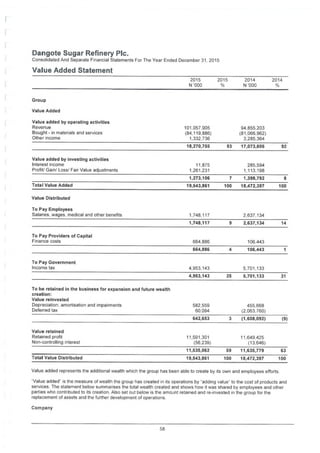
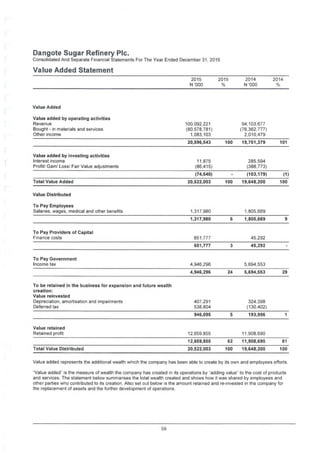
58Value Added Statement
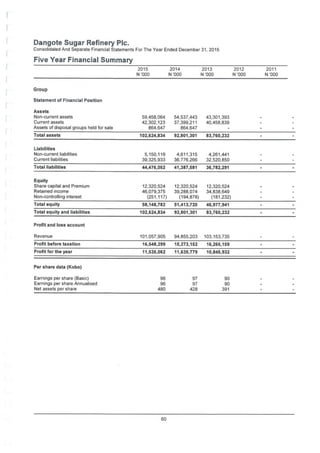
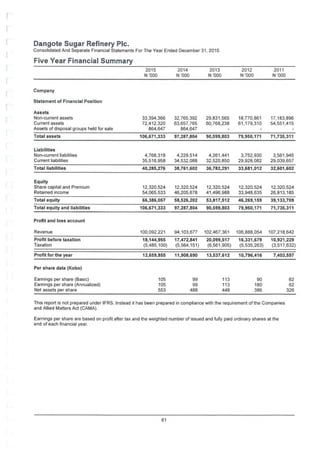
60-61Five Year Financial Summary
2
Dangote Sugar Refinery Pic.
Consolidated And Separate Financial Statements For The Year Ended December 31, 2015
Directors' Responsibilities and Approval
The Directors of Dangote Sugar Refinery Pic are responsible for the preparation of the consolidated and separate
financial statements that give a true and fair view of the financial position of the Group and Company as at 31 December
2015, and the results of its operations, cash flows and changes in equity for the period ended, in compliance with
International Financial Reporting Standards ("IFRS") and in the manner required by the Companies and Allied Matters Act
Cap C20 LFN 2004, the Financial Reporting Council of Nigeria Act 2011.
In preparing the consolidated financial statements, the Directors are responsible for
properly selecting and applying accounting policies,
presenting information, including accounting policies, in a manner that provides relevant, reliable, comparable and
understandable information;
providing additional disclosures when compliance with the specific requirements in IFRSs are insufficient to enable
users to understand the impact of particular transactions, other events and conditions on the Group and
Company's financial position and financial performance; and
making an assessment of the Group's ability to continue as a going concern
The Directors are responsible for:
designing, implementing and maintaining an effective and sound system of internal controls throughout the Group
and Company;
maintaining adequate accounting records that are sufficient to show and explain the Group’s and company's
transactions and disclose with reasonable accuracy at any time the financial position of the Group and Company,
and which enable them to ensure that the financial statements of the Group and Company comply with IFRS;
maintaining statutory accounting records in compliance with the legislation of Nigeria and IFRS;
taking such steps as are reasonably available to them to safeguard the assets of the Group and Company; and
preventing and detecting fraud and other irregularities.
Going Concern
The Directors have made an assessment of the Group s and Company's ability to continue as a going concern and have no
reason to believe the Group and Company will not remain a going concern in the year ahead.
The consolidated financial statements of the Group and Company for the year ended 31 December 2015 were approved by
directors on March 10, 2016
Signed on behalf of the Board of Directors By:
Alh. Aliko Dangote, GCON
Chairman
FRC/2013/IODN/OOOOOOOI766
Eng. Abdullahi Sule
Ag. Chief Executive Officer
FRC/2013/NSE/00000002065
3
Deloitte. PO Sox 96S
Marina
Lagos
Nigeria
Akintola Williams Deloitte
235 Ikorodu Road
llupe]u
Lagos
Nigeria
Tel; -234 (1) 271 7800
fax: -234 (1)271 7801
www.deloilte.com/ng
REPORT OF THE INDEPENDENT AUDITOR TO THE MEMBERS OF
DANGOTE SUGAR REFINERY PLC
We have audited the accompanying financial statements of Dangote Sugar Refinery Pic (“the Company”) and its subsidiary
(together referred to as the Group) which comprise the consolidated and separate statements of financial position as at 31
December 2015, the consolidated income statement, statement of changes in equity, statement of cash flows for the year then
ended 31 December 2015, a summary of significant accounting policies and other explanatory information.
Directors’ Responsibility for the Financial Statements
The Directors are responsible for the preparation and fair presentation of these financial statements in accordance with the
Companies and Allied Matters Act, CAP C20, LFN 2004, Financial Reporting Council of Nigeria Act 2011, the International
Financial Reeporting Standards and for such internal control as the Directors determine are necessary to enable the preparation
of financial statements that are free from material misstatements, whether due to fraud or error.
Auditors’ Responsibility
Our responsibility is to express an opinion on these financial statements based on our audit. We conducted our audit in accordance
with International Standards on Auditing. Those standards require that we comply with ethical requirements and plan and perform
the audit to obtain reasonable assurance about whether the financial statements are free from material misstatement.
An audit involves performing procedures to obtain audit evidence about the amounts and disclosures in the financial statements.
The procedures selected depend on the auditors’ judgement, including the assessment of the risks of material misstatement of
the financial statements, whether due to fraud or error. In making those risk assessments, the auditors consider internal control
relevant to the entity's preparation and fair presentation of the financial statements in order to design audit procedures that are
appropriate in the circumstances, but not for the purpose of expressing an opinion on the effectiveness of the entity's internal
control. An audit also includes evaluating the appropriateness of accounting policies used and the reasonableness of accounting
estimates made by the Directors, as well as evaluating the overall presentation of the financial statements.
We believe that the audit evidence we have obtained is sufficient and appropriate to provide a basis for our audit opinion.
Opinion
In our opinion, the financial statements give a true and fair view of the financial position of Dangote Sugar Refinery Pic and its
subsidiaries as at 31 December 2015 and of its financial performance and cash flows for the year ended 31 December 2015 in
accordance with the Companies and Allied Matters Act CAP C20 LFN 2004 and the Financial Reporting Council of Nigeria Act,
2011 and the International Financial Reporting Standards.
Other reporting responsibilities
In accordance with the Sixth Schedule of Companies and Allied Matters Act CAP C20 LFN 2004, we expressly state that:
We have obtained all the information and explanation which to the best of our knowledge and believe were necessary for
the purpose of our audit.
i)
The Group has kept proper books of account, so far as appears from our examination of those books.ii)
iii) The Group’s financial position and its statement of profit or loss and other comprehensive income are in agreement with
the books of account.
Jelili Adebisi- FRC/2013/ICAN/000000004247
For: Akintola Williams Deloitte
Chartered Accountants
Lagos, Nigeria
/tt March 2016 St9«0
List of partners and partner equivalents available on the website
Associate of Deloitte Africa, a Member of Deloitte Touche Tohmatsu Limited
Dangote Sugar Refinery Pic.
Consolidated And Separate Financial Statements For The Year Ended December 31, 2015
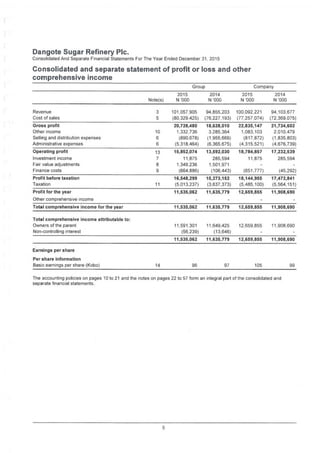
Consoiidafed and separate statement of profit or loss and other
comprehensive income
Group Company
2015
N '000
2014
N '000
2015
N '000
2014
N '000Note(s)
Revenue
Cost of sales
3 101,057,905 94,855,203 100,092,221 94,103,677
(80,329.425) (76,227,193) (77,257,074) (72,369,075)5
Gross profit
Other income
Selling and distribution expenses
Administrative expenses
20,728,480 18,628,010
1,332,736 3,285,364
(890,678) (1,955,669)
(5,318,464) (6,365,675)
22,835,147 21,734,602
1,083,103 2,010,479
(817,872) (1,835,803)
(4,315,521) (4,676,739)
10
6
6
Operating profit
Investment income
Fair value adjustments
Finance costs
15,852,074 13,592,030
11,875 285,594
1,349,236 1,501,971
(664,886) (106,443) (651,777)
18,784,857 17,232,539
285,594
13
7 11,875
8
9 (45,292)
Profit before taxation
Taxation
16,548,299 15,273,152 18,144,955 17,472,841
(5,013,237) (3,637,373) (5,485,100) (5,564,151)11
Profit for the year
Other comprehensive income
11,535,062 11,635,779 12,659,855 11,908,690
Total comprehensive income for the year 11,535,062 11,635,779 12,659,855 11,908,690
Total comprehensive income attributable to:
Owners of the parent
Non-controlling interest
11,591,301 11,649,425 12,659,855 11,908,690
(56,239) (13,646) - -
11,535,062 11,635,779 12,659,855 11,908,690
Earnings per share
Per share information
Basic earnings per share (Kobo) 14 96 97 105 99
The accounting policies on pages 10 to 21 and the notes on pages 22 to 57 form an integral part of the consolidated and
separate financial statements.
5
Dangole Sugar Refinery Pic.
Consolidated And Separate Financial Statements For The Year Ended December 31, 2015
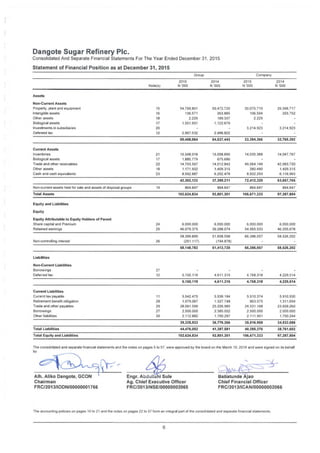
Statement of Financial Position as at December 31, 2015
CompanyGroup
2015 2014
N '000
2015
N '000
2014
Note(s) N '000 N '000
Assets
Non-Current Assets
Properly plant and equipmenl
Intangible assets
Other assets
Biological assets
Investments in subsidiaries
Deferred tax
15 54,799,801
136,571
2.229
1,551,931
50,472,720
263.885
189.337
1,122.679
30,070,710
106.504
2.229
29,346,717
203.75216
18
17
20 3.214.923 3.214.923
2.967.532 2.488.82212
59,458,064 54,537,443 33,394,366 32,765,392
Current Assets
Inventories
Biological assets
Trade and other receivables
Other assets
Cash and cash equivalents
21 15.548.018
1.885,779
14.703.507
1.171.932
8.992.887
15.098.890
675.686
14.012.842
1.409 315
6.202.478
14.035.388 14.047,767
17
22 49.064.149
380.490
8.932.293
42.083.720
1.409.315
6.116.963
18
23
42,302,123 37,399,211 72,412,320 63,657,765
Non-current assets held for sale and assets of disposal groups 19 864.647 864 647 864.647 864.647
Total Assets 102.624,834 92,801,301 106,671,333 97,287,804
Equity and Liabilities
Equity
Equity Attributable to Equity Holders of Parent
Share capital and Premium
Retained earnings
24 6.000.000
46.079.375
6.000.000
39.288.074
6.000.000
54.065.533
6.000.000
46.205.67825
58.399.899
(251.117)
51.608.598
(194.878)
66.386.057 58.526.202
Non-controlling interest 26
58.148,782 51,413.720 66,386,057 58,526,202
Liabilities
Non-Current Liabilities
Borrowings
Deferred tax
27
12 5.150.119 4.611.315 4.768.318 4.229.514
5,150,119 4,611,315 4,768,318 4,229,514
Current Liabilities
Current tax payable
Retirement benefit obligation
Trade and other payables
Borrowings
Other liabilities
11 5.542.475
1.079.067
28.091 509
2.500.000
2.112.882
5.936 184
1.527.748
25,226 985
2.385.052
1.700 297
5.510.374
863.575
24.531,108
2.500.000
2.111.901
5.910.930
1.311.654
23,609.260
2 000.000
1.700.244
28
29
27
30
39,325,933 36,776.266 35.516,958 34,532,088
Total Liabilities 44.476,052 41,387,581 40,285,276 38,761,602
Total Equity and Liabilities 102,624,834 92,801,301 106,671,333 97,287,804
The consolidated and separate financial statements and the notes on pages 5 to 57. were approved by the board on the March 10. 2016 and were signed on its behalf
by
Babatunde Ajao
Chief Financial Officer
FRC/2013/ICAN/00000002066
AA-
Alh.Aliko Dangote, GCON
Chairman
FRC/2013/IODN/00000001766
Engr. Abdullahi Sule
Ag. Chief Executive Officer
FRC/2013/NSE/00000002065
The accounting policies on pages 10 to 21 and the notes on pages 22 to 57 form an integral part of the consolidated and separate financial statements.
6
Dangote Sugar Refinery Pic.
Consolidated And Separate Financial Statements for the year ended December 31, 2015
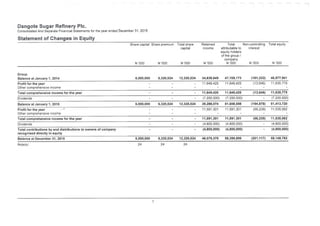
Statement of Changes in Equity
Total Non-controlling Total equity
attributable to interest
equity holders
of the group /
company
N '000
Share capital Share premium Total share
capital
Retained
income
N '000 N '000N '000 N '000 N '000 N '000
Group
Balance at January 1, 2014 6,000,000 6,320,524 12,320,524 34,838,649 47,159,173 (181,232) 46,977,941
11,649.425 11.649.425 (13,646) 11,635,779Profit for the year
Other comprehensive income
(13,646) 11,635,77911,649,425 11,649,425Total comprehensive income for the year
(7,200.000)(7,200.000) (7.200.000)Dividends
6,000,000 6,320,524 12,320,524 39,288,074 51,608,598 (194,878) 51,413,720Balance at January 1, 2015
11.591.301 11.591,301 (56.239) 11,535.062Profit for the year
Other comprehensive income
(56,239) 11,535,06211,591,301 11,591,301Total comprehensive income for the year
(4,800.000) (4.800,000) (4,800.000)Dividends
(4,800,000)(4,800,000) (4,800,000)Total contributions by and distributions to owners of company
recognised directly in equity
(251,117) 58,148,7826,000,000 6,320,524 12,320,524 46,079,375 58,399,899Balance at December 31, 2015
24 2424Note(s)
7
Dangote Sugar Refinery Pic.
Consolidated And Separate Financial Statements for the year ended December 31. 2015
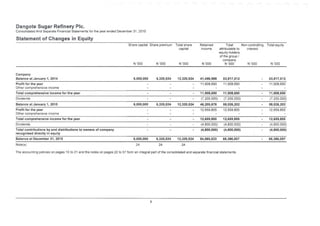
Statement of Changes in Equity
Share capital Share premium Total share
capital
Retained
income
Total Non-controlling Total equity
attributable to interest
equity holders
of the group /
company
N '000N '000 N '000 N '000 N '000 N '000 N '000
Company
Balance at January 1. 2014 6,000,000 6,320,524 12,320,524 41,496,988 53,817,512 53,817,512
Profit for the year
Other comprehensive income
11.908.690 11.908.690 11,908.690
Total comprehensive income for the year 11,908,690 11,908,690 11,908,690
Dividends (7.200.000) (7.200,000) (7.200.000)
Balance at January 1, 2015 6,000,000 6,320,524 12,320,524 46,205,678 58,526,202 58,526,202
Profit for the year
Other comprehensive income
12,659,855 12.659855 12,659.855
Total comprehensive income for the year 12,659,855 12,659,855 12,659,855
Dividends (4.800.000) (4.800.000) (4.800.000)
Total contributions by and distributions to owners of company
recognised directly in equity
(4,800,000) (4,800,000) (4,800,000)
Balance at December 31, 2015 6,000,000 6,320,524 12,320,524 54,065,533 66,386,057 66,386,057
Note(s) 24 24 24
The accounting policies on pages 10 to 21 and the notes on pages 22 to 57 form an integral part of the consolidated and separate financial statements.
8
Dangote Sugar Refinery Pic.
Consolidated And Separate Financial Statements For The Year Ended December 31.2015
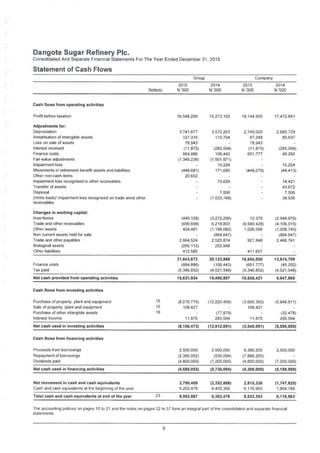
Statement of Cash Flows
Group Company
2015 2014 2015 2014
Note(s) N '000 N '000 N '000 N'000
Cash flows from operating activities
Profit before taxation 16.548.299 15.273.152 18.144.955 17.472.841
Adjustments for:
Depreciation
Amortisation of intangible assets
Loss on sale of assets
Interest received
Finance costs
Fair value adjustments
Impairment loss
Movements in retirement benefit assets and liabilities
Other non-cash items
Impairment loss recognised in other receivables
Transfer of assets
Disposal
(Write back)/ impairment loss recognised on trade annd other
receivables
3.741,677
127.315
78.943
(11,875)
664.886
(1.349,236)
3.572,263
115,704
2.749,029
97,248
78,943
(11,875)
651,777
2,685,729
85,637
(285,594)
106,443
(1,501,971)
15.224
171,680
(285,594)
45,292
15,224
(44,413)(448,681)
20,652
(448,079)
75.629 14,421
43,672
7,506
34,936
7,506
(1.033,748)
Changes in working capital:
Inventories
Trade and other receivables
Other assets
Non current assets held for sale
Trade and other payables
Biological assets
Other liabilities
(449,128)
(690.668)
424,491
(3,272,296)
6,218,803
(1 198,082)
(864,647)
2,520,874
202,948
12.379
(6.980.428)
1,026,596
(2,949.876)
(4.106.015)
(1,008,745)
(864.647)
2.468.7412,864.524
(290,112)
412,585
921.848
411.657
21,643,672
(664,886)
(5.346,852)
20,123,888
(106,443)
(4.521,548)
16,654,050
(651,777)
(5.346,852)
13,614,709
(45,292)
(4,521,548)
Finance costs
Tax paid
Net cash provided from operating activities 15,631,934 15,495,897 10,655,421 9,047,869
Cash flows from investing activities
15Purchase of property, plant and equipment
Sale of property, plant and equipment
Purchase of other intangible assets
Interest Income
(8.276,775) (12.220,406)
108.427 -
(3,660,393) (5,848,811)
108.427 -15
16 (77,879)
285,594
(32,478)
285.59411.875 11 875
Net cash used in investing activities (8,156,473) (12,012,691) (3,540,091) (5,595,695)
Cash flows from financing activities
Proceeds from borrowings
Repayment of borrowings
Dividends paid
2.500,000
(2.385.052)
(4.800.000)
2.000,000
(536.094)
(7.200,000)
8,386.205 2,000,000
(7.886.205) -
(4.800,000) (7,200,000)
Net cash used in financing activities (4,685,052) (5,736,094) (4,300,000) (5,199,999)
Net movement in cash and cash equivalents
Cash and cash equivalents at the beginning of the year
2,790,409
6.202.478
(2,252,888)
8.455,366
2,815,330
6,116.963
(1,747,825)
7,864,788
23Total cash and cash equivalents at end of the year 8,992,887 6,202,478 8,932,293 6,116,963
The accounting policies on pages 10 to 21 and the notes on pages 22 to 57 form an integral part of the consolidated and separate financial
statements.
9
Dangote Sugar Refinery Pic.
Consolidated And Separate Financial Statements For The Year Ended December 31, 2015
Notes to the Consolidated and Separate Financial Statements
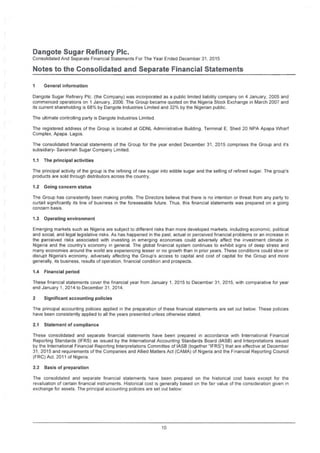
i General information
Dangote Sugar Refinery Pic. (the Company) was incorporated as a public limited liability company on 4 January, 2005 and
commenced operations on 1 January, 2006. The Group became quoted on the Nigeria Stock Exchange in March 2007 and
its current shareholding is 68% by Dangote Industries Limited and 32% by the Nigerian public.
The ultimate controlling party is Dangote Industries Limited.
The registered address of the Group is located at GDNL Administrative Building. Terminal E, Shed 20 NPA Apapa Wharf
Complex, Apapa. Lagos.
The consolidated financial statements of the Group for the year ended December 31, 2015 comprises the Group and it's
subsidiary- Savannah Sugar Company Limited.
1.1 The principal activities
The principal activity of the group is the refining of raw sugar into edible sugar and the selling of refined sugar. The group's
products are sold through distributors across the country.
1.2 Going concern status
The Group has consistently been making profits. The Directors believe that there is no intention or threat from any party to
curtail significantly its line of business in the foreseeable future. Thus, this financial statements was prepared on a going
concern basis.
1.3 Operating environment
Emerging markets such as Nigeria are subject to different risks than more developed markets, including economic, political
and social, and legal legislative risks. As has happened in the past, actual or perceived financial problems or an increase in
the perceived risks associated with investing in emerging economies could adversely affect the investment climate in
Nigeria and the country's economy in general. The global financial system continues to exhibit signs of deep stress and
many economies around the world are experiencing lesser or no growth than in prior years. These conditions could slow or
disrupt Nigeria's economy, adversely affecting the Group's access to capital and cost of capital for the Group and more
generally, its business, results of operation, financial condition and prospects.
1.4 Financial period
These financial statements cover the financial year from January 1, 2015 to December 31. 2015. with comparative for year
end January 1, 2014 to December 31, 2014.
2 Significant accounting policies
The principal accounting policies applied in the preparation of these financial statements are set out below. These policies
have been consistently applied to all the years presented unless otherwise stated.
2.1 Statement of compliance
These consolidated and separate financial statements have been prepared in accordance with International Financial
Reporting Standards (IFRS) as issued by the International Accounting Standards Board (IASB) and Interpretations issued
by the International Financial Reporting Interpretations Committee of IASB (together "IFRS"} that are effective at December
31, 2015 and requirements of the Companies and Allied Matters Act (CAMA) of Nigeria and the Financial Reporting Council
(FRC) Act. 2011 of Nigeria.
2.2 Basis of preparation
The consolidated and separate financial statements have been prepared on the historical cost basis except for the
revaluation of certain financial instruments. Historical cost is generally based on the fair value of the consideration given in
exchange for assets. The principal accounting policies are set out below:
10
Damgote Sugar Refinery Pic.
Consolidated And Separate Financial Statements For The Year Ended December 31, 2015
Notes to the Consolidated and Separate Financial Statements
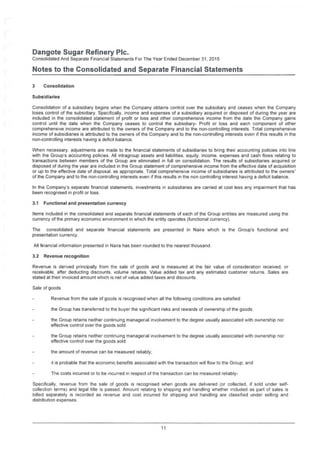
3 Consolidation
Subsidiaries
Consolidation of a subsidiary begins when the Company obtains control over the subsidiary and ceases when the Company
loses control of the subsidiary. Specifically, income and expenses of a subsidiary acquired or disposed of during the year are
included in the consolidated statement of profit or loss and other comprehensive income from the date the Company gains
control until the date when the Company ceases to control the subsidiary- Profit or loss and each component of other
comprehensive income are attributed to the owners of the Company and to the non-controlling interests. Total comprehensive
income of subsidiaries is attributed to the owners of the Company and to the non-controlling interests even if this results in the
non-controlling interests having a deficit balance.
When necessary, adjustments are made to the financial statements of subsidiaries to bring their accounting policies into line
with the Group's accounting policies. All intragroup assets and liabilities, equity, income, expenses and cash flows relating to
transactions between members of the Group are eliminated in full on consolidation. The results of subsidiaries acquired or
disposed of during the year are included in the Group statement of comprehensive income from the effective date of acquisition
or up to the effective date of disposal, as appropriate. Total comprehensive income of subsidiaries is attributed to the owners"
of the Company and to the non-controlling interests even if this results in the non controlling interest having a deficit balance.
In the Company's separate financial statements, investments in subsidiaries are carried at cost less any impairment that has
been recognised in profit or loss.
3.1 Functional and presentation currency
Items included in the consolidated and separate financial statements of each of the Group entities are measured using the
currency of the primary economic environment in which the entity operates (functional currency).
The consolidated and separate financial statements are presented in Naira which is the Group's functional and
presentation currency.
All financial information presented in Naira has been rounded to the nearest thousand.
3.2 Revenue recognition
Revenue is derived principally from the sale of goods and is measured at the fair value of consideration received, or
receivable, after deducting discounts, volume rebates. Value added tax and any estimated customer returns. Sales are
stated at their invoiced amount which is net of value added taxes and discounts.
Sale of goods
Revenue from the sale of goods is recognised when all the following conditions are satisfied:
the Group has transferred to the buyer the significant risks and rewards of ownership of the goods
the Group retains neither continuing managerial involvement to the degree usually associated with ownership nor
effective control over the goods sold
the Group retains neither continuing managerial involvement to the degree usually associated with ownership nor
effective control over the goods sold:
the amount of revenue can be measured reliably:
it is probable that the economic benefits associated with the transaction will flow to the Group: and
The costs incurred or to be incurred in respect of the transaction can be measured reliably-
Specifically, revenue from the sale of goods is recognised when goods are delivered (or collected, if sold under self­
collection terms) and legal title is passed. Amount relating to shipping and handling whether included as part of sales is
billed separately is recorded as revenue and cost incurred for shipping and handling are classified under selling and
distribution expenses.
11
Dangote Sugar Refinery Pic.
Consolidated And Separate Financial Statements For The Year Ended December 31, 2015
Notes to the Consolidated and Separate Financial Statements
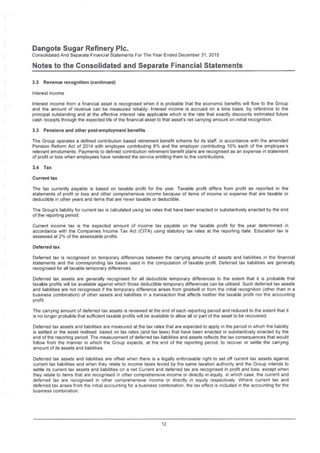
3.2 Revenue recognition (continued)
Interest income
Interest income from a financial asset is recognised when it is probable that the economic benefits will flow to the Group
and the amount of revenue can be measured reliably- Interest income is accrued on a time basis, by reference to the
principal outstanding and at the effective interest rate applicable which is the rate that exactly discounts estimated future
cash receipts through the expected life of the financial asset to that asset's net carrying amount on initial recognition.
3.3 Pensions and other post-employment benefits
The Group operates a defined contribution based retirement benefit scheme for its staff, in accordance with the amended
Pension Reform Act of 2014 with employee contributing 8% and the employer contributing 10% each of the employee's
relevant emoluments. Payments to defined contribution retirement benefit plans are recognised as an expense in statement
of profit or loss when employees have rendered the service entitling them to the contributions.
3.4 Tax
Current tax
The tax currently payable is based on taxable profit for the year. Taxable profit differs from profit as reported in the
statements of profit or loss and other comprehensive income because of items of income or expense that are taxable or
deductible in other years and items that are never taxable or deductible.
The Group's liability for current tax is calculated using tax rates that have been enacted or substantively enacted by the end
of the reporting period.
Current income tax is the expected amount of income tax payable on the taxable profit for the year determined in
accordance with the Companies Income Tax Act (CITA) using statutory tax rates at the reporting date. Education tax is
assessed at 2% of the assessable profits.
Deferred tax
Deferred tax is recognised on temporary differences between the carrying amounts of assets and liabilities in the financial
statements and the corresponding tax bases used in the computation of taxable profit. Deferred tax liabilities are generally
recognised for all taxable temporary differences.
Deferred tax assets are generally recognised for all deductible temporary differences to the extent that it is probable that
taxable profits will be available against which those deductible temporary differences can be utilised. Such deferred tax assets
and liabilities are not recognised if the temporary difference arises from goodwill or from the initial recognition (other than in a
business combination) of other assets and liabilities in a transaction that affects neither the taxable profit nor the accounting
profit.
The carrying amount of deferred tax assets is reviewed at the end of each reporting period and reduced to the extent that it
is no longer probable that sufficient taxable profits will be available to allow all or part of the asset to be recovered.
Deferred tax assets and liabilities are measured at the tax rates that are expected to apply in the period in which the liability
is settled or the asset realised, based on tax rates (and tax laws) that have been enacted or substantively enacted by the
end of the reporting period. The measurement of deferred tax liabilities and assets reflects the tax consequences that would
follow from the manner in which the Group expects, at the end of the reporting period, to recover or settle the carrying
amount of its assets and liabilities.
Deferred tax assets and liabilities are offset when there is a legally enforceable right to set off current tax assets against
current tax liabilities and when they relate to income taxes levied by the same taxation authority and the Group intends to
settle its current tax assets and liabilities on a net Current and deferred tax are recognised in profit and loss, except when
they relate to items that are recognised in other comprehensive income or directly in equity in which case, the current and
deferred tax are recognised in other comprehensive income or directly in equity respectively. Where current tax and
deferred tax arises from the initial accounting for a business combination the tax effect is included in the accounting for the
business combination.
12
Dangote Sugar Refinery Pic.
Consolidated And Separate Financial Statements For The Year Ended December 31, 2015
Notes to the Consolidated and Separate Financial Statements
3.5 Property, plant and equipment
Recognition and measurement
Items of property, plant and equipment are measured at cost less accumulated depreciation and accumulated impairment
losses.
Cost includes expenditure that is directly attributable to the acquisition of the asset. Fixed assets under construction are
disclosed as capital work-in-progress. The cost of construction recognised includes the cost of materials and direct labour, any
other costs directly attributable to bringing the assets to a working condition for their intended use, the costs of dismantling and
removing the items and restoring the site on which they are located, and borrowing costs on qualifying assets.
Purchased software that is integral to the functionality of the related equipment is capitalized as part of the equipment.
When parts of an item of property, plant and equipment have different useful lives, they are accounted for as separate items
(major components) of property, plant and equipment.
Gains and losses on disposal of an item of property, plant and equipment are determined by comparing the proceeds from
disposal with the carrying amount of property, plant and equipment, and are recognised in the statement of comprehensive
income.
Subsequent costs
The cost of replacing a part of an item of property, plant and equipment is recognized in the carrying amount of the item if it is
probable that the future economic benefits embodied within the part will flow to the Group and its cost can be measured
reliably. The carrying amount of the replaced part is derecognized. The costs of the day-to-day servicing of property, plant and
equipment are recognized in profit or loss as incurred.
Depreciation is calculated on the depreciable amount, which is the cost of an asset, or other amount substituted for cost, less
its residual value.
Depreciation is recognized in profit or loss on a straight-line basis over the estimated useful lives of each part of an item of
property, plant and equipment which reflects the expected pattern of consumption of the future economic benefits embodied in
the asset. Leased assets are depreciated over the shorter of the lease term and their useful lives unless it is reasonably certain
that the Group will obtain ownership by the end of the lease term in which case the assets are depreciated over the useful life.
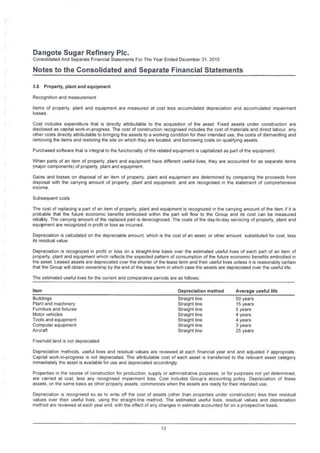
The estimated useful lives for the current and comparative periods are as follows:
Item Depreciation method Average useful life
Buildings
Plant and machinery
Furniture and fixtures
Motor vehicles
Tools and equipment
Computer equipment
Aircraft
Straight line
Straight line
Straight line
Straight line
Straight line
Straight line
Straight line
50 years
15 years
5 years
4 years
4 years
3 years
25 years
Freehold land is not depreciated
Depreciation methods, useful lives and residual values are reviewed at each financial year end and adjusted if appropriate.
Capital work-in-progress is not depreciated. The attributable cost of each asset is transferred to the relevant asset category
immediately the asset is available for use and depreciated accordingly.
Properties in the course of construction for production, supply or administrative purposes, or for purposes not yet determined,
are carried at cost, less any recognised impairment loss. Cost includes Group's accounting policy. Depreciation of these
assets, on the same basis as other property assets, commences when the assets are ready for their intended use.
Depreciation is recognised so as to write off the cost of assets (other than properties under construction) less their residual
values over their useful lives, using the straight-line method. The estimated useful lives, residual values and depreciation
method are reviewed at each year end. with the effect of any changes in estimate accounted for on a prospective basis.
13
Damgote Sugar Refinery Pic.
Consolidated And Separate Financial Statements For The Year Ended December 31, 2015
Notes to the Consolidated and Separate Financial Statements
3.5 Property, plant and equipment (continued)
Assets held under finance leases are depreciated over their expected useful lives on the same basis as owned assets or,
where shorter, the term of the relevant lease.
3.6 Leases
Leases are classified as finance leases whenever the terms of the lease transfer substantially all the risks and rewards of
ownership to the lessee. All other leases are classified as operating leases.
Operating lease payments are recognised as an expense on a straight line basis over the lease term, except where another
systematic basis is more representative of the time pattern in which economic benefits from the leased assets are
consumed. Contingent rentals arising under operating leases are recognised as an expense in the period in which they are
incurred.
In the event that lease incentives are received to enter into operating leases, such incentives are recognised as a liability.
The aggregate benefit of incentives is recognised as a reduction of rental expense on a straight line basis, except where
another systematic basis is more representative of the time pattern in which economic benefits from the leased assets are
consumed.
Where there are no agreed lease terms, rent payable is recognised as incurred.
3.7 Intangible assets
Intangible assets acquired separately Intangible assets with finite useful lives that are acquired separately are carried at
cost less accumulated amortisation and accumulated impairment losses. Amortisation is recognised on a straight-line basis
over their estimated useful lives. The estimated useful life and amortisation method are reviewed at the end of each annual
reporting period, with the effect of any changes in estimate being accounted for on a prospective basis. Intangible assets
with indefinite useful lives that are acquired separately are carried at cost less accumulated impairment losses.
Derecognition of intangible assets
An intangible asset is derecognised on disposal, or when no future economic benefits are expected from use or disposal.
Gams or losses arising from derecognition of an intangible asset, measured as the difference between the net disposal
proceeds and the carrying amount of the asset, and are recognised in profit or loss when the asset is derecognised
3.8 Impairment of Tangible and Intangible assets other than Goodwill
At the end of each reporting period, the Group reviews the carrying amounts of its tangible and intangible assets to
determine whether there is any indication that those assets have suffered an impairment loss. If any such indication exists,
the recoverable amount of the asset is estimated in order to determine the extent of the impairment loss (if any). Where it is
not possible to estimate the recoverable amount of an individual asset, the Group estimates the recoverable amount of the
cash-generating unit to which the asset belongs. Where a reasonable and consistent basis of allocation can be identified,
corporate assets are also allocated to individual cash-generating units, or otherwise they are allocated to the smallest group
of cash-generating units for which a reasonable and consistent allocation basis can be identified.
Intangible assets with indefinite useful lives and intangible assets not yet available for use are tested for impairment at least
annually, and whenever there is an indication that the asset may be impaired.
Recoverable amount is the higher of fair value less costs to sell and value in use. In assessing value in use, the estimated
future cash flows are discounted to their present value using a pre-tax discount rate that reflects current market
assessments of the time value of money and the risks specific to the asset for which the estimates of future cash flows have
not been adjusted.
If the recoverable amount of an asset (or cash-generating unit) is estimated to be less than its carrying amount, the carrying
amount of the asset (or cash-generating unit) is reduced to its recoverable amount. An impairment loss is recognised
immediately in profit or loss.
Where an impairment loss subsequently reverses, the carrying amount of the asset (or cash-generating unit) is increased to
the revised estimate of its recoverable amount, but so that the increased carrying amount does not exceed the carrying
amount that would have been determined had no impairment loss been recognised for the asset (or cash-generating unit) in
prior years. A reversal of an impairment loss is recognised immediately in profit or loss.
14
Dangote Sugar Refinery Pic.
Consolidated And Separate Financial Statements For The Year Ended December 31, 2015
Notes to the Consolidated and Separate Financial Statements
3.9 Inventories
Inventories are stated at the lower of cost and net realisable value. Cost of engineering spares and consumable stock is
determined on a first in first out basis. Cost of other stock (Raw materials, packaging materials, work in progress and
finished goods) is determined on the basis of standard costs adjusted for variances. Standard costs are periodically
reviewed to approximate actual costs.
Goods in transit are valued at the invoice price. Cost of inventory includes purchase cost, conversion cost (materials, labour
and overhead) and other costs incurred to bring inventory to its present location and condition. Finished goods, which
include direct labour and factory overheads, are valued at standard cost adjusted at year-end on an actual cost basis.
Costs, including an appropriate portion of fixed and variable overhead expenses, are assigned to inventories by the method
most appropriate to the particular class of inventory, with the majority being valued on an average cost basis. Net realisable
value represents the estimated selling price for inventories less all estimated costs of completion and costs necessary to
make the sale.
3.10 Provisions
Provisions are recognised when the Group has a present obligation (legal or constructive) as a result of a past event, it is
probable that the Group will be required to settle the obligation, and a reliable estimate can be made of the amount of the
obligation (when the time value of money is material).
The amount recognised as a provision is the best estimate of the consideration required to settle the present obligation at
the end of the reporting period, taking into account the risks and uncertainties surrounding the obligation. Where a provision
is measured using the cash flows estimated to settle the present obligation, its carrying amount is the present value of those
cash flows.
When some or all of the economic benefits required to settle a provision are expected to be recovered from a third party, a
receivable is recognised as an asset if it is virtually certain that reimbursement will be received and the amount of the
receivable can be measured reliably.
3.11 Onerous contracts
Present obligations arising under onerous contracts are recognised and measured as provisions. An onerous contract is
considered to exist where the Group has a contract under which the unavoidable costs of meeting the obligations under the
contract exceed the economic benefits expected to be received from the contract
3.12 Environmental costs
Costs incurred that result in future economic benefits, such as extending useful lives, increasing capacity or safety, and those
costs incurred to mitigate or prevent future environmental contamination are capitalized. When the Group's management
determine that it is probable that a liability for the future remediation cost is recorded as a provision without contingent
insurance recoveries being offset (only virtually certain insurance recoveries are recognized as an asset on the statement of
financial position). When we do not have a reliable reversal time schedule or when the effect of the passage of time is not
significant the provision is calculated based on undiscounted cash flows.
Environmental costs, which are not included above, are expensed as incurred.
15
Dangote Sugar Refinery Pic.
Consolidated And Separate Financial Statements For The Year Ended December 31, 2015
Notes to the Consolidated and Separate Financial Statements
3.13 Financial instruments
Financial assets
Financial assets are classified into the following specified categories: financial assets at fair value through profit or loss
(FVTPL), held-to-maturity investments, available-for-sale (AFS) financial assets and loans and receivables. The
classification depends on the nature and purpose of the financial assets and is determined at the time of initial recognition.
All regular purchases or sales of financial assets are recognised and derecognized on a trade date basis. Regular
purchases or sales are purchases or sales of financial assets that require delivery of assets within the time frame
established by regulation or convention in the market place. The Group's financial assets comprise other loans and
receivables
Effective interest method
The effective interest method is a method of calculating the amortised cost of a debt instrument and of allocating interest
income over the relevant period. The effective interest rate is the rate that exactly discounts estimated future cash receipts
(including all fees on points paid or received that form an integral part of the effective interest rate, transaction costs and
other premiums or discounts) through the expected life of the debt instrument, or (where appropriate) a shorter period, to
the net carrying amount on initial recognition.
Income is recognised on an effective interest basis for debt instruments other than those financial assets classified as at
FVTPL.
Loans and receivables
Loans and receivables are non-derivative financial assets with fixed or determinable payments that are not quoted in an
active market. Loans and receivables (including trade and other receivables) are measured at amortised cost using the
effective interest method, less any impairment. Interest income is recognised by applying the effective interest rate, except
for short-term receivables when the recognition of interest would be immaterial
Derecognition of financial assets
The Group derecognises a financial asset only when the contractual rights to the cash flows from the asset expire, or when
it transfers the financial asset and substantially all the risks and rewards of ownership of the asset to another entity. If the
Group neither transfers nor retains substantially all the risks and rewards of ownership and continues to control the
transferred asset, the Group recognises its retained interest in the asset and an associated liability for amounts it may have
to pay.
If the Group retains substantially all the risks and rewards of ownership of a transferred financial asset, the Group continues
to recognise the financial asset and also recognises a collateralised borrowing for the proceeds received.
On derecognition of a financial asset in its entirety, the difference between the asset's carrying amount and the sum of the
consideration received and receivable and the cumulative gain or loss that had been recognised in other comprehensive
income and accumulated in equity is recognised in profit or loss.
Impairment of financial assets
Financial assets, other than those at FVTPL, are assessed for indicators of impairment at the end of Working Draft each
reporting period. Financial assets are considered impaired when there is objective evidence that as a result of one or more
events that occurred after the initial recognition of the financial asset, the estimated future cash flows of the investment
have been affected.
For all categories of financial assets, objective evidence of impairment could include:
significant financial difficulty of the issuer or counterparty, or
breach of contract, such as a default or delinquency in interest or principal payments: or
It is becoming probable that the owner will enter bankruptcy or financial re-organisation: or
the disappearance of an active market for that financial asset because of financial difficulties.
16
Dangote Sugar Refinery Pic.
Consolidated And Separate Financial Statements For The Year Ended December 31, 2015
Notes to the Consolidated and Separate Financial Statements
3.13 Financial instruments (continued)
For certain categories of financial asset, such as trade receivables, assets that are assessed not to be impaired individually
are, in addition, assessed for impairment on a collective basis. Objective evidence of impairment for a portfolio of
receivables could include the Group?s past experience of collecting payments, an increase in the number of delayed
payments in the portfolio past the average credit period of 30 days, as well as observable changes in national or local
economic conditions that correlate with default on receivables.
For financial assets carried at amortised cost, the amount of the impairment loss recognised is the difference between the
asset's carrying amount and the present value of estimated future cash flows, discounted at the financial asset's original
effective interest rate.
For financial assets carried at cost, the amount of the impairment loss is measured as the difference between the asset's
carrying amount and the present value of the estimated future cash flows discounted at the current market rate of return for
a similar financial asset. Such impairment loss will not be reversed in subsequent periods.
The carrying amount of the financial asset is reduced by the impairment loss directly for all financial assets with the
exception of trade receivables, where the carrying amount is reduced through the use of an allowance account. When a
trade receivable is considered uncollectible, it is written off against the allowance account. Subsequent recoveries of
amounts previously written off are credited against the allowance account. Changes in the carrying amount of the allowance
account are recognised in profit or loss
Cash and cash equivalents
Cash and cash equivalents consist of cash, highly liquid investments and cash equivalents which are not subject to
significant changes in value and with an original maturity date of generally less than three months from the time of
purchase.
Financial liabilities and equity instruments issued by the Group
Classification as debt or equity
Debts and equity instruments are classified as either financial liabilities or as equity in accordance with the substance of the
contractual arrangements and the definitions of a financial liability and an equity instrument.
Equity instruments
An equity instrument is any contract that evidences a residual interest in the assets of an entity after deducting all of its
liabilities. Equity instruments issued by the Group are recognised at the proceeds received, net of direct issue costs.
Incremental costs directly attributable to the issue of ordinary shares and share options are recognized as a deduction from
equity, net of any tax effects.
Financial Liabilities
Financial Liabilities are classified as either financial liabilities, at fair value through profit or loss (FVTPL) or other liabilities.
The Group only operates the category of other financial liability
Other financial liabilities
Other financial liabilities (including borrowings and trade and other payables) are subsequently measured at amortised cost
using the effective interest method.
The effective interest method is a method of calculating the amortised cost of a financial liability and of allocating interest
expense over the relevant period. The effective interest rate is the rate that exactly estimates future cash payments
(including all fees and points paid or received that form an integral part of the effective interest rate, transaction costs and
other premiums or discounts) through the expected life of the financial liability, or (where appropriate) , a shorter period, to
the net carrying amount on initial recognition.
17
Dangote Sugar Refinery Pic.
Consolidated And Separate Financial Statements For The Year Ended December 31. 2015
Notes to the Consolidated and Separate Financial Statements
3.13 Financial instruments (continued)
Derecognition of financial liabilities
The Group derecognises financial liabilities when, and only when the Group's obligations are discharged, cancelled, or they
expire. The difference between the carrying amount of the financial liability derecognised and the consideration paid, and
payable is recognised in profit or loss.
3.14 Earnings per share
The Group presents basic and diluted earnings per share (EPS) data for its ordinary shares. Basic EPS is calculated by
dividing the profit or loss attributable to ordinary shareholders of the Group by the weighted average number of ordinary
shares outstanding during the period, adjusted for own shares held, if any. Diluted EPS is determined by adjusting the profit
or loss attributable to ordinary shareholders and the weighted average number of ordinary shares outstanding, adjusted for
own shares held, if any, for the effects of all dilutive potential ordinary shares.
3.15 Functional and presentation currency
Functional and presentation currency
Items included in the consolidated and separate financial statements of each of the Group entities are measured using the
currency of the primary economic environment in which the entity operates (functional currency).
The consolidated consolidated and separate financial statements are presented in Naira which is the Group functional and
presentation currency.
Foreign currency transactions and translation
Foreign currency transactions are translated into the functional currency using the exchange rates prevailing at the dates of
the transactions. Foreign exchange gains and losses resulting from the settlement of such transactions and from the
translation at year-end exchange rates of monetary assets and liabilities denominated in foreign currencies are recognized
in the statement of profit or loss and other comprehensive income.
Non-monetary assets and liabilities in a foreign currency that are measured in terms of historical cost are translated using
the exchange rate at the transaction date and are not restated.
Non-monetary assets and liabilities denominated in foreign currencies that are stated at fair value are translated to the
functional currency at foreign exchange rates prevailing at the dates the fair value was determined and are not restated.
3.16 Borrowing costs
Borrowing costs directly attributable to the acquisition, construction, or production of qualifying assets, which are assets that
necessarily take a substantial period of time to get ready for their intended use or sale are added to the cost of those
assets, until such time as the assets are substantially ready for their intended use or sale.
Investment income earned on the temporary investment of specific borrowings pending their expenditure on qualifying
assets is deducted from the borrowing costs eligible for capitalization.
All other borrowing costs are recognised as an expense in the period in which they are incurred.
18
Dangote Sugar Refinery Pic.
Consolidated And Separate Financial Statements For The Year Ended December 31, 2015
Notes to the Consolidated and Separate Financial Statements
3.17 Segment information
Information reported to the Chief Operating decision maker of the Group for the purposes of resource allocation and
assessment of segment performance focuses on its sole product, refined sugar based on different geographical location.
Segment reporting has been prepared based on the geographical information of the group.
3.18 Biological assets
A biological asset is defined as a living animal or plant while biological transformation comprises the processes of growth,
degeneration, production and procreation that cause qualitative or quantitative changes in the biological asset
Recognition of assets
The Company recognises biological assets or agricultural produce when, and only when, all of the following conditions are met:
the comapny controls the asset as a result of past events;
it is probable that future economic benefits associated with the asset will flow to the Company; and
the fair value or cost of the asset can be measured reliably."
Biological asset consists of cane roots and growing cane which are yet to be harvested as at year end. and these are measured
at fair value.
The basis of fair value determination of cane roots and growing canes have been included in Note 16 respectively.
4 Significant judgements and sources of estimation uncertainty
In the application of the group's significant accounting policies, described in note 4. the directors are required to make
judgments, estimates and assumptions about the carrying amounts of assets and liabilities that are not readily apparent
from other sources. The estimates and associated assumptions are based on historical experience and other factors that
are considered to be relevant.
Actual results may differ from these estimates
The estimates and underlying assumptions are reviewed on an ongoing basis. Revisions to accounting estimates are
recognised in the period in which the estimate is revised if the revision affects only that period, or in the period of the
revision and future periods if the revision affects both current and future periods.
Critical judgements in applying accounting policies
The following are the critical judgements, apart from those involving estimations, that the directors have made in the
process of applying the Group’s accounting policies and that have the most significant effect on the amounts recognised in
the consolidated financial statements.
The key assumptions concerning the future, and other key sources of estimation uncertainty at the reporting date, that have
a significant risk of causing a material adjustment to the carrying amounts of assets and liabilities within the next financial
year, are discussed below.
Revenue Recognition
In recognising revenue, critical judgement is made with respect to the mode of delivery. Where the customer opts to make
personal arrangement to take delivery of goods by bringing his own truck, revenue is recognised as soon as the truck is
loaded and a waybill is generated. Flowever, where the customer opts for delivery to be made using DSR trucks, revenue is
recognised only when the goods are delivered at the address provided and receipt of same is acknowledged on the waybill
19
Dangote Sugar Refinery Pie.
Consolidated And Separate Financial Statements For The Year Ended December 31, 2015
Notes to the Consolidated and Separate Financial Statements
4 Significantjudgements and sources of estimation uncertainty (continued)
Allowance for credit losses
The Group periodically assesses its trade receivables for probability of credit losses. Management considers several factors
including past credit record, current financial position and credibility of management, judgment is exercised in determining
the allowances made for credit losses.
Provisions are made for receivables that have been outstanding for 365 days, in respect of which there is no firm
commitment to pay by the customer.
Furthermore all balances are reviewed for evidence of impairment and provided against once recovery is doubtful. These
assessments are subjective and involve a significant element of judgment by management on the ultimate recoverability of
amounts receivable.
Fair values of biological assets
The fair value of the biological asset is derived using a replacement cost approach. Management uses estimates for the
costs to replace the biological asset by segmenting the assets into their various life circles less expected costs to produce
and sell the sugar and molasses, which are determined by considering historical actual costs incurred on a per hector basis.
The estimated selling price and costs are subject to fluctuations based on the timing of prevailing growing conditions
economic and market conditions as obtained from the various units directly involved in the sales and biological
transformation of the assets
Fair values of biological assets
Cane roots
The fair value of the cane roots is derived using a replacement cost approach, which is adjusted for the remaining expected
useful life of the cane roots. This requires an estimate from management of the expected useful lives of the cane roots,
which has been assessed as 5 years.
The carrying value of cane roots is disclosed in Note 17 of the financial statements.
Growing cane
Growing cane is valued using the estimated yield in tons of sugarcane projected to be harvested from the existing cane
roots, less estimated costs of harvest and transport. For this purpose, management is required to assess the estimated
selling price, which has been adjusted for time value of money and inflation based on prevailing market and economic
conditions.
The carrying value of growing cane is disclosed in Note 17 of the financial statements.
Key sources of estimation uncertainty
The following are the key assumptions concerning the future, and other key sources of estimation uncertainty at the end of
the reporting period, that have a significant risk of causing a material adjustment to the carrying amounts of assets and
liabilities within the next financial year.
Useful life of properly, plant and equipment
The Group reviewed and revised the estimated useful lives of its property, plant and equipment on transition to IFRS on 1
January, 2011, and under IFRS, has reviewed them annually at each reporting date. Useful lives are estimated based on
the engineer’s report, as at each reporting date. Some of the factors considered include the current service potential of the
assets, potential cost of repairs and maintenance.
There is a degree of subjective judgment in such estimation which has a resultant impact on profit and total comprehensive
income for the year.
20
Dangote Sugar Refinery Pic.
Consolidated And Separate Financial Statements For The Year Ended December 31, 2015
Notes to the Consolidated and Separate Financial Statements
4 Significant judgements and sources of estimation uncertainty (continued)
Valuation of deferred tax
The recognition of deferred tax assets requires an assessment of future taxable profit. Deferred tax assets are only
recognised to the extent that it is probable that taxable profits will be available against which deductible temporary
differences can be utilised. The availability of future taxable profits depends on several factors including the group's future
financial performance and if necessary, implementation of tax planning strategies.
21
Dangote Sugar Refinery Pic.
Consolidated And Separate Financial Statements For The Year Ended December 31, 2015
Notes to the Consolidated And Separate Financial Statements
2. New Standards and Interpretations
2.1 Standards and interpretations effective and adopted in the current year
in the current year, the group has adopted the following standards and interpretations that are effective for the current financial
year and that are relevant to its operations:
Amendment to IAS 24: Related Party Disclosures: Annual improvements project
The definition of a related party has been amended to include an entity, or any member of a group of which it is a part, which
provides key management personnel services to the reporting entity or to the parent of the reporting entity ("management
entity"). Disclosure is required of payments made to the management entity for these services but not of payments made by the
management entity to its directors or employees.
The effective date of the amendment is for years beginning on or after July 1, 2014.
The group has adopted the amendment for the first time in the 2015 consolidated and separate financial statements.
Amendments to IAS 19: Defined Benefit Plans: Employee Contributions.
The amendment relates to contributions received from employees or third parties for defined benefit plans. These contributions
could either be discretionary or set out in the formal terms of the plan. If they are discretionary then they reduce the service
cost. Those which are set out in the formal terms of the plan are either linked to service or not. When they are not linked to
service then the contributions affect the remeasurement. When they are linked to service and to the number of years of service,
they reduce the service cost by being attributed to the periods of service. If they are linked to service but not to the number of
years' service then they either reduce the service cost by being attributed to the periods of service or they reduce the service
cost in the period in which the related service is rendered.
The effective date of the amendment is for years beginning on or after July 1, 2014.
This amendment does not have any impact on group consolidated and separate finacial statement.
Amendment to IFRS 2: Share-based Payment: Annual improvements project
Amended the definitions of "vesting conditions" and "market conditions" and added definitions for "performance condition" and
"service condition."
The effective date of the amendment is for years beginning on or after July 1, 2014.
This amendment does not have any impact on group consolidated and separate finacial statement.
Amendment to IFRS 3: Business Combinations: Annual improvements project
The amendment clarifies that contingent consideration in a business combination which meets the definition of a financial
instrument shall be classified as a financial liability or equity. It further stipulates that contingent consideration which is required
to be measured at fair value shall be done so by recognising changes in fair value through profit or loss. Reference to
measuring contingent consideration to fair value through other comprehensive income has been deleted.
The effective date of the amendment is for years beginning on or after July 1,2014.
The group has adopted the amendment for the first time in the 2015 consolidated and separate financial statements.
This amendment does not have any impact on group consolidated and separate finacial statement.
Amendment to IFRS 8: Operating Segments: Annual improvements project
Management are now required to disclose the judgements made in applying the aggregation criteria. This includes a brief
description of the operating segments that have been aggregated in this way and the economic indicators that have been
assessed in determining that the aggregated operating segments share similar economic characteristics.
The effective date of the amendment is for years beginning on or after July 1, 2014.
The group has adopted the amendment for the first time in the 2015 consolidated and separate financial statements.
22
Dangote Sugar Refinery Pic.
Consolidated And Separate Financial Statements For The Year Ended December 31. 2015
Motes to the Consolidated And Separate Financial Statements
2. New Standards and Interpretations (continued)
Please refer to Note 4.
Amendment to IAS 16: Property, Plant and Equipment: Annual improvements project
The amendment adjusts the option to proportionately restate accumulated depreciation when an item of property, plant and
equipment is revalued. Instead, the gross carrying amount is to be adjusted in a manner consistent with the revaluation of the
carrying amount. The accumulated depreciation is then adjusted as the difference between the gross and net carrying amount.
The effective date of the amendment is for years beginning on or after July 1. 2014.
This amendment does not have any impact on group consolidated and separate finacial statement.
Amendment to IAS 38: Intangible Assets: Annual improvements project
The amendment adjusts the option to proportionately restate accumulated amortisation when an intangible asset is revalued.
Instead, the gross carrying amount is to be adjusted in a manner consistent with the revaluation of the carrying amount. The
accumulated amortisation is then adjusted as the difference between the gross and net carrying amount.
The effective date of the amendment is for years beginning on or after July 1, 2014.
The group has adopted the amendment for the first time in the 2015 consolidated and separate financial statements.
TThis amendment does not have any impact on group consolidated and separate finacial statement.
Amendment to IFRS 3: Business Combinations: Annual improvements project
The amendment to the scope exclusions removes reference to the formation of joint ventures. It now excludes from the scope
the formation of a joint arrangement in the financial statements of the joint arrangement itself.
The effective date of the amendment is for years beginning on or after July 1,2014.
This amendment does not have any impact on group consolidated and separate finacial statement.
Amendment to IFRS 13: Fair Value Measurement: Annual improvements project
The amendment clarifies that references to financial assets and financial liabilities in paragraphs 48-51 and 53-56 should be
read as applying to all contracts within the scope of. and accounted for in accordance with, IAS 39 or IFRS 9, regardless of
whether they meet the definitions of financial assets or financial liabilities in IAS 32 Financial Instruments Presentation,
The effective date of the amendment is for years beginning on or after July 1, 2014.
IFRS 14 Regulatory Deferral Accounts
The new standard is an interim standard applicable to entities subject to rate regulation. The standard is only applicable to
entities adopting IFRS for the first time. It permits entities to recognise regulatory deferral account balances in the statement of
financial position. When the account has a debit balance, it is recognised after total assets. Similarly, when it has a credit
balance, it is recognised after total liabilities. Movements in these accounts, either in profit or loss or other comprehensive
income are allowed only as single line items.
The effective date of the standard is for years beginning on or after January 1, 2016.
The group expects to adopt the standard for the first time in the 2016 consolidated and separate financial statements.
It is unlikely that the standard will have a material impact on the group's consolidated and separate financial statements.
23
Dangote Sugar Refinery Pic.
Consolidated And Separate Financial Statements For The Year Ended December 31, 2015
Notes to the Consolidated And Separate Financial Statements
2. New Standards and Interpretations (continued)
Amendments to IFRS 11: Accounting for Acquisitions of Interests in Joint Operations
The amendments apply to the acquisitions of interest in joint operations. When an entity acquires an interest in a joint operation
in which the activity of the joint operation constitutes a business, as defined in IFRS 3, it shall apply, to the extent of its share,
all of the principles on business combinations accounting in IFRS 3, and other IFRSs, that do not conflict with the guidance in
this IFRS and disclose the information that is required in those IFRSs in relation to business combinations. This applies to the
acquisition of both the initial interest and additional interests in a joint operation in which the activity of the joint operation
constitutes a business.
The effective date of the amendments is for years beginning on or after January 1, 2016.
The group expects to adopt the amendments for the first time in the 2016 consolidated and separate financial statements.
It is unlikely that the amendments will have a material impact on the group's consolidated and separate financial statements.
Amendments to IAS 16 and IAS 38: Clarification of Acceptable Methods of Depreciation and Amortisation
The amendment clarifies that a depreciation or amortisation method that is based on revenue that is generated by an activity
that includes the use of the asset is not an appropriate method. This requirement can be rebutted for intangible assets in very
specific circumstances as set out in the amendments to IAS 38.
The effective date of the amendment is for years beginning on or after January 1, 2016.
The group expects to adopt the amendment for the first time in the 2016 consolidated and separate financial statements.
It is unlikely that the amendment will have a material impact on the group's consolidated and separate financial statements.
IFRS 15 Revenue from Contracts with Customers
IFRS 15 supersedes IAS 11 Construction contracts; IAS 18 Revenue; IFRIC 13 Customer Loyalty Programmes; IFRIC 15
Agreements for the construction of Real Estate; IFRIC 18 Transfers of Assets from Customers and SIC 31 Revenue - Barter
Transactions Involving Advertising Services.
The core principle of IFRS 15 is that an entity recognises revenue to depict the transfer of promised goods or services to
customers in an amount that reflects the consideration to which the entity expects to be entitled in exchange for those goods or
services. An entity recognises revenue in accordance with that core principle by applying the following steps:
Identify the contract(s) with a customer
Identify the performance obligations in the contract
Determine the transaction price
Allocate the transaction price to the performance obligations in the contract
Recognise revenue when (or as) the entity satisfies a performance obligation
IFRS 15 also includes extensive new disclosure requirements
The effective date of the standard is for years beginning on or after January 1, 2018.
The group expects to adopt the standard for the first time in the 2018 consolidated and separate financial statements.
It is unlikely that the standard will have a material impact on the group's consolidated and separate financial statements
IFRS 9 (AC 146) Financial Instruments
This new standard is the result of a three phase project to replace IAS 39 Financial Instruments Recognition and
Measurement To date, the standard includes chapters for classification, measurement and derecognition of financial assets
and liabilities as well as new hedging requirements. The following are main changes from IAS 39
• Financial assets will be categorised as those subsequently measured at fair value or at amortised cost.
24
Dangote Sugar Refinery Pic.
Consolidated And Separate Financial Statements For The Year Ended December 31,2015
Notes to the Consolidated And Separate Financial Statements
2. New Standards and Interpretations (continued)
• Financial assets at amortised cost are those financial assets where the business model for managing the assets is to
hold the assets to collect contractual cash flows (where the contractual cash flows represent payments of principal
and interest only). All other financial assets are to be subsequently measured at fair value.
• For hybrid contracts, where the host contract is an asset within the scope of IFRS 9, then the whole instrument is
classified in accordance with IFRS 9. without separation of the embedded derivative. In other circumstances, the
provisions of IAS 39 still apply.
• Voluntary reclassification of financial assets is prohibited. Financial assets shall be reclassified if the group changes
its business model for the management of financial assets. In such circumstances, reclassification takes place
prospectively from the beginning of the first reporting period after the date of change of the business model.
• Investments in equity instruments may be measured at fair value through other comprehensive income. When such
an election is made, it may not subsequently be revoked, and gains or losses accumulated in equity are not recycled
to profit or loss on derecognition of the investment. The election may be made per individual investment.
• IFRS 9 does not allow for investments in equity instruments to be measured at cost.
• The classification categories for financial liabilities remains unchanged. However, where a financial liability is
designated as at fair value through profit or loss, the change in fair value attributable to changes in the liabilities
credit risk shall be presented in other comprehensive income. This excludes situations where such presentation will
create or enlarge an accounting mismatch, in which case, the full fair value adjustment shall be recognised in profit
or loss.
• The new hedging provisions align hedge accounting more closely with the actual risk management approach
• Certain non-derivative financial instruments are now allowed as hedging instruments.
° Additional exposures are allowed as hedged items. These exposures include risk components of non-financial items,
net positions and layer components of items, aggregated exposures combining derivative and non-derivative
exposures and equity instruments at fair value through other comprehensive income.
• The hedge effectiveness criteria have been amended, including the removal of the 80%-125% "bright line test" to
qualify for hedge accounting.
• The concept of rebalancing has been introduced when the hedging relationship is ineffective because the hedge
ratio is no longer appropriate. When rebalancing is required, and provided the risk management objective remains
the same, the hedge ratio is adjusted rather than discontinuing the hedging relationship.
• Additional disclosure requirements have been introduced for hedging.
The effective date has not yet been established as the project is currently incomplete. The IASB has communicated that the
effective date will not be before years beginning on or after January 1, 2018. IFRS 9 may be early adopted. If IFRS 9 is early
adopted, the new hedging requirements may be excluded until the effective date.
The group expects to adopt the standard for the first time in the first annual financial period after the effective date.
It is unlikely that the standard will have a material impact on the group's consolidated and separate financial statements.
The aggregate impact of the initial application of the statements and interpretations on the group’s consolidated and separate
financial statements is expected to be as follows:
25
Dangote Sugar Refinery Pic.
Consolidated And Separate Financial Statements For The Year Ended December 31, 2015
Notes to the Consolidated And Separate Financial Statements
Group Company
2015
N'000
2014 2015
N '000
2014
N '000 N '000
3. Revenue
Sale of sugar- 50kg
Sale of sugar- retail
Sale of molasses
Freight income
96,611,421
1,995,224
62,973
2,388,287
90,549,361
1,234,714
58,389
3,012,739
95,665,920
1,995,224
42,790
2,388,287
89,811,404
1,234,714
44,820
3,012,739
101,057,905 94,855,203 100,092,221 94,103,677
4. Segmental information
information reported to the chief operating decision maker (the Managing Director) for the purposes of resource allocation and
assessment of segment performance is based on the entity as a whole as there is no other distinguishable component of the
entity that engages in business activities from which it earns revenues and incurs expenses whose operating results are
regularly reviewed by the Managing Director to make decisions about resources to be allocated to the segment and assess its
performance and for which discrete financial information is available.
Segment information is presented in respect of the group's reportable segments. For Management purposes, the Group is
organised into business units by geographical areas in which the group operates and the locations that comprise such regions
represent operating segments. The Group has 4 reportable segments based on location of the principal operations as follows:
North Nigeria, South Nigeria, East Nigeria and Lagos
26
Damgote Sugar Refinery Pic.
Consolidated And Separate Financial Statements For The Year Ended December 31, 2015
Notes to the Consolidated And Separate Financial Statements
4 Segmental information (continued)
4.1. Segmental revenue and results
2014
N '000
2015
N '000
2014 2015
N '000 N '000
Nigeria:
Lagos
North
West
East
44,714,271
39,242,259
12,063.291
5,038,084
26,504,641
38,296.462
25.987,415
4,066.684
44.714,271
38.276,575
12.063,291
5.038,084
26,504.640
37.544,935
25.987,415
4,066.687
101,057,305 94,855,202 100,092,221 94,103,677
Segment Profits
December December
31,2014
N '000
Segment Revenue Segment Cost of Sales
December December December December
31, 2014
N '000
Group
31, 2015
N '000
31, 2014
N '000
31, 2015
N '000
31, 2015
N '000
Nigeria:
Lagos
North
West
East
44.714.271 26,504,641 34.513,109 19.136,869 10,201.162
39,242,259 38,296,462 32.616.467 28,784,332 6,625,792
12,063.291 25.987,415 9,311,159 25.369,765 2,752.132
5,038.084 4,066.685 3.888,690 2,936,227 1.149.394
7,367,772
9.512,130
617,650
1,130,458
101,057,905 94,855,203 80,329,425 76,227,193 20,728,480 18,628,010
27
Dangote Sugar Refinery Pic.
Consolidated And Separate Financial Statements For The Year Ended December 31 2015
Notes to the Consolidated And Separate Financial Statements
4 Segmental information (continued)
Segment Revenue Segment Cost of Sales
December December December December
31,2015
N '000
Segment Profits
December December
31, 2014
N '000
Company
31, 2015
N '000
31, 2014
N '000
31, 2014
N '000
31, 2015
N '000
Nigeria:
Lagos
North
West
East
44,714.271 26,504.642 34.513.109 19,136.870 10,201.162 7.367,772
38,276.575 37,544,935 29.544,116 27,108.178 8,732,459 10.436.757
12,063.291 25,987,415 9.311,159 23,187,800 2,752,132 2,799,615
5,038.084 4,066,685 3.888,690 2,936.227 1,149,394 1,130.458
100,092,221 94,103,677 77,257,074 72,369,075 22,835,147 21,734,602
Segment assets and liabilities
The amounts provided to the steering committee with respect to total assets are measured in a manner consistent with that of the financial statements. These assets are allocated based on
the operations of the segment and the physical location of the asset.
Investments in shares held by the group and deferred tax assets are not considered to be segment assets and are not allocated to segments.
Capital expenditure reflects additions to non-current assets, other than financial instruments, deferred tax assets post employment benefit assets and rights arising under insurance
contracts.
The amounts provided to the steering committee with respect to total liabilities are measured in a manner consistent with that of the financial statements. These liabilities are allocated
based on the operations of the segment.
The group's interest-bearing liabilities are not considered to be segment liabilities but rather are managed by the group's treasury function.
The table below provides information on segment assets and liabilities as well as a reconciliation to total assets and liabilities as per the statement of financial position
28
Dangote Sugar Refinery Pic.
Consolidated And Separate Financial Statements For The Year Ended December 31, 2015
Notes to the Consolidated And Separate Financial Statements
4 Segmental information (continued)
Total Segment Assets Total Segment Liabilities
December December December December
31, 2015
N '000
Group
31, 2015
N '000
31, 2014
N '000
31, 2014
N '000
Nigeria:
Lagos
North
West
East
102.624,834 92,801,301 44.476,052 41.387.581
Total Segment Assets Total Segment Liabilities
December December December December
31, 2015
N '000
Company
31, 2014
N '000
31, 2015
N '000
31, 2014
N '000
Nigeria:
Lagos
North
West
East
106.671.333 97,287.804 40,285,276 38.761.602
information about customers
There is a single customer who buys industrial non- fortified sugar that represents more than 10% of total sales during the year.
Large Corporate/Industrial Users
These are leading blue chip companies in Nigeria, and they include manufacturers of confectioneries and soft drinks. This group typically accounts for 30% of the company's sales. They
buy non-fortified sugar exclusively.
29
Dangote Sugar Refinery Pic.
Consolidated And Separate Financial Statements For The Year Ended December 31. 2015
Notes to the Consolidated And Separate Financial Statements
4 Segmental information (continued)
Distributors
The company sells unfortified sugar mainly to pharmaceutical, food and beverage manufacturers, while Vitamin A-fortified sugar is sold to distributors who sell to small wholesalers,
confectioners and other smaller value-adding enterprises who provide the distribution network to the Nigerian retail market. The Company sells a small amount of sugar directly to retail
customers. Retail packaging comes in various sizes of 250g. 500g. and 1kg under the brand name “Dangote Sugar". Sales to Distributors account for 70% of the company's revenue.
The Company provides a delivery service to customers by transporting refined sugar to other destinations. Freight income represents revenue earned in this respect during the year. The
associated cost of providing this service is included in cost of sales.
30
Dangote Sugar Refinery Pic.
Consolidated And Separate Financial Statements For The Year Ended December 31, 2015
Notes to the Consolidated And Separate Financial Statements
Group Company
2015 2014 2015 2014
N '000 N '000 N '000 N '000
5. Cost of sales
Sale of goods
Manufacturing - Raw materials consumed
Manufacturing - Employee costs
Direct overheads
Manufacturing - Depreciation and impairments
Fleet expenses
Other overheads
64,331,487
2,850,038
6,785,765
3,286,433
2,601,800
473,902
60,018,765
3,122,304
7,034.802
3,232,313
2,323,081
495,928
63,716,356
1,773,335
6,304,953
2,438,986
2,595,139
428,305
59.619,604
1.522,499
6.050,947
2,446.968
2,323,081
405.976
80,329,425 76,227,193 77,257,074 72,369,075
6. Administrative expenses
Accounting fees
Administration and management fees
Assessment rates & municipal charges
Auditors remuneration
Bad debts
Bank charges
Cleaning
Consulting and professional fees
Consumables
Depreciation, amortisation and impairments
Donations
Employee costs
Entertainment
IT expenses
Insurance
Rental - office/residential accomodation
Magazines, books and periodicals
Utilities
Petrol and oil
Printing and stationery
Profit and loss on exchange differences
Profit and loss on sale of assets and liabilities
Repairs and maintenance
Secretarial fees
Security
Software expenses
Staff welfare
Subscriptions
Telephone and fax
Training
Travel - local
Travel - overseas
348
1,244,507
7,904
44,100
590,462
6,710
44.100
248,415
151,970
58,367
217,627
34,180
455,668
19,384
2,637,134
10,128
11,842
125,977
105,366
54,166
15.492
44.868
1.244,507
6,522
35,000
590,462
6,700
35,000
248,415
147,988
57,038
163,938
32,186
324,398
19,384
1.805,669
9,714
(2,684)
86,582
105,339
50,802
15,400
34,326
126,189
49,828
205,666
25,279
582,559
4,926
1,748,117
27,754
3,838
58,690
73,676
60,251
14,182
51,337
122,327
49,680
138,235
17,635
407,291
4,926
1,317,980
26,334
316
25,136
72,456
46,285
14,130
32,346
100 91 70 80
9,062
78,943
130,967
59,606
153,140
18,849
44,709
13,556
74,258
14,054
97,019
295,398
388,773 7,472
78,943
105,471
59,606
107,114
388.7~3
270.946
156,047
279.791
42,912
105,997
8.744
92,176
27,158
78,516
82.320
165.0~3
51.035
72,5~6
24,374
9,691
28,360
10,106
57,385
265,823
95,765
7,635
25,092
21,650
46.898
71,505
5,318,464 6,365,675 4,315,521 4.676,739
Selling and administrative expenses
Selling and marketing expenes
Carriage expenses
402,915
487,763
1,954,657
1,012
338,507
479,365
1.115,712
720,091
890,678 1.955,669 817,872 1.835,863
31
Dangote Sugar Refinery Pic.
Consolidated And Separate Financial Statements For The Year Ended December 31, 2015
Notes to the Consolidated And Separate Financial Statements
Group Company
2015
N '000
2014
N ’000
2015
N '000
2014
N '000
7. Investment income
Interest income
Interest income on bank deposits 11,875 285,594 11,875 285,594
Interest is earned on bank deposits at an average rate of 11.45 % p.a. on short term (30days) bank deposits.
8. Fair value adjustments
Biological assets - (Fair value model) 1,349,236 1,501,971
In line with IAS 41, the Group values its consumable biological assets(sugar cane) at fair value less cost to sell with fair value
adjustment reported in profit or loss.
9. Finance costs
Group Company
2015
N '000
2014
N '000
2015
N '000
2014
N '000
Group companies
Loan interest
406,116
258,770
406,116
245,661106.443 45,292
664,886 106,443 651,777 45,292
The finance cost to Group companies relate to interest paid on loan from Dangote Industries Limited totalling N 2.5 billion while
loan interest include interest on loans from banks.
10. Other income
Insurance claims
Discount received
Bad debt recovered
Gratuity provisions no longer required
Miscellaneous income
1.270.022
6,773
11,543
1,222,799
6,772
11,543
43 43
370,103 -
962,590 1.997,026
370,103
712,957 769.365
1,332,736 3,285,364 1,083,103 2,010,479
2015 Miscellaneous Income include amount of N621,058,842.99 (Group) and N373.016.017.99 ( Company ) representing
provisions no longer required; 14240,109,292.12 (Group and Company) representing Electricity issued to Sister Companies;
N67,500,000 (Group and Company ) representing Rental Income from Sister Companies.
32
Dangote Sugar Refinery Pic.
Consolidated And Separate Financial Statements For The Year Ended December 31. 2015
Notes to the Consolidated And Separate Financial Statements
Group Company
2015
N '000
2014
N '000
2015
N '000
2014
N '000
11. Taxation
11.1 Major components of the tax expense
Current
Income tax based on profit for the year
Education tax expense
4.545.466
407,677
5,302,009
399,124
4.538,619
407,677
5.295,429
399.124
4,953,143 5,701,133 4,946,296 5,694,553
Deferred
Deferred Tax (incomej/expense 60,094 (2,063,760) 538,804 (130,402)
5,013,237 3,637,373 5,485,100 5,564,151
The tax rates used in the above comparative figures are the corporate tax rate of 30% payable by corporate entities in Nigeria.
Education tax rate of 2% is also payable.
11.2Reconciliation of the tax expense
Reconciliation between accounting profit and tax expense.
Accounting profit 16.548.299 15,273,152 18.144,955 17,472.841
Tax at the applicable tax rate of 30% (2014: 30%) 4.964 490 4,887,409 5,443,487 5,591,309
Tax effect of adjustments on taxable income
Effect of Investment allowance, not recognised in
accounting
Effect of expenses which are not deductible in
determining profits
Effect of concessions (research and development and
other allowances)
Effect of minimum tax adjustment
Others
Education tax at 2% of assessable profits
Effect of Capital gams tax rolled over
Capital gains on disposal of assets (subject to tax at
different rates)
Adjustments recognised in the current year in relation to
the deferred tax of prior years
Adjustments recognised in the current year in relation to
the current tax of prior years
1,694 12,285 55.169
12,572 55,169
(32,232) (1,324,150) (32,232) (49,008)
6,847 6,579
93,660 49.668
409.262 409,262
41,395
(124,383)
41.395
(124,382)
(347,702) (347,702)
Income tax expense recognised in profit or loss 5,013,237 3,637,373 5,485,100 5,564,151
11.3. Current tax in the statement of financial position
Balance at the beginmg of the year
Charge for the year
Payment made during the year
(5,936,184) (4,756,599) (5,910,930) (4,737.925)
(4,953,143) (5,701,133) (4.946,296) (5,694,553)
5,346,852 4,521,548 5,346,852 4,521.548
(5,542,475) (5,936,184) (5,510,374) (5,910,930)
33
Dangote Sugar Refinery Pic.
Consolidated And Separate Financial Statements For The Year Ended December 31, 2015
Notes to the Consolidated And Separate Financial Statements
CompanyGroup
2015
N '000
2014 2015
N '000
2014
N '000N '000
11.4. Current tax liabilities
Company income tax
Education tax payable
4,545,466
407,677
5.302,009
399,124
4,538,619
407,677
5,295,429
399,124
4,953,143 5,701,133 4,946,296 5,694,553
12. Deferred tax
The deferred tax assets and the deferred tax liability relate to income tax in the same jurisdiction, and the law allows net
settlement. Therefore, they have been offset in the statement of financial position as follows:
Deferred tax asset
Deferred tax liability
2,967,532 2.488.822 - -
(5,150,119) (4,611,315) (4,768,318) (4,229,514)
Total net deferred tax liability (2,182,587) (2,122,493) (4,768,318) (4,229,514)
Recognition of deferred tax asset
An entity shall disclose the amount of a deferred tax asset and the nature of the evidence supporting its recognition, when:
• the utilisation of the deferred tax asset is dependent on future taxable profits in excess of the profits arising from the
reversal of existing taxable temporary differences, and
• the entity has suffered a loss in either the current or preceding period in the tax jurisdiction to which the deferred tax
asset relates.
Deferred tax reconciliation
Group as at December 31, 2015
Deferred tax (liabilities)/assets in relation to: Closing
balance
Opening
balance
Movements Recognised
recognised directly in
equity
Property, plant and equipment @ 30%
Property, plant and equipment @ 10%
Exchange difference
Provisions
Unrelieved losses @ 30%
Capital gains tax on revaluation of land @ 10%
(5.392,197)
(503,971)
754,522
576,869
2.442,284
(69.561) (5,461.758)
(503,971)
757,241
4.617
3,021.284
2,719
(572,252)
579.000
(2,182,587)(2,122,493) (60,094)
Group as at December 31, 2014
Deferred tax (liabilities)/assets in relation to: Closing
balance
Opening
balance
Movements Recognised
recognised directly in
equity
(49,772) 1,273,449
(41,395) -
772,274 -
109,204 -
Property, plant and equipment @ 30%
Property, plant and equipment @ 10%
Exchange difference
Provisions
Unrelieved losses @ 30%
Capital gains tax on revaluation of land @ 10%
(6 615,874)
(80,775)
(17,752)
467,664
2.442.285
(381,801)
(5,392,197)
(122,170)
754.522
576.868
2.442.285
(381.801)
(4,186,253) 790,311 1,273,449 (2,122,493)
34
Dangote Sugar Refinery Pic.
Consolidated And Separate Financial Statements For The Year Ended December 31, 2015
Notes to the Consolidated And Separate Financial Statements
12. Deferred tax (continued)
Company as at December 31, 2015
Deferred tax (liabilities)/assets in relation to: Opening
balance
Movements Recognised
recognised directly in
equity
Closing
balance
Property, plant and equipment @ 30%
Property, plant and equipment @ 10%
Exchange difference
Provisions
Unrelieved losses @ 30%
Capital gains tax on revaluation of land @ 10%
(4,555,977) (373,565)
(122,170)
17,752
430,881
(4,929,542)
(122,170)
19,994
263,400
2,242
(167,481)
(4,229,514) (538,804) (4,768,318)
Company as at December 31, 2014
Deferred tax (liabilities)/assets in relation to: Opening
balance
Movements Recognised
recognised directly in
equity
Closing
balance
Property, plant and equipment @ 30%
Property, plant and equipment @ 10%
Exchange difference
Provisions
(4,726,291)
(80,775)
17,752
429,398
170,314
(41,395)
(4,555,977)
(122,170)
17,752
430,8811,483
(4,359,916) 130,402 (4,229,514)
13. Operating profit
Group Company
2015
N '000
2014
N '000
2015
N '000
2014
N '000
Loss on sale of property, plant and equipment
Impairment on property, plant and equipment
Auditors’ remuneration
Amortisation on intangible assets
Depreciation on property, plant and equipment
Gratuity provision no longer required
Amount expensed in respect of retirement benefit plans:
Defined contribution funds
Defined benefit funds
(78,943) (78,943)
14
44,100
127,315
3,741,677
370,103
224,341
224,341
44,100
115,704
3,572,263
35,000
97,248
2,749,029
370,103
169,772
169,772
35,000
85,637
2,685,729
377.648
161,554
216,094
117,531
117,531
14. Earnings per share
Basic earnings per share
Basic earnings per share is determined by dividing profit or loss attributable to the ordinary equity holders of the parent by the
weighted average number of ordinary shares outstanding during the year.
Weighted average number of ordinary shares 12,000,000 12,000,000 12,000,000 12.000,000
Profit for the year 11,535,062 11,635,779 12,659,855 11,908,690
Basic earnings per share
From continuing operations (Kobo per share) 96 97 105 99
35
Dangote Sugar Refinery Pic.
Consolidated And Separate Financial Statements For The Year Ended December 31, 2015
Notes to the Consolidated And Separate Financial Statements
Group Company
2015 2014 2015
N '000
2014
N '000N '000 N '000
14. Earnings per share (continued)
Basic earnings per share was based on earnings of N 11,535,062 (2014: N 11,635,779) and a weighted average number of
ordinary shares of 12,000,000,000 (2014: 12,000,000,000).
36
Dangote Sugar Refinery Pic.
Consolidated And Separate Financial Statements For The Year Ended December 31 2015
Notes to the Consolidated And Separate Financial Statements
15. Property, plant and equipment
Group
Land and
Building
Plant and
machinery
Furniture
and
Fixtures
N'000
Motor IT Equipment
Vehicle
Aircraft Tools &
Equipment
Work in
progress
Total
N'000 N'000 N'000 N'000 N'000 N'000 N'000 N'000
Cost
Balance at January 1, 2014
Addition
Disposal
Reclassification
Write-off
14.561,180
2.681.206
21.416.896
153.059
121.826
117.749
9,312.424
656.296
(16.401)
35,440
117,249
899,828 2,359,358
117,001
6,090,351
7,238.847
54.797,303
11,081,407
(16,401)
1.138,999
(21,493)
1,138 999
(21.493)
Balance at December 31. 2014
Addition
Disposal
Reclassification
17.242.386 21,569.955 239,575 9,930.826
44,470 1.570,580 14,412 4,166.443
- (1.929,267)
171.735 10.962 2,517,647
152,689
9,823
899.828 2,476,359 14,468.197 66.979.815
546,907 1,924.140 8.276,775
(54.780) (1.984,047)
3,940 (2.704.859)575
Balance at December 31, 2015 17,286.856 23,312,270 264.949 14,685,649 163,087 899.828 3,027,206 13,632.698 73.272,543
Accumulated depreciation
Balance at January 1. 2014
Charge for the year
Disposal
Transfer
1,340,532
241.570
5.673,458
1,564,509
59.351 4,348,032
30,360 1,523,442
(8,895)
(6,269)
20.872
12.110
2,958 1,504,793
35,993 164,279
12,949.996
3,572.263
(8.895)
(6.269)
Balance at December 31, 2014
Charge for the year
Disposal
Adjustment
1,582.102
233,181
7,237.967 89.711 5.856,310
820,579 15,551 1,366,535
- (1,796,677)
20,647
32,982
46,224
38,951 1.669,072
35,993 1,223,614
16,507,095
3,741.677
(1,796.677)
20.647
Balance at December 31. 2015 1,815,283 8,058,546 105.262 5.446,815 79,206 74,944 2.892,686 18,472,742
Carrying amount
Balance as at December 31. 2015 15,471,573 15,253,724 159,687 9,238,834 83.881 824,884 134,520 13,632,698 54,799.801
Balance as at December 31.2014 15,660,284 14.331,988 149.864 4.074,516 119,707 860,877 807,287 14,468,197 50,472.720
37
Dangote Sugar Refinery Pic.
Consolidated And Separate Financial Statements For The Year Ended December 31,2015
Notes to the Consolidated And Separate Financial Statements
15 Property, plant and equipment (continued)
Company
IT Equipment Aircraft Tools &
Equipment
TotalLand and
Building
Plant and
machinery
Furniture
and
fixutres
N'000
Motor
Vehicle
Work in
progress
N'000 N'000 N‘000 N‘000 N'000 N‘000 N‘000 N‘000
Cost
Balance at January 1 2014
Addition
Disposal
Transfer
Reclassification
Write-off
4,950,081
3,399,061
15,395,586
257,326
72,905
1,670
7,848,131
152,746
(16,401)
(70,095)
28,767
92,924
899,828 356,132
106,350
6.066.415
699,734
35.617,845
4,709.811
(16.401)
(70,095)
1,138,999
(21,493)
1,138,999
(21,492)
Balance at December 31, 2014
Addition
Disposal
Reclassification
8.349,142 15,652,912
27,370 660,451
74.575 7.892.889
12,108 1.797.178
- (1,929,267)
10,815 19.487
121,691
6.763
899.828 462,482 7.905.148
231,612 924,911
(54,780)
3,940 (205,860)
41,358.667
3,660.393
(1.984,047)
171,043 575
8,376,512 16,484,406 97,498 7,780,287 129.029 899.828 698,034 8,569,419 43,035.013Balance at December 31. 2015
Accumulated depreciation
Balance at January 1. 2014
Charge for the year
Disposal
Reclassification
Write-off
768,199 5,194.381
123,505 1,050,458
29,873 3.245.542
11.643 1.369.314
(8.895)
(26.424)
(6,269)
20.106
7,266
2.959 106,748
35.993 87,551
9,367.808
2,685.730
(8,895)
(26,424)
(6.269)
Balance at December 31. 2014
Charge for the year
Disposal
891,704 6.244,839
118,457 1,050,181
41,516 4.573.268
14.190 1,372,368
- (1.796.677)
27,372
35,313
38.952 194,299
35,993 122,528
12,011.950
2,749.030
(1,796,677)
Balance at December 31, 2015 12,964.3031,010,161 7,295,020 55.706 4.148.959 62.685 74.945 316,827
Carrying amount
Balance as at December 31,2015 7,366,351 9,189,386 41,792 3.631,328 66,344 824.883 381,207 8,569.419 30.070.710
Balance as at December 31, 2014 7,457,438 9.408,073 33,059 3.319,621 94,319 860.876 268,183 7.905.148 29,346.717
38
Dangote Sugar Refinery Pic.
Consolidated And Separate Financial Statements For The Year Ended December 31.2015
Notes to the Consolidated And Separate Financial Statements
15 Property, plant and equipment (continued)
Impairment losses recognised in the year
Impairment loss(N6.2 Million) and (N6.2 Million) for Group and Company were recognised in 2014 representing the Net book value of Motor vehicles destroyed by fire . There was however
none for 2015.
Contractual commitments
At December 31.2015 the company had no contractual commitments for the acquisition of property plant and equipment (2014: Nil).
Adjustment
The adjustment of N20.6 million is 2015 represents depreciation charge in motor vehicles used in certain project which was capitalised as part of capital work in progress during the year.
12/31/2015 12/31/2014Group
Cost /
Valuation
Accumulated Carrying value
depreciation
Cost/
Valuation
Accumulated Carrying value
depreciation
15.660,283
14.331.988
149,864
4,074,516
807,287
119.707
860,877
14.468.198
Buildings
Plant and machinery
Furniture and fixtures
Motor vehicles
Office equipment
IT equipment
Property, plant and equipment 1
Other property, plant and equipment
17,286,856
23,312.270
264,949
14,685,649
3,027,206
163,087
899.828
13,632,698
(1,815,283)
(8.058,546)
(105,262)
(5,446,815)
(2,892,686)
(79,206)
(74.944)
15,471,573
15,253,724
159.687
9,238.834
134.520
83.881
824.884
13,632.698
17.242.385
21.569.955
239,575
9.930,826
2,476,359
152,689
899,828
14.468,198
(1,582,102)
(7,237,967)
(89,711)
(5,856,310)
(1,669,072)
(32.982)
(38,951)
73,272,543 (18,472,742) 54,799,801 66,979,815 (16,507,095) 50,472,720Total
39
Dangote Sugar Refinery Pic.
Consolidated And Separate Financial Statements For The Year Ended December 31.2015
Notes to the Consolidated And Separate Financial Statements
Company 12/31/2015 12/31/2014
Cost/
Valuation
Accumulated Carrying value
depreciation
Cost/
Valuation
Accumulated Carrying value
depreciation
Land and Building
Plant and machinery
Furniture and equipment
Motor vehicles
Office equipment
IT equipment
Properly, plant and equipment 1
Capital work-m-progress
8.376,512
16.484,406
97.498
7.780,287
698,034
129.029
899.828
8.569.419
(1.010,161)
(7.295,020)
(55,706)
(4.148,959)
(316,827)
(62,685)
(74,945)
7,366,351
9.189,386
41,792
3,631,328
381,207
66,344
824,883
8.569,419
8,349.142
15,652.914
74,575
7.892,889
462.484
121,684
899,828
7,905,150
(891,704)
(6.244.839)
(41,516)
(4.573.268)
(194.299)
(27.372)
(38.951)
7,457.438
9,408,075
33,059
3.319,621
268,185
94,312
860,877
7,905,150
Total 43,035,013 (12,964,303) 30,070,710 41,358,666 (12,011,949) 29,346,717
16. Intangible assets
Computer software
Group
2015
N '000
Group
2014
N '000
Company
2015
N '000
Company
2014
N '000
Cost
At start of the year
Additions
379,590 301,711
77,879
289,390 256,912
32,478
At end of the year 379,590 379,590 289,390 289,390
Accumulated depreciation
At start of the year
Charge for the year
115,705
127,314
85,638
97,248115.705 85.638
At the end of the year 243,019 115,705 182,886 85,638
Carrying amount at end of the year 136,571 263.885 106,504 203.752
40
Dangote Sugar Refinery Pic.
Consolidated And Separate Financial Statements For The Year Ended December 31,2015
Notes to the Consolidated And Separate Financial Statements
Group Company
2015 2014 2015
N '000
2014
N '000N '000 N '000
17. Biological assets
Carrying value at the beginning of the year
(Usage)/ addition
Fair value adjustments
1,798.365
290,110
1,349,235
499,339
(202,945)
1,501,971
Carrying value at the year end 3,437,710 1,798,365
Roots
Standing canes
1.551.931
1.885,779
1,122,679
675,686
3,437,710 1,798,365
Reconciliation of changes in biological assets
Carrying value as at 1 January
Changes in fair value
Increase arising from purchases
Decreases arising from sales and biological assets
classified as held for sale
1.798.363
1,349,236
876,088
(585,977)
499.339
1,501,971
271,124
(474,069)
3,437,710 1,798,365
Area under cane as at 31st December (hectares)
Quantity of standing cane harvested (tonnes)
Expected life of cane roots as at 31st December (years)
Estimated growing cane average yield (tons per hectare)
Inflation rates used (%)
5,788
124,723
5,511
225,000
5 5
65 35
9.55 8
Description of biological assets and activities
Biological assets comprises of cane roots and growing cane. The roots represents the biological assets that are not regarded
as agricultural produce or consumable biological assets, while growing cane represents biological assets which are expected
to be harvested as agricultural produce, intended for the production of sugar. The biological assets have been measured at fair
value.
Basis for measurement of fair value
The fair values of biological assets are determined based on unobservable inputs, using the best information available in the
circumstances and therefore falls within the Level 3 fair value category.
Cane roots and Growing cane were valued using the Cost (replacement cost) and income approach respectively.
Nature and carrying amounts of biological assets whose title is restricted
The Company currently does not have biological assets with restricted titles
Biological assets pledged as security for liabilities
The Company has not pledged any biological asset as security for any liability as at this date
Commitments for the development or acquisition of biological assets
Although management intends to continually develop more biological assets through the expansion of its agricultural activities,
management has however not made any commitment for the development or acquisition of biological assets as at this date.
41
Dangote Sugar Refinery Pic.
Consolidated And Separate Financial Statements For The Year Ended December 31, 2015
Notes to the Consolidated And Separate Financial Statements
CompanyGroup
2015
N '000
2014
N '000
2015 2014
N '000 N '000
17. Biological assets (continued)
Net biological assets
Non-current assets
Current assets
1.551,931
1,885,779
1,122,679
675,686
3,437,710 1,798,365
18. Other assets
Prepaid rent
Prepaid insurance
Advance payment to vendors
Prepaid lease
Others
281.948
6,948
731,756
151.280
2,229
282,908 281,948
1,489
282,908
1,222,911
92.833
1,033,574
92,83397,053
2,229
1,174,161 1,598,652 382,719 1,409,315
Current portion
Non-current portion
1.171,932
2,229
1,409.315
189,337
380,490
2,229
1,409,315
1,174,161 1,598,652 382,719 1,409,315
19. Assets held for sale
Held for sale investment 864,647864.647 864.647 864,647
Amount represents investment made by the company in 2008 in Algeria for the intended purpose of expansion of the
Company's activities through an Algerian Company SPA Dangote Algeria. Subsequent to the payment for the Land, the
Algerian Government, without revoking the Algerian company's title to the Land, refused the siting of the proposed Refinery at
the Port citing that the site is not suitable for the intended purpose. The company lost control over this company in late 2010.
The balance has been disclosed as a Held for Sale Investment in subsidiary in 2015 (2014: Held for sale) as Management has
obtained ownership to the land and is committed to selling the Land within the next 12 months.
20. Investment in subsidiary
The following table lists the entities which are controlled by the group, either directly or indirectly through subsidiaries.
Company
Name of company Held by Carrying Carrying
amount 2015 amount 2014
N '000
3,214,923
N '000
3,214,923Savannah Sugar Company Limited Dangote
Sugar
Refinery
Limited
3,214,923 3,214,923
The Group owns 95% shareholding in Savannah Sugar Company Limited. The principal activities of Savannah Sugar Company
Limited are planting of sugar cane, processing, packaging and selling of refined sugar and molasses and registered address is
Km 81, Yola Gombe Road (Near Numan) Adamawa State.
There are no significant restrictions on the use of the subsidiary assets.
Dangote Sugar Refinery provides financial support to Savannah Sugar in terms of payment of salaries and wages purchase of
assets and settlement of liabilities.
42
Dangote Sugar Refinery Pic.
Consolidated And Separate Financial Statements For The Year Ended December 31. 2015
Notes to the Consolidated And Separate Financial Statements
CompanyGroup
2014 2015 2014
N '000
2015
N '000 N'000 N '000
21. Inventories
7,065,062
220,892
3,313,653
2,901,762
370,042
163,977
3,026,374
76,711
8,158,937
2.359,058
315,542
111.145
Raw materials
Work in progress
Finished goods
Production supplies
Chemicals and consumables
Packaging materials
7,064,637
220.892
3,323,059
4.643,812
935,446
197,310
3,332,462
76,711
8,167,677
3,853,977
387.396
117,805
16,385,156 15,936,028 14,035,388 14.047,767
(837,138) (837,138) - -Inventories (write-downs)
15,548,018 15,098,890 14,035,388 14,047,767
21.1 Inventory pledged as security
No inventory was pledged as security for any liability.
21.2 The cost of inventory recognised in profit or loss during the year is; Group N64.823.570 (2014: N 60,018,765) and
Company N 64,208,439 (2014 N 59,619,604)
21.3 There was no write down of inventories and neither was there any reversal of previously write down during the period
(2014: Nil)
22. Trade and other receivables
Group Company
2015 2014
N '000
2015
N '000
2014
N '000N '000
Trade receivables
Impairment for bad debts
6.344,131 7,522,277 6,335,642
- (682,087) -
7,522.278
(682,087)
6.344,131 6.840,190 6,335,642 6,840.191
Staff loans and advances
VAT
Insurance claims receivable
Negotiable duty credit certificate
Other receivable
Allowance for impaired other receivables
Amounts due from related parties (Note 34)
274.542
1,283.977
448.760
805.683
1.550,569
(198,662)
4,194.507
298,873
1,032,679
666,911
805,683
1,436,725
(276,412)
3,208,193
247,019
1,283,977
448,760
805,683
1,432,002
(80,095)
38,591,161
211.624
1,032,273
666.911
805.683
1,306.787
(80,095)
31,300.346
8,359,376 7,172,652 42,728,507 35,243,529
14,703,507 14,012,842 49,064,149 42,083,720
The average credit period on sales of goods is 30 days. Allowances for doubtful debts are recognised against trade receivables
outstanding beyond 365 days based on estimated irrecoverable amounts. Previous experience has shown that receivables that
are past due after 365 days are doubtful of recovery. Allowances for doubtful debts are recognised against trade receivables
due over 180 days and below 365 days based on estimated irrecoverable amounts determined by reference to past default
experience of the counterparty and an analysis of their current position.
Before accepting any new customer to buy on credit, the customer must have purchased goods on cash basis for a minimum
period of six months in order to test the financial capability of the customer. Based on good credit rating by the credit committee
of the Group, the customer may be allowed to migrate to credit purchases after the presentation of an acceptable bank
guarantee which must be valid for one year.
Trade receivables disclosed above include amounts (see below for aged analysis) that are past due more than 30 days as at
the reporting date for which the Group has not recognised an allowance for doubtful debts because there has not been a
significant change in credit quality and the amounts are still considered recoverable.
43
Dangote Sugair Refinery Pic.
Consolidated And Separate Financial Statements For The Year Ended December 31. 2015
Notes to the Consolidated And Separate Financial Statements
22. Trade and other receivables (continued)
Age analysis of trade receivables that are past due but not impaired
The ageing of amounts past due but not impaired is as follows:
Group Company
2015
N '000
2014 2015
N '000
2014
N '000 N '000
0-30 days
30-60 days
61-90 days
91-180 days
5.040.197
1,180.814
15,513
107.607
3,555,159
1,669,754
1,419,688
195,589
5,040,198
1,180,815
15,515
99,114
3,555,159
1,669,754
1,419,689
195,589
6,344,131 6,840,190 6,335,642 6,840,191
Reconciliation of provision for impairment of trade and other receivables
Above 365 days 682,087 682,087
Allowance for credit losses
Balance brought forward
Impairment losses recognised on receivables
Effect of acquisition under common control
Amount written off during the year as uncollectible
Effect of acquisition under common control
Amounts recovered during the year
682,087 1,715,835 682,087 647,151
46,479
(682,087) (682,087)
(1,033,748) (11,543)
682,087 682,087
Concentration risk
About 32% of the trade receivables are due from a single customer. The Group evaluates the concentration of risk with respect
to trade receivables as low, as the concentration is with a well- established local blue chip company. Its customers otherwise
are diverse including both corporate entities and a large number of individual end users. The requirement for impairment is
analysed at each reporting date on an individual basis for corporate and individual customers.
23. Cash and cash equivalents
For the purpose of the statement of cash flows, cash and cash equivalents include cash on hand and in banks and short term
deposits with 30 days tenure. Cash and cash equivalents at the end of the reporting period as shown in the statement of cash
flows can be reconciled to the related items in the statement of financial position as follows:
Group Company
2015 2014
N '000
2015
N '000
2014
N '000N '000
Cash on hand
Bank balances
Bank overdraft
13,095
8,979,792
13,091
6,189,387
13.095
8,919,198
13,091
6,103,872
8,992,887 6,202,478 8,932,293 6,116,963
Current assets
Current liabilities
8,992,887 6,202,478 8,932,293 6,116,963
8,992,887 6,202,478 8,932,293 6,116,963
44
Dangote Sugar Refinery Pic.
Consolidated And Separate Financial Statements For The Year Ended December 31, 2015
Notes to the Consolidated And Separate Financial Statements
Group Company
2015 2014
N '000
2015
N '000
2014
N '000N '000
24. Share capital and Premium
Authorised
12,000,000,000 Ordinary shares of 50k each 6,000,000 6,000,000 6,000,000 6,000,000
The balance in the share capital account was as follows:.
Issued
12,000,000,000 Ordinary shares at 50k each 6,000,000 6,000,000 6,000,000 6.000,000
Share premium
Authorised: 12,000,000,000 ordinary shares of 50k
each issued at 52.67k premium
6,320,524 6,320,524 6,320,524 6,320,524
Share premium represents the excess of the shareholders' value over the nominal share capital at the point of the
commencement of operations in January 2006.
25. Retained earnings
Group Company
2015 2014
N '000
2015
N '000
2014
N '000N '000
Balance at the beginning of the year
Profit for the year
Payment of dividend
39,288,074 34,838,649 46,205,678 41,496,988
11,591,301 11.649,425 12,659.855 11,908,690
(4,800,000) (7,200,000) (4,800,000) (7,200.000)
46,079,375 39,288,074 54,065,533 46,205,678
26. Non- controlling interest
Balance brought forward
Share of loss for the year
(194,878)
(56,239)
(181,232)
(13,646)
Total (251,117) (194,878)
27. Borrowings
Held at amortised cost
Bank loan
Related party loan
- 385.052 - -
2.500.000 2,000.000 2,500,000 2,000,000
2,500,000 2,385,052 2,500,000 2,000,000
Current liabilities
At amortised cost 2,500,000 2,385,052 2,500,000 2.000,000
Movement of borrowings
Balance brought forward
Additions
Payments
2,385,052
2,500,000
(2,385,052)
921,146 2,000,000 -
2,000,000 8,386,205 2.000,000
(536,094) (7,886,205) -
2,500,000 2,385,052 2,500,000 2,000,000
On 5 June 2015. the Group received a loan of N2.5 billion from a related party- Dangote Industries Limited for Short term
Working Capacity purpose over a period of 90days which is renewable at the prevailing market interest rate of 13.5%. The loan
is repayable in full at the end of the tenor plus interest on maturity. The loan is not secured by assets of the company
45
Dangote Sugar Refinery Pic.
Consolidated And Separate Financial Statements For The Year Ended December 31, 2015
Notes to the Consolidated And Separate Financial Statements
28. Retirement benefits
Defined benefit plan
The Group operated a defined benefit plans for all qualifying employees up till 30 September 2013 . Under the plan, the
employees were entitled to retirement benefits which vary according to length of service. At the date of discontinuation,
qualified staff as at this date are to be paid their retirement benefit at the point of exit hence the recognition as a current liability
as it is payable on demand. The amounts stated in the financial statement as at 2013 are based on actuarial valuation carried
out in 2013.
For the purpose of comparison the present value of the defined benefit obligation, and the related current service cost and past
service cost stated in the books up till 30 September 2013 was measured using the Project Unit Credit Method.
The present value of the defined benefit obligation, and the related current service cost and past service cost, were measured
using the Project Unit Credit Method.
The most recent Actuarial Valuation was carried out in 2013 using the staff payroll of 30 September 2013
In calculating the liabilities, the consultant took the following into recognition:
• length of service rendered by each member of staff at the review date
• discounting of the expected benefit payments
Investment risk
The present value of the defined benefit plan
liability is calculated using a discount rate
determined by reference to high quality corporate
bond yields; if the return on plan asset is below
this rate, it will create a plan deficit. Currently the
plan has a relatively balanced investment in
equity securities, debt instruments and real
estates. Due to the long-term nature of the plan
liabilities, the board of the pension fund
considers it appropriate that a reasonable portion
of the plan assets should be invested in equity
securities and in real estate to leverage the
return generated by the fund.
Interest risk
A decrease in the bond interest rate will increase
the plan liability; however, this will be partially
offset by an increase in the return on the plan’s
debt investments
Longevity risk
The present value of the defined benefit plan
liability is calculated by reference to the best
estimate of the mortality of plan participants both
during and after their employment. An increase in
the life expectancy of the plan participants will
increase the plan's liability.
Salary risk
The present value of the defined benefit plan
liability is calculated by reference to the future
salaries of plan participants. As such, an
increase in the salary of the plan participants will
increase the plan's liability.
46
Dangote Sugar Refinery Pic.
Consolidated And Separate Financial Statements For The Year Ended December 31, 2015
Notes to the Consolidated And Separate Financial Statements
28. Retirement benefits (continued)
Carrying value
Group Company
2015 2014
N '000
2015
N '000
2014
N '000N '000
Balance as at 1 January
Current service charge
Provision no longer required
Actuarial losses - change in assumption
Actuarial losses - experience
Curtailments gains/losses
Benefits paid from plan
1,527,748 1,356,067 1,311,654 1,356,067
- 216,094 - -
(370.103)(370,103)
(78,578) (44,413) (77,976) (44.413)
1,079,067 1,527,748 863,575 1,311,654
As at the date of the valuation, no fund has been set up from which payments can be disbursed. Dangote Sugar Refinery
expects to settle its obligations out of its existing reserves. The contribution into the gratuity scheme was discontinued in 2013.
At the date of discontinuation, all qualified staff as at date are to be paid their entitlement at the point of exit which classifies the
outstanding balance as a current liability as it is payable on demand.
Defined contribution plan
The Group operates a defined contribution retirement benefit plan for all qualifying employees. The assets of the plans are held
separately from those of the Group in funds under the control of trustees.
The employees contribute 8% of their gross salary (basic, housing and transport) while the Group contributes 10% of gross
salary on behalf of the employees to the same plan.
The obligation of the Group and Company to the employer with respect to the retirement benefit plan is recognised as an
expense in the statement of profit or loss and amounts are N224 Million.(2014 N117.5 million) and N169.8 Million, (2014:
N161.5 million) for the Group and Company respectively.
29. Trade and other payables
Group Company
2015
N '000
2014 2015
N '000
2014
N '000N '000
Trade payables
Amounts due to related parties (Note 34)
VAT
Accrued audit fees
Accruals and sundry creditors
Dividend payable
Deposits received
Other credit balances
16,459,378 22,570.681 14,531,762 22,243,366
8,043,185 1,977,529 6,814,372 1,292,565
264 208,252 - -
64,757
1,752,634
299,936
2,053
1,469,302
35,000
1,512,295
299,936
2,053
1,335,690
101 183 (68.956)
369,340 142,285
28,091,509 25,226,985 24,531,108 23,609,260
The average credit period on purchases of goods from suppliers is 90days. No interest is charged on
the trade payables.
30. Other liabilities
Advance payment for goods 2,112,882 1,700,297 2,111,901 1.700.244
47
Damgote Sugar Refinery Pic.
Consolidated And Separate Financial Statements For The Year Ended December 31, 2015
Notes to the Consolidated And Separate Financial Statements
31. Risk management
Capital risk management
The group's objectives when managing capital are to safeguard the group's ability to continue as a going concern in order to
provide returns for shareholder and benefits for other stakeholders and to maintain an optimal capital structure to reduce the
cost of capital.
The capital structure of the Group is made up of equity comprising issued capital, share premium and retained earnings. The
Group is not subject to any externally imposed capital requirements..
The Group's risk management committee reviews the capital structure of the Group on an annual basis. As part of this review,
the committee considers the cost of capital and the risks associated with each class of capital. The gearing ratio at December
31, 2015 is -13% (see below).
Consistent with others in the industry, the group monitors capital on the basis of the gearing ratio
This ratio is calculated as net debt divided by total capital. Net debt is calculated as total borrowings (including 'current and non­
current borrowings' as shown in the statement of financial position) less cash and cash equivalents. Total capital is calculated
as 'equity' as shown in the statement of financial position plus net debt.
The gearing ratio at 2015 and 2014 respectively were as follows:
Group Company
2015
N '000
2014
N '000
2015
N '000
2014
N '000
Total borrowings
Borrowings
Less: Cash and cash equivalents
27 2,500,000
8,992,887
2,385,052 2.500,000 2,000,000
6,202,478 8,932,293 6,116,96323
Net debt (6,492,887) (3,817,426) (6.432,293) (4,116,963)
Total equity 58,148,782 51,413,720 66,386,057 58,526,202
Financial risk management
The group's activities expose it to a variety of financial risks market risk (including currency risk, fair value interest rate risk
cash flow interest rate risk and price risk), credit risk and liquidity risk.
The group's overall risk management program focuses on the unpredictability of financial markets and seeks to minimise
potential adverse effects on the group's financial performance. The group uses derivative financial instruments to hedge certain
risk exposures. Risk management is carried out by a central treasury department (group treasury) under policies approved by
the board. Group treasury identifies, evaluates and hedges financial risks in close co-operation with the group's operating units.
The board provides written principles for overall risk management, as well as written policies covering specific areas, such as
foreign exchange risk, interest rate risk, credit risk, use of derivative financial instruments and non-derivative financial
instruments, and investment of excess liquidity.
48
Dasigote Sugar Refinery Pic.
Consolidated And Separate Financial Statements For The Year Ended December 31,2015
Notes to the Consolidated And Separate Financial Statements
31. Risk management (continued)
Liquidity risk management
The Company monitors its risk to a shortage of funds by maintaining a balance between continuity of funding and by
continuously monitoring forecast and actual cash flows and by matching the maturity profiles of financial assets and liabilities.
To manage liquidity risk our allocation of letters of credit on raw sugar and spares/chemicals are spread over dedicated banks.
Therefore, the establishment of these Letters of Credit which are commitments by the banks provides security to our funds
placed on deposit accounts. In other words our funds placed are substantially tied to our obligations on raw sugar and spares.
Group
At December 31, 2015 Less than 1 More than one
year
Total
year
2,500,000
28.091,509
Borrowings
Trade and other payables
2,500,000
28,091,509
At December 31, 2014 Less than 1 More than one
year
Total
year
2,385,052
25,226,985
Borrowings
Trade and other payables
2,385,052
25.226,985
Company
At December 31, 2015 Less than 1 Between 1 and
2 years
Total
year
2,500,000
24,531.108
Borrowings
Trade and other payables
2,500,000
24,531,108
At December 31. 2014 Less than 1 More than one
year
2,000.000
23,609,260
Total
year
Borrowings
Trade and other payables
2,000,000
23,609,260
Financial liabilities that can be repaid at any time have been assigned to the earliest possible time period. It is not expected that
the cash flows included in the maturity analysis could occur significantly earlier, or at significantly different amounts.
Interest rate risk management
Interest rate risk is the risk that the fair value or future cash flows of a financial instrument will fluctuate because of changes in
market interest rates. The Group is exposed to fluctuations in interest rates on its borrowings. The Group pays fixed/floating
rate interest on its borrowings. The company actively monitors interest rate exposures on its investment portfolio and
borrowings so as to minimise the effect of interest rate fluctuations on the income statement. The risk on borrowings is
managed by the company by maintaining an appropriate mix between fixed and floating rate borrowings. All loans, cash and
cash equivalent are fixed interest based and therefore the company does not have any exposure to the risk of changes in
Market rates
Interest rate sensitivity
The sensitivity analysis below have been determined based on the exposure to interest rates for Related party loan at the
prevailing market interest rate of 13.5% at the end of the reporting period. A 250 basis point increase or decrease is used when
reporting interest rate risk internally to key management personnel and represents management's assessment of the
reasonably possible change in interest rates. A 250 basis points reflects a N50million impact on finance cost. A positive number
below indicates an increase in profit or equity for a 250 basis points change in the Finance cost .A negative number below
indicates a decrease in profit or equity for a 250 basis points change in the Finance cost.
49
Dangote Sugar Refinery Pic.
Consolidated And Separate Financial Statements For The Year Ended December 31, 2015
Notes to the Consolidated And Separate Financial Statements
31. Risk management (continued)
Credit risk
Credit risk is the risk that a counterparty will not meet its obligations under a financial instrument or customer contract, leading
to a financial loss.
The Group is exposed to credit risk from its operating activities (primarily for trade receivables) and from its investing activities,
including deposits with banks and other financial institutions. The Group has a credit management committee that is
responsible for carrying out preliminary credit checks, review and approval of bank guarantees to credit customers. A credit
controller also monitors trade receivable balances and resolves credit related matters.
Concentration of risk
About 32% of the trade receivables are due from a single customer whose credit history is good. The Group evaluates the
concentration of risk with respect to trade receivables as low. as its customers are otherwise diverse including both corporate
entities and lots of individual end users. The requirement for impairment is analysed at each reporting date on an individual
basis for corporate and individual customers.
Deposits with banks and other financial institutions
Credit risk from balances with banks and financial institutions is managed by the Group s treasury department in accordance
with its corporate treasury policy that spells out counterparty limits, list of financial institutions that the Group deals with and the
maximum tenure of fixed term funds. Surplus funds are spread amongst these institutions and funds must be within credit limits
assigned to each counterparty. Counterparty credit limits are reviewed by the Corporate Treasurer periodically and may be
updated throughout the year. The limits are set to minimise the concentration of risks and therefore mitigate financial loss
through the potential counterparty's failure.
Maximum exposure to credit risks
The carrying value of the Group's financial assets represents its maximum exposure to credit risk.
The maximum exposure to credit risk at the reporting date was:
Financial instrument Group - 2015
N '000
Group-2014 Company-
N '000
Company -
2014
N '000
6.840,191
3.943,183
2015
N '000
6,840,190 6,335,642
3,964,459 4.137,346
Trade receivables
Other receivables
Deposits with banks
Amount due from related party
6.344,131
4,164,869
4.194,507 3,208,193 38,591,161 31,300,346
Foreign currency risk management
Foreign currency risk is the risk that the fair value or future cash flows of a financial instrument will fluctuate because of
changes in foreign exchange rates. The Group's exposure to the risk of changes in foreign exchange rates is limited to foreign
currency purchases of operating materials (e.g. finished equipment and other inventory items) and trade receivables that are
denominated in foreign currencies. Foreign exchange exposure is monitored by the Group’s treasury unit.
The Naira carrying amounts of the Group’s foreign currency denominated monetary assets and monetary liabilities at the
reporting date are as follows:
The group reviews its foreign currency exposure, including commitments on an ongoing basis. The company expects its foreign
exchange contracts to hedge foreign exchange exposure.
This represents advance payment by customers for finished goods
50
Dangote Sugar Refinery Pic.
Consolidated And Separate Financial Statements For The Year Ended December 31, 2015
Notes to the Consolidated And Separate Financial Statements
32. Financial assets by category
The accounting policies for financial instruments have been applied to the line items below:
Group - 2015
Loans and
receivables
N '000
14,703,507
8,992,887
Available-for-
sale
N'000
Total
N'000
14,703,507
8,992,887
Trade and other receivables
Cash and cash equivalents
23,696,394 23,696,394
Group - 2014
Loans and
receivables
N '000
14,012.842
6,202,478
Available-for-
sale
N'000
Total
N '000
14,012,842
6,202,478
Trade and other receivables
Cash and cash equivalents
20,215,320 20,215,320
Company - 2015
Loans and
receivables
N '000
49,064,149
8,932,293
Available-for-
sale
N '000
Total
N '000
49,064.149
8,932,293
Trade and other receivables
Cash and cash equivalents
57,996,442 57,996,442
Company - 2014
Loans and
receivables
N'000
42,083,720
6,116,963
Available-for-
sale
N '000
Total
N '000
42.083,720
6.116,963
Trade and other receivables
Cash and cash equivalents
48,200,683 48,200,683
33. Financial liabilities by category
The accounting policies for financial instruments have been applied to the line items below
Group - 2015
Other financial Fair value
liabilities through profit
or loss -
designated
N '000
Total
N '000
2,500,000
28.091,509
N '000
2,500,000
28,091,509
Borrowings
Trade and other payables
30,591,509 30,591,509
51
Dangote Sugar Refinery Pic.
Consolidated And Separate Financial Statements For The Year Ended December 31, 2015
Notes to the Consolidated And Separate Financial Statements
33. Financial liabilities by category (continued)
Group - 2014
Financial Fair value
liabilities at through profit
amortised cost or loss -
designated
N '000
Total
N '000
2,385,052
25,226,985
N '000
2,385,052
25,226,985
Other financial liabilities
Trade and other payables
27,612,037 27,612,037
Company - 2015
Other financial Fair value
liabilities through profit
or loss -
designated
N '000
Total
N '000
2,500,000
24,531,108
N'000
2,500,000
24.531,108
Borrowings
Trade and other payables
27,031,108 27,031,108
Company - 2014
Other Financial Fair value
liabilities through profit
or loss -
designated
N '000
Total
N '000
2,000,000
23,609,260
N '000
2.000,000
23,609,260
Other financial liabilities
Trade and other payables
25,609,260 25,609,260
34. Related parties
Relationships
Dangote Transport Limited services prior to 2010.
Nature of transactions
Fellow subsidiary company that provided haulage
services prior to 2010
Dangote Textile Industries Limited (LPFO) Fellow subsidiary company that exchanges inventory
of Automotive gas oil(AGO)and low pour fuel oil
Dansa Foods Limited An entity controlled by the Directors of the Company
that has trading relationship with the Company.
National Salt Company of Nigeria (NASCON) Fellow subsidiary from which the Company
purchases raw salt as input in the production process
Dangote Nigeria Clearing Limited Fellow subsidiary Company which is a registered
custom broker that provides clearing services
Savannah Sugar Company Pic Subsidiary- Exchange of spare parts
Dangote Industries Limited Parent company that provides management support
and receives 2% of turnover as management fees
52
Dangote Sugar Refinery Pic.
Consolidated And Separate Financial Statements For The Year Ended December 31, 2015
Notes to the Consolidated And Separate Financial Statements
34. Related parties (continued)
Green view Development Company Limited Fellow subsidiary - Property rentals, concessionaries
of Lands were factory and office building are located
Dangote Cement Pic Related company - Supply of diesel and LPFO
Bluestar Investments U.K Provision of agency and logistics services
Dangote Flour Mills Pic Related company -Supplies of power
Dangote Pasta Limited Related company -Supply of AGO LPFO
Dangote Noodles Limited Related company- Supply of AGO LPFO
Dangote Agrosacks sacks Related company- Supplies empty bags for bagging
of finished sugar
Related party transactions
Group Company
2015
N '000
2014 2015
N '000
2014
N '000N '000
Sales of goods & services
Nascon Pic
Dangote Agrosacks Ltd
Savannah Sugar Company Ltd
Dangote Nigeria Limited -clearing
Dancom Technologies
Dangote Foundation
Dangote Cement
Dangote Industries Limited
Greenview Dev. Coy. Ltd
Bluestar Investments
Dangote Flour
Bluestar Shipping
Dangote Port Operations
Dangote Noodles
Dansa Foods Limited
1,754
388
2,401 115.608
18,874
2,401
113,340 7 113,340
31.807
2,903 53,915
186.926
2,903
3 2 3
22.950
193,4669,048 9,048
127,695 625,697 127,695
Purchases of goods & services
Nascon Pic
Dangote Agrosacks Ltd
Savannah Sugar Company Ltd
Dangote Nigeria Limited -clearing
Dancom Technologies
Dangote Foundation
Dangote Cement
Dangote Industries Limited
Greenview Dev. Coy. Ltd
Bluestar Investments
Dangote Flour
Bluestar Shipping
Dangote Port Operations
Dangote Noodles
193,466
2,100,379
166,089
2,226,838
5,353,580
193,466
2.062,674
166,089
2,188,622
84,962
3,420,692 92,715
590,462
3,420,692
5,714,537 8,514,646 5,676,832 2,354,711
53
Dangote Sugar Refinery Pic.
Consolidated And Separate Financial Statements For The Year Ended December 31, 2015
Notes to the Consolidated And Separate Financial Statements
CompanyGroup
2015
N '000
2014 2015
N '000
2014
N '000N '000
34. Related parties (continued)
Related party balances
Amount owed by related parties
Dangote Textile Industries Limited
Dansa Foods Limited
Dangote Nigeria Clearing Limited
Dangote Flour Mills Pic
Savannah Sugar Company Pic
Dangote Flour Mills Pic
DIL Strategic Supplies
Dangote Pasta Limited
Dangote Industries Limited
Dangote Noodles Limited
Dangote Group Transport Maintenance
National Salt Company of Nigeria Pic
Dangote Nigeria Limited
Dancom Technologies
Dangote Cement Pic
Dangote Ports Operations
Dangote Foundation
Dangote Agro sacks Limited
Dangote Cement Pic
Dangote Fertilizers
Dangote Industries Limited
Dangote Global Service Limited
AG-Dangote
Greenview
MHF Properties
11,038 11,038 11,038 11,038
243,632
28,092,152
246,535
216,709
56,153
643,320
16,157
2,903 243,632 2,903
34,397,137
364,717
216.710
56.153
113,340
13,351
364,717
216,710
56,153
113,340
13,351
246,535
216,709
56,153
801,242
16,157
2 2
54,015 54,015
22,194 59 22,194 59
632,065 632,065
2,401 2,401
576,224576,224
1,229,573 979,984
6,443
1,229,573 1.137,907
6,443483
457,787
811,710
257,046
3,036
457,787
811,710
257,046
3,036
4,194,507 3,208,193 38,591,161 31,300,346
Amount owed to related parties
Dangote Cement Pic
Greenview Development Company Limited
Dangote Agrosacks Nigeria Limited
Bluestar Shipping
National Salt Company PLC
Dangote Flour Mills Pic
Dangote Foundation
Dancom Technologies
Dangote Group Transport Maintenance
DNL Clearing
MHF Property
Dangote Ports Operation
Dangote Intraplant
Bluestar Investments U K
Obajana Transport
Dangote Noodles
Dangote Industries Limited
Kura Holdings
DIL Strategic Supplies
6,939,920 1.342.785
134,345
5,806,211 657,821
134,345
284.790
43,305
15.537
277,860
43,305
15.537
65,48265,482
2,903
18.656
2,903
5,90530,715 30,715
29,235 28.932
1.922
28.542 28,932
1,922
11 11
238,474
134,863
238,474
134,863134,863
1,551
493,483
4,212
74,730
134,863
1,551
493,483
4,212
8,043,185 1,977,529 6,814,372 1,292,565
Sales of goods to related parties were made at the company's usual market price without any discount to reflect the quantity of
goods sold to related parties. Purchases were made at market price and there was no discount on all purchases.
54
Dangote Sugar Refinery Pic.
Consolidated And Separate Financial Statements For The Year Ended December 31, 2015
Notes to the Consolidated And Separate Financial Statements
34. Related parties (continued)
The amounts outstanding are unsecured and will be settled in cash. No guarantees have been given or received.
Dangote industries Limited (D.I.L) in recognition of the requirement of Transfer Pricing Regulations that all transactions
between connected taxable persons shall be carried out in a manner that is consistent with arm's length principle has come up
with basis of computing its Management fees and Royalty taking into cognizance certain principles.
Dangote Industries Limited (D.I.L) in recognition of the requirement of Transfer Pricing Regulations that all transactions
between connected taxable persons shall be carried out in a manner that is consistent with arm's length principle has come up
with basis of computing its Management fees and Royalty taking into cognizance certain principles.
Royalty payment shall be made in addition to Management Fees payable, from 1st January, 2015 at the rate of 0.5% of the
total revenue.
The amount due from the holding company represents current account balances
Loans to and from related parties
On 5 June 2015, the Group received a loan of N2.5 billion from a related party- Dangote Industries Limited for Short term
Working Capacity purpose over a period of 90days which is renewable at the prevailing market interest rate of 13.5%. The loan
is repayable in full at the end of the tenor plus interest on maturity. The loan is not secured by assets.
Compensation to directors and other key
management
Short-term employee benefits
Post-employment benefits - Pension - Defined
contribution plan
Long-term benefits - incentive scheme
Termination benefits
Share-based payment
Key Management personnel
List of Directors of DSR
0 Alh. Aliko Dangote (GCON)
• Engr. Abdullahi Sule
5 Alh. Sani Dangote
• Mr. Olakunle Alake
0 Mr. Uzoma Nwankwo
Chairman
Acting Group Managing Director
Board Member
Board Member
Board Member
Ms. Benedikter Molokwu
Dr. Konyinsola Ajayi (SAN)
Alh. Abdu Dantata
Ms. Maryam Bashir
Board Member
Board Member
Board Member
Board Member
List of key management staff
• Engr. Abdullahi Sule
• Mr. Mayroud El-Sunni
• Engr. Braimah Ogunwale
0 Mr. Abdusalam Waya
• Mr. Murtala Zubair
• Mr. Chris Okoh
° Mr Babatunde Ajao
Acting Group Managing Director
ED - Engr. & Oprs
General Manager. Refinery
Head, Sale/ Marketing
DGM, HR/Admin
Process Manager
Chief Financial Officer
55
Dangote Sugar Refinery Pic.
Consolidated And Separate Financial Statements For The Year Ended December 31, 2015
Notes to the Consolidated And Separate Financial Statements
Group Company
2015
N '000
2014
N '000
2015
N '000
2014
N '000
34. Related parties (continued)
Compensation to directors and other key
management
Short-term employee benefits
Post-employment benefits - Pension - Defined
contribution plan
Long-term benefits - incentive scheme
Termination benefits
Share-based payment
77,310 87,358 77,310 84.954
77,310 87,358 77,310 84,954
35. Employee costs
The following items are included within employee benefits expense
Direct employee costs
Basic
Bonus
Medical claims
Leave allowance
Short term benefit
Other short term costs
Post-employment benefits - Pension - Defined
contribution plan
Termination benefits
1,132,608
79,170
20,373
94,604
1,331,673
4,020
149,801
1,995,902
107,470
534,854
59,226
779,892
85,053
8
88,690
916,117
5,056
13,498
71,394
996,963
58,624
599,021
4,578
110,898
37,789 (4,437) (4,669)
2,850,038 3,122,304 1,773,335 1,522,499
Indirect employee costs
Basic
Bonus
Medical claims and allowance
NSITF and ITF levies
Short term benefit
Other short term costs
Post-employment benefits - Pension - Defined
contribution plan
Termination benefits
1,129,581
33,302
21,252
16,161
375,326
108,055
56,064
1,362,158
100,724
4,081
97,839
598,565
90,130
157,370
867,639
25,326
17,231
5,567
270,995
86,096
40,960
999,149
91,978
1.413
75,647
433,895
70.662
127.007
8,376 226,267 4,166 5,918
1,748,117 2,637,134 1,317,980 1,805,669
Total employee costs
Direct employee costs
Indirect employee costs
2,850,038 3,122,304 1,773,335 1,522.499
1,748,117 2,637,134 1,317,980 1,805,669
4,598,155 5,759,438 3,091,315 3,328,168
Average number of persons employed during the year was:
Average number of persons employed during the year:
Number Number Number Number
Management
Senior staff
Junior staff
55 63 54 53
225 318 219 213
442 982 384 401
722 1,363 657 667
56
Dangote Sugar Refinery Pic.
Consolidated And Separate Financial Statements For The Year Ended December 31, 2015
Notes to the Consolidated And Separate Financial Statements
36. Directors' emoluments
Directors' emoluments comprise:
Fees
Salaries
Others
16,500
123,613
59,813
18,500
240,670
69,585
16,500
123,613
59,813
16,500
240,670
68,133
199,926 328,755 199,926 325,303
Emoluments of the highest paid Director were 100,335 200,670 100,335 200,670
One of the directors resigned during the year hence the reduction in salaries payable to Directors by 50%.
The number of Directors excluding the Chairman with gross emoluments within the bands stated below were
N'000
0-19,000
20.000- 25,000
26.000- 31,000
26,000-31,000
Number Number Number Number
7 8 7 8
2 2 2 2
9 10 9 10
37. Events after the reporting period
There were no events after the reporting period that could have had a material effect on the financial statements of the
Company as at 31 December 2015 that have not been taken into account in these financial statements.
Proposed dividends
At the board meeting held on Thursday, March 10, 2016, the Board recommended a dividend of 50K per ordinary share to be
paid to shareholders for the year ended December 31, 2015,
This is subject to approval at the Annual General Meeting of the Group.
38. Capital Commitment
As at 31 December, 2015, there were capital commitments in respect of the Lagos factory expansion which amounted to N603
million (2014 716 million)
39. Contingent assets and contingent liabilities
There were no contingent assets and liabilities as at 31 December, 2015 (2014: Nil)
40. Approval of financial statements
The Board approved the financial statements during its meeting of 10 March, 2016.
57
Dangote Sugar Refinery Pic.
Consolidated And Separate Financial Statements For The Year Ended December 31, 2015
Value Added Statement
2015
N '000
2015 2014
N '000
2014
% %
Group
Value Added
Value added by operating activities
Revenue
Bought - in materials and services
Other income
101,057,905
(84,119,886)
1,332,736
94,855,203
(81,066,962)
3,285,364
18,270,755 93 17,073,605 92
Value added by investing activities
Interest income
Profit/ Gain/ Loss/ Fair Value adjustments
11,875
1,261,231
285,594
1,113,198
1,273,106 7 1,398,792 8
Total Value Added 19,543,861 100 18,472,397 100
Value Distributed
To Pay Employees
Salaries, wages, medical and other benefits 1,748.117 2,637,134
1,748,117 9 2,637,134 14
To Pay Providers of Capital
Finance costs 664,886 106,443
664,886 4 106,443 1
To Pay Government
Income tax 4,953,143 5.701,133
4,953,143 25 5,701,133 31
To be retained in the business for expansion and future wealth
creation:
Value reinvested
Depreciation amortisation and impairments
Deferred tax
582,559
60,094
455,668
(2,063,760)
642,653 3 (1,608,092) (9)
Value retained
Retained profit
Non-controlling interest
11,591,301
(56,239)
11,649.425
(13,646)
11,535,062 59 11,635,779 63
Total Value Distributed 19,543,861 100 18,472,397 100
Value added represents the additional wealth which the group has been able to create by its own and employees efforts.
“Value added” is the measure of wealth the group has created in its operations by "adding value” to the cost of products and
services. The statement below summarises the total wealth created and shows how it was shared by employees and other
parties who contributed to its creation. Also set out below is the amount retained and re-invested in the group for the
replacement of assets and the further development of operations.
Company
58
Dangote Sugar Refinery Pic.
Consolidated And Separate Financial Statements For The Year Ended December 31.2015
Value Added Statement
2015
N '000
2015 2014
N '000
2014
% %
Value Added
Value added by operating activities
Revenue
Bought - in materials and services
Other income
100.092,221
(80,578.781)
1,083,103
94,103,677
(76,362.777)
2,010.479
100 19,751,379 10120,596,543
Value added by investing activities
Interest income
Profit/ Gain/ Loss/ Fair Value adjustments
11,875
(86,415)
285,594
(388.773)
(74,540) (103,179) (D
Total Value Added 20,522,003 100 19,648,200 100
Value Distributed
To Pay Employees
Salaries, wages, medical and other benefits 1,317,980 1,805,669
1,317,980 6 1,805,669 9
To Pay Providers of Capital
Finance costs 651,777 45,292
651,777 3 45,292
To Pay Government
Income tax 4.946.296 5.694,553
4,946,296 2924 5,694,553
To be retained in the business for expansion and future wealth
creation:
Value reinvested
Depreciation, amortisation and impairments
Deferred tax
407,291
538,804
324.398
(130.402)
946,095 5 193,996 1
Value retained
Retained profit 12,659,855 11.908.690
12,659,855 62 11,908,690 61
Total Value Distributed 20,522,003 100 19,648,200 100
Value added represents the additional wealth which the company has been able to create by its own and employees efforts.
"Value added" is the measure of wealth the company has created in its operations by "adding value" to the cost of products
and services. The statement below summarises the total wealth created and shows how it was shared by employees and
other parties who contributed to its creation. Also set out below is the amount retained and re-invested in the company for
the replacement of assets and the further development of operations.
59
Dangofe Sugar Refinery Pic.
Consolidated And Separate Financial Statements For The Year Ended December 31, 2015
Five Year Financial Summary
2015
N '000
2014
N ’000
2013 2012 2011
N ’000 N '000 N '000
Group
Statement of Financial Position
Assets
Non-current assets
Current assets
Assets of disposal groups held for sale
59,458,064
42,302,123
864,647
54,537,443 43,301,393
37,399,211 40,458,839
864,647 -
Total assets 102,624,834 92,801,301 83,760,232
Liabilities
Non-current liabilities
Current liabilities
5,150,119 4,611,315 4,261,441
39,325,933 36,776,266 32,520,850
Total liabilities 44,476,052 41,387,581 36,782,291
Equity
Share capital and Premium
Retained income
Non-controlling interest
12,320,524 12,320,524 12,320,524
46,079,375 39,288,074 34,838,649
(251,117) (194,878) (181,232)
Total equity 58,148,782 51,413,720 46,977,941
Total equity and liabilities 102,624,834 92,801,301 83,760,232
Profit and loss account
Revenue 101,057,905 94,855,203 103,153,735
Profit before taxation 16,548,299 15,273,152 16,265,159
Profit for the year 11,535,062 11,635,779 10,845,932
Per share data (Kobo)
Earnings per share (Basic)
Earnings per share Annualised
Net assets per share
96 97 90
96 97 90
480 428 391
60
Dangote Sugar Refinery Pic.
Consolidated And Separate Financial Statements For The Year Ended December 31, 2015
Five Year Financial Summary
2012
N’000
2015
N '000
2014 2013
N '000
2011
N '000 N '000
Company
Statement of Financial Position
Assets
Non-current assets
Current assets
Assets of disposal groups held for sale
33,394,366 32,765,392 29,831,565 18,770,861 17,183,896
72,412,320 63,657,765 60,768,238 61,179,310 54,551,415
864,647 864,647 - - -
Total assets 106,671,333 97,287,804 90,599,803 79,950,171 71,735,311
Liabilities
Non-current liabilities
Current liabilities
4,768,318 4,229,514 4,261,441 3,752,930 3,561,945
35,516,958 34,532,088 32,520,850 29,928,082 29,039,657
Total liabilities 40,285,276 38,761,602 36,782,291 33,681,012 32,601,602
Equity
Share capital and Premium
Retained income
12,320,524 12,320,524 12,320,524 12,320,524 12,320,524
54,065,533 46,205,678 41,496,988 33,948,635 26,813,185
Total equity 66,386,057 58,526,202 53,817,512 46,269,159 39,133,709
Total equity and liabilities 106,671,333 97,287,804 90,599,803 79,950,171 71,735,311
Profit and loss account
Revenue 100,092,221 94,103,677 102,467,361 106,888,054 107,218,642
Profit before taxation
Taxation
18,144,955 17,472,841 20,099,517 16,331,679 10,921,229
(5,485,100) (5,564,151) (6,561,905) (5,535,263) (3,517,632)
Profit for the year 12,659,855 11,908,690 13,537,612 10,796,416 7,403,597
Per share data (Kobo)
Earnings per share (Basic)
Earnings per share (Annualized)
Net assets per share
105 99 113 90 62
105 99 113 180 62
553 488 448 386 326
This report is not prepared under IFRS. Instead it has been prepared in compliance with the requirement of the Companies
and Allied Matters Act (CAMA).
Earnings per share are based on profit after tax and the weighted number of issued and fully paid ordinary shares at the
end of each financial year.
61

Dangote sugar annual report 2015

  • 1.
    Deloitte. aDANGOTE SUGAR Dangote Sugar RefineryPic. Consolidated and Separate Financial Statements for the year ended December 31, 2015
  • 2.
    Dangote Sugar RefineryPic. Consolidated And Separate Financial Statements For The Year Ended December 31. 2015 General information Country of incorporation and domicile Nigeria Nature of business and principal activities Refining of raw sugar into edible sugar and selling of refined sugar Directors Alh. Aliko Dangote (GCON) Mr. Olakunle Alake Eng. Abdullahi Sule Alh. Sani Dangote Mr. Uzoma Nwankwo Ms. Bennedikter Molokwu Dr. Koyinsola Ajayi Alh. Abdu Dantata Ms. Maryam Bashir Registered office GDNL Administrative Building, Terminal E Shed 20, NPA Apapa Wharf Complex, Apapa, Lagos. Holding company Dangote Industries Limited incorporated in Nigeria Ultimate holding company Dangote Industries Limited incorporated in Nigeria Auditors Akintola Williams Deloitte Chartered Accountants 1
  • 3.
    Dangote Sugar RefineryPic. Consolidated And Separate Financial Statements For The Year Ended December 31, 2015 Index The reports and statements set out below comprise the consolidated and separate financial statements presented to the shareholders: PageIndex 3Directors' Responsibilities and Approval 4Independent Auditor's Report Consolidated and separate statement of profit or loss and other comprehensive income 5 6Statement of Financial Position 7-8Statement of Changes in Equity 9Statement of Cash Flows 10-57Notes to the Consolidated and Separate Financial Statements 58Value Added Statement 60-61Five Year Financial Summary 2
  • 4.
    Dangote Sugar RefineryPic. Consolidated And Separate Financial Statements For The Year Ended December 31, 2015 Directors' Responsibilities and Approval The Directors of Dangote Sugar Refinery Pic are responsible for the preparation of the consolidated and separate financial statements that give a true and fair view of the financial position of the Group and Company as at 31 December 2015, and the results of its operations, cash flows and changes in equity for the period ended, in compliance with International Financial Reporting Standards ("IFRS") and in the manner required by the Companies and Allied Matters Act Cap C20 LFN 2004, the Financial Reporting Council of Nigeria Act 2011. In preparing the consolidated financial statements, the Directors are responsible for properly selecting and applying accounting policies, presenting information, including accounting policies, in a manner that provides relevant, reliable, comparable and understandable information; providing additional disclosures when compliance with the specific requirements in IFRSs are insufficient to enable users to understand the impact of particular transactions, other events and conditions on the Group and Company's financial position and financial performance; and making an assessment of the Group's ability to continue as a going concern The Directors are responsible for: designing, implementing and maintaining an effective and sound system of internal controls throughout the Group and Company; maintaining adequate accounting records that are sufficient to show and explain the Group’s and company's transactions and disclose with reasonable accuracy at any time the financial position of the Group and Company, and which enable them to ensure that the financial statements of the Group and Company comply with IFRS; maintaining statutory accounting records in compliance with the legislation of Nigeria and IFRS; taking such steps as are reasonably available to them to safeguard the assets of the Group and Company; and preventing and detecting fraud and other irregularities. Going Concern The Directors have made an assessment of the Group s and Company's ability to continue as a going concern and have no reason to believe the Group and Company will not remain a going concern in the year ahead. The consolidated financial statements of the Group and Company for the year ended 31 December 2015 were approved by directors on March 10, 2016 Signed on behalf of the Board of Directors By: Alh. Aliko Dangote, GCON Chairman FRC/2013/IODN/OOOOOOOI766 Eng. Abdullahi Sule Ag. Chief Executive Officer FRC/2013/NSE/00000002065 3
  • 5.
    Deloitte. PO Sox96S Marina Lagos Nigeria Akintola Williams Deloitte 235 Ikorodu Road llupe]u Lagos Nigeria Tel; -234 (1) 271 7800 fax: -234 (1)271 7801 www.deloilte.com/ng REPORT OF THE INDEPENDENT AUDITOR TO THE MEMBERS OF DANGOTE SUGAR REFINERY PLC We have audited the accompanying financial statements of Dangote Sugar Refinery Pic (“the Company”) and its subsidiary (together referred to as the Group) which comprise the consolidated and separate statements of financial position as at 31 December 2015, the consolidated income statement, statement of changes in equity, statement of cash flows for the year then ended 31 December 2015, a summary of significant accounting policies and other explanatory information. Directors’ Responsibility for the Financial Statements The Directors are responsible for the preparation and fair presentation of these financial statements in accordance with the Companies and Allied Matters Act, CAP C20, LFN 2004, Financial Reporting Council of Nigeria Act 2011, the International Financial Reeporting Standards and for such internal control as the Directors determine are necessary to enable the preparation of financial statements that are free from material misstatements, whether due to fraud or error. Auditors’ Responsibility Our responsibility is to express an opinion on these financial statements based on our audit. We conducted our audit in accordance with International Standards on Auditing. Those standards require that we comply with ethical requirements and plan and perform the audit to obtain reasonable assurance about whether the financial statements are free from material misstatement. An audit involves performing procedures to obtain audit evidence about the amounts and disclosures in the financial statements. The procedures selected depend on the auditors’ judgement, including the assessment of the risks of material misstatement of the financial statements, whether due to fraud or error. In making those risk assessments, the auditors consider internal control relevant to the entity's preparation and fair presentation of the financial statements in order to design audit procedures that are appropriate in the circumstances, but not for the purpose of expressing an opinion on the effectiveness of the entity's internal control. An audit also includes evaluating the appropriateness of accounting policies used and the reasonableness of accounting estimates made by the Directors, as well as evaluating the overall presentation of the financial statements. We believe that the audit evidence we have obtained is sufficient and appropriate to provide a basis for our audit opinion. Opinion In our opinion, the financial statements give a true and fair view of the financial position of Dangote Sugar Refinery Pic and its subsidiaries as at 31 December 2015 and of its financial performance and cash flows for the year ended 31 December 2015 in accordance with the Companies and Allied Matters Act CAP C20 LFN 2004 and the Financial Reporting Council of Nigeria Act, 2011 and the International Financial Reporting Standards. Other reporting responsibilities In accordance with the Sixth Schedule of Companies and Allied Matters Act CAP C20 LFN 2004, we expressly state that: We have obtained all the information and explanation which to the best of our knowledge and believe were necessary for the purpose of our audit. i) The Group has kept proper books of account, so far as appears from our examination of those books.ii) iii) The Group’s financial position and its statement of profit or loss and other comprehensive income are in agreement with the books of account. Jelili Adebisi- FRC/2013/ICAN/000000004247 For: Akintola Williams Deloitte Chartered Accountants Lagos, Nigeria /tt March 2016 St9«0 List of partners and partner equivalents available on the website Associate of Deloitte Africa, a Member of Deloitte Touche Tohmatsu Limited
  • 6.
    Dangote Sugar RefineryPic. Consolidated And Separate Financial Statements For The Year Ended December 31, 2015 Consoiidafed and separate statement of profit or loss and other comprehensive income Group Company 2015 N '000 2014 N '000 2015 N '000 2014 N '000Note(s) Revenue Cost of sales 3 101,057,905 94,855,203 100,092,221 94,103,677 (80,329.425) (76,227,193) (77,257,074) (72,369,075)5 Gross profit Other income Selling and distribution expenses Administrative expenses 20,728,480 18,628,010 1,332,736 3,285,364 (890,678) (1,955,669) (5,318,464) (6,365,675) 22,835,147 21,734,602 1,083,103 2,010,479 (817,872) (1,835,803) (4,315,521) (4,676,739) 10 6 6 Operating profit Investment income Fair value adjustments Finance costs 15,852,074 13,592,030 11,875 285,594 1,349,236 1,501,971 (664,886) (106,443) (651,777) 18,784,857 17,232,539 285,594 13 7 11,875 8 9 (45,292) Profit before taxation Taxation 16,548,299 15,273,152 18,144,955 17,472,841 (5,013,237) (3,637,373) (5,485,100) (5,564,151)11 Profit for the year Other comprehensive income 11,535,062 11,635,779 12,659,855 11,908,690 Total comprehensive income for the year 11,535,062 11,635,779 12,659,855 11,908,690 Total comprehensive income attributable to: Owners of the parent Non-controlling interest 11,591,301 11,649,425 12,659,855 11,908,690 (56,239) (13,646) - - 11,535,062 11,635,779 12,659,855 11,908,690 Earnings per share Per share information Basic earnings per share (Kobo) 14 96 97 105 99 The accounting policies on pages 10 to 21 and the notes on pages 22 to 57 form an integral part of the consolidated and separate financial statements. 5
  • 7.
    Dangole Sugar RefineryPic. Consolidated And Separate Financial Statements For The Year Ended December 31, 2015 Statement of Financial Position as at December 31, 2015 CompanyGroup 2015 2014 N '000 2015 N '000 2014 Note(s) N '000 N '000 Assets Non-Current Assets Properly plant and equipmenl Intangible assets Other assets Biological assets Investments in subsidiaries Deferred tax 15 54,799,801 136,571 2.229 1,551,931 50,472,720 263.885 189.337 1,122.679 30,070,710 106.504 2.229 29,346,717 203.75216 18 17 20 3.214.923 3.214.923 2.967.532 2.488.82212 59,458,064 54,537,443 33,394,366 32,765,392 Current Assets Inventories Biological assets Trade and other receivables Other assets Cash and cash equivalents 21 15.548.018 1.885,779 14.703.507 1.171.932 8.992.887 15.098.890 675.686 14.012.842 1.409 315 6.202.478 14.035.388 14.047,767 17 22 49.064.149 380.490 8.932.293 42.083.720 1.409.315 6.116.963 18 23 42,302,123 37,399,211 72,412,320 63,657,765 Non-current assets held for sale and assets of disposal groups 19 864.647 864 647 864.647 864.647 Total Assets 102.624,834 92,801,301 106,671,333 97,287,804 Equity and Liabilities Equity Equity Attributable to Equity Holders of Parent Share capital and Premium Retained earnings 24 6.000.000 46.079.375 6.000.000 39.288.074 6.000.000 54.065.533 6.000.000 46.205.67825 58.399.899 (251.117) 51.608.598 (194.878) 66.386.057 58.526.202 Non-controlling interest 26 58.148,782 51,413.720 66,386,057 58,526,202 Liabilities Non-Current Liabilities Borrowings Deferred tax 27 12 5.150.119 4.611.315 4.768.318 4.229.514 5,150,119 4,611,315 4,768,318 4,229,514 Current Liabilities Current tax payable Retirement benefit obligation Trade and other payables Borrowings Other liabilities 11 5.542.475 1.079.067 28.091 509 2.500.000 2.112.882 5.936 184 1.527.748 25,226 985 2.385.052 1.700 297 5.510.374 863.575 24.531,108 2.500.000 2.111.901 5.910.930 1.311.654 23,609.260 2 000.000 1.700.244 28 29 27 30 39,325,933 36,776.266 35.516,958 34,532,088 Total Liabilities 44.476,052 41,387,581 40,285,276 38,761,602 Total Equity and Liabilities 102,624,834 92,801,301 106,671,333 97,287,804 The consolidated and separate financial statements and the notes on pages 5 to 57. were approved by the board on the March 10. 2016 and were signed on its behalf by Babatunde Ajao Chief Financial Officer FRC/2013/ICAN/00000002066 AA- Alh.Aliko Dangote, GCON Chairman FRC/2013/IODN/00000001766 Engr. Abdullahi Sule Ag. Chief Executive Officer FRC/2013/NSE/00000002065 The accounting policies on pages 10 to 21 and the notes on pages 22 to 57 form an integral part of the consolidated and separate financial statements. 6
  • 8.
    Dangote Sugar RefineryPic. Consolidated And Separate Financial Statements for the year ended December 31, 2015 Statement of Changes in Equity Total Non-controlling Total equity attributable to interest equity holders of the group / company N '000 Share capital Share premium Total share capital Retained income N '000 N '000N '000 N '000 N '000 N '000 Group Balance at January 1, 2014 6,000,000 6,320,524 12,320,524 34,838,649 47,159,173 (181,232) 46,977,941 11,649.425 11.649.425 (13,646) 11,635,779Profit for the year Other comprehensive income (13,646) 11,635,77911,649,425 11,649,425Total comprehensive income for the year (7,200.000)(7,200.000) (7.200.000)Dividends 6,000,000 6,320,524 12,320,524 39,288,074 51,608,598 (194,878) 51,413,720Balance at January 1, 2015 11.591.301 11.591,301 (56.239) 11,535.062Profit for the year Other comprehensive income (56,239) 11,535,06211,591,301 11,591,301Total comprehensive income for the year (4,800.000) (4.800,000) (4,800.000)Dividends (4,800,000)(4,800,000) (4,800,000)Total contributions by and distributions to owners of company recognised directly in equity (251,117) 58,148,7826,000,000 6,320,524 12,320,524 46,079,375 58,399,899Balance at December 31, 2015 24 2424Note(s) 7
  • 9.
    Dangote Sugar RefineryPic. Consolidated And Separate Financial Statements for the year ended December 31. 2015 Statement of Changes in Equity Share capital Share premium Total share capital Retained income Total Non-controlling Total equity attributable to interest equity holders of the group / company N '000N '000 N '000 N '000 N '000 N '000 N '000 Company Balance at January 1. 2014 6,000,000 6,320,524 12,320,524 41,496,988 53,817,512 53,817,512 Profit for the year Other comprehensive income 11.908.690 11.908.690 11,908.690 Total comprehensive income for the year 11,908,690 11,908,690 11,908,690 Dividends (7.200.000) (7.200,000) (7.200.000) Balance at January 1, 2015 6,000,000 6,320,524 12,320,524 46,205,678 58,526,202 58,526,202 Profit for the year Other comprehensive income 12,659,855 12.659855 12,659.855 Total comprehensive income for the year 12,659,855 12,659,855 12,659,855 Dividends (4.800.000) (4.800.000) (4.800.000) Total contributions by and distributions to owners of company recognised directly in equity (4,800,000) (4,800,000) (4,800,000) Balance at December 31, 2015 6,000,000 6,320,524 12,320,524 54,065,533 66,386,057 66,386,057 Note(s) 24 24 24 The accounting policies on pages 10 to 21 and the notes on pages 22 to 57 form an integral part of the consolidated and separate financial statements. 8
  • 10.
    Dangote Sugar RefineryPic. Consolidated And Separate Financial Statements For The Year Ended December 31.2015 Statement of Cash Flows Group Company 2015 2014 2015 2014 Note(s) N '000 N '000 N '000 N'000 Cash flows from operating activities Profit before taxation 16.548.299 15.273.152 18.144.955 17.472.841 Adjustments for: Depreciation Amortisation of intangible assets Loss on sale of assets Interest received Finance costs Fair value adjustments Impairment loss Movements in retirement benefit assets and liabilities Other non-cash items Impairment loss recognised in other receivables Transfer of assets Disposal (Write back)/ impairment loss recognised on trade annd other receivables 3.741,677 127.315 78.943 (11,875) 664.886 (1.349,236) 3.572,263 115,704 2.749,029 97,248 78,943 (11,875) 651,777 2,685,729 85,637 (285,594) 106,443 (1,501,971) 15.224 171,680 (285,594) 45,292 15,224 (44,413)(448,681) 20,652 (448,079) 75.629 14,421 43,672 7,506 34,936 7,506 (1.033,748) Changes in working capital: Inventories Trade and other receivables Other assets Non current assets held for sale Trade and other payables Biological assets Other liabilities (449,128) (690.668) 424,491 (3,272,296) 6,218,803 (1 198,082) (864,647) 2,520,874 202,948 12.379 (6.980.428) 1,026,596 (2,949.876) (4.106.015) (1,008,745) (864.647) 2.468.7412,864.524 (290,112) 412,585 921.848 411.657 21,643,672 (664,886) (5.346,852) 20,123,888 (106,443) (4.521,548) 16,654,050 (651,777) (5.346,852) 13,614,709 (45,292) (4,521,548) Finance costs Tax paid Net cash provided from operating activities 15,631,934 15,495,897 10,655,421 9,047,869 Cash flows from investing activities 15Purchase of property, plant and equipment Sale of property, plant and equipment Purchase of other intangible assets Interest Income (8.276,775) (12.220,406) 108.427 - (3,660,393) (5,848,811) 108.427 -15 16 (77,879) 285,594 (32,478) 285.59411.875 11 875 Net cash used in investing activities (8,156,473) (12,012,691) (3,540,091) (5,595,695) Cash flows from financing activities Proceeds from borrowings Repayment of borrowings Dividends paid 2.500,000 (2.385.052) (4.800.000) 2.000,000 (536.094) (7.200,000) 8,386.205 2,000,000 (7.886.205) - (4.800,000) (7,200,000) Net cash used in financing activities (4,685,052) (5,736,094) (4,300,000) (5,199,999) Net movement in cash and cash equivalents Cash and cash equivalents at the beginning of the year 2,790,409 6.202.478 (2,252,888) 8.455,366 2,815,330 6,116.963 (1,747,825) 7,864,788 23Total cash and cash equivalents at end of the year 8,992,887 6,202,478 8,932,293 6,116,963 The accounting policies on pages 10 to 21 and the notes on pages 22 to 57 form an integral part of the consolidated and separate financial statements. 9
  • 11.
    Dangote Sugar RefineryPic. Consolidated And Separate Financial Statements For The Year Ended December 31, 2015 Notes to the Consolidated and Separate Financial Statements i General information Dangote Sugar Refinery Pic. (the Company) was incorporated as a public limited liability company on 4 January, 2005 and commenced operations on 1 January, 2006. The Group became quoted on the Nigeria Stock Exchange in March 2007 and its current shareholding is 68% by Dangote Industries Limited and 32% by the Nigerian public. The ultimate controlling party is Dangote Industries Limited. The registered address of the Group is located at GDNL Administrative Building. Terminal E, Shed 20 NPA Apapa Wharf Complex, Apapa. Lagos. The consolidated financial statements of the Group for the year ended December 31, 2015 comprises the Group and it's subsidiary- Savannah Sugar Company Limited. 1.1 The principal activities The principal activity of the group is the refining of raw sugar into edible sugar and the selling of refined sugar. The group's products are sold through distributors across the country. 1.2 Going concern status The Group has consistently been making profits. The Directors believe that there is no intention or threat from any party to curtail significantly its line of business in the foreseeable future. Thus, this financial statements was prepared on a going concern basis. 1.3 Operating environment Emerging markets such as Nigeria are subject to different risks than more developed markets, including economic, political and social, and legal legislative risks. As has happened in the past, actual or perceived financial problems or an increase in the perceived risks associated with investing in emerging economies could adversely affect the investment climate in Nigeria and the country's economy in general. The global financial system continues to exhibit signs of deep stress and many economies around the world are experiencing lesser or no growth than in prior years. These conditions could slow or disrupt Nigeria's economy, adversely affecting the Group's access to capital and cost of capital for the Group and more generally, its business, results of operation, financial condition and prospects. 1.4 Financial period These financial statements cover the financial year from January 1, 2015 to December 31. 2015. with comparative for year end January 1, 2014 to December 31, 2014. 2 Significant accounting policies The principal accounting policies applied in the preparation of these financial statements are set out below. These policies have been consistently applied to all the years presented unless otherwise stated. 2.1 Statement of compliance These consolidated and separate financial statements have been prepared in accordance with International Financial Reporting Standards (IFRS) as issued by the International Accounting Standards Board (IASB) and Interpretations issued by the International Financial Reporting Interpretations Committee of IASB (together "IFRS"} that are effective at December 31, 2015 and requirements of the Companies and Allied Matters Act (CAMA) of Nigeria and the Financial Reporting Council (FRC) Act. 2011 of Nigeria. 2.2 Basis of preparation The consolidated and separate financial statements have been prepared on the historical cost basis except for the revaluation of certain financial instruments. Historical cost is generally based on the fair value of the consideration given in exchange for assets. The principal accounting policies are set out below: 10
  • 12.
    Damgote Sugar RefineryPic. Consolidated And Separate Financial Statements For The Year Ended December 31, 2015 Notes to the Consolidated and Separate Financial Statements 3 Consolidation Subsidiaries Consolidation of a subsidiary begins when the Company obtains control over the subsidiary and ceases when the Company loses control of the subsidiary. Specifically, income and expenses of a subsidiary acquired or disposed of during the year are included in the consolidated statement of profit or loss and other comprehensive income from the date the Company gains control until the date when the Company ceases to control the subsidiary- Profit or loss and each component of other comprehensive income are attributed to the owners of the Company and to the non-controlling interests. Total comprehensive income of subsidiaries is attributed to the owners of the Company and to the non-controlling interests even if this results in the non-controlling interests having a deficit balance. When necessary, adjustments are made to the financial statements of subsidiaries to bring their accounting policies into line with the Group's accounting policies. All intragroup assets and liabilities, equity, income, expenses and cash flows relating to transactions between members of the Group are eliminated in full on consolidation. The results of subsidiaries acquired or disposed of during the year are included in the Group statement of comprehensive income from the effective date of acquisition or up to the effective date of disposal, as appropriate. Total comprehensive income of subsidiaries is attributed to the owners" of the Company and to the non-controlling interests even if this results in the non controlling interest having a deficit balance. In the Company's separate financial statements, investments in subsidiaries are carried at cost less any impairment that has been recognised in profit or loss. 3.1 Functional and presentation currency Items included in the consolidated and separate financial statements of each of the Group entities are measured using the currency of the primary economic environment in which the entity operates (functional currency). The consolidated and separate financial statements are presented in Naira which is the Group's functional and presentation currency. All financial information presented in Naira has been rounded to the nearest thousand. 3.2 Revenue recognition Revenue is derived principally from the sale of goods and is measured at the fair value of consideration received, or receivable, after deducting discounts, volume rebates. Value added tax and any estimated customer returns. Sales are stated at their invoiced amount which is net of value added taxes and discounts. Sale of goods Revenue from the sale of goods is recognised when all the following conditions are satisfied: the Group has transferred to the buyer the significant risks and rewards of ownership of the goods the Group retains neither continuing managerial involvement to the degree usually associated with ownership nor effective control over the goods sold the Group retains neither continuing managerial involvement to the degree usually associated with ownership nor effective control over the goods sold: the amount of revenue can be measured reliably: it is probable that the economic benefits associated with the transaction will flow to the Group: and The costs incurred or to be incurred in respect of the transaction can be measured reliably- Specifically, revenue from the sale of goods is recognised when goods are delivered (or collected, if sold under self­ collection terms) and legal title is passed. Amount relating to shipping and handling whether included as part of sales is billed separately is recorded as revenue and cost incurred for shipping and handling are classified under selling and distribution expenses. 11
  • 13.
    Dangote Sugar RefineryPic. Consolidated And Separate Financial Statements For The Year Ended December 31, 2015 Notes to the Consolidated and Separate Financial Statements 3.2 Revenue recognition (continued) Interest income Interest income from a financial asset is recognised when it is probable that the economic benefits will flow to the Group and the amount of revenue can be measured reliably- Interest income is accrued on a time basis, by reference to the principal outstanding and at the effective interest rate applicable which is the rate that exactly discounts estimated future cash receipts through the expected life of the financial asset to that asset's net carrying amount on initial recognition. 3.3 Pensions and other post-employment benefits The Group operates a defined contribution based retirement benefit scheme for its staff, in accordance with the amended Pension Reform Act of 2014 with employee contributing 8% and the employer contributing 10% each of the employee's relevant emoluments. Payments to defined contribution retirement benefit plans are recognised as an expense in statement of profit or loss when employees have rendered the service entitling them to the contributions. 3.4 Tax Current tax The tax currently payable is based on taxable profit for the year. Taxable profit differs from profit as reported in the statements of profit or loss and other comprehensive income because of items of income or expense that are taxable or deductible in other years and items that are never taxable or deductible. The Group's liability for current tax is calculated using tax rates that have been enacted or substantively enacted by the end of the reporting period. Current income tax is the expected amount of income tax payable on the taxable profit for the year determined in accordance with the Companies Income Tax Act (CITA) using statutory tax rates at the reporting date. Education tax is assessed at 2% of the assessable profits. Deferred tax Deferred tax is recognised on temporary differences between the carrying amounts of assets and liabilities in the financial statements and the corresponding tax bases used in the computation of taxable profit. Deferred tax liabilities are generally recognised for all taxable temporary differences. Deferred tax assets are generally recognised for all deductible temporary differences to the extent that it is probable that taxable profits will be available against which those deductible temporary differences can be utilised. Such deferred tax assets and liabilities are not recognised if the temporary difference arises from goodwill or from the initial recognition (other than in a business combination) of other assets and liabilities in a transaction that affects neither the taxable profit nor the accounting profit. The carrying amount of deferred tax assets is reviewed at the end of each reporting period and reduced to the extent that it is no longer probable that sufficient taxable profits will be available to allow all or part of the asset to be recovered. Deferred tax assets and liabilities are measured at the tax rates that are expected to apply in the period in which the liability is settled or the asset realised, based on tax rates (and tax laws) that have been enacted or substantively enacted by the end of the reporting period. The measurement of deferred tax liabilities and assets reflects the tax consequences that would follow from the manner in which the Group expects, at the end of the reporting period, to recover or settle the carrying amount of its assets and liabilities. Deferred tax assets and liabilities are offset when there is a legally enforceable right to set off current tax assets against current tax liabilities and when they relate to income taxes levied by the same taxation authority and the Group intends to settle its current tax assets and liabilities on a net Current and deferred tax are recognised in profit and loss, except when they relate to items that are recognised in other comprehensive income or directly in equity in which case, the current and deferred tax are recognised in other comprehensive income or directly in equity respectively. Where current tax and deferred tax arises from the initial accounting for a business combination the tax effect is included in the accounting for the business combination. 12
  • 14.
    Dangote Sugar RefineryPic. Consolidated And Separate Financial Statements For The Year Ended December 31, 2015 Notes to the Consolidated and Separate Financial Statements 3.5 Property, plant and equipment Recognition and measurement Items of property, plant and equipment are measured at cost less accumulated depreciation and accumulated impairment losses. Cost includes expenditure that is directly attributable to the acquisition of the asset. Fixed assets under construction are disclosed as capital work-in-progress. The cost of construction recognised includes the cost of materials and direct labour, any other costs directly attributable to bringing the assets to a working condition for their intended use, the costs of dismantling and removing the items and restoring the site on which they are located, and borrowing costs on qualifying assets. Purchased software that is integral to the functionality of the related equipment is capitalized as part of the equipment. When parts of an item of property, plant and equipment have different useful lives, they are accounted for as separate items (major components) of property, plant and equipment. Gains and losses on disposal of an item of property, plant and equipment are determined by comparing the proceeds from disposal with the carrying amount of property, plant and equipment, and are recognised in the statement of comprehensive income. Subsequent costs The cost of replacing a part of an item of property, plant and equipment is recognized in the carrying amount of the item if it is probable that the future economic benefits embodied within the part will flow to the Group and its cost can be measured reliably. The carrying amount of the replaced part is derecognized. The costs of the day-to-day servicing of property, plant and equipment are recognized in profit or loss as incurred. Depreciation is calculated on the depreciable amount, which is the cost of an asset, or other amount substituted for cost, less its residual value. Depreciation is recognized in profit or loss on a straight-line basis over the estimated useful lives of each part of an item of property, plant and equipment which reflects the expected pattern of consumption of the future economic benefits embodied in the asset. Leased assets are depreciated over the shorter of the lease term and their useful lives unless it is reasonably certain that the Group will obtain ownership by the end of the lease term in which case the assets are depreciated over the useful life. The estimated useful lives for the current and comparative periods are as follows: Item Depreciation method Average useful life Buildings Plant and machinery Furniture and fixtures Motor vehicles Tools and equipment Computer equipment Aircraft Straight line Straight line Straight line Straight line Straight line Straight line Straight line 50 years 15 years 5 years 4 years 4 years 3 years 25 years Freehold land is not depreciated Depreciation methods, useful lives and residual values are reviewed at each financial year end and adjusted if appropriate. Capital work-in-progress is not depreciated. The attributable cost of each asset is transferred to the relevant asset category immediately the asset is available for use and depreciated accordingly. Properties in the course of construction for production, supply or administrative purposes, or for purposes not yet determined, are carried at cost, less any recognised impairment loss. Cost includes Group's accounting policy. Depreciation of these assets, on the same basis as other property assets, commences when the assets are ready for their intended use. Depreciation is recognised so as to write off the cost of assets (other than properties under construction) less their residual values over their useful lives, using the straight-line method. The estimated useful lives, residual values and depreciation method are reviewed at each year end. with the effect of any changes in estimate accounted for on a prospective basis. 13
  • 15.
    Damgote Sugar RefineryPic. Consolidated And Separate Financial Statements For The Year Ended December 31, 2015 Notes to the Consolidated and Separate Financial Statements 3.5 Property, plant and equipment (continued) Assets held under finance leases are depreciated over their expected useful lives on the same basis as owned assets or, where shorter, the term of the relevant lease. 3.6 Leases Leases are classified as finance leases whenever the terms of the lease transfer substantially all the risks and rewards of ownership to the lessee. All other leases are classified as operating leases. Operating lease payments are recognised as an expense on a straight line basis over the lease term, except where another systematic basis is more representative of the time pattern in which economic benefits from the leased assets are consumed. Contingent rentals arising under operating leases are recognised as an expense in the period in which they are incurred. In the event that lease incentives are received to enter into operating leases, such incentives are recognised as a liability. The aggregate benefit of incentives is recognised as a reduction of rental expense on a straight line basis, except where another systematic basis is more representative of the time pattern in which economic benefits from the leased assets are consumed. Where there are no agreed lease terms, rent payable is recognised as incurred. 3.7 Intangible assets Intangible assets acquired separately Intangible assets with finite useful lives that are acquired separately are carried at cost less accumulated amortisation and accumulated impairment losses. Amortisation is recognised on a straight-line basis over their estimated useful lives. The estimated useful life and amortisation method are reviewed at the end of each annual reporting period, with the effect of any changes in estimate being accounted for on a prospective basis. Intangible assets with indefinite useful lives that are acquired separately are carried at cost less accumulated impairment losses. Derecognition of intangible assets An intangible asset is derecognised on disposal, or when no future economic benefits are expected from use or disposal. Gams or losses arising from derecognition of an intangible asset, measured as the difference between the net disposal proceeds and the carrying amount of the asset, and are recognised in profit or loss when the asset is derecognised 3.8 Impairment of Tangible and Intangible assets other than Goodwill At the end of each reporting period, the Group reviews the carrying amounts of its tangible and intangible assets to determine whether there is any indication that those assets have suffered an impairment loss. If any such indication exists, the recoverable amount of the asset is estimated in order to determine the extent of the impairment loss (if any). Where it is not possible to estimate the recoverable amount of an individual asset, the Group estimates the recoverable amount of the cash-generating unit to which the asset belongs. Where a reasonable and consistent basis of allocation can be identified, corporate assets are also allocated to individual cash-generating units, or otherwise they are allocated to the smallest group of cash-generating units for which a reasonable and consistent allocation basis can be identified. Intangible assets with indefinite useful lives and intangible assets not yet available for use are tested for impairment at least annually, and whenever there is an indication that the asset may be impaired. Recoverable amount is the higher of fair value less costs to sell and value in use. In assessing value in use, the estimated future cash flows are discounted to their present value using a pre-tax discount rate that reflects current market assessments of the time value of money and the risks specific to the asset for which the estimates of future cash flows have not been adjusted. If the recoverable amount of an asset (or cash-generating unit) is estimated to be less than its carrying amount, the carrying amount of the asset (or cash-generating unit) is reduced to its recoverable amount. An impairment loss is recognised immediately in profit or loss. Where an impairment loss subsequently reverses, the carrying amount of the asset (or cash-generating unit) is increased to the revised estimate of its recoverable amount, but so that the increased carrying amount does not exceed the carrying amount that would have been determined had no impairment loss been recognised for the asset (or cash-generating unit) in prior years. A reversal of an impairment loss is recognised immediately in profit or loss. 14
  • 16.
    Dangote Sugar RefineryPic. Consolidated And Separate Financial Statements For The Year Ended December 31, 2015 Notes to the Consolidated and Separate Financial Statements 3.9 Inventories Inventories are stated at the lower of cost and net realisable value. Cost of engineering spares and consumable stock is determined on a first in first out basis. Cost of other stock (Raw materials, packaging materials, work in progress and finished goods) is determined on the basis of standard costs adjusted for variances. Standard costs are periodically reviewed to approximate actual costs. Goods in transit are valued at the invoice price. Cost of inventory includes purchase cost, conversion cost (materials, labour and overhead) and other costs incurred to bring inventory to its present location and condition. Finished goods, which include direct labour and factory overheads, are valued at standard cost adjusted at year-end on an actual cost basis. Costs, including an appropriate portion of fixed and variable overhead expenses, are assigned to inventories by the method most appropriate to the particular class of inventory, with the majority being valued on an average cost basis. Net realisable value represents the estimated selling price for inventories less all estimated costs of completion and costs necessary to make the sale. 3.10 Provisions Provisions are recognised when the Group has a present obligation (legal or constructive) as a result of a past event, it is probable that the Group will be required to settle the obligation, and a reliable estimate can be made of the amount of the obligation (when the time value of money is material). The amount recognised as a provision is the best estimate of the consideration required to settle the present obligation at the end of the reporting period, taking into account the risks and uncertainties surrounding the obligation. Where a provision is measured using the cash flows estimated to settle the present obligation, its carrying amount is the present value of those cash flows. When some or all of the economic benefits required to settle a provision are expected to be recovered from a third party, a receivable is recognised as an asset if it is virtually certain that reimbursement will be received and the amount of the receivable can be measured reliably. 3.11 Onerous contracts Present obligations arising under onerous contracts are recognised and measured as provisions. An onerous contract is considered to exist where the Group has a contract under which the unavoidable costs of meeting the obligations under the contract exceed the economic benefits expected to be received from the contract 3.12 Environmental costs Costs incurred that result in future economic benefits, such as extending useful lives, increasing capacity or safety, and those costs incurred to mitigate or prevent future environmental contamination are capitalized. When the Group's management determine that it is probable that a liability for the future remediation cost is recorded as a provision without contingent insurance recoveries being offset (only virtually certain insurance recoveries are recognized as an asset on the statement of financial position). When we do not have a reliable reversal time schedule or when the effect of the passage of time is not significant the provision is calculated based on undiscounted cash flows. Environmental costs, which are not included above, are expensed as incurred. 15
  • 17.
    Dangote Sugar RefineryPic. Consolidated And Separate Financial Statements For The Year Ended December 31, 2015 Notes to the Consolidated and Separate Financial Statements 3.13 Financial instruments Financial assets Financial assets are classified into the following specified categories: financial assets at fair value through profit or loss (FVTPL), held-to-maturity investments, available-for-sale (AFS) financial assets and loans and receivables. The classification depends on the nature and purpose of the financial assets and is determined at the time of initial recognition. All regular purchases or sales of financial assets are recognised and derecognized on a trade date basis. Regular purchases or sales are purchases or sales of financial assets that require delivery of assets within the time frame established by regulation or convention in the market place. The Group's financial assets comprise other loans and receivables Effective interest method The effective interest method is a method of calculating the amortised cost of a debt instrument and of allocating interest income over the relevant period. The effective interest rate is the rate that exactly discounts estimated future cash receipts (including all fees on points paid or received that form an integral part of the effective interest rate, transaction costs and other premiums or discounts) through the expected life of the debt instrument, or (where appropriate) a shorter period, to the net carrying amount on initial recognition. Income is recognised on an effective interest basis for debt instruments other than those financial assets classified as at FVTPL. Loans and receivables Loans and receivables are non-derivative financial assets with fixed or determinable payments that are not quoted in an active market. Loans and receivables (including trade and other receivables) are measured at amortised cost using the effective interest method, less any impairment. Interest income is recognised by applying the effective interest rate, except for short-term receivables when the recognition of interest would be immaterial Derecognition of financial assets The Group derecognises a financial asset only when the contractual rights to the cash flows from the asset expire, or when it transfers the financial asset and substantially all the risks and rewards of ownership of the asset to another entity. If the Group neither transfers nor retains substantially all the risks and rewards of ownership and continues to control the transferred asset, the Group recognises its retained interest in the asset and an associated liability for amounts it may have to pay. If the Group retains substantially all the risks and rewards of ownership of a transferred financial asset, the Group continues to recognise the financial asset and also recognises a collateralised borrowing for the proceeds received. On derecognition of a financial asset in its entirety, the difference between the asset's carrying amount and the sum of the consideration received and receivable and the cumulative gain or loss that had been recognised in other comprehensive income and accumulated in equity is recognised in profit or loss. Impairment of financial assets Financial assets, other than those at FVTPL, are assessed for indicators of impairment at the end of Working Draft each reporting period. Financial assets are considered impaired when there is objective evidence that as a result of one or more events that occurred after the initial recognition of the financial asset, the estimated future cash flows of the investment have been affected. For all categories of financial assets, objective evidence of impairment could include: significant financial difficulty of the issuer or counterparty, or breach of contract, such as a default or delinquency in interest or principal payments: or It is becoming probable that the owner will enter bankruptcy or financial re-organisation: or the disappearance of an active market for that financial asset because of financial difficulties. 16
  • 18.
    Dangote Sugar RefineryPic. Consolidated And Separate Financial Statements For The Year Ended December 31, 2015 Notes to the Consolidated and Separate Financial Statements 3.13 Financial instruments (continued) For certain categories of financial asset, such as trade receivables, assets that are assessed not to be impaired individually are, in addition, assessed for impairment on a collective basis. Objective evidence of impairment for a portfolio of receivables could include the Group?s past experience of collecting payments, an increase in the number of delayed payments in the portfolio past the average credit period of 30 days, as well as observable changes in national or local economic conditions that correlate with default on receivables. For financial assets carried at amortised cost, the amount of the impairment loss recognised is the difference between the asset's carrying amount and the present value of estimated future cash flows, discounted at the financial asset's original effective interest rate. For financial assets carried at cost, the amount of the impairment loss is measured as the difference between the asset's carrying amount and the present value of the estimated future cash flows discounted at the current market rate of return for a similar financial asset. Such impairment loss will not be reversed in subsequent periods. The carrying amount of the financial asset is reduced by the impairment loss directly for all financial assets with the exception of trade receivables, where the carrying amount is reduced through the use of an allowance account. When a trade receivable is considered uncollectible, it is written off against the allowance account. Subsequent recoveries of amounts previously written off are credited against the allowance account. Changes in the carrying amount of the allowance account are recognised in profit or loss Cash and cash equivalents Cash and cash equivalents consist of cash, highly liquid investments and cash equivalents which are not subject to significant changes in value and with an original maturity date of generally less than three months from the time of purchase. Financial liabilities and equity instruments issued by the Group Classification as debt or equity Debts and equity instruments are classified as either financial liabilities or as equity in accordance with the substance of the contractual arrangements and the definitions of a financial liability and an equity instrument. Equity instruments An equity instrument is any contract that evidences a residual interest in the assets of an entity after deducting all of its liabilities. Equity instruments issued by the Group are recognised at the proceeds received, net of direct issue costs. Incremental costs directly attributable to the issue of ordinary shares and share options are recognized as a deduction from equity, net of any tax effects. Financial Liabilities Financial Liabilities are classified as either financial liabilities, at fair value through profit or loss (FVTPL) or other liabilities. The Group only operates the category of other financial liability Other financial liabilities Other financial liabilities (including borrowings and trade and other payables) are subsequently measured at amortised cost using the effective interest method. The effective interest method is a method of calculating the amortised cost of a financial liability and of allocating interest expense over the relevant period. The effective interest rate is the rate that exactly estimates future cash payments (including all fees and points paid or received that form an integral part of the effective interest rate, transaction costs and other premiums or discounts) through the expected life of the financial liability, or (where appropriate) , a shorter period, to the net carrying amount on initial recognition. 17
  • 19.
    Dangote Sugar RefineryPic. Consolidated And Separate Financial Statements For The Year Ended December 31. 2015 Notes to the Consolidated and Separate Financial Statements 3.13 Financial instruments (continued) Derecognition of financial liabilities The Group derecognises financial liabilities when, and only when the Group's obligations are discharged, cancelled, or they expire. The difference between the carrying amount of the financial liability derecognised and the consideration paid, and payable is recognised in profit or loss. 3.14 Earnings per share The Group presents basic and diluted earnings per share (EPS) data for its ordinary shares. Basic EPS is calculated by dividing the profit or loss attributable to ordinary shareholders of the Group by the weighted average number of ordinary shares outstanding during the period, adjusted for own shares held, if any. Diluted EPS is determined by adjusting the profit or loss attributable to ordinary shareholders and the weighted average number of ordinary shares outstanding, adjusted for own shares held, if any, for the effects of all dilutive potential ordinary shares. 3.15 Functional and presentation currency Functional and presentation currency Items included in the consolidated and separate financial statements of each of the Group entities are measured using the currency of the primary economic environment in which the entity operates (functional currency). The consolidated consolidated and separate financial statements are presented in Naira which is the Group functional and presentation currency. Foreign currency transactions and translation Foreign currency transactions are translated into the functional currency using the exchange rates prevailing at the dates of the transactions. Foreign exchange gains and losses resulting from the settlement of such transactions and from the translation at year-end exchange rates of monetary assets and liabilities denominated in foreign currencies are recognized in the statement of profit or loss and other comprehensive income. Non-monetary assets and liabilities in a foreign currency that are measured in terms of historical cost are translated using the exchange rate at the transaction date and are not restated. Non-monetary assets and liabilities denominated in foreign currencies that are stated at fair value are translated to the functional currency at foreign exchange rates prevailing at the dates the fair value was determined and are not restated. 3.16 Borrowing costs Borrowing costs directly attributable to the acquisition, construction, or production of qualifying assets, which are assets that necessarily take a substantial period of time to get ready for their intended use or sale are added to the cost of those assets, until such time as the assets are substantially ready for their intended use or sale. Investment income earned on the temporary investment of specific borrowings pending their expenditure on qualifying assets is deducted from the borrowing costs eligible for capitalization. All other borrowing costs are recognised as an expense in the period in which they are incurred. 18
  • 20.
    Dangote Sugar RefineryPic. Consolidated And Separate Financial Statements For The Year Ended December 31, 2015 Notes to the Consolidated and Separate Financial Statements 3.17 Segment information Information reported to the Chief Operating decision maker of the Group for the purposes of resource allocation and assessment of segment performance focuses on its sole product, refined sugar based on different geographical location. Segment reporting has been prepared based on the geographical information of the group. 3.18 Biological assets A biological asset is defined as a living animal or plant while biological transformation comprises the processes of growth, degeneration, production and procreation that cause qualitative or quantitative changes in the biological asset Recognition of assets The Company recognises biological assets or agricultural produce when, and only when, all of the following conditions are met: the comapny controls the asset as a result of past events; it is probable that future economic benefits associated with the asset will flow to the Company; and the fair value or cost of the asset can be measured reliably." Biological asset consists of cane roots and growing cane which are yet to be harvested as at year end. and these are measured at fair value. The basis of fair value determination of cane roots and growing canes have been included in Note 16 respectively. 4 Significant judgements and sources of estimation uncertainty In the application of the group's significant accounting policies, described in note 4. the directors are required to make judgments, estimates and assumptions about the carrying amounts of assets and liabilities that are not readily apparent from other sources. The estimates and associated assumptions are based on historical experience and other factors that are considered to be relevant. Actual results may differ from these estimates The estimates and underlying assumptions are reviewed on an ongoing basis. Revisions to accounting estimates are recognised in the period in which the estimate is revised if the revision affects only that period, or in the period of the revision and future periods if the revision affects both current and future periods. Critical judgements in applying accounting policies The following are the critical judgements, apart from those involving estimations, that the directors have made in the process of applying the Group’s accounting policies and that have the most significant effect on the amounts recognised in the consolidated financial statements. The key assumptions concerning the future, and other key sources of estimation uncertainty at the reporting date, that have a significant risk of causing a material adjustment to the carrying amounts of assets and liabilities within the next financial year, are discussed below. Revenue Recognition In recognising revenue, critical judgement is made with respect to the mode of delivery. Where the customer opts to make personal arrangement to take delivery of goods by bringing his own truck, revenue is recognised as soon as the truck is loaded and a waybill is generated. Flowever, where the customer opts for delivery to be made using DSR trucks, revenue is recognised only when the goods are delivered at the address provided and receipt of same is acknowledged on the waybill 19
  • 21.
    Dangote Sugar RefineryPie. Consolidated And Separate Financial Statements For The Year Ended December 31, 2015 Notes to the Consolidated and Separate Financial Statements 4 Significantjudgements and sources of estimation uncertainty (continued) Allowance for credit losses The Group periodically assesses its trade receivables for probability of credit losses. Management considers several factors including past credit record, current financial position and credibility of management, judgment is exercised in determining the allowances made for credit losses. Provisions are made for receivables that have been outstanding for 365 days, in respect of which there is no firm commitment to pay by the customer. Furthermore all balances are reviewed for evidence of impairment and provided against once recovery is doubtful. These assessments are subjective and involve a significant element of judgment by management on the ultimate recoverability of amounts receivable. Fair values of biological assets The fair value of the biological asset is derived using a replacement cost approach. Management uses estimates for the costs to replace the biological asset by segmenting the assets into their various life circles less expected costs to produce and sell the sugar and molasses, which are determined by considering historical actual costs incurred on a per hector basis. The estimated selling price and costs are subject to fluctuations based on the timing of prevailing growing conditions economic and market conditions as obtained from the various units directly involved in the sales and biological transformation of the assets Fair values of biological assets Cane roots The fair value of the cane roots is derived using a replacement cost approach, which is adjusted for the remaining expected useful life of the cane roots. This requires an estimate from management of the expected useful lives of the cane roots, which has been assessed as 5 years. The carrying value of cane roots is disclosed in Note 17 of the financial statements. Growing cane Growing cane is valued using the estimated yield in tons of sugarcane projected to be harvested from the existing cane roots, less estimated costs of harvest and transport. For this purpose, management is required to assess the estimated selling price, which has been adjusted for time value of money and inflation based on prevailing market and economic conditions. The carrying value of growing cane is disclosed in Note 17 of the financial statements. Key sources of estimation uncertainty The following are the key assumptions concerning the future, and other key sources of estimation uncertainty at the end of the reporting period, that have a significant risk of causing a material adjustment to the carrying amounts of assets and liabilities within the next financial year. Useful life of properly, plant and equipment The Group reviewed and revised the estimated useful lives of its property, plant and equipment on transition to IFRS on 1 January, 2011, and under IFRS, has reviewed them annually at each reporting date. Useful lives are estimated based on the engineer’s report, as at each reporting date. Some of the factors considered include the current service potential of the assets, potential cost of repairs and maintenance. There is a degree of subjective judgment in such estimation which has a resultant impact on profit and total comprehensive income for the year. 20
  • 22.
    Dangote Sugar RefineryPic. Consolidated And Separate Financial Statements For The Year Ended December 31, 2015 Notes to the Consolidated and Separate Financial Statements 4 Significant judgements and sources of estimation uncertainty (continued) Valuation of deferred tax The recognition of deferred tax assets requires an assessment of future taxable profit. Deferred tax assets are only recognised to the extent that it is probable that taxable profits will be available against which deductible temporary differences can be utilised. The availability of future taxable profits depends on several factors including the group's future financial performance and if necessary, implementation of tax planning strategies. 21
  • 23.
    Dangote Sugar RefineryPic. Consolidated And Separate Financial Statements For The Year Ended December 31, 2015 Notes to the Consolidated And Separate Financial Statements 2. New Standards and Interpretations 2.1 Standards and interpretations effective and adopted in the current year in the current year, the group has adopted the following standards and interpretations that are effective for the current financial year and that are relevant to its operations: Amendment to IAS 24: Related Party Disclosures: Annual improvements project The definition of a related party has been amended to include an entity, or any member of a group of which it is a part, which provides key management personnel services to the reporting entity or to the parent of the reporting entity ("management entity"). Disclosure is required of payments made to the management entity for these services but not of payments made by the management entity to its directors or employees. The effective date of the amendment is for years beginning on or after July 1, 2014. The group has adopted the amendment for the first time in the 2015 consolidated and separate financial statements. Amendments to IAS 19: Defined Benefit Plans: Employee Contributions. The amendment relates to contributions received from employees or third parties for defined benefit plans. These contributions could either be discretionary or set out in the formal terms of the plan. If they are discretionary then they reduce the service cost. Those which are set out in the formal terms of the plan are either linked to service or not. When they are not linked to service then the contributions affect the remeasurement. When they are linked to service and to the number of years of service, they reduce the service cost by being attributed to the periods of service. If they are linked to service but not to the number of years' service then they either reduce the service cost by being attributed to the periods of service or they reduce the service cost in the period in which the related service is rendered. The effective date of the amendment is for years beginning on or after July 1, 2014. This amendment does not have any impact on group consolidated and separate finacial statement. Amendment to IFRS 2: Share-based Payment: Annual improvements project Amended the definitions of "vesting conditions" and "market conditions" and added definitions for "performance condition" and "service condition." The effective date of the amendment is for years beginning on or after July 1, 2014. This amendment does not have any impact on group consolidated and separate finacial statement. Amendment to IFRS 3: Business Combinations: Annual improvements project The amendment clarifies that contingent consideration in a business combination which meets the definition of a financial instrument shall be classified as a financial liability or equity. It further stipulates that contingent consideration which is required to be measured at fair value shall be done so by recognising changes in fair value through profit or loss. Reference to measuring contingent consideration to fair value through other comprehensive income has been deleted. The effective date of the amendment is for years beginning on or after July 1,2014. The group has adopted the amendment for the first time in the 2015 consolidated and separate financial statements. This amendment does not have any impact on group consolidated and separate finacial statement. Amendment to IFRS 8: Operating Segments: Annual improvements project Management are now required to disclose the judgements made in applying the aggregation criteria. This includes a brief description of the operating segments that have been aggregated in this way and the economic indicators that have been assessed in determining that the aggregated operating segments share similar economic characteristics. The effective date of the amendment is for years beginning on or after July 1, 2014. The group has adopted the amendment for the first time in the 2015 consolidated and separate financial statements. 22
  • 24.
    Dangote Sugar RefineryPic. Consolidated And Separate Financial Statements For The Year Ended December 31. 2015 Motes to the Consolidated And Separate Financial Statements 2. New Standards and Interpretations (continued) Please refer to Note 4. Amendment to IAS 16: Property, Plant and Equipment: Annual improvements project The amendment adjusts the option to proportionately restate accumulated depreciation when an item of property, plant and equipment is revalued. Instead, the gross carrying amount is to be adjusted in a manner consistent with the revaluation of the carrying amount. The accumulated depreciation is then adjusted as the difference between the gross and net carrying amount. The effective date of the amendment is for years beginning on or after July 1. 2014. This amendment does not have any impact on group consolidated and separate finacial statement. Amendment to IAS 38: Intangible Assets: Annual improvements project The amendment adjusts the option to proportionately restate accumulated amortisation when an intangible asset is revalued. Instead, the gross carrying amount is to be adjusted in a manner consistent with the revaluation of the carrying amount. The accumulated amortisation is then adjusted as the difference between the gross and net carrying amount. The effective date of the amendment is for years beginning on or after July 1, 2014. The group has adopted the amendment for the first time in the 2015 consolidated and separate financial statements. TThis amendment does not have any impact on group consolidated and separate finacial statement. Amendment to IFRS 3: Business Combinations: Annual improvements project The amendment to the scope exclusions removes reference to the formation of joint ventures. It now excludes from the scope the formation of a joint arrangement in the financial statements of the joint arrangement itself. The effective date of the amendment is for years beginning on or after July 1,2014. This amendment does not have any impact on group consolidated and separate finacial statement. Amendment to IFRS 13: Fair Value Measurement: Annual improvements project The amendment clarifies that references to financial assets and financial liabilities in paragraphs 48-51 and 53-56 should be read as applying to all contracts within the scope of. and accounted for in accordance with, IAS 39 or IFRS 9, regardless of whether they meet the definitions of financial assets or financial liabilities in IAS 32 Financial Instruments Presentation, The effective date of the amendment is for years beginning on or after July 1, 2014. IFRS 14 Regulatory Deferral Accounts The new standard is an interim standard applicable to entities subject to rate regulation. The standard is only applicable to entities adopting IFRS for the first time. It permits entities to recognise regulatory deferral account balances in the statement of financial position. When the account has a debit balance, it is recognised after total assets. Similarly, when it has a credit balance, it is recognised after total liabilities. Movements in these accounts, either in profit or loss or other comprehensive income are allowed only as single line items. The effective date of the standard is for years beginning on or after January 1, 2016. The group expects to adopt the standard for the first time in the 2016 consolidated and separate financial statements. It is unlikely that the standard will have a material impact on the group's consolidated and separate financial statements. 23
  • 25.
    Dangote Sugar RefineryPic. Consolidated And Separate Financial Statements For The Year Ended December 31, 2015 Notes to the Consolidated And Separate Financial Statements 2. New Standards and Interpretations (continued) Amendments to IFRS 11: Accounting for Acquisitions of Interests in Joint Operations The amendments apply to the acquisitions of interest in joint operations. When an entity acquires an interest in a joint operation in which the activity of the joint operation constitutes a business, as defined in IFRS 3, it shall apply, to the extent of its share, all of the principles on business combinations accounting in IFRS 3, and other IFRSs, that do not conflict with the guidance in this IFRS and disclose the information that is required in those IFRSs in relation to business combinations. This applies to the acquisition of both the initial interest and additional interests in a joint operation in which the activity of the joint operation constitutes a business. The effective date of the amendments is for years beginning on or after January 1, 2016. The group expects to adopt the amendments for the first time in the 2016 consolidated and separate financial statements. It is unlikely that the amendments will have a material impact on the group's consolidated and separate financial statements. Amendments to IAS 16 and IAS 38: Clarification of Acceptable Methods of Depreciation and Amortisation The amendment clarifies that a depreciation or amortisation method that is based on revenue that is generated by an activity that includes the use of the asset is not an appropriate method. This requirement can be rebutted for intangible assets in very specific circumstances as set out in the amendments to IAS 38. The effective date of the amendment is for years beginning on or after January 1, 2016. The group expects to adopt the amendment for the first time in the 2016 consolidated and separate financial statements. It is unlikely that the amendment will have a material impact on the group's consolidated and separate financial statements. IFRS 15 Revenue from Contracts with Customers IFRS 15 supersedes IAS 11 Construction contracts; IAS 18 Revenue; IFRIC 13 Customer Loyalty Programmes; IFRIC 15 Agreements for the construction of Real Estate; IFRIC 18 Transfers of Assets from Customers and SIC 31 Revenue - Barter Transactions Involving Advertising Services. The core principle of IFRS 15 is that an entity recognises revenue to depict the transfer of promised goods or services to customers in an amount that reflects the consideration to which the entity expects to be entitled in exchange for those goods or services. An entity recognises revenue in accordance with that core principle by applying the following steps: Identify the contract(s) with a customer Identify the performance obligations in the contract Determine the transaction price Allocate the transaction price to the performance obligations in the contract Recognise revenue when (or as) the entity satisfies a performance obligation IFRS 15 also includes extensive new disclosure requirements The effective date of the standard is for years beginning on or after January 1, 2018. The group expects to adopt the standard for the first time in the 2018 consolidated and separate financial statements. It is unlikely that the standard will have a material impact on the group's consolidated and separate financial statements IFRS 9 (AC 146) Financial Instruments This new standard is the result of a three phase project to replace IAS 39 Financial Instruments Recognition and Measurement To date, the standard includes chapters for classification, measurement and derecognition of financial assets and liabilities as well as new hedging requirements. The following are main changes from IAS 39 • Financial assets will be categorised as those subsequently measured at fair value or at amortised cost. 24
  • 26.
    Dangote Sugar RefineryPic. Consolidated And Separate Financial Statements For The Year Ended December 31,2015 Notes to the Consolidated And Separate Financial Statements 2. New Standards and Interpretations (continued) • Financial assets at amortised cost are those financial assets where the business model for managing the assets is to hold the assets to collect contractual cash flows (where the contractual cash flows represent payments of principal and interest only). All other financial assets are to be subsequently measured at fair value. • For hybrid contracts, where the host contract is an asset within the scope of IFRS 9, then the whole instrument is classified in accordance with IFRS 9. without separation of the embedded derivative. In other circumstances, the provisions of IAS 39 still apply. • Voluntary reclassification of financial assets is prohibited. Financial assets shall be reclassified if the group changes its business model for the management of financial assets. In such circumstances, reclassification takes place prospectively from the beginning of the first reporting period after the date of change of the business model. • Investments in equity instruments may be measured at fair value through other comprehensive income. When such an election is made, it may not subsequently be revoked, and gains or losses accumulated in equity are not recycled to profit or loss on derecognition of the investment. The election may be made per individual investment. • IFRS 9 does not allow for investments in equity instruments to be measured at cost. • The classification categories for financial liabilities remains unchanged. However, where a financial liability is designated as at fair value through profit or loss, the change in fair value attributable to changes in the liabilities credit risk shall be presented in other comprehensive income. This excludes situations where such presentation will create or enlarge an accounting mismatch, in which case, the full fair value adjustment shall be recognised in profit or loss. • The new hedging provisions align hedge accounting more closely with the actual risk management approach • Certain non-derivative financial instruments are now allowed as hedging instruments. ° Additional exposures are allowed as hedged items. These exposures include risk components of non-financial items, net positions and layer components of items, aggregated exposures combining derivative and non-derivative exposures and equity instruments at fair value through other comprehensive income. • The hedge effectiveness criteria have been amended, including the removal of the 80%-125% "bright line test" to qualify for hedge accounting. • The concept of rebalancing has been introduced when the hedging relationship is ineffective because the hedge ratio is no longer appropriate. When rebalancing is required, and provided the risk management objective remains the same, the hedge ratio is adjusted rather than discontinuing the hedging relationship. • Additional disclosure requirements have been introduced for hedging. The effective date has not yet been established as the project is currently incomplete. The IASB has communicated that the effective date will not be before years beginning on or after January 1, 2018. IFRS 9 may be early adopted. If IFRS 9 is early adopted, the new hedging requirements may be excluded until the effective date. The group expects to adopt the standard for the first time in the first annual financial period after the effective date. It is unlikely that the standard will have a material impact on the group's consolidated and separate financial statements. The aggregate impact of the initial application of the statements and interpretations on the group’s consolidated and separate financial statements is expected to be as follows: 25
  • 27.
    Dangote Sugar RefineryPic. Consolidated And Separate Financial Statements For The Year Ended December 31, 2015 Notes to the Consolidated And Separate Financial Statements Group Company 2015 N'000 2014 2015 N '000 2014 N '000 N '000 3. Revenue Sale of sugar- 50kg Sale of sugar- retail Sale of molasses Freight income 96,611,421 1,995,224 62,973 2,388,287 90,549,361 1,234,714 58,389 3,012,739 95,665,920 1,995,224 42,790 2,388,287 89,811,404 1,234,714 44,820 3,012,739 101,057,905 94,855,203 100,092,221 94,103,677 4. Segmental information information reported to the chief operating decision maker (the Managing Director) for the purposes of resource allocation and assessment of segment performance is based on the entity as a whole as there is no other distinguishable component of the entity that engages in business activities from which it earns revenues and incurs expenses whose operating results are regularly reviewed by the Managing Director to make decisions about resources to be allocated to the segment and assess its performance and for which discrete financial information is available. Segment information is presented in respect of the group's reportable segments. For Management purposes, the Group is organised into business units by geographical areas in which the group operates and the locations that comprise such regions represent operating segments. The Group has 4 reportable segments based on location of the principal operations as follows: North Nigeria, South Nigeria, East Nigeria and Lagos 26
  • 28.
    Damgote Sugar RefineryPic. Consolidated And Separate Financial Statements For The Year Ended December 31, 2015 Notes to the Consolidated And Separate Financial Statements 4 Segmental information (continued) 4.1. Segmental revenue and results 2014 N '000 2015 N '000 2014 2015 N '000 N '000 Nigeria: Lagos North West East 44,714,271 39,242,259 12,063.291 5,038,084 26,504,641 38,296.462 25.987,415 4,066.684 44.714,271 38.276,575 12.063,291 5.038,084 26,504.640 37.544,935 25.987,415 4,066.687 101,057,305 94,855,202 100,092,221 94,103,677 Segment Profits December December 31,2014 N '000 Segment Revenue Segment Cost of Sales December December December December 31, 2014 N '000 Group 31, 2015 N '000 31, 2014 N '000 31, 2015 N '000 31, 2015 N '000 Nigeria: Lagos North West East 44.714.271 26,504,641 34.513,109 19.136,869 10,201.162 39,242,259 38,296,462 32.616.467 28,784,332 6,625,792 12,063.291 25.987,415 9,311,159 25.369,765 2,752.132 5,038.084 4,066.685 3.888,690 2,936,227 1.149.394 7,367,772 9.512,130 617,650 1,130,458 101,057,905 94,855,203 80,329,425 76,227,193 20,728,480 18,628,010 27
  • 29.
    Dangote Sugar RefineryPic. Consolidated And Separate Financial Statements For The Year Ended December 31 2015 Notes to the Consolidated And Separate Financial Statements 4 Segmental information (continued) Segment Revenue Segment Cost of Sales December December December December 31,2015 N '000 Segment Profits December December 31, 2014 N '000 Company 31, 2015 N '000 31, 2014 N '000 31, 2014 N '000 31, 2015 N '000 Nigeria: Lagos North West East 44,714.271 26,504.642 34.513.109 19,136.870 10,201.162 7.367,772 38,276.575 37,544,935 29.544,116 27,108.178 8,732,459 10.436.757 12,063.291 25,987,415 9.311,159 23,187,800 2,752,132 2,799,615 5,038.084 4,066,685 3.888,690 2,936.227 1,149,394 1,130.458 100,092,221 94,103,677 77,257,074 72,369,075 22,835,147 21,734,602 Segment assets and liabilities The amounts provided to the steering committee with respect to total assets are measured in a manner consistent with that of the financial statements. These assets are allocated based on the operations of the segment and the physical location of the asset. Investments in shares held by the group and deferred tax assets are not considered to be segment assets and are not allocated to segments. Capital expenditure reflects additions to non-current assets, other than financial instruments, deferred tax assets post employment benefit assets and rights arising under insurance contracts. The amounts provided to the steering committee with respect to total liabilities are measured in a manner consistent with that of the financial statements. These liabilities are allocated based on the operations of the segment. The group's interest-bearing liabilities are not considered to be segment liabilities but rather are managed by the group's treasury function. The table below provides information on segment assets and liabilities as well as a reconciliation to total assets and liabilities as per the statement of financial position 28
  • 30.
    Dangote Sugar RefineryPic. Consolidated And Separate Financial Statements For The Year Ended December 31, 2015 Notes to the Consolidated And Separate Financial Statements 4 Segmental information (continued) Total Segment Assets Total Segment Liabilities December December December December 31, 2015 N '000 Group 31, 2015 N '000 31, 2014 N '000 31, 2014 N '000 Nigeria: Lagos North West East 102.624,834 92,801,301 44.476,052 41.387.581 Total Segment Assets Total Segment Liabilities December December December December 31, 2015 N '000 Company 31, 2014 N '000 31, 2015 N '000 31, 2014 N '000 Nigeria: Lagos North West East 106.671.333 97,287.804 40,285,276 38.761.602 information about customers There is a single customer who buys industrial non- fortified sugar that represents more than 10% of total sales during the year. Large Corporate/Industrial Users These are leading blue chip companies in Nigeria, and they include manufacturers of confectioneries and soft drinks. This group typically accounts for 30% of the company's sales. They buy non-fortified sugar exclusively. 29
  • 31.
    Dangote Sugar RefineryPic. Consolidated And Separate Financial Statements For The Year Ended December 31. 2015 Notes to the Consolidated And Separate Financial Statements 4 Segmental information (continued) Distributors The company sells unfortified sugar mainly to pharmaceutical, food and beverage manufacturers, while Vitamin A-fortified sugar is sold to distributors who sell to small wholesalers, confectioners and other smaller value-adding enterprises who provide the distribution network to the Nigerian retail market. The Company sells a small amount of sugar directly to retail customers. Retail packaging comes in various sizes of 250g. 500g. and 1kg under the brand name “Dangote Sugar". Sales to Distributors account for 70% of the company's revenue. The Company provides a delivery service to customers by transporting refined sugar to other destinations. Freight income represents revenue earned in this respect during the year. The associated cost of providing this service is included in cost of sales. 30
  • 32.
    Dangote Sugar RefineryPic. Consolidated And Separate Financial Statements For The Year Ended December 31, 2015 Notes to the Consolidated And Separate Financial Statements Group Company 2015 2014 2015 2014 N '000 N '000 N '000 N '000 5. Cost of sales Sale of goods Manufacturing - Raw materials consumed Manufacturing - Employee costs Direct overheads Manufacturing - Depreciation and impairments Fleet expenses Other overheads 64,331,487 2,850,038 6,785,765 3,286,433 2,601,800 473,902 60,018,765 3,122,304 7,034.802 3,232,313 2,323,081 495,928 63,716,356 1,773,335 6,304,953 2,438,986 2,595,139 428,305 59.619,604 1.522,499 6.050,947 2,446.968 2,323,081 405.976 80,329,425 76,227,193 77,257,074 72,369,075 6. Administrative expenses Accounting fees Administration and management fees Assessment rates & municipal charges Auditors remuneration Bad debts Bank charges Cleaning Consulting and professional fees Consumables Depreciation, amortisation and impairments Donations Employee costs Entertainment IT expenses Insurance Rental - office/residential accomodation Magazines, books and periodicals Utilities Petrol and oil Printing and stationery Profit and loss on exchange differences Profit and loss on sale of assets and liabilities Repairs and maintenance Secretarial fees Security Software expenses Staff welfare Subscriptions Telephone and fax Training Travel - local Travel - overseas 348 1,244,507 7,904 44,100 590,462 6,710 44.100 248,415 151,970 58,367 217,627 34,180 455,668 19,384 2,637,134 10,128 11,842 125,977 105,366 54,166 15.492 44.868 1.244,507 6,522 35,000 590,462 6,700 35,000 248,415 147,988 57,038 163,938 32,186 324,398 19,384 1.805,669 9,714 (2,684) 86,582 105,339 50,802 15,400 34,326 126,189 49,828 205,666 25,279 582,559 4,926 1,748,117 27,754 3,838 58,690 73,676 60,251 14,182 51,337 122,327 49,680 138,235 17,635 407,291 4,926 1,317,980 26,334 316 25,136 72,456 46,285 14,130 32,346 100 91 70 80 9,062 78,943 130,967 59,606 153,140 18,849 44,709 13,556 74,258 14,054 97,019 295,398 388,773 7,472 78,943 105,471 59,606 107,114 388.7~3 270.946 156,047 279.791 42,912 105,997 8.744 92,176 27,158 78,516 82.320 165.0~3 51.035 72,5~6 24,374 9,691 28,360 10,106 57,385 265,823 95,765 7,635 25,092 21,650 46.898 71,505 5,318,464 6,365,675 4,315,521 4.676,739 Selling and administrative expenses Selling and marketing expenes Carriage expenses 402,915 487,763 1,954,657 1,012 338,507 479,365 1.115,712 720,091 890,678 1.955,669 817,872 1.835,863 31
  • 33.
    Dangote Sugar RefineryPic. Consolidated And Separate Financial Statements For The Year Ended December 31, 2015 Notes to the Consolidated And Separate Financial Statements Group Company 2015 N '000 2014 N ’000 2015 N '000 2014 N '000 7. Investment income Interest income Interest income on bank deposits 11,875 285,594 11,875 285,594 Interest is earned on bank deposits at an average rate of 11.45 % p.a. on short term (30days) bank deposits. 8. Fair value adjustments Biological assets - (Fair value model) 1,349,236 1,501,971 In line with IAS 41, the Group values its consumable biological assets(sugar cane) at fair value less cost to sell with fair value adjustment reported in profit or loss. 9. Finance costs Group Company 2015 N '000 2014 N '000 2015 N '000 2014 N '000 Group companies Loan interest 406,116 258,770 406,116 245,661106.443 45,292 664,886 106,443 651,777 45,292 The finance cost to Group companies relate to interest paid on loan from Dangote Industries Limited totalling N 2.5 billion while loan interest include interest on loans from banks. 10. Other income Insurance claims Discount received Bad debt recovered Gratuity provisions no longer required Miscellaneous income 1.270.022 6,773 11,543 1,222,799 6,772 11,543 43 43 370,103 - 962,590 1.997,026 370,103 712,957 769.365 1,332,736 3,285,364 1,083,103 2,010,479 2015 Miscellaneous Income include amount of N621,058,842.99 (Group) and N373.016.017.99 ( Company ) representing provisions no longer required; 14240,109,292.12 (Group and Company) representing Electricity issued to Sister Companies; N67,500,000 (Group and Company ) representing Rental Income from Sister Companies. 32
  • 34.
    Dangote Sugar RefineryPic. Consolidated And Separate Financial Statements For The Year Ended December 31. 2015 Notes to the Consolidated And Separate Financial Statements Group Company 2015 N '000 2014 N '000 2015 N '000 2014 N '000 11. Taxation 11.1 Major components of the tax expense Current Income tax based on profit for the year Education tax expense 4.545.466 407,677 5,302,009 399,124 4.538,619 407,677 5.295,429 399.124 4,953,143 5,701,133 4,946,296 5,694,553 Deferred Deferred Tax (incomej/expense 60,094 (2,063,760) 538,804 (130,402) 5,013,237 3,637,373 5,485,100 5,564,151 The tax rates used in the above comparative figures are the corporate tax rate of 30% payable by corporate entities in Nigeria. Education tax rate of 2% is also payable. 11.2Reconciliation of the tax expense Reconciliation between accounting profit and tax expense. Accounting profit 16.548.299 15,273,152 18.144,955 17,472.841 Tax at the applicable tax rate of 30% (2014: 30%) 4.964 490 4,887,409 5,443,487 5,591,309 Tax effect of adjustments on taxable income Effect of Investment allowance, not recognised in accounting Effect of expenses which are not deductible in determining profits Effect of concessions (research and development and other allowances) Effect of minimum tax adjustment Others Education tax at 2% of assessable profits Effect of Capital gams tax rolled over Capital gains on disposal of assets (subject to tax at different rates) Adjustments recognised in the current year in relation to the deferred tax of prior years Adjustments recognised in the current year in relation to the current tax of prior years 1,694 12,285 55.169 12,572 55,169 (32,232) (1,324,150) (32,232) (49,008) 6,847 6,579 93,660 49.668 409.262 409,262 41,395 (124,383) 41.395 (124,382) (347,702) (347,702) Income tax expense recognised in profit or loss 5,013,237 3,637,373 5,485,100 5,564,151 11.3. Current tax in the statement of financial position Balance at the beginmg of the year Charge for the year Payment made during the year (5,936,184) (4,756,599) (5,910,930) (4,737.925) (4,953,143) (5,701,133) (4.946,296) (5,694,553) 5,346,852 4,521,548 5,346,852 4,521.548 (5,542,475) (5,936,184) (5,510,374) (5,910,930) 33
  • 35.
    Dangote Sugar RefineryPic. Consolidated And Separate Financial Statements For The Year Ended December 31, 2015 Notes to the Consolidated And Separate Financial Statements CompanyGroup 2015 N '000 2014 2015 N '000 2014 N '000N '000 11.4. Current tax liabilities Company income tax Education tax payable 4,545,466 407,677 5.302,009 399,124 4,538,619 407,677 5,295,429 399,124 4,953,143 5,701,133 4,946,296 5,694,553 12. Deferred tax The deferred tax assets and the deferred tax liability relate to income tax in the same jurisdiction, and the law allows net settlement. Therefore, they have been offset in the statement of financial position as follows: Deferred tax asset Deferred tax liability 2,967,532 2.488.822 - - (5,150,119) (4,611,315) (4,768,318) (4,229,514) Total net deferred tax liability (2,182,587) (2,122,493) (4,768,318) (4,229,514) Recognition of deferred tax asset An entity shall disclose the amount of a deferred tax asset and the nature of the evidence supporting its recognition, when: • the utilisation of the deferred tax asset is dependent on future taxable profits in excess of the profits arising from the reversal of existing taxable temporary differences, and • the entity has suffered a loss in either the current or preceding period in the tax jurisdiction to which the deferred tax asset relates. Deferred tax reconciliation Group as at December 31, 2015 Deferred tax (liabilities)/assets in relation to: Closing balance Opening balance Movements Recognised recognised directly in equity Property, plant and equipment @ 30% Property, plant and equipment @ 10% Exchange difference Provisions Unrelieved losses @ 30% Capital gains tax on revaluation of land @ 10% (5.392,197) (503,971) 754,522 576,869 2.442,284 (69.561) (5,461.758) (503,971) 757,241 4.617 3,021.284 2,719 (572,252) 579.000 (2,182,587)(2,122,493) (60,094) Group as at December 31, 2014 Deferred tax (liabilities)/assets in relation to: Closing balance Opening balance Movements Recognised recognised directly in equity (49,772) 1,273,449 (41,395) - 772,274 - 109,204 - Property, plant and equipment @ 30% Property, plant and equipment @ 10% Exchange difference Provisions Unrelieved losses @ 30% Capital gains tax on revaluation of land @ 10% (6 615,874) (80,775) (17,752) 467,664 2.442.285 (381,801) (5,392,197) (122,170) 754.522 576.868 2.442.285 (381.801) (4,186,253) 790,311 1,273,449 (2,122,493) 34
  • 36.
    Dangote Sugar RefineryPic. Consolidated And Separate Financial Statements For The Year Ended December 31, 2015 Notes to the Consolidated And Separate Financial Statements 12. Deferred tax (continued) Company as at December 31, 2015 Deferred tax (liabilities)/assets in relation to: Opening balance Movements Recognised recognised directly in equity Closing balance Property, plant and equipment @ 30% Property, plant and equipment @ 10% Exchange difference Provisions Unrelieved losses @ 30% Capital gains tax on revaluation of land @ 10% (4,555,977) (373,565) (122,170) 17,752 430,881 (4,929,542) (122,170) 19,994 263,400 2,242 (167,481) (4,229,514) (538,804) (4,768,318) Company as at December 31, 2014 Deferred tax (liabilities)/assets in relation to: Opening balance Movements Recognised recognised directly in equity Closing balance Property, plant and equipment @ 30% Property, plant and equipment @ 10% Exchange difference Provisions (4,726,291) (80,775) 17,752 429,398 170,314 (41,395) (4,555,977) (122,170) 17,752 430,8811,483 (4,359,916) 130,402 (4,229,514) 13. Operating profit Group Company 2015 N '000 2014 N '000 2015 N '000 2014 N '000 Loss on sale of property, plant and equipment Impairment on property, plant and equipment Auditors’ remuneration Amortisation on intangible assets Depreciation on property, plant and equipment Gratuity provision no longer required Amount expensed in respect of retirement benefit plans: Defined contribution funds Defined benefit funds (78,943) (78,943) 14 44,100 127,315 3,741,677 370,103 224,341 224,341 44,100 115,704 3,572,263 35,000 97,248 2,749,029 370,103 169,772 169,772 35,000 85,637 2,685,729 377.648 161,554 216,094 117,531 117,531 14. Earnings per share Basic earnings per share Basic earnings per share is determined by dividing profit or loss attributable to the ordinary equity holders of the parent by the weighted average number of ordinary shares outstanding during the year. Weighted average number of ordinary shares 12,000,000 12,000,000 12,000,000 12.000,000 Profit for the year 11,535,062 11,635,779 12,659,855 11,908,690 Basic earnings per share From continuing operations (Kobo per share) 96 97 105 99 35
  • 37.
    Dangote Sugar RefineryPic. Consolidated And Separate Financial Statements For The Year Ended December 31, 2015 Notes to the Consolidated And Separate Financial Statements Group Company 2015 2014 2015 N '000 2014 N '000N '000 N '000 14. Earnings per share (continued) Basic earnings per share was based on earnings of N 11,535,062 (2014: N 11,635,779) and a weighted average number of ordinary shares of 12,000,000,000 (2014: 12,000,000,000). 36
  • 38.
    Dangote Sugar RefineryPic. Consolidated And Separate Financial Statements For The Year Ended December 31 2015 Notes to the Consolidated And Separate Financial Statements 15. Property, plant and equipment Group Land and Building Plant and machinery Furniture and Fixtures N'000 Motor IT Equipment Vehicle Aircraft Tools & Equipment Work in progress Total N'000 N'000 N'000 N'000 N'000 N'000 N'000 N'000 Cost Balance at January 1, 2014 Addition Disposal Reclassification Write-off 14.561,180 2.681.206 21.416.896 153.059 121.826 117.749 9,312.424 656.296 (16.401) 35,440 117,249 899,828 2,359,358 117,001 6,090,351 7,238.847 54.797,303 11,081,407 (16,401) 1.138,999 (21,493) 1,138 999 (21.493) Balance at December 31. 2014 Addition Disposal Reclassification 17.242.386 21,569.955 239,575 9,930.826 44,470 1.570,580 14,412 4,166.443 - (1.929,267) 171.735 10.962 2,517,647 152,689 9,823 899.828 2,476,359 14,468.197 66.979.815 546,907 1,924.140 8.276,775 (54.780) (1.984,047) 3,940 (2.704.859)575 Balance at December 31, 2015 17,286.856 23,312,270 264.949 14,685,649 163,087 899.828 3,027,206 13,632.698 73.272,543 Accumulated depreciation Balance at January 1. 2014 Charge for the year Disposal Transfer 1,340,532 241.570 5.673,458 1,564,509 59.351 4,348,032 30,360 1,523,442 (8,895) (6,269) 20.872 12.110 2,958 1,504,793 35,993 164,279 12,949.996 3,572.263 (8.895) (6.269) Balance at December 31, 2014 Charge for the year Disposal Adjustment 1,582.102 233,181 7,237.967 89.711 5.856,310 820,579 15,551 1,366,535 - (1,796,677) 20,647 32,982 46,224 38,951 1.669,072 35,993 1,223,614 16,507,095 3,741.677 (1,796.677) 20.647 Balance at December 31. 2015 1,815,283 8,058,546 105.262 5.446,815 79,206 74,944 2.892,686 18,472,742 Carrying amount Balance as at December 31. 2015 15,471,573 15,253,724 159,687 9,238,834 83.881 824,884 134,520 13,632,698 54,799.801 Balance as at December 31.2014 15,660,284 14.331,988 149.864 4.074,516 119,707 860,877 807,287 14,468,197 50,472.720 37
  • 39.
    Dangote Sugar RefineryPic. Consolidated And Separate Financial Statements For The Year Ended December 31,2015 Notes to the Consolidated And Separate Financial Statements 15 Property, plant and equipment (continued) Company IT Equipment Aircraft Tools & Equipment TotalLand and Building Plant and machinery Furniture and fixutres N'000 Motor Vehicle Work in progress N'000 N'000 N‘000 N‘000 N'000 N‘000 N‘000 N‘000 Cost Balance at January 1 2014 Addition Disposal Transfer Reclassification Write-off 4,950,081 3,399,061 15,395,586 257,326 72,905 1,670 7,848,131 152,746 (16,401) (70,095) 28,767 92,924 899,828 356,132 106,350 6.066.415 699,734 35.617,845 4,709.811 (16.401) (70,095) 1,138,999 (21,493) 1,138,999 (21,492) Balance at December 31, 2014 Addition Disposal Reclassification 8.349,142 15,652,912 27,370 660,451 74.575 7.892.889 12,108 1.797.178 - (1,929,267) 10,815 19.487 121,691 6.763 899.828 462,482 7.905.148 231,612 924,911 (54,780) 3,940 (205,860) 41,358.667 3,660.393 (1.984,047) 171,043 575 8,376,512 16,484,406 97,498 7,780,287 129.029 899.828 698,034 8,569,419 43,035.013Balance at December 31. 2015 Accumulated depreciation Balance at January 1. 2014 Charge for the year Disposal Reclassification Write-off 768,199 5,194.381 123,505 1,050,458 29,873 3.245.542 11.643 1.369.314 (8.895) (26.424) (6,269) 20.106 7,266 2.959 106,748 35.993 87,551 9,367.808 2,685.730 (8,895) (26,424) (6.269) Balance at December 31. 2014 Charge for the year Disposal 891,704 6.244,839 118,457 1,050,181 41,516 4.573.268 14.190 1,372,368 - (1.796.677) 27,372 35,313 38.952 194,299 35,993 122,528 12,011.950 2,749.030 (1,796,677) Balance at December 31, 2015 12,964.3031,010,161 7,295,020 55.706 4.148.959 62.685 74.945 316,827 Carrying amount Balance as at December 31,2015 7,366,351 9,189,386 41,792 3.631,328 66,344 824.883 381,207 8,569.419 30.070.710 Balance as at December 31, 2014 7,457,438 9.408,073 33,059 3.319,621 94,319 860.876 268,183 7.905.148 29,346.717 38
  • 40.
    Dangote Sugar RefineryPic. Consolidated And Separate Financial Statements For The Year Ended December 31.2015 Notes to the Consolidated And Separate Financial Statements 15 Property, plant and equipment (continued) Impairment losses recognised in the year Impairment loss(N6.2 Million) and (N6.2 Million) for Group and Company were recognised in 2014 representing the Net book value of Motor vehicles destroyed by fire . There was however none for 2015. Contractual commitments At December 31.2015 the company had no contractual commitments for the acquisition of property plant and equipment (2014: Nil). Adjustment The adjustment of N20.6 million is 2015 represents depreciation charge in motor vehicles used in certain project which was capitalised as part of capital work in progress during the year. 12/31/2015 12/31/2014Group Cost / Valuation Accumulated Carrying value depreciation Cost/ Valuation Accumulated Carrying value depreciation 15.660,283 14.331.988 149,864 4,074,516 807,287 119.707 860,877 14.468.198 Buildings Plant and machinery Furniture and fixtures Motor vehicles Office equipment IT equipment Property, plant and equipment 1 Other property, plant and equipment 17,286,856 23,312.270 264,949 14,685,649 3,027,206 163,087 899.828 13,632,698 (1,815,283) (8.058,546) (105,262) (5,446,815) (2,892,686) (79,206) (74.944) 15,471,573 15,253,724 159.687 9,238.834 134.520 83.881 824.884 13,632.698 17.242.385 21.569.955 239,575 9.930,826 2,476,359 152,689 899,828 14.468,198 (1,582,102) (7,237,967) (89,711) (5,856,310) (1,669,072) (32.982) (38,951) 73,272,543 (18,472,742) 54,799,801 66,979,815 (16,507,095) 50,472,720Total 39
  • 41.
    Dangote Sugar RefineryPic. Consolidated And Separate Financial Statements For The Year Ended December 31.2015 Notes to the Consolidated And Separate Financial Statements Company 12/31/2015 12/31/2014 Cost/ Valuation Accumulated Carrying value depreciation Cost/ Valuation Accumulated Carrying value depreciation Land and Building Plant and machinery Furniture and equipment Motor vehicles Office equipment IT equipment Properly, plant and equipment 1 Capital work-m-progress 8.376,512 16.484,406 97.498 7.780,287 698,034 129.029 899.828 8.569.419 (1.010,161) (7.295,020) (55,706) (4.148,959) (316,827) (62,685) (74,945) 7,366,351 9.189,386 41,792 3,631,328 381,207 66,344 824,883 8.569,419 8,349.142 15,652.914 74,575 7.892,889 462.484 121,684 899,828 7,905,150 (891,704) (6.244.839) (41,516) (4.573.268) (194.299) (27.372) (38.951) 7,457.438 9,408,075 33,059 3.319,621 268,185 94,312 860,877 7,905,150 Total 43,035,013 (12,964,303) 30,070,710 41,358,666 (12,011,949) 29,346,717 16. Intangible assets Computer software Group 2015 N '000 Group 2014 N '000 Company 2015 N '000 Company 2014 N '000 Cost At start of the year Additions 379,590 301,711 77,879 289,390 256,912 32,478 At end of the year 379,590 379,590 289,390 289,390 Accumulated depreciation At start of the year Charge for the year 115,705 127,314 85,638 97,248115.705 85.638 At the end of the year 243,019 115,705 182,886 85,638 Carrying amount at end of the year 136,571 263.885 106,504 203.752 40
  • 42.
    Dangote Sugar RefineryPic. Consolidated And Separate Financial Statements For The Year Ended December 31,2015 Notes to the Consolidated And Separate Financial Statements Group Company 2015 2014 2015 N '000 2014 N '000N '000 N '000 17. Biological assets Carrying value at the beginning of the year (Usage)/ addition Fair value adjustments 1,798.365 290,110 1,349,235 499,339 (202,945) 1,501,971 Carrying value at the year end 3,437,710 1,798,365 Roots Standing canes 1.551.931 1.885,779 1,122,679 675,686 3,437,710 1,798,365 Reconciliation of changes in biological assets Carrying value as at 1 January Changes in fair value Increase arising from purchases Decreases arising from sales and biological assets classified as held for sale 1.798.363 1,349,236 876,088 (585,977) 499.339 1,501,971 271,124 (474,069) 3,437,710 1,798,365 Area under cane as at 31st December (hectares) Quantity of standing cane harvested (tonnes) Expected life of cane roots as at 31st December (years) Estimated growing cane average yield (tons per hectare) Inflation rates used (%) 5,788 124,723 5,511 225,000 5 5 65 35 9.55 8 Description of biological assets and activities Biological assets comprises of cane roots and growing cane. The roots represents the biological assets that are not regarded as agricultural produce or consumable biological assets, while growing cane represents biological assets which are expected to be harvested as agricultural produce, intended for the production of sugar. The biological assets have been measured at fair value. Basis for measurement of fair value The fair values of biological assets are determined based on unobservable inputs, using the best information available in the circumstances and therefore falls within the Level 3 fair value category. Cane roots and Growing cane were valued using the Cost (replacement cost) and income approach respectively. Nature and carrying amounts of biological assets whose title is restricted The Company currently does not have biological assets with restricted titles Biological assets pledged as security for liabilities The Company has not pledged any biological asset as security for any liability as at this date Commitments for the development or acquisition of biological assets Although management intends to continually develop more biological assets through the expansion of its agricultural activities, management has however not made any commitment for the development or acquisition of biological assets as at this date. 41
  • 43.
    Dangote Sugar RefineryPic. Consolidated And Separate Financial Statements For The Year Ended December 31, 2015 Notes to the Consolidated And Separate Financial Statements CompanyGroup 2015 N '000 2014 N '000 2015 2014 N '000 N '000 17. Biological assets (continued) Net biological assets Non-current assets Current assets 1.551,931 1,885,779 1,122,679 675,686 3,437,710 1,798,365 18. Other assets Prepaid rent Prepaid insurance Advance payment to vendors Prepaid lease Others 281.948 6,948 731,756 151.280 2,229 282,908 281,948 1,489 282,908 1,222,911 92.833 1,033,574 92,83397,053 2,229 1,174,161 1,598,652 382,719 1,409,315 Current portion Non-current portion 1.171,932 2,229 1,409.315 189,337 380,490 2,229 1,409,315 1,174,161 1,598,652 382,719 1,409,315 19. Assets held for sale Held for sale investment 864,647864.647 864.647 864,647 Amount represents investment made by the company in 2008 in Algeria for the intended purpose of expansion of the Company's activities through an Algerian Company SPA Dangote Algeria. Subsequent to the payment for the Land, the Algerian Government, without revoking the Algerian company's title to the Land, refused the siting of the proposed Refinery at the Port citing that the site is not suitable for the intended purpose. The company lost control over this company in late 2010. The balance has been disclosed as a Held for Sale Investment in subsidiary in 2015 (2014: Held for sale) as Management has obtained ownership to the land and is committed to selling the Land within the next 12 months. 20. Investment in subsidiary The following table lists the entities which are controlled by the group, either directly or indirectly through subsidiaries. Company Name of company Held by Carrying Carrying amount 2015 amount 2014 N '000 3,214,923 N '000 3,214,923Savannah Sugar Company Limited Dangote Sugar Refinery Limited 3,214,923 3,214,923 The Group owns 95% shareholding in Savannah Sugar Company Limited. The principal activities of Savannah Sugar Company Limited are planting of sugar cane, processing, packaging and selling of refined sugar and molasses and registered address is Km 81, Yola Gombe Road (Near Numan) Adamawa State. There are no significant restrictions on the use of the subsidiary assets. Dangote Sugar Refinery provides financial support to Savannah Sugar in terms of payment of salaries and wages purchase of assets and settlement of liabilities. 42
  • 44.
    Dangote Sugar RefineryPic. Consolidated And Separate Financial Statements For The Year Ended December 31. 2015 Notes to the Consolidated And Separate Financial Statements CompanyGroup 2014 2015 2014 N '000 2015 N '000 N'000 N '000 21. Inventories 7,065,062 220,892 3,313,653 2,901,762 370,042 163,977 3,026,374 76,711 8,158,937 2.359,058 315,542 111.145 Raw materials Work in progress Finished goods Production supplies Chemicals and consumables Packaging materials 7,064,637 220.892 3,323,059 4.643,812 935,446 197,310 3,332,462 76,711 8,167,677 3,853,977 387.396 117,805 16,385,156 15,936,028 14,035,388 14.047,767 (837,138) (837,138) - -Inventories (write-downs) 15,548,018 15,098,890 14,035,388 14,047,767 21.1 Inventory pledged as security No inventory was pledged as security for any liability. 21.2 The cost of inventory recognised in profit or loss during the year is; Group N64.823.570 (2014: N 60,018,765) and Company N 64,208,439 (2014 N 59,619,604) 21.3 There was no write down of inventories and neither was there any reversal of previously write down during the period (2014: Nil) 22. Trade and other receivables Group Company 2015 2014 N '000 2015 N '000 2014 N '000N '000 Trade receivables Impairment for bad debts 6.344,131 7,522,277 6,335,642 - (682,087) - 7,522.278 (682,087) 6.344,131 6.840,190 6,335,642 6,840.191 Staff loans and advances VAT Insurance claims receivable Negotiable duty credit certificate Other receivable Allowance for impaired other receivables Amounts due from related parties (Note 34) 274.542 1,283.977 448.760 805.683 1.550,569 (198,662) 4,194.507 298,873 1,032,679 666,911 805,683 1,436,725 (276,412) 3,208,193 247,019 1,283,977 448,760 805,683 1,432,002 (80,095) 38,591,161 211.624 1,032,273 666.911 805.683 1,306.787 (80,095) 31,300.346 8,359,376 7,172,652 42,728,507 35,243,529 14,703,507 14,012,842 49,064,149 42,083,720 The average credit period on sales of goods is 30 days. Allowances for doubtful debts are recognised against trade receivables outstanding beyond 365 days based on estimated irrecoverable amounts. Previous experience has shown that receivables that are past due after 365 days are doubtful of recovery. Allowances for doubtful debts are recognised against trade receivables due over 180 days and below 365 days based on estimated irrecoverable amounts determined by reference to past default experience of the counterparty and an analysis of their current position. Before accepting any new customer to buy on credit, the customer must have purchased goods on cash basis for a minimum period of six months in order to test the financial capability of the customer. Based on good credit rating by the credit committee of the Group, the customer may be allowed to migrate to credit purchases after the presentation of an acceptable bank guarantee which must be valid for one year. Trade receivables disclosed above include amounts (see below for aged analysis) that are past due more than 30 days as at the reporting date for which the Group has not recognised an allowance for doubtful debts because there has not been a significant change in credit quality and the amounts are still considered recoverable. 43
  • 45.
    Dangote Sugair RefineryPic. Consolidated And Separate Financial Statements For The Year Ended December 31. 2015 Notes to the Consolidated And Separate Financial Statements 22. Trade and other receivables (continued) Age analysis of trade receivables that are past due but not impaired The ageing of amounts past due but not impaired is as follows: Group Company 2015 N '000 2014 2015 N '000 2014 N '000 N '000 0-30 days 30-60 days 61-90 days 91-180 days 5.040.197 1,180.814 15,513 107.607 3,555,159 1,669,754 1,419,688 195,589 5,040,198 1,180,815 15,515 99,114 3,555,159 1,669,754 1,419,689 195,589 6,344,131 6,840,190 6,335,642 6,840,191 Reconciliation of provision for impairment of trade and other receivables Above 365 days 682,087 682,087 Allowance for credit losses Balance brought forward Impairment losses recognised on receivables Effect of acquisition under common control Amount written off during the year as uncollectible Effect of acquisition under common control Amounts recovered during the year 682,087 1,715,835 682,087 647,151 46,479 (682,087) (682,087) (1,033,748) (11,543) 682,087 682,087 Concentration risk About 32% of the trade receivables are due from a single customer. The Group evaluates the concentration of risk with respect to trade receivables as low, as the concentration is with a well- established local blue chip company. Its customers otherwise are diverse including both corporate entities and a large number of individual end users. The requirement for impairment is analysed at each reporting date on an individual basis for corporate and individual customers. 23. Cash and cash equivalents For the purpose of the statement of cash flows, cash and cash equivalents include cash on hand and in banks and short term deposits with 30 days tenure. Cash and cash equivalents at the end of the reporting period as shown in the statement of cash flows can be reconciled to the related items in the statement of financial position as follows: Group Company 2015 2014 N '000 2015 N '000 2014 N '000N '000 Cash on hand Bank balances Bank overdraft 13,095 8,979,792 13,091 6,189,387 13.095 8,919,198 13,091 6,103,872 8,992,887 6,202,478 8,932,293 6,116,963 Current assets Current liabilities 8,992,887 6,202,478 8,932,293 6,116,963 8,992,887 6,202,478 8,932,293 6,116,963 44
  • 46.
    Dangote Sugar RefineryPic. Consolidated And Separate Financial Statements For The Year Ended December 31, 2015 Notes to the Consolidated And Separate Financial Statements Group Company 2015 2014 N '000 2015 N '000 2014 N '000N '000 24. Share capital and Premium Authorised 12,000,000,000 Ordinary shares of 50k each 6,000,000 6,000,000 6,000,000 6,000,000 The balance in the share capital account was as follows:. Issued 12,000,000,000 Ordinary shares at 50k each 6,000,000 6,000,000 6,000,000 6.000,000 Share premium Authorised: 12,000,000,000 ordinary shares of 50k each issued at 52.67k premium 6,320,524 6,320,524 6,320,524 6,320,524 Share premium represents the excess of the shareholders' value over the nominal share capital at the point of the commencement of operations in January 2006. 25. Retained earnings Group Company 2015 2014 N '000 2015 N '000 2014 N '000N '000 Balance at the beginning of the year Profit for the year Payment of dividend 39,288,074 34,838,649 46,205,678 41,496,988 11,591,301 11.649,425 12,659.855 11,908,690 (4,800,000) (7,200,000) (4,800,000) (7,200.000) 46,079,375 39,288,074 54,065,533 46,205,678 26. Non- controlling interest Balance brought forward Share of loss for the year (194,878) (56,239) (181,232) (13,646) Total (251,117) (194,878) 27. Borrowings Held at amortised cost Bank loan Related party loan - 385.052 - - 2.500.000 2,000.000 2,500,000 2,000,000 2,500,000 2,385,052 2,500,000 2,000,000 Current liabilities At amortised cost 2,500,000 2,385,052 2,500,000 2.000,000 Movement of borrowings Balance brought forward Additions Payments 2,385,052 2,500,000 (2,385,052) 921,146 2,000,000 - 2,000,000 8,386,205 2.000,000 (536,094) (7,886,205) - 2,500,000 2,385,052 2,500,000 2,000,000 On 5 June 2015. the Group received a loan of N2.5 billion from a related party- Dangote Industries Limited for Short term Working Capacity purpose over a period of 90days which is renewable at the prevailing market interest rate of 13.5%. The loan is repayable in full at the end of the tenor plus interest on maturity. The loan is not secured by assets of the company 45
  • 47.
    Dangote Sugar RefineryPic. Consolidated And Separate Financial Statements For The Year Ended December 31, 2015 Notes to the Consolidated And Separate Financial Statements 28. Retirement benefits Defined benefit plan The Group operated a defined benefit plans for all qualifying employees up till 30 September 2013 . Under the plan, the employees were entitled to retirement benefits which vary according to length of service. At the date of discontinuation, qualified staff as at this date are to be paid their retirement benefit at the point of exit hence the recognition as a current liability as it is payable on demand. The amounts stated in the financial statement as at 2013 are based on actuarial valuation carried out in 2013. For the purpose of comparison the present value of the defined benefit obligation, and the related current service cost and past service cost stated in the books up till 30 September 2013 was measured using the Project Unit Credit Method. The present value of the defined benefit obligation, and the related current service cost and past service cost, were measured using the Project Unit Credit Method. The most recent Actuarial Valuation was carried out in 2013 using the staff payroll of 30 September 2013 In calculating the liabilities, the consultant took the following into recognition: • length of service rendered by each member of staff at the review date • discounting of the expected benefit payments Investment risk The present value of the defined benefit plan liability is calculated using a discount rate determined by reference to high quality corporate bond yields; if the return on plan asset is below this rate, it will create a plan deficit. Currently the plan has a relatively balanced investment in equity securities, debt instruments and real estates. Due to the long-term nature of the plan liabilities, the board of the pension fund considers it appropriate that a reasonable portion of the plan assets should be invested in equity securities and in real estate to leverage the return generated by the fund. Interest risk A decrease in the bond interest rate will increase the plan liability; however, this will be partially offset by an increase in the return on the plan’s debt investments Longevity risk The present value of the defined benefit plan liability is calculated by reference to the best estimate of the mortality of plan participants both during and after their employment. An increase in the life expectancy of the plan participants will increase the plan's liability. Salary risk The present value of the defined benefit plan liability is calculated by reference to the future salaries of plan participants. As such, an increase in the salary of the plan participants will increase the plan's liability. 46
  • 48.
    Dangote Sugar RefineryPic. Consolidated And Separate Financial Statements For The Year Ended December 31, 2015 Notes to the Consolidated And Separate Financial Statements 28. Retirement benefits (continued) Carrying value Group Company 2015 2014 N '000 2015 N '000 2014 N '000N '000 Balance as at 1 January Current service charge Provision no longer required Actuarial losses - change in assumption Actuarial losses - experience Curtailments gains/losses Benefits paid from plan 1,527,748 1,356,067 1,311,654 1,356,067 - 216,094 - - (370.103)(370,103) (78,578) (44,413) (77,976) (44.413) 1,079,067 1,527,748 863,575 1,311,654 As at the date of the valuation, no fund has been set up from which payments can be disbursed. Dangote Sugar Refinery expects to settle its obligations out of its existing reserves. The contribution into the gratuity scheme was discontinued in 2013. At the date of discontinuation, all qualified staff as at date are to be paid their entitlement at the point of exit which classifies the outstanding balance as a current liability as it is payable on demand. Defined contribution plan The Group operates a defined contribution retirement benefit plan for all qualifying employees. The assets of the plans are held separately from those of the Group in funds under the control of trustees. The employees contribute 8% of their gross salary (basic, housing and transport) while the Group contributes 10% of gross salary on behalf of the employees to the same plan. The obligation of the Group and Company to the employer with respect to the retirement benefit plan is recognised as an expense in the statement of profit or loss and amounts are N224 Million.(2014 N117.5 million) and N169.8 Million, (2014: N161.5 million) for the Group and Company respectively. 29. Trade and other payables Group Company 2015 N '000 2014 2015 N '000 2014 N '000N '000 Trade payables Amounts due to related parties (Note 34) VAT Accrued audit fees Accruals and sundry creditors Dividend payable Deposits received Other credit balances 16,459,378 22,570.681 14,531,762 22,243,366 8,043,185 1,977,529 6,814,372 1,292,565 264 208,252 - - 64,757 1,752,634 299,936 2,053 1,469,302 35,000 1,512,295 299,936 2,053 1,335,690 101 183 (68.956) 369,340 142,285 28,091,509 25,226,985 24,531,108 23,609,260 The average credit period on purchases of goods from suppliers is 90days. No interest is charged on the trade payables. 30. Other liabilities Advance payment for goods 2,112,882 1,700,297 2,111,901 1.700.244 47
  • 49.
    Damgote Sugar RefineryPic. Consolidated And Separate Financial Statements For The Year Ended December 31, 2015 Notes to the Consolidated And Separate Financial Statements 31. Risk management Capital risk management The group's objectives when managing capital are to safeguard the group's ability to continue as a going concern in order to provide returns for shareholder and benefits for other stakeholders and to maintain an optimal capital structure to reduce the cost of capital. The capital structure of the Group is made up of equity comprising issued capital, share premium and retained earnings. The Group is not subject to any externally imposed capital requirements.. The Group's risk management committee reviews the capital structure of the Group on an annual basis. As part of this review, the committee considers the cost of capital and the risks associated with each class of capital. The gearing ratio at December 31, 2015 is -13% (see below). Consistent with others in the industry, the group monitors capital on the basis of the gearing ratio This ratio is calculated as net debt divided by total capital. Net debt is calculated as total borrowings (including 'current and non­ current borrowings' as shown in the statement of financial position) less cash and cash equivalents. Total capital is calculated as 'equity' as shown in the statement of financial position plus net debt. The gearing ratio at 2015 and 2014 respectively were as follows: Group Company 2015 N '000 2014 N '000 2015 N '000 2014 N '000 Total borrowings Borrowings Less: Cash and cash equivalents 27 2,500,000 8,992,887 2,385,052 2.500,000 2,000,000 6,202,478 8,932,293 6,116,96323 Net debt (6,492,887) (3,817,426) (6.432,293) (4,116,963) Total equity 58,148,782 51,413,720 66,386,057 58,526,202 Financial risk management The group's activities expose it to a variety of financial risks market risk (including currency risk, fair value interest rate risk cash flow interest rate risk and price risk), credit risk and liquidity risk. The group's overall risk management program focuses on the unpredictability of financial markets and seeks to minimise potential adverse effects on the group's financial performance. The group uses derivative financial instruments to hedge certain risk exposures. Risk management is carried out by a central treasury department (group treasury) under policies approved by the board. Group treasury identifies, evaluates and hedges financial risks in close co-operation with the group's operating units. The board provides written principles for overall risk management, as well as written policies covering specific areas, such as foreign exchange risk, interest rate risk, credit risk, use of derivative financial instruments and non-derivative financial instruments, and investment of excess liquidity. 48
  • 50.
    Dasigote Sugar RefineryPic. Consolidated And Separate Financial Statements For The Year Ended December 31,2015 Notes to the Consolidated And Separate Financial Statements 31. Risk management (continued) Liquidity risk management The Company monitors its risk to a shortage of funds by maintaining a balance between continuity of funding and by continuously monitoring forecast and actual cash flows and by matching the maturity profiles of financial assets and liabilities. To manage liquidity risk our allocation of letters of credit on raw sugar and spares/chemicals are spread over dedicated banks. Therefore, the establishment of these Letters of Credit which are commitments by the banks provides security to our funds placed on deposit accounts. In other words our funds placed are substantially tied to our obligations on raw sugar and spares. Group At December 31, 2015 Less than 1 More than one year Total year 2,500,000 28.091,509 Borrowings Trade and other payables 2,500,000 28,091,509 At December 31, 2014 Less than 1 More than one year Total year 2,385,052 25,226,985 Borrowings Trade and other payables 2,385,052 25.226,985 Company At December 31, 2015 Less than 1 Between 1 and 2 years Total year 2,500,000 24,531.108 Borrowings Trade and other payables 2,500,000 24,531,108 At December 31. 2014 Less than 1 More than one year 2,000.000 23,609,260 Total year Borrowings Trade and other payables 2,000,000 23,609,260 Financial liabilities that can be repaid at any time have been assigned to the earliest possible time period. It is not expected that the cash flows included in the maturity analysis could occur significantly earlier, or at significantly different amounts. Interest rate risk management Interest rate risk is the risk that the fair value or future cash flows of a financial instrument will fluctuate because of changes in market interest rates. The Group is exposed to fluctuations in interest rates on its borrowings. The Group pays fixed/floating rate interest on its borrowings. The company actively monitors interest rate exposures on its investment portfolio and borrowings so as to minimise the effect of interest rate fluctuations on the income statement. The risk on borrowings is managed by the company by maintaining an appropriate mix between fixed and floating rate borrowings. All loans, cash and cash equivalent are fixed interest based and therefore the company does not have any exposure to the risk of changes in Market rates Interest rate sensitivity The sensitivity analysis below have been determined based on the exposure to interest rates for Related party loan at the prevailing market interest rate of 13.5% at the end of the reporting period. A 250 basis point increase or decrease is used when reporting interest rate risk internally to key management personnel and represents management's assessment of the reasonably possible change in interest rates. A 250 basis points reflects a N50million impact on finance cost. A positive number below indicates an increase in profit or equity for a 250 basis points change in the Finance cost .A negative number below indicates a decrease in profit or equity for a 250 basis points change in the Finance cost. 49
  • 51.
    Dangote Sugar RefineryPic. Consolidated And Separate Financial Statements For The Year Ended December 31, 2015 Notes to the Consolidated And Separate Financial Statements 31. Risk management (continued) Credit risk Credit risk is the risk that a counterparty will not meet its obligations under a financial instrument or customer contract, leading to a financial loss. The Group is exposed to credit risk from its operating activities (primarily for trade receivables) and from its investing activities, including deposits with banks and other financial institutions. The Group has a credit management committee that is responsible for carrying out preliminary credit checks, review and approval of bank guarantees to credit customers. A credit controller also monitors trade receivable balances and resolves credit related matters. Concentration of risk About 32% of the trade receivables are due from a single customer whose credit history is good. The Group evaluates the concentration of risk with respect to trade receivables as low. as its customers are otherwise diverse including both corporate entities and lots of individual end users. The requirement for impairment is analysed at each reporting date on an individual basis for corporate and individual customers. Deposits with banks and other financial institutions Credit risk from balances with banks and financial institutions is managed by the Group s treasury department in accordance with its corporate treasury policy that spells out counterparty limits, list of financial institutions that the Group deals with and the maximum tenure of fixed term funds. Surplus funds are spread amongst these institutions and funds must be within credit limits assigned to each counterparty. Counterparty credit limits are reviewed by the Corporate Treasurer periodically and may be updated throughout the year. The limits are set to minimise the concentration of risks and therefore mitigate financial loss through the potential counterparty's failure. Maximum exposure to credit risks The carrying value of the Group's financial assets represents its maximum exposure to credit risk. The maximum exposure to credit risk at the reporting date was: Financial instrument Group - 2015 N '000 Group-2014 Company- N '000 Company - 2014 N '000 6.840,191 3.943,183 2015 N '000 6,840,190 6,335,642 3,964,459 4.137,346 Trade receivables Other receivables Deposits with banks Amount due from related party 6.344,131 4,164,869 4.194,507 3,208,193 38,591,161 31,300,346 Foreign currency risk management Foreign currency risk is the risk that the fair value or future cash flows of a financial instrument will fluctuate because of changes in foreign exchange rates. The Group's exposure to the risk of changes in foreign exchange rates is limited to foreign currency purchases of operating materials (e.g. finished equipment and other inventory items) and trade receivables that are denominated in foreign currencies. Foreign exchange exposure is monitored by the Group’s treasury unit. The Naira carrying amounts of the Group’s foreign currency denominated monetary assets and monetary liabilities at the reporting date are as follows: The group reviews its foreign currency exposure, including commitments on an ongoing basis. The company expects its foreign exchange contracts to hedge foreign exchange exposure. This represents advance payment by customers for finished goods 50
  • 52.
    Dangote Sugar RefineryPic. Consolidated And Separate Financial Statements For The Year Ended December 31, 2015 Notes to the Consolidated And Separate Financial Statements 32. Financial assets by category The accounting policies for financial instruments have been applied to the line items below: Group - 2015 Loans and receivables N '000 14,703,507 8,992,887 Available-for- sale N'000 Total N'000 14,703,507 8,992,887 Trade and other receivables Cash and cash equivalents 23,696,394 23,696,394 Group - 2014 Loans and receivables N '000 14,012.842 6,202,478 Available-for- sale N'000 Total N '000 14,012,842 6,202,478 Trade and other receivables Cash and cash equivalents 20,215,320 20,215,320 Company - 2015 Loans and receivables N '000 49,064,149 8,932,293 Available-for- sale N '000 Total N '000 49,064.149 8,932,293 Trade and other receivables Cash and cash equivalents 57,996,442 57,996,442 Company - 2014 Loans and receivables N'000 42,083,720 6,116,963 Available-for- sale N '000 Total N '000 42.083,720 6.116,963 Trade and other receivables Cash and cash equivalents 48,200,683 48,200,683 33. Financial liabilities by category The accounting policies for financial instruments have been applied to the line items below Group - 2015 Other financial Fair value liabilities through profit or loss - designated N '000 Total N '000 2,500,000 28.091,509 N '000 2,500,000 28,091,509 Borrowings Trade and other payables 30,591,509 30,591,509 51
  • 53.
    Dangote Sugar RefineryPic. Consolidated And Separate Financial Statements For The Year Ended December 31, 2015 Notes to the Consolidated And Separate Financial Statements 33. Financial liabilities by category (continued) Group - 2014 Financial Fair value liabilities at through profit amortised cost or loss - designated N '000 Total N '000 2,385,052 25,226,985 N '000 2,385,052 25,226,985 Other financial liabilities Trade and other payables 27,612,037 27,612,037 Company - 2015 Other financial Fair value liabilities through profit or loss - designated N '000 Total N '000 2,500,000 24,531,108 N'000 2,500,000 24.531,108 Borrowings Trade and other payables 27,031,108 27,031,108 Company - 2014 Other Financial Fair value liabilities through profit or loss - designated N '000 Total N '000 2,000,000 23,609,260 N '000 2.000,000 23,609,260 Other financial liabilities Trade and other payables 25,609,260 25,609,260 34. Related parties Relationships Dangote Transport Limited services prior to 2010. Nature of transactions Fellow subsidiary company that provided haulage services prior to 2010 Dangote Textile Industries Limited (LPFO) Fellow subsidiary company that exchanges inventory of Automotive gas oil(AGO)and low pour fuel oil Dansa Foods Limited An entity controlled by the Directors of the Company that has trading relationship with the Company. National Salt Company of Nigeria (NASCON) Fellow subsidiary from which the Company purchases raw salt as input in the production process Dangote Nigeria Clearing Limited Fellow subsidiary Company which is a registered custom broker that provides clearing services Savannah Sugar Company Pic Subsidiary- Exchange of spare parts Dangote Industries Limited Parent company that provides management support and receives 2% of turnover as management fees 52
  • 54.
    Dangote Sugar RefineryPic. Consolidated And Separate Financial Statements For The Year Ended December 31, 2015 Notes to the Consolidated And Separate Financial Statements 34. Related parties (continued) Green view Development Company Limited Fellow subsidiary - Property rentals, concessionaries of Lands were factory and office building are located Dangote Cement Pic Related company - Supply of diesel and LPFO Bluestar Investments U.K Provision of agency and logistics services Dangote Flour Mills Pic Related company -Supplies of power Dangote Pasta Limited Related company -Supply of AGO LPFO Dangote Noodles Limited Related company- Supply of AGO LPFO Dangote Agrosacks sacks Related company- Supplies empty bags for bagging of finished sugar Related party transactions Group Company 2015 N '000 2014 2015 N '000 2014 N '000N '000 Sales of goods & services Nascon Pic Dangote Agrosacks Ltd Savannah Sugar Company Ltd Dangote Nigeria Limited -clearing Dancom Technologies Dangote Foundation Dangote Cement Dangote Industries Limited Greenview Dev. Coy. Ltd Bluestar Investments Dangote Flour Bluestar Shipping Dangote Port Operations Dangote Noodles Dansa Foods Limited 1,754 388 2,401 115.608 18,874 2,401 113,340 7 113,340 31.807 2,903 53,915 186.926 2,903 3 2 3 22.950 193,4669,048 9,048 127,695 625,697 127,695 Purchases of goods & services Nascon Pic Dangote Agrosacks Ltd Savannah Sugar Company Ltd Dangote Nigeria Limited -clearing Dancom Technologies Dangote Foundation Dangote Cement Dangote Industries Limited Greenview Dev. Coy. Ltd Bluestar Investments Dangote Flour Bluestar Shipping Dangote Port Operations Dangote Noodles 193,466 2,100,379 166,089 2,226,838 5,353,580 193,466 2.062,674 166,089 2,188,622 84,962 3,420,692 92,715 590,462 3,420,692 5,714,537 8,514,646 5,676,832 2,354,711 53
  • 55.
    Dangote Sugar RefineryPic. Consolidated And Separate Financial Statements For The Year Ended December 31, 2015 Notes to the Consolidated And Separate Financial Statements CompanyGroup 2015 N '000 2014 2015 N '000 2014 N '000N '000 34. Related parties (continued) Related party balances Amount owed by related parties Dangote Textile Industries Limited Dansa Foods Limited Dangote Nigeria Clearing Limited Dangote Flour Mills Pic Savannah Sugar Company Pic Dangote Flour Mills Pic DIL Strategic Supplies Dangote Pasta Limited Dangote Industries Limited Dangote Noodles Limited Dangote Group Transport Maintenance National Salt Company of Nigeria Pic Dangote Nigeria Limited Dancom Technologies Dangote Cement Pic Dangote Ports Operations Dangote Foundation Dangote Agro sacks Limited Dangote Cement Pic Dangote Fertilizers Dangote Industries Limited Dangote Global Service Limited AG-Dangote Greenview MHF Properties 11,038 11,038 11,038 11,038 243,632 28,092,152 246,535 216,709 56,153 643,320 16,157 2,903 243,632 2,903 34,397,137 364,717 216.710 56.153 113,340 13,351 364,717 216,710 56,153 113,340 13,351 246,535 216,709 56,153 801,242 16,157 2 2 54,015 54,015 22,194 59 22,194 59 632,065 632,065 2,401 2,401 576,224576,224 1,229,573 979,984 6,443 1,229,573 1.137,907 6,443483 457,787 811,710 257,046 3,036 457,787 811,710 257,046 3,036 4,194,507 3,208,193 38,591,161 31,300,346 Amount owed to related parties Dangote Cement Pic Greenview Development Company Limited Dangote Agrosacks Nigeria Limited Bluestar Shipping National Salt Company PLC Dangote Flour Mills Pic Dangote Foundation Dancom Technologies Dangote Group Transport Maintenance DNL Clearing MHF Property Dangote Ports Operation Dangote Intraplant Bluestar Investments U K Obajana Transport Dangote Noodles Dangote Industries Limited Kura Holdings DIL Strategic Supplies 6,939,920 1.342.785 134,345 5,806,211 657,821 134,345 284.790 43,305 15.537 277,860 43,305 15.537 65,48265,482 2,903 18.656 2,903 5,90530,715 30,715 29,235 28.932 1.922 28.542 28,932 1,922 11 11 238,474 134,863 238,474 134,863134,863 1,551 493,483 4,212 74,730 134,863 1,551 493,483 4,212 8,043,185 1,977,529 6,814,372 1,292,565 Sales of goods to related parties were made at the company's usual market price without any discount to reflect the quantity of goods sold to related parties. Purchases were made at market price and there was no discount on all purchases. 54
  • 56.
    Dangote Sugar RefineryPic. Consolidated And Separate Financial Statements For The Year Ended December 31, 2015 Notes to the Consolidated And Separate Financial Statements 34. Related parties (continued) The amounts outstanding are unsecured and will be settled in cash. No guarantees have been given or received. Dangote industries Limited (D.I.L) in recognition of the requirement of Transfer Pricing Regulations that all transactions between connected taxable persons shall be carried out in a manner that is consistent with arm's length principle has come up with basis of computing its Management fees and Royalty taking into cognizance certain principles. Dangote Industries Limited (D.I.L) in recognition of the requirement of Transfer Pricing Regulations that all transactions between connected taxable persons shall be carried out in a manner that is consistent with arm's length principle has come up with basis of computing its Management fees and Royalty taking into cognizance certain principles. Royalty payment shall be made in addition to Management Fees payable, from 1st January, 2015 at the rate of 0.5% of the total revenue. The amount due from the holding company represents current account balances Loans to and from related parties On 5 June 2015, the Group received a loan of N2.5 billion from a related party- Dangote Industries Limited for Short term Working Capacity purpose over a period of 90days which is renewable at the prevailing market interest rate of 13.5%. The loan is repayable in full at the end of the tenor plus interest on maturity. The loan is not secured by assets. Compensation to directors and other key management Short-term employee benefits Post-employment benefits - Pension - Defined contribution plan Long-term benefits - incentive scheme Termination benefits Share-based payment Key Management personnel List of Directors of DSR 0 Alh. Aliko Dangote (GCON) • Engr. Abdullahi Sule 5 Alh. Sani Dangote • Mr. Olakunle Alake 0 Mr. Uzoma Nwankwo Chairman Acting Group Managing Director Board Member Board Member Board Member Ms. Benedikter Molokwu Dr. Konyinsola Ajayi (SAN) Alh. Abdu Dantata Ms. Maryam Bashir Board Member Board Member Board Member Board Member List of key management staff • Engr. Abdullahi Sule • Mr. Mayroud El-Sunni • Engr. Braimah Ogunwale 0 Mr. Abdusalam Waya • Mr. Murtala Zubair • Mr. Chris Okoh ° Mr Babatunde Ajao Acting Group Managing Director ED - Engr. & Oprs General Manager. Refinery Head, Sale/ Marketing DGM, HR/Admin Process Manager Chief Financial Officer 55
  • 57.
    Dangote Sugar RefineryPic. Consolidated And Separate Financial Statements For The Year Ended December 31, 2015 Notes to the Consolidated And Separate Financial Statements Group Company 2015 N '000 2014 N '000 2015 N '000 2014 N '000 34. Related parties (continued) Compensation to directors and other key management Short-term employee benefits Post-employment benefits - Pension - Defined contribution plan Long-term benefits - incentive scheme Termination benefits Share-based payment 77,310 87,358 77,310 84.954 77,310 87,358 77,310 84,954 35. Employee costs The following items are included within employee benefits expense Direct employee costs Basic Bonus Medical claims Leave allowance Short term benefit Other short term costs Post-employment benefits - Pension - Defined contribution plan Termination benefits 1,132,608 79,170 20,373 94,604 1,331,673 4,020 149,801 1,995,902 107,470 534,854 59,226 779,892 85,053 8 88,690 916,117 5,056 13,498 71,394 996,963 58,624 599,021 4,578 110,898 37,789 (4,437) (4,669) 2,850,038 3,122,304 1,773,335 1,522,499 Indirect employee costs Basic Bonus Medical claims and allowance NSITF and ITF levies Short term benefit Other short term costs Post-employment benefits - Pension - Defined contribution plan Termination benefits 1,129,581 33,302 21,252 16,161 375,326 108,055 56,064 1,362,158 100,724 4,081 97,839 598,565 90,130 157,370 867,639 25,326 17,231 5,567 270,995 86,096 40,960 999,149 91,978 1.413 75,647 433,895 70.662 127.007 8,376 226,267 4,166 5,918 1,748,117 2,637,134 1,317,980 1,805,669 Total employee costs Direct employee costs Indirect employee costs 2,850,038 3,122,304 1,773,335 1,522.499 1,748,117 2,637,134 1,317,980 1,805,669 4,598,155 5,759,438 3,091,315 3,328,168 Average number of persons employed during the year was: Average number of persons employed during the year: Number Number Number Number Management Senior staff Junior staff 55 63 54 53 225 318 219 213 442 982 384 401 722 1,363 657 667 56
  • 58.
    Dangote Sugar RefineryPic. Consolidated And Separate Financial Statements For The Year Ended December 31, 2015 Notes to the Consolidated And Separate Financial Statements 36. Directors' emoluments Directors' emoluments comprise: Fees Salaries Others 16,500 123,613 59,813 18,500 240,670 69,585 16,500 123,613 59,813 16,500 240,670 68,133 199,926 328,755 199,926 325,303 Emoluments of the highest paid Director were 100,335 200,670 100,335 200,670 One of the directors resigned during the year hence the reduction in salaries payable to Directors by 50%. The number of Directors excluding the Chairman with gross emoluments within the bands stated below were N'000 0-19,000 20.000- 25,000 26.000- 31,000 26,000-31,000 Number Number Number Number 7 8 7 8 2 2 2 2 9 10 9 10 37. Events after the reporting period There were no events after the reporting period that could have had a material effect on the financial statements of the Company as at 31 December 2015 that have not been taken into account in these financial statements. Proposed dividends At the board meeting held on Thursday, March 10, 2016, the Board recommended a dividend of 50K per ordinary share to be paid to shareholders for the year ended December 31, 2015, This is subject to approval at the Annual General Meeting of the Group. 38. Capital Commitment As at 31 December, 2015, there were capital commitments in respect of the Lagos factory expansion which amounted to N603 million (2014 716 million) 39. Contingent assets and contingent liabilities There were no contingent assets and liabilities as at 31 December, 2015 (2014: Nil) 40. Approval of financial statements The Board approved the financial statements during its meeting of 10 March, 2016. 57
  • 59.
    Dangote Sugar RefineryPic. Consolidated And Separate Financial Statements For The Year Ended December 31, 2015 Value Added Statement 2015 N '000 2015 2014 N '000 2014 % % Group Value Added Value added by operating activities Revenue Bought - in materials and services Other income 101,057,905 (84,119,886) 1,332,736 94,855,203 (81,066,962) 3,285,364 18,270,755 93 17,073,605 92 Value added by investing activities Interest income Profit/ Gain/ Loss/ Fair Value adjustments 11,875 1,261,231 285,594 1,113,198 1,273,106 7 1,398,792 8 Total Value Added 19,543,861 100 18,472,397 100 Value Distributed To Pay Employees Salaries, wages, medical and other benefits 1,748.117 2,637,134 1,748,117 9 2,637,134 14 To Pay Providers of Capital Finance costs 664,886 106,443 664,886 4 106,443 1 To Pay Government Income tax 4,953,143 5.701,133 4,953,143 25 5,701,133 31 To be retained in the business for expansion and future wealth creation: Value reinvested Depreciation amortisation and impairments Deferred tax 582,559 60,094 455,668 (2,063,760) 642,653 3 (1,608,092) (9) Value retained Retained profit Non-controlling interest 11,591,301 (56,239) 11,649.425 (13,646) 11,535,062 59 11,635,779 63 Total Value Distributed 19,543,861 100 18,472,397 100 Value added represents the additional wealth which the group has been able to create by its own and employees efforts. “Value added” is the measure of wealth the group has created in its operations by "adding value” to the cost of products and services. The statement below summarises the total wealth created and shows how it was shared by employees and other parties who contributed to its creation. Also set out below is the amount retained and re-invested in the group for the replacement of assets and the further development of operations. Company 58
  • 60.
    Dangote Sugar RefineryPic. Consolidated And Separate Financial Statements For The Year Ended December 31.2015 Value Added Statement 2015 N '000 2015 2014 N '000 2014 % % Value Added Value added by operating activities Revenue Bought - in materials and services Other income 100.092,221 (80,578.781) 1,083,103 94,103,677 (76,362.777) 2,010.479 100 19,751,379 10120,596,543 Value added by investing activities Interest income Profit/ Gain/ Loss/ Fair Value adjustments 11,875 (86,415) 285,594 (388.773) (74,540) (103,179) (D Total Value Added 20,522,003 100 19,648,200 100 Value Distributed To Pay Employees Salaries, wages, medical and other benefits 1,317,980 1,805,669 1,317,980 6 1,805,669 9 To Pay Providers of Capital Finance costs 651,777 45,292 651,777 3 45,292 To Pay Government Income tax 4.946.296 5.694,553 4,946,296 2924 5,694,553 To be retained in the business for expansion and future wealth creation: Value reinvested Depreciation, amortisation and impairments Deferred tax 407,291 538,804 324.398 (130.402) 946,095 5 193,996 1 Value retained Retained profit 12,659,855 11.908.690 12,659,855 62 11,908,690 61 Total Value Distributed 20,522,003 100 19,648,200 100 Value added represents the additional wealth which the company has been able to create by its own and employees efforts. "Value added" is the measure of wealth the company has created in its operations by "adding value" to the cost of products and services. The statement below summarises the total wealth created and shows how it was shared by employees and other parties who contributed to its creation. Also set out below is the amount retained and re-invested in the company for the replacement of assets and the further development of operations. 59
  • 61.
    Dangofe Sugar RefineryPic. Consolidated And Separate Financial Statements For The Year Ended December 31, 2015 Five Year Financial Summary 2015 N '000 2014 N ’000 2013 2012 2011 N ’000 N '000 N '000 Group Statement of Financial Position Assets Non-current assets Current assets Assets of disposal groups held for sale 59,458,064 42,302,123 864,647 54,537,443 43,301,393 37,399,211 40,458,839 864,647 - Total assets 102,624,834 92,801,301 83,760,232 Liabilities Non-current liabilities Current liabilities 5,150,119 4,611,315 4,261,441 39,325,933 36,776,266 32,520,850 Total liabilities 44,476,052 41,387,581 36,782,291 Equity Share capital and Premium Retained income Non-controlling interest 12,320,524 12,320,524 12,320,524 46,079,375 39,288,074 34,838,649 (251,117) (194,878) (181,232) Total equity 58,148,782 51,413,720 46,977,941 Total equity and liabilities 102,624,834 92,801,301 83,760,232 Profit and loss account Revenue 101,057,905 94,855,203 103,153,735 Profit before taxation 16,548,299 15,273,152 16,265,159 Profit for the year 11,535,062 11,635,779 10,845,932 Per share data (Kobo) Earnings per share (Basic) Earnings per share Annualised Net assets per share 96 97 90 96 97 90 480 428 391 60
  • 62.
    Dangote Sugar RefineryPic. Consolidated And Separate Financial Statements For The Year Ended December 31, 2015 Five Year Financial Summary 2012 N’000 2015 N '000 2014 2013 N '000 2011 N '000 N '000 Company Statement of Financial Position Assets Non-current assets Current assets Assets of disposal groups held for sale 33,394,366 32,765,392 29,831,565 18,770,861 17,183,896 72,412,320 63,657,765 60,768,238 61,179,310 54,551,415 864,647 864,647 - - - Total assets 106,671,333 97,287,804 90,599,803 79,950,171 71,735,311 Liabilities Non-current liabilities Current liabilities 4,768,318 4,229,514 4,261,441 3,752,930 3,561,945 35,516,958 34,532,088 32,520,850 29,928,082 29,039,657 Total liabilities 40,285,276 38,761,602 36,782,291 33,681,012 32,601,602 Equity Share capital and Premium Retained income 12,320,524 12,320,524 12,320,524 12,320,524 12,320,524 54,065,533 46,205,678 41,496,988 33,948,635 26,813,185 Total equity 66,386,057 58,526,202 53,817,512 46,269,159 39,133,709 Total equity and liabilities 106,671,333 97,287,804 90,599,803 79,950,171 71,735,311 Profit and loss account Revenue 100,092,221 94,103,677 102,467,361 106,888,054 107,218,642 Profit before taxation Taxation 18,144,955 17,472,841 20,099,517 16,331,679 10,921,229 (5,485,100) (5,564,151) (6,561,905) (5,535,263) (3,517,632) Profit for the year 12,659,855 11,908,690 13,537,612 10,796,416 7,403,597 Per share data (Kobo) Earnings per share (Basic) Earnings per share (Annualized) Net assets per share 105 99 113 90 62 105 99 113 180 62 553 488 448 386 326 This report is not prepared under IFRS. Instead it has been prepared in compliance with the requirement of the Companies and Allied Matters Act (CAMA). Earnings per share are based on profit after tax and the weighted number of issued and fully paid ordinary shares at the end of each financial year. 61