





2015 ANNUAL REPORT AND ACCOUNTS
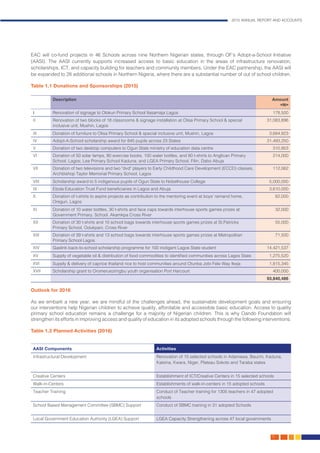
1.
Annual Report & Accounts 2015
RC 6474
2015 ANNUAL REPORT AND ACCOUNTS
2.
Our Global Footprint
Our Corporate Culture
Asset Overview
A New Strategic Perspective
Directors and Professional Advisers
Notice of 39th Annual General Meeting
Chairman’s Statement
Business Review
Corporate Governance
Report of the Directors
Report of the Audit Committee
Oando Foundation Report
Financial Statements
TABLE OF CONTENTTABLE OF CONTENT
2015 ANNUAL REPORT AND ACCOUNTS
2.
4
5
6
7
8
9
10
11
28
32
47
48
53
2015 ANNUAL REPORT AND ACCOUNTS
3.
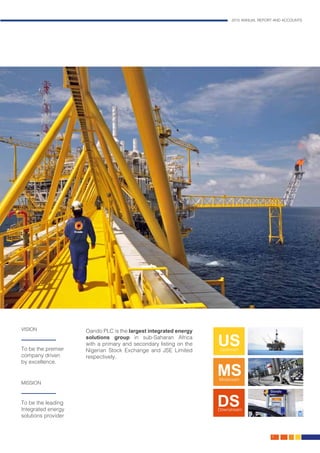
Oando PLC is the largest integrated energy
solutions group in sub-Saharan Africa
with a primary and secondary listing on the
Nigerian Stock Exchange and JSE Limited
respectively.
To be the premier
company driven
by excellence.
To be the leading
Integrated energy
solutions provider
VISION
MISSION
US
MS
DS
Midstream
Downstream
Upstream
2015 ANNUAL REPORT AND ACCOUNTS
4.
OUR GLOBAL FOOTPRINT
1,500+
Employees
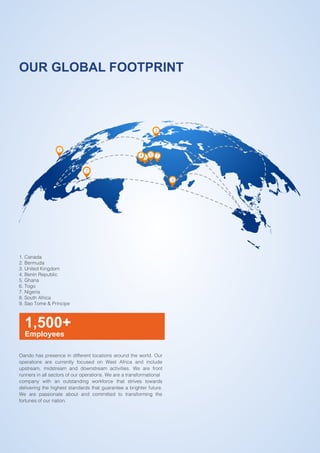
Oando has presence in different locations around the world. Our
operations are currently focused on West Africa and include
upstream, midstream and downstream activities. We are front
runners in all sectors of our operations. We are a transformational
company with an outstanding workforce that strives towards
delivering the highest standards that guarantee a brighter future.
We are passionate about and committed to transforming the
fortunes of our nation.
1
2
3
8
4 5
6 7
1. Canada
2. Bermuda
3. United Kingdom
4. Benin Republic
5. Ghana
6. Togo
7. Nigeria
8. South Africa
9. Sao Tome & Principe
2015 ANNUAL REPORT AND ACCOUNTS
5.
OUR CORPORATE
CULTURE
OANDO’S CORPORATE CULTURE
IS HINGED ON THE VALUES
OF TEAMWORK, RESPECT,
INTEGRITY,PASSION, AND
PROFESSIONALISM (TRIPP),
WHICH EMBODIES THE OANDO
WAY
Teamwork: Everyday, our people are driven to work together towards
actualising the organisation’s common goals and core values.
Respect: We encourage that consideration is shown to all colleagues. By
appreciating the worth of others and valuing their contributions, productivity
is improved, and a work friendly environment is created.
Integrity: Reliability, honesty, and trustworthiness are integral to all business
dealings and employees’ interpersonal relationships.
Passion: At Oando, we perform our tasks with enthusiasm and vigor, with
an underlying zeal to always perform at an extraordinary level.
Professionalism: Proper conduct by all employees is a critical component
for our achievement of business excellence
2015 ANNUAL REPORT AND ACCOUNTS
6.
ASSET OVERVIEW
With shared values of Teamwork, Respect, Integrity, Passion
and Professionalism (TRIPP), the Oando Group comprises
various divisions, each division encompasses companies
who are leaders in their respective markets.
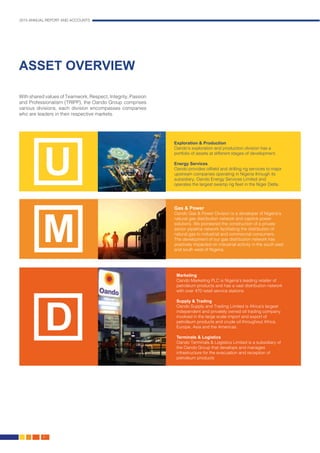
Exploration & Production
Oando’s exploration and production division has a
portfolio of assets at different stages of development.
Energy Services
Oando provides oilfield and drilling rig services to major
upstream companies operating in Nigeria through its
subsidiary, Oando Energy Services Limited and
operates the largest swamp rig fleet in the Niger Delta.
Gas & Power
Oando Gas & Power Division is a developer of Nigeria’s
natural gas distribution network and captive power
solutions. We pioneered the construction of a private
sector pipeline network facilitating the distribution of
natural gas to industrial and commercial consumers.
The development of our gas distribution network has
positively impacted on industrial activity in the south east
and south west of Nigeria.
Marketing
Oando Marketing PLC is Nigeria’s leading retailer of
petroleum products and has a vast distribution network
with over 470 retail service stations.
Supply & Trading
Oando Supply and Trading Limited is Africa’s largest
independent and privately owned oil trading company
involved in the large scale import and export of
petroleum products and crude oil throughout Africa,
Europe, Asia and the Americas.
Terminals & Logistics
Oando Terminals & Logistics Limited is a subsidiary of
the Oando Group that develops and manages
infrastructure for the evacuation and reception of
petroleum products
U
M
D
2015 ANNUAL REPORT AND ACCOUNTS
7.
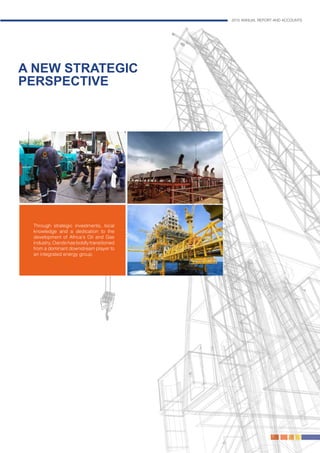
Through strategic investments, local
knowledge and a dedication to the
development of Africa’s Oil and Gas
industry,Oandohasboldlytransitioned
from a dominant downstream player to
an integrated energy group.
A NEW STRATEGIC
PERSPECTIVE
2015 ANNUAL REPORT AND ACCOUNTS
8.
Directors and
Professional Advisers
Oando’s general policies are determined by a Board
of Directors drawn from different facets of the society.
The Board members are successful individuals in their
various fields and bring a wealth of experience to the
running of the affairs of the Company. The Board met
regularly during the year to provide entrepreneurial
leadership, strategic guidance, risk management
oversight and governance over Managements’ plans
and operations for the Group.
HRM Oba Michael Adedotun
Gbadebo, CFR
The Alake of Egbaland
Chairman, Non-Executive Director
Mr Jubril Adewale Tinubu	
Group Chief Executive
Mr Omamofe Boyo
Deputy Group Chief Executive
Mr Olufemi Adeyemo
Group Executive Director
Mr Mobolaji Osunsanya
Group Executive Director
Mr Oghogho Akpata
Non- Executive Director
Ammuna Lawan Ali, OON
Independent Non-Executive Director
Chief Sena Anthony
Independent Non-Executive Director
Ms Nana Afoah Appiah-Korang
Non-Executive Director
(Resigned June 30, 2015)
Mr Tanimu Yakubu
Independent Non-Executive Director
Mr. Francesco Cuzzocrea
(Resigned with effect from
19th February 2016)
Non-Executive Director
Engr Yusuf N’jie
Independent Non-Executive Director
PROFESSIONAL ADVISERS:
Mr Olufemi Adeyemo
Group Chief Financial Officer
Ms Ayotola Jagun
Chief Compliance Officer
and Company Secretary
Mrs Ngozi Okonkwo		
Chief Legal Officer		
REGISTERED OFFICE
2, Ajose Adeogun Street
Victoria Island, Lagos, Nigeria
AUDITORS
Ernst & Young
UBA House (10th Floor), 57 Marina,
Lagos, Nigeria.
THE REGISTRARS & TRANSFER
OFFICES
First Registrars & Investor
Services Limited
Plot 2, Abebe Village Road, Iganmu,
Lagos, Nigeria
Computershare Investor Services
(Proprietary) Limited
70, Marshall Street, Johannesburg
2001,
PO Box 61051, Marshalltown 2107,
South Africa
BANKS
•	 ABN Amro Bank
•	 Access Bank Plc
•	 Access Bank UK
•	 African Export-Import Bank
•	 BNP Paribas, Paris
•	 Citibank Nigeria Limited
•	 Citibank UK
•	 Diamond Bank Plc
•	 Ecobank Plc
•	 Fidelity Bank Plc
•	 First Bank of Nigeria Limited
•	 First Bank UK
•	 First City Monument Bank Plc
•	 Guaranty Trust Bank Plc
•	 Heritage Banking Company
Limited
•	 Keystone Bank Limited
•	 Natixis Bank
•	 Rand Merchant Bank (First Rand)
•	 Skye Bank Plc
•	 Stanbic IBTC Bank Plc
•	 Standard Bank London
•	 Standard Bank of South Africa Ltd
•	 Standard Chartered Bank Plc UK
•	 Standard Chartered Bank Nigeria
Limited
•	 Sterling Bank Plc
•	 Union Bank of Nigeria Plc
•	 United Bank for Africa Plc
•	 United Bank for Africa New York
•	 Unity Bank Plc
•	 Wema Bank Plc
•	 Zenith Bank Plc
2015 ANNUAL REPORT AND ACCOUNTS
9.
Notice of 39th
Annual General Meeting
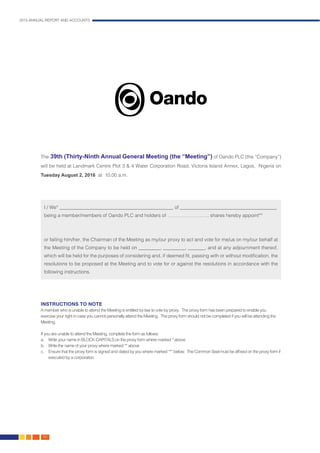
NOTICE IS HEREBY GIVEN that the 39th (Thirty–Ninth)
Annual General Meeting (the “Meeting”) of Oando PLC
(the “Company”) will be held at Landmark Centre, Plot 3 &
4 Water Corporation Road, Victoria Island Annex, Lagos,
Nigeria on Tuesday, 02 August 2016 at 10:00am prompt
for the purposes of:
1. Transacting the following ordinary business:
1.1.	 To receive the audited financial statements of the
Company and of the Group for the year ended
December 31, 2015 and the Reports of the
Directors, Auditors and Audit Committee thereon;
1.2.	 To elect members of the Audit Committee;
1.3.	 To re-appoint Ernst & Young as Auditors and to
authorise the Directors of the Company to fix their
remuneration;
1.4.	 To re-elect HRM M.A. Gbadebo, (CFR) as a
Director;
1.5.	 To re-elect Chief Sena Anthony as a Director;
1.6.	 To re-elect Mr. Mobolaji Osunsanya as a Director;
1.7.	 To elect Mr. Ikeme Osakwe to the Board of Directors
of the Company with effect from 08 July, 2016
as a Director whose term expires in accordance
with Article 88 of the Article of Association of the
Company (“the Articles”) but being eligible, offers
himself for election;
1.8.	 To elect Mr. Ademola Akinrele, SAN to the Board
of Directors of the Company with effect from
08 July, 2016 as a Director whose term expires
in accordance with Article 88 of the Article of
Association of the Company (“the Articles”) but
being eligible, offers himself for election.
2.	 Transacting the following special business:
2.1	 To consider, and if approved, to pass, with or without
modification, the following ordinary resolution to fix
the remuneration of the Non-Executive Directors:
	 “It is hereby resolved that the fees, payable
quarterly in arrears remain N5,000,000 per annum
for the Chairman and N4,000,000 per annum, for all
other Non-Executive Directors.”
Voting and Proxies
On a show of hands, every member present in person or
by proxy shall have one vote, and on a poll, every member
shall have one vote for each share of which he is the holder.
A member of the Company entitled to attend and vote at
the Meeting is entitled to appoint a proxy to attend, speak
and vote in their stead. A proxy need not be a member of
the Company.
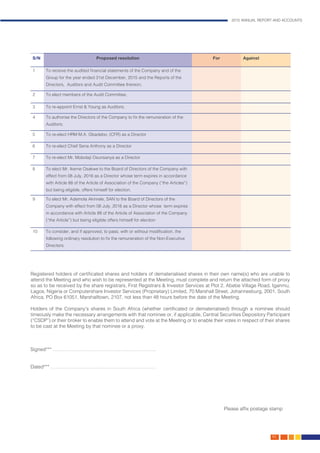
Registered holders of certificated shares and holders of
dematerialised shares in their own name who are unable
to attend the Meeting and who wish to be represented at
the Meeting, must complete and return the attached form
of proxy in accordance with the instructions contained
in the form of proxy so as to be received by the share
registrars, First Registrars Nigeria Limited at Plot 2, Abebe
Village Road, Iganmu, Lagos, Nigeria or Computershare
Investor Services (Proprietary) Limited, 70, Marshall Street,
Johannesburg, 2001, PO Box 61051, Marshalltown, 2107,
South Africa not less than 48 hours before the time of the
Meeting.
Holders of the Company’s shares in South Africa (whether
certificated or dematerialised) through a nominee should
timeously make the necessary arrangements with that
nominee or, if applicable, Central Securities Depository
Participant (“CSDP”) or broker to enable them attend and
vote at the Meeting or to enable their votes in respect of
their shares to be cast at the Meeting by that nominee or
a proxy.
Closure of Register of Members
The Register of Members and Transfer Books of the
Company (Nigerian and South African) will be closed
between 18th of July 2016 and 20th of July 2016 (both
days inclusive) in terms of the provisions of Section 89 of
the Companies and Allied Matter Act, Cap C20, Laws of
the Federation of Nigeria, 2004 (“CAMA”).
Nominations for the Audit Committee
In accordance with Section 359(5) of CAMA, any member
may nominate a shareholder as a member of the Audit
Committee, by giving notice in writing of such nomination
to the Chief Compliance Officer and Company Secretary at
least 21 days before the Meeting.
Right of Shareholders to ask Questions
Shareholders have a right to ask questions not only at the
meeting, but also in writing prior to the meeting, and such
questions must be submitted to the company on or before
29th of July, 2016.
Dated July 11, 2016
By the Order of the Board
Ayotola Jagun (Ms.)
Chief Compliance Officer and Company Secretary 		
	
Registered Office
2, Ajose Adeogun Street
Victoria Island, Lagos, Nigeria
2015 ANNUAL REPORT AND ACCOUNTS
10.
2015 was a challenging year as
developments offered a mix of
notable events which shaped the
business and economic environment
in the year. We operate in an
environment that has become more
turbulent and the price of oil has
significantly declined, returning to a
pattern of volatility not seen for years.
Global oil prices which commenced
a fall mid-2014, as a result of a
combination of excess supply and
weakening demand across major
consumers of energy, continued its
free fall in 2015. Oil prices which
averaged $52 per barrel in January
2015, slipped to $35 per barrel in
December, 2015 (far below the
2015 federal government budget
benchmark of $53 per barrel set
for 2015). All indicators point to oil
prices remaining at low levels in 2016
(at least in the short term), which
implies that several adjustments
are required in the short to mid-
term, while we continue to plan for
a profitable long term future that will
see increasing demand for energy.
The drastic decline in crude oil prices
consequently led to various fiscal
and economic challenges such as
the drop in foreign earnings, strained
fiscal budget and huge financial
bailout for some state governments,
and general cash flow issues in the
economy. According to the National
Bureau of Statistics, Nigeria’s real
Gross Domestic Product (GDP) fell
to 2.84% in the third quarter of 2015
compared to 6.23% in the same
period in 2014. Unemployment rate
which stood at 6.4% in Q4 2014, rose
to 9.9% in Q2, 2015 and exchange
rate depreciated by over 55 percent
from N136/ dollar to N199/ dollar in
2015.
On a positive note, the country
witnessed a successful and relatively
peaceful democratic transition
that ushered in a new political
administration at the federal level.
However, business activities were
largely slow for a better part of the
year due to uncertainties around the
general economic policy direction of
the present administration.
Our local oil and gas industry is
also experiencing positive changes
with significant restructuring
completed at the NNPC, positioning
the corporation for improved
transparency and industry
engagement. Efforts are also
being made to resolve the funding
challenges which have hampered
production growth in the country.
These, coupled with significant
reduction in crude oil losses due
to improved security of pipelines,
provides hope that the operating
environment for upstream players
such as ourselves will improve going
forward.
Executing our Strategy
In the upstream, the crash in oil
prices coincided with our growth into
this higher margin upstream sector.
Even with the crash in oil prices, the
strategic decision taken to partial
cash in on our hedge allowed us to
pay down ~$224 million of the $900
million of debt utilized for the Conoco
Phillip acquisition. Production also
commenced at our Qua-Iboe Field.
A notable development in our
downstream business was the
execution of a definitive Sales
and Purchase Agreement towards
the partial divestment and
recapitalization of our downstream
business to Helios Investment and
the Vitol Group. By virtue of this
divestment, we have positioned
our downstream business for
more capital injection towards a
sustained growth and returns for all
shareholders.
Our Gas and Power business
continues to grow from strength to
strength as construction works on our
9km Greater Lagos Pipeline Project
nears completion. We remain bullish
in our commitment to gas and power
in this space as the potential the
Nigerian market offers is immense.
The Oil Field Services business
remained challenged by funding
issues which have typified the
Nigerian Joint Venture operations
over the last decade. As such, in line
with our goal to deleverage, we took
a strategic decision to divest from
this line of business in 2015.
2016 Outlook
All forecasts point to global crude
prices remaining at low levels for
2016, as even the possibility of a
production freeze arrangement
among oil producers will not be
enough to eliminate the current
excess oil in the market. Hence,
we need to prepare for a period of
sustained low oil prices.
Cost Management, Risk Management
and Disciplined Execution must
be our watchwords in 2016. We
will focus on deleveraging our
balance sheets to create a platform
for long term profitability. Cost
management will be key and we
will ensure disciplined execution of
our highlighted corporate initiatives
towards achieving long term
profitability and guaranteed returns
for all shareholders.
HRM Oba Michael Gbadebo, CFR
CHAIRMAN’S STATEMENT
A notable development
in our downstream
business was the
execution of a definitive
Sales and Purchase
Agreement towards the
partial divestment and
recapitalization of our
downstream business to
Helios Investment and the
Vitol Group.
HRM Oba Michael Gbadebo, CFR
Chairman
2015 ANNUAL REPORT AND ACCOUNTS
11.
Business Review
Business Review
Group Chief Executive’s Statement
Upstream
Midstream
Downstream
12
15
21
25
2015 ANNUAL REPORT AND ACCOUNTS
12.
GROUP CHIEF
EXECUTIVE’S STATEMENT
Dear Fellow Shareholder,
In recognition of the privilege
accorded to me, I hereby present
your company’s operational and
financial performance for 2015.
2015 was a very volatile year for
the oil and gas industry. Oil prices
which for the better part of the
last five years had averaged $100
per barrel, continued its mid-2014
originated crash (opening at $55
per barrel in January and slipping to
$35 per barrel in December, 2015).
This unexpected price drop created
a new dawn of adversity within the
industry as projects which were once
economically viable were suspended
and global oil companies and
services companies, experienced
significant asset write downs and
impairments totaling billions of
dollars.
The year was also graced by other
challenges that directly impacted our
business such as delays in payment
of petroleum subsidy receivables,
forex scarcity resulting in difficulty
liquidating foreign currency loan
obligations and liquidity tightness
occasioned by shrunk bank portfolio
limits in the Oil & Gas sector.
Executing our Strategy
Against the backdrop of a slowing
global growth, and weakening
domestic environment we remained
steadfast to our commitment to
you. We faced each challenge
with renewed vigor and recorded
significant milestones.
In the upstream, we commenced
production at our Qua Iboe field at
an initial gross rate of 2,150boepd.
We also took a strategic decision to
restructure our hedge from $97.50/
barrel to $65/ barrel, thus resulting
in cash generation of approximately
$224 million dollars which we
used in significantly reducing our
ConocoPhillips debt obligation. We
successfully completed the $91
million upsizing of our Reserve Based
Loan debt as well as repayment of
our $100 million Afrexim subordinated
loan facility and also commenced the
process towards partial divestment of
our Energy Services Company.
In the downstream business we
entered into a definitive Sales and
Purchase Agreement (SPA) with HV
Investment, a joint venture co-owned
by Helios Investment Partners and
Vitol SA. This strategic partnership
will significantly deleverage the
balance sheet of the business and
enable its accelerated growth through
increased investment. Furthermore,
it will enhance our competitiveness
to continue to create value for our
stakeholders.
Our Gas and Power business
continues to be one of our prized
and most profitable businesses.
We continued construction work
on our 9km Greater Lagos Pipeline
Expansion (Phase IV) Project which
is expected to open up the Ijora -
Lagos Island - Victoria Island markets
to our gas products. The project is
84.5% completed, with Segment
1 completed and we have started
to record new customer connects
along the pipeline expansion route.
In addition, our pilot Compressed
Mr. J. A. Tinubu
Group Chief Executive
2015 ANNUAL REPORT AND ACCOUNTS
13.
Natural Gas offering, which enables
customers outside our existing
pipeline grid access natural gas for
their industrial processes and power
generation, doubled its customer
base in the year under review. We
are in the process of completing the
divestment of Akute Power limited,
in line with our strategy to move
to bigger scale embedded/grid
connected power business.
2016 Outlook
We expect 2016 to be as challenging
as 2015 given the continuous
oversupply of crude in the market,
driven by the re-entrance of Iran
into the export market, increased
production from the likes of Iraq as
well as a slowdown of the global
economy. However, we have pro-
actively instituted several initiatives
that would enable us face the new
oil price challenge with resilience
towards maintaining profitability.
We have reset your business to
deliver value in this new context,
scaling back on capital spending
and reducing costs while maintaining
safe and reliable operations. Our
focus is a renewed drive towards cost
management, risk management and
disciplined execution to ensure every
amount spent results in value creation
for you our esteemed shareholders.
We will continue to actively manage
our portfolio and divest from assets
where optimal value cannot be
derived. Making the right investment
choices is of the highest priority in
view of the global liquidity constraints.
Our three key business drivers
remain: Growth, Deleverage and
Profitability. The dollar earning
upstream and trading businesses
will be our growth focus areas while
we will achieve reduced leverage
via balance sheet optimization.
Profitability will be driven through
improved cost and capex
management focus.
In the upstream, whilst the majority
of oil producers endure the shock of
falling oil prices, we are protected to
a certain extent with ~45% of our oil
production secured at $65 per barrel.
We also have a diversified portfolio,
with 60% of our total production
being natural gas tied to long term
contracts. As the year progresses,
we will continue to work with our
joint venture partners to execute our
development program in 2016, which
has been scaled back in response
to low oil prices. Our development
program is focused on lower risk
activities that provide short term
returns to our company. We are
also actively monitoring oil prices to
determine when to cash in our hedge
and generate capital towards paying
down more of our debt.
We will conclude the partial
divestment process towards
recapitalization of the downstream
business by H1, 2016. Post
divestment, we will embrace a new
and exciting opportunity to further
position Oando Downstream as
a market leader in the local and
global sector. In addition, our Lagos
Oando Jetty will be commissioned
in Q3, 2016 – a jetty positioned to
revolutionize petroleum products
supply and distribution within the
country.
As approved by you our esteemed
shareholders, we have commenced
the recapitalization and partial
divestment from our Gas & Power
Business and expect to conclude this
process by Q3, 2016. This divestment
will result in capital injection to the
Group and will create a platform for
the Gas & Power business to grow
driven by increased investment.
We have reset your business to
deliver value in this new context,
scaling back on capital spending
and reducing costs while
maintaining safe and reliable
operations
2015 ANNUAL REPORT AND ACCOUNTS
14.
Upstream
Business Review
2015 ANNUAL REPORT AND ACCOUNTS
15.
OANDO ENERGY RESOURCES
2015 ECONOMIC REVIEW:
The oil and gas industry is in the
midst of a significant structural shift
— a move from an era when capital
investment decisions were driven by
the perception of “resource scarcity”
to an era of “abundance”. 2015 was
thus a difficult and turbulent time
for the industry as traditional energy
business models had to be altered in
order for companies to survive their
new reality.
The significant drop in both crude
oil and natural gas prices across
the year coupled with a high level
of uncertainty about their future
trajectory challenged oil and gas
players in 2015. Crude oil prices,
which began the year at US$55 per
barrel (Brent), declined to US$37
per barrel by December, the lowest
level since May 2004 with natural gas
prices experiencing a similar journey.
With crude oil production continuing
to outpace demand by 2 million
barrels per day, and with no clear
sign when the market will rebalance,
prices have continued to decline in
2016.
A range of factors led to greater
price volatility. These included
uncertainty about the sustainability
of US and other production at lower
prices, the lifting of Iranian sanctions,
geopolitical instability, the economic
outlook for China, and concerns
about global energy demand.
In Nigeria, the newly elected
President was quick in taking bold
steps which signify that the oil
industry is high on his list of priorities.
The appointment of a technocrat,
gives hope that the NNPC will be
run as a company with increased
accountability and transparency.
The new GMD has been quick to set
out his strategy to restructure the
corporation, ensure transparency
and fully engage with all industry
stakeholders. There is a sense of
positivity amongst industry players
that Nigeria’s oil industry will finally
begin to achieve its full potential,
albeit tempered by a volatile oil price
environment.
2015 ASSET PROFILES
OML 60-63
Overview
The NAOC JV (20% OER WI; NAOC
20% and operator; NNPC 60%) holds
OMLs 60, 61, 62 and 63, located
onshore in the Niger Delta and the
licenses have an expiry date of June
14, 2027.
OML 60 is located on land, in the
northern Niger Delta and covers an
area of 358 km2 (88,464 acres). OML
61 is also located on land, in the
northern Niger Delta and covers an
area of 1,499 km2 (370,410 acres).
OML 62 terrain varies eastwards from
swamp to land and is located in the
central Niger Delta, covering an area
of 1,221 km2. OML 63 is located
along the coastal swamp area of the
Niger Delta and covers an area of
2,246 km2 (554,998 acres).
OER’s gross share of total production
sold from NAOC JV in 2015 was 16.6
MMboe (comprised of 5.7 MMbbls of
oil, 58.5 Bscf of gas and 1.2 MMbbls
of natural gas liquids). Therefore,
in 2015, OER’s gross share of daily
production sold from NAOC JV
averaged 45,565 Mboe per day
(consisting of 15,561 bbls/d of oil,
160,030 MMscf/d of gas and 3,332
bbls/d of natural gas liquids).
As of December 31, 2015, OER
held a net share in the NAOC JV 2P
reserves of 427 MMboe (comprised
of 152.3 MMbbls of oil, 12.5 MMbbls
of natural gas liquids and 1,573.6
Bscf of gas), gross Best estimate
unrisked Contingent resources of
78.2 MMboe, gross Best estimate of
risked (defined as risk for chance of
development) Contingent resources
of 19.1 MMboe, gross Mean estimate
unrisked Prospective resources
of 51.5 MMboe and gross Mean
estimate of risked (defined as risk
for chance of geologic success)
Prospective resources of 19.5
MMboe.
The assets of the NAOC JV also
include extensive infrastructure,
comprising 12 Flowstations,
an oil processing centre, an oil
export terminal, three gas plants
(Kwale, Ob-Ob and Ogbainbiri),
the Kwale-Okpai IPP, a network of
approximately 1,190 km of pipelines
and associated infrastructure
Upstream
2015 ANNUAL REPORT AND ACCOUNTS
16.
including, roads, power
stations and heliports.
Some of the NAOC JV’s
main export pipelines are
used by third parties and
agreements are in place
for transportation and
processing. In addition,
some gas is supplied from
the Akri field to the Oguta
plant. Reserves have been
attributed to Beniboye in
OML 62, which is currently
not producing. The
wells and flowstation are
capable of producing but production
stopped in 2013 after the asset was
vandalized. Prior to that incident,
the field was producing about
2,000 barrels of oil per day, which
was evacuated to Shell-operated
Forcados Terminal 10km away.
Capital Budgets and Budgeted Capital
Expenditure:
During 2015 capital expenditures
on OMLs 60 to 63 totalled $41.3
million. Capital expenditures during
the period included $11.7 million
spent on development drilling and
completion activities in the Ogbainbiri
Deep 4 well, $27.5 million was spent
on pipeline and facility upgrades
and $2.1 million was spent on
geophysical exploration studies and
other assets. The reduction of capital
spending in 2015 compared to the
budgeted amount was due to project
delays and a reduction of spending
as a result of the lower crude oil and
natural gas price environment.
In 2016, the Corporation estimates
that a total of $60.0 million will be
spent at OMLs 60 to 63, consisting
of $44.4 million directed to facilities
for asset integrity, water disposal
and flare down, and $15.6 million on
drilling three development wells and
a workover.
OML 56 (EBENDO)
Overview
Ebendo Marginal License (42.75%
OER WI; Energia, an indigenous
company and operator, 55% WI),
was carved from OML 56 in the
central Niger Delta, approximately
100 km north-west of Port Harcourt.
The License covers an area of 65
km2 (16,062 acres). The License
includes two fields, the Ebendo
field (producing), Obodeti field
(undeveloped) and one prospect,
Ebendo North. Ebendo operates
under Marginal Field terms that
benefit from advantageous fiscal
terms.
OER’s gross share of total production
sold from Ebendo in 2015 was 1.294
MMboe (consisting of 0.623 MMbbls
of oil and 4.027 Bscf of gas), hence
OER’s company gross share of
daily production sold from Ebendo
averaged 3,545 Mboe per day
(consisting of 1,706 bbls/d of oil and
11,034 MMscf/day of gas).
As of December 31, 2015, the
Ebendo License held net 2P
reserves of 8.8 MMboe (comprised
5.4 MMbbls oil and 20.3 Bscf of
gas), gross Best estimate unrisked
Contingent resources of 1.4 MMboe,
gross Best estimate of risked
Contingent resources of 1.0 MMboe,
gross Mean estimate unrisked
Prospective resources of 2.4 MMboe
and gross Mean estimate of risked
Prospective resources of 1.2 MMboe.
Capital Projects and Budgeted
Expenditure
During 2015, the Corporation
incurred $1.7 million in capital
expenditures at Ebendo, which
included the pipeline facility
enhancements and drilling site
preparation costs.
Throughout 2016, the Corporation
has estimated $6.7 million in capital
expenditures for five well workovers,
a storage tank and Umugini pipeline
upgrades.
OML 13 (QUA IBO)
Overview
Qua Ibo (40% OER WI and
technical partner; NEPN, an
indigenous company, 60%
WI and operator) is located
in onshore Nigeria, near the
mouth of the Qua Iboe River,
immediately adjacent to the
ExxonMobil Qua Ibo Terminal.
The License covers an area
of 14 km2 (3,459 acres) and
includes one producing field
(Qua Ibo). The Qua Ibo
License was acquired by OER
during 2013 and it operates under
Marginal Field terms that benefit
from advantageous fiscal terms.
Production from the Qua Ibo field
began in 2015 and the field currently
has two producing wells and one
shut -in well.
OER’s gross share of total production
sold from Qua Ibo in 2015 was 0.282
MMbbls of oil, hence OER’s gross
share of daily production sold from
OML 125 averaged 772 bbls/d of oil.
As of December 31, 2015, Qua Ibo
License held net 2P reserves of 3.7
MMbbls of oil, gross Best estimate
unrisked Contingent resources of
0.3 MMboe and gross Best estimate
risked Contingent resources of 0.2
MMboe.
In its capacity as technical services
provider, ORPS oversees, together
with NEPN, the operations on Qua
In Nigeria, the
newly elected
President was
quick in taking
bold steps which
signify that the
oil industry is
high on his list of
priorities.
2015 ANNUAL REPORT AND ACCOUNTS
17.
Ibo. ORPS agreed to fund some
of NEPN’s costs on Qua Ibo until
first oil, following which ORPS will
be entitled to 90% of NEPN’s sales
proceeds from its 60% share of crude
oil production until NEPN’s obligation
plus a 10% fee is paid in full.
Capital Projects and Budgeted Capital
Expenditure
In 2015, the Corporation incurred
capital expenditures of $3.8 million
at Qua Ibo on pipeline and crude
oil facility costs. The Qua Ibo field
commenced production late February
2015 and realized its first sales from
production in the second quarter of
2015. The Corporation revised its
2015 budget from $0.6 million capital
spending to $3.8 million to account
for additional facility requirements
for water handling, in addition to
the previously planned facility
enhancements.
In 2016, the Corporation has
budgeted $0.9 million to be spent
on gathering facilities and water
treatment facilities.
OML 125 (ABO)
Overview
OML 125 (15% WI; Eni, operator, 85%
OER WI) is located approximately 40
km offshore from the western Nigerian
coast in water depths ranging from
550 m to 1,100 m. The License
covers an area of 1,983 km2 (490,010
acres). The License includes one
producing field (Abo field), one
undeveloped discovery (Abo North)
and 13 prospects. OML 125 operates
under a Production Sharing Contract.
Production from the Abo field began
in 2003 and the field currently has
four producing wells, two other wells
are shut-in pending flowline repairs
while another is waiting on arrival of
the Xmas tree. In addition there are
two water injection wells and two gas
injection wells.
OER’s gross share of total production
sold from OML 125 in 2015 was 1.2
MMbbls of oil, hence, OER’s gross
share of daily production sold from
OML 125 averaged 3,313 bbls/d of
oil.
As of December 31, 2015, OML
125 held net 2P reserves of 5.8
MMbbls of oil, gross Best estimate
unrisked Contingent resources of 1.1
MMboe, gross Best estimate of risked
Contingent resources of 0.6 MMboe,
gross Mean estimate unrisked
Prospective resources of 16.6
MMboe and gross Mean estimate of
risked Prospective resources of 7.0
MMboe.
Capital Projects and Budgeted Capital
Expenditure
The Corporation incurred $36.4
million of capital expenditures during
2015 at OML 125 related to gathering
and transportation infrastructure
enhancements and facility
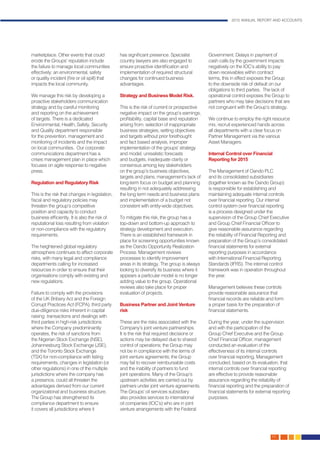
maintenance. The enhancements
included $23.1 million spent on Abo
phase 3 gathering and transportation
construction, $4.2 million on well
completion costs at Abo 12, $5.6
million on its FPSO on capital
maintenance, and $3.5 million on
other capital maintenance projects.
The significant reduction of capital
spending in 2015 compared to the
budgeted amount was primarily
due to delaying planned projects as
a result of the lower crude oil and
natural gas price environment to
ration capital spending.
The Corporation has an agreement
to divest out of the OML 125 asset in
2016. Therefore, no capital spending
has been budgeted in 2016 for OML
125.
OML 90 (AKEPO)
Overview
Akepo Marginal License (40% WI and
technical partner; Sogenal, operator,
60% WI) was carved from OML 90
and located in shallow waters (<20m)
of the western Niger Delta. The
License covers an area of 26 km2
(6,425 acres). The License includes
one undeveloped field (Akepo) and
two prospects (A and B, collectively
referred to as Akepo North). The
Akepo field is expected to commence
production from a single well in
2017, evacuating production through
a barge to the Escravos terminal.
Akepo operates under Marginal Field
terms that benefit from advantageous
fiscal terms.
As of December 31, 2015, the Akepo
License held gross Best estimate
unrisked Contingent resources of 3.8
MMboe, gross Best estimate of risked
Contingent resources of 2.6 MMboe,
gross Mean estimate unrisked
Prospective resources of 3.7 MMboe
and gross Mean estimate of risked
Prospective resources of 1.2 MMboe.
OML 134 (OBERAN)
OML 134 (15% OER WI; NAE
operator, 85% WI) is located offshore
in water depths ranging from 550 m
to 1,100 m approximately 80 km
2015 ANNUAL REPORT AND ACCOUNTS
18.
from the western Nigerian coast.
The License covers an area of
1,132 km2 (279,723 acres). The
License includes three undeveloped
discoveries (Oberan-1 fault
block, Oberan-2 fault block and
Minidiogboro), two single-well
discoveries (Engule and Udoro) and
nine prospects. There has been no
production from OML 134 to date.
As of December 31, 2015, OML 134
held gross Best estimate unrisked
Contingent resources of 1.6 MMboe,
gross Best estimate of risked
Contingent resources is 0.9 MMboe,
gross Mean estimate of unrisked
Prospective resources of 16.9
MMboe and gross Mean estimate of
risked Prospective resources of 5.3
MMboe.
In December 2015 OER agreed to
sell its interests in OMLs 134 and 125
to the operator.
OML 145
OML 145 (20% WI; ExxonMobil
operator, 80% WI) is located offshore
in water depths ranging from 1000
to 1,500 m, approximately 110 km
from the western Nigerian coast. OER
acquired interests in OML 145 as part
of the acquisition of ConocoPhillips’s
Nigerian business in July 2014. The
License covers an area of 1,293
km2 (319,507.5 acres) and includes
two undeveloped discoveries (Uge
and Uge North), two single-well
discoveries (Nza and Orso) and
five prospects. There has been no
production from OML 145 to date.
As of December 31, 2015, OML 145
held gross Best estimate unrisked
Contingent resources of 42.7
MMboe, gross Best estimate of risked
Contingent resources of 24.4 MMboe,
gross Mean estimate of unrisked
Prospective resources of 39.8
MMboe and gross Mean estimate of
risked Prospective resources of 19.6
MMboe.
OML 122
OML 122 (12.5% gas WI and 5.0% oil
WI; Peak, an indigenous company,
87.5% gas WI and 95.0% oil WI) is
located in the offshore Niger Delta,
40 km from the coastline of southern
Nigeria, at a water depth of between
40 m to 300 m. The License covers
an area of 1,599 km2 (395,122
acres). The License includes three
discoveries (Bilabri,
Orobiri and Owanare). There has
been no production from OML 122 to
date.
As of December 31, 2015, OML 122
held gross Best estimate unrisked
Contingent resources of 7.7 MMboe
and gross Best estimate risked
Contingent resources of 4.8 MMboe.
OML 131
OML131 (100% WI; operator
OER) is located offshore in water
depths ranging from 500 to 1,200m
approximately 70 km from the
western Nigerian coast. The License
is expected to be unitized with OML
135 with a resulting unit share of 51%
for OML 131. OML 131 covers an
area of 1,204 km2 (301,000 acres)
and includes two undeveloped
discoveries (Bolia-Chota and Ebitemi)
and two prospects (Pulolulu and
Chota East). There has been no
production from OML 131 to date.
As of December 31, 2015, OML 131
held gross Best estimate unrisked
Contingent resources of 71.6
MMboe, gross Best estimate of risked
Contingent resources of 40.9 MMboe,
gross Mean estimate of unrisked
Prospective resources of 165.9
MMboe and gross Mean estimate of
risked Prospective resources of 41.5
MMboe.
BLOCKS 5 AND 12, EXCLUSIVE
ECONOMIC ZONE OF SAO TOME
PRICIPE
OER holds its interest in Blocks 5
and 12 through its 81.5% interest in
Equator Exploration Limited (EEL). In
February 2010, in accordance with
agreements signed in 2001 and 2003,
the government of STP awarded OER
Blocks 5 and 12, located within the
country’s EEZ. Block 5 has an area of
2,844 km2 and the water depth within
the block ranges from 2000 to 2500
m. Existing 2D seismic data over
the block were reprocessed in 2014
and interpreted to identify several
prospects. In 2015, 3D seismic
data was acquired over an area of
1400 km2. The processing of the
newly acquired 3D seismic data was
completed in December 2015 and
interpretation of the 3D is currently
ongoing to further mature identified
prospects for exploration drilling in
2017.
In December 2015, EEL agreed to
farm out 65% of its participating
interest in Block 5 for $7.4 million to
equalize past costs and will retain a
20% participating interest, with a 50%
carry up to $9.0 million each for both
Phases II and III. EEL also entered
into an agreement to farm out 65%
of its participating interest in Block
12, retaining a 22.5% participating
interest with a carry of the first $2.0
million of OER’s portion of project
costs. The farm-out for Block 12 is yet
to be completed. The government of
STP (through its National Petroleum
Agency) will retain15% and 12.5%
2015 ANNUAL REPORT AND ACCOUNTS
19.
carried interests in Blocks 5 and
12, respectively. Closing of the
transaction is subject to satisfaction
or waiver of government approvals
and certain other standard conditions
precedent and is expected to occur
during the second quarter of 2016.
As of December 31, 2015, the EEZ
Block 5 held gross Mean estimate
unrisked Prospective resources of
1,474.7 MMboe and gross Mean
estimate risked.
OPL 321 AND OPL 323
Overview
OPL 321 and OPL 323 (24.5%
WI; operator KNOC) are located
adjacent to OML 125, offshore from
the Nigerian coast, at a water depth
of 950 m to 2,000 m. The Licenses
cover a combined area of 2,147 km2
(530,535 acres). The Licenses are
presently the subject of a dispute
between the operator, KNOC, and
the Nigerian Government. Due to
this ongoing dispute, since 2008
exploration on these Licenses has not
been possible and as a result, OER
requested and received a refund of
the aggregate signature bonus paid
by OER in respect of the two Licenses
($162 million).
No wells have been drilled on the
Licenses to date. The License
includes five sizeable prospects
(Gorilla, Lobster, Octopus and Whale
(OPL 323) and Elephant (OPL 321)).
As of December 31, 2015, OPLs
321 and 323 jointly held gross
Mean estimate unrisked Prospective
resources of 826.5 MMboe and gross
Mean estimate risked Prospective
resources of 197.2 MMboe.
Capital Projects and Budgeted
Capital Expenditure on Non-
producing Licences
Other than as set forth above,
asset capital expenditures include
spending on OML 131, OML
134 and EEL. During 2015 the
Corporation spent $4.7 million to
advance exploration of the respective
properties with geological and
technical studies.
In 2016, the Corporation estimates
that $5.7 million will be expended on
exploration projects and corporate
assets. The exploration is focused
on OML 131, OML 145 and Block
5, to assess the geological and
geophysical aspects of the project
areas, along with the environmental
impacts through technical studies
and seismic acquisition.
OPL 236
Oando Exploration and Production
Limited was awarded this block in
May 2007 and the PSC was signed
with NNPC in February 2008. This
conferred OEPL with a 95% working
interest and operatorship of the block.
RFO Ventures is the local content
vehicle (LCV) with a 5% participatory
interest. The block is located onshore
Akwa Ibom State with a total acreage
of 1,650 km2. A Global Memorandum
of Understanding (GMOU) was
signed with the Ukana community in
August 2008.
OPL 236 is
currently in the
exploration
stage. In 2010,
2D seismic data
for OPL 236 was
purchased and
digitized. Work
is ongoing on
a development
program aimed
at harnessing
the gas reserves
in line with
the proposed
industry gas
master plan and
delivering the much needed clean
energy for the growing energy needs
of the utilities and power industry
within the region.
OPL 278
In January 2006, OEPL acquired a
60% working interest pursuant to a
PSC between the Group, CAMAC,
Allied Energy and First Axis and the
NNPC, in respect of OPL 278. OPL
278 is operated by OEPL under a
joint operating agreement (“JOA”)
made between OEPL, CAMAC, Allied
Energy and First Axis. OPL 278 is
located offshore of Rivers State in a
transition zone (swamp to shallow
marine) on an area of 91.9 km2.
Three prospects have been identified
in OPL 278, which are Ke, Prospect A
and Prospect B.
OPL 282
On 8 August 2006, OEPL acquired
a 4% working interest in the PSC
between NAOC, Alliance Oil
Producing Nigeria Limited (“AOPN”)
and NNPC, in respect of OPL 282
(the “OPL 282 PSC”). NAOC holds a
90% working interest in the OPL 282
PSC, while AOPN, which represents
the LCV in OPL 282, holds the
remaining 10% working interest.
The Group holds 40% of the shares
in AOPN, while ARC Oil and Gas
Nigeria Limited holds the remaining
60%. OPL 282 is operated by NAOC
under a JOA made between NAOC
and AOPN. OPL 282 is located in a
transition zone (onshore to shallow
marine) in Bayelsa State, on an area
of 695 km2. This block is currently in
the exploration phase.
An exploratory drilling campaign
in the block was kicked off with the
Tinpa 1 Dir well, which spudded in
Q4, 2011. Tinpa 1 was successfully
drilled to a TD of 3700 MD, and it
encountered the oil and associated
gas in three sands, which were
successfully tested and completed.
Tinpa 2 was drilled and completed
in Q2, 2013 but did not encounter
hydrocarbon bearing sands. The
well was subsequently plugged and
abandoned.
2015 ANNUAL REPORT AND ACCOUNTS
20.
2015 ANNUAL REPORT AND ACCOUNTS
21.
Midstream
Business Review
2015 ANNUAL REPORT AND ACCOUNTS
22.
2015 ANNUAL REPORT AND ACCOUNTS
23.
2015 ANNUAL REPORT AND ACCOUNTS
24.
2015 ANNUAL REPORT AND ACCOUNTS
25.
Downstream
Business Review
2015 ANNUAL REPORT AND ACCOUNTS
26.
Oando Marketing Plc (OMP) is a leading
Nigerian oil marketing firm with over 400
retail outlets Nationwide and industrial
customers operating in various sector
of the Nigerian economy, as well
as having operations in Ghana and
Togo. OMP’s activities cover the sales,
marketing and distribution of petroleum
products including Premium Motor
Spirit (PMS), Automotive Gas Oil (AGO),
Dual Purpose Kerosene (DPK), Aviation
Turbine Kerosene (ATK), Low Pour
Fuel (LPFO), Lubricating Oils, Greases,
Liquefied Petroleum Gas (LPG - cooking
gas), and Bitumen.
2015 Review
2015 saw a continuation in the declining
oil revenues to Nigeria which began
in 2014, due to the global fall of crude
prices in the international market. This
decline created trade deficits which
in turn led to a fall in the value of the
Naira. Consequently, the Central Bank
pursued an intervention policy that
reduced Nigeria’s external reserves. The
policy proved unsustainable, therefore
leading the apex bank to explore other
measures. First of these was to close the
Retail Dutch Auction System (RDAS) of
bidding for FOREX. The closure led to
exchange rate “fixing” thereby inhibiting
capital mobility.
The economic situation affected many
sectors of the Nigerian economy and the
Oil and Gas sector was no exception.
One of such effects on Oando was the
perennial issue of delayed subsidy
payments. These became worse during
the year, with the government owing
backlogs of up to 199 days. This was
an increase of 73% from an average of
115 days in 2014. The resultant effect
of this was an increase in the interest
payable to banks for trade finance by
the company.
Also, scarcity of FOREX within the
economy made it difficult for us to
secure financing for product importation.
However, despite these challenges,
Oando recorded successes, these
include:
Partial Divestment:
In July 2015, we signed a Sales and
Purchase Agreement (SPA) with
our potential investors. This was an
important step in the divestment process
which began in 2014.
•	 Improvement in our retail
infrastructure:
	 Our continued commitment to
market leadership in the retail sector
was further reflected in the upgrade
of our Falomo & Ijora service
stations.
•	 Improved Operational Infrastructure.
•	 Our Apapa marshalling yard was
upgraded to ensure more effective
loading operations. Trucks can now
be coordinated more efficiently, and
also transport vendors benefit from
improved turnaround time.
•	 Apapa LPG plant filling capacity was
upgraded from 15mt/day to 30mt/
day, a 100% increment.
•	 Benin plant was upgraded to best in
industry safety standards.
IT Solutions (ROMS):
	 The launch of the Retail Online
Monitoring System (ROMS) at
our service stations nationwide
seeks to replace the manual daily
sales record book (DSRB) with an
automated solution.
	 As at end of the year, 13 service
stations ran on this application.
Benefits of this solution include:
•	 Improved station efficiency
by providing real-time station
information to stakeholders
•	 On the-spot insight to station
management.
•	 Reduced human errors and
irregularities.
•	 Automated OMP’s Retail Outlet’s
Daily sales record book.
•	 Remote Head office visibility
into sales, pumps and stock
performance at all stations.
Product launch:
The launch of our new and improved
Oleum bottle took place in June. This
is geared towards improving market
penetration for our brand of lubricants,
thereby increasing market share.
These initiatives are geared towards
protecting and growing our existing
market share by improving our
comparative advantage with respect to
other marketers in Nigeria.
Product Review
PMS sales volumes fell by 29% to
600,000MT compared to 917,000MT the
previous year part driven by challenges
in securing credit for imports driven by
foreign exchange scarcity. The sectorial
credit limits for the sector were reduced
and this also had an adverse effect on
liquidity.
AGO volumes sold during the year
stood at 199,000MT, a 28% drop from
2014 level.
HHK sales also dipped by 70% to
27,600MT due to supply challenges.
Other products (Lubricants,
Specialties)
ATK volumes for the year were
128,600MT, a 9% increase from 2014.
This was driven by increased bulk
sales to other marketers off the back of
competitive product sourcing.
Lubricants volumes reduced by 20%
to 11,242MT in 2015 compared to
14,029MT prior year. The launch of the
Oando Marketing
2015 ANNUAL REPORT AND ACCOUNTS
27.
new “transformer” bottles for our Oleum
brand necessitated a slowdown of sales
in order to exhaust stock of the old
bottles. This transition period lasted 4
months.
LPG sales stood at 31,159MT. This is a
19% reduction from the 38,440MT sold
in 2014.
2016 Outlook
Despite the general downturn in the
Nigerian economy, we have various
initiatives geared towards driving our
performance in 2016.
Some of these include but are not
limited to:
•	 Conclusion on the partial divestment
of Oando Marketing from the Group.
The divestment process is expected
to be concluded in H1 2016. This
process will offer an opportunity to
leverage on expertise of our potential
investors in the downstream value
chain and create a synergy which
will optimize overall shareholder
wealth.
•	 Continued deployment of business
intelligence tools to improve
efficiency of our operating systems
and save costs.
•	 Complete the upgrade of our Enugu
and Kaduna filling plants to conform
to regulatory standards.
•	 Conversion of a minimum of
forty restaurants from cooking
sources other than Gas to Liquified
Petroleum Gas (LPG) nationwide as
well as market storms nationwide to
promote our specialty products
•	 Periodic promotions during the
festive seasons during the year e.g.
Easter, Ramadan etc. to boost sales
of all products.
•	 Increase our strategic partnerships
with various stakeholders in the oil
and gas industry to increase our
brand exposure.
•	 Continuation of our African Skills
Development Initiative.
•	 Continued execution of our LPG
strategies; the Cylinder Exchange
Scheme, Secondary Distribution
Point (SDP) and Microfinance
Bank (MFB) partnerships. 20
additional SDPs and MFBs will be
engaged through the year. Our LPG
products will also be distributed in
Independent service stations signed
up as partners
•	 Upgrade of five service stations to
increase earnings potential.
•	 Continuous upgrade of our safety
standards and ensuring adherence
to standards as well as investing in
the education of staff and 3rd party
contractors to ensure zero fatalities
in their operating and physical
environments.
Supply and Trading
Oando Supply and Trading (OST)
provides management and advisory
services to support the procurement
and trades of a broad range of refined
products from the traditional white
products; Premium Motor Spirit (PMS),
Automotive Gas Oil (AGO) & Dual
Purpose Kerosene (DPK) to other
specialty products like Aviation Turbine
Kerosene (ATK), Naphtha, Liquefied
Petroleum Gas (LPG), Fuel Oils (FO),
Base Oils and Bitumen.
Terminals
Oando Terminals and Logistics (OTL) is
the infrastructure management company
of Oando Downstream saddled with the
responsibility of:
•	 Monetizing Oando’s Apapa mid-
stream Jetty;
•	 Optimizing Oando Marketing’s
terminal infrastructural assets to
ensure maximum value and return of
investment for the shareholders;
•	 Identifying infrastructure gaps in the
downstream sector and working with
strategic partners to develop the
required infrastructure.
2015 Review
Key achievements in the year under
review include:
•	 Tie-ins of the Apapa Mid-stream
Jetty to four terminals via a 2km
Horizontal Directional Drilled (HDD)
pipeline.
•	 AGO Tank Conversion:
	 Conversion of a 5,500MT PMS tank
for AGO storage. Hitherto there was
no AGO storage in the South-West
region of the country and we had to
pay throughput and storage charges
to 3rd party facilities to meet our
AGO sales volumes.
	 This tank will also improve
optimization of the Apapa Mid-
stream Jetty and generate income
through storage fees charged to 3rd
parties.
•	 Commissioning of a 14m Litre PMS
tank at Apapa;
Features of this new tank include;
•	 Compliance with the most recent
safety and operational standards
including but not limited to API 650
and NPFA 16.
•	 Use of an internal floating roof which
reduces operational losses by 99%
when compared with existing tanks
in the axis.
•	 Equipped with automatic level
transmitters and emergency foam
pourers reducing the response time
for emergency situations
	 With this, storage capacity in
Oando’s Apapa Terminal in Lagos
has been increased by 44% to
32million liters.
Outlook
Key projects and activities planned for
2016 include:
•	 Commissioning of the Apapa Mid-
stream Jetty in H1 2016.
•	 In addition to the four terminals
already connected, Oando aims to
connect the Apapa Mid-stream Jetty
to other terminals within the Apapa
axis increasing connection to PMS
storage of 200,000MT.
•	 Commence the upgrade of our
Apapa Terminal increasing storage
by 13,000MT.
Oando Foundation
In line with our commitment towards
corporate social responsibility and
creating positive impacts in every
community we operate in, the Oando
Foundation will be expanding the
Adopt-a-school Initiative (AASI) to 100
schools across 23 states and the FCT
in 2016. In addition to this, we intend to
achieve the following activities through
the foundation in 2016: Enrolment of
15,000 school children; awards of 500
scholarships; renovation of a minimum
of 15 schools; and training of 705 class
teachers and head teachers.
Conclusion
To succeed in the business climate
we are witnessing today is both
demanding and challenging. Yet our
present position is a vindication of our
perseverance and dedication. We will
continue to ensure we pro-actively
identify business challenges and face
them promptly with renewed vigor
towards achieving sustainable solutions
hence guaranteeing returns for our
shareholders. On behalf of the board
of directors, I thank you for your faith in
us during these times and assure you
of our continued commitment towards
returning our company to profitability in
the 2016.
Mr. J. A. Tinubu
Group Chief Executive
2015 ANNUAL REPORT AND ACCOUNTS
28.
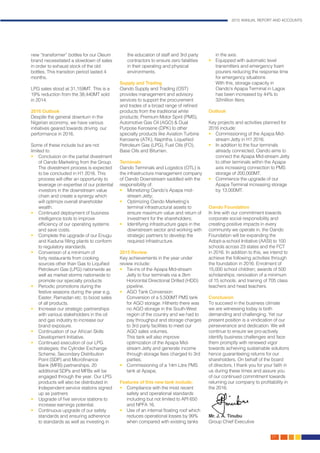
Corporate Governance
2015 ANNUAL REPORT AND ACCOUNTS
29.
2015 ANNUAL REPORT AND ACCOUNTS
30.
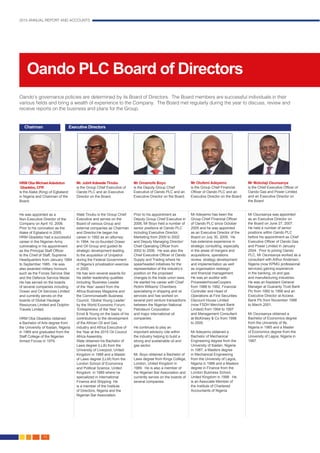
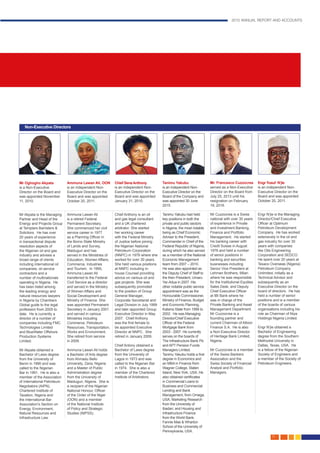
Oando PLC Board of Directors
Oando’s governance policies are determined by its Board of Directors. The Board members are successful individuals in their
various fields and bring a wealth of experience to the Company. The Board met regularly during the year to discuss, review and
receive reports on the business and plans for the Group.
HRM Oba Michael Adedotun
Gbadebo, CFR
is the Alake (King) of Egbaland
in Nigeria and Chairman of the
Board.
He was appointed as a
Non-Executive Director of the
Company on April 10, 2006.
Prior to his coronation as the
Alake of Egbaland in 2005,
HRM Gbadebo had a successful
career in the Nigerian Army
culminating in his appointment
as the Principal Staff Officer
to the Chief of Staff, Supreme
Headquarters from January 1984
to September 1985. He was
also awarded military honours
such as the Forces Service Star
and the Defence Service Medal.
He has served on the boards
of several companies including
Ocean and Oil Services Limited
and currently serves on the
boards of Global Haulage
Resources Limited and Dolphin
Travels Limited.
HRM Oba Gbadebo obtained
a Bachelor of Arts degree from
the University of Ibadan, Nigeria
in 1969 and graduated from the
Staff College of the Nigerian
Armed Forces in 1979.
Mr. Jubril Adewale Tinubu
is the Group Chief Executive of
Oando PLC and an Executive
Director on the Board.
Wale Tinubu is the Group Chief
Executive and serves on the
Board of various Group and
external companies as Chairman
and Director.He began his
career in 1992 as an attorney.
In 1994, he co-founded Ocean
and Oil Group and guided its
strategic development leading
to the acquisition of Unipetrol
during the Federal Government
of Nigeria’s privatisation exercise
in 2000.
He has won several awards for
his steller leadership qualities
including ‘Business Leader
of the Year’ award from the
Africa Business Magazine and
the Commonwealth Business
Council; ‘Global Young Leader’
by the World Economic Forum;
‘Entrepreneur of the Year’ by
Ernst & Young on the basis of his
contributions to the development
of the African Oil and Gas
industry and Africa Executive of
the Year at the 2015 Oil Council
Africa Assembly.
Wale obtained his Bachelor of
Laws degree (LLB) from the
University of Liverpool, United
Kingdom in 1988 and a Master
of Laws degree (LLM) from the
London School of Economics
and Political Science, United
Kingdom in 1989 where he
specialized in International
Finance and Shipping. He
is a member of the Institute
of Directors, Nigeria and the
Nigerian Bar Association.
Mr Omamofe Boyo
is the Deputy Group Chief
Executive of Oando PLC and an
Executive Director on the Board.
Prior to his appointment as
Deputy Group Chief Executive in
2006, Mr Boyo held a number of
senior positions at Oando PLC
including Executive Director,
Marketing from 2000 to 2002
and Deputy Managing Director/
Chief Operating Officer from
2002 to 2006. He was also the
Chief Executive Officer of Oando
Supply and Trading where he
spearheaded initiatives for the
representation of the industry’s
position on the proposed
changes to the trade union laws.
He started his career with Chief
Rotimi Williams’ Chambers
specialising in shipping and oil
services and has worked on
several joint venture transactions
between the Nigerian National
Petroleum Corporation
and major international oil
companies.
He continues to play an
important advisory role within
the industry helping to build a
strong and sustainable oil and
gas sector.
Mr. Boyo obtained a Bachelor of
Laws degree from Kings College,
London, United Kingdom in
1989. He is also a member of
the Nigerian Bar Association and
currently serves on the boards of
several companies.
Mr Olufemi Adeyemo
is the Group Chief Financial
Officer of Oando PLC and an
Executive Director on the Board.
Mr Adeyemo has been the
Group Chief Financial Officer
of Oando PLC since October
2005 and he was appointed
as an Executive Director of the
Board on July 30, 2009. He
has extensive experience in
strategic consulting, especially
in the areas of mergers and
acquisitions, operations
review, strategy development
and implementation as well
as organisation redesign
and financial management.
He was an auditor with
PricewaterhouseCoopers
from 1988 to 1992, Financial
Controller and Head of
Operations at First Securities
Discount House Limited
(now FSDH Merchant Bank
Limited) from 1994 to 1997
and Management Consultant
at McKinsey & Co from 1998
to 2005.
Mr Adeyemo obtained a
Bachelor of Mechanical
Engineering degree from the
University of Ibadan, Nigeria
in 1987, a Masters degree
in Mechanical Engineering
from the University of Lagos,
Nigeria in 1988 and a Masters
degree in Finance from the
London Business School,
United Kingdom in 1998. He
is an Associate Member of
the Institute of Chartered
Accountants of Nigeria.
Mr Mobolaji Osunsanya
is the Chief Executive Officer of
Oando Gas and Power Limited
and an Executive Director on
the Board.
Mr Osunsanya was appointed
as an Executive Director on
the Board on June 27, 2007.
He held a number of senior
positions within Oando PLC
before his appointment as Chief
Executive Officer of Oando Gas
and Power Limited in January
2004. Prior to joining Oando
PLC, Mr Osunsanya worked as a
consultant with Arthur Andersen,
Nigeria (now KPMG professional
services) gaining experience
in the banking, oil and gas
and manufacturing industries.
He was an Assistant General
Manager at Guaranty Trust Bank
Plc from 1992 to 1998 and an
Executive Director at Access
Bank Plc from November 1998
to March 2001.
Mr Osunsanya obtained a
Bachelor of Economics degree
from the University of Ife,
Nigeria in 1985 and a Master
of Economics degree from the
University of Lagos, Nigeria in
1987.
Chairman Executive Directors
2015 ANNUAL REPORT AND ACCOUNTS
31.
Mr Oghogho Akpata
is a Non-Executive
Director on the Board and
was appointed November
11, 2010.
Mr Akpata is the Managing
Partner and Head of the
Energy and Projects Group
at Templars Barristers &
Solicitors. He has over
20 years of experience
in transactional dispute
resolution aspects of
the Nigerian oil and gas
industry and advises a
broad range of clients
including international oil
companies, oil service
contractors and a
number of multinationals
operating in Nigeria. He
has been listed among
the leading energy and
natural resources lawyers
in Nigeria by Chambers
Global guide to the legal
profession from 2005 to
date. He is currently a
director of a number of
companies including FMC
Technologies Limited
and BlueWater Offshore
Production Systems
Limited.
Mr Akpata obtained a
Bachelor of Laws degree
from the University of
Benin in 1990 and was
called to the Nigerian
Bar in 1991. He is also a
member of the Association
of International Petroleum
Negotiators (AIPN),
Chartered Institute of
Taxation, Nigeria and
the International Bar
Association’s Section on
Energy, Environment,
Natural Resources and
Infrastructure Law.
Ammuna Lawan Ali, OON
is an independent Non-
Executive Director on the
Board and was appointed
October 20, 2011.
Ammuna Lawan Ali
is a retired Federal
Permanent Secretary.
She commenced her civil
service career in 1977
as a Planning Officer in
the Borno State Ministry
of Lands and Survey,
Maiduguri and has
served in the Ministries of
Education, Women Affairs,
Commerce, Industries
and Tourism. In 1995,
Ammuna Lawan Ali
transferred to the Federal
Civil Service as a director
and served in the Ministry
of Women Affairs and
Social Development and
Ministry of Finance. She
was appointed Permanent
Secretary in January 2001
and served in various
Ministries including
Commerce, Petroleum
Resources, Transportation,
Works and Environment.
She retired from service
in 2009.
Ammuna Lawan Ali holds
a Bachelor of Arts degree
from Ahmadu Bello
University, Zaria, Nigeria
and a Master of Public
Administration degree
from the University of
Maiduguri, Nigeria. She is
a recipient of the Nigerian
National Honour, Officer
of the Order of the Niger
(OON) and a member
of the National Institute
of Policy and Strategic
Studies (NIPSS).
Chief Sena Anthony	
is an independent Non-
Executive Director on the
Board and was appointed
January 31, 2010.
Chief Anthony is an oil
and gas legal consultant
and a UK chartered
arbitrator. She started
her working career
with the Federal Ministry
of Justice before joining
the Nigerian National
Petroleum Corporation
(NNPC) in 1978 where she
worked for over 30 years.
She held various positions
at NNPC including in-
house Counsel providing
advice on various oil and
gas projects. She was
subsequently promoted
to the position of Group
General Manager,
Corporate Secretariat and
Legal Division in July 1999
and later appointed Group
Executive Director in May
2007. Chief Anthony
was the first female to
be appointed Executive
Director at NNPC. She
retired in January 2009.
Chief Antony obtained a
Bachelor of Laws degree
from the University of
Lagos in 1973 and was
called to the Nigerian Bar
in 1974. She is also a
member of the Chartered
Institute of Arbitrators.
Tanimu Yakubu	
is an independent Non-
Executive Director on the
Board of the Company and
was appointed 30 June
2015.
Tanimu Yakubu had held
key positions in both the
private and public sectors
in Nigeria, the most notable
being as Chief Economic
Adviser to the President,
Commander in Chief of the
Federal Republic of Nigeria,
during which he also served
as a member of the National
Economic Management
team from 2007 – 2010.
He was also appointed as
the Deputy Chief of Staff to
the then President, Umaru
Yar-Adua in 2007. His
other notable public service
appointment was as the
Honourable Commissioner,
Ministry of Finance, Budget
and Economic Planning,
Katsina State from 1999 to
2002. He was Managing
Director/Chief Executive
Officer of the Federal
Mortgage Bank from
2003 - 2007. He currently
serves on the boards of
The Infrastructure Bank Plc
and APT Pension Funds
Managers Limited.
Tanimu Yakubu holds a first
degree in Economics and
an MBA in Finance from
Wagner College, Staten
Island, New York, USA. He
also obtained certificates
in Commercial Loans to
Business and Commercial
Lending and Bank
Management, from Omega,
USA; Marketing Research
from the University of
Ibadan; and Housing and
Infrastructure Finance
from the World Bank,
Fannie Mae & Wharton
School of the University of
Pennsylvania, USA.
Mr. Francesco Cuzzocrea
served as a Non-Executive
Director on the Board from
July 25, 2013 until his
resignation on February
19, 2016.
Mr Cuzzocrea is a Swiss
national with over 30 years
of experience in Private
and Investment Banking,
Finance and Portfolio
Management. He started
his banking career with
Credit Suisse in August
1976 and held a number
of senior positions in
banking and securities
businesses including
Senior Vice President at
Lehman Brothers, Milan
where he was responsible
for the Institutional Equities
Sales Desk, and Deputy
Chief Executive Officer
at IBI Bank where he
was in charge of the
Private Banking and Asset
Management Department.
Mr Cuzzocrea is a
founding partner and
current Chairman of Albion
Finance S.A. He is also
a Non-Executive Director
of Heritage Bank Limited,
Nigeria.
Mr Cuzzocrea is a member
of the Swiss Bankers
Association and the
Swiss Society of Financial
Analyst and Portfolio
Managers.
	
Engr Yusuf N’jie
is an independent Non-
Executive Director on the
Board and was appointed
October 20, 2011.
Engr N’jie is the Managing
Director/Chief Executive
Officer at Optimum
Petroleum Development
Company. He has worked
extensively in the oil and
gas industry for over 30
years with companies
like Otis Engineering
Corporation and SEDCO.
He spent over 20 years at
Texaco Overseas (Nigeria)
Petroleum Company
Unlimited, initially as a
Technical Advisor and
subsequently as an
Executive Director on the
board of directors. He has
held a number of senior
positions and is a member
of the boards of various
organisations including his
role as Chairman of Niya
Holdings Nigeria Limited.
Engr N’jie obtained a
Bachelor of Engineering
degree from the Southern
Methodist University in
Dallas, Texas, USA. He
is a fellow of the Nigerian
Society of Engineers and
a member of the Society of
Petroleum Engineers.
Non-Executive Directors
2015 ANNUAL REPORT AND ACCOUNTS
32.
The Company commenced
operations in 1956 as a petroleum-
marketing company in Nigeria
under the name ESSO West
Africa Inc., a subsidiary of Exxon
Corporation (“Exxon”), and was
incorporated under Nigerian Law
as Esso Standard Nigeria Limited
(“Esso”) in 1969. In 1976, the
Federal Government acquired
Exxon’s interest in Esso; Esso
was nationalised and rebranded
as Unipetrol Nigeria Limited
(“Unipetrol”).
A process of privatisation began in
1991 when the Federal Government
divested 60% of its shareholding in
Unipetrol to the public. Unipetrol’s
shares were listed on the Nigerian
Stock Exchange (the “NSE”) in
February 1992, quoted as Unipetrol
Nigeria PLC.
Under the second phase of the
privatisation process, the Federal
Government sold its remaining
shareholding in Unipetrol. In 2000
Ocean and Oil Investments (Nigeria)
Limited, the Company’s major
shareholder (“OOIN”), acquired
30% in Unipetrol from the Federal
Government. The residual 10% stake
held by the Federal Government was
sold to the public in 2001.
In August 2002, Unipetrol acquired
a 60% stake in Agip Nigeria
Plc (“Agip”) from Agip Petroli
International. The remaining 40%
of the shares in Agip was acquired
by Unipetrol by way of a share swap
under a scheme of merger. The
combined entity that resulted from
the merger of Unipetrol and Agip
was rebranded as Oando PLC in
December 2003.
In 1999, Unipetrol acquired a
40% stake in Gaslink Nigeria
Limited (“Gaslink”); this stake was
subsequently increased to 51% in
2001. The Company’s Gas and
Power division emerged as a result
of the consolidation of Gaslink’s
gas distribution franchise and the
Company’s customer base in 2004.
On 25 November 2005, the Company
was listed on the main market of the
Johannesburg Stock Exchange (the
“JSE”) and thereby became the first
African company to achieve a cross
border inward listing.
In June 2007, the Company entered
into a scheme of arrangement (the
“Scheme”) with certain minority
shareholders of Gaslink and with
OOIN. Under the Scheme, the
minority shareholders of Gaslink
transferred their equity holdings
in Gaslink to the Company in
consideration for ordinary shares
in the Company. In addition, OOIN
transferred its interests in Oando
Supply and Trading Limited, Oando
Trading (Bermuda) Limited, Oando
Production and Development
Company Limited, Oando Energy
Services Limited and Oando
Exploration and Production Limited
to the Company in consideration for
ordinary shares in the Company.
On July 24, 2012, the Company
acquired a 94.6% stake in Exile
Resources Inc., (“Exile”), a Canadian
public company whose shares were
listed on the Toronto Stock Exchange
venture list (“TSX V”), through a
reverse takeover (“RTO”) which
saw the transfer of the upstream
exploration and production division of
the Company to Exile, later renamed
Oando Energy Resources (“OER”).
OER then sought for an obtained
a full listing on the Toronto Stock
Exchange (“TSX”). The Company
became the first Nigerian company
Report of the Directors
A majority of the
directors on the Board
are non-executive
directors of which
four are independent;
with no material
relationship with the
Company except as
directors. The positions
of the Chairman
and Group Chief
Executive are vested
in different individuals
in accordance with
governance best
practice.
2015 ANNUAL REPORT AND ACCOUNTS
33.
to have three trans-border listings –
the NSE, JSE and TSX.
Business Review
The Company is required by CAMA
to set out in the Annual Report a fair
review of the business of the Group
during the financial year ended
December 31, 2015, the position
of the Group at the end of the year
and a description of the principal
risks and uncertainties facing the
Group (the “Business Review”).
The information that fulfils these
requirements can be found within the
Chairman’s Report and the Group
Chief Executive’s Report.
DIRECTORS
The Board
The names of Directors who held
office during the year and at the date
of this report are as follows:
Non-Executive Directors
1.	 HRM Oba Michael Adedotun
Gbadebo, CFR
2.	 Mr Oghogho Akpata
3.	 Ammuna Lawan Ali, OON
(Independent)
4.	 Chief Sena Anthony
(Independent)
5.	 Tanimu Yakubu (Independent)
6.	 Ms Nana Afoah Appiah-Korang
	 (Resigned June 30, 2015)
7.	 Mr Francesco Cuzzocrea
(Resigned February 19, 2016)
8.	 Engr Yusuf N’jie (Independent)
Executive Directors
10.	Mr Jubril Adewale Tinubu
11.	Mr Omamofe Boyo
12.	Mr Olufemi Adeyemo
13.	Mr Mobolaji Osunsanya
Board Composition and
Independence
The Board is made up of a group
of seasoned individuals from
diverse academic and professional
backgrounds. The Board size is in
line with the prescriptions of Article
78 of the Company’s Articles of
Association which provides that the
number of directors shall not be less
than 10 or more than 15.
A majority of the directors on the
Board are non-executive directors
of which four are independent;
with no material relationship with
the Company except as directors.
The positions of the Chairman and
Group Chief Executive are vested in
different individuals in accordance
with governance best practice.
Re-election of Directors
Annually, a maximum of one third
of the Directors, who are longest in
office since their last appointment
or election, are required to retire
by rotation and, if eligible, offer
themselves for re-election. The
Board has the power to appoint a
new director and any director so
appointed is subject to shareholder
election at the next Annual General
Meeting (“AGM”).
In accordance with Section 259(1)
and (2) of CAMA and Articles 91-
93 of the Company’s Articles of
Association, the following Directors,
who are longest in office since
their last election are retiring by
rotation and present themselves for
re-election at the Company’s 2016
AGM:
•	 HRM M.A. Gbadebo, CFR
•	 Chief Sena Anthony
•	 Mr. Mobolaji Osunsanya
Resignation of Director
Mr. Francesco Cuzzocrea resigned
from the Board with effect from
February 19, 2016 to pursue other
personal interests. While serving on
the Board, Mr Francesco Cuzzocrea
was an active member of the
Board and its sub-committees and
contributed to the improvement
of Oando’s governance and risk
management practices in keeping
with global best practice standards.
His valuable contributions to the
growth of the Company are greatly
appreciated.
Appointment of New Directors
In accordance with Article 88 of the
Company’s articles of association,
the board of directors appointed
Mr Ikeme (Ike) Osakwe MA (Oxon.)
ACA and Mr. Ademola Akinrele SAN
as non-executive directors to the
Board of the company effective July
8 2016. The directors are proposing
Mr Ike Osakwe and Mr Ademola
Akinrele for election as directors.
Summary profiles for each of the new
directors are stated below.
Mr Ike Osakwe MA (Oxon.) ACA
Ike Osakwe is a Chartered
Accountant and practising
Management Consultant. He holds
bachelors’ and masters’ degrees
in Chemistry from the University of
Oxford, and is an associate Member
of the Institutes of Chartered
Accountants both for Nigeria, and
for England and Wales. Initially
trained for four years at KPMG
Audit in London, Ike now serves
as the Managing Director of GRID
Consulting Ltd. - a company that
he established in 1986 and which
specializes in financial management
advisory for commerce, industry,
governments and NGOs.
Ike Osakwe has over 35 years’
experience in financial, strategic
and corporate planning, as well
as organisational and financial
management systems development,
both in Nigeria and internationally.
He has brought his vast experience
in the dynamics of most major
industrial sectors to bear in his work
on corporate governance.
He has held several government and
board appointments and currently
serves on the boards of Leadway
Pensure PFA and Notore Chemical
Industries. He previously served
on the boards of Oando Plc. and
Red Star Express Nigeria Ltd; and
chaired the boards of Thomas Wyatt
Nig. Plc. and UBA Trustees Ltd.
Ademola Akinrele SAN
Mr. Ademola Akinrele is the
Managing Partner, F. O. Akinrele
& Co., born Ondo State, 3rd
June, 1961; Education: University
College, London LL.B (Hons.) 1982;
University of Cambridge, LL.M. 1984;
Admitted to the Nigerian Bar 1983;
Associate of Chief Rotimi Williams
Chambers 1984 - 1987. Co-Editor,
Nigerian Legal Practitioners Review;
Former Country Correspondent,
Euromoney International Financial
Practice Law Files 1990; Recipient of
Award of Fifteen Legal Practitioners
of Distinction in Nigeria by body of
2015 ANNUAL REPORT AND ACCOUNTS
34.
Nigerian Universities and Law School
Students 1990. Editorial Board -
Nigerian Legal Digest 1993.Former
Secretary Oxford and Cambridge
club of Nigeria 1997. Married in 1998
with two daughters. Elevated to the
rank of Senior Advocate of Nigeria
-1999, Fellow Chartered Institute of
Arbitrators-1999 Director Pier Pier
Properties Limited 1999. Director
Oando Plc-2000 Director Agip Plc
2001. Commodore Lagos Motor Boat
Club 2002. Director Danos & Curole
Marine contractors 2005.
Ademola Akinrele is a commercial
advocate who traverses all
aspects of Commercial Law and
represents a variety of national and
multinational entities before Nigerian
Courts and international arbitral
tribunals. He was described in the
Chamber Global 2008 directory for
international lawyers as follows:
The “cerebral and focused” Demola
Akinrele is a Senior Advocate of
Nigeria (SAN) with vast experience
in litigation law. A “forceful and
persuasive” advocate, he has
built up a reputation in aviation
and maritime-related matters. One
client enthused: “One of his most
striking skills is his ability to combine
his knowledge of the law with his
extensive experience.”

Board Appointment Process
To ensure the highest standards of
corporate governance, the Company
has in place a Board Appointment
Process to guide the appointment
of its directors (executive and non-
executive). The policy is in line with
applicable corporate laws, rules,
regulations, Codes of Corporate
Governance, international best
practice and the Company’s Articles
of Association.
The Governance and Nominations
Committee has the overall
responsibility for the appointment
process subject to approval by
the full Board and ultimately by the
shareholders of the Company in
General Meeting. The fundamental
principles of the process include:
evaluation of the balance of skills,
knowledge and experience on
the Board, leadership needs of
the Company and ability of the
candidate to fulfil his/her duties and
obligations as a Director.
Training and Access to Advisers
The Company has a mandatory
induction programme for new
directors on the Company’s business
and other information that will assist
them in discharging their duties
effectively. The Company believes
in and provides continuous training
and professional education to its
Directors. The Board of Directors
and Board Committees have the
ability to retain external counsel to
advice them on matters, as they
deem necessary.
A group-wide training for directors
on strategic risk management,
investment analysis and transfer
pricing was held on the 23rd of April
2015 and was well attended.
Board Authority
A range of decisions are specifically
reserved for the Board to ensure it
retains proper direction and control
of the Oando Group. These are
listed in the Schedule of Matters
Reserved for the Board. The Board
is authorised to delegate some of
these functions to Executive Direc-
tors who are responsible for the day
to day management of the business
or to Committees of the Board. The
Delegation of Authority Framework
highlights all corporate actions that
can be taken by Executive Direc-
tors and various Committees of the
Board.
The Schedule of Matters Reserved
for the Board includes (but is not
limited to) the following:
•	 Strategy and objectives
•	 Business plans and budgets
•	 Changes in capital and corporate
structure
•	 Accounting policies and financial
reporting
•	 Internal controls
•	 Major contracts
•	 Capital projects
•	 Acquisitions and disposals
•	 Communications with sharehold-
ers and
•	 Board membership
The day-to-day operational
management of the Group’s activities
and operations is delegated to
the Group Chief Executive (GCE),
who has direct responsibility. He is
supported in this role by the Deputy
Group Chief Executive (DGCE) and
the Group Leadership Council which
comprises, in addition to the GCE
and DGCE, the Chief Executive
Officers of operating subsidiaries,
the Chief Financial Officer, Chief
Human Resources Officer, Chief
Compliance Officer and Company
Secretary, Chief Legal Officer, Chief
Strategy Officer, Chief Environment,
Health, Safety, Security and Quality
Officer and the Chief Information and
Corporate Services Officer.
Board Duties and Responsibilities
The Directors act in good faith,
with due care and in the best
interests of the Company and all
its stakeholders. Each Director is
expected to attend and actively
participate in Board meetings.
The Company does not prohibit
its Directors from serving on other
boards. However, Directors should
ensure that other commitments
do not conflict with the interests
of the Company or interfere with
the discharge of their duties to the
Company and shall ensure that they
do not divulge or misuse confidential
or inside information gained by virtue
of their position in the Company.
The Board adopts the following best
practice principles in the discharge
of its duties:
•	 The Company believes that the
Chairman of the Board should be
a Non-Executive Director;
•	 To maintain an appropriate
balance of interest and ensure
transparency and impartiality,
a number of the Directors are
independent. The independent
directors are those who have
no material relationship with
the Company beyond their
directorship;
•	 Directors are to abstain from
actions that may lead to “conflict
of interest” situations; and shall
comply fully with the Company’s
Related Party Transaction
Policies and Insider Trading
Policy.
2015 ANNUAL REPORT AND ACCOUNTS
35.
Remuneration
The remuneration of Non-Executive
Directors is competitive and
comprises of an annual fee and a
meeting attendance allowance. The
Board, through its Remuneration
Committee, periodically reviews
the remuneration package for
Directors which is structured in a
manner that seeks to ensure that the
independence of the Director is not
compromised.
The Company does not provide
personal loans or credits to its Non-
Executive Directors and publicly
discloses the remuneration of each
Director on an annual basis. In
addition, the Company does not
provide stock options to its Non-
Executive Directors unless approved
by shareholders at a general
meeting.
The Chief Compliance Officer and
Company Secretary is available
to advise individual Directors on
corporate governance matters.
Working Procedures
The Board meet at least once every
quarter. Additional meetings are
scheduled whenever matters arise
which require the attention of the
Board.
Prior to meetings, the Governance
office circulates the agenda for the
meeting along with all documents
the Directors would be required to
deliberate upon. This enables the
Directors to contribute effectively at
Board meetings.
The Board, through the Chief
Compliance Officer and Company
Secretary, keeps detailed minutes of
its meetings that adequately reflect
Board discussions.
Committee Membership during the year ended December 2015
Director Audit Governance and
Nominations
Risk, Environmental,
Health, Safety, Security
and Quality
Strategic Planning and
Finance
HRM M.A. Gbadebo, CFR - - - -
J. A. Tinubu - - - -
O. Boyo - - - -
O. Adeyemo - - - -
M. Osunsanya - - - -
O. Akpata - √ √ -
A. Lawan Ali, OON √ √ - -
S. Anthony √ √ - -
Nana Appiah Korang - - √ √
Tanimu Yakubu - - √ √
F. Cuzzocrea √ - - √
Yusuf N’jie - - √ √
Attendance at meetings during the year ended 31 December 2015
Names Board Audit Governance and
Nominations
Risk, Environmental,
Health, Safety, Security
and Quality
Strategic Planning and
Finance
Executive Directors
J. A. Tinubu 6/6 - - - -
O. Boyo 6/6 - - - -
O. Adeyemo 6/6 - - - -
M. Osunsanya 6/6 - - - -
Non-Executive Directors
HRM M.A. Gbadebo, CFR 6/6 - - - -
O. Akpata 6/6 - 1/1 1/1 1/1
A. Lawan Ali, OON 6/6 5/5 1/1 - 1/1
S. Anthony 6/6 5/5 1/1 - 1/1
Tanimu Yakubu 6/6 - 1/1 1/1 1/1
F. Cuzzocrea* 6/6 5/5 - - 1/1
Yusuf N’jie 6/6 - - 1/1 1/1
Nana Appiah Korang 3/3 - - 1/1 -
2015 ANNUAL REPORT AND ACCOUNTS
36.
Shareholder Members of the Audit Committee
L.A Shonubi - 5/5 - - -
T.O.Durojaiye - 5/5 - - -
J. Asaolu* - 1/5 - - -
* Elected as a shareholder’s representative of the Audit Committee at the 38th AGM held on the 7th December 2015
Dates of Board/Committee
meetings held in 2015
Board Meetings:
•	 March 2, 2015
•	 June 17, 2015
•	 October 6, 2015
•	 October 23, 2015
•	 October 26, 2015
•	 December 18, 2015
Audit Committee:
•	 March 18, 2015
•	 October 23 2015
•	 October 26 2015
•	 November 18, 2015
•	 December 17, 2015
Governance and Nominations
Committee:
•	 March 18, 2015
Risk, EHSSQ Committee:
•	 March 17, 2015
Strategic Planning & Finance
Committee:
•	 December 17 and 18, 2015
Board Committees
Under the Company’s Articles of As-
sociation, the Directors may appoint
Committees consisting of members of
the Board and such other persons as
they may think fit and may delegate
any of their powers to such Commit-
tees. The Committees are required to
use their delegated powers in con-
formity with the regulations laid down
by the Board.
Committee members are expected
to attend each Committee meeting,
unless exceptional circumstances
prevent them from doing so. All the
Committees have terms of reference
which guide the members in the exe-
cution of their duties.
All Committees report to the Board
of Directors and provide recom-
mendations to the Board on matters
reserved for Board authorisation. The
following Committees are currently
operating at Board level:
•	 Audit Committee
•	 Governance and Nominations
Committee
•	 Risk, Environmental, Health, Safe-
ty, Security and Quality Committee
•	 Strategic Planning and Finance
Committee
BOARD OF DIRECTORS
AUDIT COMMITTEE
GOVERNANCE AND
NOMINATIONS COMMITTEE
STRATEGIC PLANNING AND
FINANCE COMMITTEE
RISK, ENVIRONMENTAL,
HEALTH, SAFETY, SECURITY
AND QUALITY COMMITTEE
The Company’s Board Committee structure is as follows:
2015 ANNUAL REPORT AND ACCOUNTS
37.
Audit Committee (Statutory
Committee with shareholder
members)
The Audit Committee was established
in compliance with Sections 359(3)
and (4) of CAMA, which requires
every public company to have an
audit committee made up of not more
than six members and which consist
of an equal number of directors and
representatives of the shareholders of
the Company.
The Audit Committee is made up of
six members, three Non-Executive Di-
rectors and three shareholders of the
Company, who are elected each year
at the Annual General Meeting.
The Audit Committee members meet
at least three times a year, and the
meetings are attended by appropriate
executives of the Company, including
the Group Chief Financial Officer, the
Head of Internal Control and Audit
and the Head, Risk Management and
Control. In the financial year ended
December 31, 2015, the Audit Com-
mittee held five meetings.
The Audit Committee’s duties include
keeping under review the scope and
results of the external audit, as well
as the independence and objectivity
of the auditors. The Committee also
keeps under review internal finan-
cial controls, compliance with laws
and regulations, processes for the
safeguarding of Company assets and
the adequacy of the internal audit unit
plans and audit reports.
The members of the 2015 Audit
Committee are:
Ammuna Lawan Ali, OON
Chairperson	
Chief Sena Anthony	
Non-Executive Director
Mr. Francesco Cuzzocrea
Non-Executive Director
Mr Joseph Asaolu.
Shareholder Member
Mr. Lateef Ayodeji Shonubi	
Shareholder Member
Mrs. Temilade.O. Durojaiye
Shareholder Member
Curriculum Vitae of shareholder members of the Audit Committee
Mr. Joseph Asaolu
Shareholder Member
Mr. Joseph Asaolu is a chartered
accountant with close to 40 years
professional experience. He retired
in March 2013 as the Managing
Partner of Balogun Badejo & Co.
(now BBC Professionals), a reputable
firm of Chartered Accountants. He
is currently the Managing Partner
of JOA Professional Services
(Chartered Accountants).
He is a Fellow of the Institute of
Chartered Accountants of Nigeria
(FCA), Fellow of the Chartered
Institute of Taxation of Nigeria
(FCTI) and Associate Member of the
Nigerian Institute of Management
(NIM).
Mr Lateef Ayodeji Shonubi
Shareholder Member
Mr Lateef Ayodeji Shonubi is a
Chartered Accountant. A graduate
of the University of Strathclyde,
Glasgow, Scotland, he is skilled
in accounting, taxation and
investigation. He has 41 years’
experience in audit and accounting
services. He is presently the
Principal Partner at Ayo Shonubi
& Co and a member of the Audit
Committee of Flourmills Plc. He has
been a member of audit committees
in various public companies
including a previous role as the
Chairman of the Audit Committee of
Guinness Nigeria Plc. He has served
as a member of the Professional
Examination Committee of the
Institute of Chartered Accountants
of Nigeria (ICAN) as well as the
Finance and General Committee
of ICAN. He also served as the
Vice-Chairman of the Membership
Committee of the Chartered Institute
of Taxation of Nigeria.
Mrs Temilade Funmilayo Durojaiye
Shareholder Member
Mrs. Durojaiye is a fellow of the
Institute of Chartered Accountants
of Nigeria and an Associate Member
of the Chartered Institute of Taxation
of Nigeria. She graduated from
Yaba College of Technology in 1989
with a Higher National Diploma
in Accountancy. She started her
working career at the Nigerian Postal
Services as an internal auditor in
1990. She also worked in Open Gate
Finance Company and United Bank
for Africa Plc for 12 years where she
resigned in 2006 as the Head of the
Fixed Asset Management unit in the
Financial Control division to pursue
other interests.
For the curriculum vitae of the Board
of Directors, including the Non-
Executive Director members of the
Audit Committee please see pages
30 and 31.
Governance and Nominations
Committee
The Governance and Nominations
Committee is responsible for
compliance with and periodic review of
the Company’s corporate governance
policies and practices, the review
and monitoring of policies concerning
shareholder rights, conflict resolution,
ethics, disclosure and transparency,
evaluation and review of the Company’s
internal documents (organisation and
process), the review and setting of the
by laws of all Board Committees, and
ensuring that the Company’s policies,
including the remuneration policy,
support the successful identification,
recruitment, development and retention
of directors, senior executives and
managers.
The members of the 2015 Governance
and Nominations Committee are:
Chief Sena Anthony
Chairperson
2015 ANNUAL REPORT AND ACCOUNTS
38.
Mr. Oghogho Akpata
Non-Executive Director
Ammuna Lawan Ali, OON
Non-Executive Director
Risk, Environmental, Health, Safety,
Security and Quality Committee
The Risk, Environmental, Health, Security
and Safety Committee (REHSSQ) is
responsible for reviewing the policies and
processes established by management
which are designed to implement the
risk, environmental, health and safety
quality policy of the Company and
ensuring the Company’s compliance
with international standards of risk,
environmental, health and safety quality.
The members of the 2015 Risk,
Environmental, Health, Safety, Security
and Quality Committee are:
Tanimu Yakubu
Chairman
Mr. Oghogho Akpata
Non-Executive Director
Engr. Yusuf N’jie
Non-Executive Director
Nana Appiah Korang
Non-Executive Director
(Resigned June 30, 2015)
Strategic Planning and Finance
Committee
The Strategic Planning and Finance
Committee is responsible for defining
the Company’s strategic objectives,
determining its financial and operational
priorities, making recommendations to
the Board regarding the Company’s
dividend policy and evaluating the
long-term productivity of the Company’s
operations. The Committee was
established to assist the Board in
performing its guidance and oversight
functions efficiently and effectively. In
December 2015 the Committee held
a two-day strategy session that was
attended by all Non-Executive Directors.
The members of the 2015 Strategic
Planning and Finance Committee are:
Mr. Francesco Cuzzocrea
Chairman
Tanimu Yakubu
Non-Executive Director
Engr. Yusuf N’jie
Non-Executive Director
Nana Appiah Korang
Non-Executive Director
(Resigned June 30, 2015)
Directors’declarations
None of the directors have:
•	 ever been convicted of an offence
resulting from dishonesty, fraud or
embezzlement
•	 ever been declared bankrupt or
sequestrated in any jurisdiction
•	 at any time been a party to a scheme
of arrangement or made any other
form of compromise with their
creditors
•	 ever been found guilty in disciplinary
proceedings by an employer or
regulatory body, due to dishonest
activities
•	 ever been involved in any
receiverships, compulsory
liquidations or creditors voluntary
liquidations
•	 ever been barred from entry into a
profession or occupation
•	 ever been convicted in any
jurisdiction of any criminal offence
or an offence under any Nigerian or
South African legislation.
Directors’shareholdings
The holdings of ordinary shares by the Directors of Oando as at December 31, 2015 being the end of Oando’s immediately
preceding financial year, are set out in the table below:
Directors’shareholdings
The holdings of ordinary shares by the Directors of Oando as at December 31, 2015 being the end of Oando’s immediately
preceding financial year, are set out in the table below:
Director Direct Indirect
HRM M.A. Gbadebo, CFR 437,500 Nil
J. A. Tinubu*^ Nil 3,670,995
O. Boyo*^ Nil 2,354,713
O. Adeyemo 75,000 1,723,898
M. Osunsanya 269,988 1,890,398
O. Akpata Nil Nil
A. Lawan Ali, OON Nil Nil
S. Anthony 299,133 Nil
Tanimu Yakubu Nil Nil
F. Cuzzocrea^ Nil Nil
Yusuf N’jie Nil Nil
Indirect shareholding in:
** Ocean and Oil Investments Limited (OOIL) owns 159,701,243 (1.76%) shares in Oando
Mr. Jubril Adewale Tinubu and Mr. Omamofe Boyo own 0.97% and 0.38% respectively in Oando PLC through OOIL
^Ocean and Oil Development Partners Limited (OODP) owns 6,734,943,086 shares in Oando (55.96%)
Mr. Jubril Adewale Tinubu and Mr. Omamofe Boyo own 20.99% and 12.75% respectively in Oando PLC through OODP
Mr. Francesco Cuzzocrea was a director of OODP until February 19, 2016
2015 ANNUAL REPORT AND ACCOUNTS
39.
Directors’interests in transactions
Some of the Directors hold
directorships in other companies
or are partners in firms with which
Oando had material transactions
during the current financial year, as
summarised on page 139 to 140.
Corporate Governance Structure and
Statement of Compliance
The Board of Directors of the
Company is responsible for
setting the strategic direction for
the Company and overseeing
its business affairs. The Board
develops and implements
sustainable policies which reflect
the Company’s responsibility to all
its stakeholders. The affairs of the
Board are conducted in conformity
with the requirements of relevant
corporate governance principles.
The Company is dedicated to
the protection and promotion of
shareholder interests. The Company
recognises the importance of the
adoption of superior management
principles, its valuable contribution to
sustainable business prosperity and
accountability to its shareholders.
The Company observes the
highest standards of transparency,
accountability and good corporate
governance in its operations by
complying with the requirements of
Nigerian and International corporate
governance regulations, particularly,
the Securities and Exchange
Commission’s Code of Corporate
Governance for Public Companies in
Nigeria 2011 and the King Report on
Corporate Governance (King III).
Oando’s Compliance Framework
Oando PLC’s Governance
office is responsible for setting
and implementing corporate
governance policies for the
Company and its subsidiaries.
The unit also measures the
Company’s level of compliance
and periodically review its policy
to ensure they continually align
with best practice.
The Company is committed
to the global fight against
corruption and actively
participates in this fight through
its membership and involvement
in collective action initiatives
with the following local and
international organisations.
1.	 Partnering Against Corruption
Initiative (“PACI”) of the World
Economic Forum
Oando joined PACI, a cross-
industry global initiative of the World
Economic Forum, in 2008 and
continues to be an active member.
PACI seeks to create a highly visible,
agenda-setting platform by working
with business leaders, international
organizations and governments to
address corruption, transparency
and emerging-market risks.
The PACI Principles for Countering
Corruption as revised in 2013
and launched at the 2014 World
Economic Forum Annual Meeting in
Davos seeks to expand the focus
beyond bribery and is intended to be
a guiding framework for businesses
ready to assume a leading role in
combating corruption in all its forms.
The core aspirational principles
reinforces the drive for transparency,
integrity and ethical conduct
amongst businesses.
2.	 United Nations Global
Compact (“UNGC”)
The UNGC is a strategic policy
initiative for businesses committed
to aligning their operations and
strategies with ten universally
accepted principles covering the
areas of human rights, labour,
environment and anti-corruption
and reporting publically on
progress made in implementing
these principles in their business
operations. Oando became a
signatory to the UNGC in July 2009
and the Chief Compliance Officer
and Company Secretary was
appointed co-chair of the UNGC
10th Principle Working Group on
the 9th of December 2013. Oando
has also been an active participant
in the Local Network of the Global
Compact in Nigeria as a member
of its Steering Group. In March of
2015, the Chief Compliance Officer
co-facilitated a 2-day training course
on corruption risk assessment for
government institutions in Abuja.
The course, which marked the final
phase of the Siemens Integrity
Project, a collective action initiative
against corruption in Nigeria was
well attended by officials in charge
of ethics, compliance, legal, internal
audit & risk management from
several Ministries, Departments and
Agencies in Nigeria.
Oando PLC is also a pioneer
member of the Global Compact
LEAD platform. The Company
continues to be a contributor to
several UNGC initiatives globally and
in Nigeria.
3.	 Convention on Business
Integrity (“CBi”)
Oando is a member of the Core
Group of signatories to the CBi
and became its 21st member
on November 16, 2009. CBi is a
declaration for the maintenance
of ethical conduct, competence,
transparency and accountability
by private sector operators. It was
established to empower business
transactions within Nigeria against
corruption and corrupt practices.
In 2014, CBi in partnership with
the Nigerian Stock Exchange
(NSE) developed a Corporate
Governance Rating System (CGRS)
for companies listed on the NSE. The
CGRS is designed to rate companies
listed on the NSE based on their
corporate governance and anti-
corruption culture thereby improving
the overall perception of and trust
in Nigeria’s capital markets and
business practices. Oando was
one of the eight companies who
successfully participated in the pilot
scheme and received a rating well
above the pass mark of 70%.
4.	 Clean Business Practice
Initiative (“CBPI”)
Oando is a member of the CBPI, a
multi-industry private sector driven
anti-corruption organization, with
a clear mandate to encourage
businesses operating in Nigeria
to adopt sustainable principles of
accountability and transparency to
counter corruption, whilst serving
as a channel of communication
between the private sector and
the Federal Government on anti-
corruption matters.
2015 ANNUAL REPORT AND ACCOUNTS
40.
Corporate Code of Business Conduct
and Ethics
Oando, together with its subsidiaries,
maintains a Corporate Code of
Business Conduct and Ethics (the
“Code”), applicable to all Directors,
Managers, Employees and those
who work for or on behalf of Oando.
The Code sets out the Company’s
core values of Teamwork, Respect,
Integrity, Professionalism and
Passion and minimum standards
of ethical behaviour expected of all
persons involved in the conduct of
the Company’s business.
Oando’s Internal Policies and
Processes Governing Ethics and
Compliance
In order to provide guidance on
Corporate Governance issues, the
Company has implemented internal
policies and practices which are
reviewed periodically and revised
as appropriate to ensure continued
relevance. The Governance Office
supports the business units and
entities in implementing policies
and monitoring compliance. The
following policies and practices have
been developed, approved and
implemented:
•	 Anti-Corruption Policy
•	 Blacklisting Policy
•	 Board Appointment Process
•	 Corporate Code of Business
Conduct and Ethics
•	 Delegation of Authority
•	 Dividend Policy
•	 Environmental, Health, Safety and
Security Policy
•	 Gift and Benefits Policy
•	 Information Disclosure Policy
•	 Insider Trading Policy
•	 Know Your Customer Policy
•	 Matters Reserved for the Board
•	 Records Management Policy
•	 Related Party Transactions
Policies
•	 Remuneration Policy
•	 Staff Handbook
•	 Whistle Blowing Policy
•	 Complaint Management Policy
Ethics Hotline
The Ethics Hotline was set up as
an avenue for employees and other
stakeholders to confidentially report
unlawful and/or unethical conduct
involving the Company, members of
staff or directors.
KPMG Professional Services
manages the Ethics Hotline and
weblink and ensure that all reports
are kept confidential and channelled
to the appropriate authorities for
investigation and resolution.
Employees are also encouraged to
report grievances through any of the
following channels:
•	 Visits, calls or emails to members
of the Governance Office;
•	 Escalation of issues through
appointed Torch Bearers,
who are volunteer employees
assisting the Governance Office
in entrenching Oando’s core
values in the entities or business
units to which they belong.
Complaint Management Policy
In compliance with the Securities
and Exchange Commission’s
Rules relating to the Complaints
Management Framework (the
‘Framework’) which requires every
listed company to establish a clearly
defined complaint management
policy to resolve complaints arising
from issues covered under the
Investment and Securities Act
2007, the Company has developed
a Complaint Management Policy,
endorsed by the Board of Directors.
The Policy is available on the
Company’s website and a copy is
included in this annual report
Due Diligence Process
The Company is committed to doing
business with only reputable, honest
and qualified business partners.
Oando, through its employees,
exercises due care and takes
reasonable steps and precautions,
geared towards evaluating business
partners’ tendencies towards
corruption in making selections
and/or choosing whom to transact
business with.
In an increasingly complex global
business environment, it is crucial
for us as a company to know exactly
who our business partners are and
the possible risks when dealing with
them as the integrity of a business
partner could have a huge impact on
our Company’s reputation.
The Company has a licences to
Thomson Reuters’ World-Check
Risk Screening solution, a source
of intelligence on heightened risk
individuals and companies covering
aspects of Know Your Customer
(KYC) and Anti-Money Laundering
(AML). This tool augments the
Company’s existing policies and
procedures that identify and manage
financial, regulatory and reputational
risks associated with doing business
with new business partners,
suppliers and counter parties.
Anti-Corruption Initiatives
In order to fully inculcate an ethical
culture in the organisation, new
entrants into the Group are trained
on the Company’s policies and
practices through a compliance on-
boarding process.
Furthermore, there is an annual re-
certification exercise for all directors
and employees of Oando PLC and
its subsidiaries which involves a
refresher course on the Company’s
core values, relevant governance
policies and anti-corruption
principles, with testing conducted
online. Certificates of compliance
are generated for all participants
who pass the test.
The Company also ensures that all
employees in sensitive business
units such as Sales and Marketing,
Supply Chain, Legal, Finance and
Human Resources are specifically
trained on how to deal with the
various ethical dilemmas that may
arise in the execution of their duties.
A periodic newsletter called “Ethics
Watch” is published and circulated
to all employees and business
partners to educate them on different
ethical and compliance issues and to
promote a culture of doing the right
thing even when no one is watching.
2015 ANNUAL REPORT AND ACCOUNTS
41.
On December 9 of every year, the
Company joins the rest of the world
to commemorate International Anti-
Corruption Day to further entrench
the ideals of good corporate
governance and international best
practice as an essential part of the
Company’s culture.
 
Internal control and risk
The Board has overall responsibility
for ensuring that the Group maintains
a sound system of internal controls
to provide them with reasonable
assurance that all information
and processes used in running
the business and for reporting its
activities are robust and adequate,
including financial, operational
and compliance control and risk
management, and for ensuring that
assets are properly safeguarded and
shareholders’ investment protected.
There are limitations with any system
of internal control and, accordingly,
even the most effective system can
only provide reasonable, and not
absolute, assurance against material
misstatement or loss.
In line with good practice, the
Company has an internal audit unit
that carries out planned, routine and
random checks on the Company’s
operations. The unit is also
responsible for investigating fraud
and misuse or misappropriation
of the Company’s assets. The unit
is supervised by an experienced
manager who submits regular
reports on the activities of the unit to
the Oando PLC Audit Committee and
Risk & EHSSQ Committee.
The Company also has a risk
management and internal control
unit, which establishes, monitors and
tests internal controls and processes
to ensure that the assets of the
Company are properly safeguarded.
The Board has established clear
procedures designed to provide
effective internal control within the
Group which include as follows:
• 	 The communication of clear
authority procedures approved
by the Board which are adapted
for the subsidiary companies.
• 	 The issuance of a Group
Accounting and Procedures
Manual which sets out the
Groups’ accounting policies
and practices under IFRS,
revenue recognition rules,
and procurement approval
processes.
• 	 The application of a rigorous
annual budgeting process which
requires that all budgets are
subject to approval by the Board
following a detailed entity and
Group strategy review.
• 	 The ongoing review by the
Group Leadership Council
of operational results
and communication and
application of Group-wide
operational strategy, policies
and procedures and the
communication of such to the
Board and operating units.
• 	 The occurrence of formal
monthly operational evaluation
by the Executive Directors
together with the divisional
management teams to (i) assess
the financial and operating
performance; (ii) discuss the
ongoing development of each
business unit; and (iii) review the
comparison of detailed monthly
management reports against
budgets, forecasts and prior
years. In addition the Group
Chief Executive and Group
Chief Financial Officer prepare a
quarterly report for the Board on
key developments, performance
and issues in the business.
• 	 Management is responsible for
the identification and mitigation
of major business risks affecting
the Company. Each operating
entity maintains internal controls
and procedures appropriate
to its structure and business
environment, whilst complying
with Group policies, standards
and guidelines. Insurance cover
is maintained to insure all major
risk areas of the Group based
on the scale of the risk and
the availability of cover in the
external market.
• 	 The use of external professional
advisers to carry out due
diligence reviews of potential
acquisitions.
The Committee of Sponsoring
Organizations of the Treadway
Commission (COSO) is a joint
initiative of five private sector
organizations dedicated to providing
thought leadership through the
development of frameworks
and guidance on enterprise risk
management, internal control and
fraud deterrence. Management has
adopted the COSO Framework of
1992 to guide its implementation
of internal control across the
Group except for our upstream
subsidiary which has adopted the
2013 COSO framework in line with
the requirements of the Canadian
Sarbanes Oxley requirements.
All other subsidiary will adopt the
updated framework in 2015.
Risk management organization
To assist the Board with its oversight
role and decision making with regards
to risks that are the Company’s primary
focus, we are continuously improving
our enterprise risk assessment and
management framework. The Group
Risk Management and Control
(GRM&C) department facilitates the
identification, assessment, evaluation
and monitoring of controls established
to mitigate any downside risk to
the business. Most of the risks are
managed by respective subsidiaries
with input from the Group where
required.
There is an in-house risk committee
known as the Group Risk Management
Committee, chaired by the Group
Chief Financial Officer and made
up of senior officers from across the
Group. This Committee acts as an
advisory body on enterprise wide risk
management. The Committee provides
regular reports to the Oando PLC Risk,
EHSSQ Board Committee who have
primary responsibility for reviewing the
adequacy and overall effectiveness
of the Company’s risk management
function and its implementation by
management. All risk information,
including risk data, the analyses of
the data and risk reports prepared by
the Risk Management Department
are reviewed and approved prior
to presentation to the Board. The
Committee met once during the year.
2015 ANNUAL REPORT AND ACCOUNTS
42.
Enterprise Risk Management Report
Introduction
In 2014, the world faced unprecedented
market volatility, with rapidly changing
market conditions coupled with
a heightened global regulatory
atmosphere which brought complexity
and uncertainty. Global oil prices fell
sharply, cutting 50% from oil prices
compared to 2013. This created both
losers and winners. Oil producing
nations such as Nigeria has seen a
dip in oil revenue leading to significant
budget deficits due to budgetary
demands and a large population,
devaluation of the naira and increased
interest rates. The Middle Eastern oil
producing nations on the other hand,
have huge foreign reserves enabling
them to run on low oil prices budget
deficits for much longer. The lack of
alignment of priorities between OPEC
and non-OPEC countries has made
it difficult to successfully negotiate a
freeze or reduction in production as
a means of boosting oil prices. Non
-oil producing nations have increased
spending, as less is spent at the pump
and on heating fuel.
We have taken steps to review our
strategic intent against the backdrop of
the market volatility and other risk factors
that we have identified and assessed
during the year.
Key Risk Factors of Oando Group
The following are the top risks derived
from an aggregation of the risks facing
the entities that make up the Oando
Group. These risk factors were identified
and assessed as of the disclosure date
of this Annual Report. The risks derive
from local and international industry,
economic, and market circumstances
affecting the Oando Group.
Macroeconomic Risk
This is the risk that changes in national
and international economic factors
(such as interest rates, exchange rates,
commodity prices, inflation, systemic
financial crisis etc.) will negatively
affect corporate performance and
sustainability.
The fall in oil prices delivered
opportunities for cheaper refined
products in the downstream sector, this
led to a N10 reduction by the Federal
Government in pump prices of gasoline.
On the other hand, the devaluation of
the naira as a result of lower reserves
and the squeeze on the available dollar
affected our corporate performance due
to transactional risk that crystallized at
the end of the year. In addition, the fall
in oil prices affected drilling campaigns
leading to a reduction in the demand for
our swamp rigs.
The group had various risk management
strategies in place to minimize the
effect of the volatility on our various
businesses. To protect the company
from a deepening drop in crude oil
prices, the upstream subsidiary hedged
its crude oil production till January 2019
at $97 per barrel. As prices dropped, we
were at an advantage. The difference
between the daily crude prices and the
hedged price was paid in cash by the
respective financial institutions. We took
advantage of this opportunity to pay
down our loans and save the company
$67 million of interest payment.
The downstream business has since
scaled down and focused on supplying
majorly regulated products (Gasoline)
into the market due to guaranteed
payment of the interest and FX
differentials as subsidies by the federal
government. Deregulated products
supplied into the market have been
limited to those that guaranteed dollar
denominated receivables, protecting
Oando from volatility.
The oil services subsidiary has
been exploring other new business
opportunities where sustainability is not
dependent on government participation
or intervention.
Socio-Political Risk
This risk was heightened during the
months leading to the general elections,
pronouncements by militant groups
regarding oil facilities and the delays in
obtaining necessary key approval from
various regulatory bodies made this risk
one of our top risks prior to conclusion of
the elections.
In our ERM framework, this risk is
defined as the risk to the group’s
objectives, arising from political
uncertainties due to the actions of
Nigerian governments (Local/state/
federal) and or non- governmental
groups (community, human rights
groups). Examples include change in
government and policies.
We took steps to protect our facilities
and manage our people with the aim of
reducing the risk of attack on our assets
and human lives. The group continues
to engage government within the ambits
of corporate governance, to obtain any
outstanding approvals.
Capital Availability risk
This is the risk that the Group may not
be able to raise the capital required
to support its growth plans, execute
its strategies and generate adequate
financial returns for its stakeholders.
Given the aggressive growth plans
of the Company and the recently
concluded acquisition of COP assets we
run the risk of high leverage making it
difficult to provide the required corporate
collateral for the various existing and
proposed capital projects/acquisitions
and investment of the subsidiaries.
The Group raises its funds from a
diversified base and where possible,
harmonises the tenure of funds to
project requirements. The group has
commenced restructuring of its balance
sheet through the proposed sale of
shares in the downstream business
to provide the much needed cash for
upstream capital projects.
Reputational risk.
Surveys show that media attention is
much greater than in previous years.
This increasing scrutiny on corporate
behaviour is making companies
more vulnerable. Reputational risk
arises from unfavourable changes in
stakeholders’ opinions or perceptions
of the company’s behavior, or failure to
comply with laws or standards. All of
these will result in loss of earnings or limit
access to capital. Stakeholders’ opinions
might be negatively influenced by the
Group’s failure to achieve forecasts and
targets, or from misrepresentations by
third parties especially in the press and
news media. The rise of social media
has enabled instantaneous global
communications that make it harder for
the Group to influence perception in the
2015 ANNUAL REPORT AND ACCOUNTS
43.
marketplace. Other events that could
erode the Groups’ reputation include
the failure to manage local communities
effectively; an environmental, safety
or quality incident (fire or oil spill) that
impacts the local community.
We manage this risk by developing a
proactive stakeholders communication
strategy and by careful monitoring
and reporting on the achievement
of targets. There is a dedicated
Environmental, Health, Safety, Security
and Quality department responsible
for the prevention, management and
monitoring of incidents and the impact
on local communities. Our corporate
communications department has a
crises management plan in place which
focuses on agile response to negative
press.
Regulation and Regulatory Risk
This is the risk that changes in legislation,
fiscal and regulatory policies may
threaten the group’s competitive
position and capacity to conduct
business efficiently. It is also the risk of
reputational loss resulting from violation
or non-compliance with the regulatory
requirements.
The heightened global regulatory
atmosphere continues to affect corporate
risks, with many legal and compliance
departments calling for increased
resources in order to ensure that their
organisations comply with existing and
new regulations.
Failure to comply with the provisions
of the UK Bribery Act and the Foreign
Corrupt Practices Act (FCPA), third party
due-diligence risks inherent in capital
raising transactions and dealings with
third parties in high-risk jurisdictions
where the Company predominantly
operates, the risk of sanctions from
the Nigerian Stock Exchange (NSE),
Johannesburg Stock Exchange (JSE),
and the Toronto Stock Exchange
(TSX) for non-compliance with listing
requirements, changes in legislation (or
other regulations) in one of the multiple
jurisdictions where the company has
a presence, could all threaten the
advantages derived from our current
organizational and business structure.
The Group has strengthened its
compliance department to ensure
it covers all jurisdictions where it
has significant presence. Specialist
country lawyers are also engaged to
ensure proactive identification and
implementation of required structural
changes for continued business
advantages.
Strategy and Business Model Risk.
This is the risk of current or prospective
negative impact on the group’s earnings,
profitability, capital base and reputation
arising from: selection of inappropriate
business strategies, setting objectives
and targets without prior forethought
and fact based analysis, improper
implementation of the groups’ strategy
and model, unrealistic forecasts
and budgets, inadequate clarity or
consensus among key stakeholders
on the group’s business objectives,
targets and plans, management’s lack of
long-term focus on budget and planning
resulting in not adequately addressing
the long term needs and business plans
and implementation of a budget not
consistent with entity-wide objectives.
To mitigate this risk, the group has a
top-down and bottom-up approach to
strategy development and execution.
There is an established framework in
place for screening opportunities known
as the Oando Opportunity Realization
Process. Management reviews
processes to identify improvement
areas in its strategy. The group is always
looking to diversify its business where it
appears a particular model is no longer
adding value to the group. Operational
reviews also take place for proper
evaluation of projects.
Business Partner and Joint Venture
risk
These are the risks associated with the
Company’s joint venture partnerships.
It is the risk that required decisions or
actions may be delayed due to shared
control of operations; the Group may
not be in compliance with the terms of
joint venture agreements; the Group
may fail to recover reimbursable costs
and the inability of partners to fund
joint operations. Many of the Group’s
upstream activities are carried out by
partners under joint venture agreements.
The Groups’ oil services subsidiary
also provides services to international
oil companies (IOC’s) who are in joint
venture arrangements with the Federal
Government. Delays in payment of
cash calls by the government impacts
negatively on the IOC’s ability to pay
down receivables within contract
terms, this in effect exposes the Group
to the downside risk of default on our
obligations to third parties. The lack of
operational control exposes the Group to
partners who may take decisions that are
not congruent with the Group’s strategy.
We continue to employ the right resource
mix, recruit experienced hands across
all departments with a clear focus on
Partner Management via the various
Asset Managers.
Internal Control over Financial
Reporting for 2015
The Management of Oando PLC
and its consolidated subsidiaries
(together known as the Oando Group)
is responsible for establishing and
maintaining adequate internal controls
over financial reporting. Our internal
control system over financial reporting
is a process designed under the
supervision of the Group Chief Executive
and Group Chief Financial Officer to
give reasonable assurance regarding
the reliability of Financial Reporting and
preparation of the Group’s consolidated
financial statements for external
reporting purposes in accordance
with International Financial Reporting
Standards (IFRS). The internal control
framework was in operation throughout
the year.
Management believes these controls
provide reasonable assurance that
financial records are reliable and form
a proper basis for the preparation of
financial statements.
During the year, under the supervision
and with the participation of the
Group Chief Executive and the Group
Chief Financial Officer, management
conducted an evaluation of the
effectiveness of its internal controls
over financial reporting. Management
concluded, based on its evaluation, that
internal controls over financial reporting
are effective to provide reasonable
assurance regarding the reliability of
financial reporting and the preparation of
financial statements for external reporting
purposes.
2015 ANNUAL REPORT AND ACCOUNTS
44.
Relations with shareholders
The Board considers effective communication with its investors, whether institutional, retail or employees, to be of uttermost importance.
The Company reports formally to shareholders four times a year, with the quarterly results announcement and the preliminary announcement
of the full-year results. Shareholders are issued with the full-year Annual Report and Accounts. These reports are posted on the Company’s
website.
The Company also makes other announcements from time to time, which can be found on the Oando PLC website.
Members of the Group Leadership Council meet institutional investors on a regular basis, providing an opportunity to discuss, in the context
of publicly available information, the progress of the business. Institutional investors and analysts are also invited to attend briefings by the
Company following the announcements of the full-year and quarterly results. Copies of the presentations given at these briefings are available
on the Company’s website.
The Company hosts quarterly conference calls, giving investors an opportunity to interact with senior management and ask any questions
they may have with regards to the running of the business. This practice continued in 2015. The investor relations team also attend numerous
conferences and roadshows within and outside Nigeria with the aim of reaching out to existing and potential investors globally.
Oando PLC values the importance and role of our investors and the part they have played in the Company’s progress. We therefore make a
conscious effort to keep investors updated on the Company’s activities and keep communication lines open for constructive feedback. We
plan to continue in this light in 2016.
Constructive use of the Annual General Meeting (the “AGM”)
The notice of meeting is sent to shareholders at least 21 working days before the AGM. The Directors encourage the participation of
shareholders at the AGM, and are available, both formally during the meeting and informally afterwards, for questions. The Chairperson of
each Committee including the Audit Committee and Governance and Nomination Committee are available to answer questions at the AGM.
Compliance Statement
The Company paid the sum of N2,200,000 to the Nigerian Stock Exchange (NSE) for late submission of Audited Accounts for the year ended
December 2015
Major shareholder
According to the register of members, the following shareholder of the Company holds more than 5% of the issued ordinary share capital of
the Company.
Name Units Percentage
Ocean and Oil Development Partners Limited 6,734,943,086 55.96%
OANDO PLC
RANGE ANALYSIS AS AT 31/12/2015
RANGE No of Holders Holders % Units Units
1 - 1000 167,599 61.12 61,691,408 0.51
1001 - 5000 73,863 26.94 155,074,552 1.29
5001 - 10000 12,756 4.65 92,103,687 0.77
10001 - 50000 14,178 5.17 313,225,428 2.60
50001 - 100000 2,545 0.93 183,582,376 1.53
100001 - 500000 2,544 0.93 522,744,282 4.34
500001 - 1000000 370 0.13 266,957,350 2.22
1000001 - 5000000 292 0.11 579,726,050 4.82
5000001 - 10000000 34 0.01 223,954,952 1.86
100000001 - 50000000 23 0.01 513,191,018 4.26
50000001 - 100000000 8 0.00 597,362,730 4.96
100000001 - 500000000 7 0.00 1,790,061,975 14.87
500000001 - 12034618894 1 0.00 6,734,943,086 55.96
274,220 100.00 12,034,618,894 100.00
2015 ANNUAL REPORT AND ACCOUNTS
45.
Human Capital Management (HCM)
Department
Oando Employee Equity Incentive
Scheme (OEEIS)
The Oando Staff Equity Participation Scheme
was extended for an additional one year
period by resolution of the Board. As at 31st
December, 2015 a total of 8,466,711 shares
are held under the Scheme by Eligible
Employees.
No additional units of Shares were offered
to employees under the Stock Option Plan
during the 2015 period.
Environmental, Health, Safety, Security
and Quality (EHSSQ)
In 2015, the focus within Oando PLC was to
ensure that there was no fatality attributed
to our vast operations, while ensuring that
our employees stayed safe and maintained
a healthy lifestyle. We also focused on
continual improvement in our ability to
deliver quality products and services without
impacting the environment negatively.
The 2015 EHSSQ/SCA Key initiatives
focused on continuous improvement in the
following areas:
•	 Aligning our Environmental Management
System to ISO 14001
•	 Focus on assisting employees and their
families develop healthy lifestyles
•	 Ensuring zero work-related fatalities
•	 Improving Asset and Personnel
protection
•	 Improving the quality of the EHS
management system documentation and
awareness
•	 Ensure no business disruptions due to
local stakeholder and community issues
Key achievements in 2015
Upstream:
•	 An Emergency Control Centre was
established to improve the ability to
respond to emergencies and evacuate
injured employees as quickly as
possible.
•	 A safety induction program was
developed to enhance employees
and contractors understanding of
managing safety in Oando.
•	 Completed final certification
documentation which qualified for
an Environmental Management
certification audit.
•	 Communication of strict adherence
to processes and procedures with
emphasis on accountability which
promoted a safe work environment.
Midstream:
•	 Maintained Certifications for
the Quality Management and
Integrated Management Systems.
•	 A full implementation of energy
requirements of the midstream
business resulted in the
development of a sustainability
report dedicated entirely to
midstream activities.
Downstream:
•	 Maintained Certifications for
the Quality Management and
Integrated Management Systems
•	 Improved customer satisfaction
by achieving zero product
contamination in the various sales
outlets
•	 Received a Merit Award from the
British Safety Society as a result of
sustained safety programs within
the business
Oando Plc EHS-MS Performance
2014 2015
Manhours 4,464,212 2,945,060
Fatalities 0 0
Lost Time Injury (LTI) 0 0
Lost Time Injury Frequency (LTIF) 0 0
Total Recordable Incident Rate (TRIR) or
Total Recordable Case Frequence (TRCF)
0.81 0.68
Product Spills (Litre) 26,208 201, 129
Gas Leaks 2 2
Fire 18 5
HIR 69,132 8,746
Acquisition of Own Shares
The Company did not acquire its own
shares in year 2015.
Market Value of Fixed Assets
Information regarding the Group’s asset
value and notes thereon are contained
in Note 15 of the financial statements on
page 108 of this Report. In the opinion
of the Directors, the market value of
the Company’s properties is not lower
than the value shown in the financial
statements.
Auditors
Ernst & Young, have indicated their
willingness to continue in office as the
Company’s auditors in accordance with
Section 357(2) of the Companies and
Allied Matters Act 2004
By Order of the Board
Ayotola Jagun
Chief Compliance Officer and Company
Secretary
2015 ANNUAL REPORT AND ACCOUNTS
46.
Report of the Audit Committee
We have exercised our statutory functions in compliance with Section 359 (6) of the Companies and Allied Matters Act
2004 and as the members of the Oando PLC Audit Committee have, on the documents and information made available
to us:
a.	 Reviewed the scope and planning of the audit requirements and found them satisfactory;
b.	 Reviewed the External Auditors’ Management Controls Report for the year ended December 31, 2015 as well as
the Management response thereto;
c.	 Appraised the Financial Statements for the year ended 31 December 2015 and are satisfied with the financial
explanations provided.
We ascertain that the accounting and reporting policies of the Company for the year ended December 31, 2015 are in
accordance with legal requirements and agreed ethical practices.
Dated this day 15th of June 2016
Ammuna Lawan Ali, OON
FRC/2014/NIM/00000009265
Chairperson, Audit Committee
Chief Sena Anthony (Independent Non-Executive Director)
Mr Francesco Cuzzocreat (Non-Executive Director)*
Mr. Lateef Ayodeji Shonubi (Shareholder Member)
Mr. Joseph Asaolu (Shareholder Member)
Mrs. Temilade Funmilayo Durojaiye (Shareholder Member)
*Resigned 19 February 2016
 
2015 ANNUAL REPORT AND ACCOUNTS
47.
Oando Foundation Report
2015 ANNUAL REPORT AND ACCOUNTS
48.
Oando Foundation
Introduction
In 2011, Oando Plc established
the Oando Foundation (OF) as a
separate and independent charity
to be at the forefront of pioneering a
sustainable and replicable model for
youth empowerment and community
development through education.
Oando Foundation is committed to
improving access to quality basic
education for all children of school
age in Nigeria. The Foundation’s
mission is to improve the learning
environment in public primary
schools by holistically creating world-
class basic education systems in the
community.
Today, through the Adopt-a-School
Initiative (AASI), Oando Foundation
works closely with Federal, State
and Local Governments to support
the development of government-
owned primary schools through the
rehabilitation of school infrastructure,
teacher training, upgrade of Early
Childhood Care and Development
Centers (ECCD), establishment
of Information Communication
Technology (ICT) centers, provision
of scholarships and strengthening
school governance through capacity
building for Local Government
Education Authority (LGEA) officials.
Annual Review (2015)
In over 5 years of operation, Oando
Foundation continues to raise the bar
for itself and its stakeholders. While
the external environment for nonprofit
and philanthropic organizations in
Nigeria remains challenging, OF has
shown resilience and determination,
working effectively to transform the
lives of Nigerian children.
In line with the Foundation’s
expansion strategy, 11 new schools
were adopted in 2015 bringing the
total number of adopted schools
to date to 58 in 23 States and the
Federal Capital Territory (FCT). We
achieved steady progress in our
interventions. A summary of our
achievements are as follows:
School Infrastructure 		
Renovation
Oando Foundation improves the
quality of learning and improves
learning environments by supporting
infrastructural development in public
primary schools through renovation
and construction of new structures,
provision of water and toilet facilities.
In line with the Foundation’s
renovation strategy, the following
renovation work was carried out:
Newly renovated Classroom blocks at Olisa Primary and Inclusive Unit School, Mushin, Lagos State
State School Name Renovations
Lagos State Olisa Primary and Inclusive Unit School,
Mushin
Completion of construction of two (2)
blocks of 18 classrooms
Lagos State Gbagada School complex Ongoing rehabilitation to reduce
flooding within the compound
Ogun State Zumuratul Islamiyat Primary School, Akute Completion and launch of three (3)
blocks of ten (10) classrooms
2015 ANNUAL REPORT AND ACCOUNTS
49.
Establishment of ICT Centers
Oando Foundation contributes to the implementation of ICT Curricula in its adopted schools, through the establishment
of ICT/Creative Centers. Our ICT centres increase ICT literacy, enhance learning capabilities of pupils and teachers and
encourage innovation through the use of the internet. Oando Foundation has three ICT Centers in Archbishop Taylor
Primary School, Lagos, St Patrick’s Primary School, Odukpani, Cross River and St. Patrick’s Primary School, Etinan Akwa
Ibom State.
Scholarship Award
Oando Foundation awards annual scholarships to the 10 best performing students in
each of its adopted schools. The scholarship supports pupils’ transition to secondary
school, covers tuition (where applicable) and is subject to continuous excellent academic
performance. In 2015, Oando Foundation supported the education of 845 scholarship
beneficiaries.
Practical ICT Class at St. Patrick’s Primary School, Odukpani, Calabar and Archbishop Taylor Memorial
Primary School, Lagos
Scholarship Beneficiary,
Shalom Oti in FCT Abuja
Female Pupils from Salihu
Anka Model Primary School,
Sokoto
	
Special Education Project
The Foundation set up a Three Million Naira Trust in support of the education of two infants
under the Ebola Education Support Fund. The Ebola Education Support Fund supports
the education of two infants who have lost their parents to Ebola Virus Disease (EVD) and
require financial assistance to stay in school until they graduate. The Education fund will
cover school fees and other education costs.
Advocacy
As part of our activities to commemorate the International Day of the African Child and
Girl Child (11th October), the Voices of the Girl Child Campaign was launched to capture
previously unheard voices of the Nigerian Girl child and channel back into the corridors
of power. The Campaign spanned 23 states and captured responses from 2000 girls on
the enablers and barriers to education in different states
2015 ANNUAL REPORT AND ACCOUNTS
50.
Employee Volunteer Program (EVP)
The Foundation has an active Employee Volunteer Programme (EVP) which presents a structured platform for Oando Plc
employees to give time and talent to uplift the local communities they live and work in. Presently, over 80 employees have
signed up. Each employee is expected to volunteer in the following areas: Teaching Assistance, Mentorship, Donations,
Advocacy and Fundraising.
The volunteers typically engage in targeted community centered activities. On December 5, 2015 International Volunteer
Day 2015, Oando employee volunteers visited Anglican Primary School, Apapa Lagos, Filin Dabo Primary School, FCT
Abuja and LGEA Primary School, Rido, Kaduna to donate educational and learning materials.
Sustainability is at the very core of our interventions at Oando Foundation and education remains the most potent tool in
our quest to transform lives. Our accomplishments in the past year, shows us the great task that lies ahead in transforming
Nigerian public schools to modern citadels of learning.
Partnerships
Oando Foundation won a three year grant from Educate A Child (EAC), a global program of the Education Above All
Foundation, launched by Her Highness Sheikha Moza bint Nasser of Qatar. The grant will provide 60,000 out of school
children with quality basic education in Nigeria.
Awards
In recognition of our contribution to the achievement of quality
education in Nigerian primary schools, OF was recognized by the
Lagos and Enugu State Governments with the following awards:
•	 Enugu State Award for “Contributing to the improvement of the
Primary School System”
•	 Lagos State Merit Awards for “Supporting the Primary Education
Sector in Lagos State” Category A
Volunteers at Anglican Primary School, Apapa, Lagos State and Filin Dabo Primary School, FCT Abuja
Enugu State Certificate of Recognition
2015 ANNUAL REPORT AND ACCOUNTS
51.
EAC will co-fund projects in 46 Schools across nine Northern Nigerian states, through OF’s Adopt-a-School Initiative
(AASI). The AASI currently supports increased access to basic education in the areas of infrastructure renovation,
scholarships, ICT, and capacity building for teachers and community members. Under the EAC partnership, the AASI will
be expanded to 28 additional schools in Northern Nigeria, where there are a substantial number of out of school children.
Table 1.1 Donations and Sponsorships (2015)
Description	 Amount
=N=
I Renovation of signage to Olokun Primary School Ilasamaja Lagos 178,500
II Renovation of two blocks of 18 classrooms & signage installation at Olisa Primary School & special
inclusive unit, Mushin, Lagos
31,083,896
III Donation of furniture to Olisa Primary School & special inclusive unit, Mushin, Lagos 3,684,923
IV Adopt-A-School scholarship award for 845 pupils across 23 States 31,493,250
V Donation of two desktop computers to Ogun State ministry of education data centre 310,953
VI Donation of 50 solar lamps, 80 exercise books, 100 water bottles, and 80 t-shirts to Anglican Primary
School, Lagos; Lea Primary School Kaduna; and LGEA Primary School, Filin, Dabo Abuja
214,000
VII Donation of two televisions and two "dvd" players to Early Childhood Care Development (ECCD) classes,
Archbishop Taylor Memorial Primary School, Lagos
112,062
VIII Scholarship award to 5 indigenous pupils of Ogun State to Nobelhouse College 5,000,000
IX Ebola Education Trust Fund beneficiaries in Lagos and Abuja 3,610,000
X Donation of t-shirts to aspire projects as contribution to the mentoring event at boys' remand home,
Oregun, Lagos
82,000
XI Donation of 10 water bottles, 30 t-shirts and face caps towards interhouse sports games prizes at
Government Primary. School. Akamkpa Cross River
32,000
XII Donation of 30 t-shirts and 10 school bags towards interhouse sports games prizes at St.Patricks
Primary School, Odukpani, Cross River
55,000
XIII Donation of 39 t-shirts and 13 school bags towards interhouse sports games prizes at Metropolitan
Primary School Lagos
71,500
XIV Gaslink back-to-school scholarship programme for 100 inidigent Lagos State student 14,421,537
XV Supply of vegetable oil & distribution of food commodities to identified communities across Lagos State 1,275,520
XVI Supply & delivery of caprice thailand rice to host communities around Otunba Jobi Fele Way Ikeja 1,815,345
XVII Scholarship grant to Oromeruezimgbu youth organisation Port Harcourt 400,000
93,840,486
Outlook for 2016
As we embark a new year, we are mindful of the challenges ahead, the sustainable development goals and ensuring
our interventions help Nigerian children to achieve quality, affordable and accessible basic education. Access to quality
primary school education remains a challenge for a majority of Nigerian children. This is why Oando Foundation will
strengthen its efforts in improving access and quality of education in its adopted schools through the following interventions:
Table 1.2 Planned Activities (2016)
AASI Components Activities
Infrastructural Development Renovation of 15 selected schools in Adamawa, Bauchi, Kaduna,
Katsina, Kwara, Niger, Plateau Sokoto and Taraba states
Creative Centers Establishment of ICT/Creative Centers in 15 selected schools
Walk-in-Centers Establishments of walk-in-centers in 15 adopted schools
Teacher Training Conduct of Teacher training for 1305 teachers in 47 adopted
schools
School Based Management Committee (SBMC) Support Conduct of SBMC training in 31 adopted Schools
Local Government Education Authority (LGEA) Support LGEA Capacity Strengthening across 47 local governments
2015 ANNUAL REPORT AND ACCOUNTS
52.
Financial Statements
2015 ANNUAL REPORT AND ACCOUNTS
53.
Statement of Directors’ Responsibilities
Report of the Independent Auditors
Statement of Profit or Loss
Statement of Other Comprehensive Income
Consolidated Statement of Financial Position
Separate Statement of Financial Position
Consolidated Statement of Changes in Equity
Separate Statement of Changes in Equity
Consolidated and Separate Statement of Cash Flows
Notes to the Consolidated Financial Statements
Value Added Statement
Five Year Financial Summary (2011 - 2015)
Financial Statements
54
55
57
58
59
60
61
62
63
64
159
160
2015 ANNUAL REPORT AND ACCOUNTS
54.
Statement of Directors’ Responsibilities
for the year ended December 31, 2015
i.	 Responsibilities in respect of the financial statements								
The Companies and Allied Matters Act requires the Directors to prepare financial statements for each financial year that give a true and fair
view of the state of financial affairs of the Company at the end of the year and of its profit or loss. The responsibilities include ensuring that the
Company: 													
	
(a) keeps proper accounting records that disclose, with reasonable accuracy, the financial position of the Company and comply with the
requirements of International Financial Reporting Standards (IFRS), Companies and Allied Matters Act, CAP C20, Laws of the Federation of
Nigeria 2004 and the Financial Reporting Council of Nigeria Act, No.6, 2011;							
(b) establishes adequate internal controls to safeguard its assets and to prevent and detect fraud and other irregularities; and 		
	
(c) prepares its financial statements using suitable accounting policies supported by reasonable and prudent judgements and estimates, and
are consistently applied.
	
The Directors accept responsibility for the annual financial statements, which have been prepared using appropriate accounting policies
supported by reasonable and prudent judgements and estimates, in conformity with the International Financial Reporting Standards (IFRS)
and the requirements of the Companies and Allied Matters Act. 									
	
The Directors are of the opinion that the financial statements give a true and fair view of the state of the financial affairs of the Company and
of its loss for the year. The directors further accept responsibility for the maintenance of accounting records that may be relied upon in the
preparation of the financial statements, as well as adequate systems of internal controls over financial reporting
Nothing has come to the attention of the Directors to indicate that the Company will not remain a going concern for at least twelve months from
the date of this Statement.	
ii.	 Responsibilities in respect of Corporate Governance
	 The Company is committed to the principles and implementation of good corporate governance. The Company recognises the valuable
contribution that it makes to long term business prosperity and to ensuring accountability to its shareholders. The Company is managed in a
way that maximises long term shareholder value and takes into account the interests of all of its stakeholders.
	 The Company believes that full disclosure and transparency in its operations are in the interests of good governance. As indicated in the
statement of responsibilities of directors and notes to the accounts, the business adopts standard accounting practices and ensures sound
internal controls to facilitate the reliability of the financial statements.”								
							
	 The Board of Directors 												
	 The Board is responsible for setting the Company’s strategic direction, for leading and controlling the Company and for monitoring activities of
the executive management. The Board presents a balanced and understandable assessment of the Company’s progress and prospects.
The Board consists of the Chairman, six non-executive directors and four executive directors. The non-executive directors have experience
and knowledge of the industry, markets, financial and/or other business information to make valuable contributions to the Company’s
progress. The Group Chief Executive is a separate individual from the Chairman and he implements the management strategies and policies
approved by the Board. The Board meet at least four times a year.”
The Audit Committee	 											
The Audit Committee (the “Committee”) is made up of six members - three directors (all of whom are non-executive) and three shareholders in
compliance with section 359(4) of the Companies and Allied Matters Act The Committee members meet at least thrice a year. 			
			
The Committee’s duties include keeping under review the scope and results of the external audit, as well as the independence and objectivity
of the auditors. The Committee also keeps under review the risk and controls over financial reporting, compliance with laws and regulations
and the safeguarding of assets. In addition, the Committee reviews the adequacy of the internal audit plan and implementation status of
internal audit recommendations.												
				
Systems of Internal Control 											
The Company has well-established internal control system for identifying, managing and monitoring risks. The Risk and Controls and Internal
Audit functions have reporting responsibilities to the Audit Committee. Both functions have appropriately trained personnel and undergo
training on current business and best practices.
	
Code of Business Ethics 												
Management has communicated the principles of business ethics in the Company’s Code of Business Conduct and Ethics to all employees in
the discharge of their duties. This Code sets the professionalism and integrity required for business operations which covers compliance with
laws, conflicts of interest, environmental issues, reliability of financial reporting, bribery and strict adherence to the principles so as to eliminate
the potential for illegal practices.												
															
				
Director
June 15, 2016
FRC/2013/NBA/00000003348
Director
June 15, 2016
FRC/2013/ICAN/00000003349
2015 ANNUAL REPORT AND ACCOUNTS
55.
2015 ANNUAL REPORT AND ACCOUNTS
56.
2015 ANNUAL REPORT AND ACCOUNTS
57.
The statement of significant accounting policies and notes on pages 64 to 158 form an integral part of these consolidated financial statements.
2015 ANNUAL REPORT AND ACCOUNTS
58.
The statement of significant accounting policies and notes on pages 64 to 158 form an integral part of these consolidated financial statements.
Annual Consolidated and Separate Financial Statements	
Statement of other comprehensive income 	
For the year ended 31 December 2015
2015 ANNUAL REPORT AND ACCOUNTS
59.
The statement of significant accounting policies and notes on pages 64 to 158 form an integral part of these consolidated financial statements.
The financial statements and notes on pages 64 to 158 were approved and authorised for issue by the Board of Directors on 15th June 2016 and were signed on its
behalf by:
Annual Consolidated Financial Statements		
Consolidated statement of financial position	
As at 31 December 2015
2015 ANNUAL REPORT AND ACCOUNTS
60.
The financial statements and notes on pages 64 to 158 were approved and authorised for issue by the Board of Directors on 15th June 2016 and were signed on its
behalf by:
The statement of significant accounting policies and notes on pages 64 to 158 form an integral part of these consolidated financial statements.
Annual Separate Financial Statements	
Statement of financial position 	
As at 31 December 2015
2015 ANNUAL REPORT AND ACCOUNTS
61.
The statement of significant accounting policies and notes on pages 64 to 158 form an integral part of these consolidated financial statements.
Annual Consolidated Financial Statements	
Consolidated statement of changes in equity	
For the year ended 31 December 2015
2015 ANNUAL REPORT AND ACCOUNTS
62.
The statement of significant accounting policies and notes on pages 64 to 158 form an integral part of these consolidated financial statements.
Annual Separate Financial Statements	
Separate statement of changes in equity	
For the year ended 31 December 2015
2015 ANNUAL REPORT AND ACCOUNTS
63.
The statement of significant accounting policies and notes on pages 64 to 158 form an integral part of these consolidated financial statements.
Annual Consolidated and Separate Financial Statements	
Consolidated and separate statement of cash flows	
For the year ended 31 December 2015
2015 ANNUAL REPORT AND ACCOUNTS
64.
1.	 General information										
Oando Plc. (formerly Unipetrol Nigeria Plc.) was registered by a special resolution as a result of the acquisition of the shareholding
of Esso Africa Incorporated (principal shareholder of Esso Standard Nigeria Limited) by the Federal Government of Nigeria. It
was partially privatised in 1991 and fully privatised in the year 2000 following the disposal of the 40% shareholding of the Federal
Government of Nigeria to Ocean and Oil Investments Limited and the Nigerian public. In December 2002, the Company merged
with Agip Nigeria Plc. following its acquisition of 60% of Agip Petrol’s stake in Agip Nigeria Plc. The Company formally changed its
name from Unipetrol Nigeria Plc. to Oando Plc. in December 2003.								
								
“Oando Plc. (the Company”) is listed on the Nigerian Stock Exchange and the Johannesburg Stock Exchange. The Company
conducts downstream business through a wholly owned subsidiary named Oando Marketing Plc; Oando Marketing Plc. has retail
and distribution outlets in Nigeria, Ghana and Togo. In addition, the Company retained 100% interest in Oando Trading Bermuda
(OTB) and Oando Supply & Trading (OST).
OTB supply petroleum products to marketing companies and large industrial customers.
The Group provides energy services to Exploration and Production (E&P) companies through its fully owned subsidiary, Oando
Energy Services.
On October 13, 2011, Exile Resources Inc. (“Exile”) and the Upstream Exploration and Production Division (“OEPD”) of Oando
PLC (“Oando”) announced that they had entered into a definitive master agreement dated September 27, 2011 providing for
the previously announced proposed acquisition by Exile of certain shareholding interests in Oando subsidiaries via a Reverse
Take Over (“RTO”) in respect of Oil Mining Leases (“OMLs”) and Oil Prospecting Licenses (“OPLs”) (the “Upstream Assets”) of
Oando (the “Acquisition”) first announced on August 2, 2011. The Acquisition was completed on July 24, 2012, giving birth to
Oando Energy Resources Inc. (“OER”); a company listed on the Toronto Stock Exchange. Immediately prior to completion of the
Acquisition, Oando PLC and the Oando Exploration and Production Division first entered into a reorganization transaction (the
“Oando Reorganization”) with the purpose of facilitating the transfer of the OEPD interests to OER (formerly Exile). 			
													
OER effectively became the Group’s main vehicle for all oil exploration and production activities.					
											
Other subsidiaries within the Group and their respective lines of business including, Gas and Power, are shown in note 42.	
				
2.	 Basis of preparation	 										
“The consolidated financial statements of Oando Plc. have been prepared in accordance with International Financial Reporting
Standards (IFRS) issued by the International Accounting Standards Board (IASB) and IFRS Interpretations Committee (IFRS IC)
interpretations applicable to companies reporting under IFRS. The annual consolidated financial statements are presented in Naira,
rounded to the nearest thousand, and prepared under the historical cost convention, as modified by the revaluation of land and
buildings, available-for-sale financial assets, and financial assets and financial liabilities (including derivative instruments) at fair
value through profit or loss.
The preparation of financial statements in conformity with IFRS requires the use of certain critical accounting estimates. It also
requires management to exercise its judgement in the process of applying the Group’s accounting policies. The areas involving a
higher degree of judgement or complexity, or areas where assumptions and estimates are significant to these consolidated financial
statements, are disclosed in Note 6.
	
3.		 Changes in accounting policies and disclosures	 							
a) 	 New standards, amendments and interpretations adopted by the Group						
The Group applied for the first time, certain standards and amendments, which are effective for annual periods beginning on or after
1 January 2015. The Group has not early adopted any other standard, interpretation or amendment that has been issued but is not
yet effective.
The nature and the effect of these changes are disclosed below. Although these new standards and amendments applied for the
first time in 2015, they did not have a material impact on the annual consolidated financial statements of the Group. The nature and
the impact of each new standard or amendment is described below:”
2015 ANNUAL REPORT AND ACCOUNTS
65.
Amendments to IAS 19 Defined Benefit Plans: Employee Contributions	 					
IAS 19 requires an entity to consider contributions from employees or third parties when accounting for defined benefit plans. Where
the contributions are linked to service, they should be attributed to periods of service as a negative benefit. These amendments
clarify that, if the amount of the contributions is independent of the number of years of service, an entity is permitted to recognise
such contributions as a reduction in the service cost in the period in which the service is rendered, instead of allocating the
contributions to the periods of service. This amendment is effective for annual periods beginning on or after 1 July 2014. This
amendment is not relevant to the Group, since none of the entities within the Group has defined benefit plans with contributions from
employees or third parties.													
			
Annual Improvements 2010-2012 Cycle	 										
With the exception of the improvement relating to IFRS 2 Share-based Payment applied to share-based payment transactions with
a grant date on or after 1 July 2014, all other improvements are effective for accounting periods beginning on or after 1 July 2014.
The Group has applied these improvements for the first time in these consolidated financial statements. They include:		
														
IFRS 2 Share-based Payment											
This improvement is applied prospectively and clarifies various issues relating to the definitions of performance and service
conditions which are vesting conditions. The clarifications are consistent with how the Group has identified any performance and
service conditions which are vesting conditions in previous periods. In addition,
the Group had not granted any awards during the second half of 2014. Thus, these amendments did not impact the Group’s
financial statements or accounting policies.”											
					
IFRS 3 Business Combinations	 											
The amendment is applied prospectively and clarifies that all contingent consideration arrangements classified as liabilities (or
assets) arising from a business combination should be subsequently measured at fair value through profit or loss whether or not
they fall within the scope of IAS 39. This is consistent with the Group’s current accounting policy and, thus, this amendment did not
impact the Group’s accounting policy.											
					
IFRS 8 Operating Segments	 											
“The amendments are applied retrospectively and clarify that:
• 	 An entity must disclose the judgements made by management in applying the aggregation criteria in paragraph 12 of IFRS
8, including a brief description of operating segments that have been aggregated and the economic characteristics used to
assess whether the segments are ‘similar’
• 	 The reconciliation of segment assets to total assets is only required to be disclosed if the reconciliation is reported to the chief
operating decision maker, similar to the required disclosure for segment liabilities.
The Group has not applied the aggregation criteria in IFRS 8.12. The Group has presented the reconciliation of segment assets to
total assets in previous periods and continues to disclose the same in Note 4 in this period’s financial statements as the reconciliation
is reported to the chief operating decision maker for the purpose of her decision making.”					
	
IAS 16 Property, Plant and Equipment and IAS 38 Intangible Assets							
The amendment is applied retrospectively and clarifies in IAS 16 and IAS 38 that the asset may be revalued by reference to
observable data by either adjusting the gross carrying amount of the asset to market value or by determining the market value
of the carrying value and adjusting the gross carrying amount proportionately so that the resulting carrying amount equals the
market value. In addition, the accumulated depreciation or amortisation is the difference between the gross and carrying amounts
of the asset. This amendment did not have any impact to the revaluation adjustments recorded by the Group during the current
period.															
	
IAS 24 Related Party Disclosures											
The amendment is applied retrospectively and clarifies that a management entity (an entity that provides key management personnel
services) is a related party subject to the related party disclosures. In addition, an entity that uses a management entity is required
2015 ANNUAL REPORT AND ACCOUNTS
66.
to disclose the expenses incurred for management services. This amendment is not relevant for the Group as it does not receive
any management services from other entities.										
				
Annual Improvements 2011-2013 Cycle											
These improvements are effective from 1 July 2014 and the Group has applied these amendments for the first time in these
consolidated financial statements. They include:
IFRS 3 Business Combinations	 											
The amendment is applied prospectively and clarifies for the scope exceptions within IFRS 3 that:
• Joint arrangements, not just joint ventures, are outside the scope of IFRS 3
• This scope exception applies only to the accounting in the financial statements of the joint arrangement itself.
This is consistent with the Group’s current accounting policy and, thus, this amendment did not impact the Group’s accounting
policy.”														
														
IFRS 13 Fair Value Measurement	 											
The amendment is applied prospectively and clarifies that the portfolio exception in IFRS 13 can be applied not only to financial
assets and financial liabilities, but also to other contracts within the scope of IAS 39. The Group does not apply the portfolio
exception in IFRS 13.													
	
IAS 40 Investment Property											
The description of ancillary services in IAS 40 differentiates between investment property and owner-occupied property (i.e.,
property, plant and equipment). The amendment is applied prospectively and clarifies that IFRS 3, and not the description of
ancillary services in IAS 40, is used to determine if the transaction is the purchase of an asset or a business combination. In previous
periods, the Group has relied on IFRS 3, not IAS 40, in determining whether an acquisition is of an asset or is a business acquisition.
Thus, this amendment did not impact the accounting policy of the Group.							
							
b) New standards, amendments and interpretations issued and not effective for the financial year beginning 1 January
2015 		 												
A number of new standards and amendments to standards and interpretations are effective for annual periods beginning after 1
January 2015, and have not been applied in preparing these consolidated financial statements. None of these is expected to have
significant effect on the consolidated financial statements of the Group, except the following set out below:				
										
‘IFRS 9, ‘Financial instruments	 										
IFRS 9, ‘Financial instruments’, addresses the classification, measurement and recognition of financial liabilities. The complete
version of IFRS 9 was issued in July 2014. It replaces IAS 39 that relates to the classification and measurement of financial
instruments. IFRS 9 retains but simplifies the mixed measurement model and establishes three primary measurement categories
of financial assets: amortised cost, fair value through OCI and fair value through P&L. The basis of classification depends on the
entity’s business model and the contractual; cash flow characteristics of the financial asset. Investments in equity instruments are
required to be measured at fair value through profit or loss with the irrevocable option at inception to present changes in fair value
in OCI not recycling. There is a new expected credit model that replaces the incurred loss impairment model in IAS 39. For financial
liabilities, there were no changes to classification and measurement except for the recognition of changes in own credit risk in OCI,
for liabilities designated at fair value through profit ot loss. IFRS 9 relaxes the requirements for hedge effectiveness by replacing the
bright line hedge effectiveness test. It requires an economic relationship between the hedged item and hedging instrument and for
the ‘hedged ratio’ to be the same as the one management actually use for risk management purposes. The standard is effective for
accounting periods beginning on or after 2018. Early adoption is permitted. The Group is yet to assess the full impact of IFRS 9. 	
													
IFRS 15, ‘Revenue from contracts with customers’										
IFRS 15, ‘Revenue from contracts with customers’ deals with revenue recognition and establishes principles for reporting useful
information to users of financial statements about the nature, timing, amount and uncertainty of revenue and cash flows arising from
an entity’s contracts with customers. Revenue is recognized when a customer obtains control of a good or service and thus has
2015 ANNUAL REPORT AND ACCOUNTS
67.
the ability to direct the use and obtain the benefits from the good or service. The standard replaces IAS 18 ‘Revenue’ and IAS 11
‘Construction contracts’ and related interpretations. The standard is effective for annual periods beginning on or after 1 January
2017 and earlier adoption is permitted. The Group is yet to assess the impact of IFRS 15.	
The amendments to IFRS 11, ‘Joint Arrangements’,	 								
“The amendments to IFRS 11, ‘Joint Arrangements’, require that a joint operator accounting for the acquisition of an interest in a joint
operation, in which the activity of the joint operation constitutes a business, must apply the relevant IFRS 3 principles for business
combinations accounting. The amendments also clarify that a previously held interest in a joint operation is not remeasured on the
acquisition of an additional interest in the same joint operation while joint control is retained. In addition, a scope exclusion has been
added to IFRS 11 to specify that the amendments do not apply when the parties sharing joint control, including the reporting entity,
are under common control of the same ultimate controlling party.
The amendments apply to both the acquisition of the initial interest in a joint operation and the acquisition of any additional interests
in the same joint operation and are prospectively effective for annual periods beginning on or after 1 January 2016, with early
adoption permitted. These amendments are not expected to have any impact on the Group. “					
									
The amendments to IAS 27, ‘Equity method in separate financial statements’		 				
“The amendments to IAS 27, ‘Equity method in separate financial statements’, will allow entities to use the equity method to account
for investments in subsidiaries, joint ventures and associates in their separate financial statements. Entities already applying IFRS
and electing to change to the equity method in its separate financial statements will have to apply that change retrospectively.
For first-time adopters of IFRS electing to use the equity method in its separate financial statements, they will be required to apply this
method from the date of transition to IFRS. The amendments are effective for annual periods beginning on or after 1 January 2016,
with early adoption permitted. These amendments will not have any impact on the Group’s consolidated financial statements.”	
													
Amendments to IAS 16 and IAS 38: Clarification of Acceptable Methods of Depreciation and Amortisation		 	
The amendments clarify the principle in IAS 16 and IAS 38 that revenue reflects a pattern of economic benefits that are generated
from operating a business (of which the asset is part) rather than the economic benefits that are consumed through use of the asset.
As a result, a revenue-based method cannot be used to depreciate property, plant and equipment and may only be used in very
limited circumstances to amortise intangible assets. The amendments are effective prospectively for annual periods beginning on
or after 1 January 2016, with early adoption permitted. These amendments are not expected to have any impact to the Group given
that the Group has not used a revenue-based method to depreciate its non-current assets.					
									
Amendments to IFRS 10 and IAS 28: Sale or Contribution of Assets between an Investor and its Associate or Joint Venture	
The amendments address the conflict between IFRS 10 and IAS 28 in dealing with the loss of control of a subsidiary that is sold or
contributed to an associate or joint venture. The amendments clarify that the gain or loss resulting from the sale or contribution of
assets that constitute a business, as defined in IFRS 3, between an investor and its associate or joint venture, is recognised in full.
Any gain or loss resulting from the sale or contribution of assets that do not constitute a business, however, is recognised only to
the extent of unrelated investors’ interests in the associate or joint venture. These amendments must be applied prospectively and
are effective for annual periods beginning on or after 1 January 2016, with early adoption permitted. These amendments are not
expected to have any impact on the Group.											
			
Annual Improvements 2012-2014 Cycle	 										
IFRS 5 Non-current Assets Held for Sale and Discontinued Operations
Assets (or disposal groups) are generally disposed of either through sale or distribution to owners. The amendment clarifies that
changing from one of these disposal methods to the other would not be considered a new plan of disposal, rather it is a continuation
of the original plan. There is, therefore, no interruption of the application of the requirements in IFRS 5. This amendment must be
applied prospectively.
IAS 19 Employee Benefits
The amendment clarifies that market depth of high quality corporate bonds is assessed based on the currency in which the
2015 ANNUAL REPORT AND ACCOUNTS
68.
obligation is denominated, rather than the country where the obligation is located. When there is no deep market for high quality
corporate bonds in that currency, government bond rates must be used. This amendment must be applied prospectively.
														
Amendments to IAS 1 Disclosure Initiative
The amendments to IAS 1 Presentation of Financial Statements clarify, rather than significantly change, existing IAS 1 requirements.
The amendments clarify:
• The materiality requirements in IAS 1
• That specific line items in the statement(s) of profit or loss and OCI and the statement of financial position may be disaggregated
• That entities have flexibility as to the order in which they present the notes to financial statements
• That the share of OCI of associates and joint ventures accounted for using the equity method must be presented in aggregate as
a single line item, and classified between those items that will or will not be subsequently reclassified to profit or loss
Furthermore, the amendments clarify the requirements that apply when additional subtotals are presented in the statement of
financial position and the statement(s) of profit or loss and OCI. These amendments are effective for annual periods beginning on or
after 1 January 2016, with early adoption permitted. These amendments are not expected to have any impact on the Group.
															
There are no other IFRSs or IFRIC interpretations that are not yet effective that would be expected to have material impact on the
Group.														
														
Basis of Consolidation	 												
	
														
(i) Subsidiaries	 												
	
Subsidiaries are all entities (including structured entities) over which the Group has power or control. The Group controls an entity
when the Group is exposed to, or has rights to, variable returns from its involvement with the entity and has the ability to use its
power over the entity to affect the amount of the entity’s return. Subsidiaries are fully consolidated from the date on which control is
transferred to the Group. They are de-consolidated from the date that control ceases.						
								
In the separate financial statement, investment in subsidiaries is measured at cost less accumulated impairments. Investment in
subsidiary is impaired when its recoverable amount is lower than its carrying value.						
								
The Group considers all facts and circumstances’, including the size of the Group’s voting rights relative to the size and dispersion
of other vote holders in the determination of control.										
				
If the business consideration is achieved in stages, the acquisition date carrying value of the acquirer’s previously held equity
interest in the acquiree is re-measured to fair value at the acquisition date; any gains or losses arising from such re-measurement
are recognised in profit or loss.												
		
The acquisition method of accounting is used to account for the acquisition of subsidiaries by the Group. The consideration
transferred for the acquisition of a subsidiary is the fair value of the assets transferred, the liabilities incurred to the former owners
of the acquiree and the equity interests issued by the Group. The consideration transferred includes the fair value of any asset or
liability resulting from a contingent consideration arrangement. 								
						
Identifiable assets acquired and liabilities and contingent liabilities assumed in a business combination are measured initially at
their fair values at the acquisition date. On an acquisition-by-acquisition basis, the Group recognises any non-controlling interest
in the acquiree, either at fair value or at the non-controlling interest’s proportionate share of the recognised amounts of acquiree’s
identifiable net assets. Any contingent consideration to be transferred by the Group is recognised at fair value at the acquisition
date. Subsequent changes to the fair value of the contingent consideration that is deemed to be an asset or liability is recognised
in accordance with IAS 39 either in profit or loss or as a change to other comprehensive income. Contingent consideration that is
classified as equity is not re-measured, and its subsequent settlement is accounted for within equity.
2015 ANNUAL REPORT AND ACCOUNTS
69.
Acquisition-related costs are expensed as incurred. 										
The excess of the consideration transferred, the amount of any controlling interest in the acquiree, and the acquisition date fair value
of any previous equity interest in the acquiree over the fair value of the identifiable net assets acquired is recorded as goodwill. If the
total of consideration transferred non-controlling interest recognised and previously held interest is less than the fair value of the net
assets of the subsidiary acquired in the case of a bargain purchase, the difference is recognised directly in the income statement.	
													
Inter-company transactions, amounts, balances and income and expenses on transactions between Group companies are
eliminated. Profits and losses resulting from transactions that are recognised in assets are also eliminated. Accounting policies and
amounts of subsidiaries have been changed where necessary to ensure consistency with the policies adopted by the Group.		
												
(ii) Changes in ownership interests in subsidiaries without change of control		
The Group treats transactions with non-controlling interests that do not result in loss of control as equity transactions. For purchases
from non-controlling interests, the difference between fair value of any consideration paid and the relevant share acquired of the
carrying value of net assets of the subsidiary is recorded in equity. Gains or losses on disposals to non-controlling interests are also
recorded in equity.													
	
(iii) Disposal of subsidiaries												
When the Group ceases to have control, any retained interest in the entity is re-measured to its fair value at the date when control
is lost, with the change in carrying amount recognised in profit or loss. The fair value is the initial carrying amount for the purposes
of subsequently accounting for the retained interest as an associate, joint venture or financial asset. In addition, any amounts
previously recognised in other comprehensive income in respect of that entity are accounted for as if the Group had directly
disposed of the related assets or liabilities. This may mean that amounts previously recognised in other comprehensive income are
reclassified to profit or loss. 											
(iv) Investment in Associates												
Associates are all entities over which the Group has significant influence but not control, generally accompanying a shareholding
of between 20% and 50% of the voting rights. Investments in associates are accounted for using the equity method of accounting.
Under the equity method, the investment is initially recognised at cost, and the carrying amount is increased or decreased to
recognise the investor’s share of the change in the associate’s net assets after the date of acquisition. The Group’s investment in
associates includes goodwill identified on acquisition.
If the ownership interest in an associate is reduced but significant influence is retained, only a proportionate share of the amounts
previously recognised in other comprehensive income is reclassified to profit or loss where appropriate.
The Group’s share of post-acquisition profit or loss is recognised in the income statement, and its share of post-acquisition
movements in other comprehensive income is recognised in other comprehensive income with a corresponding adjustment to
the carrying amount of the investment. When the Group’s share of losses in an associate equals or exceeds its interest in the
associate, including any other unsecured receivables, the Group does not recognise further losses, unless it has incurred legal or
constructive obligations or made payments on behalf of the associate.”								
	
The Group determines at each reporting date whether there is any objective evidence that the investment in the associate is
impaired. If this is the case, the group calculates the amount of impairment as the difference between the recoverable amount of
the associate and its carrying value and recognises the amount adjacent to ‘share of profit/(loss) of associates in the statement of
profit or loss.
Profits and losses resulting from upstream and downstream transactions between the Group and its associate are recognised in the
Group’s financial statements only to the extent of unrelated investor’s interests in the associates. Unrealised losses are eliminated
unless the transaction provides evidence of an impairment of the asset transferred.
Dilution gains and losses arising in investments in associates are recognised in the statement of profit or loss.”			
												
In the separate financial statements of the Company, Investment in associates are measured at cost less impairment. Investment in
associate is impaired when its recoverable amount is lower than its carrying value.
2015 ANNUAL REPORT AND ACCOUNTS
70.
(v) Joint arrangements													
The group applies IFRS 11 to all joint arrangements as of 1 January 2012. Under IFRS 11 investments in joint arrangements are
classified as either joint operations or joint ventures depending on the contractual rights and obligations of each investor. Joint
ventures are accounted for using the equity method.
Under the equity method of accounting, interests in joint ventures are initially recognised at cost and adjusted thereafter to recognise
the Group’s share of the post-acquisition profits or losses and movements in other comprehensive income. When the Group’s share
of losses in a joint venture equals or exceeds its interests in the joint ventures (which includes any long-term interests that, in
substance, form part of the Group’s net investment in the joint ventures), the Group does not recognise further losses, unless it has
incurred obligations or made payments on behalf of the joint ventures.”								
						
Unrealised gains and losses on transactions between the Group and its joint ventures are eliminated to the extent of the Group’s
interest in the joint ventures. Unrealised losses are also eliminated unless the transaction provides evidence of an impairment of
the asset transferred. Accounting policies of the joint ventures have been changed where necessary to ensure consistency with the
policies adopted by the Group. The change in accounting policy is applied from 1 January 2012.					
									
“For the arrangements determined to be joint operations, the Group recognises in relation to its interest the following:
- 	 its assets, including its share of any assets held jointly;
- 	 its liabilities, including its share of any liabilities incurred jointly;
- 	 its revenue from the sale of its share of the output arising from the joint operation;
- 	 its share of the revenue from the sale of the output by the joint operation; and
- 	 its expenses, including its share of any expenses incurred jointly.”							
							
The Group accounts for the assets, liabilities, revenues and expenses relating to its interest in a joint operation in accordance with
the IFRSs applicable to the particular assets, liabilities, revenues and expenses 							
							
Transactions with other parties in the joint operations 									
When the Group enters into a transaction in a joint operation, such as a sale or contribution of assets, the Group recognises gains
and losses resulting from such a transaction only to the extent of its interests in the joint operation.
When such transactions provide evidence of a reduction in the net realisable value of the assets to be sold or contributed to the joint
operation, or of an impairment loss of those assets, those losses are recognised fully by the Group.
When the Group enters into a transaction with a joint operation in which it is a joint operator, such as a purchase of assets, the Group
does not recognise its share of the gains and losses until it resells those assets to a third party.
When such transactions provide evidence of a reduction in the net realisable value of the assets to be purchased or of an impairment
loss of those assets, the Group recognises its share of those losses.
													
(vi) Functional currency and translation of foreign currencies	 							
These consolidated financial statements are presented in Naira, which is the Group’s functional and presentation currency. Items
included in the financial statements of each of the Group’s entities are measured using the currency of the primary economic
environment in which the entity operates (‘the functional currency’). 								
	
(vii) Transactions and balances in Group entities	 								
“Foreign currency transactions are translated into the functional currency of the respective entity using the exchange rates prevailing
on the dates of the transactions or the date of valuation where items are re-measured. Foreign exchange gains and losses resulting
from the settlement of such transactions and from the translation at year-end exchange rates of monetary assets and liabilities
denominated in foreign currencies are recognised in the statement of profit or loss. except when deferred in other comprehensive
income as qualifying cashflow hedges and qualifying net investment hedges. Foreign exchange gains and losses that relate to
borrowings and cash and cash equivalents are presented in the income statement within ‘finance income or costs’. All other foreign
exchange gains and losses are presented in the income statement within ‘other (losses)/gains – net’. Changes in the fair value of
2015 ANNUAL REPORT AND ACCOUNTS
71.
monetary securities denominated in foreign currency classified as available for sale are analysed between translation
differences resulting from changes in the amortised cost of the security and other changes in the carrying amount of the
security. Translation differences related to changes in amortised cost are recognised in profit or loss, and other changes
in carrying amount are recognised in other comprehensive income. Translation differences on non-monetary financial
assets and liabilities such as equities held at fair value through profit or loss are recognised in profit or loss as part of the
fair value gain or loss. Translation differences on non-monetary financial assets, such as equities classified as available
for sale, are included in other comprehensive income.
(viii) Consolidation of Group entities										
The results and financial position of all the Group entities (none of which has the currency of a hyperinflationary economy)
that have a functional currency different from the presentation currency are translated into the presentation currency
as follows:													
	
- 	 assets and liabilities for each statement of financial position items presented, are translated at the closing rate at the
reporting date; 					
- 	 income and expenses for each statement of profit or loss are translated at average exchange rates where it
is impracticable to translate using transaction rate. Where the average is not a reasonable approximation of the
cumulative effect of the rates prevailing on the transaction dates, in which case the income and expense are translated
at a rate on the dates of the transactions; and 	
- 	 all resulting exchange differences are recognised in other comprehensive income. 				
	
On consolidation, exchange differences arising from the translation of the net investment in foreign entities are taken to
other comprehensive income. When a foreign operation is sold, such exchange differences are recognised in the profit
or loss as part of the gain or loss on sale.										
				
Goodwill and fair value adjustments arising on the acquisition of a foreign entity are treated as assets and liabilities of the
foreign entity and translated at the closing rate.									
	
5.	 Other significant accounting policies	 								
	
(a)	 Segment reporting										
Operating segments are reported in a manner consistent with internal reporting provided to the chief operating
decision-maker. The chief operating decision-maker, who is responsible for allocating resources and assessing
performance of the operating segments, has been identified as the Group Leadership Council (GLC).		
											
(b)	Revenue recognition										
Revenue is measured at the fair value of the consideration received or receivable for sales of goods and services,
in the ordinary course of the Group’s activities and is stated net of value-added tax (VAT), rebates and discounts
and after eliminating sales within the Group. The Group recognises revenue when the amount of revenue can be
reliably measured, it is probable that future economic benefits will flow to the entity and when specific criteria have
been met for each of the Group’s activities as described below:
	 (i) Sale of goods		 								
	 Revenue from sales of oil, natural gas, chemicals and all other products is recognized at the fair value of
consideration received or receivable, after deducting sales taxes, excise duties and similar levies, when the
significant risks and rewards of ownership have been transferred. 				
	
	 In Exploration & Production and Gas & Power, transfer of risks and rewards generally occurs when the
product is physically transferred into a vessel, pipe or other delivery mechanism. For sales to refining
companies, it is either when the product is placed on-board a vessel or delivered to the counterparty,
depending on the contractually agreed terms. For wholesale sales of oil products and chemicals it is either
at the point of delivery or the point of receipt, depending on contractual terms.
2015 ANNUAL REPORT AND ACCOUNTS
72.
Revenue resulting from the production of oil and natural gas properties in which Oando has an interest with other producers is
recognised on the basis of Oando’s working interest (entitlement method).
Sales between subsidiaries, as disclosed in the segment information.							
	
(ii)	 Sale of services		 										
Sales of services are recognised in the period in which the services are rendered, by reference to the stage of
completion of the specific transaction assessed on the basis of the actual service provided as a proportion of the total
services to be provided. The outcome of a transaction can be estimated reliably when all the following conditions are
satisfied:
(a) 	 the amount of revenue can be measured reliably;
(b) 	 it is probable that the economic benefits associated with the transaction will flow to the entity;
(c) 	 the stage of completion of the transaction at the reporting date can be measured reliably; and
(d) 	 the costs incurred for the transaction and the costs to complete the transaction can be measured reliably.
“In the Energy Services segment, revenue on rig and drilling services rendered to customers is recognised in the accounting
period in which the services are rendered based on the number of hours worked at agreed contractual day rates. The recognition
of revenue on this basis provides useful information on the extent of service activity and performance during the period.
When the outcome of the transaction involving the rendering of services cannot be estimated reliably, revenue is recognised only to
the extent of the expenses recognised that are recoverable.
(iii)	 Construction contracts
	 The revenue from construction projects is recognized in accordance with IAS 11 Construction Contracts with the use
of the percentage-of-completion method provided that the conditions for application are fulfilled. The percentage
of completion is mainly calculated on the basis of the ratio on the balance sheet date of the output volume already
delivered to the total output volume to be delivered. The percentage of completion is also calculated from the ratio
of the actual costs already incurred on the balance sheet date to the planned total costs (cost-to-cost method). If the
results of construction contracts cannot be reliably estimated, revenue is calculated using the zero profit method in the
amount of the costs incurred and probably recoverable.							
	 Revenue from the provision of services is recognized in accordance with the percentage of completion method –
provided that the conditions for application are fulfilled. In the area of services, percentage of completion is mainly
calculated using the cost-to-cost method.
(iv)	 Service concession arrangements	 									
In the context of concession projects, construction services provided are recognized as revenue in accordance with
the percentage of completion method. In the operating phase of concession projects, the recognition of revenue from
operator services depends upon whether a financial or an intangible asset is to be received as consideration for the
construction services provided. If a financial asset is to be received, i.e. the operator receives a fixed payment from
the client irrespective of the extent of use, revenue from the provision of operator services is recognized according to
the percentage of completion method. 				
	 If an intangible asset is to be received, i.e. the operator receives payments from the users or from the client depending
on use, the payments for use are recognized as revenue according to IAS 18 generally in line with the extent of use
of the infrastructure by the users.
	 If the operator receives both use-dependent and use-independent payments, revenue recognition is split in accordance
with the ratio of the two types of payment.
2015 ANNUAL REPORT AND ACCOUNTS
73.
(v)	 Interest income	 											
Interest income is recognized using the effective interest method. When a loan or receivable is impaired, the Group
reduces the carrying amount to its recoverable amount, being the estimated future cash flows discounted at the
original effective interest rate of the instrument, and continues unwinding the discount as interest income. Interest
income on impaired loans and receivables are recognised using the original effective interest rate. 		
(vi)	Dividend												
Dividend income is recognised when the right to receive payment is established.					
												
(vii)	 Take or pay contracts	 										
The Group has entered into gas sale contracts with customers, which contain take-or-pay clauses. Under these
contracts, the Company makes a long term supply commitment in return for a commitment from the buyer to pay
for minimum quantities, whether or not it takes delivery. These commitments contain protective (force majeure) and
adjustment provisions. If a buyer has a right to get a ‘make up’ delivery at a later date, revenue recognition is deferred.
If no such option exists according to the contract terms, revenue is recognised when the take-or-pay penalty is
triggered.													
			
(c)	Property, plant and equipment										
All categories of property, plant and equipment are initially recorded at cost. Buildings, freehold land and downstream plant
& machinery are subsequently shown at fair value, based on valuations by external independent valuers, less subsequent
depreciation for buildings and plant & machinery. Valuations are performed with sufficient regularity to ensure that the fair
value of a revalued asset does not differ materially from its carrying amount. Any accumulated depreciation at the date of
revaluation is eliminated against the gross carrying amount of the asset, and the net amount is restated to the revalued
amount of the asset. All other property, plant and equipment are stated at historical cost less depreciation. Historical cost
includes expenditure that is directly attributable to the acquisition of the items.					
	
Subsequent costs are included in the asset’s carrying amount or recognised as a separate asset, as appropriate, only
when it is probable that future economic benefits associated with the item will flow to the Group and the cost of the item can
be measured reliably. The carrying amount of the replaced part is derecognised. All other repairs and maintenance are
charged to the income statement during the financial period in which they are incurred.					
									
Increases in the carrying amount arising on revaluation of property, plant & equipment are credited to other comprehensive
income and shown as a component of other reserves in shareholders’ equity. Decreases that offset previous increases of
the same asset are charged in other comprehensive income and debited against other reserves directly in equity; all other
decreases are charged to the statement of profit or loss. Revaluation surplus is recovered through disposal or use of property
plant and equipment. In the event of a disposal, the whole of the revaluation surplus is transferred to retained earnings from
other reserves. Otherwise, each year, the difference between depreciation based on the revalued carrying amount of the
asset charged to the statement of profit or loss, and depreciation based on the assets original cost is transferred from “other
reserves” to “retained earnings”.											
					
Freehold land is not depreciated. Depreciation on other assets is calculated using the straight line method to write down
their cost or revalued amounts to their residual values over their estimated useful lives as follows:				
									
Buildings 	 20 – 50 years 	 (2 – 5%)					
Plant and machinery 	 8 – 20 years 	 (5 – 121/2 %)				
Equipment and motor vehicles 3 – 5 years 	 (20 – 331/3 %)				
Production wells				Unit-of-production (UOP)							
					
	 Where the cost of a part of an item of property, plant and equipment is significant when compared to the total cost, that part
is depreciated separately based on the pattern which reflects how economic benefits are consumed.	
	 The assets’ residual values and useful lives are reviewed, and adjusted if appropriate, at each reporting period. An asset’s
carrying amount is written down immediately to its estimated recoverable amount if the asset’s carrying amount is greater
than its estimated recoverable amount.
2015 ANNUAL REPORT AND ACCOUNTS
74.
	 Gains and losses on disposal of property, plant and equipment are determined by comparing proceeds with carrying amount
and are recognised within “other (losses)/gains - net” in the statement of profit or loss .					
											
	 Property, plant and equipment under construction is not depreciated until they are available for use.			
	
(d)	 Intangible assets	
										
	(a)	Goodwill												
Goodwill arises from the acquisition of subsidiaries and is initially measured at cost, being the excess of the aggregate of the
consideration transferred and the amount recognized for non-controlling interest and any interest previously held over the net
identifiable assets acquired, liabilities assumed. Goodwill on acquisitions of subsidiaries is included in intangible assets. 	
		
	Goodwill is allocated to cash-generating units (CGU’s) for the purpose of impairment testing. The allocation is made to those
CGU’s expected to benefit from the business combination in which the goodwill arose, identified according to operating
segment. Each unit or group of units to which goodwill is allocated represents the lower level within the entity at which the
goodwill is monitored for internal management purposes.							
	
	Goodwill is tested annually for impairment or more frequently if events or changes in circumstances indicate a potential
impairment. The carrying value of goodwill is compared to the recoverable amount, which is the higher of value in use and
the fair value less costs to sell. Any impairment is recognised immediately as an expense and is not subsequently reversed.
Gains and losses on disposal of an entity include the carrying amount of goodwill relating to the entity sold.
(b) 	 Computer software										
	Acquired computer software licences are capitalised on the basis of the costs incurred to acquire and bring to use
the specific software. Software licenses have a finite useful life and are carried at cost less accumulated amortisation.
Amortisation is calculated using straight line method to allocate the cost over their estimated useful lives of three to five
years. The amortisation period is reviewed at each balance sheet date. Costs associated with maintaining computer software
programmes are recognised as an expense when incurred. 	
			
(c) 	 Concession contracts	 									
	
	The Group, through its subsidiaries have concession arrangements to fund, design and construct gas pipelines on behalf of
the Nigerian Gas Company (NGC). The arrangement requires the Group as the operator to construct gas pipelines on behalf
of NGC (the grantor) and recover the cost incurred from a proportion of the sale of gas to customers. The arrangement is
within the scope of IFRIC 12.	
							
Under the terms of IFRIC 12, a concession operator has a twofold activity: 					
-	 a construction activity in respect of its obligations to design, build and finance a new asset that it makes available to
the grantor: revenue is recognised on a stage of completion basis in accordance with IAS 11; 		
- 	 an operating and maintenance activity in respect of concession assets: revenue is recognised in accordance with IAS
18.
	
The intangible asset model: The operator has a right to receive payments from users in consideration for the financing and
construction of the infrastructure. The intangible asset model also applies whenever the concession grantor remunerates the
concession operator to the extent of use of the infrastructure by users, but with no guarantees as to the amounts that will be
paid to the operator .
									
Under this model, the right to receive payments (or other remuneration) is recognised in the concession operator’s
statement of financial position under “Concession intangible assets”. This right corresponds to the fair value of the asset
under concession plus the borrowing costs capitalised during the construction phase. It is amortised over the term of the
arrangement in a manner that reflects the pattern in which the asset’s economic benefits are consumed by the entity, starting
from the entry into service of the asset.
2015 ANNUAL REPORT AND ACCOUNTS
75.
Amortisation on the intangible assets is calculated using the straight line method to write down their cost amounts to their
residual values over their estimated useful life of 20 years.							
	
(e)	 Impairment of non financial assets	 										
The Group assesses, at each reporting date, whether there is an indication that an asset may be impaired. If any indication
exists, or when annual impairment testing for an asset is required, the Group estimates the asset’s recoverable amount. An
asset’s recoverable amount is the higher of an asset’s or CGU’s fair value less costs of disposal and its value in use. The
recoverable amount is determined for an individual asset, unless the asset does not generate cash inflows that are largely
independent of those from other assets or groups of assets. When the carrying amount of an asset or CGU exceeds its
recoverable amount, the asset is considered impaired and is written down to its recoverable amount.			
In assessing value in use, the estimated future cash flows are discounted to their present value using a pre-tax discount rate
that reflects current market assessments of the time value of money and the risks specific to the asset. In determining fair
value less costs of disposal, recent market transactions are taken into account. If no such transactions can be identified, an
appropriate valuation model is used. These calculations are corroborated by valuation multiples, quoted share prices for
publicly traded companies or other available fair value indicators.					
	 Intangible assets that have an indefinite useful life or intangible assets not ready to use are not subject to amortisation and
are tested annually for impairment. Assets that are subject to amortisation are reviewed for impairment whenever events or
changes in circumstances indicate that the carrying amount may not be recoverable. 				
	
(f)	 Financial instruments	
	 Financial assets classification											
The Group classifies its financial assets into the following categories: financial assets at fair value through profit or loss, loans
and receivables, and available-for-sale financial assets. The classification depends on the purpose for which the investments
were acquired. Management determines the classification of its financial assets at initial recognition. 		
	 (i)	 Financial assets at fair value through profit or loss
	 This category has two sub-categories: financial assets held for trading, and those designated at fair value through
profit or loss at inception. A financial asset is classified in this category if acquired principally for the purpose of selling
in the short term or if so designated by directors. Derivatives are also categorised as held for trading. Assets in this
category are classified as current assets if they are either held for trading or are expected to be realised within 12
months of the reporting date. Otherwise, they are classified as non-current. The Group’s derivatives are categorized
as FVTPL unless they are designated as hedges and hedge accounting is applied; hedge accounting has not been
applied for the Group’s derivatives in the periods presented.”					
	
	 (ii) 	Loans and receivables
	 Loans and receivables are non-derivative financial assets with fixed or determinable payments that are not quoted in
an active market. They arise when the Group provides money, goods or services directly to a debtor with no intention
of trading the receivable. They are included in current assets, except for maturities greater than twelve months after
the reporting date. These are classified as non-current assets. The Group’s loans and receivables comprise of non-
current receivables; trade and other receivables and cash and cash equivalents.
	 (iii) Available-for-sale financial assets
	 Available-for-sale financial assets are non-derivatives that are either designated in this category or not classified
in any of the other categories. They are included in non-current assets unless directors intend to dispose of the
investment within twelve months of the reporting date.
Recognition and measurement												
Purchases and sales of financial assets are recognised on the trade date, which is the date at which the Group commits to purchase
or sell the asset. Investments are initially recognised at fair value plus transaction costs for all financial assets not carried at fair value
through profit or loss.
2015 ANNUAL REPORT AND ACCOUNTS
76.
Financial assets carried at fair value through profit or loss are initially recognised at fair value, and transaction cost are expensed
in the income statement.
Available for-sale financial assets and financial assets at fair value through profit or loss are subsequently carried at fair value.
Loans and receivables are subsequently carried at amortised cost using the effective interest method.
Realised and unrealised gains and losses arising from changes in the fair value of the ‘financial assets at fair value through profit
or loss’ category are included in the income statement within other (losses)/gains - net in the period in which they arise. Dividend
income from financial assets at fair value through profit or loss is recognised in the income statement as part of other income when
the Group’s right to receive payment is established. Changes in the fair value of monetary and non-monetary securities classified
as available-for-sale are recognised in other comprehensive income. When securities classified as available-for-sale are sold
or impaired, the accumulated fair value adjustments are included in the income statement as gains and losses from investment
securities.
Derecognition														
		
A financial asset (or, where applicable, a part of a financial asset or part of a group of similar financial assets) is primarily derecognised
(i.e., removed from the Group’s consolidated statement of financial position) when:
(i) 	 The rights to receive cash flows from the asset have expired; or
(ii) 	 The Group has transferred its rights to receive cash flows from the asset or has assumed an obligation to pay the
received cash flows in full without material delay to a third party under a ‘pass-through’ arrangement; and either (a)
the Group has transferred substantially all the risks and rewards of the asset, or (b) the Group has neither transferred
nor retained substantially all the risks and rewards of the asset, but has transferred control of the asset.
When the Group has transferred its rights to receive cash flows from an asset or has entered into a pass-through arrangement,
it evaluates if and to what extent it has retained the risks and rewards of ownership. When it has neither transferred nor retained
substantially all of the risks and rewards of the asset, nor transferred control of the asset, the Group continues to recognise the
transferred asset to the extent of the Group’s continuing involvement. In that case, the Group also recognises an associated liability.
The transferred asset and the associated liability are measured on a basis that reflects the rights and obligations that the Group
has retained.
Continuing involvement that takes the form of a guarantee over the transferred asset is measured at the lower of the original carrying
amount of the asset and the maximum amount of consideration that the Group could be required to repay.”				
												
Impairment of financial assets												
The Group assesses, at each reporting date, whether there is objective evidence that a financial asset or a group of financial assets
is impaired. An impairment exists if one or more events that has occurred since the initial recognition of the asset (an incurred ‘loss
event’), has an impact on the estimated future cash flows of the financial asset or the group of financial assets that can be reliably
estimated. Evidence of impairment may include indications that the debtors or a group of debtors is experiencing significant
financial difficulty, default or delinquency in interest or principal payments, the probability that they will enter bankruptcy or other
financial reorganisation and observable data indicating that there is a measurable decrease in the estimated future cash flows, such
as changes in arrears or economic conditions that correlate with defaults.					
								
(i) 	 Assets carried at amortized cost	 									
The Group assesses at the end of each reporting period whether there is objective evidence that a financial asset or
group of financial assets is impaired. A financial asset or group of financial assets is impaired and impairment losses
are recognized only if there is objective evidence of impairment as a result of one or more events that occurred after
the initial recognition of the asset (a “loss event”) and that loss event (or events) has an impact on the estimated future
cash flows of the financial asset or group of financial assets that can be reliably estimated.
2015 ANNUAL REPORT AND ACCOUNTS
77.
	 Evidence of impairment may include indications that the debtors or a group of debtors is experiencing significant
financial difficulty, default or delinquency in interest or principal repayment, the probability of bankruptcy and where
observable, data or information indicate there is a measurable decrease in the estimated future cash flows.		
					
	 For loans and receivables category, the amount of loss is measured as the difference between the assets carrying
amount and the present value of estimated future cash flows (excluding future credit loss that have been incurred)
discounted at the financial assets original effective interest rate. The carrying amount of the asset is reduced and the
amount of the loss is recognized in the consolidated statement of profit or loss. If a loan or held-to-maturity investment
has a variable interest rate, the discount rate for measuring any impairment loss is the current effective interest rate
determined under the contract.
	 Objective subsequent decreases in impairment loss are reversed against previously recognized impairment loss in
the consolidated income statement.”										
														
			 	
(ii) 	 Assets classified as available for sale.	 								
The Group assess at the end of each reporting period whether there is objective evidence that a financial asset
or group of financial assets is impaired. For debt securities, the Group uses the criteria referred to in a) above. In
the case of equity investment classified as available for sale, a significant or prolonged decline in the fair share of
the security below its cost is also evidence that the assets are impaired. If such evidence exists for available-for-
sale financial assets, the cumulative loss (measured as the difference between the acquisition cost and the current
fair value, less any impairment loss on that financial asset previously recognized in profit or loss) is removed from
equity and recognized in profit or loss. Impairment losses recognized in the consolidated income statement on equity
instruments are not reversed through the consolidated income statement. If in a subsequent period, the fair value of
a debt instrument classified as available for sale increases and the increase can be objectively related to an event
occurring after the impairment loss was recognized in profit or loss, the impairment loss is reversed through the
consolidated income statement.										
			
Receivables
Receivables are recognised initially at fair value and subsequently measured at amortised cost using the effective interest method
less provision for impairment. An impairment allowance of receivables is established when there is objective evidence that the
Group will not be able to collect all the amounts due according to the original terms of receivables. Significant financial difficulties of
the debtor, probability that debtor will enter bankruptcy and default or delinquency in payment (more than 90 days overdue), are the
indicators that a trade receivable is impaired. The carrying amount of the asset is reduced through the use of an allowance account
and the amount of the loss is recognised in the profit or loss within administrative costs. When a trade receivable is uncollectible, it is
written off against the allowance account for trade receivables. Subsequent recoveries of amounts previously written off are credited
against administrative costs in the profit or loss.
	
The amount of the provision is the difference between the carrying amount and the present value of estimated future cash flows,
discounted at the original effective interest rate. If collection is expected within the normal operating cycle of the Group they are
classified as current, if not they are presented as non-current assets.								
	
Derivative financial instruments											
A derivative is a financial instrument or contract whose value changes in response to the change in a specified interest rate, financial
instrument price, commodity price, foreign exchange rate, index of prices or rates, credit rating or credit index, or other variable,
provided in the case of a non-financial variable that the variable is not specific to a party to the contract (sometimes called the
‘underlying’); requires no initial net investment or an initial net investment that is smaller than would be required for other types of
contracts that would be expected to have a similar response to changes in market factors; and is settled at a future date.
Derivatives are initially recognised at fair value on the date a derivative contract is entered into and are subsequently re-measured
at their fair value. The resulting gains or losses are recognised in profit or loss.
2015 ANNUAL REPORT AND ACCOUNTS
78.
Embedded derivatives
An embedded derivative is a component of a hybrid (combined) instrument that also includes a non-derivative host contract.
An embedded derivative causes some or all of the cash flows that otherwise would be required by the contract to be modified
according to a specified interest rate, financial instrument price, commodity price, foreign exchange rate, index of prices or rates or
other variable (provided in the case of a non-financial variable that the variable is not specific to a party to the contract).
An embedded derivative is only separated and reported at fair value with gains and losses being recognised in the profit or loss
component of the statement of comprehensive income when the following requirements are met:
- 	 where the economic characteristics and risks of the embedded derivative are not clearly and closely related to those
of the host contract.
- 	 the terms of the embedded derivative are the same as those of a stand-alone derivative; and
- 	 the combined contract is not held for trading or designated at fair value through profit or loss.
Offsetting financial instruments
Financial assets and liabilities are offset and the net amount reported in the statement of financial position, when there is a legally
enforceable right to offset the recognised amounts and there is an intention to settle on a net basis or realise the asset and settle
the liability simultaneously.
Financial liabilities												
	
Initial recognition and measurement
Financial liabilities are classified, at initial recognition, as financial liabilities at fair value through profit or loss, loans and borrowings,
payables, or as derivatives designated as hedging instruments in an effective hedge, as appropriate.
All financial liabilities are recognised initially at fair value and, in the case of loans and borrowings and payables, net of directly
attributable transaction costs. The Group’s financial liabilities include trade and other payables, loans and borrowings including
bank overdrafts, financial guarantee contracts and derivative financial instruments.
Subsequent measurement
The measurement of financial liabilities depends on their classification, as described below:
Financial liabilities at fair value through profit or loss
Financial liabilities at fair value through profit or loss include financial liabilities held for trading and financial liabilities designated
upon initial recognition as at fair value through profit or loss.
													
Financial liabilities are classified as held for trading if they are incurred for the purpose of repurchasing in the near term. This
category also includes derivative financial instruments entered into by the Group that are not designated as hedging instruments in
hedge relationships as defined by IAS 39. Separated embedded derivatives are also classified as held for trading unless they are
designated as effective hedging instruments.										
													
Financial liabilities designated upon initial recognition at fair value through profit or loss are designated at the initial date of recognition,
and only if the criteria in IAS 39 are satisfied. The Group has not designated any financial liability as at fair value through profit or
loss.														
														
Borrowings
Borrowings are recognised initially at fair value, net of transaction costs incurred. Borrowings are subsequently carried at amortised
cost using the effective interest method; any differences between proceeds (net of transaction costs) and the redemption value is
recognised in the income statement over the period of the borrowings, using the effective interest method.
Borrowings are classified as current liabilities unless the Group has an unconditional right to defer settlement of the liability for at
least twelve months after the reporting date.
The Group has designated certain borrowings at fair value with changes in fair value recognised through P&L.
2015 ANNUAL REPORT AND ACCOUNTS
79.
Borrowing costs
Borrowing costs are recognised as an expense in the period in which they are incurred, except when they are directly attributable to
the acquisition, construction or production of a qualifying asset, which are assets that necessarily take a substantial period of time to
get ready for their intended use or sale. These are added to the cost of the assets, until such a time as the assets are substantially
ready for their intended use or sale.
Convertible debts
On issue, the debt and equity components of convertible bonds are separated and recorded at fair value net of issue costs. The
fair value of the debt component is estimated using the prevailing market interest rate for similar non-convertible debt. This amount
is classified as a liability and measured on an amortised cost basis until extinguished on conversion or maturity of the bonds. The
remainder of the proceeds is allocated to the conversion option and is recognised in equity, net of income tax effects. The carrying
amount of the equity component is not re-measured in subsequent years.
On early repurchase of the convertible bond, the consideration paid is allocated to the liability and equity components at the date of
transaction. The liability component at the date of transaction is determined using the prevailing market interest rate for similar non-
convertible debt at the date of the transaction, with the equity component as the residual of the consideration paid and the liability
component at the date of transaction. The difference between the consideration paid for the repurchase allocated to the liability
component and the carrying amount of the liability at that date is recognised in profit or loss. The amount of consideration paid for
the repurchase and transaction costs relating to the equity component is recognised in equity.
Payables
Payables are recognised initially at fair value and subsequently measured at amortised cost using the effective interest method.
Payables are classified as current if they are due within one year or less. If not, they are presented as non-current liabilities.
Derecognition	 												
	
A financial liability is derecognised when the obligation under the liability is discharged or cancelled or expires. When an existing
financial liability is replaced by another from the same lender on substantially different terms, or the terms of an existing liability are
substantially modified, such an exchange or modification is treated as the derecognition of the original liability and the recognition
of a new liability. The difference in the respective carrying amounts is recognised in the statement of profit or loss.			
											
														
(g)	 Accounting for leases
Leases
The determination of whether an arrangement is, or contains, a lease is based on the substance of the arrangement at the inception
of the lease. The arrangement is, or contains, a lease if fulfilment is dependent on the use of a specific asset or assets and the
arrangement conveys a right to use the asset (or assets), even if that right is not explicitly specified in an arrangement. Leases in
which a significant portion of the risks and rewards of ownership are retained by the lessor are classified as operating leases.
														
Group as a lessee
Finance leases, which transfer substantially all of the risks and benefits incidental to ownership of the leased item to the Group,
are capitalised at the commencement of the lease at the fair value of the leased property or, if lower, at the present value of the
minimum lease payments. Lease payments are apportioned between finance charges and reduction of the lease liability to achieve
a constant rate of interest on the remaining balance of the liability. Finance charges are recognised in finance costs in the statement
of profit or loss and other comprehensive income.
A leased asset is depreciated over the useful life of the asset. However, if there is no reasonable certainty that the Group will obtain
ownership by the end of the lease term, the asset is depreciated over the shorter of the estimated useful life of the asset and the
lease term.
2015 ANNUAL REPORT AND ACCOUNTS
80.
Operating lease payments are recognised as an operating expense in the statement of profit or loss and other comprehensive
income on a straight line basis over the lease term.
Embedded leases
All take-or-pay contracts and concession contracts are reviewed at inception to determine whether they contain any embedded
leases. If there are any embedded leases, they are assessed as either finance or operating leases and accounted for accordingly.
Group as a lessor
Leases where the Group does not transfer substantially all of the risks and benefits of ownership of the asset are classified as
operating leases. Initial direct costs incurred in negotiating an operating lease are added to the carrying amount of the leased asset
and recognised over the lease term on the same basis as rental income. Contingent rents are recognised as revenue in the period
in which they are earned.
Under a finance lease substantially all the risks and rewards incindental to legal ownership are transferred to the lessee, and a lease
receivable is recognized which is equal to the net investmen in the lease. The recognition of finance income shall be based on a
pattern reflecting a constant periodic rate of return on the lessor’s net investment in the finance lease.
(h)	Inventories
Inventories are stated at the lower of cost and net realisable value. Cost is determined using the weighted average method. The cost
of finished goods and work in progress comprises raw materials, direct labour, other direct costs and related production overheads
(based on normal operating capacity), but excludes borrowing costs. Net realisable value is the estimated selling price in the
ordinary course of business, less applicable costs of completion and selling expenses.
(i)	 Share capital
Ordinary shares are classified as equity. Share issue costs net of tax are charged to the share premium account.
(j)	 Cash and cash equivalents
Cash and cash equivalents include cash in hand, deposits held at call with banks, other short term highly liquid investments with
original maturities of three months or less, restricted cash and bank overdrafts. Bank overdrafts are shown within borrowings in
current liabilities in the consolidated statement of financial position.”							
	
(k)	 Employee benefits
(i) 	 Retirement benefit obligations
Defined contribution scheme
The Group operates a defined contribution retirement benefit schemes for its employees. A defined contribution plan is a
pension plan under which the Group pays fixed contributions into a separate entity. The Group has no legal or constructive
obligations to pay further contributions if the fund does not hold sufficient assets to pay all employees the benefits relating
to employee service in the current and prior periods. The Group’s contributions to the defined contribution plan are charged
to the profit or loss in the year to which they relate. The assets of the scheme are funded by contributions from both the
Group and employees and are managed by pension fund custodians.”	
Defined benefit scheme
The Group operates a defined benefit gratuity scheme in Nigeria, where members of staff who have spent 3 years or more
in employment are entitled to benefit payments upon retirement. The benefit payments are based on final emolument of
2015 ANNUAL REPORT AND ACCOUNTS
81.
staff and length of service. A defined benefit plan is a pension plan that is not a defined contribution plan. Typically defined
benefit plans define an amount of gratuity benefit that an employee will receive on retirement, usually dependent on one or
more factors such as age, years of service and compensation.
The liability recognised in respect of defined benefit gratuity plans is the present value of the defined benefit obligation
at the end of the reporting period less the fair value of plan assets. The defined benefit obligation is calculated annually
by an independent actuary using the projected unit credit method. The present value of the defined benefit obligation is
determined by discounting the estimated future cash outflows using the market rates on government bonds that have terms
to maturity approximating to the terms of the related pension obligation.
Remeasurements of the net defined benefit liability, which comprise actuarial gains and losses, the return on plan assets
(excluding interest) and the effect of the asset ceiling (if any, excluding interest), are recognised immediately in OCI. The
Group determines the net interest expense (income) on the net defined benefit liability (asset) for the period by applying
the discount rate used to measure the defined benefit obligation at the beginning of the annual period to the then-net
defined benefit liability (asset), taking into account any changes in the net defined benefit liability (asset) during the period
as a result of contributions and benefit payments. Net interest expense and other expenses related to defined benefit plans
are recognised in the profit or loss.
Past-service costs are recognised in statement of profit or loss on the earlier of the date of the plan amendment or
curtailment, and the date that the Group recognises related restructuring costs.
Gains or losses on curtailment or settlement are recognised in profit or loss when the curtailment or settlement occurs.”	
														
	
(ii) 	 Employee share-based compensation
The Group operates a number of equity-settled, share-based compensation plans, under which the entity receives
services from employees as consideration for equity instruments (options/ awards) of the Group. The fair value of the
employee services received in exchange for the grant of the option/awards is recognised as an expense. The total amount
to be expensed is determined by reference to the fair value of the options granted, including any market performance
conditions(for example, an entity’s share prices); excluding the impact of any service and non-market performance vesting
conditions (for example, profitability, sales growth targets and remaining an employee of the entity over a specified time
period); and including impact of any non-vesting conditions (for example, the requirement for employees to save).
Non-market vesting conditions are included in assumptions about the number of options that are expected to vest. The
total amount expensed is recognised over the vesting period, which is the period over which all of the specified vesting
conditions are to be satisfied. At each reporting date, the entity revises its estimates of the number of options that are
expected to vest based on the non-market vesting conditions. It recognises the impact of the revision to original estimates,
if any, in the income statement, with a corresponding adjustment to share-based payment reserve in equity.
When the options are exercised, the Group issues new shares. The proceeds received net of any directly attributable
transaction costs are credited to share capital (nominal value) and share premium.
Share-based compensation are settled in Oando Plc’s shares, in the separate or individual financial statements of the
subsidiary receiving the employee services, the share based payments are treated as capital contribution as the subsidiary
entity has no obligation to settle the share-based payment transaction.
The entity subsequently re-measures such an equity-settled share-based payment transaction only for changes in non-
market vesting conditions.
In the separate financial statements of Oando Plc., the transaction is recognised as an equity-settled share-based payment
transaction and additional investments in the subsidiary.
2015 ANNUAL REPORT AND ACCOUNTS
82.
(iii) 	 Other share based payment transactions
Where the Group obtains goods or services in compensation for its shares or the terms of the arrangement provide either
the entity or the supplier of those goods or services with a choice of whether the Group settles the transaction in cash (or
other assets) or by issuing equity instruments, such transactions are accounted as share based payments in the Group’s
financial statements.”												
				
(iv) 	 Profit-sharing and bonus plans
The Group recognises a liability and an expense for bonuses and profit-sharing, based on a formula that takes into
consideration the profit attributable to the company’s shareholders after certain adjustments. The group recognises a
provision where contractually obliged or where there is a past practice that has created a constructive obligation.		
				
(l)	Provisions
Provisions are recognised when the Group has a present obligation (legal or constructive) as a result of a past event, it is probable
that an outflow of resources embodying economic benefits will be required to settle the obligation and a reliable estimate can be
made of the amount of the obligation. When the Group expects some or all of a provision to be reimbursed, for example, under an
insurance contract, the reimbursement is recognised as a separate asset, but only when the reimbursement is virtually certain. The
expense relating to a provision is presented in the statement of profit or loss.
Provisions for environmental restoration and legal claims are recognised when: the Group has a present legal or constructive
obligation as a result of past events; it is more likely than not that an outflow of resources will be required to settle the obligation; and
the amount has been reliably estimated.
Where there are a number of similar obligations, the likelihood that an outflow will be required in settlement is determined by
considering the class of obligations as a whole. A provision is recognised even if the likelihood of an outflow with respect to any one
item included in the same class of obligations may be small.
Provisions are measured at the present value of management’s best estimate of the expenditure required to settle the present
obligation at the reporting date. The discount rate used to determine the present value is a pre-tax rate which reflects current market
assessments of the time value of money and the specific risk. The increase in the provision due to the passage of time is recognised
as interest expense.”													
			
Decommissioning liabilities
A provision is recognised for the decommissioning liabilities for underground tanks described in Note 6. Based on management
estimation of the future cash flows required for the decommissioning of those assets, a provision is recognised and the corresponding
amount added to the cost of the asset under property, plant and equipment for assets measured using the cost model. For assets
measured using the revaluation model, subsequent changes in the liability are recognised in revaluation reserves through OCI to the
extent of any credit balances existing in the revaluation surplus reserve in respect of that asset. The present values are determined
using a pre-tax rate which reflects current market assessments of the time value of money and the risks specific to the obligation.
Subsequent depreciation charges of the asset are accounted for in accordance with the Group’s depreciation policy and the
accretion of discount (i.e. the increase during the period in the discounted amount of provision arising from the passage of time)
included in finance costs.
Estimated site restoration and abandonment costs are based on current requirements, technology and price levels and are stated
at fair value, and the associated asset retirement costs are capitalized as part of the carrying amount of the related tangible fixed
assets. The obligation is reflected under provisions in the statement of financial position.
(m)	 Current income and deferred tax
	Income tax expense is the aggregate of the charge to profit or loss in respect of current and deferred income tax.
	
Current income tax is the amount of income tax payable on the taxable profit for the year determined in accordance with the relevant
tax legislation. Education tax is provided at 2% of assessable profits of companies operating within Nigeria. Tax is recognised in
2015 ANNUAL REPORT AND ACCOUNTS
83.
the income statement except to the extent that it relates to items recognised in OCI or equity respectively. In this case, tax is also
recognised in other comprehensive income or directly in equity, respectively.
Deferred tax is provided in full, using the liability method, on all temporary differences arising between the tax bases of assets
and liabilities and their carrying amount in the consolidated financial statements. However, if the deferred tax arises from the initial
recognition of an asset or liability in a transaction other than a business combination that at the time of the transaction affects neither
accounting nor taxable profit or loss, it is not accounted for. Current income deferred tax is determined using tax rates and laws
enacted or substantively enacted at the reporting date and are expected to apply when the related deferred tax liability is settled.
Deferred tax assets are recognised only to the extent that it is probable that future taxable profits will be available against which the
temporary differences can be utilised. Deferred tax is provided on temporary differences arising on investments in subsidiaries and
associates, except where the timing of the reversal of the temporary difference is controlled by the Group and it is probable that the
temporary difference will not reverse in the foreseeable future.
Deferred tax assets and liabilities are offset when there is a legally enforceable right to offset current tax assets against current tax
liabilities and when the deferred taxes assets and liabilities relate to income taxes levied by the same taxation authority on either the
same taxable entity or different taxable entities where there is an intention to settle the balances on a net basis.
	
(n)	 Exceptional items 												
Exceptional items are disclosed separately in the financial statements where it is necessary to do so to provide further understanding
of the financial performance of the Group. They are material items of income or expense that have been shown separately due to
significance of their nature and amount.											
			
(o)	Dividend 													
Dividend payable to the Company’s shareholders is recognised as a liability in the consolidated financial statements period in which
they are declared (i.e. approved by the shareholders).									
	
(p)	Upstream activities											
	
Exploration and evaluation assets										
Exploration and evaluation (“E&E”) assets represent expenditures incurred on exploration properties for which technical feasibility
and commercial viability have not been determined. E&E costs are initially capitalized as either tangible or intangible exploration
and evaluation assets according to the nature of the assets acquired, these costs include acquisition of rights to explore, exploration
drilling, carrying costs of unproved properties, and any other activities relating to evaluation of technical feasibility and commercial
viability of extracting oil and gas resources. The Corporation will expense items that are not directly attributable to the exploration
and evaluation asset pool. Costs that are incurred prior to obtaining the legal right to explore, develop or extract resources are
expensed in the statement of income (loss) as incurred. Costs that are capitalized are recorded using the cost model with which
they will be carried at cost less accumulated impairment. Costs that are capitalized are accumulated in cost centers by well, field
or exploration area pending determination of technical feasibility and commercial viability.					
															
Once technical feasibility and commercial viability of extracting the oil or gas is demonstrable, intangible exploration and evaluation
assets attributable to those reserves are first tested for impairment and then reclassified from exploration and evaluation assets to
a separate category within Property Plant and Equipment (“PP&E”) referred to as oil and gas development assets and oil and gas
assets. If it is determined that commercial discovery has not been achieved, these costs are charged to expense.			
													
Pre-license cost are expensed in the profit or loss in the period in which they occur .	
Oil and gas assets													
When technical feasibility and commercial viability is determinable, costs attributable to those reserves are reclassified from E&E
assets to a separate category within Property Plant and Equipment (“PP&E”) referred to as oil and gas properties under development
or oil and gas producing assets. Costs incurred subsequent to the determination of technical feasibility and commercial viability and
the costs of replacing parts of property, plant and equipment are recognized as oil and gas interests only when they increase the
2015 ANNUAL REPORT AND ACCOUNTS
84.
future economic benefits embodied in the specific asset to which they relate. All other expenditures are recognized in profit or loss
as incurred. Such capitalized oil and natural gas interests generally represent costs incurred in developing proved and/or probable
reserves and bringing in or enhancing production from such reserves, and are accumulated on a field or geotechnical area basis.
The carrying amount of any replaced or sold component is derecognized. The costs of the day-to-day servicing of property and
equipment are recognized in the statement of comprehensive loss as incurred.							
							
Oil and gas assets are measured at cost less accumulated depletion and depreciation and accumulated impairment losses. Oil and
gas assets are incorporated into Cash Generating Units “CGU’s” for impairment testing.						
								
The net carrying value of development or production assets is depleted using the unit of production method by reference to the
ratio of production in the year to the related proved and probable reserves, taking into account estimated future development
costs necessary to bring those reserves into production. Future development costs are estimated taking into account the level of
development required to produce the reserves. These estimates are reviewed by independent reserve engineers at least annually.
Proved and probable reserves are estimated using independent reserve engineer reports and represent the estimated quantities
of crude oil, natural gas and natural gas liquids which geological, geophysical and engineering data demonstrate with a specified
degree of certainty to be recoverable in future years from known reservoirs and which are considered commercially producible.”	
													
Refer to note “5l” for information on the provision for estimated site restoration, abandonment costs and decommissioning costs.	
	
(q)		Impairment
The Group assesses its assets for indicators of impairments annually. All assets are reviewed whenever events or changes in
circumstances indicate that the carrying amounts for those assets may not be recoverable. If assets are determined to be impaired,
the carrying amounts of those assets are written down to their recoverable amount, which is the higher of fair value less costs to
sell and value in use, the latter being determined as the amount of estimated risk-adjusted discounted future cash flows. For this
purpose, assets are grouped into cash-generating units based on separately identifiable and largely independent cash inflows.
Estimates of future cash flows used in the evaluation for impairment of assets related to hydrocarbon production are made using risk
assessments on field and reservoir performance and include expectations about proved reserves and unproved volumes, which are
then risk-weighted utilising the results from projections of geological, production, recovery and economic factors.
Exploration and evaluation assets are tested for impairment by reference to group of cash-generating units (CGU). Such CGU
groupings are not larger than an operating segment. A CGU comprises of a concession with the wells within the field and its related
assets as this is the lowest level at which outputs are generated for which independent cash flows can be segregated. Management
makes investment decisions/allocates resources and monitors performance on a field/concession basis. Impairment testing for E&E
assets is carried out on a field by field basis, which is consistent with the Group’s operating segments as defined by IFRS 8. 		
												
Impairments, except those related to goodwill, are reversed as applicable to the extent that the events or circumstances that
triggered the original impairment have changed.										
				
Impairment charges and reversals are reported within depreciation, depletion and amortisation. As of the reporting date no
impairment charges or reversals were recognized.										
				
(r)	Government grant											
The Group, through its subsidiaries, benefits from the Bank of Industry (BOI) Scheme where the government through the BOI provide
finance to companies in certain industries at subsidised interest rates. Grants from the government are recognised at their fair
value where there is a reasonable assurance that the grant will be received and the Group will comply with all attached conditions.
Government grants relating to costs are deferred and recognised in the income statement over the period necessary to match them
with the costs that they are intended to compensate. 								
(s)	 Non-current assets (or disposal groups) held for sale.								
Non-current assets are classified as assets held for sale when their carrying amount is to be recovered principally through a sale
transaction and a sale is considered highly probable. They are stated at lower of carrying amount and fair value less costs to sell.
2015 ANNUAL REPORT AND ACCOUNTS
85.
(t)	Production underlift and overlift											
The Group receives lifting schedules for oil production generated by the Group’s working interest in certain oil and gas properties.
These lifting schedules identify the order and frequency with which each partner can lift. The amount of oil lifted by each partner
at the balance sheet date may not be equal to its working interest in the field. Some partners will have taken more than their
share (overlifted) and others will have taken less than their share (underlifted). The initial measurement of the overlift liability and
underlift asset is at the market price of oil at the date of lifting, consistent with the measurement of the sale and purchase. Overlift
balances are subsequently measured at fair value, while Underlift balances are carried at lower of carrying amount and current fair
value.	
(u)		Fair value												
Fair value is the price that would be received to sell an asset or paid to transfer a liability in an orderly transaction between market
participants at the measurement date. The fair value measurement is based on the presumption that the transaction to sell the asset
or transfer the liability takes place either:
- In the principal market for the asset or liability, or
- In the absence of a principal market, in the most advantageous market for the asset or liability.
The principal or the most advantageous market must be accessible to the Group.”						
								
The fair value of an asset or a liability is measured using the assumptions that market participants would use when pricing the asset
or liability, assuming that market participants act in their economic best interest. A fair value measurement of a non-financial asset
takes into account a market participant’s ability to generate economic benefits by using the asset in its highest and best use or by
selling it to another market participant that would use the asset in its highest and best use. The Group uses valuation techniques
that are appropriate in the circumstances and for which sufficient data are available to measure fair value, maximising the use of
relevant observable inputs and minimising the use of unobservable inputs.							
							
“All assets and liabilities for which fair value is measured or disclosed in the financial statements are categorized within the fair value
hierarchy, described as follows, based on the lowest level input that is significant to the fair value measurement as a whole:
Level 1 — 	 Quoted (unadjusted) market prices in active markets for identical assets or liabilities
Level 2 — 	 Valuation techniques for which the lowest level input that is significant to the fair value measurement is directly or
		indirectly observable
Level 3 — 	 Valuation techniques for which the lowest level input that is significant to the fair value measurement is
		unobservable.”												
		
For assets and liabilities that are recognised in the financial statements on a recurring basis, the Group determines whether transfers
have occurred between Levels in the hierarchy by re-assessing categorization (based on the lowest level input that is significant to
the fair value measurement as a whole) at the end of each reporting period. External valuers are involved for valuation of significant
assets, such as Available for sale financial assets, and significant liabilities. Involvement of external valuers is decided upon annually
by the valuation committee after discussion with and approval by the Group’s audit committee. Selection criteria include market
knowledge, reputation, independence and whether professional standards are maintained. Valuers are normally rotated every three
years. The valuation committee decides, after discussions with the Group’s external valuers, which valuation techniques and inputs
to use for each case.	
At each reporting date, the Board analyses the movements in the values of assets and liabilities which are required to be re-
measured or re-assessed as per the Group’s accounting policies. For this analysis, the Board verifies the major inputs applied in
the latest valuation by agreeing the information in the valuation computation to contracts and other relevant documents. The Board,
in conjunction with the Group’s external valuers, also compares the changes in the fair value of each asset and liability with relevant
external sources to determine whether the change is reasonable. On an interim basis, the Board and the Group’s external valuers
present the valuation results to the audit committee and the Group’s independent auditors. This includes a discussion of the major
assumptions used in the valuations.
2015 ANNUAL REPORT AND ACCOUNTS
86.
For the purpose of fair value disclosures, the Group has determined classes of assets and liabilities on the basis of the nature,
characteristics and risks of the asset or liability and the level of the fair value hierarchy as explained above.				
										
(v)	 Offshore processing arrangements	
An offshore processing arrangement involves the lifting of crude oil from an owner (usually government/third party) in agreed
specifications and quantities for a swap for agreed yields and specifications of refined petroleum products. Under such arrangements,
the owner of the crude oil may not attach monetary value to the crude oil delivered to the Group or the refined products received
from the Group. Rather, the owner defines the yields and specification of refined products expected from the Group. Sometimes,
the owner may request the Group to deliver specific refined products, increase quantity of certain products contrary to previously
agreed quantity ratios, or make cash payments in lieu of delivery of products not required (“retained products”). It is also possible
that the owner may request the Group to pre-deliver refined products against future lifting of crude oil. Parties to offshore processing
arrangements are often guided by terms and conditions codified in an Agreement/Contract. Such terms may include risk and
title to crude oil and refined products, free on board or cost, insurance and freight deliveries by counterparties, obligations of
counterparties, costs and basis of reimbursements, etc. Depending on the terms of an offshore processing arrangement, the Group
may act as a principal or an agent.												
		
The Group acting in the capacity of a principal	 									
The Group acts as a principal in an offshore processing arrangement and has significant risks and rewards associated with the sale
of products or rendering of services when the following conditions are met:
• 	 it has the primary responsibility for providing the products or services to the customer or for fulfilling the order, for
example by being responsible for the acceptability of the products or services ordered or purchased by the customer;
• 	 it has inventory risk before or after the customer order, during shipping or on return;
• 	 it has latitude in establishing prices, either directly or indirectly, for example by providing additional products or
services; and
• 	 it bears the customer’s credit risk on the receivable due from the customer.
		
The Group shall recognise revenue from the sale of products when all the following conditions have been satisfied:
• 	 it has transferred to the counterparty the significant risks and rewards of ownership of the products;
• 	 it retains neither continuing managerial involvement to the degree usually associated with ownership nor effective
control over the products sold;
• 	 the amount of revenue can be measured reliably;
• 	 it is probable that the economic benefits associated with the transaction will flow to the Group; and
• 	 the costs incurred or to be incurred in respect of the transaction can be measured reliably.
The gross amount of the crude oil received by the Group under an offshore processing arrangement represents consideration for
the obligation to the counterparty. Risk and rewards transfer to the counter party upon delivery of refined products. At this point, the
Group determines the value of crude oil received using the market price on the date of receipt and records the value as revenue. In
addition, the Group records processing fees received/receivable from the counterparty as part of revenue. The Group determines
the value of refined products at cost and includes the value in cost of sales in the Statement of profit or loss. All direct costs relating
to an offshore processing arrangement that are not reimbursable are included in cost of sales, where applicable, in the Statement
of profit or loss. Such costs may include processing, freight, demurrage, insurance, directly attributable fees and charges, etc. All
expenses, which are not directly related to an offshore processing arrangement is included as part of administrative expenses.	
													
Where the Group lifted crude oil but delivered petroleum products subsequent to the accounting period, it does not record the value
of the crude oil received as part of revenue. Rather, the Group records the value of crude oil received as deferred revenue under
current liabilities.
Where the Group pre-delivered products in expectation of lifting of crude oil in future, it does not record the value in the Statement of
profit or loss in order to comply with the matching concept. Rather, it will deplete cash (where actual payment was done) or increase
trade payables and receivables. The Group transfers the amount recognised from trade receivables to cost of sales and recognise
the value of crude oil lifted as turnover, when crude oil is eventually lifted in respect of the pre-delivery.
2015 ANNUAL REPORT AND ACCOUNTS
87.
The Group discloses letters of credit and amounts outstanding at the reporting date under contingent liabilities in the notes to the
financial statements.
The Group acting in the capacity of an agent										
The Group acts as an agent in an offshore processing arrangement where the gross inflows of economic benefits include amounts
collected on behalf of a third party. Such amounts do not result in increases in equity for the Group. Thus, the amounts collected
on behalf of the counterparty are not revenue. Instead, revenue is the amount of commission earned for acting as an agent.
Costs incurred by the Group are done on behalf of the counterparty and they are fully reimbursable. 				
	
6.	 Significant accounting judgements, estimates and assumptions
	The preparation of the Group’s consolidated financial statements requires management to make judgements, estimates and
assumptions that affect the reported amounts of revenues, expenses, assets and liabilities, and the accompanying disclosures,
and the disclosure of contingent liabilities at the date of the consolidated financial statements. Estimates and assumptions are
continuously evaluated and are based on management’s experience and other factors, including expectations of future events
that are believed to be reasonable under the circumstances. Uncertainty about these assumptions and estimates could result in
outcomes that require a material adjustment to the carrying amount of assets or liabilities affected in future periods. In particular, the
Group has identified the following areas where significant judgements, estimates and assumptions are required. Further information
on each of these areas and how they impact the various accounting policies are described below and also in the relevant notes to
the financial statements. Changes in estimates are accounted for prospectively.
Judgements
In the process of applying the Group’s accounting policies, management has made the following judgements, which have the most
significant effect on the amounts recognised in the consolidated financial statements:
(a) 	 Joint arrangements (Note 44b)
Judgement is required to determine when the Group has joint control over an arrangement, which requires an assessment of the
relevant activities and when the decisions in relation to those activities require unanimous consent. The Group has determined that
the relevant activities for its joint arrangements are those relating to the operating and capital decisions of the arrangement, including
the approval of the annual capital and operating expenditure work program and budget for the joint arrangement, and the approval
of chosen service providers for any major capital expenditure as required by the joint operating agreements applicable to the
entity’s joint arrangements. The considerations made in determining joint control are similar to those necessary to determine control
over subsidiaries, as set out in Note 4.1. Judgement is also required to classify a joint arrangement. Classifying the arrangement
requires the Group to assess their rights and obligations arising from the arrangement. Specifically, the Group considers:
- 	 The structure of the joint arrangement – whether it is structured through a separate vehicle
- 	 When the arrangement is structured through a separate vehicle, the Group also considers the rights and obligations
arising from: the legal form of the separate vehicle; the terms of the contractual arrangement; and other facts and
circumstances, considered on a case by case basis. This assessment often requires significant judgement. A different
conclusion about both joint control and whether the arrangement is a joint operation or a joint venture, may materially
impact the accounting.
(b) 	 Contingencies (Note 41)
Contingent liabilities may arise from the ordinary course of business in relation to claims against the Group, including legal,
contractor, land access and other claims. By their nature, contingencies will be resolved only when one or more uncertain future
events occur or fail to occur. The assessment of the existence, and potential quantum, of contingencies inherently involves the
exercise of significant judgement and the use of estimates regarding the outcome of future events. “				
												
(c) 	 Service concessions
The contracts between Nigerian Gas Company (NGC) and Gaslink Nigeria Limited for the construction of gas transmission pipelines
fall within the scope of IFRIC 12. Management is of the opinion that the recovery of construction and interest costs are conditional
upon sale of gas as specified in the contract and does not give the Group an unconditional right to receive cash. Hence an
intangible asset has been recognised at the present value of the estimated value of capital recovery and interest charges from the
sale of gas over the duration of the contract.
2015 ANNUAL REPORT AND ACCOUNTS
88.
(d) 	 Capitalisation of borrowing costs
Management exercises sound judgement when determining which assets are qualifying assets, taking into account, among other
factors, the nature of the assets. An asset that normally takes more than one year to prepare for use is usually considered as a
qualifying asset. Management determined that the fourth rig (Respect) and exploration and evaluation assets are qualifying assets
and therefore eligible for capitalisation of borrowing cost during the year reviewed.
(e)	 Exploration costs
Exploration costs are capitalised pending the results of evaluation and appraisal to determine the presence of commercially
producible quantities of reserves. Following a positive determination, continued capitalisation is subject to further exploration or
appraisal activity in that either drilling of additional exploratory wells is under way or firmly planned for the near future or other
activities are being undertaken to sufficiently progress the assessment of reserves and the economic and operating viability of the
project. In making decisions about whether to continue to capitalise exploration costs, it is necessary to make judgments about the
satisfaction of each of these conditions. If there is a change in one of these judgments in any period, then the related capitalised
exploration costs would be expensed in that period, resulting in a charge to the income statement.”				
												
(f)	 Offshore processing arrangements
Judgement is required in order to determine whether the Group or any of its affiliates acts as a principal or an agent in an offshore
processing arrangement. In doing so, the Group considers the nature of arrangements, terms and conditions agreed to by the
Group and counterparties and other relevant information. A different conclusion about the role of the Group in an offshore processing
arrangement may materially impact the accounting for offshore processing arrangements. “					
											
Estimates and assumptions 											
The key assumptions concerning the future and other key sources of estimation uncertainty at the reporting date that have a
significant risk of causing a material adjustment to the carrying amounts of assets and liabilities within the next financial year,
are described below. The Group based its assumptions and estimates on parameters available when the consolidated financial
statements were prepared. Existing circumstances and assumptions about future developments, however, may change due to
market change or circumstances arising beyond the control of the Group. Such changes are reflected in the assumptions when
they occur.
The estimates and assumptions that have significant risk of causing material adjsutment to the carrying amounts of asstes and
liabilities within the next financial year are addressed below: “								
	
i	Fair value estimation												
				
Financial instruments												
The fair value of financial instruments traded in active markets (such as available-for-sale securities) is based on quoted market
prices at the reporting date. The quoted market price used for financial assets held by the Group is the current bid price.		
														
The fair value of financial instruments that are not traded in an active market (for example, over-the-counter derivatives) is
determined by using valuation techniques. These include the use of recent arm’s length transactions, reference to other instruments
that are substantially the same, discounted cash flows analysis, and option pricing models refined to reflect the issuer’s specific
circumstances. See Note 7 on details of fair value estimation methods applied by the Group.					
											
The carrying value less impairment provision of trade receivables and payables are assumed to approximate their fair values. The
fair value of financial liabilities for disclosure purposes is estimated by discounting the future contractual cash flows at the current
market interest rate that is available to the Group for similar financial instruments.
2015 ANNUAL REPORT AND ACCOUNTS
89.
Employee share based payments												
The fair value of employee share options is determined using valuation techniques such as the binomial lattice/black scholes model
. The valuation inputs such as the volatility, dividend yield is based on the market indices of Oando Plc.’s shares.			
													
Property, plant and equipment												
Land, building and plant and machinery are carried at revalued amounts. Formal revaluations are performed every three years
by independent experts for these asset classes. Appropriate indices, as determined by independent experts, are applied in the
intervening periods to ensure that the assets are carried at fair value at the reporting date. Judgement is applied in the selection
of such indices. Fair value is derived by applying internationally acceptable and appropriately benchmarked valuation techniques
such as depreciated replacement cost or market value approach.
The depreciated replacement cost approach involves estimating the value of the property in its existing use and the gross
replacement cost. For this appropriate deductions are made to allow for age, condition and economic or functional obsolescence,
environmental and other factors that might result in the existing property being worth less than a new replacement.
The market value approach involves comparing the properties with identical or similar properties, for which evidence of recent
transaction is available or alternatively identical or similar properties that are available in the market for sale making adequate
adjustments on price information to reflect any differences in terms of actual time of the transaction, including legal, physical and
economic characteristics of the properties.
The useful life of each asset group has been determined by independent experts based on the build quality, maintenance history,
operational regime and other internationally recognised benchmarks relative to the assets.
	
ii	 Defined Benefits (Gratuity)										
The present value of the defined benefits obligations depend on a number of factors that are determined on an actuarial basis using
a number of assumptions. The assumptions used in determining the net cost (income) for the benefits include appropriate discount
rate. Any changes in these assumptions will impact the carrying amount of the obligations.	
The Group determines the appropriate discount rate at the end of each year. This is the interest rate that should be used to determine
the present value of estimated future cash outflows expected to be required to settle the gratuity obligations. In determining the
appropriate discount rate, the Group considers the interest rates of high-quality government bonds that are denominated in
the currency in which the benefits will be paid and that have terms to maturity approximating the terms of the related gratuity
obligation.												
Other key assumptions for the obligations are based in part on current market conditions. Additional information is disclosed in
Note 33.	
													
iii	Impairment of goodwill												
The Group tests annually whether goodwill has suffered any impairment, in accordance with the accounting policy stated in Note 4.
The recoverable amounts of cash-generating units have been determined based on value-in-use calculations. These calculations
require the use of estimates. See Note 16 for detailed assumptions and methods used for impairment calculation.		
	
	If the estimated pre-tax discount rate applied to the discounted cash flows of the Marketing and Supply and trading division
(Downstream division) had been higher by 17.7% (i.e. 33% instead of 15.3%), the Group would have recognised an impairment
against goodwill of N656million. For other segments (Gas and Power, Energy Services and Exploration & Production), no impairment
would have resulted from application of discount rates higher by 48% respectively.	
		
iv	 Income taxes	 											
The Group is subject to income taxes in various jurisdictions. Significant judgment is required in determining the Group’s provision for
income taxes. There are many transactions and calculations for which the ultimate tax determination is uncertain during the ordinary
course of business. The Group recognises liabilities for anticipated tax audit issues based on estimates of whether additional taxes
2015 ANNUAL REPORT AND ACCOUNTS
90.
will be due. Where the final tax outcome of these matters is different from the amounts that were initially recorded, such differences
will impact the income tax and deferred tax provisions in the period in which such determination is made.
		
v	 Provision for environmental restoration
The Group has underground tanks for storage of petroleum products in its outlets. Environmental damage caused by such substances
may require the Group to incur restoration costs to comply with the environmental protection regulations in the various jurisdictions in
which the Group operates, and to settle any legal or constructive obligation. In addition, the Group has decommissioning obligations
in respect of its oil and gas interests in the Niger Delta area.
Analysis and estimates are performed by the Group, together with its legal advisers, in order to determine the probability, timing and
amount involved with probable required outflow of resources. Estimated restoration costs, for which disbursements are determined
to be probable, are recognised as a provision in the Group’s financial statements. The assumptions used for the estimates are
reviewed on a frequent basis (for example, 3 years to under-ground tanks). The difference between the final determination of such
obligation amounts and the recognised provisions are reflected in the income statement.
	
vi	 Estimation of oil and gas reserves
Oil and gas reserves are key elements in Oando’s investment decision-making process that is focused on generating value. They
are also an important factor in testing for impairment. Changes in proved oil and gas reserves will affect the standardised measure
of discounted cash flows and unit-of-production depreciation charges to the income statement.					
											
Proved oil and gas reserves are the estimated quantities of crude oil that geological and engineering data demonstrate with
reasonable certainty to be recoverable in future years from known reservoirs under existing economic and operating conditions, i.e.,
prices and costs as of the date the estimate is made. Proved developed reserves are reserves that can be expected to be recovered
through existing wells with existing equipment and operating methods. Estimates of oil and gas reserves are inherently imprecise,
require the application of judgement and are subject to future revision. Accordingly, financial and accounting measures (such as
the standardised measure of discounted cash flows, depreciation, depletion and amortisation charges, and decommissioning and
restoration provisions) that are based on proved reserves are also subject to change.
Furthermore, estimates of proved reserves only include volumes for which access to market is assured with reasonable certainty.
All proved reserves estimates are subject to revision, either upward or downward, based on new information, such as from
development drilling and production activities or from changes in economic factors, including product prices, contract terms or
development plans. Changes in the technical maturity of hydrocarbon reserves resulting from new information becoming available
from development and production activities have tended to be the most significant cause of annual revisions.
In general, estimates of reserves for undeveloped or partially developed fields are subject to greater uncertainty over their future
life than estimates of reserves for fields that are substantially developed and depleted. As a field goes into production, the amount
of proved reserves will be subject to future revision once additional information becomes available through, for example, the drilling
of additional wells or the observation of long-term reservoir performance under producing conditions. As those fields are further
developed, new information may lead to revisions.
Changes to Oando’s estimates of proved reserves, particularly proved developed reserves, also affect the amount of depreciation,
depletion and amortisation recorded in the consolidated financial statements for property, plant and equipment related to hydrocarbon
production activities. These changes can for example be the result of production and revisions of reserves. A reduction in proved
developed reserves will increase the rate of depreciation, depletion and amortisation charges (assuming constant production) and
reduce income.
Although the possibility exists for changes in reserves to have a critical effect on depreciation, depletion and amortisation charges
and, therefore, income, it is expected that in the normal course of business the diversity of the Oando portfolio will constrain the
likelihood of this occurring.
vii	Service concessions												
The intangible asset has been recognised at the present value of the estimated value of capital recovery and interest charges from
the sale of gas over the duration of the contracts. The assessment of the present value of the estimated capital recovery requires the
2015 ANNUAL REPORT AND ACCOUNTS
91.
use of estimates and assumptions. The volume of sales of gas over the term of the contract is the main driver for capital recovery.
Estimates of future cash flows for recovery of construction costs have been based on the assumption that the sale of gas from the
pipeline will approximate the total capacity of the pipeline.
	 The assumption that the volume of sales over the term of the contract will approximate the total capacity of the pipeline
has been based on management’s estimate of existing and future demand for gas in a region. Estimates of future cash flows for
recovery of interest costs were arrived at assuming current bank interest rates applied up until the full recovery of the investment.
Other assumptions include exchange rate of N184.79/ 1USD and applicable FGN bond discount rate, which does not include the
specific industry and market risks.
viii	Akute & Alausa leases												
The Group has accounted for the power purchase arrangement between Lagos State Government and Akute power Limited for
the construction of an Electrical Power Plant as a finance lease. Hence the asset has been recognised at the present value of the
estimated lease payments. The estimated lease payments were computed by making assumptions about the total annual volume
of electricity delivered, discounted at the rate implicit in the contract of 17%. The minimum lease payment is the total payment on
the lease. In addition, the Group has recognized fuel, operation and maintenance (O&M), charges on the lease of the Alausa poer
plant to Lagos State Government as revenue.										
										
ix	 Impairment of assets
For oil and gas properties with no proved reserves, the capitalisation of exploration costs and the basis for carrying those costs
on the statement of financial position are explained above. For other properties, the carrying amounts of major property, plant
and equipment are reviewed for possible impairment annually, while all assets are reviewed whenever events or changes in
circumstances indicate that the carrying amounts for those assets may not be recoverable. If assets are determined to be impaired,
the carrying amounts of those assets are written down to their recoverable amount. For this purpose, assets are grouped into
cash-generating units based on separately identifiable and largely independent cash inflows. Impairments can also occur when
decisions are taken to dispose off assets.
Impairments, except those relating to goodwill, are reversed as applicable to the extent that the events or circumstances that
triggered the original impairment have changed. Estimates of future cash flows are based on current year end prices, management
estimates of future production volumes, market supply and demand and product margins. Expected future production volumes,
which include both proved reserves as well as volumes that are expected to constitute proved reserves in the future, are used for
impairment testing because the Group believes this to be the most appropriate indicator of expected future cash flows, used as a
measure of value in use.
Estimates of future cash flows are risk-weighted to reflect expected cash flows and are consistent with those used in the Group’s
business plans. A discount rate based on the Group’s weighted average cost of capital (WACC) is used in impairment testing.
Expected cash flows are then risk-adjusted to reflect specific local circumstances or risks surrounding the cash flows. Oando
reviews the discount rate to be applied on an annual basis. The discount rate applied in 2015 was 11.7% (2014: 12%). Asset
impairments or their reversal will impact income.
		
x	 Useful lives and residual value of property, plant and equipment
The residual values, depreciation methods and estimated useful lives of property, plant and equipment are reviewed at least on an
annual basis. The review is based on the current market situation.
The residual value of the various classes of assets were estimated as follows:
Land and building - 10%
Plant and machinery - 10%
Motor vehicles – 10%
Furniture and fittings - 10%
Computer and IT equipment - 10%
These estimates have been consistent with the amounts realised from previous disposals for the various asset categories.
2015 ANNUAL REPORT AND ACCOUNTS
92.
7	 Financial risk management
The Group’s activities expose it to a variety of financial risks: market risk (including currency risk, fair value interest rate risk, cash
flows interest rate risk and price risk), credit risk and liquidity risk. The Group’s overall risk management programme focuses on the
unpredictability of financial markets and seeks to minimise potential adverse effect on its financial and operational performance.	
												
The Group has a risk management function that manages the financial risks relating to the Group’s operations under the policies
approved by the Board of Directors. The Group’s liquidity, credit, foreign currency, interest rate and price risks are continuously
monitored. The Board approves written principles for overall risk management, as well as written policies covering specific areas,
such as foreign exchange risk, interest-rate risk, credit risk, and investing excess liquidity. The Group uses derivative financial
instruments to manage certain risk exposures.	
					
Market risk
Market risk is the risk that the fair value of future cash flows of a financial instrument will fluctuate because of changes in market
prices. Market risk comprises three types of risk: interest rate risk, currency risk and other price risk, such as equity price risk and
commodity risk. Financial instruments affected by market risk include loans and borrowings, deposits, AFS financial assets and
derivative financial instruments.												
				
(i)      Foreign exchange risk
The Group operates internationally and is exposed to foreign exchange risk arising primarily from various product sourcing activities
as well as other currency exposures, mainly US Dollars. Foreign exchange risk arises when future commercial transactions and
recorded assets and liabilities are denominated in a currency that is not the entity’s functional currency e.g. foreign denominated
loans, purchases and sales transactions etc. The Group manages their foreign exchange risk by revising cost estimates of orders
based on exchange rate fluctuations, forward contracts and cross currency swaps transacted with commercial banks. The Group
also apply internal hedging strategies with subsidiaries with USD functional currency.						
										
At 31 December 2015, if the Naira had strengthened/weakened by 12% against the US Dollar with all other variables held constant,
consolidated pre tax profit for the year would have been N1.53 billion lower/higher mainly as a result of US Dollar denominated bank
balances and receivables (2014: if the Naira had strengthened/weakened by 12% against the US Dollar with all other variables
held constant, consolidated pre tax profit for the year would have been N1.26 billion lower/higher mainly as a result of US Dollar
denominated bank balances). The Company’s pre tax profit would have also been N1.4 million lower/higher mainly as a result of US
Dollar denominated bank balances and receivables (2014: 39.7 million)								
								
At 31 December 2015, if the Naira had strengthened/weakened by 12% against the US Dollar with all other variables held constant,
consolidated pre tax profit for the year would have been N21.05 billion higher/lower mainly as a result of US Dollar denominated
borrowing balances. (2014: if the Naira had strengthened/weakened by 12% against the US Dollar with all other variables held
constant, consolidated pre tax profit for the year would have been N11.33 billion higher/lower mainly as a result of US Dollar
denominated trade payables and loan balances.) The Company’s pre tax profit would have also been N392 million higher/lower
mainly as a result of US Dollar denominated borrowing balances (2014: N340.6 million)						
										
(ii)    Price risk														
		
Equity price risk														
		
The Group is exposed to equity security price risk because of its investments in the marketable securities classified as available-
for-sale. The shares held by the Group are traded on the Nigerian Stock Exchange (NSE). A 10% change in the market price of the
instrument would result in N13.6m gain/loss, to be recognised in equity.								
								
Commodity price risk													
Fluctuations in the international prices of crude oil would have corresponding effects on the results of operations of the Group. In
order to mitigate against the risk of fluctuation in international crude oil prices, the Group hedges its exposure to fluctuations in the
price of the commodity by entering into hedges for minimum volumes and prices in US$ per barrel of oil.
2015 ANNUAL REPORT AND ACCOUNTS
93.
The table below provides a summary of the impact of changes in crude oil prices and interest rates on income before tax, with all
other variables held constant for the year ended December 31, 2015.								
							
Instrument Sensitivity Range Income / (Loss) Before Tax
N’000 N’000
Financial commodity
contracts
+/- $10 per barrel change in Brent crude oil
price
(9,784,277) 10,640,621
												
(iii) Cash flow and fair value interest rate risk									
The Group holds short term, highly liquid bank deposits at fixed interest rates. No limits are placed on the ratio of variable rate
borrowing to fixed rate borrowing. The effect of an increase or decrease in interest on bank deposit by 100 point basis is not
material.		
												
The Group does not have any investments in quoted corporate bonds that are of fixed rate and carried at fair value through profit or
loss. Therefore the Group is not exposed to fair value interest rate risk.
The Group has borrowings at variable rates, which expose the Group to cash flow interest rate risk. The Group regularly monitors
financing options available to ensure optimum interest rates are obtained.
At 31 December 2015, an increase/decrease of 100 basis points on LIBOR/MPR would have resulted in a decrease/increase in
consolidated pre tax profit of N3.9 billion (2014: N4.83 billion), mainly as a result of higher/lower interest charges on variable rate
borrowings. An increase/decrease of 100 basis points on LIBOR/MPR would have resulted in a decrease/increase in the Company’s
pre tax profit of N901.4 million (2014: N1.3 billion), mainly as a result of higher/lower interest charges on variable rate borrowings.
Management enters into derivative contracts as an economic hedge against interest and foreign currency exposures. As at the
reporting date, the Group does not have any outstanding derivatives with respect to interest and foreign currency hedge.
Credit risk
Credit risk is managed on a Group basis. Credit risk arises from cash and cash equivalents, non-current receivables and deposits
with banks as well as trade and other receivables. The Group has no significant concentrations of credit risk. It has policies in place
to ensure that credit limits are set for commercial customers taking into consideration the customers’ financial position, past trading
relationship, credit history and other factors. Sales to retail customers are made in cash. The Group has policies that limit the amount
of credit exposure to any financial institution. “										
						
Management monitors the aging analysis of trade receivables and other receivables on a periodic basis. The analysis of current,
past due but not impaired and impaired trade receivables is as follows:
2015 ANNUAL REPORT AND ACCOUNTS
94.
Included in non-current receivable is receivables of N6.86 billion (2014: N3.47 billion) that is past due and impaired. N2.78 billion
(2014: N3.53 billion) of the other receivables has also been classified as doubtful on collection, and therefore impaired.
											
											
For the Company, receivables are largely intercompany receivable, and are neither past due nor impaired.
2015 ANNUAL REPORT AND ACCOUNTS
95.
Definition of the ratings above:												
				
	Group 1	New customers (less than 6 months)								
	 Group 2	existing customers (more than 6 months) with no defaults in the past					
	 Group 3	existing customers (more than 6 months) with some defaults in the past						
	
							
Liquidity risk
Cash flow forecasting is performed in the operating entities of the Group and aggregated by Group treasury. Group treasury
monitors cash forecast on a periodic basis in response to liquidity requirements of the Group. This helps to ensure that the Group
has sufficient cash to meeting operational needs while maintaining sufficient headroom on its undrawn committed borrowing
facilities (note 26 and 30). Such forecasting takes into consideration the Group’s debt financing plans, covenant compliance and
compliance with internal targets.
														
Credit quality of financial assets
The credit quality of financial assets that are neither past due nor impaired have been assessed by reference to historical information
about counterparty default rates:”												
	
Counter parties without external credit rating
2015 ANNUAL REPORT AND ACCOUNTS
96.
Capital risk management
The Group’s objectives when managing capital are to safeguard the Group’s ability to continue as a going concern in order to
provide returns for shareholders and to maintain an optimal capital structure to reduce the cost of capital. In order to maintain or
adjust the capital structure, the Group may issue new capital or sell assets to reduce debt.
												
“Various financial ratios and internal targets are assessed and reported to the Board on a quarterly basis to monitor and support the
key objectives set out above. These ratios and targets include:
– 	 Gearing ratio;
– 	 Earnings before interest tax depreciation and amortisation (EBITDA);
– 	 Fixed/floating debt ratio;
– 	 Current asset ratio;
– 	 Interest cover;
The Group’s objective is to maintain these financial ratios in excess of any debt covenant restrictions and use them as a performance
measurement and hurdle rate. The failure of a covenant test could render the facilities in default and repayable on demand at the
option of the lender.
The table below analyses the Group’s financial liabilities into relevant maturity groupings based on the remaining period at the
reporting date to the contractual maturity date. The amounts disclosed in the table below are the contractual undiscounted cash
flows.
2015 ANNUAL REPORT AND ACCOUNTS
97.
Accordingly, in situations where these ratios are not met, the Group takes immediate steps to redress the potential negative impact
on its financial performance. Such steps include additional equity capital through rights issue and special placement during the
year under review.
Total capital is calculated as equity plus net debt. During 2015, the Group’s strategy was to maintain a gearing ratio between 50%
and 75% (2014: 50% and 75%). The gearing ratios as at the end of December 2015 and 2014 were as follows:	
Fair Value estimation
The table below analyses financial instruments carried at fair value, by valuation method. The different levels have been defined as
follows:
- 	 Quoted prices (unadjusted) in active markets for identical assets or liabilities (level 1). 			
- 	 Inputs other than quoted prices included within level 1 that are observable for the asset or liability, either directly (that
is, as prices) or indirectly (that is, derived from prices) (level 2). 					
- 	 Inputs for the asset or liability that are not based on observable market data (that is, unobservable inputs) (level 3).
	
The following table presents the Group’s assets and liabilities that are measured at fair value at 31 December 2015. See note 15 for
disclosures of the Buildings, freehold land and plant & machinery that are measured at fair value and note 27 for disclosures of the
disposal groups held for sale that are measured at fair value.
2015 ANNUAL REPORT AND ACCOUNTS
98.
2015 ANNUAL REPORT AND ACCOUNTS
99.
The fair value of borrowings and finance lease receivables is estimated by discounting future cash flows using rates currently
available for debt on similar terms, credit risk and remaining maturities. In addition to being sensitive to a reasonably possible
change in the forecast cash flows or the discount rate, the fair value of the equity instruments is also sensitive to a reasonably
possible change in the growth rates. The discount rate used for finance lease receivables and borrowing are 17.0% (2014: 17.1%)
and 21% (2014: 21%) respectively.												
												
There were no transfers between levels 1 and 2 during the year.								
						
(a) 	Financial instruments in level 1											
			 						
“The fair value of financial instruments traded in active markets is based on unadjusted quoted market prices at the reporting date.
A market is regarded as active if quoted prices are readily and regularly available from an exchange, dealer, broker, industry Group,
and pricing market transactions on an arm’s length basis. The quoted market price used for financial assets held by the Group is
the current bid price. These instruments are included in level 1. Instruments included in level 1 comprise primarily of Nigerian Stock
Exchange (NSE) listed instruments classified as available-for-sale.
													
(b) Financial instruments in level 2											
			
	The fair value of financial instruments that are not traded in an active market (for example, over-the-counter derivatives) is determined
by using valuation techniques. These valuation techniques maximise the use of observable market data where it is available and
rely as little as possible on entity specific estimates. If all significant inputs required to fair value an instrument are observable, the
instrument is included in level 2. Instruments included in level 2 comprise primarily of interest swaps and derivatives. Their fair
values are determined based on marked to market values provided by the counterparty financial institutions.
Specific valuation techniques used to value financial instruments include:					
- 	 The fair value of commodity contracts are calculated based on observable inputs which include forward prices of crude
oil. 									
- 	 The fair value of interest rate swaps is calculated as the present value of the estimated future cash flows based on
observable yield curves;									
- 	 The fair value of forward foreign exchange contracts is determined using forward exchange rates at the reporting date,
with the resulting value discounted back to present value;							
- 	 Other techniques, such as discounted cash flow analysis, are used to determine fair value for the remaining financial
instruments.													
	
	If one or more of the significant inputs is not based on observable market data, the instrument is included in level 3. 			
														
(c) Financial instruments in level 3											
			
The level 3 instrument comprise of option derivative on convertible loan note from Oando Energy Services Ltd (OES) and convertible
notes to Ocean and Oil Development Partners (OODP). Oando Energy Services Limited and Ocean and Oil Development Partners
are private companies, whose business values are a significant input in the fair value of the financial instruments. Option derivative
on the convertible loan notes were valued using the Goldman Sachs model. The business value comprise of unobservable inputs
such as risk freee rate, volatility, credit spread, dividend yield, etc.
Oando Plc exercised her option of conversion during the financial year and a total of 11,004,744 shares were issued in exchange
for $100,000,000 convertible loan notes. See note 38 for the details.
2015 ANNUAL REPORT AND ACCOUNTS
100.
The fair value changes on the instruments were recognized in other operating income and other expenses respectively.		
													
Description of significant unobservable inputs to valuation:									
												
The significant unobservable inputs used in the fair value measurement categorised within Level 3 of the fair value hierarchy
together with a quantitative sensitivity analysis as at 31 December 2015 and 2014 are as shown below:				
										
The table below presents the changes in level 3 instruments for the year ended 31 December 2015.
2015 ANNUAL REPORT AND ACCOUNTS
101.
8	 Segment information
The Group Leadership Council (GLC) is the Groups’ primary operating decision-making body. Management has determined the
operating segments based on the performance reports reviewed monthly by Group Leadership Council (GLC) and these reports
are used to make strategic decisions. GLC considers the businesses from a divisional perspective. Each of the division’s operations
may transcend different geographical locations.
The GLC assesses the performance of the operating segments by reviewing actual results against set targets on revenue, operating
profit and profit after tax for each divisions. Interest expenses suffered by the Corporate division on loans raised on behalf of the
other divisions and similar operating expenses are transferred to the relevant divisions. Transactions between operating segments
are on arm’s length basis in a manner similar to transactions with third parties.
At 31 December 2015, the Group was organised into six operating segments:
(i) 	 Exploration and production (E&P) – involved in the exploration for and production of oil and gas through the acquisition
of rights in oil blocks on the Nigerian continental shelf and deep offshore.
(ii) 	 Marketing, Refinery and Terminals – involved in the marketing and sale of petroleum products. The Group also has
three principal refinery and terminals projects currently planned – the construction of 210,000 MT import terminal in
Lekki, the construction of LPG storage facility at Apapa Terminal, and the construction of a marina jetty and subsea
pipeline at Lagos Port.
(iii) 	 Supply and Trading – involved in trading of refined and unrefined petroleum products.
(iv) 	 Gas and Power – involved in the distribution of natural gas through the subsidiaries Gaslink and Eastern Horizon. The
Group also incorporated two power companies to serve in Nigeria’s power sector, by providing power to industrial
customers.
(v) 	 Energy Services – involved in the provision of services such as drilling and completion fluids and solid control waste
management; oil-well cementing and other services to upstream companies.
(vi) 	Corporate and others”
2015 ANNUAL REPORT AND ACCOUNTS
102.
(a)	 The segment results for the period ended 31 December, 2015 are as follows:		
Inter-segment revenue represents sales between the Marketing, Refining & Terminal segment and the Supply & Trading segment.
Profit on inter-segment sales have been eliminated on consolidation.
2015 ANNUAL REPORT AND ACCOUNTS
103.
Other information included in the income statement by segment are:
2015 ANNUAL REPORT AND ACCOUNTS
104.
2015 ANNUAL REPORT AND ACCOUNTS
105.
2015 ANNUAL REPORT AND ACCOUNTS
106.
2015 ANNUAL REPORT AND ACCOUNTS
107.
Weighted average number of shares outstanding at 31 December 2015 includes rights issue during the year. The weighted
average number of shares in 2014 has been restated to include the effect of rights issue in 2015.				
							
Diluted Earnings Per share
Diluted earnings per share is calculated by adjusting the weighted average number of ordinary shares outstanding to
assume conversion of all dilutive potential ordinary shares. There was no difference in the weighted average number of
ordinary shares used for basic and diluted net loss per share from continuing operation, as the effect of all potentially
dilutive ordinary shares outstanding (5,741,605,521 shares) was anti dilutive.
2015 ANNUAL REPORT AND ACCOUNTS
108.
(1)See Note 44(a) for details of upstream assets.
2015 ANNUAL REPORT AND ACCOUNTS
109.
Fair Value Estimation												
An independent valuation of the Group’s land and buildings and downstream plant and machinery was performed by independent
valuers as at 1 December 2013. The revaluation surplus net of applicable deferred income taxes was credited to other comprehensive
income and is shown in ‘other reserves’ in shareholders equity (note 26) The following table analyses the non-financial assets
carried at fair value, by valuation method. The different levels have been defined as follows:
- 	 Quoted prices (unadjusted) in active markets for identical assets or liabilities (Level 1)		
- 	 Inputs other than quoted prices included within level 1 that are observable for the asset or liability, either directly
	 (that is, derived from prices) (Level 2)
- 	 Inputs for the asset or liability that are not based on observable market data that is, unobservable inputs (Level 3)	
												
Valuation processes of the group												
The group engages external, independent and qualified valuers to determine the fair value of the group’s land and buildings and
downstream Plant & machinery. As at 31 December 2013, the fair values of the land and buildings have been determined by Ubosi
Eleh and Company . The external valuations of the level 3 Land and buildings have been performed using a sales comparison
approach for land and building and depreciated replacement cost for plant and machinery. The external valuers, in discussion with
the group’s internal valuation team, has determined these inputs based on the size, age and condition of the assets, the state of the
local economy and comparable prices in the corresponding national economy. 	 						
											
Land and buildings													
This has been valued by the direct comparison method of valuation. This method derives its value from an open Market transactions
on similar properties in the neighbourhood within a given time frame. 								
											
Plant and machinery											
Plant and machinery have been considered in the light of their continuous existing use and are valued by the depreciation
replacement cost method. This method equates to an open market value of an asset to the estimated total cost of the item as new
at the date of valuation less an allowance for depreciation to account for age, wear and tear and obsolescence.
The following factors were taken into consideration in valuing the items:
1) 	 Total economic working life of the asset in question.
2) 	 Age and remaining life of the asset.
2015 ANNUAL REPORT AND ACCOUNTS
110.
3) 	 The degree of physical deterioration and obsolescence of the item.
4) 	 Workload to which the item is subjected.
5) 	 Frequency of maintenance and availability cum replacement of parts where applicable.
6) 	 Current costs of the item including installation, freight and customs charge where applicable.		
ii	 Capital work in progress	
	Capital work in progress mainly comprises of Gas and Power’s tubeskids and pipeline acquisition/construction costs incurred as at
31 December 2015. Interest capitalised was N212 million (2014: 1.4 billion).							
							
iii	 Impairment loss	 								
On June 28th, 2015 there was a fire involving two crude storage tanks at the Ebocha flow station in Rivers State, Nigeria; a third tank
collapsed after suffering structural damage due to the fire outbreak. The facility is a part of the Nigerian Agip Oil Company Limited
Joint Venture (“NAOC JV”) in which the Corporation holds a 20% interest. As a result of the incident, $6.7 million was recognized
as reduction of the remaining book value relating to the Corporation’s share of the infrastructure and facilities damaged. As the net
book value of the specific assets damaged in the fire was not available and the nature and extent of the damage is still unknown.
Management determined that there was no indication of impairment of the cash generating unit in which the incident occurred; only
the specific assets damaged were derecognized.
As at September 30, 2015 the carrying amount of the OML 125 cash generating unit in property, plant and equipment was reduced
to its recoverable amount of N20.5 billion ($103.0 million) through the recognition of an impairment loss of N17 billion ($86.3
million). The impairment was triggered by declining oil prices and internal data indicating worse than expected long-term economic
performance. The recoverable amount was determined based on the asset’s fair value less costs of disposal using a discounted
cash flow technique and categorized in Level 3 of the fair value hierarchy. Key assumptions included crude oil prices and the
discount rate of 12%. Reserves as at September 30, 2015 were based on internal estimates.
As December 31, 2015 the carrying amount of the Corporation’s Interest in Qua Ibo cash generating unit has been reduced to
its recoverable amount of N6.9 billion ($34.6 million) through the recognition of impairment loss of N3.92 billion ($7.3 million). The
i	 If land and buildings and downstream plant and machinery were stated on the historical cost basis, the amount would have
been as follows:
2015 ANNUAL REPORT AND ACCOUNTS
111.
impairment was triggered by declining oil prices and internal data indicating worse than expected long-term economic performance.
The recoverable amount was determined based on the asset’s fair value less costs of disposal using a discounted cash flow
technique and categorized in Level 3 of the fair value hierarchy. Key assumptions included crude oil prices and the discount rate
of 12%. 												
												
As at December 31, 2015, the Group recorded an impairment reversal of N16.3 billion ($82.8 million) as a result of a change in
estimate of the fair value less cost to sell of the asset based on the terms of a signed sale and purchase agreement. Based on this
arrangement, the recoverable amount of the OML 125 cash generating unit was determined to be N37 billion ($185.8 million). No
other impairments or impairment reversals were recorded for PP&E as a result of impairment testing in 2015. The recoverable amount
was determined based on the asset’s fair value less costs of disposal using a discounted cash flow technique and categorized in
Level 3 of the fair value hierarchy. Key assumptions included crude oil prices and the discount rate of 12%. 			
									
The total impairments recognised of N22.3 billion and reversal of impairments of N16.3 billion affected the upstream asset class. 	
											
iv	 N216 million which relates to items of intangibles previously classfied as property, plant and equipment is now being
reclassfied to Intangible asset.
2015 ANNUAL REPORT AND ACCOUNTS
112.
i	 Service Concession Arrangements (Gas Transmission Pipeline and Asset Under Construction )				
		
Gaslink Nigeria Limited (GNL)									
									
GNL entered into an arrangement with the Nigerian Gas Company Limited (NGC), a government business parastatal charged with
the development and management of the Federal Government of Nigeria’s natural gas reserves and interests. Under the agreement,
GNL is required to fund, design and construct gas supply and distribution facilities to deliver gas to end-users in Greater Lagos
Industrial area. During the agreed period, GNL shall purchase gas from NGC and sell to its customers. The agreement was
entered into in March 1999 and shall be in force for 20 years. The total sum due to putting in place the distribution facilities shall
be determined by GNL in consultation with NGC. This amount determined shall represent capital contribution by GNL and shall
be recovered by GNL from revenue from sale of gas over the contract period using an agreed cost recovery formula. Per the
agreement, the cost recovery rate shall be based on mutually agreed rate per molecule of gas sold.
GNL is required to fund, design and construct the gas distribution facilities, and has a right to utilise the pipeline asset and the right
of way licence obtained by NGC for the generation of revenue from the use of the pipeline during the contract period. NGC is also
obligated to deliver Annual Contract Quantity of gas to GNL and GNL is obligated to take or pay for the quantity delivered. At the
end of the contract period, the pipeline asset will be transferred to NGC. Either party has the right to terminate the agreement by
serving the other party six (6) months notice in the event of failure to meet the first gas delivery date, major breach of the contract
terms, force majeure and in the event of insolvency or bankruptcy of either party.
Capital recovery is capped at the total capital expenditures plus finance costs incurred over the life of the contract. As of 31 Dec
2015, the total recoverable amount was N6.52billion (31 December 2014: N3.28billion). The service concession arrangement has
been classified as an intangible asset as Gaslink has the right to charge the users of the pipeline over the concession period. NGC
has not guaranteed payment of any shortfall on recovery from users.
									
Asset under Construction represent construction of a gas pipelines for Greater Lagos Industrial area phase IV. This project is
expected to be completed in the second quarter of the year 2016. The carrying amount of the facility at 31 December 2015 was
N7.9 billion (2014: N1.9 billion).
2015 ANNUAL REPORT AND ACCOUNTS
113.
ii	Impairment on intangible assets									
									
a.	 Exploration and evaluation asset impairment losses
The above exploration and evaluation assets represent expenditures arising from the exploration and evaluation of oil and gas
interests. The costs relate to oil and gas properties primarily located in Nigeria and São Tomé and Príncipe. The technical feasibility
and commercial viability of extracting oil and gas has not yet been determined in relation to the above properties, and therefore,
they remain classified as exploration and evaluation assets at December 31, 2015. 					
In 2015, the carrying amount of certain exploration and evaluation assets have been reduced to their recoverable amount through
recognition of an impairment loss of N2.79 billion ($14.2 million). The impairment was triggered by declining oil prices. The
recoverable amounts have been determined based on the asset’s fair value less costs of disposal using per boe values implied from
recent acquisitions; the estimate has been categorized in Level 3 of the fair value hierarchy. Key assumptions in the determination of
fair value are the $/boe and reserve estimates. Reserves as at December 31, 2015 have been evaluated by independent qualified
reserves evaluators. The table below summarizes the forecasted Dated Brent crude oil price used to determine cash flows from
crude oil reserves and resources which is based on a consensus of views on future pricing.		 			
				
Crude oil loss factors applied ranged from 12% to 15% depending on the field. The discount rate applied was 12%. For exploration
and evaluation assets, the Corporation used $0.7/boe as the implied value/boe on 2C unrisked contingent resources based on
comparable market transactions and consideration of forward price declines. If the $/boe was reduced by $0.1, this will result in an
increase in the total impairment loss by $11.4 million (2014: $11.9 million).	 						
		
b.	Goodwill impairment losses									
									
No goodwill impairment was recognised in 2015 (2014: N696 million).							
	
Impairment tests for goodwill	 										
											
Key assumptions	 										
In determining the recoverable amount of the CGU, management has made key assumptions to estimate the present value of future
cash flows. These key assumptions have been made by management reflecting past experience and are consistent with relevant
external sources of information.
Operating cash flows
The main assumptions within forecast operating cash flows include the planned use of the airplane for the Group’s business.
The achievement of future charter rates, hours, and the use of industry relevant external forecasts such as fuel consumption,
maintenance and crew costs are based on standard aviation practices.
2015 ANNUAL REPORT AND ACCOUNTS
114.
Pre-tax risk adjusted discount rates
Pre-tax risk adjusted discount rates are derived from risk-free rates based upon long term government bonds in the territory in which
the CGU operates. A relative risk adjustment has been applied to risk-free rates to reflect the risk inherent in the CGU. The cash
forecast covered five years.											
											
Goodwill is allocated to the Group’s cash generating units (CGUs) identified according to the operating segments. A segment-level
summary of the goodwill allocation is presented below:									
The recoverable amount of the CGU is determined based on value-in-use calculations. These calculations use pre-tax cash flow
projections based on financial budgets approved by management covering a 5 year period. Cash flows beyond the five-year period
are extrapolated using the estimated growth rates for the CGU in future as disclosed below. The growth rate does not exceed
the long-term average growth rate for the respective industry in which the CGU operates. The goodwill of Churchill and Oando
Energy services limited was impaired as the recoverable amount have been assessed to be nil.					
	
The key assumptions used for value-in-use calculations were as follows:							
				
Management determined budgeted gross margins based on past performance and its expectations of market development. The
weighted average growth rates used are consistent with the forecast performance of the energy industry in which the CGUs
operate. The discount rates used are pre-tax and reflect specific risks relating to the relevant segment and CGU. 			
						
iii	 N216 million which relates to items of intangibles previously classfied as property, plant and equipment is now being
reclassfied to Intangible asset.
2015 ANNUAL REPORT AND ACCOUNTS
115.
Investment in associate									
									
Set out below is the associate of the Group as at 31 December 2015, which, in the opinion of the directors, is material to the Group.
The associate as listed below has share capital consisting solely of ordinary shares, which are held directly by the Group; the country
of incorporation or registration is also its principal place of business.								
	
Oando Wings Development Limited is a Special Purpose Vehicle incorporated in 2011 in Nigeria to invest in real estate and to
undertake, alone or jointly with other companies or persons the development of property generally for residential, commercial or
any other purpose including but not limited to the development of office complexes and industrial estates. The company is a private
company and therefore there is no quoted market price available for its shares. The company has an authorised share capital of
ten million ordinary shares of N1 each.
The company was a fully owned subsidiary of Oando Plc. until December 20, 2013, when it issued 3,710,000 ordinary shares of
N1 each to RMB Westpoint. The issue of ordinary shares to RMB Westpoint Wings diluted Oando Plc’s interest to 41% and OWDL
was subsequently accounted for as investment in associate. On May 8, 2014, Standard Bank Group International Limited (SBGI)
exercised its option and an additional 3,710,000 ordinary shares of N1 each was taken up by SBGI. As a result, Oando Plc’s interest
(“investment in associate”) was further diluted to 25.8%.
								
There are no contingent liabilities relating to the Group’s interest in the associate.						
			
17.	 Investment in associate accounted for using the equity method
2015 ANNUAL REPORT AND ACCOUNTS
116.
Summarised financial information for the associate						
						
Set out below are the summarised financial information for Oando Wings Development Limited
2015 ANNUAL REPORT AND ACCOUNTS
117.
The fair value of the company at the date control was lost was based on the net asset of the company between Oando Plc and RMB
Westport. The gain on deemed disposal has been recognised in other incomes. The associate has a capital commitments of N5.52
billion as at 31 December 2015 (2014: N6.06 billion)									
18.	 Deferred income tax liabilities and deferred income tax assets
Deferred income tax assets and liabilities are offset when there is a legally enforceable right to offset current tax assets against
current tax liabilities and when the deferred income tax assets and liabilities relate to income taxes levied by the same taxation
authority on either the taxable entity or different taxable entities where there is an intention to settle the balances on a net basis.”
2015 ANNUAL REPORT AND ACCOUNTS
118.
Deferred tax asset relating to unutilised tax losses carried forward are recognised if it is probable that they can be offset against
future taxable profits or existing temporary differences. As at 31 December 2015, deferred tax assets of N65.9 billion (2014: N55.2
billion) on tax losses of N189.5 billion (2014: N159 billion) relating to tax losses from Oando Plc (Company), Oando Energy Services
(OES) and OER were not recognised. Management is of the view that due to the structure of the companies, sufficient taxable profit
may not be generated in the future to recover the deferred tax. The tax losses can be carried forward indefinitely. The subsidiaries
does not have any unrecognised deffered tax liability.									
									
At 31 December 2015, there was no recognised deferred tax liability (2014: Nil) for taxes that would be payable on the unremitted
earnings of certain of the Group’s subsidiaries, associate or joint venture. The Group has determined that undistributed profits of its
subsidiaries, joint venture or associate will not be distributed in the foreseeable future. 						
				
Deferred income tax assets and liabilities, deferred income tax charge/(credit) in the profit or loss, in equity and other comprehensive
income are attributable to the following items:
2015 ANNUAL REPORT AND ACCOUNTS
119.
The deferred tax asset balance was written off in 2014 as management is of the view that sufficient taxable profit may not be
generated in the future to recover the deferred tax asset. The company has unused tax losses of N30.2 billion (2014: N38.5 billion)
for which no deferred tax was recognised. There was no time limit within which the tax assets could be utilised.	
i	 Commodity option contracts										
On February 6, 2015, OER entered into an early settlement and reset arrangements with hedging counterparties which resulted in
the receipt of N44.7 billion ($226.2 million) in net cash ($234.0 million including scheduled February cash settlements) which was
used to repay existing debt obligations and resetting the pricing on financial commodity contracts. The table below summarizes the
details of the financial commodity contracts in place as at December 31, 2015 as a result of these arrangements:			
							
1
Based on the weighted average price/unit for the remainder of contract.
2
Premiums are deferred and payable monthly and settled net of fixed and strike cash flows.
3
Financial commodities contract associated with the Senior Secured Facility..
4
Financial commodities contract associated with the Corporate Finance Loan Facility.
5
Remaining term excludes February 2016 to January 2017.
6
Average volume over the remaining life of the contract.
The effect of the hedges associated with the Senior Secured Facility is to fix the price of oil that the Corporation receives, on the
specific volumes at $65/bbl until the benchmark price of dated Brent crude oil reaches $75/bbl; when dated Brent crude oil price
exceeds $75/bbl the Corporation will receive the incremental price above $75/bbl. These hedges account for 8,000 bbl/day. The
effect of the hedges associated with the Corporate Finance Loan Facility is to fix the price of oil that the Corporation receives,
on the specific volumes at an average price of $65/bbl until the benchmark price of dated Brent crude oil reaches the cap price
(which ranges from $75/bbl to $85/bbl); when dated Brent crude oil price exceeds the cap price the Corporation will receive the
incremental price above cap price. These hedges account for an average of 1,617 bbl/day.					
					
Derivatives, including financial commodity contracts, are initially recognized at fair value on the date the derivative contract is
entered into and are subsequently re-measured at their fair value with the resulting gains or losses recognized as income or
expense in the statement of comprehensive loss in the period. The fair value of the commodity contracts as at December 31,
2015 was N24.8 billion ($124.9 million). Included in the net fair value gains on financial commodity contracts for the year ended
December 31, 2015 is a loss of N6.9 billion ($34.9 million), from the aforementioned early settlement and reset arrangements (2014
19
2015 ANNUAL REPORT AND ACCOUNTS
120.
i.	 The Group through its subsidiary Alausa Power Limited (APL) entered into an agreement with the Lagos State Government
(LASG) to build, operate and transfer an electricity generating power plant located at Alausa, Ikeja, Lagos State, Nigeria, with up
to 10MW installed capacity. Under the terms of the contract LASG will purchase 10.4MW of electricity from APL, with a committed
annual demand of 4MW on a take-or-pay basis. The contract is for an initial period of 10 years from commercial operations date
with an option to negotiate an extension for successive terms upon terms and conditions that shall be mutually agreed. Commercial
operation commenced in October 2013.										
										
The excess of the present value of the lease receivables over the carrying value of the asset derecognised (N1.3 billion) is recognised
as unearned lease premium and amortised as other operating income to profit or loss over the lease term of 10 years; N132 million
was amortised in 2015 (2014: N126.9 million). The carrying value of the finance lease as at 31 December 2015 is N4.43 billion (2014:
N4.62 billion).
ii.	 As a result of the COP Acquisition, the Group through OER became a party to a power purchase agreement which is
accounted for as a finance lease. The Group, as a party to the NAOC/POCNL/NNPC JV entered into a power purchase agreement
with Power Holding Company of Nigeria (PHCN) in 2001. The agreement is to develop, finance, construct, own maintain and operate
as a joint arrangement an upstream gas project. The agreement is classified as a joint operation for accounting purposes. The gas
project is located at Kwale for the production of electric power (“the Kwale-Okpai Independent Power Plant” or “Kwale IPP”). The
gas plant utilizes fuel source from the natural gas reserves in joint venture oil fields operated by Nigeria Agip Oil Company Limited
(NAOC). The agreement will continue in full force and effect for 20 years from the Commercial operations date with the option of
renewal of 5 years. At the end of the 25th year, PHCN shall have the option to purchase the Kwale IPP at a fair price determined by
an expert. PHCN will pay a contracted sum to the Joint Venture partners throughout the tenure for capacity and for the purchase of
electricity from the plant. 										
										
The residual value has been estimated to be N32.4 billion ($164.7million). The lease payments grow over time but are lower than
the interest income for the first five years and as such all the finance lease receivable has been considered as non-current. The
carrying value of the finance lease as at 31 December 2015 is N36.39 billion (2014: N36.17 billion).				
	
The finance lease receivables by the Group amounted to N43.8 billion as of December 31, 2015. (2014: N43.45 billion) and will bear
interest until their maturity dates of N68.2 billion (2014: N70 billion). The fair value of the lease receivable as at 31 December 2015
is N42.34 billion (2014: N42.5 billion).										
										
- $nil) and N17 billion ($86 million) of net unrealized gains. As at December 31, 2014 the fair value of financial commodity contracts
was N55.4 billion ($299.9 million); N44.7 billion ($226.2 million) of this value was received in exchange for cash in association with
the early settlement agreements described above.
The fair value of commodity contracts are calculated based on observable inputs which include forward prices of crude oil. “		
								
ii
20
2015 ANNUAL REPORT AND ACCOUNTS
121.
The receivables under the finance leases are as follows
2015 ANNUAL REPORT AND ACCOUNTS
122.
a.	 Underlift receivables
Under lift receivables represent the Group’s crude oil entitlements as a result of operations on OML 125. These balances are
owed by the Nigerian National Petroleum Corporation (NNPC). The NNPC is the state oil corporation through which the federal
government of Nigeria regulates and participates in the Country’s petroleum industry. OER is currently in a dispute with the NNPC in
relation to certain liftings done by the NNPC in 2008 and 2009 and which, in the view of OER and Nigeria Agip Exploration Limited
(“NAE”), the operator of OML 125, exceeded the NNPC’s entitlements due to a dispute between OER and the NNPC in relation to
OER’s tax obligations associated with oil production from OML 125. This dispute was referred to arbitration by NAE and the OER
and, in October 2011, the arbitral tribunal issued an award which was in favour of NAE and the OER. “				
						
Later in October 2011, NNPC filed a lawsuit in the Nigerian Federal High Court challenging the award and it obtained an injunction
restraining further action in the arbitration. The NNPC also filed an action requesting the court to retain an injunction pending final
determination of the case before the Federal High Court. In response to the NNPC law suit, NAE and the OER filed an application
to discharge the injunction. The case is still pending before the Nigerian Federal High Court. Although not a party to the arbitration
proceedings described above, in October 2011, the Federal Inland Revenue Service (“FIRS”) began an action in the Federal High
Court challenging the jurisdiction of the arbitral tribunal to determine tax issues in the proceedings between the NNPC, NAE and
the OER. In response to this, in October 2011, NAE and OER filed a jurisdictional challenge against the FIRS on the ground that
the FIRS lacked the ability to demonstrate sufficient connection to the matter between NNPC and NAE/OER.			
	
On February 28, 2014, the injunction obtained by the NNPC restraining the arbitration was set aside by the Court of Appeal. NAE
and OER have subsequently communicated the value of final award expected to the arbitration panel. The award has not been
granted neither has NNPC appealed the setting aside of the injunction to date.
On completion of the Oando Reorganization on July 24, 2012, OER retained the contractual rights to receive the cash flows
associated with N14.47 billion ($72.7 million) of the underlift receivable and also assumed a contractual obligation to pay a portion
of those cash flows to the Group. As part of the terms, OER has no obligation to pay amounts to Oando Plc unless it collects the
equivalent amounts from the original receivable.
								
The Group has made full provision for the recievables due to the uncertainty associated with the timing of collectability and the
related dispute. The incease in the underlift receivables is as a result of exchange rate differential, which also impacted on the
translated accumulated provisions amount.										
										
b.	 Convertible loan
Convertible loan in Company’s separate financial statement relates to non-current portion of convertible loan to OES. Under the
contract, Oando Plc has the option to convert to the subsidiary’s shares at an agreed price. The instruments were split according
to their features comprising of a loan measured at amortised cost and an embedded option measured at fair value through profit or
loss (see note 19 for the details of the option derivatives).
The Company exercised its conversion right during the year. See note 35 on related party transactions.
c.	 Other non-current receivable
Other non-current receivables also include a joint venture receivable of N7.09 billion ($36.1 million), which represents the maximum
credit risk exposure on this instrument. As at September 30, 2015 the carrying amount of the joint venture receivable related to
the Corporation’s Interest in Qua Ibo has been reduced to its recoverable amount through the recognition of an impairment loss of
N3.08 billion ($15.6 million). The recoverable amount has been determined based on the asset’s fair value using a discounted cash
flow technique and categorized in Level 3 of the fair value hierarchy. Key assumptions include crude oil prices and the discount rate
of 15%.
2015 ANNUAL REPORT AND ACCOUNTS
123.
2015 ANNUAL REPORT AND ACCOUNTS
124.
25	 Available-for-sale financial assets & Investment in subsidiaries	 						
			
(a) Available-for-sale financial assets represent the Company’s investments in listed securities on the Nigerian Stock Exchange, and
all relates to equity instruments. Each investment is carried at fair value based on current bid price at the Nigerian Stock Exchange.
The movement in the available-for-sale financial asset is as follows:
2015 ANNUAL REPORT AND ACCOUNTS
125.
The weighted average effective interest rate on short-term bank deposits at the year-end was 9.2% (2014:11.7%). These deposits
have an average maturity of 30 days. The management assessed that the fair value of cash and short term deposits approximates
their carrying amounts.
“Restricted cash relates to cash collateral and is excluded from cash and cash equivalents for cash flow purposes.
For the purposes of the statement of cash flows, cash and cash equivalents comprise cash in hand, deposits held at call with banks,
net of bank overdrafts. In the statement of financial position, bank overdrafts are included in borrowings under current liabilities.
The year-end cash and cash equivalents comprise the following:
(i)	 Investment classified as “Held for sale”	 									
		
	Investments are classified as held for sale based on criteria presented in IFRS 5. See note 27 for details. 				
								
27.	 Discontinued operations and disposal groups held for sale								
The assets and liabilities of some targeted companies of the Marketing and Supply & Trading division, Oando Energy Services
Limited and Akute Power Limited have been presented as held for sale following the approval of the Group’s management and
shareholders at the 37th Annual General Meeting (AGM) on 27 October 2014 to sell the entities. See note 27(b) for further details.
On 18 June 2015, Oando Plc signed a Sale and Purchase Agreement for the disposal of 75% of its equity interest in some target
operating companies of the downstream segment to Copper Energy B.V. This transaction is expected to be concluded in 2016.
Oando Plc also signed another Share Purchase and Sale Agreement (“SPA”) to sell the entire issued share capital of Oando Energy
Services Limited (OES) to OES Integrated Services Limited (the buyer), a Nigerian company, under a Management Buy-out (MBO)
arrangement on 31 December 2015.
In 2015, the Group also signed a Sale and Purchase Agreement for the disposal of 100% of its equity interest in Akute Power
Limited to Viathan Engineering Limited. The transaction was closed on 11 March 2016 after fulfilment of all closing conditions and
obligations prior to that date. “										
										
In December 2015, the Group signed a Sale and Purchase agreement with Nigerian Agip Exploration Limited “NAE” for the sale
of its non-operated interests in OMLs 125 and 134. As a result of this, the associated assets and liabilities have been classified as
held for sale as at December 31, 2015. The transaction is expected to be completed in 2016 subject to the receipt of consent from
the Lenders and Minister of Petroleum.
The recoverable amount of the property, plant and equipment was in excess of its carrying value and as such no gain or loss was
recorded in classification to held for sale.
2015 ANNUAL REPORT AND ACCOUNTS
126.
The major classes of assets and liabilities comprising the disposal group classified as held for sale. As part of the arrangement with
NAE, the Group retains its rights to the N14.47 billion ($72.9 million) award for amounts overlifted by NNPC (See Note 22) and has
therefore not been included in the disposal group.”										
							
Analysis of the result of discontinued operations, and the result recognised on the re-measurement of assets or disposal group is
as follows:										
										
b	Disposal group held for sale									
In accordance with IFRS 5, the assets and liabilities held for sale were recognised at the carrying amount which is not higher than
the fair value less cost to sell. This is a non-recurring fair value which has been measured using observable inputs, being the prices
for recent sales of similar businesses.
									
Analysis of the result of discontinued operations, and the result recognised on the
re-measurement of assets or disposal group is as follows
2015 ANNUAL REPORT AND ACCOUNTS
127.
	Authorised share capital	
The total authorised number of Ordinary shares is fifteen (15) billion (2014: 15 billion) with a par value of 50 Kobo per share. All
issued shares are fully paid.										
										
The Company on 3 December 2014 made offer by way of rights issue to existing shareholders of one (1) new Ordinary share for
every three (3) Ordinary shares of 50kobo each as at the close business on Friday 25 July, 2014. On 5 June 2015, the Nigerian
Stock Exchange confirmed the listing of 2,949,933,156 ordinary shares of the Company allotted under the Rights issue on 4 June
2015.
2015 ANNUAL REPORT AND ACCOUNTS
128.
Revaluation reserve (2)
The revaluation reserve is used to recognise revaluation increase (surplus) on property, plant and equipment. However, the increase
is recognised in surplus or deficit to the extent that it reverses a revaluation decrease of the same asset previously recognised in
surplus or deficit. Revaluation reserve is not available for redistribution to shareholders until realised through disposal of related
assets.
												
The Group accounted for an increase in the decommissioning obligation as a corresponding increase in the value of the
decommissioning asset under property, plant and equipment. IFRIC 1 requires that any decrease/increase in the decommissioning
costs for assets measured under the revaluation model be recognised as an increase/decrease in the revaluation surplus account.
There was an increase in the re-measurement of the decommissioning obligation estimate during the year. As at 31 December
2015, the effect of this is an increase in the revaluation reserve account of N69.4 million.
2015 ANNUAL REPORT AND ACCOUNTS
129.
Share based payment reserve (2)
The share-based payment reserve is used to recognise the value of equity-settled share-based payments provided to employees,
including key management personnel, as part of their remuneration. Refer to Note 28 for further details of these plans. Share based
payment reserve is not available for distribution to shareholders.”								
						
Currency translation reserve(3)
The translation reserve comprises all foreign currency difference arising from the translation of the financial statements of foreign
operations, as well as the effective portion of any foreign currency differences arising from hedges of a net investment in a foreign
operation.”													
	
The borrowings above include secured bank borrowings amounting to N23.4 billion (2014: N28.2 billion). Oando Plc (the borrower)
by a security trust deed (“STD”) dated 9 October 2009 and amendments in 2010 (Supplemental Security Trust Deed), 2011 (Second
Supplemental Security Trust Deed), and 2014 (Third Supplemental Security Trust Deed), created Security over its assets in favour
of FBN Trustees Limited (Security Trustee and formerly known as First Trustees Nigeria Limited). The STD creates fixed and floating
charges over plant, machinery, vehicles, computers, office and other equipment, all book and other debts, accounts receivables, all
stock, shares, bonds, notes or loan capital, all copyrights, patents, licences, trademarks, etc., for and on behalf of the Lender.
2015 ANNUAL REPORT AND ACCOUNTS
130.
2015 ANNUAL REPORT AND ACCOUNTS
131.
Convertible loan notes													
In 2014, the Company entered into agreements with Ocean and Oil Development Partners Limited (OODP) and Offshore Personnel
Services Limited (OPSL) converting funds received. The Company also offered the Lenders (Holders) the right to opt for conversion
of the loan balances to its own issued shares upon maturity (period subsequent to year-end).					
									
														
The average conversion price was the lower of:
a. 	 Proposed rights issue or private/public placement per share of common stock to be concluded by December 2014, or
b. 	 The volume-weighted average price (VWAP) of an ordinary share of the Company on the Nigerian Stock Exchange for
the five (5) trading days immediately preceeding, but not including, the relevant conversion closing date.
														
Table below shows details of the Convertible Notes issued:
2015 ANNUAL REPORT AND ACCOUNTS
132.
The decommissioning provisions represent the present value of decommissioning cost relating to oil & gas assets. These provisions
have been created based on internal estimates, and the estimates are reviewed regularly to take account of material changes
to the assumptions.													
	
The Group accounted for an increase in the decommissioning obligation as a corresponding increase in the value of the
decommissioning asset under property, plant and equipment. IFRIC 1 requires that any increase in the decommissioning costs for
assets measured under the revaluation model be recognised as a decrease in the revaluation surplus account. The key assumption
upon which the carrying amount of the decommissioning obligation is based is a discount rates ranging from 15.2% to 18.0% and an
inflation rate of 8% to 12%. These obligations are expected to be settled over the next five to thirty-one years.			
											
Fair values are based on cash flows using a discount rate based upon the borrowing rate that directors expect would be available to
the Group at the reporting date. Set out below is a comparison of the carrying amounts and fair values of the Company’s borrowings
that are carried in the financial statements.
2015 ANNUAL REPORT AND ACCOUNTS
133.
Other liabilities in 2015 relates to bid deposits received on the sale of Akute. This has been classfied as current as the sale is expected
to be finalised in 2016.
2015 ANNUAL REPORT AND ACCOUNTS
134.
Description of the plan	 												
The normal retirement age is the age at which a staff member completes 30 years of service or reaches the age of 60, whichever
comes first. The gratuity benefits are payable to staff members with at least 3 years’ service. The gratuity benefit is calculated as
follows:
- Less than 10 years of service: 8.33% of qualifying gross salary per annum for each year of service; and
- More than 10 years of service: once the annual qualifying gross salary.
The qualifying gross salary for employees consists of basic salary, transport, lunch, utility and housing allowances.
Curtailment													
With effect from 1 January 2012, the Group discontinued the Scheme for management staff and increased employer’s contribution
in respect of their existing contribution plan under the 2014 Pension Act. In 2013, the Group further discontinued the scheme for all
senior staff except those in Oando Marketing Plc. Alexander Forbes Consulting Actuaries Nigeria Limited (Alexander Forbes) was
engaged to determine the liability from the scheme, which was estimated at N979 million. The Group intends to pay the money over
to a fund manager who will manage the funds on behalf of employees. Till then, the liability shall bear an interest rate equivalent to
the average of the 90 day deposit rate of First Bank of Nigeria and Guaranty Trust Bank. Interest on the liability is included in the
interest cost above.
2015 ANNUAL REPORT AND ACCOUNTS
135.
The following were the principal actuarial assumptions at the reporting date (expressed as weighted averages).		
										2015 		2014 		
Discount rate								16.0%		16.0%		
Future salary increases							12.0%		12.0%		
Inflation rate								 10.0%		 9.5%		
															
	
Assumptions regarding future mortality experience are set based on actuarial advice in accordance with published statistics and
experience in Nigeria. Mortality assumptions are based on the British A49/52 ultimate table published by the institute of actuaries
of England.
	
These tables translate into withdrawal rates as follows:						
Age									2015 		 2014 	 	
18-29									5.0%		4.5%		
30-44									6.0%		6.0%		
45-49									3.0%		2.5%		
50-59									2.0%		2.0%		
60+									100.0%		100.0%		
Sensitivity Analysis												
The sensitivity analyses above have been determined based on a method that extrapolates the impact on the defined benefit
obligation as a result of reasonable changes in key assumptions occurring at the end of the reporting period. The sensitivity analyses
are based on a change in a significant assumption, keeping all other assumptions constant. The sensitivity analyses may not be
representative of an actual change in the defined benefit obligation as it is unlikely that changes in assumptions would occur in
isolation of one another.
Reasonably possible changes at the reporting date to one of the relevant actuarial assumptions, holding other assumptions constant,
would have affected the defined benefit obligation by the amounts shown below.”						
										
31 December 2015													
								Defined benefit obligation	
										Increase		Decrease
										 N’000		 N’000
Discount rate (1% movement)						 (80,478)		94,804
Mortality rate (1% movement)						 (448)		 491
														
31 December 2014	 											
Defined benefit obligation		
										Increase		Decrease
										 N’000		 N’000
Discount rate (1% movement)						 (31,106)		35,837
Future salary increases (1% movement)					 35,837 	 (31,609)
														
The maturity profile of the Retired Benefit Obligation is as detailed below:							
								 	 2015 		 2014
										 N’000		N’000
Within the next 12 months							 37,899 	 128,908
Between 2 and 5 years							 190,575 	 977,622
Between 5 and 10 years					 		 324,389 	 1,868,607
Beyond 10 years							 3,458,668 	 6,965,796
														
The weighted average duration of the defined benefit obligtion is 13.9 years (2014: 13.9 years)
2015 ANNUAL REPORT AND ACCOUNTS
136.
34.	 Government grant											
Government grant relates to below the market rate loan obtained through the restructuring of the loan secured for the construction
of the Akute plant under the bank of industry loan scheme. The fair value of the grant was recognized initially on the grant date
and subsequently amortized on a straight line basis over the tenor of the loan. There were no unfulfilled conditions relating to the
grant as at the reporting date. The initial grant was N417million out of which N298 million was credited to interest expense in the
statement of comprehensive income at the end of 2014. N87 million out of balance of N119 million at the beginning of the year was
further credited to interest expense in 2015, leaving a balance of N32 million at 31 December 2015. This has been reclassified as
non-current liabilities held for sale in line with IFRS 5.										
															
Trade & other payables are non-interest bearing and are normally settled within one year. The carrying amounts of trade and other
payables for 2015 and 2014 respectively approximate their fair values.								
												
Other payabless includes refund to Greenpark on sale of OEPL, make up gas liabilities and VAT & witholding tax payables.		
													
Deferred income														
												
IFRIC 4 requires the recognition of lease when there is an arrangement that conveys a right to use an asset for a specific period.
The effect of applying the standards (IAS 17 and IFRIC 4) resulted in the recognition of finance lease receivable in 2014 when the
power plant was completed. The corresponding effect resulted in derecognition of plant and machinery capitalised. The excess of
the present value of the lease receivable over the carrying value of the asset derecognized of N1.3 billion is recognised as unearned
lease premium and amortised as other operating income to the profit or loss account over the lease term of 10 years; N132 million
was amortised in 2015 (2014: N126 million).											
35
2015 ANNUAL REPORT AND ACCOUNTS
137.
38.	 Related party transactions	 										
On 5 June 2015, the Nigerian Stock Exchange (NSE) confirmed listing of 2,940,300,000 ordinary shares, which was allotted to
Ocean and Oil Development Partners Limited (OODP) consequent upon completion of the December 2014 rights issues exercise.
This increased OODP’s shareholding to 55.96% at 31 December 2015 (2014: 55.09%). The remaining 44.04% shares are widely
held. OODP is ultimately owned 40% by the family of Mr. Gabriele Volpi, 40% by the Group Chief Executive and 20% by the Deputy
Chief Executive of the Company.												
										
The following transactions existed between Oando Plc (the “company”) and related parties during the year under review: 		
												
(ii)	 Shareholder Agreements dated July 24, 2012 between Oando PLC and Oando Netherlands Holding 2 BV (Holdco 2) in
respect of Oando Akepo Limited (Oando Akepo); Oando PLC and Oando Netherlands Holding 3 BV (Holdco 3) in respect
of Oando Petroleum Development Company Limited (“OPDC2”) (which owns 95% of the shares of OPDC); Oando PLC and
Oando OML 125 & 134 BVI in respect of Oando OML 125&134. Shareholder agreements dated April 30, 2013 between
Oando PLC and Oando Netherlands Holding 4 BV (Holdco 4) and Oando Netherlands Holding 5 BV (Holdco 5) in respect
of Oando Qua Ibo Limited (OQIL) and Oando reservoir and Production Services Limited (ORPSL), respectively. Shareholder
agreements dated July 31, 2014 between Oando PLC and Oando 60, 61, 62 & 63 Holding BV (Holdco 60-63), Oando OPL
2015 ANNUAL REPORT AND ACCOUNTS
138.
214 Holding BV (Holdco 214), and Oando OML 131 Holding BV (Holdco 131) in respect of Phillips Oil Company Nigeria
Limited (POCNL – name subsequently changed to Oando Hydrocarbon Limited), Phillips Deepwater Exploration Nigeria
Limited (PDENL – name subsequently changed to Oando Deepwater Exploration Limited), and Conoco Exploration and
Production Nigeria Limited (CEPNL – name subsequently changed to Oando 131 Limited), respectively Oando PLC owns
Class A shares and each of Holdco 2, Holdco 3, Oando OML 125&134 BVI, Holdco 4, Holdco 5, Holdco 60-63, Holdco 214,
and Holdco 131 (together the “Holdco Associates”) owns Class B shares, in each of Oando Akepo, OPDC2, Oando OML
125&134, OQIL, ORPSL, POCNL, PDENL, and CEPNL (the “Operating Associates”), respectively. Ownership of the Class A
shares by Oando PLC provides it with 60% voting rights but no rights to receive dividends or distributions from the applicable
Operating Associate, except on liquidation or winding up. Ownership of the Class B shares entitles the Holdco Associates
(each an indirectly wholly-owned subsidiary of OER) to 40% voting rights and 100% dividends and distributions, except on
liquidation or winding up. Pursuant to each of these agreements, Oando PLC, on the one hand, and the respective Holdco
Associates, on the other hand, agreed to exercise their respective ownership rights in accordance with the manner set forth
in the shareholder agreements. Pursuant to the shareholder agreements, each of Oando PLC and the respective Holdco
Associate is entitled to appoint two directors to the board of Oando Akepo, OPDC2, Oando OML 125&134, OQIL, ORPSL,
POCNL, PDENL, and CEPNL respectively, with the Holdco Associate being entitled to appoint the Chairman, who has a
casting vote. In addition, the applicable Holdco Associate has the power to compel Oando PLC to sell its Class A shares for
nominal consideration. No amounts have been paid or are due to be paid by either party to the other under the shareholder
agreements. 													
	
(iii)	 Right of First Offer Agreement (“ROFO Agreement”) dated September 27, 2011, as amended, between Oando PLC and
OER. Pursuant to the ROFO Agreement, OER has the right to make an offer to Oando PLC in respect of certain assets owned
by Oando PLC in accordance with the terms of the ROFO Agreement. No amounts have been paid or are due to be paid
under the ROFO Agreement. On September 27, 2013, the ROFO agreement between OER and Oando PLC was amended.
The amendment terminates the ROFO agreement on the first date on which Oando PLC no longer holds, directly or indirectly,
at least 20% of the issued and outstanding common shares of OER. Prior to the amendment, the right of first offer in the
ROFO agreement would have terminated on September 27, 2013. During the year, OER didn’t incur any amounts under this
agreement (2014: Nil).												
		
(iv)	 Referral and Non-Competition Agreement dated July 24, 2012 between Oando PLC and OER. Pursuant to this agreement,
Oando PLC is prohibited from competing with OER except in respect of the assets referred to in the ROFO Agreement until
the later of July 25, 2014 and such time as Oando PLC owns less than 20% of the shares of OER. Oando PLC is also required
to refer all upstream oil and gas opportunities to OER pursuant to this agreement. In addition, in the event that Oando PLC
acquired any upstream assets between September 27, 2011 and July 24, 2012, Oando PLC is required to offer to sell these
assets to OER at a purchase price consisting of the amount paid by Oando PLC for the assets, together with all expenses
incurred by Oando PLC to the date of the acquisition by OER, plus an administrative fee of 1.75%. OER has no amounts due
to Oando PLC under this agreement during the year under review (2014: Nil). 						
								
(v)	 Cooperation and Services Agreement dated July 24, 2012 between Oando PLC and OER. Pursuant to this agreement,
Oando PLC agreed, until the later of July 24, 2017 and such time as Oando PLC owns less than 20% of the shares of OER,
to provide certain services to OER, including in respect of legal services in Nigeria, corporate secretariat and compliance
services in Nigeria, corporate finance, procurement, corporate communications, internal audit and control, information
technology, human capital management, environment, health, safety, security and quality and administrative services.
These services are to be provided to OER on the basis of the cost to Oando PLC plus a margin of 10%. The independent
directors of OER are entitled to approve all such cost allocations. At any time, OER may elect to terminate any of the services
under the agreement provided such notice is effective only on December 31 or June 30 of any year and such notice has
been given at least 60 days in advance. Once terminated, Oando PLC shall have no further obligation to make available the
services as have been so terminated and equitable adjustments shall be made as to the cost for the remaining services, if
any, that are continued to be supplied by Oando PLC to OER under the agreement. During the period under review, OER
incurred N4.73 billion ($24 million) under this agreement (2014: N6.65 billion/$36 million).					
									
(vi)	 Transitional Services Agreement dated July 24, 2012 between OER, Oando Servco Nigeria (a subsidiary of OER) and OEPL
(a former subsidiary of Oando Plc). Pursuant to this agreement, OER and Oando Servco Nigeria (Servco) agreed that Servco
2015 ANNUAL REPORT AND ACCOUNTS
139.
would provide services to OEPL until January 24, 2014 for no more than 10% of the employees’ normal working hours per
month. OEPL is required to pay Servco’s costs of providing such services. OER through Servco has N3.52 billion ($17.7
million) due from OEPL (2014: N3.27billion/$17.7million), under this agreement in respect of services provided.
													
(vii)	 Pursuant to the completion of the Oando reorganization in July 2012, the cumulative amount advanced by Oando Plc to
Equator Exploration Limited (“EEL”) of N1.1billion (US$7.2 million) as of 21 December 2012 was classified as loan payable
in EEL’s books and loan receivable in Oando Plc’s books. The carrying amount of the loan using effective interest method
was N1.3billion at 31 December 2012. The amount increased to N2.4 billion at 31 December 2015 (2014: N2.0 billion) due
to accrued interest. The receivables and payables in the books of the Company and OER respectively have been eliminated
on consolidation.													
	
(viii)	 The Company signed an amendment to the operating lease agreement with a subsidiary XRS11 Ltd during the year. The
Company, the lessee in the agreement, agreed to lease the Bombardier XRS aircraft owned by XRS11Ltd, the lessor, for a
period of earlier of eighty four months from the execution date and date of termination of the agreement. XRS recognized
income of N2.2 billion which arose from the agreement in 2015. In addition, the Company granted a loan of N1.8 billion ($9
million) to XRS11 Ltd in 2014. The loan was outstanding at 31 December 2015. The income and loan have been eliminated
on consolidation.	
(ix)	 On 29 April 2015, the Board of the Company approved redenomination of the Oando Note, which was transferred and
assigned to OODP on 19 November 2014, from N16.4 billion to US$100 million. The US$100 million is agreed to convert
at the lower of (a) N16.50 per share of Common Stock or (b) the volume-weighted average price of an ordinary share
of the Company on the Nigerian Stock Exchange for the five trading days immediately preceding, but not including, the
relevant Conversion price. The effective date of the redenomination was 17 January 2015. Further to the above, the Company
and OODP agreed to extend the maturity date of the US$100 million Note to 10 April 2016 through an addendum to the
Convertible Notes Purchase Agreement dated 1 August 2015. 								
	
(x)	 The Company exercised the option of conversion into OES during the year in line with the terms of the Convertible Notes
Purchase Agreement dated 31 July 2013. The conversion resulted in the issue of 11,004,744 shares to the Company in
exchange for $100million convertible loan notes. 									
					
Other related party transactions include:										
i. 	 Argentil Property Asset Management Services Limited provided property development and advisory services worth
N5.3 million (2014: N15.8 million). The Group Chief Executive (GCE) is a director.			
ii. 	 Brick House Construction Company provided building construction services worth N203.9 million (2014: N83.7
million). A key management personnel of Oando Marketing Plc (OMP) is a shareholder and director of Brick House
Construction Company Ltd.										
iii. 	 Broll Properties Services Limited provided facilities management services worth N146.4 million (2014: N137.6million).
The GCE has control over one of the joint interest owners of the company.		
iv. 	 Checklist Nig. Ltd provided event planning services worth N6.5 million (2014: N15.9 million) to OMP during the year.
The managing director of Checklist Nig. Ltd is related to the CEO of OMP, a key management personnel of the Group.
v. 	 Ibushe Limited provided consultancy services to OMP amounting to N121.5 million (2014: N245.4 million) during the
year. A key management personnel of the Company owns shares in Ibushe Limited.			
vi. 	 Intels West Africa Ltd provided various services worth N1.3 billion (2014: N1.1 billion) to Oando Energy Services
Limited. Intels West Africa Ltd is owned 70% by a joint owner of OODP, the largest shareholder of the Company.
vii.	 Lagoon Waters Limited, one of the dealers for the sale of petroleum products, purchased petroleum products and
liquefied petroleum gas worth N2.1 billion (2014: N2.5 billion) from the Group. Lagoon Waters Limited is controlled by
a close family member of the GCE. 									
viii. 	 Noxie Limited supplied office equipment worth N42.4 million (2014: N268.8 million) to members of the Group. A close
family member of the GCE has control over the company. 					
ix. 	 Olajide Oyewole & co. rendered professional services worth N217.9 million (2014: N39.7 million). A close family
member of the GCE has significant influence over the firm.
x. 	 Pine Crest Specialist Hospital provided medical services worth N9 million (2014: Nil). A close family member of the
Deputy Chief Executive Officer (DGCE) has control over the company
2015 ANNUAL REPORT AND ACCOUNTS
140.
xi. 	 Rosabon Financial Services Limited provided transport services worth N24.2 million (2014: N27.6 million) to the
Company during the year under review. Rosabon Financial Services Limited is owned by a director of Gaslink Nigeria
Limited.												
xii. 	 SCIB Nigeria and Co. Ltd. (“SCIB”) provided insurance brokerage services worth N0.8 billion (2014: N0.9 billion) to
various members of the Group. A beneficial owner of SCIB is related to the GCE.
xiii.	 Triton Aviation Limited provided management services worth N656 million (2014: N409 million) to Churchill C-300
Finance Limited, an indirect subsidiary of the Company. Triton Aviation Limited is owned by the GCE.
xiv. 	 Templegate Consultants Ltd. provided architectural services worth N26.6 million (2014: N41.1 million) to Oando
Marketing Plc, during the year. The managing partner of Templegate Consultants Ltd. is related to the CEO of Oando
Marketing Plc, a key management personnel of the Group.
xv. 	 Transport Services Limited (“TSL”) provided haulage services to OMP. During the year under review, TSL provided
haulage services worth N1.2 billion (2014: N1.4 billion) to OMP. TSL is ultimately controlled by a close family member
of the GCE.
xvi. 	 TSL Logistics Limited supplied products and throughput services worth N2.1 billion (2014: N7.9 billion) to OMP. The
company is ultimately controlled by a close family member of the GCE.
xvii. 	 West Africa Catering Nigeria Limited catering services worth N0.3 billion (2014: N0.9 billion) to Oando Energy
Services Limited. West Africa Catering Nigeria Limited is ultimately owned 49.8% by a shareholder of OODP. OODP
has controlling share in the Company. 										
													
Key management personnel
Key management includes directors (executive and non-executive) and members of the Group Leadership Council. The
compensation paid or payable to key management for employee services is shown below:					
			
Year-end balances arising from transactions with related parties				
	
The following receivables or payables at December 31, 2015 arose from transactions with related parties:			
	
Receivables from related parties:	
Apapa SPM Limited 	
Oando Energy Resources Ltd.	
Oando Energy Services Limited 	
Oando Gas and Power Limited	
Oando Lekki Refinery Limited	
Oando Properties Limited 	
Oando Terminal & Logistics Ltd	
XRS II	
Oando Port Harcourt Refinery	
Oando Refinery & Terminals	
Oando Exploration & Production Limited	
OES Constitution - Integrity	
Oando Trading DMCC	
OES Searex 12 - Teamwork	
OES Searex 6 - Respect	
Oando Netherlands Holdings 1	
Company
2015
N’000
7,801,974
136,396,152
5,836,888
10,206
375,741
59,063
-
1,677,120
430
222,120
33,711,604
4,927,820
437,702
180,437
107,320
11,203
Company
2014
N’000
6,528,912
144,369,355
8,214,684
1,730
375,741
59,063
222,120
1,713,623
430
-
33,711,604
-
-
-
-
-
2015 ANNUAL REPORT AND ACCOUNTS
141.
39.	Commitments													
The Group had outstanding capital expenditure contracted but not provided for under property, plant and equipment amounting to
N1.23 billion (2014: N1.81 billion) at December 31, 2015.	 								
															
40.	 Events after the reporting period										
i.	 On 22 December 2015, Oando PLC entered into a definitive agreement with Oando Energy Resources (OER) and
Oando E&P Holdings Limited, a private company incorporated under the laws of the Province of British Columbia as a
wholly-owned subsidiary of Oando PLC (the “Purchaser”), under which the Purchaser would acquire all of the issued
and outstanding common shares of OER (the “Common Shares”), excluding the Common Shares held by Oando
PLC and those held by M1 Petroleum Ltd., West African Investment Ltd. and Southern Star Shipping Company Inc.,
pursuant to a plan of arrangement for cash consideration of US$1.20 per share, subject to the receipt of relevant
lender consent and regulatory approvals. OER shareholders overwhelmingly approved the plan of arrangement,
which will culminate in the Purchaser acquiring all of the issued and outstanding Common Shares at OER’s special
meeting on 25 February 2016. 										
				
ii.	 The sale of Akute Power Limited to Viathan Engineering Limited was closed on 11 March 2016 after fulfilment of all
closing conditions and obligations prior to that date. Akute Power Limited had been classified as held for sale at 31
December 2015 (see note 27).											
			
iii.	 On 28 January 2016, Copper Energy BV, Oando Netherlands Holdings 2 Cooperatief U.A. and Oando Plc signed the
first amendment to the sale and purchase agreement (SPA) dated 24 June 2015. The parties redefined the Long Stop
Date to mean 1 February 2016. In addition, the parties agreed for the purchaser to exercise its right to extend the Long
Stop Date to the last business day prior to the date that is 89 days after 1 February 2016. 	
													
iv.	 On 19 February 2016, an indirect subsidiary of the Company, Equator Exploration Ltd (“Equator”), executed a
Production Sharing Contract (“PSC”) with the National Petroleum Agency of Democratic Republic of Sao Tome and
Principe (“ANP-STP”) for Block 12, taking an 87.5% participating interest with ANP-STP holding the remaining 12.5%
as a carried interest. 												
		
	Payables to related parties:	
Ajah Distribution Company	
Alausa Power Ltd	
Central Horizon Gas Company Ltd	
Gasgrid Nigeria Limited	
Gaslink Nigeria Limited 	
Lekki Gardens Power Ltd	
Oando Energy Resources Inc.	
Churchill C-300 Finance Ltd	
Oando Liberia	
Oando Marketing Plc	
Oando Supply and Trading Limited	
Oando Trading Bermuda	
Oando Energy Services Limited 	
XRS I	
Oando Equator Holdings	
Oando Servco Nigeria	
OES Passion	
Oando Petroleum Develoment Company Limit	
Oando Servco UK Limited	
Oando Netherlands Holdings 2 B.V	
Oando Netherlands Holdings 3 B.V.	
OES Professionalism	
2,500
12,539
-
2,500
8,184,108
2,500
-
83,250
9,953
87,612,195
1,542,686
7,527,329
-
20
1,816
2,500
1,647
2,500
3,734
3,734
3,734
10,939
2,500
2,500
5,100
2,500
11,842,712
2,500
28,018
250,764
9,240
71,009,141
1,580,300
7,060,360
11,004
18
-
-
-
-
-
-
-
-
2015 ANNUAL REPORT AND ACCOUNTS
142.
Further to the PSC, Equator farmed out a 65% participating interest and transferred operatorship in each of Blocks 5 and 12 to
Kosmos Energy Sao Tome and Principe (“Kosmos”). The Block 5 farmout transaction was approved by ANP-STP on 19 February
2016, while the Block 12 farmout transaction was approved on 31 March 2016.
Prior to the Block 5 farmout transaction, Equator held an 85% participating interest in the PSC for Block 5, with ANP-STP holding the
remaining 15% as a carried interest. The PSC was signed in April 2012 and a 3D seismic survey of 1480 km2 was acquired in April
2015. After completion of both farmouts, the parties hold the following interests:
															
	
	Company						Block 5			Block 12					
							
	ANP-STP						15%			12.5%					
Equator							20%			22.5%					
Kosmos							65%			65%					
							
															
41.	Contingent liabilities											
	
i.	 (a)	 Guarantees to third parties
	 Guarantees, performance bonds, and advance payment guarantees issued in favour of memebers of the Group by
commercial banks and third parties amounted to NGN 8.44 billion (2014: N51.31 billion). Oando Plc also guaranteed
various loans in respect of the following subsidiaries: Ebony Oil and Gas Limited (N14.9 billion); Gaslink Nigeria
Limited (N8 billion); Oando Trading DMCC Dubai (N29.9 billion) and; Oando Marketing Plc (N330.0 billion).”	
	
	 (b)	 Outstanding Letters of credit in respect of the offshore processing arrangement (OPA) amounted to N28.4billion
($142.5million) at the reporting date.										
						
ii.	 Pending litigation
There are a number of legal suits outstanding against the Company for stated amounts of NGN245.96 billion (2014: N213.4
billion). Of the total legal suits outstanding, NGN177.6 billion was filed against OER’s portion of NAOC JV (OML 60-63). On
the advice of Counsel, the Board of Directors are of the opinion that no material losses are expected to arise. Therefore, no
provision has been made in the financial statements.
iii.	 Pending tax audit
Oando Energy Services (OES) is awaiting the outcome of a recently concluded tax audit and probable liability not yet
recognised is estimated at N900 million. Based on the advice of legal counsel, the directors are of the opinion that outcome
of pending litigations would likely be in favour of the Company.
iv.	Bilabri Oil Field (OML 122)										
In 2007, the Corporation transferred, under the Bilabri Settlement Agreement, the full responsibility for completing the
development of the Bilabri oil field in OML 122 to Peak Petroleum Industries (Nigeria) Limited (“Peak”). Peak specifically
assumed responsibility for the project’s future funding and historical unpaid liabilities. In the event that Peak fails to meet
its obligations to the projects creditors, it remains possible that the Corporation may be called upon to meet the debts.
Therefore, a contingent liability of N4.32 billion exists at December 31, 2015 (2014 – N4.32 billion). The Corporation has
assessed the likelihood that cash outflows will be required to settle the obligation as remote, and therefore, no liability has
been recorded in the financial statements at December 31, 2015 (2014 – Nil).						
										
v.	OPL 321 and OPL 323										
(a)	 In January 2009, the Nigerian government voided the allocation of OPL 323 and OPL 321 to the operator, Korea
National Oil Corporation (KNOC) and reallocated the blocks to the winning group of the 2005 licensing round
comprising ONGC Videsh, Equator (an indirect subsidiary of Oando Plc) and Owel. KNOC instituted a lawsuit against
the government and a judgement was awarded in her favor. The government and Owel appealed the judgement. The
case has now gone to the Supreme Court. In 2009, the government refunded the signature bonus paid by Equator.
2015 ANNUAL REPORT AND ACCOUNTS
143.
The CompanyEquator has not recognized a liability to the government for the blocks subsequent to the refund of the
signature bonus. This is due to the uncertainty surrounding the timing of the settlement of the ongoing dispute as well
as to the amount to be paid upon settlement. Also, there is no obligation to pay the signature bonus as Equator can
opt in or out once the legal dispute is settled. Equator has declared its intention to continue to invest in the blocks.
Equator has impaired the carrying value and currently carries both assets at Nil value (2013: N351.1 million).
(b)	 Equator originally bid as member of a consortium for OPL 321 and 323. It was granted a 30% interest in the Production
Sharing Contracts “PSCs” but two of its bidding partners were not included as direct participants in the PSCs, as a
result, Equator granted those bidding partners 3% and 1% carried economic interests respectively in recognition of
their contribution to the consortium. During 2007, it was agreed with the bidding partners that they would surrender
their carried interests in return for warrants in Equator and payments of N796.2 million and N199.05 million. The
warrants were issued immediately but it was agreed that the cash payments would be deferred. The warrants have
expired. In the first instance, payment would be made within 5 days after the closing of a farm out of a 20% interest
in OPL 323 to a subsidiary of BG Corporation PLC (BG). However, BG terminated the farm out agreement. Under the
successor obligation, Equator issued loan notes with an aggregate value of NGN 995.25 million which are redeemable
out of the first NGN 995.25 million of proceeds received on the occurrence of any one of the following events related
to OPL 321 or OPL 323:
- 	 A farm out with another party;
- 	 A sale or partial sale of the interests; and
- 	 A sale or partial sale of subsidiaries holding the relevant PSCs.
	 During 2010, one bidding partner successfully sued Equator in an arbitration tribunal for N199.05 million. This has
been paid in full. On the advice of legal Counsel, Equator maintains that the remaining N739.16 million owed is not yet
due and that any second arbitration hearing can be successfully defended. If none of the above events occurred, it is
assumed that Equator will not need to settle the NGN 796.2 million loan note and can defer payment indefinitely. The
above contingencies are based on the best judgements of the Board and management.
	 Equator has been involved in settlement negotiations in respect of the dispute between KNOC, Owel and the
Nigerian Government. The negotiating parties have agreed in principle to restructure the working interests in order to
accommodate additional members into the new consortium being formed pursuant to the negotiations.
42	 Subsidiaries’ information
2015 ANNUAL REPORT AND ACCOUNTS
144.
All subsidiary undertakings are included in the consolidation. The proportion of the voting rights in the subsidiary undertakings held
directly by the parent company do not differ from the proportion of ordinary shares held. The parent company further does not have
any shareholdings in the preference shares of subsidiary undertakings included in the group. 					
									
Summarised financial information on subsidiaries with material non-controlling interests	 				
Set out below are the summarised financial information for each subsidiary that has non-controlling interests that are material to the
Group.
2015 ANNUAL REPORT AND ACCOUNTS
145.
Change in ownership interests in subsidiaries that do not result in a loss of control						
								
On January 9, 2015, a total of 630,000 common shares of OER were issued to an officer of the Corporation which vested in 2013.
This effectively increased the share of non controlling interest from 6.2% to 6.3%.						
								
Impact of change in ownership interests in subsidiaries that do not result in a loss of control is as analysed below:			
							 Group 		 	Group
								 2015			 2014
								 N’000 		 	N’000
Consideration received from non-controlling interest		 - 		 	 -
Increase in non-controlling interest			 (142,175)		 (235,874)
Group’s loss on deemed disposal			 (142,175)		 (235,874)
2015 ANNUAL REPORT AND ACCOUNTS
146.
43	 Financial instruments by category
2015 ANNUAL REPORT AND ACCOUNTS
147.
2015 ANNUAL REPORT AND ACCOUNTS
148.
44	 Upstream activities
2015 ANNUAL REPORT AND ACCOUNTS
149.
45	 Business combination	 											
														
(a) COP Acquisition													
In 2014, the Group through OER completed the acquisition of all the issued and authorised shares of Phillips Oil Company Nigeria
Limited (“POCNL”); Phillips Deepwater Exploration Nigeria Limited (“PDENL”); and Conoco Exploration and Production Nigeria
Limited (“CEPNL”) for a cash consideration of N232.6 billion (US$1.5 billion) on July 30, 2014. 					
									
POCNL, through joint operations holds 20% non-operating interest in Oil Mining Leases (“OMLs”) 60, 61, 62, and 63 as well as
related infrastructure and facilities in the Nigerian Agip Oil Company Limited (“NAOC”) Joint Venture (“NAOC JV”). The other joint
interest owners are the Nigerian National Petroleum Corporation (“NNPC”) with a 60% interest and NAOC (20% and operator). 	
													
CEPNL, through joint operations holds 95% operating interest in OML 131 located 70 km offshore in water depths of 500m to
1,200m.; the remaining 5% was held by Medal Oil Company Limited (Medal Oil) prior to July 11, 2014 and PDENL holds 20% non-
operating interest in Oil Prospecting License (“OPL”) 214 located 110 km offshore in water depths of 800m to 1,800m. The other joint
interest owners are ExxonMobil (20% and operator), Chevron (20%), Svenska (20%), Nigerian Petroleum Development Company
(15%) and Sasol (5%). In June 2014, the Honourable Minister of Petroleum Resources approved the conversion of OPL 214 to OML
145 for an initial period of 20 years.
(b) Medal Oil acquisition	 												
	
On July 11, 2014, the Group through OER completed the acquisition of Medal Oil Company Limited, the previous owner of 5%
interest in OML 131. Upon completion of the acquisition, OER owns 100% interest in OML 131.					
									
The purchase consideration for the acquisition was N776million (US$5million) satisfied through the issuance of common shares
and warrants. Consequently, OER issued 3,491,082 units of its shares, each unit consisting of one common share of the Company
and one-half of one warrant to purchase an additional common share at a price of C$2.00 per common share for a period of 24
months from 30 July 2014, being the date on which OER closed the acquisition of the Nigerian upstream oil and gas business
of ConocoPhillips.													
	
	The purpose of the acquisition is to increase the oil and gas assets of the Group.					
	
Net asset and liabilities acquired	 											
		
The assets and liabilities acquired in all the entities consist of cash, accounts receivables, property plant and equipment, oil and gas
assets and exploration and evaluation assets located in Nigeria. The fair value of the assets and liabilities acquired approximates
N75.2 billion (US$484 million) in POCNL, PDENL AND CEPNL and N776m (US$5 million) in Medal Oil.				
										
There were no contingent liabilities in any of the acquired entities as at the acquisition dates.
2015 ANNUAL REPORT AND ACCOUNTS
150.
The following table summarises the consideration paid for the companies, the fair value of assets acquired, liabilities assumed, the
non-controlling interest and goodwill recognised resulting at the acquisition dates:						
								
(1)	 Relates to cash advances and receipts (excluding dividends) between POCNL, PDENL, CEPNL and its previous
owners prior to the closing date.										
				
(2)	 The purchase price of Philips Oil Company Nigeria Limited, an entity acquired in the COP Acquisition, was increased
by N4.66 billion ($30million).											
			
(3)	 OER was charged interest on the unpaid purchase price from January 1, 2012 to the closing date at LIBOR plus
2%.													
	
(4)	 A total of N86.46 billion ($557 million) in dividends has been paid to the previous owners of COP between January 1,
2012 and closing date of the COP Acquisition. This has been used to offset the final purchase price.			
											
(5)	 Included in the Tax payable line are uncertain tax provisions of N9.69 billion ($62.4million) relating to tax contingencies
against POCNL which might result into a settlement to the Tax Authorities in Nigeria. In line with the Sale and
Purchase Agreement between OER and the previous owners of POCNL, an equal amount has been recognized as an
indemnification asset under the Trade and other receivables line in the statement of financial position on the date of
acquisition.
46		 Prior year restatements	
In preparing the accounts for 2015 and as a result of a more comprehensive consideration of the Group’s arrangements and
policies, the directors have reconsidered and adjusted the accounting for certain matters in the prior period.
2015 ANNUAL REPORT AND ACCOUNTS
151.
	In 2013, Oando Plc (seller) sold its entire interest in Oando Exploration & Production Limited (“OEPL”) to Green Park Management
Limited (buyer) and recognised a profit on disposal of N2.3 billion and N16.2 billion respectively in the separate and consolidated
financial statements. The disposal of OEPL shares should not have been reported as concluded in 2013, because Securities and
Exchange Commission (SEC) approval and Ministerial consent had not been obtained prior to 31 December 2013. In view of this,
accounting for the disposal at 31 December, 2013 is regarded as an error.
Also, during the year 2015, the Group reclassified receivables from NEPL for the develoment of the Qua Iboe marginal field from
current to non-current as the receivables was originally not expected to be collected within the next twelve months. The fact that
these receivables were included in the statement of financial position as at 31 December 2014 and 31 December 2013 as current
assets was an error which is now being corrected.
Accordingly, the 2013 and 2014 separate and consolidated financial statements of Oando Plc is hereby restated.”			
											
Reconciliation of IFRS previously reported at 1 January 2014 and 31 Dec 2014
2015 ANNUAL REPORT AND ACCOUNTS
152.
2015 ANNUAL REPORT AND ACCOUNTS
153.
2015 ANNUAL REPORT AND ACCOUNTS
154.
2015 ANNUAL REPORT AND ACCOUNTS
155.
2015 ANNUAL REPORT AND ACCOUNTS
156.
2015 ANNUAL REPORT AND ACCOUNTS
157.
Notes to Reconciliation	 											
	
Reclassifications/Restatements to previously published IFRS accounts		 			
(a)	 Comparative figures in the profit or loss statement have been restated for the effect of discontinued operations. 	
													
(b)	 Consequently, the profit which arose from the sale of N16.2 billion, net assets of OEPL and receivables of approximately
N35.9 billion, being balance outstanding on purchase consideration and other receivables from the buyer have been
restated effective 1 January 2014. Also, the goodwill associated with the OEPL CGU has been restated.	
(c)	 On January 2014, exploration and evaluation assets of OEPL of N14.5 billion was restated. The carrying amount
of the exploration and evaluation assets have been reduced to their recoverable amount through recognition of an
impairment loss of N14.5 billion. The impairment was triggered by declining oil prices and significant downward
reserve revisions. The recoverable amount has been determined based on the asset’s fair value less costs to sell
using per barrels of oil equivalent (boe) values implied from recent acquisitions.
(d)	 Also, the deferred tax asset of N2.2 billion was restated in 1 January 2014 and subsequently impaired as there was
no evidence that there would be sufficient taxable profit against which the deferred tax asset would be recovered. 	
													
(e)	 The goodwill on consolidation in relation to OEPL of N2.03 billion was also restated in 1 January 2014. The carrying
amount of the goodwill have been reduced to its recoverable amount (nil) through recognition of an impairment loss
of N2.03 billion.												
		
(f)	 In 31 December 2014, the receivables from the buyer of N35.9 billion was impaired in the consolidated and separate
financial statement as the receivables had become doubtful on collection. The impairment provision on the receivable
of N35.9 billion from the buyer, which was impaired in the previously published 2014 financial statements, has been
reversed in the statement of profit or loss owing to the reversal of the sale.
														
(g)	 In 1 January 2014, the carrying amount N3.93 billion of the Investment in OEPL in the separate financial statement
was restated and was subsequently reduced to its nil recoverable amount through recognition of an impairment loss
of N3.93 billion. Decline in performance, resulting in significant reduction in net asset was the trigger for impairment
assessment. 												
		
(h)	 The Group’s receivable from NEPN for the development of the Qua Ibo Marginal Field (31 December 2014: N5.1
billion, 1 January 2014: N9.07 billion), has been reclassified to non-current receivables from current receivables in 1
January 2014 and 2014. This balances arose from the farm-in arrangement between a Group’s subsidiary, OER and
NEPN. The amount is expected to be recovered from proceeds of production from OML 13.
2015 ANNUAL REPORT AND ACCOUNTS
158.
(j)	 The restatement did not have any income tax impact on the consolidated and separate financial statement.		
												
(k)	 Assets in the books of OEPL previously derecognised from sale now recognised in the consolidated financial
statement. Intercompany balance previously recognised as other receivables upon sale has now been recognised as
intercompany and subsequently eliminated on consolidation. The impact of the consolidation of OEPL in 31 December
2014 resulted in the recognition of the income for the year as detailed below:					
									
									 N’000
		Other operating income					5,239,534
		Administrative expenses					 (102,220)
		 Finance costs - net				 (2,802,082)
								 2,335,232
														
(l)	 The Group recognised exchange difference of N5.18 billion on the translation of the reserves of OEPL.			
											
(m)	 Available for sale reserve was was reclassified from retained earnings and classified as part of other reserves.		
												
47	 Going concern	 											
The Group and Company recorded comprehensive losses, net of tax of N37.8billion and N56.6billion respectively during the year
ended 31 December 2015 (2014 comprehensive losses: Group – N116.5billion; Company – N66.5billion). As of year-end, the Group
and Company were in net current liabilities position of N247.9billion and N32.8billion respectively (2014 net current liabilities: Group
– N329.0billion; Company – N34.7billion). Management has developed key strategic initiatives which aim to return the Company
(and Group) to profitability, improve working capital and cash flows.
The key initiatives include: 					
- 	 Conversion of the “convertible loan notes” of N36.4billion currently classified under current liability to equity,
which conversion has been approved by the shareholders of Oando Plc and which will commensurately increase
shareholders’ funds by N36.4billion;
- 	 A refinancing of approximately N94.6billion of short term borrowings into a new five-year medium term loan note
facility which took place on June 6, 2016;
- 	 Divestment of the energy services business leads to deconsolidation of approximately N43billion debt from the
Group’s statement of financial position;
- 	 Partial divestment and recapitalisation of the downstream division of which net proceeds of approximately N44billion
will be used entirely to pay down debt, while deconsolidation of the downstream division will remove the downstream
debt from the Group’s statement of financial position;
- 	 Partial divestment of the midstream business to raise up to N40billion, for which proceeds will be used to pay down
debt; and
- 	 Sale of the Company’s shares in Oando Energy Resources to raise up to N30billion in order to fund working capital
and further pay down debt.	
These conditions indicate the existence of material uncertainty which may cast significant doubt on the Company’s ability to continue
as a going concern and, therefore, the Company may be unable to realise its assets and discharge its liabilities in the normal course
of business.
The financial statements have been prepared on the basis of accounting principles applicable to a going concern. This basis
presumes that the realisation of assets and settlement of liabilities will occur in the ordinary course of business.
2015 ANNUAL REPORT AND ACCOUNTS
159.
2015 ANNUAL REPORT AND ACCOUNTS
160.
2015 ANNUAL REPORT AND ACCOUNTS
161.
OANDO PLC 	
UNCLAIMED DIVIDEND AS AT DECEMBER 2015 	
PYT 17-21 	
PAYMENT NUMBER DECEMBER 2015 Payable Date
17 225,934,158.69 30/05/08
18 169,825,365.58 30/09/08
19 19,875,263.25 03/08/09
20 154,256,369.28 31/08/10
21 398,256,547.25 30/08/11
22 218,056,373.63 30/08/13
23 120,885,297.66 17/11/14
24 310,500,644.72 15/12/14
1,617,590,020.06
Share Capital History
Year/Date Authorized (N)
Increase
Cumulative Issued and fully
Paid-up (N)
Increase
Cumulative Consideration
Cash/Bonus
1969 0 4,000,000 0 4,000,000 Cash
1978 3,000,000 7,000,000 2,100,000 6,100,000 Cash
1987 43,000,000 50,000,000 33,900,000 40,000,000 Cash
1991 10,000,000 60,000,000 0 40,000,000 -
1993 40,000,000 100,000,000 10,000,000 50,000,000 Bonus
1995 0 100,000,000 12,500,000 62,500,000 Cash
1998 0 100,000,000 15,625,000 78,125,000 Bonus
2001 50,000,000 150,000,000 0 78,125,000 -
2002 150,000,000 300,000,000 70,129,233 148,254,233 Bonus, Loan Stock
Conversion and Agip
Share Exchange
2003 0 300,000,000 14,825,423 163,079,656 Bonus
2004 0 300,000,000 40,769,914 203,849,570 Bonus
2005 0 300,000,000 82,300,879 286,150,449 Cash
2005 100,000,000 400,000,000 0 286,150,449 -
2007 100,000,000 500,000,000 90,884,813 377,035,262 Share Exchange
under Scheme of
Arrangement
2008 0 500,000,000 75,407, 052 452,442,314 Bonus issue
2009 0 500,000,000 100,000 452,542,314 Staff Share Scheme
2009 500,000,000 1,000,000,000 0 452,542,314 -
2010 2,000,000,000 3,000,000,000 150,847.438 603,389,752 Right Issue
2010 0 3,000,000,000 301,694,876 905,084,628 Bonus Issue
2011 0 3,000,000,000 226,271,157 1,131,355,785 Bonus Issue
2011 0 3,000,000,000 5,703,284 1,137,059,069 Staff Equity Scheme
2012 2,000,000,000 5,000,000,000 0 1,137,059,069 Rights Issue
2013 0 5,000,000,000 2,274,118,138 3,411,177,207 Rights Issue
2014 2,500,000,000 7,500,000,000 1,023,353,162 4,434,530,369 Private Placement
2014 0 0 107,812,500 4,542,342,869 Convertible Notes
2015 7,500,000,000 1,474,966,578 6,017,309,447 Rights Issue
2015 ANNUAL REPORT AND ACCOUNTS
162.
The 39th (Thirty-Ninth Annual General Meeting (the “Meeting”) of Oando PLC (the “Company”)
will be held at Landmark Centre Plot 3 & 4 Water Corporation Road, Victoria Island Annex, Lagos, Nigeria on
Tuesday August 2, 2016 at 10.00 a.m.
I / We* _______________________________________________ of ________________________________________
being a member/members of Oando PLC and holders of …………………….. shares hereby appoint**
or failing him/her, the Chairman of the Meeting as my/our proxy to act and vote for me/us on my/our behalf at
the Meeting of the Company to be held on _________, _________, _______, and at any adjournment thereof,
which will be held for the purposes of considering and, if deemed fit, passing with or without modification, the
resolutions to be proposed at the Meeting and to vote for or against the resolutions in accordance with the
following instructions.
INSTRUCTIONS TO NOTE
A member who is unable to attend the Meeting is entitled by law to vote by proxy. The proxy form has been prepared to enable you
exercise your right in case you cannot personally attend the Meeting. The proxy form should not be completed if you will be attending the
Meeting.
If you are unable to attend the Meeting, complete the form as follows:
a.	 Write your name in BLOCK CAPITALS on the proxy form where marked * above
b.	 Write the name of your proxy where marked ** above
c.	 Ensure that the proxy form is signed and dated by you where marked *** below. The Common Seal must be affixed on the proxy form if
executed by a corporation.
2015 ANNUAL REPORT AND ACCOUNTS
163.
S/N Proposed resolution For Against
1 To receive the audited financial statements of the Company and of the
Group for the year ended 31st December, 2015 and the Reports of the
Directors, Auditors and Audit Committee thereon;
2 To elect members of the Audit Committee;
3 To re-appoint Ernst & Young as Auditors;
4 To authorise the Directors of the Company to fix the remuneration of the
Auditors;
5 To re-elect HRM M.A. Gbadebo, (CFR) as a Director
6 To re-elect Chief Sena Anthony as a Director
7 To re-elect Mr. Mobolaji Osunsanya as a Director
8 To elect Mr. Ikeme Osakwe to the Board of Directors of the Company with
effect from 08 July, 2016 as a Director whose term expires in accordance
with Article 88 of the Article of Association of the Company (“the Articles”)
but being eligible, offers himself for election.
9 To elect Mr. Ademola Akinrele, SAN to the Board of Directors of the
Company with effect from 08 July, 2016 as a Director whose term expires
in accordance with Article 88 of the Article of Association of the Company
(“the Article”) but being eligible offers himself for election
10 To consider, and if approved, to pass, with or without modification, the
following ordinary resolution to fix the remuneration of the Non-Executive
Directors:
Registered holders of certificated shares and holders of dematerialised shares in their own name(s) who are unable to
attend the Meeting and who wish to be represented at the Meeting, must complete and return the attached form of proxy
so as to be received by the share registrars, First Registrars & Investor Services at Plot 2, Abebe Village Road, Iganmu,
Lagos, Nigeria or Computershare Investor Services (Proprietary) Limited, 70 Marshall Street, Johannesburg, 2001, South
Africa, PO Box 61051, Marshalltown, 2107, not less than 48 hours before the date of the Meeting.
Holders of the Company’s shares in South Africa (whether certificated or dematerialised) through a nominee should
timeously make the necessary arrangements with that nominee or, if applicable, Central Securities Depository Participant
(“CSDP”) or their broker to enable them to attend and vote at the Meeting or to enable their votes in respect of their shares
to be cast at the Meeting by that nominee or a proxy.
Signed*** ……………………………………………………….
Dated*** ………………………….…………………………….
	
	 									Please affix postage stamp
2015 ANNUAL REPORT AND ACCOUNTS
164.
First Registrars & Investor Services
Plot 2, Abebe Village Road,
Iganmu, Lagos
or
Computershare Investor Services (Proprietary) Limited
70 Marshall Street,
Johannesburg, 2001, South Africa
PO Box 61051, Marshalltown, 2107
2015 ANNUAL REPORT AND ACCOUNTS
165.
ADMISSION CARD
The 39th (Thirty-Ninth) Annual General Meeting to be held at
Landmark Centre, Plot 3 & 4 Water Corporation Road, Victoria Island Annex, Lagos, Nigeria Lagos, on Tuesday, 2nd
August, 2016 at10.00 a.m.
NAME OF SHAREHOLDER
______________________________________________________________________________________________________
SIGATURE OF PERSON ATTENDING
_________________________________________________
NOTE: The Shareholder or his/her proxy must produce this admission card
in order to be admitted at the meeting.
2015 ANNUAL REPORT AND ACCOUNTS
166.
OANDO PLC
COMPLAINTS MANAGEMENT POLICY
1.	Introduction
1.1	 Oando Plc. (the “Company”) is committed to providing the highest standards of service to its Stakeholders
in line with the Oando Quality Policy Statement.
1.2	 The Company acknowledges that Complaints are a common occurrence in all Stakeholder business
engagements. The Company further recognizes the right of any person covered under this Policy to raise
an issue or make a Complaint in the course of their dealings with the Company and shall ensure that their
Complaints are dealt with in an efficient, responsive, impartial and courteous manner.
1.3	 This Policy will complement the Company’s Whistle Blowing Policy which provides a broader framework
for employees and other stakeholders to report unlawful conduct, financial malpractice, harassment or
misbehavior at work or an actual or potential infraction of the company’s policies and business principles or
danger to the public or the environment.	
2.	 Regulatory Framework
	 This Policy is issued in compliance with the provisions of:
a.	 the Investment and Securities Act 2007 (ISA);
b.	 the Security and Exchange Commission (“SEC”) Rules and Regulations 2013; and
c.	 Rules Relating to the Complaints Management Framework of the Nigerian Capital Market released by the
Securities and Exchange Commission in February 2015.
3.	 Scope and Objective of the Policy
The key objective of this Policy is to provide information about the framework for handling Complaints relating to
the Company. The Policy will:
• 	 provide a fair complaints procedure which is clear and easy to follow by any Complainant wishing to make a
complaint;
• 	 document and publicise the existence of our complaints procedure so that Stakeholders know what to do when
they have a complaint.
• 	 make sure that all complaints are investigated fairly and in a timely manner.
• 	 make sure that complaints are, wherever possible, resolved and that relationships are appropriately managed.
4.	 Definitions
Complaint Proposed resolution
Complaint A written expression of dissatisfaction (justified or not) made to the Company, relating to an act or omission of the
Company covered under the Investment and Securities Act 2007, Securities and Exchange Commission Rules; NSE
Listing Rules for which a response or resolution is expected.
For the avoidance of doubt, the following shall not constitute a complaint under this Policy:
i.	 a request for information, clarification of service offered or provided;
ii.	 a complaint against any of the Company’s unlisted, delisted, wound up or liquidated subsidiaries or affiliates;
iii.	 a request for explanation(s) for non-trading of shares or illiquidity of shares;
iv.	 dissatisfaction with the trading price of the shares of the Company;
v.	 Complaints whose subject matter are being investigated by competent persons or have been or are currently
the subject of legal proceedings.
vi.	 complaints that are not covered under the ISA, SEC Rules, NSE and/or within the purview of other regulatory
bodies;
Complainant A person, organization or their legal representative who makes a complaint
Competent
Authority
Means Self-Regulatory Organizations (SROs) and recognized Capital Market Trade Associations
CMO Capital Market Operators as defined under ISA
NSE Nigerian Securities and Exchange Commission
Stakeholder A shareholder and/or an investor of Oando Plc; including their legal representatives.
SEC Security and Exchange Commission
SROs Self-Regulatory Organisations (SROs)
2015 ANNUAL REPORT AND ACCOUNTS
167.
5.	 Complaints Handling Responsibility
5.1	 The Chief Compliance Officer & Company Secretary (CCO&CS) shall be responsible for handling all
complaints received from complainants. In this context, complaints should be in writing and addressed to
any of the following:
(a)	 The Chief Compliance Officer & Company Secretary
	 Oando Plc
	 2, Ajose Adeogun Street
	 Victoria Island
	Lagos
(b)	 Head, Investor Relations
	 2, Ajose Adeogun Street
	 Victoria Island
	Lagos.
(c)	 Head, Corporate Communication,
	 2, Ajose Adeogun Street
	 Victoria Island
	Lagos.
	 E-mail: complaint@oandoplc.com
5.2	 The CCO&CS shall be responsible for ensuring that the proper process for managing complaints is followed
and for monitoring compliance.
5.3	 TheCCO&CSshalldesignateaGovernanceOfficertoassisthim/herinthedischargeoftheseresponsibilities.
5.4	 A copy of this Policy shall be made freely available on the Company website.
6.	 Complaints Handling Procedure
6.1	 Receipt and Acknowledgment
6.1.1	 Upon receipt of a Complaint, the Complaint will be recorded in the Electronic Complaints Register by the
Governance office.
6.1.2	 Receipt of an electronic Complaint via email shall be acknowledged as soon as possible (not exceeding 2
(two) working from the date of receipt), whilst a Complaint received by post shall be acknowledged within
5 (five) working days of receipt.
6.1.3	 Where a Complaint is resolved within the timeframe for acknowledging Complaints as set out in paragraph
6.1.2 above, and a response containing the decision regarding the Complaint sent to the Complainant, this
will be deemed to be sufficient acknowledgment and resolution of the Complaint.
6.1.4	 Sufficient records of Complaints received by email and the respective email acknowledgement shall be
made available to NSE on a quarterly basis. Records for Complaints received and resolved via a physical
or post office box address shall also be sent to the NSE on a quarterly basis. Evidence of posting a
response to the complainant shall be deemed sufficient proof that the Complaint received attention from
the company.
6.2	 Resolving a Complaint
6.2.1	 The CCO&CS shall have the capacity to investigate and take all reasonable steps to resolve Complaints
and to implement appropriate remedies as may be required.
6.2.2	 Upon resolution of a Complaint, the outcome shall be communicated to the Complainant and the Governance
Officer shall record the decision in the Complaint Register.
6.2.3	 Where a Complainant is dissatisfied with the decision reached by the Company, the complainant, may, if
he/she so wishes, refer the Complaint to a Competent Authority.
6.3	 Timing of Complaint Resolution
6.3.1	 All Complaints received shall be resolved and a final response sent to the Complainant within 10 (ten)
business days of it being received by the Company and the NSE shall be notified of the resolution of the
Complaint within two (2) working days following the date the response was sent to the Complainant.
2015 ANNUAL REPORT AND ACCOUNTS
168.
6.3.2	 Where the Company is unable to resolve a particular Complaint within the timeline stipulated above, the
complainant shall have a right to refer the Complaint to a Competent Authority.
7.	 Complaints Record Management
7.1	 The Company shall maintain a Complaints Register which shall be in electronic form. The Complaints
Register shall contain the following details:
i.	 Name of the Complainant;
ii.	 Date the Complaint was received;
iii.	 Nature of the Complaint;
iv.	 Summary of the Complaint;
v.	 Decision/resolution made.
7.2	 Copies of letters, memos sent including any update letters, acknowledgment letters, and response/resolution
documents shall form part of the Complaint management record that shall be kept in accordance with the
Oando Document Management Policy.
8.	 Malicious Complaints
	 Any improper use of the Complaint process by way of malicious accusations shall not be tolerated and appropriate
actions shall be taken within the confines of the law.
9.	 Confidentiality
	 The identity of Complainants shall be kept strictly confidential except where the concern raised is of a criminal nature
and requires legal proceedings. However, the Company will to the best of its ability ensure that the Complainant is
protected from any form of retaliation, victimization or retribution.
10.	 Monitoring and Reporting
	 The CCO&CS shall monitor the resolution status of all Complaints and shall provide a quarterly report of Complaints
received and their status, independently verified by the Internal Audit, to the Group Leadership Council of the
company. The report shall serve as a monitoring tool which shall enable management monitor the effectiveness
of the Company’s Complaint-handling procedures, other related policies and/or procedures and identify relevant
trends (if any) which could indicate areas for future focus or improved performance.
11.	Publicity
	 This Policy shall be published on the Company’s website together with details of the contact person(s) mentioned
in section 5 above and the procedure described under section 6 above.
12.	 Commencement Date
	 This Policy shall come to force on the 20th day of November 2015.
2015 ANNUAL REPORT AND ACCOUNTS
169.
2015 ANNUAL REPORT AND ACCOUNTS
170.
2015 ANNUAL REPORT AND ACCOUNTS
171.
Oando plc annual report 2015

Oando plc annual report 2015

  • 1.
    2015 ANNUAL REPORTAND ACCOUNTS 1. Annual Report & Accounts 2015 RC 6474
  • 2.
    2015 ANNUAL REPORTAND ACCOUNTS 2. Our Global Footprint Our Corporate Culture Asset Overview A New Strategic Perspective Directors and Professional Advisers Notice of 39th Annual General Meeting Chairman’s Statement Business Review Corporate Governance Report of the Directors Report of the Audit Committee Oando Foundation Report Financial Statements TABLE OF CONTENTTABLE OF CONTENT 2015 ANNUAL REPORT AND ACCOUNTS 2. 4 5 6 7 8 9 10 11 28 32 47 48 53
  • 3.
    2015 ANNUAL REPORTAND ACCOUNTS 3. Oando PLC is the largest integrated energy solutions group in sub-Saharan Africa with a primary and secondary listing on the Nigerian Stock Exchange and JSE Limited respectively. To be the premier company driven by excellence. To be the leading Integrated energy solutions provider VISION MISSION US MS DS Midstream Downstream Upstream
  • 4.
    2015 ANNUAL REPORTAND ACCOUNTS 4. OUR GLOBAL FOOTPRINT 1,500+ Employees Oando has presence in different locations around the world. Our operations are currently focused on West Africa and include upstream, midstream and downstream activities. We are front runners in all sectors of our operations. We are a transformational company with an outstanding workforce that strives towards delivering the highest standards that guarantee a brighter future. We are passionate about and committed to transforming the fortunes of our nation. 1 2 3 8 4 5 6 7 1. Canada 2. Bermuda 3. United Kingdom 4. Benin Republic 5. Ghana 6. Togo 7. Nigeria 8. South Africa 9. Sao Tome & Principe
  • 5.
    2015 ANNUAL REPORTAND ACCOUNTS 5. OUR CORPORATE CULTURE OANDO’S CORPORATE CULTURE IS HINGED ON THE VALUES OF TEAMWORK, RESPECT, INTEGRITY,PASSION, AND PROFESSIONALISM (TRIPP), WHICH EMBODIES THE OANDO WAY Teamwork: Everyday, our people are driven to work together towards actualising the organisation’s common goals and core values. Respect: We encourage that consideration is shown to all colleagues. By appreciating the worth of others and valuing their contributions, productivity is improved, and a work friendly environment is created. Integrity: Reliability, honesty, and trustworthiness are integral to all business dealings and employees’ interpersonal relationships. Passion: At Oando, we perform our tasks with enthusiasm and vigor, with an underlying zeal to always perform at an extraordinary level. Professionalism: Proper conduct by all employees is a critical component for our achievement of business excellence
  • 6.
    2015 ANNUAL REPORTAND ACCOUNTS 6. ASSET OVERVIEW With shared values of Teamwork, Respect, Integrity, Passion and Professionalism (TRIPP), the Oando Group comprises various divisions, each division encompasses companies who are leaders in their respective markets. Exploration & Production Oando’s exploration and production division has a portfolio of assets at different stages of development. Energy Services Oando provides oilfield and drilling rig services to major upstream companies operating in Nigeria through its subsidiary, Oando Energy Services Limited and operates the largest swamp rig fleet in the Niger Delta. Gas & Power Oando Gas & Power Division is a developer of Nigeria’s natural gas distribution network and captive power solutions. We pioneered the construction of a private sector pipeline network facilitating the distribution of natural gas to industrial and commercial consumers. The development of our gas distribution network has positively impacted on industrial activity in the south east and south west of Nigeria. Marketing Oando Marketing PLC is Nigeria’s leading retailer of petroleum products and has a vast distribution network with over 470 retail service stations. Supply & Trading Oando Supply and Trading Limited is Africa’s largest independent and privately owned oil trading company involved in the large scale import and export of petroleum products and crude oil throughout Africa, Europe, Asia and the Americas. Terminals & Logistics Oando Terminals & Logistics Limited is a subsidiary of the Oando Group that develops and manages infrastructure for the evacuation and reception of petroleum products U M D
  • 7.
    2015 ANNUAL REPORTAND ACCOUNTS 7. Through strategic investments, local knowledge and a dedication to the development of Africa’s Oil and Gas industry,Oandohasboldlytransitioned from a dominant downstream player to an integrated energy group. A NEW STRATEGIC PERSPECTIVE
  • 8.
    2015 ANNUAL REPORTAND ACCOUNTS 8. Directors and Professional Advisers Oando’s general policies are determined by a Board of Directors drawn from different facets of the society. The Board members are successful individuals in their various fields and bring a wealth of experience to the running of the affairs of the Company. The Board met regularly during the year to provide entrepreneurial leadership, strategic guidance, risk management oversight and governance over Managements’ plans and operations for the Group. HRM Oba Michael Adedotun Gbadebo, CFR The Alake of Egbaland Chairman, Non-Executive Director Mr Jubril Adewale Tinubu Group Chief Executive Mr Omamofe Boyo Deputy Group Chief Executive Mr Olufemi Adeyemo Group Executive Director Mr Mobolaji Osunsanya Group Executive Director Mr Oghogho Akpata Non- Executive Director Ammuna Lawan Ali, OON Independent Non-Executive Director Chief Sena Anthony Independent Non-Executive Director Ms Nana Afoah Appiah-Korang Non-Executive Director (Resigned June 30, 2015) Mr Tanimu Yakubu Independent Non-Executive Director Mr. Francesco Cuzzocrea (Resigned with effect from 19th February 2016) Non-Executive Director Engr Yusuf N’jie Independent Non-Executive Director PROFESSIONAL ADVISERS: Mr Olufemi Adeyemo Group Chief Financial Officer Ms Ayotola Jagun Chief Compliance Officer and Company Secretary Mrs Ngozi Okonkwo Chief Legal Officer REGISTERED OFFICE 2, Ajose Adeogun Street Victoria Island, Lagos, Nigeria AUDITORS Ernst & Young UBA House (10th Floor), 57 Marina, Lagos, Nigeria. THE REGISTRARS & TRANSFER OFFICES First Registrars & Investor Services Limited Plot 2, Abebe Village Road, Iganmu, Lagos, Nigeria Computershare Investor Services (Proprietary) Limited 70, Marshall Street, Johannesburg 2001, PO Box 61051, Marshalltown 2107, South Africa BANKS • ABN Amro Bank • Access Bank Plc • Access Bank UK • African Export-Import Bank • BNP Paribas, Paris • Citibank Nigeria Limited • Citibank UK • Diamond Bank Plc • Ecobank Plc • Fidelity Bank Plc • First Bank of Nigeria Limited • First Bank UK • First City Monument Bank Plc • Guaranty Trust Bank Plc • Heritage Banking Company Limited • Keystone Bank Limited • Natixis Bank • Rand Merchant Bank (First Rand) • Skye Bank Plc • Stanbic IBTC Bank Plc • Standard Bank London • Standard Bank of South Africa Ltd • Standard Chartered Bank Plc UK • Standard Chartered Bank Nigeria Limited • Sterling Bank Plc • Union Bank of Nigeria Plc • United Bank for Africa Plc • United Bank for Africa New York • Unity Bank Plc • Wema Bank Plc • Zenith Bank Plc
  • 9.
    2015 ANNUAL REPORTAND ACCOUNTS 9. Notice of 39th Annual General Meeting NOTICE IS HEREBY GIVEN that the 39th (Thirty–Ninth) Annual General Meeting (the “Meeting”) of Oando PLC (the “Company”) will be held at Landmark Centre, Plot 3 & 4 Water Corporation Road, Victoria Island Annex, Lagos, Nigeria on Tuesday, 02 August 2016 at 10:00am prompt for the purposes of: 1. Transacting the following ordinary business: 1.1. To receive the audited financial statements of the Company and of the Group for the year ended December 31, 2015 and the Reports of the Directors, Auditors and Audit Committee thereon; 1.2. To elect members of the Audit Committee; 1.3. To re-appoint Ernst & Young as Auditors and to authorise the Directors of the Company to fix their remuneration; 1.4. To re-elect HRM M.A. Gbadebo, (CFR) as a Director; 1.5. To re-elect Chief Sena Anthony as a Director; 1.6. To re-elect Mr. Mobolaji Osunsanya as a Director; 1.7. To elect Mr. Ikeme Osakwe to the Board of Directors of the Company with effect from 08 July, 2016 as a Director whose term expires in accordance with Article 88 of the Article of Association of the Company (“the Articles”) but being eligible, offers himself for election; 1.8. To elect Mr. Ademola Akinrele, SAN to the Board of Directors of the Company with effect from 08 July, 2016 as a Director whose term expires in accordance with Article 88 of the Article of Association of the Company (“the Articles”) but being eligible, offers himself for election. 2. Transacting the following special business: 2.1 To consider, and if approved, to pass, with or without modification, the following ordinary resolution to fix the remuneration of the Non-Executive Directors: “It is hereby resolved that the fees, payable quarterly in arrears remain N5,000,000 per annum for the Chairman and N4,000,000 per annum, for all other Non-Executive Directors.” Voting and Proxies On a show of hands, every member present in person or by proxy shall have one vote, and on a poll, every member shall have one vote for each share of which he is the holder. A member of the Company entitled to attend and vote at the Meeting is entitled to appoint a proxy to attend, speak and vote in their stead. A proxy need not be a member of the Company. Registered holders of certificated shares and holders of dematerialised shares in their own name who are unable to attend the Meeting and who wish to be represented at the Meeting, must complete and return the attached form of proxy in accordance with the instructions contained in the form of proxy so as to be received by the share registrars, First Registrars Nigeria Limited at Plot 2, Abebe Village Road, Iganmu, Lagos, Nigeria or Computershare Investor Services (Proprietary) Limited, 70, Marshall Street, Johannesburg, 2001, PO Box 61051, Marshalltown, 2107, South Africa not less than 48 hours before the time of the Meeting. Holders of the Company’s shares in South Africa (whether certificated or dematerialised) through a nominee should timeously make the necessary arrangements with that nominee or, if applicable, Central Securities Depository Participant (“CSDP”) or broker to enable them attend and vote at the Meeting or to enable their votes in respect of their shares to be cast at the Meeting by that nominee or a proxy. Closure of Register of Members The Register of Members and Transfer Books of the Company (Nigerian and South African) will be closed between 18th of July 2016 and 20th of July 2016 (both days inclusive) in terms of the provisions of Section 89 of the Companies and Allied Matter Act, Cap C20, Laws of the Federation of Nigeria, 2004 (“CAMA”). Nominations for the Audit Committee In accordance with Section 359(5) of CAMA, any member may nominate a shareholder as a member of the Audit Committee, by giving notice in writing of such nomination to the Chief Compliance Officer and Company Secretary at least 21 days before the Meeting. Right of Shareholders to ask Questions Shareholders have a right to ask questions not only at the meeting, but also in writing prior to the meeting, and such questions must be submitted to the company on or before 29th of July, 2016. Dated July 11, 2016 By the Order of the Board Ayotola Jagun (Ms.) Chief Compliance Officer and Company Secretary Registered Office 2, Ajose Adeogun Street Victoria Island, Lagos, Nigeria
  • 10.
    2015 ANNUAL REPORTAND ACCOUNTS 10. 2015 was a challenging year as developments offered a mix of notable events which shaped the business and economic environment in the year. We operate in an environment that has become more turbulent and the price of oil has significantly declined, returning to a pattern of volatility not seen for years. Global oil prices which commenced a fall mid-2014, as a result of a combination of excess supply and weakening demand across major consumers of energy, continued its free fall in 2015. Oil prices which averaged $52 per barrel in January 2015, slipped to $35 per barrel in December, 2015 (far below the 2015 federal government budget benchmark of $53 per barrel set for 2015). All indicators point to oil prices remaining at low levels in 2016 (at least in the short term), which implies that several adjustments are required in the short to mid- term, while we continue to plan for a profitable long term future that will see increasing demand for energy. The drastic decline in crude oil prices consequently led to various fiscal and economic challenges such as the drop in foreign earnings, strained fiscal budget and huge financial bailout for some state governments, and general cash flow issues in the economy. According to the National Bureau of Statistics, Nigeria’s real Gross Domestic Product (GDP) fell to 2.84% in the third quarter of 2015 compared to 6.23% in the same period in 2014. Unemployment rate which stood at 6.4% in Q4 2014, rose to 9.9% in Q2, 2015 and exchange rate depreciated by over 55 percent from N136/ dollar to N199/ dollar in 2015. On a positive note, the country witnessed a successful and relatively peaceful democratic transition that ushered in a new political administration at the federal level. However, business activities were largely slow for a better part of the year due to uncertainties around the general economic policy direction of the present administration. Our local oil and gas industry is also experiencing positive changes with significant restructuring completed at the NNPC, positioning the corporation for improved transparency and industry engagement. Efforts are also being made to resolve the funding challenges which have hampered production growth in the country. These, coupled with significant reduction in crude oil losses due to improved security of pipelines, provides hope that the operating environment for upstream players such as ourselves will improve going forward. Executing our Strategy In the upstream, the crash in oil prices coincided with our growth into this higher margin upstream sector. Even with the crash in oil prices, the strategic decision taken to partial cash in on our hedge allowed us to pay down ~$224 million of the $900 million of debt utilized for the Conoco Phillip acquisition. Production also commenced at our Qua-Iboe Field. A notable development in our downstream business was the execution of a definitive Sales and Purchase Agreement towards the partial divestment and recapitalization of our downstream business to Helios Investment and the Vitol Group. By virtue of this divestment, we have positioned our downstream business for more capital injection towards a sustained growth and returns for all shareholders. Our Gas and Power business continues to grow from strength to strength as construction works on our 9km Greater Lagos Pipeline Project nears completion. We remain bullish in our commitment to gas and power in this space as the potential the Nigerian market offers is immense. The Oil Field Services business remained challenged by funding issues which have typified the Nigerian Joint Venture operations over the last decade. As such, in line with our goal to deleverage, we took a strategic decision to divest from this line of business in 2015. 2016 Outlook All forecasts point to global crude prices remaining at low levels for 2016, as even the possibility of a production freeze arrangement among oil producers will not be enough to eliminate the current excess oil in the market. Hence, we need to prepare for a period of sustained low oil prices. Cost Management, Risk Management and Disciplined Execution must be our watchwords in 2016. We will focus on deleveraging our balance sheets to create a platform for long term profitability. Cost management will be key and we will ensure disciplined execution of our highlighted corporate initiatives towards achieving long term profitability and guaranteed returns for all shareholders. HRM Oba Michael Gbadebo, CFR CHAIRMAN’S STATEMENT A notable development in our downstream business was the execution of a definitive Sales and Purchase Agreement towards the partial divestment and recapitalization of our downstream business to Helios Investment and the Vitol Group. HRM Oba Michael Gbadebo, CFR Chairman
  • 11.
    2015 ANNUAL REPORTAND ACCOUNTS 11. Business Review Business Review Group Chief Executive’s Statement Upstream Midstream Downstream 12 15 21 25
  • 12.
    2015 ANNUAL REPORTAND ACCOUNTS 12. GROUP CHIEF EXECUTIVE’S STATEMENT Dear Fellow Shareholder, In recognition of the privilege accorded to me, I hereby present your company’s operational and financial performance for 2015. 2015 was a very volatile year for the oil and gas industry. Oil prices which for the better part of the last five years had averaged $100 per barrel, continued its mid-2014 originated crash (opening at $55 per barrel in January and slipping to $35 per barrel in December, 2015). This unexpected price drop created a new dawn of adversity within the industry as projects which were once economically viable were suspended and global oil companies and services companies, experienced significant asset write downs and impairments totaling billions of dollars. The year was also graced by other challenges that directly impacted our business such as delays in payment of petroleum subsidy receivables, forex scarcity resulting in difficulty liquidating foreign currency loan obligations and liquidity tightness occasioned by shrunk bank portfolio limits in the Oil & Gas sector. Executing our Strategy Against the backdrop of a slowing global growth, and weakening domestic environment we remained steadfast to our commitment to you. We faced each challenge with renewed vigor and recorded significant milestones. In the upstream, we commenced production at our Qua Iboe field at an initial gross rate of 2,150boepd. We also took a strategic decision to restructure our hedge from $97.50/ barrel to $65/ barrel, thus resulting in cash generation of approximately $224 million dollars which we used in significantly reducing our ConocoPhillips debt obligation. We successfully completed the $91 million upsizing of our Reserve Based Loan debt as well as repayment of our $100 million Afrexim subordinated loan facility and also commenced the process towards partial divestment of our Energy Services Company. In the downstream business we entered into a definitive Sales and Purchase Agreement (SPA) with HV Investment, a joint venture co-owned by Helios Investment Partners and Vitol SA. This strategic partnership will significantly deleverage the balance sheet of the business and enable its accelerated growth through increased investment. Furthermore, it will enhance our competitiveness to continue to create value for our stakeholders. Our Gas and Power business continues to be one of our prized and most profitable businesses. We continued construction work on our 9km Greater Lagos Pipeline Expansion (Phase IV) Project which is expected to open up the Ijora - Lagos Island - Victoria Island markets to our gas products. The project is 84.5% completed, with Segment 1 completed and we have started to record new customer connects along the pipeline expansion route. In addition, our pilot Compressed Mr. J. A. Tinubu Group Chief Executive
  • 13.
    2015 ANNUAL REPORTAND ACCOUNTS 13. Natural Gas offering, which enables customers outside our existing pipeline grid access natural gas for their industrial processes and power generation, doubled its customer base in the year under review. We are in the process of completing the divestment of Akute Power limited, in line with our strategy to move to bigger scale embedded/grid connected power business. 2016 Outlook We expect 2016 to be as challenging as 2015 given the continuous oversupply of crude in the market, driven by the re-entrance of Iran into the export market, increased production from the likes of Iraq as well as a slowdown of the global economy. However, we have pro- actively instituted several initiatives that would enable us face the new oil price challenge with resilience towards maintaining profitability. We have reset your business to deliver value in this new context, scaling back on capital spending and reducing costs while maintaining safe and reliable operations. Our focus is a renewed drive towards cost management, risk management and disciplined execution to ensure every amount spent results in value creation for you our esteemed shareholders. We will continue to actively manage our portfolio and divest from assets where optimal value cannot be derived. Making the right investment choices is of the highest priority in view of the global liquidity constraints. Our three key business drivers remain: Growth, Deleverage and Profitability. The dollar earning upstream and trading businesses will be our growth focus areas while we will achieve reduced leverage via balance sheet optimization. Profitability will be driven through improved cost and capex management focus. In the upstream, whilst the majority of oil producers endure the shock of falling oil prices, we are protected to a certain extent with ~45% of our oil production secured at $65 per barrel. We also have a diversified portfolio, with 60% of our total production being natural gas tied to long term contracts. As the year progresses, we will continue to work with our joint venture partners to execute our development program in 2016, which has been scaled back in response to low oil prices. Our development program is focused on lower risk activities that provide short term returns to our company. We are also actively monitoring oil prices to determine when to cash in our hedge and generate capital towards paying down more of our debt. We will conclude the partial divestment process towards recapitalization of the downstream business by H1, 2016. Post divestment, we will embrace a new and exciting opportunity to further position Oando Downstream as a market leader in the local and global sector. In addition, our Lagos Oando Jetty will be commissioned in Q3, 2016 – a jetty positioned to revolutionize petroleum products supply and distribution within the country. As approved by you our esteemed shareholders, we have commenced the recapitalization and partial divestment from our Gas & Power Business and expect to conclude this process by Q3, 2016. This divestment will result in capital injection to the Group and will create a platform for the Gas & Power business to grow driven by increased investment. We have reset your business to deliver value in this new context, scaling back on capital spending and reducing costs while maintaining safe and reliable operations
  • 14.
    2015 ANNUAL REPORTAND ACCOUNTS 14. Upstream Business Review
  • 15.
    2015 ANNUAL REPORTAND ACCOUNTS 15. OANDO ENERGY RESOURCES 2015 ECONOMIC REVIEW: The oil and gas industry is in the midst of a significant structural shift — a move from an era when capital investment decisions were driven by the perception of “resource scarcity” to an era of “abundance”. 2015 was thus a difficult and turbulent time for the industry as traditional energy business models had to be altered in order for companies to survive their new reality. The significant drop in both crude oil and natural gas prices across the year coupled with a high level of uncertainty about their future trajectory challenged oil and gas players in 2015. Crude oil prices, which began the year at US$55 per barrel (Brent), declined to US$37 per barrel by December, the lowest level since May 2004 with natural gas prices experiencing a similar journey. With crude oil production continuing to outpace demand by 2 million barrels per day, and with no clear sign when the market will rebalance, prices have continued to decline in 2016. A range of factors led to greater price volatility. These included uncertainty about the sustainability of US and other production at lower prices, the lifting of Iranian sanctions, geopolitical instability, the economic outlook for China, and concerns about global energy demand. In Nigeria, the newly elected President was quick in taking bold steps which signify that the oil industry is high on his list of priorities. The appointment of a technocrat, gives hope that the NNPC will be run as a company with increased accountability and transparency. The new GMD has been quick to set out his strategy to restructure the corporation, ensure transparency and fully engage with all industry stakeholders. There is a sense of positivity amongst industry players that Nigeria’s oil industry will finally begin to achieve its full potential, albeit tempered by a volatile oil price environment. 2015 ASSET PROFILES OML 60-63 Overview The NAOC JV (20% OER WI; NAOC 20% and operator; NNPC 60%) holds OMLs 60, 61, 62 and 63, located onshore in the Niger Delta and the licenses have an expiry date of June 14, 2027. OML 60 is located on land, in the northern Niger Delta and covers an area of 358 km2 (88,464 acres). OML 61 is also located on land, in the northern Niger Delta and covers an area of 1,499 km2 (370,410 acres). OML 62 terrain varies eastwards from swamp to land and is located in the central Niger Delta, covering an area of 1,221 km2. OML 63 is located along the coastal swamp area of the Niger Delta and covers an area of 2,246 km2 (554,998 acres). OER’s gross share of total production sold from NAOC JV in 2015 was 16.6 MMboe (comprised of 5.7 MMbbls of oil, 58.5 Bscf of gas and 1.2 MMbbls of natural gas liquids). Therefore, in 2015, OER’s gross share of daily production sold from NAOC JV averaged 45,565 Mboe per day (consisting of 15,561 bbls/d of oil, 160,030 MMscf/d of gas and 3,332 bbls/d of natural gas liquids). As of December 31, 2015, OER held a net share in the NAOC JV 2P reserves of 427 MMboe (comprised of 152.3 MMbbls of oil, 12.5 MMbbls of natural gas liquids and 1,573.6 Bscf of gas), gross Best estimate unrisked Contingent resources of 78.2 MMboe, gross Best estimate of risked (defined as risk for chance of development) Contingent resources of 19.1 MMboe, gross Mean estimate unrisked Prospective resources of 51.5 MMboe and gross Mean estimate of risked (defined as risk for chance of geologic success) Prospective resources of 19.5 MMboe. The assets of the NAOC JV also include extensive infrastructure, comprising 12 Flowstations, an oil processing centre, an oil export terminal, three gas plants (Kwale, Ob-Ob and Ogbainbiri), the Kwale-Okpai IPP, a network of approximately 1,190 km of pipelines and associated infrastructure Upstream
  • 16.
    2015 ANNUAL REPORTAND ACCOUNTS 16. including, roads, power stations and heliports. Some of the NAOC JV’s main export pipelines are used by third parties and agreements are in place for transportation and processing. In addition, some gas is supplied from the Akri field to the Oguta plant. Reserves have been attributed to Beniboye in OML 62, which is currently not producing. The wells and flowstation are capable of producing but production stopped in 2013 after the asset was vandalized. Prior to that incident, the field was producing about 2,000 barrels of oil per day, which was evacuated to Shell-operated Forcados Terminal 10km away. Capital Budgets and Budgeted Capital Expenditure: During 2015 capital expenditures on OMLs 60 to 63 totalled $41.3 million. Capital expenditures during the period included $11.7 million spent on development drilling and completion activities in the Ogbainbiri Deep 4 well, $27.5 million was spent on pipeline and facility upgrades and $2.1 million was spent on geophysical exploration studies and other assets. The reduction of capital spending in 2015 compared to the budgeted amount was due to project delays and a reduction of spending as a result of the lower crude oil and natural gas price environment. In 2016, the Corporation estimates that a total of $60.0 million will be spent at OMLs 60 to 63, consisting of $44.4 million directed to facilities for asset integrity, water disposal and flare down, and $15.6 million on drilling three development wells and a workover. OML 56 (EBENDO) Overview Ebendo Marginal License (42.75% OER WI; Energia, an indigenous company and operator, 55% WI), was carved from OML 56 in the central Niger Delta, approximately 100 km north-west of Port Harcourt. The License covers an area of 65 km2 (16,062 acres). The License includes two fields, the Ebendo field (producing), Obodeti field (undeveloped) and one prospect, Ebendo North. Ebendo operates under Marginal Field terms that benefit from advantageous fiscal terms. OER’s gross share of total production sold from Ebendo in 2015 was 1.294 MMboe (consisting of 0.623 MMbbls of oil and 4.027 Bscf of gas), hence OER’s company gross share of daily production sold from Ebendo averaged 3,545 Mboe per day (consisting of 1,706 bbls/d of oil and 11,034 MMscf/day of gas). As of December 31, 2015, the Ebendo License held net 2P reserves of 8.8 MMboe (comprised 5.4 MMbbls oil and 20.3 Bscf of gas), gross Best estimate unrisked Contingent resources of 1.4 MMboe, gross Best estimate of risked Contingent resources of 1.0 MMboe, gross Mean estimate unrisked Prospective resources of 2.4 MMboe and gross Mean estimate of risked Prospective resources of 1.2 MMboe. Capital Projects and Budgeted Expenditure During 2015, the Corporation incurred $1.7 million in capital expenditures at Ebendo, which included the pipeline facility enhancements and drilling site preparation costs. Throughout 2016, the Corporation has estimated $6.7 million in capital expenditures for five well workovers, a storage tank and Umugini pipeline upgrades. OML 13 (QUA IBO) Overview Qua Ibo (40% OER WI and technical partner; NEPN, an indigenous company, 60% WI and operator) is located in onshore Nigeria, near the mouth of the Qua Iboe River, immediately adjacent to the ExxonMobil Qua Ibo Terminal. The License covers an area of 14 km2 (3,459 acres) and includes one producing field (Qua Ibo). The Qua Ibo License was acquired by OER during 2013 and it operates under Marginal Field terms that benefit from advantageous fiscal terms. Production from the Qua Ibo field began in 2015 and the field currently has two producing wells and one shut -in well. OER’s gross share of total production sold from Qua Ibo in 2015 was 0.282 MMbbls of oil, hence OER’s gross share of daily production sold from OML 125 averaged 772 bbls/d of oil. As of December 31, 2015, Qua Ibo License held net 2P reserves of 3.7 MMbbls of oil, gross Best estimate unrisked Contingent resources of 0.3 MMboe and gross Best estimate risked Contingent resources of 0.2 MMboe. In its capacity as technical services provider, ORPS oversees, together with NEPN, the operations on Qua In Nigeria, the newly elected President was quick in taking bold steps which signify that the oil industry is high on his list of priorities.
  • 17.
    2015 ANNUAL REPORTAND ACCOUNTS 17. Ibo. ORPS agreed to fund some of NEPN’s costs on Qua Ibo until first oil, following which ORPS will be entitled to 90% of NEPN’s sales proceeds from its 60% share of crude oil production until NEPN’s obligation plus a 10% fee is paid in full. Capital Projects and Budgeted Capital Expenditure In 2015, the Corporation incurred capital expenditures of $3.8 million at Qua Ibo on pipeline and crude oil facility costs. The Qua Ibo field commenced production late February 2015 and realized its first sales from production in the second quarter of 2015. The Corporation revised its 2015 budget from $0.6 million capital spending to $3.8 million to account for additional facility requirements for water handling, in addition to the previously planned facility enhancements. In 2016, the Corporation has budgeted $0.9 million to be spent on gathering facilities and water treatment facilities. OML 125 (ABO) Overview OML 125 (15% WI; Eni, operator, 85% OER WI) is located approximately 40 km offshore from the western Nigerian coast in water depths ranging from 550 m to 1,100 m. The License covers an area of 1,983 km2 (490,010 acres). The License includes one producing field (Abo field), one undeveloped discovery (Abo North) and 13 prospects. OML 125 operates under a Production Sharing Contract. Production from the Abo field began in 2003 and the field currently has four producing wells, two other wells are shut-in pending flowline repairs while another is waiting on arrival of the Xmas tree. In addition there are two water injection wells and two gas injection wells. OER’s gross share of total production sold from OML 125 in 2015 was 1.2 MMbbls of oil, hence, OER’s gross share of daily production sold from OML 125 averaged 3,313 bbls/d of oil. As of December 31, 2015, OML 125 held net 2P reserves of 5.8 MMbbls of oil, gross Best estimate unrisked Contingent resources of 1.1 MMboe, gross Best estimate of risked Contingent resources of 0.6 MMboe, gross Mean estimate unrisked Prospective resources of 16.6 MMboe and gross Mean estimate of risked Prospective resources of 7.0 MMboe. Capital Projects and Budgeted Capital Expenditure The Corporation incurred $36.4 million of capital expenditures during 2015 at OML 125 related to gathering and transportation infrastructure enhancements and facility maintenance. The enhancements included $23.1 million spent on Abo phase 3 gathering and transportation construction, $4.2 million on well completion costs at Abo 12, $5.6 million on its FPSO on capital maintenance, and $3.5 million on other capital maintenance projects. The significant reduction of capital spending in 2015 compared to the budgeted amount was primarily due to delaying planned projects as a result of the lower crude oil and natural gas price environment to ration capital spending. The Corporation has an agreement to divest out of the OML 125 asset in 2016. Therefore, no capital spending has been budgeted in 2016 for OML 125. OML 90 (AKEPO) Overview Akepo Marginal License (40% WI and technical partner; Sogenal, operator, 60% WI) was carved from OML 90 and located in shallow waters (<20m) of the western Niger Delta. The License covers an area of 26 km2 (6,425 acres). The License includes one undeveloped field (Akepo) and two prospects (A and B, collectively referred to as Akepo North). The Akepo field is expected to commence production from a single well in 2017, evacuating production through a barge to the Escravos terminal. Akepo operates under Marginal Field terms that benefit from advantageous fiscal terms. As of December 31, 2015, the Akepo License held gross Best estimate unrisked Contingent resources of 3.8 MMboe, gross Best estimate of risked Contingent resources of 2.6 MMboe, gross Mean estimate unrisked Prospective resources of 3.7 MMboe and gross Mean estimate of risked Prospective resources of 1.2 MMboe. OML 134 (OBERAN) OML 134 (15% OER WI; NAE operator, 85% WI) is located offshore in water depths ranging from 550 m to 1,100 m approximately 80 km
  • 18.
    2015 ANNUAL REPORTAND ACCOUNTS 18. from the western Nigerian coast. The License covers an area of 1,132 km2 (279,723 acres). The License includes three undeveloped discoveries (Oberan-1 fault block, Oberan-2 fault block and Minidiogboro), two single-well discoveries (Engule and Udoro) and nine prospects. There has been no production from OML 134 to date. As of December 31, 2015, OML 134 held gross Best estimate unrisked Contingent resources of 1.6 MMboe, gross Best estimate of risked Contingent resources is 0.9 MMboe, gross Mean estimate of unrisked Prospective resources of 16.9 MMboe and gross Mean estimate of risked Prospective resources of 5.3 MMboe. In December 2015 OER agreed to sell its interests in OMLs 134 and 125 to the operator. OML 145 OML 145 (20% WI; ExxonMobil operator, 80% WI) is located offshore in water depths ranging from 1000 to 1,500 m, approximately 110 km from the western Nigerian coast. OER acquired interests in OML 145 as part of the acquisition of ConocoPhillips’s Nigerian business in July 2014. The License covers an area of 1,293 km2 (319,507.5 acres) and includes two undeveloped discoveries (Uge and Uge North), two single-well discoveries (Nza and Orso) and five prospects. There has been no production from OML 145 to date. As of December 31, 2015, OML 145 held gross Best estimate unrisked Contingent resources of 42.7 MMboe, gross Best estimate of risked Contingent resources of 24.4 MMboe, gross Mean estimate of unrisked Prospective resources of 39.8 MMboe and gross Mean estimate of risked Prospective resources of 19.6 MMboe. OML 122 OML 122 (12.5% gas WI and 5.0% oil WI; Peak, an indigenous company, 87.5% gas WI and 95.0% oil WI) is located in the offshore Niger Delta, 40 km from the coastline of southern Nigeria, at a water depth of between 40 m to 300 m. The License covers an area of 1,599 km2 (395,122 acres). The License includes three discoveries (Bilabri, Orobiri and Owanare). There has been no production from OML 122 to date. As of December 31, 2015, OML 122 held gross Best estimate unrisked Contingent resources of 7.7 MMboe and gross Best estimate risked Contingent resources of 4.8 MMboe. OML 131 OML131 (100% WI; operator OER) is located offshore in water depths ranging from 500 to 1,200m approximately 70 km from the western Nigerian coast. The License is expected to be unitized with OML 135 with a resulting unit share of 51% for OML 131. OML 131 covers an area of 1,204 km2 (301,000 acres) and includes two undeveloped discoveries (Bolia-Chota and Ebitemi) and two prospects (Pulolulu and Chota East). There has been no production from OML 131 to date. As of December 31, 2015, OML 131 held gross Best estimate unrisked Contingent resources of 71.6 MMboe, gross Best estimate of risked Contingent resources of 40.9 MMboe, gross Mean estimate of unrisked Prospective resources of 165.9 MMboe and gross Mean estimate of risked Prospective resources of 41.5 MMboe. BLOCKS 5 AND 12, EXCLUSIVE ECONOMIC ZONE OF SAO TOME PRICIPE OER holds its interest in Blocks 5 and 12 through its 81.5% interest in Equator Exploration Limited (EEL). In February 2010, in accordance with agreements signed in 2001 and 2003, the government of STP awarded OER Blocks 5 and 12, located within the country’s EEZ. Block 5 has an area of 2,844 km2 and the water depth within the block ranges from 2000 to 2500 m. Existing 2D seismic data over the block were reprocessed in 2014 and interpreted to identify several prospects. In 2015, 3D seismic data was acquired over an area of 1400 km2. The processing of the newly acquired 3D seismic data was completed in December 2015 and interpretation of the 3D is currently ongoing to further mature identified prospects for exploration drilling in 2017. In December 2015, EEL agreed to farm out 65% of its participating interest in Block 5 for $7.4 million to equalize past costs and will retain a 20% participating interest, with a 50% carry up to $9.0 million each for both Phases II and III. EEL also entered into an agreement to farm out 65% of its participating interest in Block 12, retaining a 22.5% participating interest with a carry of the first $2.0 million of OER’s portion of project costs. The farm-out for Block 12 is yet to be completed. The government of STP (through its National Petroleum Agency) will retain15% and 12.5%
  • 19.
    2015 ANNUAL REPORTAND ACCOUNTS 19. carried interests in Blocks 5 and 12, respectively. Closing of the transaction is subject to satisfaction or waiver of government approvals and certain other standard conditions precedent and is expected to occur during the second quarter of 2016. As of December 31, 2015, the EEZ Block 5 held gross Mean estimate unrisked Prospective resources of 1,474.7 MMboe and gross Mean estimate risked. OPL 321 AND OPL 323 Overview OPL 321 and OPL 323 (24.5% WI; operator KNOC) are located adjacent to OML 125, offshore from the Nigerian coast, at a water depth of 950 m to 2,000 m. The Licenses cover a combined area of 2,147 km2 (530,535 acres). The Licenses are presently the subject of a dispute between the operator, KNOC, and the Nigerian Government. Due to this ongoing dispute, since 2008 exploration on these Licenses has not been possible and as a result, OER requested and received a refund of the aggregate signature bonus paid by OER in respect of the two Licenses ($162 million). No wells have been drilled on the Licenses to date. The License includes five sizeable prospects (Gorilla, Lobster, Octopus and Whale (OPL 323) and Elephant (OPL 321)). As of December 31, 2015, OPLs 321 and 323 jointly held gross Mean estimate unrisked Prospective resources of 826.5 MMboe and gross Mean estimate risked Prospective resources of 197.2 MMboe. Capital Projects and Budgeted Capital Expenditure on Non- producing Licences Other than as set forth above, asset capital expenditures include spending on OML 131, OML 134 and EEL. During 2015 the Corporation spent $4.7 million to advance exploration of the respective properties with geological and technical studies. In 2016, the Corporation estimates that $5.7 million will be expended on exploration projects and corporate assets. The exploration is focused on OML 131, OML 145 and Block 5, to assess the geological and geophysical aspects of the project areas, along with the environmental impacts through technical studies and seismic acquisition. OPL 236 Oando Exploration and Production Limited was awarded this block in May 2007 and the PSC was signed with NNPC in February 2008. This conferred OEPL with a 95% working interest and operatorship of the block. RFO Ventures is the local content vehicle (LCV) with a 5% participatory interest. The block is located onshore Akwa Ibom State with a total acreage of 1,650 km2. A Global Memorandum of Understanding (GMOU) was signed with the Ukana community in August 2008. OPL 236 is currently in the exploration stage. In 2010, 2D seismic data for OPL 236 was purchased and digitized. Work is ongoing on a development program aimed at harnessing the gas reserves in line with the proposed industry gas master plan and delivering the much needed clean energy for the growing energy needs of the utilities and power industry within the region. OPL 278 In January 2006, OEPL acquired a 60% working interest pursuant to a PSC between the Group, CAMAC, Allied Energy and First Axis and the NNPC, in respect of OPL 278. OPL 278 is operated by OEPL under a joint operating agreement (“JOA”) made between OEPL, CAMAC, Allied Energy and First Axis. OPL 278 is located offshore of Rivers State in a transition zone (swamp to shallow marine) on an area of 91.9 km2. Three prospects have been identified in OPL 278, which are Ke, Prospect A and Prospect B. OPL 282 On 8 August 2006, OEPL acquired a 4% working interest in the PSC between NAOC, Alliance Oil Producing Nigeria Limited (“AOPN”) and NNPC, in respect of OPL 282 (the “OPL 282 PSC”). NAOC holds a 90% working interest in the OPL 282 PSC, while AOPN, which represents the LCV in OPL 282, holds the remaining 10% working interest. The Group holds 40% of the shares in AOPN, while ARC Oil and Gas Nigeria Limited holds the remaining 60%. OPL 282 is operated by NAOC under a JOA made between NAOC and AOPN. OPL 282 is located in a transition zone (onshore to shallow marine) in Bayelsa State, on an area of 695 km2. This block is currently in the exploration phase. An exploratory drilling campaign in the block was kicked off with the Tinpa 1 Dir well, which spudded in Q4, 2011. Tinpa 1 was successfully drilled to a TD of 3700 MD, and it encountered the oil and associated gas in three sands, which were successfully tested and completed. Tinpa 2 was drilled and completed in Q2, 2013 but did not encounter hydrocarbon bearing sands. The well was subsequently plugged and abandoned.
  • 20.
    2015 ANNUAL REPORTAND ACCOUNTS 20.
  • 21.
    2015 ANNUAL REPORTAND ACCOUNTS 21. Midstream Business Review
  • 22.
    2015 ANNUAL REPORTAND ACCOUNTS 22.
  • 23.
    2015 ANNUAL REPORTAND ACCOUNTS 23.
  • 24.
    2015 ANNUAL REPORTAND ACCOUNTS 24.
  • 25.
    2015 ANNUAL REPORTAND ACCOUNTS 25. Downstream Business Review
  • 26.
    2015 ANNUAL REPORTAND ACCOUNTS 26. Oando Marketing Plc (OMP) is a leading Nigerian oil marketing firm with over 400 retail outlets Nationwide and industrial customers operating in various sector of the Nigerian economy, as well as having operations in Ghana and Togo. OMP’s activities cover the sales, marketing and distribution of petroleum products including Premium Motor Spirit (PMS), Automotive Gas Oil (AGO), Dual Purpose Kerosene (DPK), Aviation Turbine Kerosene (ATK), Low Pour Fuel (LPFO), Lubricating Oils, Greases, Liquefied Petroleum Gas (LPG - cooking gas), and Bitumen. 2015 Review 2015 saw a continuation in the declining oil revenues to Nigeria which began in 2014, due to the global fall of crude prices in the international market. This decline created trade deficits which in turn led to a fall in the value of the Naira. Consequently, the Central Bank pursued an intervention policy that reduced Nigeria’s external reserves. The policy proved unsustainable, therefore leading the apex bank to explore other measures. First of these was to close the Retail Dutch Auction System (RDAS) of bidding for FOREX. The closure led to exchange rate “fixing” thereby inhibiting capital mobility. The economic situation affected many sectors of the Nigerian economy and the Oil and Gas sector was no exception. One of such effects on Oando was the perennial issue of delayed subsidy payments. These became worse during the year, with the government owing backlogs of up to 199 days. This was an increase of 73% from an average of 115 days in 2014. The resultant effect of this was an increase in the interest payable to banks for trade finance by the company. Also, scarcity of FOREX within the economy made it difficult for us to secure financing for product importation. However, despite these challenges, Oando recorded successes, these include: Partial Divestment: In July 2015, we signed a Sales and Purchase Agreement (SPA) with our potential investors. This was an important step in the divestment process which began in 2014. • Improvement in our retail infrastructure: Our continued commitment to market leadership in the retail sector was further reflected in the upgrade of our Falomo & Ijora service stations. • Improved Operational Infrastructure. • Our Apapa marshalling yard was upgraded to ensure more effective loading operations. Trucks can now be coordinated more efficiently, and also transport vendors benefit from improved turnaround time. • Apapa LPG plant filling capacity was upgraded from 15mt/day to 30mt/ day, a 100% increment. • Benin plant was upgraded to best in industry safety standards. IT Solutions (ROMS): The launch of the Retail Online Monitoring System (ROMS) at our service stations nationwide seeks to replace the manual daily sales record book (DSRB) with an automated solution. As at end of the year, 13 service stations ran on this application. Benefits of this solution include: • Improved station efficiency by providing real-time station information to stakeholders • On the-spot insight to station management. • Reduced human errors and irregularities. • Automated OMP’s Retail Outlet’s Daily sales record book. • Remote Head office visibility into sales, pumps and stock performance at all stations. Product launch: The launch of our new and improved Oleum bottle took place in June. This is geared towards improving market penetration for our brand of lubricants, thereby increasing market share. These initiatives are geared towards protecting and growing our existing market share by improving our comparative advantage with respect to other marketers in Nigeria. Product Review PMS sales volumes fell by 29% to 600,000MT compared to 917,000MT the previous year part driven by challenges in securing credit for imports driven by foreign exchange scarcity. The sectorial credit limits for the sector were reduced and this also had an adverse effect on liquidity. AGO volumes sold during the year stood at 199,000MT, a 28% drop from 2014 level. HHK sales also dipped by 70% to 27,600MT due to supply challenges. Other products (Lubricants, Specialties) ATK volumes for the year were 128,600MT, a 9% increase from 2014. This was driven by increased bulk sales to other marketers off the back of competitive product sourcing. Lubricants volumes reduced by 20% to 11,242MT in 2015 compared to 14,029MT prior year. The launch of the Oando Marketing
  • 27.
    2015 ANNUAL REPORTAND ACCOUNTS 27. new “transformer” bottles for our Oleum brand necessitated a slowdown of sales in order to exhaust stock of the old bottles. This transition period lasted 4 months. LPG sales stood at 31,159MT. This is a 19% reduction from the 38,440MT sold in 2014. 2016 Outlook Despite the general downturn in the Nigerian economy, we have various initiatives geared towards driving our performance in 2016. Some of these include but are not limited to: • Conclusion on the partial divestment of Oando Marketing from the Group. The divestment process is expected to be concluded in H1 2016. This process will offer an opportunity to leverage on expertise of our potential investors in the downstream value chain and create a synergy which will optimize overall shareholder wealth. • Continued deployment of business intelligence tools to improve efficiency of our operating systems and save costs. • Complete the upgrade of our Enugu and Kaduna filling plants to conform to regulatory standards. • Conversion of a minimum of forty restaurants from cooking sources other than Gas to Liquified Petroleum Gas (LPG) nationwide as well as market storms nationwide to promote our specialty products • Periodic promotions during the festive seasons during the year e.g. Easter, Ramadan etc. to boost sales of all products. • Increase our strategic partnerships with various stakeholders in the oil and gas industry to increase our brand exposure. • Continuation of our African Skills Development Initiative. • Continued execution of our LPG strategies; the Cylinder Exchange Scheme, Secondary Distribution Point (SDP) and Microfinance Bank (MFB) partnerships. 20 additional SDPs and MFBs will be engaged through the year. Our LPG products will also be distributed in Independent service stations signed up as partners • Upgrade of five service stations to increase earnings potential. • Continuous upgrade of our safety standards and ensuring adherence to standards as well as investing in the education of staff and 3rd party contractors to ensure zero fatalities in their operating and physical environments. Supply and Trading Oando Supply and Trading (OST) provides management and advisory services to support the procurement and trades of a broad range of refined products from the traditional white products; Premium Motor Spirit (PMS), Automotive Gas Oil (AGO) & Dual Purpose Kerosene (DPK) to other specialty products like Aviation Turbine Kerosene (ATK), Naphtha, Liquefied Petroleum Gas (LPG), Fuel Oils (FO), Base Oils and Bitumen. Terminals Oando Terminals and Logistics (OTL) is the infrastructure management company of Oando Downstream saddled with the responsibility of: • Monetizing Oando’s Apapa mid- stream Jetty; • Optimizing Oando Marketing’s terminal infrastructural assets to ensure maximum value and return of investment for the shareholders; • Identifying infrastructure gaps in the downstream sector and working with strategic partners to develop the required infrastructure. 2015 Review Key achievements in the year under review include: • Tie-ins of the Apapa Mid-stream Jetty to four terminals via a 2km Horizontal Directional Drilled (HDD) pipeline. • AGO Tank Conversion: Conversion of a 5,500MT PMS tank for AGO storage. Hitherto there was no AGO storage in the South-West region of the country and we had to pay throughput and storage charges to 3rd party facilities to meet our AGO sales volumes. This tank will also improve optimization of the Apapa Mid- stream Jetty and generate income through storage fees charged to 3rd parties. • Commissioning of a 14m Litre PMS tank at Apapa; Features of this new tank include; • Compliance with the most recent safety and operational standards including but not limited to API 650 and NPFA 16. • Use of an internal floating roof which reduces operational losses by 99% when compared with existing tanks in the axis. • Equipped with automatic level transmitters and emergency foam pourers reducing the response time for emergency situations With this, storage capacity in Oando’s Apapa Terminal in Lagos has been increased by 44% to 32million liters. Outlook Key projects and activities planned for 2016 include: • Commissioning of the Apapa Mid- stream Jetty in H1 2016. • In addition to the four terminals already connected, Oando aims to connect the Apapa Mid-stream Jetty to other terminals within the Apapa axis increasing connection to PMS storage of 200,000MT. • Commence the upgrade of our Apapa Terminal increasing storage by 13,000MT. Oando Foundation In line with our commitment towards corporate social responsibility and creating positive impacts in every community we operate in, the Oando Foundation will be expanding the Adopt-a-school Initiative (AASI) to 100 schools across 23 states and the FCT in 2016. In addition to this, we intend to achieve the following activities through the foundation in 2016: Enrolment of 15,000 school children; awards of 500 scholarships; renovation of a minimum of 15 schools; and training of 705 class teachers and head teachers. Conclusion To succeed in the business climate we are witnessing today is both demanding and challenging. Yet our present position is a vindication of our perseverance and dedication. We will continue to ensure we pro-actively identify business challenges and face them promptly with renewed vigor towards achieving sustainable solutions hence guaranteeing returns for our shareholders. On behalf of the board of directors, I thank you for your faith in us during these times and assure you of our continued commitment towards returning our company to profitability in the 2016. Mr. J. A. Tinubu Group Chief Executive
  • 28.
    2015 ANNUAL REPORTAND ACCOUNTS 28. Corporate Governance
  • 29.
    2015 ANNUAL REPORTAND ACCOUNTS 29.
  • 30.
    2015 ANNUAL REPORTAND ACCOUNTS 30. Oando PLC Board of Directors Oando’s governance policies are determined by its Board of Directors. The Board members are successful individuals in their various fields and bring a wealth of experience to the Company. The Board met regularly during the year to discuss, review and receive reports on the business and plans for the Group. HRM Oba Michael Adedotun Gbadebo, CFR is the Alake (King) of Egbaland in Nigeria and Chairman of the Board. He was appointed as a Non-Executive Director of the Company on April 10, 2006. Prior to his coronation as the Alake of Egbaland in 2005, HRM Gbadebo had a successful career in the Nigerian Army culminating in his appointment as the Principal Staff Officer to the Chief of Staff, Supreme Headquarters from January 1984 to September 1985. He was also awarded military honours such as the Forces Service Star and the Defence Service Medal. He has served on the boards of several companies including Ocean and Oil Services Limited and currently serves on the boards of Global Haulage Resources Limited and Dolphin Travels Limited. HRM Oba Gbadebo obtained a Bachelor of Arts degree from the University of Ibadan, Nigeria in 1969 and graduated from the Staff College of the Nigerian Armed Forces in 1979. Mr. Jubril Adewale Tinubu is the Group Chief Executive of Oando PLC and an Executive Director on the Board. Wale Tinubu is the Group Chief Executive and serves on the Board of various Group and external companies as Chairman and Director.He began his career in 1992 as an attorney. In 1994, he co-founded Ocean and Oil Group and guided its strategic development leading to the acquisition of Unipetrol during the Federal Government of Nigeria’s privatisation exercise in 2000. He has won several awards for his steller leadership qualities including ‘Business Leader of the Year’ award from the Africa Business Magazine and the Commonwealth Business Council; ‘Global Young Leader’ by the World Economic Forum; ‘Entrepreneur of the Year’ by Ernst & Young on the basis of his contributions to the development of the African Oil and Gas industry and Africa Executive of the Year at the 2015 Oil Council Africa Assembly. Wale obtained his Bachelor of Laws degree (LLB) from the University of Liverpool, United Kingdom in 1988 and a Master of Laws degree (LLM) from the London School of Economics and Political Science, United Kingdom in 1989 where he specialized in International Finance and Shipping. He is a member of the Institute of Directors, Nigeria and the Nigerian Bar Association. Mr Omamofe Boyo is the Deputy Group Chief Executive of Oando PLC and an Executive Director on the Board. Prior to his appointment as Deputy Group Chief Executive in 2006, Mr Boyo held a number of senior positions at Oando PLC including Executive Director, Marketing from 2000 to 2002 and Deputy Managing Director/ Chief Operating Officer from 2002 to 2006. He was also the Chief Executive Officer of Oando Supply and Trading where he spearheaded initiatives for the representation of the industry’s position on the proposed changes to the trade union laws. He started his career with Chief Rotimi Williams’ Chambers specialising in shipping and oil services and has worked on several joint venture transactions between the Nigerian National Petroleum Corporation and major international oil companies. He continues to play an important advisory role within the industry helping to build a strong and sustainable oil and gas sector. Mr. Boyo obtained a Bachelor of Laws degree from Kings College, London, United Kingdom in 1989. He is also a member of the Nigerian Bar Association and currently serves on the boards of several companies. Mr Olufemi Adeyemo is the Group Chief Financial Officer of Oando PLC and an Executive Director on the Board. Mr Adeyemo has been the Group Chief Financial Officer of Oando PLC since October 2005 and he was appointed as an Executive Director of the Board on July 30, 2009. He has extensive experience in strategic consulting, especially in the areas of mergers and acquisitions, operations review, strategy development and implementation as well as organisation redesign and financial management. He was an auditor with PricewaterhouseCoopers from 1988 to 1992, Financial Controller and Head of Operations at First Securities Discount House Limited (now FSDH Merchant Bank Limited) from 1994 to 1997 and Management Consultant at McKinsey & Co from 1998 to 2005. Mr Adeyemo obtained a Bachelor of Mechanical Engineering degree from the University of Ibadan, Nigeria in 1987, a Masters degree in Mechanical Engineering from the University of Lagos, Nigeria in 1988 and a Masters degree in Finance from the London Business School, United Kingdom in 1998. He is an Associate Member of the Institute of Chartered Accountants of Nigeria. Mr Mobolaji Osunsanya is the Chief Executive Officer of Oando Gas and Power Limited and an Executive Director on the Board. Mr Osunsanya was appointed as an Executive Director on the Board on June 27, 2007. He held a number of senior positions within Oando PLC before his appointment as Chief Executive Officer of Oando Gas and Power Limited in January 2004. Prior to joining Oando PLC, Mr Osunsanya worked as a consultant with Arthur Andersen, Nigeria (now KPMG professional services) gaining experience in the banking, oil and gas and manufacturing industries. He was an Assistant General Manager at Guaranty Trust Bank Plc from 1992 to 1998 and an Executive Director at Access Bank Plc from November 1998 to March 2001. Mr Osunsanya obtained a Bachelor of Economics degree from the University of Ife, Nigeria in 1985 and a Master of Economics degree from the University of Lagos, Nigeria in 1987. Chairman Executive Directors
  • 31.
    2015 ANNUAL REPORTAND ACCOUNTS 31. Mr Oghogho Akpata is a Non-Executive Director on the Board and was appointed November 11, 2010. Mr Akpata is the Managing Partner and Head of the Energy and Projects Group at Templars Barristers & Solicitors. He has over 20 years of experience in transactional dispute resolution aspects of the Nigerian oil and gas industry and advises a broad range of clients including international oil companies, oil service contractors and a number of multinationals operating in Nigeria. He has been listed among the leading energy and natural resources lawyers in Nigeria by Chambers Global guide to the legal profession from 2005 to date. He is currently a director of a number of companies including FMC Technologies Limited and BlueWater Offshore Production Systems Limited. Mr Akpata obtained a Bachelor of Laws degree from the University of Benin in 1990 and was called to the Nigerian Bar in 1991. He is also a member of the Association of International Petroleum Negotiators (AIPN), Chartered Institute of Taxation, Nigeria and the International Bar Association’s Section on Energy, Environment, Natural Resources and Infrastructure Law. Ammuna Lawan Ali, OON is an independent Non- Executive Director on the Board and was appointed October 20, 2011. Ammuna Lawan Ali is a retired Federal Permanent Secretary. She commenced her civil service career in 1977 as a Planning Officer in the Borno State Ministry of Lands and Survey, Maiduguri and has served in the Ministries of Education, Women Affairs, Commerce, Industries and Tourism. In 1995, Ammuna Lawan Ali transferred to the Federal Civil Service as a director and served in the Ministry of Women Affairs and Social Development and Ministry of Finance. She was appointed Permanent Secretary in January 2001 and served in various Ministries including Commerce, Petroleum Resources, Transportation, Works and Environment. She retired from service in 2009. Ammuna Lawan Ali holds a Bachelor of Arts degree from Ahmadu Bello University, Zaria, Nigeria and a Master of Public Administration degree from the University of Maiduguri, Nigeria. She is a recipient of the Nigerian National Honour, Officer of the Order of the Niger (OON) and a member of the National Institute of Policy and Strategic Studies (NIPSS). Chief Sena Anthony is an independent Non- Executive Director on the Board and was appointed January 31, 2010. Chief Anthony is an oil and gas legal consultant and a UK chartered arbitrator. She started her working career with the Federal Ministry of Justice before joining the Nigerian National Petroleum Corporation (NNPC) in 1978 where she worked for over 30 years. She held various positions at NNPC including in- house Counsel providing advice on various oil and gas projects. She was subsequently promoted to the position of Group General Manager, Corporate Secretariat and Legal Division in July 1999 and later appointed Group Executive Director in May 2007. Chief Anthony was the first female to be appointed Executive Director at NNPC. She retired in January 2009. Chief Antony obtained a Bachelor of Laws degree from the University of Lagos in 1973 and was called to the Nigerian Bar in 1974. She is also a member of the Chartered Institute of Arbitrators. Tanimu Yakubu is an independent Non- Executive Director on the Board of the Company and was appointed 30 June 2015. Tanimu Yakubu had held key positions in both the private and public sectors in Nigeria, the most notable being as Chief Economic Adviser to the President, Commander in Chief of the Federal Republic of Nigeria, during which he also served as a member of the National Economic Management team from 2007 – 2010. He was also appointed as the Deputy Chief of Staff to the then President, Umaru Yar-Adua in 2007. His other notable public service appointment was as the Honourable Commissioner, Ministry of Finance, Budget and Economic Planning, Katsina State from 1999 to 2002. He was Managing Director/Chief Executive Officer of the Federal Mortgage Bank from 2003 - 2007. He currently serves on the boards of The Infrastructure Bank Plc and APT Pension Funds Managers Limited. Tanimu Yakubu holds a first degree in Economics and an MBA in Finance from Wagner College, Staten Island, New York, USA. He also obtained certificates in Commercial Loans to Business and Commercial Lending and Bank Management, from Omega, USA; Marketing Research from the University of Ibadan; and Housing and Infrastructure Finance from the World Bank, Fannie Mae & Wharton School of the University of Pennsylvania, USA. Mr. Francesco Cuzzocrea served as a Non-Executive Director on the Board from July 25, 2013 until his resignation on February 19, 2016. Mr Cuzzocrea is a Swiss national with over 30 years of experience in Private and Investment Banking, Finance and Portfolio Management. He started his banking career with Credit Suisse in August 1976 and held a number of senior positions in banking and securities businesses including Senior Vice President at Lehman Brothers, Milan where he was responsible for the Institutional Equities Sales Desk, and Deputy Chief Executive Officer at IBI Bank where he was in charge of the Private Banking and Asset Management Department. Mr Cuzzocrea is a founding partner and current Chairman of Albion Finance S.A. He is also a Non-Executive Director of Heritage Bank Limited, Nigeria. Mr Cuzzocrea is a member of the Swiss Bankers Association and the Swiss Society of Financial Analyst and Portfolio Managers. Engr Yusuf N’jie is an independent Non- Executive Director on the Board and was appointed October 20, 2011. Engr N’jie is the Managing Director/Chief Executive Officer at Optimum Petroleum Development Company. He has worked extensively in the oil and gas industry for over 30 years with companies like Otis Engineering Corporation and SEDCO. He spent over 20 years at Texaco Overseas (Nigeria) Petroleum Company Unlimited, initially as a Technical Advisor and subsequently as an Executive Director on the board of directors. He has held a number of senior positions and is a member of the boards of various organisations including his role as Chairman of Niya Holdings Nigeria Limited. Engr N’jie obtained a Bachelor of Engineering degree from the Southern Methodist University in Dallas, Texas, USA. He is a fellow of the Nigerian Society of Engineers and a member of the Society of Petroleum Engineers. Non-Executive Directors
  • 32.
    2015 ANNUAL REPORTAND ACCOUNTS 32. The Company commenced operations in 1956 as a petroleum- marketing company in Nigeria under the name ESSO West Africa Inc., a subsidiary of Exxon Corporation (“Exxon”), and was incorporated under Nigerian Law as Esso Standard Nigeria Limited (“Esso”) in 1969. In 1976, the Federal Government acquired Exxon’s interest in Esso; Esso was nationalised and rebranded as Unipetrol Nigeria Limited (“Unipetrol”). A process of privatisation began in 1991 when the Federal Government divested 60% of its shareholding in Unipetrol to the public. Unipetrol’s shares were listed on the Nigerian Stock Exchange (the “NSE”) in February 1992, quoted as Unipetrol Nigeria PLC. Under the second phase of the privatisation process, the Federal Government sold its remaining shareholding in Unipetrol. In 2000 Ocean and Oil Investments (Nigeria) Limited, the Company’s major shareholder (“OOIN”), acquired 30% in Unipetrol from the Federal Government. The residual 10% stake held by the Federal Government was sold to the public in 2001. In August 2002, Unipetrol acquired a 60% stake in Agip Nigeria Plc (“Agip”) from Agip Petroli International. The remaining 40% of the shares in Agip was acquired by Unipetrol by way of a share swap under a scheme of merger. The combined entity that resulted from the merger of Unipetrol and Agip was rebranded as Oando PLC in December 2003. In 1999, Unipetrol acquired a 40% stake in Gaslink Nigeria Limited (“Gaslink”); this stake was subsequently increased to 51% in 2001. The Company’s Gas and Power division emerged as a result of the consolidation of Gaslink’s gas distribution franchise and the Company’s customer base in 2004. On 25 November 2005, the Company was listed on the main market of the Johannesburg Stock Exchange (the “JSE”) and thereby became the first African company to achieve a cross border inward listing. In June 2007, the Company entered into a scheme of arrangement (the “Scheme”) with certain minority shareholders of Gaslink and with OOIN. Under the Scheme, the minority shareholders of Gaslink transferred their equity holdings in Gaslink to the Company in consideration for ordinary shares in the Company. In addition, OOIN transferred its interests in Oando Supply and Trading Limited, Oando Trading (Bermuda) Limited, Oando Production and Development Company Limited, Oando Energy Services Limited and Oando Exploration and Production Limited to the Company in consideration for ordinary shares in the Company. On July 24, 2012, the Company acquired a 94.6% stake in Exile Resources Inc., (“Exile”), a Canadian public company whose shares were listed on the Toronto Stock Exchange venture list (“TSX V”), through a reverse takeover (“RTO”) which saw the transfer of the upstream exploration and production division of the Company to Exile, later renamed Oando Energy Resources (“OER”). OER then sought for an obtained a full listing on the Toronto Stock Exchange (“TSX”). The Company became the first Nigerian company Report of the Directors A majority of the directors on the Board are non-executive directors of which four are independent; with no material relationship with the Company except as directors. The positions of the Chairman and Group Chief Executive are vested in different individuals in accordance with governance best practice.
  • 33.
    2015 ANNUAL REPORTAND ACCOUNTS 33. to have three trans-border listings – the NSE, JSE and TSX. Business Review The Company is required by CAMA to set out in the Annual Report a fair review of the business of the Group during the financial year ended December 31, 2015, the position of the Group at the end of the year and a description of the principal risks and uncertainties facing the Group (the “Business Review”). The information that fulfils these requirements can be found within the Chairman’s Report and the Group Chief Executive’s Report. DIRECTORS The Board The names of Directors who held office during the year and at the date of this report are as follows: Non-Executive Directors 1. HRM Oba Michael Adedotun Gbadebo, CFR 2. Mr Oghogho Akpata 3. Ammuna Lawan Ali, OON (Independent) 4. Chief Sena Anthony (Independent) 5. Tanimu Yakubu (Independent) 6. Ms Nana Afoah Appiah-Korang (Resigned June 30, 2015) 7. Mr Francesco Cuzzocrea (Resigned February 19, 2016) 8. Engr Yusuf N’jie (Independent) Executive Directors 10. Mr Jubril Adewale Tinubu 11. Mr Omamofe Boyo 12. Mr Olufemi Adeyemo 13. Mr Mobolaji Osunsanya Board Composition and Independence The Board is made up of a group of seasoned individuals from diverse academic and professional backgrounds. The Board size is in line with the prescriptions of Article 78 of the Company’s Articles of Association which provides that the number of directors shall not be less than 10 or more than 15. A majority of the directors on the Board are non-executive directors of which four are independent; with no material relationship with the Company except as directors. The positions of the Chairman and Group Chief Executive are vested in different individuals in accordance with governance best practice. Re-election of Directors Annually, a maximum of one third of the Directors, who are longest in office since their last appointment or election, are required to retire by rotation and, if eligible, offer themselves for re-election. The Board has the power to appoint a new director and any director so appointed is subject to shareholder election at the next Annual General Meeting (“AGM”). In accordance with Section 259(1) and (2) of CAMA and Articles 91- 93 of the Company’s Articles of Association, the following Directors, who are longest in office since their last election are retiring by rotation and present themselves for re-election at the Company’s 2016 AGM: • HRM M.A. Gbadebo, CFR • Chief Sena Anthony • Mr. Mobolaji Osunsanya Resignation of Director Mr. Francesco Cuzzocrea resigned from the Board with effect from February 19, 2016 to pursue other personal interests. While serving on the Board, Mr Francesco Cuzzocrea was an active member of the Board and its sub-committees and contributed to the improvement of Oando’s governance and risk management practices in keeping with global best practice standards. His valuable contributions to the growth of the Company are greatly appreciated. Appointment of New Directors In accordance with Article 88 of the Company’s articles of association, the board of directors appointed Mr Ikeme (Ike) Osakwe MA (Oxon.) ACA and Mr. Ademola Akinrele SAN as non-executive directors to the Board of the company effective July 8 2016. The directors are proposing Mr Ike Osakwe and Mr Ademola Akinrele for election as directors. Summary profiles for each of the new directors are stated below. Mr Ike Osakwe MA (Oxon.) ACA Ike Osakwe is a Chartered Accountant and practising Management Consultant. He holds bachelors’ and masters’ degrees in Chemistry from the University of Oxford, and is an associate Member of the Institutes of Chartered Accountants both for Nigeria, and for England and Wales. Initially trained for four years at KPMG Audit in London, Ike now serves as the Managing Director of GRID Consulting Ltd. - a company that he established in 1986 and which specializes in financial management advisory for commerce, industry, governments and NGOs. Ike Osakwe has over 35 years’ experience in financial, strategic and corporate planning, as well as organisational and financial management systems development, both in Nigeria and internationally. He has brought his vast experience in the dynamics of most major industrial sectors to bear in his work on corporate governance. He has held several government and board appointments and currently serves on the boards of Leadway Pensure PFA and Notore Chemical Industries. He previously served on the boards of Oando Plc. and Red Star Express Nigeria Ltd; and chaired the boards of Thomas Wyatt Nig. Plc. and UBA Trustees Ltd. Ademola Akinrele SAN Mr. Ademola Akinrele is the Managing Partner, F. O. Akinrele & Co., born Ondo State, 3rd June, 1961; Education: University College, London LL.B (Hons.) 1982; University of Cambridge, LL.M. 1984; Admitted to the Nigerian Bar 1983; Associate of Chief Rotimi Williams Chambers 1984 - 1987. Co-Editor, Nigerian Legal Practitioners Review; Former Country Correspondent, Euromoney International Financial Practice Law Files 1990; Recipient of Award of Fifteen Legal Practitioners of Distinction in Nigeria by body of
  • 34.
    2015 ANNUAL REPORTAND ACCOUNTS 34. Nigerian Universities and Law School Students 1990. Editorial Board - Nigerian Legal Digest 1993.Former Secretary Oxford and Cambridge club of Nigeria 1997. Married in 1998 with two daughters. Elevated to the rank of Senior Advocate of Nigeria -1999, Fellow Chartered Institute of Arbitrators-1999 Director Pier Pier Properties Limited 1999. Director Oando Plc-2000 Director Agip Plc 2001. Commodore Lagos Motor Boat Club 2002. Director Danos & Curole Marine contractors 2005. Ademola Akinrele is a commercial advocate who traverses all aspects of Commercial Law and represents a variety of national and multinational entities before Nigerian Courts and international arbitral tribunals. He was described in the Chamber Global 2008 directory for international lawyers as follows: The “cerebral and focused” Demola Akinrele is a Senior Advocate of Nigeria (SAN) with vast experience in litigation law. A “forceful and persuasive” advocate, he has built up a reputation in aviation and maritime-related matters. One client enthused: “One of his most striking skills is his ability to combine his knowledge of the law with his extensive experience.”
 Board Appointment Process To ensure the highest standards of corporate governance, the Company has in place a Board Appointment Process to guide the appointment of its directors (executive and non- executive). The policy is in line with applicable corporate laws, rules, regulations, Codes of Corporate Governance, international best practice and the Company’s Articles of Association. The Governance and Nominations Committee has the overall responsibility for the appointment process subject to approval by the full Board and ultimately by the shareholders of the Company in General Meeting. The fundamental principles of the process include: evaluation of the balance of skills, knowledge and experience on the Board, leadership needs of the Company and ability of the candidate to fulfil his/her duties and obligations as a Director. Training and Access to Advisers The Company has a mandatory induction programme for new directors on the Company’s business and other information that will assist them in discharging their duties effectively. The Company believes in and provides continuous training and professional education to its Directors. The Board of Directors and Board Committees have the ability to retain external counsel to advice them on matters, as they deem necessary. A group-wide training for directors on strategic risk management, investment analysis and transfer pricing was held on the 23rd of April 2015 and was well attended. Board Authority A range of decisions are specifically reserved for the Board to ensure it retains proper direction and control of the Oando Group. These are listed in the Schedule of Matters Reserved for the Board. The Board is authorised to delegate some of these functions to Executive Direc- tors who are responsible for the day to day management of the business or to Committees of the Board. The Delegation of Authority Framework highlights all corporate actions that can be taken by Executive Direc- tors and various Committees of the Board. The Schedule of Matters Reserved for the Board includes (but is not limited to) the following: • Strategy and objectives • Business plans and budgets • Changes in capital and corporate structure • Accounting policies and financial reporting • Internal controls • Major contracts • Capital projects • Acquisitions and disposals • Communications with sharehold- ers and • Board membership The day-to-day operational management of the Group’s activities and operations is delegated to the Group Chief Executive (GCE), who has direct responsibility. He is supported in this role by the Deputy Group Chief Executive (DGCE) and the Group Leadership Council which comprises, in addition to the GCE and DGCE, the Chief Executive Officers of operating subsidiaries, the Chief Financial Officer, Chief Human Resources Officer, Chief Compliance Officer and Company Secretary, Chief Legal Officer, Chief Strategy Officer, Chief Environment, Health, Safety, Security and Quality Officer and the Chief Information and Corporate Services Officer. Board Duties and Responsibilities The Directors act in good faith, with due care and in the best interests of the Company and all its stakeholders. Each Director is expected to attend and actively participate in Board meetings. The Company does not prohibit its Directors from serving on other boards. However, Directors should ensure that other commitments do not conflict with the interests of the Company or interfere with the discharge of their duties to the Company and shall ensure that they do not divulge or misuse confidential or inside information gained by virtue of their position in the Company. The Board adopts the following best practice principles in the discharge of its duties: • The Company believes that the Chairman of the Board should be a Non-Executive Director; • To maintain an appropriate balance of interest and ensure transparency and impartiality, a number of the Directors are independent. The independent directors are those who have no material relationship with the Company beyond their directorship; • Directors are to abstain from actions that may lead to “conflict of interest” situations; and shall comply fully with the Company’s Related Party Transaction Policies and Insider Trading Policy.
  • 35.
    2015 ANNUAL REPORTAND ACCOUNTS 35. Remuneration The remuneration of Non-Executive Directors is competitive and comprises of an annual fee and a meeting attendance allowance. The Board, through its Remuneration Committee, periodically reviews the remuneration package for Directors which is structured in a manner that seeks to ensure that the independence of the Director is not compromised. The Company does not provide personal loans or credits to its Non- Executive Directors and publicly discloses the remuneration of each Director on an annual basis. In addition, the Company does not provide stock options to its Non- Executive Directors unless approved by shareholders at a general meeting. The Chief Compliance Officer and Company Secretary is available to advise individual Directors on corporate governance matters. Working Procedures The Board meet at least once every quarter. Additional meetings are scheduled whenever matters arise which require the attention of the Board. Prior to meetings, the Governance office circulates the agenda for the meeting along with all documents the Directors would be required to deliberate upon. This enables the Directors to contribute effectively at Board meetings. The Board, through the Chief Compliance Officer and Company Secretary, keeps detailed minutes of its meetings that adequately reflect Board discussions. Committee Membership during the year ended December 2015 Director Audit Governance and Nominations Risk, Environmental, Health, Safety, Security and Quality Strategic Planning and Finance HRM M.A. Gbadebo, CFR - - - - J. A. Tinubu - - - - O. Boyo - - - - O. Adeyemo - - - - M. Osunsanya - - - - O. Akpata - √ √ - A. Lawan Ali, OON √ √ - - S. Anthony √ √ - - Nana Appiah Korang - - √ √ Tanimu Yakubu - - √ √ F. Cuzzocrea √ - - √ Yusuf N’jie - - √ √ Attendance at meetings during the year ended 31 December 2015 Names Board Audit Governance and Nominations Risk, Environmental, Health, Safety, Security and Quality Strategic Planning and Finance Executive Directors J. A. Tinubu 6/6 - - - - O. Boyo 6/6 - - - - O. Adeyemo 6/6 - - - - M. Osunsanya 6/6 - - - - Non-Executive Directors HRM M.A. Gbadebo, CFR 6/6 - - - - O. Akpata 6/6 - 1/1 1/1 1/1 A. Lawan Ali, OON 6/6 5/5 1/1 - 1/1 S. Anthony 6/6 5/5 1/1 - 1/1 Tanimu Yakubu 6/6 - 1/1 1/1 1/1 F. Cuzzocrea* 6/6 5/5 - - 1/1 Yusuf N’jie 6/6 - - 1/1 1/1 Nana Appiah Korang 3/3 - - 1/1 -
  • 36.
    2015 ANNUAL REPORTAND ACCOUNTS 36. Shareholder Members of the Audit Committee L.A Shonubi - 5/5 - - - T.O.Durojaiye - 5/5 - - - J. Asaolu* - 1/5 - - - * Elected as a shareholder’s representative of the Audit Committee at the 38th AGM held on the 7th December 2015 Dates of Board/Committee meetings held in 2015 Board Meetings: • March 2, 2015 • June 17, 2015 • October 6, 2015 • October 23, 2015 • October 26, 2015 • December 18, 2015 Audit Committee: • March 18, 2015 • October 23 2015 • October 26 2015 • November 18, 2015 • December 17, 2015 Governance and Nominations Committee: • March 18, 2015 Risk, EHSSQ Committee: • March 17, 2015 Strategic Planning & Finance Committee: • December 17 and 18, 2015 Board Committees Under the Company’s Articles of As- sociation, the Directors may appoint Committees consisting of members of the Board and such other persons as they may think fit and may delegate any of their powers to such Commit- tees. The Committees are required to use their delegated powers in con- formity with the regulations laid down by the Board. Committee members are expected to attend each Committee meeting, unless exceptional circumstances prevent them from doing so. All the Committees have terms of reference which guide the members in the exe- cution of their duties. All Committees report to the Board of Directors and provide recom- mendations to the Board on matters reserved for Board authorisation. The following Committees are currently operating at Board level: • Audit Committee • Governance and Nominations Committee • Risk, Environmental, Health, Safe- ty, Security and Quality Committee • Strategic Planning and Finance Committee BOARD OF DIRECTORS AUDIT COMMITTEE GOVERNANCE AND NOMINATIONS COMMITTEE STRATEGIC PLANNING AND FINANCE COMMITTEE RISK, ENVIRONMENTAL, HEALTH, SAFETY, SECURITY AND QUALITY COMMITTEE The Company’s Board Committee structure is as follows:
  • 37.
    2015 ANNUAL REPORTAND ACCOUNTS 37. Audit Committee (Statutory Committee with shareholder members) The Audit Committee was established in compliance with Sections 359(3) and (4) of CAMA, which requires every public company to have an audit committee made up of not more than six members and which consist of an equal number of directors and representatives of the shareholders of the Company. The Audit Committee is made up of six members, three Non-Executive Di- rectors and three shareholders of the Company, who are elected each year at the Annual General Meeting. The Audit Committee members meet at least three times a year, and the meetings are attended by appropriate executives of the Company, including the Group Chief Financial Officer, the Head of Internal Control and Audit and the Head, Risk Management and Control. In the financial year ended December 31, 2015, the Audit Com- mittee held five meetings. The Audit Committee’s duties include keeping under review the scope and results of the external audit, as well as the independence and objectivity of the auditors. The Committee also keeps under review internal finan- cial controls, compliance with laws and regulations, processes for the safeguarding of Company assets and the adequacy of the internal audit unit plans and audit reports. The members of the 2015 Audit Committee are: Ammuna Lawan Ali, OON Chairperson Chief Sena Anthony Non-Executive Director Mr. Francesco Cuzzocrea Non-Executive Director Mr Joseph Asaolu. Shareholder Member Mr. Lateef Ayodeji Shonubi Shareholder Member Mrs. Temilade.O. Durojaiye Shareholder Member Curriculum Vitae of shareholder members of the Audit Committee Mr. Joseph Asaolu Shareholder Member Mr. Joseph Asaolu is a chartered accountant with close to 40 years professional experience. He retired in March 2013 as the Managing Partner of Balogun Badejo & Co. (now BBC Professionals), a reputable firm of Chartered Accountants. He is currently the Managing Partner of JOA Professional Services (Chartered Accountants). He is a Fellow of the Institute of Chartered Accountants of Nigeria (FCA), Fellow of the Chartered Institute of Taxation of Nigeria (FCTI) and Associate Member of the Nigerian Institute of Management (NIM). Mr Lateef Ayodeji Shonubi Shareholder Member Mr Lateef Ayodeji Shonubi is a Chartered Accountant. A graduate of the University of Strathclyde, Glasgow, Scotland, he is skilled in accounting, taxation and investigation. He has 41 years’ experience in audit and accounting services. He is presently the Principal Partner at Ayo Shonubi & Co and a member of the Audit Committee of Flourmills Plc. He has been a member of audit committees in various public companies including a previous role as the Chairman of the Audit Committee of Guinness Nigeria Plc. He has served as a member of the Professional Examination Committee of the Institute of Chartered Accountants of Nigeria (ICAN) as well as the Finance and General Committee of ICAN. He also served as the Vice-Chairman of the Membership Committee of the Chartered Institute of Taxation of Nigeria. Mrs Temilade Funmilayo Durojaiye Shareholder Member Mrs. Durojaiye is a fellow of the Institute of Chartered Accountants of Nigeria and an Associate Member of the Chartered Institute of Taxation of Nigeria. She graduated from Yaba College of Technology in 1989 with a Higher National Diploma in Accountancy. She started her working career at the Nigerian Postal Services as an internal auditor in 1990. She also worked in Open Gate Finance Company and United Bank for Africa Plc for 12 years where she resigned in 2006 as the Head of the Fixed Asset Management unit in the Financial Control division to pursue other interests. For the curriculum vitae of the Board of Directors, including the Non- Executive Director members of the Audit Committee please see pages 30 and 31. Governance and Nominations Committee The Governance and Nominations Committee is responsible for compliance with and periodic review of the Company’s corporate governance policies and practices, the review and monitoring of policies concerning shareholder rights, conflict resolution, ethics, disclosure and transparency, evaluation and review of the Company’s internal documents (organisation and process), the review and setting of the by laws of all Board Committees, and ensuring that the Company’s policies, including the remuneration policy, support the successful identification, recruitment, development and retention of directors, senior executives and managers. The members of the 2015 Governance and Nominations Committee are: Chief Sena Anthony Chairperson
  • 38.
    2015 ANNUAL REPORTAND ACCOUNTS 38. Mr. Oghogho Akpata Non-Executive Director Ammuna Lawan Ali, OON Non-Executive Director Risk, Environmental, Health, Safety, Security and Quality Committee The Risk, Environmental, Health, Security and Safety Committee (REHSSQ) is responsible for reviewing the policies and processes established by management which are designed to implement the risk, environmental, health and safety quality policy of the Company and ensuring the Company’s compliance with international standards of risk, environmental, health and safety quality. The members of the 2015 Risk, Environmental, Health, Safety, Security and Quality Committee are: Tanimu Yakubu Chairman Mr. Oghogho Akpata Non-Executive Director Engr. Yusuf N’jie Non-Executive Director Nana Appiah Korang Non-Executive Director (Resigned June 30, 2015) Strategic Planning and Finance Committee The Strategic Planning and Finance Committee is responsible for defining the Company’s strategic objectives, determining its financial and operational priorities, making recommendations to the Board regarding the Company’s dividend policy and evaluating the long-term productivity of the Company’s operations. The Committee was established to assist the Board in performing its guidance and oversight functions efficiently and effectively. In December 2015 the Committee held a two-day strategy session that was attended by all Non-Executive Directors. The members of the 2015 Strategic Planning and Finance Committee are: Mr. Francesco Cuzzocrea Chairman Tanimu Yakubu Non-Executive Director Engr. Yusuf N’jie Non-Executive Director Nana Appiah Korang Non-Executive Director (Resigned June 30, 2015) Directors’declarations None of the directors have: • ever been convicted of an offence resulting from dishonesty, fraud or embezzlement • ever been declared bankrupt or sequestrated in any jurisdiction • at any time been a party to a scheme of arrangement or made any other form of compromise with their creditors • ever been found guilty in disciplinary proceedings by an employer or regulatory body, due to dishonest activities • ever been involved in any receiverships, compulsory liquidations or creditors voluntary liquidations • ever been barred from entry into a profession or occupation • ever been convicted in any jurisdiction of any criminal offence or an offence under any Nigerian or South African legislation. Directors’shareholdings The holdings of ordinary shares by the Directors of Oando as at December 31, 2015 being the end of Oando’s immediately preceding financial year, are set out in the table below: Directors’shareholdings The holdings of ordinary shares by the Directors of Oando as at December 31, 2015 being the end of Oando’s immediately preceding financial year, are set out in the table below: Director Direct Indirect HRM M.A. Gbadebo, CFR 437,500 Nil J. A. Tinubu*^ Nil 3,670,995 O. Boyo*^ Nil 2,354,713 O. Adeyemo 75,000 1,723,898 M. Osunsanya 269,988 1,890,398 O. Akpata Nil Nil A. Lawan Ali, OON Nil Nil S. Anthony 299,133 Nil Tanimu Yakubu Nil Nil F. Cuzzocrea^ Nil Nil Yusuf N’jie Nil Nil Indirect shareholding in: ** Ocean and Oil Investments Limited (OOIL) owns 159,701,243 (1.76%) shares in Oando Mr. Jubril Adewale Tinubu and Mr. Omamofe Boyo own 0.97% and 0.38% respectively in Oando PLC through OOIL ^Ocean and Oil Development Partners Limited (OODP) owns 6,734,943,086 shares in Oando (55.96%) Mr. Jubril Adewale Tinubu and Mr. Omamofe Boyo own 20.99% and 12.75% respectively in Oando PLC through OODP Mr. Francesco Cuzzocrea was a director of OODP until February 19, 2016
  • 39.
    2015 ANNUAL REPORTAND ACCOUNTS 39. Directors’interests in transactions Some of the Directors hold directorships in other companies or are partners in firms with which Oando had material transactions during the current financial year, as summarised on page 139 to 140. Corporate Governance Structure and Statement of Compliance The Board of Directors of the Company is responsible for setting the strategic direction for the Company and overseeing its business affairs. The Board develops and implements sustainable policies which reflect the Company’s responsibility to all its stakeholders. The affairs of the Board are conducted in conformity with the requirements of relevant corporate governance principles. The Company is dedicated to the protection and promotion of shareholder interests. The Company recognises the importance of the adoption of superior management principles, its valuable contribution to sustainable business prosperity and accountability to its shareholders. The Company observes the highest standards of transparency, accountability and good corporate governance in its operations by complying with the requirements of Nigerian and International corporate governance regulations, particularly, the Securities and Exchange Commission’s Code of Corporate Governance for Public Companies in Nigeria 2011 and the King Report on Corporate Governance (King III). Oando’s Compliance Framework Oando PLC’s Governance office is responsible for setting and implementing corporate governance policies for the Company and its subsidiaries. The unit also measures the Company’s level of compliance and periodically review its policy to ensure they continually align with best practice. The Company is committed to the global fight against corruption and actively participates in this fight through its membership and involvement in collective action initiatives with the following local and international organisations. 1. Partnering Against Corruption Initiative (“PACI”) of the World Economic Forum Oando joined PACI, a cross- industry global initiative of the World Economic Forum, in 2008 and continues to be an active member. PACI seeks to create a highly visible, agenda-setting platform by working with business leaders, international organizations and governments to address corruption, transparency and emerging-market risks. The PACI Principles for Countering Corruption as revised in 2013 and launched at the 2014 World Economic Forum Annual Meeting in Davos seeks to expand the focus beyond bribery and is intended to be a guiding framework for businesses ready to assume a leading role in combating corruption in all its forms. The core aspirational principles reinforces the drive for transparency, integrity and ethical conduct amongst businesses. 2. United Nations Global Compact (“UNGC”) The UNGC is a strategic policy initiative for businesses committed to aligning their operations and strategies with ten universally accepted principles covering the areas of human rights, labour, environment and anti-corruption and reporting publically on progress made in implementing these principles in their business operations. Oando became a signatory to the UNGC in July 2009 and the Chief Compliance Officer and Company Secretary was appointed co-chair of the UNGC 10th Principle Working Group on the 9th of December 2013. Oando has also been an active participant in the Local Network of the Global Compact in Nigeria as a member of its Steering Group. In March of 2015, the Chief Compliance Officer co-facilitated a 2-day training course on corruption risk assessment for government institutions in Abuja. The course, which marked the final phase of the Siemens Integrity Project, a collective action initiative against corruption in Nigeria was well attended by officials in charge of ethics, compliance, legal, internal audit & risk management from several Ministries, Departments and Agencies in Nigeria. Oando PLC is also a pioneer member of the Global Compact LEAD platform. The Company continues to be a contributor to several UNGC initiatives globally and in Nigeria. 3. Convention on Business Integrity (“CBi”) Oando is a member of the Core Group of signatories to the CBi and became its 21st member on November 16, 2009. CBi is a declaration for the maintenance of ethical conduct, competence, transparency and accountability by private sector operators. It was established to empower business transactions within Nigeria against corruption and corrupt practices. In 2014, CBi in partnership with the Nigerian Stock Exchange (NSE) developed a Corporate Governance Rating System (CGRS) for companies listed on the NSE. The CGRS is designed to rate companies listed on the NSE based on their corporate governance and anti- corruption culture thereby improving the overall perception of and trust in Nigeria’s capital markets and business practices. Oando was one of the eight companies who successfully participated in the pilot scheme and received a rating well above the pass mark of 70%. 4. Clean Business Practice Initiative (“CBPI”) Oando is a member of the CBPI, a multi-industry private sector driven anti-corruption organization, with a clear mandate to encourage businesses operating in Nigeria to adopt sustainable principles of accountability and transparency to counter corruption, whilst serving as a channel of communication between the private sector and the Federal Government on anti- corruption matters.
  • 40.
    2015 ANNUAL REPORTAND ACCOUNTS 40. Corporate Code of Business Conduct and Ethics Oando, together with its subsidiaries, maintains a Corporate Code of Business Conduct and Ethics (the “Code”), applicable to all Directors, Managers, Employees and those who work for or on behalf of Oando. The Code sets out the Company’s core values of Teamwork, Respect, Integrity, Professionalism and Passion and minimum standards of ethical behaviour expected of all persons involved in the conduct of the Company’s business. Oando’s Internal Policies and Processes Governing Ethics and Compliance In order to provide guidance on Corporate Governance issues, the Company has implemented internal policies and practices which are reviewed periodically and revised as appropriate to ensure continued relevance. The Governance Office supports the business units and entities in implementing policies and monitoring compliance. The following policies and practices have been developed, approved and implemented: • Anti-Corruption Policy • Blacklisting Policy • Board Appointment Process • Corporate Code of Business Conduct and Ethics • Delegation of Authority • Dividend Policy • Environmental, Health, Safety and Security Policy • Gift and Benefits Policy • Information Disclosure Policy • Insider Trading Policy • Know Your Customer Policy • Matters Reserved for the Board • Records Management Policy • Related Party Transactions Policies • Remuneration Policy • Staff Handbook • Whistle Blowing Policy • Complaint Management Policy Ethics Hotline The Ethics Hotline was set up as an avenue for employees and other stakeholders to confidentially report unlawful and/or unethical conduct involving the Company, members of staff or directors. KPMG Professional Services manages the Ethics Hotline and weblink and ensure that all reports are kept confidential and channelled to the appropriate authorities for investigation and resolution. Employees are also encouraged to report grievances through any of the following channels: • Visits, calls or emails to members of the Governance Office; • Escalation of issues through appointed Torch Bearers, who are volunteer employees assisting the Governance Office in entrenching Oando’s core values in the entities or business units to which they belong. Complaint Management Policy In compliance with the Securities and Exchange Commission’s Rules relating to the Complaints Management Framework (the ‘Framework’) which requires every listed company to establish a clearly defined complaint management policy to resolve complaints arising from issues covered under the Investment and Securities Act 2007, the Company has developed a Complaint Management Policy, endorsed by the Board of Directors. The Policy is available on the Company’s website and a copy is included in this annual report Due Diligence Process The Company is committed to doing business with only reputable, honest and qualified business partners. Oando, through its employees, exercises due care and takes reasonable steps and precautions, geared towards evaluating business partners’ tendencies towards corruption in making selections and/or choosing whom to transact business with. In an increasingly complex global business environment, it is crucial for us as a company to know exactly who our business partners are and the possible risks when dealing with them as the integrity of a business partner could have a huge impact on our Company’s reputation. The Company has a licences to Thomson Reuters’ World-Check Risk Screening solution, a source of intelligence on heightened risk individuals and companies covering aspects of Know Your Customer (KYC) and Anti-Money Laundering (AML). This tool augments the Company’s existing policies and procedures that identify and manage financial, regulatory and reputational risks associated with doing business with new business partners, suppliers and counter parties. Anti-Corruption Initiatives In order to fully inculcate an ethical culture in the organisation, new entrants into the Group are trained on the Company’s policies and practices through a compliance on- boarding process. Furthermore, there is an annual re- certification exercise for all directors and employees of Oando PLC and its subsidiaries which involves a refresher course on the Company’s core values, relevant governance policies and anti-corruption principles, with testing conducted online. Certificates of compliance are generated for all participants who pass the test. The Company also ensures that all employees in sensitive business units such as Sales and Marketing, Supply Chain, Legal, Finance and Human Resources are specifically trained on how to deal with the various ethical dilemmas that may arise in the execution of their duties. A periodic newsletter called “Ethics Watch” is published and circulated to all employees and business partners to educate them on different ethical and compliance issues and to promote a culture of doing the right thing even when no one is watching.
  • 41.
    2015 ANNUAL REPORTAND ACCOUNTS 41. On December 9 of every year, the Company joins the rest of the world to commemorate International Anti- Corruption Day to further entrench the ideals of good corporate governance and international best practice as an essential part of the Company’s culture.   Internal control and risk The Board has overall responsibility for ensuring that the Group maintains a sound system of internal controls to provide them with reasonable assurance that all information and processes used in running the business and for reporting its activities are robust and adequate, including financial, operational and compliance control and risk management, and for ensuring that assets are properly safeguarded and shareholders’ investment protected. There are limitations with any system of internal control and, accordingly, even the most effective system can only provide reasonable, and not absolute, assurance against material misstatement or loss. In line with good practice, the Company has an internal audit unit that carries out planned, routine and random checks on the Company’s operations. The unit is also responsible for investigating fraud and misuse or misappropriation of the Company’s assets. The unit is supervised by an experienced manager who submits regular reports on the activities of the unit to the Oando PLC Audit Committee and Risk & EHSSQ Committee. The Company also has a risk management and internal control unit, which establishes, monitors and tests internal controls and processes to ensure that the assets of the Company are properly safeguarded. The Board has established clear procedures designed to provide effective internal control within the Group which include as follows: • The communication of clear authority procedures approved by the Board which are adapted for the subsidiary companies. • The issuance of a Group Accounting and Procedures Manual which sets out the Groups’ accounting policies and practices under IFRS, revenue recognition rules, and procurement approval processes. • The application of a rigorous annual budgeting process which requires that all budgets are subject to approval by the Board following a detailed entity and Group strategy review. • The ongoing review by the Group Leadership Council of operational results and communication and application of Group-wide operational strategy, policies and procedures and the communication of such to the Board and operating units. • The occurrence of formal monthly operational evaluation by the Executive Directors together with the divisional management teams to (i) assess the financial and operating performance; (ii) discuss the ongoing development of each business unit; and (iii) review the comparison of detailed monthly management reports against budgets, forecasts and prior years. In addition the Group Chief Executive and Group Chief Financial Officer prepare a quarterly report for the Board on key developments, performance and issues in the business. • Management is responsible for the identification and mitigation of major business risks affecting the Company. Each operating entity maintains internal controls and procedures appropriate to its structure and business environment, whilst complying with Group policies, standards and guidelines. Insurance cover is maintained to insure all major risk areas of the Group based on the scale of the risk and the availability of cover in the external market. • The use of external professional advisers to carry out due diligence reviews of potential acquisitions. The Committee of Sponsoring Organizations of the Treadway Commission (COSO) is a joint initiative of five private sector organizations dedicated to providing thought leadership through the development of frameworks and guidance on enterprise risk management, internal control and fraud deterrence. Management has adopted the COSO Framework of 1992 to guide its implementation of internal control across the Group except for our upstream subsidiary which has adopted the 2013 COSO framework in line with the requirements of the Canadian Sarbanes Oxley requirements. All other subsidiary will adopt the updated framework in 2015. Risk management organization To assist the Board with its oversight role and decision making with regards to risks that are the Company’s primary focus, we are continuously improving our enterprise risk assessment and management framework. The Group Risk Management and Control (GRM&C) department facilitates the identification, assessment, evaluation and monitoring of controls established to mitigate any downside risk to the business. Most of the risks are managed by respective subsidiaries with input from the Group where required. There is an in-house risk committee known as the Group Risk Management Committee, chaired by the Group Chief Financial Officer and made up of senior officers from across the Group. This Committee acts as an advisory body on enterprise wide risk management. The Committee provides regular reports to the Oando PLC Risk, EHSSQ Board Committee who have primary responsibility for reviewing the adequacy and overall effectiveness of the Company’s risk management function and its implementation by management. All risk information, including risk data, the analyses of the data and risk reports prepared by the Risk Management Department are reviewed and approved prior to presentation to the Board. The Committee met once during the year.
  • 42.
    2015 ANNUAL REPORTAND ACCOUNTS 42. Enterprise Risk Management Report Introduction In 2014, the world faced unprecedented market volatility, with rapidly changing market conditions coupled with a heightened global regulatory atmosphere which brought complexity and uncertainty. Global oil prices fell sharply, cutting 50% from oil prices compared to 2013. This created both losers and winners. Oil producing nations such as Nigeria has seen a dip in oil revenue leading to significant budget deficits due to budgetary demands and a large population, devaluation of the naira and increased interest rates. The Middle Eastern oil producing nations on the other hand, have huge foreign reserves enabling them to run on low oil prices budget deficits for much longer. The lack of alignment of priorities between OPEC and non-OPEC countries has made it difficult to successfully negotiate a freeze or reduction in production as a means of boosting oil prices. Non -oil producing nations have increased spending, as less is spent at the pump and on heating fuel. We have taken steps to review our strategic intent against the backdrop of the market volatility and other risk factors that we have identified and assessed during the year. Key Risk Factors of Oando Group The following are the top risks derived from an aggregation of the risks facing the entities that make up the Oando Group. These risk factors were identified and assessed as of the disclosure date of this Annual Report. The risks derive from local and international industry, economic, and market circumstances affecting the Oando Group. Macroeconomic Risk This is the risk that changes in national and international economic factors (such as interest rates, exchange rates, commodity prices, inflation, systemic financial crisis etc.) will negatively affect corporate performance and sustainability. The fall in oil prices delivered opportunities for cheaper refined products in the downstream sector, this led to a N10 reduction by the Federal Government in pump prices of gasoline. On the other hand, the devaluation of the naira as a result of lower reserves and the squeeze on the available dollar affected our corporate performance due to transactional risk that crystallized at the end of the year. In addition, the fall in oil prices affected drilling campaigns leading to a reduction in the demand for our swamp rigs. The group had various risk management strategies in place to minimize the effect of the volatility on our various businesses. To protect the company from a deepening drop in crude oil prices, the upstream subsidiary hedged its crude oil production till January 2019 at $97 per barrel. As prices dropped, we were at an advantage. The difference between the daily crude prices and the hedged price was paid in cash by the respective financial institutions. We took advantage of this opportunity to pay down our loans and save the company $67 million of interest payment. The downstream business has since scaled down and focused on supplying majorly regulated products (Gasoline) into the market due to guaranteed payment of the interest and FX differentials as subsidies by the federal government. Deregulated products supplied into the market have been limited to those that guaranteed dollar denominated receivables, protecting Oando from volatility. The oil services subsidiary has been exploring other new business opportunities where sustainability is not dependent on government participation or intervention. Socio-Political Risk This risk was heightened during the months leading to the general elections, pronouncements by militant groups regarding oil facilities and the delays in obtaining necessary key approval from various regulatory bodies made this risk one of our top risks prior to conclusion of the elections. In our ERM framework, this risk is defined as the risk to the group’s objectives, arising from political uncertainties due to the actions of Nigerian governments (Local/state/ federal) and or non- governmental groups (community, human rights groups). Examples include change in government and policies. We took steps to protect our facilities and manage our people with the aim of reducing the risk of attack on our assets and human lives. The group continues to engage government within the ambits of corporate governance, to obtain any outstanding approvals. Capital Availability risk This is the risk that the Group may not be able to raise the capital required to support its growth plans, execute its strategies and generate adequate financial returns for its stakeholders. Given the aggressive growth plans of the Company and the recently concluded acquisition of COP assets we run the risk of high leverage making it difficult to provide the required corporate collateral for the various existing and proposed capital projects/acquisitions and investment of the subsidiaries. The Group raises its funds from a diversified base and where possible, harmonises the tenure of funds to project requirements. The group has commenced restructuring of its balance sheet through the proposed sale of shares in the downstream business to provide the much needed cash for upstream capital projects. Reputational risk. Surveys show that media attention is much greater than in previous years. This increasing scrutiny on corporate behaviour is making companies more vulnerable. Reputational risk arises from unfavourable changes in stakeholders’ opinions or perceptions of the company’s behavior, or failure to comply with laws or standards. All of these will result in loss of earnings or limit access to capital. Stakeholders’ opinions might be negatively influenced by the Group’s failure to achieve forecasts and targets, or from misrepresentations by third parties especially in the press and news media. The rise of social media has enabled instantaneous global communications that make it harder for the Group to influence perception in the
  • 43.
    2015 ANNUAL REPORTAND ACCOUNTS 43. marketplace. Other events that could erode the Groups’ reputation include the failure to manage local communities effectively; an environmental, safety or quality incident (fire or oil spill) that impacts the local community. We manage this risk by developing a proactive stakeholders communication strategy and by careful monitoring and reporting on the achievement of targets. There is a dedicated Environmental, Health, Safety, Security and Quality department responsible for the prevention, management and monitoring of incidents and the impact on local communities. Our corporate communications department has a crises management plan in place which focuses on agile response to negative press. Regulation and Regulatory Risk This is the risk that changes in legislation, fiscal and regulatory policies may threaten the group’s competitive position and capacity to conduct business efficiently. It is also the risk of reputational loss resulting from violation or non-compliance with the regulatory requirements. The heightened global regulatory atmosphere continues to affect corporate risks, with many legal and compliance departments calling for increased resources in order to ensure that their organisations comply with existing and new regulations. Failure to comply with the provisions of the UK Bribery Act and the Foreign Corrupt Practices Act (FCPA), third party due-diligence risks inherent in capital raising transactions and dealings with third parties in high-risk jurisdictions where the Company predominantly operates, the risk of sanctions from the Nigerian Stock Exchange (NSE), Johannesburg Stock Exchange (JSE), and the Toronto Stock Exchange (TSX) for non-compliance with listing requirements, changes in legislation (or other regulations) in one of the multiple jurisdictions where the company has a presence, could all threaten the advantages derived from our current organizational and business structure. The Group has strengthened its compliance department to ensure it covers all jurisdictions where it has significant presence. Specialist country lawyers are also engaged to ensure proactive identification and implementation of required structural changes for continued business advantages. Strategy and Business Model Risk. This is the risk of current or prospective negative impact on the group’s earnings, profitability, capital base and reputation arising from: selection of inappropriate business strategies, setting objectives and targets without prior forethought and fact based analysis, improper implementation of the groups’ strategy and model, unrealistic forecasts and budgets, inadequate clarity or consensus among key stakeholders on the group’s business objectives, targets and plans, management’s lack of long-term focus on budget and planning resulting in not adequately addressing the long term needs and business plans and implementation of a budget not consistent with entity-wide objectives. To mitigate this risk, the group has a top-down and bottom-up approach to strategy development and execution. There is an established framework in place for screening opportunities known as the Oando Opportunity Realization Process. Management reviews processes to identify improvement areas in its strategy. The group is always looking to diversify its business where it appears a particular model is no longer adding value to the group. Operational reviews also take place for proper evaluation of projects. Business Partner and Joint Venture risk These are the risks associated with the Company’s joint venture partnerships. It is the risk that required decisions or actions may be delayed due to shared control of operations; the Group may not be in compliance with the terms of joint venture agreements; the Group may fail to recover reimbursable costs and the inability of partners to fund joint operations. Many of the Group’s upstream activities are carried out by partners under joint venture agreements. The Groups’ oil services subsidiary also provides services to international oil companies (IOC’s) who are in joint venture arrangements with the Federal Government. Delays in payment of cash calls by the government impacts negatively on the IOC’s ability to pay down receivables within contract terms, this in effect exposes the Group to the downside risk of default on our obligations to third parties. The lack of operational control exposes the Group to partners who may take decisions that are not congruent with the Group’s strategy. We continue to employ the right resource mix, recruit experienced hands across all departments with a clear focus on Partner Management via the various Asset Managers. Internal Control over Financial Reporting for 2015 The Management of Oando PLC and its consolidated subsidiaries (together known as the Oando Group) is responsible for establishing and maintaining adequate internal controls over financial reporting. Our internal control system over financial reporting is a process designed under the supervision of the Group Chief Executive and Group Chief Financial Officer to give reasonable assurance regarding the reliability of Financial Reporting and preparation of the Group’s consolidated financial statements for external reporting purposes in accordance with International Financial Reporting Standards (IFRS). The internal control framework was in operation throughout the year. Management believes these controls provide reasonable assurance that financial records are reliable and form a proper basis for the preparation of financial statements. During the year, under the supervision and with the participation of the Group Chief Executive and the Group Chief Financial Officer, management conducted an evaluation of the effectiveness of its internal controls over financial reporting. Management concluded, based on its evaluation, that internal controls over financial reporting are effective to provide reasonable assurance regarding the reliability of financial reporting and the preparation of financial statements for external reporting purposes.
  • 44.
    2015 ANNUAL REPORTAND ACCOUNTS 44. Relations with shareholders The Board considers effective communication with its investors, whether institutional, retail or employees, to be of uttermost importance. The Company reports formally to shareholders four times a year, with the quarterly results announcement and the preliminary announcement of the full-year results. Shareholders are issued with the full-year Annual Report and Accounts. These reports are posted on the Company’s website. The Company also makes other announcements from time to time, which can be found on the Oando PLC website. Members of the Group Leadership Council meet institutional investors on a regular basis, providing an opportunity to discuss, in the context of publicly available information, the progress of the business. Institutional investors and analysts are also invited to attend briefings by the Company following the announcements of the full-year and quarterly results. Copies of the presentations given at these briefings are available on the Company’s website. The Company hosts quarterly conference calls, giving investors an opportunity to interact with senior management and ask any questions they may have with regards to the running of the business. This practice continued in 2015. The investor relations team also attend numerous conferences and roadshows within and outside Nigeria with the aim of reaching out to existing and potential investors globally. Oando PLC values the importance and role of our investors and the part they have played in the Company’s progress. We therefore make a conscious effort to keep investors updated on the Company’s activities and keep communication lines open for constructive feedback. We plan to continue in this light in 2016. Constructive use of the Annual General Meeting (the “AGM”) The notice of meeting is sent to shareholders at least 21 working days before the AGM. The Directors encourage the participation of shareholders at the AGM, and are available, both formally during the meeting and informally afterwards, for questions. The Chairperson of each Committee including the Audit Committee and Governance and Nomination Committee are available to answer questions at the AGM. Compliance Statement The Company paid the sum of N2,200,000 to the Nigerian Stock Exchange (NSE) for late submission of Audited Accounts for the year ended December 2015 Major shareholder According to the register of members, the following shareholder of the Company holds more than 5% of the issued ordinary share capital of the Company. Name Units Percentage Ocean and Oil Development Partners Limited 6,734,943,086 55.96% OANDO PLC RANGE ANALYSIS AS AT 31/12/2015 RANGE No of Holders Holders % Units Units 1 - 1000 167,599 61.12 61,691,408 0.51 1001 - 5000 73,863 26.94 155,074,552 1.29 5001 - 10000 12,756 4.65 92,103,687 0.77 10001 - 50000 14,178 5.17 313,225,428 2.60 50001 - 100000 2,545 0.93 183,582,376 1.53 100001 - 500000 2,544 0.93 522,744,282 4.34 500001 - 1000000 370 0.13 266,957,350 2.22 1000001 - 5000000 292 0.11 579,726,050 4.82 5000001 - 10000000 34 0.01 223,954,952 1.86 100000001 - 50000000 23 0.01 513,191,018 4.26 50000001 - 100000000 8 0.00 597,362,730 4.96 100000001 - 500000000 7 0.00 1,790,061,975 14.87 500000001 - 12034618894 1 0.00 6,734,943,086 55.96 274,220 100.00 12,034,618,894 100.00
  • 45.
    2015 ANNUAL REPORTAND ACCOUNTS 45. Human Capital Management (HCM) Department Oando Employee Equity Incentive Scheme (OEEIS) The Oando Staff Equity Participation Scheme was extended for an additional one year period by resolution of the Board. As at 31st December, 2015 a total of 8,466,711 shares are held under the Scheme by Eligible Employees. No additional units of Shares were offered to employees under the Stock Option Plan during the 2015 period. Environmental, Health, Safety, Security and Quality (EHSSQ) In 2015, the focus within Oando PLC was to ensure that there was no fatality attributed to our vast operations, while ensuring that our employees stayed safe and maintained a healthy lifestyle. We also focused on continual improvement in our ability to deliver quality products and services without impacting the environment negatively. The 2015 EHSSQ/SCA Key initiatives focused on continuous improvement in the following areas: • Aligning our Environmental Management System to ISO 14001 • Focus on assisting employees and their families develop healthy lifestyles • Ensuring zero work-related fatalities • Improving Asset and Personnel protection • Improving the quality of the EHS management system documentation and awareness • Ensure no business disruptions due to local stakeholder and community issues Key achievements in 2015 Upstream: • An Emergency Control Centre was established to improve the ability to respond to emergencies and evacuate injured employees as quickly as possible. • A safety induction program was developed to enhance employees and contractors understanding of managing safety in Oando. • Completed final certification documentation which qualified for an Environmental Management certification audit. • Communication of strict adherence to processes and procedures with emphasis on accountability which promoted a safe work environment. Midstream: • Maintained Certifications for the Quality Management and Integrated Management Systems. • A full implementation of energy requirements of the midstream business resulted in the development of a sustainability report dedicated entirely to midstream activities. Downstream: • Maintained Certifications for the Quality Management and Integrated Management Systems • Improved customer satisfaction by achieving zero product contamination in the various sales outlets • Received a Merit Award from the British Safety Society as a result of sustained safety programs within the business Oando Plc EHS-MS Performance 2014 2015 Manhours 4,464,212 2,945,060 Fatalities 0 0 Lost Time Injury (LTI) 0 0 Lost Time Injury Frequency (LTIF) 0 0 Total Recordable Incident Rate (TRIR) or Total Recordable Case Frequence (TRCF) 0.81 0.68 Product Spills (Litre) 26,208 201, 129 Gas Leaks 2 2 Fire 18 5 HIR 69,132 8,746 Acquisition of Own Shares The Company did not acquire its own shares in year 2015. Market Value of Fixed Assets Information regarding the Group’s asset value and notes thereon are contained in Note 15 of the financial statements on page 108 of this Report. In the opinion of the Directors, the market value of the Company’s properties is not lower than the value shown in the financial statements. Auditors Ernst & Young, have indicated their willingness to continue in office as the Company’s auditors in accordance with Section 357(2) of the Companies and Allied Matters Act 2004 By Order of the Board Ayotola Jagun Chief Compliance Officer and Company Secretary
  • 46.
    2015 ANNUAL REPORTAND ACCOUNTS 46. Report of the Audit Committee We have exercised our statutory functions in compliance with Section 359 (6) of the Companies and Allied Matters Act 2004 and as the members of the Oando PLC Audit Committee have, on the documents and information made available to us: a. Reviewed the scope and planning of the audit requirements and found them satisfactory; b. Reviewed the External Auditors’ Management Controls Report for the year ended December 31, 2015 as well as the Management response thereto; c. Appraised the Financial Statements for the year ended 31 December 2015 and are satisfied with the financial explanations provided. We ascertain that the accounting and reporting policies of the Company for the year ended December 31, 2015 are in accordance with legal requirements and agreed ethical practices. Dated this day 15th of June 2016 Ammuna Lawan Ali, OON FRC/2014/NIM/00000009265 Chairperson, Audit Committee Chief Sena Anthony (Independent Non-Executive Director) Mr Francesco Cuzzocreat (Non-Executive Director)* Mr. Lateef Ayodeji Shonubi (Shareholder Member) Mr. Joseph Asaolu (Shareholder Member) Mrs. Temilade Funmilayo Durojaiye (Shareholder Member) *Resigned 19 February 2016  
  • 47.
    2015 ANNUAL REPORTAND ACCOUNTS 47. Oando Foundation Report
  • 48.
    2015 ANNUAL REPORTAND ACCOUNTS 48. Oando Foundation Introduction In 2011, Oando Plc established the Oando Foundation (OF) as a separate and independent charity to be at the forefront of pioneering a sustainable and replicable model for youth empowerment and community development through education. Oando Foundation is committed to improving access to quality basic education for all children of school age in Nigeria. The Foundation’s mission is to improve the learning environment in public primary schools by holistically creating world- class basic education systems in the community. Today, through the Adopt-a-School Initiative (AASI), Oando Foundation works closely with Federal, State and Local Governments to support the development of government- owned primary schools through the rehabilitation of school infrastructure, teacher training, upgrade of Early Childhood Care and Development Centers (ECCD), establishment of Information Communication Technology (ICT) centers, provision of scholarships and strengthening school governance through capacity building for Local Government Education Authority (LGEA) officials. Annual Review (2015) In over 5 years of operation, Oando Foundation continues to raise the bar for itself and its stakeholders. While the external environment for nonprofit and philanthropic organizations in Nigeria remains challenging, OF has shown resilience and determination, working effectively to transform the lives of Nigerian children. In line with the Foundation’s expansion strategy, 11 new schools were adopted in 2015 bringing the total number of adopted schools to date to 58 in 23 States and the Federal Capital Territory (FCT). We achieved steady progress in our interventions. A summary of our achievements are as follows: School Infrastructure Renovation Oando Foundation improves the quality of learning and improves learning environments by supporting infrastructural development in public primary schools through renovation and construction of new structures, provision of water and toilet facilities. In line with the Foundation’s renovation strategy, the following renovation work was carried out: Newly renovated Classroom blocks at Olisa Primary and Inclusive Unit School, Mushin, Lagos State State School Name Renovations Lagos State Olisa Primary and Inclusive Unit School, Mushin Completion of construction of two (2) blocks of 18 classrooms Lagos State Gbagada School complex Ongoing rehabilitation to reduce flooding within the compound Ogun State Zumuratul Islamiyat Primary School, Akute Completion and launch of three (3) blocks of ten (10) classrooms
  • 49.
    2015 ANNUAL REPORTAND ACCOUNTS 49. Establishment of ICT Centers Oando Foundation contributes to the implementation of ICT Curricula in its adopted schools, through the establishment of ICT/Creative Centers. Our ICT centres increase ICT literacy, enhance learning capabilities of pupils and teachers and encourage innovation through the use of the internet. Oando Foundation has three ICT Centers in Archbishop Taylor Primary School, Lagos, St Patrick’s Primary School, Odukpani, Cross River and St. Patrick’s Primary School, Etinan Akwa Ibom State. Scholarship Award Oando Foundation awards annual scholarships to the 10 best performing students in each of its adopted schools. The scholarship supports pupils’ transition to secondary school, covers tuition (where applicable) and is subject to continuous excellent academic performance. In 2015, Oando Foundation supported the education of 845 scholarship beneficiaries. Practical ICT Class at St. Patrick’s Primary School, Odukpani, Calabar and Archbishop Taylor Memorial Primary School, Lagos Scholarship Beneficiary, Shalom Oti in FCT Abuja Female Pupils from Salihu Anka Model Primary School, Sokoto Special Education Project The Foundation set up a Three Million Naira Trust in support of the education of two infants under the Ebola Education Support Fund. The Ebola Education Support Fund supports the education of two infants who have lost their parents to Ebola Virus Disease (EVD) and require financial assistance to stay in school until they graduate. The Education fund will cover school fees and other education costs. Advocacy As part of our activities to commemorate the International Day of the African Child and Girl Child (11th October), the Voices of the Girl Child Campaign was launched to capture previously unheard voices of the Nigerian Girl child and channel back into the corridors of power. The Campaign spanned 23 states and captured responses from 2000 girls on the enablers and barriers to education in different states
  • 50.
    2015 ANNUAL REPORTAND ACCOUNTS 50. Employee Volunteer Program (EVP) The Foundation has an active Employee Volunteer Programme (EVP) which presents a structured platform for Oando Plc employees to give time and talent to uplift the local communities they live and work in. Presently, over 80 employees have signed up. Each employee is expected to volunteer in the following areas: Teaching Assistance, Mentorship, Donations, Advocacy and Fundraising. The volunteers typically engage in targeted community centered activities. On December 5, 2015 International Volunteer Day 2015, Oando employee volunteers visited Anglican Primary School, Apapa Lagos, Filin Dabo Primary School, FCT Abuja and LGEA Primary School, Rido, Kaduna to donate educational and learning materials. Sustainability is at the very core of our interventions at Oando Foundation and education remains the most potent tool in our quest to transform lives. Our accomplishments in the past year, shows us the great task that lies ahead in transforming Nigerian public schools to modern citadels of learning. Partnerships Oando Foundation won a three year grant from Educate A Child (EAC), a global program of the Education Above All Foundation, launched by Her Highness Sheikha Moza bint Nasser of Qatar. The grant will provide 60,000 out of school children with quality basic education in Nigeria. Awards In recognition of our contribution to the achievement of quality education in Nigerian primary schools, OF was recognized by the Lagos and Enugu State Governments with the following awards: • Enugu State Award for “Contributing to the improvement of the Primary School System” • Lagos State Merit Awards for “Supporting the Primary Education Sector in Lagos State” Category A Volunteers at Anglican Primary School, Apapa, Lagos State and Filin Dabo Primary School, FCT Abuja Enugu State Certificate of Recognition
  • 51.
    2015 ANNUAL REPORTAND ACCOUNTS 51. EAC will co-fund projects in 46 Schools across nine Northern Nigerian states, through OF’s Adopt-a-School Initiative (AASI). The AASI currently supports increased access to basic education in the areas of infrastructure renovation, scholarships, ICT, and capacity building for teachers and community members. Under the EAC partnership, the AASI will be expanded to 28 additional schools in Northern Nigeria, where there are a substantial number of out of school children. Table 1.1 Donations and Sponsorships (2015) Description Amount =N= I Renovation of signage to Olokun Primary School Ilasamaja Lagos 178,500 II Renovation of two blocks of 18 classrooms & signage installation at Olisa Primary School & special inclusive unit, Mushin, Lagos 31,083,896 III Donation of furniture to Olisa Primary School & special inclusive unit, Mushin, Lagos 3,684,923 IV Adopt-A-School scholarship award for 845 pupils across 23 States 31,493,250 V Donation of two desktop computers to Ogun State ministry of education data centre 310,953 VI Donation of 50 solar lamps, 80 exercise books, 100 water bottles, and 80 t-shirts to Anglican Primary School, Lagos; Lea Primary School Kaduna; and LGEA Primary School, Filin, Dabo Abuja 214,000 VII Donation of two televisions and two "dvd" players to Early Childhood Care Development (ECCD) classes, Archbishop Taylor Memorial Primary School, Lagos 112,062 VIII Scholarship award to 5 indigenous pupils of Ogun State to Nobelhouse College 5,000,000 IX Ebola Education Trust Fund beneficiaries in Lagos and Abuja 3,610,000 X Donation of t-shirts to aspire projects as contribution to the mentoring event at boys' remand home, Oregun, Lagos 82,000 XI Donation of 10 water bottles, 30 t-shirts and face caps towards interhouse sports games prizes at Government Primary. School. Akamkpa Cross River 32,000 XII Donation of 30 t-shirts and 10 school bags towards interhouse sports games prizes at St.Patricks Primary School, Odukpani, Cross River 55,000 XIII Donation of 39 t-shirts and 13 school bags towards interhouse sports games prizes at Metropolitan Primary School Lagos 71,500 XIV Gaslink back-to-school scholarship programme for 100 inidigent Lagos State student 14,421,537 XV Supply of vegetable oil & distribution of food commodities to identified communities across Lagos State 1,275,520 XVI Supply & delivery of caprice thailand rice to host communities around Otunba Jobi Fele Way Ikeja 1,815,345 XVII Scholarship grant to Oromeruezimgbu youth organisation Port Harcourt 400,000 93,840,486 Outlook for 2016 As we embark a new year, we are mindful of the challenges ahead, the sustainable development goals and ensuring our interventions help Nigerian children to achieve quality, affordable and accessible basic education. Access to quality primary school education remains a challenge for a majority of Nigerian children. This is why Oando Foundation will strengthen its efforts in improving access and quality of education in its adopted schools through the following interventions: Table 1.2 Planned Activities (2016) AASI Components Activities Infrastructural Development Renovation of 15 selected schools in Adamawa, Bauchi, Kaduna, Katsina, Kwara, Niger, Plateau Sokoto and Taraba states Creative Centers Establishment of ICT/Creative Centers in 15 selected schools Walk-in-Centers Establishments of walk-in-centers in 15 adopted schools Teacher Training Conduct of Teacher training for 1305 teachers in 47 adopted schools School Based Management Committee (SBMC) Support Conduct of SBMC training in 31 adopted Schools Local Government Education Authority (LGEA) Support LGEA Capacity Strengthening across 47 local governments
  • 52.
    2015 ANNUAL REPORTAND ACCOUNTS 52. Financial Statements
  • 53.
    2015 ANNUAL REPORTAND ACCOUNTS 53. Statement of Directors’ Responsibilities Report of the Independent Auditors Statement of Profit or Loss Statement of Other Comprehensive Income Consolidated Statement of Financial Position Separate Statement of Financial Position Consolidated Statement of Changes in Equity Separate Statement of Changes in Equity Consolidated and Separate Statement of Cash Flows Notes to the Consolidated Financial Statements Value Added Statement Five Year Financial Summary (2011 - 2015) Financial Statements 54 55 57 58 59 60 61 62 63 64 159 160
  • 54.
    2015 ANNUAL REPORTAND ACCOUNTS 54. Statement of Directors’ Responsibilities for the year ended December 31, 2015 i. Responsibilities in respect of the financial statements The Companies and Allied Matters Act requires the Directors to prepare financial statements for each financial year that give a true and fair view of the state of financial affairs of the Company at the end of the year and of its profit or loss. The responsibilities include ensuring that the Company: (a) keeps proper accounting records that disclose, with reasonable accuracy, the financial position of the Company and comply with the requirements of International Financial Reporting Standards (IFRS), Companies and Allied Matters Act, CAP C20, Laws of the Federation of Nigeria 2004 and the Financial Reporting Council of Nigeria Act, No.6, 2011; (b) establishes adequate internal controls to safeguard its assets and to prevent and detect fraud and other irregularities; and (c) prepares its financial statements using suitable accounting policies supported by reasonable and prudent judgements and estimates, and are consistently applied. The Directors accept responsibility for the annual financial statements, which have been prepared using appropriate accounting policies supported by reasonable and prudent judgements and estimates, in conformity with the International Financial Reporting Standards (IFRS) and the requirements of the Companies and Allied Matters Act. The Directors are of the opinion that the financial statements give a true and fair view of the state of the financial affairs of the Company and of its loss for the year. The directors further accept responsibility for the maintenance of accounting records that may be relied upon in the preparation of the financial statements, as well as adequate systems of internal controls over financial reporting Nothing has come to the attention of the Directors to indicate that the Company will not remain a going concern for at least twelve months from the date of this Statement. ii. Responsibilities in respect of Corporate Governance The Company is committed to the principles and implementation of good corporate governance. The Company recognises the valuable contribution that it makes to long term business prosperity and to ensuring accountability to its shareholders. The Company is managed in a way that maximises long term shareholder value and takes into account the interests of all of its stakeholders. The Company believes that full disclosure and transparency in its operations are in the interests of good governance. As indicated in the statement of responsibilities of directors and notes to the accounts, the business adopts standard accounting practices and ensures sound internal controls to facilitate the reliability of the financial statements.” The Board of Directors The Board is responsible for setting the Company’s strategic direction, for leading and controlling the Company and for monitoring activities of the executive management. The Board presents a balanced and understandable assessment of the Company’s progress and prospects. The Board consists of the Chairman, six non-executive directors and four executive directors. The non-executive directors have experience and knowledge of the industry, markets, financial and/or other business information to make valuable contributions to the Company’s progress. The Group Chief Executive is a separate individual from the Chairman and he implements the management strategies and policies approved by the Board. The Board meet at least four times a year.” The Audit Committee The Audit Committee (the “Committee”) is made up of six members - three directors (all of whom are non-executive) and three shareholders in compliance with section 359(4) of the Companies and Allied Matters Act The Committee members meet at least thrice a year. The Committee’s duties include keeping under review the scope and results of the external audit, as well as the independence and objectivity of the auditors. The Committee also keeps under review the risk and controls over financial reporting, compliance with laws and regulations and the safeguarding of assets. In addition, the Committee reviews the adequacy of the internal audit plan and implementation status of internal audit recommendations. Systems of Internal Control The Company has well-established internal control system for identifying, managing and monitoring risks. The Risk and Controls and Internal Audit functions have reporting responsibilities to the Audit Committee. Both functions have appropriately trained personnel and undergo training on current business and best practices. Code of Business Ethics Management has communicated the principles of business ethics in the Company’s Code of Business Conduct and Ethics to all employees in the discharge of their duties. This Code sets the professionalism and integrity required for business operations which covers compliance with laws, conflicts of interest, environmental issues, reliability of financial reporting, bribery and strict adherence to the principles so as to eliminate the potential for illegal practices. Director June 15, 2016 FRC/2013/NBA/00000003348 Director June 15, 2016 FRC/2013/ICAN/00000003349
  • 55.
    2015 ANNUAL REPORTAND ACCOUNTS 55.
  • 56.
    2015 ANNUAL REPORTAND ACCOUNTS 56.
  • 57.
    2015 ANNUAL REPORTAND ACCOUNTS 57. The statement of significant accounting policies and notes on pages 64 to 158 form an integral part of these consolidated financial statements.
  • 58.
    2015 ANNUAL REPORTAND ACCOUNTS 58. The statement of significant accounting policies and notes on pages 64 to 158 form an integral part of these consolidated financial statements. Annual Consolidated and Separate Financial Statements Statement of other comprehensive income For the year ended 31 December 2015
  • 59.
    2015 ANNUAL REPORTAND ACCOUNTS 59. The statement of significant accounting policies and notes on pages 64 to 158 form an integral part of these consolidated financial statements. The financial statements and notes on pages 64 to 158 were approved and authorised for issue by the Board of Directors on 15th June 2016 and were signed on its behalf by: Annual Consolidated Financial Statements Consolidated statement of financial position As at 31 December 2015
  • 60.
    2015 ANNUAL REPORTAND ACCOUNTS 60. The financial statements and notes on pages 64 to 158 were approved and authorised for issue by the Board of Directors on 15th June 2016 and were signed on its behalf by: The statement of significant accounting policies and notes on pages 64 to 158 form an integral part of these consolidated financial statements. Annual Separate Financial Statements Statement of financial position As at 31 December 2015
  • 61.
    2015 ANNUAL REPORTAND ACCOUNTS 61. The statement of significant accounting policies and notes on pages 64 to 158 form an integral part of these consolidated financial statements. Annual Consolidated Financial Statements Consolidated statement of changes in equity For the year ended 31 December 2015
  • 62.
    2015 ANNUAL REPORTAND ACCOUNTS 62. The statement of significant accounting policies and notes on pages 64 to 158 form an integral part of these consolidated financial statements. Annual Separate Financial Statements Separate statement of changes in equity For the year ended 31 December 2015
  • 63.
    2015 ANNUAL REPORTAND ACCOUNTS 63. The statement of significant accounting policies and notes on pages 64 to 158 form an integral part of these consolidated financial statements. Annual Consolidated and Separate Financial Statements Consolidated and separate statement of cash flows For the year ended 31 December 2015
  • 64.
    2015 ANNUAL REPORTAND ACCOUNTS 64. 1. General information Oando Plc. (formerly Unipetrol Nigeria Plc.) was registered by a special resolution as a result of the acquisition of the shareholding of Esso Africa Incorporated (principal shareholder of Esso Standard Nigeria Limited) by the Federal Government of Nigeria. It was partially privatised in 1991 and fully privatised in the year 2000 following the disposal of the 40% shareholding of the Federal Government of Nigeria to Ocean and Oil Investments Limited and the Nigerian public. In December 2002, the Company merged with Agip Nigeria Plc. following its acquisition of 60% of Agip Petrol’s stake in Agip Nigeria Plc. The Company formally changed its name from Unipetrol Nigeria Plc. to Oando Plc. in December 2003. “Oando Plc. (the Company”) is listed on the Nigerian Stock Exchange and the Johannesburg Stock Exchange. The Company conducts downstream business through a wholly owned subsidiary named Oando Marketing Plc; Oando Marketing Plc. has retail and distribution outlets in Nigeria, Ghana and Togo. In addition, the Company retained 100% interest in Oando Trading Bermuda (OTB) and Oando Supply & Trading (OST). OTB supply petroleum products to marketing companies and large industrial customers. The Group provides energy services to Exploration and Production (E&P) companies through its fully owned subsidiary, Oando Energy Services. On October 13, 2011, Exile Resources Inc. (“Exile”) and the Upstream Exploration and Production Division (“OEPD”) of Oando PLC (“Oando”) announced that they had entered into a definitive master agreement dated September 27, 2011 providing for the previously announced proposed acquisition by Exile of certain shareholding interests in Oando subsidiaries via a Reverse Take Over (“RTO”) in respect of Oil Mining Leases (“OMLs”) and Oil Prospecting Licenses (“OPLs”) (the “Upstream Assets”) of Oando (the “Acquisition”) first announced on August 2, 2011. The Acquisition was completed on July 24, 2012, giving birth to Oando Energy Resources Inc. (“OER”); a company listed on the Toronto Stock Exchange. Immediately prior to completion of the Acquisition, Oando PLC and the Oando Exploration and Production Division first entered into a reorganization transaction (the “Oando Reorganization”) with the purpose of facilitating the transfer of the OEPD interests to OER (formerly Exile). OER effectively became the Group’s main vehicle for all oil exploration and production activities. Other subsidiaries within the Group and their respective lines of business including, Gas and Power, are shown in note 42. 2. Basis of preparation “The consolidated financial statements of Oando Plc. have been prepared in accordance with International Financial Reporting Standards (IFRS) issued by the International Accounting Standards Board (IASB) and IFRS Interpretations Committee (IFRS IC) interpretations applicable to companies reporting under IFRS. The annual consolidated financial statements are presented in Naira, rounded to the nearest thousand, and prepared under the historical cost convention, as modified by the revaluation of land and buildings, available-for-sale financial assets, and financial assets and financial liabilities (including derivative instruments) at fair value through profit or loss. The preparation of financial statements in conformity with IFRS requires the use of certain critical accounting estimates. It also requires management to exercise its judgement in the process of applying the Group’s accounting policies. The areas involving a higher degree of judgement or complexity, or areas where assumptions and estimates are significant to these consolidated financial statements, are disclosed in Note 6. 3. Changes in accounting policies and disclosures a) New standards, amendments and interpretations adopted by the Group The Group applied for the first time, certain standards and amendments, which are effective for annual periods beginning on or after 1 January 2015. The Group has not early adopted any other standard, interpretation or amendment that has been issued but is not yet effective. The nature and the effect of these changes are disclosed below. Although these new standards and amendments applied for the first time in 2015, they did not have a material impact on the annual consolidated financial statements of the Group. The nature and the impact of each new standard or amendment is described below:”
  • 65.
    2015 ANNUAL REPORTAND ACCOUNTS 65. Amendments to IAS 19 Defined Benefit Plans: Employee Contributions IAS 19 requires an entity to consider contributions from employees or third parties when accounting for defined benefit plans. Where the contributions are linked to service, they should be attributed to periods of service as a negative benefit. These amendments clarify that, if the amount of the contributions is independent of the number of years of service, an entity is permitted to recognise such contributions as a reduction in the service cost in the period in which the service is rendered, instead of allocating the contributions to the periods of service. This amendment is effective for annual periods beginning on or after 1 July 2014. This amendment is not relevant to the Group, since none of the entities within the Group has defined benefit plans with contributions from employees or third parties. Annual Improvements 2010-2012 Cycle With the exception of the improvement relating to IFRS 2 Share-based Payment applied to share-based payment transactions with a grant date on or after 1 July 2014, all other improvements are effective for accounting periods beginning on or after 1 July 2014. The Group has applied these improvements for the first time in these consolidated financial statements. They include: IFRS 2 Share-based Payment This improvement is applied prospectively and clarifies various issues relating to the definitions of performance and service conditions which are vesting conditions. The clarifications are consistent with how the Group has identified any performance and service conditions which are vesting conditions in previous periods. In addition, the Group had not granted any awards during the second half of 2014. Thus, these amendments did not impact the Group’s financial statements or accounting policies.” IFRS 3 Business Combinations The amendment is applied prospectively and clarifies that all contingent consideration arrangements classified as liabilities (or assets) arising from a business combination should be subsequently measured at fair value through profit or loss whether or not they fall within the scope of IAS 39. This is consistent with the Group’s current accounting policy and, thus, this amendment did not impact the Group’s accounting policy. IFRS 8 Operating Segments “The amendments are applied retrospectively and clarify that: • An entity must disclose the judgements made by management in applying the aggregation criteria in paragraph 12 of IFRS 8, including a brief description of operating segments that have been aggregated and the economic characteristics used to assess whether the segments are ‘similar’ • The reconciliation of segment assets to total assets is only required to be disclosed if the reconciliation is reported to the chief operating decision maker, similar to the required disclosure for segment liabilities. The Group has not applied the aggregation criteria in IFRS 8.12. The Group has presented the reconciliation of segment assets to total assets in previous periods and continues to disclose the same in Note 4 in this period’s financial statements as the reconciliation is reported to the chief operating decision maker for the purpose of her decision making.” IAS 16 Property, Plant and Equipment and IAS 38 Intangible Assets The amendment is applied retrospectively and clarifies in IAS 16 and IAS 38 that the asset may be revalued by reference to observable data by either adjusting the gross carrying amount of the asset to market value or by determining the market value of the carrying value and adjusting the gross carrying amount proportionately so that the resulting carrying amount equals the market value. In addition, the accumulated depreciation or amortisation is the difference between the gross and carrying amounts of the asset. This amendment did not have any impact to the revaluation adjustments recorded by the Group during the current period. IAS 24 Related Party Disclosures The amendment is applied retrospectively and clarifies that a management entity (an entity that provides key management personnel services) is a related party subject to the related party disclosures. In addition, an entity that uses a management entity is required
  • 66.
    2015 ANNUAL REPORTAND ACCOUNTS 66. to disclose the expenses incurred for management services. This amendment is not relevant for the Group as it does not receive any management services from other entities. Annual Improvements 2011-2013 Cycle These improvements are effective from 1 July 2014 and the Group has applied these amendments for the first time in these consolidated financial statements. They include: IFRS 3 Business Combinations The amendment is applied prospectively and clarifies for the scope exceptions within IFRS 3 that: • Joint arrangements, not just joint ventures, are outside the scope of IFRS 3 • This scope exception applies only to the accounting in the financial statements of the joint arrangement itself. This is consistent with the Group’s current accounting policy and, thus, this amendment did not impact the Group’s accounting policy.” IFRS 13 Fair Value Measurement The amendment is applied prospectively and clarifies that the portfolio exception in IFRS 13 can be applied not only to financial assets and financial liabilities, but also to other contracts within the scope of IAS 39. The Group does not apply the portfolio exception in IFRS 13. IAS 40 Investment Property The description of ancillary services in IAS 40 differentiates between investment property and owner-occupied property (i.e., property, plant and equipment). The amendment is applied prospectively and clarifies that IFRS 3, and not the description of ancillary services in IAS 40, is used to determine if the transaction is the purchase of an asset or a business combination. In previous periods, the Group has relied on IFRS 3, not IAS 40, in determining whether an acquisition is of an asset or is a business acquisition. Thus, this amendment did not impact the accounting policy of the Group. b) New standards, amendments and interpretations issued and not effective for the financial year beginning 1 January 2015 A number of new standards and amendments to standards and interpretations are effective for annual periods beginning after 1 January 2015, and have not been applied in preparing these consolidated financial statements. None of these is expected to have significant effect on the consolidated financial statements of the Group, except the following set out below: ‘IFRS 9, ‘Financial instruments IFRS 9, ‘Financial instruments’, addresses the classification, measurement and recognition of financial liabilities. The complete version of IFRS 9 was issued in July 2014. It replaces IAS 39 that relates to the classification and measurement of financial instruments. IFRS 9 retains but simplifies the mixed measurement model and establishes three primary measurement categories of financial assets: amortised cost, fair value through OCI and fair value through P&L. The basis of classification depends on the entity’s business model and the contractual; cash flow characteristics of the financial asset. Investments in equity instruments are required to be measured at fair value through profit or loss with the irrevocable option at inception to present changes in fair value in OCI not recycling. There is a new expected credit model that replaces the incurred loss impairment model in IAS 39. For financial liabilities, there were no changes to classification and measurement except for the recognition of changes in own credit risk in OCI, for liabilities designated at fair value through profit ot loss. IFRS 9 relaxes the requirements for hedge effectiveness by replacing the bright line hedge effectiveness test. It requires an economic relationship between the hedged item and hedging instrument and for the ‘hedged ratio’ to be the same as the one management actually use for risk management purposes. The standard is effective for accounting periods beginning on or after 2018. Early adoption is permitted. The Group is yet to assess the full impact of IFRS 9. IFRS 15, ‘Revenue from contracts with customers’ IFRS 15, ‘Revenue from contracts with customers’ deals with revenue recognition and establishes principles for reporting useful information to users of financial statements about the nature, timing, amount and uncertainty of revenue and cash flows arising from an entity’s contracts with customers. Revenue is recognized when a customer obtains control of a good or service and thus has
  • 67.
    2015 ANNUAL REPORTAND ACCOUNTS 67. the ability to direct the use and obtain the benefits from the good or service. The standard replaces IAS 18 ‘Revenue’ and IAS 11 ‘Construction contracts’ and related interpretations. The standard is effective for annual periods beginning on or after 1 January 2017 and earlier adoption is permitted. The Group is yet to assess the impact of IFRS 15. The amendments to IFRS 11, ‘Joint Arrangements’, “The amendments to IFRS 11, ‘Joint Arrangements’, require that a joint operator accounting for the acquisition of an interest in a joint operation, in which the activity of the joint operation constitutes a business, must apply the relevant IFRS 3 principles for business combinations accounting. The amendments also clarify that a previously held interest in a joint operation is not remeasured on the acquisition of an additional interest in the same joint operation while joint control is retained. In addition, a scope exclusion has been added to IFRS 11 to specify that the amendments do not apply when the parties sharing joint control, including the reporting entity, are under common control of the same ultimate controlling party. The amendments apply to both the acquisition of the initial interest in a joint operation and the acquisition of any additional interests in the same joint operation and are prospectively effective for annual periods beginning on or after 1 January 2016, with early adoption permitted. These amendments are not expected to have any impact on the Group. “ The amendments to IAS 27, ‘Equity method in separate financial statements’ “The amendments to IAS 27, ‘Equity method in separate financial statements’, will allow entities to use the equity method to account for investments in subsidiaries, joint ventures and associates in their separate financial statements. Entities already applying IFRS and electing to change to the equity method in its separate financial statements will have to apply that change retrospectively. For first-time adopters of IFRS electing to use the equity method in its separate financial statements, they will be required to apply this method from the date of transition to IFRS. The amendments are effective for annual periods beginning on or after 1 January 2016, with early adoption permitted. These amendments will not have any impact on the Group’s consolidated financial statements.” Amendments to IAS 16 and IAS 38: Clarification of Acceptable Methods of Depreciation and Amortisation The amendments clarify the principle in IAS 16 and IAS 38 that revenue reflects a pattern of economic benefits that are generated from operating a business (of which the asset is part) rather than the economic benefits that are consumed through use of the asset. As a result, a revenue-based method cannot be used to depreciate property, plant and equipment and may only be used in very limited circumstances to amortise intangible assets. The amendments are effective prospectively for annual periods beginning on or after 1 January 2016, with early adoption permitted. These amendments are not expected to have any impact to the Group given that the Group has not used a revenue-based method to depreciate its non-current assets. Amendments to IFRS 10 and IAS 28: Sale or Contribution of Assets between an Investor and its Associate or Joint Venture The amendments address the conflict between IFRS 10 and IAS 28 in dealing with the loss of control of a subsidiary that is sold or contributed to an associate or joint venture. The amendments clarify that the gain or loss resulting from the sale or contribution of assets that constitute a business, as defined in IFRS 3, between an investor and its associate or joint venture, is recognised in full. Any gain or loss resulting from the sale or contribution of assets that do not constitute a business, however, is recognised only to the extent of unrelated investors’ interests in the associate or joint venture. These amendments must be applied prospectively and are effective for annual periods beginning on or after 1 January 2016, with early adoption permitted. These amendments are not expected to have any impact on the Group. Annual Improvements 2012-2014 Cycle IFRS 5 Non-current Assets Held for Sale and Discontinued Operations Assets (or disposal groups) are generally disposed of either through sale or distribution to owners. The amendment clarifies that changing from one of these disposal methods to the other would not be considered a new plan of disposal, rather it is a continuation of the original plan. There is, therefore, no interruption of the application of the requirements in IFRS 5. This amendment must be applied prospectively. IAS 19 Employee Benefits The amendment clarifies that market depth of high quality corporate bonds is assessed based on the currency in which the
  • 68.
    2015 ANNUAL REPORTAND ACCOUNTS 68. obligation is denominated, rather than the country where the obligation is located. When there is no deep market for high quality corporate bonds in that currency, government bond rates must be used. This amendment must be applied prospectively. Amendments to IAS 1 Disclosure Initiative The amendments to IAS 1 Presentation of Financial Statements clarify, rather than significantly change, existing IAS 1 requirements. The amendments clarify: • The materiality requirements in IAS 1 • That specific line items in the statement(s) of profit or loss and OCI and the statement of financial position may be disaggregated • That entities have flexibility as to the order in which they present the notes to financial statements • That the share of OCI of associates and joint ventures accounted for using the equity method must be presented in aggregate as a single line item, and classified between those items that will or will not be subsequently reclassified to profit or loss Furthermore, the amendments clarify the requirements that apply when additional subtotals are presented in the statement of financial position and the statement(s) of profit or loss and OCI. These amendments are effective for annual periods beginning on or after 1 January 2016, with early adoption permitted. These amendments are not expected to have any impact on the Group. There are no other IFRSs or IFRIC interpretations that are not yet effective that would be expected to have material impact on the Group. Basis of Consolidation (i) Subsidiaries Subsidiaries are all entities (including structured entities) over which the Group has power or control. The Group controls an entity when the Group is exposed to, or has rights to, variable returns from its involvement with the entity and has the ability to use its power over the entity to affect the amount of the entity’s return. Subsidiaries are fully consolidated from the date on which control is transferred to the Group. They are de-consolidated from the date that control ceases. In the separate financial statement, investment in subsidiaries is measured at cost less accumulated impairments. Investment in subsidiary is impaired when its recoverable amount is lower than its carrying value. The Group considers all facts and circumstances’, including the size of the Group’s voting rights relative to the size and dispersion of other vote holders in the determination of control. If the business consideration is achieved in stages, the acquisition date carrying value of the acquirer’s previously held equity interest in the acquiree is re-measured to fair value at the acquisition date; any gains or losses arising from such re-measurement are recognised in profit or loss. The acquisition method of accounting is used to account for the acquisition of subsidiaries by the Group. The consideration transferred for the acquisition of a subsidiary is the fair value of the assets transferred, the liabilities incurred to the former owners of the acquiree and the equity interests issued by the Group. The consideration transferred includes the fair value of any asset or liability resulting from a contingent consideration arrangement. Identifiable assets acquired and liabilities and contingent liabilities assumed in a business combination are measured initially at their fair values at the acquisition date. On an acquisition-by-acquisition basis, the Group recognises any non-controlling interest in the acquiree, either at fair value or at the non-controlling interest’s proportionate share of the recognised amounts of acquiree’s identifiable net assets. Any contingent consideration to be transferred by the Group is recognised at fair value at the acquisition date. Subsequent changes to the fair value of the contingent consideration that is deemed to be an asset or liability is recognised in accordance with IAS 39 either in profit or loss or as a change to other comprehensive income. Contingent consideration that is classified as equity is not re-measured, and its subsequent settlement is accounted for within equity.
  • 69.
    2015 ANNUAL REPORTAND ACCOUNTS 69. Acquisition-related costs are expensed as incurred. The excess of the consideration transferred, the amount of any controlling interest in the acquiree, and the acquisition date fair value of any previous equity interest in the acquiree over the fair value of the identifiable net assets acquired is recorded as goodwill. If the total of consideration transferred non-controlling interest recognised and previously held interest is less than the fair value of the net assets of the subsidiary acquired in the case of a bargain purchase, the difference is recognised directly in the income statement. Inter-company transactions, amounts, balances and income and expenses on transactions between Group companies are eliminated. Profits and losses resulting from transactions that are recognised in assets are also eliminated. Accounting policies and amounts of subsidiaries have been changed where necessary to ensure consistency with the policies adopted by the Group. (ii) Changes in ownership interests in subsidiaries without change of control The Group treats transactions with non-controlling interests that do not result in loss of control as equity transactions. For purchases from non-controlling interests, the difference between fair value of any consideration paid and the relevant share acquired of the carrying value of net assets of the subsidiary is recorded in equity. Gains or losses on disposals to non-controlling interests are also recorded in equity. (iii) Disposal of subsidiaries When the Group ceases to have control, any retained interest in the entity is re-measured to its fair value at the date when control is lost, with the change in carrying amount recognised in profit or loss. The fair value is the initial carrying amount for the purposes of subsequently accounting for the retained interest as an associate, joint venture or financial asset. In addition, any amounts previously recognised in other comprehensive income in respect of that entity are accounted for as if the Group had directly disposed of the related assets or liabilities. This may mean that amounts previously recognised in other comprehensive income are reclassified to profit or loss. (iv) Investment in Associates Associates are all entities over which the Group has significant influence but not control, generally accompanying a shareholding of between 20% and 50% of the voting rights. Investments in associates are accounted for using the equity method of accounting. Under the equity method, the investment is initially recognised at cost, and the carrying amount is increased or decreased to recognise the investor’s share of the change in the associate’s net assets after the date of acquisition. The Group’s investment in associates includes goodwill identified on acquisition. If the ownership interest in an associate is reduced but significant influence is retained, only a proportionate share of the amounts previously recognised in other comprehensive income is reclassified to profit or loss where appropriate. The Group’s share of post-acquisition profit or loss is recognised in the income statement, and its share of post-acquisition movements in other comprehensive income is recognised in other comprehensive income with a corresponding adjustment to the carrying amount of the investment. When the Group’s share of losses in an associate equals or exceeds its interest in the associate, including any other unsecured receivables, the Group does not recognise further losses, unless it has incurred legal or constructive obligations or made payments on behalf of the associate.” The Group determines at each reporting date whether there is any objective evidence that the investment in the associate is impaired. If this is the case, the group calculates the amount of impairment as the difference between the recoverable amount of the associate and its carrying value and recognises the amount adjacent to ‘share of profit/(loss) of associates in the statement of profit or loss. Profits and losses resulting from upstream and downstream transactions between the Group and its associate are recognised in the Group’s financial statements only to the extent of unrelated investor’s interests in the associates. Unrealised losses are eliminated unless the transaction provides evidence of an impairment of the asset transferred. Dilution gains and losses arising in investments in associates are recognised in the statement of profit or loss.” In the separate financial statements of the Company, Investment in associates are measured at cost less impairment. Investment in associate is impaired when its recoverable amount is lower than its carrying value.
  • 70.
    2015 ANNUAL REPORTAND ACCOUNTS 70. (v) Joint arrangements The group applies IFRS 11 to all joint arrangements as of 1 January 2012. Under IFRS 11 investments in joint arrangements are classified as either joint operations or joint ventures depending on the contractual rights and obligations of each investor. Joint ventures are accounted for using the equity method. Under the equity method of accounting, interests in joint ventures are initially recognised at cost and adjusted thereafter to recognise the Group’s share of the post-acquisition profits or losses and movements in other comprehensive income. When the Group’s share of losses in a joint venture equals or exceeds its interests in the joint ventures (which includes any long-term interests that, in substance, form part of the Group’s net investment in the joint ventures), the Group does not recognise further losses, unless it has incurred obligations or made payments on behalf of the joint ventures.” Unrealised gains and losses on transactions between the Group and its joint ventures are eliminated to the extent of the Group’s interest in the joint ventures. Unrealised losses are also eliminated unless the transaction provides evidence of an impairment of the asset transferred. Accounting policies of the joint ventures have been changed where necessary to ensure consistency with the policies adopted by the Group. The change in accounting policy is applied from 1 January 2012. “For the arrangements determined to be joint operations, the Group recognises in relation to its interest the following: - its assets, including its share of any assets held jointly; - its liabilities, including its share of any liabilities incurred jointly; - its revenue from the sale of its share of the output arising from the joint operation; - its share of the revenue from the sale of the output by the joint operation; and - its expenses, including its share of any expenses incurred jointly.” The Group accounts for the assets, liabilities, revenues and expenses relating to its interest in a joint operation in accordance with the IFRSs applicable to the particular assets, liabilities, revenues and expenses Transactions with other parties in the joint operations When the Group enters into a transaction in a joint operation, such as a sale or contribution of assets, the Group recognises gains and losses resulting from such a transaction only to the extent of its interests in the joint operation. When such transactions provide evidence of a reduction in the net realisable value of the assets to be sold or contributed to the joint operation, or of an impairment loss of those assets, those losses are recognised fully by the Group. When the Group enters into a transaction with a joint operation in which it is a joint operator, such as a purchase of assets, the Group does not recognise its share of the gains and losses until it resells those assets to a third party. When such transactions provide evidence of a reduction in the net realisable value of the assets to be purchased or of an impairment loss of those assets, the Group recognises its share of those losses. (vi) Functional currency and translation of foreign currencies These consolidated financial statements are presented in Naira, which is the Group’s functional and presentation currency. Items included in the financial statements of each of the Group’s entities are measured using the currency of the primary economic environment in which the entity operates (‘the functional currency’). (vii) Transactions and balances in Group entities “Foreign currency transactions are translated into the functional currency of the respective entity using the exchange rates prevailing on the dates of the transactions or the date of valuation where items are re-measured. Foreign exchange gains and losses resulting from the settlement of such transactions and from the translation at year-end exchange rates of monetary assets and liabilities denominated in foreign currencies are recognised in the statement of profit or loss. except when deferred in other comprehensive income as qualifying cashflow hedges and qualifying net investment hedges. Foreign exchange gains and losses that relate to borrowings and cash and cash equivalents are presented in the income statement within ‘finance income or costs’. All other foreign exchange gains and losses are presented in the income statement within ‘other (losses)/gains – net’. Changes in the fair value of
  • 71.
    2015 ANNUAL REPORTAND ACCOUNTS 71. monetary securities denominated in foreign currency classified as available for sale are analysed between translation differences resulting from changes in the amortised cost of the security and other changes in the carrying amount of the security. Translation differences related to changes in amortised cost are recognised in profit or loss, and other changes in carrying amount are recognised in other comprehensive income. Translation differences on non-monetary financial assets and liabilities such as equities held at fair value through profit or loss are recognised in profit or loss as part of the fair value gain or loss. Translation differences on non-monetary financial assets, such as equities classified as available for sale, are included in other comprehensive income. (viii) Consolidation of Group entities The results and financial position of all the Group entities (none of which has the currency of a hyperinflationary economy) that have a functional currency different from the presentation currency are translated into the presentation currency as follows: - assets and liabilities for each statement of financial position items presented, are translated at the closing rate at the reporting date; - income and expenses for each statement of profit or loss are translated at average exchange rates where it is impracticable to translate using transaction rate. Where the average is not a reasonable approximation of the cumulative effect of the rates prevailing on the transaction dates, in which case the income and expense are translated at a rate on the dates of the transactions; and - all resulting exchange differences are recognised in other comprehensive income. On consolidation, exchange differences arising from the translation of the net investment in foreign entities are taken to other comprehensive income. When a foreign operation is sold, such exchange differences are recognised in the profit or loss as part of the gain or loss on sale. Goodwill and fair value adjustments arising on the acquisition of a foreign entity are treated as assets and liabilities of the foreign entity and translated at the closing rate. 5. Other significant accounting policies (a) Segment reporting Operating segments are reported in a manner consistent with internal reporting provided to the chief operating decision-maker. The chief operating decision-maker, who is responsible for allocating resources and assessing performance of the operating segments, has been identified as the Group Leadership Council (GLC). (b) Revenue recognition Revenue is measured at the fair value of the consideration received or receivable for sales of goods and services, in the ordinary course of the Group’s activities and is stated net of value-added tax (VAT), rebates and discounts and after eliminating sales within the Group. The Group recognises revenue when the amount of revenue can be reliably measured, it is probable that future economic benefits will flow to the entity and when specific criteria have been met for each of the Group’s activities as described below: (i) Sale of goods Revenue from sales of oil, natural gas, chemicals and all other products is recognized at the fair value of consideration received or receivable, after deducting sales taxes, excise duties and similar levies, when the significant risks and rewards of ownership have been transferred. In Exploration & Production and Gas & Power, transfer of risks and rewards generally occurs when the product is physically transferred into a vessel, pipe or other delivery mechanism. For sales to refining companies, it is either when the product is placed on-board a vessel or delivered to the counterparty, depending on the contractually agreed terms. For wholesale sales of oil products and chemicals it is either at the point of delivery or the point of receipt, depending on contractual terms.
  • 72.
    2015 ANNUAL REPORTAND ACCOUNTS 72. Revenue resulting from the production of oil and natural gas properties in which Oando has an interest with other producers is recognised on the basis of Oando’s working interest (entitlement method). Sales between subsidiaries, as disclosed in the segment information. (ii) Sale of services Sales of services are recognised in the period in which the services are rendered, by reference to the stage of completion of the specific transaction assessed on the basis of the actual service provided as a proportion of the total services to be provided. The outcome of a transaction can be estimated reliably when all the following conditions are satisfied: (a) the amount of revenue can be measured reliably; (b) it is probable that the economic benefits associated with the transaction will flow to the entity; (c) the stage of completion of the transaction at the reporting date can be measured reliably; and (d) the costs incurred for the transaction and the costs to complete the transaction can be measured reliably. “In the Energy Services segment, revenue on rig and drilling services rendered to customers is recognised in the accounting period in which the services are rendered based on the number of hours worked at agreed contractual day rates. The recognition of revenue on this basis provides useful information on the extent of service activity and performance during the period. When the outcome of the transaction involving the rendering of services cannot be estimated reliably, revenue is recognised only to the extent of the expenses recognised that are recoverable. (iii) Construction contracts The revenue from construction projects is recognized in accordance with IAS 11 Construction Contracts with the use of the percentage-of-completion method provided that the conditions for application are fulfilled. The percentage of completion is mainly calculated on the basis of the ratio on the balance sheet date of the output volume already delivered to the total output volume to be delivered. The percentage of completion is also calculated from the ratio of the actual costs already incurred on the balance sheet date to the planned total costs (cost-to-cost method). If the results of construction contracts cannot be reliably estimated, revenue is calculated using the zero profit method in the amount of the costs incurred and probably recoverable. Revenue from the provision of services is recognized in accordance with the percentage of completion method – provided that the conditions for application are fulfilled. In the area of services, percentage of completion is mainly calculated using the cost-to-cost method. (iv) Service concession arrangements In the context of concession projects, construction services provided are recognized as revenue in accordance with the percentage of completion method. In the operating phase of concession projects, the recognition of revenue from operator services depends upon whether a financial or an intangible asset is to be received as consideration for the construction services provided. If a financial asset is to be received, i.e. the operator receives a fixed payment from the client irrespective of the extent of use, revenue from the provision of operator services is recognized according to the percentage of completion method. If an intangible asset is to be received, i.e. the operator receives payments from the users or from the client depending on use, the payments for use are recognized as revenue according to IAS 18 generally in line with the extent of use of the infrastructure by the users. If the operator receives both use-dependent and use-independent payments, revenue recognition is split in accordance with the ratio of the two types of payment.
  • 73.
    2015 ANNUAL REPORTAND ACCOUNTS 73. (v) Interest income Interest income is recognized using the effective interest method. When a loan or receivable is impaired, the Group reduces the carrying amount to its recoverable amount, being the estimated future cash flows discounted at the original effective interest rate of the instrument, and continues unwinding the discount as interest income. Interest income on impaired loans and receivables are recognised using the original effective interest rate. (vi) Dividend Dividend income is recognised when the right to receive payment is established. (vii) Take or pay contracts The Group has entered into gas sale contracts with customers, which contain take-or-pay clauses. Under these contracts, the Company makes a long term supply commitment in return for a commitment from the buyer to pay for minimum quantities, whether or not it takes delivery. These commitments contain protective (force majeure) and adjustment provisions. If a buyer has a right to get a ‘make up’ delivery at a later date, revenue recognition is deferred. If no such option exists according to the contract terms, revenue is recognised when the take-or-pay penalty is triggered. (c) Property, plant and equipment All categories of property, plant and equipment are initially recorded at cost. Buildings, freehold land and downstream plant & machinery are subsequently shown at fair value, based on valuations by external independent valuers, less subsequent depreciation for buildings and plant & machinery. Valuations are performed with sufficient regularity to ensure that the fair value of a revalued asset does not differ materially from its carrying amount. Any accumulated depreciation at the date of revaluation is eliminated against the gross carrying amount of the asset, and the net amount is restated to the revalued amount of the asset. All other property, plant and equipment are stated at historical cost less depreciation. Historical cost includes expenditure that is directly attributable to the acquisition of the items. Subsequent costs are included in the asset’s carrying amount or recognised as a separate asset, as appropriate, only when it is probable that future economic benefits associated with the item will flow to the Group and the cost of the item can be measured reliably. The carrying amount of the replaced part is derecognised. All other repairs and maintenance are charged to the income statement during the financial period in which they are incurred. Increases in the carrying amount arising on revaluation of property, plant & equipment are credited to other comprehensive income and shown as a component of other reserves in shareholders’ equity. Decreases that offset previous increases of the same asset are charged in other comprehensive income and debited against other reserves directly in equity; all other decreases are charged to the statement of profit or loss. Revaluation surplus is recovered through disposal or use of property plant and equipment. In the event of a disposal, the whole of the revaluation surplus is transferred to retained earnings from other reserves. Otherwise, each year, the difference between depreciation based on the revalued carrying amount of the asset charged to the statement of profit or loss, and depreciation based on the assets original cost is transferred from “other reserves” to “retained earnings”. Freehold land is not depreciated. Depreciation on other assets is calculated using the straight line method to write down their cost or revalued amounts to their residual values over their estimated useful lives as follows: Buildings 20 – 50 years (2 – 5%) Plant and machinery 8 – 20 years (5 – 121/2 %) Equipment and motor vehicles 3 – 5 years (20 – 331/3 %) Production wells Unit-of-production (UOP) Where the cost of a part of an item of property, plant and equipment is significant when compared to the total cost, that part is depreciated separately based on the pattern which reflects how economic benefits are consumed. The assets’ residual values and useful lives are reviewed, and adjusted if appropriate, at each reporting period. An asset’s carrying amount is written down immediately to its estimated recoverable amount if the asset’s carrying amount is greater than its estimated recoverable amount.
  • 74.
    2015 ANNUAL REPORTAND ACCOUNTS 74. Gains and losses on disposal of property, plant and equipment are determined by comparing proceeds with carrying amount and are recognised within “other (losses)/gains - net” in the statement of profit or loss . Property, plant and equipment under construction is not depreciated until they are available for use. (d) Intangible assets (a) Goodwill Goodwill arises from the acquisition of subsidiaries and is initially measured at cost, being the excess of the aggregate of the consideration transferred and the amount recognized for non-controlling interest and any interest previously held over the net identifiable assets acquired, liabilities assumed. Goodwill on acquisitions of subsidiaries is included in intangible assets. Goodwill is allocated to cash-generating units (CGU’s) for the purpose of impairment testing. The allocation is made to those CGU’s expected to benefit from the business combination in which the goodwill arose, identified according to operating segment. Each unit or group of units to which goodwill is allocated represents the lower level within the entity at which the goodwill is monitored for internal management purposes. Goodwill is tested annually for impairment or more frequently if events or changes in circumstances indicate a potential impairment. The carrying value of goodwill is compared to the recoverable amount, which is the higher of value in use and the fair value less costs to sell. Any impairment is recognised immediately as an expense and is not subsequently reversed. Gains and losses on disposal of an entity include the carrying amount of goodwill relating to the entity sold. (b) Computer software Acquired computer software licences are capitalised on the basis of the costs incurred to acquire and bring to use the specific software. Software licenses have a finite useful life and are carried at cost less accumulated amortisation. Amortisation is calculated using straight line method to allocate the cost over their estimated useful lives of three to five years. The amortisation period is reviewed at each balance sheet date. Costs associated with maintaining computer software programmes are recognised as an expense when incurred. (c) Concession contracts The Group, through its subsidiaries have concession arrangements to fund, design and construct gas pipelines on behalf of the Nigerian Gas Company (NGC). The arrangement requires the Group as the operator to construct gas pipelines on behalf of NGC (the grantor) and recover the cost incurred from a proportion of the sale of gas to customers. The arrangement is within the scope of IFRIC 12. Under the terms of IFRIC 12, a concession operator has a twofold activity: - a construction activity in respect of its obligations to design, build and finance a new asset that it makes available to the grantor: revenue is recognised on a stage of completion basis in accordance with IAS 11; - an operating and maintenance activity in respect of concession assets: revenue is recognised in accordance with IAS 18. The intangible asset model: The operator has a right to receive payments from users in consideration for the financing and construction of the infrastructure. The intangible asset model also applies whenever the concession grantor remunerates the concession operator to the extent of use of the infrastructure by users, but with no guarantees as to the amounts that will be paid to the operator . Under this model, the right to receive payments (or other remuneration) is recognised in the concession operator’s statement of financial position under “Concession intangible assets”. This right corresponds to the fair value of the asset under concession plus the borrowing costs capitalised during the construction phase. It is amortised over the term of the arrangement in a manner that reflects the pattern in which the asset’s economic benefits are consumed by the entity, starting from the entry into service of the asset.
  • 75.
    2015 ANNUAL REPORTAND ACCOUNTS 75. Amortisation on the intangible assets is calculated using the straight line method to write down their cost amounts to their residual values over their estimated useful life of 20 years. (e) Impairment of non financial assets The Group assesses, at each reporting date, whether there is an indication that an asset may be impaired. If any indication exists, or when annual impairment testing for an asset is required, the Group estimates the asset’s recoverable amount. An asset’s recoverable amount is the higher of an asset’s or CGU’s fair value less costs of disposal and its value in use. The recoverable amount is determined for an individual asset, unless the asset does not generate cash inflows that are largely independent of those from other assets or groups of assets. When the carrying amount of an asset or CGU exceeds its recoverable amount, the asset is considered impaired and is written down to its recoverable amount. In assessing value in use, the estimated future cash flows are discounted to their present value using a pre-tax discount rate that reflects current market assessments of the time value of money and the risks specific to the asset. In determining fair value less costs of disposal, recent market transactions are taken into account. If no such transactions can be identified, an appropriate valuation model is used. These calculations are corroborated by valuation multiples, quoted share prices for publicly traded companies or other available fair value indicators. Intangible assets that have an indefinite useful life or intangible assets not ready to use are not subject to amortisation and are tested annually for impairment. Assets that are subject to amortisation are reviewed for impairment whenever events or changes in circumstances indicate that the carrying amount may not be recoverable. (f) Financial instruments Financial assets classification The Group classifies its financial assets into the following categories: financial assets at fair value through profit or loss, loans and receivables, and available-for-sale financial assets. The classification depends on the purpose for which the investments were acquired. Management determines the classification of its financial assets at initial recognition. (i) Financial assets at fair value through profit or loss This category has two sub-categories: financial assets held for trading, and those designated at fair value through profit or loss at inception. A financial asset is classified in this category if acquired principally for the purpose of selling in the short term or if so designated by directors. Derivatives are also categorised as held for trading. Assets in this category are classified as current assets if they are either held for trading or are expected to be realised within 12 months of the reporting date. Otherwise, they are classified as non-current. The Group’s derivatives are categorized as FVTPL unless they are designated as hedges and hedge accounting is applied; hedge accounting has not been applied for the Group’s derivatives in the periods presented.” (ii) Loans and receivables Loans and receivables are non-derivative financial assets with fixed or determinable payments that are not quoted in an active market. They arise when the Group provides money, goods or services directly to a debtor with no intention of trading the receivable. They are included in current assets, except for maturities greater than twelve months after the reporting date. These are classified as non-current assets. The Group’s loans and receivables comprise of non- current receivables; trade and other receivables and cash and cash equivalents. (iii) Available-for-sale financial assets Available-for-sale financial assets are non-derivatives that are either designated in this category or not classified in any of the other categories. They are included in non-current assets unless directors intend to dispose of the investment within twelve months of the reporting date. Recognition and measurement Purchases and sales of financial assets are recognised on the trade date, which is the date at which the Group commits to purchase or sell the asset. Investments are initially recognised at fair value plus transaction costs for all financial assets not carried at fair value through profit or loss.
  • 76.
    2015 ANNUAL REPORTAND ACCOUNTS 76. Financial assets carried at fair value through profit or loss are initially recognised at fair value, and transaction cost are expensed in the income statement. Available for-sale financial assets and financial assets at fair value through profit or loss are subsequently carried at fair value. Loans and receivables are subsequently carried at amortised cost using the effective interest method. Realised and unrealised gains and losses arising from changes in the fair value of the ‘financial assets at fair value through profit or loss’ category are included in the income statement within other (losses)/gains - net in the period in which they arise. Dividend income from financial assets at fair value through profit or loss is recognised in the income statement as part of other income when the Group’s right to receive payment is established. Changes in the fair value of monetary and non-monetary securities classified as available-for-sale are recognised in other comprehensive income. When securities classified as available-for-sale are sold or impaired, the accumulated fair value adjustments are included in the income statement as gains and losses from investment securities. Derecognition A financial asset (or, where applicable, a part of a financial asset or part of a group of similar financial assets) is primarily derecognised (i.e., removed from the Group’s consolidated statement of financial position) when: (i) The rights to receive cash flows from the asset have expired; or (ii) The Group has transferred its rights to receive cash flows from the asset or has assumed an obligation to pay the received cash flows in full without material delay to a third party under a ‘pass-through’ arrangement; and either (a) the Group has transferred substantially all the risks and rewards of the asset, or (b) the Group has neither transferred nor retained substantially all the risks and rewards of the asset, but has transferred control of the asset. When the Group has transferred its rights to receive cash flows from an asset or has entered into a pass-through arrangement, it evaluates if and to what extent it has retained the risks and rewards of ownership. When it has neither transferred nor retained substantially all of the risks and rewards of the asset, nor transferred control of the asset, the Group continues to recognise the transferred asset to the extent of the Group’s continuing involvement. In that case, the Group also recognises an associated liability. The transferred asset and the associated liability are measured on a basis that reflects the rights and obligations that the Group has retained. Continuing involvement that takes the form of a guarantee over the transferred asset is measured at the lower of the original carrying amount of the asset and the maximum amount of consideration that the Group could be required to repay.” Impairment of financial assets The Group assesses, at each reporting date, whether there is objective evidence that a financial asset or a group of financial assets is impaired. An impairment exists if one or more events that has occurred since the initial recognition of the asset (an incurred ‘loss event’), has an impact on the estimated future cash flows of the financial asset or the group of financial assets that can be reliably estimated. Evidence of impairment may include indications that the debtors or a group of debtors is experiencing significant financial difficulty, default or delinquency in interest or principal payments, the probability that they will enter bankruptcy or other financial reorganisation and observable data indicating that there is a measurable decrease in the estimated future cash flows, such as changes in arrears or economic conditions that correlate with defaults. (i) Assets carried at amortized cost The Group assesses at the end of each reporting period whether there is objective evidence that a financial asset or group of financial assets is impaired. A financial asset or group of financial assets is impaired and impairment losses are recognized only if there is objective evidence of impairment as a result of one or more events that occurred after the initial recognition of the asset (a “loss event”) and that loss event (or events) has an impact on the estimated future cash flows of the financial asset or group of financial assets that can be reliably estimated.
  • 77.
    2015 ANNUAL REPORTAND ACCOUNTS 77. Evidence of impairment may include indications that the debtors or a group of debtors is experiencing significant financial difficulty, default or delinquency in interest or principal repayment, the probability of bankruptcy and where observable, data or information indicate there is a measurable decrease in the estimated future cash flows. For loans and receivables category, the amount of loss is measured as the difference between the assets carrying amount and the present value of estimated future cash flows (excluding future credit loss that have been incurred) discounted at the financial assets original effective interest rate. The carrying amount of the asset is reduced and the amount of the loss is recognized in the consolidated statement of profit or loss. If a loan or held-to-maturity investment has a variable interest rate, the discount rate for measuring any impairment loss is the current effective interest rate determined under the contract. Objective subsequent decreases in impairment loss are reversed against previously recognized impairment loss in the consolidated income statement.” (ii) Assets classified as available for sale. The Group assess at the end of each reporting period whether there is objective evidence that a financial asset or group of financial assets is impaired. For debt securities, the Group uses the criteria referred to in a) above. In the case of equity investment classified as available for sale, a significant or prolonged decline in the fair share of the security below its cost is also evidence that the assets are impaired. If such evidence exists for available-for- sale financial assets, the cumulative loss (measured as the difference between the acquisition cost and the current fair value, less any impairment loss on that financial asset previously recognized in profit or loss) is removed from equity and recognized in profit or loss. Impairment losses recognized in the consolidated income statement on equity instruments are not reversed through the consolidated income statement. If in a subsequent period, the fair value of a debt instrument classified as available for sale increases and the increase can be objectively related to an event occurring after the impairment loss was recognized in profit or loss, the impairment loss is reversed through the consolidated income statement. Receivables Receivables are recognised initially at fair value and subsequently measured at amortised cost using the effective interest method less provision for impairment. An impairment allowance of receivables is established when there is objective evidence that the Group will not be able to collect all the amounts due according to the original terms of receivables. Significant financial difficulties of the debtor, probability that debtor will enter bankruptcy and default or delinquency in payment (more than 90 days overdue), are the indicators that a trade receivable is impaired. The carrying amount of the asset is reduced through the use of an allowance account and the amount of the loss is recognised in the profit or loss within administrative costs. When a trade receivable is uncollectible, it is written off against the allowance account for trade receivables. Subsequent recoveries of amounts previously written off are credited against administrative costs in the profit or loss. The amount of the provision is the difference between the carrying amount and the present value of estimated future cash flows, discounted at the original effective interest rate. If collection is expected within the normal operating cycle of the Group they are classified as current, if not they are presented as non-current assets. Derivative financial instruments A derivative is a financial instrument or contract whose value changes in response to the change in a specified interest rate, financial instrument price, commodity price, foreign exchange rate, index of prices or rates, credit rating or credit index, or other variable, provided in the case of a non-financial variable that the variable is not specific to a party to the contract (sometimes called the ‘underlying’); requires no initial net investment or an initial net investment that is smaller than would be required for other types of contracts that would be expected to have a similar response to changes in market factors; and is settled at a future date. Derivatives are initially recognised at fair value on the date a derivative contract is entered into and are subsequently re-measured at their fair value. The resulting gains or losses are recognised in profit or loss.
  • 78.
    2015 ANNUAL REPORTAND ACCOUNTS 78. Embedded derivatives An embedded derivative is a component of a hybrid (combined) instrument that also includes a non-derivative host contract. An embedded derivative causes some or all of the cash flows that otherwise would be required by the contract to be modified according to a specified interest rate, financial instrument price, commodity price, foreign exchange rate, index of prices or rates or other variable (provided in the case of a non-financial variable that the variable is not specific to a party to the contract). An embedded derivative is only separated and reported at fair value with gains and losses being recognised in the profit or loss component of the statement of comprehensive income when the following requirements are met: - where the economic characteristics and risks of the embedded derivative are not clearly and closely related to those of the host contract. - the terms of the embedded derivative are the same as those of a stand-alone derivative; and - the combined contract is not held for trading or designated at fair value through profit or loss. Offsetting financial instruments Financial assets and liabilities are offset and the net amount reported in the statement of financial position, when there is a legally enforceable right to offset the recognised amounts and there is an intention to settle on a net basis or realise the asset and settle the liability simultaneously. Financial liabilities Initial recognition and measurement Financial liabilities are classified, at initial recognition, as financial liabilities at fair value through profit or loss, loans and borrowings, payables, or as derivatives designated as hedging instruments in an effective hedge, as appropriate. All financial liabilities are recognised initially at fair value and, in the case of loans and borrowings and payables, net of directly attributable transaction costs. The Group’s financial liabilities include trade and other payables, loans and borrowings including bank overdrafts, financial guarantee contracts and derivative financial instruments. Subsequent measurement The measurement of financial liabilities depends on their classification, as described below: Financial liabilities at fair value through profit or loss Financial liabilities at fair value through profit or loss include financial liabilities held for trading and financial liabilities designated upon initial recognition as at fair value through profit or loss. Financial liabilities are classified as held for trading if they are incurred for the purpose of repurchasing in the near term. This category also includes derivative financial instruments entered into by the Group that are not designated as hedging instruments in hedge relationships as defined by IAS 39. Separated embedded derivatives are also classified as held for trading unless they are designated as effective hedging instruments. Financial liabilities designated upon initial recognition at fair value through profit or loss are designated at the initial date of recognition, and only if the criteria in IAS 39 are satisfied. The Group has not designated any financial liability as at fair value through profit or loss. Borrowings Borrowings are recognised initially at fair value, net of transaction costs incurred. Borrowings are subsequently carried at amortised cost using the effective interest method; any differences between proceeds (net of transaction costs) and the redemption value is recognised in the income statement over the period of the borrowings, using the effective interest method. Borrowings are classified as current liabilities unless the Group has an unconditional right to defer settlement of the liability for at least twelve months after the reporting date. The Group has designated certain borrowings at fair value with changes in fair value recognised through P&L.
  • 79.
    2015 ANNUAL REPORTAND ACCOUNTS 79. Borrowing costs Borrowing costs are recognised as an expense in the period in which they are incurred, except when they are directly attributable to the acquisition, construction or production of a qualifying asset, which are assets that necessarily take a substantial period of time to get ready for their intended use or sale. These are added to the cost of the assets, until such a time as the assets are substantially ready for their intended use or sale. Convertible debts On issue, the debt and equity components of convertible bonds are separated and recorded at fair value net of issue costs. The fair value of the debt component is estimated using the prevailing market interest rate for similar non-convertible debt. This amount is classified as a liability and measured on an amortised cost basis until extinguished on conversion or maturity of the bonds. The remainder of the proceeds is allocated to the conversion option and is recognised in equity, net of income tax effects. The carrying amount of the equity component is not re-measured in subsequent years. On early repurchase of the convertible bond, the consideration paid is allocated to the liability and equity components at the date of transaction. The liability component at the date of transaction is determined using the prevailing market interest rate for similar non- convertible debt at the date of the transaction, with the equity component as the residual of the consideration paid and the liability component at the date of transaction. The difference between the consideration paid for the repurchase allocated to the liability component and the carrying amount of the liability at that date is recognised in profit or loss. The amount of consideration paid for the repurchase and transaction costs relating to the equity component is recognised in equity. Payables Payables are recognised initially at fair value and subsequently measured at amortised cost using the effective interest method. Payables are classified as current if they are due within one year or less. If not, they are presented as non-current liabilities. Derecognition A financial liability is derecognised when the obligation under the liability is discharged or cancelled or expires. When an existing financial liability is replaced by another from the same lender on substantially different terms, or the terms of an existing liability are substantially modified, such an exchange or modification is treated as the derecognition of the original liability and the recognition of a new liability. The difference in the respective carrying amounts is recognised in the statement of profit or loss. (g) Accounting for leases Leases The determination of whether an arrangement is, or contains, a lease is based on the substance of the arrangement at the inception of the lease. The arrangement is, or contains, a lease if fulfilment is dependent on the use of a specific asset or assets and the arrangement conveys a right to use the asset (or assets), even if that right is not explicitly specified in an arrangement. Leases in which a significant portion of the risks and rewards of ownership are retained by the lessor are classified as operating leases. Group as a lessee Finance leases, which transfer substantially all of the risks and benefits incidental to ownership of the leased item to the Group, are capitalised at the commencement of the lease at the fair value of the leased property or, if lower, at the present value of the minimum lease payments. Lease payments are apportioned between finance charges and reduction of the lease liability to achieve a constant rate of interest on the remaining balance of the liability. Finance charges are recognised in finance costs in the statement of profit or loss and other comprehensive income. A leased asset is depreciated over the useful life of the asset. However, if there is no reasonable certainty that the Group will obtain ownership by the end of the lease term, the asset is depreciated over the shorter of the estimated useful life of the asset and the lease term.
  • 80.
    2015 ANNUAL REPORTAND ACCOUNTS 80. Operating lease payments are recognised as an operating expense in the statement of profit or loss and other comprehensive income on a straight line basis over the lease term. Embedded leases All take-or-pay contracts and concession contracts are reviewed at inception to determine whether they contain any embedded leases. If there are any embedded leases, they are assessed as either finance or operating leases and accounted for accordingly. Group as a lessor Leases where the Group does not transfer substantially all of the risks and benefits of ownership of the asset are classified as operating leases. Initial direct costs incurred in negotiating an operating lease are added to the carrying amount of the leased asset and recognised over the lease term on the same basis as rental income. Contingent rents are recognised as revenue in the period in which they are earned. Under a finance lease substantially all the risks and rewards incindental to legal ownership are transferred to the lessee, and a lease receivable is recognized which is equal to the net investmen in the lease. The recognition of finance income shall be based on a pattern reflecting a constant periodic rate of return on the lessor’s net investment in the finance lease. (h) Inventories Inventories are stated at the lower of cost and net realisable value. Cost is determined using the weighted average method. The cost of finished goods and work in progress comprises raw materials, direct labour, other direct costs and related production overheads (based on normal operating capacity), but excludes borrowing costs. Net realisable value is the estimated selling price in the ordinary course of business, less applicable costs of completion and selling expenses. (i) Share capital Ordinary shares are classified as equity. Share issue costs net of tax are charged to the share premium account. (j) Cash and cash equivalents Cash and cash equivalents include cash in hand, deposits held at call with banks, other short term highly liquid investments with original maturities of three months or less, restricted cash and bank overdrafts. Bank overdrafts are shown within borrowings in current liabilities in the consolidated statement of financial position.” (k) Employee benefits (i) Retirement benefit obligations Defined contribution scheme The Group operates a defined contribution retirement benefit schemes for its employees. A defined contribution plan is a pension plan under which the Group pays fixed contributions into a separate entity. The Group has no legal or constructive obligations to pay further contributions if the fund does not hold sufficient assets to pay all employees the benefits relating to employee service in the current and prior periods. The Group’s contributions to the defined contribution plan are charged to the profit or loss in the year to which they relate. The assets of the scheme are funded by contributions from both the Group and employees and are managed by pension fund custodians.” Defined benefit scheme The Group operates a defined benefit gratuity scheme in Nigeria, where members of staff who have spent 3 years or more in employment are entitled to benefit payments upon retirement. The benefit payments are based on final emolument of
  • 81.
    2015 ANNUAL REPORTAND ACCOUNTS 81. staff and length of service. A defined benefit plan is a pension plan that is not a defined contribution plan. Typically defined benefit plans define an amount of gratuity benefit that an employee will receive on retirement, usually dependent on one or more factors such as age, years of service and compensation. The liability recognised in respect of defined benefit gratuity plans is the present value of the defined benefit obligation at the end of the reporting period less the fair value of plan assets. The defined benefit obligation is calculated annually by an independent actuary using the projected unit credit method. The present value of the defined benefit obligation is determined by discounting the estimated future cash outflows using the market rates on government bonds that have terms to maturity approximating to the terms of the related pension obligation. Remeasurements of the net defined benefit liability, which comprise actuarial gains and losses, the return on plan assets (excluding interest) and the effect of the asset ceiling (if any, excluding interest), are recognised immediately in OCI. The Group determines the net interest expense (income) on the net defined benefit liability (asset) for the period by applying the discount rate used to measure the defined benefit obligation at the beginning of the annual period to the then-net defined benefit liability (asset), taking into account any changes in the net defined benefit liability (asset) during the period as a result of contributions and benefit payments. Net interest expense and other expenses related to defined benefit plans are recognised in the profit or loss. Past-service costs are recognised in statement of profit or loss on the earlier of the date of the plan amendment or curtailment, and the date that the Group recognises related restructuring costs. Gains or losses on curtailment or settlement are recognised in profit or loss when the curtailment or settlement occurs.” (ii) Employee share-based compensation The Group operates a number of equity-settled, share-based compensation plans, under which the entity receives services from employees as consideration for equity instruments (options/ awards) of the Group. The fair value of the employee services received in exchange for the grant of the option/awards is recognised as an expense. The total amount to be expensed is determined by reference to the fair value of the options granted, including any market performance conditions(for example, an entity’s share prices); excluding the impact of any service and non-market performance vesting conditions (for example, profitability, sales growth targets and remaining an employee of the entity over a specified time period); and including impact of any non-vesting conditions (for example, the requirement for employees to save). Non-market vesting conditions are included in assumptions about the number of options that are expected to vest. The total amount expensed is recognised over the vesting period, which is the period over which all of the specified vesting conditions are to be satisfied. At each reporting date, the entity revises its estimates of the number of options that are expected to vest based on the non-market vesting conditions. It recognises the impact of the revision to original estimates, if any, in the income statement, with a corresponding adjustment to share-based payment reserve in equity. When the options are exercised, the Group issues new shares. The proceeds received net of any directly attributable transaction costs are credited to share capital (nominal value) and share premium. Share-based compensation are settled in Oando Plc’s shares, in the separate or individual financial statements of the subsidiary receiving the employee services, the share based payments are treated as capital contribution as the subsidiary entity has no obligation to settle the share-based payment transaction. The entity subsequently re-measures such an equity-settled share-based payment transaction only for changes in non- market vesting conditions. In the separate financial statements of Oando Plc., the transaction is recognised as an equity-settled share-based payment transaction and additional investments in the subsidiary.
  • 82.
    2015 ANNUAL REPORTAND ACCOUNTS 82. (iii) Other share based payment transactions Where the Group obtains goods or services in compensation for its shares or the terms of the arrangement provide either the entity or the supplier of those goods or services with a choice of whether the Group settles the transaction in cash (or other assets) or by issuing equity instruments, such transactions are accounted as share based payments in the Group’s financial statements.” (iv) Profit-sharing and bonus plans The Group recognises a liability and an expense for bonuses and profit-sharing, based on a formula that takes into consideration the profit attributable to the company’s shareholders after certain adjustments. The group recognises a provision where contractually obliged or where there is a past practice that has created a constructive obligation. (l) Provisions Provisions are recognised when the Group has a present obligation (legal or constructive) as a result of a past event, it is probable that an outflow of resources embodying economic benefits will be required to settle the obligation and a reliable estimate can be made of the amount of the obligation. When the Group expects some or all of a provision to be reimbursed, for example, under an insurance contract, the reimbursement is recognised as a separate asset, but only when the reimbursement is virtually certain. The expense relating to a provision is presented in the statement of profit or loss. Provisions for environmental restoration and legal claims are recognised when: the Group has a present legal or constructive obligation as a result of past events; it is more likely than not that an outflow of resources will be required to settle the obligation; and the amount has been reliably estimated. Where there are a number of similar obligations, the likelihood that an outflow will be required in settlement is determined by considering the class of obligations as a whole. A provision is recognised even if the likelihood of an outflow with respect to any one item included in the same class of obligations may be small. Provisions are measured at the present value of management’s best estimate of the expenditure required to settle the present obligation at the reporting date. The discount rate used to determine the present value is a pre-tax rate which reflects current market assessments of the time value of money and the specific risk. The increase in the provision due to the passage of time is recognised as interest expense.” Decommissioning liabilities A provision is recognised for the decommissioning liabilities for underground tanks described in Note 6. Based on management estimation of the future cash flows required for the decommissioning of those assets, a provision is recognised and the corresponding amount added to the cost of the asset under property, plant and equipment for assets measured using the cost model. For assets measured using the revaluation model, subsequent changes in the liability are recognised in revaluation reserves through OCI to the extent of any credit balances existing in the revaluation surplus reserve in respect of that asset. The present values are determined using a pre-tax rate which reflects current market assessments of the time value of money and the risks specific to the obligation. Subsequent depreciation charges of the asset are accounted for in accordance with the Group’s depreciation policy and the accretion of discount (i.e. the increase during the period in the discounted amount of provision arising from the passage of time) included in finance costs. Estimated site restoration and abandonment costs are based on current requirements, technology and price levels and are stated at fair value, and the associated asset retirement costs are capitalized as part of the carrying amount of the related tangible fixed assets. The obligation is reflected under provisions in the statement of financial position. (m) Current income and deferred tax Income tax expense is the aggregate of the charge to profit or loss in respect of current and deferred income tax. Current income tax is the amount of income tax payable on the taxable profit for the year determined in accordance with the relevant tax legislation. Education tax is provided at 2% of assessable profits of companies operating within Nigeria. Tax is recognised in
  • 83.
    2015 ANNUAL REPORTAND ACCOUNTS 83. the income statement except to the extent that it relates to items recognised in OCI or equity respectively. In this case, tax is also recognised in other comprehensive income or directly in equity, respectively. Deferred tax is provided in full, using the liability method, on all temporary differences arising between the tax bases of assets and liabilities and their carrying amount in the consolidated financial statements. However, if the deferred tax arises from the initial recognition of an asset or liability in a transaction other than a business combination that at the time of the transaction affects neither accounting nor taxable profit or loss, it is not accounted for. Current income deferred tax is determined using tax rates and laws enacted or substantively enacted at the reporting date and are expected to apply when the related deferred tax liability is settled. Deferred tax assets are recognised only to the extent that it is probable that future taxable profits will be available against which the temporary differences can be utilised. Deferred tax is provided on temporary differences arising on investments in subsidiaries and associates, except where the timing of the reversal of the temporary difference is controlled by the Group and it is probable that the temporary difference will not reverse in the foreseeable future. Deferred tax assets and liabilities are offset when there is a legally enforceable right to offset current tax assets against current tax liabilities and when the deferred taxes assets and liabilities relate to income taxes levied by the same taxation authority on either the same taxable entity or different taxable entities where there is an intention to settle the balances on a net basis. (n) Exceptional items Exceptional items are disclosed separately in the financial statements where it is necessary to do so to provide further understanding of the financial performance of the Group. They are material items of income or expense that have been shown separately due to significance of their nature and amount. (o) Dividend Dividend payable to the Company’s shareholders is recognised as a liability in the consolidated financial statements period in which they are declared (i.e. approved by the shareholders). (p) Upstream activities Exploration and evaluation assets Exploration and evaluation (“E&E”) assets represent expenditures incurred on exploration properties for which technical feasibility and commercial viability have not been determined. E&E costs are initially capitalized as either tangible or intangible exploration and evaluation assets according to the nature of the assets acquired, these costs include acquisition of rights to explore, exploration drilling, carrying costs of unproved properties, and any other activities relating to evaluation of technical feasibility and commercial viability of extracting oil and gas resources. The Corporation will expense items that are not directly attributable to the exploration and evaluation asset pool. Costs that are incurred prior to obtaining the legal right to explore, develop or extract resources are expensed in the statement of income (loss) as incurred. Costs that are capitalized are recorded using the cost model with which they will be carried at cost less accumulated impairment. Costs that are capitalized are accumulated in cost centers by well, field or exploration area pending determination of technical feasibility and commercial viability. Once technical feasibility and commercial viability of extracting the oil or gas is demonstrable, intangible exploration and evaluation assets attributable to those reserves are first tested for impairment and then reclassified from exploration and evaluation assets to a separate category within Property Plant and Equipment (“PP&E”) referred to as oil and gas development assets and oil and gas assets. If it is determined that commercial discovery has not been achieved, these costs are charged to expense. Pre-license cost are expensed in the profit or loss in the period in which they occur . Oil and gas assets When technical feasibility and commercial viability is determinable, costs attributable to those reserves are reclassified from E&E assets to a separate category within Property Plant and Equipment (“PP&E”) referred to as oil and gas properties under development or oil and gas producing assets. Costs incurred subsequent to the determination of technical feasibility and commercial viability and the costs of replacing parts of property, plant and equipment are recognized as oil and gas interests only when they increase the
  • 84.
    2015 ANNUAL REPORTAND ACCOUNTS 84. future economic benefits embodied in the specific asset to which they relate. All other expenditures are recognized in profit or loss as incurred. Such capitalized oil and natural gas interests generally represent costs incurred in developing proved and/or probable reserves and bringing in or enhancing production from such reserves, and are accumulated on a field or geotechnical area basis. The carrying amount of any replaced or sold component is derecognized. The costs of the day-to-day servicing of property and equipment are recognized in the statement of comprehensive loss as incurred. Oil and gas assets are measured at cost less accumulated depletion and depreciation and accumulated impairment losses. Oil and gas assets are incorporated into Cash Generating Units “CGU’s” for impairment testing. The net carrying value of development or production assets is depleted using the unit of production method by reference to the ratio of production in the year to the related proved and probable reserves, taking into account estimated future development costs necessary to bring those reserves into production. Future development costs are estimated taking into account the level of development required to produce the reserves. These estimates are reviewed by independent reserve engineers at least annually. Proved and probable reserves are estimated using independent reserve engineer reports and represent the estimated quantities of crude oil, natural gas and natural gas liquids which geological, geophysical and engineering data demonstrate with a specified degree of certainty to be recoverable in future years from known reservoirs and which are considered commercially producible.” Refer to note “5l” for information on the provision for estimated site restoration, abandonment costs and decommissioning costs. (q) Impairment The Group assesses its assets for indicators of impairments annually. All assets are reviewed whenever events or changes in circumstances indicate that the carrying amounts for those assets may not be recoverable. If assets are determined to be impaired, the carrying amounts of those assets are written down to their recoverable amount, which is the higher of fair value less costs to sell and value in use, the latter being determined as the amount of estimated risk-adjusted discounted future cash flows. For this purpose, assets are grouped into cash-generating units based on separately identifiable and largely independent cash inflows. Estimates of future cash flows used in the evaluation for impairment of assets related to hydrocarbon production are made using risk assessments on field and reservoir performance and include expectations about proved reserves and unproved volumes, which are then risk-weighted utilising the results from projections of geological, production, recovery and economic factors. Exploration and evaluation assets are tested for impairment by reference to group of cash-generating units (CGU). Such CGU groupings are not larger than an operating segment. A CGU comprises of a concession with the wells within the field and its related assets as this is the lowest level at which outputs are generated for which independent cash flows can be segregated. Management makes investment decisions/allocates resources and monitors performance on a field/concession basis. Impairment testing for E&E assets is carried out on a field by field basis, which is consistent with the Group’s operating segments as defined by IFRS 8. Impairments, except those related to goodwill, are reversed as applicable to the extent that the events or circumstances that triggered the original impairment have changed. Impairment charges and reversals are reported within depreciation, depletion and amortisation. As of the reporting date no impairment charges or reversals were recognized. (r) Government grant The Group, through its subsidiaries, benefits from the Bank of Industry (BOI) Scheme where the government through the BOI provide finance to companies in certain industries at subsidised interest rates. Grants from the government are recognised at their fair value where there is a reasonable assurance that the grant will be received and the Group will comply with all attached conditions. Government grants relating to costs are deferred and recognised in the income statement over the period necessary to match them with the costs that they are intended to compensate. (s) Non-current assets (or disposal groups) held for sale. Non-current assets are classified as assets held for sale when their carrying amount is to be recovered principally through a sale transaction and a sale is considered highly probable. They are stated at lower of carrying amount and fair value less costs to sell.
  • 85.
    2015 ANNUAL REPORTAND ACCOUNTS 85. (t) Production underlift and overlift The Group receives lifting schedules for oil production generated by the Group’s working interest in certain oil and gas properties. These lifting schedules identify the order and frequency with which each partner can lift. The amount of oil lifted by each partner at the balance sheet date may not be equal to its working interest in the field. Some partners will have taken more than their share (overlifted) and others will have taken less than their share (underlifted). The initial measurement of the overlift liability and underlift asset is at the market price of oil at the date of lifting, consistent with the measurement of the sale and purchase. Overlift balances are subsequently measured at fair value, while Underlift balances are carried at lower of carrying amount and current fair value. (u) Fair value Fair value is the price that would be received to sell an asset or paid to transfer a liability in an orderly transaction between market participants at the measurement date. The fair value measurement is based on the presumption that the transaction to sell the asset or transfer the liability takes place either: - In the principal market for the asset or liability, or - In the absence of a principal market, in the most advantageous market for the asset or liability. The principal or the most advantageous market must be accessible to the Group.” The fair value of an asset or a liability is measured using the assumptions that market participants would use when pricing the asset or liability, assuming that market participants act in their economic best interest. A fair value measurement of a non-financial asset takes into account a market participant’s ability to generate economic benefits by using the asset in its highest and best use or by selling it to another market participant that would use the asset in its highest and best use. The Group uses valuation techniques that are appropriate in the circumstances and for which sufficient data are available to measure fair value, maximising the use of relevant observable inputs and minimising the use of unobservable inputs. “All assets and liabilities for which fair value is measured or disclosed in the financial statements are categorized within the fair value hierarchy, described as follows, based on the lowest level input that is significant to the fair value measurement as a whole: Level 1 — Quoted (unadjusted) market prices in active markets for identical assets or liabilities Level 2 — Valuation techniques for which the lowest level input that is significant to the fair value measurement is directly or indirectly observable Level 3 — Valuation techniques for which the lowest level input that is significant to the fair value measurement is unobservable.” For assets and liabilities that are recognised in the financial statements on a recurring basis, the Group determines whether transfers have occurred between Levels in the hierarchy by re-assessing categorization (based on the lowest level input that is significant to the fair value measurement as a whole) at the end of each reporting period. External valuers are involved for valuation of significant assets, such as Available for sale financial assets, and significant liabilities. Involvement of external valuers is decided upon annually by the valuation committee after discussion with and approval by the Group’s audit committee. Selection criteria include market knowledge, reputation, independence and whether professional standards are maintained. Valuers are normally rotated every three years. The valuation committee decides, after discussions with the Group’s external valuers, which valuation techniques and inputs to use for each case. At each reporting date, the Board analyses the movements in the values of assets and liabilities which are required to be re- measured or re-assessed as per the Group’s accounting policies. For this analysis, the Board verifies the major inputs applied in the latest valuation by agreeing the information in the valuation computation to contracts and other relevant documents. The Board, in conjunction with the Group’s external valuers, also compares the changes in the fair value of each asset and liability with relevant external sources to determine whether the change is reasonable. On an interim basis, the Board and the Group’s external valuers present the valuation results to the audit committee and the Group’s independent auditors. This includes a discussion of the major assumptions used in the valuations.
  • 86.
    2015 ANNUAL REPORTAND ACCOUNTS 86. For the purpose of fair value disclosures, the Group has determined classes of assets and liabilities on the basis of the nature, characteristics and risks of the asset or liability and the level of the fair value hierarchy as explained above. (v) Offshore processing arrangements An offshore processing arrangement involves the lifting of crude oil from an owner (usually government/third party) in agreed specifications and quantities for a swap for agreed yields and specifications of refined petroleum products. Under such arrangements, the owner of the crude oil may not attach monetary value to the crude oil delivered to the Group or the refined products received from the Group. Rather, the owner defines the yields and specification of refined products expected from the Group. Sometimes, the owner may request the Group to deliver specific refined products, increase quantity of certain products contrary to previously agreed quantity ratios, or make cash payments in lieu of delivery of products not required (“retained products”). It is also possible that the owner may request the Group to pre-deliver refined products against future lifting of crude oil. Parties to offshore processing arrangements are often guided by terms and conditions codified in an Agreement/Contract. Such terms may include risk and title to crude oil and refined products, free on board or cost, insurance and freight deliveries by counterparties, obligations of counterparties, costs and basis of reimbursements, etc. Depending on the terms of an offshore processing arrangement, the Group may act as a principal or an agent. The Group acting in the capacity of a principal The Group acts as a principal in an offshore processing arrangement and has significant risks and rewards associated with the sale of products or rendering of services when the following conditions are met: • it has the primary responsibility for providing the products or services to the customer or for fulfilling the order, for example by being responsible for the acceptability of the products or services ordered or purchased by the customer; • it has inventory risk before or after the customer order, during shipping or on return; • it has latitude in establishing prices, either directly or indirectly, for example by providing additional products or services; and • it bears the customer’s credit risk on the receivable due from the customer. The Group shall recognise revenue from the sale of products when all the following conditions have been satisfied: • it has transferred to the counterparty the significant risks and rewards of ownership of the products; • it retains neither continuing managerial involvement to the degree usually associated with ownership nor effective control over the products sold; • the amount of revenue can be measured reliably; • it is probable that the economic benefits associated with the transaction will flow to the Group; and • the costs incurred or to be incurred in respect of the transaction can be measured reliably. The gross amount of the crude oil received by the Group under an offshore processing arrangement represents consideration for the obligation to the counterparty. Risk and rewards transfer to the counter party upon delivery of refined products. At this point, the Group determines the value of crude oil received using the market price on the date of receipt and records the value as revenue. In addition, the Group records processing fees received/receivable from the counterparty as part of revenue. The Group determines the value of refined products at cost and includes the value in cost of sales in the Statement of profit or loss. All direct costs relating to an offshore processing arrangement that are not reimbursable are included in cost of sales, where applicable, in the Statement of profit or loss. Such costs may include processing, freight, demurrage, insurance, directly attributable fees and charges, etc. All expenses, which are not directly related to an offshore processing arrangement is included as part of administrative expenses. Where the Group lifted crude oil but delivered petroleum products subsequent to the accounting period, it does not record the value of the crude oil received as part of revenue. Rather, the Group records the value of crude oil received as deferred revenue under current liabilities. Where the Group pre-delivered products in expectation of lifting of crude oil in future, it does not record the value in the Statement of profit or loss in order to comply with the matching concept. Rather, it will deplete cash (where actual payment was done) or increase trade payables and receivables. The Group transfers the amount recognised from trade receivables to cost of sales and recognise the value of crude oil lifted as turnover, when crude oil is eventually lifted in respect of the pre-delivery.
  • 87.
    2015 ANNUAL REPORTAND ACCOUNTS 87. The Group discloses letters of credit and amounts outstanding at the reporting date under contingent liabilities in the notes to the financial statements. The Group acting in the capacity of an agent The Group acts as an agent in an offshore processing arrangement where the gross inflows of economic benefits include amounts collected on behalf of a third party. Such amounts do not result in increases in equity for the Group. Thus, the amounts collected on behalf of the counterparty are not revenue. Instead, revenue is the amount of commission earned for acting as an agent. Costs incurred by the Group are done on behalf of the counterparty and they are fully reimbursable. 6. Significant accounting judgements, estimates and assumptions The preparation of the Group’s consolidated financial statements requires management to make judgements, estimates and assumptions that affect the reported amounts of revenues, expenses, assets and liabilities, and the accompanying disclosures, and the disclosure of contingent liabilities at the date of the consolidated financial statements. Estimates and assumptions are continuously evaluated and are based on management’s experience and other factors, including expectations of future events that are believed to be reasonable under the circumstances. Uncertainty about these assumptions and estimates could result in outcomes that require a material adjustment to the carrying amount of assets or liabilities affected in future periods. In particular, the Group has identified the following areas where significant judgements, estimates and assumptions are required. Further information on each of these areas and how they impact the various accounting policies are described below and also in the relevant notes to the financial statements. Changes in estimates are accounted for prospectively. Judgements In the process of applying the Group’s accounting policies, management has made the following judgements, which have the most significant effect on the amounts recognised in the consolidated financial statements: (a) Joint arrangements (Note 44b) Judgement is required to determine when the Group has joint control over an arrangement, which requires an assessment of the relevant activities and when the decisions in relation to those activities require unanimous consent. The Group has determined that the relevant activities for its joint arrangements are those relating to the operating and capital decisions of the arrangement, including the approval of the annual capital and operating expenditure work program and budget for the joint arrangement, and the approval of chosen service providers for any major capital expenditure as required by the joint operating agreements applicable to the entity’s joint arrangements. The considerations made in determining joint control are similar to those necessary to determine control over subsidiaries, as set out in Note 4.1. Judgement is also required to classify a joint arrangement. Classifying the arrangement requires the Group to assess their rights and obligations arising from the arrangement. Specifically, the Group considers: - The structure of the joint arrangement – whether it is structured through a separate vehicle - When the arrangement is structured through a separate vehicle, the Group also considers the rights and obligations arising from: the legal form of the separate vehicle; the terms of the contractual arrangement; and other facts and circumstances, considered on a case by case basis. This assessment often requires significant judgement. A different conclusion about both joint control and whether the arrangement is a joint operation or a joint venture, may materially impact the accounting. (b) Contingencies (Note 41) Contingent liabilities may arise from the ordinary course of business in relation to claims against the Group, including legal, contractor, land access and other claims. By their nature, contingencies will be resolved only when one or more uncertain future events occur or fail to occur. The assessment of the existence, and potential quantum, of contingencies inherently involves the exercise of significant judgement and the use of estimates regarding the outcome of future events. “ (c) Service concessions The contracts between Nigerian Gas Company (NGC) and Gaslink Nigeria Limited for the construction of gas transmission pipelines fall within the scope of IFRIC 12. Management is of the opinion that the recovery of construction and interest costs are conditional upon sale of gas as specified in the contract and does not give the Group an unconditional right to receive cash. Hence an intangible asset has been recognised at the present value of the estimated value of capital recovery and interest charges from the sale of gas over the duration of the contract.
  • 88.
    2015 ANNUAL REPORTAND ACCOUNTS 88. (d) Capitalisation of borrowing costs Management exercises sound judgement when determining which assets are qualifying assets, taking into account, among other factors, the nature of the assets. An asset that normally takes more than one year to prepare for use is usually considered as a qualifying asset. Management determined that the fourth rig (Respect) and exploration and evaluation assets are qualifying assets and therefore eligible for capitalisation of borrowing cost during the year reviewed. (e) Exploration costs Exploration costs are capitalised pending the results of evaluation and appraisal to determine the presence of commercially producible quantities of reserves. Following a positive determination, continued capitalisation is subject to further exploration or appraisal activity in that either drilling of additional exploratory wells is under way or firmly planned for the near future or other activities are being undertaken to sufficiently progress the assessment of reserves and the economic and operating viability of the project. In making decisions about whether to continue to capitalise exploration costs, it is necessary to make judgments about the satisfaction of each of these conditions. If there is a change in one of these judgments in any period, then the related capitalised exploration costs would be expensed in that period, resulting in a charge to the income statement.” (f) Offshore processing arrangements Judgement is required in order to determine whether the Group or any of its affiliates acts as a principal or an agent in an offshore processing arrangement. In doing so, the Group considers the nature of arrangements, terms and conditions agreed to by the Group and counterparties and other relevant information. A different conclusion about the role of the Group in an offshore processing arrangement may materially impact the accounting for offshore processing arrangements. “ Estimates and assumptions The key assumptions concerning the future and other key sources of estimation uncertainty at the reporting date that have a significant risk of causing a material adjustment to the carrying amounts of assets and liabilities within the next financial year, are described below. The Group based its assumptions and estimates on parameters available when the consolidated financial statements were prepared. Existing circumstances and assumptions about future developments, however, may change due to market change or circumstances arising beyond the control of the Group. Such changes are reflected in the assumptions when they occur. The estimates and assumptions that have significant risk of causing material adjsutment to the carrying amounts of asstes and liabilities within the next financial year are addressed below: “ i Fair value estimation Financial instruments The fair value of financial instruments traded in active markets (such as available-for-sale securities) is based on quoted market prices at the reporting date. The quoted market price used for financial assets held by the Group is the current bid price. The fair value of financial instruments that are not traded in an active market (for example, over-the-counter derivatives) is determined by using valuation techniques. These include the use of recent arm’s length transactions, reference to other instruments that are substantially the same, discounted cash flows analysis, and option pricing models refined to reflect the issuer’s specific circumstances. See Note 7 on details of fair value estimation methods applied by the Group. The carrying value less impairment provision of trade receivables and payables are assumed to approximate their fair values. The fair value of financial liabilities for disclosure purposes is estimated by discounting the future contractual cash flows at the current market interest rate that is available to the Group for similar financial instruments.
  • 89.
    2015 ANNUAL REPORTAND ACCOUNTS 89. Employee share based payments The fair value of employee share options is determined using valuation techniques such as the binomial lattice/black scholes model . The valuation inputs such as the volatility, dividend yield is based on the market indices of Oando Plc.’s shares. Property, plant and equipment Land, building and plant and machinery are carried at revalued amounts. Formal revaluations are performed every three years by independent experts for these asset classes. Appropriate indices, as determined by independent experts, are applied in the intervening periods to ensure that the assets are carried at fair value at the reporting date. Judgement is applied in the selection of such indices. Fair value is derived by applying internationally acceptable and appropriately benchmarked valuation techniques such as depreciated replacement cost or market value approach. The depreciated replacement cost approach involves estimating the value of the property in its existing use and the gross replacement cost. For this appropriate deductions are made to allow for age, condition and economic or functional obsolescence, environmental and other factors that might result in the existing property being worth less than a new replacement. The market value approach involves comparing the properties with identical or similar properties, for which evidence of recent transaction is available or alternatively identical or similar properties that are available in the market for sale making adequate adjustments on price information to reflect any differences in terms of actual time of the transaction, including legal, physical and economic characteristics of the properties. The useful life of each asset group has been determined by independent experts based on the build quality, maintenance history, operational regime and other internationally recognised benchmarks relative to the assets. ii Defined Benefits (Gratuity) The present value of the defined benefits obligations depend on a number of factors that are determined on an actuarial basis using a number of assumptions. The assumptions used in determining the net cost (income) for the benefits include appropriate discount rate. Any changes in these assumptions will impact the carrying amount of the obligations. The Group determines the appropriate discount rate at the end of each year. This is the interest rate that should be used to determine the present value of estimated future cash outflows expected to be required to settle the gratuity obligations. In determining the appropriate discount rate, the Group considers the interest rates of high-quality government bonds that are denominated in the currency in which the benefits will be paid and that have terms to maturity approximating the terms of the related gratuity obligation. Other key assumptions for the obligations are based in part on current market conditions. Additional information is disclosed in Note 33. iii Impairment of goodwill The Group tests annually whether goodwill has suffered any impairment, in accordance with the accounting policy stated in Note 4. The recoverable amounts of cash-generating units have been determined based on value-in-use calculations. These calculations require the use of estimates. See Note 16 for detailed assumptions and methods used for impairment calculation. If the estimated pre-tax discount rate applied to the discounted cash flows of the Marketing and Supply and trading division (Downstream division) had been higher by 17.7% (i.e. 33% instead of 15.3%), the Group would have recognised an impairment against goodwill of N656million. For other segments (Gas and Power, Energy Services and Exploration & Production), no impairment would have resulted from application of discount rates higher by 48% respectively. iv Income taxes The Group is subject to income taxes in various jurisdictions. Significant judgment is required in determining the Group’s provision for income taxes. There are many transactions and calculations for which the ultimate tax determination is uncertain during the ordinary course of business. The Group recognises liabilities for anticipated tax audit issues based on estimates of whether additional taxes
  • 90.
    2015 ANNUAL REPORTAND ACCOUNTS 90. will be due. Where the final tax outcome of these matters is different from the amounts that were initially recorded, such differences will impact the income tax and deferred tax provisions in the period in which such determination is made. v Provision for environmental restoration The Group has underground tanks for storage of petroleum products in its outlets. Environmental damage caused by such substances may require the Group to incur restoration costs to comply with the environmental protection regulations in the various jurisdictions in which the Group operates, and to settle any legal or constructive obligation. In addition, the Group has decommissioning obligations in respect of its oil and gas interests in the Niger Delta area. Analysis and estimates are performed by the Group, together with its legal advisers, in order to determine the probability, timing and amount involved with probable required outflow of resources. Estimated restoration costs, for which disbursements are determined to be probable, are recognised as a provision in the Group’s financial statements. The assumptions used for the estimates are reviewed on a frequent basis (for example, 3 years to under-ground tanks). The difference between the final determination of such obligation amounts and the recognised provisions are reflected in the income statement. vi Estimation of oil and gas reserves Oil and gas reserves are key elements in Oando’s investment decision-making process that is focused on generating value. They are also an important factor in testing for impairment. Changes in proved oil and gas reserves will affect the standardised measure of discounted cash flows and unit-of-production depreciation charges to the income statement. Proved oil and gas reserves are the estimated quantities of crude oil that geological and engineering data demonstrate with reasonable certainty to be recoverable in future years from known reservoirs under existing economic and operating conditions, i.e., prices and costs as of the date the estimate is made. Proved developed reserves are reserves that can be expected to be recovered through existing wells with existing equipment and operating methods. Estimates of oil and gas reserves are inherently imprecise, require the application of judgement and are subject to future revision. Accordingly, financial and accounting measures (such as the standardised measure of discounted cash flows, depreciation, depletion and amortisation charges, and decommissioning and restoration provisions) that are based on proved reserves are also subject to change. Furthermore, estimates of proved reserves only include volumes for which access to market is assured with reasonable certainty. All proved reserves estimates are subject to revision, either upward or downward, based on new information, such as from development drilling and production activities or from changes in economic factors, including product prices, contract terms or development plans. Changes in the technical maturity of hydrocarbon reserves resulting from new information becoming available from development and production activities have tended to be the most significant cause of annual revisions. In general, estimates of reserves for undeveloped or partially developed fields are subject to greater uncertainty over their future life than estimates of reserves for fields that are substantially developed and depleted. As a field goes into production, the amount of proved reserves will be subject to future revision once additional information becomes available through, for example, the drilling of additional wells or the observation of long-term reservoir performance under producing conditions. As those fields are further developed, new information may lead to revisions. Changes to Oando’s estimates of proved reserves, particularly proved developed reserves, also affect the amount of depreciation, depletion and amortisation recorded in the consolidated financial statements for property, plant and equipment related to hydrocarbon production activities. These changes can for example be the result of production and revisions of reserves. A reduction in proved developed reserves will increase the rate of depreciation, depletion and amortisation charges (assuming constant production) and reduce income. Although the possibility exists for changes in reserves to have a critical effect on depreciation, depletion and amortisation charges and, therefore, income, it is expected that in the normal course of business the diversity of the Oando portfolio will constrain the likelihood of this occurring. vii Service concessions The intangible asset has been recognised at the present value of the estimated value of capital recovery and interest charges from the sale of gas over the duration of the contracts. The assessment of the present value of the estimated capital recovery requires the
  • 91.
    2015 ANNUAL REPORTAND ACCOUNTS 91. use of estimates and assumptions. The volume of sales of gas over the term of the contract is the main driver for capital recovery. Estimates of future cash flows for recovery of construction costs have been based on the assumption that the sale of gas from the pipeline will approximate the total capacity of the pipeline. The assumption that the volume of sales over the term of the contract will approximate the total capacity of the pipeline has been based on management’s estimate of existing and future demand for gas in a region. Estimates of future cash flows for recovery of interest costs were arrived at assuming current bank interest rates applied up until the full recovery of the investment. Other assumptions include exchange rate of N184.79/ 1USD and applicable FGN bond discount rate, which does not include the specific industry and market risks. viii Akute & Alausa leases The Group has accounted for the power purchase arrangement between Lagos State Government and Akute power Limited for the construction of an Electrical Power Plant as a finance lease. Hence the asset has been recognised at the present value of the estimated lease payments. The estimated lease payments were computed by making assumptions about the total annual volume of electricity delivered, discounted at the rate implicit in the contract of 17%. The minimum lease payment is the total payment on the lease. In addition, the Group has recognized fuel, operation and maintenance (O&M), charges on the lease of the Alausa poer plant to Lagos State Government as revenue. ix Impairment of assets For oil and gas properties with no proved reserves, the capitalisation of exploration costs and the basis for carrying those costs on the statement of financial position are explained above. For other properties, the carrying amounts of major property, plant and equipment are reviewed for possible impairment annually, while all assets are reviewed whenever events or changes in circumstances indicate that the carrying amounts for those assets may not be recoverable. If assets are determined to be impaired, the carrying amounts of those assets are written down to their recoverable amount. For this purpose, assets are grouped into cash-generating units based on separately identifiable and largely independent cash inflows. Impairments can also occur when decisions are taken to dispose off assets. Impairments, except those relating to goodwill, are reversed as applicable to the extent that the events or circumstances that triggered the original impairment have changed. Estimates of future cash flows are based on current year end prices, management estimates of future production volumes, market supply and demand and product margins. Expected future production volumes, which include both proved reserves as well as volumes that are expected to constitute proved reserves in the future, are used for impairment testing because the Group believes this to be the most appropriate indicator of expected future cash flows, used as a measure of value in use. Estimates of future cash flows are risk-weighted to reflect expected cash flows and are consistent with those used in the Group’s business plans. A discount rate based on the Group’s weighted average cost of capital (WACC) is used in impairment testing. Expected cash flows are then risk-adjusted to reflect specific local circumstances or risks surrounding the cash flows. Oando reviews the discount rate to be applied on an annual basis. The discount rate applied in 2015 was 11.7% (2014: 12%). Asset impairments or their reversal will impact income. x Useful lives and residual value of property, plant and equipment The residual values, depreciation methods and estimated useful lives of property, plant and equipment are reviewed at least on an annual basis. The review is based on the current market situation. The residual value of the various classes of assets were estimated as follows: Land and building - 10% Plant and machinery - 10% Motor vehicles – 10% Furniture and fittings - 10% Computer and IT equipment - 10% These estimates have been consistent with the amounts realised from previous disposals for the various asset categories.
  • 92.
    2015 ANNUAL REPORTAND ACCOUNTS 92. 7 Financial risk management The Group’s activities expose it to a variety of financial risks: market risk (including currency risk, fair value interest rate risk, cash flows interest rate risk and price risk), credit risk and liquidity risk. The Group’s overall risk management programme focuses on the unpredictability of financial markets and seeks to minimise potential adverse effect on its financial and operational performance. The Group has a risk management function that manages the financial risks relating to the Group’s operations under the policies approved by the Board of Directors. The Group’s liquidity, credit, foreign currency, interest rate and price risks are continuously monitored. The Board approves written principles for overall risk management, as well as written policies covering specific areas, such as foreign exchange risk, interest-rate risk, credit risk, and investing excess liquidity. The Group uses derivative financial instruments to manage certain risk exposures. Market risk Market risk is the risk that the fair value of future cash flows of a financial instrument will fluctuate because of changes in market prices. Market risk comprises three types of risk: interest rate risk, currency risk and other price risk, such as equity price risk and commodity risk. Financial instruments affected by market risk include loans and borrowings, deposits, AFS financial assets and derivative financial instruments. (i)      Foreign exchange risk The Group operates internationally and is exposed to foreign exchange risk arising primarily from various product sourcing activities as well as other currency exposures, mainly US Dollars. Foreign exchange risk arises when future commercial transactions and recorded assets and liabilities are denominated in a currency that is not the entity’s functional currency e.g. foreign denominated loans, purchases and sales transactions etc. The Group manages their foreign exchange risk by revising cost estimates of orders based on exchange rate fluctuations, forward contracts and cross currency swaps transacted with commercial banks. The Group also apply internal hedging strategies with subsidiaries with USD functional currency. At 31 December 2015, if the Naira had strengthened/weakened by 12% against the US Dollar with all other variables held constant, consolidated pre tax profit for the year would have been N1.53 billion lower/higher mainly as a result of US Dollar denominated bank balances and receivables (2014: if the Naira had strengthened/weakened by 12% against the US Dollar with all other variables held constant, consolidated pre tax profit for the year would have been N1.26 billion lower/higher mainly as a result of US Dollar denominated bank balances). The Company’s pre tax profit would have also been N1.4 million lower/higher mainly as a result of US Dollar denominated bank balances and receivables (2014: 39.7 million) At 31 December 2015, if the Naira had strengthened/weakened by 12% against the US Dollar with all other variables held constant, consolidated pre tax profit for the year would have been N21.05 billion higher/lower mainly as a result of US Dollar denominated borrowing balances. (2014: if the Naira had strengthened/weakened by 12% against the US Dollar with all other variables held constant, consolidated pre tax profit for the year would have been N11.33 billion higher/lower mainly as a result of US Dollar denominated trade payables and loan balances.) The Company’s pre tax profit would have also been N392 million higher/lower mainly as a result of US Dollar denominated borrowing balances (2014: N340.6 million) (ii)    Price risk Equity price risk The Group is exposed to equity security price risk because of its investments in the marketable securities classified as available- for-sale. The shares held by the Group are traded on the Nigerian Stock Exchange (NSE). A 10% change in the market price of the instrument would result in N13.6m gain/loss, to be recognised in equity. Commodity price risk Fluctuations in the international prices of crude oil would have corresponding effects on the results of operations of the Group. In order to mitigate against the risk of fluctuation in international crude oil prices, the Group hedges its exposure to fluctuations in the price of the commodity by entering into hedges for minimum volumes and prices in US$ per barrel of oil.
  • 93.
    2015 ANNUAL REPORTAND ACCOUNTS 93. The table below provides a summary of the impact of changes in crude oil prices and interest rates on income before tax, with all other variables held constant for the year ended December 31, 2015. Instrument Sensitivity Range Income / (Loss) Before Tax N’000 N’000 Financial commodity contracts +/- $10 per barrel change in Brent crude oil price (9,784,277) 10,640,621 (iii) Cash flow and fair value interest rate risk The Group holds short term, highly liquid bank deposits at fixed interest rates. No limits are placed on the ratio of variable rate borrowing to fixed rate borrowing. The effect of an increase or decrease in interest on bank deposit by 100 point basis is not material. The Group does not have any investments in quoted corporate bonds that are of fixed rate and carried at fair value through profit or loss. Therefore the Group is not exposed to fair value interest rate risk. The Group has borrowings at variable rates, which expose the Group to cash flow interest rate risk. The Group regularly monitors financing options available to ensure optimum interest rates are obtained. At 31 December 2015, an increase/decrease of 100 basis points on LIBOR/MPR would have resulted in a decrease/increase in consolidated pre tax profit of N3.9 billion (2014: N4.83 billion), mainly as a result of higher/lower interest charges on variable rate borrowings. An increase/decrease of 100 basis points on LIBOR/MPR would have resulted in a decrease/increase in the Company’s pre tax profit of N901.4 million (2014: N1.3 billion), mainly as a result of higher/lower interest charges on variable rate borrowings. Management enters into derivative contracts as an economic hedge against interest and foreign currency exposures. As at the reporting date, the Group does not have any outstanding derivatives with respect to interest and foreign currency hedge. Credit risk Credit risk is managed on a Group basis. Credit risk arises from cash and cash equivalents, non-current receivables and deposits with banks as well as trade and other receivables. The Group has no significant concentrations of credit risk. It has policies in place to ensure that credit limits are set for commercial customers taking into consideration the customers’ financial position, past trading relationship, credit history and other factors. Sales to retail customers are made in cash. The Group has policies that limit the amount of credit exposure to any financial institution. “ Management monitors the aging analysis of trade receivables and other receivables on a periodic basis. The analysis of current, past due but not impaired and impaired trade receivables is as follows:
  • 94.
    2015 ANNUAL REPORTAND ACCOUNTS 94. Included in non-current receivable is receivables of N6.86 billion (2014: N3.47 billion) that is past due and impaired. N2.78 billion (2014: N3.53 billion) of the other receivables has also been classified as doubtful on collection, and therefore impaired. For the Company, receivables are largely intercompany receivable, and are neither past due nor impaired.
  • 95.
    2015 ANNUAL REPORTAND ACCOUNTS 95. Definition of the ratings above: Group 1 New customers (less than 6 months) Group 2 existing customers (more than 6 months) with no defaults in the past Group 3 existing customers (more than 6 months) with some defaults in the past Liquidity risk Cash flow forecasting is performed in the operating entities of the Group and aggregated by Group treasury. Group treasury monitors cash forecast on a periodic basis in response to liquidity requirements of the Group. This helps to ensure that the Group has sufficient cash to meeting operational needs while maintaining sufficient headroom on its undrawn committed borrowing facilities (note 26 and 30). Such forecasting takes into consideration the Group’s debt financing plans, covenant compliance and compliance with internal targets. Credit quality of financial assets The credit quality of financial assets that are neither past due nor impaired have been assessed by reference to historical information about counterparty default rates:” Counter parties without external credit rating
  • 96.
    2015 ANNUAL REPORTAND ACCOUNTS 96. Capital risk management The Group’s objectives when managing capital are to safeguard the Group’s ability to continue as a going concern in order to provide returns for shareholders and to maintain an optimal capital structure to reduce the cost of capital. In order to maintain or adjust the capital structure, the Group may issue new capital or sell assets to reduce debt. “Various financial ratios and internal targets are assessed and reported to the Board on a quarterly basis to monitor and support the key objectives set out above. These ratios and targets include: – Gearing ratio; – Earnings before interest tax depreciation and amortisation (EBITDA); – Fixed/floating debt ratio; – Current asset ratio; – Interest cover; The Group’s objective is to maintain these financial ratios in excess of any debt covenant restrictions and use them as a performance measurement and hurdle rate. The failure of a covenant test could render the facilities in default and repayable on demand at the option of the lender. The table below analyses the Group’s financial liabilities into relevant maturity groupings based on the remaining period at the reporting date to the contractual maturity date. The amounts disclosed in the table below are the contractual undiscounted cash flows.
  • 97.
    2015 ANNUAL REPORTAND ACCOUNTS 97. Accordingly, in situations where these ratios are not met, the Group takes immediate steps to redress the potential negative impact on its financial performance. Such steps include additional equity capital through rights issue and special placement during the year under review. Total capital is calculated as equity plus net debt. During 2015, the Group’s strategy was to maintain a gearing ratio between 50% and 75% (2014: 50% and 75%). The gearing ratios as at the end of December 2015 and 2014 were as follows: Fair Value estimation The table below analyses financial instruments carried at fair value, by valuation method. The different levels have been defined as follows: - Quoted prices (unadjusted) in active markets for identical assets or liabilities (level 1). - Inputs other than quoted prices included within level 1 that are observable for the asset or liability, either directly (that is, as prices) or indirectly (that is, derived from prices) (level 2). - Inputs for the asset or liability that are not based on observable market data (that is, unobservable inputs) (level 3). The following table presents the Group’s assets and liabilities that are measured at fair value at 31 December 2015. See note 15 for disclosures of the Buildings, freehold land and plant & machinery that are measured at fair value and note 27 for disclosures of the disposal groups held for sale that are measured at fair value.
  • 98.
    2015 ANNUAL REPORTAND ACCOUNTS 98.
  • 99.
    2015 ANNUAL REPORTAND ACCOUNTS 99. The fair value of borrowings and finance lease receivables is estimated by discounting future cash flows using rates currently available for debt on similar terms, credit risk and remaining maturities. In addition to being sensitive to a reasonably possible change in the forecast cash flows or the discount rate, the fair value of the equity instruments is also sensitive to a reasonably possible change in the growth rates. The discount rate used for finance lease receivables and borrowing are 17.0% (2014: 17.1%) and 21% (2014: 21%) respectively. There were no transfers between levels 1 and 2 during the year. (a) Financial instruments in level 1 “The fair value of financial instruments traded in active markets is based on unadjusted quoted market prices at the reporting date. A market is regarded as active if quoted prices are readily and regularly available from an exchange, dealer, broker, industry Group, and pricing market transactions on an arm’s length basis. The quoted market price used for financial assets held by the Group is the current bid price. These instruments are included in level 1. Instruments included in level 1 comprise primarily of Nigerian Stock Exchange (NSE) listed instruments classified as available-for-sale. (b) Financial instruments in level 2 The fair value of financial instruments that are not traded in an active market (for example, over-the-counter derivatives) is determined by using valuation techniques. These valuation techniques maximise the use of observable market data where it is available and rely as little as possible on entity specific estimates. If all significant inputs required to fair value an instrument are observable, the instrument is included in level 2. Instruments included in level 2 comprise primarily of interest swaps and derivatives. Their fair values are determined based on marked to market values provided by the counterparty financial institutions. Specific valuation techniques used to value financial instruments include: - The fair value of commodity contracts are calculated based on observable inputs which include forward prices of crude oil. - The fair value of interest rate swaps is calculated as the present value of the estimated future cash flows based on observable yield curves; - The fair value of forward foreign exchange contracts is determined using forward exchange rates at the reporting date, with the resulting value discounted back to present value; - Other techniques, such as discounted cash flow analysis, are used to determine fair value for the remaining financial instruments. If one or more of the significant inputs is not based on observable market data, the instrument is included in level 3. (c) Financial instruments in level 3 The level 3 instrument comprise of option derivative on convertible loan note from Oando Energy Services Ltd (OES) and convertible notes to Ocean and Oil Development Partners (OODP). Oando Energy Services Limited and Ocean and Oil Development Partners are private companies, whose business values are a significant input in the fair value of the financial instruments. Option derivative on the convertible loan notes were valued using the Goldman Sachs model. The business value comprise of unobservable inputs such as risk freee rate, volatility, credit spread, dividend yield, etc. Oando Plc exercised her option of conversion during the financial year and a total of 11,004,744 shares were issued in exchange for $100,000,000 convertible loan notes. See note 38 for the details.
  • 100.
    2015 ANNUAL REPORTAND ACCOUNTS 100. The fair value changes on the instruments were recognized in other operating income and other expenses respectively. Description of significant unobservable inputs to valuation: The significant unobservable inputs used in the fair value measurement categorised within Level 3 of the fair value hierarchy together with a quantitative sensitivity analysis as at 31 December 2015 and 2014 are as shown below: The table below presents the changes in level 3 instruments for the year ended 31 December 2015.
  • 101.
    2015 ANNUAL REPORTAND ACCOUNTS 101. 8 Segment information The Group Leadership Council (GLC) is the Groups’ primary operating decision-making body. Management has determined the operating segments based on the performance reports reviewed monthly by Group Leadership Council (GLC) and these reports are used to make strategic decisions. GLC considers the businesses from a divisional perspective. Each of the division’s operations may transcend different geographical locations. The GLC assesses the performance of the operating segments by reviewing actual results against set targets on revenue, operating profit and profit after tax for each divisions. Interest expenses suffered by the Corporate division on loans raised on behalf of the other divisions and similar operating expenses are transferred to the relevant divisions. Transactions between operating segments are on arm’s length basis in a manner similar to transactions with third parties. At 31 December 2015, the Group was organised into six operating segments: (i) Exploration and production (E&P) – involved in the exploration for and production of oil and gas through the acquisition of rights in oil blocks on the Nigerian continental shelf and deep offshore. (ii) Marketing, Refinery and Terminals – involved in the marketing and sale of petroleum products. The Group also has three principal refinery and terminals projects currently planned – the construction of 210,000 MT import terminal in Lekki, the construction of LPG storage facility at Apapa Terminal, and the construction of a marina jetty and subsea pipeline at Lagos Port. (iii) Supply and Trading – involved in trading of refined and unrefined petroleum products. (iv) Gas and Power – involved in the distribution of natural gas through the subsidiaries Gaslink and Eastern Horizon. The Group also incorporated two power companies to serve in Nigeria’s power sector, by providing power to industrial customers. (v) Energy Services – involved in the provision of services such as drilling and completion fluids and solid control waste management; oil-well cementing and other services to upstream companies. (vi) Corporate and others”
  • 102.
    2015 ANNUAL REPORTAND ACCOUNTS 102. (a) The segment results for the period ended 31 December, 2015 are as follows: Inter-segment revenue represents sales between the Marketing, Refining & Terminal segment and the Supply & Trading segment. Profit on inter-segment sales have been eliminated on consolidation.
  • 103.
    2015 ANNUAL REPORTAND ACCOUNTS 103. Other information included in the income statement by segment are:
  • 104.
    2015 ANNUAL REPORTAND ACCOUNTS 104.
  • 105.
    2015 ANNUAL REPORTAND ACCOUNTS 105.
  • 106.
    2015 ANNUAL REPORTAND ACCOUNTS 106.
  • 107.
    2015 ANNUAL REPORTAND ACCOUNTS 107. Weighted average number of shares outstanding at 31 December 2015 includes rights issue during the year. The weighted average number of shares in 2014 has been restated to include the effect of rights issue in 2015. Diluted Earnings Per share Diluted earnings per share is calculated by adjusting the weighted average number of ordinary shares outstanding to assume conversion of all dilutive potential ordinary shares. There was no difference in the weighted average number of ordinary shares used for basic and diluted net loss per share from continuing operation, as the effect of all potentially dilutive ordinary shares outstanding (5,741,605,521 shares) was anti dilutive.
  • 108.
    2015 ANNUAL REPORTAND ACCOUNTS 108. (1)See Note 44(a) for details of upstream assets.
  • 109.
    2015 ANNUAL REPORTAND ACCOUNTS 109. Fair Value Estimation An independent valuation of the Group’s land and buildings and downstream plant and machinery was performed by independent valuers as at 1 December 2013. The revaluation surplus net of applicable deferred income taxes was credited to other comprehensive income and is shown in ‘other reserves’ in shareholders equity (note 26) The following table analyses the non-financial assets carried at fair value, by valuation method. The different levels have been defined as follows: - Quoted prices (unadjusted) in active markets for identical assets or liabilities (Level 1) - Inputs other than quoted prices included within level 1 that are observable for the asset or liability, either directly (that is, derived from prices) (Level 2) - Inputs for the asset or liability that are not based on observable market data that is, unobservable inputs (Level 3) Valuation processes of the group The group engages external, independent and qualified valuers to determine the fair value of the group’s land and buildings and downstream Plant & machinery. As at 31 December 2013, the fair values of the land and buildings have been determined by Ubosi Eleh and Company . The external valuations of the level 3 Land and buildings have been performed using a sales comparison approach for land and building and depreciated replacement cost for plant and machinery. The external valuers, in discussion with the group’s internal valuation team, has determined these inputs based on the size, age and condition of the assets, the state of the local economy and comparable prices in the corresponding national economy. Land and buildings This has been valued by the direct comparison method of valuation. This method derives its value from an open Market transactions on similar properties in the neighbourhood within a given time frame. Plant and machinery Plant and machinery have been considered in the light of their continuous existing use and are valued by the depreciation replacement cost method. This method equates to an open market value of an asset to the estimated total cost of the item as new at the date of valuation less an allowance for depreciation to account for age, wear and tear and obsolescence. The following factors were taken into consideration in valuing the items: 1) Total economic working life of the asset in question. 2) Age and remaining life of the asset.
  • 110.
    2015 ANNUAL REPORTAND ACCOUNTS 110. 3) The degree of physical deterioration and obsolescence of the item. 4) Workload to which the item is subjected. 5) Frequency of maintenance and availability cum replacement of parts where applicable. 6) Current costs of the item including installation, freight and customs charge where applicable. ii Capital work in progress Capital work in progress mainly comprises of Gas and Power’s tubeskids and pipeline acquisition/construction costs incurred as at 31 December 2015. Interest capitalised was N212 million (2014: 1.4 billion). iii Impairment loss On June 28th, 2015 there was a fire involving two crude storage tanks at the Ebocha flow station in Rivers State, Nigeria; a third tank collapsed after suffering structural damage due to the fire outbreak. The facility is a part of the Nigerian Agip Oil Company Limited Joint Venture (“NAOC JV”) in which the Corporation holds a 20% interest. As a result of the incident, $6.7 million was recognized as reduction of the remaining book value relating to the Corporation’s share of the infrastructure and facilities damaged. As the net book value of the specific assets damaged in the fire was not available and the nature and extent of the damage is still unknown. Management determined that there was no indication of impairment of the cash generating unit in which the incident occurred; only the specific assets damaged were derecognized. As at September 30, 2015 the carrying amount of the OML 125 cash generating unit in property, plant and equipment was reduced to its recoverable amount of N20.5 billion ($103.0 million) through the recognition of an impairment loss of N17 billion ($86.3 million). The impairment was triggered by declining oil prices and internal data indicating worse than expected long-term economic performance. The recoverable amount was determined based on the asset’s fair value less costs of disposal using a discounted cash flow technique and categorized in Level 3 of the fair value hierarchy. Key assumptions included crude oil prices and the discount rate of 12%. Reserves as at September 30, 2015 were based on internal estimates. As December 31, 2015 the carrying amount of the Corporation’s Interest in Qua Ibo cash generating unit has been reduced to its recoverable amount of N6.9 billion ($34.6 million) through the recognition of impairment loss of N3.92 billion ($7.3 million). The i If land and buildings and downstream plant and machinery were stated on the historical cost basis, the amount would have been as follows:
  • 111.
    2015 ANNUAL REPORTAND ACCOUNTS 111. impairment was triggered by declining oil prices and internal data indicating worse than expected long-term economic performance. The recoverable amount was determined based on the asset’s fair value less costs of disposal using a discounted cash flow technique and categorized in Level 3 of the fair value hierarchy. Key assumptions included crude oil prices and the discount rate of 12%. As at December 31, 2015, the Group recorded an impairment reversal of N16.3 billion ($82.8 million) as a result of a change in estimate of the fair value less cost to sell of the asset based on the terms of a signed sale and purchase agreement. Based on this arrangement, the recoverable amount of the OML 125 cash generating unit was determined to be N37 billion ($185.8 million). No other impairments or impairment reversals were recorded for PP&E as a result of impairment testing in 2015. The recoverable amount was determined based on the asset’s fair value less costs of disposal using a discounted cash flow technique and categorized in Level 3 of the fair value hierarchy. Key assumptions included crude oil prices and the discount rate of 12%. The total impairments recognised of N22.3 billion and reversal of impairments of N16.3 billion affected the upstream asset class. iv N216 million which relates to items of intangibles previously classfied as property, plant and equipment is now being reclassfied to Intangible asset.
  • 112.
    2015 ANNUAL REPORTAND ACCOUNTS 112. i Service Concession Arrangements (Gas Transmission Pipeline and Asset Under Construction ) Gaslink Nigeria Limited (GNL) GNL entered into an arrangement with the Nigerian Gas Company Limited (NGC), a government business parastatal charged with the development and management of the Federal Government of Nigeria’s natural gas reserves and interests. Under the agreement, GNL is required to fund, design and construct gas supply and distribution facilities to deliver gas to end-users in Greater Lagos Industrial area. During the agreed period, GNL shall purchase gas from NGC and sell to its customers. The agreement was entered into in March 1999 and shall be in force for 20 years. The total sum due to putting in place the distribution facilities shall be determined by GNL in consultation with NGC. This amount determined shall represent capital contribution by GNL and shall be recovered by GNL from revenue from sale of gas over the contract period using an agreed cost recovery formula. Per the agreement, the cost recovery rate shall be based on mutually agreed rate per molecule of gas sold. GNL is required to fund, design and construct the gas distribution facilities, and has a right to utilise the pipeline asset and the right of way licence obtained by NGC for the generation of revenue from the use of the pipeline during the contract period. NGC is also obligated to deliver Annual Contract Quantity of gas to GNL and GNL is obligated to take or pay for the quantity delivered. At the end of the contract period, the pipeline asset will be transferred to NGC. Either party has the right to terminate the agreement by serving the other party six (6) months notice in the event of failure to meet the first gas delivery date, major breach of the contract terms, force majeure and in the event of insolvency or bankruptcy of either party. Capital recovery is capped at the total capital expenditures plus finance costs incurred over the life of the contract. As of 31 Dec 2015, the total recoverable amount was N6.52billion (31 December 2014: N3.28billion). The service concession arrangement has been classified as an intangible asset as Gaslink has the right to charge the users of the pipeline over the concession period. NGC has not guaranteed payment of any shortfall on recovery from users. Asset under Construction represent construction of a gas pipelines for Greater Lagos Industrial area phase IV. This project is expected to be completed in the second quarter of the year 2016. The carrying amount of the facility at 31 December 2015 was N7.9 billion (2014: N1.9 billion).
  • 113.
    2015 ANNUAL REPORTAND ACCOUNTS 113. ii Impairment on intangible assets a. Exploration and evaluation asset impairment losses The above exploration and evaluation assets represent expenditures arising from the exploration and evaluation of oil and gas interests. The costs relate to oil and gas properties primarily located in Nigeria and São Tomé and Príncipe. The technical feasibility and commercial viability of extracting oil and gas has not yet been determined in relation to the above properties, and therefore, they remain classified as exploration and evaluation assets at December 31, 2015. In 2015, the carrying amount of certain exploration and evaluation assets have been reduced to their recoverable amount through recognition of an impairment loss of N2.79 billion ($14.2 million). The impairment was triggered by declining oil prices. The recoverable amounts have been determined based on the asset’s fair value less costs of disposal using per boe values implied from recent acquisitions; the estimate has been categorized in Level 3 of the fair value hierarchy. Key assumptions in the determination of fair value are the $/boe and reserve estimates. Reserves as at December 31, 2015 have been evaluated by independent qualified reserves evaluators. The table below summarizes the forecasted Dated Brent crude oil price used to determine cash flows from crude oil reserves and resources which is based on a consensus of views on future pricing. Crude oil loss factors applied ranged from 12% to 15% depending on the field. The discount rate applied was 12%. For exploration and evaluation assets, the Corporation used $0.7/boe as the implied value/boe on 2C unrisked contingent resources based on comparable market transactions and consideration of forward price declines. If the $/boe was reduced by $0.1, this will result in an increase in the total impairment loss by $11.4 million (2014: $11.9 million). b. Goodwill impairment losses No goodwill impairment was recognised in 2015 (2014: N696 million). Impairment tests for goodwill Key assumptions In determining the recoverable amount of the CGU, management has made key assumptions to estimate the present value of future cash flows. These key assumptions have been made by management reflecting past experience and are consistent with relevant external sources of information. Operating cash flows The main assumptions within forecast operating cash flows include the planned use of the airplane for the Group’s business. The achievement of future charter rates, hours, and the use of industry relevant external forecasts such as fuel consumption, maintenance and crew costs are based on standard aviation practices.
  • 114.
    2015 ANNUAL REPORTAND ACCOUNTS 114. Pre-tax risk adjusted discount rates Pre-tax risk adjusted discount rates are derived from risk-free rates based upon long term government bonds in the territory in which the CGU operates. A relative risk adjustment has been applied to risk-free rates to reflect the risk inherent in the CGU. The cash forecast covered five years. Goodwill is allocated to the Group’s cash generating units (CGUs) identified according to the operating segments. A segment-level summary of the goodwill allocation is presented below: The recoverable amount of the CGU is determined based on value-in-use calculations. These calculations use pre-tax cash flow projections based on financial budgets approved by management covering a 5 year period. Cash flows beyond the five-year period are extrapolated using the estimated growth rates for the CGU in future as disclosed below. The growth rate does not exceed the long-term average growth rate for the respective industry in which the CGU operates. The goodwill of Churchill and Oando Energy services limited was impaired as the recoverable amount have been assessed to be nil. The key assumptions used for value-in-use calculations were as follows: Management determined budgeted gross margins based on past performance and its expectations of market development. The weighted average growth rates used are consistent with the forecast performance of the energy industry in which the CGUs operate. The discount rates used are pre-tax and reflect specific risks relating to the relevant segment and CGU. iii N216 million which relates to items of intangibles previously classfied as property, plant and equipment is now being reclassfied to Intangible asset.
  • 115.
    2015 ANNUAL REPORTAND ACCOUNTS 115. Investment in associate Set out below is the associate of the Group as at 31 December 2015, which, in the opinion of the directors, is material to the Group. The associate as listed below has share capital consisting solely of ordinary shares, which are held directly by the Group; the country of incorporation or registration is also its principal place of business. Oando Wings Development Limited is a Special Purpose Vehicle incorporated in 2011 in Nigeria to invest in real estate and to undertake, alone or jointly with other companies or persons the development of property generally for residential, commercial or any other purpose including but not limited to the development of office complexes and industrial estates. The company is a private company and therefore there is no quoted market price available for its shares. The company has an authorised share capital of ten million ordinary shares of N1 each. The company was a fully owned subsidiary of Oando Plc. until December 20, 2013, when it issued 3,710,000 ordinary shares of N1 each to RMB Westpoint. The issue of ordinary shares to RMB Westpoint Wings diluted Oando Plc’s interest to 41% and OWDL was subsequently accounted for as investment in associate. On May 8, 2014, Standard Bank Group International Limited (SBGI) exercised its option and an additional 3,710,000 ordinary shares of N1 each was taken up by SBGI. As a result, Oando Plc’s interest (“investment in associate”) was further diluted to 25.8%. There are no contingent liabilities relating to the Group’s interest in the associate. 17. Investment in associate accounted for using the equity method
  • 116.
    2015 ANNUAL REPORTAND ACCOUNTS 116. Summarised financial information for the associate Set out below are the summarised financial information for Oando Wings Development Limited
  • 117.
    2015 ANNUAL REPORTAND ACCOUNTS 117. The fair value of the company at the date control was lost was based on the net asset of the company between Oando Plc and RMB Westport. The gain on deemed disposal has been recognised in other incomes. The associate has a capital commitments of N5.52 billion as at 31 December 2015 (2014: N6.06 billion) 18. Deferred income tax liabilities and deferred income tax assets Deferred income tax assets and liabilities are offset when there is a legally enforceable right to offset current tax assets against current tax liabilities and when the deferred income tax assets and liabilities relate to income taxes levied by the same taxation authority on either the taxable entity or different taxable entities where there is an intention to settle the balances on a net basis.”
  • 118.
    2015 ANNUAL REPORTAND ACCOUNTS 118. Deferred tax asset relating to unutilised tax losses carried forward are recognised if it is probable that they can be offset against future taxable profits or existing temporary differences. As at 31 December 2015, deferred tax assets of N65.9 billion (2014: N55.2 billion) on tax losses of N189.5 billion (2014: N159 billion) relating to tax losses from Oando Plc (Company), Oando Energy Services (OES) and OER were not recognised. Management is of the view that due to the structure of the companies, sufficient taxable profit may not be generated in the future to recover the deferred tax. The tax losses can be carried forward indefinitely. The subsidiaries does not have any unrecognised deffered tax liability. At 31 December 2015, there was no recognised deferred tax liability (2014: Nil) for taxes that would be payable on the unremitted earnings of certain of the Group’s subsidiaries, associate or joint venture. The Group has determined that undistributed profits of its subsidiaries, joint venture or associate will not be distributed in the foreseeable future. Deferred income tax assets and liabilities, deferred income tax charge/(credit) in the profit or loss, in equity and other comprehensive income are attributable to the following items:
  • 119.
    2015 ANNUAL REPORTAND ACCOUNTS 119. The deferred tax asset balance was written off in 2014 as management is of the view that sufficient taxable profit may not be generated in the future to recover the deferred tax asset. The company has unused tax losses of N30.2 billion (2014: N38.5 billion) for which no deferred tax was recognised. There was no time limit within which the tax assets could be utilised. i Commodity option contracts On February 6, 2015, OER entered into an early settlement and reset arrangements with hedging counterparties which resulted in the receipt of N44.7 billion ($226.2 million) in net cash ($234.0 million including scheduled February cash settlements) which was used to repay existing debt obligations and resetting the pricing on financial commodity contracts. The table below summarizes the details of the financial commodity contracts in place as at December 31, 2015 as a result of these arrangements: 1 Based on the weighted average price/unit for the remainder of contract. 2 Premiums are deferred and payable monthly and settled net of fixed and strike cash flows. 3 Financial commodities contract associated with the Senior Secured Facility.. 4 Financial commodities contract associated with the Corporate Finance Loan Facility. 5 Remaining term excludes February 2016 to January 2017. 6 Average volume over the remaining life of the contract. The effect of the hedges associated with the Senior Secured Facility is to fix the price of oil that the Corporation receives, on the specific volumes at $65/bbl until the benchmark price of dated Brent crude oil reaches $75/bbl; when dated Brent crude oil price exceeds $75/bbl the Corporation will receive the incremental price above $75/bbl. These hedges account for 8,000 bbl/day. The effect of the hedges associated with the Corporate Finance Loan Facility is to fix the price of oil that the Corporation receives, on the specific volumes at an average price of $65/bbl until the benchmark price of dated Brent crude oil reaches the cap price (which ranges from $75/bbl to $85/bbl); when dated Brent crude oil price exceeds the cap price the Corporation will receive the incremental price above cap price. These hedges account for an average of 1,617 bbl/day. Derivatives, including financial commodity contracts, are initially recognized at fair value on the date the derivative contract is entered into and are subsequently re-measured at their fair value with the resulting gains or losses recognized as income or expense in the statement of comprehensive loss in the period. The fair value of the commodity contracts as at December 31, 2015 was N24.8 billion ($124.9 million). Included in the net fair value gains on financial commodity contracts for the year ended December 31, 2015 is a loss of N6.9 billion ($34.9 million), from the aforementioned early settlement and reset arrangements (2014 19
  • 120.
    2015 ANNUAL REPORTAND ACCOUNTS 120. i. The Group through its subsidiary Alausa Power Limited (APL) entered into an agreement with the Lagos State Government (LASG) to build, operate and transfer an electricity generating power plant located at Alausa, Ikeja, Lagos State, Nigeria, with up to 10MW installed capacity. Under the terms of the contract LASG will purchase 10.4MW of electricity from APL, with a committed annual demand of 4MW on a take-or-pay basis. The contract is for an initial period of 10 years from commercial operations date with an option to negotiate an extension for successive terms upon terms and conditions that shall be mutually agreed. Commercial operation commenced in October 2013. The excess of the present value of the lease receivables over the carrying value of the asset derecognised (N1.3 billion) is recognised as unearned lease premium and amortised as other operating income to profit or loss over the lease term of 10 years; N132 million was amortised in 2015 (2014: N126.9 million). The carrying value of the finance lease as at 31 December 2015 is N4.43 billion (2014: N4.62 billion). ii. As a result of the COP Acquisition, the Group through OER became a party to a power purchase agreement which is accounted for as a finance lease. The Group, as a party to the NAOC/POCNL/NNPC JV entered into a power purchase agreement with Power Holding Company of Nigeria (PHCN) in 2001. The agreement is to develop, finance, construct, own maintain and operate as a joint arrangement an upstream gas project. The agreement is classified as a joint operation for accounting purposes. The gas project is located at Kwale for the production of electric power (“the Kwale-Okpai Independent Power Plant” or “Kwale IPP”). The gas plant utilizes fuel source from the natural gas reserves in joint venture oil fields operated by Nigeria Agip Oil Company Limited (NAOC). The agreement will continue in full force and effect for 20 years from the Commercial operations date with the option of renewal of 5 years. At the end of the 25th year, PHCN shall have the option to purchase the Kwale IPP at a fair price determined by an expert. PHCN will pay a contracted sum to the Joint Venture partners throughout the tenure for capacity and for the purchase of electricity from the plant. The residual value has been estimated to be N32.4 billion ($164.7million). The lease payments grow over time but are lower than the interest income for the first five years and as such all the finance lease receivable has been considered as non-current. The carrying value of the finance lease as at 31 December 2015 is N36.39 billion (2014: N36.17 billion). The finance lease receivables by the Group amounted to N43.8 billion as of December 31, 2015. (2014: N43.45 billion) and will bear interest until their maturity dates of N68.2 billion (2014: N70 billion). The fair value of the lease receivable as at 31 December 2015 is N42.34 billion (2014: N42.5 billion). - $nil) and N17 billion ($86 million) of net unrealized gains. As at December 31, 2014 the fair value of financial commodity contracts was N55.4 billion ($299.9 million); N44.7 billion ($226.2 million) of this value was received in exchange for cash in association with the early settlement agreements described above. The fair value of commodity contracts are calculated based on observable inputs which include forward prices of crude oil. “ ii 20
  • 121.
    2015 ANNUAL REPORTAND ACCOUNTS 121. The receivables under the finance leases are as follows
  • 122.
    2015 ANNUAL REPORTAND ACCOUNTS 122. a. Underlift receivables Under lift receivables represent the Group’s crude oil entitlements as a result of operations on OML 125. These balances are owed by the Nigerian National Petroleum Corporation (NNPC). The NNPC is the state oil corporation through which the federal government of Nigeria regulates and participates in the Country’s petroleum industry. OER is currently in a dispute with the NNPC in relation to certain liftings done by the NNPC in 2008 and 2009 and which, in the view of OER and Nigeria Agip Exploration Limited (“NAE”), the operator of OML 125, exceeded the NNPC’s entitlements due to a dispute between OER and the NNPC in relation to OER’s tax obligations associated with oil production from OML 125. This dispute was referred to arbitration by NAE and the OER and, in October 2011, the arbitral tribunal issued an award which was in favour of NAE and the OER. “ Later in October 2011, NNPC filed a lawsuit in the Nigerian Federal High Court challenging the award and it obtained an injunction restraining further action in the arbitration. The NNPC also filed an action requesting the court to retain an injunction pending final determination of the case before the Federal High Court. In response to the NNPC law suit, NAE and the OER filed an application to discharge the injunction. The case is still pending before the Nigerian Federal High Court. Although not a party to the arbitration proceedings described above, in October 2011, the Federal Inland Revenue Service (“FIRS”) began an action in the Federal High Court challenging the jurisdiction of the arbitral tribunal to determine tax issues in the proceedings between the NNPC, NAE and the OER. In response to this, in October 2011, NAE and OER filed a jurisdictional challenge against the FIRS on the ground that the FIRS lacked the ability to demonstrate sufficient connection to the matter between NNPC and NAE/OER. On February 28, 2014, the injunction obtained by the NNPC restraining the arbitration was set aside by the Court of Appeal. NAE and OER have subsequently communicated the value of final award expected to the arbitration panel. The award has not been granted neither has NNPC appealed the setting aside of the injunction to date. On completion of the Oando Reorganization on July 24, 2012, OER retained the contractual rights to receive the cash flows associated with N14.47 billion ($72.7 million) of the underlift receivable and also assumed a contractual obligation to pay a portion of those cash flows to the Group. As part of the terms, OER has no obligation to pay amounts to Oando Plc unless it collects the equivalent amounts from the original receivable. The Group has made full provision for the recievables due to the uncertainty associated with the timing of collectability and the related dispute. The incease in the underlift receivables is as a result of exchange rate differential, which also impacted on the translated accumulated provisions amount. b. Convertible loan Convertible loan in Company’s separate financial statement relates to non-current portion of convertible loan to OES. Under the contract, Oando Plc has the option to convert to the subsidiary’s shares at an agreed price. The instruments were split according to their features comprising of a loan measured at amortised cost and an embedded option measured at fair value through profit or loss (see note 19 for the details of the option derivatives). The Company exercised its conversion right during the year. See note 35 on related party transactions. c. Other non-current receivable Other non-current receivables also include a joint venture receivable of N7.09 billion ($36.1 million), which represents the maximum credit risk exposure on this instrument. As at September 30, 2015 the carrying amount of the joint venture receivable related to the Corporation’s Interest in Qua Ibo has been reduced to its recoverable amount through the recognition of an impairment loss of N3.08 billion ($15.6 million). The recoverable amount has been determined based on the asset’s fair value using a discounted cash flow technique and categorized in Level 3 of the fair value hierarchy. Key assumptions include crude oil prices and the discount rate of 15%.
  • 123.
    2015 ANNUAL REPORTAND ACCOUNTS 123.
  • 124.
    2015 ANNUAL REPORTAND ACCOUNTS 124. 25 Available-for-sale financial assets & Investment in subsidiaries (a) Available-for-sale financial assets represent the Company’s investments in listed securities on the Nigerian Stock Exchange, and all relates to equity instruments. Each investment is carried at fair value based on current bid price at the Nigerian Stock Exchange. The movement in the available-for-sale financial asset is as follows:
  • 125.
    2015 ANNUAL REPORTAND ACCOUNTS 125. The weighted average effective interest rate on short-term bank deposits at the year-end was 9.2% (2014:11.7%). These deposits have an average maturity of 30 days. The management assessed that the fair value of cash and short term deposits approximates their carrying amounts. “Restricted cash relates to cash collateral and is excluded from cash and cash equivalents for cash flow purposes. For the purposes of the statement of cash flows, cash and cash equivalents comprise cash in hand, deposits held at call with banks, net of bank overdrafts. In the statement of financial position, bank overdrafts are included in borrowings under current liabilities. The year-end cash and cash equivalents comprise the following: (i) Investment classified as “Held for sale” Investments are classified as held for sale based on criteria presented in IFRS 5. See note 27 for details. 27. Discontinued operations and disposal groups held for sale The assets and liabilities of some targeted companies of the Marketing and Supply & Trading division, Oando Energy Services Limited and Akute Power Limited have been presented as held for sale following the approval of the Group’s management and shareholders at the 37th Annual General Meeting (AGM) on 27 October 2014 to sell the entities. See note 27(b) for further details. On 18 June 2015, Oando Plc signed a Sale and Purchase Agreement for the disposal of 75% of its equity interest in some target operating companies of the downstream segment to Copper Energy B.V. This transaction is expected to be concluded in 2016. Oando Plc also signed another Share Purchase and Sale Agreement (“SPA”) to sell the entire issued share capital of Oando Energy Services Limited (OES) to OES Integrated Services Limited (the buyer), a Nigerian company, under a Management Buy-out (MBO) arrangement on 31 December 2015. In 2015, the Group also signed a Sale and Purchase Agreement for the disposal of 100% of its equity interest in Akute Power Limited to Viathan Engineering Limited. The transaction was closed on 11 March 2016 after fulfilment of all closing conditions and obligations prior to that date. “ In December 2015, the Group signed a Sale and Purchase agreement with Nigerian Agip Exploration Limited “NAE” for the sale of its non-operated interests in OMLs 125 and 134. As a result of this, the associated assets and liabilities have been classified as held for sale as at December 31, 2015. The transaction is expected to be completed in 2016 subject to the receipt of consent from the Lenders and Minister of Petroleum. The recoverable amount of the property, plant and equipment was in excess of its carrying value and as such no gain or loss was recorded in classification to held for sale.
  • 126.
    2015 ANNUAL REPORTAND ACCOUNTS 126. The major classes of assets and liabilities comprising the disposal group classified as held for sale. As part of the arrangement with NAE, the Group retains its rights to the N14.47 billion ($72.9 million) award for amounts overlifted by NNPC (See Note 22) and has therefore not been included in the disposal group.” Analysis of the result of discontinued operations, and the result recognised on the re-measurement of assets or disposal group is as follows: b Disposal group held for sale In accordance with IFRS 5, the assets and liabilities held for sale were recognised at the carrying amount which is not higher than the fair value less cost to sell. This is a non-recurring fair value which has been measured using observable inputs, being the prices for recent sales of similar businesses. Analysis of the result of discontinued operations, and the result recognised on the re-measurement of assets or disposal group is as follows
  • 127.
    2015 ANNUAL REPORTAND ACCOUNTS 127. Authorised share capital The total authorised number of Ordinary shares is fifteen (15) billion (2014: 15 billion) with a par value of 50 Kobo per share. All issued shares are fully paid. The Company on 3 December 2014 made offer by way of rights issue to existing shareholders of one (1) new Ordinary share for every three (3) Ordinary shares of 50kobo each as at the close business on Friday 25 July, 2014. On 5 June 2015, the Nigerian Stock Exchange confirmed the listing of 2,949,933,156 ordinary shares of the Company allotted under the Rights issue on 4 June 2015.
  • 128.
    2015 ANNUAL REPORTAND ACCOUNTS 128. Revaluation reserve (2) The revaluation reserve is used to recognise revaluation increase (surplus) on property, plant and equipment. However, the increase is recognised in surplus or deficit to the extent that it reverses a revaluation decrease of the same asset previously recognised in surplus or deficit. Revaluation reserve is not available for redistribution to shareholders until realised through disposal of related assets. The Group accounted for an increase in the decommissioning obligation as a corresponding increase in the value of the decommissioning asset under property, plant and equipment. IFRIC 1 requires that any decrease/increase in the decommissioning costs for assets measured under the revaluation model be recognised as an increase/decrease in the revaluation surplus account. There was an increase in the re-measurement of the decommissioning obligation estimate during the year. As at 31 December 2015, the effect of this is an increase in the revaluation reserve account of N69.4 million.
  • 129.
    2015 ANNUAL REPORTAND ACCOUNTS 129. Share based payment reserve (2) The share-based payment reserve is used to recognise the value of equity-settled share-based payments provided to employees, including key management personnel, as part of their remuneration. Refer to Note 28 for further details of these plans. Share based payment reserve is not available for distribution to shareholders.” Currency translation reserve(3) The translation reserve comprises all foreign currency difference arising from the translation of the financial statements of foreign operations, as well as the effective portion of any foreign currency differences arising from hedges of a net investment in a foreign operation.” The borrowings above include secured bank borrowings amounting to N23.4 billion (2014: N28.2 billion). Oando Plc (the borrower) by a security trust deed (“STD”) dated 9 October 2009 and amendments in 2010 (Supplemental Security Trust Deed), 2011 (Second Supplemental Security Trust Deed), and 2014 (Third Supplemental Security Trust Deed), created Security over its assets in favour of FBN Trustees Limited (Security Trustee and formerly known as First Trustees Nigeria Limited). The STD creates fixed and floating charges over plant, machinery, vehicles, computers, office and other equipment, all book and other debts, accounts receivables, all stock, shares, bonds, notes or loan capital, all copyrights, patents, licences, trademarks, etc., for and on behalf of the Lender.
  • 130.
    2015 ANNUAL REPORTAND ACCOUNTS 130.
  • 131.
    2015 ANNUAL REPORTAND ACCOUNTS 131. Convertible loan notes In 2014, the Company entered into agreements with Ocean and Oil Development Partners Limited (OODP) and Offshore Personnel Services Limited (OPSL) converting funds received. The Company also offered the Lenders (Holders) the right to opt for conversion of the loan balances to its own issued shares upon maturity (period subsequent to year-end). The average conversion price was the lower of: a. Proposed rights issue or private/public placement per share of common stock to be concluded by December 2014, or b. The volume-weighted average price (VWAP) of an ordinary share of the Company on the Nigerian Stock Exchange for the five (5) trading days immediately preceeding, but not including, the relevant conversion closing date. Table below shows details of the Convertible Notes issued:
  • 132.
    2015 ANNUAL REPORTAND ACCOUNTS 132. The decommissioning provisions represent the present value of decommissioning cost relating to oil & gas assets. These provisions have been created based on internal estimates, and the estimates are reviewed regularly to take account of material changes to the assumptions. The Group accounted for an increase in the decommissioning obligation as a corresponding increase in the value of the decommissioning asset under property, plant and equipment. IFRIC 1 requires that any increase in the decommissioning costs for assets measured under the revaluation model be recognised as a decrease in the revaluation surplus account. The key assumption upon which the carrying amount of the decommissioning obligation is based is a discount rates ranging from 15.2% to 18.0% and an inflation rate of 8% to 12%. These obligations are expected to be settled over the next five to thirty-one years. Fair values are based on cash flows using a discount rate based upon the borrowing rate that directors expect would be available to the Group at the reporting date. Set out below is a comparison of the carrying amounts and fair values of the Company’s borrowings that are carried in the financial statements.
  • 133.
    2015 ANNUAL REPORTAND ACCOUNTS 133. Other liabilities in 2015 relates to bid deposits received on the sale of Akute. This has been classfied as current as the sale is expected to be finalised in 2016.
  • 134.
    2015 ANNUAL REPORTAND ACCOUNTS 134. Description of the plan The normal retirement age is the age at which a staff member completes 30 years of service or reaches the age of 60, whichever comes first. The gratuity benefits are payable to staff members with at least 3 years’ service. The gratuity benefit is calculated as follows: - Less than 10 years of service: 8.33% of qualifying gross salary per annum for each year of service; and - More than 10 years of service: once the annual qualifying gross salary. The qualifying gross salary for employees consists of basic salary, transport, lunch, utility and housing allowances. Curtailment With effect from 1 January 2012, the Group discontinued the Scheme for management staff and increased employer’s contribution in respect of their existing contribution plan under the 2014 Pension Act. In 2013, the Group further discontinued the scheme for all senior staff except those in Oando Marketing Plc. Alexander Forbes Consulting Actuaries Nigeria Limited (Alexander Forbes) was engaged to determine the liability from the scheme, which was estimated at N979 million. The Group intends to pay the money over to a fund manager who will manage the funds on behalf of employees. Till then, the liability shall bear an interest rate equivalent to the average of the 90 day deposit rate of First Bank of Nigeria and Guaranty Trust Bank. Interest on the liability is included in the interest cost above.
  • 135.
    2015 ANNUAL REPORTAND ACCOUNTS 135. The following were the principal actuarial assumptions at the reporting date (expressed as weighted averages). 2015 2014 Discount rate 16.0% 16.0% Future salary increases 12.0% 12.0% Inflation rate 10.0% 9.5% Assumptions regarding future mortality experience are set based on actuarial advice in accordance with published statistics and experience in Nigeria. Mortality assumptions are based on the British A49/52 ultimate table published by the institute of actuaries of England. These tables translate into withdrawal rates as follows: Age 2015 2014 18-29 5.0% 4.5% 30-44 6.0% 6.0% 45-49 3.0% 2.5% 50-59 2.0% 2.0% 60+ 100.0% 100.0% Sensitivity Analysis The sensitivity analyses above have been determined based on a method that extrapolates the impact on the defined benefit obligation as a result of reasonable changes in key assumptions occurring at the end of the reporting period. The sensitivity analyses are based on a change in a significant assumption, keeping all other assumptions constant. The sensitivity analyses may not be representative of an actual change in the defined benefit obligation as it is unlikely that changes in assumptions would occur in isolation of one another. Reasonably possible changes at the reporting date to one of the relevant actuarial assumptions, holding other assumptions constant, would have affected the defined benefit obligation by the amounts shown below.” 31 December 2015 Defined benefit obligation Increase Decrease N’000 N’000 Discount rate (1% movement) (80,478) 94,804 Mortality rate (1% movement) (448) 491 31 December 2014 Defined benefit obligation Increase Decrease N’000 N’000 Discount rate (1% movement) (31,106) 35,837 Future salary increases (1% movement) 35,837 (31,609) The maturity profile of the Retired Benefit Obligation is as detailed below: 2015 2014 N’000 N’000 Within the next 12 months 37,899 128,908 Between 2 and 5 years 190,575 977,622 Between 5 and 10 years 324,389 1,868,607 Beyond 10 years 3,458,668 6,965,796 The weighted average duration of the defined benefit obligtion is 13.9 years (2014: 13.9 years)
  • 136.
    2015 ANNUAL REPORTAND ACCOUNTS 136. 34. Government grant Government grant relates to below the market rate loan obtained through the restructuring of the loan secured for the construction of the Akute plant under the bank of industry loan scheme. The fair value of the grant was recognized initially on the grant date and subsequently amortized on a straight line basis over the tenor of the loan. There were no unfulfilled conditions relating to the grant as at the reporting date. The initial grant was N417million out of which N298 million was credited to interest expense in the statement of comprehensive income at the end of 2014. N87 million out of balance of N119 million at the beginning of the year was further credited to interest expense in 2015, leaving a balance of N32 million at 31 December 2015. This has been reclassified as non-current liabilities held for sale in line with IFRS 5. Trade & other payables are non-interest bearing and are normally settled within one year. The carrying amounts of trade and other payables for 2015 and 2014 respectively approximate their fair values. Other payabless includes refund to Greenpark on sale of OEPL, make up gas liabilities and VAT & witholding tax payables. Deferred income IFRIC 4 requires the recognition of lease when there is an arrangement that conveys a right to use an asset for a specific period. The effect of applying the standards (IAS 17 and IFRIC 4) resulted in the recognition of finance lease receivable in 2014 when the power plant was completed. The corresponding effect resulted in derecognition of plant and machinery capitalised. The excess of the present value of the lease receivable over the carrying value of the asset derecognized of N1.3 billion is recognised as unearned lease premium and amortised as other operating income to the profit or loss account over the lease term of 10 years; N132 million was amortised in 2015 (2014: N126 million). 35
  • 137.
    2015 ANNUAL REPORTAND ACCOUNTS 137. 38. Related party transactions On 5 June 2015, the Nigerian Stock Exchange (NSE) confirmed listing of 2,940,300,000 ordinary shares, which was allotted to Ocean and Oil Development Partners Limited (OODP) consequent upon completion of the December 2014 rights issues exercise. This increased OODP’s shareholding to 55.96% at 31 December 2015 (2014: 55.09%). The remaining 44.04% shares are widely held. OODP is ultimately owned 40% by the family of Mr. Gabriele Volpi, 40% by the Group Chief Executive and 20% by the Deputy Chief Executive of the Company. The following transactions existed between Oando Plc (the “company”) and related parties during the year under review: (ii) Shareholder Agreements dated July 24, 2012 between Oando PLC and Oando Netherlands Holding 2 BV (Holdco 2) in respect of Oando Akepo Limited (Oando Akepo); Oando PLC and Oando Netherlands Holding 3 BV (Holdco 3) in respect of Oando Petroleum Development Company Limited (“OPDC2”) (which owns 95% of the shares of OPDC); Oando PLC and Oando OML 125 & 134 BVI in respect of Oando OML 125&134. Shareholder agreements dated April 30, 2013 between Oando PLC and Oando Netherlands Holding 4 BV (Holdco 4) and Oando Netherlands Holding 5 BV (Holdco 5) in respect of Oando Qua Ibo Limited (OQIL) and Oando reservoir and Production Services Limited (ORPSL), respectively. Shareholder agreements dated July 31, 2014 between Oando PLC and Oando 60, 61, 62 & 63 Holding BV (Holdco 60-63), Oando OPL
  • 138.
    2015 ANNUAL REPORTAND ACCOUNTS 138. 214 Holding BV (Holdco 214), and Oando OML 131 Holding BV (Holdco 131) in respect of Phillips Oil Company Nigeria Limited (POCNL – name subsequently changed to Oando Hydrocarbon Limited), Phillips Deepwater Exploration Nigeria Limited (PDENL – name subsequently changed to Oando Deepwater Exploration Limited), and Conoco Exploration and Production Nigeria Limited (CEPNL – name subsequently changed to Oando 131 Limited), respectively Oando PLC owns Class A shares and each of Holdco 2, Holdco 3, Oando OML 125&134 BVI, Holdco 4, Holdco 5, Holdco 60-63, Holdco 214, and Holdco 131 (together the “Holdco Associates”) owns Class B shares, in each of Oando Akepo, OPDC2, Oando OML 125&134, OQIL, ORPSL, POCNL, PDENL, and CEPNL (the “Operating Associates”), respectively. Ownership of the Class A shares by Oando PLC provides it with 60% voting rights but no rights to receive dividends or distributions from the applicable Operating Associate, except on liquidation or winding up. Ownership of the Class B shares entitles the Holdco Associates (each an indirectly wholly-owned subsidiary of OER) to 40% voting rights and 100% dividends and distributions, except on liquidation or winding up. Pursuant to each of these agreements, Oando PLC, on the one hand, and the respective Holdco Associates, on the other hand, agreed to exercise their respective ownership rights in accordance with the manner set forth in the shareholder agreements. Pursuant to the shareholder agreements, each of Oando PLC and the respective Holdco Associate is entitled to appoint two directors to the board of Oando Akepo, OPDC2, Oando OML 125&134, OQIL, ORPSL, POCNL, PDENL, and CEPNL respectively, with the Holdco Associate being entitled to appoint the Chairman, who has a casting vote. In addition, the applicable Holdco Associate has the power to compel Oando PLC to sell its Class A shares for nominal consideration. No amounts have been paid or are due to be paid by either party to the other under the shareholder agreements. (iii) Right of First Offer Agreement (“ROFO Agreement”) dated September 27, 2011, as amended, between Oando PLC and OER. Pursuant to the ROFO Agreement, OER has the right to make an offer to Oando PLC in respect of certain assets owned by Oando PLC in accordance with the terms of the ROFO Agreement. No amounts have been paid or are due to be paid under the ROFO Agreement. On September 27, 2013, the ROFO agreement between OER and Oando PLC was amended. The amendment terminates the ROFO agreement on the first date on which Oando PLC no longer holds, directly or indirectly, at least 20% of the issued and outstanding common shares of OER. Prior to the amendment, the right of first offer in the ROFO agreement would have terminated on September 27, 2013. During the year, OER didn’t incur any amounts under this agreement (2014: Nil). (iv) Referral and Non-Competition Agreement dated July 24, 2012 between Oando PLC and OER. Pursuant to this agreement, Oando PLC is prohibited from competing with OER except in respect of the assets referred to in the ROFO Agreement until the later of July 25, 2014 and such time as Oando PLC owns less than 20% of the shares of OER. Oando PLC is also required to refer all upstream oil and gas opportunities to OER pursuant to this agreement. In addition, in the event that Oando PLC acquired any upstream assets between September 27, 2011 and July 24, 2012, Oando PLC is required to offer to sell these assets to OER at a purchase price consisting of the amount paid by Oando PLC for the assets, together with all expenses incurred by Oando PLC to the date of the acquisition by OER, plus an administrative fee of 1.75%. OER has no amounts due to Oando PLC under this agreement during the year under review (2014: Nil). (v) Cooperation and Services Agreement dated July 24, 2012 between Oando PLC and OER. Pursuant to this agreement, Oando PLC agreed, until the later of July 24, 2017 and such time as Oando PLC owns less than 20% of the shares of OER, to provide certain services to OER, including in respect of legal services in Nigeria, corporate secretariat and compliance services in Nigeria, corporate finance, procurement, corporate communications, internal audit and control, information technology, human capital management, environment, health, safety, security and quality and administrative services. These services are to be provided to OER on the basis of the cost to Oando PLC plus a margin of 10%. The independent directors of OER are entitled to approve all such cost allocations. At any time, OER may elect to terminate any of the services under the agreement provided such notice is effective only on December 31 or June 30 of any year and such notice has been given at least 60 days in advance. Once terminated, Oando PLC shall have no further obligation to make available the services as have been so terminated and equitable adjustments shall be made as to the cost for the remaining services, if any, that are continued to be supplied by Oando PLC to OER under the agreement. During the period under review, OER incurred N4.73 billion ($24 million) under this agreement (2014: N6.65 billion/$36 million). (vi) Transitional Services Agreement dated July 24, 2012 between OER, Oando Servco Nigeria (a subsidiary of OER) and OEPL (a former subsidiary of Oando Plc). Pursuant to this agreement, OER and Oando Servco Nigeria (Servco) agreed that Servco
  • 139.
    2015 ANNUAL REPORTAND ACCOUNTS 139. would provide services to OEPL until January 24, 2014 for no more than 10% of the employees’ normal working hours per month. OEPL is required to pay Servco’s costs of providing such services. OER through Servco has N3.52 billion ($17.7 million) due from OEPL (2014: N3.27billion/$17.7million), under this agreement in respect of services provided. (vii) Pursuant to the completion of the Oando reorganization in July 2012, the cumulative amount advanced by Oando Plc to Equator Exploration Limited (“EEL”) of N1.1billion (US$7.2 million) as of 21 December 2012 was classified as loan payable in EEL’s books and loan receivable in Oando Plc’s books. The carrying amount of the loan using effective interest method was N1.3billion at 31 December 2012. The amount increased to N2.4 billion at 31 December 2015 (2014: N2.0 billion) due to accrued interest. The receivables and payables in the books of the Company and OER respectively have been eliminated on consolidation. (viii) The Company signed an amendment to the operating lease agreement with a subsidiary XRS11 Ltd during the year. The Company, the lessee in the agreement, agreed to lease the Bombardier XRS aircraft owned by XRS11Ltd, the lessor, for a period of earlier of eighty four months from the execution date and date of termination of the agreement. XRS recognized income of N2.2 billion which arose from the agreement in 2015. In addition, the Company granted a loan of N1.8 billion ($9 million) to XRS11 Ltd in 2014. The loan was outstanding at 31 December 2015. The income and loan have been eliminated on consolidation. (ix) On 29 April 2015, the Board of the Company approved redenomination of the Oando Note, which was transferred and assigned to OODP on 19 November 2014, from N16.4 billion to US$100 million. The US$100 million is agreed to convert at the lower of (a) N16.50 per share of Common Stock or (b) the volume-weighted average price of an ordinary share of the Company on the Nigerian Stock Exchange for the five trading days immediately preceding, but not including, the relevant Conversion price. The effective date of the redenomination was 17 January 2015. Further to the above, the Company and OODP agreed to extend the maturity date of the US$100 million Note to 10 April 2016 through an addendum to the Convertible Notes Purchase Agreement dated 1 August 2015. (x) The Company exercised the option of conversion into OES during the year in line with the terms of the Convertible Notes Purchase Agreement dated 31 July 2013. The conversion resulted in the issue of 11,004,744 shares to the Company in exchange for $100million convertible loan notes. Other related party transactions include: i. Argentil Property Asset Management Services Limited provided property development and advisory services worth N5.3 million (2014: N15.8 million). The Group Chief Executive (GCE) is a director. ii. Brick House Construction Company provided building construction services worth N203.9 million (2014: N83.7 million). A key management personnel of Oando Marketing Plc (OMP) is a shareholder and director of Brick House Construction Company Ltd. iii. Broll Properties Services Limited provided facilities management services worth N146.4 million (2014: N137.6million). The GCE has control over one of the joint interest owners of the company. iv. Checklist Nig. Ltd provided event planning services worth N6.5 million (2014: N15.9 million) to OMP during the year. The managing director of Checklist Nig. Ltd is related to the CEO of OMP, a key management personnel of the Group. v. Ibushe Limited provided consultancy services to OMP amounting to N121.5 million (2014: N245.4 million) during the year. A key management personnel of the Company owns shares in Ibushe Limited. vi. Intels West Africa Ltd provided various services worth N1.3 billion (2014: N1.1 billion) to Oando Energy Services Limited. Intels West Africa Ltd is owned 70% by a joint owner of OODP, the largest shareholder of the Company. vii. Lagoon Waters Limited, one of the dealers for the sale of petroleum products, purchased petroleum products and liquefied petroleum gas worth N2.1 billion (2014: N2.5 billion) from the Group. Lagoon Waters Limited is controlled by a close family member of the GCE. viii. Noxie Limited supplied office equipment worth N42.4 million (2014: N268.8 million) to members of the Group. A close family member of the GCE has control over the company. ix. Olajide Oyewole & co. rendered professional services worth N217.9 million (2014: N39.7 million). A close family member of the GCE has significant influence over the firm. x. Pine Crest Specialist Hospital provided medical services worth N9 million (2014: Nil). A close family member of the Deputy Chief Executive Officer (DGCE) has control over the company
  • 140.
    2015 ANNUAL REPORTAND ACCOUNTS 140. xi. Rosabon Financial Services Limited provided transport services worth N24.2 million (2014: N27.6 million) to the Company during the year under review. Rosabon Financial Services Limited is owned by a director of Gaslink Nigeria Limited. xii. SCIB Nigeria and Co. Ltd. (“SCIB”) provided insurance brokerage services worth N0.8 billion (2014: N0.9 billion) to various members of the Group. A beneficial owner of SCIB is related to the GCE. xiii. Triton Aviation Limited provided management services worth N656 million (2014: N409 million) to Churchill C-300 Finance Limited, an indirect subsidiary of the Company. Triton Aviation Limited is owned by the GCE. xiv. Templegate Consultants Ltd. provided architectural services worth N26.6 million (2014: N41.1 million) to Oando Marketing Plc, during the year. The managing partner of Templegate Consultants Ltd. is related to the CEO of Oando Marketing Plc, a key management personnel of the Group. xv. Transport Services Limited (“TSL”) provided haulage services to OMP. During the year under review, TSL provided haulage services worth N1.2 billion (2014: N1.4 billion) to OMP. TSL is ultimately controlled by a close family member of the GCE. xvi. TSL Logistics Limited supplied products and throughput services worth N2.1 billion (2014: N7.9 billion) to OMP. The company is ultimately controlled by a close family member of the GCE. xvii. West Africa Catering Nigeria Limited catering services worth N0.3 billion (2014: N0.9 billion) to Oando Energy Services Limited. West Africa Catering Nigeria Limited is ultimately owned 49.8% by a shareholder of OODP. OODP has controlling share in the Company. Key management personnel Key management includes directors (executive and non-executive) and members of the Group Leadership Council. The compensation paid or payable to key management for employee services is shown below: Year-end balances arising from transactions with related parties The following receivables or payables at December 31, 2015 arose from transactions with related parties: Receivables from related parties: Apapa SPM Limited Oando Energy Resources Ltd. Oando Energy Services Limited Oando Gas and Power Limited Oando Lekki Refinery Limited Oando Properties Limited Oando Terminal & Logistics Ltd XRS II Oando Port Harcourt Refinery Oando Refinery & Terminals Oando Exploration & Production Limited OES Constitution - Integrity Oando Trading DMCC OES Searex 12 - Teamwork OES Searex 6 - Respect Oando Netherlands Holdings 1 Company 2015 N’000 7,801,974 136,396,152 5,836,888 10,206 375,741 59,063 - 1,677,120 430 222,120 33,711,604 4,927,820 437,702 180,437 107,320 11,203 Company 2014 N’000 6,528,912 144,369,355 8,214,684 1,730 375,741 59,063 222,120 1,713,623 430 - 33,711,604 - - - - -
  • 141.
    2015 ANNUAL REPORTAND ACCOUNTS 141. 39. Commitments The Group had outstanding capital expenditure contracted but not provided for under property, plant and equipment amounting to N1.23 billion (2014: N1.81 billion) at December 31, 2015. 40. Events after the reporting period i. On 22 December 2015, Oando PLC entered into a definitive agreement with Oando Energy Resources (OER) and Oando E&P Holdings Limited, a private company incorporated under the laws of the Province of British Columbia as a wholly-owned subsidiary of Oando PLC (the “Purchaser”), under which the Purchaser would acquire all of the issued and outstanding common shares of OER (the “Common Shares”), excluding the Common Shares held by Oando PLC and those held by M1 Petroleum Ltd., West African Investment Ltd. and Southern Star Shipping Company Inc., pursuant to a plan of arrangement for cash consideration of US$1.20 per share, subject to the receipt of relevant lender consent and regulatory approvals. OER shareholders overwhelmingly approved the plan of arrangement, which will culminate in the Purchaser acquiring all of the issued and outstanding Common Shares at OER’s special meeting on 25 February 2016. ii. The sale of Akute Power Limited to Viathan Engineering Limited was closed on 11 March 2016 after fulfilment of all closing conditions and obligations prior to that date. Akute Power Limited had been classified as held for sale at 31 December 2015 (see note 27). iii. On 28 January 2016, Copper Energy BV, Oando Netherlands Holdings 2 Cooperatief U.A. and Oando Plc signed the first amendment to the sale and purchase agreement (SPA) dated 24 June 2015. The parties redefined the Long Stop Date to mean 1 February 2016. In addition, the parties agreed for the purchaser to exercise its right to extend the Long Stop Date to the last business day prior to the date that is 89 days after 1 February 2016. iv. On 19 February 2016, an indirect subsidiary of the Company, Equator Exploration Ltd (“Equator”), executed a Production Sharing Contract (“PSC”) with the National Petroleum Agency of Democratic Republic of Sao Tome and Principe (“ANP-STP”) for Block 12, taking an 87.5% participating interest with ANP-STP holding the remaining 12.5% as a carried interest. Payables to related parties: Ajah Distribution Company Alausa Power Ltd Central Horizon Gas Company Ltd Gasgrid Nigeria Limited Gaslink Nigeria Limited Lekki Gardens Power Ltd Oando Energy Resources Inc. Churchill C-300 Finance Ltd Oando Liberia Oando Marketing Plc Oando Supply and Trading Limited Oando Trading Bermuda Oando Energy Services Limited XRS I Oando Equator Holdings Oando Servco Nigeria OES Passion Oando Petroleum Develoment Company Limit Oando Servco UK Limited Oando Netherlands Holdings 2 B.V Oando Netherlands Holdings 3 B.V. OES Professionalism 2,500 12,539 - 2,500 8,184,108 2,500 - 83,250 9,953 87,612,195 1,542,686 7,527,329 - 20 1,816 2,500 1,647 2,500 3,734 3,734 3,734 10,939 2,500 2,500 5,100 2,500 11,842,712 2,500 28,018 250,764 9,240 71,009,141 1,580,300 7,060,360 11,004 18 - - - - - - - -
  • 142.
    2015 ANNUAL REPORTAND ACCOUNTS 142. Further to the PSC, Equator farmed out a 65% participating interest and transferred operatorship in each of Blocks 5 and 12 to Kosmos Energy Sao Tome and Principe (“Kosmos”). The Block 5 farmout transaction was approved by ANP-STP on 19 February 2016, while the Block 12 farmout transaction was approved on 31 March 2016. Prior to the Block 5 farmout transaction, Equator held an 85% participating interest in the PSC for Block 5, with ANP-STP holding the remaining 15% as a carried interest. The PSC was signed in April 2012 and a 3D seismic survey of 1480 km2 was acquired in April 2015. After completion of both farmouts, the parties hold the following interests: Company Block 5 Block 12 ANP-STP 15% 12.5% Equator 20% 22.5% Kosmos 65% 65% 41. Contingent liabilities i. (a) Guarantees to third parties Guarantees, performance bonds, and advance payment guarantees issued in favour of memebers of the Group by commercial banks and third parties amounted to NGN 8.44 billion (2014: N51.31 billion). Oando Plc also guaranteed various loans in respect of the following subsidiaries: Ebony Oil and Gas Limited (N14.9 billion); Gaslink Nigeria Limited (N8 billion); Oando Trading DMCC Dubai (N29.9 billion) and; Oando Marketing Plc (N330.0 billion).” (b) Outstanding Letters of credit in respect of the offshore processing arrangement (OPA) amounted to N28.4billion ($142.5million) at the reporting date. ii. Pending litigation There are a number of legal suits outstanding against the Company for stated amounts of NGN245.96 billion (2014: N213.4 billion). Of the total legal suits outstanding, NGN177.6 billion was filed against OER’s portion of NAOC JV (OML 60-63). On the advice of Counsel, the Board of Directors are of the opinion that no material losses are expected to arise. Therefore, no provision has been made in the financial statements. iii. Pending tax audit Oando Energy Services (OES) is awaiting the outcome of a recently concluded tax audit and probable liability not yet recognised is estimated at N900 million. Based on the advice of legal counsel, the directors are of the opinion that outcome of pending litigations would likely be in favour of the Company. iv. Bilabri Oil Field (OML 122) In 2007, the Corporation transferred, under the Bilabri Settlement Agreement, the full responsibility for completing the development of the Bilabri oil field in OML 122 to Peak Petroleum Industries (Nigeria) Limited (“Peak”). Peak specifically assumed responsibility for the project’s future funding and historical unpaid liabilities. In the event that Peak fails to meet its obligations to the projects creditors, it remains possible that the Corporation may be called upon to meet the debts. Therefore, a contingent liability of N4.32 billion exists at December 31, 2015 (2014 – N4.32 billion). The Corporation has assessed the likelihood that cash outflows will be required to settle the obligation as remote, and therefore, no liability has been recorded in the financial statements at December 31, 2015 (2014 – Nil). v. OPL 321 and OPL 323 (a) In January 2009, the Nigerian government voided the allocation of OPL 323 and OPL 321 to the operator, Korea National Oil Corporation (KNOC) and reallocated the blocks to the winning group of the 2005 licensing round comprising ONGC Videsh, Equator (an indirect subsidiary of Oando Plc) and Owel. KNOC instituted a lawsuit against the government and a judgement was awarded in her favor. The government and Owel appealed the judgement. The case has now gone to the Supreme Court. In 2009, the government refunded the signature bonus paid by Equator.
  • 143.
    2015 ANNUAL REPORTAND ACCOUNTS 143. The CompanyEquator has not recognized a liability to the government for the blocks subsequent to the refund of the signature bonus. This is due to the uncertainty surrounding the timing of the settlement of the ongoing dispute as well as to the amount to be paid upon settlement. Also, there is no obligation to pay the signature bonus as Equator can opt in or out once the legal dispute is settled. Equator has declared its intention to continue to invest in the blocks. Equator has impaired the carrying value and currently carries both assets at Nil value (2013: N351.1 million). (b) Equator originally bid as member of a consortium for OPL 321 and 323. It was granted a 30% interest in the Production Sharing Contracts “PSCs” but two of its bidding partners were not included as direct participants in the PSCs, as a result, Equator granted those bidding partners 3% and 1% carried economic interests respectively in recognition of their contribution to the consortium. During 2007, it was agreed with the bidding partners that they would surrender their carried interests in return for warrants in Equator and payments of N796.2 million and N199.05 million. The warrants were issued immediately but it was agreed that the cash payments would be deferred. The warrants have expired. In the first instance, payment would be made within 5 days after the closing of a farm out of a 20% interest in OPL 323 to a subsidiary of BG Corporation PLC (BG). However, BG terminated the farm out agreement. Under the successor obligation, Equator issued loan notes with an aggregate value of NGN 995.25 million which are redeemable out of the first NGN 995.25 million of proceeds received on the occurrence of any one of the following events related to OPL 321 or OPL 323: - A farm out with another party; - A sale or partial sale of the interests; and - A sale or partial sale of subsidiaries holding the relevant PSCs. During 2010, one bidding partner successfully sued Equator in an arbitration tribunal for N199.05 million. This has been paid in full. On the advice of legal Counsel, Equator maintains that the remaining N739.16 million owed is not yet due and that any second arbitration hearing can be successfully defended. If none of the above events occurred, it is assumed that Equator will not need to settle the NGN 796.2 million loan note and can defer payment indefinitely. The above contingencies are based on the best judgements of the Board and management. Equator has been involved in settlement negotiations in respect of the dispute between KNOC, Owel and the Nigerian Government. The negotiating parties have agreed in principle to restructure the working interests in order to accommodate additional members into the new consortium being formed pursuant to the negotiations. 42 Subsidiaries’ information
  • 144.
    2015 ANNUAL REPORTAND ACCOUNTS 144. All subsidiary undertakings are included in the consolidation. The proportion of the voting rights in the subsidiary undertakings held directly by the parent company do not differ from the proportion of ordinary shares held. The parent company further does not have any shareholdings in the preference shares of subsidiary undertakings included in the group. Summarised financial information on subsidiaries with material non-controlling interests Set out below are the summarised financial information for each subsidiary that has non-controlling interests that are material to the Group.
  • 145.
    2015 ANNUAL REPORTAND ACCOUNTS 145. Change in ownership interests in subsidiaries that do not result in a loss of control On January 9, 2015, a total of 630,000 common shares of OER were issued to an officer of the Corporation which vested in 2013. This effectively increased the share of non controlling interest from 6.2% to 6.3%. Impact of change in ownership interests in subsidiaries that do not result in a loss of control is as analysed below: Group Group 2015 2014 N’000 N’000 Consideration received from non-controlling interest - - Increase in non-controlling interest (142,175) (235,874) Group’s loss on deemed disposal (142,175) (235,874)
  • 146.
    2015 ANNUAL REPORTAND ACCOUNTS 146. 43 Financial instruments by category
  • 147.
    2015 ANNUAL REPORTAND ACCOUNTS 147.
  • 148.
    2015 ANNUAL REPORTAND ACCOUNTS 148. 44 Upstream activities
  • 149.
    2015 ANNUAL REPORTAND ACCOUNTS 149. 45 Business combination (a) COP Acquisition In 2014, the Group through OER completed the acquisition of all the issued and authorised shares of Phillips Oil Company Nigeria Limited (“POCNL”); Phillips Deepwater Exploration Nigeria Limited (“PDENL”); and Conoco Exploration and Production Nigeria Limited (“CEPNL”) for a cash consideration of N232.6 billion (US$1.5 billion) on July 30, 2014. POCNL, through joint operations holds 20% non-operating interest in Oil Mining Leases (“OMLs”) 60, 61, 62, and 63 as well as related infrastructure and facilities in the Nigerian Agip Oil Company Limited (“NAOC”) Joint Venture (“NAOC JV”). The other joint interest owners are the Nigerian National Petroleum Corporation (“NNPC”) with a 60% interest and NAOC (20% and operator). CEPNL, through joint operations holds 95% operating interest in OML 131 located 70 km offshore in water depths of 500m to 1,200m.; the remaining 5% was held by Medal Oil Company Limited (Medal Oil) prior to July 11, 2014 and PDENL holds 20% non- operating interest in Oil Prospecting License (“OPL”) 214 located 110 km offshore in water depths of 800m to 1,800m. The other joint interest owners are ExxonMobil (20% and operator), Chevron (20%), Svenska (20%), Nigerian Petroleum Development Company (15%) and Sasol (5%). In June 2014, the Honourable Minister of Petroleum Resources approved the conversion of OPL 214 to OML 145 for an initial period of 20 years. (b) Medal Oil acquisition On July 11, 2014, the Group through OER completed the acquisition of Medal Oil Company Limited, the previous owner of 5% interest in OML 131. Upon completion of the acquisition, OER owns 100% interest in OML 131. The purchase consideration for the acquisition was N776million (US$5million) satisfied through the issuance of common shares and warrants. Consequently, OER issued 3,491,082 units of its shares, each unit consisting of one common share of the Company and one-half of one warrant to purchase an additional common share at a price of C$2.00 per common share for a period of 24 months from 30 July 2014, being the date on which OER closed the acquisition of the Nigerian upstream oil and gas business of ConocoPhillips. The purpose of the acquisition is to increase the oil and gas assets of the Group. Net asset and liabilities acquired The assets and liabilities acquired in all the entities consist of cash, accounts receivables, property plant and equipment, oil and gas assets and exploration and evaluation assets located in Nigeria. The fair value of the assets and liabilities acquired approximates N75.2 billion (US$484 million) in POCNL, PDENL AND CEPNL and N776m (US$5 million) in Medal Oil. There were no contingent liabilities in any of the acquired entities as at the acquisition dates.
  • 150.
    2015 ANNUAL REPORTAND ACCOUNTS 150. The following table summarises the consideration paid for the companies, the fair value of assets acquired, liabilities assumed, the non-controlling interest and goodwill recognised resulting at the acquisition dates: (1) Relates to cash advances and receipts (excluding dividends) between POCNL, PDENL, CEPNL and its previous owners prior to the closing date. (2) The purchase price of Philips Oil Company Nigeria Limited, an entity acquired in the COP Acquisition, was increased by N4.66 billion ($30million). (3) OER was charged interest on the unpaid purchase price from January 1, 2012 to the closing date at LIBOR plus 2%. (4) A total of N86.46 billion ($557 million) in dividends has been paid to the previous owners of COP between January 1, 2012 and closing date of the COP Acquisition. This has been used to offset the final purchase price. (5) Included in the Tax payable line are uncertain tax provisions of N9.69 billion ($62.4million) relating to tax contingencies against POCNL which might result into a settlement to the Tax Authorities in Nigeria. In line with the Sale and Purchase Agreement between OER and the previous owners of POCNL, an equal amount has been recognized as an indemnification asset under the Trade and other receivables line in the statement of financial position on the date of acquisition. 46 Prior year restatements In preparing the accounts for 2015 and as a result of a more comprehensive consideration of the Group’s arrangements and policies, the directors have reconsidered and adjusted the accounting for certain matters in the prior period.
  • 151.
    2015 ANNUAL REPORTAND ACCOUNTS 151. In 2013, Oando Plc (seller) sold its entire interest in Oando Exploration & Production Limited (“OEPL”) to Green Park Management Limited (buyer) and recognised a profit on disposal of N2.3 billion and N16.2 billion respectively in the separate and consolidated financial statements. The disposal of OEPL shares should not have been reported as concluded in 2013, because Securities and Exchange Commission (SEC) approval and Ministerial consent had not been obtained prior to 31 December 2013. In view of this, accounting for the disposal at 31 December, 2013 is regarded as an error. Also, during the year 2015, the Group reclassified receivables from NEPL for the develoment of the Qua Iboe marginal field from current to non-current as the receivables was originally not expected to be collected within the next twelve months. The fact that these receivables were included in the statement of financial position as at 31 December 2014 and 31 December 2013 as current assets was an error which is now being corrected. Accordingly, the 2013 and 2014 separate and consolidated financial statements of Oando Plc is hereby restated.” Reconciliation of IFRS previously reported at 1 January 2014 and 31 Dec 2014
  • 152.
    2015 ANNUAL REPORTAND ACCOUNTS 152.
  • 153.
    2015 ANNUAL REPORTAND ACCOUNTS 153.
  • 154.
    2015 ANNUAL REPORTAND ACCOUNTS 154.
  • 155.
    2015 ANNUAL REPORTAND ACCOUNTS 155.
  • 156.
    2015 ANNUAL REPORTAND ACCOUNTS 156.
  • 157.
    2015 ANNUAL REPORTAND ACCOUNTS 157. Notes to Reconciliation Reclassifications/Restatements to previously published IFRS accounts (a) Comparative figures in the profit or loss statement have been restated for the effect of discontinued operations. (b) Consequently, the profit which arose from the sale of N16.2 billion, net assets of OEPL and receivables of approximately N35.9 billion, being balance outstanding on purchase consideration and other receivables from the buyer have been restated effective 1 January 2014. Also, the goodwill associated with the OEPL CGU has been restated. (c) On January 2014, exploration and evaluation assets of OEPL of N14.5 billion was restated. The carrying amount of the exploration and evaluation assets have been reduced to their recoverable amount through recognition of an impairment loss of N14.5 billion. The impairment was triggered by declining oil prices and significant downward reserve revisions. The recoverable amount has been determined based on the asset’s fair value less costs to sell using per barrels of oil equivalent (boe) values implied from recent acquisitions. (d) Also, the deferred tax asset of N2.2 billion was restated in 1 January 2014 and subsequently impaired as there was no evidence that there would be sufficient taxable profit against which the deferred tax asset would be recovered. (e) The goodwill on consolidation in relation to OEPL of N2.03 billion was also restated in 1 January 2014. The carrying amount of the goodwill have been reduced to its recoverable amount (nil) through recognition of an impairment loss of N2.03 billion. (f) In 31 December 2014, the receivables from the buyer of N35.9 billion was impaired in the consolidated and separate financial statement as the receivables had become doubtful on collection. The impairment provision on the receivable of N35.9 billion from the buyer, which was impaired in the previously published 2014 financial statements, has been reversed in the statement of profit or loss owing to the reversal of the sale. (g) In 1 January 2014, the carrying amount N3.93 billion of the Investment in OEPL in the separate financial statement was restated and was subsequently reduced to its nil recoverable amount through recognition of an impairment loss of N3.93 billion. Decline in performance, resulting in significant reduction in net asset was the trigger for impairment assessment. (h) The Group’s receivable from NEPN for the development of the Qua Ibo Marginal Field (31 December 2014: N5.1 billion, 1 January 2014: N9.07 billion), has been reclassified to non-current receivables from current receivables in 1 January 2014 and 2014. This balances arose from the farm-in arrangement between a Group’s subsidiary, OER and NEPN. The amount is expected to be recovered from proceeds of production from OML 13.
  • 158.
    2015 ANNUAL REPORTAND ACCOUNTS 158. (j) The restatement did not have any income tax impact on the consolidated and separate financial statement. (k) Assets in the books of OEPL previously derecognised from sale now recognised in the consolidated financial statement. Intercompany balance previously recognised as other receivables upon sale has now been recognised as intercompany and subsequently eliminated on consolidation. The impact of the consolidation of OEPL in 31 December 2014 resulted in the recognition of the income for the year as detailed below: N’000 Other operating income 5,239,534 Administrative expenses (102,220) Finance costs - net (2,802,082) 2,335,232 (l) The Group recognised exchange difference of N5.18 billion on the translation of the reserves of OEPL. (m) Available for sale reserve was was reclassified from retained earnings and classified as part of other reserves. 47 Going concern The Group and Company recorded comprehensive losses, net of tax of N37.8billion and N56.6billion respectively during the year ended 31 December 2015 (2014 comprehensive losses: Group – N116.5billion; Company – N66.5billion). As of year-end, the Group and Company were in net current liabilities position of N247.9billion and N32.8billion respectively (2014 net current liabilities: Group – N329.0billion; Company – N34.7billion). Management has developed key strategic initiatives which aim to return the Company (and Group) to profitability, improve working capital and cash flows. The key initiatives include: - Conversion of the “convertible loan notes” of N36.4billion currently classified under current liability to equity, which conversion has been approved by the shareholders of Oando Plc and which will commensurately increase shareholders’ funds by N36.4billion; - A refinancing of approximately N94.6billion of short term borrowings into a new five-year medium term loan note facility which took place on June 6, 2016; - Divestment of the energy services business leads to deconsolidation of approximately N43billion debt from the Group’s statement of financial position; - Partial divestment and recapitalisation of the downstream division of which net proceeds of approximately N44billion will be used entirely to pay down debt, while deconsolidation of the downstream division will remove the downstream debt from the Group’s statement of financial position; - Partial divestment of the midstream business to raise up to N40billion, for which proceeds will be used to pay down debt; and - Sale of the Company’s shares in Oando Energy Resources to raise up to N30billion in order to fund working capital and further pay down debt. These conditions indicate the existence of material uncertainty which may cast significant doubt on the Company’s ability to continue as a going concern and, therefore, the Company may be unable to realise its assets and discharge its liabilities in the normal course of business. The financial statements have been prepared on the basis of accounting principles applicable to a going concern. This basis presumes that the realisation of assets and settlement of liabilities will occur in the ordinary course of business.
  • 159.
    2015 ANNUAL REPORTAND ACCOUNTS 159.
  • 160.
    2015 ANNUAL REPORTAND ACCOUNTS 160.
  • 161.
    2015 ANNUAL REPORTAND ACCOUNTS 161. OANDO PLC UNCLAIMED DIVIDEND AS AT DECEMBER 2015 PYT 17-21 PAYMENT NUMBER DECEMBER 2015 Payable Date 17 225,934,158.69 30/05/08 18 169,825,365.58 30/09/08 19 19,875,263.25 03/08/09 20 154,256,369.28 31/08/10 21 398,256,547.25 30/08/11 22 218,056,373.63 30/08/13 23 120,885,297.66 17/11/14 24 310,500,644.72 15/12/14 1,617,590,020.06 Share Capital History Year/Date Authorized (N) Increase Cumulative Issued and fully Paid-up (N) Increase Cumulative Consideration Cash/Bonus 1969 0 4,000,000 0 4,000,000 Cash 1978 3,000,000 7,000,000 2,100,000 6,100,000 Cash 1987 43,000,000 50,000,000 33,900,000 40,000,000 Cash 1991 10,000,000 60,000,000 0 40,000,000 - 1993 40,000,000 100,000,000 10,000,000 50,000,000 Bonus 1995 0 100,000,000 12,500,000 62,500,000 Cash 1998 0 100,000,000 15,625,000 78,125,000 Bonus 2001 50,000,000 150,000,000 0 78,125,000 - 2002 150,000,000 300,000,000 70,129,233 148,254,233 Bonus, Loan Stock Conversion and Agip Share Exchange 2003 0 300,000,000 14,825,423 163,079,656 Bonus 2004 0 300,000,000 40,769,914 203,849,570 Bonus 2005 0 300,000,000 82,300,879 286,150,449 Cash 2005 100,000,000 400,000,000 0 286,150,449 - 2007 100,000,000 500,000,000 90,884,813 377,035,262 Share Exchange under Scheme of Arrangement 2008 0 500,000,000 75,407, 052 452,442,314 Bonus issue 2009 0 500,000,000 100,000 452,542,314 Staff Share Scheme 2009 500,000,000 1,000,000,000 0 452,542,314 - 2010 2,000,000,000 3,000,000,000 150,847.438 603,389,752 Right Issue 2010 0 3,000,000,000 301,694,876 905,084,628 Bonus Issue 2011 0 3,000,000,000 226,271,157 1,131,355,785 Bonus Issue 2011 0 3,000,000,000 5,703,284 1,137,059,069 Staff Equity Scheme 2012 2,000,000,000 5,000,000,000 0 1,137,059,069 Rights Issue 2013 0 5,000,000,000 2,274,118,138 3,411,177,207 Rights Issue 2014 2,500,000,000 7,500,000,000 1,023,353,162 4,434,530,369 Private Placement 2014 0 0 107,812,500 4,542,342,869 Convertible Notes 2015 7,500,000,000 1,474,966,578 6,017,309,447 Rights Issue
  • 162.
    2015 ANNUAL REPORTAND ACCOUNTS 162. The 39th (Thirty-Ninth Annual General Meeting (the “Meeting”) of Oando PLC (the “Company”) will be held at Landmark Centre Plot 3 & 4 Water Corporation Road, Victoria Island Annex, Lagos, Nigeria on Tuesday August 2, 2016 at 10.00 a.m. I / We* _______________________________________________ of ________________________________________ being a member/members of Oando PLC and holders of …………………….. shares hereby appoint** or failing him/her, the Chairman of the Meeting as my/our proxy to act and vote for me/us on my/our behalf at the Meeting of the Company to be held on _________, _________, _______, and at any adjournment thereof, which will be held for the purposes of considering and, if deemed fit, passing with or without modification, the resolutions to be proposed at the Meeting and to vote for or against the resolutions in accordance with the following instructions. INSTRUCTIONS TO NOTE A member who is unable to attend the Meeting is entitled by law to vote by proxy. The proxy form has been prepared to enable you exercise your right in case you cannot personally attend the Meeting. The proxy form should not be completed if you will be attending the Meeting. If you are unable to attend the Meeting, complete the form as follows: a. Write your name in BLOCK CAPITALS on the proxy form where marked * above b. Write the name of your proxy where marked ** above c. Ensure that the proxy form is signed and dated by you where marked *** below. The Common Seal must be affixed on the proxy form if executed by a corporation.
  • 163.
    2015 ANNUAL REPORTAND ACCOUNTS 163. S/N Proposed resolution For Against 1 To receive the audited financial statements of the Company and of the Group for the year ended 31st December, 2015 and the Reports of the Directors, Auditors and Audit Committee thereon; 2 To elect members of the Audit Committee; 3 To re-appoint Ernst & Young as Auditors; 4 To authorise the Directors of the Company to fix the remuneration of the Auditors; 5 To re-elect HRM M.A. Gbadebo, (CFR) as a Director 6 To re-elect Chief Sena Anthony as a Director 7 To re-elect Mr. Mobolaji Osunsanya as a Director 8 To elect Mr. Ikeme Osakwe to the Board of Directors of the Company with effect from 08 July, 2016 as a Director whose term expires in accordance with Article 88 of the Article of Association of the Company (“the Articles”) but being eligible, offers himself for election. 9 To elect Mr. Ademola Akinrele, SAN to the Board of Directors of the Company with effect from 08 July, 2016 as a Director whose term expires in accordance with Article 88 of the Article of Association of the Company (“the Article”) but being eligible offers himself for election 10 To consider, and if approved, to pass, with or without modification, the following ordinary resolution to fix the remuneration of the Non-Executive Directors: Registered holders of certificated shares and holders of dematerialised shares in their own name(s) who are unable to attend the Meeting and who wish to be represented at the Meeting, must complete and return the attached form of proxy so as to be received by the share registrars, First Registrars & Investor Services at Plot 2, Abebe Village Road, Iganmu, Lagos, Nigeria or Computershare Investor Services (Proprietary) Limited, 70 Marshall Street, Johannesburg, 2001, South Africa, PO Box 61051, Marshalltown, 2107, not less than 48 hours before the date of the Meeting. Holders of the Company’s shares in South Africa (whether certificated or dematerialised) through a nominee should timeously make the necessary arrangements with that nominee or, if applicable, Central Securities Depository Participant (“CSDP”) or their broker to enable them to attend and vote at the Meeting or to enable their votes in respect of their shares to be cast at the Meeting by that nominee or a proxy. Signed*** ………………………………………………………. Dated*** ………………………….……………………………. Please affix postage stamp
  • 164.
    2015 ANNUAL REPORTAND ACCOUNTS 164. First Registrars & Investor Services Plot 2, Abebe Village Road, Iganmu, Lagos or Computershare Investor Services (Proprietary) Limited 70 Marshall Street, Johannesburg, 2001, South Africa PO Box 61051, Marshalltown, 2107
  • 165.
    2015 ANNUAL REPORTAND ACCOUNTS 165. ADMISSION CARD The 39th (Thirty-Ninth) Annual General Meeting to be held at Landmark Centre, Plot 3 & 4 Water Corporation Road, Victoria Island Annex, Lagos, Nigeria Lagos, on Tuesday, 2nd August, 2016 at10.00 a.m. NAME OF SHAREHOLDER ______________________________________________________________________________________________________ SIGATURE OF PERSON ATTENDING _________________________________________________ NOTE: The Shareholder or his/her proxy must produce this admission card in order to be admitted at the meeting.
  • 166.
    2015 ANNUAL REPORTAND ACCOUNTS 166. OANDO PLC COMPLAINTS MANAGEMENT POLICY 1. Introduction 1.1 Oando Plc. (the “Company”) is committed to providing the highest standards of service to its Stakeholders in line with the Oando Quality Policy Statement. 1.2 The Company acknowledges that Complaints are a common occurrence in all Stakeholder business engagements. The Company further recognizes the right of any person covered under this Policy to raise an issue or make a Complaint in the course of their dealings with the Company and shall ensure that their Complaints are dealt with in an efficient, responsive, impartial and courteous manner. 1.3 This Policy will complement the Company’s Whistle Blowing Policy which provides a broader framework for employees and other stakeholders to report unlawful conduct, financial malpractice, harassment or misbehavior at work or an actual or potential infraction of the company’s policies and business principles or danger to the public or the environment. 2. Regulatory Framework This Policy is issued in compliance with the provisions of: a. the Investment and Securities Act 2007 (ISA); b. the Security and Exchange Commission (“SEC”) Rules and Regulations 2013; and c. Rules Relating to the Complaints Management Framework of the Nigerian Capital Market released by the Securities and Exchange Commission in February 2015. 3. Scope and Objective of the Policy The key objective of this Policy is to provide information about the framework for handling Complaints relating to the Company. The Policy will: • provide a fair complaints procedure which is clear and easy to follow by any Complainant wishing to make a complaint; • document and publicise the existence of our complaints procedure so that Stakeholders know what to do when they have a complaint. • make sure that all complaints are investigated fairly and in a timely manner. • make sure that complaints are, wherever possible, resolved and that relationships are appropriately managed. 4. Definitions Complaint Proposed resolution Complaint A written expression of dissatisfaction (justified or not) made to the Company, relating to an act or omission of the Company covered under the Investment and Securities Act 2007, Securities and Exchange Commission Rules; NSE Listing Rules for which a response or resolution is expected. For the avoidance of doubt, the following shall not constitute a complaint under this Policy: i. a request for information, clarification of service offered or provided; ii. a complaint against any of the Company’s unlisted, delisted, wound up or liquidated subsidiaries or affiliates; iii. a request for explanation(s) for non-trading of shares or illiquidity of shares; iv. dissatisfaction with the trading price of the shares of the Company; v. Complaints whose subject matter are being investigated by competent persons or have been or are currently the subject of legal proceedings. vi. complaints that are not covered under the ISA, SEC Rules, NSE and/or within the purview of other regulatory bodies; Complainant A person, organization or their legal representative who makes a complaint Competent Authority Means Self-Regulatory Organizations (SROs) and recognized Capital Market Trade Associations CMO Capital Market Operators as defined under ISA NSE Nigerian Securities and Exchange Commission Stakeholder A shareholder and/or an investor of Oando Plc; including their legal representatives. SEC Security and Exchange Commission SROs Self-Regulatory Organisations (SROs)
  • 167.
    2015 ANNUAL REPORTAND ACCOUNTS 167. 5. Complaints Handling Responsibility 5.1 The Chief Compliance Officer & Company Secretary (CCO&CS) shall be responsible for handling all complaints received from complainants. In this context, complaints should be in writing and addressed to any of the following: (a) The Chief Compliance Officer & Company Secretary Oando Plc 2, Ajose Adeogun Street Victoria Island Lagos (b) Head, Investor Relations 2, Ajose Adeogun Street Victoria Island Lagos. (c) Head, Corporate Communication, 2, Ajose Adeogun Street Victoria Island Lagos. E-mail: complaint@oandoplc.com 5.2 The CCO&CS shall be responsible for ensuring that the proper process for managing complaints is followed and for monitoring compliance. 5.3 TheCCO&CSshalldesignateaGovernanceOfficertoassisthim/herinthedischargeoftheseresponsibilities. 5.4 A copy of this Policy shall be made freely available on the Company website. 6. Complaints Handling Procedure 6.1 Receipt and Acknowledgment 6.1.1 Upon receipt of a Complaint, the Complaint will be recorded in the Electronic Complaints Register by the Governance office. 6.1.2 Receipt of an electronic Complaint via email shall be acknowledged as soon as possible (not exceeding 2 (two) working from the date of receipt), whilst a Complaint received by post shall be acknowledged within 5 (five) working days of receipt. 6.1.3 Where a Complaint is resolved within the timeframe for acknowledging Complaints as set out in paragraph 6.1.2 above, and a response containing the decision regarding the Complaint sent to the Complainant, this will be deemed to be sufficient acknowledgment and resolution of the Complaint. 6.1.4 Sufficient records of Complaints received by email and the respective email acknowledgement shall be made available to NSE on a quarterly basis. Records for Complaints received and resolved via a physical or post office box address shall also be sent to the NSE on a quarterly basis. Evidence of posting a response to the complainant shall be deemed sufficient proof that the Complaint received attention from the company. 6.2 Resolving a Complaint 6.2.1 The CCO&CS shall have the capacity to investigate and take all reasonable steps to resolve Complaints and to implement appropriate remedies as may be required. 6.2.2 Upon resolution of a Complaint, the outcome shall be communicated to the Complainant and the Governance Officer shall record the decision in the Complaint Register. 6.2.3 Where a Complainant is dissatisfied with the decision reached by the Company, the complainant, may, if he/she so wishes, refer the Complaint to a Competent Authority. 6.3 Timing of Complaint Resolution 6.3.1 All Complaints received shall be resolved and a final response sent to the Complainant within 10 (ten) business days of it being received by the Company and the NSE shall be notified of the resolution of the Complaint within two (2) working days following the date the response was sent to the Complainant.
  • 168.
    2015 ANNUAL REPORTAND ACCOUNTS 168. 6.3.2 Where the Company is unable to resolve a particular Complaint within the timeline stipulated above, the complainant shall have a right to refer the Complaint to a Competent Authority. 7. Complaints Record Management 7.1 The Company shall maintain a Complaints Register which shall be in electronic form. The Complaints Register shall contain the following details: i. Name of the Complainant; ii. Date the Complaint was received; iii. Nature of the Complaint; iv. Summary of the Complaint; v. Decision/resolution made. 7.2 Copies of letters, memos sent including any update letters, acknowledgment letters, and response/resolution documents shall form part of the Complaint management record that shall be kept in accordance with the Oando Document Management Policy. 8. Malicious Complaints Any improper use of the Complaint process by way of malicious accusations shall not be tolerated and appropriate actions shall be taken within the confines of the law. 9. Confidentiality The identity of Complainants shall be kept strictly confidential except where the concern raised is of a criminal nature and requires legal proceedings. However, the Company will to the best of its ability ensure that the Complainant is protected from any form of retaliation, victimization or retribution. 10. Monitoring and Reporting The CCO&CS shall monitor the resolution status of all Complaints and shall provide a quarterly report of Complaints received and their status, independently verified by the Internal Audit, to the Group Leadership Council of the company. The report shall serve as a monitoring tool which shall enable management monitor the effectiveness of the Company’s Complaint-handling procedures, other related policies and/or procedures and identify relevant trends (if any) which could indicate areas for future focus or improved performance. 11. Publicity This Policy shall be published on the Company’s website together with details of the contact person(s) mentioned in section 5 above and the procedure described under section 6 above. 12. Commencement Date This Policy shall come to force on the 20th day of November 2015.
  • 169.
    2015 ANNUAL REPORTAND ACCOUNTS 169.
  • 170.
    2015 ANNUAL REPORTAND ACCOUNTS 170.
  • 171.
    2015 ANNUAL REPORTAND ACCOUNTS 171.