Uniformly Accelerated
Motion: Horizontal
Motion and Free Fall
PREPARED BY: LORDEL SEGOVIA
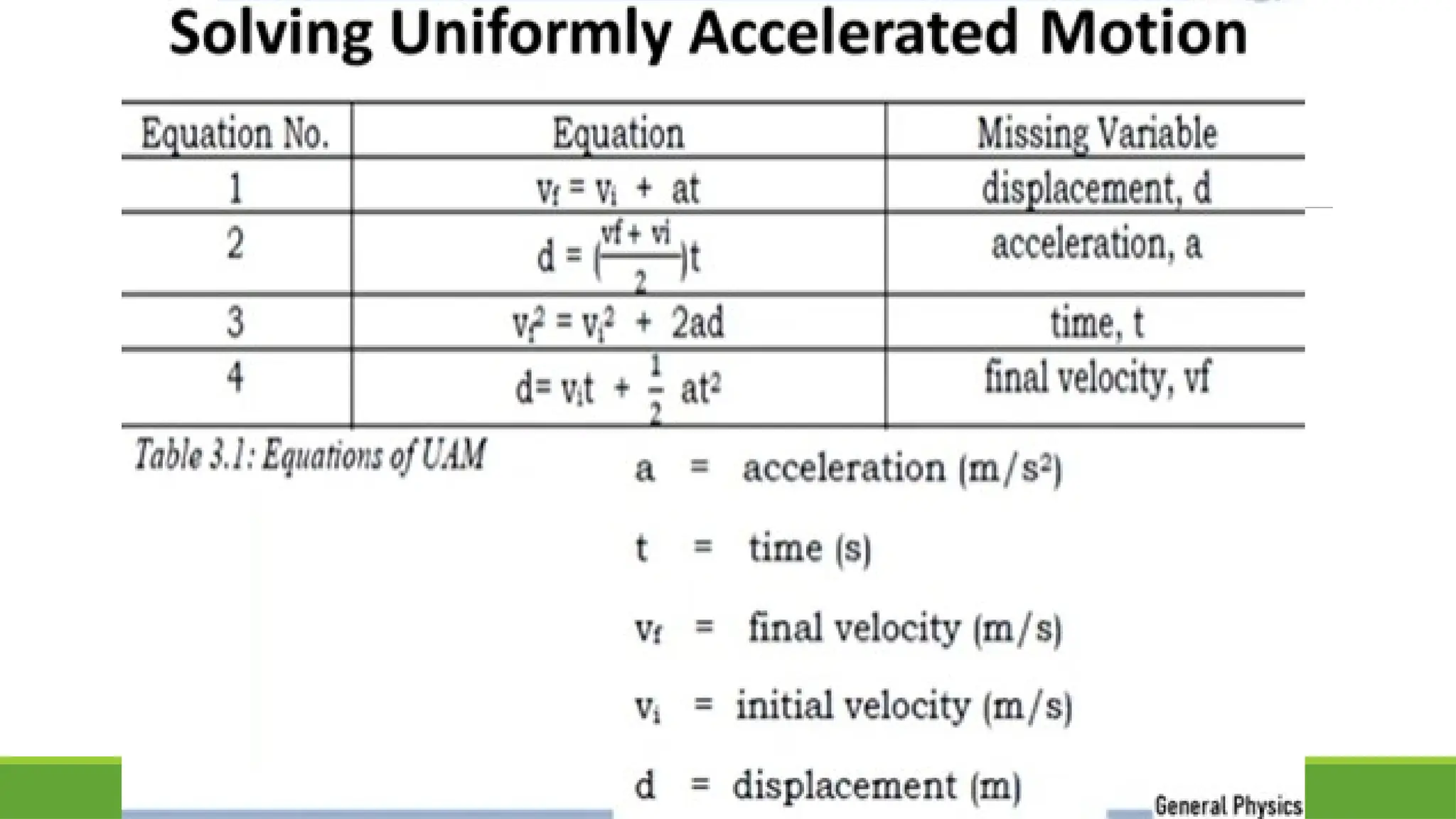
Uniformly Accelerated Motion
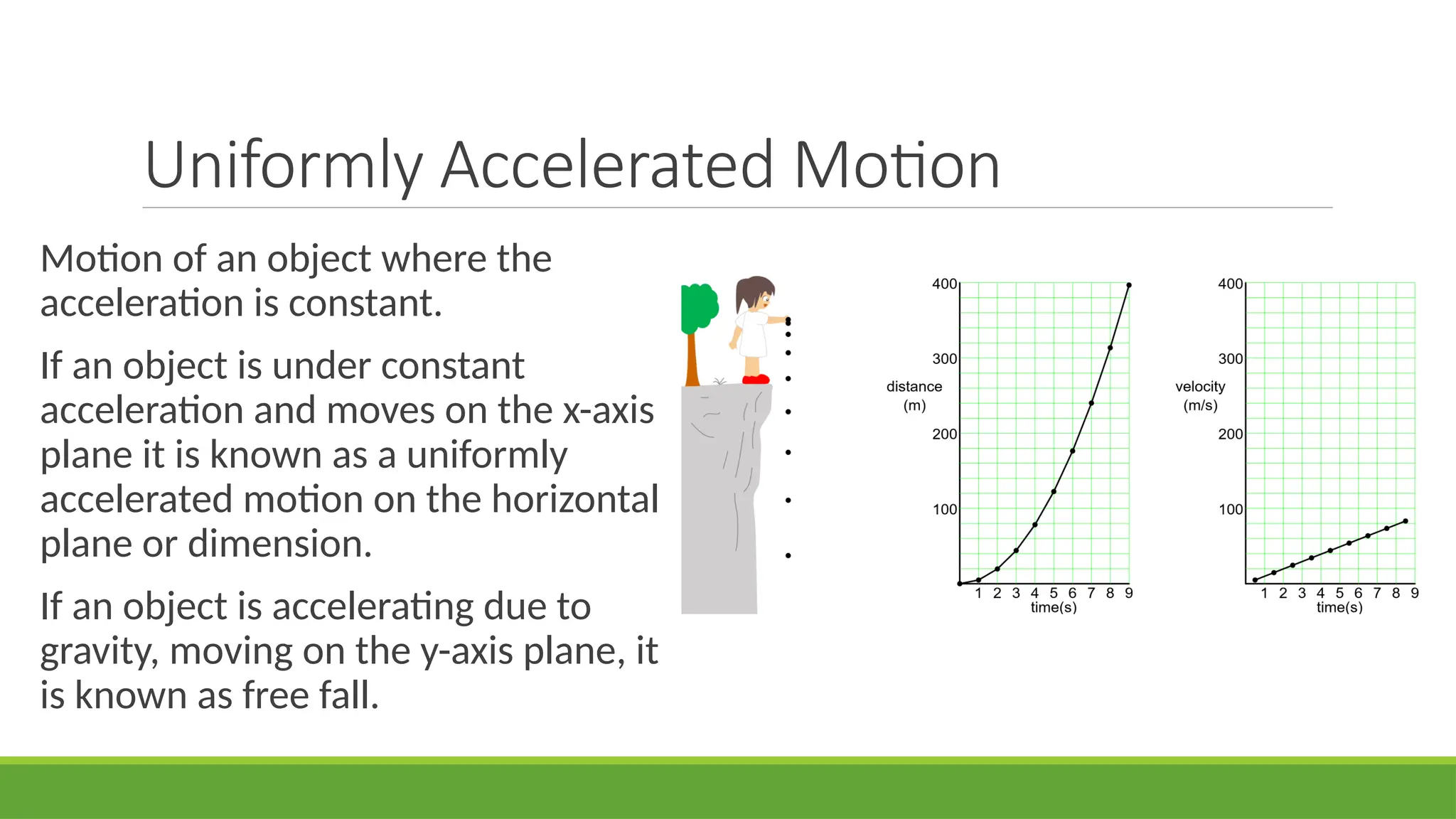
Motion of an object where the
acceleration is constant.
If an object is under constant
acceleration and moves on the x-axis
plane it is known as a uniformly
accelerated motion on the horizontal
plane or dimension.
If an object is accelerating due to
gravity, moving on the y-axis plane, it
is known as free fall.
Sample problem 1
A car covers 200.0 m while increasing
its velocity from 20.0 m/s to 30.0 m/s.
Compute the acceleration.
Sample problem 2
Starting from rest, a car accelerates at . How far will it
go after 6.0 s?
Sample problems
3. An airplane from rest accelerates on a
runway at for until it finally takes off the
ground. What is the distance covered
before take off?
Sample problems
4. A jeepney from rest accelerates
uniformly over a time of and covers a
distance of . Determine the acceleration
of the jeepney?
Sample problems
5. A train from rest accelerates to speed
of over a distance of . Determine the
acceleration ( assume uniform) of the
train.
1 Whole Practice problem 1
A car covers 3210 m while increasing its
velocity from 24.0 m/s to 38.0 m/s.
Compute the acceleration.
Practice problem 2
Starting from rest, a car accelerates at . How far will it
go after 2.50s?
Practice problem 3
3. An airplane from rest accelerates on a
runway at for until it finally takes off the
ground. What is the distance covered
before take off?
Practice problem 4
4. A jeepney from rest accelerates
uniformly over a time of and covers a
distance of . Determine the acceleration
of the jeepney?
Practice problem 5
5. A train from rest accelerates to speed
of over a distance of . Determine the
acceleration ( assume uniform) of the
train.
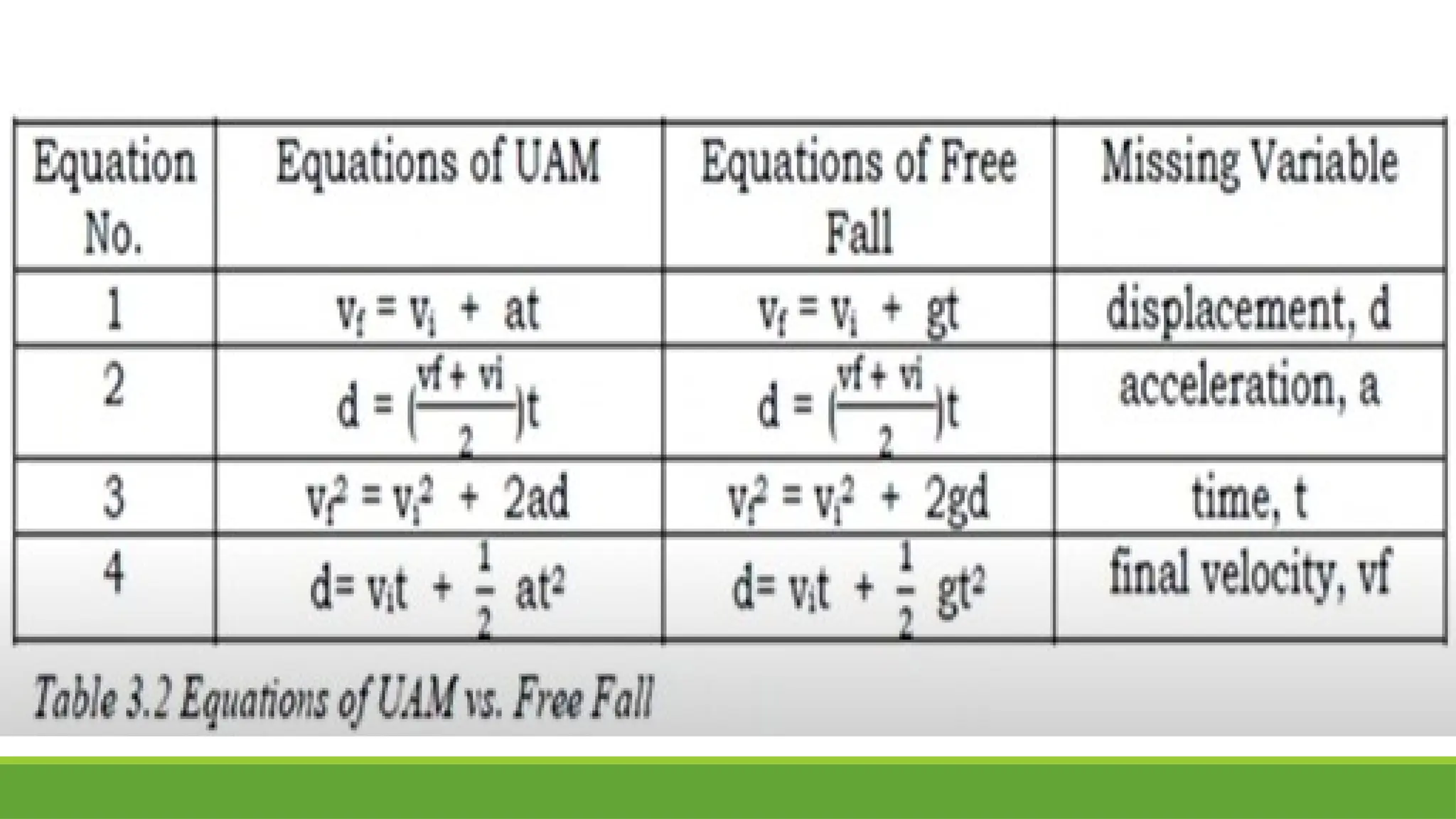
Free fall
Examples of Uniformly Accelerated Motion
(But in Vertical Motion)
Body moves under the action of the
gravitational force of the Earth (Only when
resistance is neglected)
If air resistance is neglected, regardless of
how light or heavy an object is, its velocity
will increase by 9.8 m/s after every second.
Acceleration due to gravity =
Sample problems
1. Zed is playing with a ball on top of a
building but the ball fell and hits the ground
after , what is the final velocity of the ball
just before it hits the ground and how high
is the building?
Sample problems
2. The Philippine tarsier is capable
of jumping to a height of in
hunting for food. Determine the
take off speed of the tarsier.
Sample problems 3
3. The acceleration of gravity on the moon
is . If a ball is dropped on the moon from a
height of determine the time for the ball to
fall to the surface of the moon.
Sample problem 4
A ball is thrown upward at an initial velocity of 40.0 m/s.
Compute for the:
a) The time to reach the maximum height (t)
b) The maximum height (d)
c) Total flight time (t)
d) Return velocity (vr)
Activity 1 Whole
1.Based on your junior high physics, why is the initial
velocity has equal value with the return velocity
(opposite direction)?
2. What is the difference between total time and
maximum time (object reaching the maximum height)?
3. In your own understanding what is gravity?
4. Draw 10 applications of the concept of gravity.

Uniformly-Accelerated-Motion-Horizontal-Motion-and-Free-Fall.pptx

  • 1.
    Uniformly Accelerated Motion: Horizontal Motionand Free Fall PREPARED BY: LORDEL SEGOVIA
  • 2.
    Uniformly Accelerated Motion Motionof an object where the acceleration is constant. If an object is under constant acceleration and moves on the x-axis plane it is known as a uniformly accelerated motion on the horizontal plane or dimension. If an object is accelerating due to gravity, moving on the y-axis plane, it is known as free fall.
  • 4.
    Sample problem 1 Acar covers 200.0 m while increasing its velocity from 20.0 m/s to 30.0 m/s. Compute the acceleration.
  • 5.
    Sample problem 2 Startingfrom rest, a car accelerates at . How far will it go after 6.0 s?
  • 6.
    Sample problems 3. Anairplane from rest accelerates on a runway at for until it finally takes off the ground. What is the distance covered before take off?
  • 7.
    Sample problems 4. Ajeepney from rest accelerates uniformly over a time of and covers a distance of . Determine the acceleration of the jeepney?
  • 8.
    Sample problems 5. Atrain from rest accelerates to speed of over a distance of . Determine the acceleration ( assume uniform) of the train.
  • 9.
    1 Whole Practiceproblem 1 A car covers 3210 m while increasing its velocity from 24.0 m/s to 38.0 m/s. Compute the acceleration.
  • 10.
    Practice problem 2 Startingfrom rest, a car accelerates at . How far will it go after 2.50s?
  • 11.
    Practice problem 3 3.An airplane from rest accelerates on a runway at for until it finally takes off the ground. What is the distance covered before take off?
  • 12.
    Practice problem 4 4.A jeepney from rest accelerates uniformly over a time of and covers a distance of . Determine the acceleration of the jeepney?
  • 13.
    Practice problem 5 5.A train from rest accelerates to speed of over a distance of . Determine the acceleration ( assume uniform) of the train.
  • 14.
    Free fall Examples ofUniformly Accelerated Motion (But in Vertical Motion) Body moves under the action of the gravitational force of the Earth (Only when resistance is neglected) If air resistance is neglected, regardless of how light or heavy an object is, its velocity will increase by 9.8 m/s after every second. Acceleration due to gravity =
  • 16.
    Sample problems 1. Zedis playing with a ball on top of a building but the ball fell and hits the ground after , what is the final velocity of the ball just before it hits the ground and how high is the building?
  • 17.
    Sample problems 2. ThePhilippine tarsier is capable of jumping to a height of in hunting for food. Determine the take off speed of the tarsier.
  • 18.
    Sample problems 3 3.The acceleration of gravity on the moon is . If a ball is dropped on the moon from a height of determine the time for the ball to fall to the surface of the moon.
  • 19.
    Sample problem 4 Aball is thrown upward at an initial velocity of 40.0 m/s. Compute for the: a) The time to reach the maximum height (t) b) The maximum height (d) c) Total flight time (t) d) Return velocity (vr)
  • 20.
    Activity 1 Whole 1.Basedon your junior high physics, why is the initial velocity has equal value with the return velocity (opposite direction)? 2. What is the difference between total time and maximum time (object reaching the maximum height)? 3. In your own understanding what is gravity? 4. Draw 10 applications of the concept of gravity.