SEPARATING
HETEROGENEOUS
MIXTURES
SEPARATING HETEROGENEOUS
MIXTURES
The components of some mixtures need to be separated so that
one or more of its components can be used. For example, you
sometimes need to separate the egg white from the yolk and sift
flour when baking Other mixtures need to be separated so that
their harmful component can be cleaned up, like in oil spills.
Heterogeneous mixtures are easier to separate because you can
still see their components. What are some ways of separating
heterogeneous mixtures?
SEPARATING HETEROGENEOUS
MIXTURES
When rice grains are harvested from the stalks of rice plants, they
are still covered with brown shells called hulls. Pounding the rice
grains or palay peels off the hulls but pieces of them still get
mixed with the white rice. In order to completely separate the
hulls from the rice grains a process called winnowing is done.
In winnowing, grains are tossed in front of a fan. The wind blows
off the lighter pieces of hull and dirt while the grains fall straight
int the containers.
RICE WINNOWING
Winnowing can also be done
without a fan. Here in the
Philippines, the mixture of rice
grains and hulls is placed on a
bilao and then shaker and tossed.
The lighter pieces of hull fall
slower than the grains, se moving
the bilao after catching the grains
lets the hull pieces fall to the
ground.
GRAVITY FILTRATION
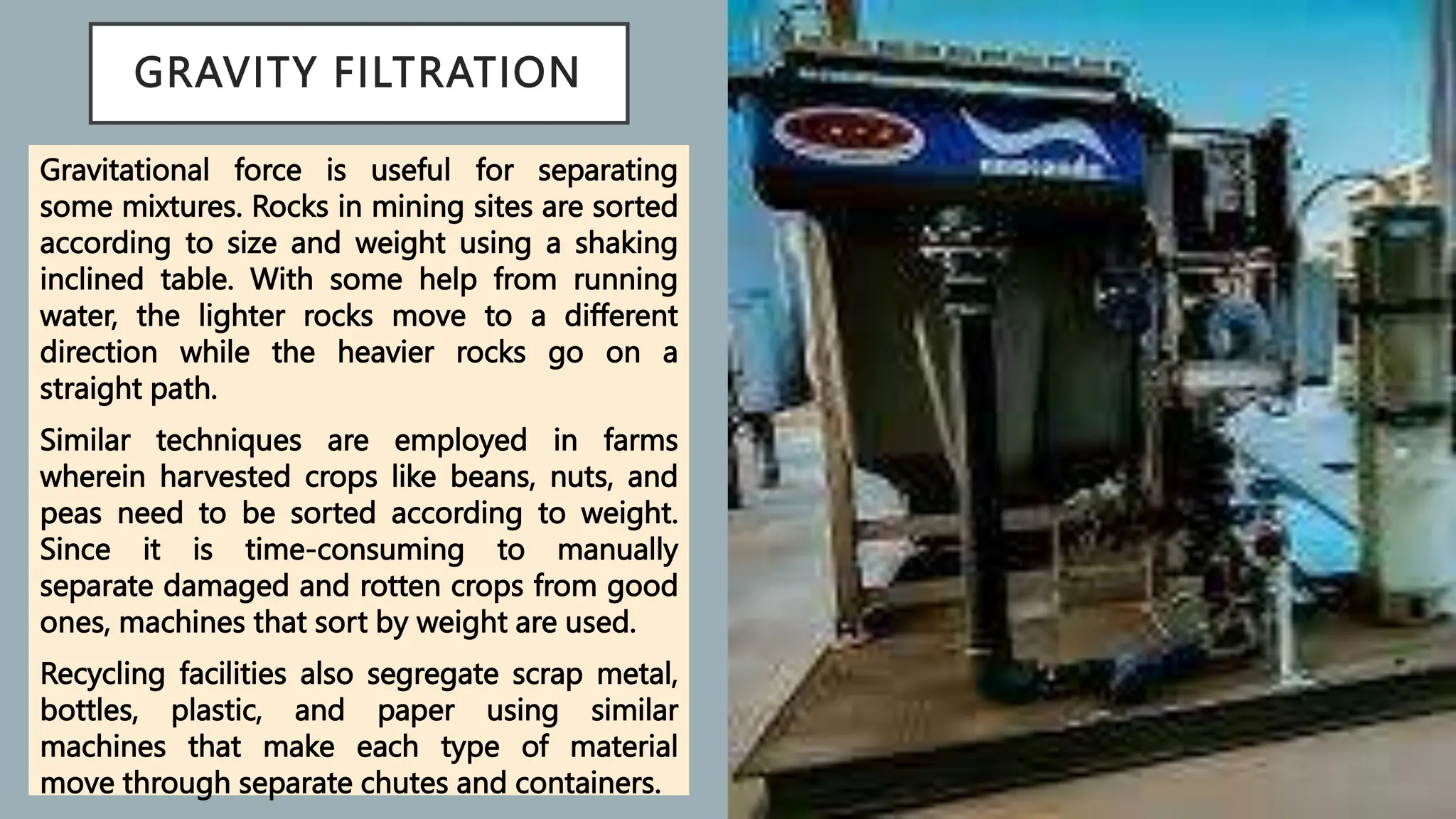
Gravitational force is useful for separating
some mixtures. Rocks in mining sites are sorted
according to size and weight using a shaking
inclined table. With some help from running
water, the lighter rocks move to a different
direction while the heavier rocks go on a
straight path.
Similar techniques are employed in farms
wherein harvested crops like beans, nuts, and
peas need to be sorted according to weight.
Since it is time-consuming to manually
separate damaged and rotten crops from good
ones, machines that sort by weight are used.
Recycling facilities also segregate scrap metal,
bottles, plastic, and paper using similar
machines that make each type of material
move through separate chutes and containers.
GOLD PANNING
Separation by panning.
Some minerals, like gold, can be
obtained not only by mining but also
by panning. It is one of the oldest
methods of separating gold in
riverbeds.
Gold panning is done by choosing a
part of the river where gold is most
likely present. Gravel from the river is
scooped into a pan with little water.
The pan is gently swirled until the
heavier materials sink to the bottom.
The lighter materials are spilled out.
The settled material is sifted for tiny
OIL DECANTING
Separation by Decantation
Some liquids, like oil and water, do not mix and
form a hetero- geneous mixture. They are
immiscible liquids. These liquids can be
separated by pouring or scooping out the
topmost liquid. This process is called
decantation.
Another way of separating two immiscible
liquids is by using a separatory funnel. The
mixture of oil and water is poured into the
funnel; the water is at the bottom while the oil
floats on top.
If the valve at the bottom is opened, the water
drops by gravity. After all the water has been
drained, only the oil remains body of water. Oil
spills need to be removed quickly and
thoroughly
MAGNETS
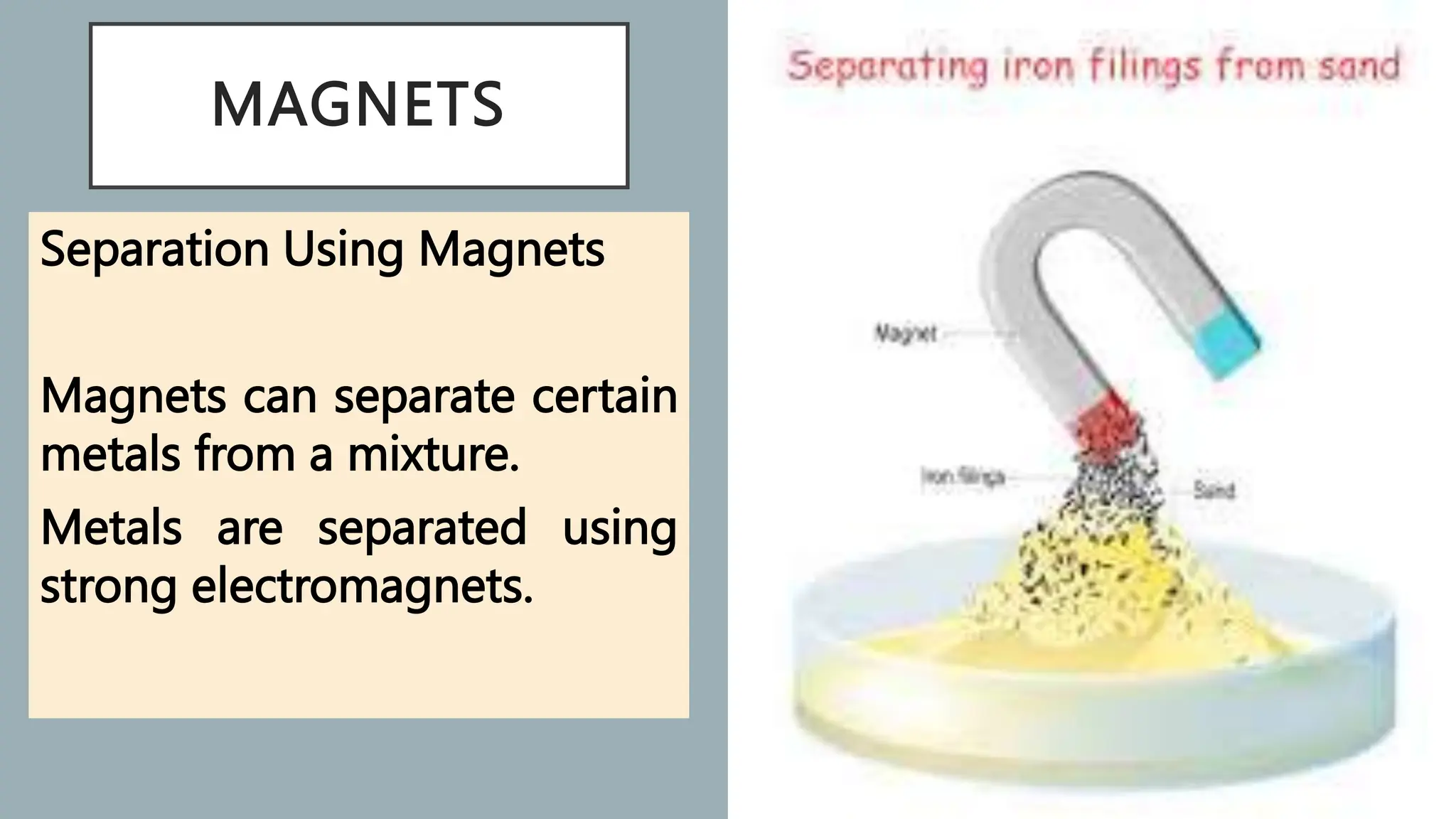
Separation Using Magnets
Magnets can separate certain
metals from a mixture.
Metals are separated using
strong electromagnets.
SEPARATING
SUSPENSIONS
AND
COLLOIDS
SEPARATING SUSPENSIONS AND
COLLOIDS
We have learned several ways of separating homogeneous
heterogeneous mixtures. Do you think components of
suspensions an colloids can also be separated?
Ground coffee dissolved in water is a suspension. It is a brewed
beverage prepared from roasted coffee beans. Once your coffee
already brewed, do you think it is still possible to separate the
ground coffee from the water?
Suspensions can be separated using the same methods used
separate other heterogeneous mixtures. How are colloids
separated The examples of how to separate suspensions and
colloids and applications are discussed in this lesson.
FILTRATION
You have learned that
heterogeneous mixtures with large
solids suspended in a liquid can be
separated using strainers. In
suspensions such as hot water and
ground coffee, the particles are
too small to be strained. The fine
suspended particles are instead
separated using filter paper. Filter
paper has much finer pores
through which water, but not
ground coffee, can pass through.
HEMODIALYZER FOR KIDNEYS AND
DIALYSIS
Blood is a suspension. It has many fine minerals
suspended in it, like sodium, potassium and calcium. It
also contains waste materials from cells. The kidneys
regulate the amounts of minerals in the blood. They
also filter off waste materials which are sent to the
bladder to be excreted as urine. Nephron is the
filtering unit of the kidneys. Each kidney has about a
million nephrons. If the kidneys fail to remove waste
materials and excess minerals from the blood, the
wastes accumulate and eventually poison the body.
People whose kidneys are not functioning properly
may need to have their kidneys replaced through a
transplant. If the patient does not want to have a
transplant or if a suitable kidney donor is not
available, dialysis is an option. In dialysis, the blood of
the patient is pumped outside the body through a
machine called hemodialyzer which filters impurities
of the blood.
The main component of the dialysis machine is the
CENTRIFUGATION
A. Separation of Blood Components
The components of the blood, such as red blood cells, white blood cells,
and platelets be separated.
Red blood cells are heavy and dense, but since plasma is thick, red
blood cells very slowly. Components of the blood in a test tube will
separate components faster w the help of centrifugation. In this process,
the blood sample which is contained in close tubes are placed in a
centrifuge machine. A centrifuge machine separates the component
mixture by spinning at high speeds around a fixed central point. The
centrifugal forces the denser material in the suspension (blood) against
the walls of the tube, separating the v particles and the liquid.
SEPARATING BLOOD
COMPONENTS USING
CENTRIFUGATION
This is a photo of a centrifuge machine,
and beside it are centrifuged blood
components In the centrifugation of
blood components, red blood cells are
pushed down to the small layer of white
blood cells is above it, and on top is the
yellowish blood plasma separated, the
blood components can be analyzed or
used for different purposes.
After centrifuging blood, the platelets
are still mixed with plasma. The plasma
is taken and centrifuged again to isolate
the platelets in order to make it fit for
transfusion.
CENTRIFUGATION
B. Preparation of Low-fat Milk
Another example of a mixture is milk. It is a colloid. However, fresh milk
from is a mixture of water, carbohydrates, proteins, and fats.
If fresh milk is left to stand, a creamy fat component floats on top of the
milk. The can fat component can be spooned off to separate it from the
remaining low in fat milk.
However, commercial milk producers want their milk to have a
consistent taste and texture. To achieve this, milk is homogenized. It
means that the globules of fat are made smaller and mixed more evenly
in the milk. The smaller globules now stay dispersed and do not float to
the top. Homogenized milk is therefore a colloid.
SEPARATING LOW FAT MILK
USING CENTRIFUGATION
A cream separator machine
can separate whole milk into
fatty cream and nonfat milk. It
works like a centrifuge
machine. The spinning throws
out the heavier milk further
than the lighter fatty cream,
and so they spill out through
separate spouts.
REMOVING SMOKE PARTICLES IN THE
AIR
Smoke particles from factories, power
plants and motor vehicles mix with air
to form a solid-in-gas colloid. This
colloid makes the air dark grey. The
colloidal particles can cause
respiratory illnesses especially among
children.
ELECTROSTATIC
PRECIPITATOR
It is hard to eradicate air pollution all at
once, but smoke particles can be
stopped from mixing with the air. A
device called an electrostatic
precipitator does that effectively. Dirty
air is passed through metal plates that
are connected to a high voltage source
and are therefore charged. The passing
smoke particles in the dirty air also
become charged. The electrically
charged plates act like a magnet and
attract the smoke particles that pass
through, effectively separating them
from the air.
The exiting air therefore is smoke-free.
THANK YOU
FOR
LISTENING!
REPORTER: ROCHELLE DE
GUZMAN

UNIFORM AND NON- UNIFORM. MIXTURES.pptx

  • 1.
  • 2.
    SEPARATING HETEROGENEOUS MIXTURES The componentsof some mixtures need to be separated so that one or more of its components can be used. For example, you sometimes need to separate the egg white from the yolk and sift flour when baking Other mixtures need to be separated so that their harmful component can be cleaned up, like in oil spills. Heterogeneous mixtures are easier to separate because you can still see their components. What are some ways of separating heterogeneous mixtures?
  • 3.
    SEPARATING HETEROGENEOUS MIXTURES When ricegrains are harvested from the stalks of rice plants, they are still covered with brown shells called hulls. Pounding the rice grains or palay peels off the hulls but pieces of them still get mixed with the white rice. In order to completely separate the hulls from the rice grains a process called winnowing is done. In winnowing, grains are tossed in front of a fan. The wind blows off the lighter pieces of hull and dirt while the grains fall straight int the containers.
  • 4.
    RICE WINNOWING Winnowing canalso be done without a fan. Here in the Philippines, the mixture of rice grains and hulls is placed on a bilao and then shaker and tossed. The lighter pieces of hull fall slower than the grains, se moving the bilao after catching the grains lets the hull pieces fall to the ground.
  • 5.
    GRAVITY FILTRATION Gravitational forceis useful for separating some mixtures. Rocks in mining sites are sorted according to size and weight using a shaking inclined table. With some help from running water, the lighter rocks move to a different direction while the heavier rocks go on a straight path. Similar techniques are employed in farms wherein harvested crops like beans, nuts, and peas need to be sorted according to weight. Since it is time-consuming to manually separate damaged and rotten crops from good ones, machines that sort by weight are used. Recycling facilities also segregate scrap metal, bottles, plastic, and paper using similar machines that make each type of material move through separate chutes and containers.
  • 6.
    GOLD PANNING Separation bypanning. Some minerals, like gold, can be obtained not only by mining but also by panning. It is one of the oldest methods of separating gold in riverbeds. Gold panning is done by choosing a part of the river where gold is most likely present. Gravel from the river is scooped into a pan with little water. The pan is gently swirled until the heavier materials sink to the bottom. The lighter materials are spilled out. The settled material is sifted for tiny
  • 7.
    OIL DECANTING Separation byDecantation Some liquids, like oil and water, do not mix and form a hetero- geneous mixture. They are immiscible liquids. These liquids can be separated by pouring or scooping out the topmost liquid. This process is called decantation. Another way of separating two immiscible liquids is by using a separatory funnel. The mixture of oil and water is poured into the funnel; the water is at the bottom while the oil floats on top. If the valve at the bottom is opened, the water drops by gravity. After all the water has been drained, only the oil remains body of water. Oil spills need to be removed quickly and thoroughly
  • 8.
    MAGNETS Separation Using Magnets Magnetscan separate certain metals from a mixture. Metals are separated using strong electromagnets.
  • 9.
  • 10.
    SEPARATING SUSPENSIONS AND COLLOIDS Wehave learned several ways of separating homogeneous heterogeneous mixtures. Do you think components of suspensions an colloids can also be separated? Ground coffee dissolved in water is a suspension. It is a brewed beverage prepared from roasted coffee beans. Once your coffee already brewed, do you think it is still possible to separate the ground coffee from the water? Suspensions can be separated using the same methods used separate other heterogeneous mixtures. How are colloids separated The examples of how to separate suspensions and colloids and applications are discussed in this lesson.
  • 11.
    FILTRATION You have learnedthat heterogeneous mixtures with large solids suspended in a liquid can be separated using strainers. In suspensions such as hot water and ground coffee, the particles are too small to be strained. The fine suspended particles are instead separated using filter paper. Filter paper has much finer pores through which water, but not ground coffee, can pass through.
  • 12.
    HEMODIALYZER FOR KIDNEYSAND DIALYSIS Blood is a suspension. It has many fine minerals suspended in it, like sodium, potassium and calcium. It also contains waste materials from cells. The kidneys regulate the amounts of minerals in the blood. They also filter off waste materials which are sent to the bladder to be excreted as urine. Nephron is the filtering unit of the kidneys. Each kidney has about a million nephrons. If the kidneys fail to remove waste materials and excess minerals from the blood, the wastes accumulate and eventually poison the body. People whose kidneys are not functioning properly may need to have their kidneys replaced through a transplant. If the patient does not want to have a transplant or if a suitable kidney donor is not available, dialysis is an option. In dialysis, the blood of the patient is pumped outside the body through a machine called hemodialyzer which filters impurities of the blood. The main component of the dialysis machine is the
  • 13.
    CENTRIFUGATION A. Separation ofBlood Components The components of the blood, such as red blood cells, white blood cells, and platelets be separated. Red blood cells are heavy and dense, but since plasma is thick, red blood cells very slowly. Components of the blood in a test tube will separate components faster w the help of centrifugation. In this process, the blood sample which is contained in close tubes are placed in a centrifuge machine. A centrifuge machine separates the component mixture by spinning at high speeds around a fixed central point. The centrifugal forces the denser material in the suspension (blood) against the walls of the tube, separating the v particles and the liquid.
  • 14.
    SEPARATING BLOOD COMPONENTS USING CENTRIFUGATION Thisis a photo of a centrifuge machine, and beside it are centrifuged blood components In the centrifugation of blood components, red blood cells are pushed down to the small layer of white blood cells is above it, and on top is the yellowish blood plasma separated, the blood components can be analyzed or used for different purposes. After centrifuging blood, the platelets are still mixed with plasma. The plasma is taken and centrifuged again to isolate the platelets in order to make it fit for transfusion.
  • 15.
    CENTRIFUGATION B. Preparation ofLow-fat Milk Another example of a mixture is milk. It is a colloid. However, fresh milk from is a mixture of water, carbohydrates, proteins, and fats. If fresh milk is left to stand, a creamy fat component floats on top of the milk. The can fat component can be spooned off to separate it from the remaining low in fat milk. However, commercial milk producers want their milk to have a consistent taste and texture. To achieve this, milk is homogenized. It means that the globules of fat are made smaller and mixed more evenly in the milk. The smaller globules now stay dispersed and do not float to the top. Homogenized milk is therefore a colloid.
  • 16.
    SEPARATING LOW FATMILK USING CENTRIFUGATION A cream separator machine can separate whole milk into fatty cream and nonfat milk. It works like a centrifuge machine. The spinning throws out the heavier milk further than the lighter fatty cream, and so they spill out through separate spouts.
  • 17.
    REMOVING SMOKE PARTICLESIN THE AIR Smoke particles from factories, power plants and motor vehicles mix with air to form a solid-in-gas colloid. This colloid makes the air dark grey. The colloidal particles can cause respiratory illnesses especially among children.
  • 18.
    ELECTROSTATIC PRECIPITATOR It is hardto eradicate air pollution all at once, but smoke particles can be stopped from mixing with the air. A device called an electrostatic precipitator does that effectively. Dirty air is passed through metal plates that are connected to a high voltage source and are therefore charged. The passing smoke particles in the dirty air also become charged. The electrically charged plates act like a magnet and attract the smoke particles that pass through, effectively separating them from the air. The exiting air therefore is smoke-free.
  • 19.