


An Academic presentation by
Dr. Nancy Agnes, Head, Technical Operations, Tutors India
Group www.tutorsindia.com
Email: info@tutorsindia.com
ARTIFICIAL INTELLIGENCE
(AI) TOOLS IN SCIENTIFIC
RESEARCH
• There has been a growing interest in knowing what artificial intelligence is. Despite numerous publications,
conferences, and applications, it was difficult to define artificial intelligence precisely.
• Artificial intelligence can be commonly understood as “biopsychological potential to process information to
solve problems or develop products that are of value in culture.”
• To be more specific, artificial intelligence can be defined as the ability of a system to interpret external data,
learn from data correctly and use those learnings to achieve specific goals and tasks.
• AI often uses external sources of information, such as the Internet of Things (IoT) and other big data sources,
to identify patterns and rules by using machine learning which describes methods that help computers learn
(Kaplan, 2019).
• Artificial intelligence is used in multiple fields like business, computer science, biomedicine, supply chain
management and healthcare (Venkatesh, 2021).
Advent and Rise of Artificial Intelligence
What are the Various AI tools used in
Scientific research?
• AI tools can help make scientific research easier. The following are some tools used by academic
researchers and students for their dissertations:
CONTD
• Semantic Scholar
• Semantic Scholar offers a one-line summary of each
paper, which helps researchers prioritise publications
for studying in-depth.
• Additionally, the in-built AI algorithms help identify
and recommend related papers based on the history
and identify hidden links between research topics.
• Consensus runs on GPT 4 and uses Natural Language Processing (NLP) and machine learning to
analyse scholarly content.
• This technology makes it easier for researchers to gain access to expert knowledge.
• An extra AI model evaluates publications most relevant to the question and presents the findings.
CONTD
• Consensus
• ChatPDF is an AI application wherein the researchers can upload a PDF document and interact with
it to seek answers.
• One need not sign up or log in for using ChatPDF. A next-generation AI model similar to ChatGPT is
used in ChatPDF.
• ChatPDF
CONTD
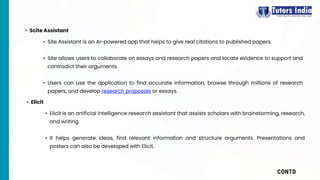
• Site Assistant is an AI-powered app that helps to give real citations to published papers.
• Site allows users to collaborate on essays and research papers and locate evidence to support and
contradict their arguments.
• Users can use the application to find accurate information, browse through millions of research
papers, and develop research proposals or essays.
• Scite Assistant
• Elicit is an artificial intelligence research assistant that assists scholars with brainstorming, research,
and writing.
• It helps generate ideas, find relevant information and structure arguments. Presentations and
posters can also be developed with Elicit.
• Elicit
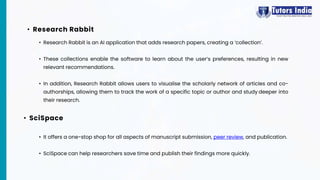
• Research Rabbit is an AI application that adds research papers, creating a ‘collection’.
• These collections enable the software to learn about the user’s preferences, resulting in new
relevant recommendations.
• In addition, Research Rabbit allows users to visualise the scholarly network of articles and co-
authorships, allowing them to track the work of a specific topic or author and study deeper into
their research.
• Research Rabbit
• It offers a one-stop shop for all aspects of manuscript submission, peer review, and publication.
• SciSpace can help researchers save time and publish their findings more quickly.
• SciSpace
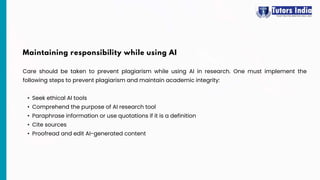
Care should be taken to prevent plagiarism while using AI in research. One must implement the
following steps to prevent plagiarism and maintain academic integrity:
• Seek ethical AI tools
• Comprehend the purpose of AI research tool
• Paraphrase information or use quotations if it is a definition
• Cite sources
• Proofread and edit AI-generated content
Maintaining responsibility while using AI
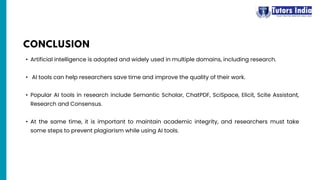
• Artificial intelligence is adopted and widely used in multiple domains, including research.
• AI tools can help researchers save time and improve the quality of their work.
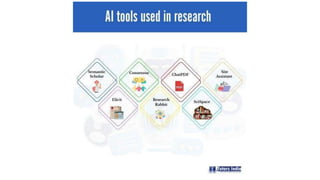
• Popular AI tools in research include Semantic Scholar, ChatPDF, SciSpace, Elicit, Scite Assistant,
Research and Consensus.
• At the same time, it is important to maintain academic integrity, and researchers must take
some steps to prevent plagiarism while using AI tools.
CONCLUSION
• We offer assistance with dissertations for Master’s students specialising in multiple fields-
like arts, law, business management, medicine, life sciences and engineering.
• Our team helps computer science students with dissertation coding, programming and
algorithms, AI and machine learning.
• We ensure the algorithms are free from errors and the dissertations are free from plagiarism,
and abide by the university guidelines.
ABOUT TUTORS INDIA
Contact Us
+44 - 1143520021
UK
+91 - 8754446690
EMAIL
INDIA
info@tutorsindia.com

Artificial Intelligence (AI) Tools in Scientific Research .pptx

  • 1.
    An Academic presentationby Dr. Nancy Agnes, Head, Technical Operations, Tutors India Group www.tutorsindia.com Email: info@tutorsindia.com ARTIFICIAL INTELLIGENCE (AI) TOOLS IN SCIENTIFIC RESEARCH
  • 2.
    • There hasbeen a growing interest in knowing what artificial intelligence is. Despite numerous publications, conferences, and applications, it was difficult to define artificial intelligence precisely. • Artificial intelligence can be commonly understood as “biopsychological potential to process information to solve problems or develop products that are of value in culture.” • To be more specific, artificial intelligence can be defined as the ability of a system to interpret external data, learn from data correctly and use those learnings to achieve specific goals and tasks. • AI often uses external sources of information, such as the Internet of Things (IoT) and other big data sources, to identify patterns and rules by using machine learning which describes methods that help computers learn (Kaplan, 2019). • Artificial intelligence is used in multiple fields like business, computer science, biomedicine, supply chain management and healthcare (Venkatesh, 2021). Advent and Rise of Artificial Intelligence
  • 3.
    What are theVarious AI tools used in Scientific research? • AI tools can help make scientific research easier. The following are some tools used by academic researchers and students for their dissertations: CONTD • Semantic Scholar • Semantic Scholar offers a one-line summary of each paper, which helps researchers prioritise publications for studying in-depth. • Additionally, the in-built AI algorithms help identify and recommend related papers based on the history and identify hidden links between research topics.
  • 4.
    • Consensus runson GPT 4 and uses Natural Language Processing (NLP) and machine learning to analyse scholarly content. • This technology makes it easier for researchers to gain access to expert knowledge. • An extra AI model evaluates publications most relevant to the question and presents the findings. CONTD • Consensus • ChatPDF is an AI application wherein the researchers can upload a PDF document and interact with it to seek answers. • One need not sign up or log in for using ChatPDF. A next-generation AI model similar to ChatGPT is used in ChatPDF. • ChatPDF
  • 6.
    CONTD • Site Assistantis an AI-powered app that helps to give real citations to published papers. • Site allows users to collaborate on essays and research papers and locate evidence to support and contradict their arguments. • Users can use the application to find accurate information, browse through millions of research papers, and develop research proposals or essays. • Scite Assistant • Elicit is an artificial intelligence research assistant that assists scholars with brainstorming, research, and writing. • It helps generate ideas, find relevant information and structure arguments. Presentations and posters can also be developed with Elicit. • Elicit
  • 7.
    • Research Rabbitis an AI application that adds research papers, creating a ‘collection’. • These collections enable the software to learn about the user’s preferences, resulting in new relevant recommendations. • In addition, Research Rabbit allows users to visualise the scholarly network of articles and co- authorships, allowing them to track the work of a specific topic or author and study deeper into their research. • Research Rabbit • It offers a one-stop shop for all aspects of manuscript submission, peer review, and publication. • SciSpace can help researchers save time and publish their findings more quickly. • SciSpace
  • 8.
    Care should betaken to prevent plagiarism while using AI in research. One must implement the following steps to prevent plagiarism and maintain academic integrity: • Seek ethical AI tools • Comprehend the purpose of AI research tool • Paraphrase information or use quotations if it is a definition • Cite sources • Proofread and edit AI-generated content Maintaining responsibility while using AI
  • 9.
    • Artificial intelligenceis adopted and widely used in multiple domains, including research. • AI tools can help researchers save time and improve the quality of their work. • Popular AI tools in research include Semantic Scholar, ChatPDF, SciSpace, Elicit, Scite Assistant, Research and Consensus. • At the same time, it is important to maintain academic integrity, and researchers must take some steps to prevent plagiarism while using AI tools. CONCLUSION
  • 10.
    • We offerassistance with dissertations for Master’s students specialising in multiple fields- like arts, law, business management, medicine, life sciences and engineering. • Our team helps computer science students with dissertation coding, programming and algorithms, AI and machine learning. • We ensure the algorithms are free from errors and the dissertations are free from plagiarism, and abide by the university guidelines. ABOUT TUTORS INDIA
  • 11.
    Contact Us +44 -1143520021 UK +91 - 8754446690 EMAIL INDIA info@tutorsindia.com