What is ArtificialIntelligence?
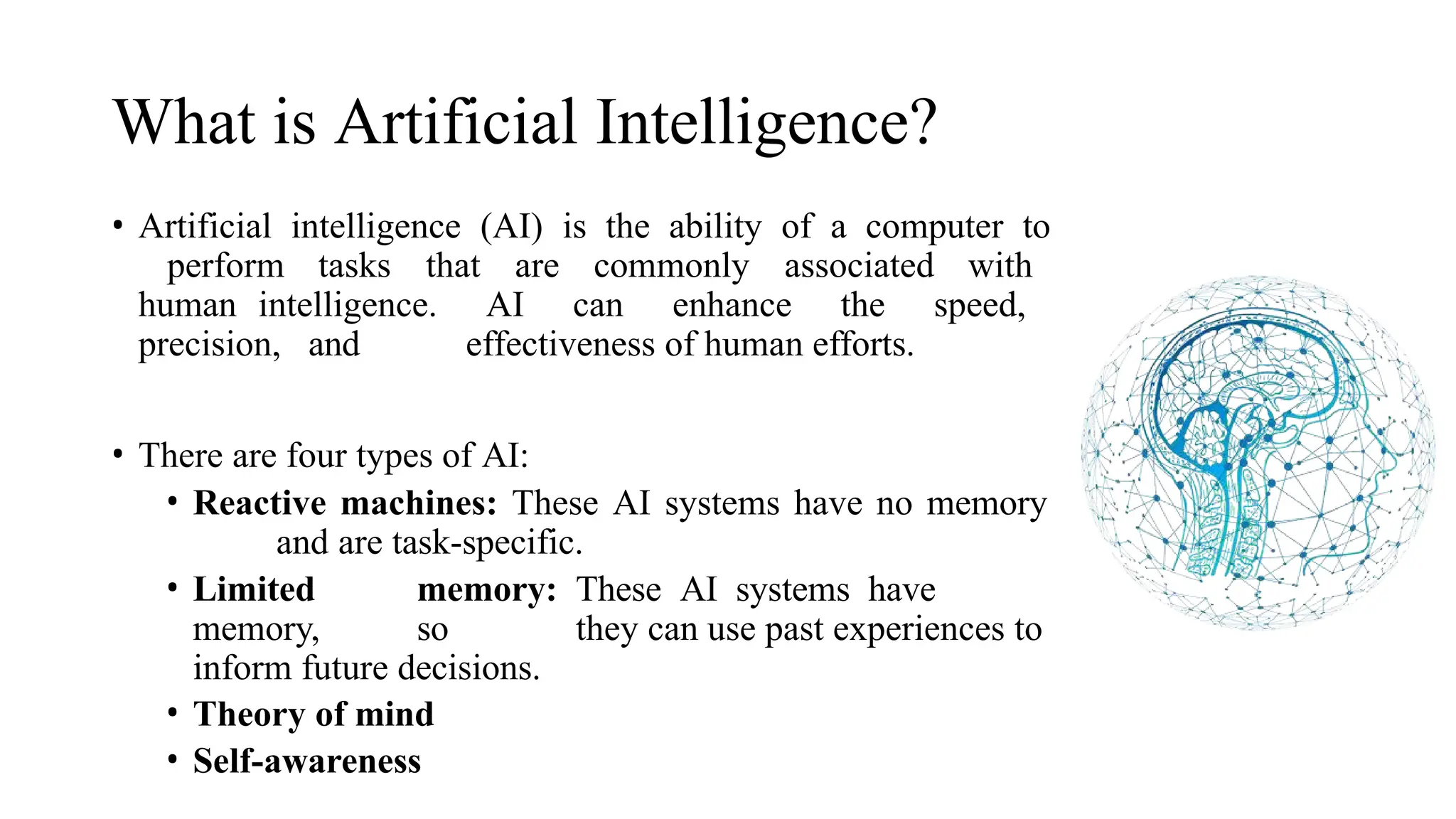
• Artificial intelligence (AI) is the ability of a computer to
perform tasks that are commonly associated with
human intelligence. AI can enhance the speed,
precision, and effectiveness of human efforts.
• There are four types of AI:
• Reactive machines: These AI systems have no memory
and are task-specific.
• Limited memory: These AI systems have
memory, so they can use past experiences to
inform future decisions.
• Theory of mind
• Self-awareness
4.
What is Research?
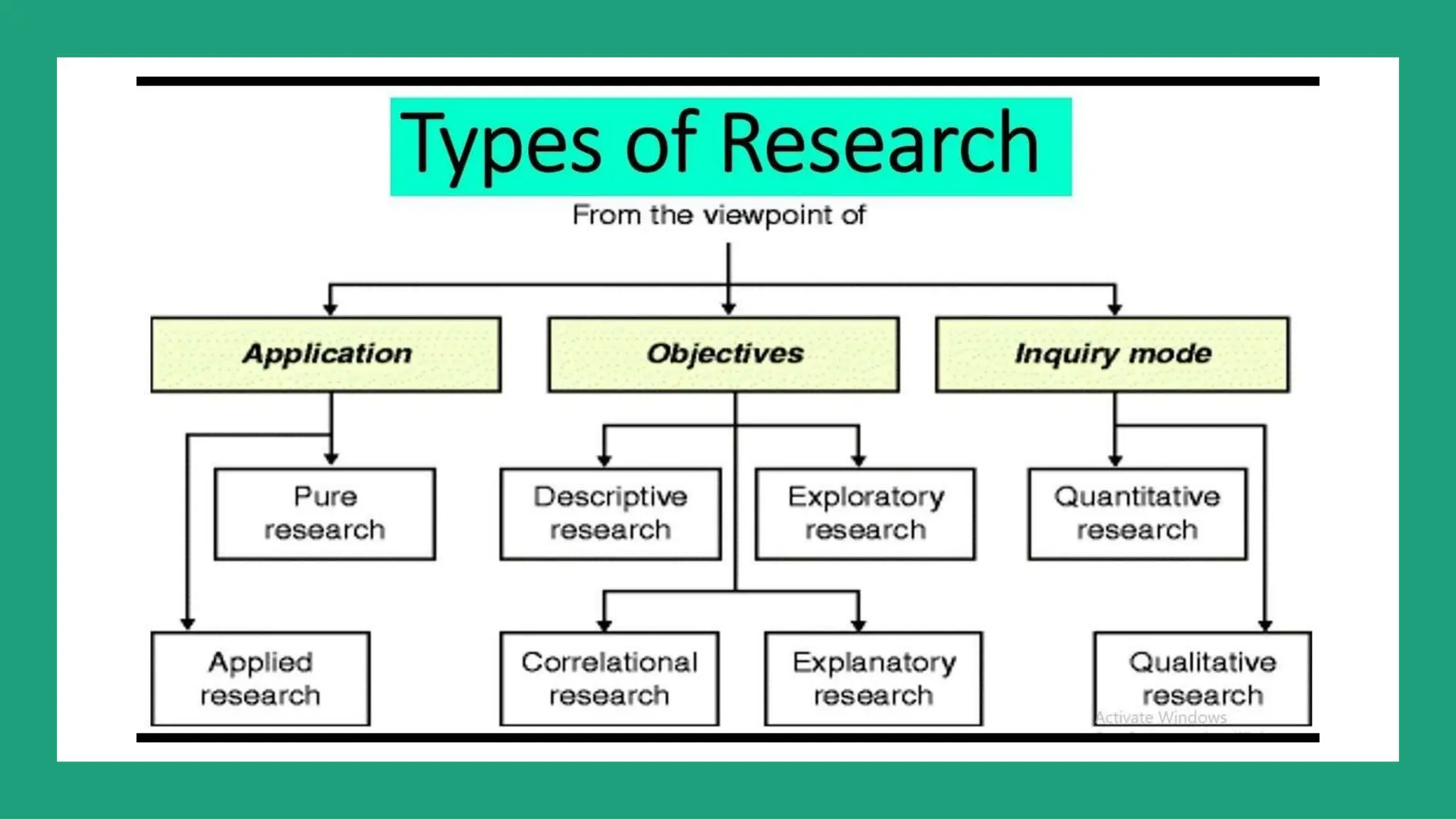
•Research is defined as the creation of new knowledge
and/or the use of existing knowledge in a new
and creative way to generate new concepts,
methodologies and understandings. This could
include synthesis and analysis of previous research
to the extent that it leads to new and creative
outcomes.
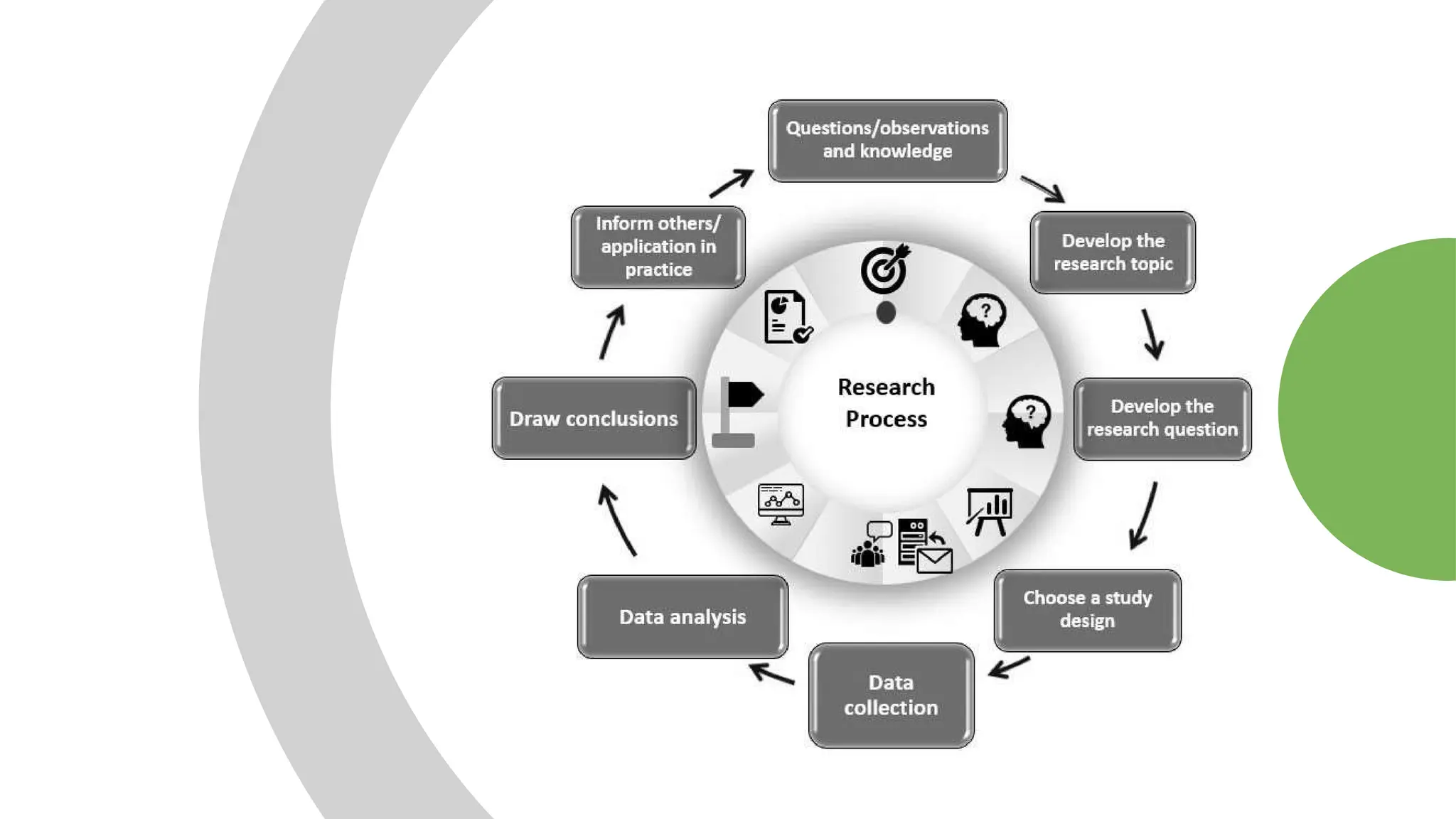
• In the pursuit of knowledge, researchers embark on a
journey of discovery, seeking to unravel the
complexities of the world around us. By
formulating clear research questions,
researchers set the course for their
investigations, carefully crafting methodologies to gather
AI in research
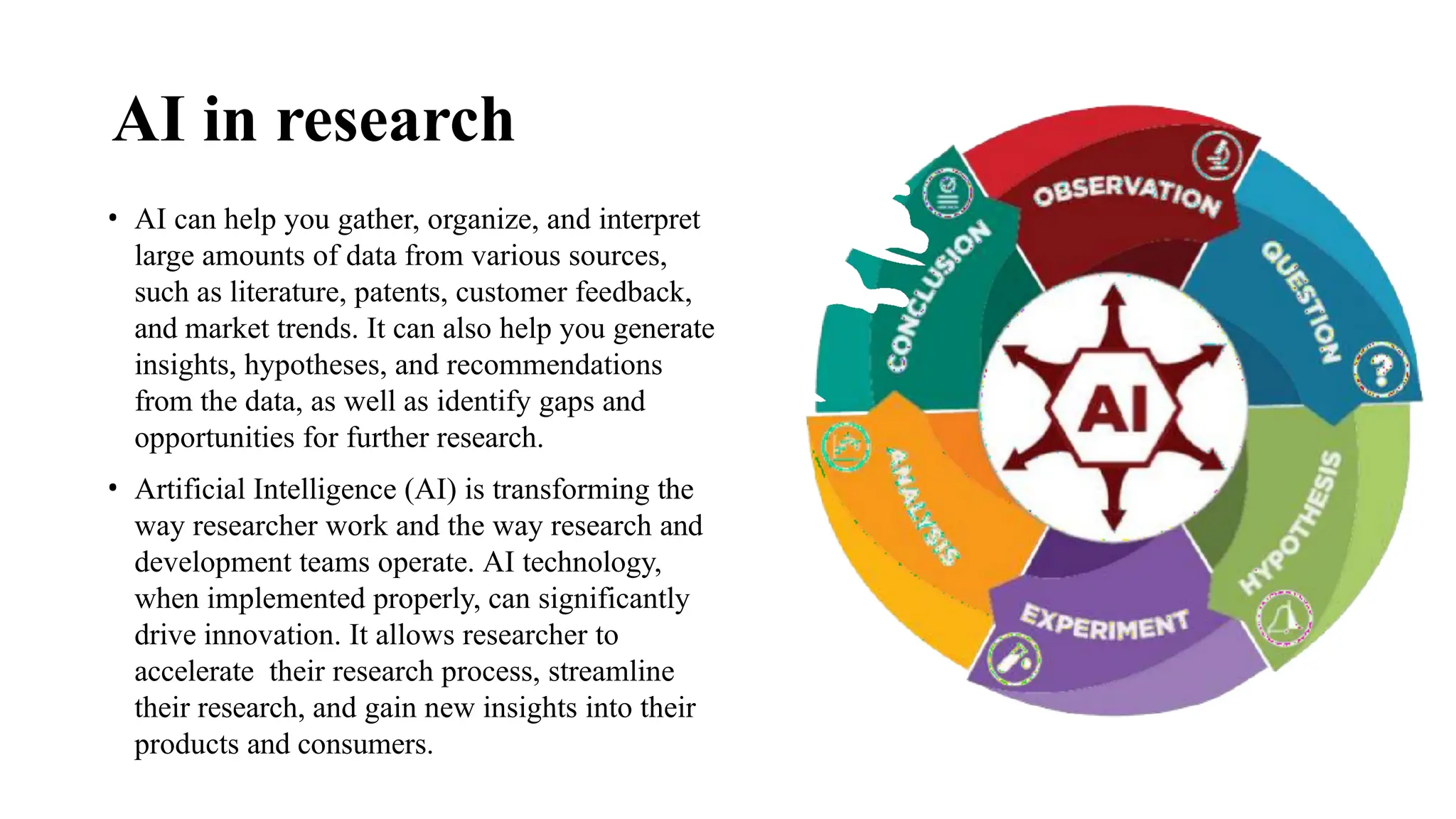
•AI can help you gather, organize, and interpret
large amounts of data from various sources,
such as literature, patents, customer feedback,
and market trends. It can also help you generate
insights, hypotheses, and recommendations
from the data, as well as identify gaps and
opportunities for further research.
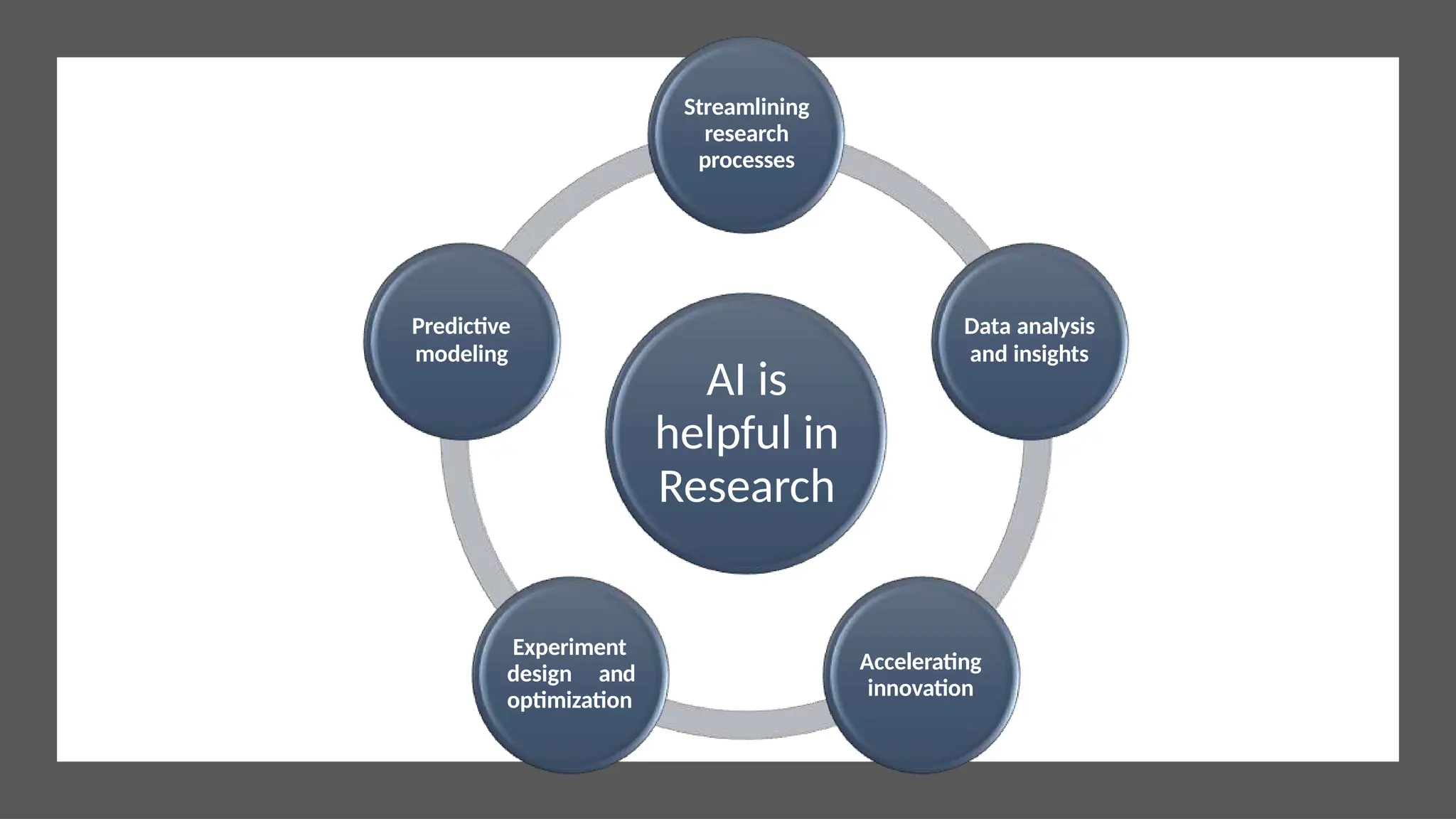
• Artificial Intelligence (AI) is transforming the
way researcher work and the way research and
development teams operate. AI technology,
when implemented properly, can significantly
drive innovation. It allows researcher to
accelerate their research process, streamline
their research, and gain new insights into their
products and consumers.
AI tools forResearch
• Artificial intelligence (AI) is rapidly transforming the way we live and work, and
scientific research is no exception. AI tools are being used to automate tasks, analyze
data, and generate insights in ways that were not possible before. This is helping
researchers to make faster progress, achieve breakthroughs, and improve the quality
of their work.
• AI has revolutionized numerous industries, and scientific research is no exception.
By harnessing the power of AI, PhD scholars, and scientists can streamline their
research processes, enhance data analysis, and accelerate discoveries.
11.
1. Google Scholar
•Google Scholar is a free search engine that
indexes scholarly literature. It allows
users to search for: Articles, Theses,
Books, Abstracts, Court
opinions, Technical reports, Preprints,
Selected Web pages.
• Google Scholar searches across many
disciplines and sources,
including: Academic publishers,
Professional societies, Online
repositories, Universities, Other
websites
12.
Features of GoogleScholar
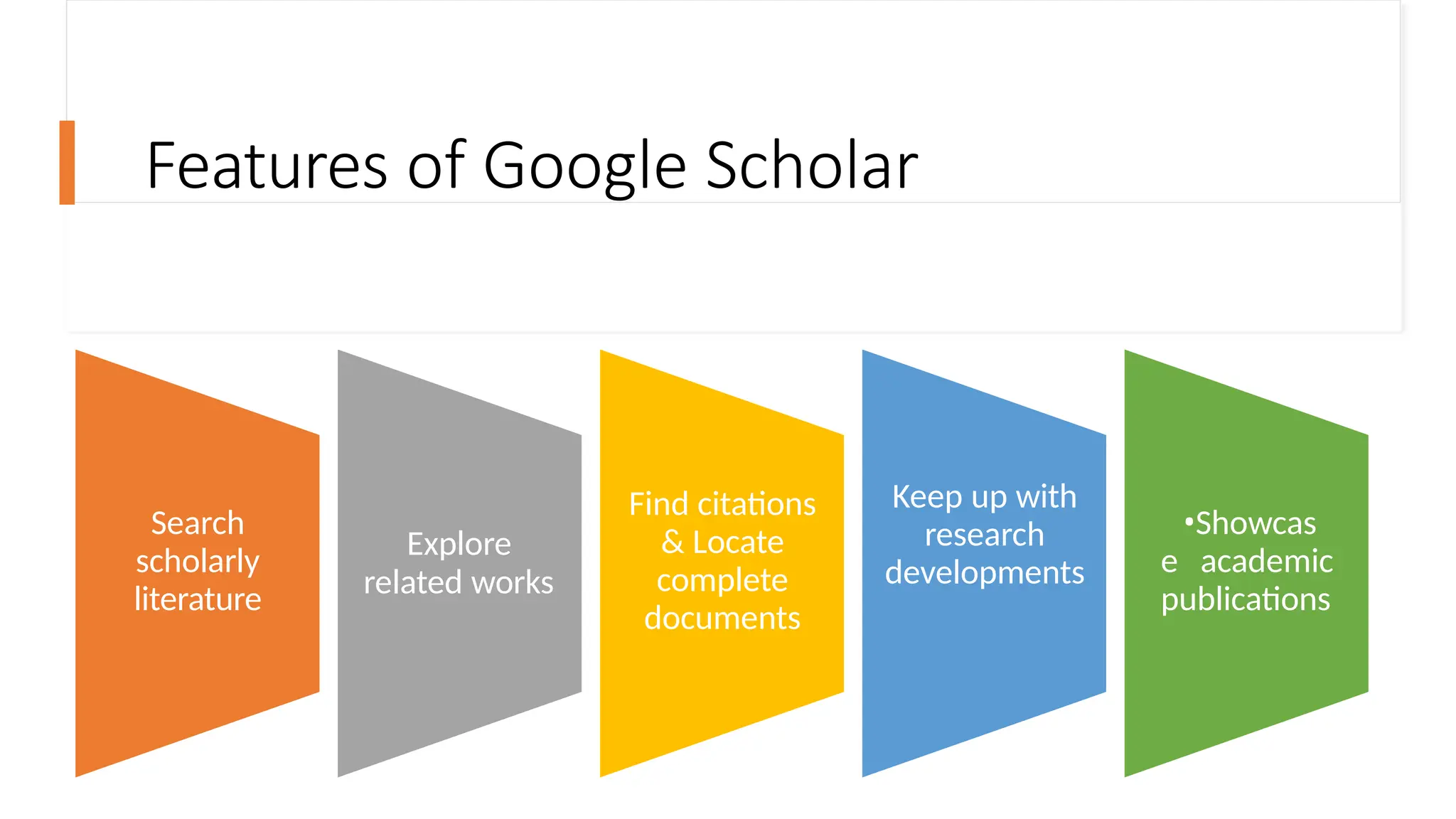
Search
scholarly
literature
Explore
related works
Find citations
& Locate
complete
documents
Keep up with
research
developments
•Showcas
e academic
publications
13.
2. Wordvice AI
•The Wordvice AI Writing Assistant, powered by the most up-to-date AI technology, is a
real-time, all-in-one text editor. It features the AI Proofreading Tool, which fixes spelling,
punctuation, and style errors and improves the clarity and flow of your text; the AI
Paraphrasing Tool and AI Summarizing Tool to ensure originality and natural expressions;
and the AI Translation Tool, which extracts relevant information from non-English
sources.
• Wordvice AI provides you with explanations as well as tips to enhance your writing skills,
lets you choose the revision mode that best suits your needs, and works on all kinds of
academic texts. You can try it out for free or sign up for Wordvice AI Premium to unlock
its more sophisticated features.
14.
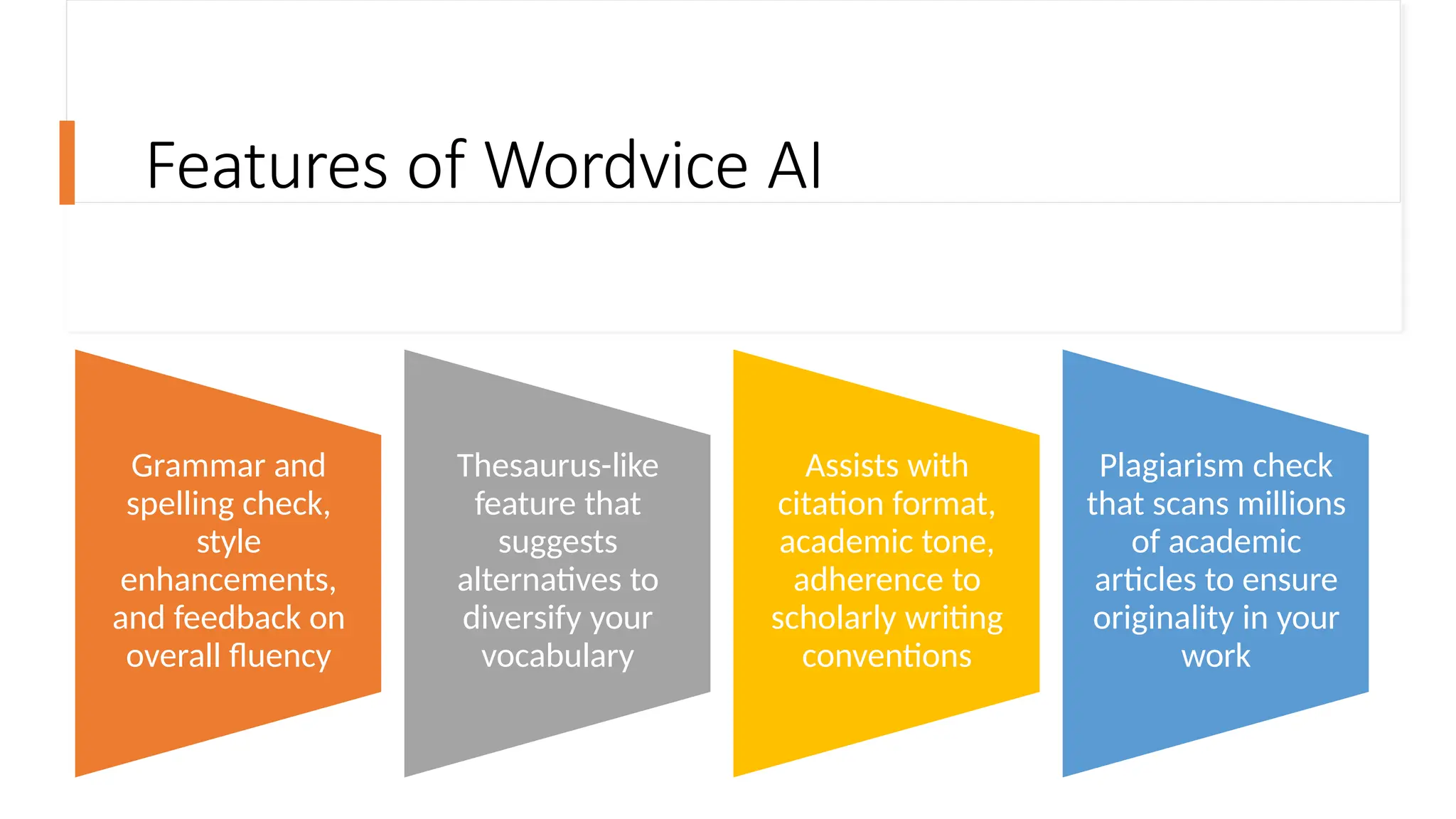
Features of WordviceAI
Grammar and
spelling check,
style
enhancements,
and feedback on
overall fluency
Thesaurus-like
feature that
suggests
alternatives to
diversify your
vocabulary
Assists with
citation format,
academic tone,
adherence to
scholarly writing
conventions
Plagiarism check
that scans millions
of academic
articles to ensure
originality in your
work
15.
3. Typeset.io
• Typeset.iois a comprehensive platform that provides
predefined manuscript templates and
automated formatting tools to help you
meet the specific guidelines of target
journals and publishers quickly and efficiently.
It also includes a citation management
system and support for various styles and can
automatically generate in-text citations and
bibliographies.
• Typeset.io is especially useful for research
collaborations because it lets a group of people
work on the same document simultaneously.
Typeset.io also features a plagiarism
detection feature and writing AI tool to
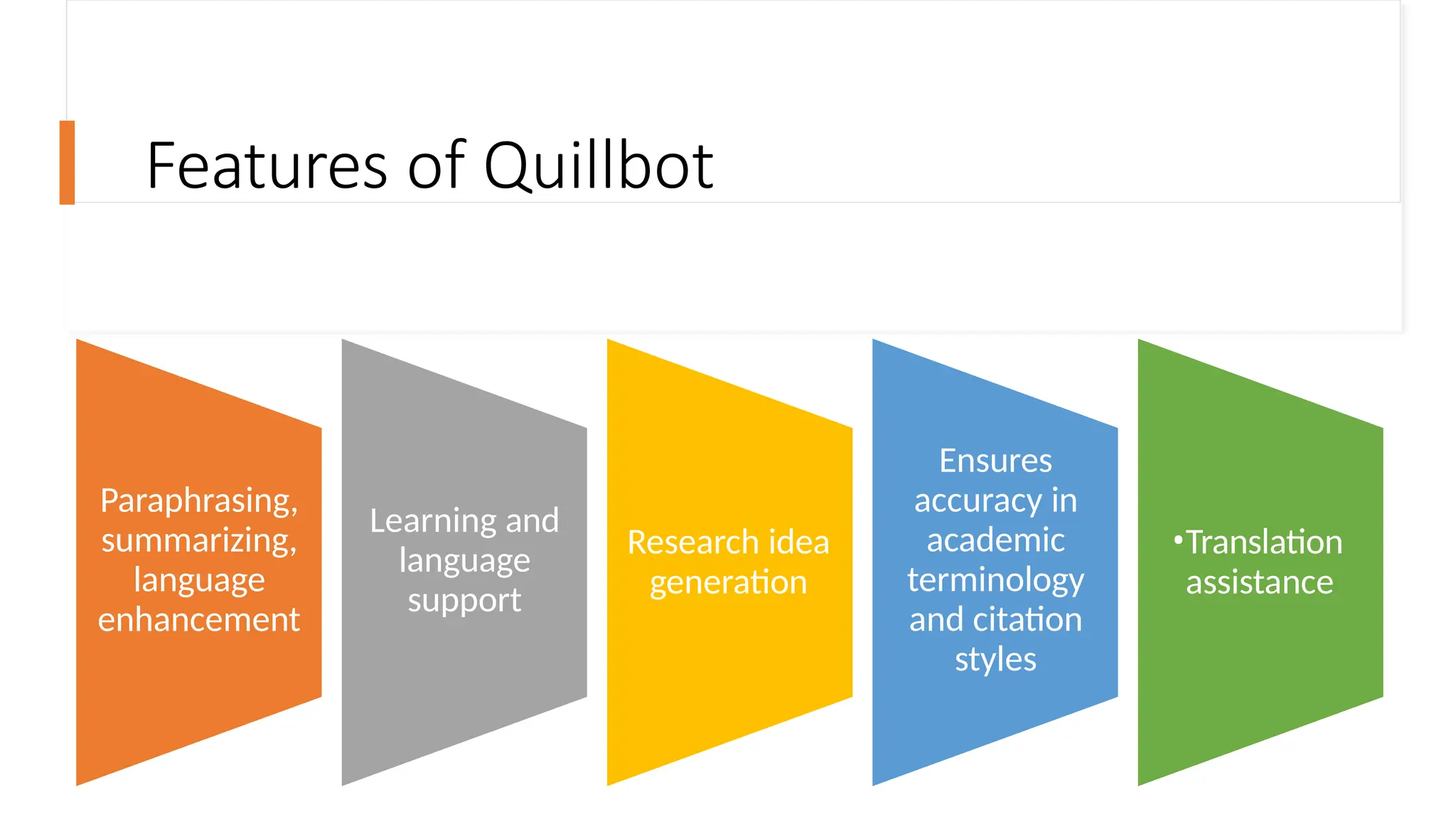
4. Quillbot
• Quillbotis another AI tool like Wordvice AI with
writing and language enhancement features that
are especially useful for academic researchers. It is
based on advanced algorithms that paraphrase to
avoid plagiarism, provide vocabulary suggestions,
and offer alternative word choices.
• Quillbot also offers explanations for its
suggestions, which can be particularly helpful for
non-native English speakers or researchers looking
to improve their language skills. Quillbot can
translate text into several different languages to
ensure accurate referencing.
5. ResearchRabbit
• ResearchRabbitis another web application that
allows you to explore scientific papers quickly
and efficiently. The "Spotify for Papers" lets you
create collections of papers and regularly
recommends new literature to you, based on
visualizes networks of papers and
your personal interests. ResearchRabbit also
co-
authorships and lets you share your collections
with colleagues to improve collaboration.
20.
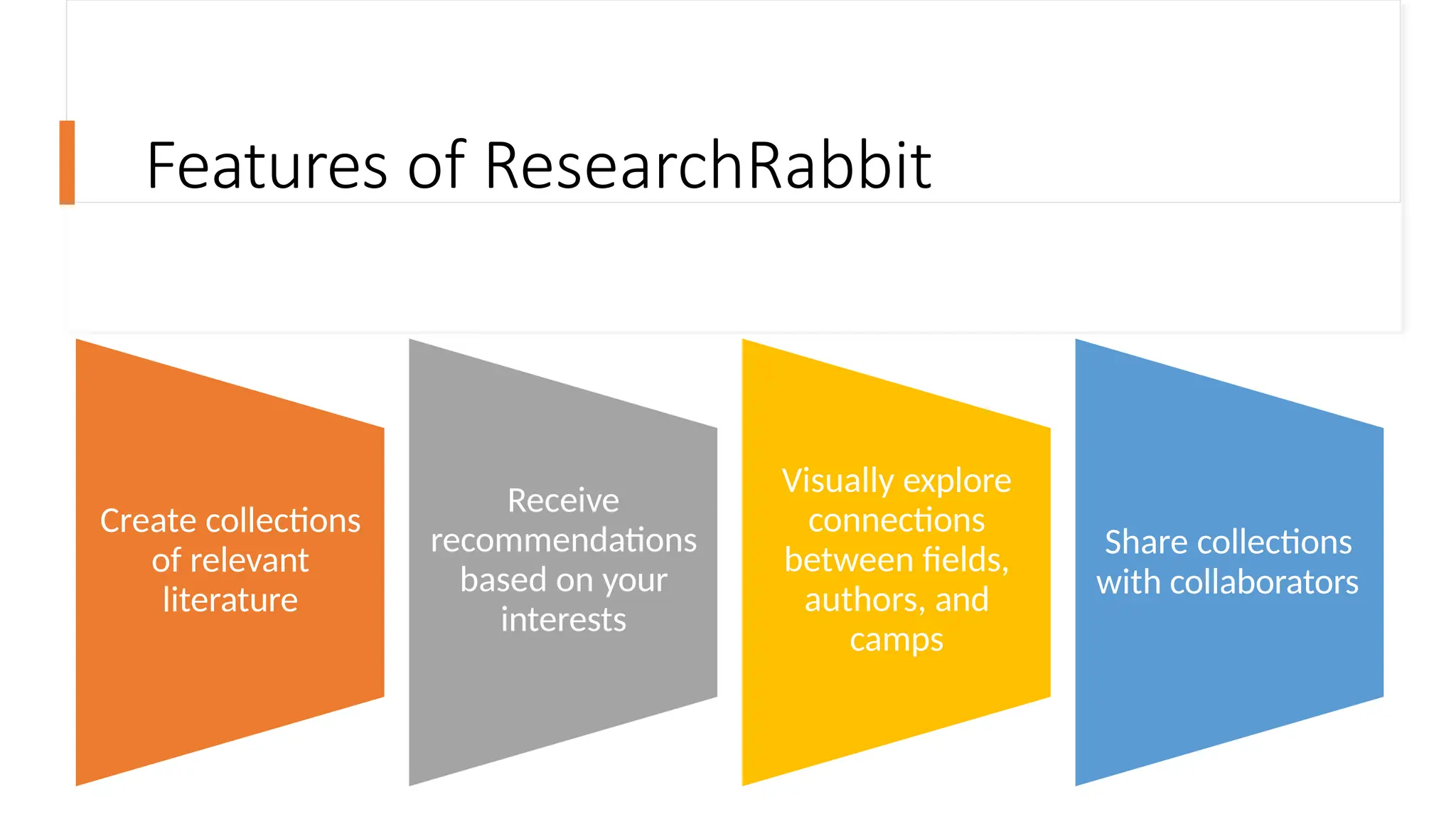
Features of ResearchRabbit
Createcollections
of relevant
literature
Receive
recommendations
based on your
interests
Visually explore
connections
between fields,
authors, and
camps
Share collections
with collaborators
21.
6. ChatPDF
• UsingChatPDF is like having a
conversation with a PDF file.
You upload an article in PDF
format into the research
software, and ChatPDF
gives you a summary and
suggests questions it could answer
based on the full article. The
AI also creates a semantic
index for each paragraph
22.
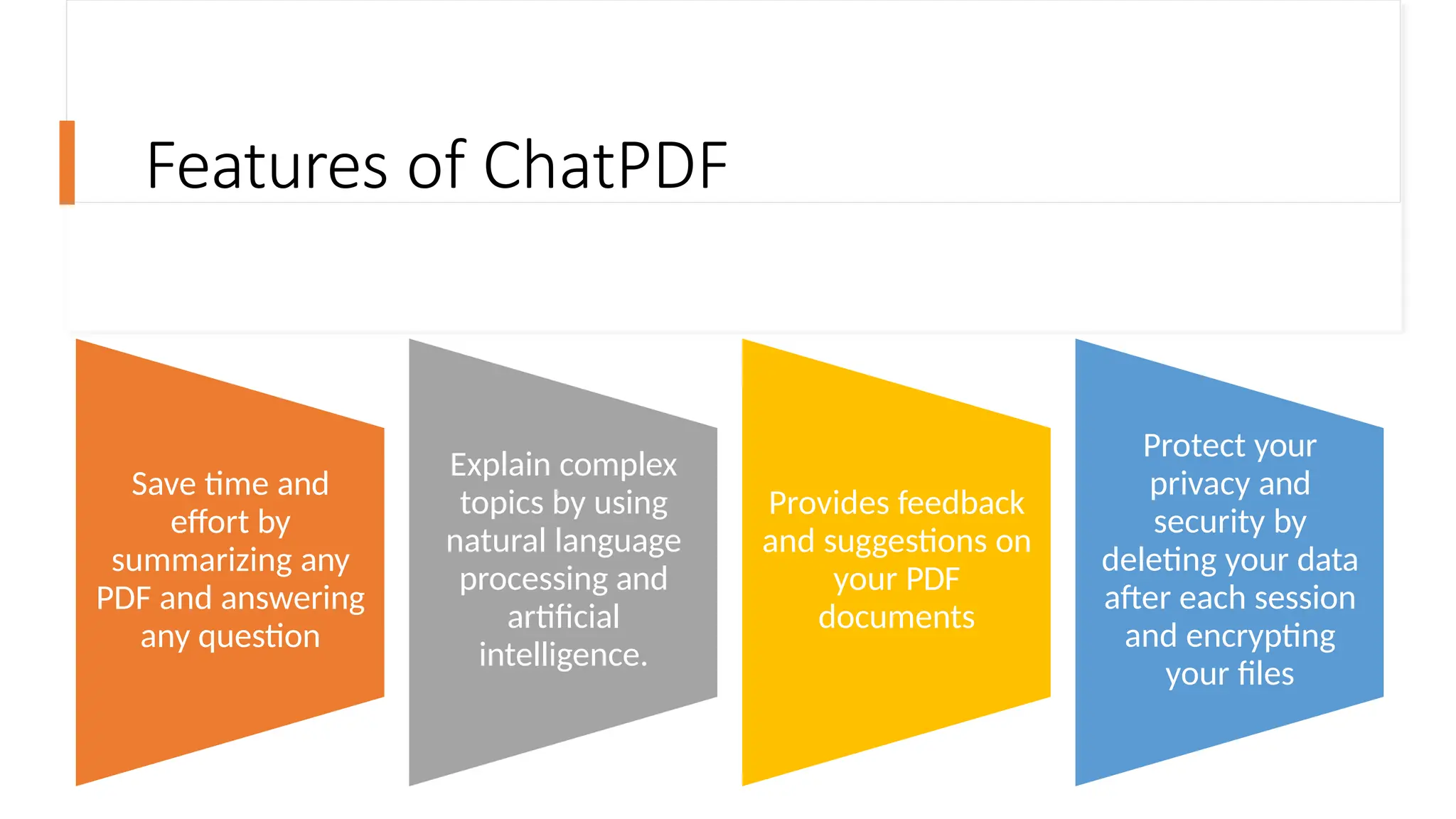
Features of ChatPDF
Savetime and
effort by
summarizing any
PDF and answering
any question
Explain complex
topics by using
natural language
processing and
artificial
intelligence.
Provides feedback
and suggestions on
your PDF
documents
Protect your
privacy and
security by
deleting your data
after each session
and encrypting
your files
23.
7. Consensus
• Consensusis an AI search engine
that helps researchers to
find relevant research papers.
It uses machine learning to
identify papers that are
likely to be relevant to a given
research question, even if they
do not use the same
keywords. Consensus also
provides summaries of each
paper, making it easy to assess
their relevance.
24.
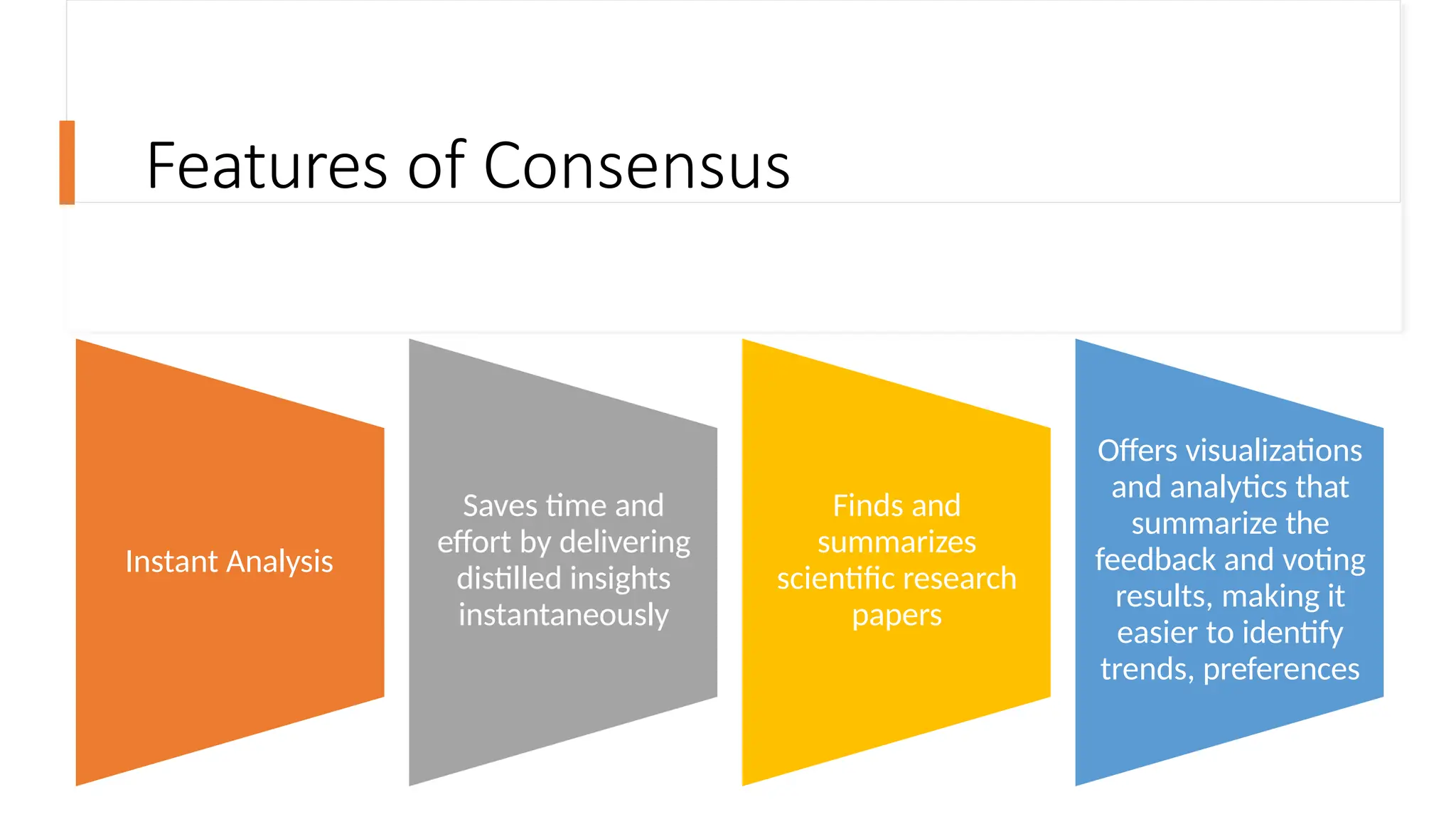
Features of Consensus
InstantAnalysis
Saves time and
effort by delivering
distilled insights
instantaneously
Finds and
summarizes
scientific research
papers
Offers visualizations
and analytics that
summarize the
feedback and voting
results, making it
easier to identify
trends, preferences
25.
8. Elicit
• Elicit,a machine learning tool, is used by the
AI research assistant to help automate research
procedures. Without specific keyword
matches, it can locate relevant articles and
extract important information. Inspire may
likewise give different exploration exercises,
including conceptualizing, summing up, and
text-order, as well as summing up central
issues from the report that are pertinent to the
client’s request.
26.
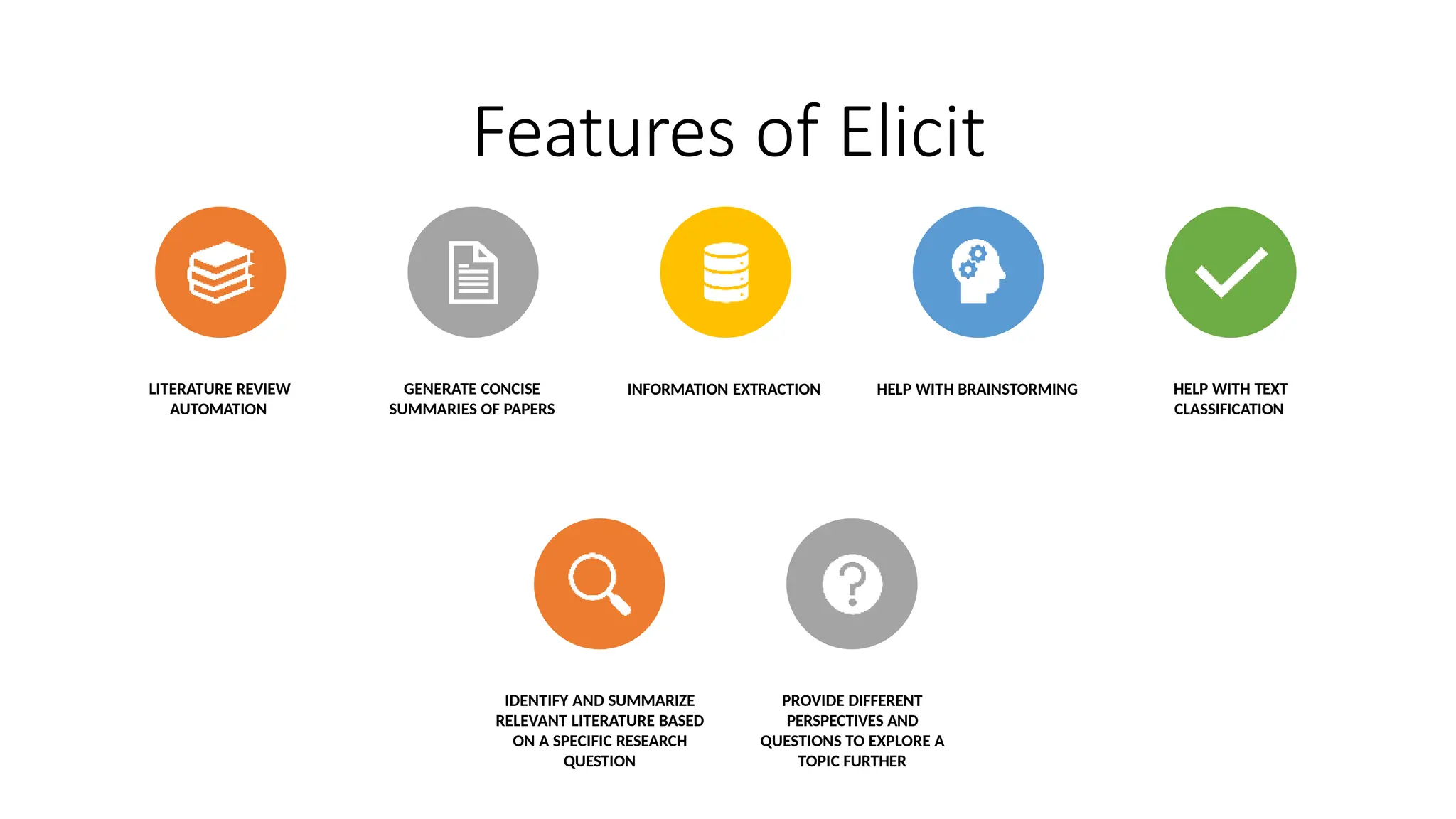
Features of Elicit
LITERATUREREVIEW
AUTOMATION
GENERATE CONCISE
SUMMARIES OF PAPERS
INFORMATION EXTRACTION HELP WITH BRAINSTORMING HELP WITH TEXT
CLASSIFICATION
IDENTIFY AND SUMMARIZE
RELEVANT LITERATURE BASED
ON A SPECIFIC RESEARCH
QUESTION
PROVIDE DIFFERENT
PERSPECTIVES AND
QUESTIONS TO EXPLORE A
TOPIC FURTHER
27.
9. Trinka
• Onlinesentence structure checker and
language proofreader Trinka
artificial intelligence was made for
specialized and scholastic
composition. It is made to catch
errors that other grammar
checkers miss, like issues with subject-
verb agreement, syntax, word
choices, the use of pronouns and
articles, and technical spelling.
In addition, it incorporates
a professional tone, the use of
technical words, conciseness that
goes beyond grammar and spelling,
and style guides.
10. OpenRead
• OpenReadis an AI-powered platform that
helps users organize, analyze, and
interact with various literature formats. It
provides a fast and intuitive way to
access and interact with papers.
OpenRead uses AI technology to
enhance the research experience.
• The platform has several features, like a
Q&A system that responds quickly
to questions about articles and
the Paper Espresso function, which
helps researchers write literature
reviews faster by digesting
publications.
30.
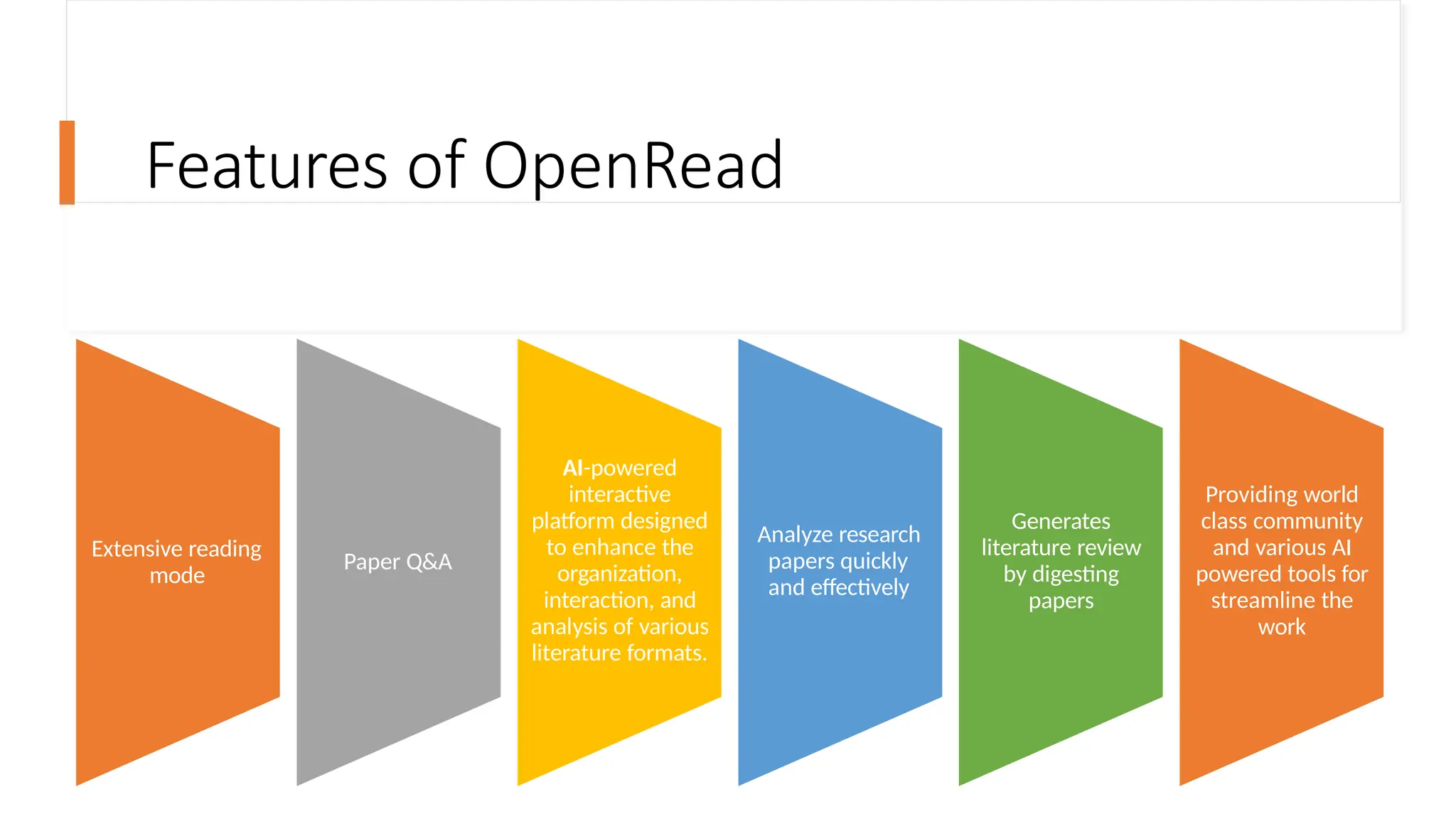
Features of OpenRead
Extensivereading
mode
Paper Q&A
AI-powered
interactive
platform designed
to enhance the
organization,
interaction, and
analysis of various
literature formats.
Analyze research
papers quickly
and effectively
Generates
literature review
by digesting
papers
Providing world
class community
and various AI
powered tools for
streamline the
work