
Jun 24, 2015
Understanding Users
Echelon 2015
Prepared by Minitheory Pte Ltd
Charmaine Low
Interaction Designer, Minitheory
I understand user needs &
behaviours to create
useful & intuitive products.
Minitheory is a digital design studio, based in sunny
Singapore. We make software simple, based on how
people think and behave.
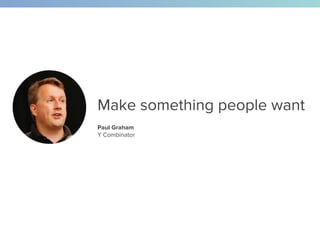
Make something people want
Paul Graham
Y Combinator
Understanding users
helps you figure out
what they want
Talk to your users!
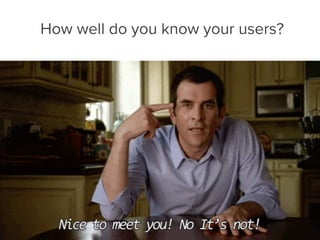
How well do you know your users?
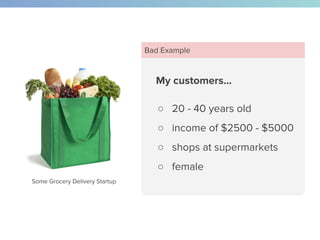
Some Grocery Delivery Startup
My customers…
○ 20 - 40 years old
○ income of $2500 - $5000
○ shops at supermarkets
○ female
Bad Example
Focus on behaviours & needs
instead of demographics
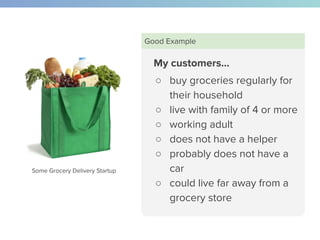
My customers…
○ buy groceries regularly for
their household
○ live with family of 4 or more
○ working adult
○ does not have a helper
○ probably does not have a
car
○ could live far away from a
grocery store
Good Example
Some Grocery Delivery Startup
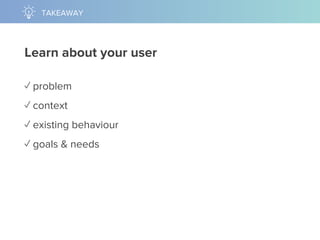
Learn about your user
✓ problem
✓ context
✓ existing behaviour
✓ goals & needs
TAKEAWAY
Tips for talking to users
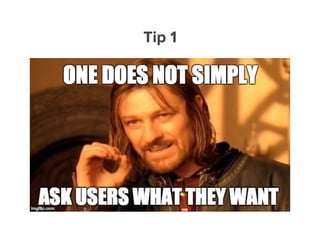
Tip 1
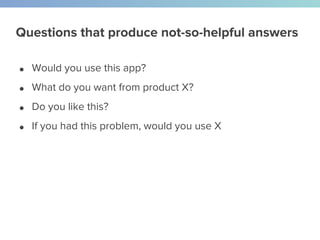
Questions that produce not-so-helpful answers
● Would you use this app?
● What do you want from product X?
● Do you like this?
● If you had this problem, would you use X
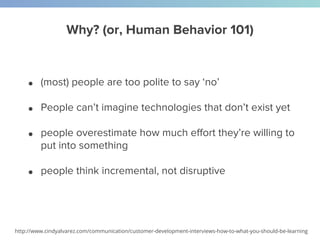
Why? (or, Human Behavior 101)
● (most) people are too polite to say ‘no’
● People can’t imagine technologies that don’t exist yet
● people overestimate how much effort they’re willing to
put into something
● people think incremental, not disruptive
http://www.cindyalvarez.com/communication/customer-development-interviews-how-to-what-you-should-be-learning
A better format
● Start off with a general question like
Tell me about the last time [insert context where
problem occurs]
● Ask for details about the problem and pain
What took you the longest time to do? What was
hard to figure out?
● Find out how they are currently solving the problem
Why do you…? How do you…?
● Figure out what is important to them
If you had to pick only one thing… What is most
important to you...
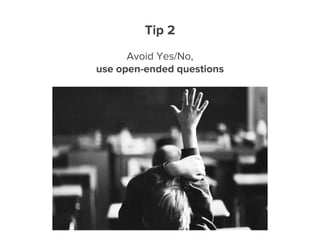
Avoid Yes/No,
use open-ended questions
Tip 2
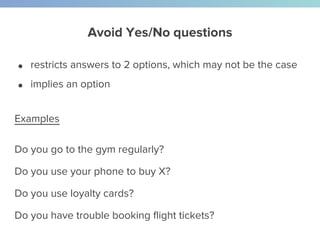
Avoid Yes/No questions
● restricts answers to 2 options, which may not be the case
● implies an option
Examples
Do you go to the gym regularly?
Do you use your phone to buy X?
Do you use loyalty cards?
Do you have trouble booking flight tickets?
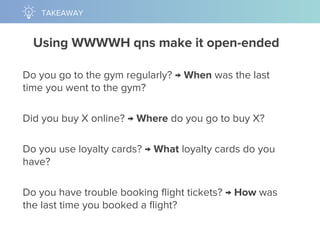
Using WWWWH qns make it open-ended
Do you go to the gym regularly? → When was the last
time you went to the gym?
Did you buy X online? → Where do you go to buy X?
Do you use loyalty cards? → What loyalty cards do you
have?
Do you have trouble booking flight tickets? → How was
the last time you booked a flight?
TAKEAWAY
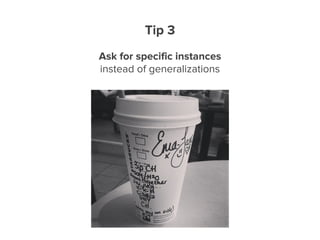
Tip 3
Ask for specific instances
instead of generalizations
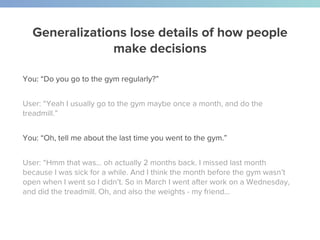
Generalizations lose details of how people
make decisions
You: “Do you go to the gym regularly?”
User: “Yeah I usually go to the gym maybe once a month, and do the
treadmill.”
You: “Oh, tell me about the last time you went to the gym.”
User: “Hmm that was… oh actually 2 months back. I missed last month
because I was sick for a while. And I think the month before the gym wasn’t
open when I went so I didn’t. So in March I went after work on a Wednesday,
and did the treadmill. Oh, and also the weights - my friend...
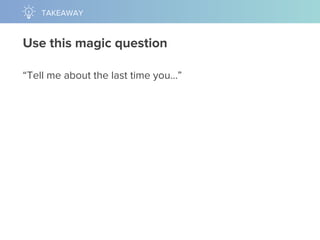
Use this magic question
“Tell me about the last time you…”
TAKEAWAY
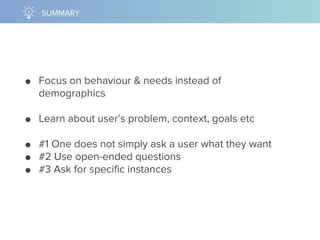
● Focus on behaviour & needs instead of
demographics
● Learn about user’s problem, context, goals etc
● #1 One does not simply ask a user what they want
● #2 Use open-ended questions
● #3 Ask for specific instances
SUMMARY
Thank you!
Feedback? Questions? Coffee?
charmaine@minitheory.com
Minitheory
@MinitheoryHQ

Understanding Users : How to Get People to Really Say What They Do

  • 1.
    Jun 24, 2015 UnderstandingUsers Echelon 2015 Prepared by Minitheory Pte Ltd
  • 2.
    Charmaine Low Interaction Designer,Minitheory I understand user needs & behaviours to create useful & intuitive products.
  • 3.
    Minitheory is adigital design studio, based in sunny Singapore. We make software simple, based on how people think and behave.
  • 4.
    Make something peoplewant Paul Graham Y Combinator
  • 5.
    Understanding users helps youfigure out what they want Talk to your users!
  • 6.
    How well doyou know your users?
  • 8.
    Some Grocery DeliveryStartup My customers… ○ 20 - 40 years old ○ income of $2500 - $5000 ○ shops at supermarkets ○ female Bad Example
  • 9.
    Focus on behaviours& needs instead of demographics
  • 10.
    My customers… ○ buygroceries regularly for their household ○ live with family of 4 or more ○ working adult ○ does not have a helper ○ probably does not have a car ○ could live far away from a grocery store Good Example Some Grocery Delivery Startup
  • 11.
    Learn about youruser ✓ problem ✓ context ✓ existing behaviour ✓ goals & needs TAKEAWAY
  • 12.
  • 13.
  • 14.
    Questions that producenot-so-helpful answers ● Would you use this app? ● What do you want from product X? ● Do you like this? ● If you had this problem, would you use X
  • 15.
    Why? (or, HumanBehavior 101) ● (most) people are too polite to say ‘no’ ● People can’t imagine technologies that don’t exist yet ● people overestimate how much effort they’re willing to put into something ● people think incremental, not disruptive http://www.cindyalvarez.com/communication/customer-development-interviews-how-to-what-you-should-be-learning
  • 16.
    A better format ●Start off with a general question like Tell me about the last time [insert context where problem occurs] ● Ask for details about the problem and pain What took you the longest time to do? What was hard to figure out? ● Find out how they are currently solving the problem Why do you…? How do you…? ● Figure out what is important to them If you had to pick only one thing… What is most important to you...
  • 17.
  • 18.
    Avoid Yes/No questions ●restricts answers to 2 options, which may not be the case ● implies an option Examples Do you go to the gym regularly? Do you use your phone to buy X? Do you use loyalty cards? Do you have trouble booking flight tickets?
  • 19.
    Using WWWWH qnsmake it open-ended Do you go to the gym regularly? → When was the last time you went to the gym? Did you buy X online? → Where do you go to buy X? Do you use loyalty cards? → What loyalty cards do you have? Do you have trouble booking flight tickets? → How was the last time you booked a flight? TAKEAWAY
  • 20.
    Tip 3 Ask forspecific instances instead of generalizations
  • 21.
    Generalizations lose detailsof how people make decisions You: “Do you go to the gym regularly?” User: “Yeah I usually go to the gym maybe once a month, and do the treadmill.” You: “Oh, tell me about the last time you went to the gym.” User: “Hmm that was… oh actually 2 months back. I missed last month because I was sick for a while. And I think the month before the gym wasn’t open when I went so I didn’t. So in March I went after work on a Wednesday, and did the treadmill. Oh, and also the weights - my friend...
  • 22.
    Use this magicquestion “Tell me about the last time you…” TAKEAWAY
  • 23.
    ● Focus onbehaviour & needs instead of demographics ● Learn about user’s problem, context, goals etc ● #1 One does not simply ask a user what they want ● #2 Use open-ended questions ● #3 Ask for specific instances SUMMARY
  • 24.
    Thank you! Feedback? Questions?Coffee? charmaine@minitheory.com Minitheory @MinitheoryHQ