









































Hans van Gent - @jcvangent
Doing

Customer Development
(and stop wasting your time)
edition
Why bother talking to
people
(when you could be building)
image by xensin
’Most startups fail due not to the failure of
product development but due to the lack of
customers’
Steve Blank - @sgblank
So do you know
what the most
dangerous
word in startups is?
With this word
You are making decisions in a vacuum.
With this word
You can take action for years, and end up
nowhere.
The most
dangerous
word in startups
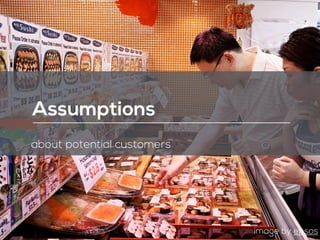
Assumptions
about potential customers,
about potential problems,
about potential solutions.
Assumptions
Assumptions
about potential customers
image by epsos
Personas
are fictional characters created to represent
the different user types within a targeted
demographic, attitude and/or behaviour set
that might use a site, brand or product in a
similar way.
Personas
A persona is a kind of an imaginary person with
a name, history, and story who has a way of
doing things.
Personas
A persona should have enough psychological
detail to allow you to conveniently step over to
the persona’s view and see your products and
services from her perspective.
Personas
A persona can function almost like another
person in the room when making a decision—It is
“Magnus.” He looks at what you’re doing from
his particular and very specific vantage point,
and points out flaws and benefits for him.
about potential customers
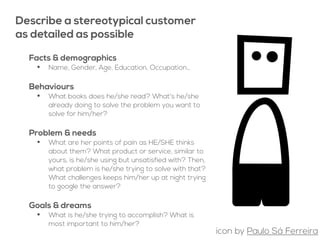
Describe a stereotypical customer
as detailed as possible
Facts & demographics
• Name, Gender, Age, Education, Occupation…
Behaviours
• What books does he/she read? What's he/she
already doing to solve the problem you want to
solve for him/her?
Problem & needs
• What are her points of pain as HE/SHE thinks
about them? What product or service, similar to
yours, is he/she using but unsatisfied with? Then,
what problem is he/she trying to solve with that?
What challenges keeps him/her up at night trying
to google the answer?
Goals & dreams
• What is he/she trying to accomplish? What is
most important to him/her?
icon by Paulo Sá Ferreira
about potential customers
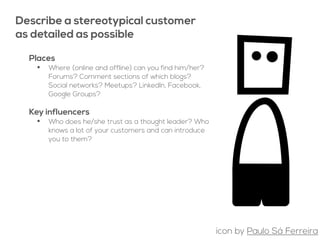
Places
• Where (online and offline) can you find him/her?
Forums? Comment sections of which blogs?
Social networks? Meetups? LinkedIn, Facebook,
Google Groups?
Key influencers
• Who does he/she trust as a thought leader? Who
knows a lot of your customers and can introduce
you to them?
icon by Paulo Sá Ferreira
Describe a stereotypical customer
as detailed as possible
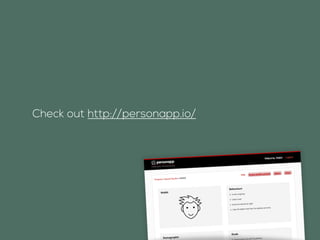
Check out http://personapp.io/
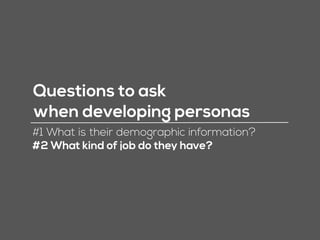
Questions to ask
when developing personas
#1 What is their demographic information?
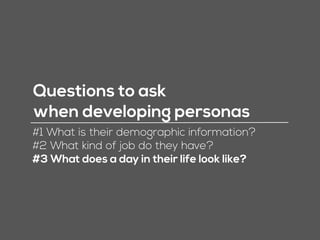
Questions to ask
when developing personas
#1 What is their demographic information?
#2 What kind of job do they have?
Questions to ask
when developing personas
#1 What is their demographic information?
#2 What kind of job do they have?
#3 What does a day in their life look like?
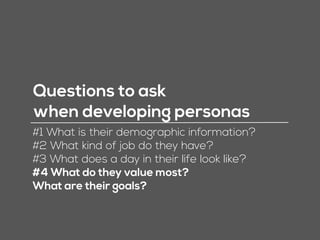
Questions to ask
when developing personas
#1 What is their demographic information?
#2 What kind of job do they have?
#3 What does a day in their life look like?
#4 What do they value most?
What are their goals?
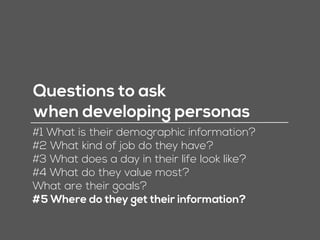
Questions to ask
when developing personas
#1 What is their demographic information?
#2 What kind of job do they have?
#3 What does a day in their life look like?
#4 What do they value most?
What are their goals?
#5 Where do they get their information?
Assumptions
about potential problems / solutions
image by edouardv66
Paul Graham - @paulg
“Build something people want!”
By talking to people you can find
out about their problems.
But it’s super easy
to screw up these
conversations.
icon by Stefano Vetere
Henry Ford
’If I had asked people what they wanted, they
would have said faster horses.’
Anybody will say your idea is great
if you annoy them for long enough.
A man wakes up, turns on the
radio, goes upstairs, turns on the
lights, and kills himself.
Why?
image by Spirit_of_69
(Note: this slide, and several other, are accompanied by a mini-workshop which is really hard to replicate
without being in the room. If you want to bring me in-house and hear the punchline, ping @jcvangent)
image by wstryder
(Note: this slide, and several other, are accompanied by a mini-workshop which is really hard to replicate
without being in the room. If you want to bring me in-house and hear the punchline, ping @jcvangent)
#1 Use a script or survey
Three ways to horrible screw up
customer development
Always know your big 3
questions
Don’t stress too much about choosing the “right” important
questions. They will change. Just choose the 3 questions which
seem murkiest or most important right now. Doing so will give
you a firmer footing and a better sense of direction for your
next 3.
Knowing your list allows you to take better advantage of
serendipitous encounters.
Questions to dig into feature requests
# Why do you want that?
# What would that let you do?
# How are you coping without it?
#Do you think we should push back the launch date, add that
feature, or is it something we can add later?
# How would that fit into your day?
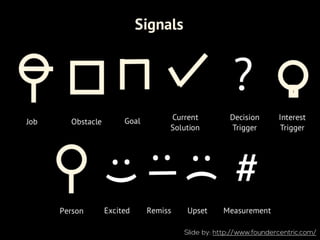
Questions to dig into emotional signals
# Tell me more about that.
# That seems to really bug you - I bet there’s a story here.
# What makes it so awful?
# Why haven’t you been able to fix this already?
# You seem pretty excited about that - it’s a big deal?
# Why so happy?
# Go on.
Softball and anchor questions
How’s it going with..?
Interesting: tell me more about that..
Can we go back to what you were saying about..?
#1 Use a script or survey
#2 Talk about your idea
Three ways to horrible screw up
customer development
Dear mom,


Don’t you think my idea is great?
Love,
your son.
Not just your mom lies.
People want to be helpful, so they tell you what
they think you want to hear.
The mom test
www.momtestbook.com
Rob Fitzpatrick- @robfitz
The mom test
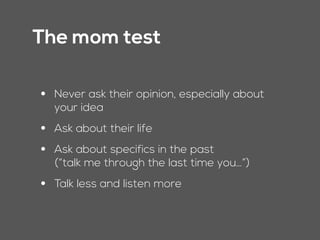
• Never ask their opinion, especially about
your idea
• Ask about their life
• Ask about specifics in the past 

(“talk me through the last time you…”)
• Talk less and listen more
Good or bad questions
Inspiration: the mom test
“Do you think it’s a good
idea?”
Me
“Do you think it’s a good
idea?”
“Would you buy a product
which solved this
problem?”
Me
“Would you buy a product
which solved this
problem?”
“How do you currently deal
with this problem?”
Me
“How do you currently deal
with this problem?”
“When does this problem
pop-up?”
Me
“When does this problem
pop-up?”
“What makes this time
consuming and go off
track?”
Me
“What makes this time
consuming and go off
track?”
“Has this ever been more
time consuming or gone of
track more than normal?”
“Please show me how..”
Me
“Please show me how..”
“Please tell me how…I’m
trying to learn from you..”
Me
“Please tell me how…I’m
trying to learn from you..”
“Talk me through the last
time you had this problem”
“What did you try to do
about it?”
Me
“What did you try to do
about it?”
“How much would you pay
for this?"
Me
“How much would you pay
for this?"
“How much money does
this problem cost you?”
So we just had a meeting
But did we make progress?
“Sound great. I love it!”
Emma
“Sound great. I love it!”
“Brilliant — let me know
when it launches!”
Jeremy
“Brilliant — let me know
when it launches!”
Compliment
+ Stalling tactic
They don’t care
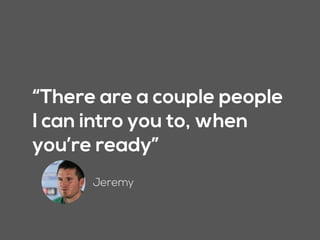
“There are a couple people
I can intro you to, when
you’re ready”
Jeremy
“There are a couple people
I can intro you to, when
you’re ready”
Partial commitment
(is there a valid reason he can’t connect you
now)
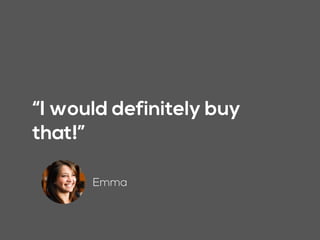
“I would definitely buy
that!”
Emma
Danger!!!
(a promising signal, but people can’t predict
their own behaviour)
#1 Use a script or survey
#2 Talk about your idea
#3 Sell
Three ways to horrible screw up
customer development
Be an apprentice, not a sales person.
Slide by: http://www.foundercentric.com/
Check out http://www.custdevcards.com/
Getting validation
(65 ways of getting validation while on a driving bus)
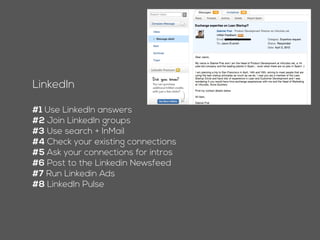
LinkedIn
#1 Join LinkedIn groups
#2 Use search + InMail
#3 Check your existing connections
#4 Ask your connections for intros
#5 Post to the Linkedin Newsfeed
#6 Run Linkedin Ads
#7 LinkedIn Pulse
Facebook
#8 Look up your friends
#9 Ask your friends for introductions
#10 Look for fan pages (message on your behalf)
#11 Run targeted Facebook ads
#12 Try graph search
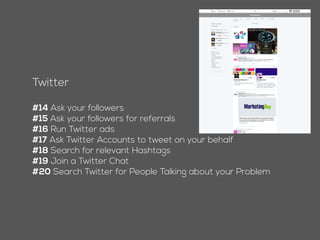
Twitter
#13 Ask your followers
#14 Ask your followers for referrals
#15 Run Twitter ads
#16 Ask Twitter Accounts to tweet on your behalf
#17 Search for relevant Hashtags
#18 Join a Twitter Chat
#19 Search Twitter for People Talking about your Problem
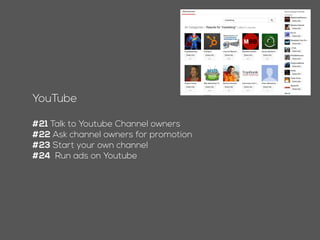
YouTube
#20 Talk to Youtube Channel owners
#21 Ask channel owners for promotion
#22 Start your own channel
#23 Run ads on Youtube
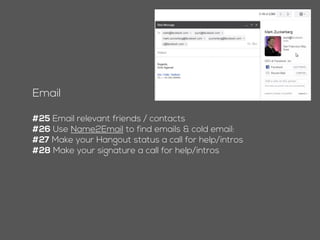
Email
#24 Email relevant friends / contacts
#25 Use Name2Email to find emails & cold email:
#26 Make your Hangout status a call for help/intros
#27 Make your signature a call for help/intros
Your Blog
#28 Write a blog post about the problem you’re solving
#29 Post your blog to discussion sites in appropriate
categories (reddit / HackerNews/ inbound.org /
GrowthHackers / DesignerNews / etc…)
#30 Update your About Page for what you’re looking for
#31 Make a page on your blog just about your market
#32 Start a blog just to talk about your industry
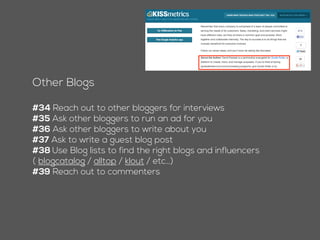
Other Blogs
#33 Reach out to other bloggers for interviews
#34 Ask other bloggers to run an ad for you
#35 Ask other bloggers to write about you
#36 Ask to write a guest blog post
#37 Use Blog lists to find the right blogs and influencers
( blogcatalog / alltop / klout / etc…)
#38 Reach out to commenters
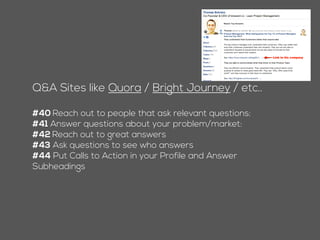
Q&A Sites like Quora / Bright Journey / etc..
#39 Reach out to people that ask relevant questions:
#40 Answer questions about your problem/market:
#41 Reach out to great answers
#42 Ask questions to see who answers
#43 Put Calls to Action in your Profile and Answer
Subheadings
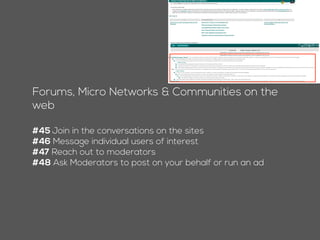
Forums, Micro Networks & Communities on the
web
#44 Join in the conversations on the sites
#45 Message individual users of interest
#46 Reach out to moderators
#47 Ask Moderators to post on your behalf or run an ad
Newsletters
#48 Talk to newsletter owners
#49 Buy Ads using a newsletter ad tool (LaunchBit)
#50 Ask for mentions in a newsletter
#51 Ask Moderators to post on your behalf or run an ad
#52 Start your own industry newsletter
Your competition
#53 Watch what they do
#54 Look for social mentions
#55 Use research tools ( mixrank / SpyFu )
Your college / university or school
#56 Ask your professors
#57 Leverage your alumni network
#58 Use your alumni directory
#59 Reach out to student groups
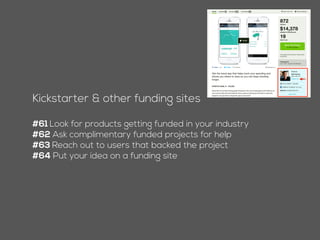
Kickstarter & other funding sites
#60 Look for products getting funded in your industry
#61 Ask complimentary funded projects for help
#62 Reach out to users that backed the project
#63 Put your idea on a funding site
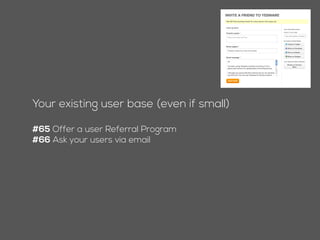
Your existing user base (even if small)
#64 Offer a user Referral Program
#65 Ask your users via email
If you remember one
thing..
There are no facts inside
the bus..
Let’s talk
http://www.jcvangent.com/
by Hans van Gent / @jcvangent

Doing customer development (and stop wasting your time) - StartupBus edition

  • 1.
    Hans van Gent- @jcvangent Doing
 Customer Development (and stop wasting your time) edition
  • 2.
    Why bother talkingto people (when you could be building) image by xensin
  • 3.
    ’Most startups faildue not to the failure of product development but due to the lack of customers’ Steve Blank - @sgblank
  • 4.
    So do youknow what the most dangerous word in startups is?
  • 5.
    With this word Youare making decisions in a vacuum.
  • 6.
    With this word Youcan take action for years, and end up nowhere.
  • 7.
  • 8.
  • 9.
    about potential customers, aboutpotential problems, about potential solutions. Assumptions
  • 10.
  • 11.
    Personas are fictional characterscreated to represent the different user types within a targeted demographic, attitude and/or behaviour set that might use a site, brand or product in a similar way.
  • 12.
    Personas A persona isa kind of an imaginary person with a name, history, and story who has a way of doing things.
  • 13.
    Personas A persona shouldhave enough psychological detail to allow you to conveniently step over to the persona’s view and see your products and services from her perspective.
  • 14.
    Personas A persona canfunction almost like another person in the room when making a decision—It is “Magnus.” He looks at what you’re doing from his particular and very specific vantage point, and points out flaws and benefits for him.
  • 15.
    about potential customers Describea stereotypical customer as detailed as possible Facts & demographics • Name, Gender, Age, Education, Occupation… Behaviours • What books does he/she read? What's he/she already doing to solve the problem you want to solve for him/her? Problem & needs • What are her points of pain as HE/SHE thinks about them? What product or service, similar to yours, is he/she using but unsatisfied with? Then, what problem is he/she trying to solve with that? What challenges keeps him/her up at night trying to google the answer? Goals & dreams • What is he/she trying to accomplish? What is most important to him/her? icon by Paulo Sá Ferreira
  • 16.
    about potential customers Places •Where (online and offline) can you find him/her? Forums? Comment sections of which blogs? Social networks? Meetups? LinkedIn, Facebook, Google Groups? Key influencers • Who does he/she trust as a thought leader? Who knows a lot of your customers and can introduce you to them? icon by Paulo Sá Ferreira Describe a stereotypical customer as detailed as possible
  • 17.
  • 18.
    Questions to ask whendeveloping personas #1 What is their demographic information?
  • 19.
    Questions to ask whendeveloping personas #1 What is their demographic information? #2 What kind of job do they have?
  • 20.
    Questions to ask whendeveloping personas #1 What is their demographic information? #2 What kind of job do they have? #3 What does a day in their life look like?
  • 21.
    Questions to ask whendeveloping personas #1 What is their demographic information? #2 What kind of job do they have? #3 What does a day in their life look like? #4 What do they value most? What are their goals?
  • 22.
    Questions to ask whendeveloping personas #1 What is their demographic information? #2 What kind of job do they have? #3 What does a day in their life look like? #4 What do they value most? What are their goals? #5 Where do they get their information?
  • 23.
    Assumptions about potential problems/ solutions image by edouardv66
  • 24.
    Paul Graham -@paulg “Build something people want!”
  • 25.
    By talking topeople you can find out about their problems.
  • 26.
    But it’s supereasy to screw up these conversations. icon by Stefano Vetere
  • 27.
    Henry Ford ’If Ihad asked people what they wanted, they would have said faster horses.’
  • 28.
    Anybody will sayyour idea is great if you annoy them for long enough.
  • 29.
    A man wakesup, turns on the radio, goes upstairs, turns on the lights, and kills himself. Why? image by Spirit_of_69 (Note: this slide, and several other, are accompanied by a mini-workshop which is really hard to replicate without being in the room. If you want to bring me in-house and hear the punchline, ping @jcvangent)
  • 30.
    image by wstryder (Note:this slide, and several other, are accompanied by a mini-workshop which is really hard to replicate without being in the room. If you want to bring me in-house and hear the punchline, ping @jcvangent)
  • 31.
    #1 Use ascript or survey Three ways to horrible screw up customer development
  • 32.
    Always know yourbig 3 questions Don’t stress too much about choosing the “right” important questions. They will change. Just choose the 3 questions which seem murkiest or most important right now. Doing so will give you a firmer footing and a better sense of direction for your next 3. Knowing your list allows you to take better advantage of serendipitous encounters.
  • 33.
    Questions to diginto feature requests # Why do you want that? # What would that let you do? # How are you coping without it? #Do you think we should push back the launch date, add that feature, or is it something we can add later? # How would that fit into your day?
  • 34.
    Questions to diginto emotional signals # Tell me more about that. # That seems to really bug you - I bet there’s a story here. # What makes it so awful? # Why haven’t you been able to fix this already? # You seem pretty excited about that - it’s a big deal? # Why so happy? # Go on.
  • 35.
    Softball and anchorquestions How’s it going with..? Interesting: tell me more about that.. Can we go back to what you were saying about..?
  • 36.
    #1 Use ascript or survey #2 Talk about your idea Three ways to horrible screw up customer development
  • 37.
    Dear mom, 
 Don’t youthink my idea is great? Love, your son.
  • 38.
    Not just yourmom lies. People want to be helpful, so they tell you what they think you want to hear.
  • 39.
  • 40.
    The mom test •Never ask their opinion, especially about your idea • Ask about their life • Ask about specifics in the past 
 (“talk me through the last time you…”) • Talk less and listen more
  • 41.
    Good or badquestions Inspiration: the mom test
  • 42.
    “Do you thinkit’s a good idea?” Me
  • 43.
    “Do you thinkit’s a good idea?”
  • 44.
    “Would you buya product which solved this problem?” Me
  • 45.
    “Would you buya product which solved this problem?”
  • 46.
    “How do youcurrently deal with this problem?” Me
  • 47.
    “How do youcurrently deal with this problem?”
  • 48.
    “When does thisproblem pop-up?” Me
  • 49.
    “When does thisproblem pop-up?”
  • 50.
    “What makes thistime consuming and go off track?” Me
  • 51.
    “What makes thistime consuming and go off track?”
  • 52.
    “Has this everbeen more time consuming or gone of track more than normal?”
  • 53.
    “Please show mehow..” Me
  • 54.
  • 55.
    “Please tell mehow…I’m trying to learn from you..” Me
  • 56.
    “Please tell mehow…I’m trying to learn from you..”
  • 57.
    “Talk me throughthe last time you had this problem”
  • 58.
    “What did youtry to do about it?” Me
  • 59.
    “What did youtry to do about it?”
  • 60.
    “How much wouldyou pay for this?" Me
  • 61.
    “How much wouldyou pay for this?"
  • 62.
    “How much moneydoes this problem cost you?”
  • 63.
    So we justhad a meeting
  • 64.
    So we justhad a meeting But did we make progress?
  • 65.
    “Sound great. Ilove it!” Emma
  • 66.
    “Sound great. Ilove it!”
  • 67.
    “Brilliant — letme know when it launches!” Jeremy
  • 68.
    “Brilliant — letme know when it launches!”
  • 69.
  • 70.
    “There are acouple people I can intro you to, when you’re ready” Jeremy
  • 71.
    “There are acouple people I can intro you to, when you’re ready”
  • 72.
    Partial commitment (is therea valid reason he can’t connect you now)
  • 73.
    “I would definitelybuy that!” Emma
  • 74.
    Danger!!! (a promising signal,but people can’t predict their own behaviour)
  • 75.
    #1 Use ascript or survey #2 Talk about your idea #3 Sell Three ways to horrible screw up customer development
  • 76.
    Be an apprentice,not a sales person.
  • 77.
  • 78.
  • 79.
    Getting validation (65 waysof getting validation while on a driving bus)
  • 80.
    LinkedIn #1 Join LinkedIngroups #2 Use search + InMail #3 Check your existing connections #4 Ask your connections for intros #5 Post to the Linkedin Newsfeed #6 Run Linkedin Ads #7 LinkedIn Pulse
  • 81.
    Facebook #8 Look upyour friends #9 Ask your friends for introductions #10 Look for fan pages (message on your behalf) #11 Run targeted Facebook ads #12 Try graph search
  • 82.
    Twitter #13 Ask yourfollowers #14 Ask your followers for referrals #15 Run Twitter ads #16 Ask Twitter Accounts to tweet on your behalf #17 Search for relevant Hashtags #18 Join a Twitter Chat #19 Search Twitter for People Talking about your Problem
  • 83.
    YouTube #20 Talk toYoutube Channel owners #21 Ask channel owners for promotion #22 Start your own channel #23 Run ads on Youtube
  • 84.
    Email #24 Email relevantfriends / contacts #25 Use Name2Email to find emails & cold email: #26 Make your Hangout status a call for help/intros #27 Make your signature a call for help/intros
  • 85.
    Your Blog #28 Writea blog post about the problem you’re solving #29 Post your blog to discussion sites in appropriate categories (reddit / HackerNews/ inbound.org / GrowthHackers / DesignerNews / etc…) #30 Update your About Page for what you’re looking for #31 Make a page on your blog just about your market #32 Start a blog just to talk about your industry
  • 86.
    Other Blogs #33 Reachout to other bloggers for interviews #34 Ask other bloggers to run an ad for you #35 Ask other bloggers to write about you #36 Ask to write a guest blog post #37 Use Blog lists to find the right blogs and influencers ( blogcatalog / alltop / klout / etc…) #38 Reach out to commenters
  • 87.
    Q&A Sites likeQuora / Bright Journey / etc.. #39 Reach out to people that ask relevant questions: #40 Answer questions about your problem/market: #41 Reach out to great answers #42 Ask questions to see who answers #43 Put Calls to Action in your Profile and Answer Subheadings
  • 88.
    Forums, Micro Networks& Communities on the web #44 Join in the conversations on the sites #45 Message individual users of interest #46 Reach out to moderators #47 Ask Moderators to post on your behalf or run an ad
  • 89.
    Newsletters #48 Talk tonewsletter owners #49 Buy Ads using a newsletter ad tool (LaunchBit) #50 Ask for mentions in a newsletter #51 Ask Moderators to post on your behalf or run an ad #52 Start your own industry newsletter
  • 90.
    Your competition #53 Watchwhat they do #54 Look for social mentions #55 Use research tools ( mixrank / SpyFu )
  • 91.
    Your college /university or school #56 Ask your professors #57 Leverage your alumni network #58 Use your alumni directory #59 Reach out to student groups
  • 92.
    Kickstarter & otherfunding sites #60 Look for products getting funded in your industry #61 Ask complimentary funded projects for help #62 Reach out to users that backed the project #63 Put your idea on a funding site
  • 93.
    Your existing userbase (even if small) #64 Offer a user Referral Program #65 Ask your users via email
  • 94.
    If you rememberone thing..
  • 95.
    There are nofacts inside the bus..
  • 96.