WELL BEING
WELL-BEING
It is the experience of health, happiness, and prosperity which includes having good mental health, high
life satisfaction, a sense of meaning or purpose, and ability to manage stress.
More generally, well-being is just feeling well.
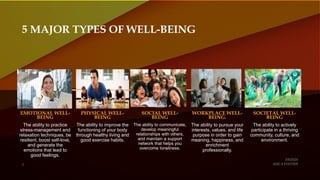
5 MAJOR TYPES OF WELL-BEING
20XX
Month
EMOTIONAL WELL-
BEING
The ability to practice
stress-management and
relaxation techniques, be
resilient, boost self-love,
and generate the
emotions that lead to
good feelings.
20XX
Month
PHYSICAL WELL-
BEING
The ability to improve the
functioning of your body
through healthy living and
good exercise habits.
20XX
Month
SOCIAL WELL-
BEING
The ability to communicate,
develop meaningful
relationships with others,
and maintain a support
network that helps you
overcome loneliness.
20XX
Month
WORKPLACE WELL-
BEING.
The ability to pursue your
interests, values, and life
purpose in order to gain
meaning, happiness, and
enrichment
professionally.
20XX
Month
SOCIETAL WELL-
BEING
The ability to actively
participate in a thriving
community, culture, and
environment.
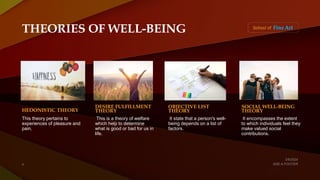
THEORIES OF WELL-BEING
HEDONISTIC THEORY
This theory pertains to
experiences of pleasure and
pain.
DESIRE FULFILLMENT
THEORY
This is a theory of welfare
which help to determine
what is good or bad for us in
life.
OBJECTIVE LIST
THEORY
It state that a person's well-
being depends on a list of
factors.
SOCIAL WELL-BEING
THEORY
It encompasses the extent
to which individuals feel they
make valued social
contributions.
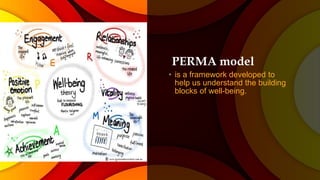
PERMA model
• is a framework developed to
help us understand the building
blocks of well-being.
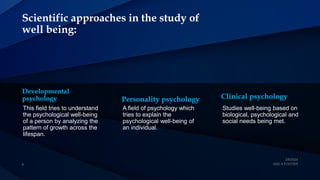
Scientific approaches in the study of
well being:
Developmental
psychology
This field tries to understand
the psychological well-being
of a person by analyzing the
pattern of growth across the
lifespan.
Personality psychology
A field of psychology which
tries to explain the
psychological well-being of
an individual.
Clinical psychology
Studies well-being based on
biological, psychological and
social needs being met.
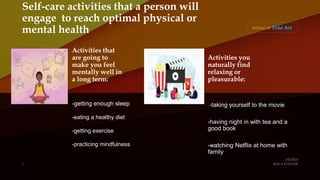
Self-care activities that a person will
engage to reach optimal physical or
mental health
Activities that
are going to
make you feel
mentally well in
a long term:
-getting enough sleep
-eating a healthy diet
-getting exercise
-practicing mindfulness
Activities you
naturally find
relaxing or
pleasurable:
-taking yourself to the movie
-having night in with tea and a
good book
-watching Netflix at home with
family
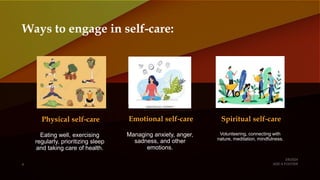
Ways to engage in self-care:
Physical self-care
Eating well, exercising
regularly, prioritizing sleep
and taking care of health.
Emotional self-care
Managing anxiety, anger,
sadness, and other
emotions.
Spiritual self-care
Volunteering, connecting with
nature, meditation, mindfulness.
Taking Care of the Self: The Need for Self-Care and
Compassion
Self-care is engaging in activities and behaviors that have a positive effect on one's mental and
physical health
Compassion is defined as the feeling that arises
when you are confronted with another's suffering
and feel motivated to relieve that suffering.
There are various forms of compassion and why they are so important.
Paul Ekman enumerates:
FAMILIAL COMPASSION
• It is the seed of compassion, planted
through our family, the caregiver-offspring
experience.
GLOBAL COMPASSION
• The care and concern for those around the
globe, with whom we have no personal
relationship.
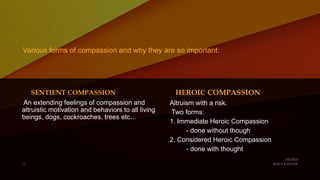
Various forms of compassion and why they are so important:
SENTIENT COMPASSION
An extending feelings of compassion and
altruistic motivation and behaviors to all living
beings, dogs, cockroaches, trees etc…
HEROIC COMPASSION
Altruism with a risk.
Two forms:
1. Immediate Heroic Compassion
- done without though
2. Considered Heroic Compassion
- done with thought
LOVE THE LIFE GIVEN BY GOD
TO YOU.
BE COMPASSIONATE TO
YOURSELF AND OTHERS!
HAVE A MEANINGFUL
JOURNEY OF LIFE AND GOD
BLESS!

UNDERSTANDING THE SELF: WELL-BEING.pptx

  • 1.
  • 2.
    WELL-BEING It is theexperience of health, happiness, and prosperity which includes having good mental health, high life satisfaction, a sense of meaning or purpose, and ability to manage stress. More generally, well-being is just feeling well.
  • 3.
    5 MAJOR TYPESOF WELL-BEING 20XX Month EMOTIONAL WELL- BEING The ability to practice stress-management and relaxation techniques, be resilient, boost self-love, and generate the emotions that lead to good feelings. 20XX Month PHYSICAL WELL- BEING The ability to improve the functioning of your body through healthy living and good exercise habits. 20XX Month SOCIAL WELL- BEING The ability to communicate, develop meaningful relationships with others, and maintain a support network that helps you overcome loneliness. 20XX Month WORKPLACE WELL- BEING. The ability to pursue your interests, values, and life purpose in order to gain meaning, happiness, and enrichment professionally. 20XX Month SOCIETAL WELL- BEING The ability to actively participate in a thriving community, culture, and environment.
  • 4.
    THEORIES OF WELL-BEING HEDONISTICTHEORY This theory pertains to experiences of pleasure and pain. DESIRE FULFILLMENT THEORY This is a theory of welfare which help to determine what is good or bad for us in life. OBJECTIVE LIST THEORY It state that a person's well- being depends on a list of factors. SOCIAL WELL-BEING THEORY It encompasses the extent to which individuals feel they make valued social contributions.
  • 5.
    PERMA model • isa framework developed to help us understand the building blocks of well-being.
  • 6.
    Scientific approaches inthe study of well being: Developmental psychology This field tries to understand the psychological well-being of a person by analyzing the pattern of growth across the lifespan. Personality psychology A field of psychology which tries to explain the psychological well-being of an individual. Clinical psychology Studies well-being based on biological, psychological and social needs being met.
  • 7.
    Self-care activities thata person will engage to reach optimal physical or mental health Activities that are going to make you feel mentally well in a long term: -getting enough sleep -eating a healthy diet -getting exercise -practicing mindfulness Activities you naturally find relaxing or pleasurable: -taking yourself to the movie -having night in with tea and a good book -watching Netflix at home with family
  • 8.
    Ways to engagein self-care: Physical self-care Eating well, exercising regularly, prioritizing sleep and taking care of health. Emotional self-care Managing anxiety, anger, sadness, and other emotions. Spiritual self-care Volunteering, connecting with nature, meditation, mindfulness.
  • 9.
    Taking Care ofthe Self: The Need for Self-Care and Compassion Self-care is engaging in activities and behaviors that have a positive effect on one's mental and physical health
  • 10.
    Compassion is definedas the feeling that arises when you are confronted with another's suffering and feel motivated to relieve that suffering. There are various forms of compassion and why they are so important. Paul Ekman enumerates: FAMILIAL COMPASSION • It is the seed of compassion, planted through our family, the caregiver-offspring experience. GLOBAL COMPASSION • The care and concern for those around the globe, with whom we have no personal relationship.
  • 11.
    Various forms ofcompassion and why they are so important: SENTIENT COMPASSION An extending feelings of compassion and altruistic motivation and behaviors to all living beings, dogs, cockroaches, trees etc… HEROIC COMPASSION Altruism with a risk. Two forms: 1. Immediate Heroic Compassion - done without though 2. Considered Heroic Compassion - done with thought
  • 12.
    LOVE THE LIFEGIVEN BY GOD TO YOU. BE COMPASSIONATE TO YOURSELF AND OTHERS! HAVE A MEANINGFUL JOURNEY OF LIFE AND GOD BLESS!