LEARNING OBJECTIVE:
•At the end of today’s session
students will be able to
differentiate the various
perspectives of philosophy in
defining the self.
VARIOUS
PHILOSOPHICAL
PERSPECTIVES OF
THE SELF
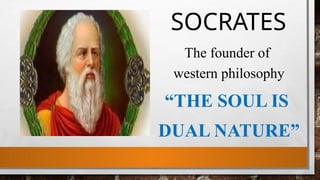
SOCRATES
The founder of
western philosophy
“THE SOUL IS
DUAL NATURE”
“KNOW THY SELF”
Know Thyself to be wise, that the "unexamined life is
not worth living" . Thus it is a cruel irony that Socrates
was condemned to death for corrupting the youth (for
educating them to Philosophy and arguing that people
are ignorant of the Truth).
• SELF – is not just the physical body, but rather the PSYCHE
(soul).
• Every man is composed of body and soul (dualistic)
a) Soul- perfect, permanent, and immortal
b) Body- imperfect and impermanent
“KNOW THY SELF”
Know Thyself to be wise, that the
"unexamined life is not worth living" .
Thus it is a cruel irony that Socrates
was condemned to death for
corrupting the youth (for educating
them to Philosophy and arguing that
people are ignorant of the Truth).
SELF – Every man is composed of body and
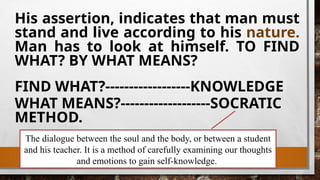
The dialogue between the soul and the body, or between a student
and his teacher. It is a method of carefully examining our thoughts
and emotions to gain self-knowledge.
His assertion, indicates that man must
stand and live according to his nature.
Man has to look at himself. TO FIND
WHAT? BY WHAT MEANS?
FIND WHAT?------------------KNOWLEDGE
WHAT MEANS?-------------------SOCRATIC
METHOD.
•IT CAN HELP ITS FOLLOWERS TO DISCOVER
THE TRUTHS THEY HAVE IN THEM.
WITHOUT THIS WORK ON YOURSELF, LIFE IS
WORTHLESS ACCORDING TO SOCRATES:
“AN UNEXAMINED LIFE NOT WORTH LIVING”
• Knowledge is necessary to become
virtuous and virtue is necessary to
attain happiness, personification
of good.
• All evil are committed out of
ignorance and hence involuntary.
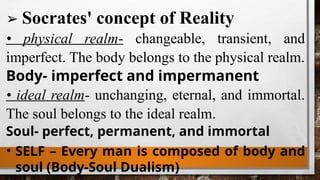
➢ Socrates' concept of Reality
• physical realm- changeable, transient, and
imperfect. The body belongs to the physical realm.
Body- imperfect and impermanent
• ideal realm- unchanging, eternal, and immortal.
The soul belongs to the ideal realm.
Soul- perfect, permanent, and immortal
• SELF – Every man is composed of body and
soul (Body-Soul Dualism)
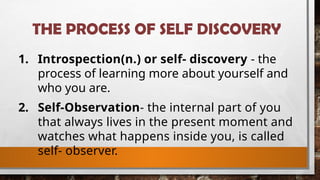
THE PROCESS OF SELF DISCOVERY
1. Introspection(n.) or self- discovery - the
process of learning more about yourself and
who you are.
2. Self-Observation- the internal part of you
that always lives in the present moment and
watches what happens inside you, is called
self- observer.
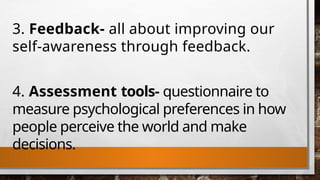
3. Feedback- all about improving our
self-awareness through feedback.
4. Assessment tools- questionnaire to
measure psychological preferences in how
people perceive the world and make
decisions.
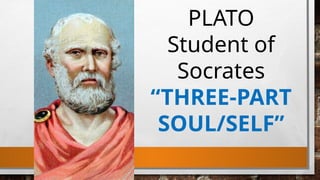
PLATO
Student of
Socrates
“THREE-PART
SOUL/SELF”
“THE SOUL IS IMMORTAL”
In Plato's philosophy, the concept of the
self is closely tied to his theory of the soul.
Plato views the self as essentially the soul,
which he believes to be the true essence of
a person, distinct from the body. The soul,
according to Plato, is immortal, pre-
existing before birth and continuing to
exist after death.
IDENTIFIED THE 3 COMPONENTS OF SOUL (APPETITIVE,
RATIONAL AND SPIRITED)
1.Rational Soul (Logos): This part is associated with reason, wisdom,
and intellect. It seeks truth and knowledge and is considered the
highest part of the soul. In an ideal state, the rational soul should
govern the other parts.
2.Spirited Soul (Thumos): This part is related to emotions, particularly
those connected to honor and courage. It drives individuals toward
action and is responsible for feelings of anger, indignation, and
pride.
3.Appetitive Soul (Epithumia): This part is linked to desires,
particularly physical and material desires such as hunger, thirst, and
sexual urges. It is the lowest part of the soul and must be controlled
by the rational part to maintain harmony.
The Development of self
knowledge is emphasized the
social aspect of human nature –
that we are not self-sufficient, we
need others, and we benefit from
our social interactions, from other
person’s talents, aptitudes, and
friendship.
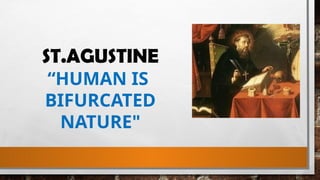
ST.AGUSTINE
“HUMAN IS
BIFURCATED
NATURE"
BODY- SOUL DUALISM
Augustine believes that the body dies
whereas the soul can stay after death
in an eternal realm with an all-
transcendent GOD.
Augustine tries to reconcile his beliefs
about freewill, especially the belief that
humans are morally responsible for
their actions.
THE IDEA OF GOOD AND EVIL
• Soul is a prisoner inside the Body
• Humans always choose to do
good, it's just a matter of whether
one chooses a “lesser good.”
 This occurs when one chooses to
allow passions and desires rule
the soul, which tend toward
WHY MAN CHOOSES TO DO ‘LESSER
GOOD’?
DO YOU BELIEVE THAT YOU ARE
PREDESTINED?
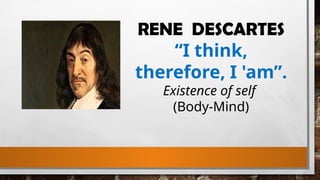
RENE DESCARTES
“I think,
therefore, I 'am”.
Existence of self
(Body-Mind)
I THINK, THEREFORE I AM’
 A philosophical conclusion from René
Descartes, who in order to work out
what he really, really did know for sure,
started by doubting everything.
 He knew that he definitely could and did
think and so concluded that if he could
think, he must exist.
 Existence of self for Descartes
becomes necessary because the self
thinks.
****Because I am the one doubting,
it rationally means that all can be
doubted except me.
*Self is reason or consciousness.
(rationalism turns idealism)
DESCARTES ALSO SAID THAT THERE IS
ALSO A COMBINATION OF TWO DISTINCT
ENTITIES:
1.Cogito- the thing that thinks, which is the mind
2.Extenza- extension of the mind, which is the body
•In Descartes's view, the body is nothing else but a
machine that is attached to the mind. The human person
has it but it is not what makes a man a man. If at all, that
is the mind.
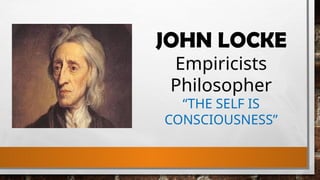
JOHN LOCKE
Empiricists
Philosopher
“THE SELF IS
CONSCIOUSNESS”
EMPIRICISM- There is no such
thing as innate knowledge;
all knowledge are derived
from experience- through
five senses or what is
perceived by our brain.
TABULA RASA (EMPTY SLATE)
He is of the view that soul is clear and
empty at birth. Ideas come from our
experience and that is what fills the
soul.
These ideas come into us through our
sense apparatus and they come in the
form of sense data.
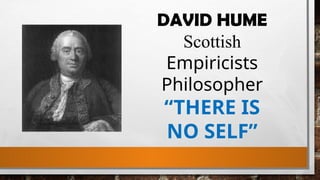
DAVID HUME
Scottish
Empiricists
Philosopher
“THERE IS
NO SELF”
Self is a unified combination of all
experience of a person.
Men can only attain knowledge by
experiencing.
All knowledge passes through the sense.
Self is a bundle of different perceptions
with inconceivable rapidity and are in
perpetual movement.
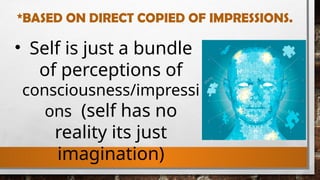
*BASED ON DIRECT COPIED OF IMPRESSIONS.
• Self is just a bundle
of perceptions of
consciousness/impressi
ons (self has no
reality its just
imagination)
TWO KINDS OF PERCEPTION:
•Hume recognized two kinds of perception:
“impressions” and “ideas.” Impressions are
perceptions that the mind experiences
with the “most force and violence,” and
ideas are the “faint images” of
impressions.
•Impressions are felt (core of thought;
vivid), and ideas are thought (not vivid).
www.britannica.c
om
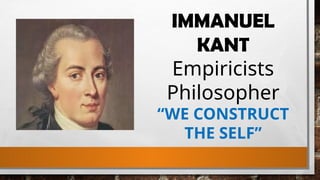
IMMANUEL
KANT
Empiricists
Philosopher
“WE CONSTRUCT
THE SELF”
•Kant was an influential German Philosopher in
the Age of Enlightenment.
•Kant's idea of the self was in response of
Hume’s notion that the mind is just a vessel of
fleeting sensations. Kant argued that it is the
mind’s inherent characteristics to unify, classify,
and synthesize information. As a result, we gain
insights and understanding of the world, as
well as knowledge about ourselves
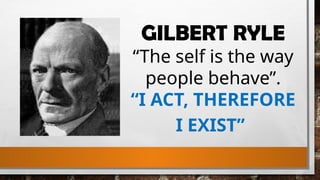
GILBERT RYLE
“The self is the way
people behave”.
“I ACT, THEREFORE
I EXIST”
1. Self is not an entity one
can locate or analyze.
Simply a convenient name
that people use to refer all
behaviors that people
make.
•“I Act Therefore, I 'Am”
•Arguing That Mind Does Not Exist And
Therefore Can’t Be The Seat Of Self
•He Believed That Self Comes From The
Behavior
•We Are Just A Bundle Of Behavior
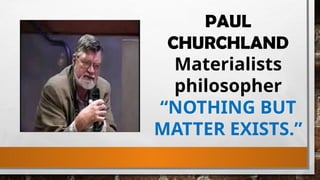
PAUL
CHURCHLAND
Materialists
philosopher
“NOTHING BUT
MATTER EXISTS.”
MIND-BODY problem:
•What is the mind? What is the body?
Materialist theories – state of the
mind/ soul are physical states –
states of the brain (or both a
material body)
•Churchland holds to
materialism, the belief that
nothing but matter exists. When
discussing the mind, this means
that the physical brain, and not the
mind, exists
ADVANTAGES OF MATERIALISM:
1. More parsimonious
2. Materialism can explain things
that dualism cannot in
understanding the function of the
brain.
•Materialism – nothing but matter
exist
Eliminative materialism
•Is the claim that people's common-sense
understanding of the mind (or traditional
psychology) is false and that certain
classes of mental states that most people
believe in do not exist.
•Is the claim that certain types of “mental
states” that most people believe in do not
exist. It is a materialist position in the
philosophy of mind.
•Churchland argue that
eliminativism is often
necessary in order to open
the minds of thinkers to new
evidence and better
explanations
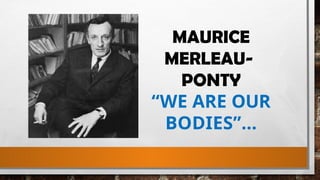
MAURICE
MERLEAU-
PONTY
“WE ARE OUR
BODIES”…
SUBJECTIVITY
• A subject is a real thing that can take
real action and cause real effects. In
short, it exists. Keeping this in
mind, Maurice Merleau-
Ponty believed the physical body to be
an important part of what makes up
the subjective self.
RATIONALISM
•When speaking of self or
being, rationalism asserts that reason
and mental perception, rather than
physical senses and experience, are
the basis of knowledge and self. In
other words, our rational thinking
minds are where it's all at!
EMPIRICISM
•Is the belief that our physical
senses are the only source of
knowledge.
Our bodily experiences do not detach
the subject, object, mind, body,
rational/irrational.
The body and mind are inseparable.
The living body, his thoughts, emotions,
and experiences are all one.
Unity of soul and body as well as their
relative distinction.

UNDERSTANDING THE SELF-- --Lesson 1.pptx

  • 1.
    LEARNING OBJECTIVE: •At theend of today’s session students will be able to differentiate the various perspectives of philosophy in defining the self.
  • 2.
  • 3.
    SOCRATES The founder of westernphilosophy “THE SOUL IS DUAL NATURE”
  • 4.
    “KNOW THY SELF” KnowThyself to be wise, that the "unexamined life is not worth living" . Thus it is a cruel irony that Socrates was condemned to death for corrupting the youth (for educating them to Philosophy and arguing that people are ignorant of the Truth). • SELF – is not just the physical body, but rather the PSYCHE (soul). • Every man is composed of body and soul (dualistic) a) Soul- perfect, permanent, and immortal b) Body- imperfect and impermanent
  • 5.
    “KNOW THY SELF” KnowThyself to be wise, that the "unexamined life is not worth living" . Thus it is a cruel irony that Socrates was condemned to death for corrupting the youth (for educating them to Philosophy and arguing that people are ignorant of the Truth). SELF – Every man is composed of body and
  • 6.
    The dialogue betweenthe soul and the body, or between a student and his teacher. It is a method of carefully examining our thoughts and emotions to gain self-knowledge. His assertion, indicates that man must stand and live according to his nature. Man has to look at himself. TO FIND WHAT? BY WHAT MEANS? FIND WHAT?------------------KNOWLEDGE WHAT MEANS?-------------------SOCRATIC METHOD.
  • 7.
    •IT CAN HELPITS FOLLOWERS TO DISCOVER THE TRUTHS THEY HAVE IN THEM. WITHOUT THIS WORK ON YOURSELF, LIFE IS WORTHLESS ACCORDING TO SOCRATES: “AN UNEXAMINED LIFE NOT WORTH LIVING”
  • 8.
    • Knowledge isnecessary to become virtuous and virtue is necessary to attain happiness, personification of good. • All evil are committed out of ignorance and hence involuntary.
  • 9.
    ➢ Socrates' conceptof Reality • physical realm- changeable, transient, and imperfect. The body belongs to the physical realm. Body- imperfect and impermanent • ideal realm- unchanging, eternal, and immortal. The soul belongs to the ideal realm. Soul- perfect, permanent, and immortal • SELF – Every man is composed of body and soul (Body-Soul Dualism)
  • 10.
    THE PROCESS OFSELF DISCOVERY 1. Introspection(n.) or self- discovery - the process of learning more about yourself and who you are. 2. Self-Observation- the internal part of you that always lives in the present moment and watches what happens inside you, is called self- observer.
  • 11.
    3. Feedback- allabout improving our self-awareness through feedback. 4. Assessment tools- questionnaire to measure psychological preferences in how people perceive the world and make decisions.
  • 12.
  • 13.
    “THE SOUL ISIMMORTAL” In Plato's philosophy, the concept of the self is closely tied to his theory of the soul. Plato views the self as essentially the soul, which he believes to be the true essence of a person, distinct from the body. The soul, according to Plato, is immortal, pre- existing before birth and continuing to exist after death.
  • 14.
    IDENTIFIED THE 3COMPONENTS OF SOUL (APPETITIVE, RATIONAL AND SPIRITED) 1.Rational Soul (Logos): This part is associated with reason, wisdom, and intellect. It seeks truth and knowledge and is considered the highest part of the soul. In an ideal state, the rational soul should govern the other parts. 2.Spirited Soul (Thumos): This part is related to emotions, particularly those connected to honor and courage. It drives individuals toward action and is responsible for feelings of anger, indignation, and pride. 3.Appetitive Soul (Epithumia): This part is linked to desires, particularly physical and material desires such as hunger, thirst, and sexual urges. It is the lowest part of the soul and must be controlled by the rational part to maintain harmony.
  • 15.
    The Development ofself knowledge is emphasized the social aspect of human nature – that we are not self-sufficient, we need others, and we benefit from our social interactions, from other person’s talents, aptitudes, and friendship.
  • 16.
  • 17.
    BODY- SOUL DUALISM Augustinebelieves that the body dies whereas the soul can stay after death in an eternal realm with an all- transcendent GOD. Augustine tries to reconcile his beliefs about freewill, especially the belief that humans are morally responsible for their actions.
  • 18.
    THE IDEA OFGOOD AND EVIL • Soul is a prisoner inside the Body • Humans always choose to do good, it's just a matter of whether one chooses a “lesser good.”  This occurs when one chooses to allow passions and desires rule the soul, which tend toward
  • 19.
    WHY MAN CHOOSESTO DO ‘LESSER GOOD’? DO YOU BELIEVE THAT YOU ARE PREDESTINED?
  • 20.
    RENE DESCARTES “I think, therefore,I 'am”. Existence of self (Body-Mind)
  • 21.
    I THINK, THEREFOREI AM’  A philosophical conclusion from René Descartes, who in order to work out what he really, really did know for sure, started by doubting everything.  He knew that he definitely could and did think and so concluded that if he could think, he must exist.
  • 22.
     Existence ofself for Descartes becomes necessary because the self thinks. ****Because I am the one doubting, it rationally means that all can be doubted except me. *Self is reason or consciousness. (rationalism turns idealism)
  • 23.
    DESCARTES ALSO SAIDTHAT THERE IS ALSO A COMBINATION OF TWO DISTINCT ENTITIES: 1.Cogito- the thing that thinks, which is the mind 2.Extenza- extension of the mind, which is the body •In Descartes's view, the body is nothing else but a machine that is attached to the mind. The human person has it but it is not what makes a man a man. If at all, that is the mind.
  • 24.
  • 25.
    EMPIRICISM- There isno such thing as innate knowledge; all knowledge are derived from experience- through five senses or what is perceived by our brain.
  • 26.
    TABULA RASA (EMPTYSLATE) He is of the view that soul is clear and empty at birth. Ideas come from our experience and that is what fills the soul. These ideas come into us through our sense apparatus and they come in the form of sense data.
  • 27.
  • 28.
    Self is aunified combination of all experience of a person. Men can only attain knowledge by experiencing. All knowledge passes through the sense. Self is a bundle of different perceptions with inconceivable rapidity and are in perpetual movement.
  • 29.
    *BASED ON DIRECTCOPIED OF IMPRESSIONS. • Self is just a bundle of perceptions of consciousness/impressi ons (self has no reality its just imagination)
  • 30.
    TWO KINDS OFPERCEPTION: •Hume recognized two kinds of perception: “impressions” and “ideas.” Impressions are perceptions that the mind experiences with the “most force and violence,” and ideas are the “faint images” of impressions. •Impressions are felt (core of thought; vivid), and ideas are thought (not vivid). www.britannica.c om
  • 31.
  • 32.
    •Kant was aninfluential German Philosopher in the Age of Enlightenment. •Kant's idea of the self was in response of Hume’s notion that the mind is just a vessel of fleeting sensations. Kant argued that it is the mind’s inherent characteristics to unify, classify, and synthesize information. As a result, we gain insights and understanding of the world, as well as knowledge about ourselves
  • 33.
    GILBERT RYLE “The selfis the way people behave”. “I ACT, THEREFORE I EXIST”
  • 34.
    1. Self isnot an entity one can locate or analyze. Simply a convenient name that people use to refer all behaviors that people make.
  • 35.
    •“I Act Therefore,I 'Am” •Arguing That Mind Does Not Exist And Therefore Can’t Be The Seat Of Self •He Believed That Self Comes From The Behavior •We Are Just A Bundle Of Behavior
  • 36.
  • 37.
    MIND-BODY problem: •What isthe mind? What is the body? Materialist theories – state of the mind/ soul are physical states – states of the brain (or both a material body)
  • 38.
    •Churchland holds to materialism,the belief that nothing but matter exists. When discussing the mind, this means that the physical brain, and not the mind, exists
  • 39.
    ADVANTAGES OF MATERIALISM: 1.More parsimonious 2. Materialism can explain things that dualism cannot in understanding the function of the brain. •Materialism – nothing but matter exist
  • 40.
    Eliminative materialism •Is theclaim that people's common-sense understanding of the mind (or traditional psychology) is false and that certain classes of mental states that most people believe in do not exist. •Is the claim that certain types of “mental states” that most people believe in do not exist. It is a materialist position in the philosophy of mind.
  • 41.
    •Churchland argue that eliminativismis often necessary in order to open the minds of thinkers to new evidence and better explanations
  • 42.
  • 43.
    SUBJECTIVITY • A subjectis a real thing that can take real action and cause real effects. In short, it exists. Keeping this in mind, Maurice Merleau- Ponty believed the physical body to be an important part of what makes up the subjective self.
  • 44.
    RATIONALISM •When speaking ofself or being, rationalism asserts that reason and mental perception, rather than physical senses and experience, are the basis of knowledge and self. In other words, our rational thinking minds are where it's all at!
  • 45.
    EMPIRICISM •Is the beliefthat our physical senses are the only source of knowledge.
  • 46.
    Our bodily experiencesdo not detach the subject, object, mind, body, rational/irrational. The body and mind are inseparable. The living body, his thoughts, emotions, and experiences are all one. Unity of soul and body as well as their relative distinction.

Editor's Notes

  • #8 Virtue- behavior showing high moral standards. Morality can be understood as a system of beliefs, values, and principles that guide individuals and societies in determining what is considered right or wrong. Morality example- Stealing is unacceptable, so you return the things that are not yours Virtue: Honesty
  • #14 For Plato, the self is not just a single unified entity but a composite of these three parts. He divides the soul into three parts:
  • #15 This idea suggests that understanding oneself is not an isolated process but one that benefits from relationships, friendships, and the talents of others. It highlights how our mental life (our understanding of ourselves) is influenced by our relationships with others