Deep Learning Srihari
Recursive Neural Networks
Sargur Srihari
srihari@buffalo.edu
1
Deep Learning Srihari
Topics
• Sequence Modeling: Recurrent and Recursive Nets
1. Unfolding Computational Graphs
2. Recurrent Neural Networks
3. Bidirectional RNNs
4. Encoder-Decoder Sequence-to-Sequence Architectures
5. Deep Recurrent Networks
6. Recursive Neural Networks
7. The Challenge of Long-Term Dependencies
8. Echo-State Networks
9. Leaky Units and Other Strategies for Multiple Time Scales
10.LSTM and Other Gated RNNs
11. Optimization for Long-Term Dependencies
12.Explicit Memory
2
Deep Learning Srihari
Recursive Neural Networks
• They are yet another generalization of recurrent networks with
a different kind of computational graph
• It is structured as a deep tree, rather than the chain structure of
RNNs
• The typical computational graph for a recursive network is
shown next
3
Deep Learning Srihari
Computational graph of a Recursive Network
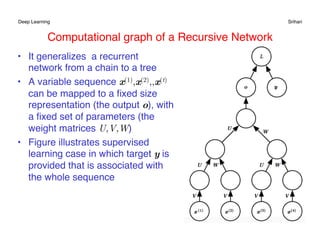
• It generalizes a recurrent
network from a chain to a tree
• A variable sequence x(1),x(2),,x(t)
can be mapped to a fixed size
representation (the output o), with
a fixed set of parameters (the
weight matrices U,V,W)
• Figure illustrates supervised
learning case in which target y is
provided that is associated with
the whole sequence
4
Deep Learning Srihari
Advantage of Recursive over Recurrent Nets
• For a sequence of the same length τ, the depth (measured as
the no. of compositions of nonlinear operations) can be reduced
from τ to O(log τ), which might help deal with long-term
dependencies
• An open question is how best to structure the tree
5
Deep Learning Srihari
Need for Recursive nets in NLP
• Deep learning based methods learn low-dimensional, real-
valued vectors for word tokens, mostly from a large data
corpus, successfully capturing syntactic and semantic
aspects of text
• For tasks where the inputs are larger text units, e.g.,
phrases, sentences or documents, a compositional model
is first needed to aggregate tokens into a vector with fixed
dimensionality that can be used for other NLP tasks
• Models for achieving this fall into two categories: recurrent
models and recursive models
6
Deep Learning Srihari
Recurrent Model for NLP
• Recurrent models deal successfully with time series data
• The recurrent models generally consider no linguistic structure
aside from the word order
• They were applied early on to NLP by modeling a sentence as
tokens processed sequentially and at each step combining the
current token with previously built embeddings
• Recurrent models can be extended to bidirectional ones from
both left to right and right to left
• These models consider no linguistic structure aside from word
order
7
Deep Learning Srihari
Recursive Models for NLP
• Recursive neural models (also referred to as tree models) by
contrast are structured by syntactic parse trees
• Instead of considering tokens sequentially, recursive models
combine neighbors based on the recursive structure of parse
trees, starting from the leaves and proceeding recursively in a
bottom-up fashion until the root of the parse tree is reached
• Ex: for the phrase the food is delicious, following the operation sequence
((the food) (is delicious)) rather than the sequential order (((the food) is)
delicious)
8
Deep Learning Srihari
Advantage of Recursive Model for NLP
• They have the potential of capturing long-distance
dependencies
• Two tokens may be structurally closer to each other even
though they are far away in word sequence
• Ex: a verb and its corresponding direct object can be far away
in terms of tokens if many adjectives lie inbetween, but they are
adjacent in the parse tree
• However parsing is slow and domain dependent
• See performance comparison with LSTM on four NLP tasks at
https://nlp.stanford.edu/pubemnlp2015_2_jiwei.pdf
9
Deep Learning Srihari
Structure of the Tree
• One option is to have a tree structure that does not depend on
the data, such as a balanced binary tree
• In some application domains, external methods can suggest the
appropriate tree structure
• Ex: when processing natural language sentences, the tree structure for
the recursive network can be fixed to the structure of the parse tree of
the sentence provided by a natural language parse
• Ideally, one would like the learner itself to discover and infer the
tree structure that is appropriate for any given input
10
Deep Learning Srihari
Variants of Recursive Net idea
• Associate data with a tree structure and associate inputs and
targets with individual nodes of the tree
• The computation performed for each node does not have to be the
artificial neuron computation (affine transformation of all inputs followed
by a monotone nonlinearity)
• Can use a tensor operations of bilinear forms
• Previously found useful to model linear relationships between
concepts when the concepts are represented by continuous vectors
11
Deep Learning Srihari
Recursive Neural Networks
• Recursive neural networks
are also called Tree Nets
• Useful for learning tree-like
structures
• They are highly useful for
parsing natural scenes and
language
12
Deep Learning Srihari
Unrolling Recurrent and Tree Nets
• In RNNs, at each time step the network takes as input its
previous state s(t-1) and its current input x(t) and produces an
output y(t) and a new hidden state s(t).
• TreeNets, on the other hand, don’t have a simple linear
structure like that.
• With RNNs, you can ‘unroll’ the net and think of it as a large
feedforward net with inputs x(0), x(1), …, x(T), initial state s(0),
and outputs y(0),y(1),…,y(T), with T varying depending on the
input data stream, and the weights in each of the cells tied with
each other.
• You can also think of TreeNets by unrolling them – the weights
in each branch node are tied with each other, and the weights
in each leaf node are tied with each other.
13
Deep Learning Srihari
Advantage of Recursive Nets
• The advantage of Recursive Nets is that they can be very
powerful in learning hierarchical, tree-like structure.
• The disadvantages are, firstly, that the tree structure of every
input sample must be known at training time.
14

Understanding Recursive Neural Networks.

  • 1.
    Deep Learning Srihari RecursiveNeural Networks Sargur Srihari srihari@buffalo.edu 1
  • 2.
    Deep Learning Srihari Topics •Sequence Modeling: Recurrent and Recursive Nets 1. Unfolding Computational Graphs 2. Recurrent Neural Networks 3. Bidirectional RNNs 4. Encoder-Decoder Sequence-to-Sequence Architectures 5. Deep Recurrent Networks 6. Recursive Neural Networks 7. The Challenge of Long-Term Dependencies 8. Echo-State Networks 9. Leaky Units and Other Strategies for Multiple Time Scales 10.LSTM and Other Gated RNNs 11. Optimization for Long-Term Dependencies 12.Explicit Memory 2
  • 3.
    Deep Learning Srihari RecursiveNeural Networks • They are yet another generalization of recurrent networks with a different kind of computational graph • It is structured as a deep tree, rather than the chain structure of RNNs • The typical computational graph for a recursive network is shown next 3
  • 4.
    Deep Learning Srihari Computationalgraph of a Recursive Network • It generalizes a recurrent network from a chain to a tree • A variable sequence x(1),x(2),,x(t) can be mapped to a fixed size representation (the output o), with a fixed set of parameters (the weight matrices U,V,W) • Figure illustrates supervised learning case in which target y is provided that is associated with the whole sequence 4
  • 5.
    Deep Learning Srihari Advantageof Recursive over Recurrent Nets • For a sequence of the same length τ, the depth (measured as the no. of compositions of nonlinear operations) can be reduced from τ to O(log τ), which might help deal with long-term dependencies • An open question is how best to structure the tree 5
  • 6.
    Deep Learning Srihari Needfor Recursive nets in NLP • Deep learning based methods learn low-dimensional, real- valued vectors for word tokens, mostly from a large data corpus, successfully capturing syntactic and semantic aspects of text • For tasks where the inputs are larger text units, e.g., phrases, sentences or documents, a compositional model is first needed to aggregate tokens into a vector with fixed dimensionality that can be used for other NLP tasks • Models for achieving this fall into two categories: recurrent models and recursive models 6
  • 7.
    Deep Learning Srihari RecurrentModel for NLP • Recurrent models deal successfully with time series data • The recurrent models generally consider no linguistic structure aside from the word order • They were applied early on to NLP by modeling a sentence as tokens processed sequentially and at each step combining the current token with previously built embeddings • Recurrent models can be extended to bidirectional ones from both left to right and right to left • These models consider no linguistic structure aside from word order 7
  • 8.
    Deep Learning Srihari RecursiveModels for NLP • Recursive neural models (also referred to as tree models) by contrast are structured by syntactic parse trees • Instead of considering tokens sequentially, recursive models combine neighbors based on the recursive structure of parse trees, starting from the leaves and proceeding recursively in a bottom-up fashion until the root of the parse tree is reached • Ex: for the phrase the food is delicious, following the operation sequence ((the food) (is delicious)) rather than the sequential order (((the food) is) delicious) 8
  • 9.
    Deep Learning Srihari Advantageof Recursive Model for NLP • They have the potential of capturing long-distance dependencies • Two tokens may be structurally closer to each other even though they are far away in word sequence • Ex: a verb and its corresponding direct object can be far away in terms of tokens if many adjectives lie inbetween, but they are adjacent in the parse tree • However parsing is slow and domain dependent • See performance comparison with LSTM on four NLP tasks at https://nlp.stanford.edu/pubemnlp2015_2_jiwei.pdf 9
  • 10.
    Deep Learning Srihari Structureof the Tree • One option is to have a tree structure that does not depend on the data, such as a balanced binary tree • In some application domains, external methods can suggest the appropriate tree structure • Ex: when processing natural language sentences, the tree structure for the recursive network can be fixed to the structure of the parse tree of the sentence provided by a natural language parse • Ideally, one would like the learner itself to discover and infer the tree structure that is appropriate for any given input 10
  • 11.
    Deep Learning Srihari Variantsof Recursive Net idea • Associate data with a tree structure and associate inputs and targets with individual nodes of the tree • The computation performed for each node does not have to be the artificial neuron computation (affine transformation of all inputs followed by a monotone nonlinearity) • Can use a tensor operations of bilinear forms • Previously found useful to model linear relationships between concepts when the concepts are represented by continuous vectors 11
  • 12.
    Deep Learning Srihari RecursiveNeural Networks • Recursive neural networks are also called Tree Nets • Useful for learning tree-like structures • They are highly useful for parsing natural scenes and language 12
  • 13.
    Deep Learning Srihari UnrollingRecurrent and Tree Nets • In RNNs, at each time step the network takes as input its previous state s(t-1) and its current input x(t) and produces an output y(t) and a new hidden state s(t). • TreeNets, on the other hand, don’t have a simple linear structure like that. • With RNNs, you can ‘unroll’ the net and think of it as a large feedforward net with inputs x(0), x(1), …, x(T), initial state s(0), and outputs y(0),y(1),…,y(T), with T varying depending on the input data stream, and the weights in each of the cells tied with each other. • You can also think of TreeNets by unrolling them – the weights in each branch node are tied with each other, and the weights in each leaf node are tied with each other. 13
  • 14.
    Deep Learning Srihari Advantageof Recursive Nets • The advantage of Recursive Nets is that they can be very powerful in learning hierarchical, tree-like structure. • The disadvantages are, firstly, that the tree structure of every input sample must be known at training time. 14