








7 July 2016 1
7 July 2016 2
7 July 2016 3
RELIGIOUS
COMMUNITY LIFE
7 July 2016 4
7 July 2016 6
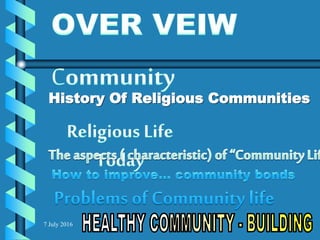
History Of Religious Communities
7 July 2016 7
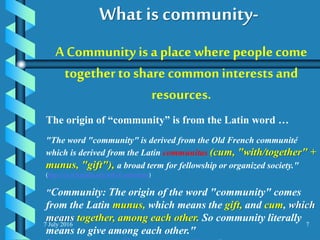
A Community is a place wherepeople come
together to share commoninterests and
resources.
The origin of “community” is from the Latin word …
"The word "community" is derived from the Old French communité
which is derived from the Latin communitas (cum, "with/together" +
munus, "gift"), a broad term for fellowship or organized society."
(http://en.wikipedia.org/wiki/Community)
"Community: The origin of the word "community" comes
from the Latin munus, which means the gift, and cum, which
means together, among each other. So community literally
means to give among each other."
What is community-
7 July 2016 8
A community is not
“MyCommunity”.
It is “Our
7 July 2016 9
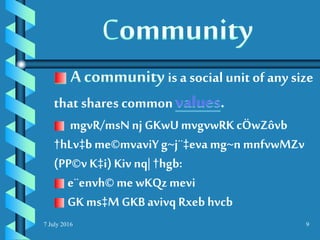
is a social unit of any size
that shares common
mgvR/msN nj GKwUmvgvwRK cÖwZôvb
†hLv‡b me©mvaviY g~j¨‡eva mg~n mnfvwMZv
(PP©v K‡i)Kiv nq| †hgb:
e¨envh© me wKQzmevi
GK ms‡M GKB avivq Rxeb hvcb
7 July 2016 10
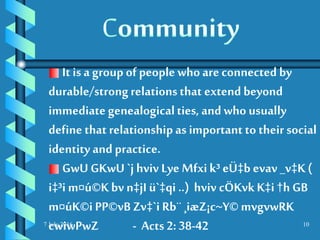
It is a group of people whoareconnected by
durable/strongrelationsthat extend beyond
immediategenealogicalties, andwho usually
define that relationshipas important to their social
identity and practice.
GwU GKwU `j hviv Lye Mfxik³ e܇b evav _v‡K (
i‡³i m¤ú©K bv n‡jI ü`‡qi ..) hviv cÖKvkK‡i †h GB
m¤úK©i PP©vB Zv‡`i Rb¨ ¸iæZ¡c~Y© mvgvwRK
cwiwPwZ - Acts 2: 38-42
7 July 2016 11
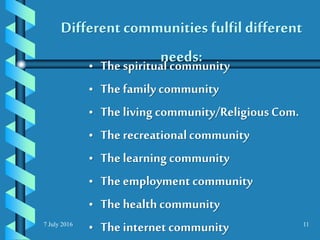
Different communities fulfil different
needs:• The spiritualcommunity
• The familycommunity
• The living community/ReligiousCom.
• The recreationalcommunity
• The learningcommunity
• The employment community
• The health community
• The internet community
7 July 2016 12
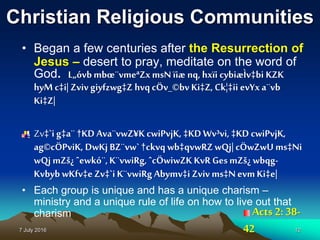
Christian Religious Communities
• Began a few centuries after the Resurrection of
Jesus – desert to pray, meditate on the word of
God. L„óvbmbœ¨vmeªZxmsNïiæ nq, hxïi cybiæÌv‡bi KZK
hyM c‡i| Zvivgiyfzwg‡Z hvqcÖv_©bv Ki‡Z, Ck¦‡ii evYx a¨vb
Ki‡Z|
Zv‡`i g‡a¨ †KD Ava¨vwZ¥K cwiPvjK, ‡KD Wv³vi, ‡KD cwiPvjK,
ag©cÖPviK, DwKj BZ¨vw`†ckvq wb‡qvwRZwQj| cÖwZwU ms‡Ni
wQj mZš¿ ˆewkó¨,K¨vwiRg, ˆcÖwiwZK KvR GesmZš¿ wbqg-
Kvbyb wKfv‡eZv‡`i K¨vwiRg Abymv‡i Zviv ms‡N evmKi‡e|
• Each group is unique and has a unique charism –
ministry and a unique rule of life on how to live out that
charism Acts 2: 38-
42
7 July 2016 13
History
7 July 2016 14
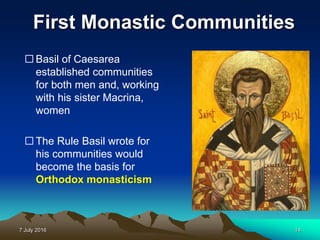
First Monastic Communities
 Basil of Caesarea
established communities
for both men and, working
with his sister Macrina,
women
 The Rule Basil wrote for
his communities would
become the basis for
Orthodox monasticism
7 July 2016 15
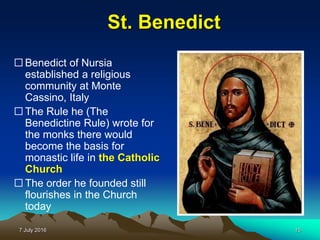
St. Benedict
 Benedict of Nursia
established a religious
community at Monte
Cassino, Italy
 The Rule he (The
Benedictine Rule) wrote for
the monks there would
become the basis for
monastic life in the Catholic
Church
 The order he founded still
flourishes in the Church
today
7 July 2016 16
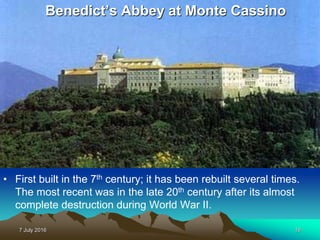
• First built in the 7th century; it has been rebuilt several times.
The most recent was in the late 20th century after its almost
complete destruction during World War II.
Benedict’s Abbey at Monte Cassino
7 July 2016 17
• Today there are two types of religious
communities:
– Contemplative – live and work in their
monasteries and convents
– Active – live in community, but work “in the
world”
7 July 2016 18
Characteristics:
• All membersof religiouscommunitiestakethe
three vowsofpoverty, chastity and
obedience
• Allcommunities haveaspecific “habit” –
• something in their clothing that identifiesthem
as belonging tothat particularcommunity
7 July 2016 19
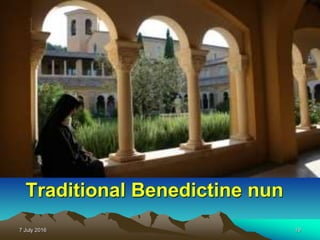
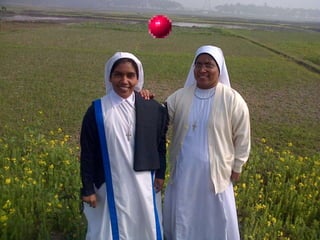
Traditional Benedictine nun
7 July 2016 20
7 July 2016 21
7 July 2016 22
7 July 2016 23
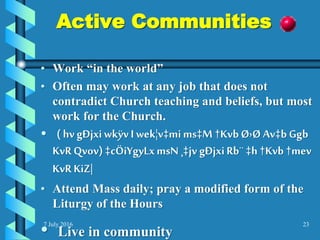
Active Communities
• Work “in the world”
• Often may work at any job that does not
contradict Church teaching and beliefs, but most
work for the Church.
• ( hv gÐjxiwkÿvI wek¦v‡mims‡M †KvbØ›Ø Av‡b Ggb
KvR Qvov) ‡cÖiYgyLxmsN ¸‡jv gÐjxiRb¨ ‡h †Kvb †mev
KvR KiZ|
• Attend Mass daily; pray a modified form of the
Liturgy of the Hours
• Live in community
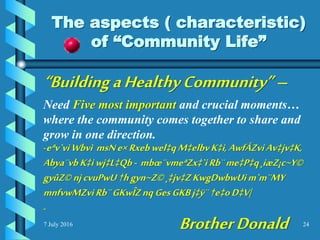
The aspects ( characteristic)
of “Community Life”
7 July 2016 24
“BuildingaHealthyCommunity” –
Need Five most important and crucial moments…
where the community comes together to share and
grow in one direction.
-eªv`viWbvì msNe×Rxebwel‡qM‡elbvK‡i, AwfÁZviAv‡jv‡K,
Abya¨vbK‡i wj‡L‡Qb- mbœ¨vmeªZx‡`iRb¨me‡P‡q¸iæZ¡c~Y©
gyûZ©njcvuPwU†hgyn~Z© ¸‡jv‡ZKwgDwbwUim`m¨MY
mnfvwMZviRb¨GKwÎZnqGesGKBj‡ÿ¨ †e‡oD‡V|
-
BrotherDonald
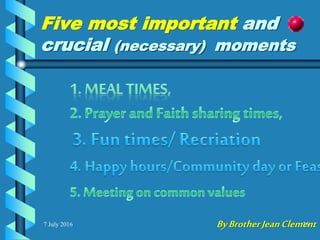
Five most important and
crucial (necessary) moments
7 July 2016 25ByBrotherJeanClement
Five most important moments
7 July 2016 26
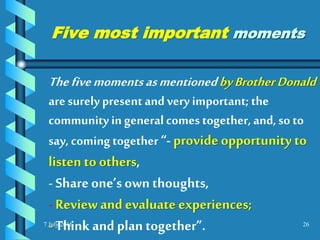
ThefivemomentsasmentionedbyBrotherDonald
are surely present andvery important; the
community in generalcomestogether, and,so to
say, comingtogether “- provide opportunity to
listen to others,
-Share one’sown thoughts,
-Review and evaluate experiences;
-Think and plan together”.
7 July 2016 27
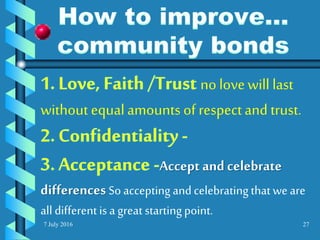
no lovewill last
without equalamounts ofrespectand trust.
Accept and celebrate
differencesSo accepting andcelebratingthatwe are
all differentis a great startingpoint.
7 July 2016 28
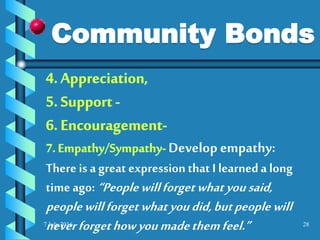
Develop empathy:
There is a great expressionthat I learneda long
time ago: “Peoplewillforgetwhatyousaid,
peoplewillforgetwhatyoudid,butpeoplewill
neverforgethowyoumadethemfeel.”
Community Bonds
7 July 2016 29
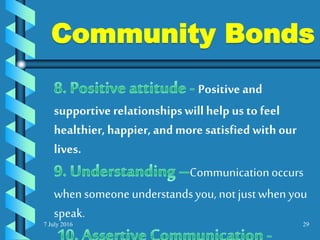
Positive and
supportive relationshipswillhelp us to feel
healthier, happier, andmore satisfiedwith our
lives.
Communicationoccurs
when someone understandsyou, notjustwhen you
speak.
Community Bonds
7 July 2016 30
7 July 2016 31
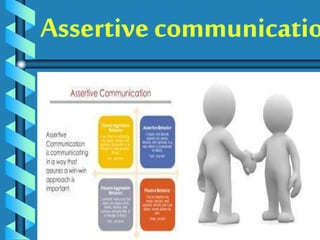
Assertivecommunicationistheabilitytospeakand
interactinamanner(way)thatconsidersand
respectstherightsandopinionsofotherswhile
alsostandingupforyourownrights,needsand
personalboundaries.
AvZ¥cÖZ¨qhy³BwZevPK†hvMv‡hvM(Assertive
communication)njA‡b¨im¤§vb,AwaKviiÿvK‡iK_vejvi
`ÿZv;†hLv‡bwb‡RiAwaKviPvwn`vGese¨w³MZ
mxgve×ZvI‡`Lvnq|
7 July 2016 32
-Assertive communicationis an effective
adaptation to conflictingsituations.
-GUv (Assertive communication) djcÖmyev
mdjKvgfv‡e Ø›Ø ev msNvZc~Y©cwiw¯’wZ‡ZLvc
LvIqv‡bv|
7 July 2016 33
Assertiveness is a key skillin maintaininghealthy
relationships.
 `„pZvev AvZ¥cÖZ¨q nj mym¤úK© ¯’vc‡bi `ÿZvi PvweKvwV|
Four DifferentStyles…
Generally speaking, communication can be characterized
by four different styles.
1. Passive communication: (without active response)
2. Aggressive Communication: (attac kor confront)
3. Passive-Aggressive Communication
4. Assertive Communication: (showing confident forceful
personality)
7 July 2016 34
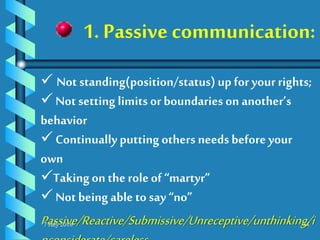
 Not standing(position/status)up for your rights;
 Not setting limitsor boundaries on another’s
behavior
 Continually putting others needs before your
own
Takingon the roleof “martyr”
 Not being able to say “no”
Passive/Reactive/Submissive/Unreceptive/unthinking/i
1. Passive communication:
7 July 2016 35
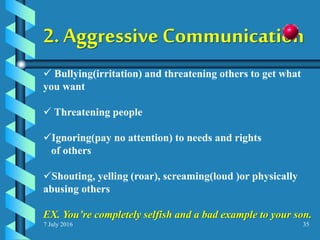
2. Aggressive Communication
 Bullying(irritation) and threatening others to get what
you want
 Threatening people
Ignoring(pay no attention) to needs and rights
of others
Shouting, yelling (roar), screaming(loud )or physically
abusing others
EX. You’re completely selfish and a bad example to your son.
7 July 2016 36
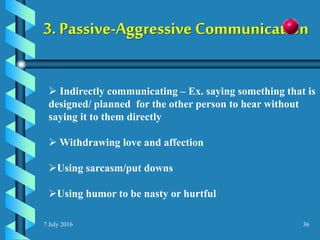
3. Passive-Aggressive Communication
 Indirectly communicating – Ex. saying something that is
designed/ planned for the other person to hear without
saying it to them directly
 Withdrawing love and affection
Using sarcasm/put downs
Using humor to be nasty or hurtful
7 July 2016 37
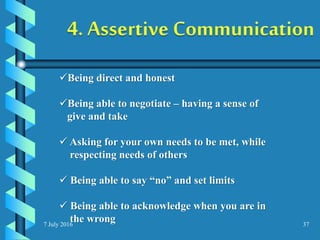
Being direct and honest
Being able to negotiate – having a sense of
give and take
 Asking for your own needs to be met, while
respecting needs of others
 Being able to say “no” and set limits
 Being able to acknowledge when you are in
the wrong
7 July 2016 38
When you are assertive
 Others will feel comfortable, know
where you stand & respect you for your
honesty...
Community Bonds
7 July 2016 39
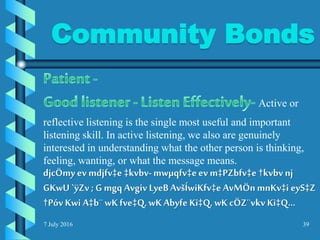
Active or
reflective listening is the single most useful and important
listening skill. In active listening, we also are genuinely
interested in understanding what the other person is thinking,
feeling, wanting, or what the message means.
djcÖmy ev mdjfv‡e ‡kvbv-mwµqfv‡eev m‡PZbfv‡e †kvbvnj
GKwU `ÿZv ; G mgq Avgiv LyeBAvšÍwiKfv‡e AvMÖnmnKv‡i eyS‡Z
†Póv Kwi A‡b¨wKfve‡Q, wKAbyfe Ki‡Q, wK cÖZ¨vkv Ki‡Q...
7 July 2016 40
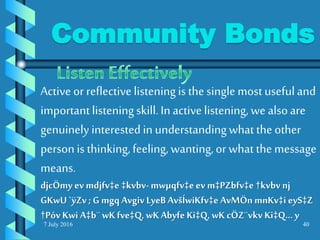
Active or reflective listeningis the singlemost usefuland
importantlisteningskill.In active listening,we alsoare
genuinely interested in understandingwhat the other
person is thinking,feeling, wanting,or what the message
means.
djcÖmy ev mdjfv‡e ‡kvbv-mwµqfv‡eev m‡PZbfv‡e †kvbvnj
GKwU `ÿZv ; G mgq Avgiv LyeBAvšÍwiKfv‡e AvMÖnmnKv‡i eyS‡Z
†Póv Kwi A‡b¨wKfve‡Q, wKAbyfe Ki‡Q, wK cÖZ¨vkv Ki‡Q... y
Community Bonds
7 July 2016 41
7 July 2016 42
7 July 2016 43
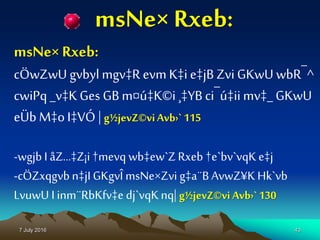
msNe× Rxeb:
msNe×Rxeb:
cÖwZwU gvbylmgv‡R evmK‡ie‡jB Zvi GKwU wbR¯^
cwiPq _v‡K Ges GB m¤ú‡K©i¸‡YB ci¯ú‡ii mv‡_ GKwU
eÜb M‡oI‡VÓ | g½jevZ©viAvb›` 115
-wgjb I åZ…‡Z¡i†mevq wb‡ew`Z Rxeb †e`bv`vqK e‡j
-cÖZxqgvbn‡jIGKgvÎ msNe×Zvi g‡a¨B AvwZ¥K Hk`vb
LvuwU I inm¨RbKfv‡e dj`vqKnq| g½jevZ©viAvb›` 130
7 July 2016 44
7 July 2016 45
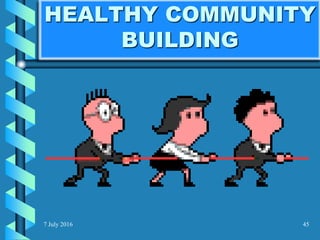
HEALTHY COMMUNITY
BUILDING
7 July 2016 46
Healthy Community Building
By Definition -
Community building is a planned effort
made in order to improve communications
and working relationships…
KwgDwbwU MVb nj-cvi¯úwiK†hvMv‡hv‡Mi Dbœqb
I Kvh©‡ÿ‡Îmym¤úK©¯’vc‡bi Rb¨cwiKwíZ cÖ‡Póv|
7 July 2016 47
 Know the individuals
 skills and abilities
 strengths, weaknesses, blind spots
 Know what the team needs to do
Increases creativity, Increases brainstorming
Increases resources, Increases efficiency
Increasestalents andabilities
 Condition the team for the work
 coach individuals and the team monitor
team conditions
 nurture the team
How To Build a team or
Healthy Community …
7 July 2016 48
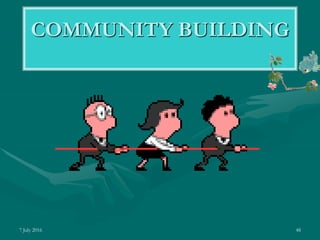
COMMUNITY BUILDING
7 July 2016 497 July 2016 49
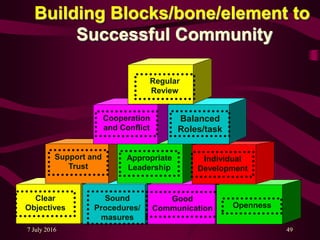
Clear
Objectives
Sound
Procedures/
masures
Good
Communication Openness
Support and
Trust
Appropriate
Leadership
Individual
Development
Cooperation
and Conflict
Balanced
Roles/task
Regular
Review
Building Blocks/bone/element to
Successful Community
7 July 2016 50
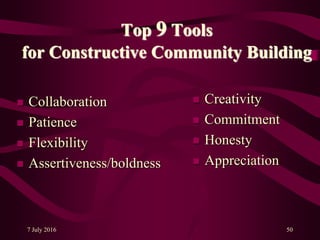
Top 9 Tools
for Constructive Community Building
 Collaboration
 Patience
 Flexibility
 Assertiveness/boldness
 Creativity
 Commitment
 Honesty
 Appreciation
7 July 2016 51
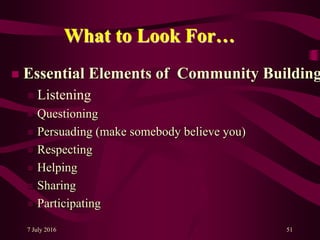
What to Look For…
 Essential Elements of Community Building
 Listening
 Questioning
 Persuading (make somebody believe you)
 Respecting
 Helping
 Sharing
 Participating
7 July 2016 52
BE A GOOD
person
TO BECOME A
BETTER religious
7 July 2016 53
The End
7 July 2016 54

Religious comunity life

  • 1.
  • 2.
  • 3.
    7 July 20163 RELIGIOUS COMMUNITY LIFE
  • 4.
  • 6.
    7 July 20166 History Of Religious Communities
  • 7.
    7 July 20167 A Community is a place wherepeople come together to share commoninterests and resources. The origin of “community” is from the Latin word … "The word "community" is derived from the Old French communité which is derived from the Latin communitas (cum, "with/together" + munus, "gift"), a broad term for fellowship or organized society." (http://en.wikipedia.org/wiki/Community) "Community: The origin of the word "community" comes from the Latin munus, which means the gift, and cum, which means together, among each other. So community literally means to give among each other." What is community-
  • 8.
    7 July 20168 A community is not “MyCommunity”. It is “Our
  • 9.
    7 July 20169 is a social unit of any size that shares common mgvR/msN nj GKwUmvgvwRK cÖwZôvb †hLv‡b me©mvaviY g~j¨‡eva mg~n mnfvwMZv (PP©v K‡i)Kiv nq| †hgb: e¨envh© me wKQzmevi GK ms‡M GKB avivq Rxeb hvcb
  • 10.
    7 July 201610 It is a group of people whoareconnected by durable/strongrelationsthat extend beyond immediategenealogicalties, andwho usually define that relationshipas important to their social identity and practice. GwU GKwU `j hviv Lye Mfxik³ e܇b evav _v‡K ( i‡³i m¤ú©K bv n‡jI ü`‡qi ..) hviv cÖKvkK‡i †h GB m¤úK©i PP©vB Zv‡`i Rb¨ ¸iæZ¡c~Y© mvgvwRK cwiwPwZ - Acts 2: 38-42
  • 11.
    7 July 201611 Different communities fulfil different needs:• The spiritualcommunity • The familycommunity • The living community/ReligiousCom. • The recreationalcommunity • The learningcommunity • The employment community • The health community • The internet community
  • 12.
    7 July 201612 Christian Religious Communities • Began a few centuries after the Resurrection of Jesus – desert to pray, meditate on the word of God. L„óvbmbœ¨vmeªZxmsNïiæ nq, hxïi cybiæÌv‡bi KZK hyM c‡i| Zvivgiyfzwg‡Z hvqcÖv_©bv Ki‡Z, Ck¦‡ii evYx a¨vb Ki‡Z| Zv‡`i g‡a¨ †KD Ava¨vwZ¥K cwiPvjK, ‡KD Wv³vi, ‡KD cwiPvjK, ag©cÖPviK, DwKj BZ¨vw`†ckvq wb‡qvwRZwQj| cÖwZwU ms‡Ni wQj mZš¿ ˆewkó¨,K¨vwiRg, ˆcÖwiwZK KvR GesmZš¿ wbqg- Kvbyb wKfv‡eZv‡`i K¨vwiRg Abymv‡i Zviv ms‡N evmKi‡e| • Each group is unique and has a unique charism – ministry and a unique rule of life on how to live out that charism Acts 2: 38- 42
  • 13.
    7 July 201613 History
  • 14.
    7 July 201614 First Monastic Communities  Basil of Caesarea established communities for both men and, working with his sister Macrina, women  The Rule Basil wrote for his communities would become the basis for Orthodox monasticism
  • 15.
    7 July 201615 St. Benedict  Benedict of Nursia established a religious community at Monte Cassino, Italy  The Rule he (The Benedictine Rule) wrote for the monks there would become the basis for monastic life in the Catholic Church  The order he founded still flourishes in the Church today
  • 16.
    7 July 201616 • First built in the 7th century; it has been rebuilt several times. The most recent was in the late 20th century after its almost complete destruction during World War II. Benedict’s Abbey at Monte Cassino
  • 17.
    7 July 201617 • Today there are two types of religious communities: – Contemplative – live and work in their monasteries and convents – Active – live in community, but work “in the world”
  • 18.
    7 July 201618 Characteristics: • All membersof religiouscommunitiestakethe three vowsofpoverty, chastity and obedience • Allcommunities haveaspecific “habit” – • something in their clothing that identifiesthem as belonging tothat particularcommunity
  • 19.
    7 July 201619 Traditional Benedictine nun
  • 20.
  • 21.
  • 22.
  • 23.
    7 July 201623 Active Communities • Work “in the world” • Often may work at any job that does not contradict Church teaching and beliefs, but most work for the Church. • ( hv gÐjxiwkÿvI wek¦v‡mims‡M †KvbØ›Ø Av‡b Ggb KvR Qvov) ‡cÖiYgyLxmsN ¸‡jv gÐjxiRb¨ ‡h †Kvb †mev KvR KiZ| • Attend Mass daily; pray a modified form of the Liturgy of the Hours • Live in community
  • 24.
    The aspects (characteristic) of “Community Life” 7 July 2016 24 “BuildingaHealthyCommunity” – Need Five most important and crucial moments… where the community comes together to share and grow in one direction. -eªv`viWbvì msNe×Rxebwel‡qM‡elbvK‡i, AwfÁZviAv‡jv‡K, Abya¨vbK‡i wj‡L‡Qb- mbœ¨vmeªZx‡`iRb¨me‡P‡q¸iæZ¡c~Y© gyûZ©njcvuPwU†hgyn~Z© ¸‡jv‡ZKwgDwbwUim`m¨MY mnfvwMZviRb¨GKwÎZnqGesGKBj‡ÿ¨ †e‡oD‡V| - BrotherDonald
  • 25.
    Five most importantand crucial (necessary) moments 7 July 2016 25ByBrotherJeanClement
  • 26.
    Five most importantmoments 7 July 2016 26 ThefivemomentsasmentionedbyBrotherDonald are surely present andvery important; the community in generalcomestogether, and,so to say, comingtogether “- provide opportunity to listen to others, -Share one’sown thoughts, -Review and evaluate experiences; -Think and plan together”.
  • 27.
    7 July 201627 no lovewill last without equalamounts ofrespectand trust. Accept and celebrate differencesSo accepting andcelebratingthatwe are all differentis a great startingpoint.
  • 28.
    7 July 201628 Develop empathy: There is a great expressionthat I learneda long time ago: “Peoplewillforgetwhatyousaid, peoplewillforgetwhatyoudid,butpeoplewill neverforgethowyoumadethemfeel.” Community Bonds
  • 29.
    7 July 201629 Positive and supportive relationshipswillhelp us to feel healthier, happier, andmore satisfiedwith our lives. Communicationoccurs when someone understandsyou, notjustwhen you speak. Community Bonds
  • 30.
  • 31.
    7 July 201631 Assertivecommunicationistheabilitytospeakand interactinamanner(way)thatconsidersand respectstherightsandopinionsofotherswhile alsostandingupforyourownrights,needsand personalboundaries. AvZ¥cÖZ¨qhy³BwZevPK†hvMv‡hvM(Assertive communication)njA‡b¨im¤§vb,AwaKviiÿvK‡iK_vejvi `ÿZv;†hLv‡bwb‡RiAwaKviPvwn`vGese¨w³MZ mxgve×ZvI‡`Lvnq|
  • 32.
    7 July 201632 -Assertive communicationis an effective adaptation to conflictingsituations. -GUv (Assertive communication) djcÖmyev mdjKvgfv‡e Ø›Ø ev msNvZc~Y©cwiw¯’wZ‡ZLvc LvIqv‡bv|
  • 33.
    7 July 201633 Assertiveness is a key skillin maintaininghealthy relationships.  `„pZvev AvZ¥cÖZ¨q nj mym¤úK© ¯’vc‡bi `ÿZvi PvweKvwV| Four DifferentStyles… Generally speaking, communication can be characterized by four different styles. 1. Passive communication: (without active response) 2. Aggressive Communication: (attac kor confront) 3. Passive-Aggressive Communication 4. Assertive Communication: (showing confident forceful personality)
  • 34.
    7 July 201634  Not standing(position/status)up for your rights;  Not setting limitsor boundaries on another’s behavior  Continually putting others needs before your own Takingon the roleof “martyr”  Not being able to say “no” Passive/Reactive/Submissive/Unreceptive/unthinking/i 1. Passive communication:
  • 35.
    7 July 201635 2. Aggressive Communication  Bullying(irritation) and threatening others to get what you want  Threatening people Ignoring(pay no attention) to needs and rights of others Shouting, yelling (roar), screaming(loud )or physically abusing others EX. You’re completely selfish and a bad example to your son.
  • 36.
    7 July 201636 3. Passive-Aggressive Communication  Indirectly communicating – Ex. saying something that is designed/ planned for the other person to hear without saying it to them directly  Withdrawing love and affection Using sarcasm/put downs Using humor to be nasty or hurtful
  • 37.
    7 July 201637 Being direct and honest Being able to negotiate – having a sense of give and take  Asking for your own needs to be met, while respecting needs of others  Being able to say “no” and set limits  Being able to acknowledge when you are in the wrong
  • 38.
    7 July 201638 When you are assertive  Others will feel comfortable, know where you stand & respect you for your honesty...
  • 39.
    Community Bonds 7 July2016 39 Active or reflective listening is the single most useful and important listening skill. In active listening, we also are genuinely interested in understanding what the other person is thinking, feeling, wanting, or what the message means. djcÖmy ev mdjfv‡e ‡kvbv-mwµqfv‡eev m‡PZbfv‡e †kvbvnj GKwU `ÿZv ; G mgq Avgiv LyeBAvšÍwiKfv‡e AvMÖnmnKv‡i eyS‡Z †Póv Kwi A‡b¨wKfve‡Q, wKAbyfe Ki‡Q, wK cÖZ¨vkv Ki‡Q...
  • 40.
    7 July 201640 Active or reflective listeningis the singlemost usefuland importantlisteningskill.In active listening,we alsoare genuinely interested in understandingwhat the other person is thinking,feeling, wanting,or what the message means. djcÖmy ev mdjfv‡e ‡kvbv-mwµqfv‡eev m‡PZbfv‡e †kvbvnj GKwU `ÿZv ; G mgq Avgiv LyeBAvšÍwiKfv‡e AvMÖnmnKv‡i eyS‡Z †Póv Kwi A‡b¨wKfve‡Q, wKAbyfe Ki‡Q, wK cÖZ¨vkv Ki‡Q... y Community Bonds
  • 41.
  • 42.
  • 43.
    7 July 201643 msNe× Rxeb: msNe×Rxeb: cÖwZwU gvbylmgv‡R evmK‡ie‡jB Zvi GKwU wbR¯^ cwiPq _v‡K Ges GB m¤ú‡K©i¸‡YB ci¯ú‡ii mv‡_ GKwU eÜb M‡oI‡VÓ | g½jevZ©viAvb›` 115 -wgjb I åZ…‡Z¡i†mevq wb‡ew`Z Rxeb †e`bv`vqK e‡j -cÖZxqgvbn‡jIGKgvÎ msNe×Zvi g‡a¨B AvwZ¥K Hk`vb LvuwU I inm¨RbKfv‡e dj`vqKnq| g½jevZ©viAvb›` 130
  • 44.
  • 45.
    7 July 201645 HEALTHY COMMUNITY BUILDING
  • 46.
    7 July 201646 Healthy Community Building By Definition - Community building is a planned effort made in order to improve communications and working relationships… KwgDwbwU MVb nj-cvi¯úwiK†hvMv‡hv‡Mi Dbœqb I Kvh©‡ÿ‡Îmym¤úK©¯’vc‡bi Rb¨cwiKwíZ cÖ‡Póv|
  • 47.
    7 July 201647  Know the individuals  skills and abilities  strengths, weaknesses, blind spots  Know what the team needs to do Increases creativity, Increases brainstorming Increases resources, Increases efficiency Increasestalents andabilities  Condition the team for the work  coach individuals and the team monitor team conditions  nurture the team How To Build a team or Healthy Community …
  • 48.
    7 July 201648 COMMUNITY BUILDING
  • 49.
    7 July 2016497 July 2016 49 Clear Objectives Sound Procedures/ masures Good Communication Openness Support and Trust Appropriate Leadership Individual Development Cooperation and Conflict Balanced Roles/task Regular Review Building Blocks/bone/element to Successful Community
  • 50.
    7 July 201650 Top 9 Tools for Constructive Community Building  Collaboration  Patience  Flexibility  Assertiveness/boldness  Creativity  Commitment  Honesty  Appreciation
  • 51.
    7 July 201651 What to Look For…  Essential Elements of Community Building  Listening  Questioning  Persuading (make somebody believe you)  Respecting  Helping  Sharing  Participating
  • 52.
    7 July 201652 BE A GOOD person TO BECOME A BETTER religious
  • 53.
    7 July 201653 The End
  • 54.