Understanding our daily stationary
Rationale of the projectMany people don’t know the science behind how things work, even daily stationary that we commonly use
PencilsCommon misconception: 	Pencil is made of lead XIn fact, pencil discovery is made of lead, but it was later changed to graphiteas it leaves a darker mark and is non-toxicPencils work when the graphite core of the pencil is rubbed off onto the paper
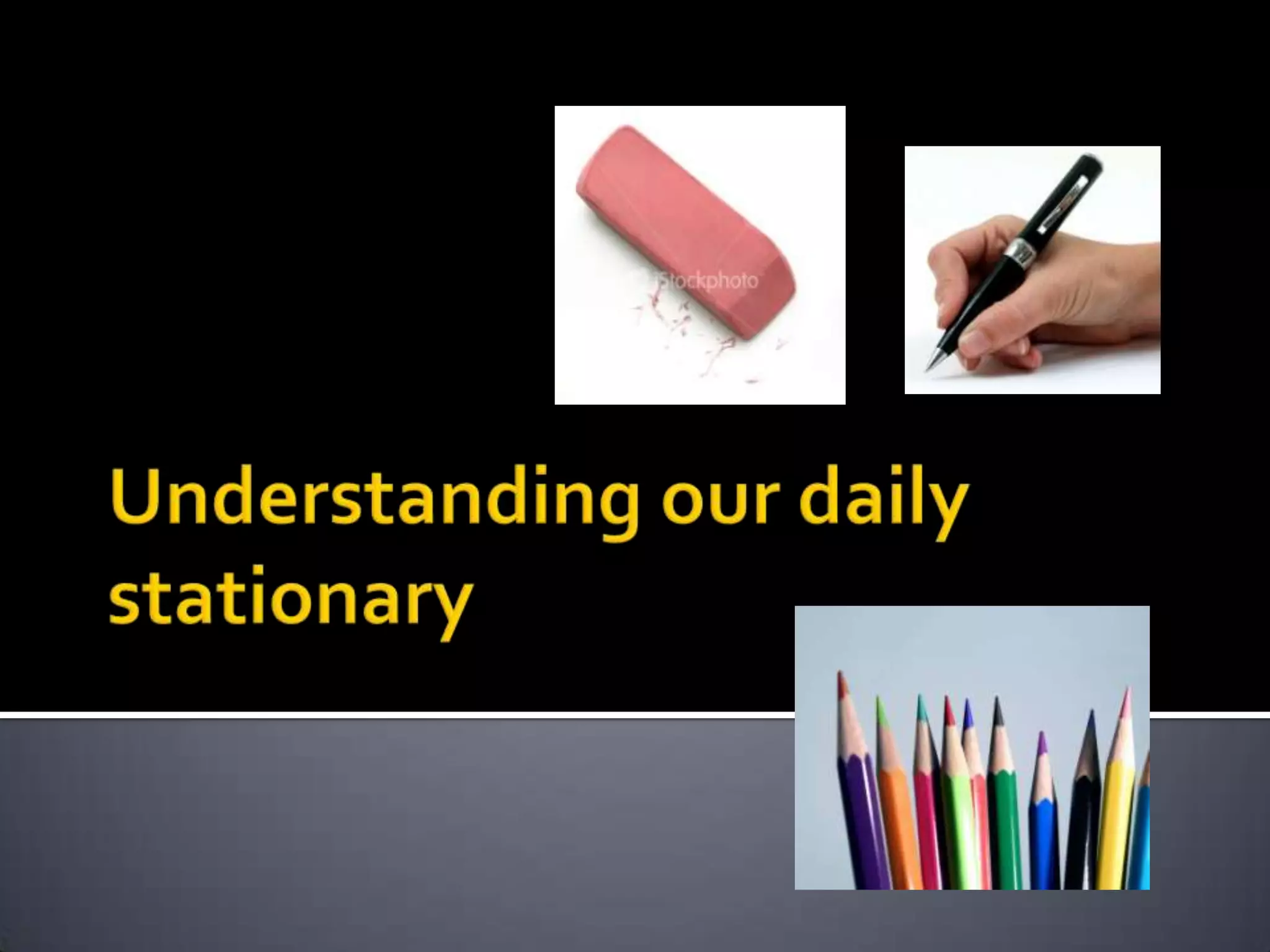
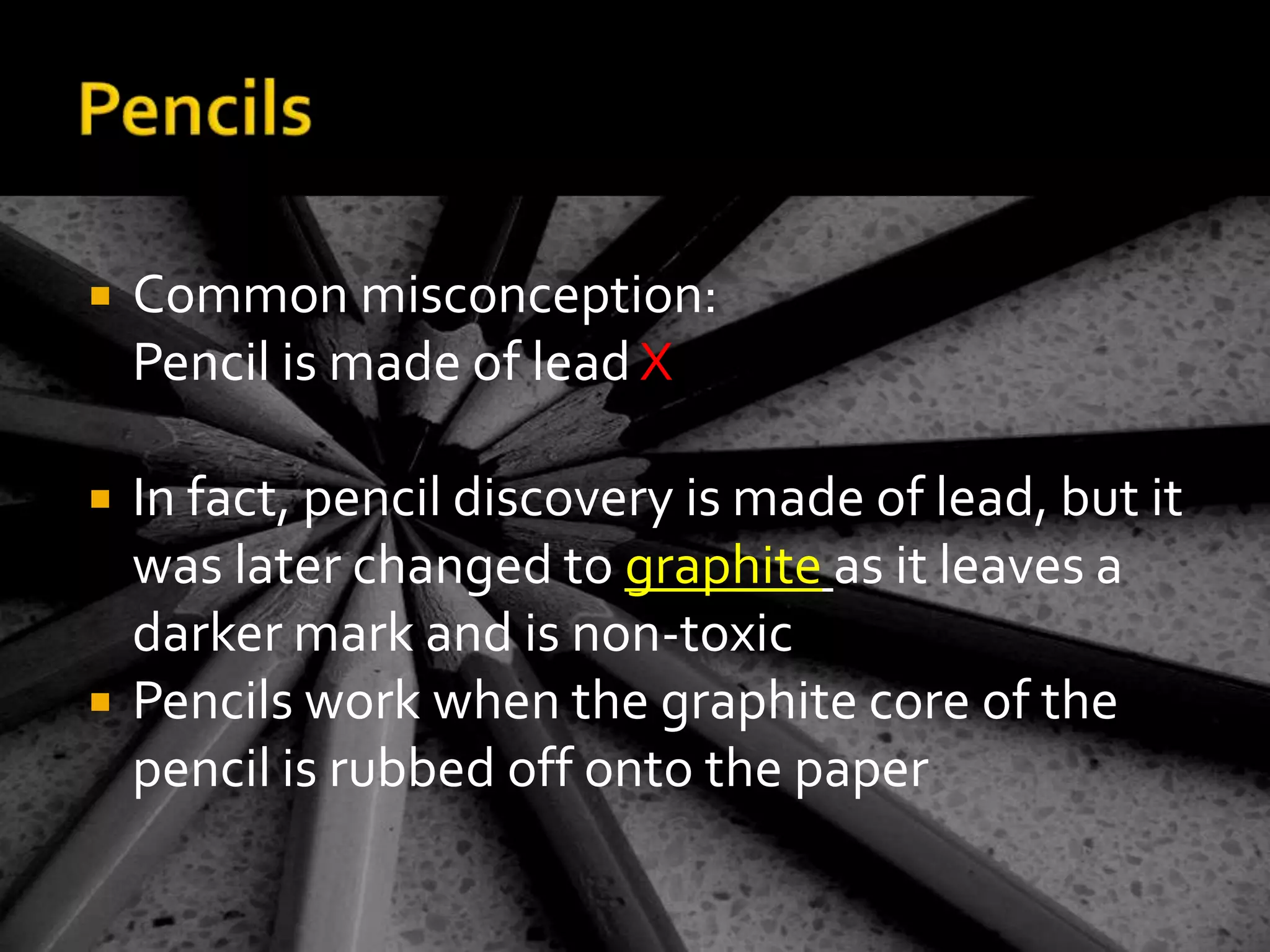
Types of PencilsColor Pencils- wax-like cores with pigment and other fillersCharcoal Pencils- Fuller black than graphite but smudge more easilyCarbon Pencils- mixture of clay and lamp black, produce fuller black than graphite pencils, smoother than Charcoal Pencils.
Erasers – a little historyBreadRubberVulcanization on rubber
Erasers – How does it work?Erasers pick up graphite particles, thus removing them from the surface of the paper. Basically, the molecules in erasers are 'stickier' than the paper, so when the eraser is rubbed onto the pencil mark, the graphite sticks to the eraser preferentially over the paper.
Erasers - MisconceptionCommon misconception: Erasers work by removing top layer of paper XSome erasers damage the top layer of the paper and remove it as well. Erasers attached to pencils absorb the graphite particles and leave a residue which needs to be brushed away. This type of eraser can remove the surface of the paper.
Erasers – Art erasersArt gum erasers are made of soft, coarse rubber and are used to remove large areas of pencil marks without damaging paper. These erasers leave a lot of residue behind.
PenWhy doesn’t the ink just come flowing out?How does the pen work?
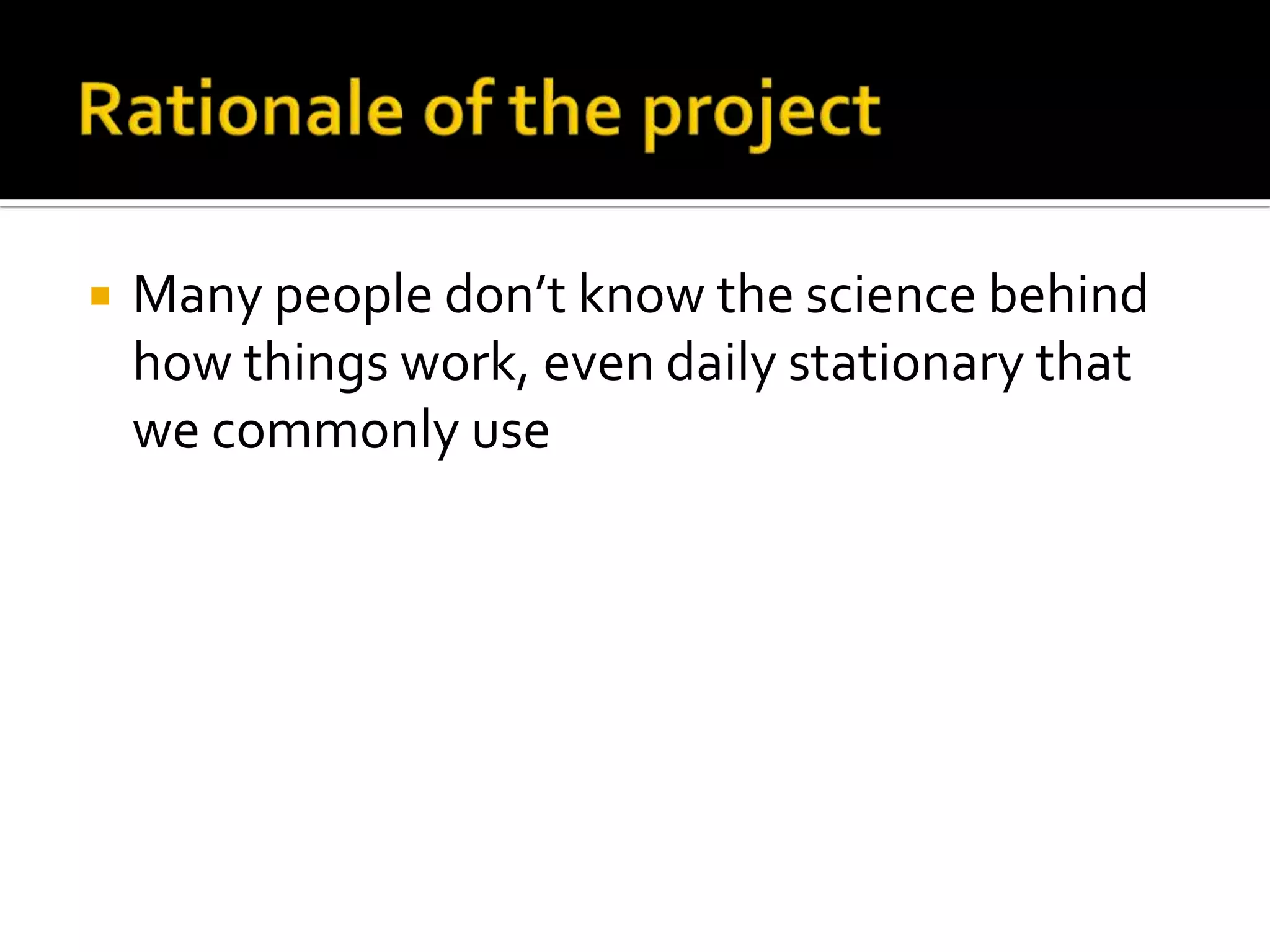
Pen – How it worksThe key to how a pen works is the ball.The ball acts as a buffer between the material you're writing on and the quick-drying ink inside the pen. The ball rotates freely and rolls out the ink as it is continuously fed from the ink reservoir (usually a narrow plastic tube filled with ink).
Pen - How it worksAs the pen moves across the paper, the ball turns and gravity forces the ink down the reservoir and onto the ball, where it is transferred onto the paper. The ball fits into the socket with just enough space to move freely
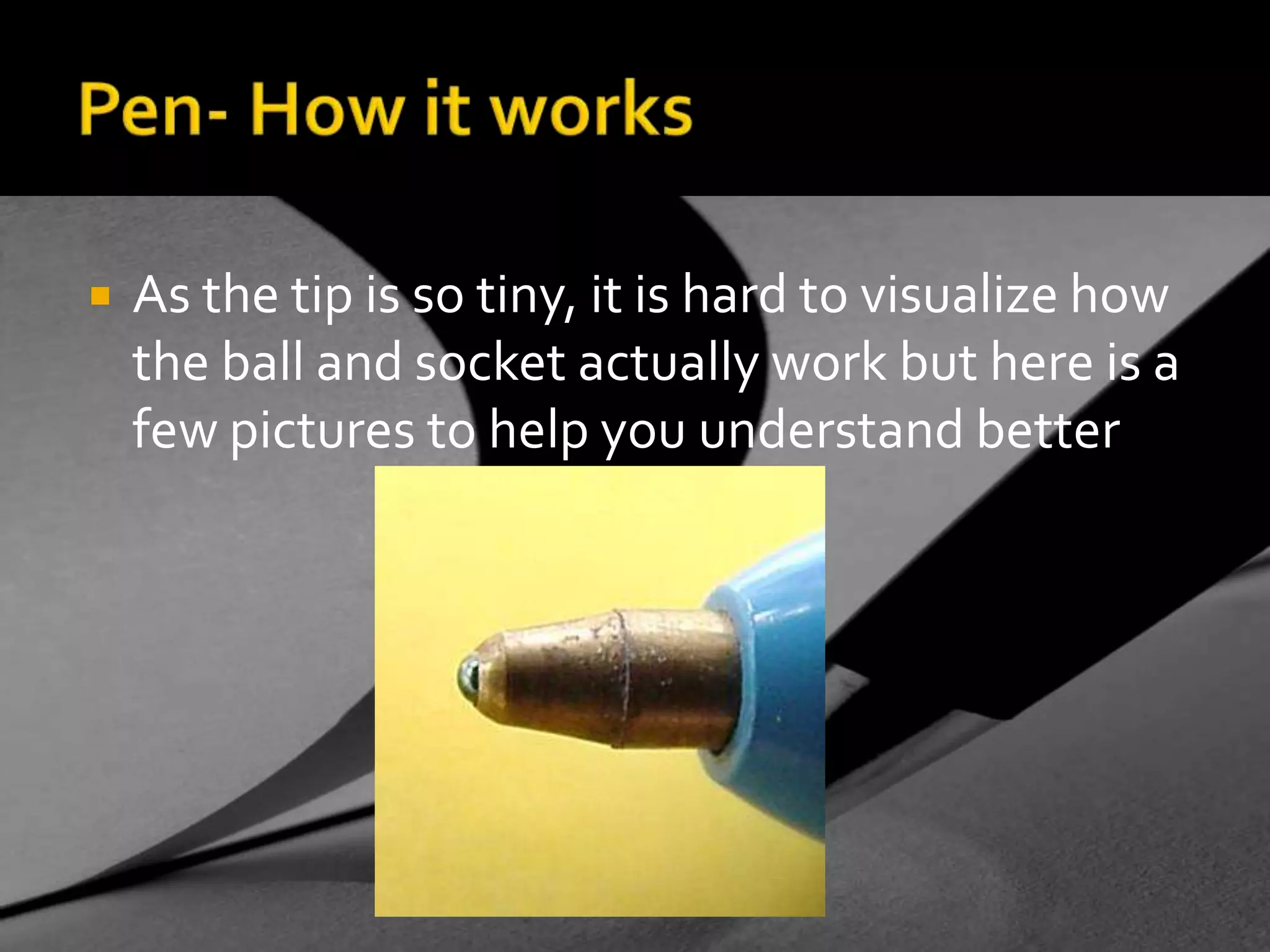
Pen- How it worksAs the tip is so tiny, it is hard to visualize how the ball and socket actually work but here is a few pictures to help you understand better
Pen – How it worksThe size of a ballpoint pen's line is determined by the width of the ballpoint. A "point five millimeter" (0.5 mm) pen has a ball that will produce a line that is 0.5-mm wide, and a "point seven millimeter" pen (0.7 mm) has a ball that will produce a 0.7-mm line. Ballpoints come as tiny as "point one millimeter" wide ("ultra fine").
ConclusionWe should ought to know how the stuff we use around us works and not live in ignoranceFrom this project, I have found out much more about the stationary I use daily that I never knew about.
Thank You!   :D

Understanding our daily stationary

  • 1.
  • 2.
    Rationale of theprojectMany people don’t know the science behind how things work, even daily stationary that we commonly use
  • 3.
    PencilsCommon misconception: Pencilis made of lead XIn fact, pencil discovery is made of lead, but it was later changed to graphiteas it leaves a darker mark and is non-toxicPencils work when the graphite core of the pencil is rubbed off onto the paper
  • 4.
    Types of PencilsColorPencils- wax-like cores with pigment and other fillersCharcoal Pencils- Fuller black than graphite but smudge more easilyCarbon Pencils- mixture of clay and lamp black, produce fuller black than graphite pencils, smoother than Charcoal Pencils.
  • 5.
    Erasers – alittle historyBreadRubberVulcanization on rubber
  • 6.
    Erasers – Howdoes it work?Erasers pick up graphite particles, thus removing them from the surface of the paper. Basically, the molecules in erasers are 'stickier' than the paper, so when the eraser is rubbed onto the pencil mark, the graphite sticks to the eraser preferentially over the paper.
  • 7.
    Erasers - MisconceptionCommonmisconception: Erasers work by removing top layer of paper XSome erasers damage the top layer of the paper and remove it as well. Erasers attached to pencils absorb the graphite particles and leave a residue which needs to be brushed away. This type of eraser can remove the surface of the paper.
  • 8.
    Erasers – ArterasersArt gum erasers are made of soft, coarse rubber and are used to remove large areas of pencil marks without damaging paper. These erasers leave a lot of residue behind.
  • 9.
    PenWhy doesn’t theink just come flowing out?How does the pen work?
  • 10.
    Pen – Howit worksThe key to how a pen works is the ball.The ball acts as a buffer between the material you're writing on and the quick-drying ink inside the pen. The ball rotates freely and rolls out the ink as it is continuously fed from the ink reservoir (usually a narrow plastic tube filled with ink).
  • 11.
    Pen - Howit worksAs the pen moves across the paper, the ball turns and gravity forces the ink down the reservoir and onto the ball, where it is transferred onto the paper. The ball fits into the socket with just enough space to move freely
  • 12.
    Pen- How itworksAs the tip is so tiny, it is hard to visualize how the ball and socket actually work but here is a few pictures to help you understand better
  • 13.
    Pen – Howit worksThe size of a ballpoint pen's line is determined by the width of the ballpoint. A "point five millimeter" (0.5 mm) pen has a ball that will produce a line that is 0.5-mm wide, and a "point seven millimeter" pen (0.7 mm) has a ball that will produce a 0.7-mm line. Ballpoints come as tiny as "point one millimeter" wide ("ultra fine").
  • 14.
    ConclusionWe should oughtto know how the stuff we use around us works and not live in ignoranceFrom this project, I have found out much more about the stationary I use daily that I never knew about.
  • 15.

Editor's Notes

  • #6 Long ago, before erasers were invented, bread(with its crusts cut off) were used for its role of removing pencil marks. In fact today, bread is still used by some artists to lighten charcoal or pastel marks.Edward Naime, an engineer then discovered rubber after he picked it up and discovered its properties. He started selling rubber erasers but rubber, like bread, was perishable and would go bad over time. Thus, it was until Charles Goodyear’s invention on vulcanization which is the processs of making rubber more durable via addition of sulfur that led to the widespread use of rubber.