Facility Layout
Strategies
The DiagnosticTool: Spaghetti Diagram.
•Action: Trace the operator's walking path on a floor map.
•Goal: Identify "Transportation Waste" and "Motion Waste".
Current State: Functional Layout (Process Village)
•Machines grouped by type (e.g., All Lathes in one room, all
Drills in another).
•Disadvantage: High Work-In-Progress (WIP), long lead times,
poor communication between steps.
Target State: Cellular Layout (Product Layout)
•Machines arranged in the sequence of operations (Lathe →
Drill → Grind → Inspect).
•Benefit: Enables "One Piece Flow" and instant feedback on
quality.
The U-Shaped Cell:
•Minimizes walking distance.
•Allows one operator to manage multiple machines (Entry and
Exit are close).
3.
Single Piece Flow(SPF) vs. Batch
Production
Batch Production (The Traditional Way):
• Processing large lots (e.g., 100 parts)
at once.
• Hidden Cost: If the first part has a
defect, you won't find out until the
100th part is inspected. (High Scrap
Risk).
• Lead Time: High (Parts wait in queues).
Single Piece Flow (The Lean Way):
• Move one part at a time between
processes. "Make one, Move one."
• Prerequisite: SMED (Single Minute
Exchange of Die). You cannot do SPF if
changeovers take hours.
• Benefit: Drastic reduction in Lead Time
(Cash is not tied up in WIP).
4.
Line
Balancing
Mechanics
Distribute workload evenlyso all stations work at the
same pace.
Objective
Takt Time - Meaning: The pace at which you must
produce to meet demand.
•Formula: Insert here
Metric 1
Cycle Time-The actual time it takes an operator to
complete their task.
•Formula: Insert here
Metric 2
5.
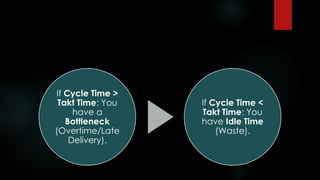
If Cycle Time>
Takt Time: You
have a
Bottleneck
(Overtime/Late
Delivery).
If Cycle Time <
Takt Time: You
have Idle Time
(Waste).
6.
Managing the Bottleneck
ThePrinciple: The
capacity of the
entire factory is
determined only by
the bottleneck
operation.
Steps to Balance:
Identify the
Bottleneck (Highest
Cycle Time).
ECRS Method:
Eliminate
unnecessary steps.
Combine steps with
other stations.
Rearrange the
sequence.
Simplify the task
(Jigs/Fixtures).
Add resources only
to the bottleneck.
7.
Daily Works Management(DWM)
Purpose: To sustain improvements
and manage daily deviations.
The "Asaichi" (Morning Meeting):
Format: Standing meeting on the shop floor.
Duration: Max 10-15 minutes.
Attendees: Supervisor + Operators.
Agenda: 1. Safety Incidents? 2. Quality issues
yesterday? 3. Plan vs Actual yesterday? 4.
Target for today.
Escalation Matrix: If a problem
cannot be solved in 10 mins, move it
to the "Manager's List"
8.
Visual Management &The "Hour-
by-Hour" Board
The 30-Second Rule: A stranger should understand the shop status in 30 seconds.
Andon Systems:
Visual signals (Green/Yellow/Red lights) indicating machine status.
9.
Visual Management &Hour-by-Hour Board
[Placeholder for visuals: Andon lights and Hour-by-Hour board layout]
30-Second Rule:
Any visitor should understand
production status (output vs.
plan, issues, machine health)
within 30 seconds.
Key Visual Tools:
Hour-by-Hour Board: Tracks
actual vs. planned output for
each hour.
Andon System: Green =
Normal, Yellow = Attention,
Red = Stop.
Other Tools: Kanban cards,
color-coded bins, digital
dashboards.
Benefits:
Immediate visibility of
problems.
Faster response and
escalation.
Promotes accountability and
continuous improvement.




![Visual Management & Hour-by-Hour Board
[Placeholder for visuals: Andon lights and Hour-by-Hour board layout]
30-Second Rule:
Any visitor should understand
production status (output vs.
plan, issues, machine health)
within 30 seconds.
Key Visual Tools:
Hour-by-Hour Board: Tracks
actual vs. planned output for
each hour.
Andon System: Green =
Normal, Yellow = Attention,
Red = Stop.
Other Tools: Kanban cards,
color-coded bins, digital
dashboards.
Benefits:
Immediate visibility of
problems.
Faster response and
escalation.
Promotes accountability and
continuous improvement.](https://image.slidesharecdn.com/understandingleantoolslinebalancingsinglepiece-251215061639-c0fab085/85/Understanding-lean-tools-line-balancing-single-piece-pptx-9-320.jpg)


