Understanding
Financial Statement
Commissionerate of Central Excise, Gurgaon-I
January 19, 2016
Presented by:
CA Gaurav Gupta
FCA, LLB, DISA
Partner
MGS & Co.
• Period of Review
Every audit should invariably cover the retrospective period up to the previous audit by the
Departmental Audit Party or the last 5 years (limited to the commencement of levy on a
particular service) whichever is less and should extend up to the last completed Financial
Year preceding the date of Commencement of audit.
All Company Balance sheet contain figures for two years.
Understanding period
Study of Financials CA Gaurav Gupta 2
• Focus of review
o Money Measurement Concept
o Cost Concept
o Going Concern Concept
o Accrual / Cash concept
o Consistency
o Disclosure
o Substance over form
Financial Statements
Study of Financials CA Gaurav Gupta 3
• Account codes with balances
• Classification of assets and Liabilities
• Movement included in summary
• Opening and closing balances
• Detailed codes – understanding of recording of ledgers
• Monthly movement – provides review of pattern of income and expense
• Taxation accounts and their balances
• Debit and credit movements in sales / Services accounts
• Minor heads also displayed
• Discounts
• Bad debts
Trial Balance
Study of Financials CA Gaurav Gupta 4
• List of all Ledger Accounts wherein entries have taken place.
• List of Ledger Accounts relevant from Service Tax point of view.
• Balance of Service Tax payable / Cenvat Credit
Trial Balance
Study of Financials CA Gaurav Gupta 5
• Main heads
o Assets
o Liabilities
o Capital
o Subsidiary Books
o Cash Book
o Purchases / Purchase return
o Sales / Sales return
o Bills receivable / payable
o journal
Balance sheet
Study of Financials CA Gaurav Gupta 6
• Consolidation of Subsidiary financials
• Fixed assets statement – loss of assets / relinquishment
• Revenue from operations
• Cash flow – receipts from debtors
• Major heads to be examined
• Advances / Outstanding debtors
• Unearned incomes / Deferred incomes
• Capital Advances
• Security deposits
• Unpaid creditors
• Detail of other income
Balance sheet
Study of Financials CA Gaurav Gupta 7
• Reverse charge mechanism- under this mechanism, the recipient of services is liable to
pay service tax (e.g. GTA Services, services received from abroad, etc.). It is to be
ensured that assessee must have paid his liability on such items.
• Reimbursement- unless the concept of pure agent is applicable, reimbursement are
includible in the value of taxable services. Reconciliation should cover all receivables
including reimbursement, sale of goods etc,
• Netting of expenses/ Income- Netting of Income with amount payable should also be
checked as liability of Service Tax does not absolve on netting. The same can be verified
from ledger/ credit notes/ debit notes.
• VAT payment on certain transaction- VAT put in case of certain transaction should be
as to arrive at then taxable value, nature and classification such transaction include-
• Commercial or Industrial Construction Services
• Complex Construction Services
• Works Contract Services
• Annual Maintenance Services
Items requiring special
mention
Study of Financials CA Gaurav Gupta 8
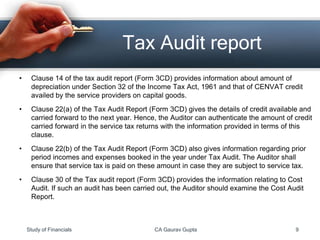
• Clause 14 of the tax audit report (Form 3CD) provides information about amount of
depreciation under Section 32 of the Income Tax Act, 1961 and that of CENVAT credit
availed by the service providers on capital goods.
• Clause 22(a) of the Tax Audit Report (Form 3CD) gives the details of credit available and
carried forward to the next year. Hence, the Auditor can authenticate the amount of credit
carried forward in the service tax returns with the information provided in terms of this
clause.
• Clause 22(b) of the Tax Audit Report (Form 3CD) also gives information regarding prior
period incomes and expenses booked in the year under Tax Audit. The Auditor shall
ensure that service tax is paid on these amount in case they are subject to service tax.
• Clause 30 of the Tax audit report (Form 3CD) provides the information relating to Cost
Audit. If such an audit has been carried out, the Auditor should examine the Cost Audit
Report.
Tax Audit report
Study of Financials CA Gaurav Gupta 9
• Applicable Net gain / Loss on foreign transaction
• Bargain agreements
• Free of cost services to group companies and employees
• Corporate Guarantee
• Form 26AS
• Change in ratios
• Form 3CEB – Arms length value with sister concerns
• Any demands under other laws – unearthed revenue
Other important Points
Study of Financials CA Gaurav Gupta 10
Disclaimer
This presentation has been prepared for internal use of ICAI and its members. The contents of this document are
solely for informational purpose. It does not constitute professional advice or a formal recommendation. The
presentation is made with utmost professional caution but in no manner guarantees the content for use by any
person. It is suggested to go through original statute / notification / circular / pronouncements before relying on the
matter given. The presentation is meant for general guidance and no responsibility for loss arising to any person
acting or refraining from acting as a result of any material contained in this presentation will be accepted by us.
Professional advice recommended to be sought before any action or refrainment.
CA Gaurav Gupta
Partner
MGS & Co.
507 B, D-Mall, Netaji Subhash Palace, Delhi - 110034
+91 11 32962487
+91 11 2735 2487
+91 98110 13940
cagauravmgs@gmail.com
Thank you

Understanding Financial Statement

  • 1.
    Understanding Financial Statement Commissionerate ofCentral Excise, Gurgaon-I January 19, 2016 Presented by: CA Gaurav Gupta FCA, LLB, DISA Partner MGS & Co.
  • 2.
    • Period ofReview Every audit should invariably cover the retrospective period up to the previous audit by the Departmental Audit Party or the last 5 years (limited to the commencement of levy on a particular service) whichever is less and should extend up to the last completed Financial Year preceding the date of Commencement of audit. All Company Balance sheet contain figures for two years. Understanding period Study of Financials CA Gaurav Gupta 2
  • 3.
    • Focus ofreview o Money Measurement Concept o Cost Concept o Going Concern Concept o Accrual / Cash concept o Consistency o Disclosure o Substance over form Financial Statements Study of Financials CA Gaurav Gupta 3
  • 4.
    • Account codeswith balances • Classification of assets and Liabilities • Movement included in summary • Opening and closing balances • Detailed codes – understanding of recording of ledgers • Monthly movement – provides review of pattern of income and expense • Taxation accounts and their balances • Debit and credit movements in sales / Services accounts • Minor heads also displayed • Discounts • Bad debts Trial Balance Study of Financials CA Gaurav Gupta 4
  • 5.
    • List ofall Ledger Accounts wherein entries have taken place. • List of Ledger Accounts relevant from Service Tax point of view. • Balance of Service Tax payable / Cenvat Credit Trial Balance Study of Financials CA Gaurav Gupta 5
  • 6.
    • Main heads oAssets o Liabilities o Capital o Subsidiary Books o Cash Book o Purchases / Purchase return o Sales / Sales return o Bills receivable / payable o journal Balance sheet Study of Financials CA Gaurav Gupta 6
  • 7.
    • Consolidation ofSubsidiary financials • Fixed assets statement – loss of assets / relinquishment • Revenue from operations • Cash flow – receipts from debtors • Major heads to be examined • Advances / Outstanding debtors • Unearned incomes / Deferred incomes • Capital Advances • Security deposits • Unpaid creditors • Detail of other income Balance sheet Study of Financials CA Gaurav Gupta 7
  • 8.
    • Reverse chargemechanism- under this mechanism, the recipient of services is liable to pay service tax (e.g. GTA Services, services received from abroad, etc.). It is to be ensured that assessee must have paid his liability on such items. • Reimbursement- unless the concept of pure agent is applicable, reimbursement are includible in the value of taxable services. Reconciliation should cover all receivables including reimbursement, sale of goods etc, • Netting of expenses/ Income- Netting of Income with amount payable should also be checked as liability of Service Tax does not absolve on netting. The same can be verified from ledger/ credit notes/ debit notes. • VAT payment on certain transaction- VAT put in case of certain transaction should be as to arrive at then taxable value, nature and classification such transaction include- • Commercial or Industrial Construction Services • Complex Construction Services • Works Contract Services • Annual Maintenance Services Items requiring special mention Study of Financials CA Gaurav Gupta 8
  • 9.
    • Clause 14of the tax audit report (Form 3CD) provides information about amount of depreciation under Section 32 of the Income Tax Act, 1961 and that of CENVAT credit availed by the service providers on capital goods. • Clause 22(a) of the Tax Audit Report (Form 3CD) gives the details of credit available and carried forward to the next year. Hence, the Auditor can authenticate the amount of credit carried forward in the service tax returns with the information provided in terms of this clause. • Clause 22(b) of the Tax Audit Report (Form 3CD) also gives information regarding prior period incomes and expenses booked in the year under Tax Audit. The Auditor shall ensure that service tax is paid on these amount in case they are subject to service tax. • Clause 30 of the Tax audit report (Form 3CD) provides the information relating to Cost Audit. If such an audit has been carried out, the Auditor should examine the Cost Audit Report. Tax Audit report Study of Financials CA Gaurav Gupta 9
  • 10.
    • Applicable Netgain / Loss on foreign transaction • Bargain agreements • Free of cost services to group companies and employees • Corporate Guarantee • Form 26AS • Change in ratios • Form 3CEB – Arms length value with sister concerns • Any demands under other laws – unearthed revenue Other important Points Study of Financials CA Gaurav Gupta 10
  • 11.
    Disclaimer This presentation hasbeen prepared for internal use of ICAI and its members. The contents of this document are solely for informational purpose. It does not constitute professional advice or a formal recommendation. The presentation is made with utmost professional caution but in no manner guarantees the content for use by any person. It is suggested to go through original statute / notification / circular / pronouncements before relying on the matter given. The presentation is meant for general guidance and no responsibility for loss arising to any person acting or refraining from acting as a result of any material contained in this presentation will be accepted by us. Professional advice recommended to be sought before any action or refrainment. CA Gaurav Gupta Partner MGS & Co. 507 B, D-Mall, Netaji Subhash Palace, Delhi - 110034 +91 11 32962487 +91 11 2735 2487 +91 98110 13940 cagauravmgs@gmail.com Thank you