* * Main Developing and Pricing Goods and Services Copyright © 2010 by the McGraw-Hill Companies, Inc. All rights reserved. McGraw-Hill/Irwin
DEVELOPING VALUE * * Product Development and the Total Product Offer According to the American Marketing Association, value is a foundation of marketing. Value --  Good quality at a fair price. Product development is a key activity in any modern business. LG1 14-
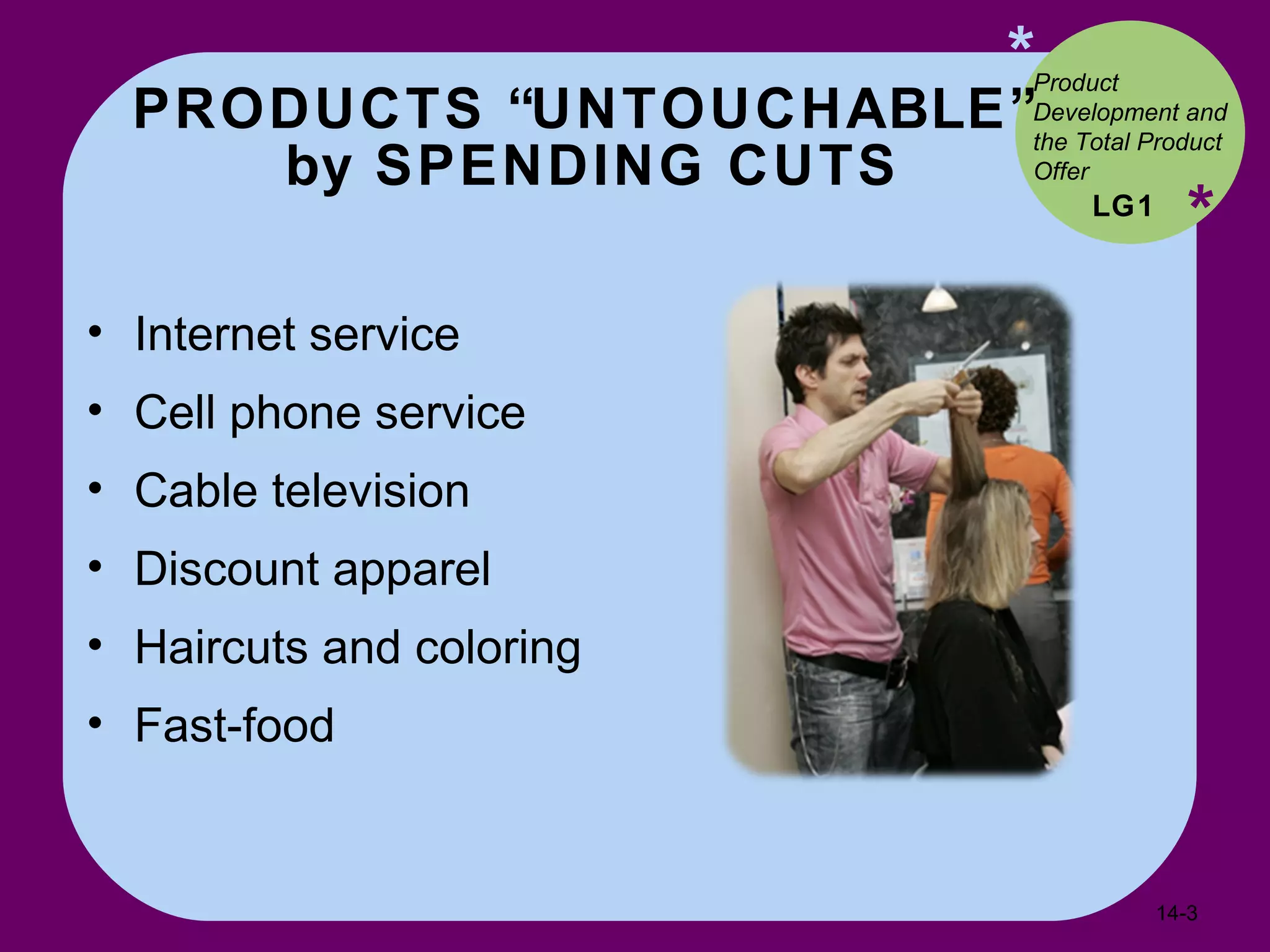
PRODUCTS “UNTOUCHABLE”  by SPENDING CUTS * * Internet service Cell phone service Cable television Discount apparel Haircuts and coloring Fast-food LG1 Product Development and the Total Product Offer 14-
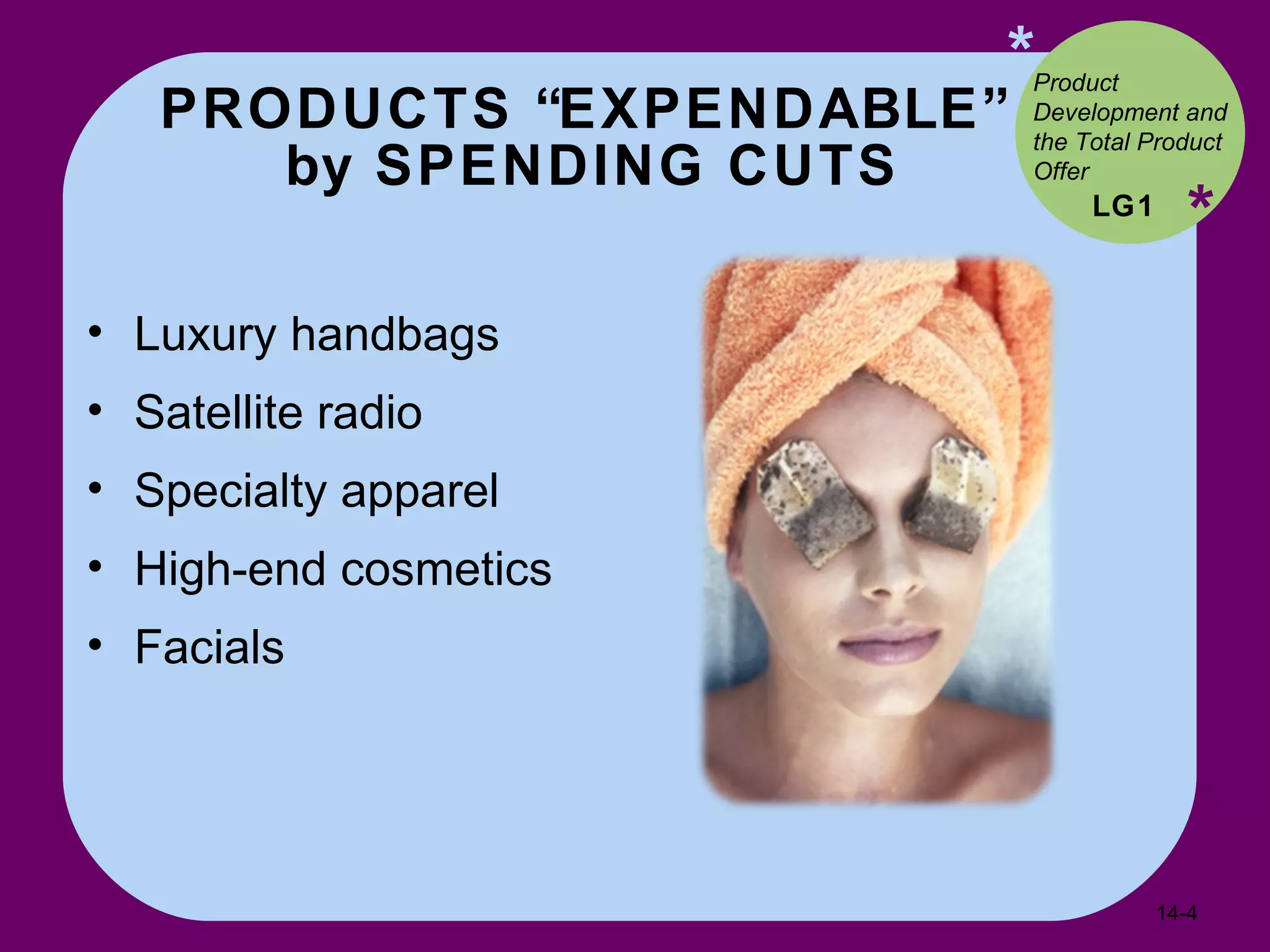
PRODUCTS “EXPENDABLE”  by SPENDING CUTS * * Luxury handbags Satellite radio Specialty apparel High-end cosmetics Facials  LG1 Product Development and the Total Product Offer 14-
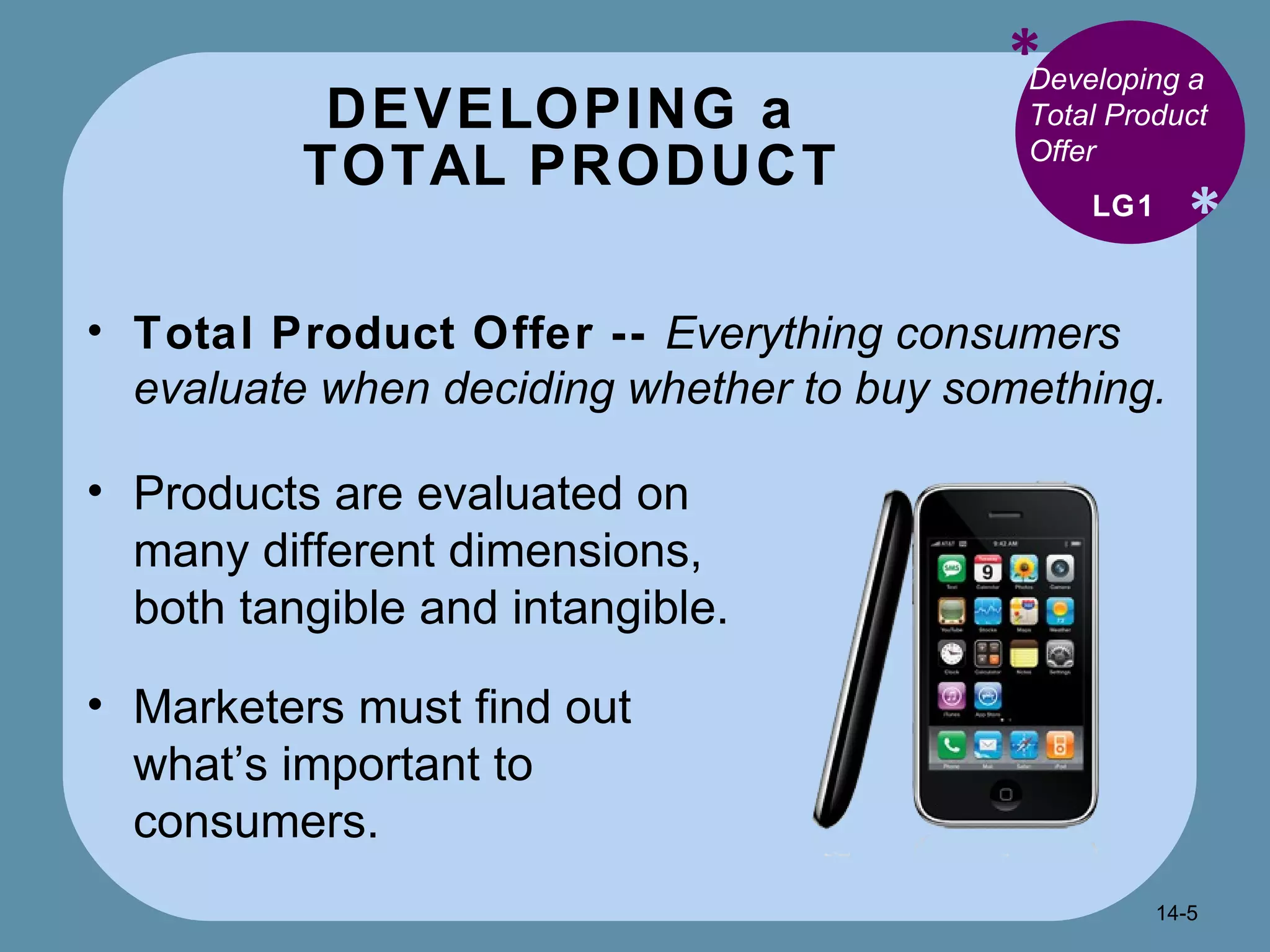
DEVELOPING a  TOTAL PRODUCT * * Developing a Total Product Offer Total Product Offer --  Everything consumers evaluate when deciding whether to buy something. LG1 Products are evaluated on many different dimensions, both tangible and intangible. Marketers must find out what’s important to consumers. 14-
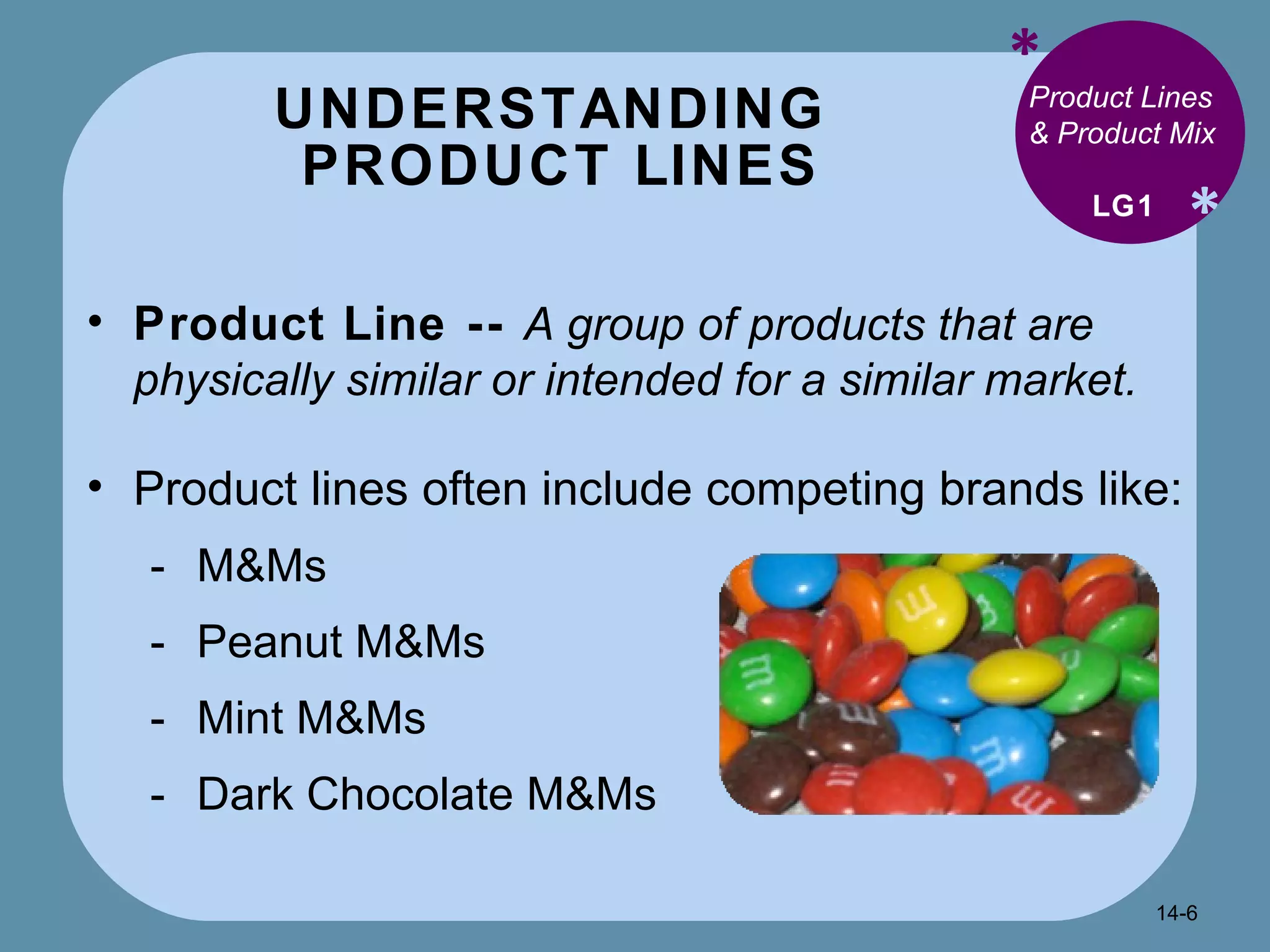
UNDERSTANDING  PRODUCT LINES * * Product Lines & Product Mix Product Line --  A group of products that are physically similar or intended for a similar market. Product lines often include competing brands like: M&Ms Peanut M&Ms Mint M&Ms Dark Chocolate M&Ms LG1 14-
The PRODUCT MIX * * Product Lines & Product Mix Product Mix --  The combination of all product lines offered by a manufacturer or service provider. Product mixes like Proctor & Gamble’s can be extensive: Laundry detergent Cosmetics Diapers Potato chips Bar soap LG1 14-
DIFFERENTIATING PRODUCTS * * Product Differentiation  Product Differentiation --  The creation of real or perceived product differences. Marketers use a mix of pricing, advertising and packaging to create different images. Examples include: Bottled water Aspirin Fast-food Laundry detergent Shampoo LG2 14-
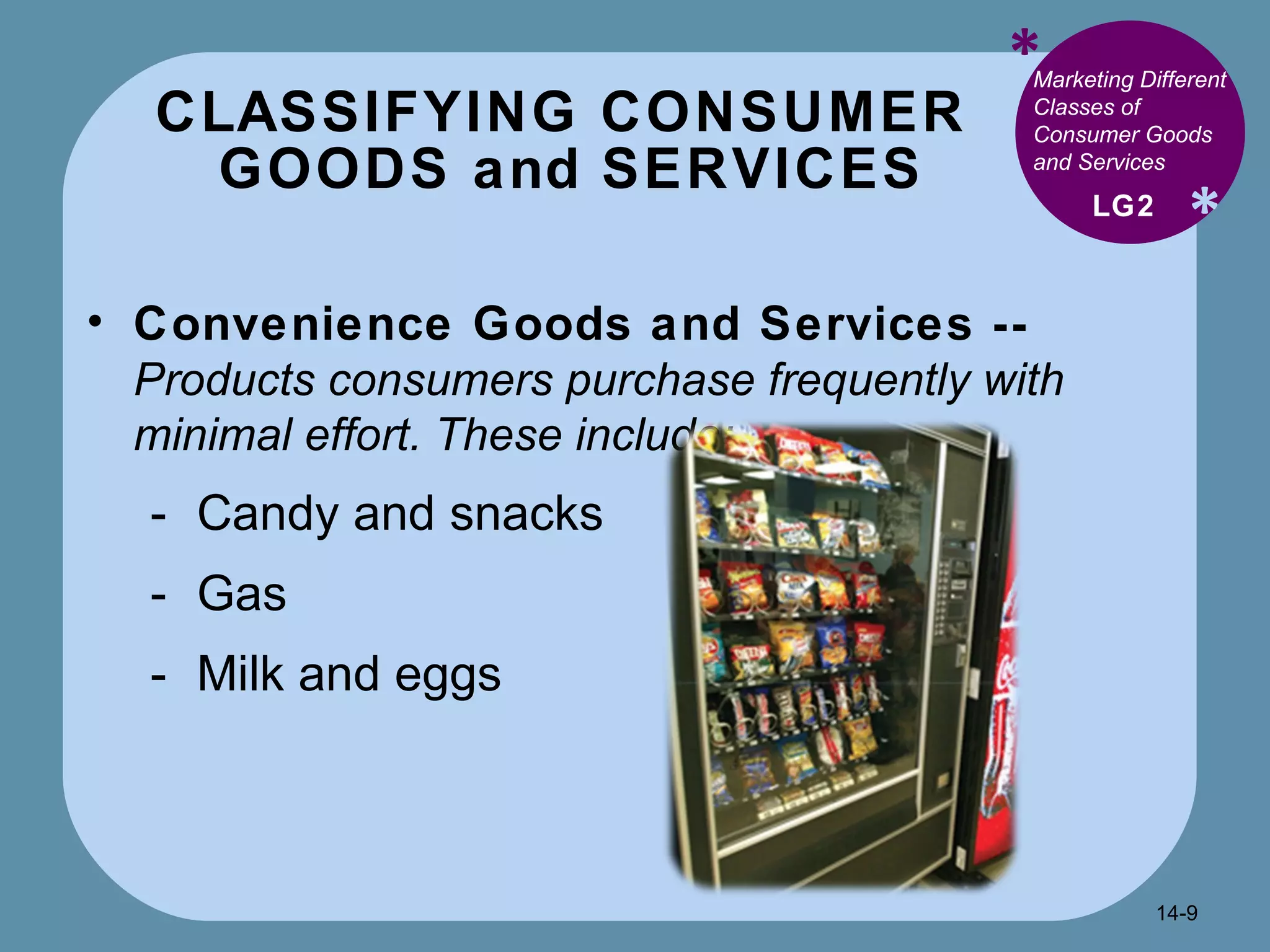
CLASSIFYING CONSUMER  GOODS and SERVICES * * Marketing Different Classes of Consumer Goods and Services  Convenience Goods and Services  --  Products consumers purchase frequently with minimal effort. These include: Candy and snacks Gas Milk and eggs LG2 14-
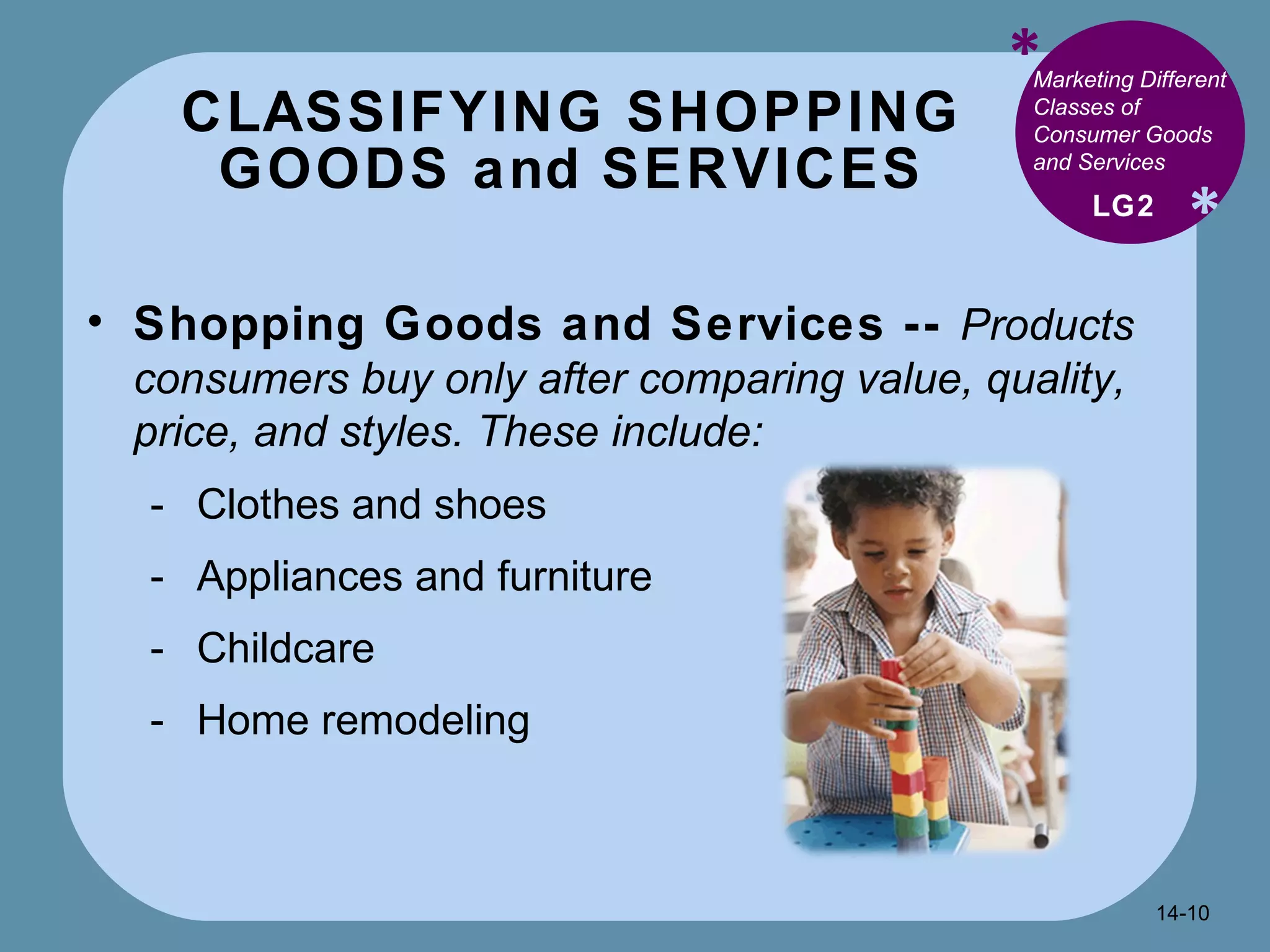
CLASSIFYING SHOPPING GOODS and SERVICES * * Marketing Different Classes of Consumer Goods and Services  Shopping Goods and Services --  Products consumers buy only after comparing value, quality, price, and styles. These include: Clothes and shoes Appliances and furniture Childcare Home remodeling  LG2 14-
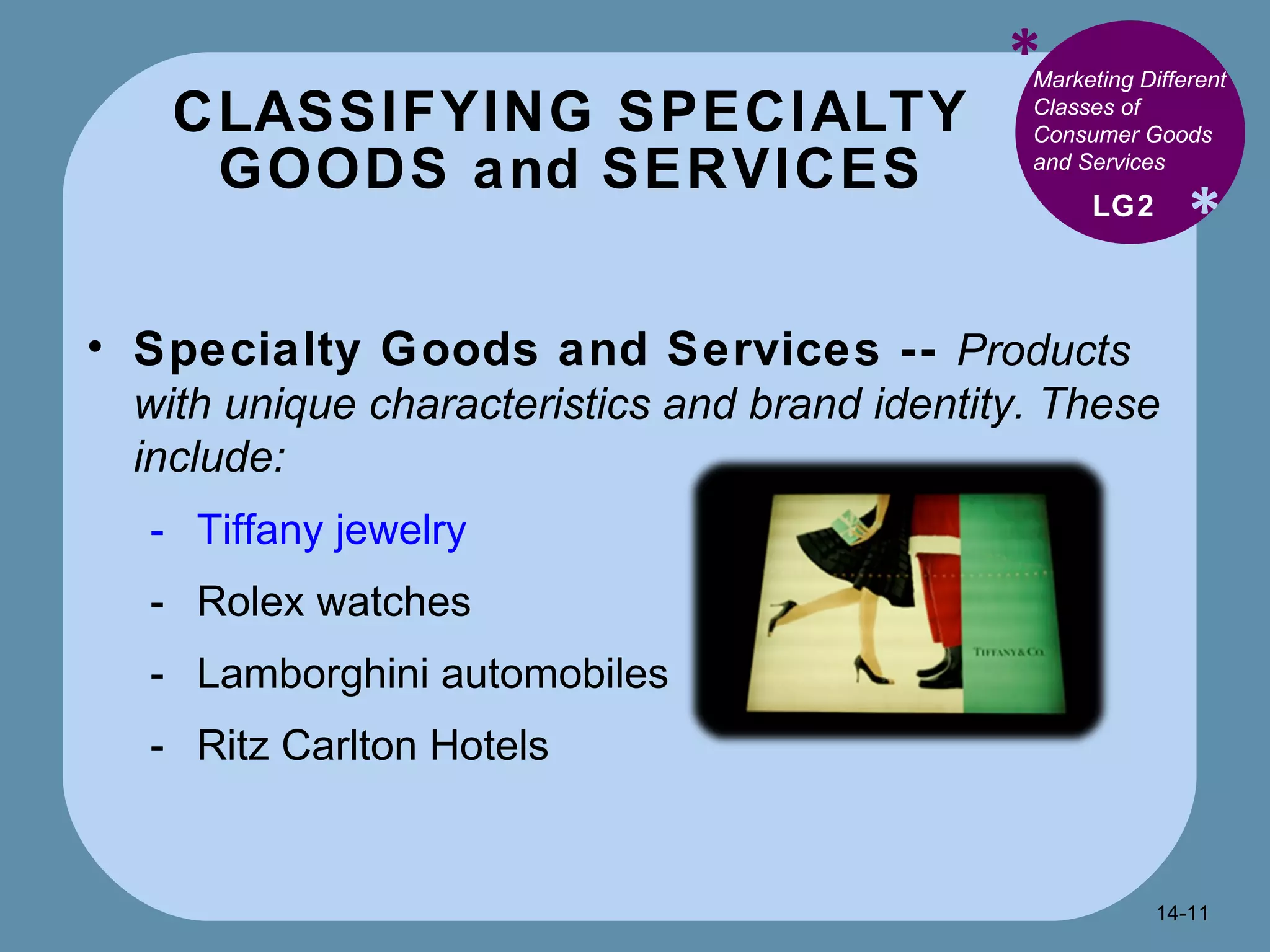
CLASSIFYING SPECIALTY GOODS and SERVICES * * Marketing Different Classes of Consumer Goods and Services  Specialty Goods and Services --  Products with unique characteristics and brand identity. These include: Tiffany jewelry Rolex watches Lamborghini automobiles Ritz Carlton Hotels LG2 14-
CLASSIFYING UNSOUGHT GOODS and SERVICES * * Marketing Different Classes of Consumer Goods and Services  Unsought Goods and Services --  Products consumers aren’t aware of or haven’t thought of buying until they need them. These include: Car-towing services Funeral services Plumbing services LG2 14-
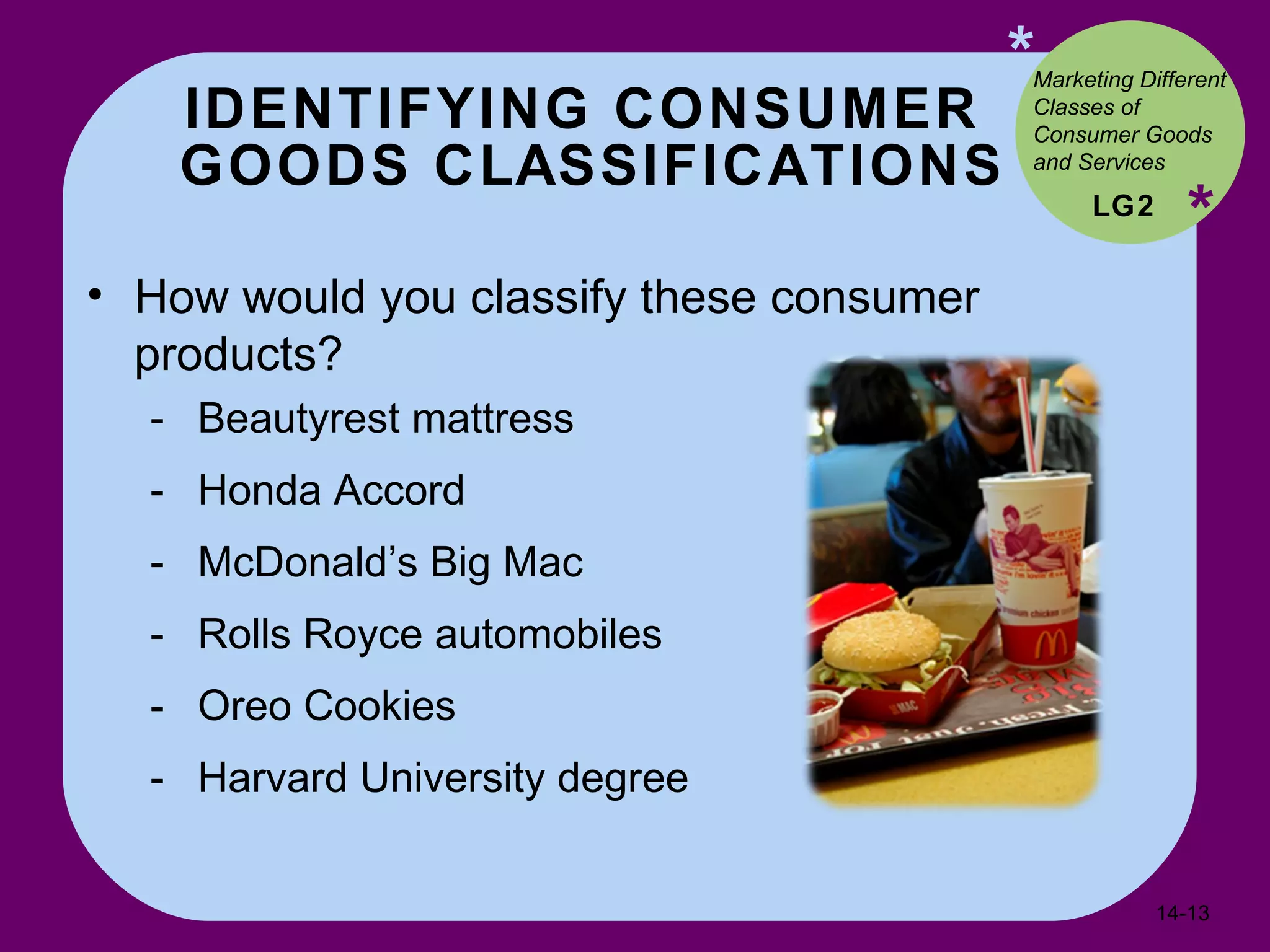
IDENTIFYING CONSUMER  GOODS CLASSIFICATIONS * * How would you classify these consumer products? Beautyrest mattress Honda Accord McDonald’s Big Mac Rolls Royce automobiles Oreo Cookies Harvard University degree LG2 Marketing Different Classes of Consumer Goods and Services  14-
ODD PRODUCT IDEAS  that WERE SUCCESSFUL * * Pet Rock  -  For $3.95 you could buy a gift-wrapped rock with eyes and a training manual. Garbage Pail Kids  -  Perhaps the grossest trading cards ever produced. Mood Rings  -  Wildly popular as the changing colors of the ring supposedly measured your mood. Chia Pets  -  Animal shaped clay figures that grew sprouts. LG2 Marketing Different Classes of Consumer Goods and Services  14-
CLASSIFYING INDUSTRIAL  GOODS and SERVICES  * * Marketing Industrial Goods and Services Industrial Goods --  Products used in the production of other products and sold in the B2B market. Industrial goods include: Installations Capital items Accessory equipment Supplies Service  LG2 14-
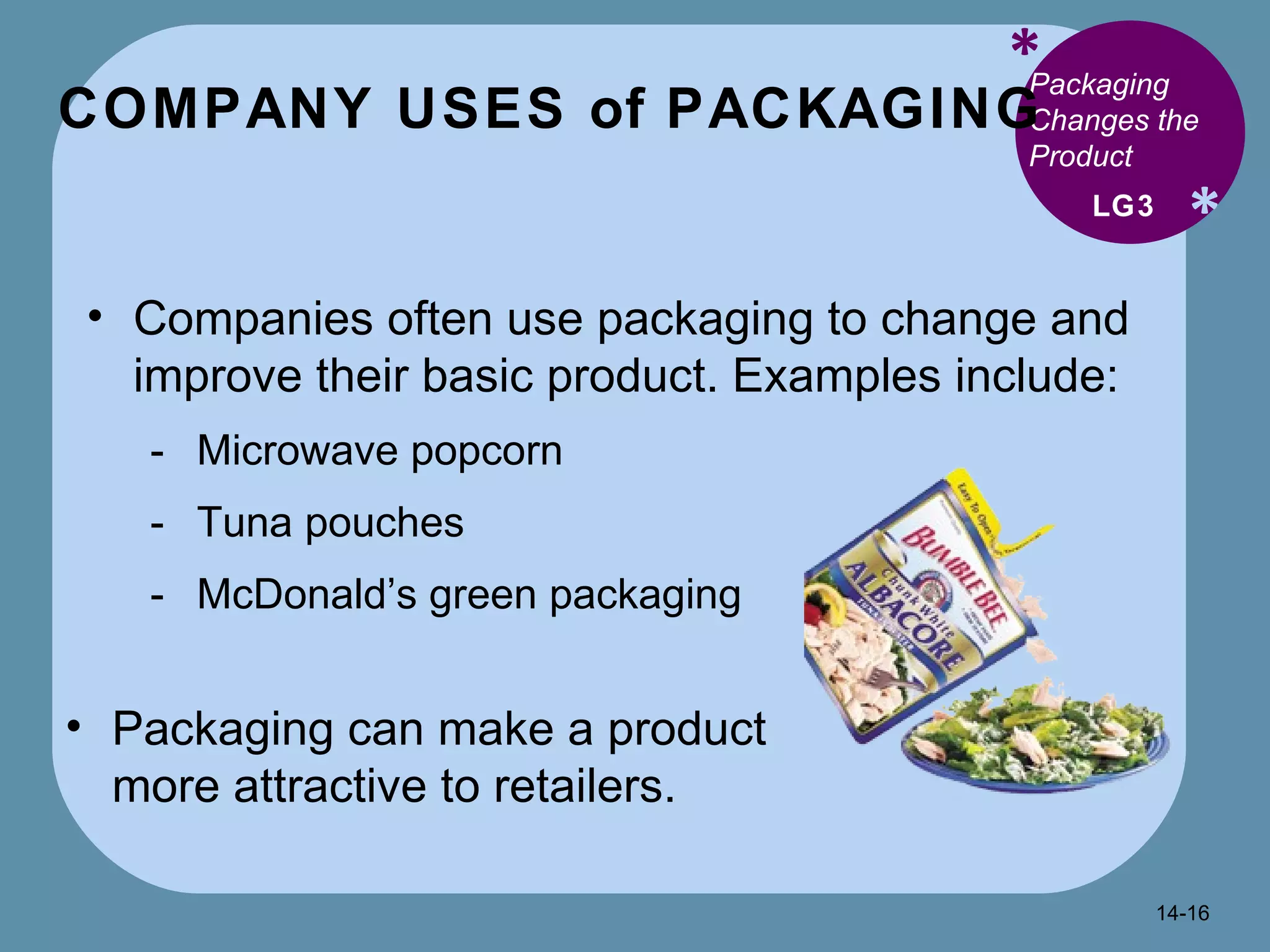
COMPANY USES of PACKAGING  * * Packaging Changes the Product  Companies often use packaging to change and improve their basic product. Examples include: Microwave popcorn Tuna pouches McDonald’s green packaging LG3 Packaging can make a product more attractive to retailers. 14-
SOME KEY FUNCTIONS of PACKAGING * * Packaging Changes the Product  To attract buyers’ attention Protect the goods inside and be tamperproof Describe and provide information about the product Explain the product’s benefits Provide warranty information and warnings Give an indication of price, value, and uses LG3 14-
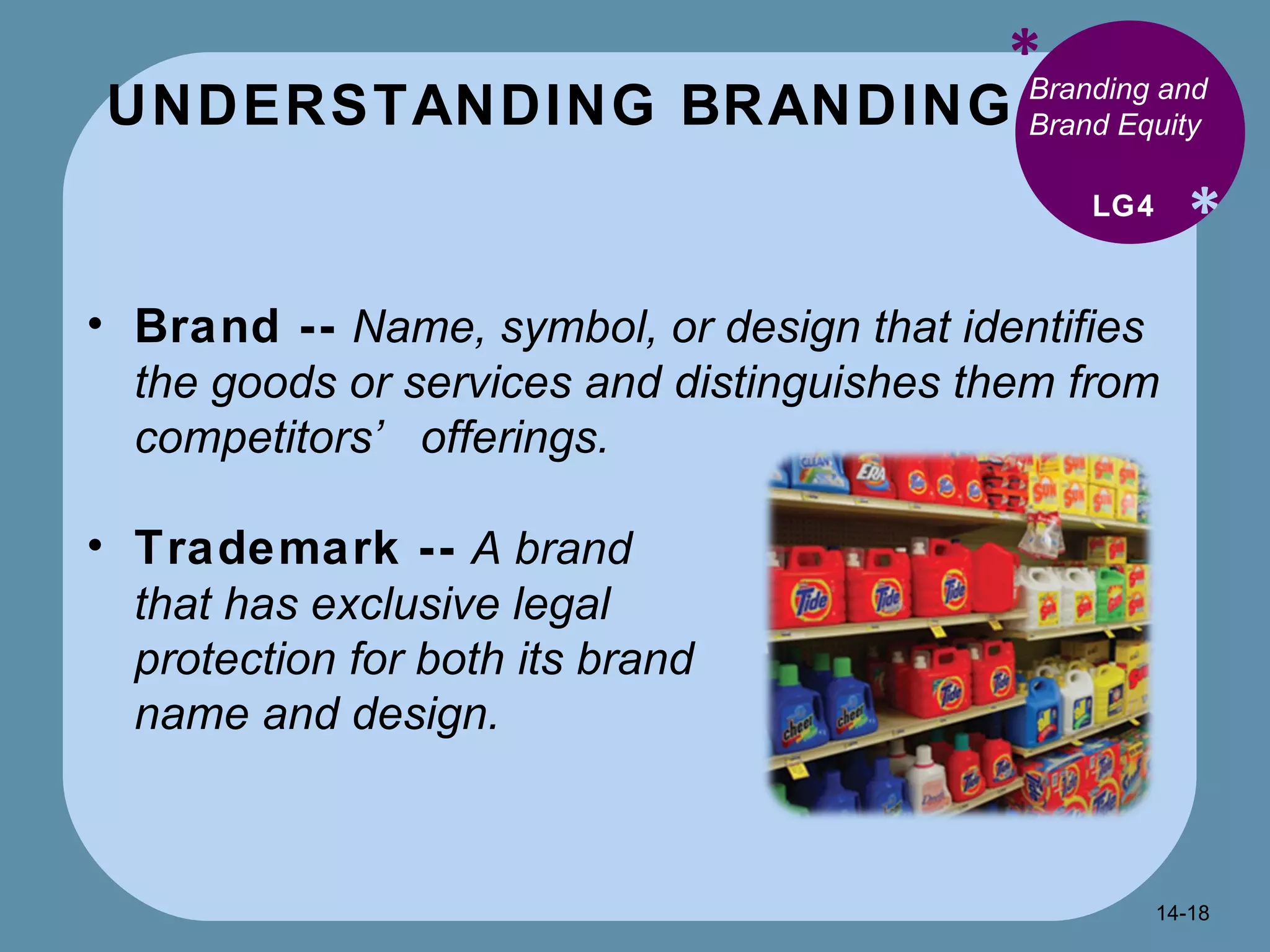
UNDERSTANDING BRANDING * * Branding and Brand Equity Brand --   Name, symbol, or design that identifies the goods or services and distinguishes them from competitors’ offerings. LG4 Trademark --   A brand that has exclusive legal protection for both its brand name and design. 14-
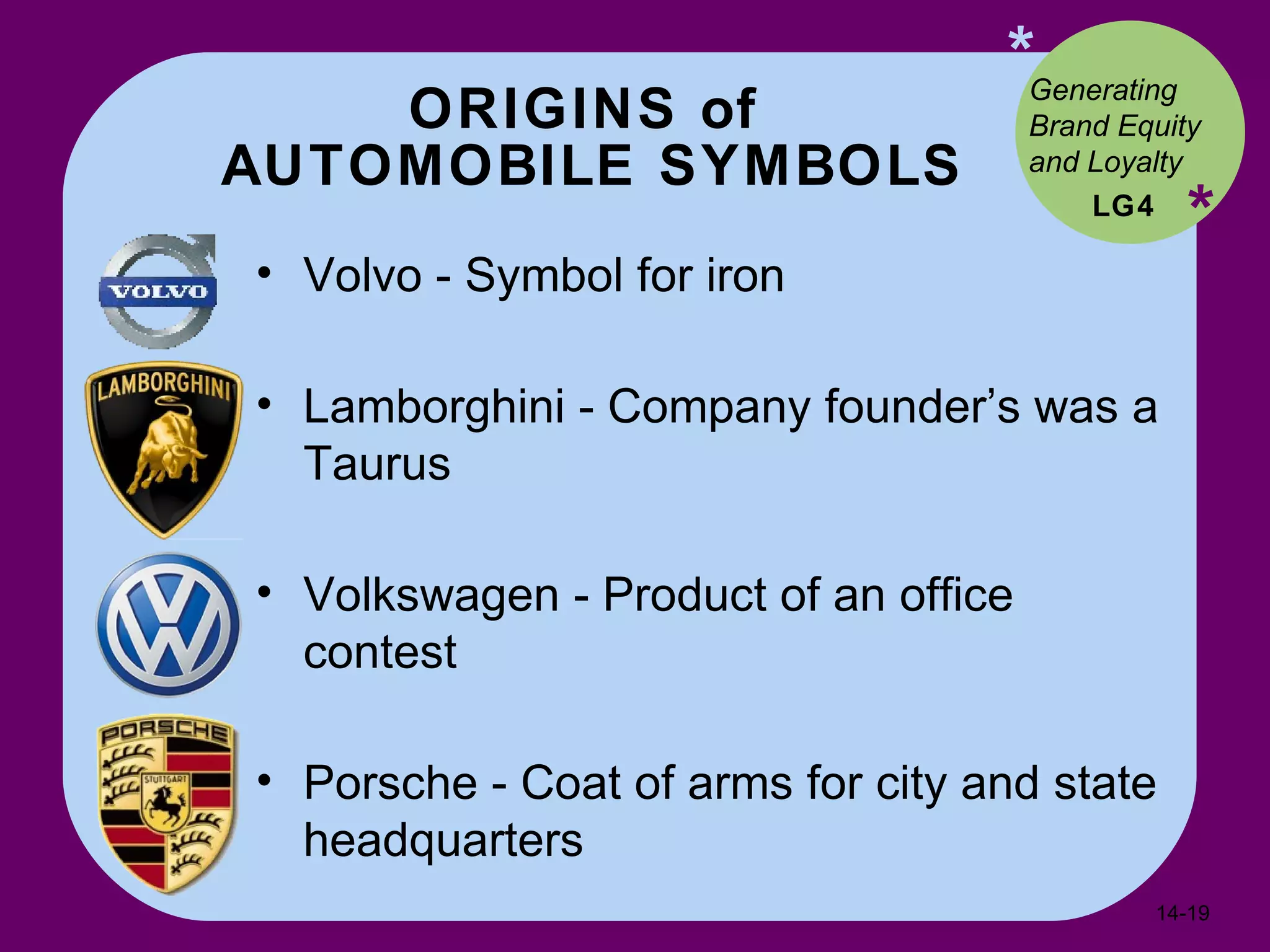
ORIGINS of  AUTOMOBILE SYMBOLS * * Volvo - Symbol for iron Lamborghini - Company founder’s was a Taurus Volkswagen - Product of an office contest Porsche - Coat of arms for city and state headquarters LG4 Generating Brand Equity and Loyalty  14-
KEY BRAND CATEGORIES * * Branding and Brand Equity Manufacturers’ Brands –   Brand names of manufacturers that distribute products nationally.  Dealer (Private-Label) Brands --   Products that carry a retailer’s or distributor’s brand name instead of a manufacturer’s.  LG4 14-
KEY BRAND CATEGORIES * * Branding and Brand Equity Generic Goods --  Non-branded products that sell at a discount compared to manufacturers’ or dealers’ brands. Knockoff Brands --  Illegal copies of national brands. LG4 14-
ESTABLISHING BRAND EQUITY  and LOYALTY * * Generating Brand Equity and Loyalty  Brand Equity –  The combination of factors (awareness, loyalty, perceived quality, images, and emotions) that people associate with a brand name.   Brand Loyalty --  The degree to which consumers are satisfied and are committed to further purchases. LG4 14-
BUILDING BRAND AWARENESS  * * Generating Brand Equity and Loyalty  Brand Awareness --  How quickly or easily a given brand name comes to mind when someone mentions a product category. Consumers reach a point of  brand preference  when they prefer one brand over another. When consumers reach  brand insistence , they will not accept substitute brands. LG4 14-
BUILDING BRAND  ASSOCIATIONS * * Generating Brand Equity and Loyalty  Brand Association --  Linking a brand to other favorable images, like celebrities or a geographic area. Brand Manager --  Person responsible for a particular brand and handles all the elements of the brand’s marketing mix. LG4 14-
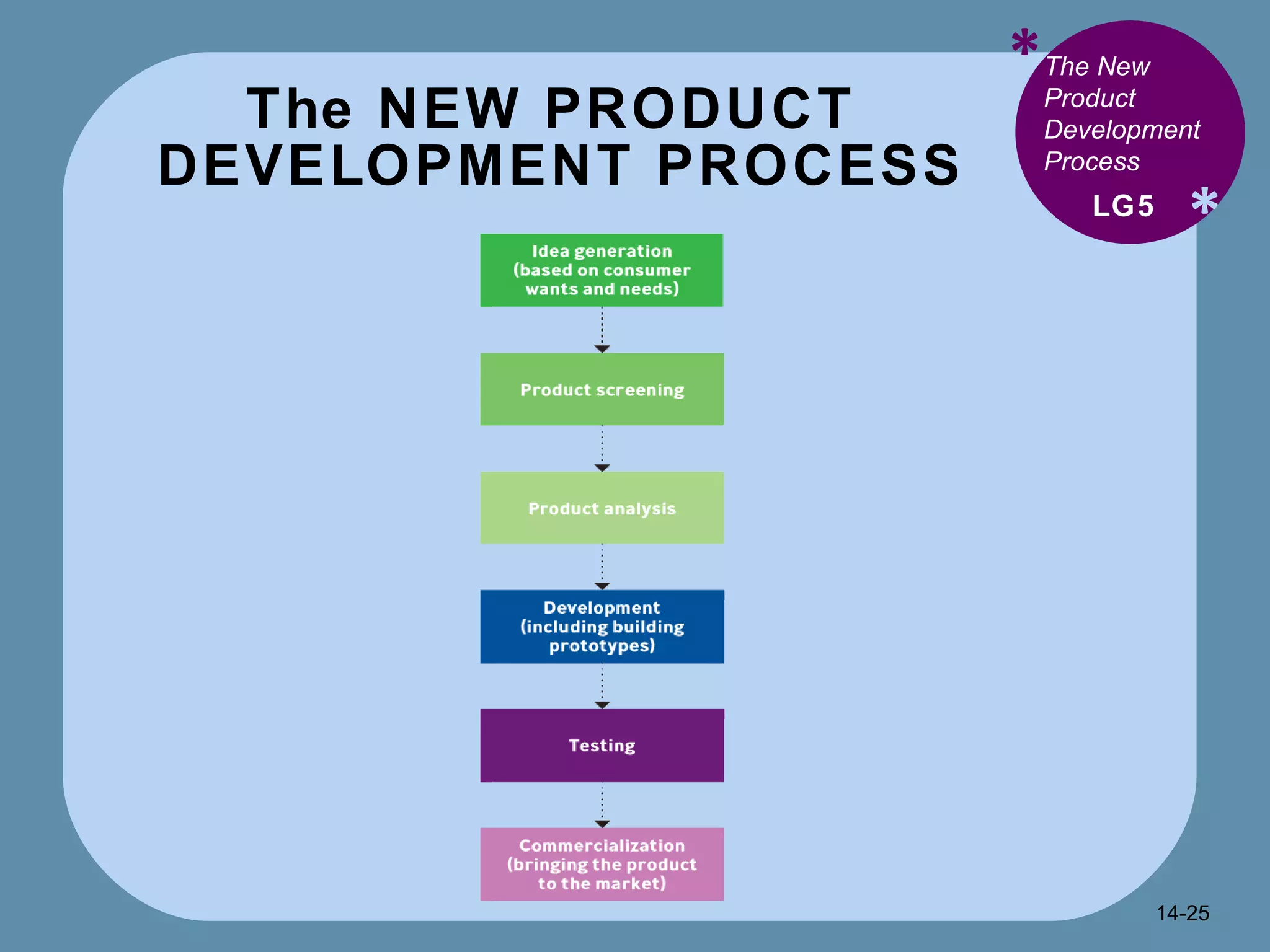
The NEW PRODUCT  DEVELOPMENT PROCESS * * The New Product Development Process LG5 14-
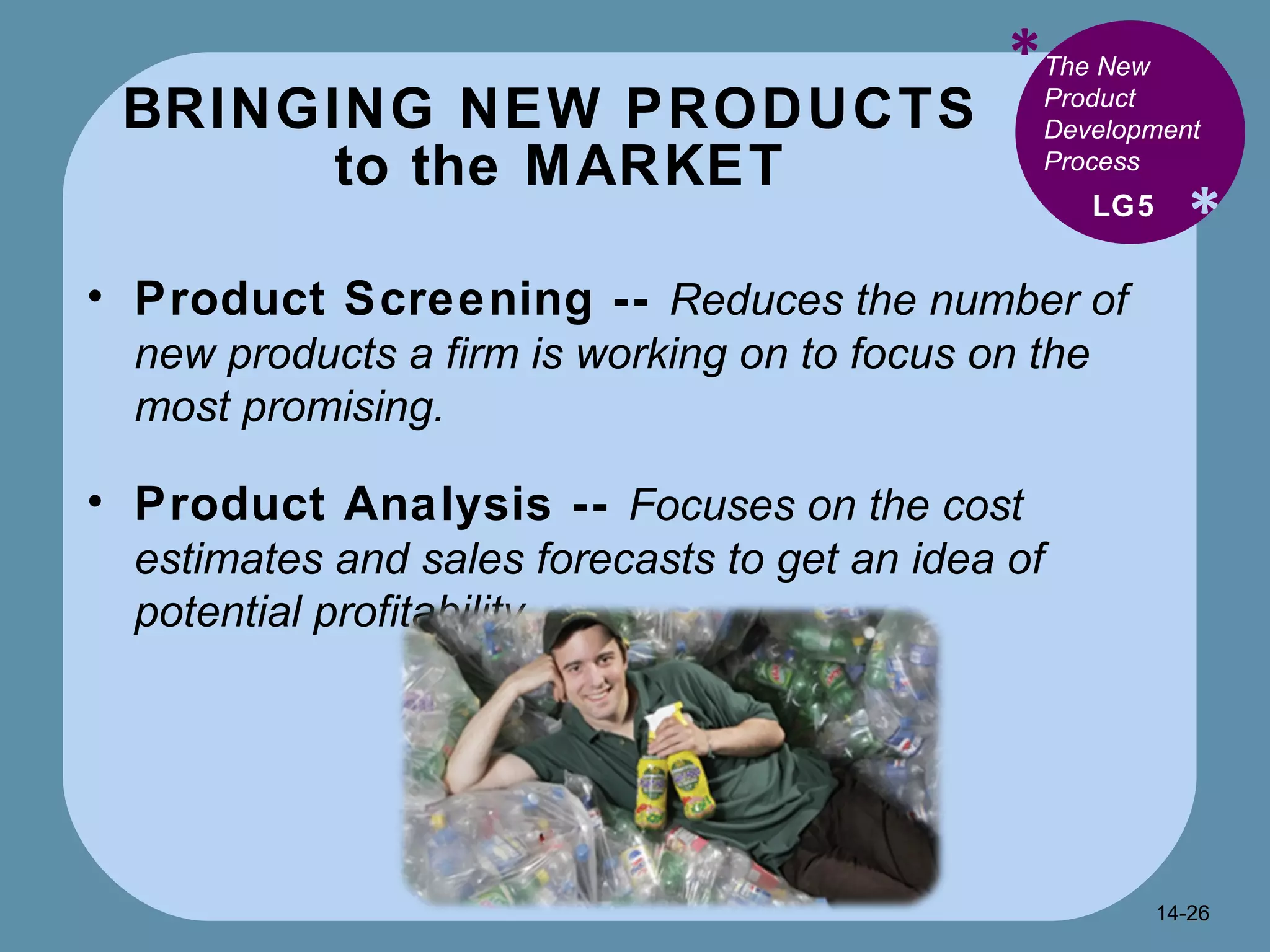
BRINGING NEW PRODUCTS  to the MARKET * * Product Screening --  Reduces the number of new products a firm is working on to focus on the most promising. Product Analysis --  Focuses on the cost estimates and sales forecasts to get an idea of potential profitability. LG5 The New Product Development Process 14-
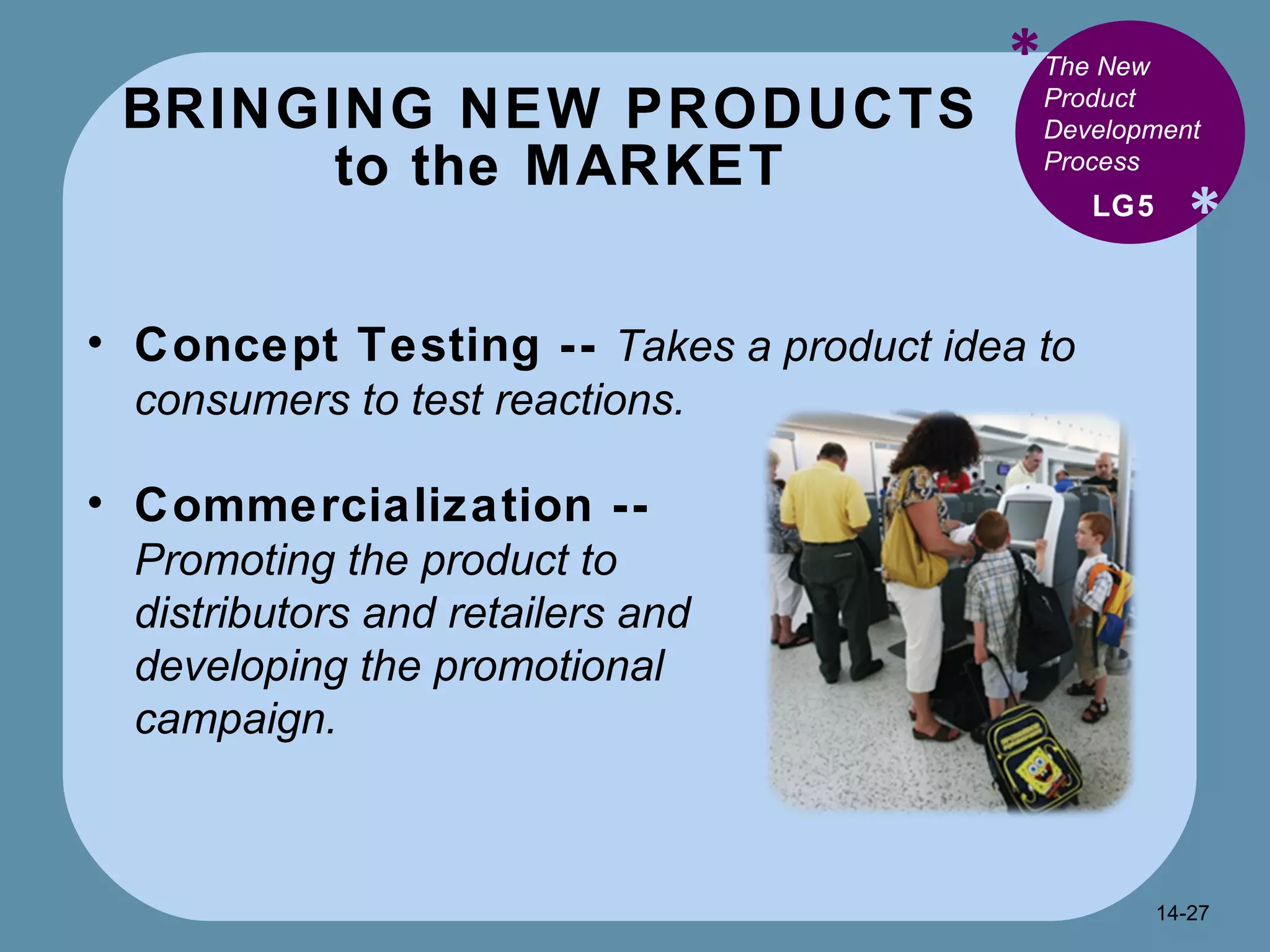
BRINGING NEW PRODUCTS  to the MARKET * * Concept Testing --   Takes a product idea to consumers to test reactions. LG5 The New Product Development Process Commercialization --  Promoting the product to distributors and retailers and developing the promotional campaign. 14-
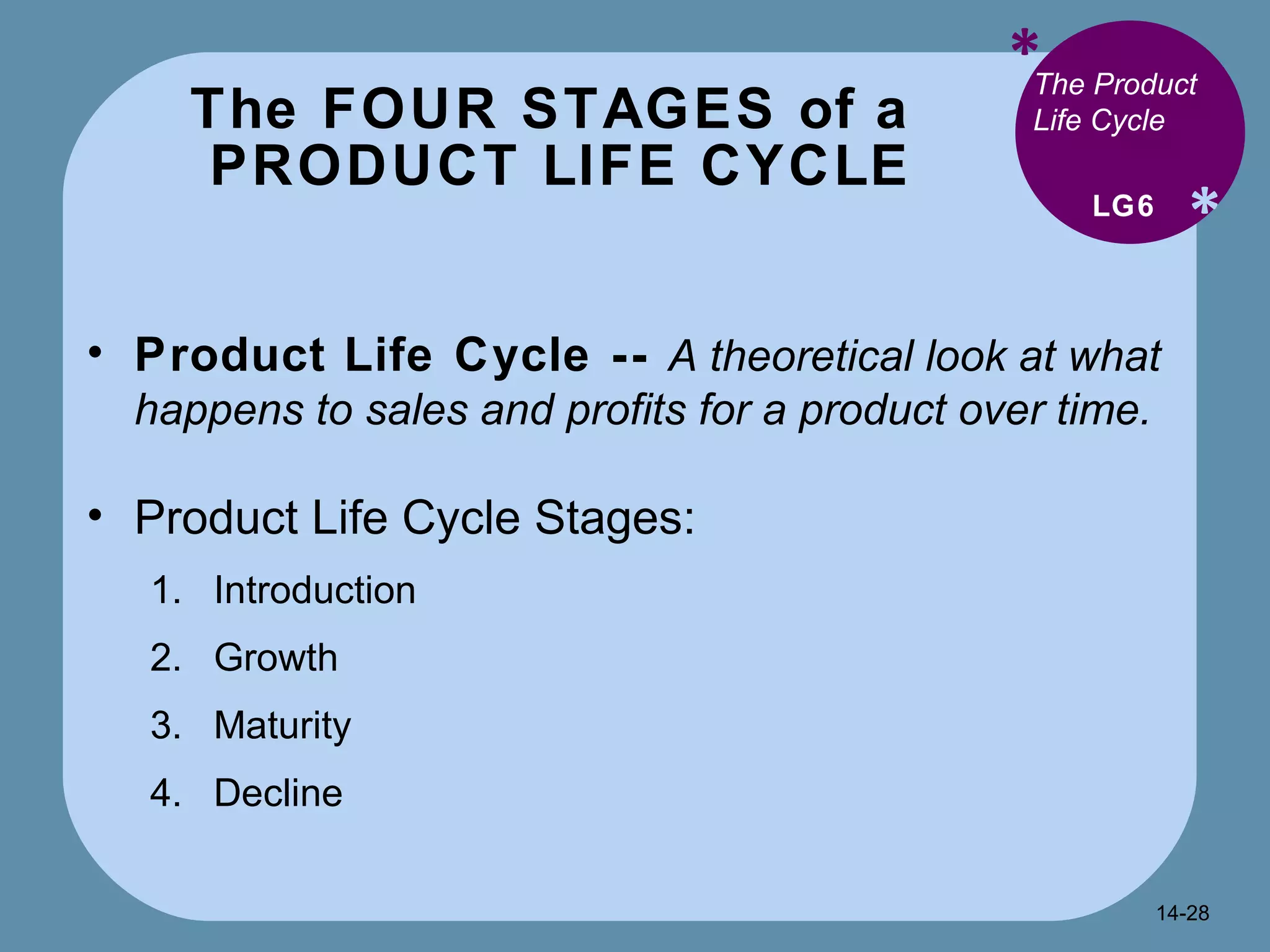
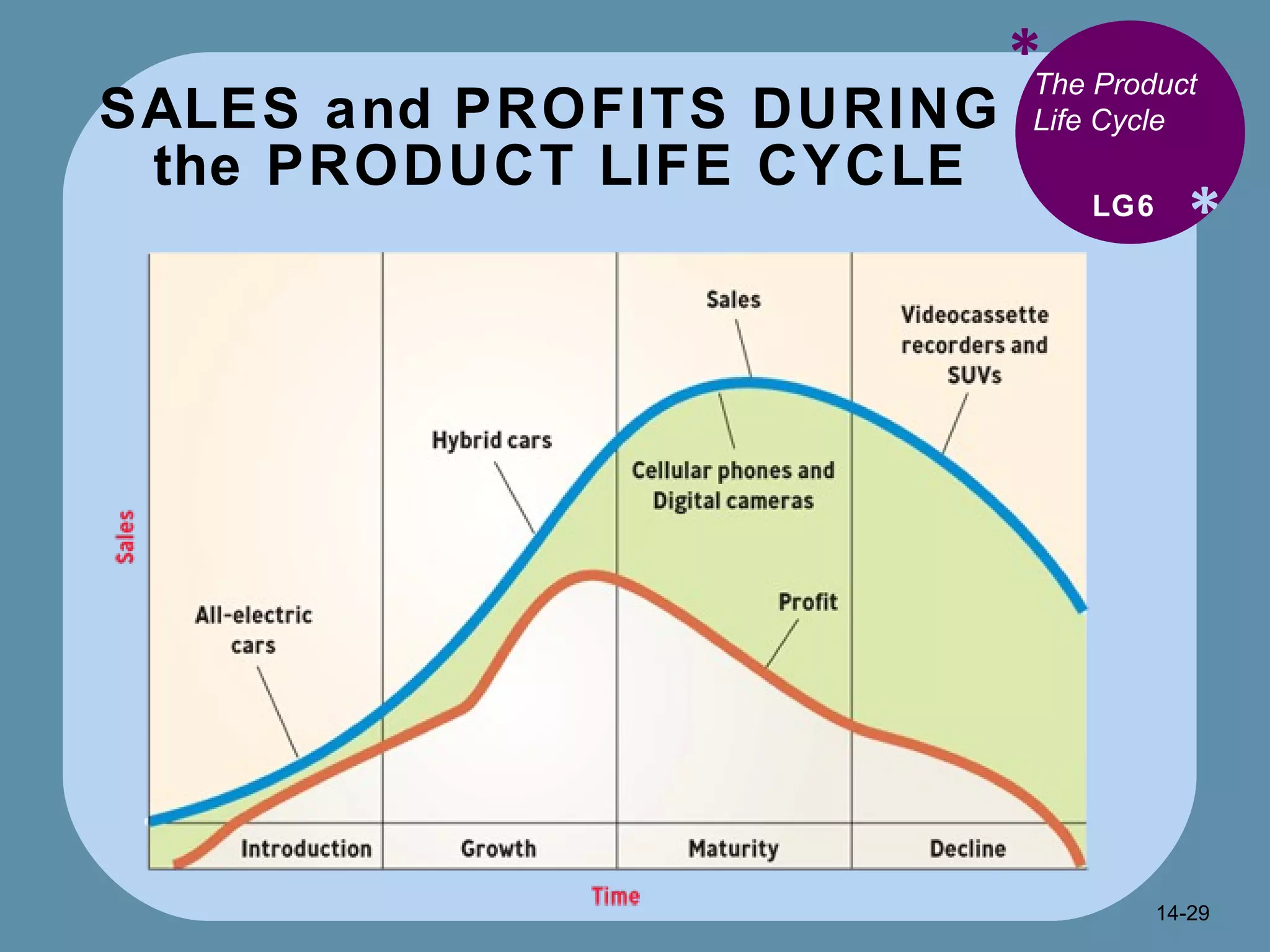
The FOUR STAGES of a  PRODUCT LIFE CYCLE * * The Product Life Cycle Product Life Cycle --  A theoretical look at what happens to sales and profits for a product over time. Product Life Cycle Stages: Introduction Growth  Maturity Decline  LG6 14-
SALES and PROFITS DURING  the PRODUCT LIFE CYCLE * * The Product Life Cycle LG6 14-
PRICING STRATEGIES * * Competitive Pricing Cost-based pricing measures cost of producing a product including materials, labor, and overhead. Target Costing --  Making the final price of a product an input in the product development process by estimating the selling price consumers will pay. Competition-Based Pricing --  A strategy based on what the competition is charging for its products. LG7 14-
USING BREAK-EVEN ANALYSIS * * Break-Even Analysis Break-Even Analysis --  The process used to determine profitability at various levels of sales. The break-even point is where revenues equals cost. Total Fixed Costs --  All costs that remain the same no matter how much is produced or sold. Variable Costs --  Costs that change according to the level of production. LG7 14-
PRICING ALTERNATIVES * * Other Pricing Strategies Skimming Price Strategy --  Pricing new products high to recover costs and make high profits while competition is limited. Penetration Price Strategy --  Pricing products low with the hope of attracting more buyers and discouraging other companies from competing in the market.   Everyday Low Pricing (EDLP) --  Setting prices lower than competitors with no special sales. LG7 14-
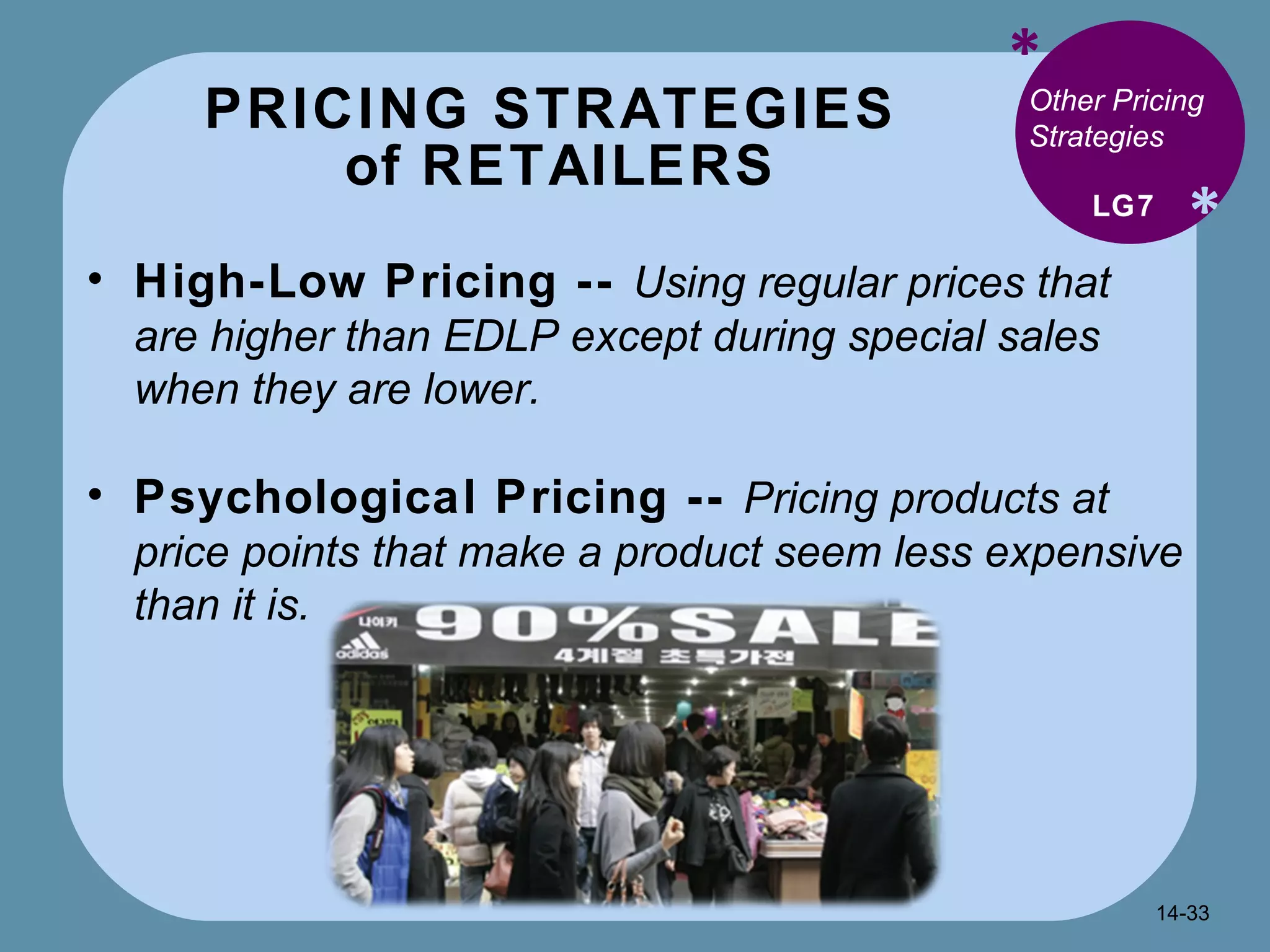
PRICING STRATEGIES  of RETAILERS * * Other Pricing Strategies High-Low Pricing --  Using regular prices that are higher than EDLP except during special sales when they are lower. Psychological Pricing --  Pricing products at price points that make a product seem less expensive than it is.  LG7 14-

Understanding business

  • 1.
    * * MainDeveloping and Pricing Goods and Services Copyright © 2010 by the McGraw-Hill Companies, Inc. All rights reserved. McGraw-Hill/Irwin
  • 2.
    DEVELOPING VALUE ** Product Development and the Total Product Offer According to the American Marketing Association, value is a foundation of marketing. Value -- Good quality at a fair price. Product development is a key activity in any modern business. LG1 14-
  • 3.
    PRODUCTS “UNTOUCHABLE” by SPENDING CUTS * * Internet service Cell phone service Cable television Discount apparel Haircuts and coloring Fast-food LG1 Product Development and the Total Product Offer 14-
  • 4.
    PRODUCTS “EXPENDABLE” by SPENDING CUTS * * Luxury handbags Satellite radio Specialty apparel High-end cosmetics Facials LG1 Product Development and the Total Product Offer 14-
  • 5.
    DEVELOPING a TOTAL PRODUCT * * Developing a Total Product Offer Total Product Offer -- Everything consumers evaluate when deciding whether to buy something. LG1 Products are evaluated on many different dimensions, both tangible and intangible. Marketers must find out what’s important to consumers. 14-
  • 6.
    UNDERSTANDING PRODUCTLINES * * Product Lines & Product Mix Product Line -- A group of products that are physically similar or intended for a similar market. Product lines often include competing brands like: M&Ms Peanut M&Ms Mint M&Ms Dark Chocolate M&Ms LG1 14-
  • 7.
    The PRODUCT MIX* * Product Lines & Product Mix Product Mix -- The combination of all product lines offered by a manufacturer or service provider. Product mixes like Proctor & Gamble’s can be extensive: Laundry detergent Cosmetics Diapers Potato chips Bar soap LG1 14-
  • 8.
    DIFFERENTIATING PRODUCTS ** Product Differentiation Product Differentiation -- The creation of real or perceived product differences. Marketers use a mix of pricing, advertising and packaging to create different images. Examples include: Bottled water Aspirin Fast-food Laundry detergent Shampoo LG2 14-
  • 9.
    CLASSIFYING CONSUMER GOODS and SERVICES * * Marketing Different Classes of Consumer Goods and Services Convenience Goods and Services -- Products consumers purchase frequently with minimal effort. These include: Candy and snacks Gas Milk and eggs LG2 14-
  • 10.
    CLASSIFYING SHOPPING GOODSand SERVICES * * Marketing Different Classes of Consumer Goods and Services Shopping Goods and Services -- Products consumers buy only after comparing value, quality, price, and styles. These include: Clothes and shoes Appliances and furniture Childcare Home remodeling LG2 14-
  • 11.
    CLASSIFYING SPECIALTY GOODSand SERVICES * * Marketing Different Classes of Consumer Goods and Services Specialty Goods and Services -- Products with unique characteristics and brand identity. These include: Tiffany jewelry Rolex watches Lamborghini automobiles Ritz Carlton Hotels LG2 14-
  • 12.
    CLASSIFYING UNSOUGHT GOODSand SERVICES * * Marketing Different Classes of Consumer Goods and Services Unsought Goods and Services -- Products consumers aren’t aware of or haven’t thought of buying until they need them. These include: Car-towing services Funeral services Plumbing services LG2 14-
  • 13.
    IDENTIFYING CONSUMER GOODS CLASSIFICATIONS * * How would you classify these consumer products? Beautyrest mattress Honda Accord McDonald’s Big Mac Rolls Royce automobiles Oreo Cookies Harvard University degree LG2 Marketing Different Classes of Consumer Goods and Services 14-
  • 14.
    ODD PRODUCT IDEAS that WERE SUCCESSFUL * * Pet Rock - For $3.95 you could buy a gift-wrapped rock with eyes and a training manual. Garbage Pail Kids - Perhaps the grossest trading cards ever produced. Mood Rings - Wildly popular as the changing colors of the ring supposedly measured your mood. Chia Pets - Animal shaped clay figures that grew sprouts. LG2 Marketing Different Classes of Consumer Goods and Services 14-
  • 15.
    CLASSIFYING INDUSTRIAL GOODS and SERVICES * * Marketing Industrial Goods and Services Industrial Goods -- Products used in the production of other products and sold in the B2B market. Industrial goods include: Installations Capital items Accessory equipment Supplies Service LG2 14-
  • 16.
    COMPANY USES ofPACKAGING * * Packaging Changes the Product Companies often use packaging to change and improve their basic product. Examples include: Microwave popcorn Tuna pouches McDonald’s green packaging LG3 Packaging can make a product more attractive to retailers. 14-
  • 17.
    SOME KEY FUNCTIONSof PACKAGING * * Packaging Changes the Product To attract buyers’ attention Protect the goods inside and be tamperproof Describe and provide information about the product Explain the product’s benefits Provide warranty information and warnings Give an indication of price, value, and uses LG3 14-
  • 18.
    UNDERSTANDING BRANDING ** Branding and Brand Equity Brand -- Name, symbol, or design that identifies the goods or services and distinguishes them from competitors’ offerings. LG4 Trademark -- A brand that has exclusive legal protection for both its brand name and design. 14-
  • 19.
    ORIGINS of AUTOMOBILE SYMBOLS * * Volvo - Symbol for iron Lamborghini - Company founder’s was a Taurus Volkswagen - Product of an office contest Porsche - Coat of arms for city and state headquarters LG4 Generating Brand Equity and Loyalty 14-
  • 20.
    KEY BRAND CATEGORIES* * Branding and Brand Equity Manufacturers’ Brands – Brand names of manufacturers that distribute products nationally. Dealer (Private-Label) Brands -- Products that carry a retailer’s or distributor’s brand name instead of a manufacturer’s. LG4 14-
  • 21.
    KEY BRAND CATEGORIES* * Branding and Brand Equity Generic Goods -- Non-branded products that sell at a discount compared to manufacturers’ or dealers’ brands. Knockoff Brands -- Illegal copies of national brands. LG4 14-
  • 22.
    ESTABLISHING BRAND EQUITY and LOYALTY * * Generating Brand Equity and Loyalty Brand Equity – The combination of factors (awareness, loyalty, perceived quality, images, and emotions) that people associate with a brand name. Brand Loyalty -- The degree to which consumers are satisfied and are committed to further purchases. LG4 14-
  • 23.
    BUILDING BRAND AWARENESS * * Generating Brand Equity and Loyalty Brand Awareness -- How quickly or easily a given brand name comes to mind when someone mentions a product category. Consumers reach a point of brand preference when they prefer one brand over another. When consumers reach brand insistence , they will not accept substitute brands. LG4 14-
  • 24.
    BUILDING BRAND ASSOCIATIONS * * Generating Brand Equity and Loyalty Brand Association -- Linking a brand to other favorable images, like celebrities or a geographic area. Brand Manager -- Person responsible for a particular brand and handles all the elements of the brand’s marketing mix. LG4 14-
  • 25.
    The NEW PRODUCT DEVELOPMENT PROCESS * * The New Product Development Process LG5 14-
  • 26.
    BRINGING NEW PRODUCTS to the MARKET * * Product Screening -- Reduces the number of new products a firm is working on to focus on the most promising. Product Analysis -- Focuses on the cost estimates and sales forecasts to get an idea of potential profitability. LG5 The New Product Development Process 14-
  • 27.
    BRINGING NEW PRODUCTS to the MARKET * * Concept Testing -- Takes a product idea to consumers to test reactions. LG5 The New Product Development Process Commercialization -- Promoting the product to distributors and retailers and developing the promotional campaign. 14-
  • 28.
    The FOUR STAGESof a PRODUCT LIFE CYCLE * * The Product Life Cycle Product Life Cycle -- A theoretical look at what happens to sales and profits for a product over time. Product Life Cycle Stages: Introduction Growth Maturity Decline LG6 14-
  • 29.
    SALES and PROFITSDURING the PRODUCT LIFE CYCLE * * The Product Life Cycle LG6 14-
  • 30.
    PRICING STRATEGIES ** Competitive Pricing Cost-based pricing measures cost of producing a product including materials, labor, and overhead. Target Costing -- Making the final price of a product an input in the product development process by estimating the selling price consumers will pay. Competition-Based Pricing -- A strategy based on what the competition is charging for its products. LG7 14-
  • 31.
    USING BREAK-EVEN ANALYSIS* * Break-Even Analysis Break-Even Analysis -- The process used to determine profitability at various levels of sales. The break-even point is where revenues equals cost. Total Fixed Costs -- All costs that remain the same no matter how much is produced or sold. Variable Costs -- Costs that change according to the level of production. LG7 14-
  • 32.
    PRICING ALTERNATIVES ** Other Pricing Strategies Skimming Price Strategy -- Pricing new products high to recover costs and make high profits while competition is limited. Penetration Price Strategy -- Pricing products low with the hope of attracting more buyers and discouraging other companies from competing in the market. Everyday Low Pricing (EDLP) -- Setting prices lower than competitors with no special sales. LG7 14-
  • 33.
    PRICING STRATEGIES of RETAILERS * * Other Pricing Strategies High-Low Pricing -- Using regular prices that are higher than EDLP except during special sales when they are lower. Psychological Pricing -- Pricing products at price points that make a product seem less expensive than it is. LG7 14-

Editor's Notes

  • #3 See Learning Goal 1: Describe a total product offer.
  • #4 See Learning Goal 1: Describe a total product offer. “Untouchable” Spending Cuts This slide profiles some of the goods and services people do not eliminate during a recession. Ask students: Why are the items listed on the slide “untouchables”? To further the discussion ask students: What items do they deem to be “untouchable” and why?
  • #5 See Learning Goal 1: Describe a total product offer. “ Expendable” Spending Cuts This slide shows the flipside of the previous slide and lists items that people are most likely to eliminate. Ask students to get into groups and discuss: Why are these items “expendable,” but the items on the previous slide are “untouchable”?
  • #6 See Learning Goal 1: Describe a total product offer. The total product offering includes tangible as well as intangible benefits.
  • #7 See Learning Goal 1: Describe a total product offer.
  • #8 See Learning Goal 1: Describe a total product offer. To give students a visual of the products offered by Proctor and Gamble, use their website at www.pg.com and click on the products tab.
  • #9 See Learning Goal 2: Identify the various kinds of consumer and industrial goods.
  • #10 See Learning Goal 2: Identify the various kinds of consumer and industrial goods. Location, brand awareness, and image are important in marketing these goods and services.
  • #11 See Learning Goal 2: Identify the various kinds of consumer and industrial goods. Brand name, price, and quality differences are important in marketing these goods and services.
  • #12 See Learning Goal 2: Identify the various kinds of consumer and industrial goods. Purchasers of the items listed on this slide are brand insistent and refuse to accept substitutes.
  • #13 See Learning Goal 2: Identify the various kinds of consumer and industrial goods. Unsought goods and services often rely on personal selling or specialty advertising - like the yellow pages.
  • #14 See Learning Goal 2: Identify the various kinds of consumer and industrial goods. Identifying Consumer Goods Classifications: Beautyrest mattress - shopping good Honda Accord - shopping good McDonald’s Big Mac - convenience good Rolls Royce automobiles - specialty good Oreo Cookies - convenience good Harvard University degree - specialty good
  • #15 See Learning Goal 2: Identify the various kinds of consumer and industrial goods. Odd Product Ideas Not all successful products necessarily make sense. Take for example the products mentioned on this slide. To start a discussion on odd product offerings: Ask students to give examples of odd products that were successful or unsuccessful. For more examples of odd products that were not successful go to http://www.guidespot.com/guides/ridiculous_stupid_products_inventions.
  • #16 See Learning Goal 2: Identify the various kinds of consumer and industrial goods.
  • #17 See Learning Goal 3: Summarize the functions of packaging.
  • #18 See Learning Goal 3: Summarize the functions of packaging.
  • #19 See Learning Goal 4: Contrast brand, a brand name, and trademark and show the value of brand equity. Recognized trademarks include the Nike Swoosh, the Pillsbury Doughboy, and Apple’s Apple.
  • #20 See Learning Goal 4: Contrast brand, a brand name, and trademark and show the value of brand equity. Origins of Automobile Symbols This slide presents the origins of car symbols. Ask the students: How important is the name and symbol of a product? What aspects should be considered in the naming process? ( Most students should suggest that the name of your product is very important, because it represents your company, tells the customers what the product is, and it should mean something.) Given that there are so many models of cars in so many different countries, naming cars becomes a very complex process. Should only one name be used in all countries or different names for the same model in different countries?
  • #21 See Learning Goal 4: Contrast brand, a brand name, and trademark and show the value of brand equity. Manufacturers’ brand examples - Ford, Microsoft, Xerox Dealer brand examples - Kenmore from Sears
  • #22 See Learning Goal 4: Contrast brand, a brand name, and trademark and show the value of brand equity.
  • #23 See Learning Goal 4: Contrast brand, a brand name, and trademark and show the value of brand equity. Example Coca-Cola and Ziploc have strong brand equity.
  • #24 See Learning Goal 4: Contrast brand, a brand name, and trademark and show the value of brand equity.
  • #25 See Learning Goal 4: Contrast brand, a brand name, and trademark and show the value of brand equity.
  • #26 See Learning Goal 5: Explain the steps in the new product development cycle. Green Ketchup and New Coke are two of the many thousands of products that failed. New product failure is common due to the fact that companies fail to properly manage the new product development process.
  • #27 See Learning Goal 5: Explain the role of brand managers and the steps of the new-product development process.
  • #28 See Learning Goal 5: Explain the role of brand managers and the steps of the new-product development process.
  • #29 See Learning Goal 6: Describe the product life cycle.
  • #30 See Learning Goal 6: Describe the product life cycle.
  • #31 See Learning Goal 7: Identify various pricing objectives and strategies.
  • #32 See Learning Goal 7: Identify various pricing objectives and strategies.
  • #33 See Learning Goal 7: Identify various pricing objectives and strategies. When Apple introduced the iPhone, they used a skimming price strategy. The everyday low pricing or EDLP has been effectively used by Wal-Mart to dominate the retail sector.
  • #34 See Learning Goal 7: Identify various pricing objectives and strategies.