
The views expressed in this presentation are the views of the author/s and do not necessarily reflect the views or policies of the Asian
Development Bank, or its Board of Governors, or the governments they represent. ADB does not guarantee the accuracy of the data included
in this presentation and accepts no responsibility for any consequence of their use. The countries listed in this presentation do not imply any
view on ADB's part as to sovereignty or independent status or necessarily conform to ADB's terminology.
Understand: The Global
Goals
Olivier Serrat
2016
Define: Sustainable Development
Sustainable development, as
defined by the World Commission
on Environment and Development
in 1987, is development that
meets the needs of the present
without compromising the ability
of future generations to meet
theirs. It embraces two notions:
The concept of needs, in
particular those of the
poor to which overriding
priority should be given.
The idea of limits to the
environment's ability to
meet present and future
needs.
The pursuit of sustainable development is a balancing act: it
requires the implementation of policies, strategies, programs,
and projects that treat environment and development as a
single issue; it also demands changes in the mindsets, attitudes,
and behaviors of stakeholders.
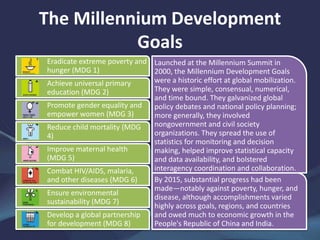
The Millennium Development
Goals
Eradicate extreme poverty and
hunger (MDG 1)
Achieve universal primary
education (MDG 2)
Promote gender equality and
empower women (MDG 3)
Reduce child mortality (MDG
4)
Improve maternal health
(MDG 5)
Combat HIV/AIDS, malaria,
and other diseases (MDG 6)
Ensure environmental
sustainability (MDG 7)
Develop a global partnership
for development (MDG 8)
Launched at the Millennium Summit in
2000, the Millennium Development Goals
were a historic effort at global mobilization.
They were simple, consensual, numerical,
and time bound. They galvanized global
policy debates and national policy planning;
more generally, they involved
nongovernment and civil society
organizations. They spread the use of
statistics for monitoring and decision
making, helped improve statistical capacity
and data availability, and bolstered
interagency coordination and collaboration.
By 2015, substantial progress had been
made—notably against poverty, hunger, and
disease, although accomplishments varied
highly across goals, regions, and countries
and owed much to economic growth in the
People's Republic of China and India.
Video #1: The Millennium
Development Goals
The Millennium Development
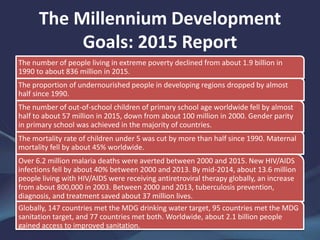
Goals: 2015 Report
The number of people living in extreme poverty declined from about 1.9 billion in
1990 to about 836 million in 2015.
The proportion of undernourished people in developing regions dropped by almost
half since 1990.
The number of out-of-school children of primary school age worldwide fell by almost
half to about 57 million in 2015, down from about 100 million in 2000. Gender parity
in primary school was achieved in the majority of countries.
The mortality rate of children under 5 was cut by more than half since 1990. Maternal
mortality fell by about 45% worldwide.
Over 6.2 million malaria deaths were averted between 2000 and 2015. New HIV/AIDS
infections fell by about 40% between 2000 and 2013. By mid-2014, about 13.6 million
people living with HIV/AIDS were receiving antiretroviral therapy globally, an increase
from about 800,000 in 2003. Between 2000 and 2013, tuberculosis prevention,
diagnosis, and treatment saved about 37 million lives.
Globally, 147 countries met the MDG drinking water target, 95 countries met the MDG
sanitation target, and 77 countries met both. Worldwide, about 2.1 billion people
gained access to improved sanitation.
The Millennium Development
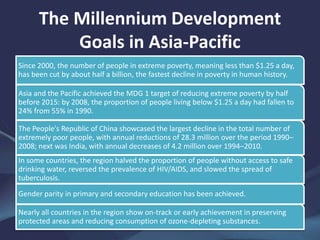
Goals in Asia-Pacific
Since 2000, the number of people in extreme poverty, meaning less than $1.25 a day,
has been cut by about half a billion, the fastest decline in poverty in human history.
Asia and the Pacific achieved the MDG 1 target of reducing extreme poverty by half
before 2015: by 2008, the proportion of people living below $1.25 a day had fallen to
24% from 55% in 1990.
The People's Republic of China showcased the largest decline in the total number of
extremely poor people, with annual reductions of 28.3 million over the period 1990–
2008; next was India, with annual decreases of 4.2 million over 1994–2010.
In some countries, the region halved the proportion of people without access to safe
drinking water, reversed the prevalence of HIV/AIDS, and slowed the spread of
tuberculosis.
Gender parity in primary and secondary education has been achieved.
Nearly all countries in the region show on-track or early achievement in preserving
protected areas and reducing consumption of ozone-depleting substances.
The Millennium Development
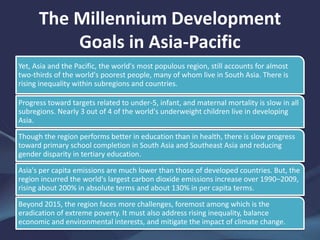
Goals in Asia-Pacific
Yet, Asia and the Pacific, the world's most populous region, still accounts for almost
two-thirds of the world's poorest people, many of whom live in South Asia. There is
rising inequality within subregions and countries.
Progress toward targets related to under-5, infant, and maternal mortality is slow in all
subregions. Nearly 3 out of 4 of the world's underweight children live in developing
Asia.
Though the region performs better in education than in health, there is slow progress
toward primary school completion in South Asia and Southeast Asia and reducing
gender disparity in tertiary education.
Asia's per capita emissions are much lower than those of developed countries. But, the
region incurred the world's largest carbon dioxide emissions increase over 1990–2009,
rising about 200% in absolute terms and about 130% in per capita terms.
Beyond 2015, the region faces more challenges, foremost among which is the
eradication of extreme poverty. It must also address rising inequality, balance
economic and environmental interests, and mitigate the impact of climate change.
Video #2: The Millennium
Development Goals in Asia-Pacific
Video #3: ADB and the Millennium
Development Goals
Shortcomings of the Millennium
Development Goals
With limited consideration of
enablers but "shared responsibility"
for implementation, the MDGs
focused on a few aspects of
development—viz. education,
health, and poverty eradication (and
only on certain forms of that if
poverty is interpreted as multiple
deprivation of economic, human,
socio-cultural, political, and
protective capabilities)—and
environmental sustainability. Lack of
consultation at the conception of the
MDG framework led to perceptions
of a donor-centric agenda.
The MDGs neglected
distributive issues. For
example, a reduction in
child mortality is more
easily achieved by focusing
on those who are already
better-off in terms of child
survival; in the eyes of
policy makers, it might be
easier, cheaper, and hence
more attractive to invest in
these rather than in those
at the bottom of the
pyramid.
Shortcomings of the Millennium
Development Goals
Some MDGs measured inputs or
outputs, not outcomes (and even
less impacts). MDG 2, for
example, only measured the
intake of education, regardless of
quality or relevance to economic,
social, and political life. Some
MDGs could not be measured—
either because no indicators or
targets had been set or because
no data was available.
The MDGs were formulated as
global goals but came to be
seen as national objectives.
Failure to account for
differences in initial conditions
posed a particular challenge to
least-developed countries:
they started out with much
poorer performance indicators
than others vis-à-vis all MDGs.
Some MDGs were unrealistic. (MDG 2 sought total enrolment in
primary education.) Others demonstrated little ambition. On top,
many criticized the MDGs for focusing on the social sectors at the
expense of economic and environmental concerns.
Video #4: New Development
Challenges in Asia-Pacific
Video #5: The Millennium
Development Goals Post-2015
Video #6: Reflections on Rio+20
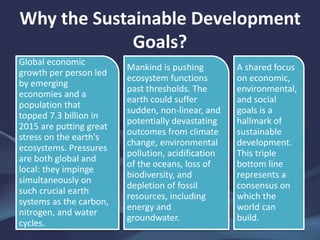
Why the Sustainable Development
Goals?
Global economic
growth per person led
by emerging
economies and a
population that
topped 7.3 billion in
2015 are putting great
stress on the earth's
ecosystems. Pressures
are both global and
local: they impinge
simultaneously on
such crucial earth
systems as the carbon,
nitrogen, and water
cycles.
Mankind is pushing
ecosystem functions
past thresholds. The
earth could suffer
sudden, non-linear, and
potentially devastating
outcomes from climate
change, environmental
pollution, acidification
of the oceans, loss of
biodiversity, and
depletion of fossil
resources, including
energy and
groundwater.
A shared focus
on economic,
environmental,
and social
goals is a
hallmark of
sustainable
development.
This triple
bottom line
represents a
consensus on
which the
world can
build.
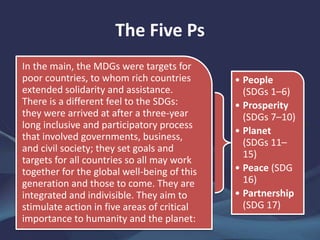
The Five Ps
In the main, the MDGs were targets for
poor countries, to whom rich countries
extended solidarity and assistance.
There is a different feel to the SDGs:
they were arrived at after a three-year
long inclusive and participatory process
that involved governments, business,
and civil society; they set goals and
targets for all countries so all may work
together for the global well-being of this
generation and those to come. They are
integrated and indivisible. They aim to
stimulate action in five areas of critical
importance to humanity and the planet:
• People
(SDGs 1–6)
• Prosperity
(SDGs 7–10)
• Planet
(SDGs 11–
15)
• Peace (SDG
16)
• Partnership
(SDG 17)
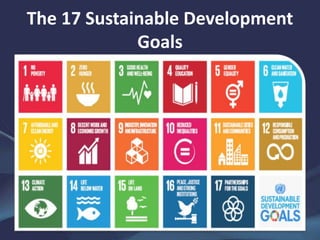
The 17 Sustainable Development
Goals
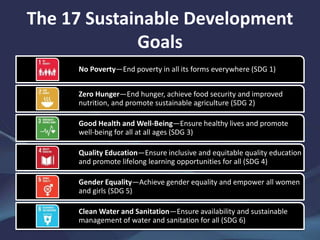
The 17 Sustainable Development
Goals
No Poverty—End poverty in all its forms everywhere (SDG 1)
Zero Hunger—End hunger, achieve food security and improved
nutrition, and promote sustainable agriculture (SDG 2)
Good Health and Well-Being—Ensure healthy lives and promote
well-being for all at all ages (SDG 3)
Quality Education—Ensure inclusive and equitable quality education
and promote lifelong learning opportunities for all (SDG 4)
Gender Equality—Achieve gender equality and empower all women
and girls (SDG 5)
Clean Water and Sanitation—Ensure availability and sustainable
management of water and sanitation for all (SDG 6)
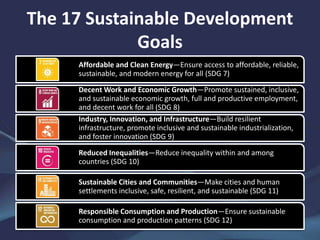
The 17 Sustainable Development
Goals
Affordable and Clean Energy—Ensure access to affordable, reliable,
sustainable, and modern energy for all (SDG 7)
Decent Work and Economic Growth—Promote sustained, inclusive,
and sustainable economic growth, full and productive employment,
and decent work for all (SDG 8)
Industry, Innovation, and Infrastructure—Build resilient
infrastructure, promote inclusive and sustainable industrialization,
and foster innovation (SDG 9)
Reduced Inequalities—Reduce inequality within and among
countries (SDG 10)
Sustainable Cities and Communities—Make cities and human
settlements inclusive, safe, resilient, and sustainable (SDG 11)
Responsible Consumption and Production—Ensure sustainable
consumption and production patterns (SDG 12)
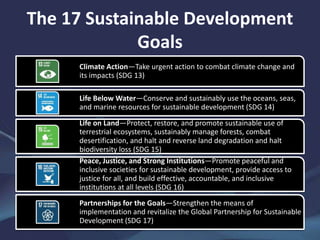
The 17 Sustainable Development
Goals
Climate Action—Take urgent action to combat climate change and
its impacts (SDG 13)
Life Below Water—Conserve and sustainably use the oceans, seas,
and marine resources for sustainable development (SDG 14)
Life on Land—Protect, restore, and promote sustainable use of
terrestrial ecosystems, sustainably manage forests, combat
desertification, and halt and reverse land degradation and halt
biodiversity loss (SDG 15)
Peace, Justice, and Strong Institutions—Promote peaceful and
inclusive societies for sustainable development, provide access to
justice for all, and build effective, accountable, and inclusive
institutions at all levels (SDG 16)
Partnerships for the Goals—Strengthen the means of
implementation and revitalize the Global Partnership for Sustainable
Development (SDG 17)
Reaching the Sustainable
Development Goals
The SDGs number 17,
with 169 targets. All
mean to move from
partial solutions to
total solutions. But,
having a development
agenda is not enough:
to stay the course
policy-makers must
turn goals into plans
for which stakeholders
are accountable. (An
operational focus is
often absent from such
high-level debates.)
The Global Partnership for Sustainable
Development needs to shift the
discussion from "billions" in development
assistance to "trillions" in investments of
all kind. Aid is important but developed
countries can go further: they can reduce
barriers to trade and promote innovation.
Still, the key is to expand the domestic
resources of developing countries:
attracting investment will create jobs and
income that will increase tax revenues;
this requires new partnerships and
greater coherence, coordination, and
collaboration within and across
governments.
17 Opportunities for Investment
The SDGs bring in a
new player: the
private sector. Unlike
the MDGs, there is
an appreciation of
the role of business
in sustainable
development. This is
important given the
cost of
implementing the
SDGs, estimated at
$3.5–5.0 trillion per
year in state
spending,
investment, and aid.
To note, SDG 7 targets expansion of
infrastructure and upgrade of technology for
modern and sustainable energy services.
SDG 8 promotes policies that support
productive activities, decent job creation,
entrepreneurship, and creativity and
innovation, and encourage the formalization
and growth of micro-, small-, and medium-
sized enterprises. SDG 9 is to build resilient
infrastructure, promote sustainable
industrialization, and foster innovation. SDG
16 can be advanced if business invests in
post-conflict states and contribute to peace-
building. SDG 17 encourages and promotes
effective public, public–private, and civil
society partnerships.
Challenges to the Sustainable
Development Goals
Involve the
whole of
government
• Political leadership will have to make sure the SDGs are
embraced across ministries and integrated into
national policies and planning. Some SDGs are better
integrated than others in existing national prioritization
processes; some SDG targets can serve multiple
purposes; inevitably, choices will have to be made.
Leaders in developed countries will need to address
inequalities at home, achieve more sustainable
pathways to economic growth, and curb the cross-
border impacts of their consumption and production
patterns.
Engage society
• More than a development agenda, the SDGs are about
structural economic transformation. For effective
prioritization in national polices and planning and for
coherent, efficient delivery based on clear roles and
responsibilities, the strength and innovation of civil
society, local governments, and the private sector must
be mobilized through transparent and participatory
decision making.
Challenges to the Sustainable
Development Goals
Secure buy-in
from financial
institutions and
the private
sector
• The SDGs call for significant public and private,
national and international, concessional and non-
concessional resources. Except in least-developed
countries, domestic resources will need to dominate
the resource envelope, which reinforces the
importance of getting national policies right.
International financial institutions can align their
portfolios with the SDGs and stimulate private finance.
But, in developing countries, the responsibility lies
with the political leadership to nurture enabling
environments and inspire good governance to speed
financial resources in the proper directions and enlarge
business opportunities.
Hold
stakeholders
accountable
• Reaching the SDGs rests on coherence, coordination,
and collaboration within and across governments and
on engagement with a multitude of other stakeholders.
As an intergovernmental system, the United Nations
can only track the progress of sovereign member states
based on voluntary progress reports.
Business and the Sustainable
Development Goals
The hidden message of the
SDGs may be that
development assistance is
an ever-declining part of
the story: the MDGs
meant to create a social
safety net; the SDGs reach
"beyond aid" to business,
acknowledging that one
cannot end poverty, fight
inequality and injustice,
and tackle climate change
if business—in all its
diversity—is not on board.
In segmented ways, some
businesses have set up
initiatives for sustainable
development through core
business operations and value
chains, first and foremost, but
also social investments,
philanthropic contributions,
and advocacy efforts. In the
comprehensive SDG
framework, notably SDGs 8–9
and SDG 12, all can think
strategically about how to align
their role in the direction the
world is heading to.
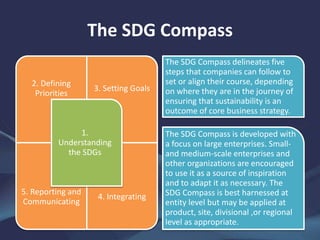
The SDG Compass
2. Defining
Priorities
3. Setting Goals
5. Reporting and
Communicating
4. Integrating
1.
Understanding
the SDGs
The SDG Compass delineates five
steps that companies can follow to
set or align their course, depending
on where they are in the journey of
ensuring that sustainability is an
outcome of core business strategy.
The SDG Compass is developed with
a focus on large enterprises. Small-
and medium-scale enterprises and
other organizations are encouraged
to use it as a source of inspiration
and to adapt it as necessary. The
SDG Compass is best harnessed at
entity level but may be applied at
product, site, divisional ,or regional
level as appropriate.
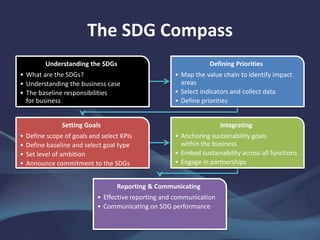
The SDG Compass
Understanding the SDGs
• What are the SDGs?
• Understanding the business case
• The baseline responsibilities
for business
Defining Priorities
• Map the value chain to identify impact
areas
• Select indicators and collect data
• Define priorities
Setting Goals
• Define scope of goals and select KPIs
• Define baseline and select goal type
• Set level of ambition
• Announce commitment to the SDGs
Integrating
• Anchoring sustainability goals
within the business
• Embed sustainability across all functions
• Engage in partnerships
Reporting & Communicating
• Effective reporting and communication
• Communicating on SDG performance
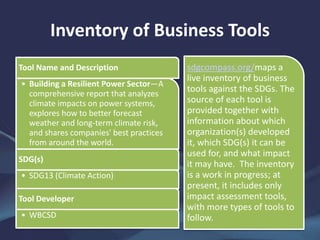
Inventory of Business Tools
sdgcompass.org/maps a
live inventory of business
tools against the SDGs. The
source of each tool is
provided together with
information about which
organization(s) developed
it, which SDG(s) it can be
used for, and what impact
it may have. The inventory
is a work in progress; at
present, it includes only
impact assessment tools,
with more types of tools to
follow.
Tool Name and Description
• Building a Resilient Power Sector—A
comprehensive report that analyzes
climate impacts on power systems,
explores how to better forecast
weather and long-term climate risk,
and shares companies' best practices
from around the world.
SDG(s)
• SDG13 (Climate Action)
Tool Developer
• WBCSD
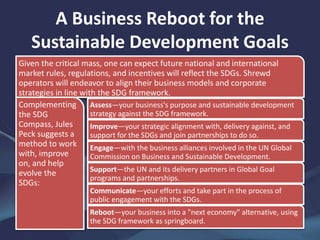
A Business Reboot for the
Sustainable Development Goals
Given the critical mass, one can expect future national and international
market rules, regulations, and incentives will reflect the SDGs. Shrewd
operators will endeavor to align their business models and corporate
strategies in line with the SDG framework.
Complementing
the SDG
Compass, Jules
Peck suggests a
method to work
with, improve
on, and help
evolve the
SDGs:
Assess—your business's purpose and sustainable development
strategy against the SDG framework.
Improve—your strategic alignment with, delivery against, and
support for the SDGs and join partnerships to do so.
Engage—with the business alliances involved in the UN Global
Commission on Business and Sustainable Development.
Support—the UN and its delivery partners in Global Goal
programs and partnerships.
Communicate—your efforts and take part in the process of
public engagement with the SDGs.
Reboot—your business into a "next economy" alternative, using
the SDG framework as springboard.
Framing Business-Led Solutions
• Measurable—so we know they are
making a difference.
• Scalable—so they can have a meaningful
impact on the world.
• Replicable—so they can be applied by
many companies in multiple sectors,
countries, and regions.
• Beyond Business As Usual—so
businesses and governments begin to
work—and collaborate—differently.
• Good for Business—so they have a
commercial logic that contributes to the
broader good and to the bottom line.
The World Business Council
for Sustainable
Development thinks that
any business—large or
small, global or local—can
frame business solutions
for economic,
environmental, and societal
must-haves, both by
minimizing negative
impacts and maximizing
positive impacts on people
and the planet. Business-
lead solutions should be:
Some business solutions require only a company's efforts to implement;
other will be enabled by policy and regulatory changes or partnerships.
Further Reading
• ADB. 2011. ADB Sustainable Development Timeline. Manila.
www.adb.org/publications/adb-sustainable-development-
timeline
• ——. 2012. World Sustainable Development Timeline. Manila.
www.adb.org/publications/world-sustainable-development-
timeline
• ——. 2013. The Millennium Development Goals in Asia and
the Pacific: 12 Things to Know. Manila.
www.adb.org/features/12-things-know-about-mdgs-asia-and-
pacific
Further Reading
• ADB. 2015. Making It Happen: Technology, Finance and
Statistics for Sustainable Development in Asia and the Pacific.
Manila. www.adb.org/publications/technology-finance-and-
statistics-sustainable-development-asia-pacific
• ——. 2015. Making Money Work: Financing a Sustainable
Future in Asia and the Pacific. Manila.
www.adb.org/publications/making-money-work-financing-
sustainable-future-asia-and-pacific
• ——. 2016. Sustainable Development Goals. Manila.
www.adb.org/site/sdg/main
Further Reading
• UN System Task Team on the Post-2015 Development Agenda.
2012. Review of the Contributions of the MDG Agenda to
Foster Development: Lessons for the Post-2015 UN
Development Agenda. Discussion Note. New York: United
Nations.
• UN. 2015. The Millennium Development Goals Report 2015.
New York: United Nations.
• UN. 2015. The Addis Ababa Action Agenda of the Third
International Conference on Financing for Development. New
York: United Nations. www.un.org/esa/ffd/wp-
content/uploads/2015/08/AAAA_Outcome.pdf
Further Reading
• UN. 2015. Transforming Our World: the 2030 Agenda for
Sustainable Development. New York: United Nations.
sustainabledevelopment.un.org/post2015/transformingourw
orld
• SDG Compass. 2016. sdgcompass.org/
• Jules Peck. 2016. Delivering on the SDGs Will Require a
System Reboot. Corporate Citizenship Briefing. Speaking Out;
2 February. ccbriefing.corporate-
citizenship.com/2016/02/02/delivering-sdgs-will-require-
system-reboot/
• World Business Council for Sustainable Development. 2016.
Action2020. action2020.org/
Videos
• ADB. 2011. Water in Asia. Manila. vimeo.com/91599203
• ——. 2011. The Water Sector in ADB. Manila.
vimeo.com/91599206
• ——. 2013. Reflections on Rio+20. Manila.
vimeo.com/92214523
• ——. 2013. The Millennium Development Goals. Manila.
vimeo.com/92214529
• ——. 2013. ADB's Contribution to the Millennium
Development Goals. Manila. vimeo.com/92214530
• ——. 2013. The Millennium Development Goals and the Post-
2015 Development Agenda. Manila. vimeo.com/92214538
Videos
• ADB. 2013. Achievements of the Millennium Development
Goals in Asia and the Pacific. Manila. vimeo.com/92482268
• ——. 2013. New Development Challenges in Asia and the
Pacific. Manila. vimeo.com/92482269
• ——. 2014. What are Social Enterprises? Manila.
vimeo.com/123062806
• ——. 2014. "Aid Fatigue" and Aid Effectiveness. Manila.
vimeo.com/124022419
• ——. 2016. The ADB Sustainable Development Timeline.
Manila. reflections.adb.org/
Videos
• ADB. 2016. ADB: Reflections and Beyond. Manila.
vimeo.com/user26371068
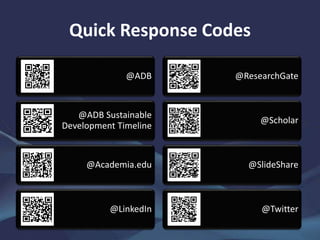
Quick Response Codes
@ADB
@ADB Sustainable
Development Timeline
@Academia.edu
@LinkedIn
@ResearchGate
@Scholar
@SlideShare
@Twitter

Understand: The Global Goals

  • 1.
    The views expressedin this presentation are the views of the author/s and do not necessarily reflect the views or policies of the Asian Development Bank, or its Board of Governors, or the governments they represent. ADB does not guarantee the accuracy of the data included in this presentation and accepts no responsibility for any consequence of their use. The countries listed in this presentation do not imply any view on ADB's part as to sovereignty or independent status or necessarily conform to ADB's terminology. Understand: The Global Goals Olivier Serrat 2016
  • 2.
    Define: Sustainable Development Sustainabledevelopment, as defined by the World Commission on Environment and Development in 1987, is development that meets the needs of the present without compromising the ability of future generations to meet theirs. It embraces two notions: The concept of needs, in particular those of the poor to which overriding priority should be given. The idea of limits to the environment's ability to meet present and future needs. The pursuit of sustainable development is a balancing act: it requires the implementation of policies, strategies, programs, and projects that treat environment and development as a single issue; it also demands changes in the mindsets, attitudes, and behaviors of stakeholders.
  • 3.
    The Millennium Development Goals Eradicateextreme poverty and hunger (MDG 1) Achieve universal primary education (MDG 2) Promote gender equality and empower women (MDG 3) Reduce child mortality (MDG 4) Improve maternal health (MDG 5) Combat HIV/AIDS, malaria, and other diseases (MDG 6) Ensure environmental sustainability (MDG 7) Develop a global partnership for development (MDG 8) Launched at the Millennium Summit in 2000, the Millennium Development Goals were a historic effort at global mobilization. They were simple, consensual, numerical, and time bound. They galvanized global policy debates and national policy planning; more generally, they involved nongovernment and civil society organizations. They spread the use of statistics for monitoring and decision making, helped improve statistical capacity and data availability, and bolstered interagency coordination and collaboration. By 2015, substantial progress had been made—notably against poverty, hunger, and disease, although accomplishments varied highly across goals, regions, and countries and owed much to economic growth in the People's Republic of China and India.
  • 4.
    Video #1: TheMillennium Development Goals
  • 5.
    The Millennium Development Goals:2015 Report The number of people living in extreme poverty declined from about 1.9 billion in 1990 to about 836 million in 2015. The proportion of undernourished people in developing regions dropped by almost half since 1990. The number of out-of-school children of primary school age worldwide fell by almost half to about 57 million in 2015, down from about 100 million in 2000. Gender parity in primary school was achieved in the majority of countries. The mortality rate of children under 5 was cut by more than half since 1990. Maternal mortality fell by about 45% worldwide. Over 6.2 million malaria deaths were averted between 2000 and 2015. New HIV/AIDS infections fell by about 40% between 2000 and 2013. By mid-2014, about 13.6 million people living with HIV/AIDS were receiving antiretroviral therapy globally, an increase from about 800,000 in 2003. Between 2000 and 2013, tuberculosis prevention, diagnosis, and treatment saved about 37 million lives. Globally, 147 countries met the MDG drinking water target, 95 countries met the MDG sanitation target, and 77 countries met both. Worldwide, about 2.1 billion people gained access to improved sanitation.
  • 6.
    The Millennium Development Goalsin Asia-Pacific Since 2000, the number of people in extreme poverty, meaning less than $1.25 a day, has been cut by about half a billion, the fastest decline in poverty in human history. Asia and the Pacific achieved the MDG 1 target of reducing extreme poverty by half before 2015: by 2008, the proportion of people living below $1.25 a day had fallen to 24% from 55% in 1990. The People's Republic of China showcased the largest decline in the total number of extremely poor people, with annual reductions of 28.3 million over the period 1990– 2008; next was India, with annual decreases of 4.2 million over 1994–2010. In some countries, the region halved the proportion of people without access to safe drinking water, reversed the prevalence of HIV/AIDS, and slowed the spread of tuberculosis. Gender parity in primary and secondary education has been achieved. Nearly all countries in the region show on-track or early achievement in preserving protected areas and reducing consumption of ozone-depleting substances.
  • 7.
    The Millennium Development Goalsin Asia-Pacific Yet, Asia and the Pacific, the world's most populous region, still accounts for almost two-thirds of the world's poorest people, many of whom live in South Asia. There is rising inequality within subregions and countries. Progress toward targets related to under-5, infant, and maternal mortality is slow in all subregions. Nearly 3 out of 4 of the world's underweight children live in developing Asia. Though the region performs better in education than in health, there is slow progress toward primary school completion in South Asia and Southeast Asia and reducing gender disparity in tertiary education. Asia's per capita emissions are much lower than those of developed countries. But, the region incurred the world's largest carbon dioxide emissions increase over 1990–2009, rising about 200% in absolute terms and about 130% in per capita terms. Beyond 2015, the region faces more challenges, foremost among which is the eradication of extreme poverty. It must also address rising inequality, balance economic and environmental interests, and mitigate the impact of climate change.
  • 8.
    Video #2: TheMillennium Development Goals in Asia-Pacific
  • 9.
    Video #3: ADBand the Millennium Development Goals
  • 10.
    Shortcomings of theMillennium Development Goals With limited consideration of enablers but "shared responsibility" for implementation, the MDGs focused on a few aspects of development—viz. education, health, and poverty eradication (and only on certain forms of that if poverty is interpreted as multiple deprivation of economic, human, socio-cultural, political, and protective capabilities)—and environmental sustainability. Lack of consultation at the conception of the MDG framework led to perceptions of a donor-centric agenda. The MDGs neglected distributive issues. For example, a reduction in child mortality is more easily achieved by focusing on those who are already better-off in terms of child survival; in the eyes of policy makers, it might be easier, cheaper, and hence more attractive to invest in these rather than in those at the bottom of the pyramid.
  • 11.
    Shortcomings of theMillennium Development Goals Some MDGs measured inputs or outputs, not outcomes (and even less impacts). MDG 2, for example, only measured the intake of education, regardless of quality or relevance to economic, social, and political life. Some MDGs could not be measured— either because no indicators or targets had been set or because no data was available. The MDGs were formulated as global goals but came to be seen as national objectives. Failure to account for differences in initial conditions posed a particular challenge to least-developed countries: they started out with much poorer performance indicators than others vis-à-vis all MDGs. Some MDGs were unrealistic. (MDG 2 sought total enrolment in primary education.) Others demonstrated little ambition. On top, many criticized the MDGs for focusing on the social sectors at the expense of economic and environmental concerns.
  • 12.
    Video #4: NewDevelopment Challenges in Asia-Pacific
  • 13.
    Video #5: TheMillennium Development Goals Post-2015
  • 14.
  • 15.
    Why the SustainableDevelopment Goals? Global economic growth per person led by emerging economies and a population that topped 7.3 billion in 2015 are putting great stress on the earth's ecosystems. Pressures are both global and local: they impinge simultaneously on such crucial earth systems as the carbon, nitrogen, and water cycles. Mankind is pushing ecosystem functions past thresholds. The earth could suffer sudden, non-linear, and potentially devastating outcomes from climate change, environmental pollution, acidification of the oceans, loss of biodiversity, and depletion of fossil resources, including energy and groundwater. A shared focus on economic, environmental, and social goals is a hallmark of sustainable development. This triple bottom line represents a consensus on which the world can build.
  • 16.
    The Five Ps Inthe main, the MDGs were targets for poor countries, to whom rich countries extended solidarity and assistance. There is a different feel to the SDGs: they were arrived at after a three-year long inclusive and participatory process that involved governments, business, and civil society; they set goals and targets for all countries so all may work together for the global well-being of this generation and those to come. They are integrated and indivisible. They aim to stimulate action in five areas of critical importance to humanity and the planet: • People (SDGs 1–6) • Prosperity (SDGs 7–10) • Planet (SDGs 11– 15) • Peace (SDG 16) • Partnership (SDG 17)
  • 17.
    The 17 SustainableDevelopment Goals
  • 18.
    The 17 SustainableDevelopment Goals No Poverty—End poverty in all its forms everywhere (SDG 1) Zero Hunger—End hunger, achieve food security and improved nutrition, and promote sustainable agriculture (SDG 2) Good Health and Well-Being—Ensure healthy lives and promote well-being for all at all ages (SDG 3) Quality Education—Ensure inclusive and equitable quality education and promote lifelong learning opportunities for all (SDG 4) Gender Equality—Achieve gender equality and empower all women and girls (SDG 5) Clean Water and Sanitation—Ensure availability and sustainable management of water and sanitation for all (SDG 6)
  • 19.
    The 17 SustainableDevelopment Goals Affordable and Clean Energy—Ensure access to affordable, reliable, sustainable, and modern energy for all (SDG 7) Decent Work and Economic Growth—Promote sustained, inclusive, and sustainable economic growth, full and productive employment, and decent work for all (SDG 8) Industry, Innovation, and Infrastructure—Build resilient infrastructure, promote inclusive and sustainable industrialization, and foster innovation (SDG 9) Reduced Inequalities—Reduce inequality within and among countries (SDG 10) Sustainable Cities and Communities—Make cities and human settlements inclusive, safe, resilient, and sustainable (SDG 11) Responsible Consumption and Production—Ensure sustainable consumption and production patterns (SDG 12)
  • 20.
    The 17 SustainableDevelopment Goals Climate Action—Take urgent action to combat climate change and its impacts (SDG 13) Life Below Water—Conserve and sustainably use the oceans, seas, and marine resources for sustainable development (SDG 14) Life on Land—Protect, restore, and promote sustainable use of terrestrial ecosystems, sustainably manage forests, combat desertification, and halt and reverse land degradation and halt biodiversity loss (SDG 15) Peace, Justice, and Strong Institutions—Promote peaceful and inclusive societies for sustainable development, provide access to justice for all, and build effective, accountable, and inclusive institutions at all levels (SDG 16) Partnerships for the Goals—Strengthen the means of implementation and revitalize the Global Partnership for Sustainable Development (SDG 17)
  • 21.
    Reaching the Sustainable DevelopmentGoals The SDGs number 17, with 169 targets. All mean to move from partial solutions to total solutions. But, having a development agenda is not enough: to stay the course policy-makers must turn goals into plans for which stakeholders are accountable. (An operational focus is often absent from such high-level debates.) The Global Partnership for Sustainable Development needs to shift the discussion from "billions" in development assistance to "trillions" in investments of all kind. Aid is important but developed countries can go further: they can reduce barriers to trade and promote innovation. Still, the key is to expand the domestic resources of developing countries: attracting investment will create jobs and income that will increase tax revenues; this requires new partnerships and greater coherence, coordination, and collaboration within and across governments.
  • 22.
    17 Opportunities forInvestment The SDGs bring in a new player: the private sector. Unlike the MDGs, there is an appreciation of the role of business in sustainable development. This is important given the cost of implementing the SDGs, estimated at $3.5–5.0 trillion per year in state spending, investment, and aid. To note, SDG 7 targets expansion of infrastructure and upgrade of technology for modern and sustainable energy services. SDG 8 promotes policies that support productive activities, decent job creation, entrepreneurship, and creativity and innovation, and encourage the formalization and growth of micro-, small-, and medium- sized enterprises. SDG 9 is to build resilient infrastructure, promote sustainable industrialization, and foster innovation. SDG 16 can be advanced if business invests in post-conflict states and contribute to peace- building. SDG 17 encourages and promotes effective public, public–private, and civil society partnerships.
  • 23.
    Challenges to theSustainable Development Goals Involve the whole of government • Political leadership will have to make sure the SDGs are embraced across ministries and integrated into national policies and planning. Some SDGs are better integrated than others in existing national prioritization processes; some SDG targets can serve multiple purposes; inevitably, choices will have to be made. Leaders in developed countries will need to address inequalities at home, achieve more sustainable pathways to economic growth, and curb the cross- border impacts of their consumption and production patterns. Engage society • More than a development agenda, the SDGs are about structural economic transformation. For effective prioritization in national polices and planning and for coherent, efficient delivery based on clear roles and responsibilities, the strength and innovation of civil society, local governments, and the private sector must be mobilized through transparent and participatory decision making.
  • 24.
    Challenges to theSustainable Development Goals Secure buy-in from financial institutions and the private sector • The SDGs call for significant public and private, national and international, concessional and non- concessional resources. Except in least-developed countries, domestic resources will need to dominate the resource envelope, which reinforces the importance of getting national policies right. International financial institutions can align their portfolios with the SDGs and stimulate private finance. But, in developing countries, the responsibility lies with the political leadership to nurture enabling environments and inspire good governance to speed financial resources in the proper directions and enlarge business opportunities. Hold stakeholders accountable • Reaching the SDGs rests on coherence, coordination, and collaboration within and across governments and on engagement with a multitude of other stakeholders. As an intergovernmental system, the United Nations can only track the progress of sovereign member states based on voluntary progress reports.
  • 25.
    Business and theSustainable Development Goals The hidden message of the SDGs may be that development assistance is an ever-declining part of the story: the MDGs meant to create a social safety net; the SDGs reach "beyond aid" to business, acknowledging that one cannot end poverty, fight inequality and injustice, and tackle climate change if business—in all its diversity—is not on board. In segmented ways, some businesses have set up initiatives for sustainable development through core business operations and value chains, first and foremost, but also social investments, philanthropic contributions, and advocacy efforts. In the comprehensive SDG framework, notably SDGs 8–9 and SDG 12, all can think strategically about how to align their role in the direction the world is heading to.
  • 26.
    The SDG Compass 2.Defining Priorities 3. Setting Goals 5. Reporting and Communicating 4. Integrating 1. Understanding the SDGs The SDG Compass delineates five steps that companies can follow to set or align their course, depending on where they are in the journey of ensuring that sustainability is an outcome of core business strategy. The SDG Compass is developed with a focus on large enterprises. Small- and medium-scale enterprises and other organizations are encouraged to use it as a source of inspiration and to adapt it as necessary. The SDG Compass is best harnessed at entity level but may be applied at product, site, divisional ,or regional level as appropriate.
  • 27.
    The SDG Compass Understandingthe SDGs • What are the SDGs? • Understanding the business case • The baseline responsibilities for business Defining Priorities • Map the value chain to identify impact areas • Select indicators and collect data • Define priorities Setting Goals • Define scope of goals and select KPIs • Define baseline and select goal type • Set level of ambition • Announce commitment to the SDGs Integrating • Anchoring sustainability goals within the business • Embed sustainability across all functions • Engage in partnerships Reporting & Communicating • Effective reporting and communication • Communicating on SDG performance
  • 28.
    Inventory of BusinessTools sdgcompass.org/maps a live inventory of business tools against the SDGs. The source of each tool is provided together with information about which organization(s) developed it, which SDG(s) it can be used for, and what impact it may have. The inventory is a work in progress; at present, it includes only impact assessment tools, with more types of tools to follow. Tool Name and Description • Building a Resilient Power Sector—A comprehensive report that analyzes climate impacts on power systems, explores how to better forecast weather and long-term climate risk, and shares companies' best practices from around the world. SDG(s) • SDG13 (Climate Action) Tool Developer • WBCSD
  • 29.
    A Business Rebootfor the Sustainable Development Goals Given the critical mass, one can expect future national and international market rules, regulations, and incentives will reflect the SDGs. Shrewd operators will endeavor to align their business models and corporate strategies in line with the SDG framework. Complementing the SDG Compass, Jules Peck suggests a method to work with, improve on, and help evolve the SDGs: Assess—your business's purpose and sustainable development strategy against the SDG framework. Improve—your strategic alignment with, delivery against, and support for the SDGs and join partnerships to do so. Engage—with the business alliances involved in the UN Global Commission on Business and Sustainable Development. Support—the UN and its delivery partners in Global Goal programs and partnerships. Communicate—your efforts and take part in the process of public engagement with the SDGs. Reboot—your business into a "next economy" alternative, using the SDG framework as springboard.
  • 30.
    Framing Business-Led Solutions •Measurable—so we know they are making a difference. • Scalable—so they can have a meaningful impact on the world. • Replicable—so they can be applied by many companies in multiple sectors, countries, and regions. • Beyond Business As Usual—so businesses and governments begin to work—and collaborate—differently. • Good for Business—so they have a commercial logic that contributes to the broader good and to the bottom line. The World Business Council for Sustainable Development thinks that any business—large or small, global or local—can frame business solutions for economic, environmental, and societal must-haves, both by minimizing negative impacts and maximizing positive impacts on people and the planet. Business- lead solutions should be: Some business solutions require only a company's efforts to implement; other will be enabled by policy and regulatory changes or partnerships.
  • 31.
    Further Reading • ADB.2011. ADB Sustainable Development Timeline. Manila. www.adb.org/publications/adb-sustainable-development- timeline • ——. 2012. World Sustainable Development Timeline. Manila. www.adb.org/publications/world-sustainable-development- timeline • ——. 2013. The Millennium Development Goals in Asia and the Pacific: 12 Things to Know. Manila. www.adb.org/features/12-things-know-about-mdgs-asia-and- pacific
  • 32.
    Further Reading • ADB.2015. Making It Happen: Technology, Finance and Statistics for Sustainable Development in Asia and the Pacific. Manila. www.adb.org/publications/technology-finance-and- statistics-sustainable-development-asia-pacific • ——. 2015. Making Money Work: Financing a Sustainable Future in Asia and the Pacific. Manila. www.adb.org/publications/making-money-work-financing- sustainable-future-asia-and-pacific • ——. 2016. Sustainable Development Goals. Manila. www.adb.org/site/sdg/main
  • 33.
    Further Reading • UNSystem Task Team on the Post-2015 Development Agenda. 2012. Review of the Contributions of the MDG Agenda to Foster Development: Lessons for the Post-2015 UN Development Agenda. Discussion Note. New York: United Nations. • UN. 2015. The Millennium Development Goals Report 2015. New York: United Nations. • UN. 2015. The Addis Ababa Action Agenda of the Third International Conference on Financing for Development. New York: United Nations. www.un.org/esa/ffd/wp- content/uploads/2015/08/AAAA_Outcome.pdf
  • 34.
    Further Reading • UN.2015. Transforming Our World: the 2030 Agenda for Sustainable Development. New York: United Nations. sustainabledevelopment.un.org/post2015/transformingourw orld • SDG Compass. 2016. sdgcompass.org/ • Jules Peck. 2016. Delivering on the SDGs Will Require a System Reboot. Corporate Citizenship Briefing. Speaking Out; 2 February. ccbriefing.corporate- citizenship.com/2016/02/02/delivering-sdgs-will-require- system-reboot/ • World Business Council for Sustainable Development. 2016. Action2020. action2020.org/
  • 35.
    Videos • ADB. 2011.Water in Asia. Manila. vimeo.com/91599203 • ——. 2011. The Water Sector in ADB. Manila. vimeo.com/91599206 • ——. 2013. Reflections on Rio+20. Manila. vimeo.com/92214523 • ——. 2013. The Millennium Development Goals. Manila. vimeo.com/92214529 • ——. 2013. ADB's Contribution to the Millennium Development Goals. Manila. vimeo.com/92214530 • ——. 2013. The Millennium Development Goals and the Post- 2015 Development Agenda. Manila. vimeo.com/92214538
  • 36.
    Videos • ADB. 2013.Achievements of the Millennium Development Goals in Asia and the Pacific. Manila. vimeo.com/92482268 • ——. 2013. New Development Challenges in Asia and the Pacific. Manila. vimeo.com/92482269 • ——. 2014. What are Social Enterprises? Manila. vimeo.com/123062806 • ——. 2014. "Aid Fatigue" and Aid Effectiveness. Manila. vimeo.com/124022419 • ——. 2016. The ADB Sustainable Development Timeline. Manila. reflections.adb.org/
  • 37.
    Videos • ADB. 2016.ADB: Reflections and Beyond. Manila. vimeo.com/user26371068
  • 38.
    Quick Response Codes @ADB @ADBSustainable Development Timeline @Academia.edu @LinkedIn @ResearchGate @Scholar @SlideShare @Twitter